Humanities and ICT
Andrea Scharnhorst, DANS and eHumanities group, Royal Netherlands Academy of Arts
and Science, KNAW
Introduction at the Workshop National Infrastructure, Social Science and Humanities,
January 20, 2015, ePlan at NLeSC
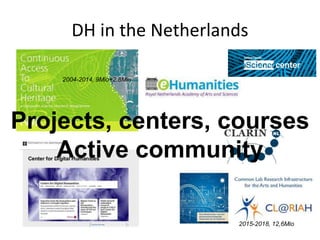
DH in the Netherlands
2004-2014, 9Mio+2.8Mio
2015-2018, 12,6Mio
Projects, centers, courses
Active community
EINS 1st PLENARY
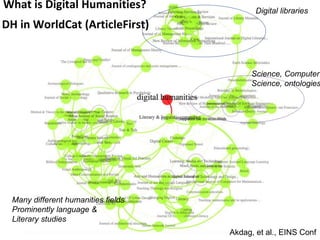
DH in WorldCat (ArticleFirst)
Digital libraries
Science, Computer
Science, ontologies
Many different humanities fields
Prominently language &
Literary studies
What is Digital Humanities?
Akdag, et al., EINS Conf
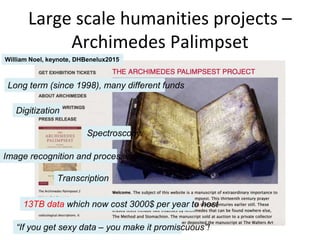
Large scale humanities projects –
Archimedes Palimpset
William Noel, keynote, DHBenelux2015
“If you get sexy data – you make it promiscuous”!
Spectroscopy
Image recognition and processing
Transcription
Digitization
Long term (since 1998), many different funds
13TB data which now cost 3000$ per year to host
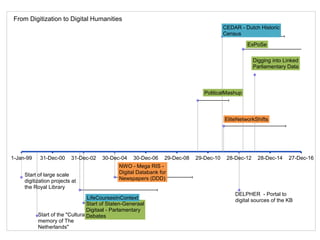
Start of large scale
digitization projects at
the Royal Library
Start of the "Cultural
memory of The
Netherlands"
Start of Staten-Generaal
Digitaal - Parlamentary
Debates
LifeCoursesInContext
NWO - Mega RIS -
Digital Databank for
Newspapers (DDD)
PoliticalMashup
CEDAR - Dutch Historic
Census
EliteNetworkShifts
DELPHER - Portal to
digital sources of the KB
ExPoSe
Digging into Linked
Parliamentary Data
1-Jan-99 31-Dec-00 31-Dec-02 30-Dec-04 30-Dec-06 29-Dec-08 29-Dec-10 28-Dec-12 28-Dec-14 27-Dec-16
From Digitization to Digital Humanities
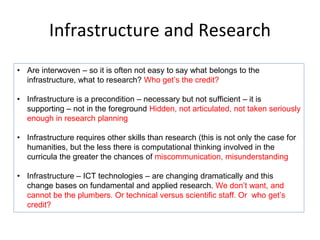
Infrastructure and Research
• Are interwoven – so it is often not easy to say what belongs to the
infrastructure, what to research? Who get’s the credit?
• Infrastructure is a precondition – necessary but not sufficient – it is
supporting – not in the foreground Hidden, not articulated, not taken seriously
enough in research planning
• Infrastructure requires other skills than research (this is not only the case for
humanities, but the less there is computational thinking involved in the
curricula the greater the chances of miscommunication, misunderstanding
• Infrastructure – ICT technologies – are changing dramatically and this
change bases on fundamental and applied research. We don’t want, and
cannot be the plumbers. Or technical versus scientific staff. Or who get’s
credit?
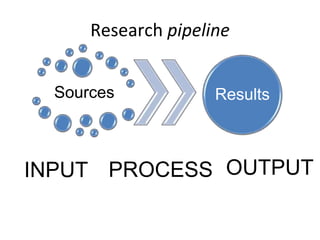
Research pipeline
Sources
INPUT
Results
OUTPUTPROCESS
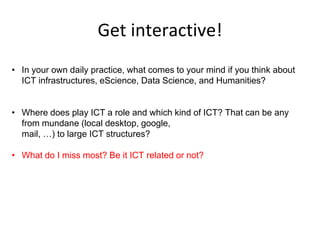
Get interactive!
• In your own daily practice, what comes to your mind if you think about
ICT infrastructures, eScience, Data Science, and Humanities?
• Where does play ICT a role and which kind of ICT? That can be any
from mundane (local desktop, google,
mail, …) to large ICT structures?
• What do I miss most? Be it ICT related or not?
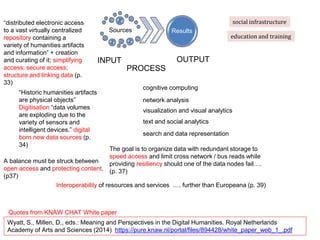
Sources
INPUT
Results
OUTPUT
PROCESS
“distributed electronic access
to a vast virtually centralized
repository containing a
variety of humanities artifacts
and information” + creation
and curating of it; simplifying
access; secure access;
structure and linking data (p.
33)
“Historic humanities artifacts
are physical objects”
Digitisation “data volumes
are exploding due to the
variety of sensors and
intelligent devices.” digital
born new data sources (p.
34)
Wyatt, S., Millen, D., eds.: Meaning and Perspectives in the Digital Humanities. Royal Netherlands
Academy of Arts and Sciences (2014) https://pure.knaw.nl/portal/files/894428/white_paper_web_1_.pdf
Quotes from KNAW CHAT White paper
cognitive computing
network analysis
visualization and visual analytics
text and social analytics
search and data representation
The goal is to organize data with redundant storage to
speed access and limit cross network / bus reads while
providing resiliency should one of the data nodes fail….
(p. 37)
A balance must be struck between
open access and protecting content.
(p37)
Interoperability of resources and services …. further than Europeana (p. 39)
social infrastructure
education and training
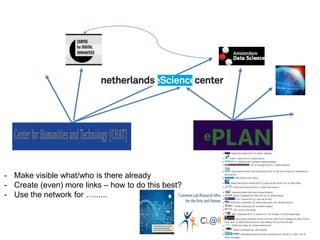
- Make visible what/who is there already
- Create (even) more links – how to do this best?
- Use the network for …......
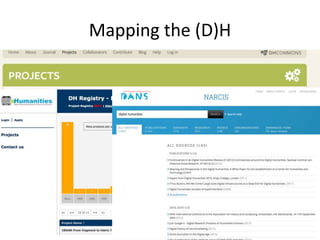
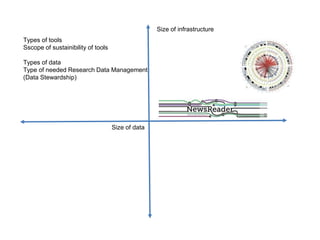
Mapping the (D)H
Size of data
Size of infrastructure
Types of tools
Sscope of sustainibility of tools
Types of data
Type of needed Research Data Management
(Data Stewardship)
References and acknowledgements
- Melissa Terras started a data collection 2011, Infographic Digital Humanities
see her blog http://melissaterras.blogspot.nl/2011/11/stats-and-digital-humanities.html
- Leydesdorff, L., Akdag Salah, A.A.: Maps on the basis of the arts & humanities citation index: The journals
Leonardo and Art journal versus digital humanities as a topic. Journal of the American Society for information
Science and Technology 61(4) (2010)
- Wyatt, S., Leydesdorff, L.: e-humanities or digital humanities: Is that the question? In: Digital Humanities
Workshop. (2013)
- Wyatt, S., Millen, D., eds.: Meaning and Perspectives in the Digital Humanities. Royal Netherlands Academy of
Arts and Sciences (2014) https://pure.knaw.nl/portal/files/894428/white_paper_web_1_.pdf
- Koopman, R., Wang, S., Scharnhorst, A., Englebienne, G.: Ariadne's thread: Interactive navigation in a world of
networked information. In: CHI'15 Extended Abstracts. (2015) http://arxiv.org/abs/1503.04358
- Akdag Salah, A., Scharnhorst, A., & Wyatt, S. (2015). Analysing an academic field through the lenses of Internet
Science : Digital Humanities as a Virtual Community. In Conference: 2nd International Conference on Internet
Science Brussels, May 27-29, 2015, At Brussels, Volume: http://internetscienceconference.eu.

Humanities and ICT

  • 1.
    Humanities and ICT AndreaScharnhorst, DANS and eHumanities group, Royal Netherlands Academy of Arts and Science, KNAW Introduction at the Workshop National Infrastructure, Social Science and Humanities, January 20, 2015, ePlan at NLeSC
  • 2.
    DH in theNetherlands 2004-2014, 9Mio+2.8Mio 2015-2018, 12,6Mio Projects, centers, courses Active community
  • 3.
    EINS 1st PLENARY DHin WorldCat (ArticleFirst) Digital libraries Science, Computer Science, ontologies Many different humanities fields Prominently language & Literary studies What is Digital Humanities? Akdag, et al., EINS Conf
  • 4.
    Large scale humanitiesprojects – Archimedes Palimpset William Noel, keynote, DHBenelux2015 “If you get sexy data – you make it promiscuous”! Spectroscopy Image recognition and processing Transcription Digitization Long term (since 1998), many different funds 13TB data which now cost 3000$ per year to host
  • 5.
    Start of largescale digitization projects at the Royal Library Start of the "Cultural memory of The Netherlands" Start of Staten-Generaal Digitaal - Parlamentary Debates LifeCoursesInContext NWO - Mega RIS - Digital Databank for Newspapers (DDD) PoliticalMashup CEDAR - Dutch Historic Census EliteNetworkShifts DELPHER - Portal to digital sources of the KB ExPoSe Digging into Linked Parliamentary Data 1-Jan-99 31-Dec-00 31-Dec-02 30-Dec-04 30-Dec-06 29-Dec-08 29-Dec-10 28-Dec-12 28-Dec-14 27-Dec-16 From Digitization to Digital Humanities
  • 6.
    Infrastructure and Research •Are interwoven – so it is often not easy to say what belongs to the infrastructure, what to research? Who get’s the credit? • Infrastructure is a precondition – necessary but not sufficient – it is supporting – not in the foreground Hidden, not articulated, not taken seriously enough in research planning • Infrastructure requires other skills than research (this is not only the case for humanities, but the less there is computational thinking involved in the curricula the greater the chances of miscommunication, misunderstanding • Infrastructure – ICT technologies – are changing dramatically and this change bases on fundamental and applied research. We don’t want, and cannot be the plumbers. Or technical versus scientific staff. Or who get’s credit?
  • 7.
  • 8.
    Get interactive! • Inyour own daily practice, what comes to your mind if you think about ICT infrastructures, eScience, Data Science, and Humanities? • Where does play ICT a role and which kind of ICT? That can be any from mundane (local desktop, google, mail, …) to large ICT structures? • What do I miss most? Be it ICT related or not?
  • 9.
    Sources INPUT Results OUTPUT PROCESS “distributed electronic access toa vast virtually centralized repository containing a variety of humanities artifacts and information” + creation and curating of it; simplifying access; secure access; structure and linking data (p. 33) “Historic humanities artifacts are physical objects” Digitisation “data volumes are exploding due to the variety of sensors and intelligent devices.” digital born new data sources (p. 34) Wyatt, S., Millen, D., eds.: Meaning and Perspectives in the Digital Humanities. Royal Netherlands Academy of Arts and Sciences (2014) https://pure.knaw.nl/portal/files/894428/white_paper_web_1_.pdf Quotes from KNAW CHAT White paper cognitive computing network analysis visualization and visual analytics text and social analytics search and data representation The goal is to organize data with redundant storage to speed access and limit cross network / bus reads while providing resiliency should one of the data nodes fail…. (p. 37) A balance must be struck between open access and protecting content. (p37) Interoperability of resources and services …. further than Europeana (p. 39) social infrastructure education and training
  • 10.
    - Make visiblewhat/who is there already - Create (even) more links – how to do this best? - Use the network for …......
  • 11.
  • 12.
    Size of data Sizeof infrastructure Types of tools Sscope of sustainibility of tools Types of data Type of needed Research Data Management (Data Stewardship)
  • 13.
    References and acknowledgements -Melissa Terras started a data collection 2011, Infographic Digital Humanities see her blog http://melissaterras.blogspot.nl/2011/11/stats-and-digital-humanities.html - Leydesdorff, L., Akdag Salah, A.A.: Maps on the basis of the arts & humanities citation index: The journals Leonardo and Art journal versus digital humanities as a topic. Journal of the American Society for information Science and Technology 61(4) (2010) - Wyatt, S., Leydesdorff, L.: e-humanities or digital humanities: Is that the question? In: Digital Humanities Workshop. (2013) - Wyatt, S., Millen, D., eds.: Meaning and Perspectives in the Digital Humanities. Royal Netherlands Academy of Arts and Sciences (2014) https://pure.knaw.nl/portal/files/894428/white_paper_web_1_.pdf - Koopman, R., Wang, S., Scharnhorst, A., Englebienne, G.: Ariadne's thread: Interactive navigation in a world of networked information. In: CHI'15 Extended Abstracts. (2015) http://arxiv.org/abs/1503.04358 - Akdag Salah, A., Scharnhorst, A., & Wyatt, S. (2015). Analysing an academic field through the lenses of Internet Science : Digital Humanities as a Virtual Community. In Conference: 2nd International Conference on Internet Science Brussels, May 27-29, 2015, At Brussels, Volume: http://internetscienceconference.eu.