WHAT HAPPENS TO EDUCATION WHEN MEDIA
BECOME PLACES OF CULTURAL AND
KNOWLEDGE EXCHANGE?
Alexandra Bal & Jason Nolan
APG meeting, Ryerson, May 12th, 2010
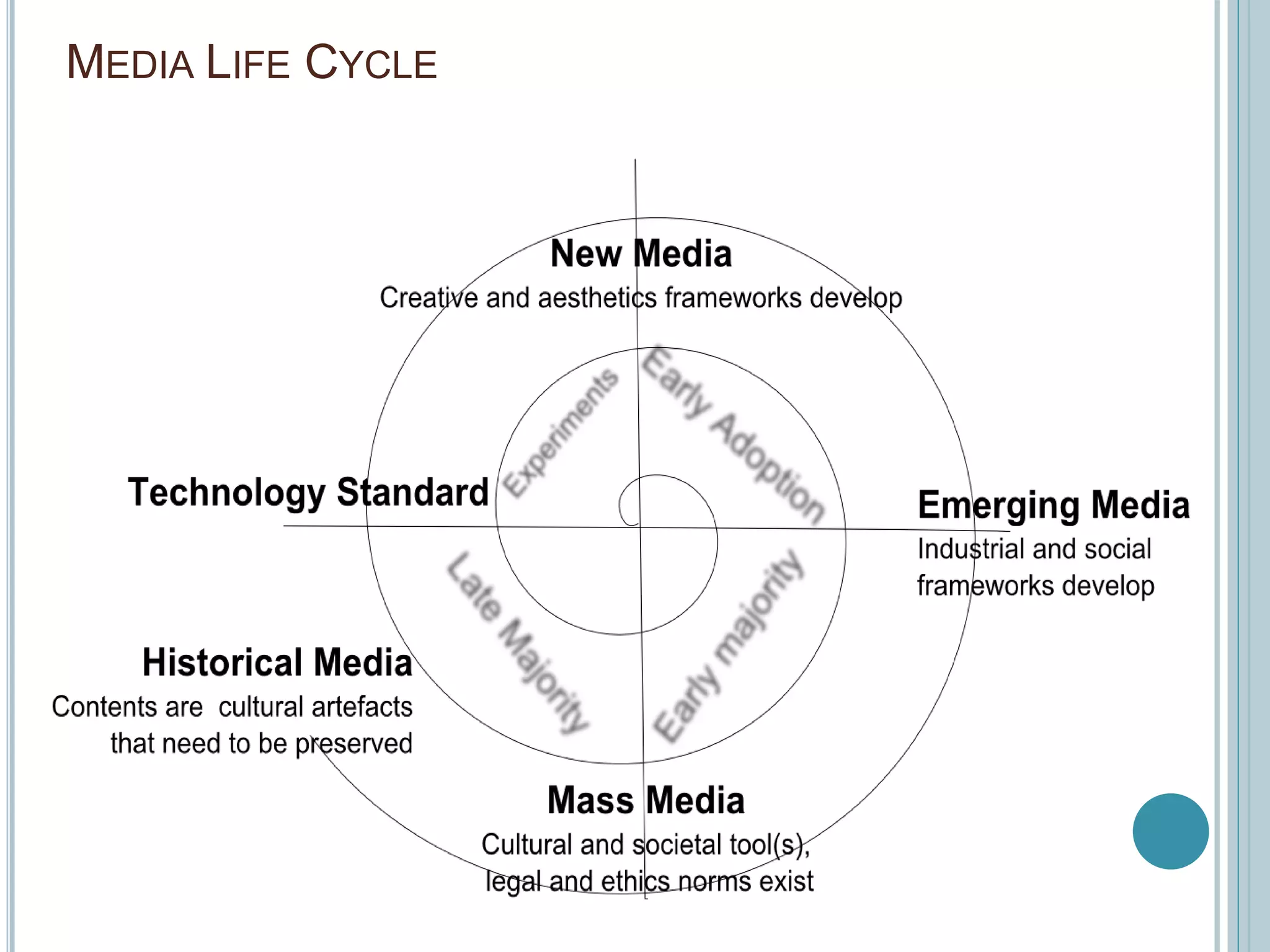
MEDIA LIFE CYCLE
NEW MEDIA IDENTIFIES A PHASE OF
INNOVATION
New media is not tied to one specific technology, it is
the experimental phase in the life of a media :
 100 years ago film was new media;
 30 years ago digital processes were new media;
 20 years ago the internet was new media;
 Today, complex media ecologies are new media.
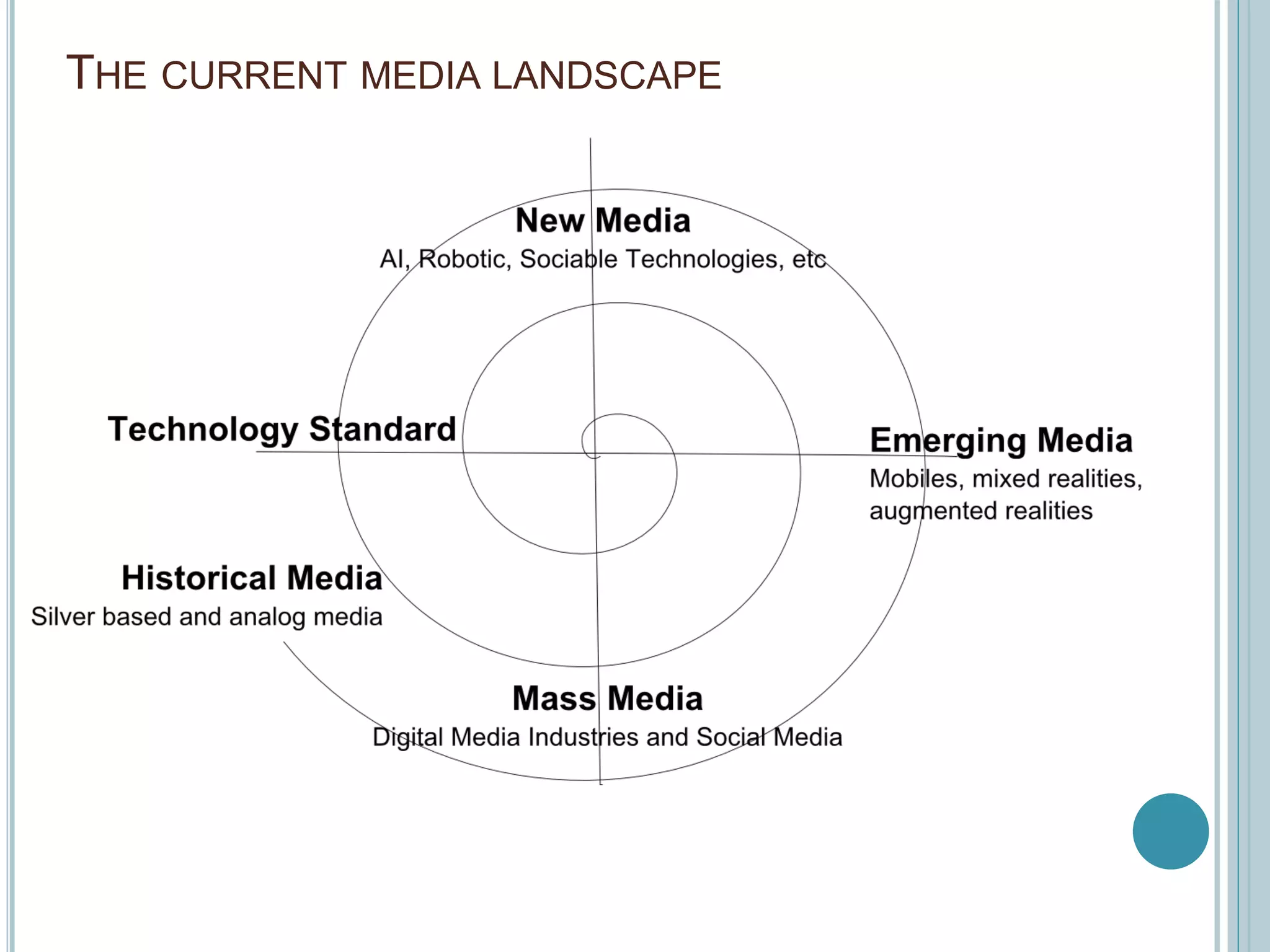
THE CURRENT MEDIA LANDSCAPE
CURRENT MASS MEDIA
 Digital Media: industries that have
adopted computational production
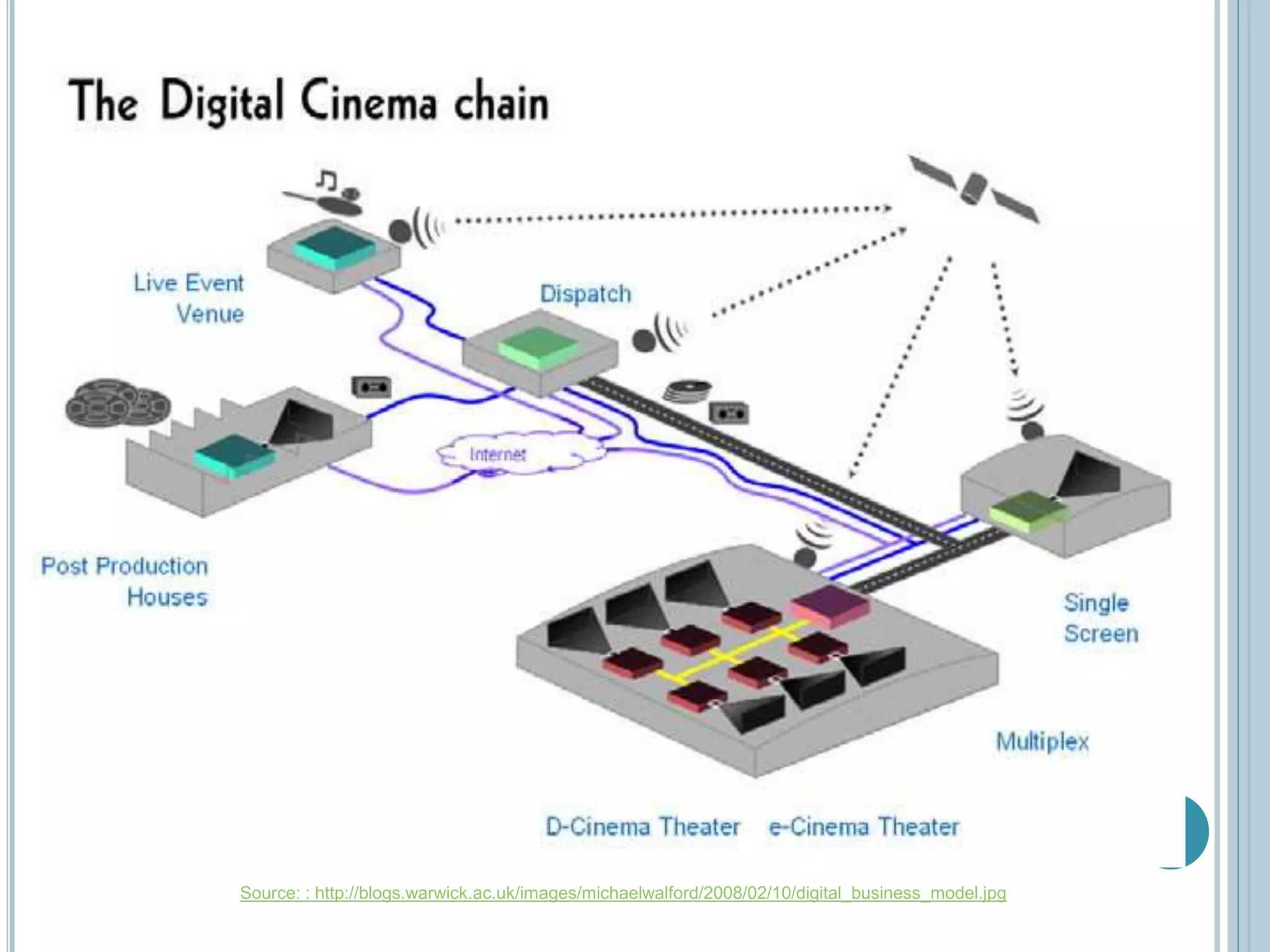
processes such as film, television,
multimedia and web.
 Social Media: peer to peer technologies
that individuals use to be active social
participants in the creation of their
culture.
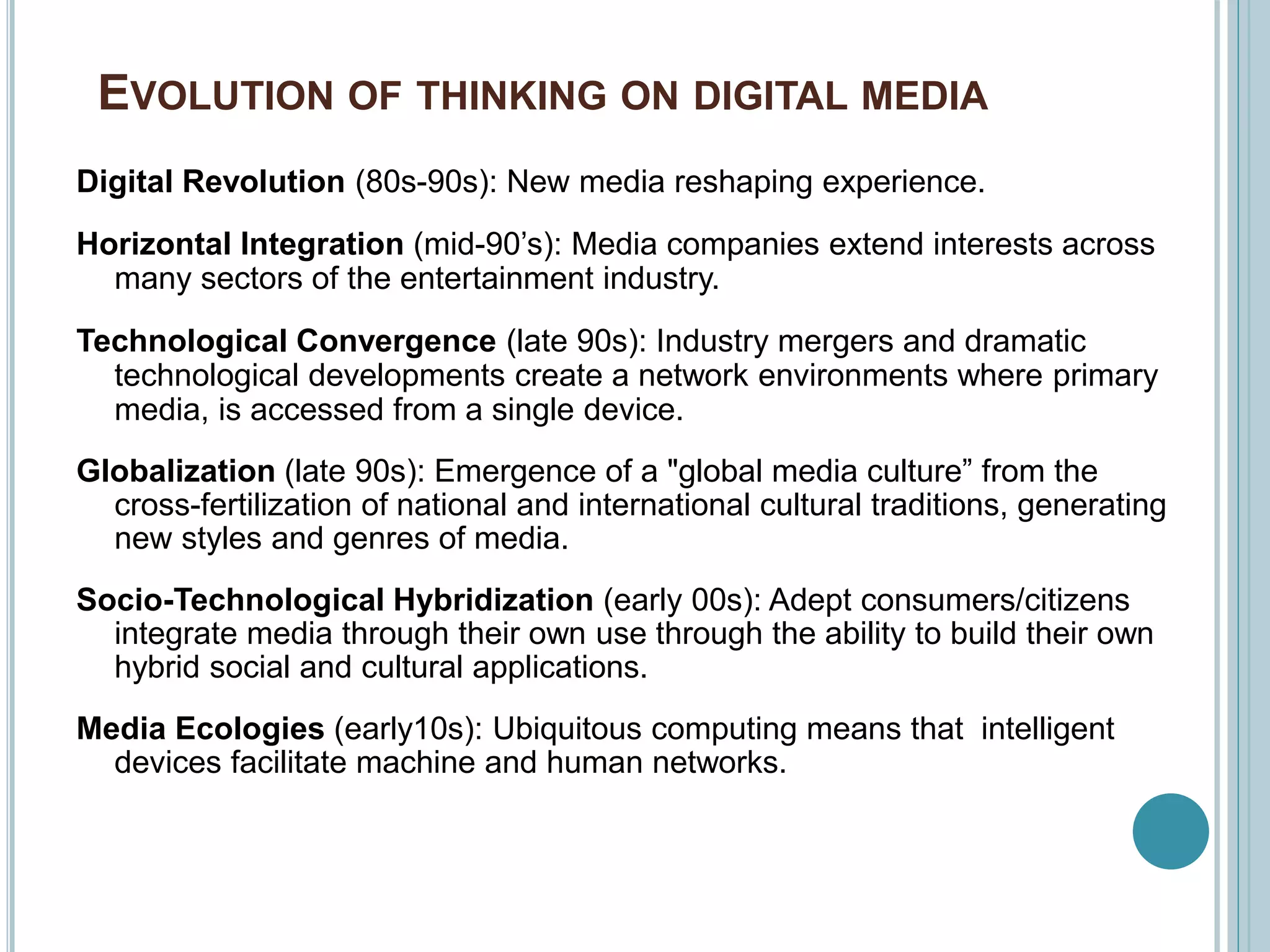
EVOLUTION OF THINKING ON DIGITAL MEDIA
Digital Revolution (80s-90s): New media reshaping experience.
Horizontal Integration (mid-90’s): Media companies extend interests across
many sectors of the entertainment industry.
Technological Convergence (late 90s): Industry mergers and dramatic
technological developments create a network environments where primary
media, is accessed from a single device.
Globalization (late 90s): Emergence of a "global media culture” from the
cross-fertilization of national and international cultural traditions, generating
new styles and genres of media.
Socio-Technological Hybridization (early 00s): Adept consumers/citizens
integrate media through their own use through the ability to build their own
hybrid social and cultural applications.
Media Ecologies (early10s): Ubiquitous computing means that intelligent
devices facilitate machine and human networks.
Source: : http://blogs.warwick.ac.uk/images/michaelwalford/2008/02/10/digital_business_model.jpg
PARTICIPATORY CULTURE IS SPREADING
THROUGH SOCIAL MEDIA
Signs of participatory culture:
 Peer-based production and consumption of media;
 Facilitated user participation;
 New tools and technologies that enable consumers to archive,
annotate, appropriate and re-circulate media;
 Mediated human relationships;
 Do It Yourself (DYI) media allows individuals and
groups to participate to conversations.
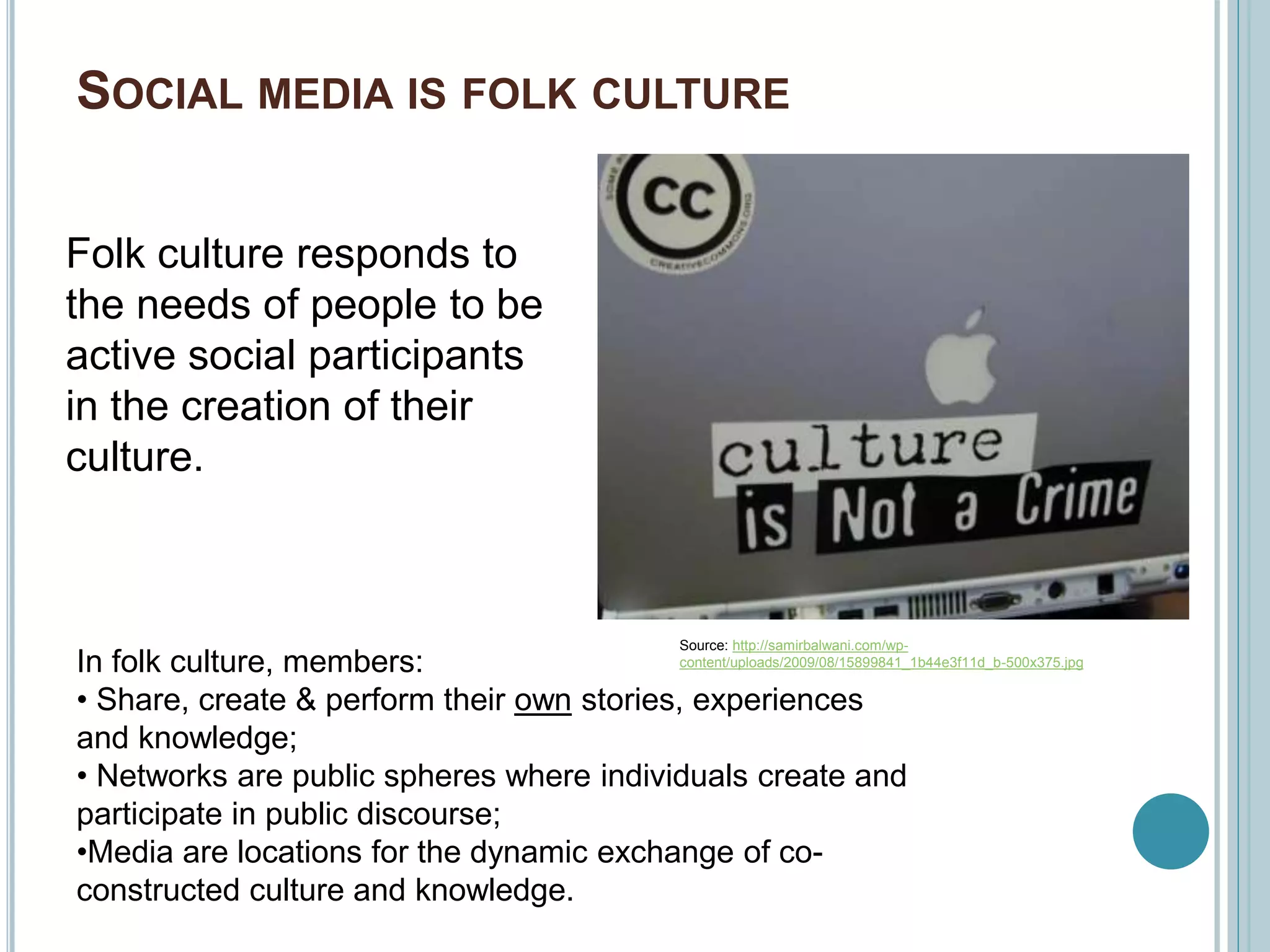
SOCIAL MEDIA IS FOLK CULTURE
Folk culture responds to
the needs of people to be
active social participants
in the creation of their
culture.
Source: http://samirbalwani.com/wp-
content/uploads/2009/08/15899841_1b44e3f11d_b-500x375.jpgIn folk culture, members:
• Share, create & perform their own stories, experiences
and knowledge;
• Networks are public spheres where individuals create and
participate in public discourse;
•Media are locations for the dynamic exchange of co-
constructed culture and knowledge.
MEDIA ARE NOW EXPERIENTIAL
 Old broadcast models are dying.
 Media industries now facilitate personalized socially-
embedded activities that are local and interconnected.
 Media are ubiquitous and interactive as modes of production
are developed around real-time simulation.
 Creators see value in engagement and experiences.
 Media are used not watched.
 Trans-disciplinary practices are emerging in cultural and
social sectors where practices grow from networked cultures.
 Media are active experiential learning.
int
wh
pro
de
tim
vis
pre
em
 Ac
pr
ex
ba
se
 Cr
ex
go
va
en
pro
an
ex
aim
me
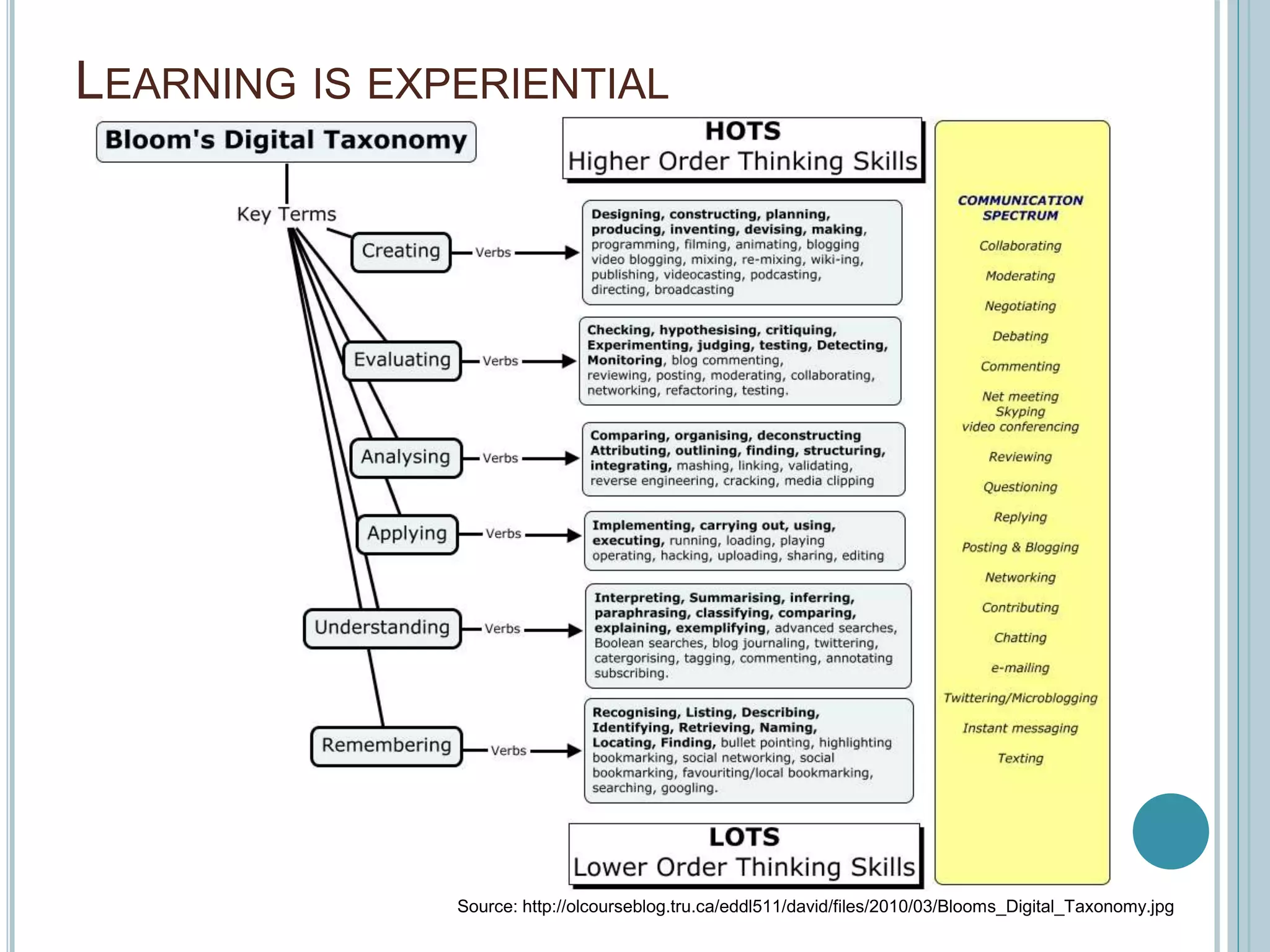
LEARNING IS EXPERIENTIAL
Source: http://olcourseblog.tru.ca/eddl511/david/files/2010/03/Blooms_Digital_Taxonomy.jpg
CHANGES IN MEDIA ARE CHANGING EDUCATION
 Digital natives are growing up with media and are
using new forms of communication that challenge our
notions of learning.
 Different models of communication influence
educational models which are a reflection of
industrial frameworks.
 Since the role of education is social reproduction,
which industrial values should we now promote?
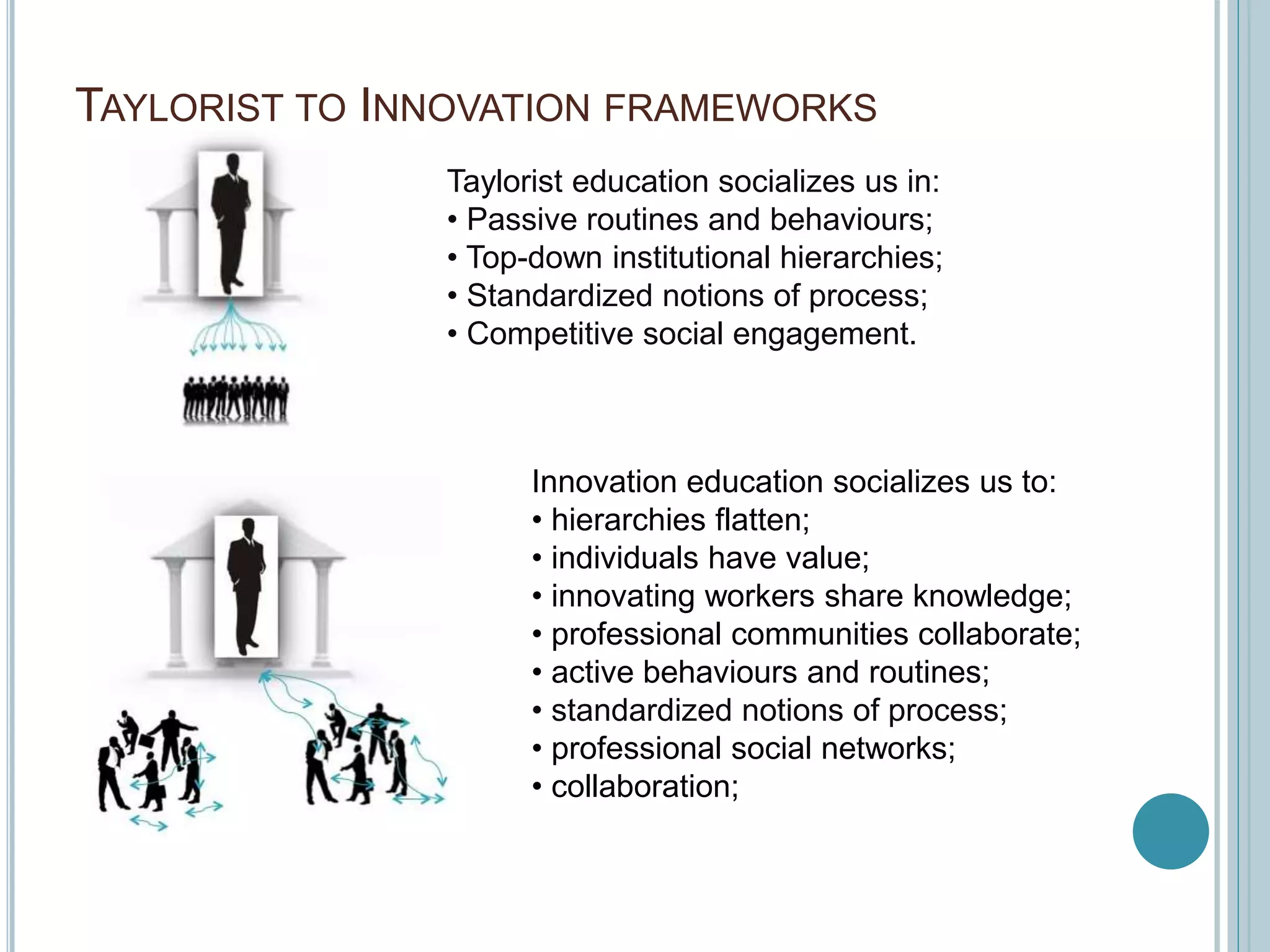
TAYLORIST TO INNOVATION FRAMEWORKS
Taylorist education socializes us in:
• Passive routines and behaviours;
• Top-down institutional hierarchies;
• Standardized notions of process;
• Competitive social engagement.
Innovation education socializes us to:
• hierarchies flatten;
• individuals have value;
• innovating workers share knowledge;
• professional communities collaborate;
• active behaviours and routines;
• standardized notions of process;
• professional social networks;
• collaboration;
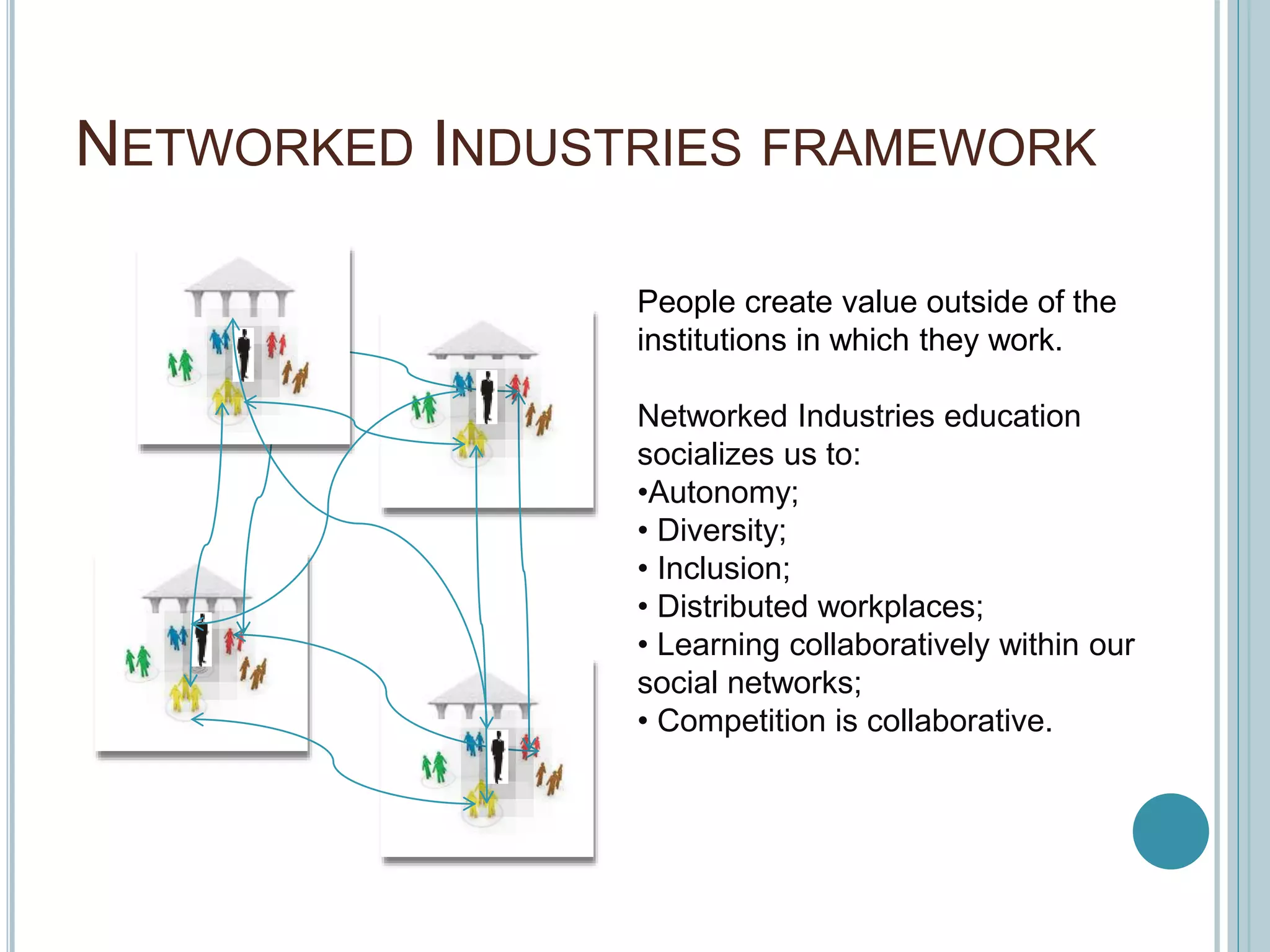
NETWORKED INDUSTRIES FRAMEWORK
People create value outside of the
institutions in which they work.
Networked Industries education
socializes us to:
•Autonomy;
• Diversity;
• Inclusion;
• Distributed workplaces;
• Learning collaboratively within our
social networks;
• Competition is collaborative.
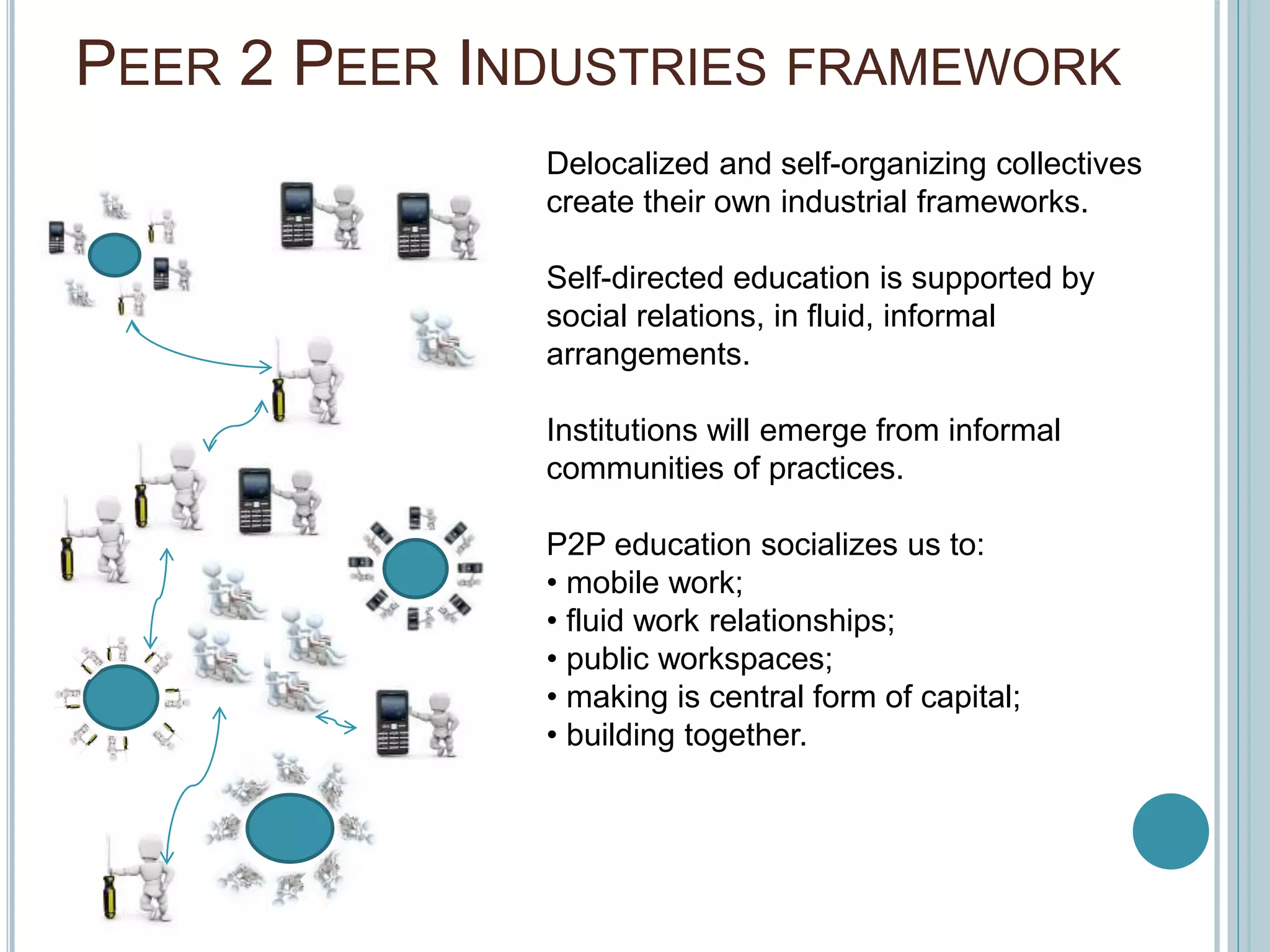
PEER 2 PEER INDUSTRIES FRAMEWORK
Delocalized and self-organizing collectives
create their own industrial frameworks.
Self-directed education is supported by
social relations, in fluid, informal
arrangements.
Institutions will emerge from informal
communities of practices.
P2P education socializes us to:
• mobile work;
• fluid work relationships;
• public workspaces;
• making is central form of capital;
• building together.
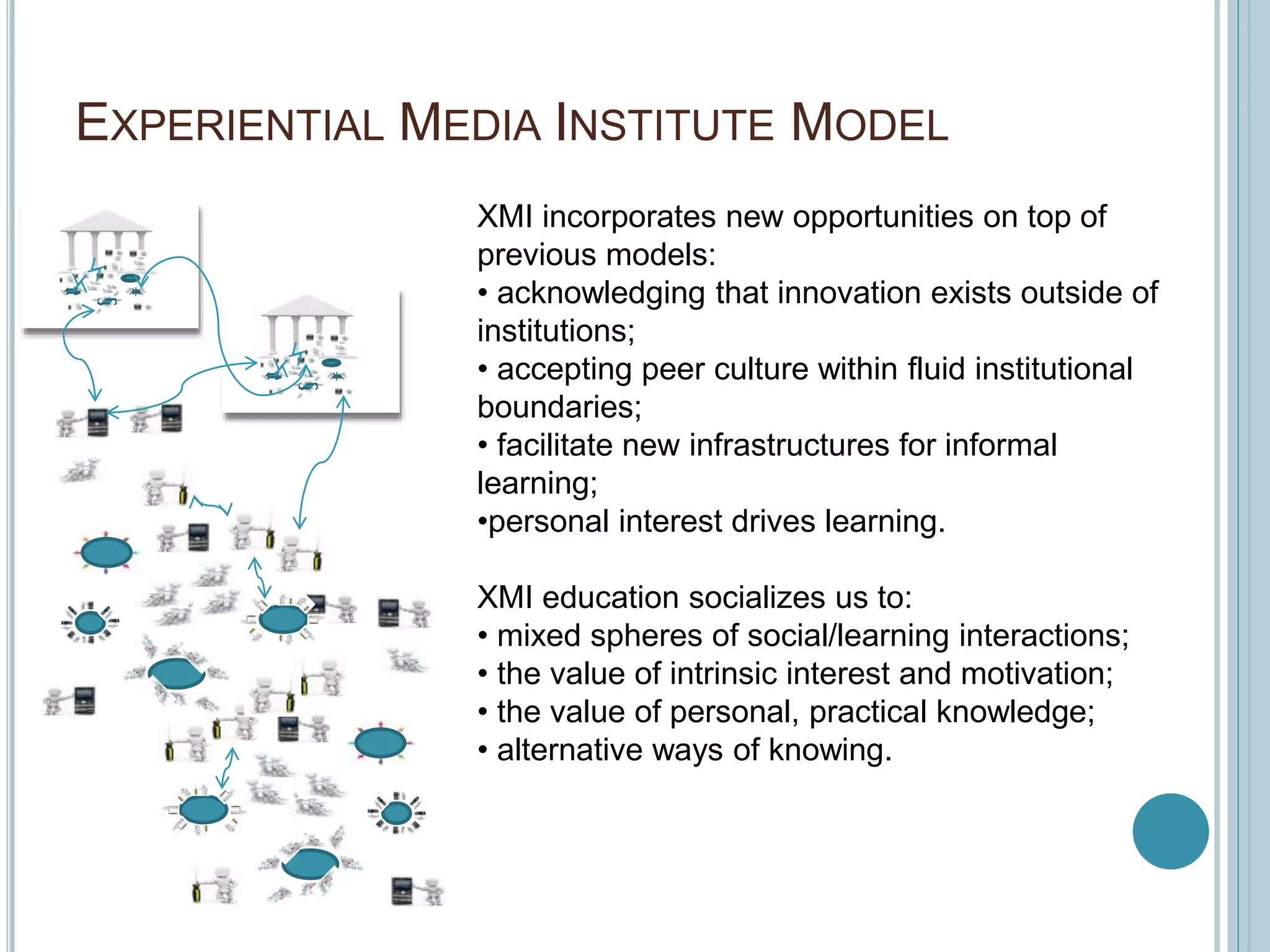
EXPERIENTIAL MEDIA INSTITUTE MODEL
XMI incorporates new opportunities on top of
previous models:
• acknowledging that innovation exists outside of
institutions;
• accepting peer culture within fluid institutional
boundaries;
• facilitate new infrastructures for informal
learning;
•personal interest drives learning.
XMI education socializes us to:
• mixed spheres of social/learning interactions;
• the value of intrinsic interest and motivation;
• the value of personal, practical knowledge;
• alternative ways of knowing.

Xmi Theoretical Contexts may11

  • 1.
    WHAT HAPPENS TOEDUCATION WHEN MEDIA BECOME PLACES OF CULTURAL AND KNOWLEDGE EXCHANGE? Alexandra Bal & Jason Nolan APG meeting, Ryerson, May 12th, 2010
  • 2.
  • 3.
    NEW MEDIA IDENTIFIESA PHASE OF INNOVATION New media is not tied to one specific technology, it is the experimental phase in the life of a media :  100 years ago film was new media;  30 years ago digital processes were new media;  20 years ago the internet was new media;  Today, complex media ecologies are new media.
  • 4.
  • 5.
    CURRENT MASS MEDIA Digital Media: industries that have adopted computational production processes such as film, television, multimedia and web.  Social Media: peer to peer technologies that individuals use to be active social participants in the creation of their culture.
  • 6.
    EVOLUTION OF THINKINGON DIGITAL MEDIA Digital Revolution (80s-90s): New media reshaping experience. Horizontal Integration (mid-90’s): Media companies extend interests across many sectors of the entertainment industry. Technological Convergence (late 90s): Industry mergers and dramatic technological developments create a network environments where primary media, is accessed from a single device. Globalization (late 90s): Emergence of a "global media culture” from the cross-fertilization of national and international cultural traditions, generating new styles and genres of media. Socio-Technological Hybridization (early 00s): Adept consumers/citizens integrate media through their own use through the ability to build their own hybrid social and cultural applications. Media Ecologies (early10s): Ubiquitous computing means that intelligent devices facilitate machine and human networks.
  • 7.
  • 8.
    PARTICIPATORY CULTURE ISSPREADING THROUGH SOCIAL MEDIA Signs of participatory culture:  Peer-based production and consumption of media;  Facilitated user participation;  New tools and technologies that enable consumers to archive, annotate, appropriate and re-circulate media;  Mediated human relationships;  Do It Yourself (DYI) media allows individuals and groups to participate to conversations.
  • 9.
    SOCIAL MEDIA ISFOLK CULTURE Folk culture responds to the needs of people to be active social participants in the creation of their culture. Source: http://samirbalwani.com/wp- content/uploads/2009/08/15899841_1b44e3f11d_b-500x375.jpgIn folk culture, members: • Share, create & perform their own stories, experiences and knowledge; • Networks are public spheres where individuals create and participate in public discourse; •Media are locations for the dynamic exchange of co- constructed culture and knowledge.
  • 10.
    MEDIA ARE NOWEXPERIENTIAL  Old broadcast models are dying.  Media industries now facilitate personalized socially- embedded activities that are local and interconnected.  Media are ubiquitous and interactive as modes of production are developed around real-time simulation.  Creators see value in engagement and experiences.  Media are used not watched.  Trans-disciplinary practices are emerging in cultural and social sectors where practices grow from networked cultures.  Media are active experiential learning. int wh pro de tim vis pre em  Ac pr ex ba se  Cr ex go va en pro an ex aim me
  • 11.
    LEARNING IS EXPERIENTIAL Source:http://olcourseblog.tru.ca/eddl511/david/files/2010/03/Blooms_Digital_Taxonomy.jpg
  • 12.
    CHANGES IN MEDIAARE CHANGING EDUCATION  Digital natives are growing up with media and are using new forms of communication that challenge our notions of learning.  Different models of communication influence educational models which are a reflection of industrial frameworks.  Since the role of education is social reproduction, which industrial values should we now promote?
  • 13.
    TAYLORIST TO INNOVATIONFRAMEWORKS Taylorist education socializes us in: • Passive routines and behaviours; • Top-down institutional hierarchies; • Standardized notions of process; • Competitive social engagement. Innovation education socializes us to: • hierarchies flatten; • individuals have value; • innovating workers share knowledge; • professional communities collaborate; • active behaviours and routines; • standardized notions of process; • professional social networks; • collaboration;
  • 14.
    NETWORKED INDUSTRIES FRAMEWORK Peoplecreate value outside of the institutions in which they work. Networked Industries education socializes us to: •Autonomy; • Diversity; • Inclusion; • Distributed workplaces; • Learning collaboratively within our social networks; • Competition is collaborative.
  • 15.
    PEER 2 PEERINDUSTRIES FRAMEWORK Delocalized and self-organizing collectives create their own industrial frameworks. Self-directed education is supported by social relations, in fluid, informal arrangements. Institutions will emerge from informal communities of practices. P2P education socializes us to: • mobile work; • fluid work relationships; • public workspaces; • making is central form of capital; • building together.
  • 16.
    EXPERIENTIAL MEDIA INSTITUTEMODEL XMI incorporates new opportunities on top of previous models: • acknowledging that innovation exists outside of institutions; • accepting peer culture within fluid institutional boundaries; • facilitate new infrastructures for informal learning; •personal interest drives learning. XMI education socializes us to: • mixed spheres of social/learning interactions; • the value of intrinsic interest and motivation; • the value of personal, practical knowledge; • alternative ways of knowing.

Editor's Notes

  • #9 This presentation explores this participatory culture in Youtube and Second Life