XBRL
Extensible Business Reporting
Language
                     M S Godbole & Co

                           Chartered
                         Accountants
Introduction


XBRL is a world-wide standard, developed by an
international, non-profit-making consortium, XBRL
International Inc. It is made up members, including
government agencies, accounting firms, software
companies, academics and business reporting experts
from worldwide. It has agreed the basic specifications
which define how XBRL works.
Why use XBRL?


Provides a database-like structure, using text files
Defines a collection of financial facts for a specific report,
industry, and jurisdiction (taxonomy)
Facilitates the data exchange between proprietary systems
Promotes the re-use of data with far less effort
Meta Data

Metadata is defined as data providing information about one
or more aspects of the data, such as:
Means of creation of the data
Purpose of the data
Time and date of creation
Creator of data
Placement on a computer network where the data was created
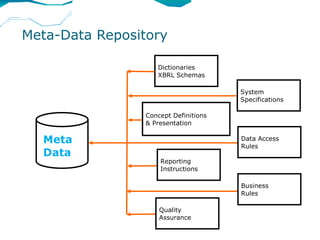
Meta-Data Repository

                   Dictionaries
                   XBRL Schemas

                                      System
                                      Specifications

                Concept Definitions
                & Presentation

  Meta                                Data Access
                                      Rules
  Data
                    Reporting
                    Instructions

                                      Business
                                      Rules

                    Quality
                    Assurance
Schemas:

Standard data naming convention
Micro Data Reference Manual
Standard used for all data series
Standard customer information
National Information Center
Standard customer ID
Begin and End dates - Version
XBRL Concepts:

XBRL is an extension of XML
It is a set of files referred to as an XBRL framework
For Example:
Validation Criteria
Report Instructions
Business Rules
Presentation
Micro Data Reference Manual
Consists of XML files and XSD files (XML Schema Definition)
Utilizes the concept of link bases which provides the ability to
   link XML files together
Tags:


Computers can treat information that has been tagged using
XBRL ‘intelligently’; they can recognize, process, store,
exchange and analyze it automatically using software.
As XBRL tags are formed in a universally accepted way, they
can be read and processed by any computer that has XBRL
software. XBRL tags are defined and organized using
categorization schemes called taxonomies.
XBRL Detail Concepts:


XBRL Taxonomies
Defines a set of business report
 concepts that can be used in the
 exchange of financial
  Micro

 information. The concept types
  data reference
  manual


 are further defined in an XSD
 file.
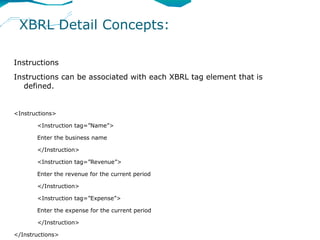
XBRL Detail Concepts:

Instructions
Instructions can be associated with each XBRL tag element that is
   defined.


<Instructions>

       <Instruction tag=”Name”>

       Enter the business name

       </Instruction>

       <Instruction tag=”Revenue”>

       Enter the revenue for the current period

       </Instruction>

       <Instruction tag=”Expense”>

       Enter the expense for the current period

       </Instruction>

</Instructions>
XBRL Detail Concepts:
Business Rules
Business Rules can be
 defined for business reports
 and forms by using a syntax
 language that refers to
 XBRL tags and predefined
 functions. Examples of
 functions, validations, or
XBRL Detail Concepts:


Instance files
Instance files contain data for
 a business form or report.


<InstanceData>
   <Data tag=”Name”
Transport Mechanism:

Web Services
SOAP -Simple Object Access Protocol
It is simple XML-based protocol to let applications exchange
    information
    over HTTP.
WSDL - Web Services Description Language
WSDL is a document written in XML. The document describes
  a Web service. It specifies the location of the service and
  the operations (or methods) the service exposes
Security
WS-I
System Requirement:

Dual Screens (min. resolution 1024 x 768)
Minimum of 4 GB RAM 80 GB Hard Disk Space
Windows Operating System (XP, Vista, 7 or above)
Microsoft Office
.NET Framework 3.5
Compact 3.5.1
JDK (Java Development Kit) 1.5 or above
MCA Mandate:


Which accounting principles are used-

           -IGAAP
Public Float exceeding Rs 5 cr (Paid up Capital)
Turnover exceeding Rs 100 Cr
 Listed entities on NSE and BSE and their Indian
 Subsidiaries


 Detail tagging : No grace period - 31st December 2011.
Taxonomy Overview:


Taxonomy tailored to MCA Reporting Requirements
Multi dimensional in nature and template based
information capture
Taxonomies enable computers with XBRL software to:
understand what the tag is (e.g. whether it is a
monetary item, a percentage or text);
what characteristics the tag has (e.g. if it has a negative
value);
its relationship to other items (e.g. if it is part of a
calculation).
ICAI Taxonomy Structure:


Industry-based classification
Commercial and Industrial companies
Banking companies
Non-Banking Financial companies
Power companies
Insurance companies
Core Schema
Exhaustive list of all element declarations
Common elements defined once
Distinct extended links for each industry
Data Model Issues:


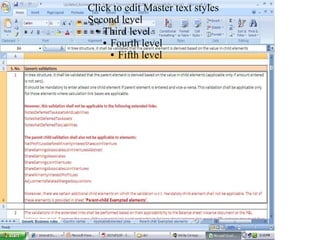
Notes to accounts information is largely tabular and therefore is


Multi-dimensional data
Data points having similar attributes
Methodology:


Automated Extraction
Patch to existing Software
Service Providers – Conversion of data into XBRL format
Click to edit Master text styles
Second level
 ● Third level

   ● Fourth level

     ● Fifth level
Click to edit Master text styles
Second level
 ● Third level

   ● Fourth level

     ● Fifth level
Click to edit Master text styles
Second level
 ● Third level

   ● Fourth level

     ● Fifth level
Click to edit Master text styles
Second level
 ● Third level

   ● Fourth level

     ● Fifth level
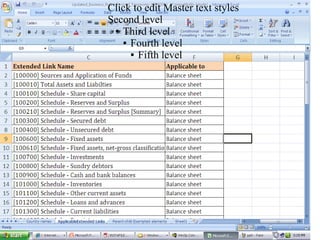
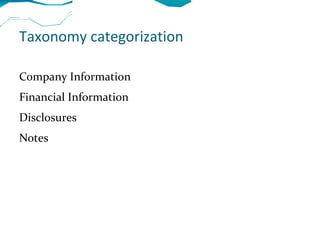
Taxonomy categorization

Company Information
Financial Information
Disclosures
Notes
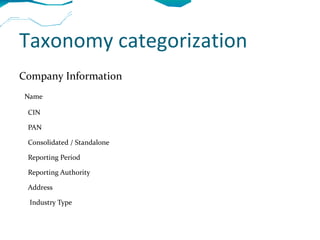
Taxonomy categorization
Company Information
Name

 CIN

 PAN

 Consolidated / Standalone

 Reporting Period

 Reporting Authority

 Address

 Industry Type
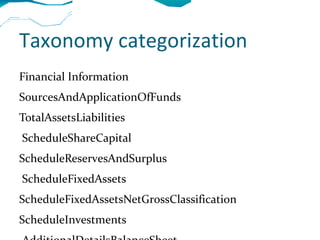
Taxonomy categorization
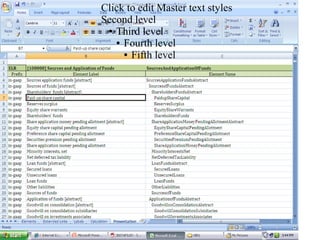
Financial Information
SourcesAndApplicationOfFunds
TotalAssetsLiabilities
ScheduleShareCapital
ScheduleReservesAndSurplus
ScheduleFixedAssets
ScheduleFixedAssetsNetGrossClassification
ScheduleInvestments
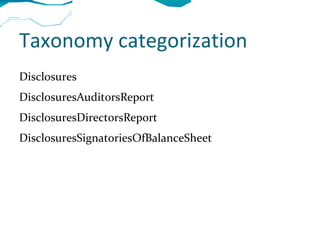
Taxonomy categorization
Disclosures
DisclosuresAuditorsReport
DisclosuresDirectorsReport
DisclosuresSignatoriesOfBalanceSheet
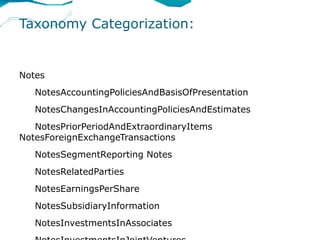
Taxonomy Categorization:


Notes
   NotesAccountingPoliciesAndBasisOfPresentation
   NotesChangesInAccountingPoliciesAndEstimates
   NotesPriorPeriodAndExtraordinaryItems
NotesForeignExchangeTransactions
   NotesSegmentReporting Notes
   NotesRelatedParties
   NotesEarningsPerShare
   NotesSubsidiaryInformation
   NotesInvestmentsInAssociates
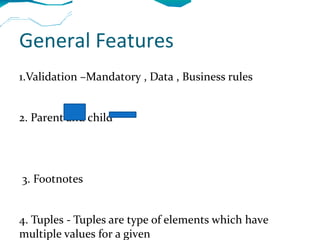
General Features
1.Validation –Mandatory , Data , Business rules


2. Parent and child


3. Footnotes


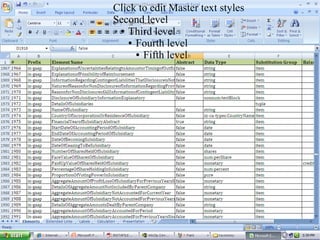
4. Tuples - Tuples are type of elements which have
multiple values for a given
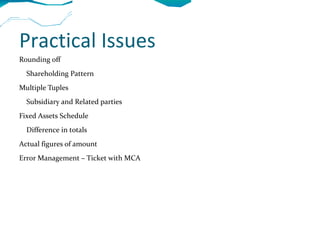
Practical Issues
Rounding off
  Shareholding Pattern
Multiple Tuples
  Subsidiary and Related parties
Fixed Assets Schedule
  Difference in totals
Actual figures of amount
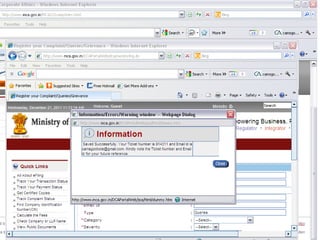
Error Management – Ticket with MCA
Agenda:


Introduction
Client case
MCA mandate
Client request
Approach
Client Case:


ABC Company listed on BSE / NSE
Indian Gaap
Public Float > 5 cr
Year End 31/03
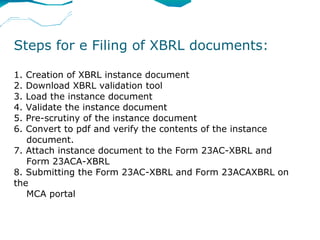
Steps for e Filing of XBRL documents:

1. Creation of XBRL instance document
2. Download XBRL validation tool
3. Load the instance document
4. Validate the instance document
5. Pre-scrutiny of the instance document
6. Convert to pdf and verify the contents of the instance
   document.
7. Attach instance document to the Form 23AC-XBRL and
   Form 23ACA-XBRL
8. Submitting the Form 23AC-XBRL and Form 23ACAXBRL on
the
   MCA portal
Thanks

Mandar S Godbole
BCOM,FCA,DISA,IFRS (ICAI)
camsgodbole@gmail.com

Xbrl slideshare

  • 1.
    XBRL Extensible Business Reporting Language M S Godbole & Co Chartered Accountants
  • 2.
    Introduction XBRL is aworld-wide standard, developed by an international, non-profit-making consortium, XBRL International Inc. It is made up members, including government agencies, accounting firms, software companies, academics and business reporting experts from worldwide. It has agreed the basic specifications which define how XBRL works.
  • 3.
    Why use XBRL? Providesa database-like structure, using text files Defines a collection of financial facts for a specific report, industry, and jurisdiction (taxonomy) Facilitates the data exchange between proprietary systems Promotes the re-use of data with far less effort
  • 4.
    Meta Data Metadata isdefined as data providing information about one or more aspects of the data, such as: Means of creation of the data Purpose of the data Time and date of creation Creator of data Placement on a computer network where the data was created
  • 5.
    Meta-Data Repository Dictionaries XBRL Schemas System Specifications Concept Definitions & Presentation Meta Data Access Rules Data Reporting Instructions Business Rules Quality Assurance
  • 6.
    Schemas: Standard data namingconvention Micro Data Reference Manual Standard used for all data series Standard customer information National Information Center Standard customer ID Begin and End dates - Version
  • 7.
    XBRL Concepts: XBRL isan extension of XML It is a set of files referred to as an XBRL framework For Example: Validation Criteria Report Instructions Business Rules Presentation Micro Data Reference Manual Consists of XML files and XSD files (XML Schema Definition) Utilizes the concept of link bases which provides the ability to link XML files together
  • 8.
    Tags: Computers can treatinformation that has been tagged using XBRL ‘intelligently’; they can recognize, process, store, exchange and analyze it automatically using software. As XBRL tags are formed in a universally accepted way, they can be read and processed by any computer that has XBRL software. XBRL tags are defined and organized using categorization schemes called taxonomies.
  • 9.
    XBRL Detail Concepts: XBRLTaxonomies Defines a set of business report concepts that can be used in the exchange of financial Micro information. The concept types data reference manual are further defined in an XSD file.
  • 10.
    XBRL Detail Concepts: Instructions Instructionscan be associated with each XBRL tag element that is defined. <Instructions> <Instruction tag=”Name”> Enter the business name </Instruction> <Instruction tag=”Revenue”> Enter the revenue for the current period </Instruction> <Instruction tag=”Expense”> Enter the expense for the current period </Instruction> </Instructions>
  • 11.
    XBRL Detail Concepts: BusinessRules Business Rules can be defined for business reports and forms by using a syntax language that refers to XBRL tags and predefined functions. Examples of functions, validations, or
  • 12.
    XBRL Detail Concepts: Instancefiles Instance files contain data for a business form or report. <InstanceData> <Data tag=”Name”
  • 13.
    Transport Mechanism: Web Services SOAP-Simple Object Access Protocol It is simple XML-based protocol to let applications exchange information over HTTP. WSDL - Web Services Description Language WSDL is a document written in XML. The document describes a Web service. It specifies the location of the service and the operations (or methods) the service exposes Security WS-I
  • 14.
    System Requirement: Dual Screens(min. resolution 1024 x 768) Minimum of 4 GB RAM 80 GB Hard Disk Space Windows Operating System (XP, Vista, 7 or above) Microsoft Office .NET Framework 3.5 Compact 3.5.1 JDK (Java Development Kit) 1.5 or above
  • 15.
    MCA Mandate: Which accountingprinciples are used- -IGAAP Public Float exceeding Rs 5 cr (Paid up Capital) Turnover exceeding Rs 100 Cr Listed entities on NSE and BSE and their Indian Subsidiaries Detail tagging : No grace period - 31st December 2011.
  • 16.
    Taxonomy Overview: Taxonomy tailoredto MCA Reporting Requirements Multi dimensional in nature and template based information capture Taxonomies enable computers with XBRL software to: understand what the tag is (e.g. whether it is a monetary item, a percentage or text); what characteristics the tag has (e.g. if it has a negative value); its relationship to other items (e.g. if it is part of a calculation).
  • 17.
    ICAI Taxonomy Structure: Industry-basedclassification Commercial and Industrial companies Banking companies Non-Banking Financial companies Power companies Insurance companies Core Schema Exhaustive list of all element declarations Common elements defined once Distinct extended links for each industry
  • 18.
    Data Model Issues: Notesto accounts information is largely tabular and therefore is Multi-dimensional data Data points having similar attributes
  • 19.
    Methodology: Automated Extraction Patch toexisting Software Service Providers – Conversion of data into XBRL format
  • 20.
    Click to editMaster text styles Second level ● Third level ● Fourth level ● Fifth level
  • 21.
    Click to editMaster text styles Second level ● Third level ● Fourth level ● Fifth level
  • 22.
    Click to editMaster text styles Second level ● Third level ● Fourth level ● Fifth level
  • 23.
    Click to editMaster text styles Second level ● Third level ● Fourth level ● Fifth level
  • 24.
  • 25.
    Taxonomy categorization Company Information Name CIN PAN Consolidated / Standalone Reporting Period Reporting Authority Address Industry Type
  • 26.
  • 27.
  • 28.
    Taxonomy Categorization: Notes NotesAccountingPoliciesAndBasisOfPresentation NotesChangesInAccountingPoliciesAndEstimates NotesPriorPeriodAndExtraordinaryItems NotesForeignExchangeTransactions NotesSegmentReporting Notes NotesRelatedParties NotesEarningsPerShare NotesSubsidiaryInformation NotesInvestmentsInAssociates
  • 29.
    General Features 1.Validation –Mandatory, Data , Business rules 2. Parent and child 3. Footnotes 4. Tuples - Tuples are type of elements which have multiple values for a given
  • 30.
    Practical Issues Rounding off Shareholding Pattern Multiple Tuples Subsidiary and Related parties Fixed Assets Schedule Difference in totals Actual figures of amount Error Management – Ticket with MCA
  • 32.
  • 33.
    Client Case: ABC Companylisted on BSE / NSE Indian Gaap Public Float > 5 cr Year End 31/03
  • 34.
    Steps for eFiling of XBRL documents: 1. Creation of XBRL instance document 2. Download XBRL validation tool 3. Load the instance document 4. Validate the instance document 5. Pre-scrutiny of the instance document 6. Convert to pdf and verify the contents of the instance document. 7. Attach instance document to the Form 23AC-XBRL and Form 23ACA-XBRL 8. Submitting the Form 23AC-XBRL and Form 23ACAXBRL on the MCA portal
  • 35.
    Thanks Mandar S Godbole BCOM,FCA,DISA,IFRS(ICAI) camsgodbole@gmail.com