Technical Overview of XBRL – Including XBRL vs. XML
Agenda XBRL Taxonomies XBRL Instance Documents  Comparison of XBRL versus XML UBmatrix, Inc. © 2006
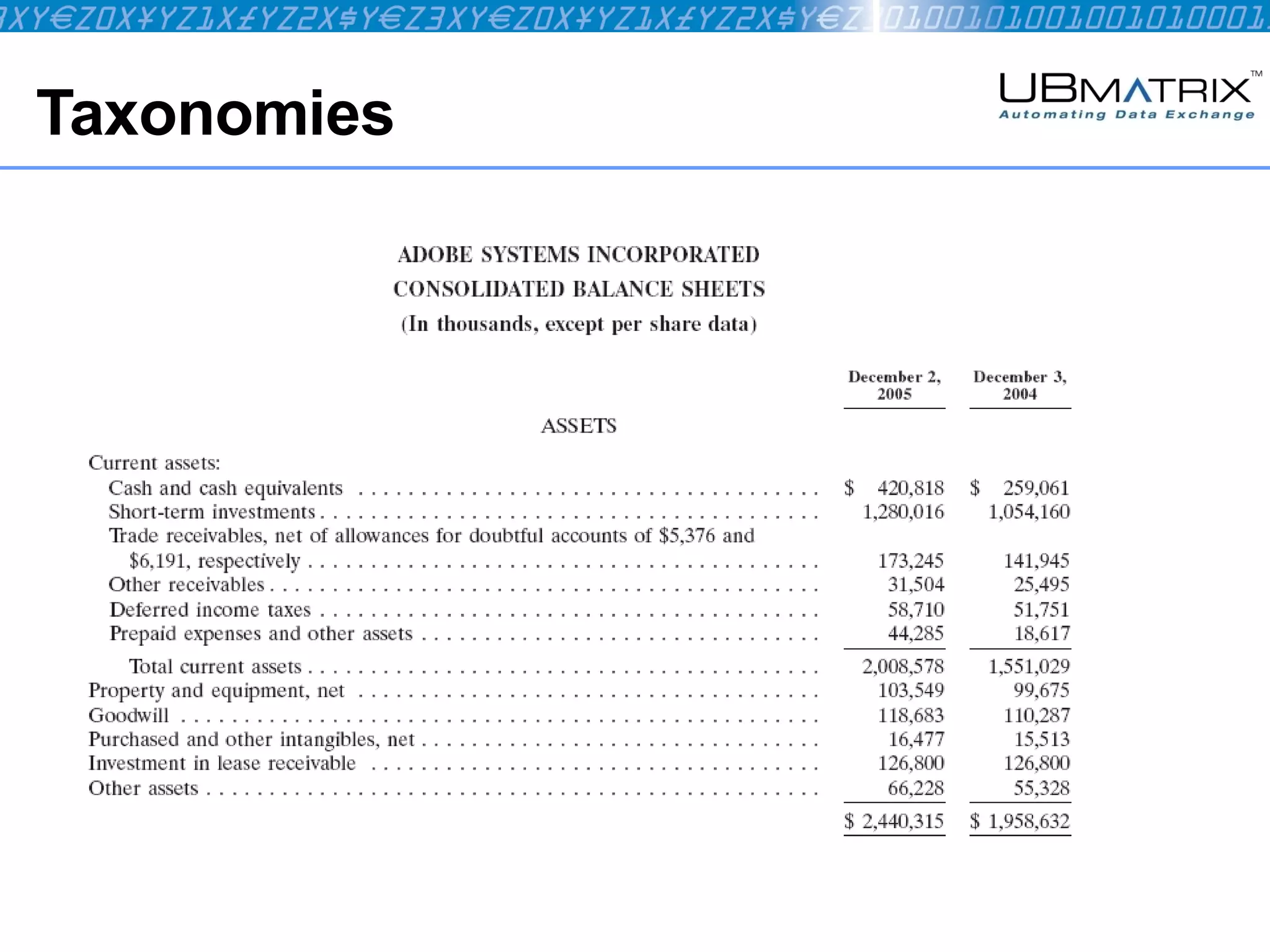
Taxonomies
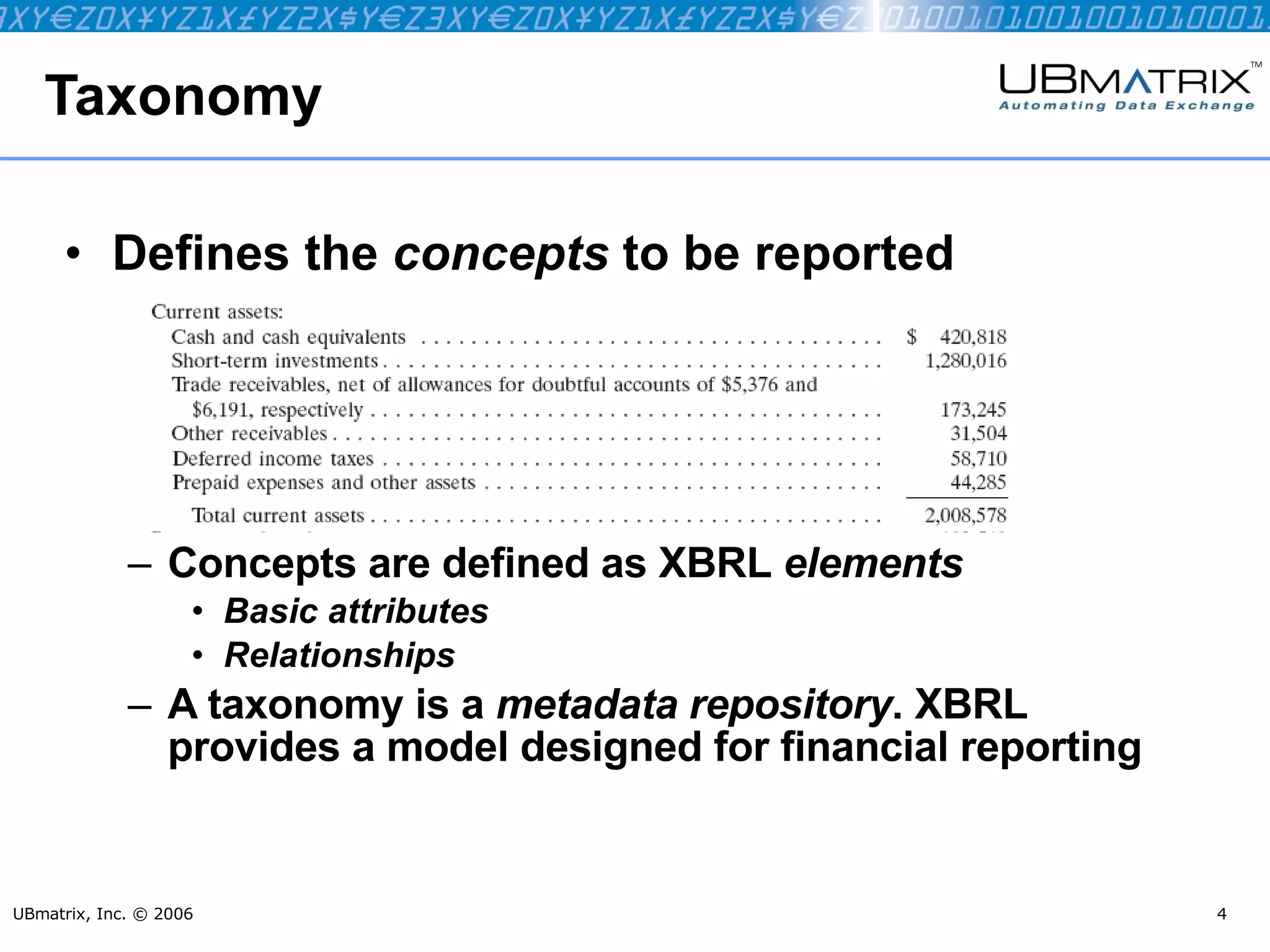
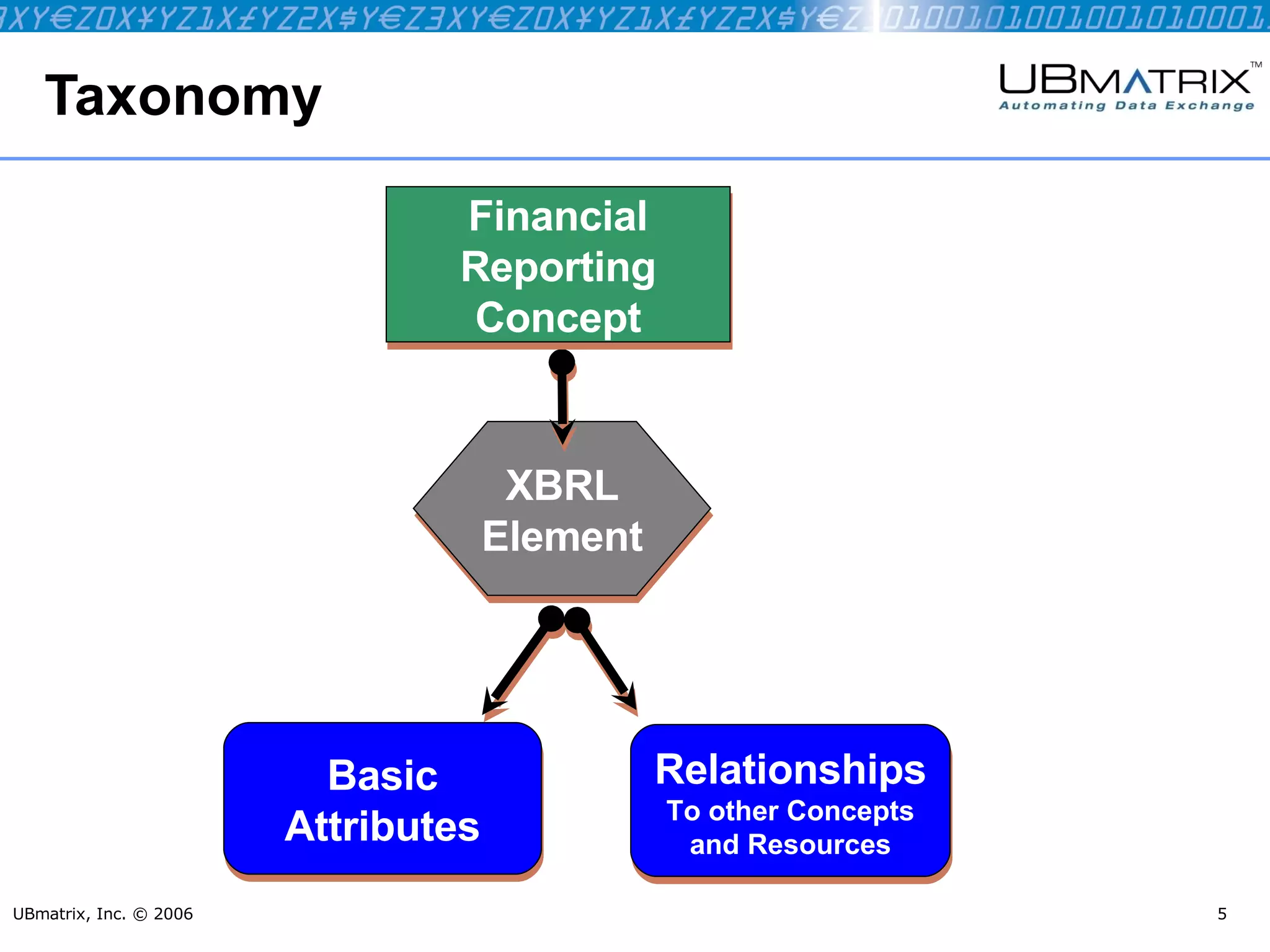
Taxonomy Defines the  concepts  to be reported  Concepts are defined as XBRL  elements Basic attributes Relationships A taxonomy is a  metadata repository . XBRL provides a model designed for financial reporting UBmatrix, Inc. © 2006
Taxonomy UBmatrix, Inc. © 2006 XBRL Element Financial Reporting Concept Basic Attributes Relationships To other Concepts and Resources
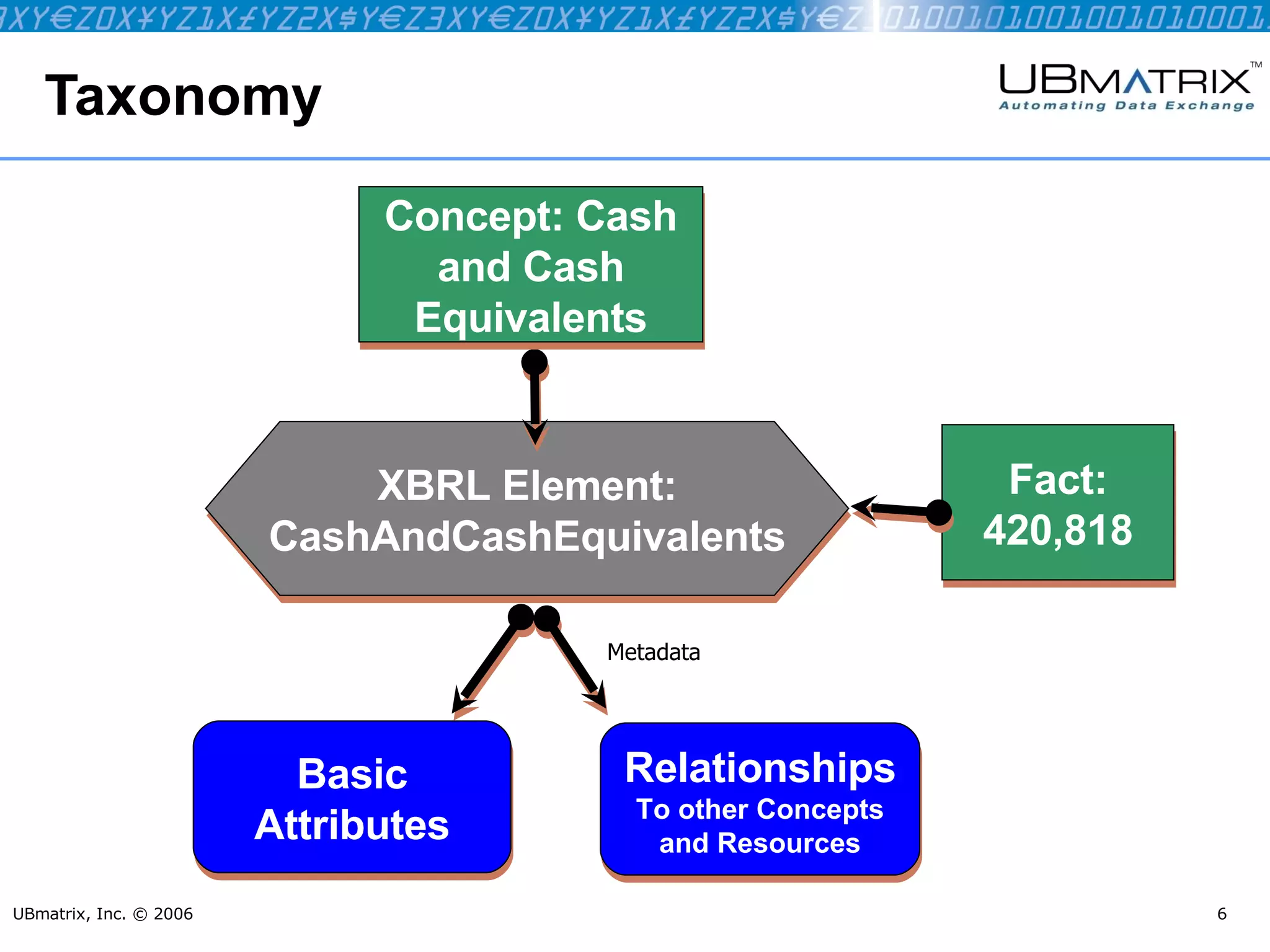
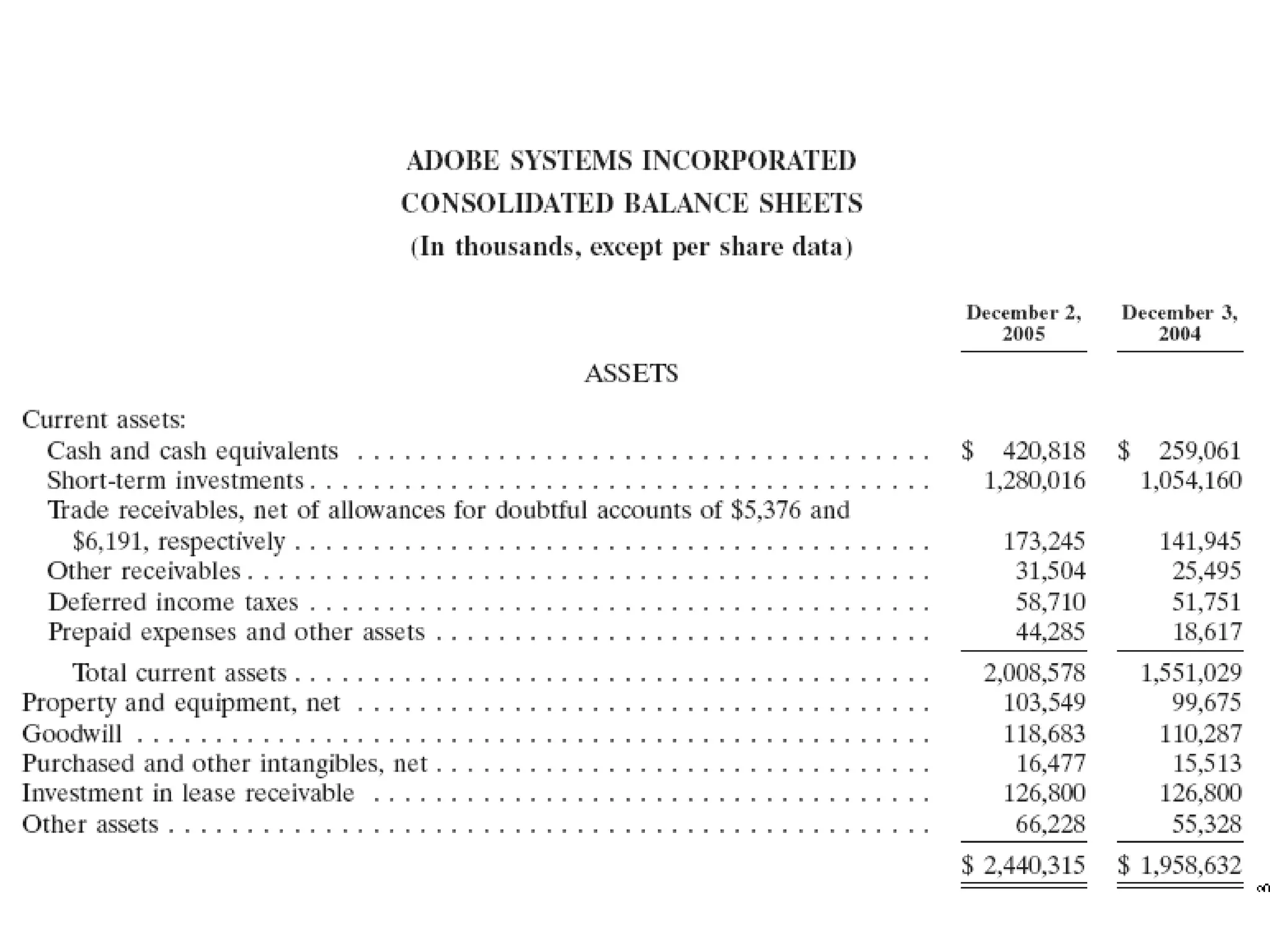
Taxonomy UBmatrix, Inc. © 2006 Fact: 420,818 Metadata XBRL Element: CashAndCashEquivalents Concept: Cash and Cash Equivalents Basic Attributes Relationships To other Concepts and Resources
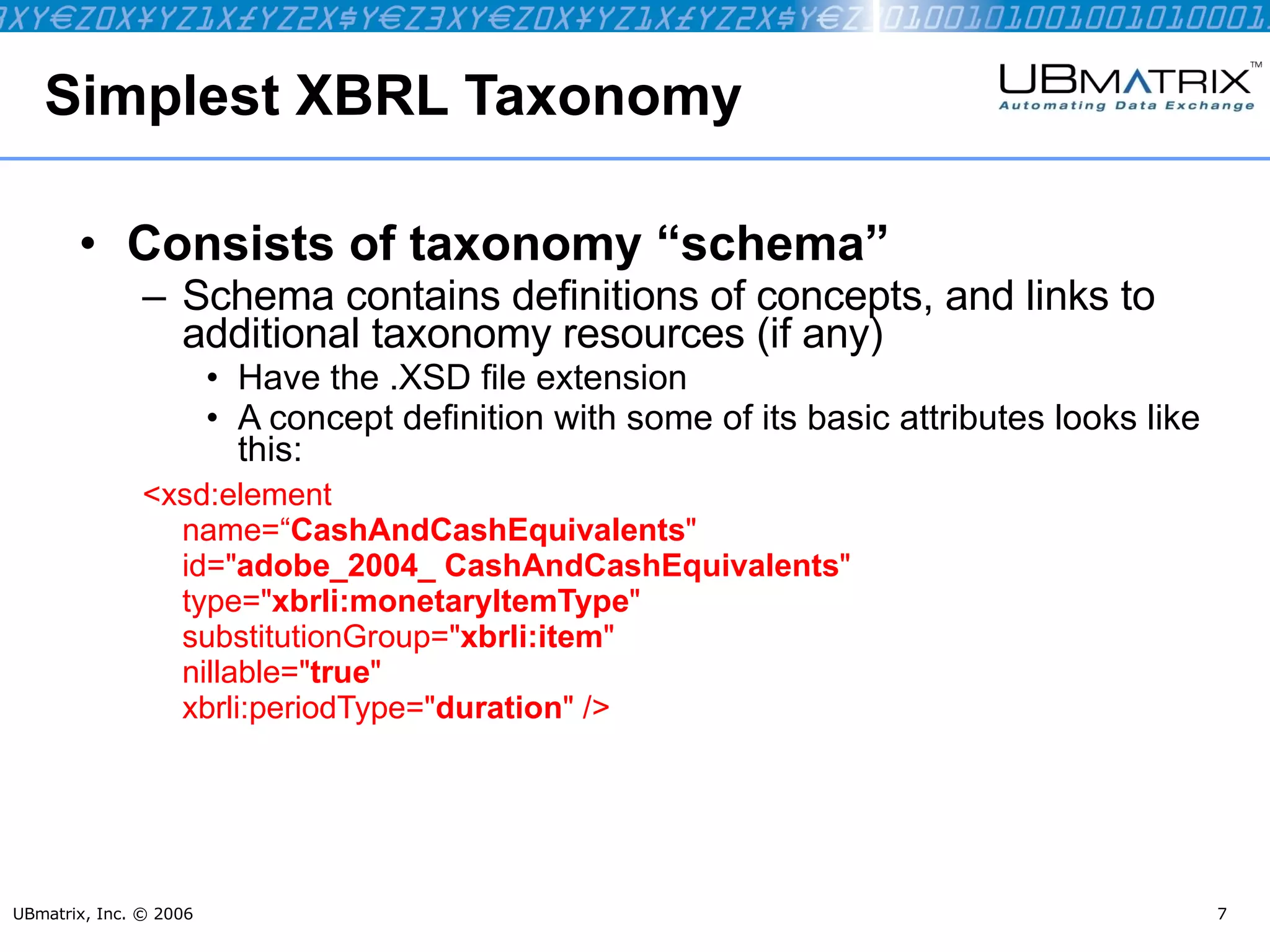
Simplest XBRL Taxonomy Consists of taxonomy “schema” Schema contains definitions of concepts, and links to additional taxonomy resources (if any) Have the .XSD file extension A concept definition with some of its basic attributes looks like this: <xsd:element  name=“ CashAndCashEquivalents &quot;  id=&quot; adobe_2004_ CashAndCashEquivalents &quot;  type=&quot; xbrli:monetaryItemType &quot;  substitutionGroup=&quot; xbrli:item &quot;  nillable=&quot; true &quot;  xbrli:periodType=&quot; duration &quot; />  UBmatrix, Inc. © 2006
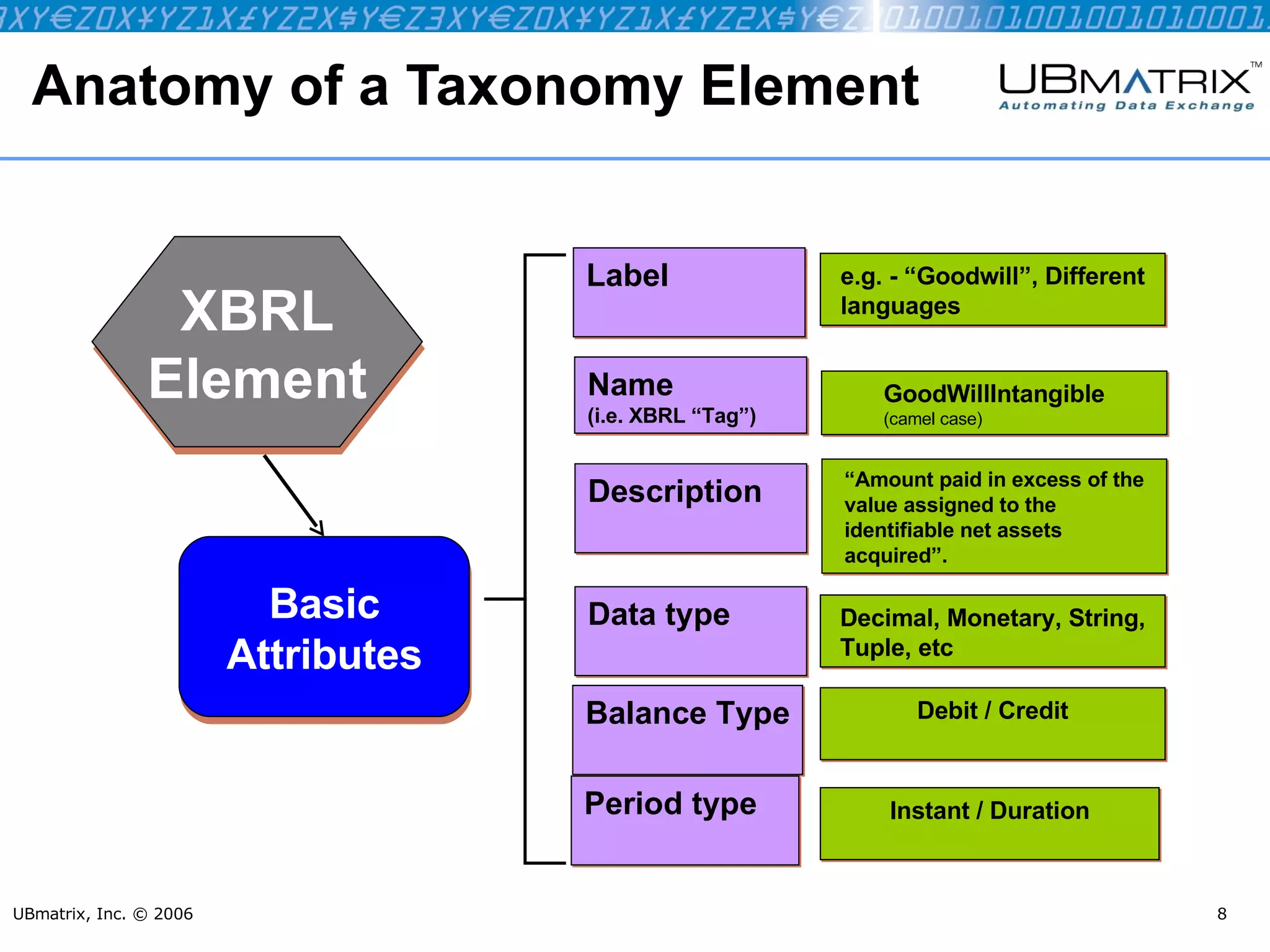
Anatomy of a Taxonomy Element UBmatrix, Inc. © 2006 XBRL Element Basic Attributes Data type  Balance Type Period type Description Name  (i.e. XBRL “Tag”) Label Decimal, Monetary, String, Tuple, etc Debit / Credit Instant / Duration “ Amount paid in excess of the value assigned to the identifiable net assets acquired”. GoodWillIntangible (camel case) e.g. - “Goodwill”, Different languages
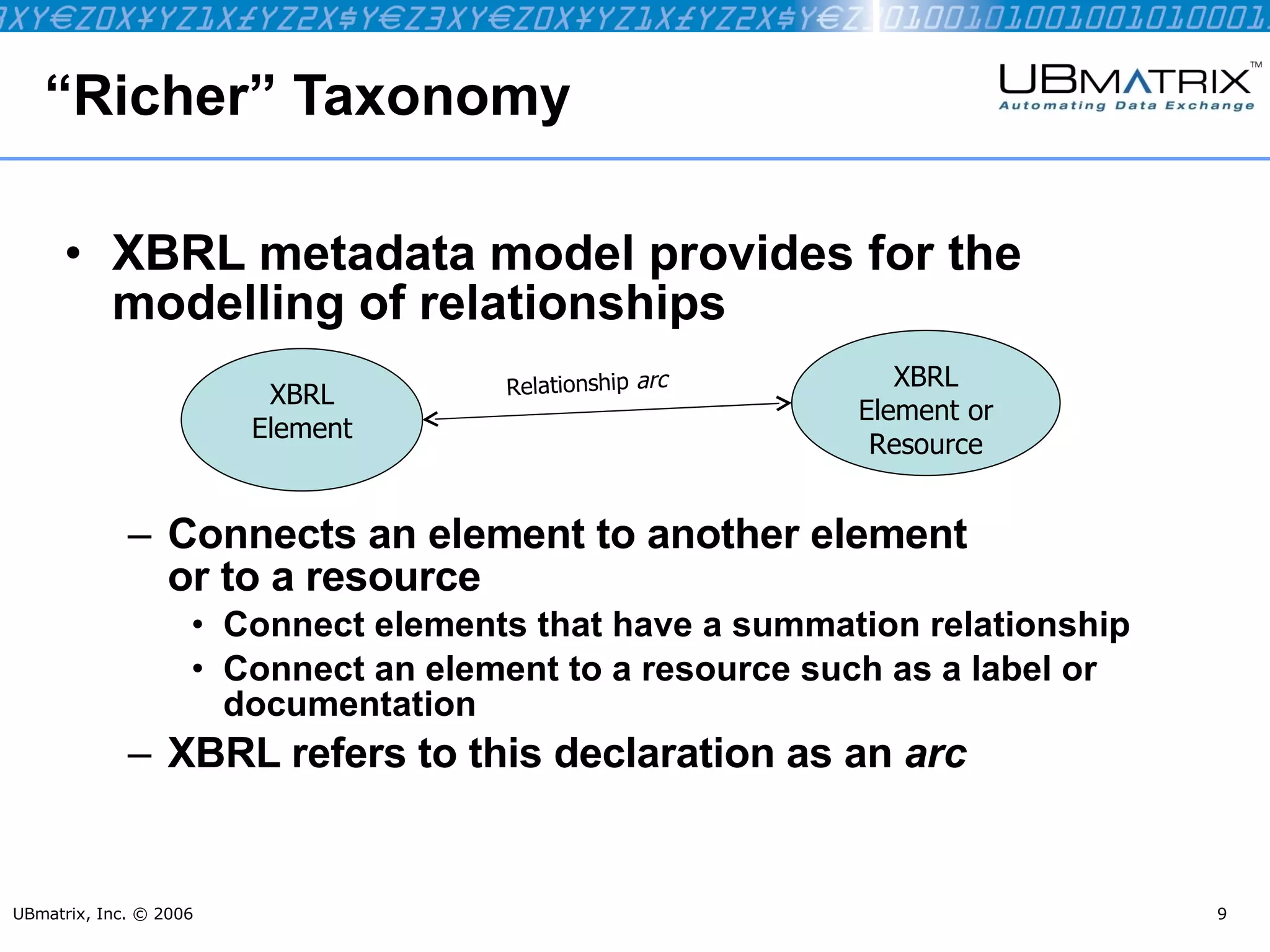
“ Richer” Taxonomy XBRL metadata model provides for the modelling of relationships Connects an element to another element  or to a resource Connect elements that have a summation relationship Connect an element to a resource such as a label or documentation XBRL refers to this declaration as an  arc UBmatrix, Inc. © 2006 XBRL Element XBRL Element or Resource Relationship  arc
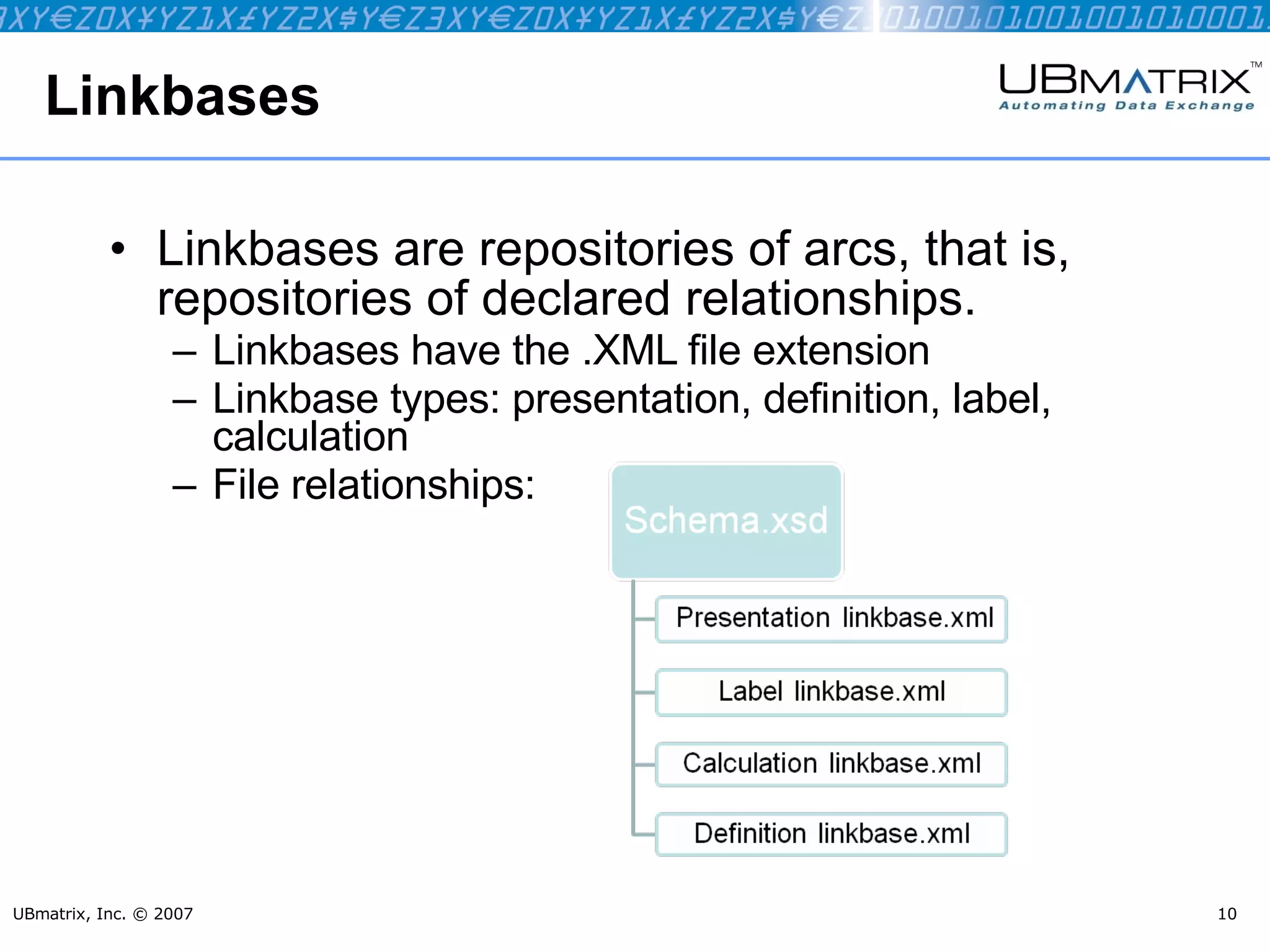
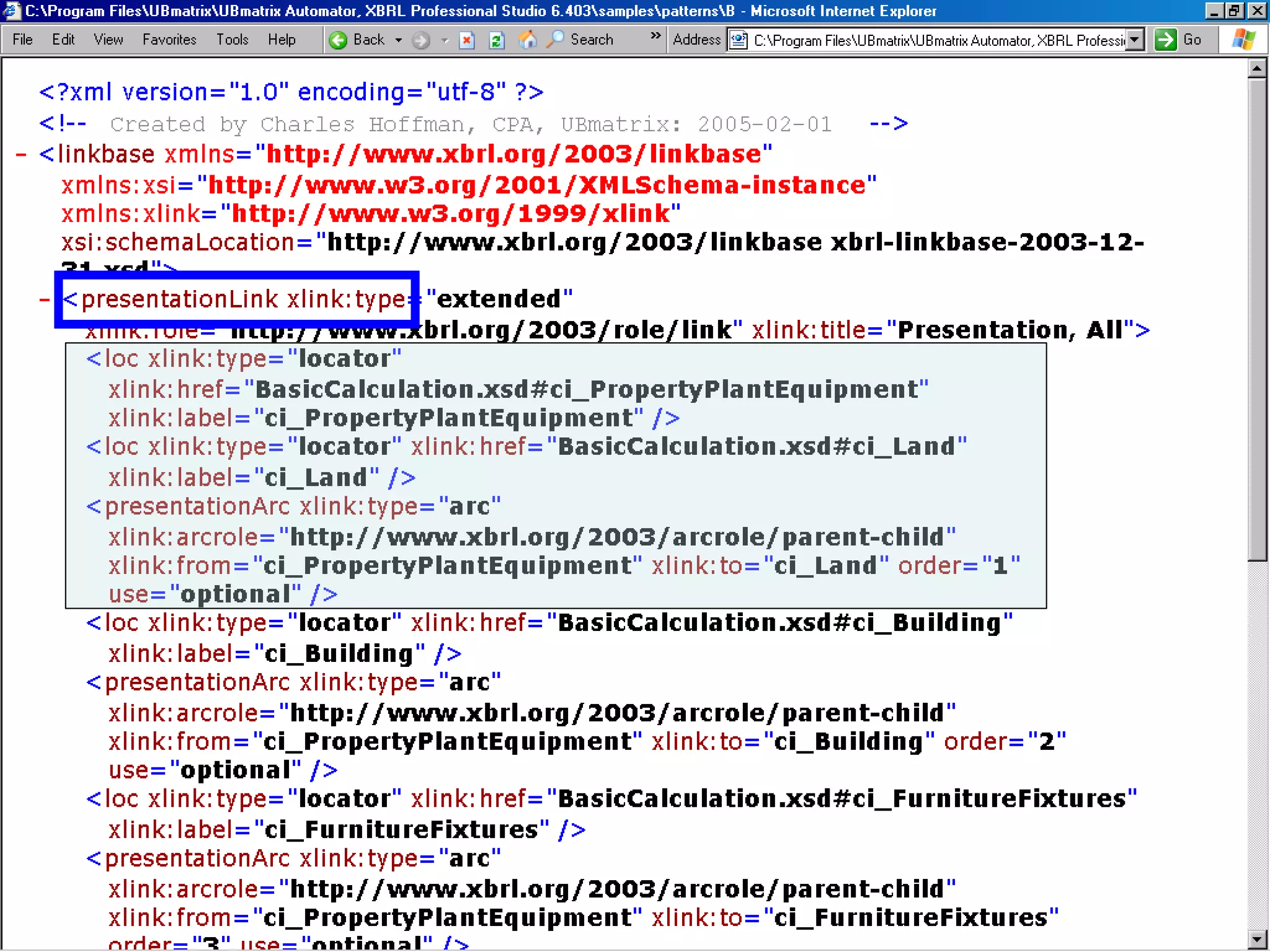
Linkbases Linkbases are repositories of arcs, that is, repositories of declared relationships. Linkbases have the .XML file extension Linkbase types: presentation, definition, label, calculation File relationships: UBmatrix, Inc. © 2007
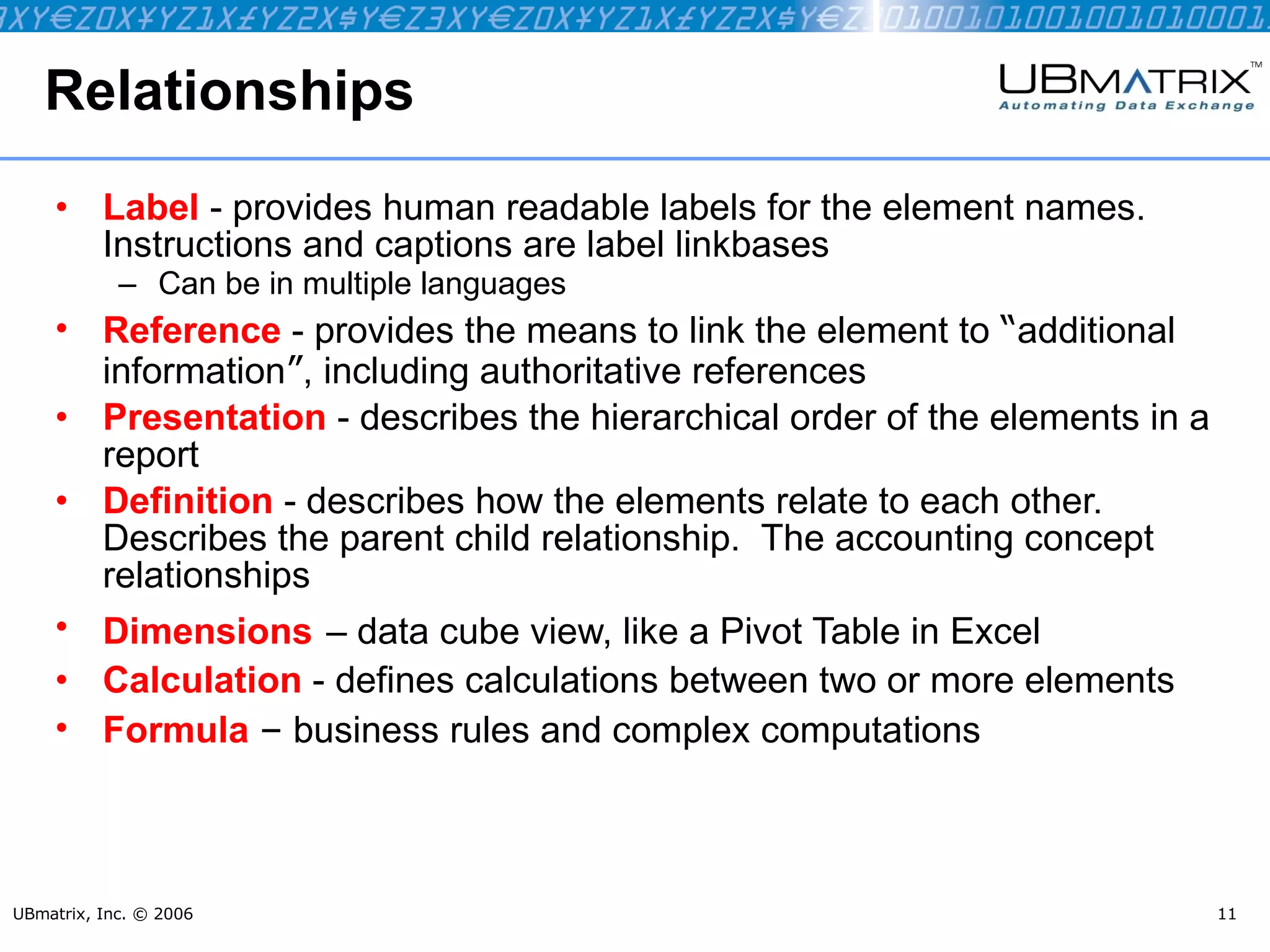
Relationships Label  -  provides human readable labels for the element names.  Instructions and captions are label linkbases Can be in multiple languages Reference  -  provides the means to link the element to  “ additional information ” , including authoritative references Presentation  -  describes the hierarchical order of the elements in a report Definition  -  describes how the elements relate to each other.  Describes the parent child relationship.  The accounting concept relationships Dimensions   – data cube view, like a Pivot Table in Excel Calculation  -  defines calculations between two or more elements Formula   –  business rules and complex computations UBmatrix, Inc. © 2006
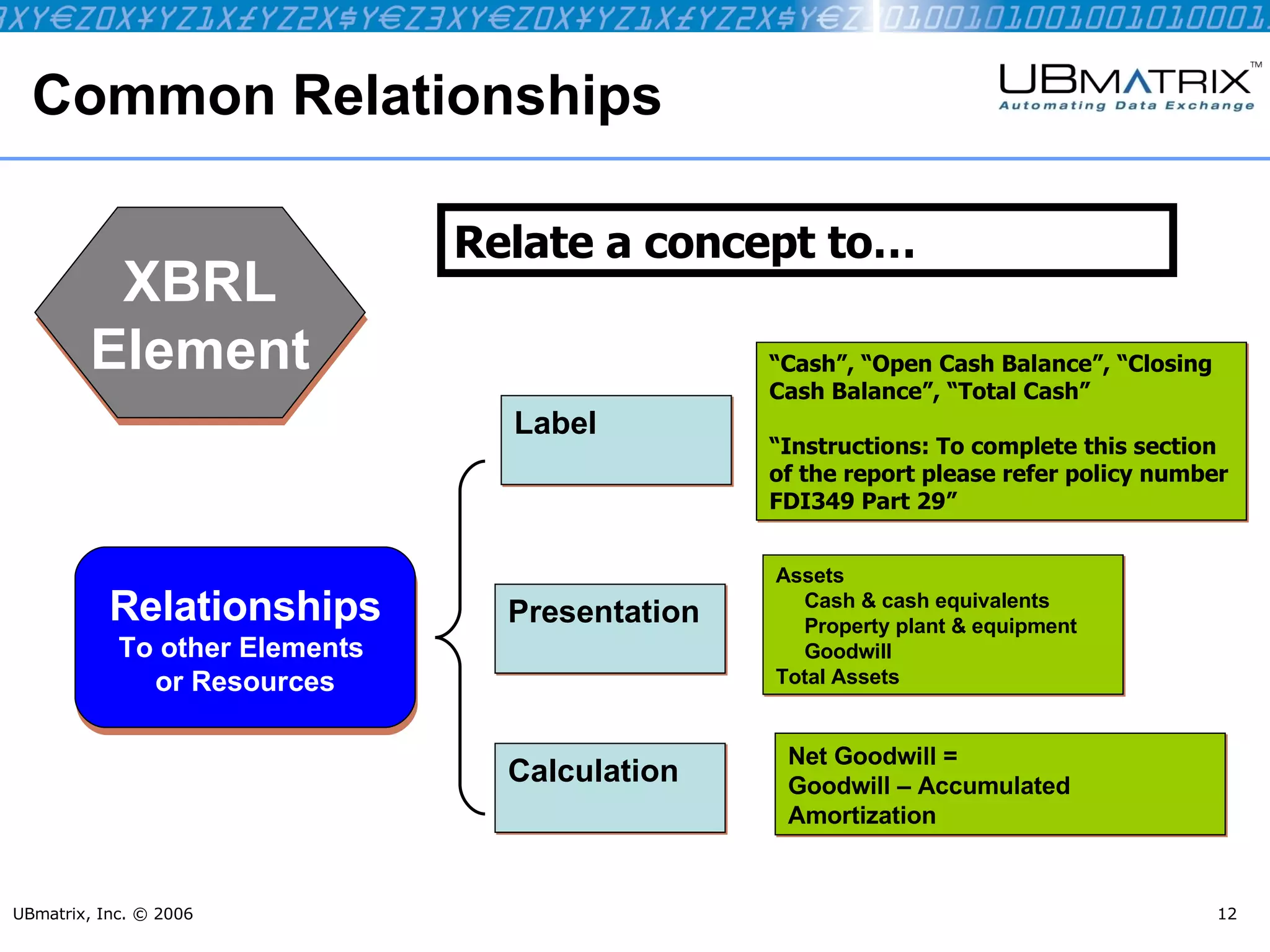
Common Relationships UBmatrix, Inc. © 2006 XBRL Element Net Goodwill =  Goodwill – Accumulated Amortization Relationships To other Elements  or Resources Calculation Presentation Assets Cash & cash equivalents Property plant & equipment Goodwill Total Assets Relate a concept to… “ Cash”, “Open Cash Balance”, “Closing Cash Balance”, “Total Cash” “ Instructions: To complete this section of the report please refer policy number FDI349 Part 29” Label
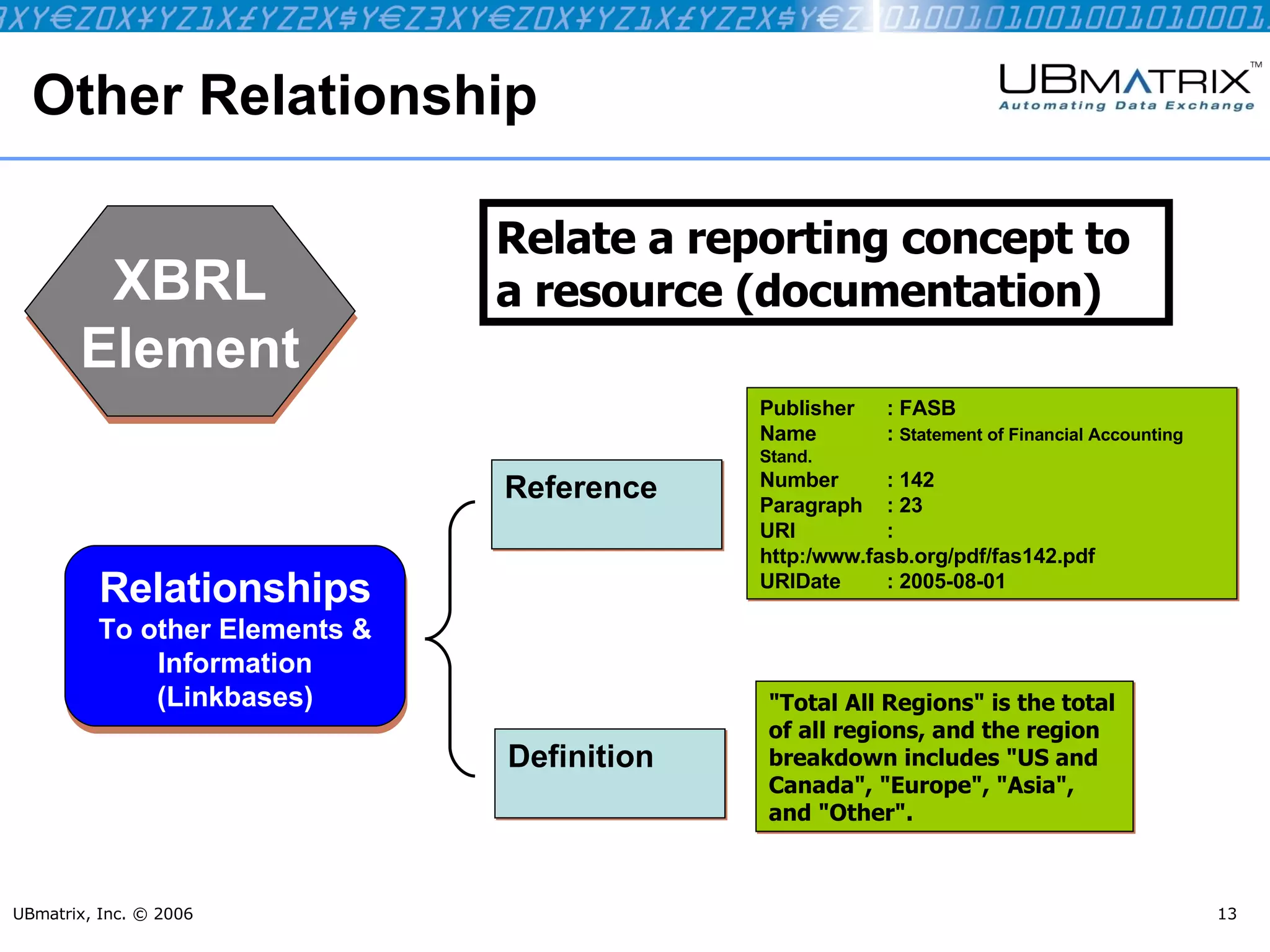
Other Relationship UBmatrix, Inc. © 2006 XBRL Element Publisher : FASB Name :  Statement of Financial Accounting Stand. Number : 142 Paragraph : 23 URI : http:/www.fasb.org/pdf/fas142.pdf URIDate : 2005-08-01 Relationships To other Elements & Information (Linkbases) Reference Relate a reporting concept to a resource (documentation) Definition &quot;Total All Regions&quot; is the total of all regions, and the region breakdown includes &quot;US and Canada&quot;, &quot;Europe&quot;, &quot;Asia&quot;, and &quot;Other&quot;.
 
Instance Document
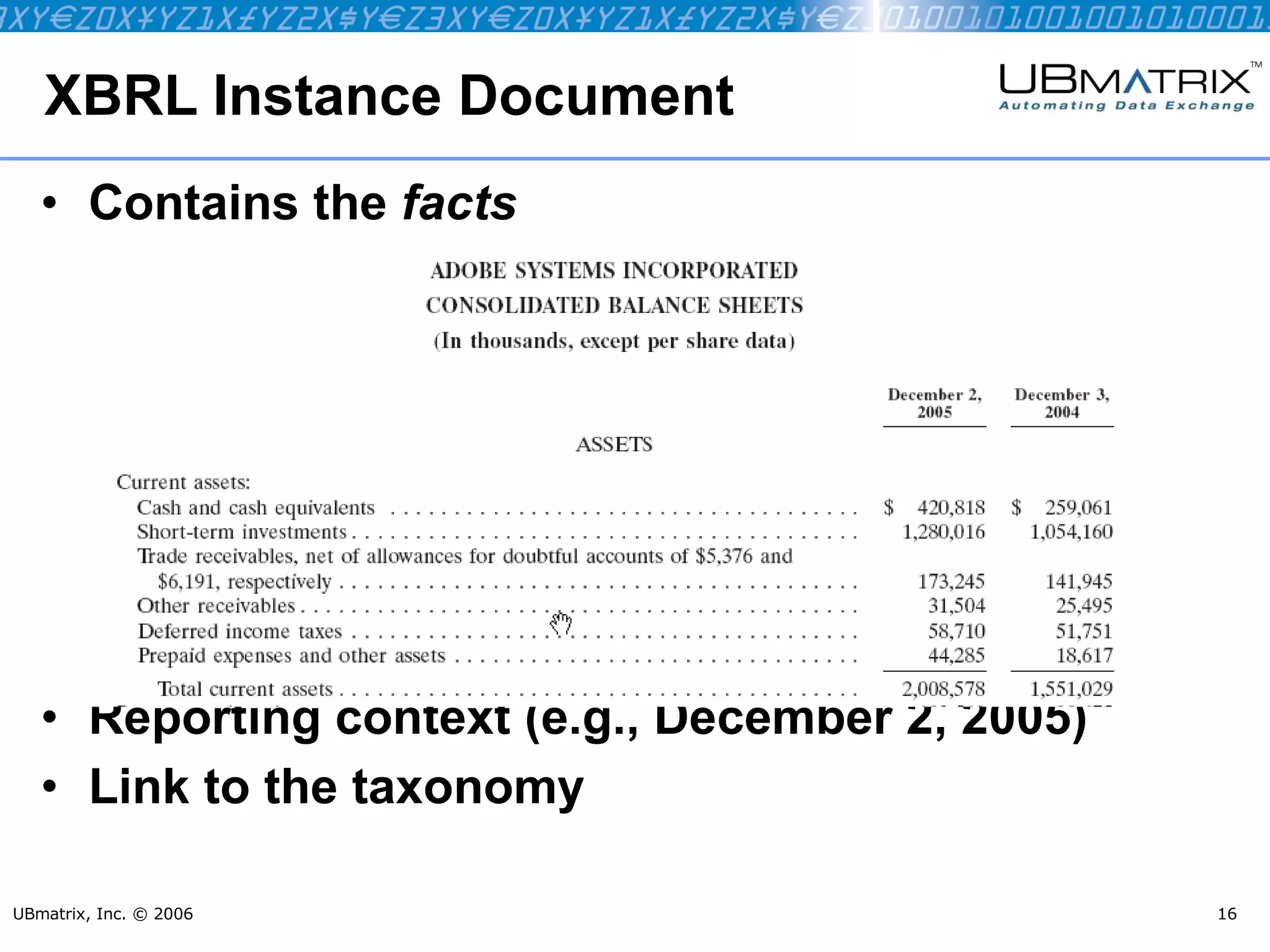
XBRL Instance Document Contains the  facts Reporting context (e.g., December 2, 2005) Link to the taxonomy UBmatrix, Inc. © 2006
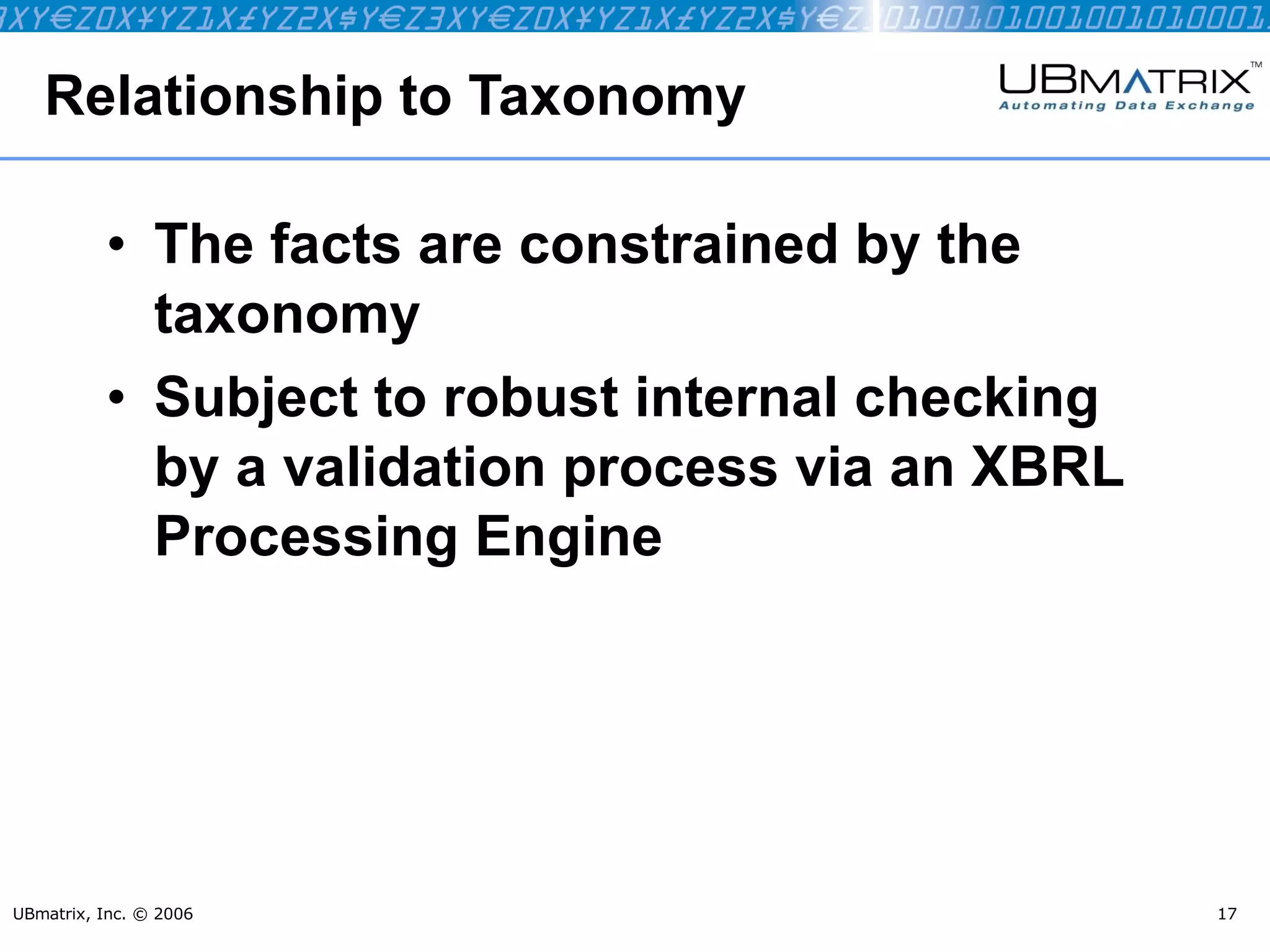
Relationship to Taxonomy The facts are constrained by the taxonomy Subject to robust internal checking  by a validation process via an XBRL Processing Engine UBmatrix, Inc. © 2006
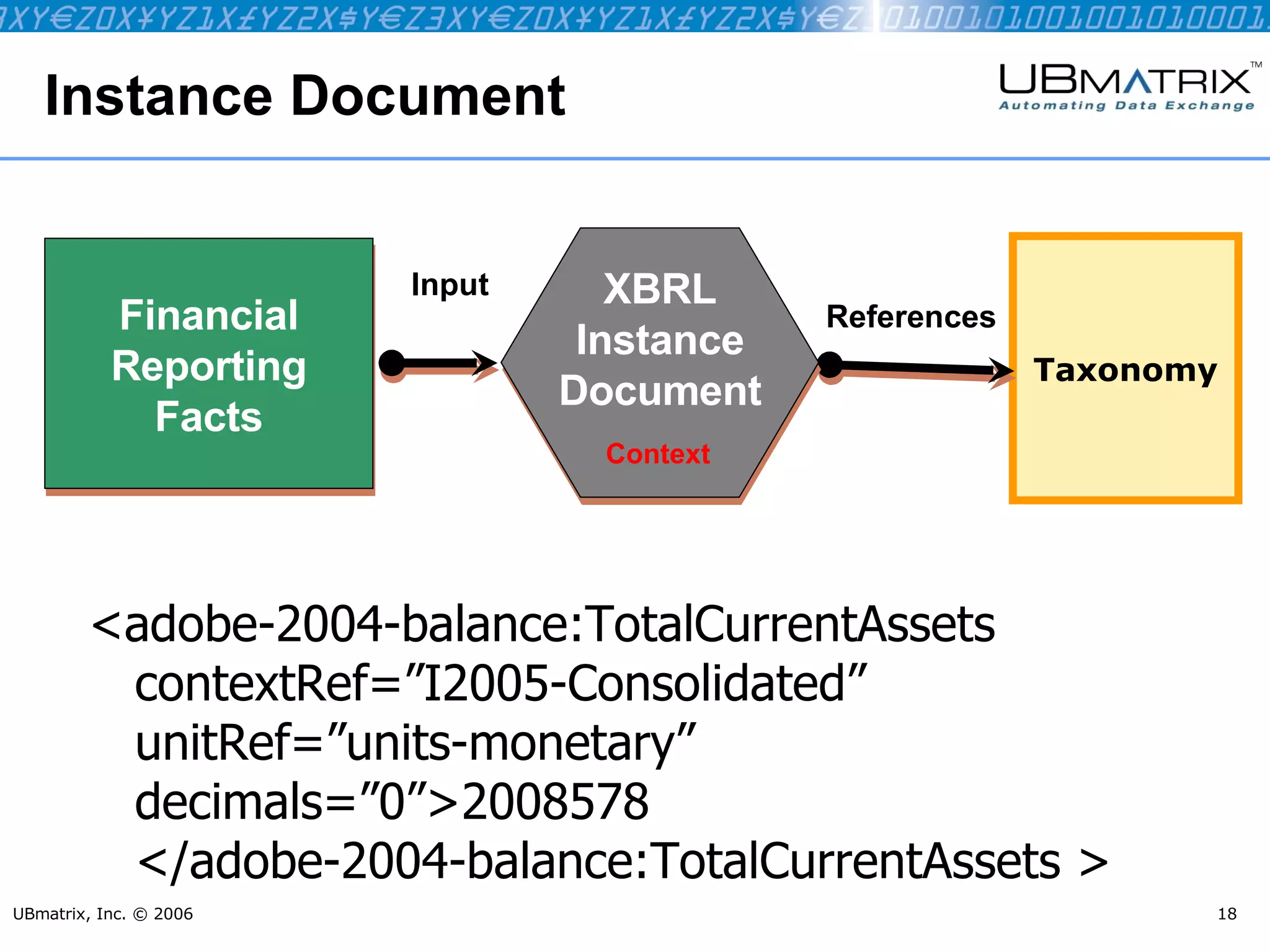
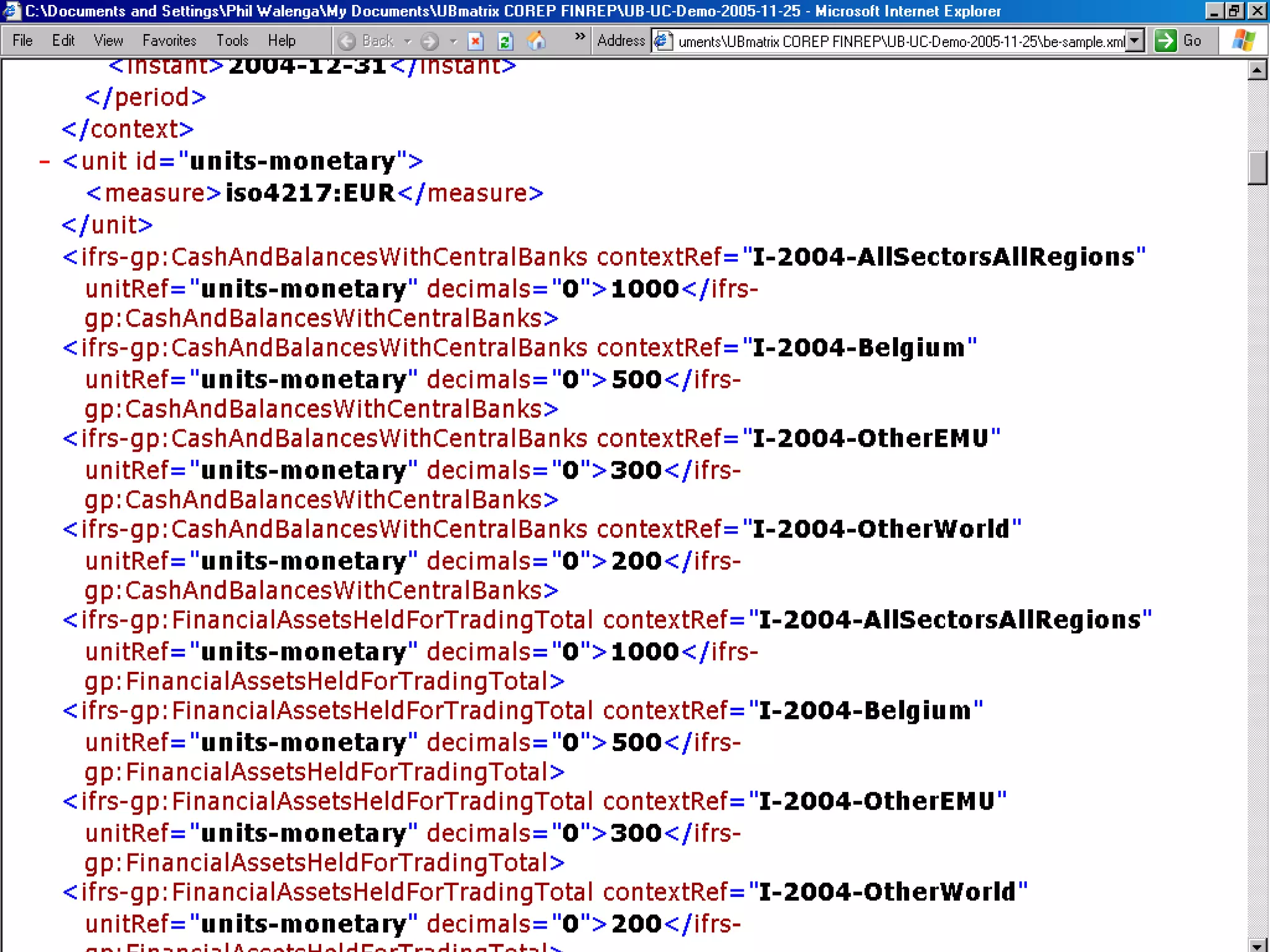
Instance Document UBmatrix, Inc. © 2006 Taxonomy Financial Reporting Facts Input References <adobe-2004-balance:TotalCurrentAssets    contextRef=”I2005-Consolidated”    unitRef=”units-monetary”  decimals=”0”>2008578 </adobe-2004-balance:TotalCurrentAssets > XBRL Instance Document  Context
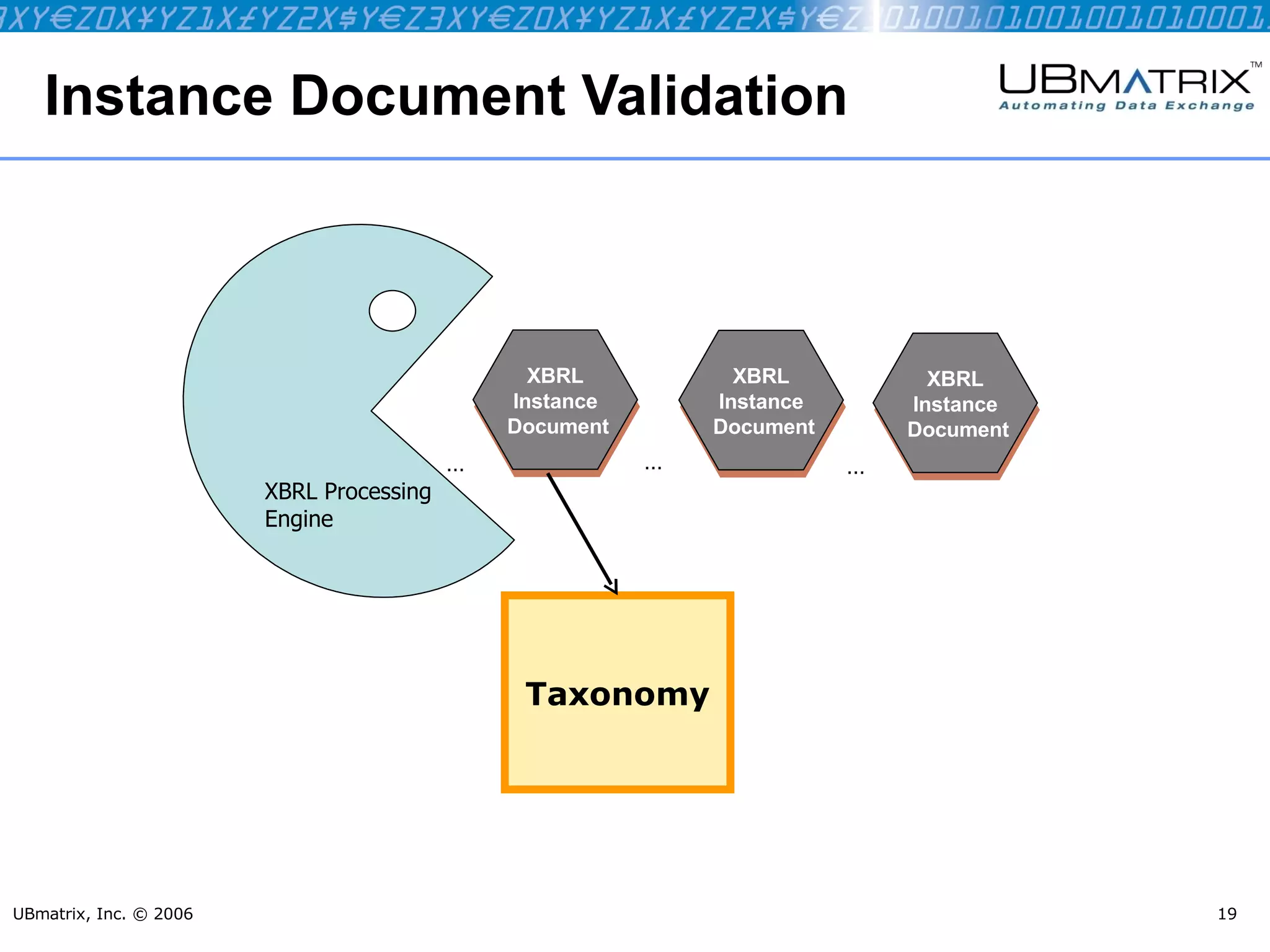
Instance Document Validation UBmatrix, Inc. © 2006 XBRL Instance Document XBRL Instance Document XBRL Instance Document … … … Taxonomy XBRL Processing Engine
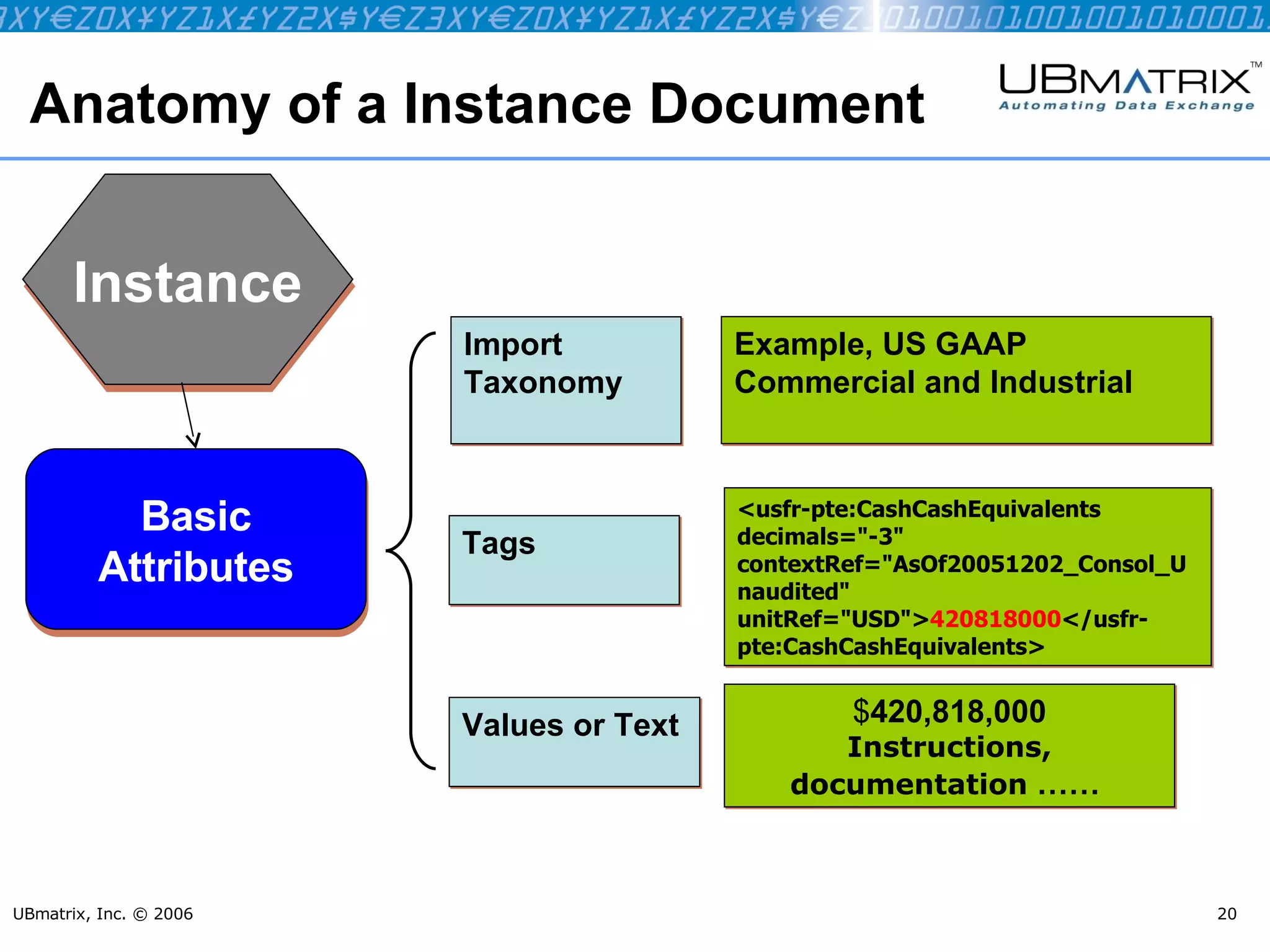
Anatomy of a Instance Document UBmatrix, Inc. © 2006 Instance Example, US GAAP Commercial and Industrial $ 420,818,000 Instructions, documentation  ……  Basic Attributes Values or Text Tags Import Taxonomy <usfr-pte:CashCashEquivalents decimals=&quot;-3&quot; contextRef=&quot;AsOf20051202_Consol_Unaudited&quot; unitRef=&quot;USD&quot;> 420818000 </usfr-pte:CashCashEquivalents>
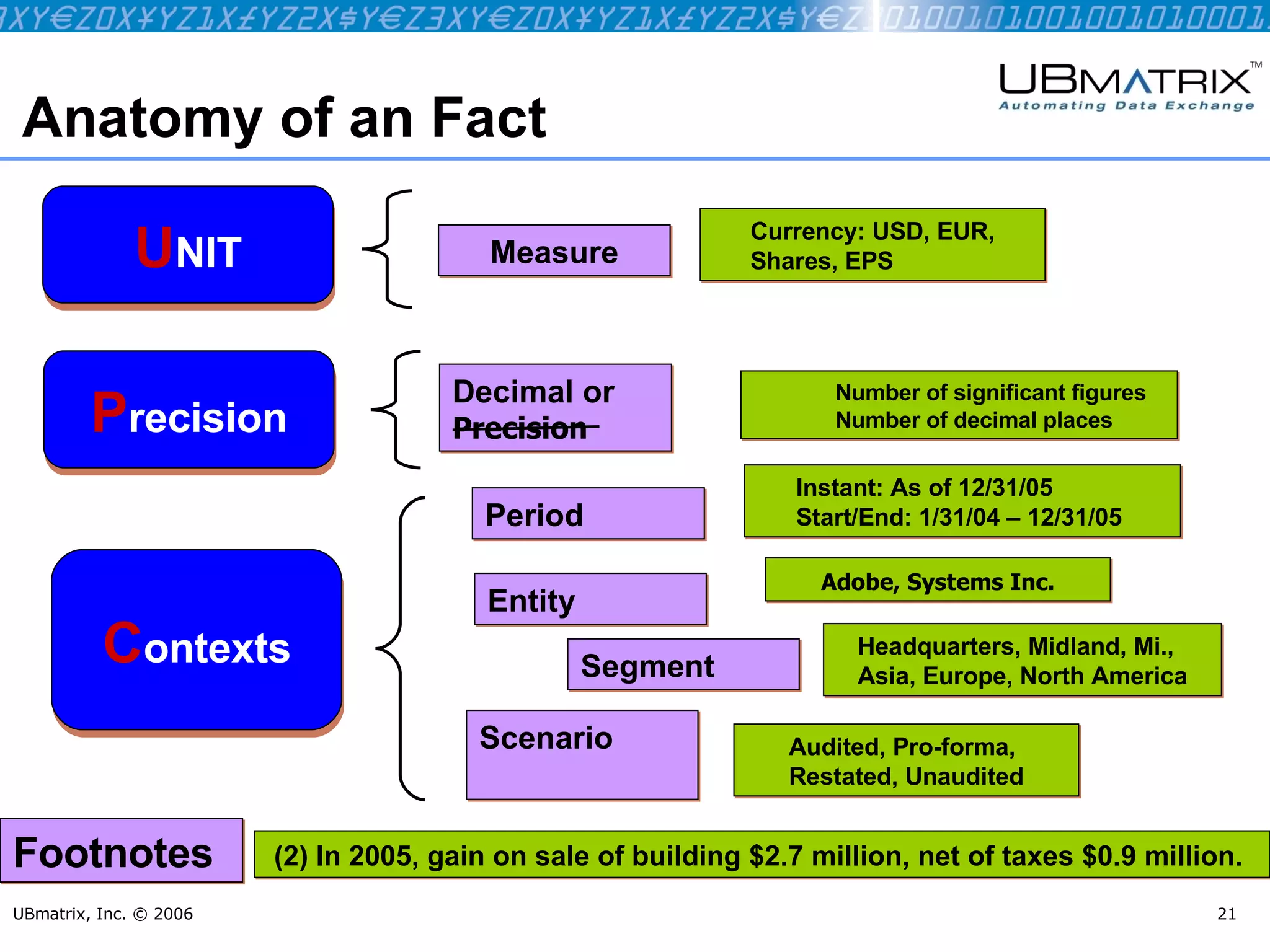
Anatomy of an Fact UBmatrix, Inc. © 2006 C ontexts Scenario  Entity Period Audited, Pro-forma, Restated, Unaudited Adobe, Systems Inc. Instant: As of 12/31/05 Start/End: 1/31/04 – 12/31/05   Measure Currency: USD, EUR, Shares, EPS U NIT Footnotes (2) In 2005, gain on sale of building $2.7 million, net of taxes $0.9 million.   Segment Headquarters, Midland, Mi., Asia, Europe, North America P recision Decimal or  Precision Number of significant figures Number of decimal places
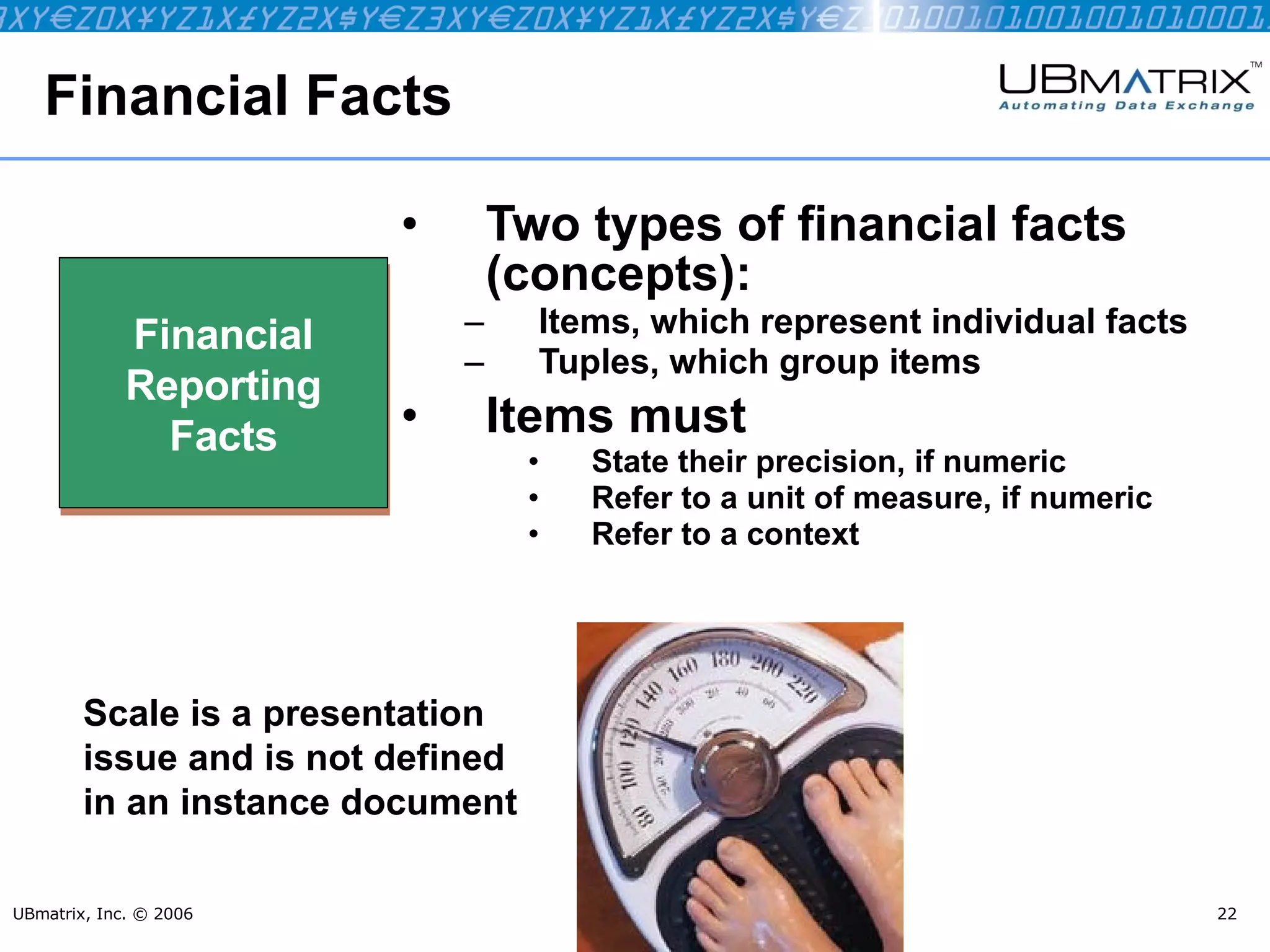
Financial Facts Two types of financial facts (concepts): Items, which represent individual facts Tuples, which group items Items must State their precision, if numeric Refer to a unit of measure, if numeric Refer to a context UBmatrix, Inc. © 2006 Financial Reporting Facts Scale is a presentation issue and is not defined in an instance document
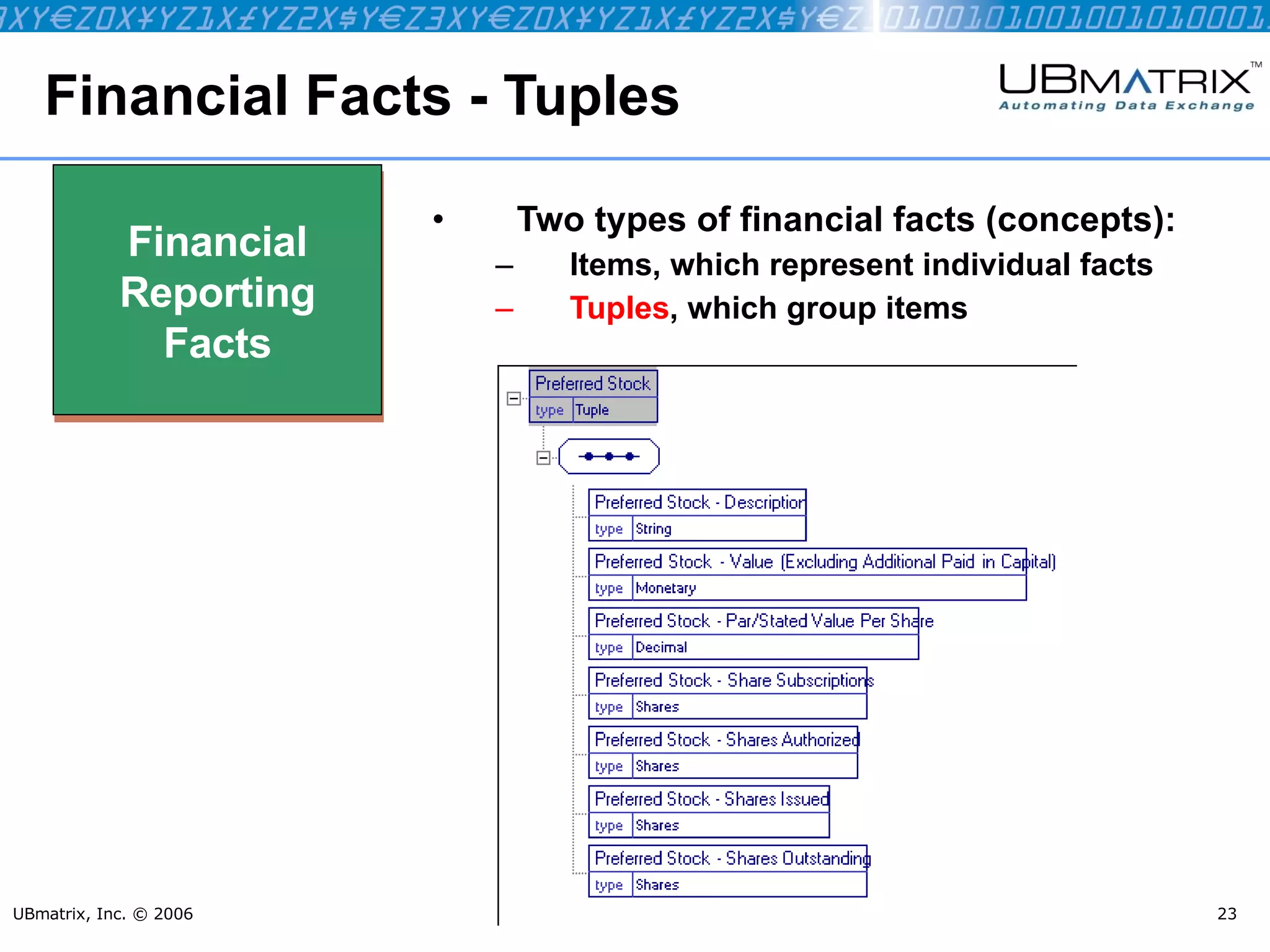
Financial Facts - Tuples Two types of financial facts (concepts): Items, which represent individual facts Tuples , which group items UBmatrix, Inc. © 2006 Financial Reporting Facts
 
 
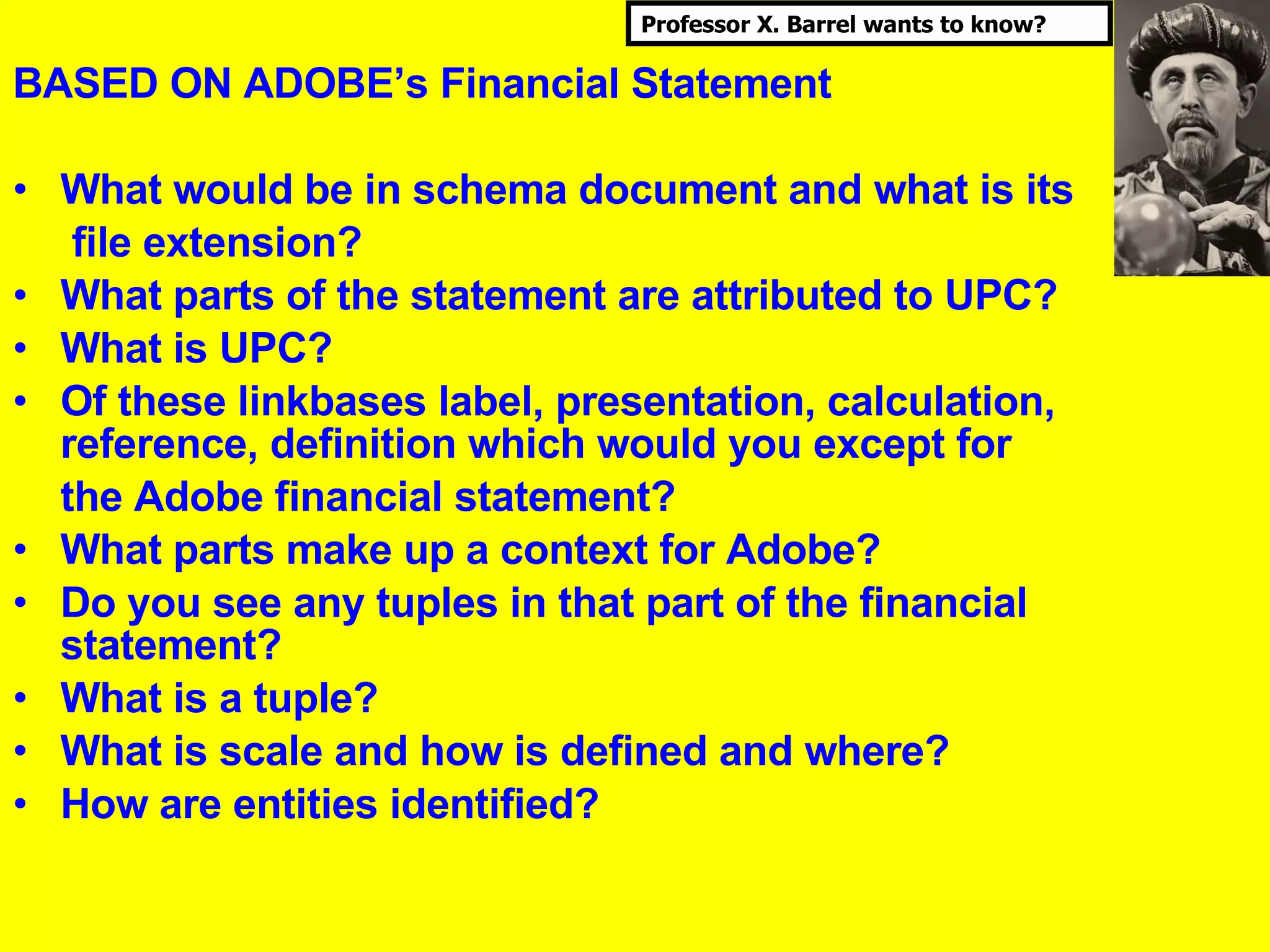
BASED ON ADOBE’s Financial Statement What would be in schema document and what is its   file extension? What parts of the statement are attributed to UPC? What is UPC? Of these linkbases label, presentation, calculation, reference, definition which would you except for  the Adobe financial statement? What parts make up a context for Adobe? Do you see any tuples in that part of the financial statement? What is a tuple? What is scale and how is defined and where? How are entities identified? UBmatrix, Inc. © 2006   Professor X. Barrel wants to know?
What is a XBRL taxonomy? Why are people working hard to use XBRL taxonomies and instance documents? What does Nillable and IsNil mean? UBmatrix, Inc. © 2006   Professor X. Barrel wants to know?
Why does XML not meet the need of business reporting?
XBRL is based on XML XBRL is an XML-based markup language for defining business report structure and authoring business information . UBmatrix, Inc. © 2006
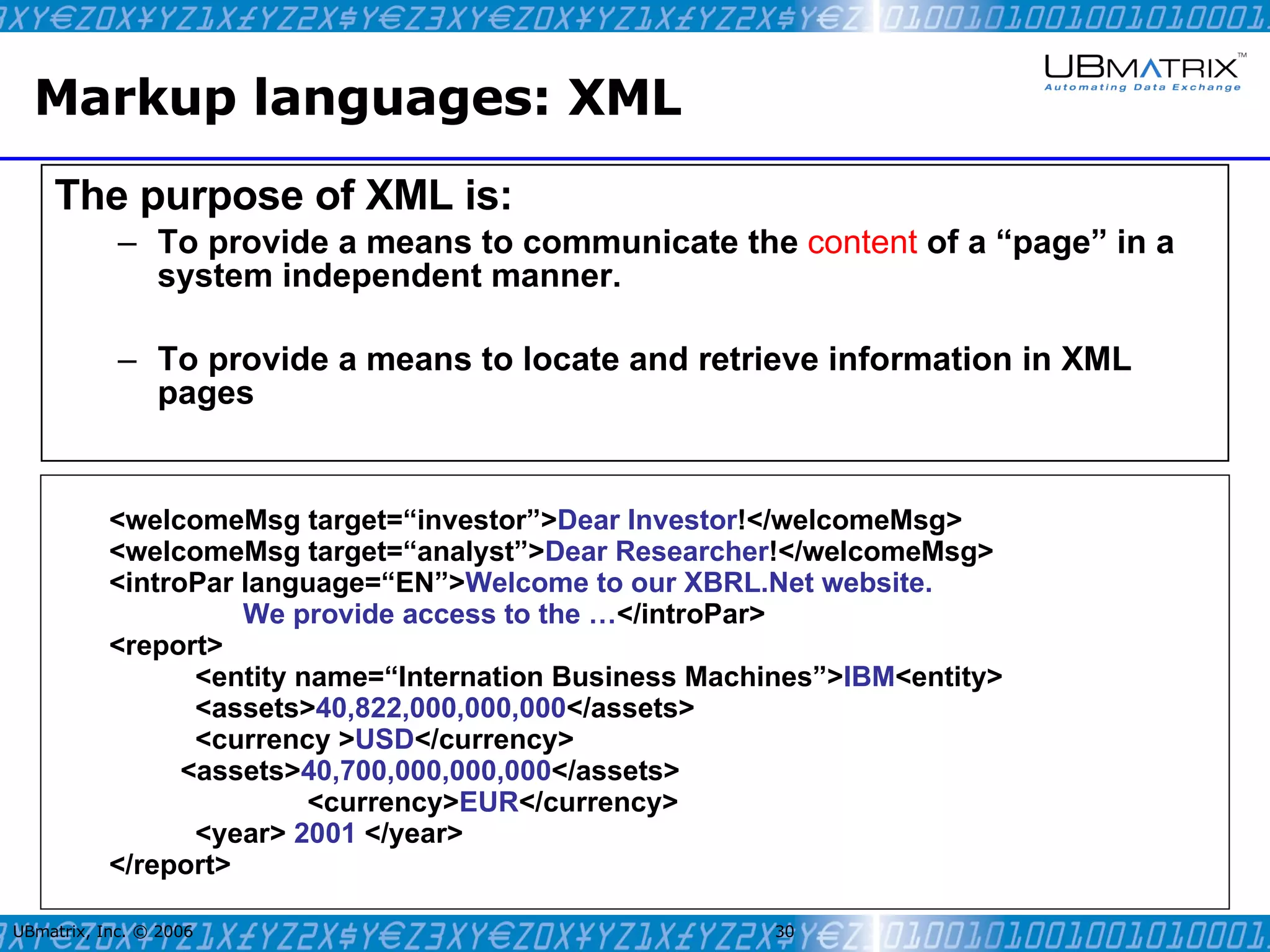
Markup languages: XML The purpose of XML is: To provide a means to communicate the  content  of a “page” in a system independent manner. To provide a means to locate and retrieve information in XML pages UBmatrix, Inc. © 2006   <welcomeMsg target=“investor”> Dear Investor !</welcomeMsg>   <welcomeMsg target=“analyst”> Dear Researcher !</welcomeMsg>   <introPar language=“EN”> Welcome to our XBRL.Net website.    We provide access to the … </introPar> <report> <entity name=“Internation Business Machines”> IBM <entity> <assets> 40,822,000,000,000 </assets>  <currency > USD </currency>  <assets> 40,700,000,000,000 </assets>  <currency> EUR </currency>  <year>  2001  </year> </report>
XML Schema and Instance documents For an application to locate certain information Needs to know first if information is contained in a  particular type (e.g. a financial statement based on the USGAAP)   of XML document. The content structure is declared by the document definition The technology used for this is the DDML ( Document Definition Markup Language, formerly XSchema ) For an application to retrieve information from a XML document an instance document must use the   tags defined in the DDML document  that goes with it. UBmatrix, Inc. © 2006
Why only XBRL fits the bill? There are two big problems with regular XML XSchema and Instance documents from a reporting perspective: XSchema document structures are fixed. You cannot add “your own” tags to the document structure. XSchema only provides syntactic validation XBRL specification enables creating and extending document structures while providing syntactic validation. The XBRL specification enables declaration of semantics and business rules validation. XML provides the right basis but  is insufficient as an end-to-end solution platform UBmatrix, Inc. © 2006
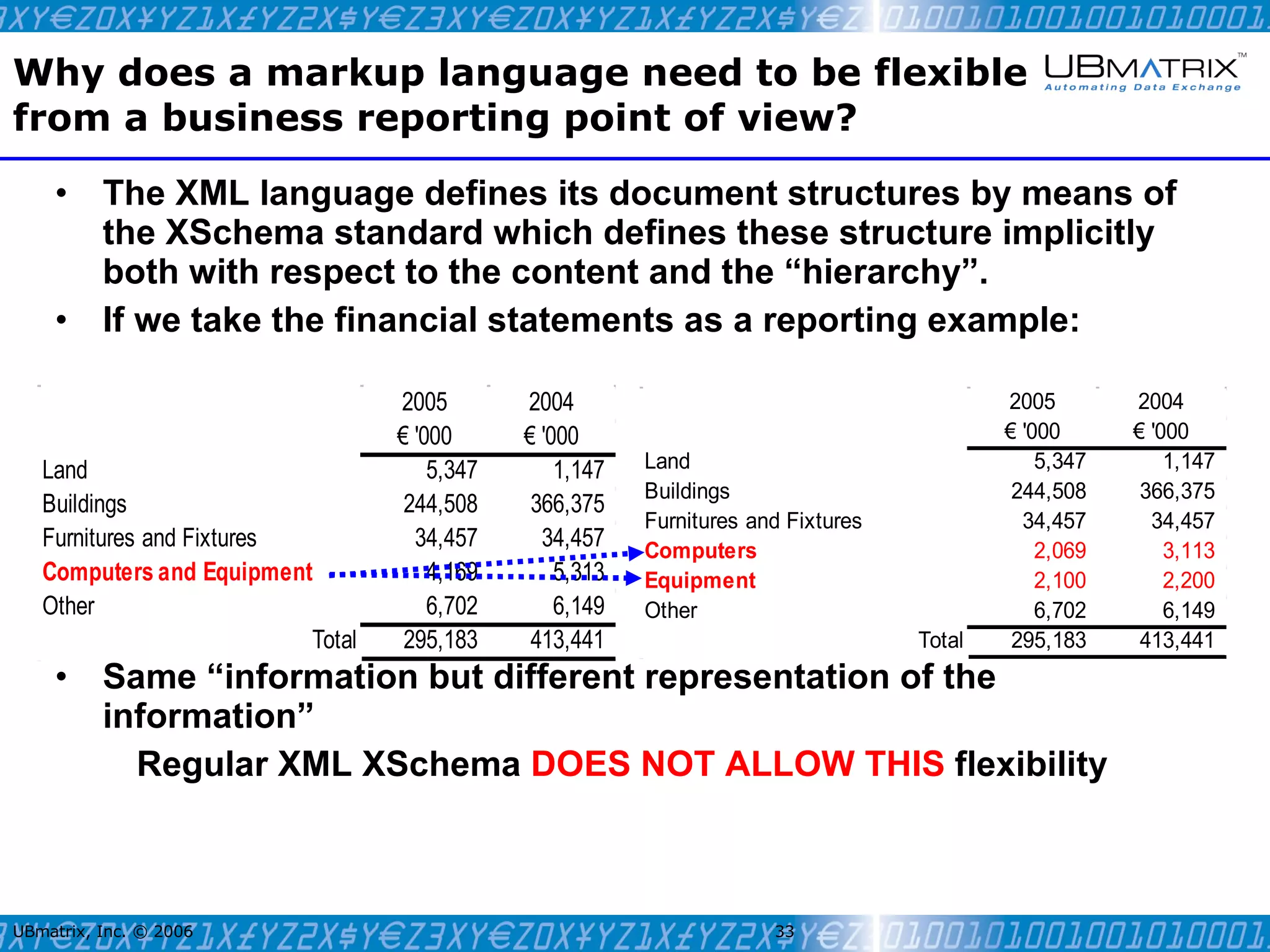
Why does a markup language need to be flexible from a business reporting point of view? The XML language defines its document structures by means of the XSchema standard which defines these structure implicitly both with respect to the content and the “hierarchy”. If we take the financial statements as a reporting example: Same “information but different representation of the information” Regular XML XSchema  DOES NOT ALLOW THIS  flexibility UBmatrix, Inc. © 2006
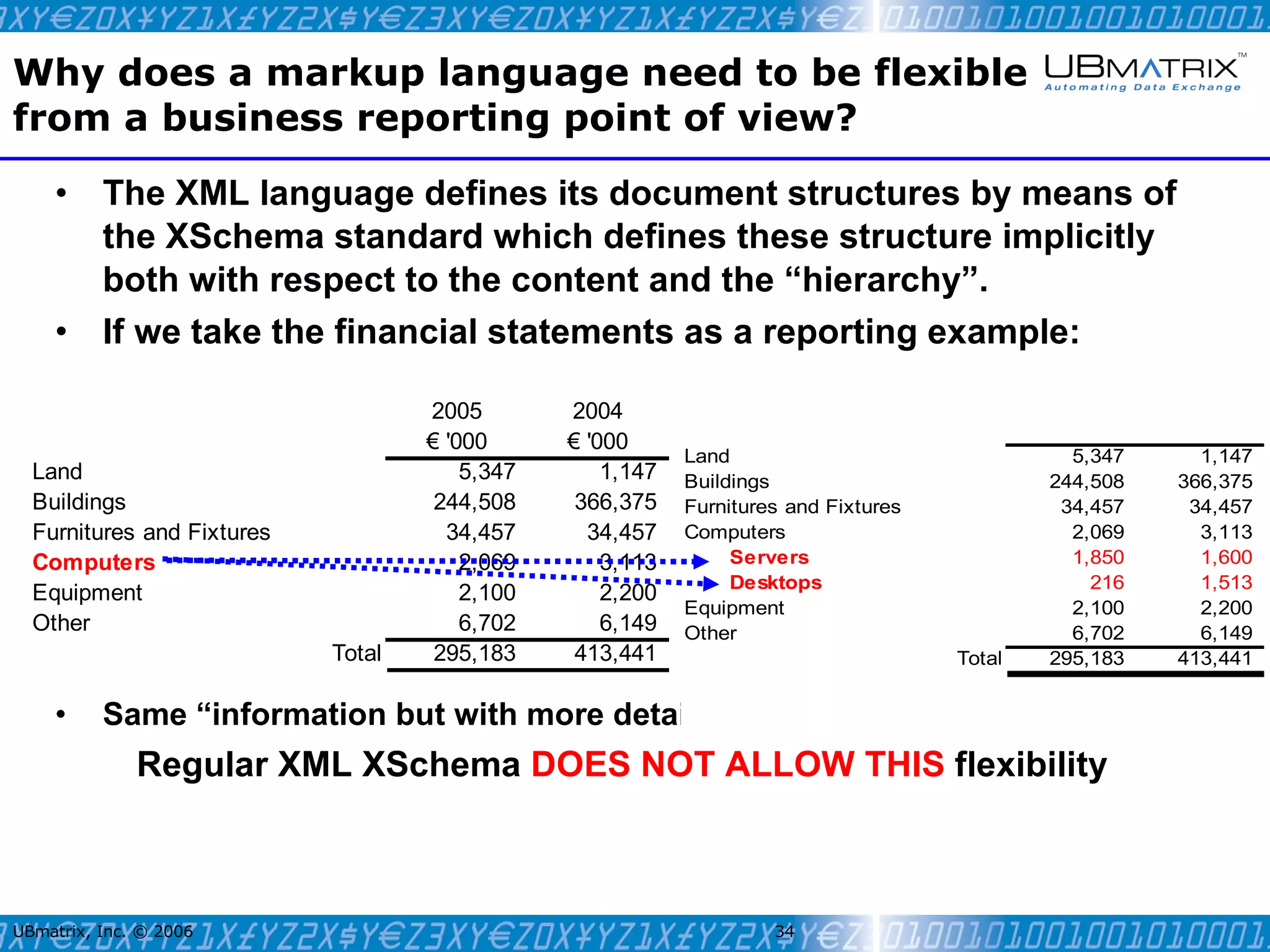
Why does a markup language need to be flexible from a business reporting point of view? The XML language defines its document structures by means of the XSchema standard which defines these structure implicitly both with respect to the content and the “hierarchy”. If we take the financial statements as a reporting example: Same “information but with more detail in the lower level breakdown” Regular XML XSchema  DOES NOT ALLOW THIS  flexibility UBmatrix, Inc. © 2006
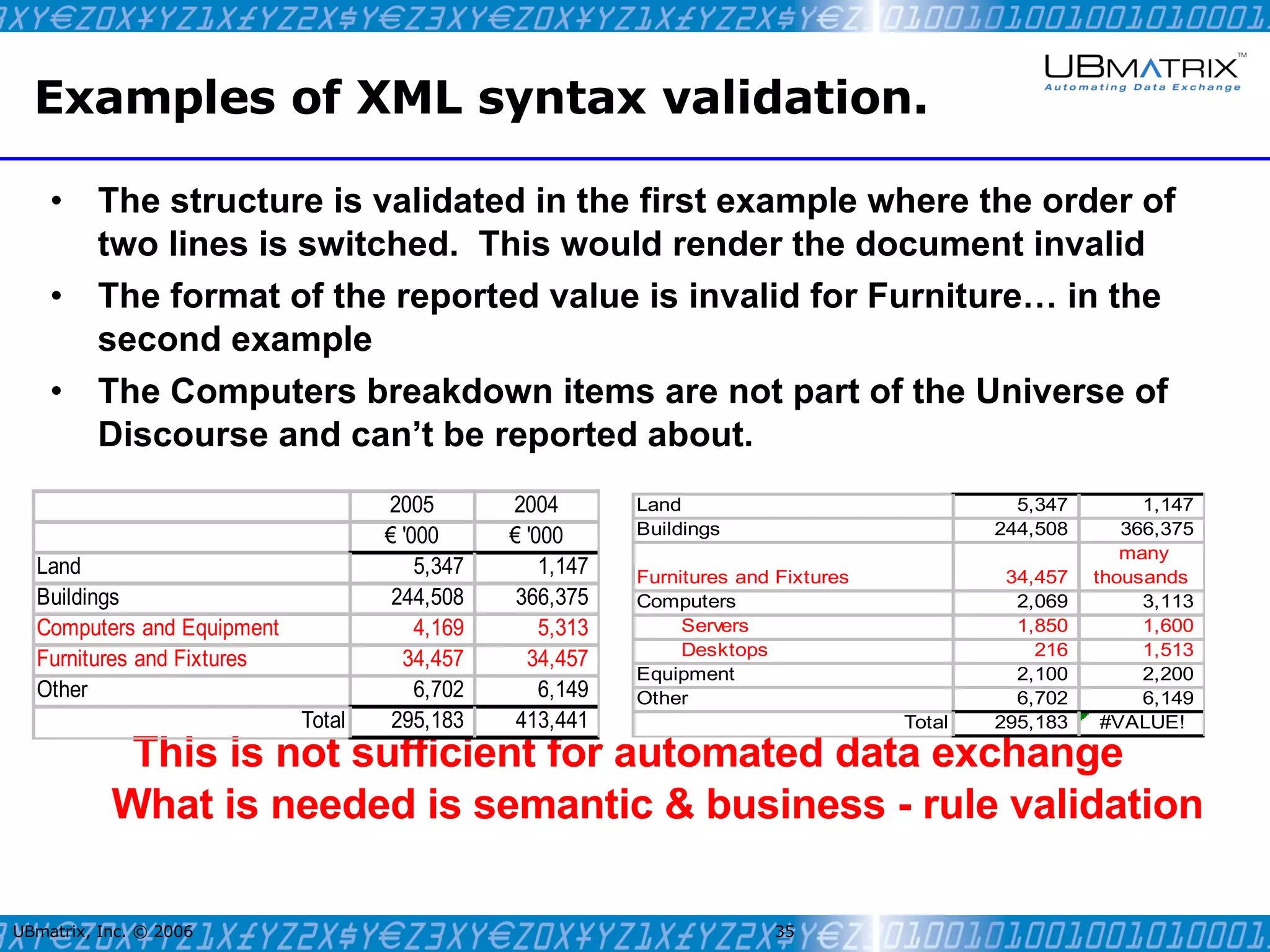
Examples of XML syntax validation. The structure is validated in the first example where the order of two lines is switched.  This would render the document invalid The format of the reported value is invalid for Furniture… in the second example The Computers breakdown items are not part of the Universe of Discourse and can’t be reported about. This is not sufficient for automated data exchange  What is needed is semantic & business - rule validation UBmatrix, Inc. © 2006
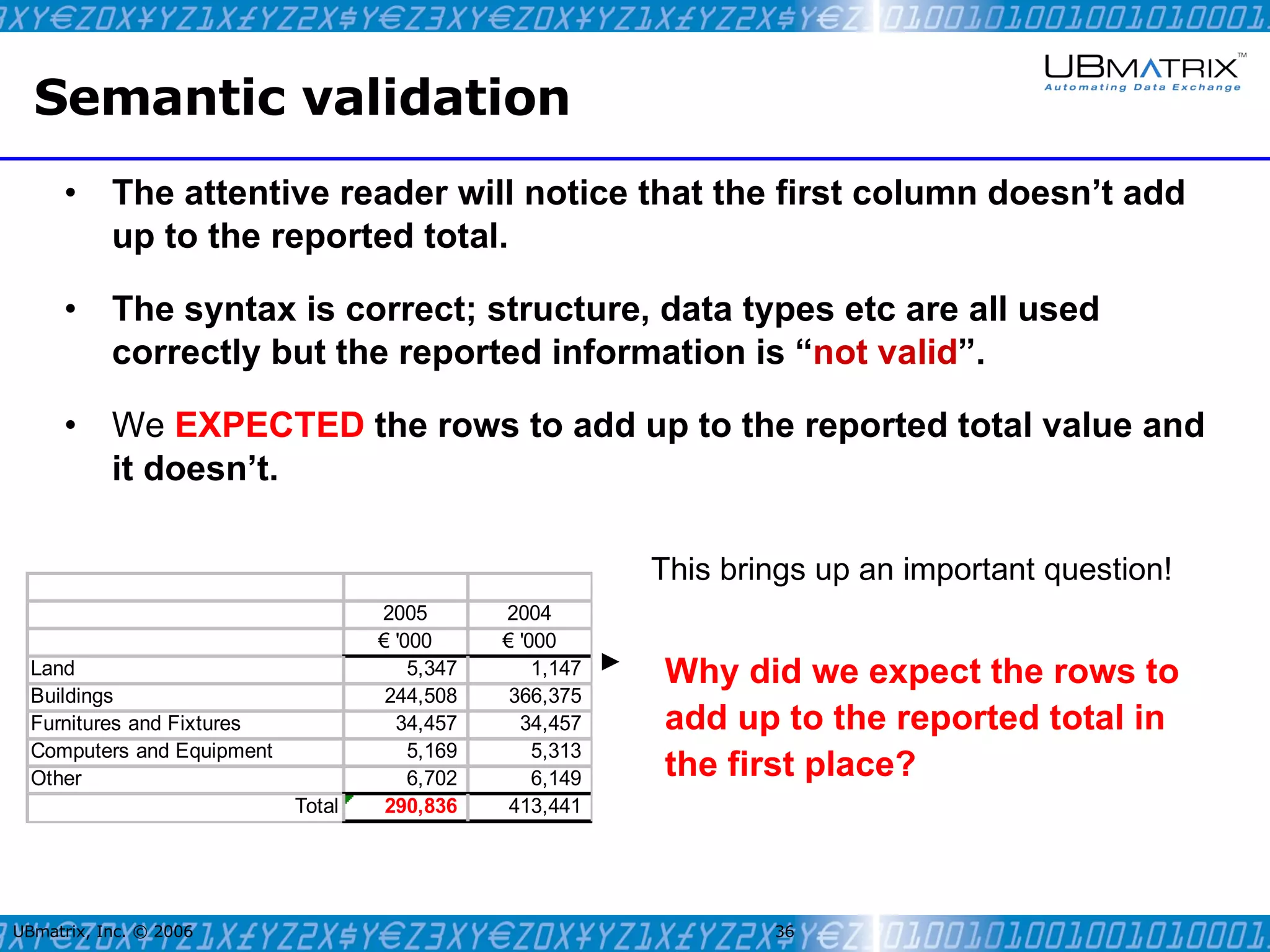
Semantic validation The attentive reader will notice that the first column doesn’t add up to the reported total. The syntax is correct; structure, data types etc are all used correctly but the reported information is “ not valid ”. We  EXPECTED  the rows to add up to the reported total value and it doesn’t. This brings up an important question! ► UBmatrix, Inc. © 2006   Why did we expect the rows to add up to the reported total in the first place?
How does XBRL solve these problems? The fundamental difference between XBRL and XML is that XBRL makes the associations between concepts explicit. Providing Unlimited Extensibility of Semantics Of the Language Markup UBmatrix, Inc. © 2006
Questions  ?

110 Introduction To Xbrl Taxonomies And Instance Documents Sept 2007 Print Version

  • 1.
    Technical Overview ofXBRL – Including XBRL vs. XML
  • 2.
    Agenda XBRL TaxonomiesXBRL Instance Documents Comparison of XBRL versus XML UBmatrix, Inc. © 2006
  • 3.
  • 4.
    Taxonomy Defines the concepts to be reported Concepts are defined as XBRL elements Basic attributes Relationships A taxonomy is a metadata repository . XBRL provides a model designed for financial reporting UBmatrix, Inc. © 2006
  • 5.
    Taxonomy UBmatrix, Inc.© 2006 XBRL Element Financial Reporting Concept Basic Attributes Relationships To other Concepts and Resources
  • 6.
    Taxonomy UBmatrix, Inc.© 2006 Fact: 420,818 Metadata XBRL Element: CashAndCashEquivalents Concept: Cash and Cash Equivalents Basic Attributes Relationships To other Concepts and Resources
  • 7.
    Simplest XBRL TaxonomyConsists of taxonomy “schema” Schema contains definitions of concepts, and links to additional taxonomy resources (if any) Have the .XSD file extension A concept definition with some of its basic attributes looks like this: <xsd:element name=“ CashAndCashEquivalents &quot; id=&quot; adobe_2004_ CashAndCashEquivalents &quot; type=&quot; xbrli:monetaryItemType &quot; substitutionGroup=&quot; xbrli:item &quot; nillable=&quot; true &quot; xbrli:periodType=&quot; duration &quot; /> UBmatrix, Inc. © 2006
  • 8.
    Anatomy of aTaxonomy Element UBmatrix, Inc. © 2006 XBRL Element Basic Attributes Data type Balance Type Period type Description Name (i.e. XBRL “Tag”) Label Decimal, Monetary, String, Tuple, etc Debit / Credit Instant / Duration “ Amount paid in excess of the value assigned to the identifiable net assets acquired”. GoodWillIntangible (camel case) e.g. - “Goodwill”, Different languages
  • 9.
    “ Richer” TaxonomyXBRL metadata model provides for the modelling of relationships Connects an element to another element or to a resource Connect elements that have a summation relationship Connect an element to a resource such as a label or documentation XBRL refers to this declaration as an arc UBmatrix, Inc. © 2006 XBRL Element XBRL Element or Resource Relationship arc
  • 10.
    Linkbases Linkbases arerepositories of arcs, that is, repositories of declared relationships. Linkbases have the .XML file extension Linkbase types: presentation, definition, label, calculation File relationships: UBmatrix, Inc. © 2007
  • 11.
    Relationships Label - provides human readable labels for the element names. Instructions and captions are label linkbases Can be in multiple languages Reference - provides the means to link the element to “ additional information ” , including authoritative references Presentation - describes the hierarchical order of the elements in a report Definition - describes how the elements relate to each other. Describes the parent child relationship. The accounting concept relationships Dimensions – data cube view, like a Pivot Table in Excel Calculation - defines calculations between two or more elements Formula – business rules and complex computations UBmatrix, Inc. © 2006
  • 12.
    Common Relationships UBmatrix,Inc. © 2006 XBRL Element Net Goodwill = Goodwill – Accumulated Amortization Relationships To other Elements or Resources Calculation Presentation Assets Cash & cash equivalents Property plant & equipment Goodwill Total Assets Relate a concept to… “ Cash”, “Open Cash Balance”, “Closing Cash Balance”, “Total Cash” “ Instructions: To complete this section of the report please refer policy number FDI349 Part 29” Label
  • 13.
    Other Relationship UBmatrix,Inc. © 2006 XBRL Element Publisher : FASB Name : Statement of Financial Accounting Stand. Number : 142 Paragraph : 23 URI : http:/www.fasb.org/pdf/fas142.pdf URIDate : 2005-08-01 Relationships To other Elements & Information (Linkbases) Reference Relate a reporting concept to a resource (documentation) Definition &quot;Total All Regions&quot; is the total of all regions, and the region breakdown includes &quot;US and Canada&quot;, &quot;Europe&quot;, &quot;Asia&quot;, and &quot;Other&quot;.
  • 14.
  • 15.
  • 16.
    XBRL Instance DocumentContains the facts Reporting context (e.g., December 2, 2005) Link to the taxonomy UBmatrix, Inc. © 2006
  • 17.
    Relationship to TaxonomyThe facts are constrained by the taxonomy Subject to robust internal checking by a validation process via an XBRL Processing Engine UBmatrix, Inc. © 2006
  • 18.
    Instance Document UBmatrix,Inc. © 2006 Taxonomy Financial Reporting Facts Input References <adobe-2004-balance:TotalCurrentAssets contextRef=”I2005-Consolidated” unitRef=”units-monetary” decimals=”0”>2008578 </adobe-2004-balance:TotalCurrentAssets > XBRL Instance Document Context
  • 19.
    Instance Document ValidationUBmatrix, Inc. © 2006 XBRL Instance Document XBRL Instance Document XBRL Instance Document … … … Taxonomy XBRL Processing Engine
  • 20.
    Anatomy of aInstance Document UBmatrix, Inc. © 2006 Instance Example, US GAAP Commercial and Industrial $ 420,818,000 Instructions, documentation …… Basic Attributes Values or Text Tags Import Taxonomy <usfr-pte:CashCashEquivalents decimals=&quot;-3&quot; contextRef=&quot;AsOf20051202_Consol_Unaudited&quot; unitRef=&quot;USD&quot;> 420818000 </usfr-pte:CashCashEquivalents>
  • 21.
    Anatomy of anFact UBmatrix, Inc. © 2006 C ontexts Scenario Entity Period Audited, Pro-forma, Restated, Unaudited Adobe, Systems Inc. Instant: As of 12/31/05 Start/End: 1/31/04 – 12/31/05 Measure Currency: USD, EUR, Shares, EPS U NIT Footnotes (2) In 2005, gain on sale of building $2.7 million, net of taxes $0.9 million. Segment Headquarters, Midland, Mi., Asia, Europe, North America P recision Decimal or Precision Number of significant figures Number of decimal places
  • 22.
    Financial Facts Twotypes of financial facts (concepts): Items, which represent individual facts Tuples, which group items Items must State their precision, if numeric Refer to a unit of measure, if numeric Refer to a context UBmatrix, Inc. © 2006 Financial Reporting Facts Scale is a presentation issue and is not defined in an instance document
  • 23.
    Financial Facts -Tuples Two types of financial facts (concepts): Items, which represent individual facts Tuples , which group items UBmatrix, Inc. © 2006 Financial Reporting Facts
  • 24.
  • 25.
  • 26.
    BASED ON ADOBE’sFinancial Statement What would be in schema document and what is its file extension? What parts of the statement are attributed to UPC? What is UPC? Of these linkbases label, presentation, calculation, reference, definition which would you except for the Adobe financial statement? What parts make up a context for Adobe? Do you see any tuples in that part of the financial statement? What is a tuple? What is scale and how is defined and where? How are entities identified? UBmatrix, Inc. © 2006 Professor X. Barrel wants to know?
  • 27.
    What is aXBRL taxonomy? Why are people working hard to use XBRL taxonomies and instance documents? What does Nillable and IsNil mean? UBmatrix, Inc. © 2006 Professor X. Barrel wants to know?
  • 28.
    Why does XMLnot meet the need of business reporting?
  • 29.
    XBRL is basedon XML XBRL is an XML-based markup language for defining business report structure and authoring business information . UBmatrix, Inc. © 2006
  • 30.
    Markup languages: XMLThe purpose of XML is: To provide a means to communicate the content of a “page” in a system independent manner. To provide a means to locate and retrieve information in XML pages UBmatrix, Inc. © 2006 <welcomeMsg target=“investor”> Dear Investor !</welcomeMsg> <welcomeMsg target=“analyst”> Dear Researcher !</welcomeMsg> <introPar language=“EN”> Welcome to our XBRL.Net website. We provide access to the … </introPar> <report> <entity name=“Internation Business Machines”> IBM <entity> <assets> 40,822,000,000,000 </assets> <currency > USD </currency> <assets> 40,700,000,000,000 </assets> <currency> EUR </currency> <year> 2001 </year> </report>
  • 31.
    XML Schema andInstance documents For an application to locate certain information Needs to know first if information is contained in a particular type (e.g. a financial statement based on the USGAAP) of XML document. The content structure is declared by the document definition The technology used for this is the DDML ( Document Definition Markup Language, formerly XSchema ) For an application to retrieve information from a XML document an instance document must use the tags defined in the DDML document that goes with it. UBmatrix, Inc. © 2006
  • 32.
    Why only XBRLfits the bill? There are two big problems with regular XML XSchema and Instance documents from a reporting perspective: XSchema document structures are fixed. You cannot add “your own” tags to the document structure. XSchema only provides syntactic validation XBRL specification enables creating and extending document structures while providing syntactic validation. The XBRL specification enables declaration of semantics and business rules validation. XML provides the right basis but is insufficient as an end-to-end solution platform UBmatrix, Inc. © 2006
  • 33.
    Why does amarkup language need to be flexible from a business reporting point of view? The XML language defines its document structures by means of the XSchema standard which defines these structure implicitly both with respect to the content and the “hierarchy”. If we take the financial statements as a reporting example: Same “information but different representation of the information” Regular XML XSchema DOES NOT ALLOW THIS flexibility UBmatrix, Inc. © 2006
  • 34.
    Why does amarkup language need to be flexible from a business reporting point of view? The XML language defines its document structures by means of the XSchema standard which defines these structure implicitly both with respect to the content and the “hierarchy”. If we take the financial statements as a reporting example: Same “information but with more detail in the lower level breakdown” Regular XML XSchema DOES NOT ALLOW THIS flexibility UBmatrix, Inc. © 2006
  • 35.
    Examples of XMLsyntax validation. The structure is validated in the first example where the order of two lines is switched. This would render the document invalid The format of the reported value is invalid for Furniture… in the second example The Computers breakdown items are not part of the Universe of Discourse and can’t be reported about. This is not sufficient for automated data exchange What is needed is semantic & business - rule validation UBmatrix, Inc. © 2006
  • 36.
    Semantic validation Theattentive reader will notice that the first column doesn’t add up to the reported total. The syntax is correct; structure, data types etc are all used correctly but the reported information is “ not valid ”. We EXPECTED the rows to add up to the reported total value and it doesn’t. This brings up an important question! ► UBmatrix, Inc. © 2006 Why did we expect the rows to add up to the reported total in the first place?
  • 37.
    How does XBRLsolve these problems? The fundamental difference between XBRL and XML is that XBRL makes the associations between concepts explicit. Providing Unlimited Extensibility of Semantics Of the Language Markup UBmatrix, Inc. © 2006
  • 38.

Editor's Notes

  • #2 UBmatrix, Inc. © 2006