XBRL Factor:
eXtensible Business Reporting Language
                is Here


                        September 21, 2010
Speakers
Gary Purnhagen
Director of Compliance Services
Gary.Purnhagen@BusinessWire.com
212-752-9600 ext. 1313


Ali Paksima
XBRL Accounting Manager
Ali.Paksima@BusinessWire.com
212-752-9600 ext. 1320
Agenda

• Overview

• SEC Rules

• Preparing for the SEC’s XBRL Mandate

• XBRL Conversion Process

• Lessons Learned from the First Wave of XBRL Submissions
What is XBRL?

• Business Reporting Language
  – Software can understand the content of business reports

• Document format mandated by SEC
  – New exhibits with financial statements, footnotes and
    schedules

• Open global standard
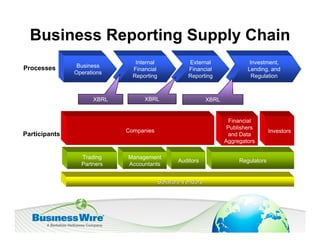
Business Reporting Supply Chain
                               Internal             External                 Investment,
Processes       Business
                              Financial             Financial               Lending, and
               Operations
                              Reporting             Reporting                 Regulation


                     XBRL         XBRL                       XBRL


                                                                      Financial
                                                                     Publishers
                            Companies                                                 Investors
Participants                                                         and Data
                                                                    Aggregators

                 Trading    Management
                                                 Auditors                Regulators
                 Partners   Accountants


                                          Software Vendors
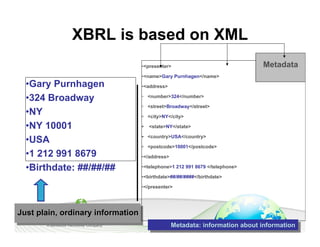
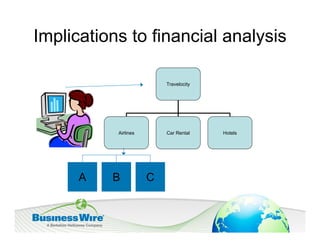
XBRL is based on XML
                                   •<presenter>                              Metadata
                                   •<name>Gary Purnhagen</name>
  •Gary Purnhagen                  •<address>

  •324 Broadway                    • <number>324</number>

                                   • <street>Broadway</street>
  •NY                              • <city>NY</city>

  •NY 10001                        •   <state>NY</state>

                                   • <country>USA</country>
  •USA
                                   • <postcode>10001</postcode>
  •1 212 991 8679                  •</address>

  •Birthdate: ##/##/##             •<telephone>1 212 991 8679 </telephone>

                                   •<birthdate>##/##/####</birthdate>

                                   •</presenter>


Just plain, ordinary information
                                                 Metadata: information about information
                                                 Metadata: information about information
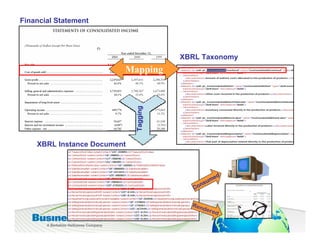
Financial Statement


                                       XBRL Taxonomy
                         Mapping


                             Tagging
    XBRL Instance Document


                                                       ed
                                                   s um
                                               n
                                          Co

                                         R en
                                                der
                                                      ed
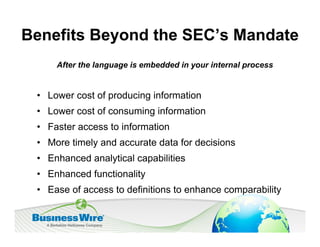
Benefits Beyond the SEC’s Mandate
     After the language is embedded in your internal process


 • Lower cost of producing information
 • Lower cost of consuming information
 • Faster access to information
 • More timely and accurate data for decisions
 • Enhanced analytical capabilities
 • Enhanced functionality
 • Ease of access to definitions to enhance comparability
Implications to financial analysis

                          Travelocity


           Airlines       Car Rental    Hotels


      A   B           C
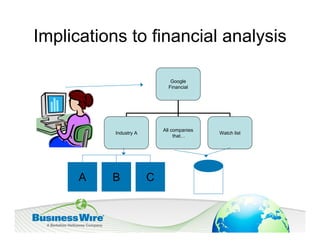
Implications to financial analysis

                               Google
                              Financial


                            All companies
           Industry A                       Watch list
                                 that…


      A   B             C
Summary of SEC Rules
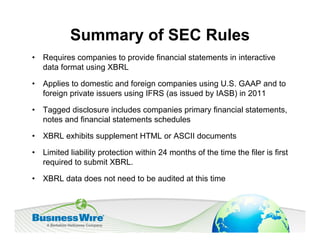
•   Requires companies to provide financial statements in interactive
    data format using XBRL

•   Applies to domestic and foreign companies using U.S. GAAP and to
    foreign private issuers using IFRS (as issued by IASB) in 2011

•   Tagged disclosure includes companies primary financial statements,
    notes and financial statements schedules

•   XBRL exhibits supplement HTML or ASCII documents

•   Limited liability protection within 24 months of the time the filer is first
    required to submit XBRL.

•   XBRL data does not need to be audited at this time
SEC Mandate
         3 Year Phase-In Schedule
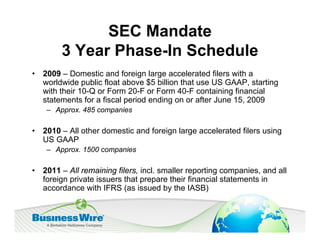
•   2009 – Domestic and foreign large accelerated filers with a
    worldwide public float above $5 billion that use US GAAP, starting
    with their 10-Q or Form 20-F or Form 40-F containing financial
    statements for a fiscal period ending on or after June 15, 2009
     – Approx. 485 companies

•   2010 – All other domestic and foreign large accelerated filers using
    US GAAP
     – Approx. 1500 companies

•   2011 – All remaining filers, incl. smaller reporting companies, and all
    foreign private issuers that prepare their financial statements in
    accordance with IFRS (as issued by the IASB)
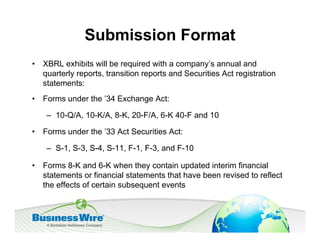
Submission Format
•   XBRL exhibits will be required with a company’s annual and
    quarterly reports, transition reports and Securities Act registration
    statements:
•   Forms under the ’34 Exchange Act:

     – 10-Q/A, 10-K/A, 8-K, 20-F/A, 6-K 40-F and 10

•   Forms under the ’33 Act Securities Act:

     – S-1, S-3, S-4, S-11, F-1, F-3, and F-10

•   Forms 8-K and 6-K when they contain updated interim financial
    statements or financial statements that have been revised to reflect
    the effects of certain subsequent events
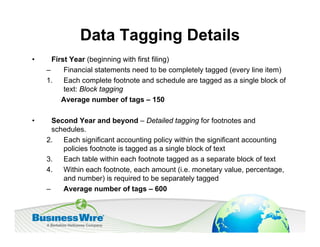
Data Tagging Details
•     First Year (beginning with first filing)
    –     Financial statements need to be completely tagged (every line item)
    1. Each complete footnote and schedule are tagged as a single block of
          text: Block tagging
         Average number of tags – 150

•     Second Year and beyond – Detailed tagging for footnotes and
      schedules.
    2. Each significant accounting policy within the significant accounting
         policies footnote is tagged as a single block of text
    3. Each table within each footnote tagged as a separate block of text
    4. Within each footnote, each amount (i.e. monetary value, percentage,
         and number) is required to be separately tagged
    –    Average number of tags – 600
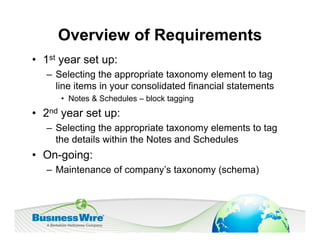
Overview of Requirements
• 1st year set up:
   – Selecting the appropriate taxonomy element to tag
     line items in your consolidated financial statements
      • Notes & Schedules – block tagging
• 2nd year set up:
   – Selecting the appropriate taxonomy elements to tag
     the details within the Notes and Schedules
• On-going:
   – Maintenance of company’s taxonomy (schema)
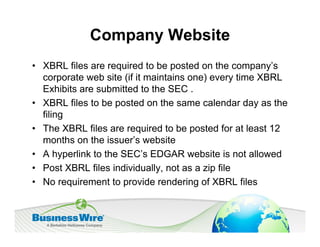
Company Website
• XBRL files are required to be posted on the company’s
  corporate web site (if it maintains one) every time XBRL
  Exhibits are submitted to the SEC .
• XBRL files to be posted on the same calendar day as the
  filing
• The XBRL files are required to be posted for at least 12
  months on the issuer’s website
• A hyperlink to the SEC’s EDGAR website is not allowed
• Post XBRL files individually, not as a zip file
• No requirement to provide rendering of XBRL files
Potential Expansion of Requirements

•   Audit requirement
•   MD&A
•   CD&A
•   Earning Releases
•   Corporate Actions
•   Eventually all business information will be
    tagged with XBRL
Current Status
• Roughly 475 companies have submitted XBRL exhibits
  for 5 reporting cycles
   – Over 75 % - outsourced
   – Less than 25 % - doing it themselves
• Validation issues
• Rendering issues – SEC’s viewer for XBRL files
• Now required to submit detailed tagging of footnotes and
  schedules
• Not much analysis of the data happening yet
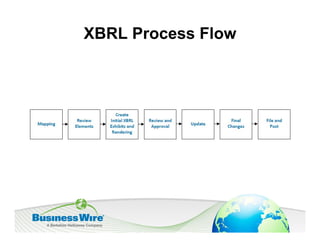
XBRL Process Flow
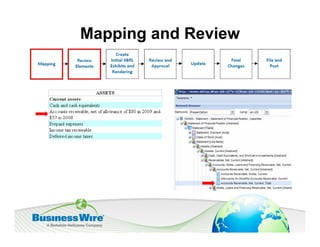
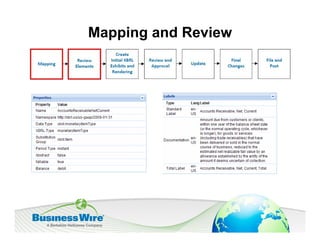
Mapping and Review
Mapping and Review
Mapping and Review


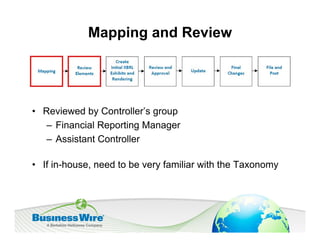
• Reviewed by Controller’s group
   – Financial Reporting Manager
   – Assistant Controller

• If in-house, need to be very familiar with the Taxonomy
Mapping and Review


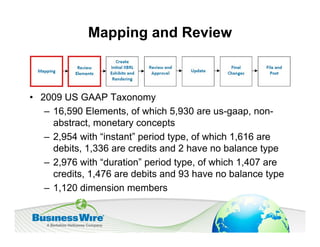
• 2009 US GAAP Taxonomy
   – 16,590 Elements, of which 5,930 are us-gaap, non-
     abstract, monetary concepts
   – 2,954 with “instant” period type, of which 1,616 are
     debits, 1,336 are credits and 2 have no balance type
   – 2,976 with “duration” period type, of which 1,407 are
     credits, 1,476 are debits and 93 have no balance type
   – 1,120 dimension members
Exhibits and Rendering


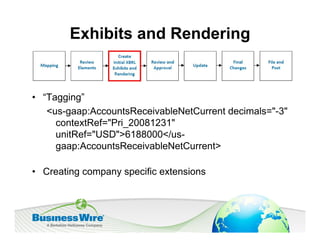
• “Tagging”
   <us-gaap:AccountsReceivableNetCurrent decimals="-3"
     contextRef="Pri_20081231"
     unitRef="USD">6188000</us-
     gaap:AccountsReceivableNetCurrent>

• Creating company specific extensions
Exhibits and Rendering


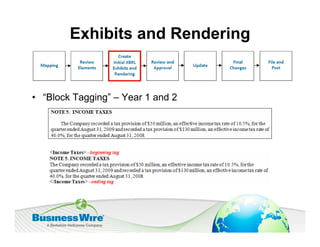
• “Block Tagging” – Year 1 and 2
Exhibits and Rendering


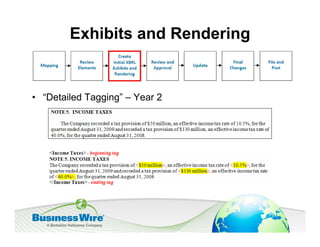
• “Detailed Tagging” – Year 2
Exhibits and Rendering


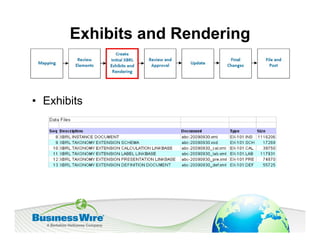
• Exhibits
Exhibits and Rendering


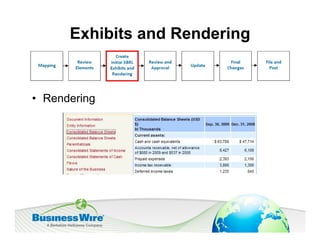
• Rendering
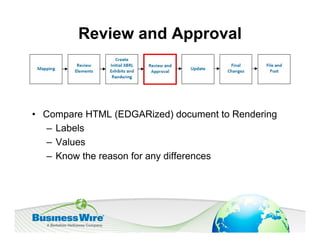
Review and Approval


• Compare HTML (EDGARized) document to Rendering
   – Labels
   – Values
   – Know the reason for any differences
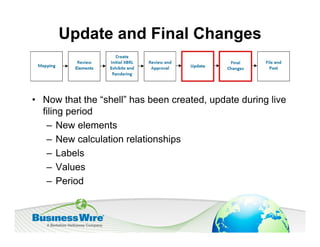
Update and Final Changes


• Now that the “shell” has been created, update during live
  filing period
   – New elements
   – New calculation relationships
   – Labels
   – Values
   – Period
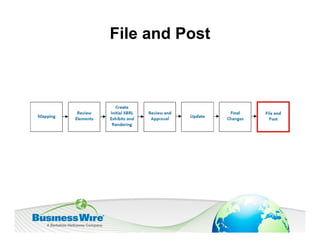
File and Post
Recommendations
• Start early
   – Best practice - six months prior to official filing day

•   Trial run
    – Quarter prior to official filing – without actually filing

•   Leave ample time for review during official filing period
    – Finalize significant changes (e.g., changes to elements,
      periods, etc.) well in advance of the official filing date.
Recommendations (continued)
•   Detailed review – throughout the process
    – Of inputs (elements, reporting period, decimals,
      value type) and outputs (rendering and validation
      results).
    – Validation – manual and automated
       • XBRL rules – see XBRL US Preparers guide
       • SEC rules – see EDGAR Filer Manual

•    A common mistake is to view the XBRL conversion process as
    merely an extension of the EDGARization process. Rather, XBRL
    conversion should be viewed as a blending of both the financial
    reporting process and the EDGARization process.
Recommendations (continued)


• The XBRL structure is more important than the
  presentation

• IR should be involved with company efforts. Who
  will be asked about it?
XBRL Limitations

Limitations
•   Rendering – SEC Viewer
     – Differences between HTML/ASCII and XBRL financial
       statements:
         • Column headings, Abstracts, Underlining, Formatting,
           Parenthetical information, Column/Row layout
     – Improvements made with update:
         • Different currencies
         • Nil concept
XBRL Considerations

Considerations
•   Segments / Dimensions – When appropriate to use, Impact on
    elements
•   FASB (as of February 5, 2010):
     – New Taxonomies
     – FAQ’s / Guidance on elements
•   SEC:
     – New guidance
     – Staff Observations
     – Validation rules (Chapter 6 of the EDGAR Filer Manual)
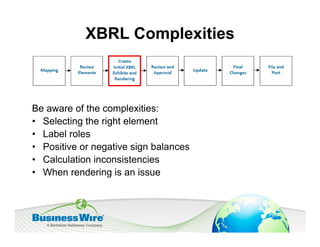
XBRL Complexities


Be aware of the complexities:
• Selecting the right element
• Label roles
• Positive or negative sign balances
• Calculation inconsistencies
• When rendering is an issue
In-House
    vs.
Outsourcing
Reasons for Performing
            Work In-House

1.   You know your financials better than anyone else
2.   Cost containment
3.   Will need to learn the language sooner or later
4.   Corporate culture
You Know Your Financials Better
      Than Anyone Else

• True, but learning XBRL is a significant undertaking
• Surveys indicate that it takes companies on average
  over 120 hours
• An ideal approach is to work with a service provider to
  ensure proper taxonomy element selection
Cost Containment
• Internal cost:
   – Time to learn XBRL, map and tag financials to
     taxonomy…
   – Software cost
   – Freeing up personnel
   – SEC estimates
      • Year One - $76,860 - $146,240
      • Year Two - $ 93,925 to $173,970
  External cost:
  – Market is charging considerably less
Will Need to Learn the Language
        Sooner or Later

• Applications will not require you to learn XBRL

• Orbitz, Travelocity, Amazon are all based on XML. We
  don’t need to know that language to operate these
  applications

• Unfortunately, this is not the case with XBRL software
Corporate Culture
•   Typically, convert and submit SEC filings in-house

•   Plan accordingly:
     1. Expertise
         –   XBRL US GAAP Taxonomy Preparers Guide
         –   SEC EDGAR Filer Manual
     2. Software
     3. Time

•   Valid strategy: outsource for first two years then take
    XBRL work in-house
     – Taxonomy selection complete
     – Software will be improved
Recommendations
• Work with a service provider that has
  expertise with:
  – Financial reporting & US GAAP
  – EDGAR & XBRL
• Collaborate with a service provider that
  works directly with your financials in
  selecting the taxonomy elements
  Best practice – assigned taxonomists
Business Wire
• Leading EDGAR filer
• Offering XBRL services since 2005
   – XBRL and EDGAR work performed in-house
   – Companies work directly with dedicated taxonomist
• Leading provider of Investor Relations Services
• Global market leader in commercial news distribution
• A trusted partner for all of your Disclosure requirements
Questions ?
Gary Purnhagen
Director of Compliance Services
Gary.Purnhagen@BusinessWire.com
212-752-9600 ext. 1313


Ali Paksima
XBRL Accounting Manager
Ali.Paksima@BusinessWire.com
212-752-9600 ext. 1320

XBRL Factor: Extensible Business Reporting Language is Here

  • 1.
    XBRL Factor: eXtensible BusinessReporting Language is Here September 21, 2010
  • 2.
    Speakers Gary Purnhagen Director ofCompliance Services Gary.Purnhagen@BusinessWire.com 212-752-9600 ext. 1313 Ali Paksima XBRL Accounting Manager Ali.Paksima@BusinessWire.com 212-752-9600 ext. 1320
  • 3.
    Agenda • Overview • SECRules • Preparing for the SEC’s XBRL Mandate • XBRL Conversion Process • Lessons Learned from the First Wave of XBRL Submissions
  • 4.
    What is XBRL? •Business Reporting Language – Software can understand the content of business reports • Document format mandated by SEC – New exhibits with financial statements, footnotes and schedules • Open global standard
  • 5.
    Business Reporting SupplyChain Internal External Investment, Processes Business Financial Financial Lending, and Operations Reporting Reporting Regulation XBRL XBRL XBRL Financial Publishers Companies Investors Participants and Data Aggregators Trading Management Auditors Regulators Partners Accountants Software Vendors
  • 6.
    XBRL is basedon XML •<presenter> Metadata •<name>Gary Purnhagen</name> •Gary Purnhagen •<address> •324 Broadway • <number>324</number> • <street>Broadway</street> •NY • <city>NY</city> •NY 10001 • <state>NY</state> • <country>USA</country> •USA • <postcode>10001</postcode> •1 212 991 8679 •</address> •Birthdate: ##/##/## •<telephone>1 212 991 8679 </telephone> •<birthdate>##/##/####</birthdate> •</presenter> Just plain, ordinary information Metadata: information about information Metadata: information about information
  • 7.
    Financial Statement XBRL Taxonomy Mapping Tagging XBRL Instance Document ed s um n Co R en der ed
  • 8.
    Benefits Beyond theSEC’s Mandate After the language is embedded in your internal process • Lower cost of producing information • Lower cost of consuming information • Faster access to information • More timely and accurate data for decisions • Enhanced analytical capabilities • Enhanced functionality • Ease of access to definitions to enhance comparability
  • 9.
    Implications to financialanalysis Travelocity Airlines Car Rental Hotels A B C
  • 10.
    Implications to financialanalysis Google Financial All companies Industry A Watch list that… A B C
  • 11.
    Summary of SECRules • Requires companies to provide financial statements in interactive data format using XBRL • Applies to domestic and foreign companies using U.S. GAAP and to foreign private issuers using IFRS (as issued by IASB) in 2011 • Tagged disclosure includes companies primary financial statements, notes and financial statements schedules • XBRL exhibits supplement HTML or ASCII documents • Limited liability protection within 24 months of the time the filer is first required to submit XBRL. • XBRL data does not need to be audited at this time
  • 12.
    SEC Mandate 3 Year Phase-In Schedule • 2009 – Domestic and foreign large accelerated filers with a worldwide public float above $5 billion that use US GAAP, starting with their 10-Q or Form 20-F or Form 40-F containing financial statements for a fiscal period ending on or after June 15, 2009 – Approx. 485 companies • 2010 – All other domestic and foreign large accelerated filers using US GAAP – Approx. 1500 companies • 2011 – All remaining filers, incl. smaller reporting companies, and all foreign private issuers that prepare their financial statements in accordance with IFRS (as issued by the IASB)
  • 13.
    Submission Format • XBRL exhibits will be required with a company’s annual and quarterly reports, transition reports and Securities Act registration statements: • Forms under the ’34 Exchange Act: – 10-Q/A, 10-K/A, 8-K, 20-F/A, 6-K 40-F and 10 • Forms under the ’33 Act Securities Act: – S-1, S-3, S-4, S-11, F-1, F-3, and F-10 • Forms 8-K and 6-K when they contain updated interim financial statements or financial statements that have been revised to reflect the effects of certain subsequent events
  • 14.
    Data Tagging Details • First Year (beginning with first filing) – Financial statements need to be completely tagged (every line item) 1. Each complete footnote and schedule are tagged as a single block of text: Block tagging Average number of tags – 150 • Second Year and beyond – Detailed tagging for footnotes and schedules. 2. Each significant accounting policy within the significant accounting policies footnote is tagged as a single block of text 3. Each table within each footnote tagged as a separate block of text 4. Within each footnote, each amount (i.e. monetary value, percentage, and number) is required to be separately tagged – Average number of tags – 600
  • 15.
    Overview of Requirements •1st year set up: – Selecting the appropriate taxonomy element to tag line items in your consolidated financial statements • Notes & Schedules – block tagging • 2nd year set up: – Selecting the appropriate taxonomy elements to tag the details within the Notes and Schedules • On-going: – Maintenance of company’s taxonomy (schema)
  • 16.
    Company Website • XBRLfiles are required to be posted on the company’s corporate web site (if it maintains one) every time XBRL Exhibits are submitted to the SEC . • XBRL files to be posted on the same calendar day as the filing • The XBRL files are required to be posted for at least 12 months on the issuer’s website • A hyperlink to the SEC’s EDGAR website is not allowed • Post XBRL files individually, not as a zip file • No requirement to provide rendering of XBRL files
  • 17.
    Potential Expansion ofRequirements • Audit requirement • MD&A • CD&A • Earning Releases • Corporate Actions • Eventually all business information will be tagged with XBRL
  • 18.
    Current Status • Roughly475 companies have submitted XBRL exhibits for 5 reporting cycles – Over 75 % - outsourced – Less than 25 % - doing it themselves • Validation issues • Rendering issues – SEC’s viewer for XBRL files • Now required to submit detailed tagging of footnotes and schedules • Not much analysis of the data happening yet
  • 19.
  • 20.
  • 21.
  • 22.
    Mapping and Review •Reviewed by Controller’s group – Financial Reporting Manager – Assistant Controller • If in-house, need to be very familiar with the Taxonomy
  • 23.
    Mapping and Review •2009 US GAAP Taxonomy – 16,590 Elements, of which 5,930 are us-gaap, non- abstract, monetary concepts – 2,954 with “instant” period type, of which 1,616 are debits, 1,336 are credits and 2 have no balance type – 2,976 with “duration” period type, of which 1,407 are credits, 1,476 are debits and 93 have no balance type – 1,120 dimension members
  • 24.
    Exhibits and Rendering •“Tagging” <us-gaap:AccountsReceivableNetCurrent decimals="-3" contextRef="Pri_20081231" unitRef="USD">6188000</us- gaap:AccountsReceivableNetCurrent> • Creating company specific extensions
  • 25.
    Exhibits and Rendering •“Block Tagging” – Year 1 and 2
  • 26.
    Exhibits and Rendering •“Detailed Tagging” – Year 2
  • 27.
  • 28.
  • 29.
    Review and Approval •Compare HTML (EDGARized) document to Rendering – Labels – Values – Know the reason for any differences
  • 30.
    Update and FinalChanges • Now that the “shell” has been created, update during live filing period – New elements – New calculation relationships – Labels – Values – Period
  • 31.
  • 32.
    Recommendations • Start early – Best practice - six months prior to official filing day • Trial run – Quarter prior to official filing – without actually filing • Leave ample time for review during official filing period – Finalize significant changes (e.g., changes to elements, periods, etc.) well in advance of the official filing date.
  • 33.
    Recommendations (continued) • Detailed review – throughout the process – Of inputs (elements, reporting period, decimals, value type) and outputs (rendering and validation results). – Validation – manual and automated • XBRL rules – see XBRL US Preparers guide • SEC rules – see EDGAR Filer Manual • A common mistake is to view the XBRL conversion process as merely an extension of the EDGARization process. Rather, XBRL conversion should be viewed as a blending of both the financial reporting process and the EDGARization process.
  • 34.
    Recommendations (continued) • TheXBRL structure is more important than the presentation • IR should be involved with company efforts. Who will be asked about it?
  • 35.
    XBRL Limitations Limitations • Rendering – SEC Viewer – Differences between HTML/ASCII and XBRL financial statements: • Column headings, Abstracts, Underlining, Formatting, Parenthetical information, Column/Row layout – Improvements made with update: • Different currencies • Nil concept
  • 36.
    XBRL Considerations Considerations • Segments / Dimensions – When appropriate to use, Impact on elements • FASB (as of February 5, 2010): – New Taxonomies – FAQ’s / Guidance on elements • SEC: – New guidance – Staff Observations – Validation rules (Chapter 6 of the EDGAR Filer Manual)
  • 37.
    XBRL Complexities Be awareof the complexities: • Selecting the right element • Label roles • Positive or negative sign balances • Calculation inconsistencies • When rendering is an issue
  • 38.
    In-House vs. Outsourcing
  • 39.
    Reasons for Performing Work In-House 1. You know your financials better than anyone else 2. Cost containment 3. Will need to learn the language sooner or later 4. Corporate culture
  • 40.
    You Know YourFinancials Better Than Anyone Else • True, but learning XBRL is a significant undertaking • Surveys indicate that it takes companies on average over 120 hours • An ideal approach is to work with a service provider to ensure proper taxonomy element selection
  • 41.
    Cost Containment • Internalcost: – Time to learn XBRL, map and tag financials to taxonomy… – Software cost – Freeing up personnel – SEC estimates • Year One - $76,860 - $146,240 • Year Two - $ 93,925 to $173,970 External cost: – Market is charging considerably less
  • 42.
    Will Need toLearn the Language Sooner or Later • Applications will not require you to learn XBRL • Orbitz, Travelocity, Amazon are all based on XML. We don’t need to know that language to operate these applications • Unfortunately, this is not the case with XBRL software
  • 43.
    Corporate Culture • Typically, convert and submit SEC filings in-house • Plan accordingly: 1. Expertise – XBRL US GAAP Taxonomy Preparers Guide – SEC EDGAR Filer Manual 2. Software 3. Time • Valid strategy: outsource for first two years then take XBRL work in-house – Taxonomy selection complete – Software will be improved
  • 44.
    Recommendations • Work witha service provider that has expertise with: – Financial reporting & US GAAP – EDGAR & XBRL • Collaborate with a service provider that works directly with your financials in selecting the taxonomy elements Best practice – assigned taxonomists
  • 45.
    Business Wire • LeadingEDGAR filer • Offering XBRL services since 2005 – XBRL and EDGAR work performed in-house – Companies work directly with dedicated taxonomist • Leading provider of Investor Relations Services • Global market leader in commercial news distribution • A trusted partner for all of your Disclosure requirements
  • 46.
    Questions ? Gary Purnhagen Directorof Compliance Services Gary.Purnhagen@BusinessWire.com 212-752-9600 ext. 1313 Ali Paksima XBRL Accounting Manager Ali.Paksima@BusinessWire.com 212-752-9600 ext. 1320