eXtensiable Business Reporting Language


                                By: Divyashree
 Language for electronic
  communication.
 Family of XML.
 Open standard, free of licence
  fees.
 Implementation of XBRL are
  growing.
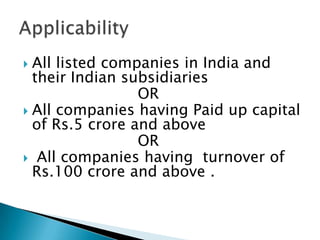
 All listed companies in India and
  their Indian subsidiaries
                 OR
 All companies having Paid up capital
  of Rs.5 crore and above
                 OR
 All companies having turnover of
  Rs.100 crore and above .
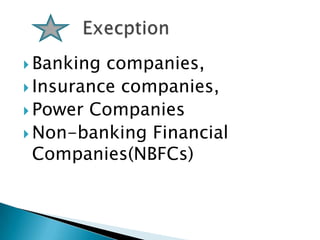
 Banking companies,
 Insurance companies,
 Power Companies
 Non-banking Financial
  Companies(NBFCs)
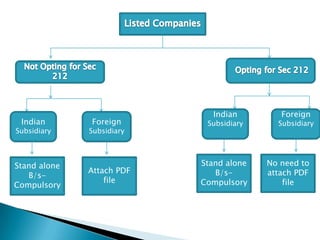
Indian         Foreign
 Indian       Foreign       Subsidiary     Subsidiary
Subsidiary    Subsidiary


Stand alone                Stand alone   No need to
              Attach PDF      B/s-       attach PDF
   B/s-
                  file     Compulsory        file
Compulsory
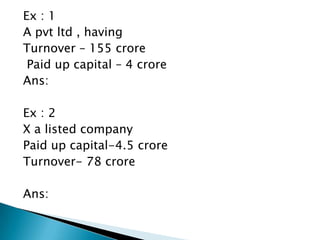
Ex : 1
A pvt ltd , having
Turnover – 155 crore
 Paid up capital – 4 crore
Ans:

Ex : 2
X a listed company
Paid up capital-4.5 crore
Turnover- 78 crore

Ans:
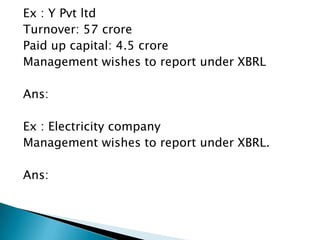
Ex : Y Pvt ltd
Turnover: 57 crore
Paid up capital: 4.5 crore
Management wishes to report under XBRL

Ans:

Ex : Electricity company
Management wishes to report under XBRL.

Ans:
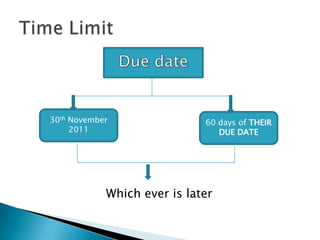
30th November                60 days of THEIR
     2011                       DUE DATE


            Which ever is later
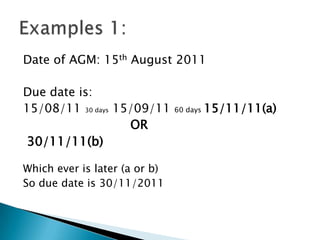
Date of AGM: 15th August 2011

Due date is:
15/08/11 30 days 15/09/11      60 days   15/11/11(a)
                   OR
 30/11/11(b)

Which ever is later (a or b)
So due date is 30/11/2011
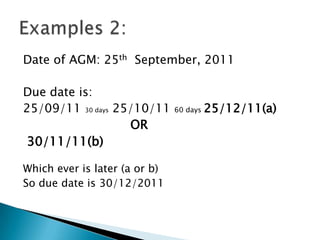
Date of AGM: 25th September, 2011

Due date is:
25/09/11 30 days 25/10/11      60 days   25/12/11(a)
                   OR
 30/11/11(b)

Which ever is later (a or b)
So due date is 30/12/2011
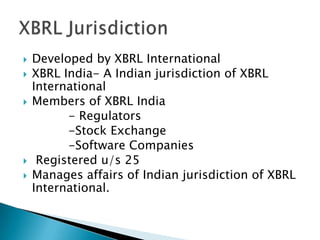
   Developed by XBRL International
   XBRL India- A Indian jurisdiction of XBRL
    International
   Members of XBRL India
          - Regulators
          -Stock Exchange
          -Software Companies
    Registered u/s 25
   Manages affairs of Indian jurisdiction of XBRL
    International.
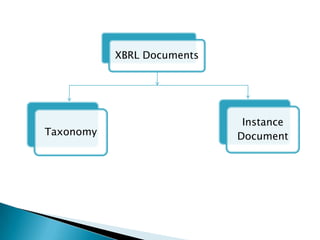
XBRL Documents


                             Instance
Taxonomy                    Document
   Dictionary
   Electronic description
   Regulated by requirements and standards
   Country specific
   Developed for Indian Companies on basis of
           -Schedule VI of Companies act
           -Accounting Standards, issued by ICAI
           -SEBI listing Requirements
 Elements  defined – are referred as
  “XBRL Tags”
 Taxonomy and instance document is
  collection of tags
 Enables the computer to understand
  XBRL instance and taxonomy
XBRL tag on “Employee Benefits expense”
Represents
1.   Fact
2.   Name of entity
3.   Period
4.   Meaning
5.   Accounting reference
6.   Scalar Factor
7.   Unit
 Business   report in electronic
  format
 Linked
 Contains Facts with their values
 Explanation to the contexts which
  they are placed
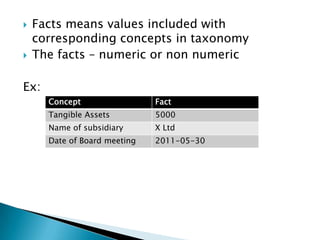
   Facts means values included with
    corresponding concepts in taxonomy
   The facts – numeric or non numeric

Ex:
      Concept                 Fact
      Tangible Assets         5000
      Name of subsidiary      X Ltd
      Date of Board meeting   2011-05-30
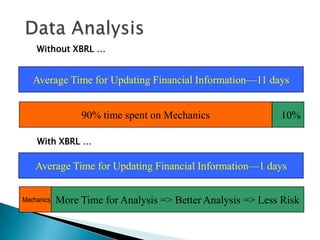
Without XBRL …


   Average Time for Updating Financial Information—11 days


              Value-added Analysis and Decision-making?
                 90% time spent on Mechanics              10%

    With XBRL …

    Average Time for Updating Financial Information—1 days


Mechanics   More Time for AnalysisXBRL? Analysis => Less Risk
                            With => Better
   Time and Cost saving
   Flexibility
   Enhances usability of Financial Statements
   Transparency
   Multiple language Capacity
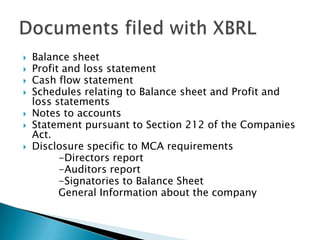
   Balance sheet
   Profit and loss statement
   Cash flow statement
   Schedules relating to Balance sheet and Profit and
    loss statements
   Notes to accounts
   Statement pursuant to Section 212 of the Companies
    Act.
   Disclosure specific to MCA requirements
          -Directors report
          -Auditors report
          -Signatories to Balance Sheet
          General Information about the company
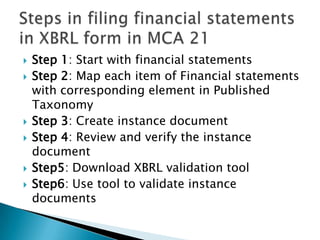
   Step 1: Start with financial statements
   Step 2: Map each item of Financial statements
    with corresponding element in Published
    Taxonomy
   Step 3: Create instance document
   Step 4: Review and verify the instance
    document
   Step5: Download XBRL validation tool
   Step6: Use tool to validate instance
    documents
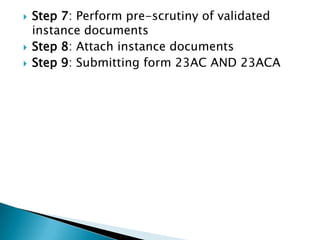
   Step 7: Perform pre-scrutiny of validated
    instance documents
   Step 8: Attach instance documents
   Step 9: Submitting form 23AC AND 23ACA

Overview on XBRL

  • 1.
    eXtensiable Business ReportingLanguage By: Divyashree
  • 2.
     Language forelectronic communication.  Family of XML.  Open standard, free of licence fees.  Implementation of XBRL are growing.
  • 3.
     All listedcompanies in India and their Indian subsidiaries OR  All companies having Paid up capital of Rs.5 crore and above OR  All companies having turnover of Rs.100 crore and above .
  • 4.
     Banking companies, Insurance companies,  Power Companies  Non-banking Financial Companies(NBFCs)
  • 5.
    Indian Foreign Indian Foreign Subsidiary Subsidiary Subsidiary Subsidiary Stand alone Stand alone No need to Attach PDF B/s- attach PDF B/s- file Compulsory file Compulsory
  • 6.
    Ex : 1 Apvt ltd , having Turnover – 155 crore Paid up capital – 4 crore Ans: Ex : 2 X a listed company Paid up capital-4.5 crore Turnover- 78 crore Ans:
  • 7.
    Ex : YPvt ltd Turnover: 57 crore Paid up capital: 4.5 crore Management wishes to report under XBRL Ans: Ex : Electricity company Management wishes to report under XBRL. Ans:
  • 8.
    30th November 60 days of THEIR 2011 DUE DATE Which ever is later
  • 9.
    Date of AGM:15th August 2011 Due date is: 15/08/11 30 days 15/09/11 60 days 15/11/11(a) OR 30/11/11(b) Which ever is later (a or b) So due date is 30/11/2011
  • 10.
    Date of AGM:25th September, 2011 Due date is: 25/09/11 30 days 25/10/11 60 days 25/12/11(a) OR 30/11/11(b) Which ever is later (a or b) So due date is 30/12/2011
  • 11.
    Developed by XBRL International  XBRL India- A Indian jurisdiction of XBRL International  Members of XBRL India - Regulators -Stock Exchange -Software Companies  Registered u/s 25  Manages affairs of Indian jurisdiction of XBRL International.
  • 12.
    XBRL Documents Instance Taxonomy Document
  • 13.
    Dictionary  Electronic description  Regulated by requirements and standards  Country specific  Developed for Indian Companies on basis of -Schedule VI of Companies act -Accounting Standards, issued by ICAI -SEBI listing Requirements
  • 14.
     Elements defined – are referred as “XBRL Tags”  Taxonomy and instance document is collection of tags  Enables the computer to understand XBRL instance and taxonomy
  • 15.
    XBRL tag on“Employee Benefits expense” Represents 1. Fact 2. Name of entity 3. Period 4. Meaning 5. Accounting reference 6. Scalar Factor 7. Unit
  • 16.
     Business report in electronic format  Linked  Contains Facts with their values  Explanation to the contexts which they are placed
  • 17.
    Facts means values included with corresponding concepts in taxonomy  The facts – numeric or non numeric Ex: Concept Fact Tangible Assets 5000 Name of subsidiary X Ltd Date of Board meeting 2011-05-30
  • 19.
    Without XBRL … Average Time for Updating Financial Information—11 days Value-added Analysis and Decision-making? 90% time spent on Mechanics 10% With XBRL … Average Time for Updating Financial Information—1 days Mechanics More Time for AnalysisXBRL? Analysis => Less Risk With => Better
  • 20.
    Time and Cost saving  Flexibility  Enhances usability of Financial Statements  Transparency  Multiple language Capacity
  • 21.
    Balance sheet  Profit and loss statement  Cash flow statement  Schedules relating to Balance sheet and Profit and loss statements  Notes to accounts  Statement pursuant to Section 212 of the Companies Act.  Disclosure specific to MCA requirements -Directors report -Auditors report -Signatories to Balance Sheet General Information about the company
  • 22.
    Step 1: Start with financial statements  Step 2: Map each item of Financial statements with corresponding element in Published Taxonomy  Step 3: Create instance document  Step 4: Review and verify the instance document  Step5: Download XBRL validation tool  Step6: Use tool to validate instance documents
  • 23.
    Step 7: Perform pre-scrutiny of validated instance documents  Step 8: Attach instance documents  Step 9: Submitting form 23AC AND 23ACA