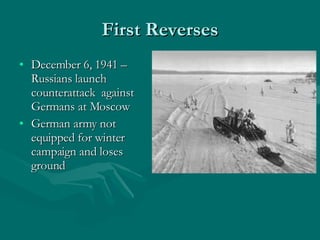
First Reverses December 6, 1941 – Russians launch counterattack  against Germans at Moscow German army not equipped for winter campaign and loses ground
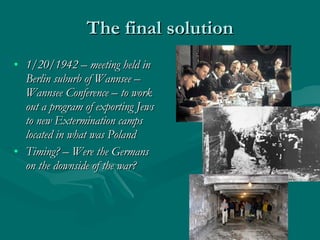
The final solution 1/20/1942 – meeting held in Berlin suburb of Wannsee – Wannsee Conference – to work out a program of exporting Jews to new Extermination camps located in what was Poland Timing? – Were the Germans on the downside of the war?
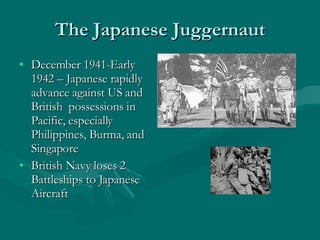
The Japanese Juggernaut December 1941-Early 1942 – Japanese rapidly advance against US and British  possessions in Pacific, especially Philippines, Burma, and Singapore British Navy loses 2 Battleships to Japanese Aircraft
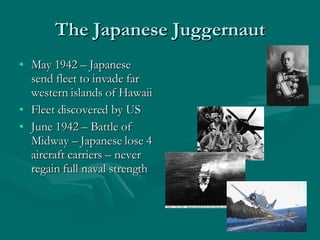
The Japanese Juggernaut May 1942 – Japanese send fleet to invade far western islands of Hawaii Fleet discovered by US June 1942 – Battle of Midway – Japanese lose 4 aircraft carriers – never regain full naval strength
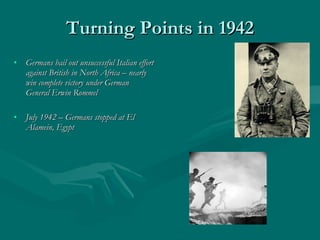
Turning Points in 1942 Germans bail out unsuccessful Italian effort against British in North Africa – nearly win complete victory under German General Erwin Rommel July 1942 – Germans stopped at El Alamein, Egypt
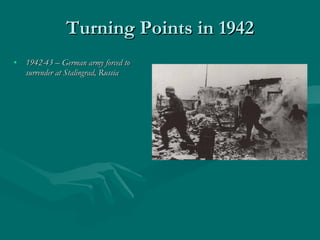
Turning Points in 1942 1942-43 – German army forced to surrender at Stalingrad, Russia
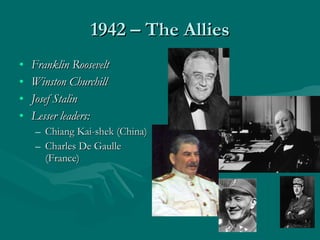
1942 – The Allies Franklin Roosevelt Winston Churchill Josef Stalin Lesser leaders: Chiang Kai-shek (China) Charles De Gaulle (France)
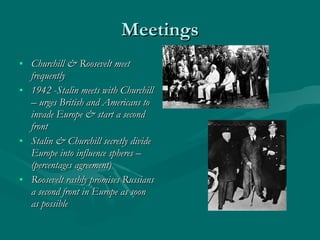
Meetings Churchill & Roosevelt meet frequently 1942 -Stalin meets with Churchill – urges British and Americans to invade Europe & start a second front Stalin & Churchill secretly divide Europe into influence spheres – (percentages agreement) Roosevelt rashly promises Russians a second front in Europe as soon as possible
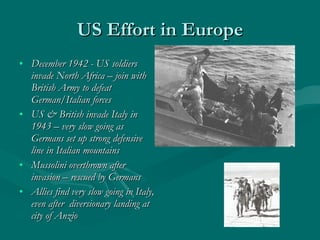
US Effort in Europe December 1942 - US soldiers invade North Africa – join with British Army to defeat German/Italian forces US & British invade Italy in 1943 – very slow going as Germans set up strong defensive line in Italian mountains Mussolini overthrown after invasion – rescued by Germans Allies find very slow going in Italy, even after  diversionary landing at city of Anzio
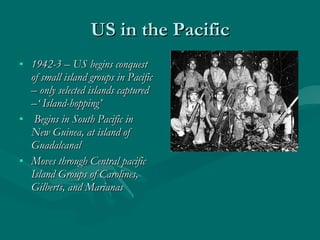
US in the Pacific 1942-3 – US begins conquest of small island groups in Pacific – only selected islands captured –‘ Island-hopping’ Begins in South Pacific in New Guinea, at island of Guadalcanal Moves through Central pacific Island Groups of Carolines, Gilberts, and Marianas
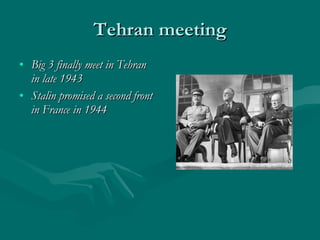
Tehran meeting Big 3 finally meet in Tehran in late 1943 Stalin promised a second front in France in 1944
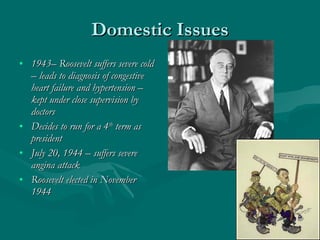
Domestic Issues 1943– Roosevelt suffers severe cold – leads to diagnosis of congestive heart failure and hypertension – kept under close supervision by doctors Decides to run for a 4 th  term as president July 20, 1944 – suffers severe angina attack Roosevelt elected in November 1944
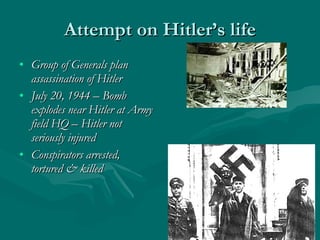
Attempt on Hitler’s life Group of Generals plan assassination of Hitler July 20, 1944 – Bomb explodes near Hitler at Army field HQ – Hitler not seriously injured Conspirators arrested, tortured & killed
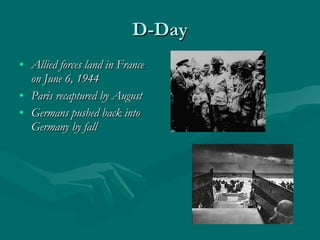
D-Day Allied forces land in France on June 6, 1944 Paris recaptured by August Germans pushed back into Germany by fall
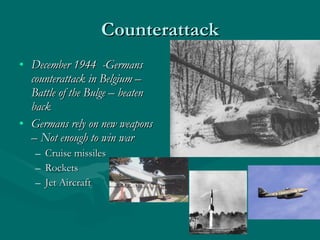
Counterattack December 1944  -Germans counterattack in Belgium – Battle of the Bulge – beaten back Germans rely on new weapons – Not enough to win war Cruise missiles Rockets Jet Aircraft
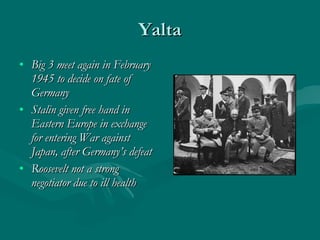
Yalta Big 3 meet again in February 1945 to decide on fate of Germany Stalin given free hand in Eastern Europe in exchange for entering War against Japan, after Germany’s defeat Roosevelt not a strong negotiator due to ill health
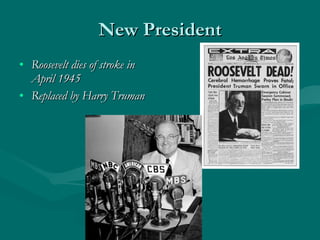
New President Roosevelt dies of stroke in April 1945 Replaced by Harry Truman
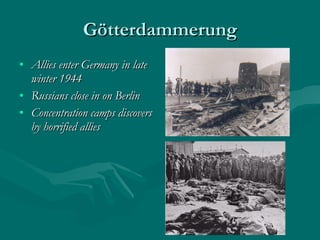
Götterdammerung Allies enter Germany in late winter 1944 Russians close in on Berlin Concentration camps discovers by horrified allies
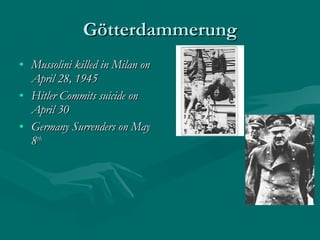
Götterdammerung Mussolini killed in Milan on April 28, 1945 Hitler Commits suicide on April 30 Germany Surrenders on May 8 th
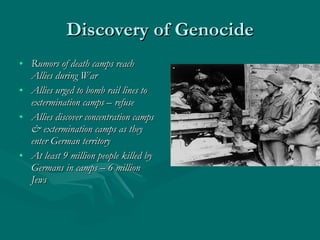
Discovery of Genocide Rumors of death camps reach Allies during War Allies urged to bomb rail lines to extermination camps – refuse Allies discover concentration camps & extermination camps as they enter German territory At least 9 million people killed by Germans in camps – 6 million Jews
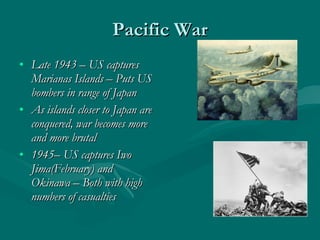
Pacific War Late 1943 – US captures Marianas Islands – Puts US bombers in range of Japan As islands closer to Japan are conquered, war becomes more and more brutal 1945– US captures Iwo Jima(February) and Okinawa – Both with high numbers of casualties
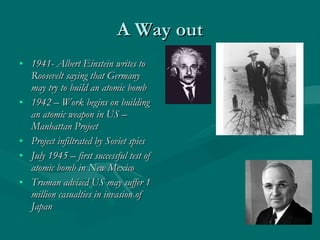
A Way out 1941- Albert Einstein writes to Roosevelt saying that Germany may try to build an atomic bomb 1942 – Work begins on building an atomic weapon in US – Manhattan Project Project infiltrated by Soviet spies July 1945 – first successful test of atomic bomb in New Mexico Truman advised US may suffer 1 million casualties in invasion of Japan
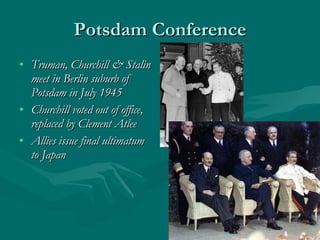
Potsdam Conference Truman, Churchill & Stalin meet in Berlin suburb of Potsdam in July 1945 Churchill voted out of office, replaced by Clement Atlee Allies issue final ultimatum to Japan
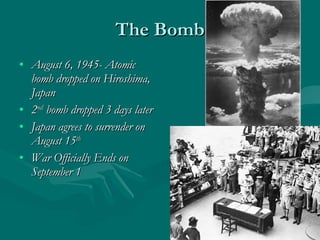
The Bomb August 6, 1945- Atomic bomb dropped on Hiroshima, Japan 2 nd  bomb dropped 3 days later Japan agrees to surrender on August 15 th War Officially Ends on September 1

World War Ii 2

  • 1.
  • 2.
    First Reverses December6, 1941 – Russians launch counterattack against Germans at Moscow German army not equipped for winter campaign and loses ground
  • 3.
    The final solution1/20/1942 – meeting held in Berlin suburb of Wannsee – Wannsee Conference – to work out a program of exporting Jews to new Extermination camps located in what was Poland Timing? – Were the Germans on the downside of the war?
  • 4.
    The Japanese JuggernautDecember 1941-Early 1942 – Japanese rapidly advance against US and British possessions in Pacific, especially Philippines, Burma, and Singapore British Navy loses 2 Battleships to Japanese Aircraft
  • 5.
    The Japanese JuggernautMay 1942 – Japanese send fleet to invade far western islands of Hawaii Fleet discovered by US June 1942 – Battle of Midway – Japanese lose 4 aircraft carriers – never regain full naval strength
  • 6.
    Turning Points in1942 Germans bail out unsuccessful Italian effort against British in North Africa – nearly win complete victory under German General Erwin Rommel July 1942 – Germans stopped at El Alamein, Egypt
  • 7.
    Turning Points in1942 1942-43 – German army forced to surrender at Stalingrad, Russia
  • 8.
    1942 – TheAllies Franklin Roosevelt Winston Churchill Josef Stalin Lesser leaders: Chiang Kai-shek (China) Charles De Gaulle (France)
  • 9.
    Meetings Churchill &Roosevelt meet frequently 1942 -Stalin meets with Churchill – urges British and Americans to invade Europe & start a second front Stalin & Churchill secretly divide Europe into influence spheres – (percentages agreement) Roosevelt rashly promises Russians a second front in Europe as soon as possible
  • 10.
    US Effort inEurope December 1942 - US soldiers invade North Africa – join with British Army to defeat German/Italian forces US & British invade Italy in 1943 – very slow going as Germans set up strong defensive line in Italian mountains Mussolini overthrown after invasion – rescued by Germans Allies find very slow going in Italy, even after diversionary landing at city of Anzio
  • 11.
    US in thePacific 1942-3 – US begins conquest of small island groups in Pacific – only selected islands captured –‘ Island-hopping’ Begins in South Pacific in New Guinea, at island of Guadalcanal Moves through Central pacific Island Groups of Carolines, Gilberts, and Marianas
  • 12.
    Tehran meeting Big3 finally meet in Tehran in late 1943 Stalin promised a second front in France in 1944
  • 13.
    Domestic Issues 1943–Roosevelt suffers severe cold – leads to diagnosis of congestive heart failure and hypertension – kept under close supervision by doctors Decides to run for a 4 th term as president July 20, 1944 – suffers severe angina attack Roosevelt elected in November 1944
  • 14.
    Attempt on Hitler’slife Group of Generals plan assassination of Hitler July 20, 1944 – Bomb explodes near Hitler at Army field HQ – Hitler not seriously injured Conspirators arrested, tortured & killed
  • 15.
    D-Day Allied forcesland in France on June 6, 1944 Paris recaptured by August Germans pushed back into Germany by fall
  • 16.
    Counterattack December 1944 -Germans counterattack in Belgium – Battle of the Bulge – beaten back Germans rely on new weapons – Not enough to win war Cruise missiles Rockets Jet Aircraft
  • 17.
    Yalta Big 3meet again in February 1945 to decide on fate of Germany Stalin given free hand in Eastern Europe in exchange for entering War against Japan, after Germany’s defeat Roosevelt not a strong negotiator due to ill health
  • 18.
    New President Rooseveltdies of stroke in April 1945 Replaced by Harry Truman
  • 19.
    Götterdammerung Allies enterGermany in late winter 1944 Russians close in on Berlin Concentration camps discovers by horrified allies
  • 20.
    Götterdammerung Mussolini killedin Milan on April 28, 1945 Hitler Commits suicide on April 30 Germany Surrenders on May 8 th
  • 21.
    Discovery of GenocideRumors of death camps reach Allies during War Allies urged to bomb rail lines to extermination camps – refuse Allies discover concentration camps & extermination camps as they enter German territory At least 9 million people killed by Germans in camps – 6 million Jews
  • 22.
    Pacific War Late1943 – US captures Marianas Islands – Puts US bombers in range of Japan As islands closer to Japan are conquered, war becomes more and more brutal 1945– US captures Iwo Jima(February) and Okinawa – Both with high numbers of casualties
  • 23.
    A Way out1941- Albert Einstein writes to Roosevelt saying that Germany may try to build an atomic bomb 1942 – Work begins on building an atomic weapon in US – Manhattan Project Project infiltrated by Soviet spies July 1945 – first successful test of atomic bomb in New Mexico Truman advised US may suffer 1 million casualties in invasion of Japan
  • 24.
    Potsdam Conference Truman,Churchill & Stalin meet in Berlin suburb of Potsdam in July 1945 Churchill voted out of office, replaced by Clement Atlee Allies issue final ultimatum to Japan
  • 25.
    The Bomb August6, 1945- Atomic bomb dropped on Hiroshima, Japan 2 nd bomb dropped 3 days later Japan agrees to surrender on August 15 th War Officially Ends on September 1