Battles and
Outcomes
   WWI
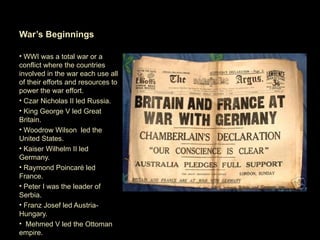
War’s Beginnings

• WWI was a total war or a
conflict where the countries
involved in the war each use all
of their efforts and resources to
power the war effort.
• Czar Nicholas II led Russia.
• King George V led Great
Britain.
• Woodrow Wilson led the
United States.
• Kaiser Wilhelm II led
Germany.
• Raymond Poincaré led
France.
• Peter I was the leader of
Serbia.
• Franz Josef led Austria-
Hungary.
• Mehmed V led the Ottoman
empire.
Fighting

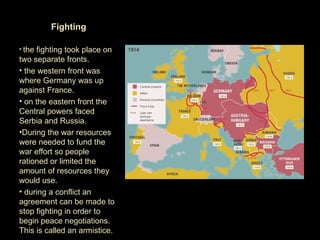
• the fighting took place on
two separate fronts.
• the western front was
where Germany was up
against France.
• on the eastern front the
Central powers faced
Serbia and Russia.
•During the war resources
were needed to fund the
war effort so people
rationed or limited the
amount of resources they
would use.
• during a conflict an
agreement can be made to
stop fighting in order to
begin peace negotiations.
This is called an armistice.
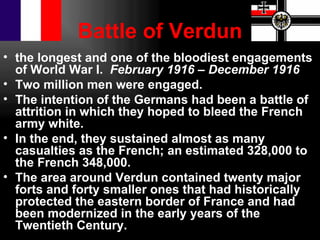
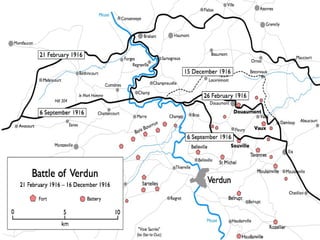
Battle of Verdun
• the longest and one of the bloodiest engagements
  of World War I. February 1916 – December 1916
• Two million men were engaged.
• The intention of the Germans had been a battle of
  attrition in which they hoped to bleed the French
  army white.
• In the end, they sustained almost as many
  casualties as the French; an estimated 328,000 to
  the French 348,000.
• The area around Verdun contained twenty major
  forts and forty smaller ones that had historically
  protected the eastern border of France and had
  been modernized in the early years of the
  Twentieth Century.
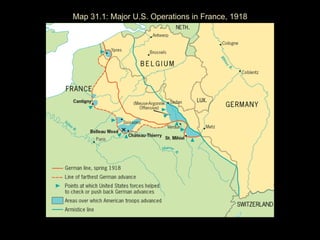
Map 31.1: Major U.S. Operations in France, 1918
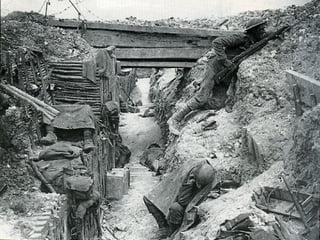
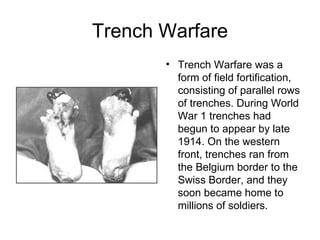
Trench Warfare
       • Trench Warfare was a
         form of field fortification,
         consisting of parallel rows
         of trenches. During World
         War 1 trenches had
         begun to appear by late
         1914. On the western
         front, trenches ran from
         the Belgium border to the
         Swiss Border, and they
         soon became home to
         millions of soldiers.
The Battles of the Marne, 1914,
                 1918
•   On September 4, 1914, the rapid advances of the German army
    through Belgium and northern France caused panic in the French
    army and troops were rushed from Paris in taxis to halt the advance.
    Combined with the BEF (British Expeditionary Force) the Germans
    were eventually halted and the War settled into the familiar
    defensive series of entrenchment's.
•   Ironically, by the end of May, 1918, the Germans had again reached
    the Marne after the enormous successes of Ludendorff's offensives
    of that year. The intervening four years had cost hundreds of
    thousands of lives and the armies were still, literally, exactly where
    they had started.
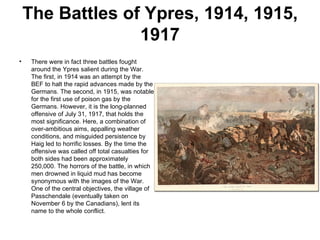
The Battles of Ypres, 1914, 1915,
                  1917
•    There were in fact three battles fought
     around the Ypres salient during the War.
     The first, in 1914 was an attempt by the
     BEF to halt the rapid advances made by the
     Germans. The second, in 1915, was notable
     for the first use of poison gas by the
     Germans. However, it is the long-planned
     offensive of July 31, 1917, that holds the
     most significance. Here, a combination of
     over-ambitious aims, appalling weather
     conditions, and misguided persistence by
     Haig led to horrific losses. By the time the
     offensive was called off total casualties for
     both sides had been approximately
     250,000. The horrors of the battle, in which
     men drowned in liquid mud has become
     synonymous with the images of the War.
     One of the central objectives, the village of
     Passchendale (eventually taken on
     November 6 by the Canadians), lent its
     name to the whole conflict.
The Battle of the Somme,
                 1916
•   At 0730 hours on the 1st July, 1916, after a weeklong artillery bombardment
    launched the now infamous "Big Push" attack across the river Somme. With the
    French Army being hard-pressed to the south at Verdun the British intended to
    breakthrough the German defences in a matter of hours.
•   The mistrust that High Command had of the so-called "New Armies" manifested
    itself in the orders to the troops to keep uniformed lines and to march towards
    the enemy across no-man's land. This, coupled with the failure of the artillery
    bombardment to dislodge much of the German wire, or to destroy their machine-
    gun posts, led to one of the biggest slaughters in military history.
•   When the attack began the Germans dragged themselves out of their dugouts,
    manned their posts and destroyed the oncoming waves of British infantry.
•   After the first day, with a gain of only 1.5km, the British had suffered 57,470
    casualties. Despite this, Haig pressed on with the attack until November 19th of
    the same year. For the meagre achievements, total losses on the British and
    Imperial side numbered 419,654 with German casualties between 450,000 and
    680,000. When the offensive was eventually called off the British were still 3
    miles short of Bapaume and Serre, part of their first-day objectives.
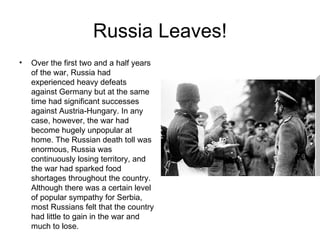
Russia Leaves!
•   Over the first two and a half years
    of the war, Russia had
    experienced heavy defeats
    against Germany but at the same
    time had significant successes
    against Austria-Hungary. In any
    case, however, the war had
    become hugely unpopular at
    home. The Russian death toll was
    enormous, Russia was
    continuously losing territory, and
    the war had sparked food
    shortages throughout the country.
    Although there was a certain level
    of popular sympathy for Serbia,
    most Russians felt that the country
    had little to gain in the war and
    much to lose.
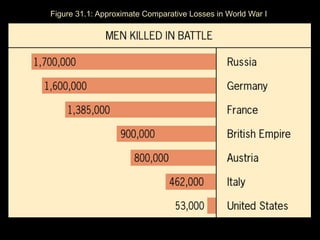
Figure 31.1: Approximate Comparative Losses in World War I
Wilson’s 14 Points


•   1. No more secret agreements.
•   2. Free navigation of all seas.
•   3. Free trade.
•   4. Reduce weapon numbers.
•   5.Less Colonialism.
•   6. The German Army is to be removed from Russia. Russia should be left to develop
    her own political set-up.
•   7. Belgium should be independent like before the war.
•   8. France should be fully liberated and allowed to recover Alsace-Lorraine
•   9. All Italians are to be allowed to live in Italy. Italy's borders are to "along clearly
    recognizable lines of nationality."
•   10. Self-determination should be allowed for all those living in Austria-Hungary.
•   11. Self-determination and guarantees of independence should be allowed for the
    Balkan states.
•   12. The Turkish people should be governed by the Turkish government. Non-Turks in
    the old Turkish Empire should govern themselves.
•   13. An independent Poland should be created which should have access to the sea.
•   14. A League of Nations should be set up to guarantee the political and territorial
    independence of all states.
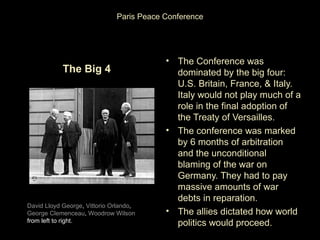
Paris Peace Conference


                                          • The Conference was
            The Big 4                       dominated by the big four:
                                            U.S. Britain, France, & Italy.
                                            Italy would not play much of a
                                            role in the final adoption of
                                            the Treaty of Versailles.
                                          • The conference was marked
                                            by 6 months of arbitration
                                            and the unconditional
                                            blaming of the war on
                                            Germany. They had to pay
                                            massive amounts of war
                                            debts in reparation.
David Lloyd George, Vittorio Orlando,
George Clemenceau, Woodrow Wilson         • The allies dictated how world
from left to right.                         politics would proceed.
Terms of the Treaty

The main points of the Treaty [BRAT]
The first 26 Articles of the Treaty set out the
Covenant of the League of Nations; the rest of
the 440 Articles detailed Germany's
punishment:
1. Germany had to accept the Blame for
starting the war (Clause 231). This was vital
because it provided the justification for...
2. Germany had to pay £6,600 million (called
Reparations) for the damage done during the
war.
3. Germany was forbidden to have
submarines or an air force. She could have a
navy of only six battleships, and an Army of
just 100,000 men. In addition, Germany was
not allowed to place any troops in the
Rhineland, the strip of land, 50 miles wide, next   While the U.S. felt that true peace could only be
to France.                                          reached by equals and that we shouldn’t rub
4. Germany lost Territory (land) in Europe          Germany’s face in the loss, both France and Great
(see map, below). Germany’s colonies were           Britain supported making Germany solely
given to Britain and France.                        responsible for fiscal reparations for the war.
(Also, Germany was forbidden to join the
League of Nations, or unite with Austria.)

Wwi battles and outcomes

  • 1.
  • 2.
    War’s Beginnings • WWIwas a total war or a conflict where the countries involved in the war each use all of their efforts and resources to power the war effort. • Czar Nicholas II led Russia. • King George V led Great Britain. • Woodrow Wilson led the United States. • Kaiser Wilhelm II led Germany. • Raymond Poincaré led France. • Peter I was the leader of Serbia. • Franz Josef led Austria- Hungary. • Mehmed V led the Ottoman empire.
  • 3.
    Fighting • the fightingtook place on two separate fronts. • the western front was where Germany was up against France. • on the eastern front the Central powers faced Serbia and Russia. •During the war resources were needed to fund the war effort so people rationed or limited the amount of resources they would use. • during a conflict an agreement can be made to stop fighting in order to begin peace negotiations. This is called an armistice.
  • 4.
    Battle of Verdun •the longest and one of the bloodiest engagements of World War I. February 1916 – December 1916 • Two million men were engaged. • The intention of the Germans had been a battle of attrition in which they hoped to bleed the French army white. • In the end, they sustained almost as many casualties as the French; an estimated 328,000 to the French 348,000. • The area around Verdun contained twenty major forts and forty smaller ones that had historically protected the eastern border of France and had been modernized in the early years of the Twentieth Century.
  • 6.
    Map 31.1: MajorU.S. Operations in France, 1918
  • 8.
    Trench Warfare • Trench Warfare was a form of field fortification, consisting of parallel rows of trenches. During World War 1 trenches had begun to appear by late 1914. On the western front, trenches ran from the Belgium border to the Swiss Border, and they soon became home to millions of soldiers.
  • 9.
    The Battles ofthe Marne, 1914, 1918 • On September 4, 1914, the rapid advances of the German army through Belgium and northern France caused panic in the French army and troops were rushed from Paris in taxis to halt the advance. Combined with the BEF (British Expeditionary Force) the Germans were eventually halted and the War settled into the familiar defensive series of entrenchment's. • Ironically, by the end of May, 1918, the Germans had again reached the Marne after the enormous successes of Ludendorff's offensives of that year. The intervening four years had cost hundreds of thousands of lives and the armies were still, literally, exactly where they had started.
  • 10.
    The Battles ofYpres, 1914, 1915, 1917 • There were in fact three battles fought around the Ypres salient during the War. The first, in 1914 was an attempt by the BEF to halt the rapid advances made by the Germans. The second, in 1915, was notable for the first use of poison gas by the Germans. However, it is the long-planned offensive of July 31, 1917, that holds the most significance. Here, a combination of over-ambitious aims, appalling weather conditions, and misguided persistence by Haig led to horrific losses. By the time the offensive was called off total casualties for both sides had been approximately 250,000. The horrors of the battle, in which men drowned in liquid mud has become synonymous with the images of the War. One of the central objectives, the village of Passchendale (eventually taken on November 6 by the Canadians), lent its name to the whole conflict.
  • 11.
    The Battle ofthe Somme, 1916 • At 0730 hours on the 1st July, 1916, after a weeklong artillery bombardment launched the now infamous "Big Push" attack across the river Somme. With the French Army being hard-pressed to the south at Verdun the British intended to breakthrough the German defences in a matter of hours. • The mistrust that High Command had of the so-called "New Armies" manifested itself in the orders to the troops to keep uniformed lines and to march towards the enemy across no-man's land. This, coupled with the failure of the artillery bombardment to dislodge much of the German wire, or to destroy their machine- gun posts, led to one of the biggest slaughters in military history. • When the attack began the Germans dragged themselves out of their dugouts, manned their posts and destroyed the oncoming waves of British infantry. • After the first day, with a gain of only 1.5km, the British had suffered 57,470 casualties. Despite this, Haig pressed on with the attack until November 19th of the same year. For the meagre achievements, total losses on the British and Imperial side numbered 419,654 with German casualties between 450,000 and 680,000. When the offensive was eventually called off the British were still 3 miles short of Bapaume and Serre, part of their first-day objectives.
  • 12.
    Russia Leaves! • Over the first two and a half years of the war, Russia had experienced heavy defeats against Germany but at the same time had significant successes against Austria-Hungary. In any case, however, the war had become hugely unpopular at home. The Russian death toll was enormous, Russia was continuously losing territory, and the war had sparked food shortages throughout the country. Although there was a certain level of popular sympathy for Serbia, most Russians felt that the country had little to gain in the war and much to lose.
  • 13.
    Figure 31.1: ApproximateComparative Losses in World War I
  • 14.
    Wilson’s 14 Points • 1. No more secret agreements. • 2. Free navigation of all seas. • 3. Free trade. • 4. Reduce weapon numbers. • 5.Less Colonialism. • 6. The German Army is to be removed from Russia. Russia should be left to develop her own political set-up. • 7. Belgium should be independent like before the war. • 8. France should be fully liberated and allowed to recover Alsace-Lorraine • 9. All Italians are to be allowed to live in Italy. Italy's borders are to "along clearly recognizable lines of nationality." • 10. Self-determination should be allowed for all those living in Austria-Hungary. • 11. Self-determination and guarantees of independence should be allowed for the Balkan states. • 12. The Turkish people should be governed by the Turkish government. Non-Turks in the old Turkish Empire should govern themselves. • 13. An independent Poland should be created which should have access to the sea. • 14. A League of Nations should be set up to guarantee the political and territorial independence of all states.
  • 15.
    Paris Peace Conference • The Conference was The Big 4 dominated by the big four: U.S. Britain, France, & Italy. Italy would not play much of a role in the final adoption of the Treaty of Versailles. • The conference was marked by 6 months of arbitration and the unconditional blaming of the war on Germany. They had to pay massive amounts of war debts in reparation. David Lloyd George, Vittorio Orlando, George Clemenceau, Woodrow Wilson • The allies dictated how world from left to right. politics would proceed.
  • 16.
    Terms of theTreaty The main points of the Treaty [BRAT] The first 26 Articles of the Treaty set out the Covenant of the League of Nations; the rest of the 440 Articles detailed Germany's punishment: 1. Germany had to accept the Blame for starting the war (Clause 231). This was vital because it provided the justification for... 2. Germany had to pay £6,600 million (called Reparations) for the damage done during the war. 3. Germany was forbidden to have submarines or an air force. She could have a navy of only six battleships, and an Army of just 100,000 men. In addition, Germany was not allowed to place any troops in the Rhineland, the strip of land, 50 miles wide, next While the U.S. felt that true peace could only be to France. reached by equals and that we shouldn’t rub 4. Germany lost Territory (land) in Europe Germany’s face in the loss, both France and Great (see map, below). Germany’s colonies were Britain supported making Germany solely given to Britain and France. responsible for fiscal reparations for the war. (Also, Germany was forbidden to join the League of Nations, or unite with Austria.)