USING POWERUPSQL AND GODDI FOR
ACTIVE DIRECTORY INFORMATION
GATHERING
THOMAS ELLING
2 Confidential & Proprietary
ABOUT
Thomas Elling
 Web Application and Network Pentester at NetSPI
 PowerUpSQL contributor
 goddi (go dump domain info) creator
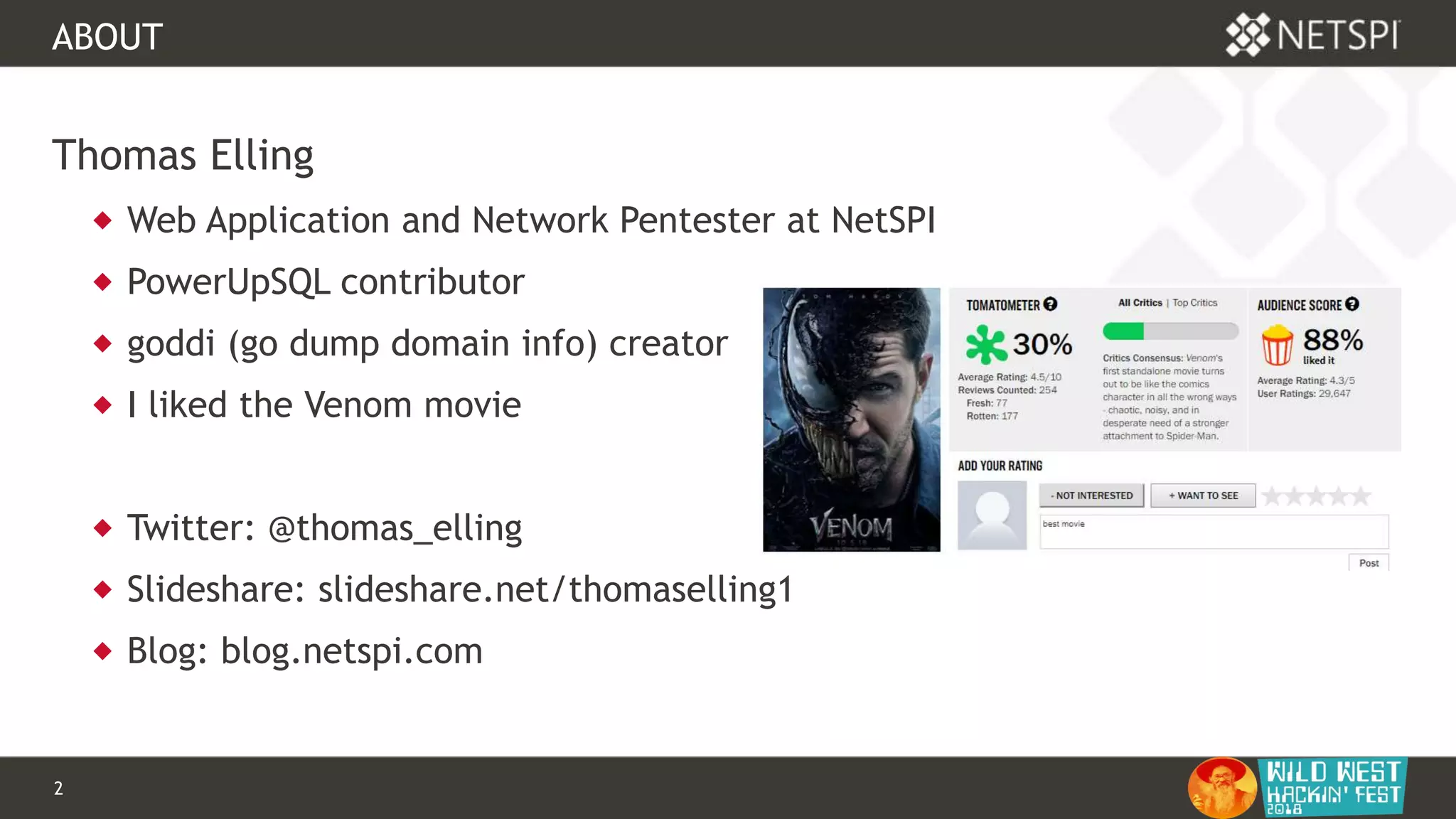
 I liked the Venom movie
 Twitter: @thomas_elling
 Slideshare: slideshare.net/thomaselling1
 Blog: blog.netspi.com
3 Confidential & Proprietary
PRESENTATION OVERVIEW
 Previous Research
 Active Directory Basics
 PowerUpSQL overview
 Install instructions
 Methodology
 Demo
 goddi overview
 Install instructions
 Methodology
 Demo
 Detection
4 Confidential & Proprietary
INTRODUCTION
Why is Active Directory Information Gathering useful?
 Situational Awareness
 What am I looking for?
 Escalation Paths
 Where are privileged users logged in?
 Identify Misconfigurations
 Are there passwords in the Description attribute?
5 Confidential & Proprietary
INTRODUCTION
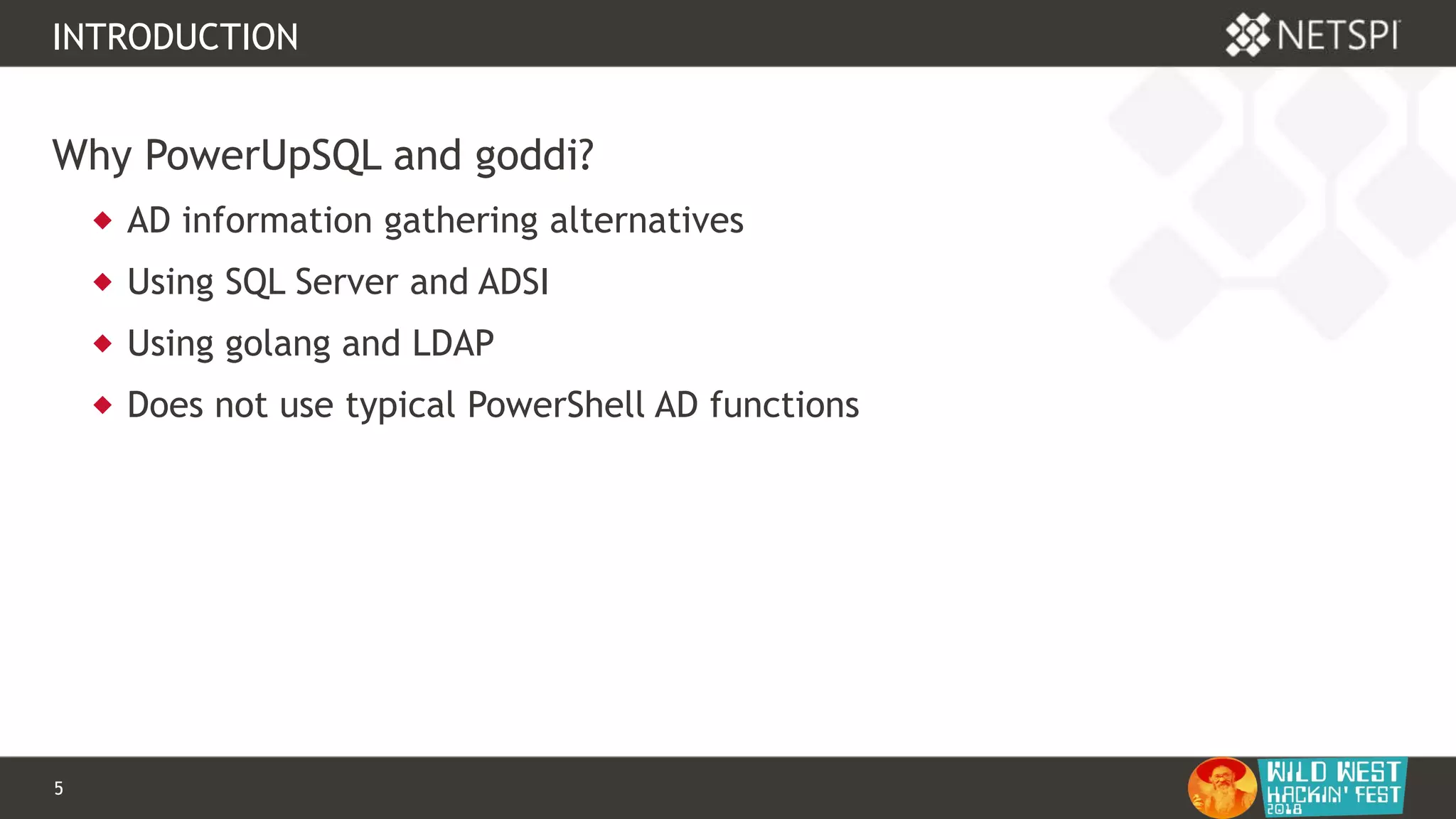
Why PowerUpSQL and goddi?
 AD information gathering alternatives
 Using SQL Server and ADSI
 Using golang and LDAP
 Does not use typical PowerShell AD functions
6 Confidential & Proprietary6 Confidential & Proprietary
PREVIOUS RESEARCH
7 Confidential & Proprietary
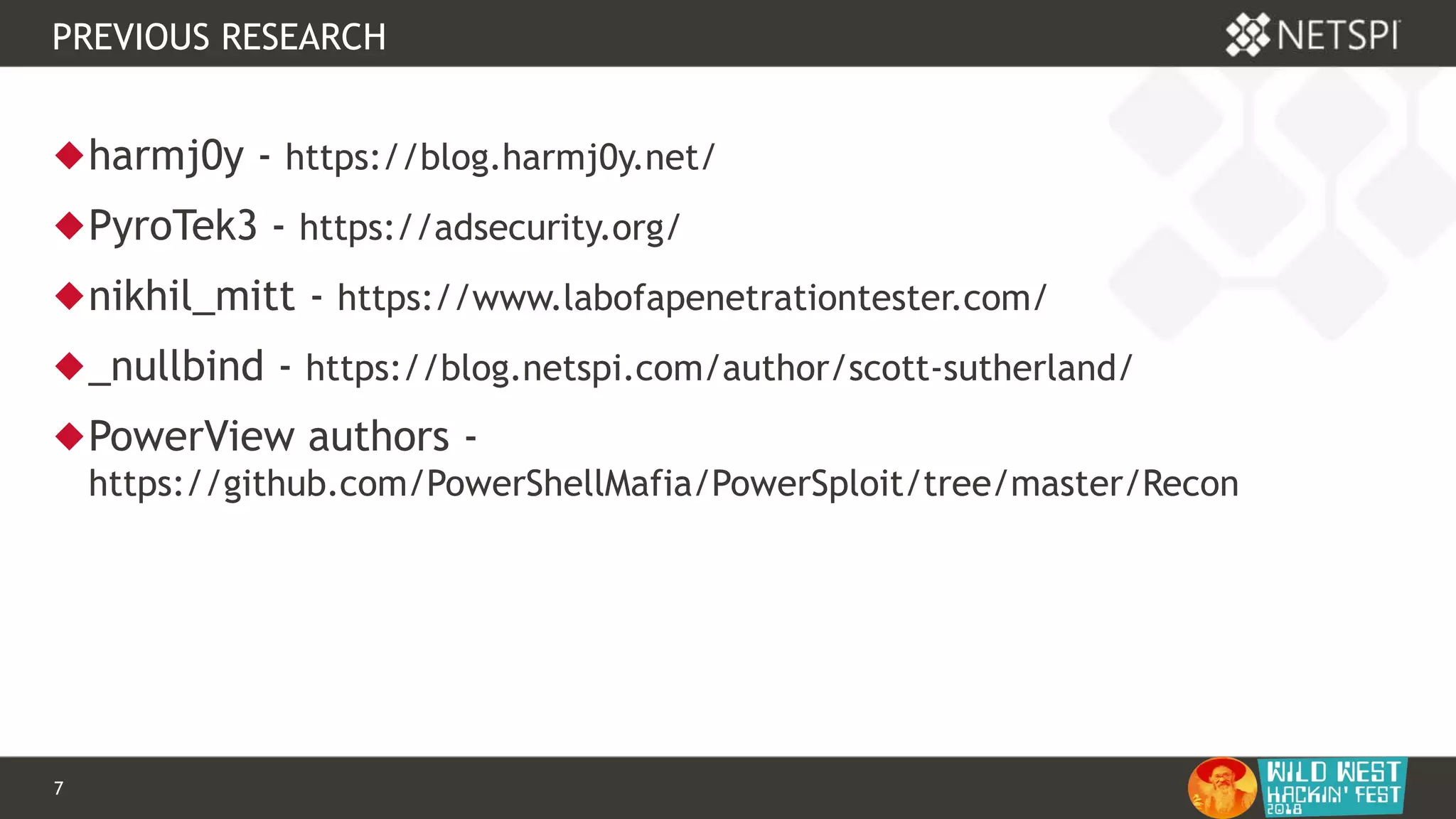
PREVIOUS RESEARCH
harmj0y - https://blog.harmj0y.net/
PyroTek3 - https://adsecurity.org/
nikhil_mitt - https://www.labofapenetrationtester.com/
_nullbind - https://blog.netspi.com/author/scott-sutherland/
PowerView authors -
https://github.com/PowerShellMafia/PowerSploit/tree/master/Recon
8 Confidential & Proprietary
PREVIOUS RESEARCH
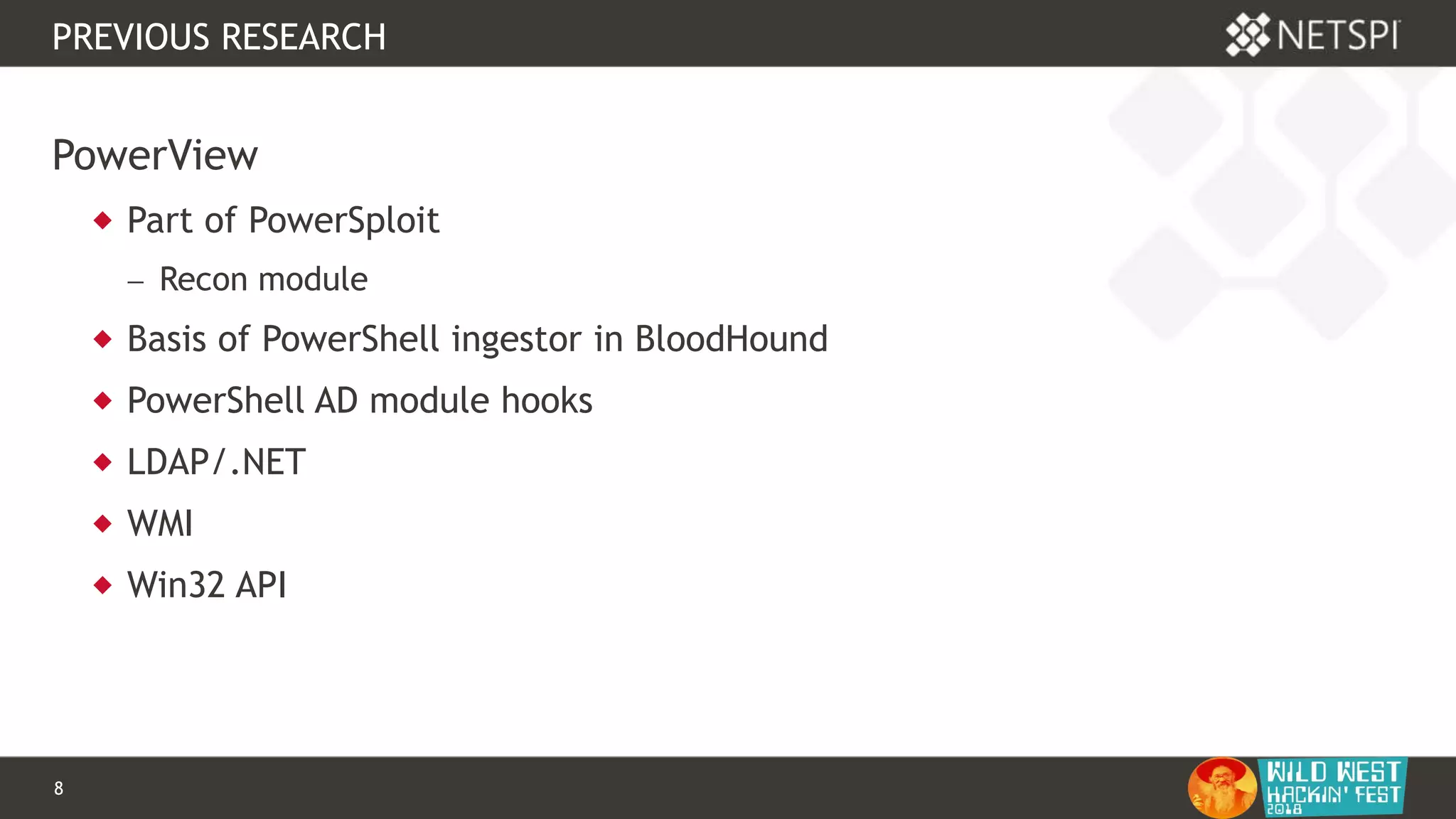
PowerView
 Part of PowerSploit
 Recon module
 Basis of PowerShell ingestor in BloodHound
 PowerShell AD module hooks
 LDAP/.NET
 WMI
 Win32 API
9 Confidential & Proprietary9 Confidential & Proprietary
ACTIVE DIRECTORY BASICS
10 Confidential & Proprietary
ACTIVE DIRECTORY BASICS
What is Active Directory?
 Microsoft’s Directory Service
 Directory Service – provides resource and network mappings for objects
distributed across a network
 Includes wide variety of directory services - Federation services, Lightweight
directory services etc.
 Domain Services – hierarchical and scalable infrastructure for object
management
 Domain Services is our focus
11 Confidential & Proprietary
ACTIVE DIRECTORY BASICS
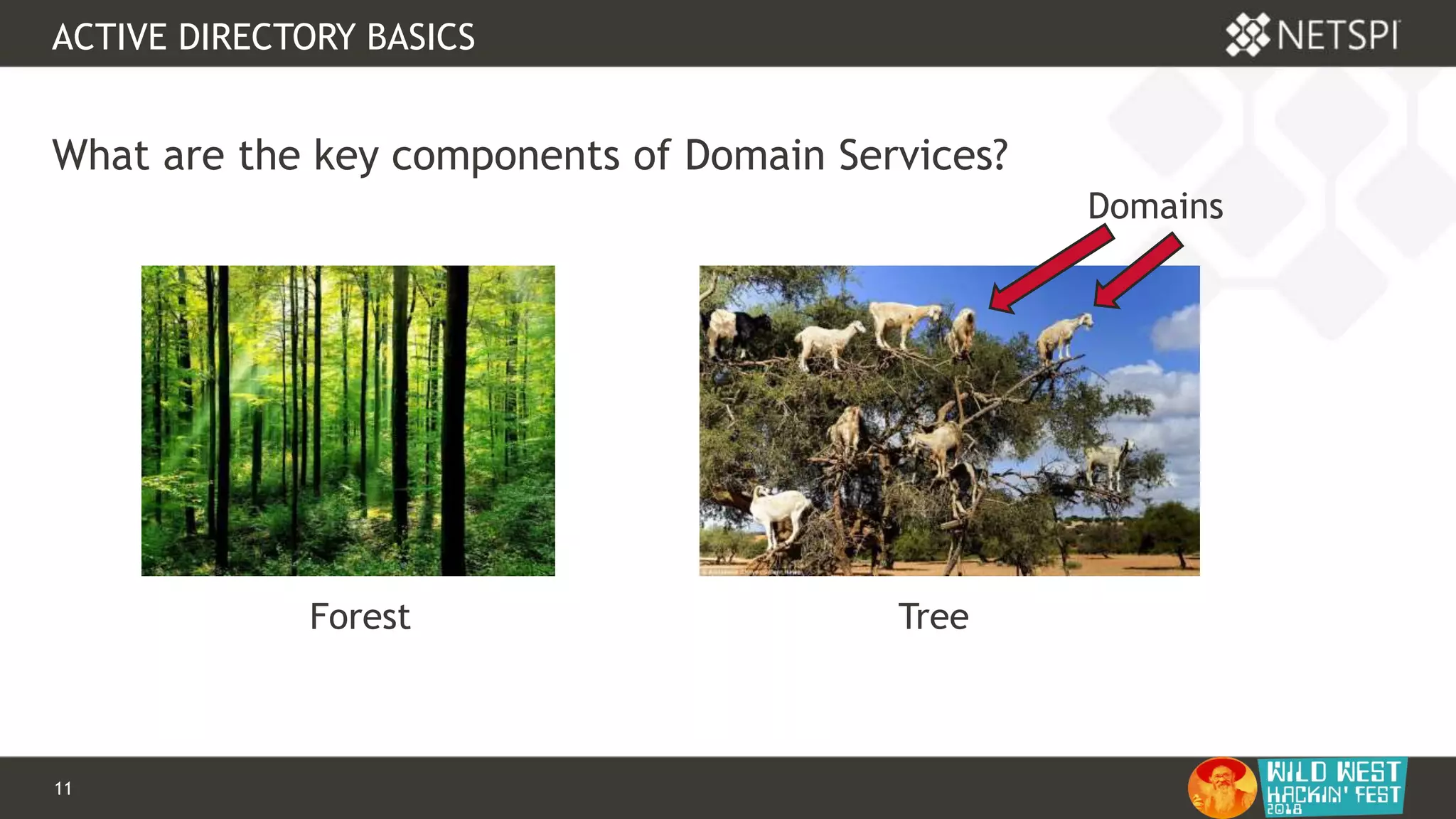
What are the key components of Domain Services?
Forest Tree
Domains
12 Confidential & Proprietary
ACTIVE DIRECTORY BASICS
 Domain - security boundary, collection of objects
 Domain Controller – server(s) where Active Directory is installed
 Users and Computers – security principals, represent physical entities on the
domain
 OU – containers for users/groups/computers, easy to apply group policies or
delegation
 Groups – collection of users/computers where access control can be applied
13 Confidential & Proprietary
ACTIVE DIRECTORY BASICS
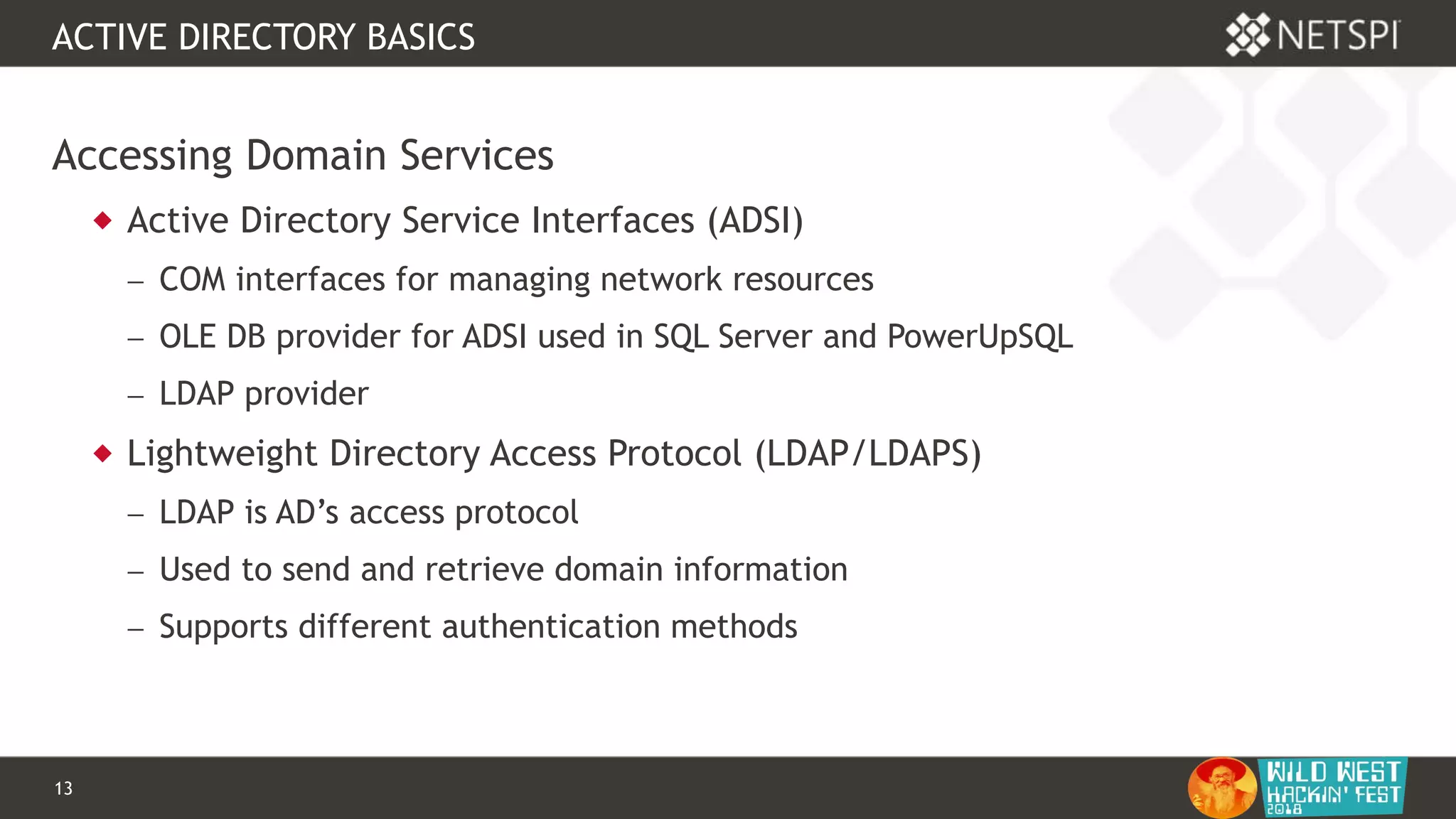
Accessing Domain Services
 Active Directory Service Interfaces (ADSI)
 COM interfaces for managing network resources
 OLE DB provider for ADSI used in SQL Server and PowerUpSQL
 LDAP provider
 Lightweight Directory Access Protocol (LDAP/LDAPS)
 LDAP is AD’s access protocol
 Used to send and retrieve domain information
 Supports different authentication methods
14 Confidential & Proprietary
ACTIVE DIRECTORY BASICS
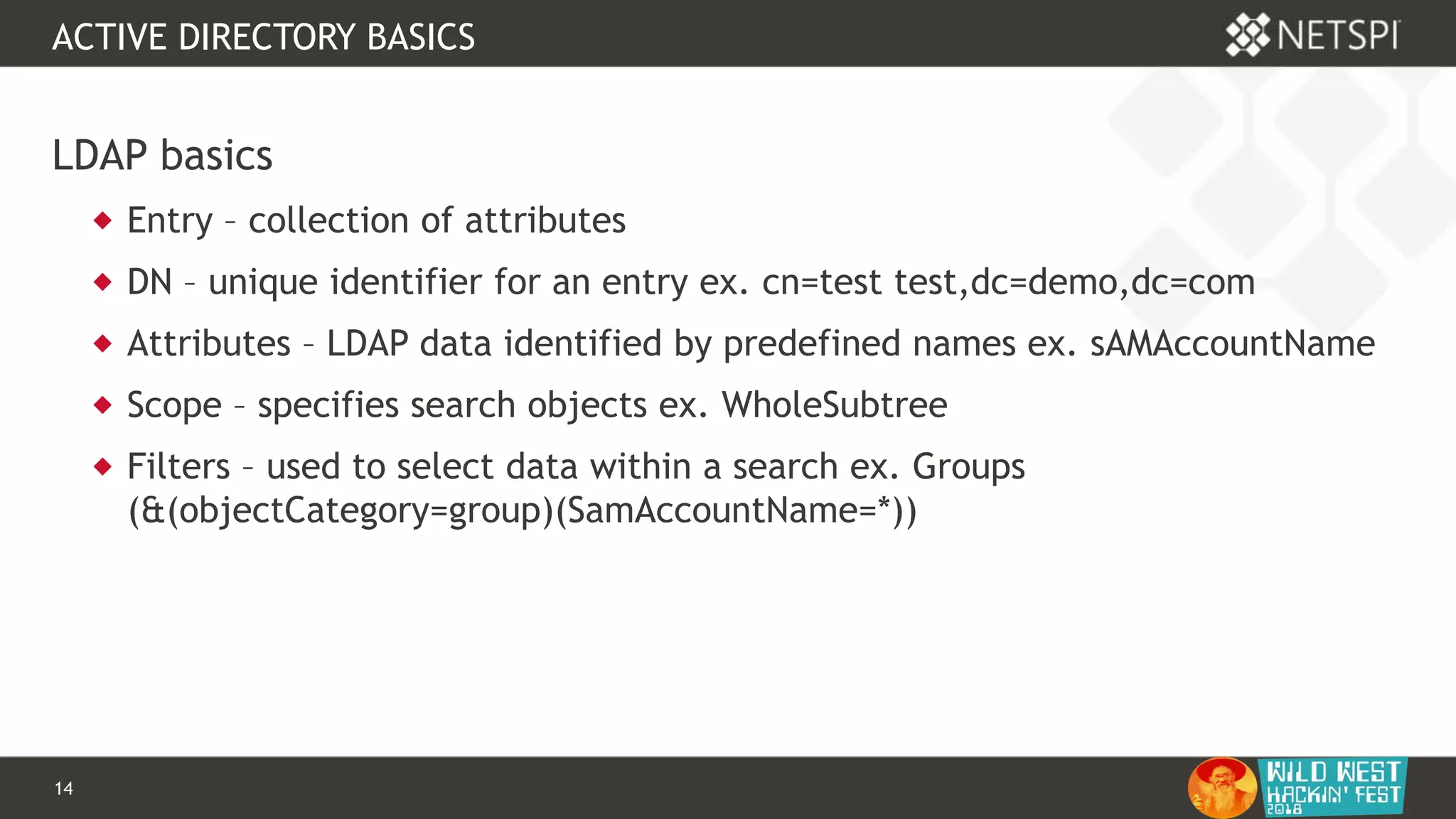
LDAP basics
 Entry – collection of attributes
 DN – unique identifier for an entry ex. cn=test test,dc=demo,dc=com
 Attributes – LDAP data identified by predefined names ex. sAMAccountName
 Scope – specifies search objects ex. WholeSubtree
 Filters – used to select data within a search ex. Groups
(&(objectCategory=group)(SamAccountName=*))
15 Confidential & Proprietary
ACTIVE DIRECTORY BASICS
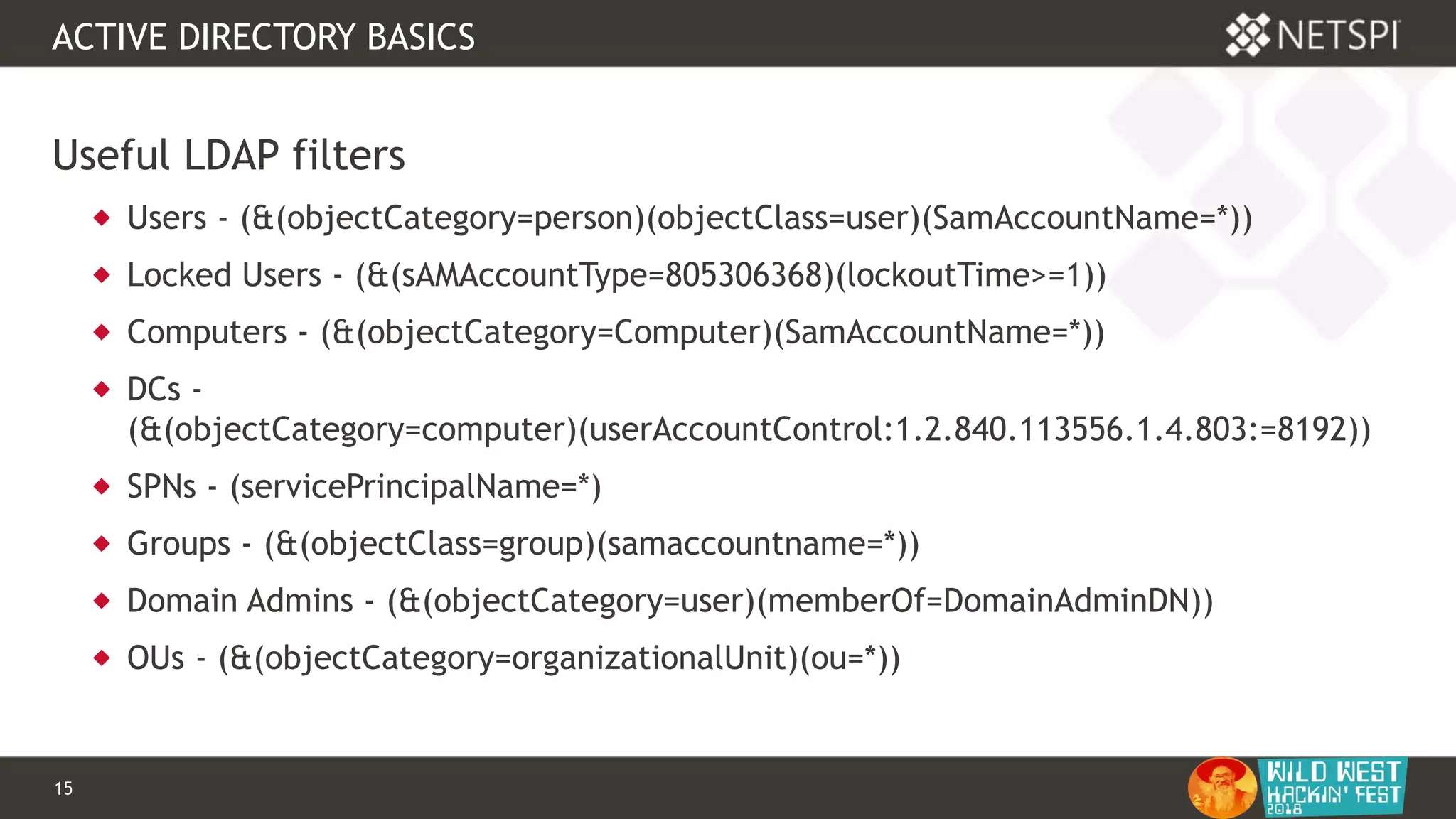
Useful LDAP filters
 Users - (&(objectCategory=person)(objectClass=user)(SamAccountName=*))
 Locked Users - (&(sAMAccountType=805306368)(lockoutTime>=1))
 Computers - (&(objectCategory=Computer)(SamAccountName=*))
 DCs -
(&(objectCategory=computer)(userAccountControl:1.2.840.113556.1.4.803:=8192))
 SPNs - (servicePrincipalName=*)
 Groups - (&(objectClass=group)(samaccountname=*))
 Domain Admins - (&(objectCategory=user)(memberOf=DomainAdminDN))
 OUs - (&(objectCategory=organizationalUnit)(ou=*))
16 Confidential & Proprietary16 Confidential & Proprietary
POWERUPSQL
17 Confidential & Proprietary
POWERUPSQL
What is PowerUpSQL?
 Written in PowerShell
 SQL Server discovery
 Weak configuration auditing
 Privilege escalation
 Post exploitation
 Hacking SQL Server on scale
18 Confidential & Proprietary
POWERUPSQL
Why SQL Server?
 Popular in enterprise environments
 Integration with Windows services
 Vertical escalation opportunities on the domain
Why PowerShell?
 Native to Windows
 Runs commands in memory
 Often flagged as trusted
 May need to start obfuscating or disabling security features soon…
19 Confidential & Proprietary
POWERUPSQL
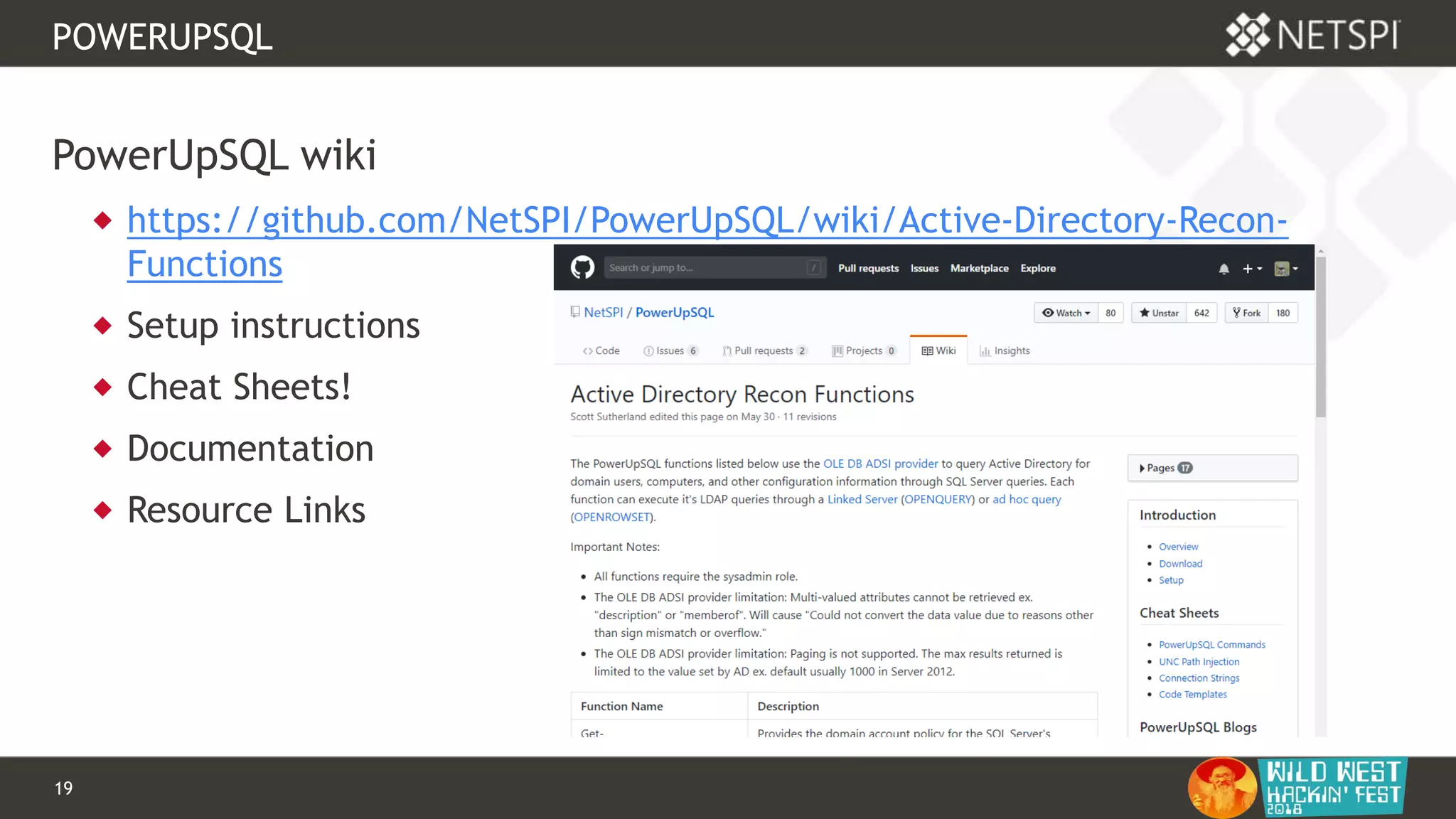
PowerUpSQL wiki
 https://github.com/NetSPI/PowerUpSQL/wiki/Active-Directory-Recon-
Functions
 Setup instructions
 Cheat Sheets!
 Documentation
 Resource Links
20 Confidential & Proprietary
POWERUPSQL
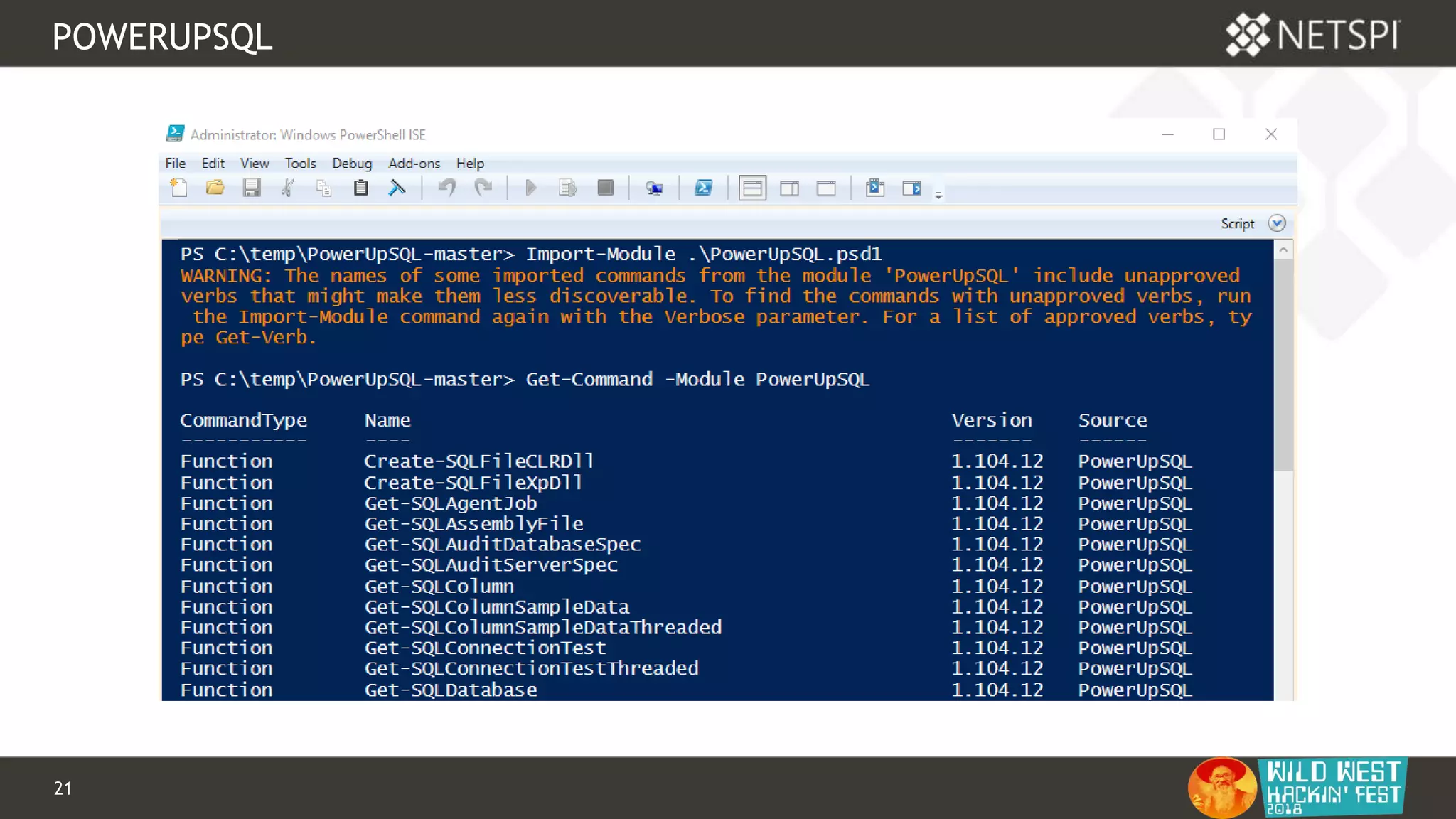
PowerUpSQL setup
 Import-Module PowerUpSQL.psd1
 Install-Module -Name PowerUpSQL
 IEX(New-Object
System.Net.WebClient).DownloadString("https://raw.githubusercontent.com
/NetSPI/PowerUpSQL/master/PowerUpSQL.ps1")
 &([scriptblock]::Create((new-object
net.webclient).downloadstring("https://raw.githubusercontent.com/NetSPI/
PowerUpSQL/master/PowerUpSQL.ps1")))
21 Confidential & Proprietary
POWERUPSQL
22 Confidential & Proprietary
POWERUPSQL
Getting started
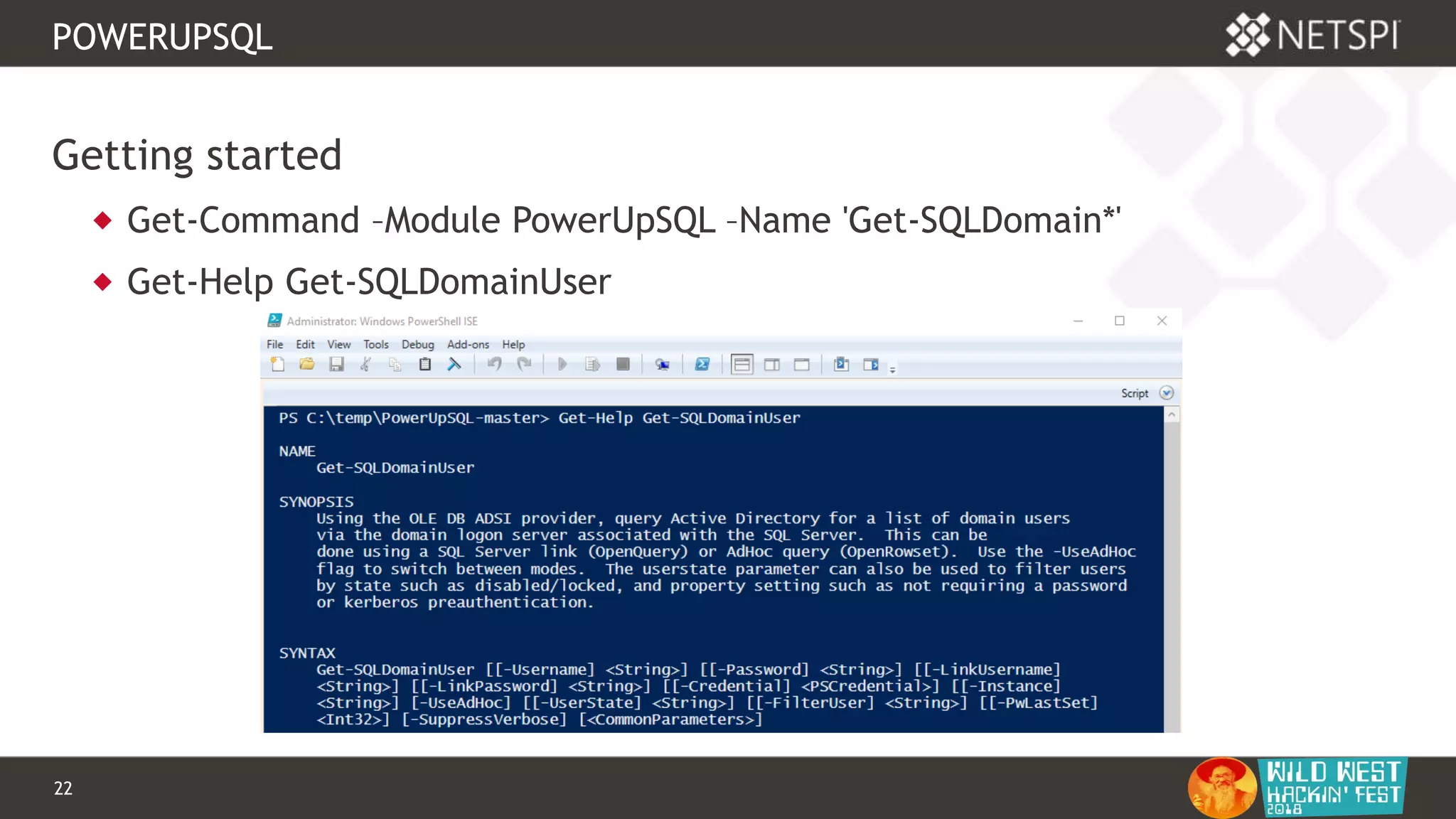
 Get-Command –Module PowerUpSQL –Name 'Get-SQLDomain*'
 Get-Help Get-SQLDomainUser
23 Confidential & Proprietary
POWERUPSQL
Getting started
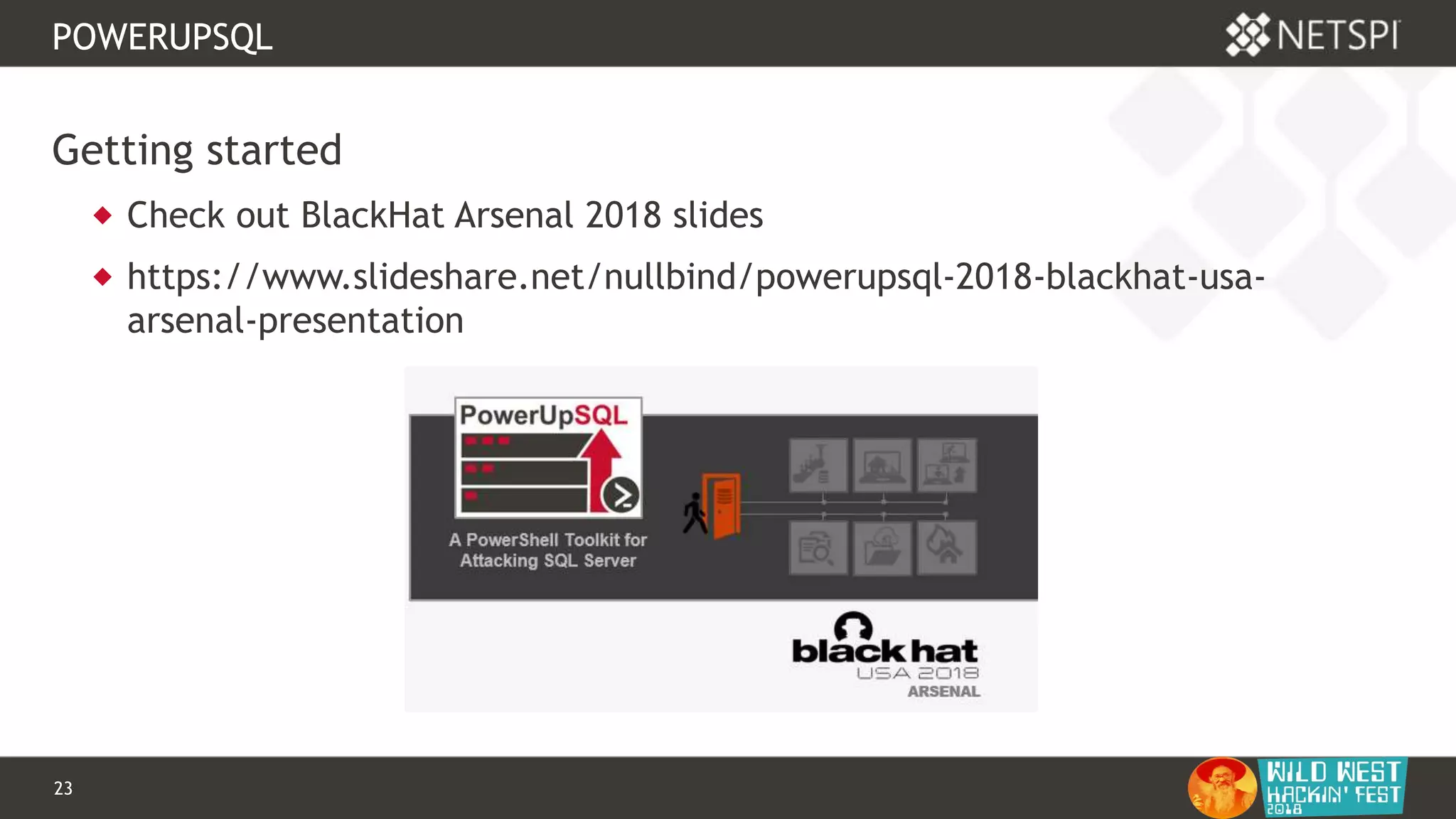
 Check out BlackHat Arsenal 2018 slides
 https://www.slideshare.net/nullbind/powerupsql-2018-blackhat-usa-
arsenal-presentation
24 Confidential & Proprietary
POWERUPSQL
Active Directory information gathering with PowerUpSQL
 OLE DB Active Directory Service Interfaces (ADSI) Provider
 Two main methods
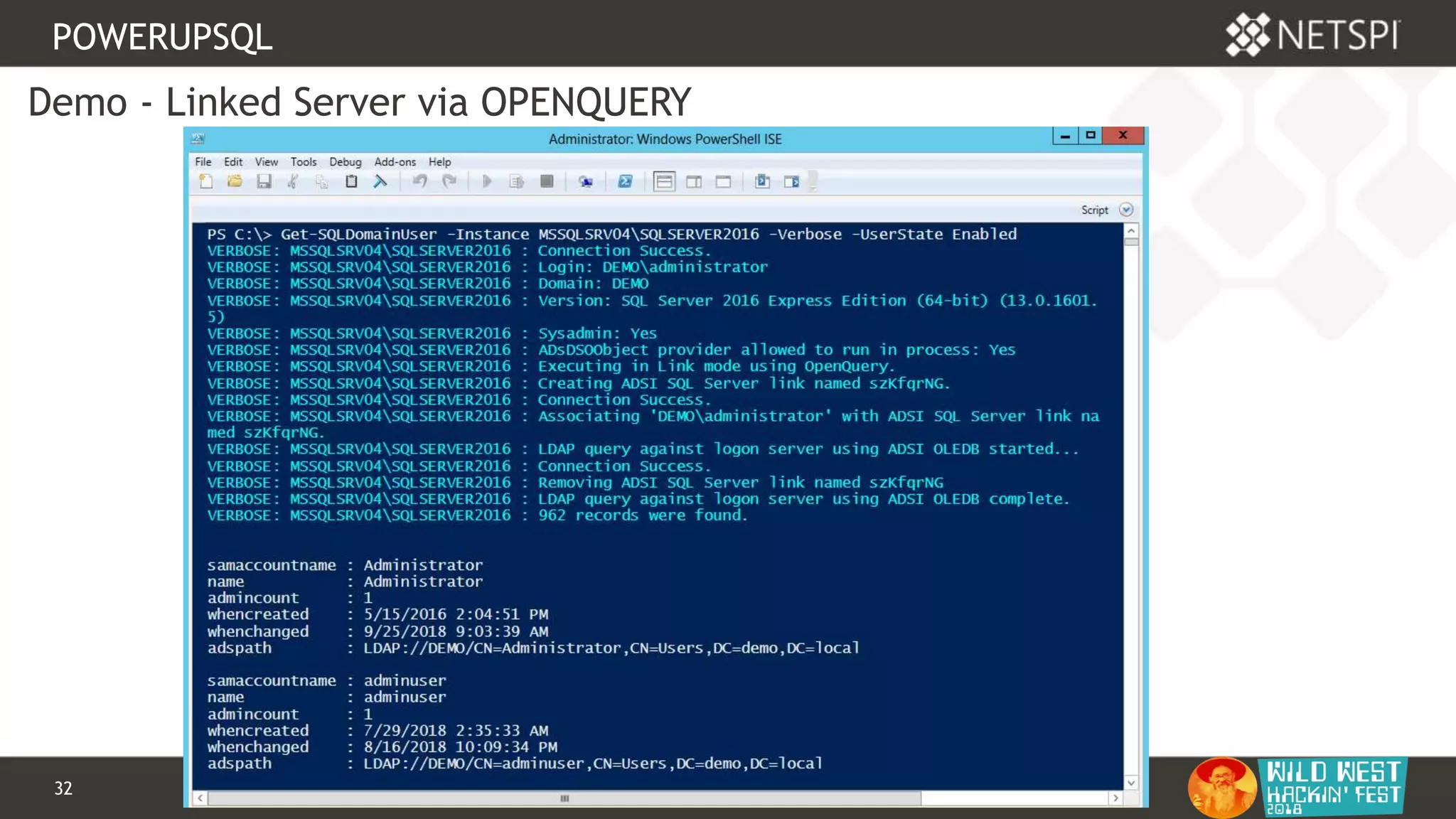
 OPENQUERY (Linked server)
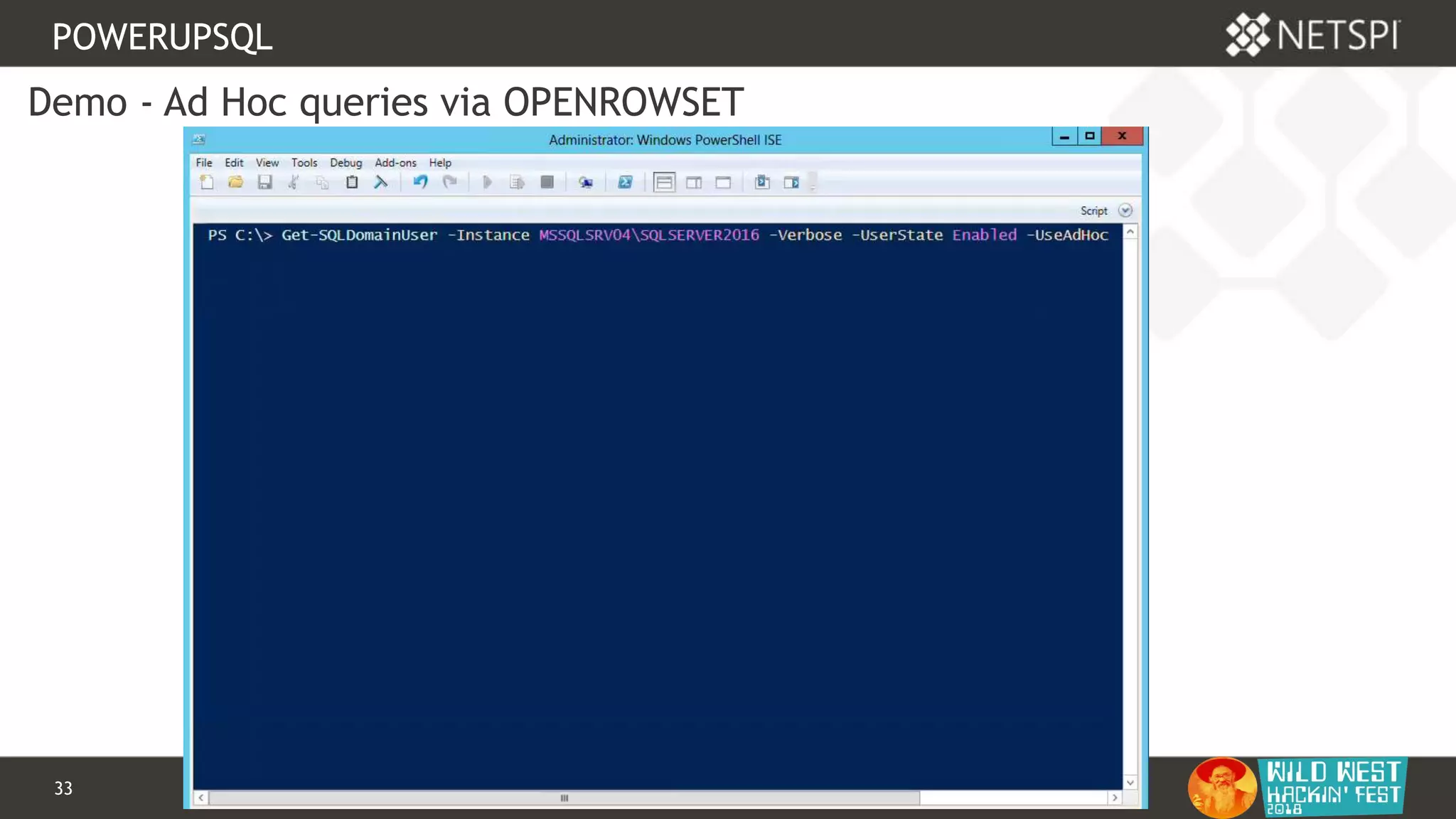
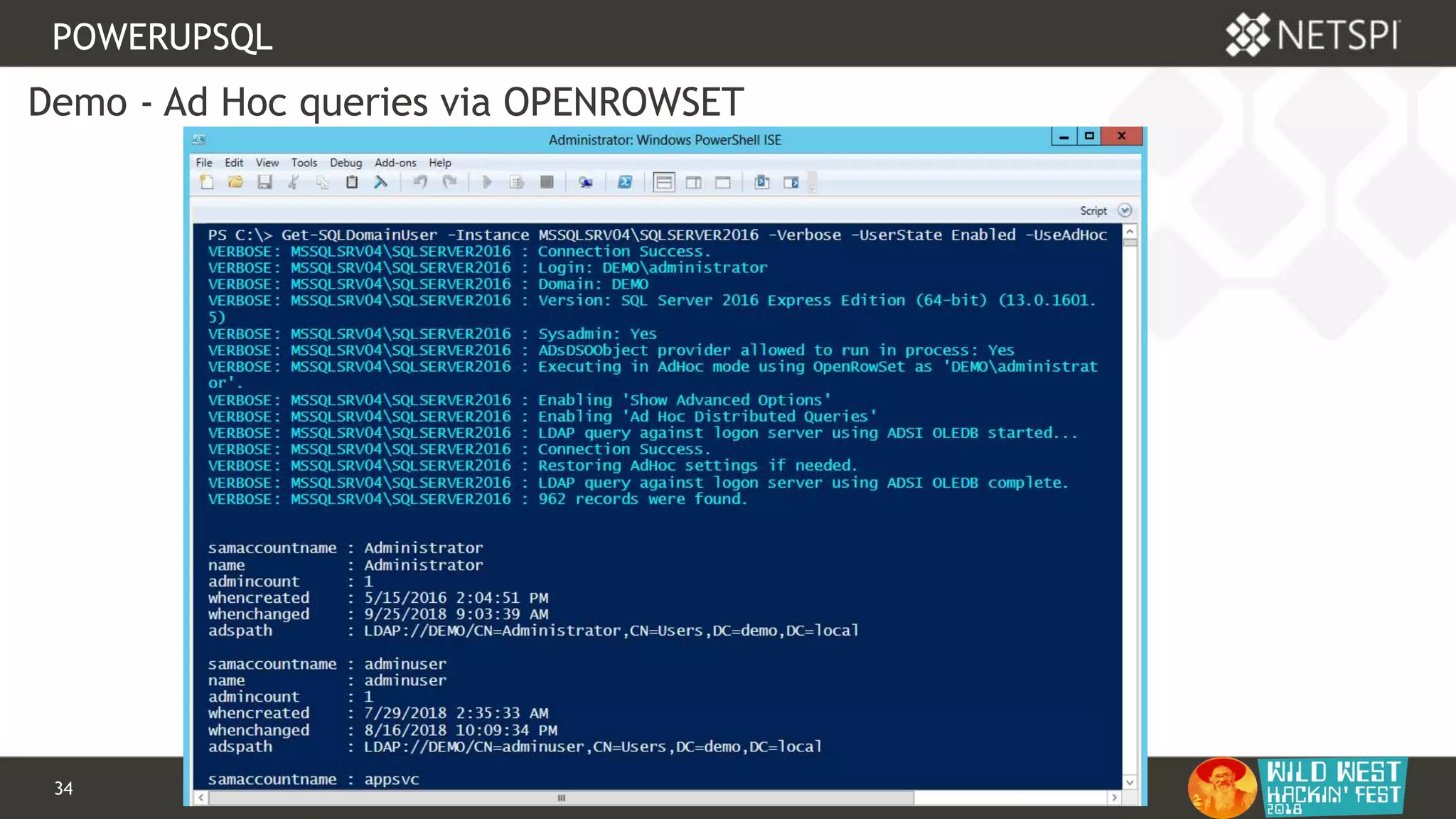
 OPENROWSET (Ad Hoc query)
 OPENQUERY technique requires creating a SQL server link
25 Confidential & Proprietary
POWERUPSQL
OPENQUERY method
 Linked Server
 Configured to run queries in another instance of SQL Server or in another DB
 Can also be used to allow data access from outside of SQL Server
 ADSI Linked Server
 OPENQUERY
 Executes a pass through query on specified linked server
 Server can be OLE DB data source
26 Confidential & Proprietary
POWERUPSQL
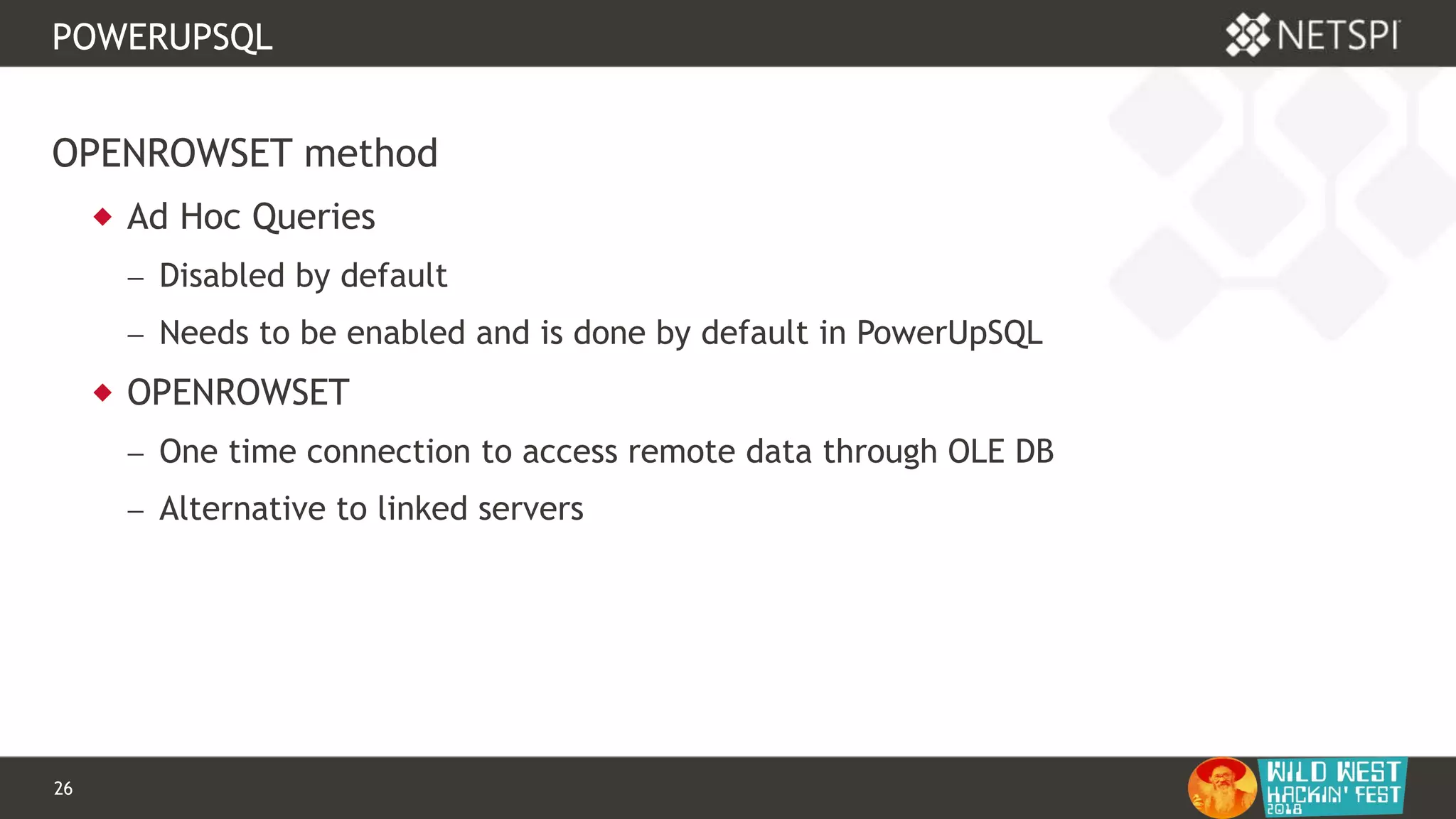
OPENROWSET method
 Ad Hoc Queries
 Disabled by default
 Needs to be enabled and is done by default in PowerUpSQL
 OPENROWSET
 One time connection to access remote data through OLE DB
 Alternative to linked servers
27 Confidential & Proprietary
POWERUPSQL
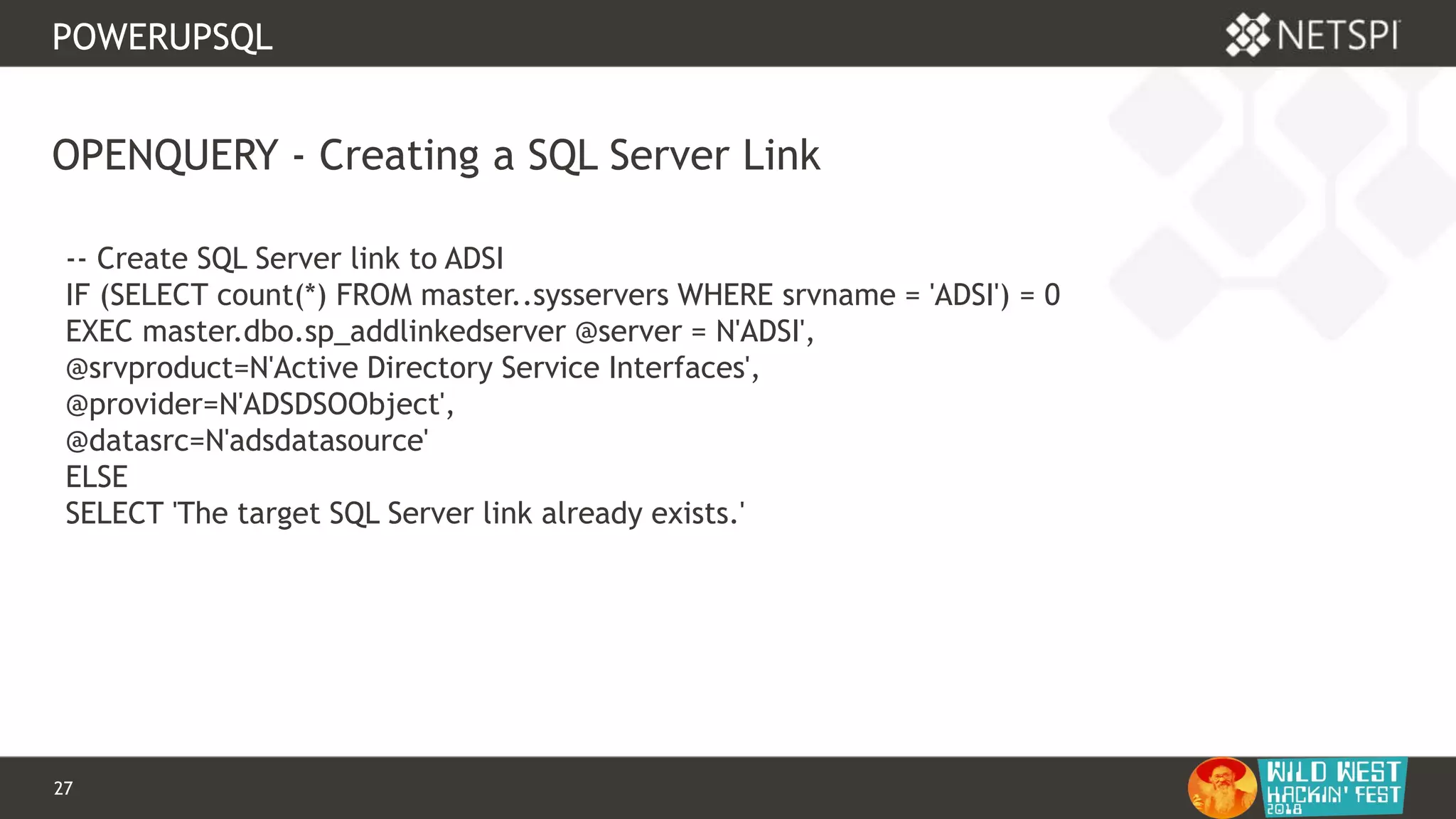
OPENQUERY - Creating a SQL Server Link
-- Create SQL Server link to ADSI
IF (SELECT count(*) FROM master..sysservers WHERE srvname = 'ADSI') = 0
EXEC master.dbo.sp_addlinkedserver @server = N'ADSI',
@srvproduct=N'Active Directory Service Interfaces',
@provider=N'ADSDSOObject',
@datasrc=N'adsdatasource'
ELSE
SELECT 'The target SQL Server link already exists.'
28 Confidential & Proprietary
POWERUPSQL
OPENQUERY
-- Define authentication context - OPENQUERY
EXEC sp_addlinkedsrvlogin
@rmtsrvname=N'ADSI',
@useself=N'True',
@locallogin=NULL,
@rmtuser=NULL,
@rmtpassword=NULL
GO
-- Use OPENQUERY
SELECT *
FROM
OPENQUERY([ADSI],'<LDAP://path>;(&(objectCategory=Person)(objectClass
=user));name, adspath;subtree')
29 Confidential & Proprietary
POWERUPSQL
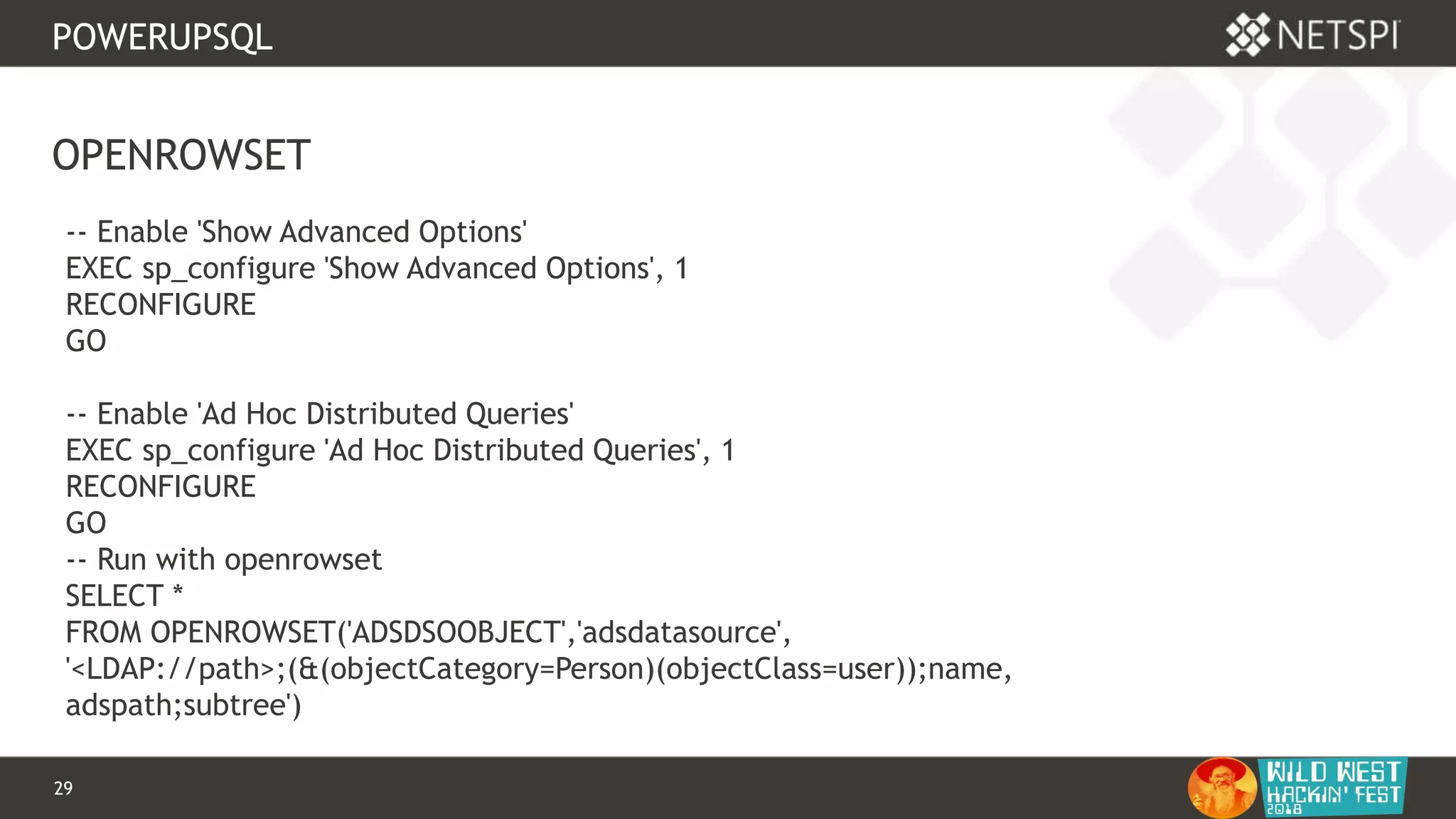
OPENROWSET
-- Enable 'Show Advanced Options'
EXEC sp_configure 'Show Advanced Options', 1
RECONFIGURE
GO
-- Enable 'Ad Hoc Distributed Queries'
EXEC sp_configure 'Ad Hoc Distributed Queries', 1
RECONFIGURE
GO
-- Run with openrowset
SELECT *
FROM OPENROWSET('ADSDSOOBJECT','adsdatasource',
'<LDAP://path>;(&(objectCategory=Person)(objectClass=user));name,
adspath;subtree')
30 Confidential & Proprietary
POWERUPSQL
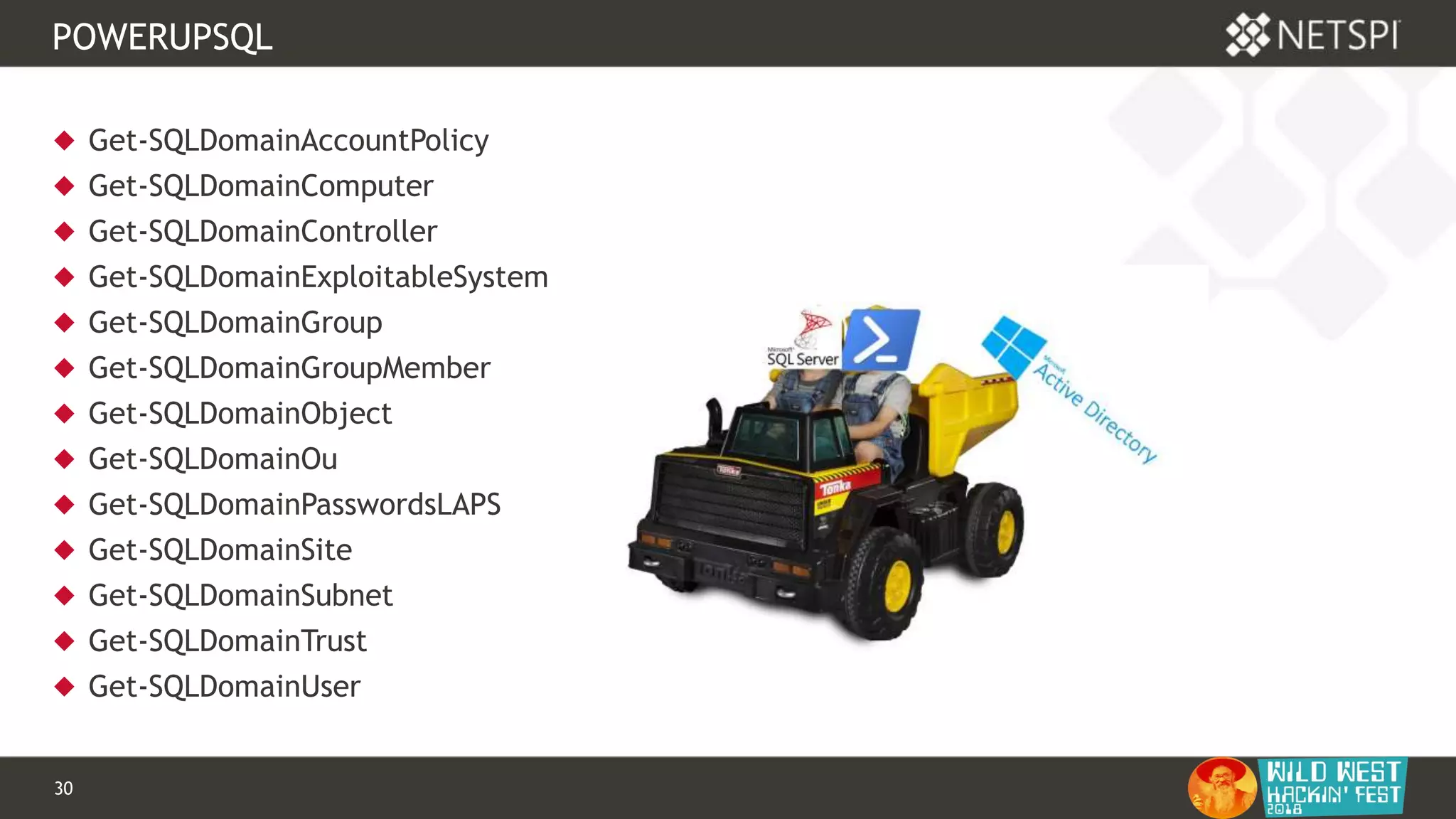
 Get-SQLDomainAccountPolicy
 Get-SQLDomainComputer
 Get-SQLDomainController
 Get-SQLDomainExploitableSystem
 Get-SQLDomainGroup
 Get-SQLDomainGroupMember
 Get-SQLDomainObject
 Get-SQLDomainOu
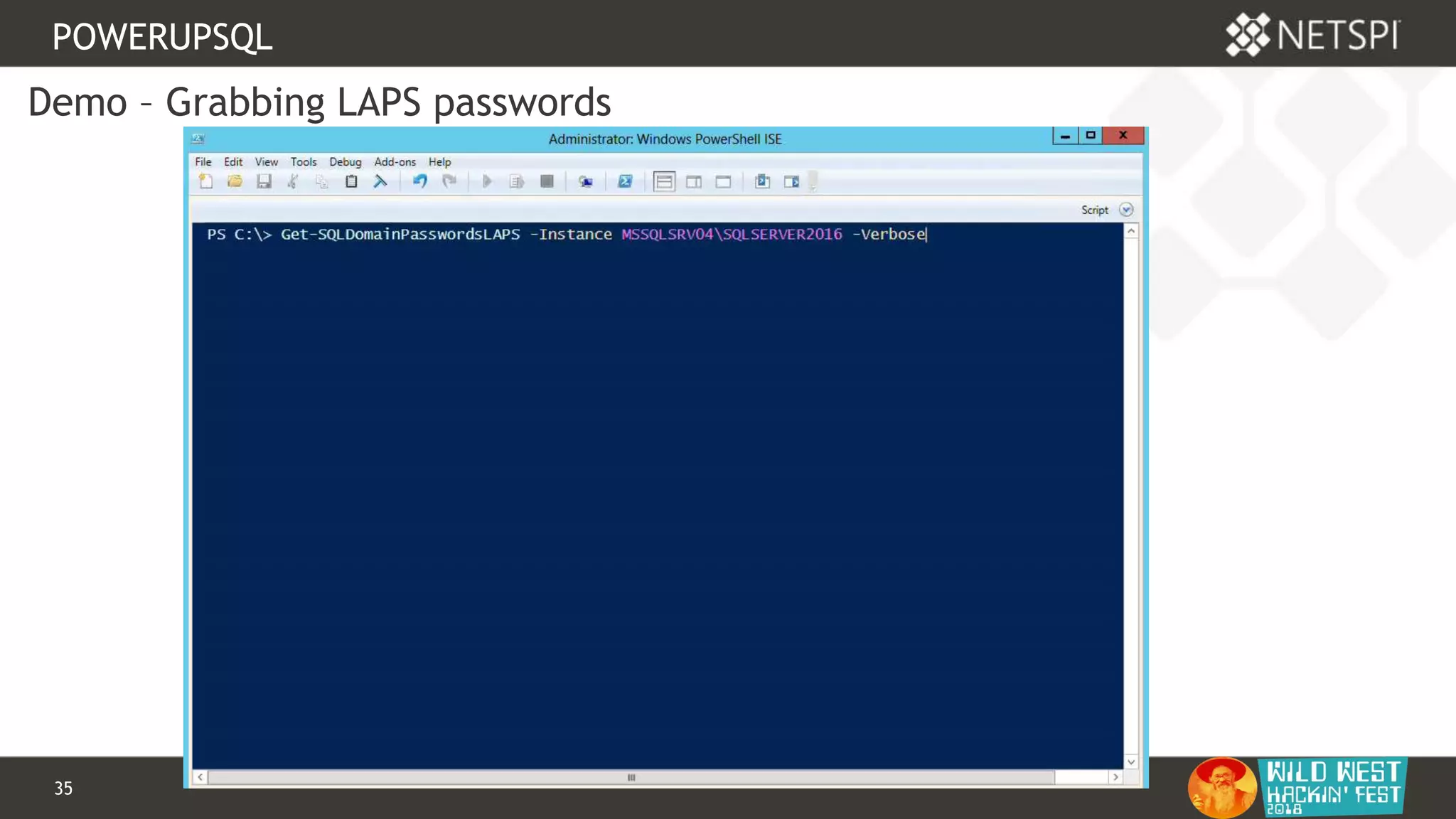
 Get-SQLDomainPasswordsLAPS
 Get-SQLDomainSite
 Get-SQLDomainSubnet
 Get-SQLDomainTrust
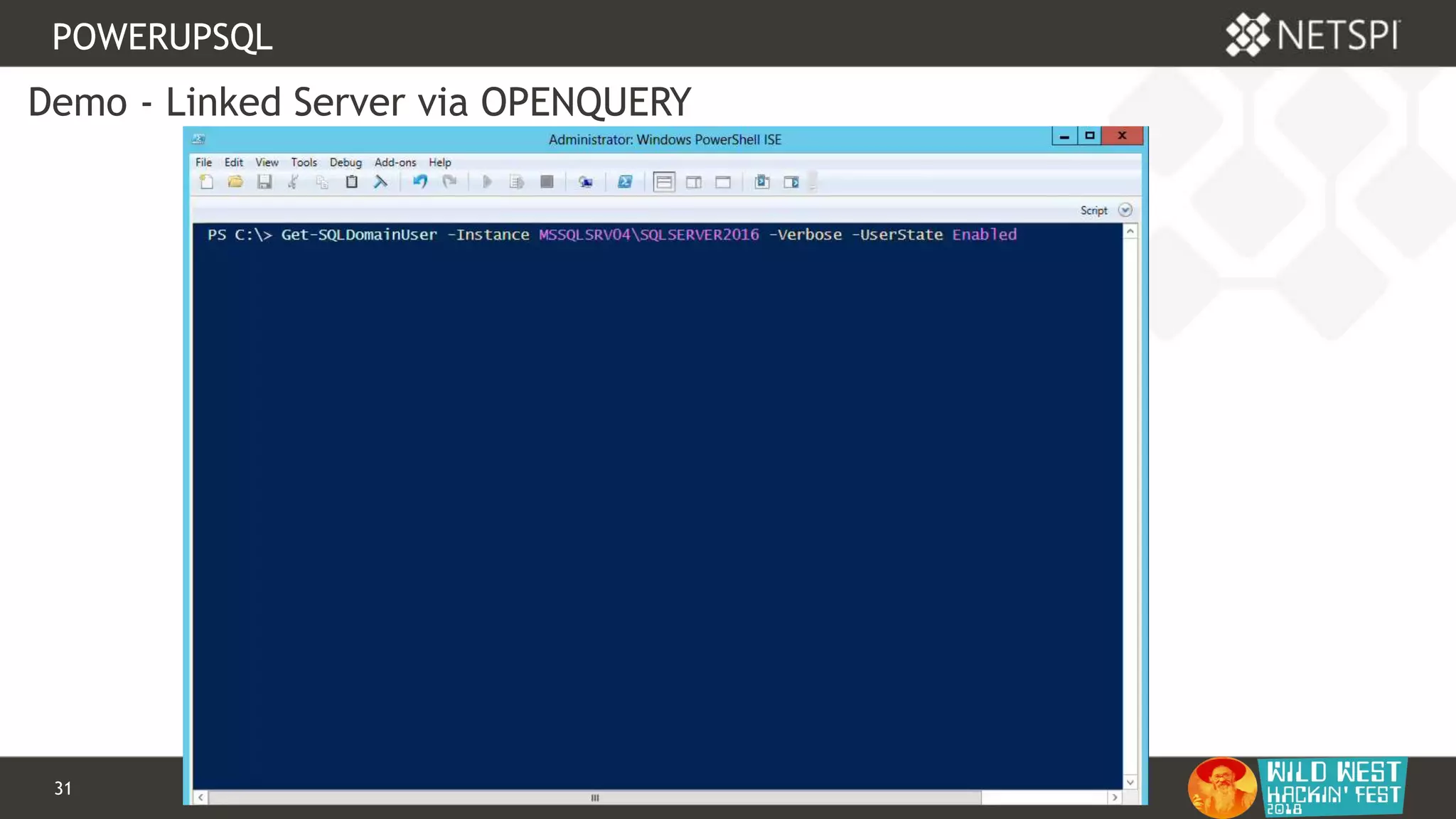
 Get-SQLDomainUser
31 Confidential & Proprietary
POWERUPSQL
Demo - Linked Server via OPENQUERY
32 Confidential & Proprietary
POWERUPSQL
Demo - Linked Server via OPENQUERY
33 Confidential & Proprietary
POWERUPSQL
Demo - Ad Hoc queries via OPENROWSET
34 Confidential & Proprietary
POWERUPSQL
Demo - Ad Hoc queries via OPENROWSET
35 Confidential & Proprietary
POWERUPSQL
Demo – Grabbing LAPS passwords
36 Confidential & Proprietary
POWERUPSQL
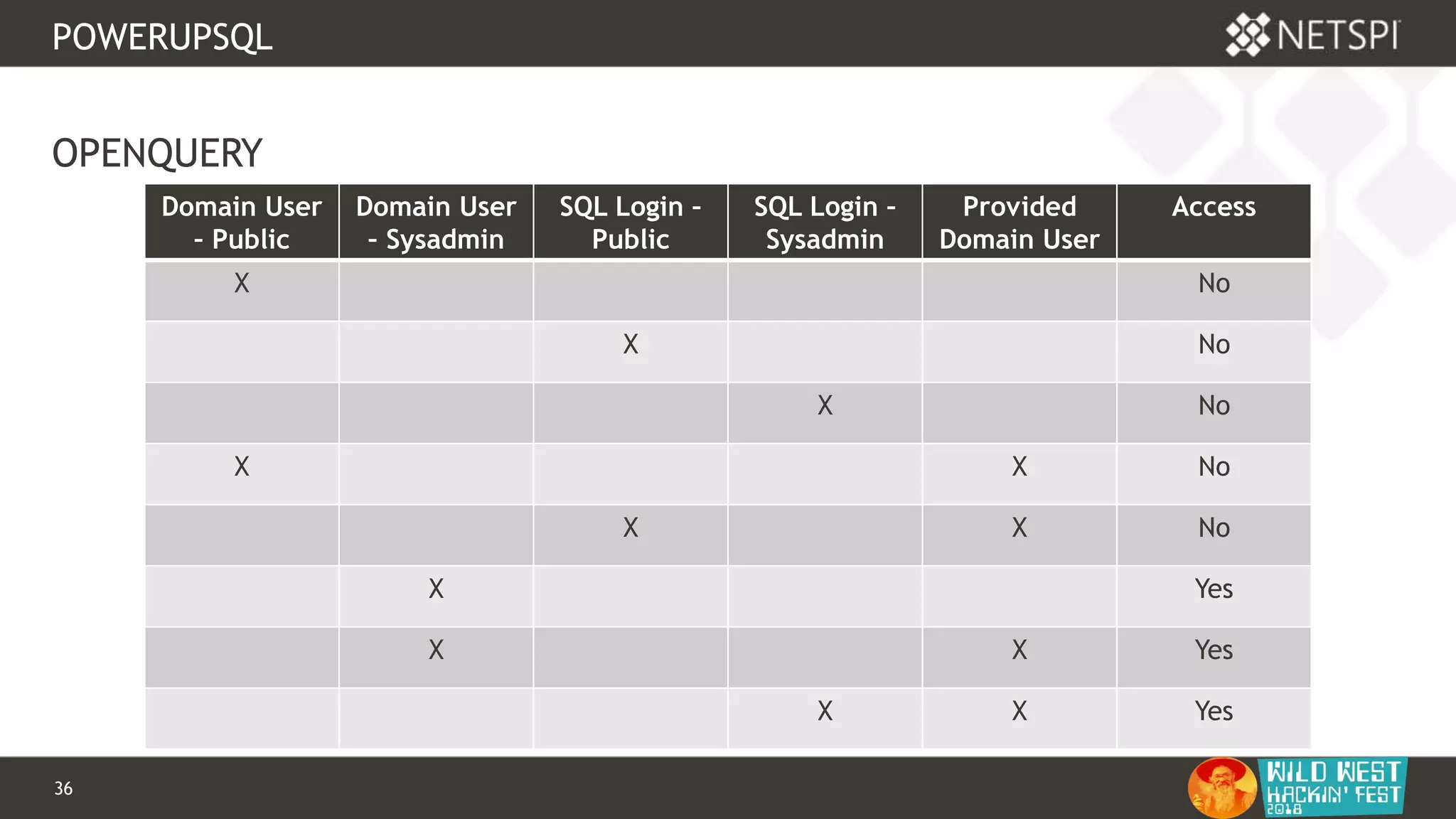
OPENQUERY
Domain User
– Public
Domain User
– Sysadmin
SQL Login –
Public
SQL Login –
Sysadmin
Provided
Domain User
Access
X No
X No
X No
X X No
X X No
X Yes
X X Yes
X X Yes
37 Confidential & Proprietary
POWERUPSQL
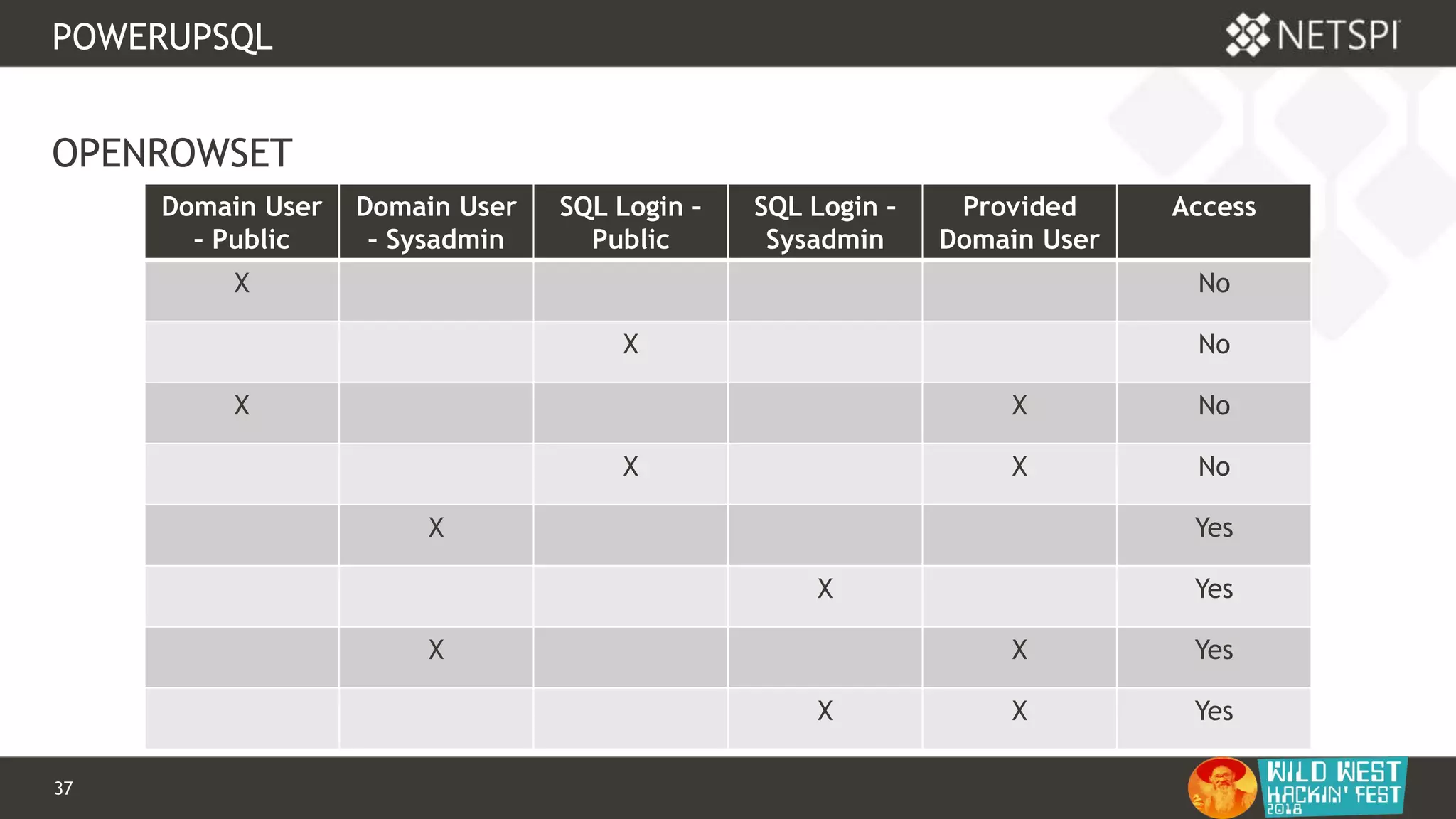
OPENROWSET
Domain User
– Public
Domain User
– Sysadmin
SQL Login –
Public
SQL Login –
Sysadmin
Provided
Domain User
Access
X No
X No
X X No
X X No
X Yes
X Yes
X X Yes
X X Yes
38 Confidential & Proprietary
POWERUPSQL
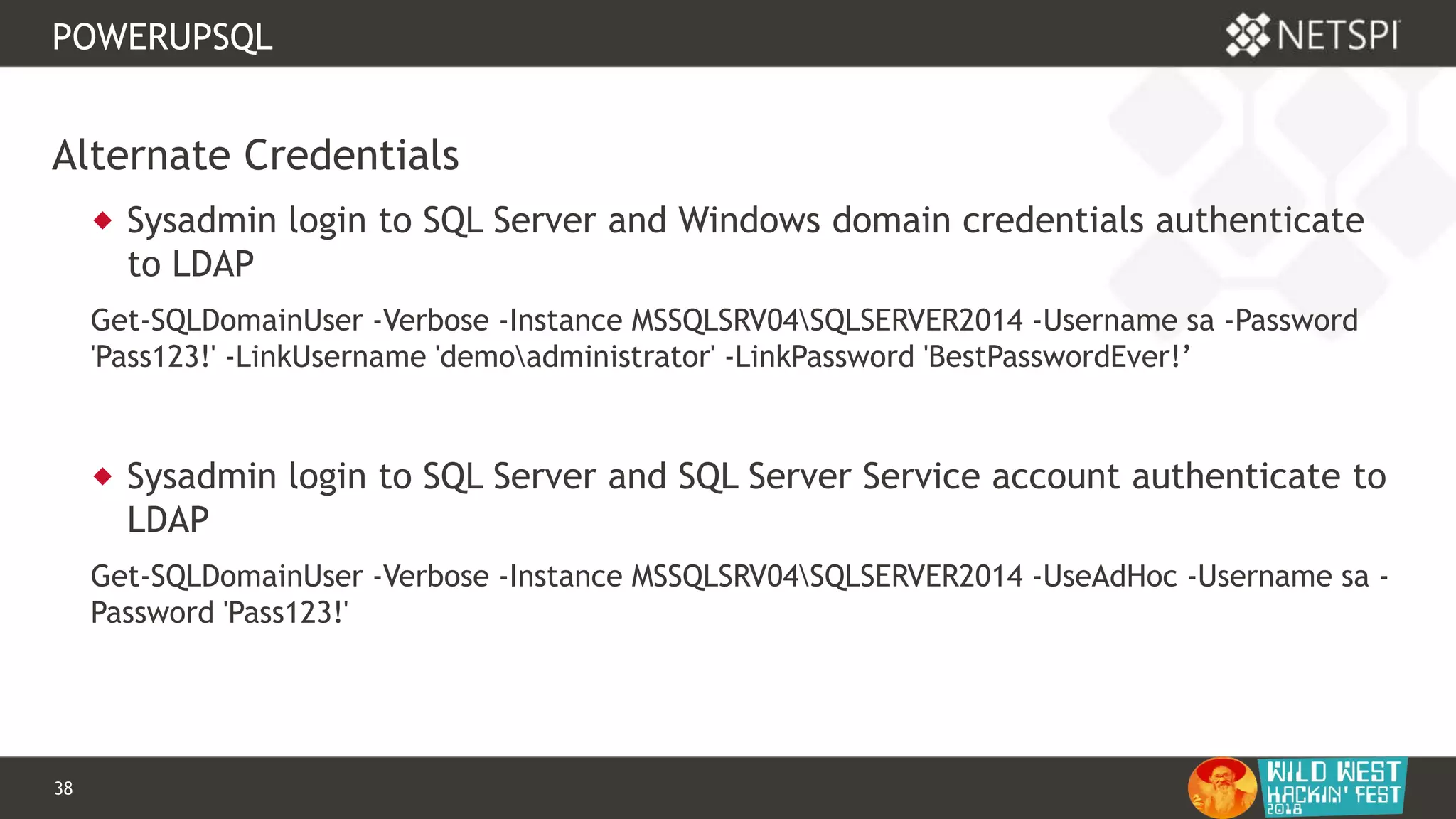
Alternate Credentials
 Sysadmin login to SQL Server and Windows domain credentials authenticate
to LDAP
Get-SQLDomainUser -Verbose -Instance MSSQLSRV04SQLSERVER2014 -Username sa -Password
'Pass123!' -LinkUsername 'demoadministrator' -LinkPassword 'BestPasswordEver!’
 Sysadmin login to SQL Server and SQL Server Service account authenticate to
LDAP
Get-SQLDomainUser -Verbose -Instance MSSQLSRV04SQLSERVER2014 -UseAdHoc -Username sa -
Password 'Pass123!'
39 Confidential & Proprietary
POWERUPSQL
PowerUpSQL caveats
 Need sysadmin privileges to return data
 Multi-valued attributes cannot be returned
 Description, memberof
 Multi-valued attributes not supported by OLE DB ADSI provider
“Msg 7346, Level 16, State 2, Line 1 Cannot get the data of the row from the OLE DB provider
"ADSDSOObject" for linked server "ADSI". Could not convert the data value due to reasons other than
sign mismatch or overflow.”
 SQL CLR workaround
 Paging not supported
 Max results returned limited
 Default set at 1000 in Windows Server 2012
40 Confidential & Proprietary40 Confidential & Proprietary
GODDI
41 Confidential & Proprietary
GODDI
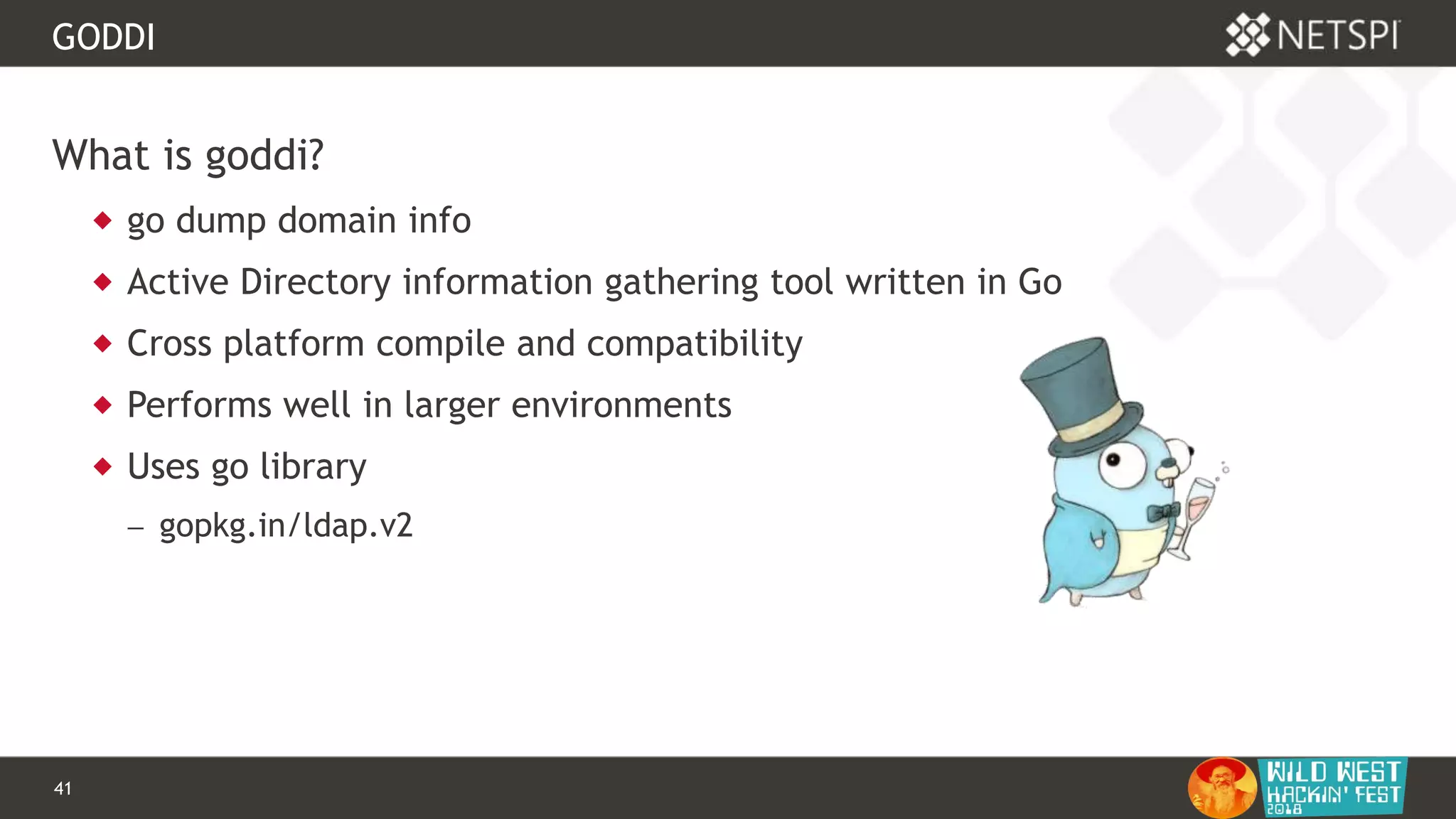
What is goddi?
 go dump domain info
 Active Directory information gathering tool written in Go
 Cross platform compile and compatibility
 Performs well in larger environments
 Uses go library
 gopkg.in/ldap.v2
42 Confidential & Proprietary
GODDI
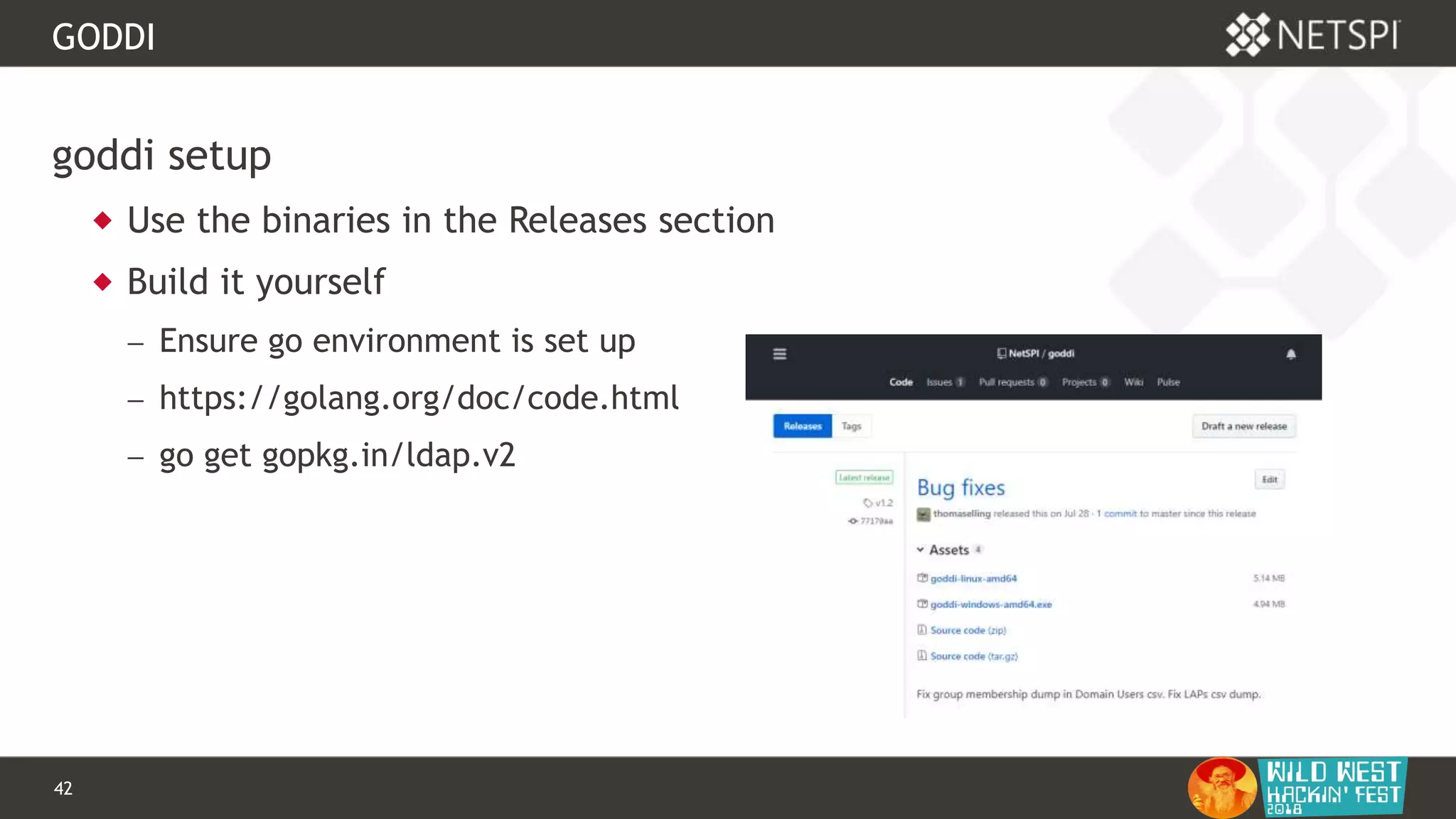
goddi setup
 Use the binaries in the Releases section
 Build it yourself
 Ensure go environment is set up
 https://golang.org/doc/code.html
 go get gopkg.in/ldap.v2
43 Confidential & Proprietary
GODDI
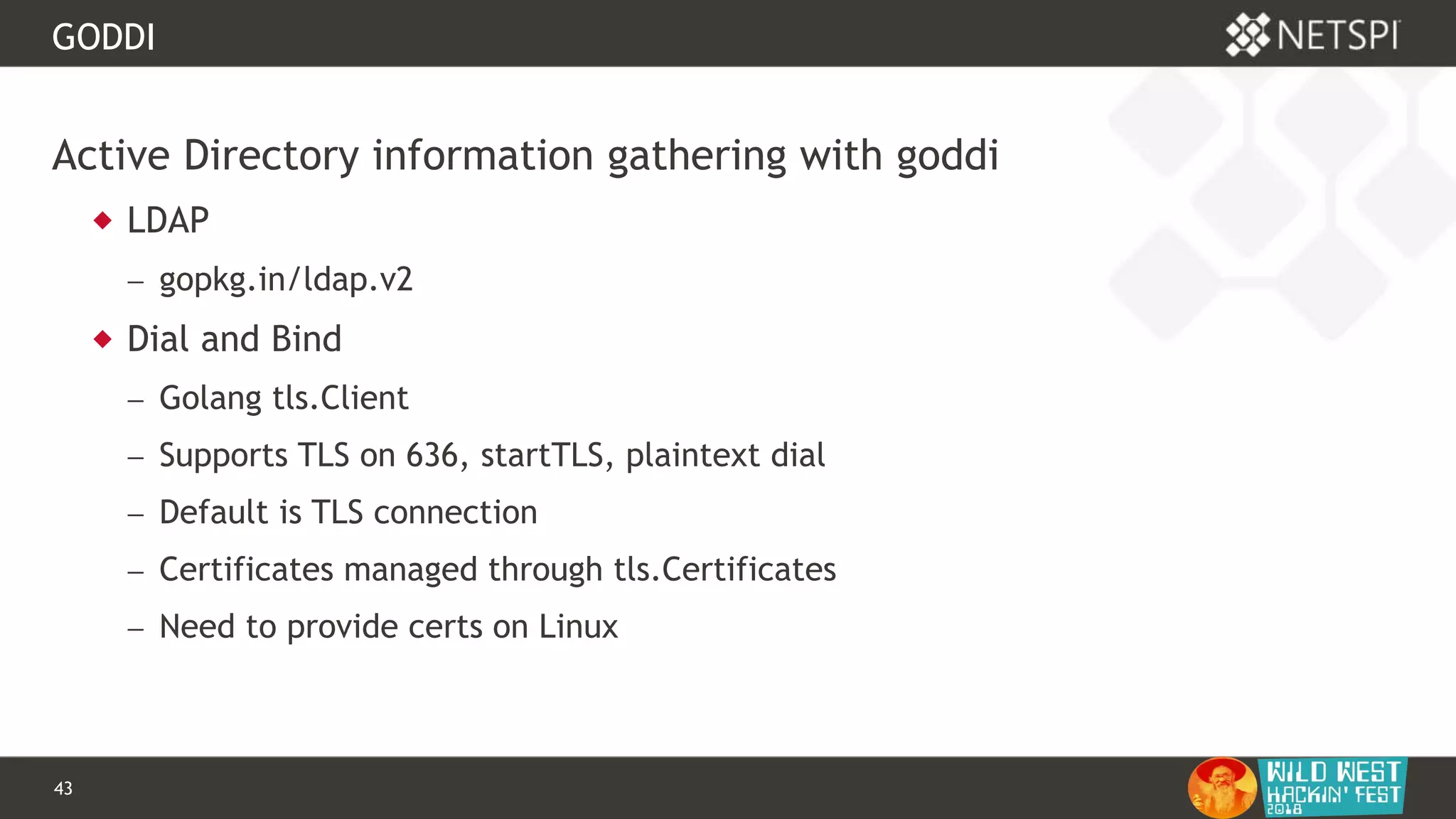
Active Directory information gathering with goddi
 LDAP
 gopkg.in/ldap.v2
 Dial and Bind
 Golang tls.Client
 Supports TLS on 636, startTLS, plaintext dial
 Default is TLS connection
 Certificates managed through tls.Certificates
 Need to provide certs on Linux
44 Confidential & Proprietary
GODDI
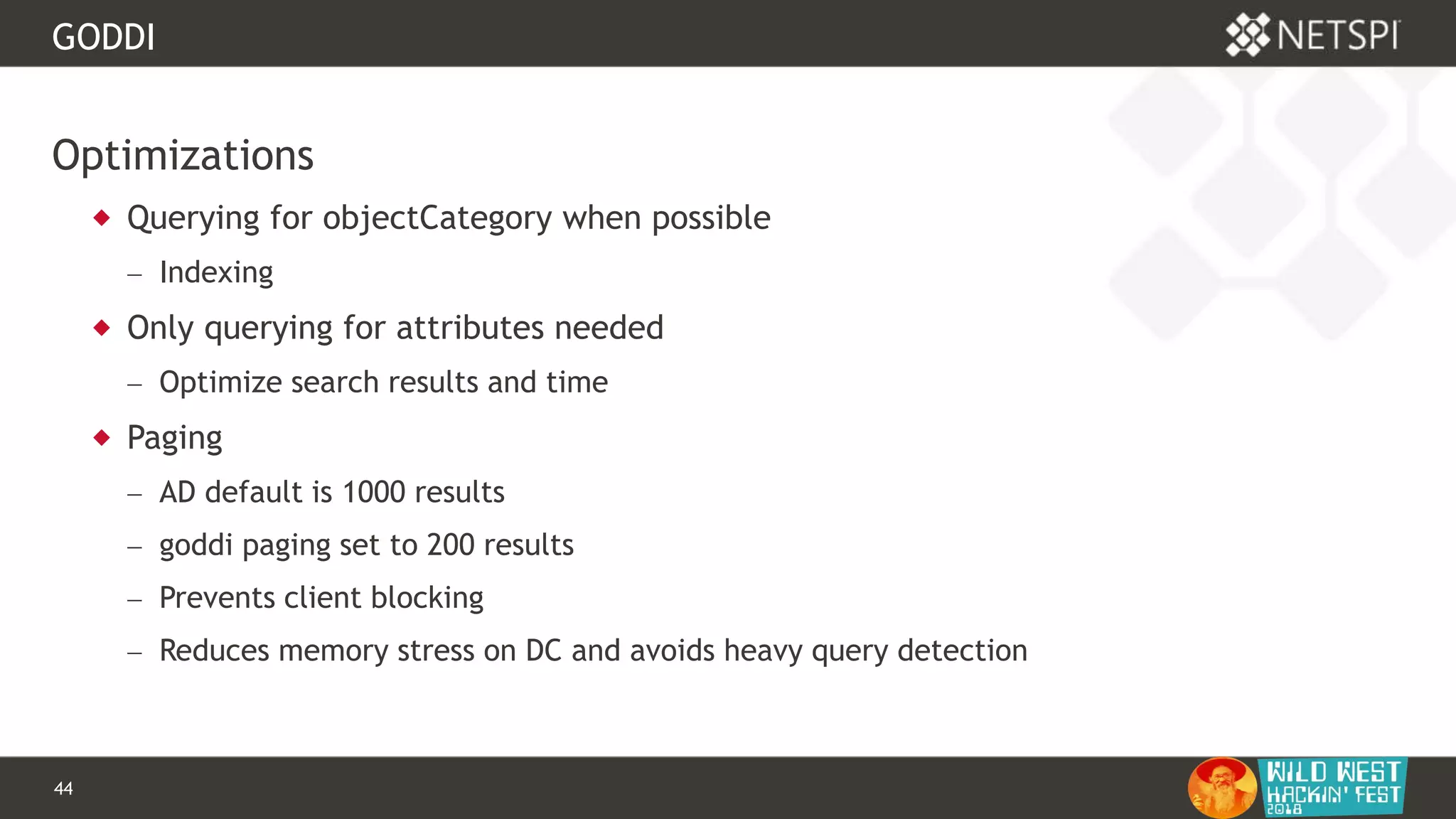
Optimizations
 Querying for objectCategory when possible
 Indexing
 Only querying for attributes needed
 Optimize search results and time
 Paging
 AD default is 1000 results
 goddi paging set to 200 results
 Prevents client blocking
 Reduces memory stress on DC and avoids heavy query detection
45 Confidential & Proprietary
GODDI
func GetLAPS(conn *ldap.Conn, baseDN string) {
attributes := []string{
"dNSHostName",
"ms-Mcs-AdmPwd",
"ms-Mcs-AdmPwdExpirationTime"}
filter := "(objectCategory=Computer)"
sr := ldapSearch(baseDN, filter, attributes, conn)
46 Confidential & Proprietary
GODDI
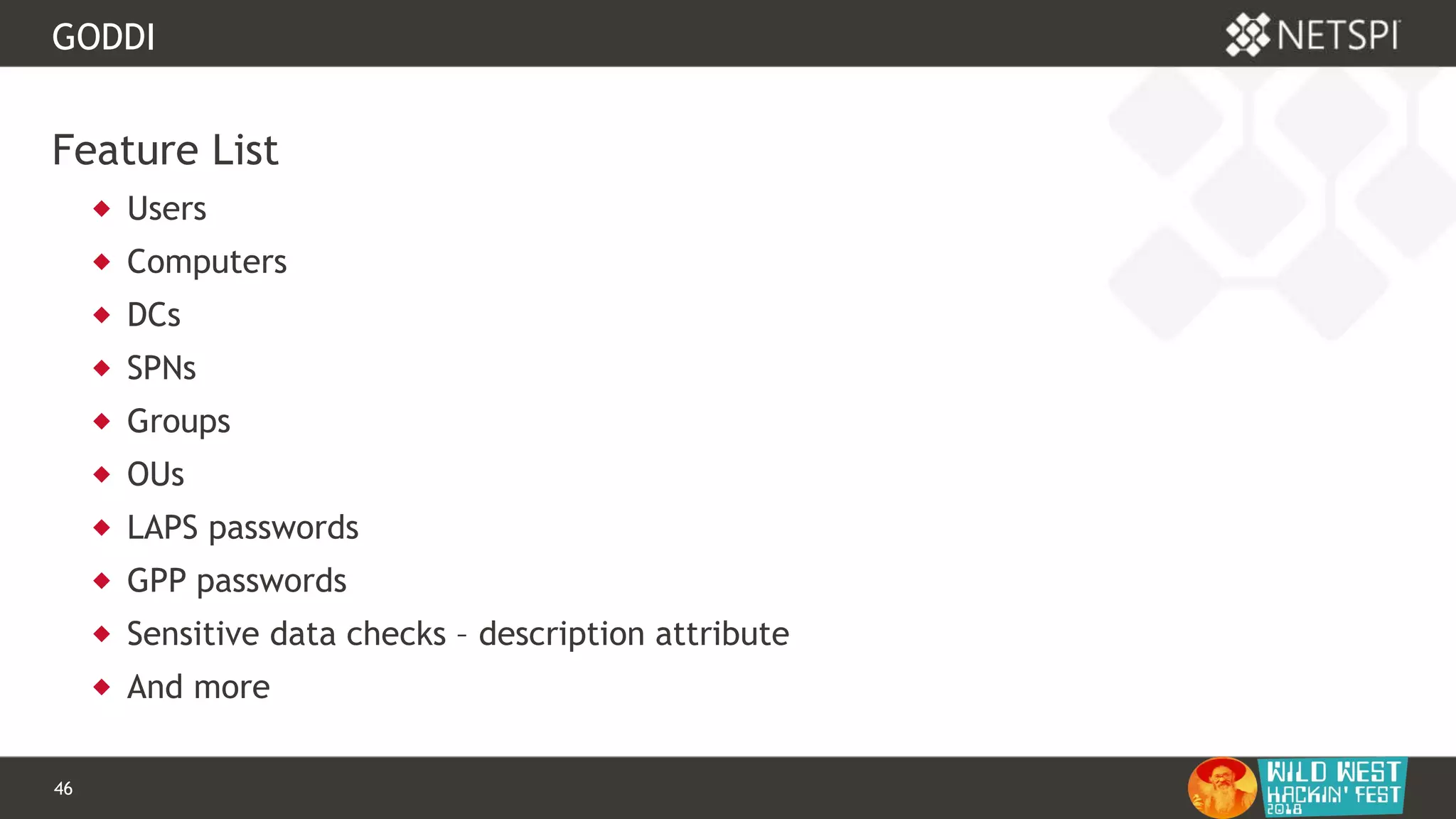
Feature List
 Users
 Computers
 DCs
 SPNs
 Groups
 OUs
 LAPS passwords
 GPP passwords
 Sensitive data checks – description attribute
 And more
47 Confidential & Proprietary
GODDI
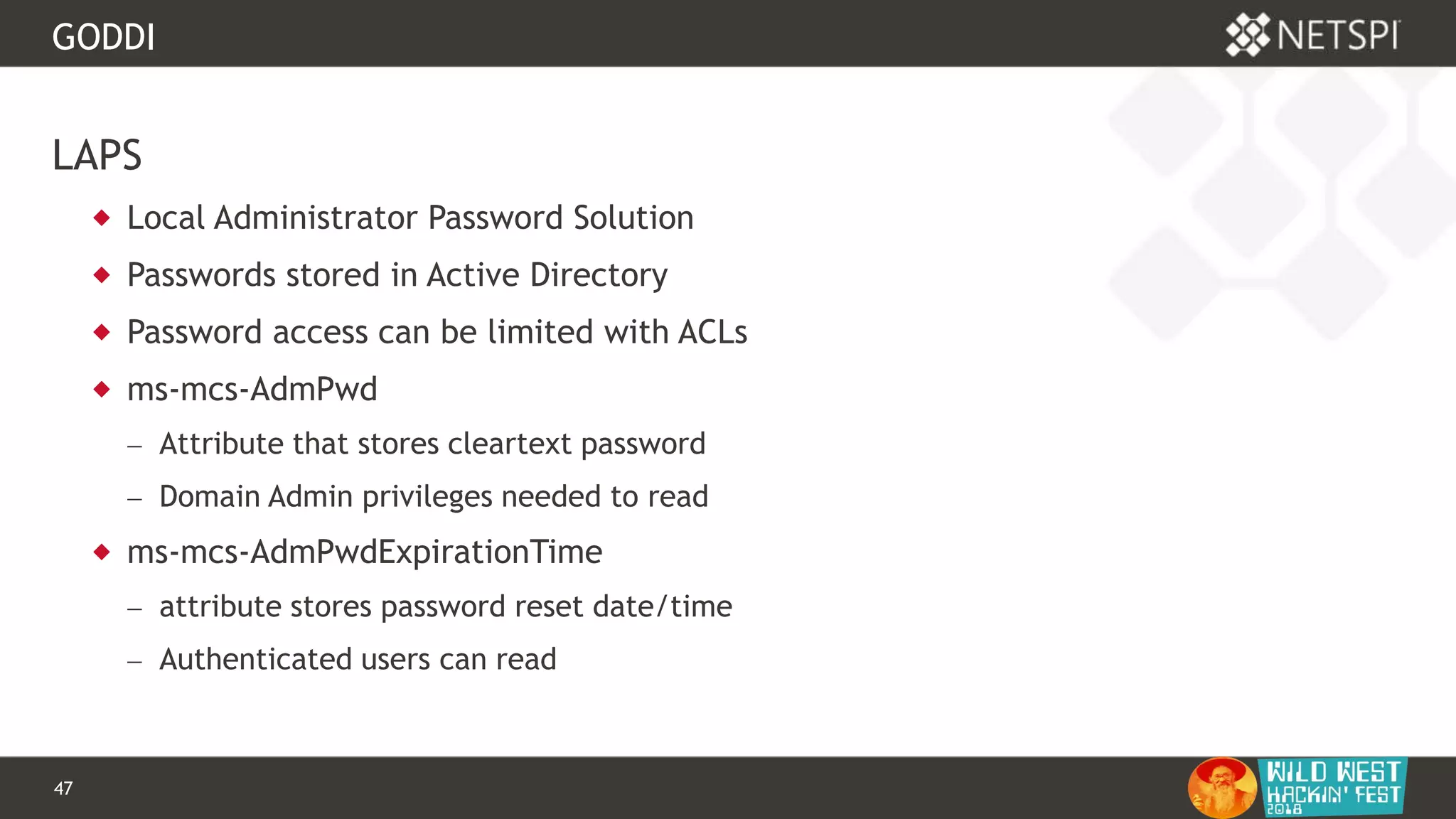
LAPS
 Local Administrator Password Solution
 Passwords stored in Active Directory
 Password access can be limited with ACLs
 ms-mcs-AdmPwd
 Attribute that stores cleartext password
 Domain Admin privileges needed to read
 ms-mcs-AdmPwdExpirationTime
 attribute stores password reset date/time
 Authenticated users can read
48 Confidential & Proprietary
GODDI
GPP
 Group Policy Preference
 Group Policy can be used to change local administrator passwords
 XML files can contain encrypted cpassword if provided
 AES 256 bit encrypted
 demo.localSYSVOLdemo.localPolicies...
49 Confidential & Proprietary
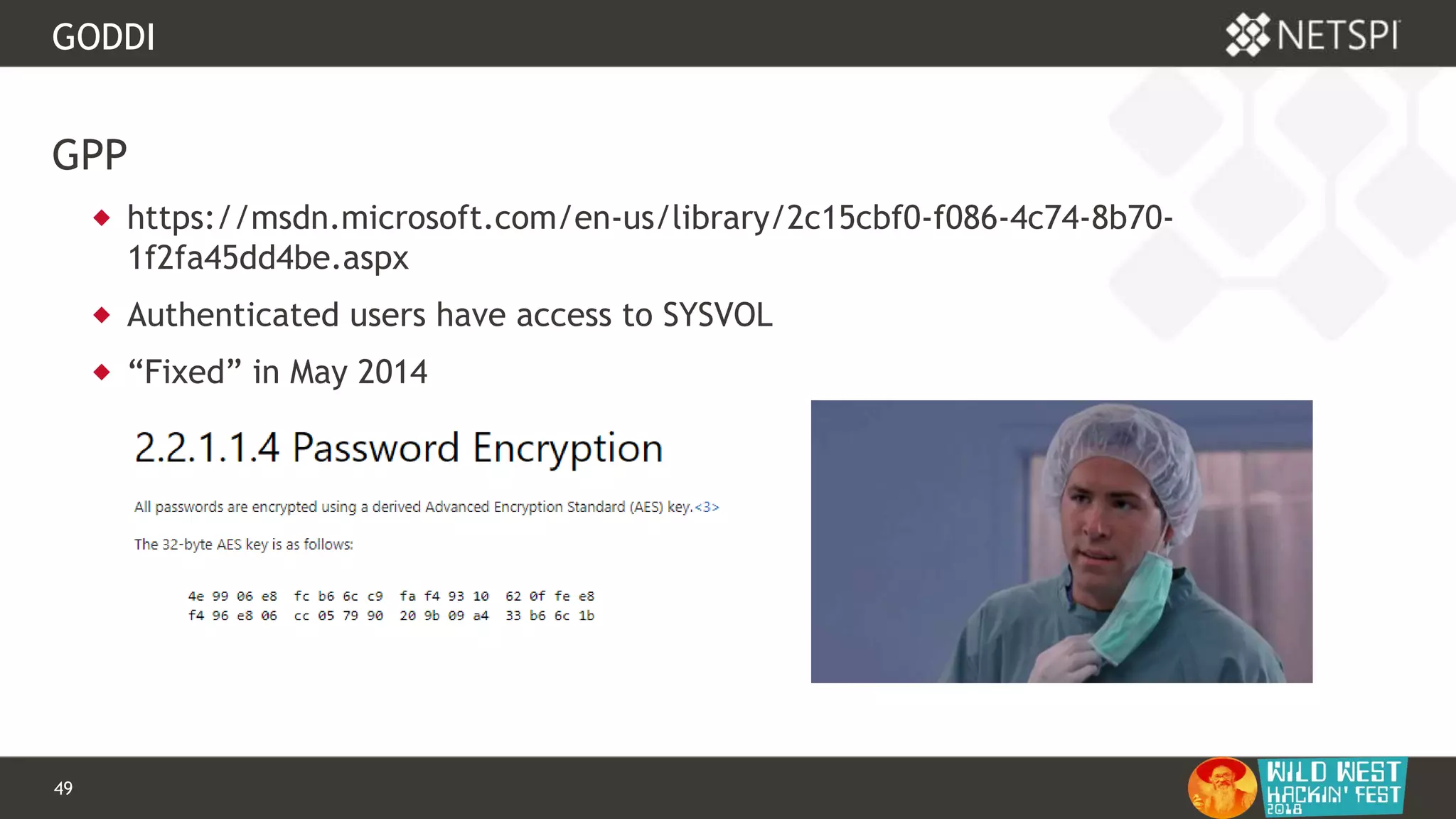
GODDI
GPP
 https://msdn.microsoft.com/en-us/library/2c15cbf0-f086-4c74-8b70-
1f2fa45dd4be.aspx
 Authenticated users have access to SYSVOL
 “Fixed” in May 2014
50 Confidential & Proprietary
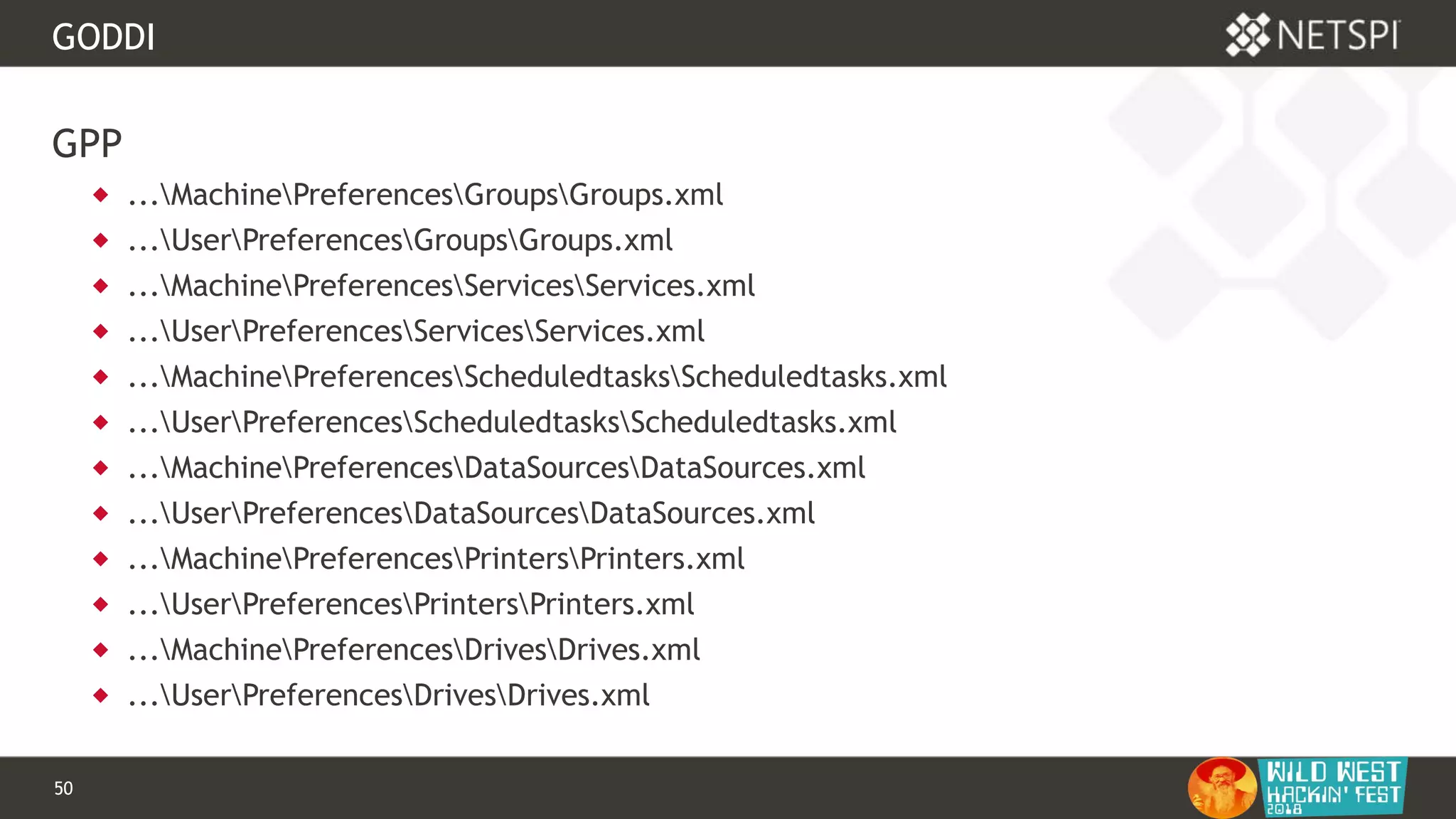
GODDI
GPP
 ...MachinePreferencesGroupsGroups.xml
 ...UserPreferencesGroupsGroups.xml
 ...MachinePreferencesServicesServices.xml
 ...UserPreferencesServicesServices.xml
 ...MachinePreferencesScheduledtasksScheduledtasks.xml
 ...UserPreferencesScheduledtasksScheduledtasks.xml
 ...MachinePreferencesDataSourcesDataSources.xml
 ...UserPreferencesDataSourcesDataSources.xml
 ...MachinePreferencesPrintersPrinters.xml
 ...UserPreferencesPrintersPrinters.xml
 ...MachinePreferencesDrivesDrives.xml
 ...UserPreferencesDrivesDrives.xml
51 Confidential & Proprietary
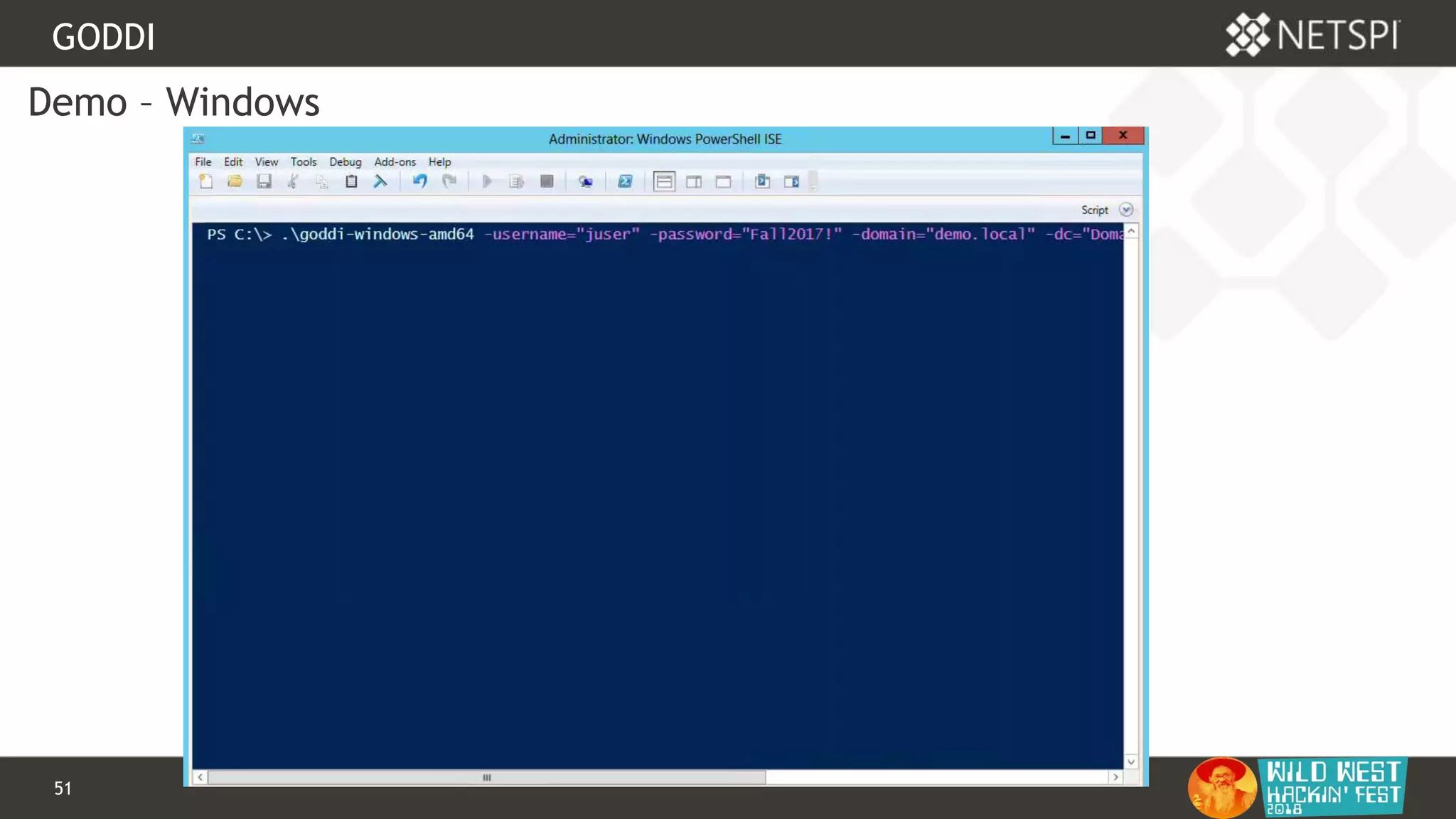
GODDI
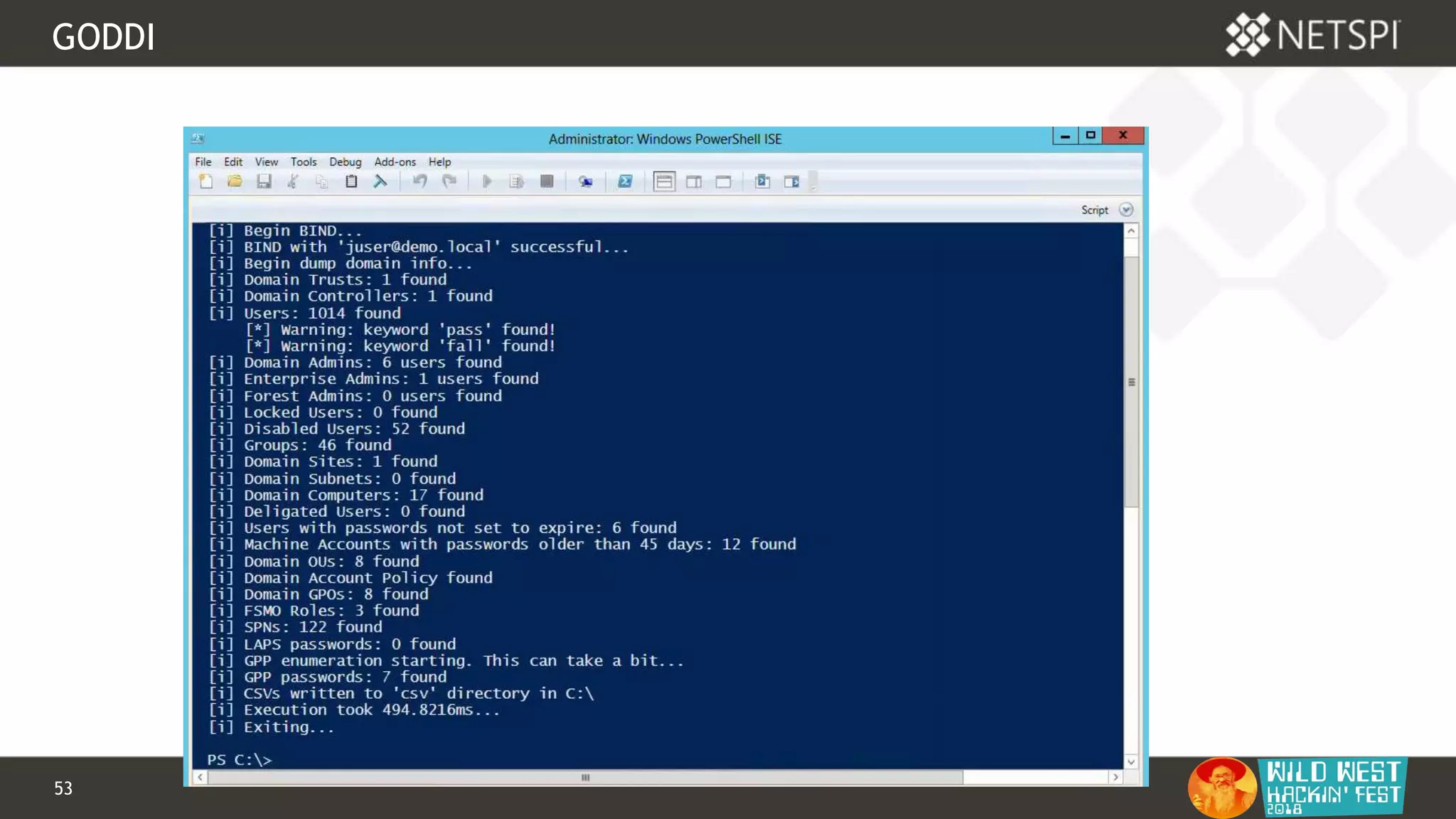
Demo – Windows
52 Confidential & Proprietary
GODDI
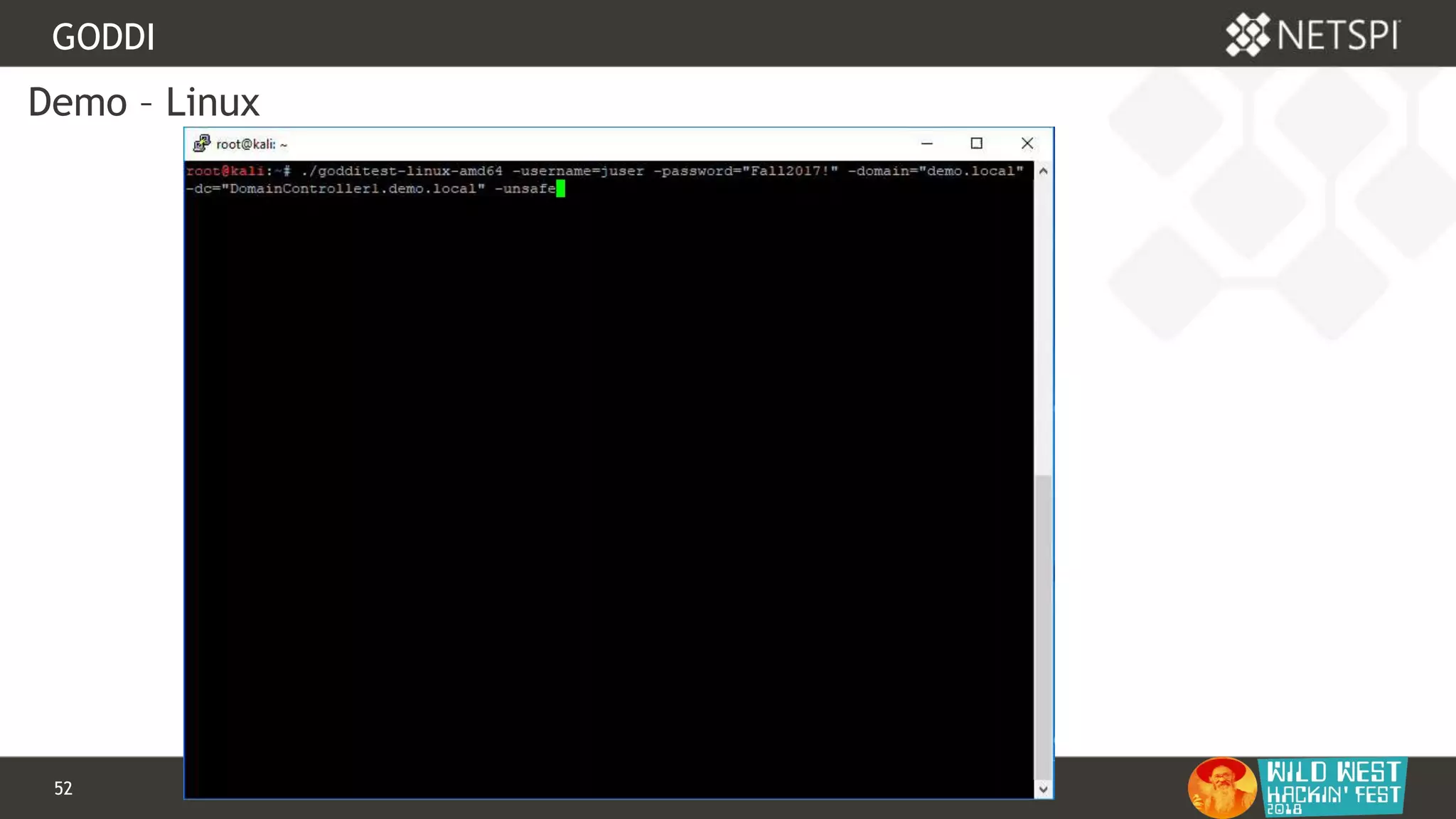
Demo – Linux
53 Confidential & Proprietary
GODDI
54 Confidential & Proprietary
GODDI
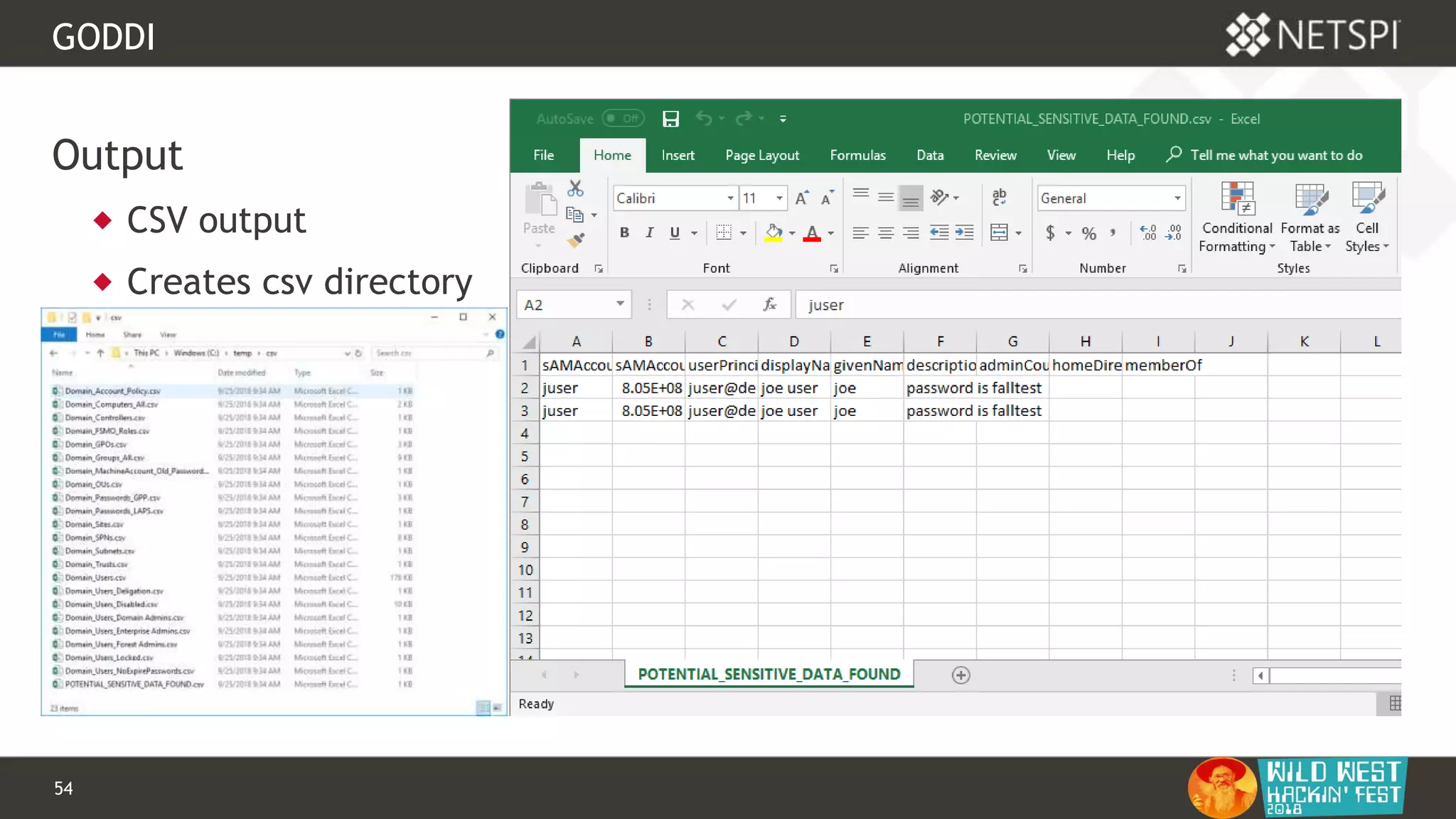
Output
 CSV output
 Creates csv directory
55 Confidential & Proprietary
GODDI
goddi caveats
 Need to supply credentials every time
 Does not run from current user context as PowerUpSQL or PowerView
 Certificates can be tricky
 Need to import them on Linux
 GetGPP
 Uses “net use” and “mount”
 Needs more robust error handling
 Need to improve XML parsing
 Underlying library requires case sensitive attributes
56 Confidential & Proprietary
GODDI
goddi Roadmap – ADSI and COM
 Best solution for using user’s current Windows security context
 Use the IADs interfaces (inherit from IDispatch)
 Requires lower level system calls
var mod = syscall.LoadDLL("ole32.dll")
var proc = mod.FindProc("CoCreateInstanceEx")
ret, _, _ := proc.Call(...)
 go-ole library
57 Confidential & Proprietary57 Confidential & Proprietary
DETECTION
58 Confidential & Proprietary
DETECTION
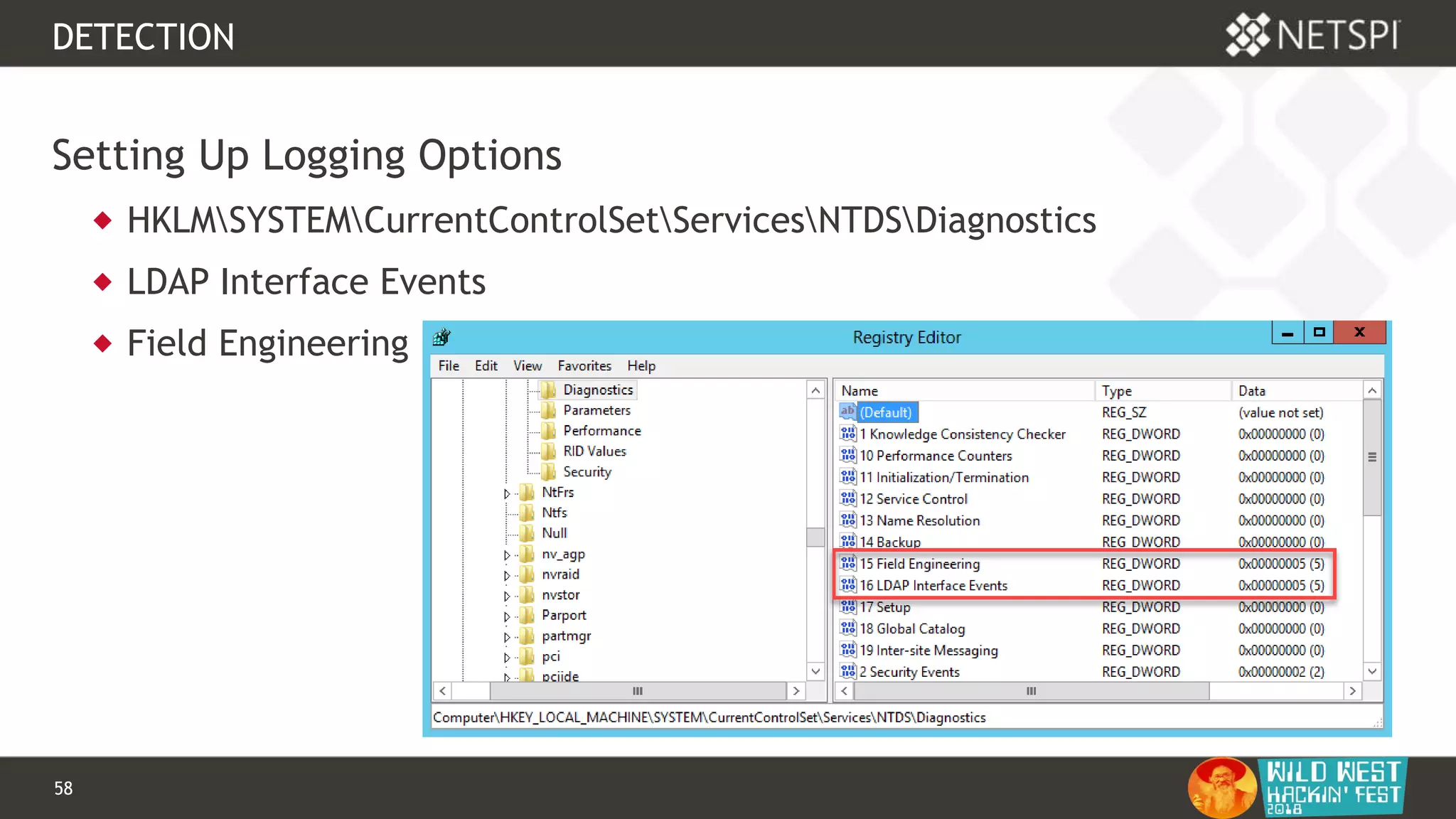
Setting Up Logging Options
 HKLMSYSTEMCurrentControlSetServicesNTDSDiagnostics
 LDAP Interface Events
 Field Engineering
59 Confidential & Proprietary
DETECTION
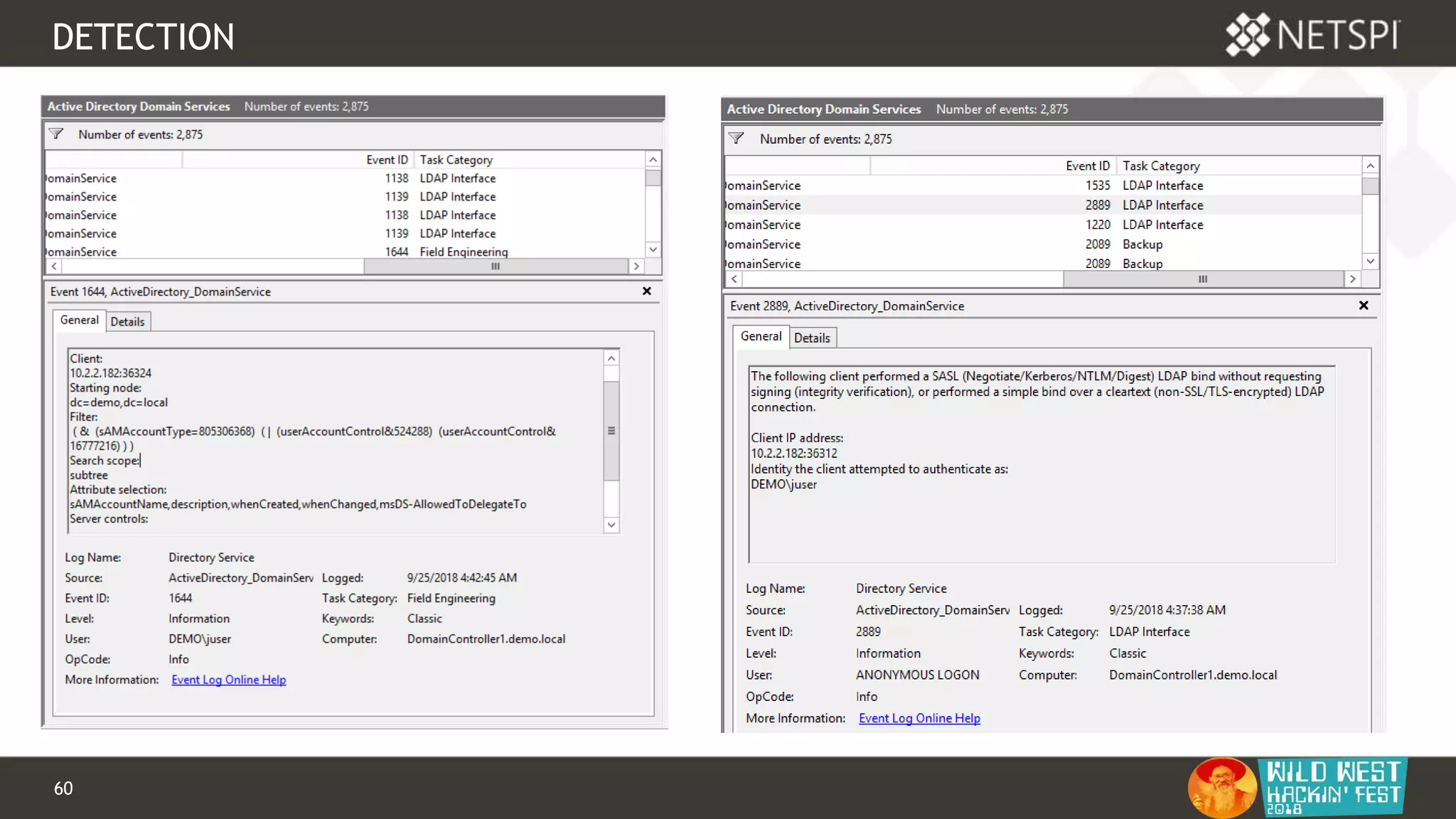
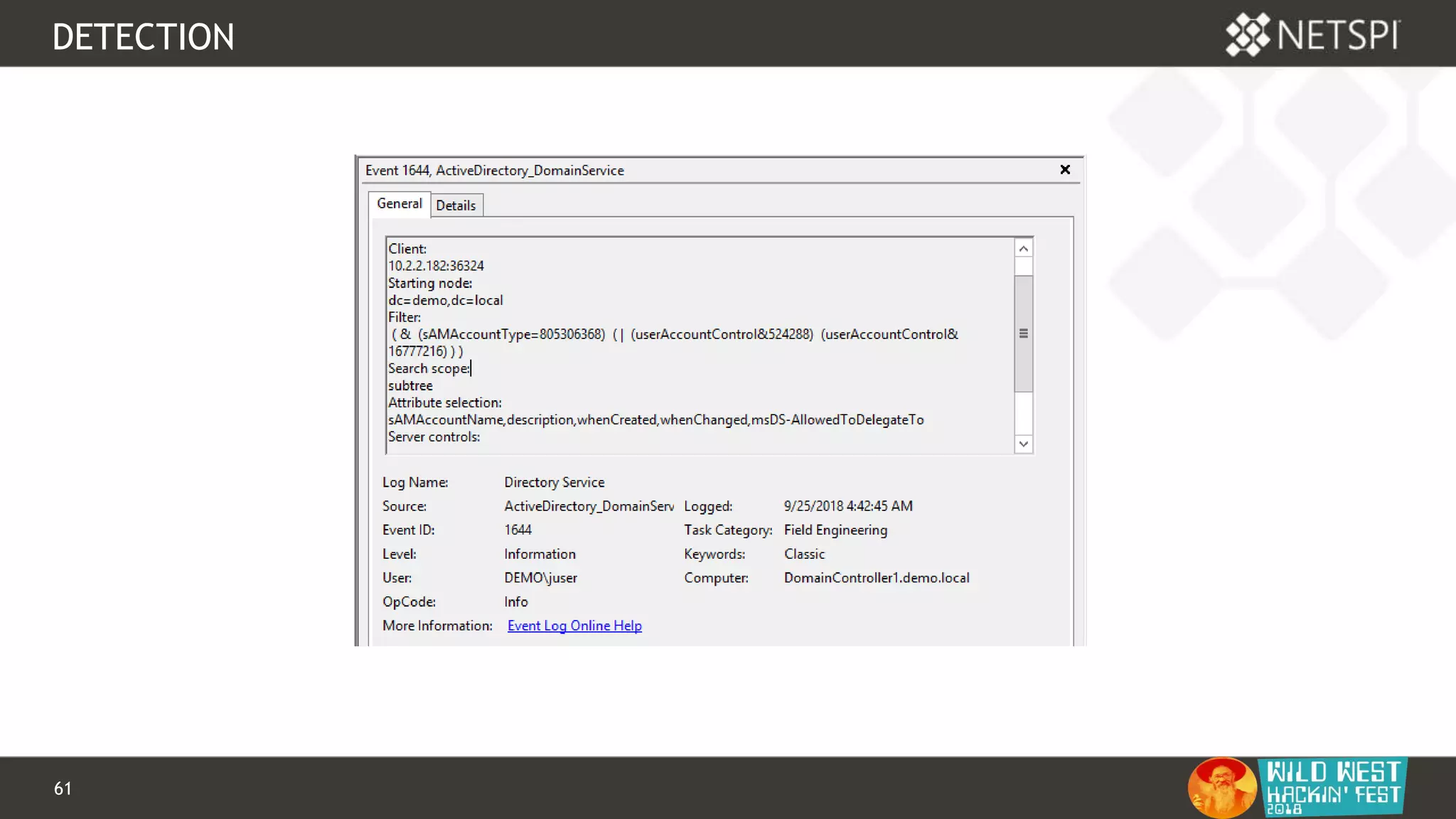
Windows Event IDs
 2889 – LDAP bind without signing or cleartext connection
 1644 – Costly LDAP searches
 https://docs.microsoft.com/en-us/windows-server/identity/ad-
ds/manage/component-updates/directory-services-component-updates
60 Confidential & Proprietary
DETECTION
61 Confidential & Proprietary
DETECTION
62 Confidential & Proprietary62 Confidential & Proprietary
WRAPPING UP
63 Confidential & Proprietary
WRAPPING UP
Thanks!
 Everyone on the Previous Research slide
 Scott Sutherland
 Karl Fosaaen
 Kevin Robertson
 PowerUpSQL and goddi contributors
 Everyone at this talk!
64 Confidential & Proprietary
WRAPPING UP
References
 Everyone on the Previous Research slide
 Fancy Gopher, by Renée French,
https://blog.golang.org/gophergala/fancygopher.jpg
MINNEAPOLIS | NEW YORK | PORTLAND | DENVER | DALLAS
https://www.netspi.com
https://www.facebook.com/netspi
@NetSPI
https://www.slideshare.net/NetSPI

WWHF 2018 - Using PowerUpSQL and goddi for Active Directory Information Gathering

  • 1.
    USING POWERUPSQL ANDGODDI FOR ACTIVE DIRECTORY INFORMATION GATHERING THOMAS ELLING
  • 2.
    2 Confidential &Proprietary ABOUT Thomas Elling  Web Application and Network Pentester at NetSPI  PowerUpSQL contributor  goddi (go dump domain info) creator  I liked the Venom movie  Twitter: @thomas_elling  Slideshare: slideshare.net/thomaselling1  Blog: blog.netspi.com
  • 3.
    3 Confidential &Proprietary PRESENTATION OVERVIEW  Previous Research  Active Directory Basics  PowerUpSQL overview  Install instructions  Methodology  Demo  goddi overview  Install instructions  Methodology  Demo  Detection
  • 4.
    4 Confidential &Proprietary INTRODUCTION Why is Active Directory Information Gathering useful?  Situational Awareness  What am I looking for?  Escalation Paths  Where are privileged users logged in?  Identify Misconfigurations  Are there passwords in the Description attribute?
  • 5.
    5 Confidential &Proprietary INTRODUCTION Why PowerUpSQL and goddi?  AD information gathering alternatives  Using SQL Server and ADSI  Using golang and LDAP  Does not use typical PowerShell AD functions
  • 6.
    6 Confidential &Proprietary6 Confidential & Proprietary PREVIOUS RESEARCH
  • 7.
    7 Confidential &Proprietary PREVIOUS RESEARCH harmj0y - https://blog.harmj0y.net/ PyroTek3 - https://adsecurity.org/ nikhil_mitt - https://www.labofapenetrationtester.com/ _nullbind - https://blog.netspi.com/author/scott-sutherland/ PowerView authors - https://github.com/PowerShellMafia/PowerSploit/tree/master/Recon
  • 8.
    8 Confidential &Proprietary PREVIOUS RESEARCH PowerView  Part of PowerSploit  Recon module  Basis of PowerShell ingestor in BloodHound  PowerShell AD module hooks  LDAP/.NET  WMI  Win32 API
  • 9.
    9 Confidential &Proprietary9 Confidential & Proprietary ACTIVE DIRECTORY BASICS
  • 10.
    10 Confidential &Proprietary ACTIVE DIRECTORY BASICS What is Active Directory?  Microsoft’s Directory Service  Directory Service – provides resource and network mappings for objects distributed across a network  Includes wide variety of directory services - Federation services, Lightweight directory services etc.  Domain Services – hierarchical and scalable infrastructure for object management  Domain Services is our focus
  • 11.
    11 Confidential &Proprietary ACTIVE DIRECTORY BASICS What are the key components of Domain Services? Forest Tree Domains
  • 12.
    12 Confidential &Proprietary ACTIVE DIRECTORY BASICS  Domain - security boundary, collection of objects  Domain Controller – server(s) where Active Directory is installed  Users and Computers – security principals, represent physical entities on the domain  OU – containers for users/groups/computers, easy to apply group policies or delegation  Groups – collection of users/computers where access control can be applied
  • 13.
    13 Confidential &Proprietary ACTIVE DIRECTORY BASICS Accessing Domain Services  Active Directory Service Interfaces (ADSI)  COM interfaces for managing network resources  OLE DB provider for ADSI used in SQL Server and PowerUpSQL  LDAP provider  Lightweight Directory Access Protocol (LDAP/LDAPS)  LDAP is AD’s access protocol  Used to send and retrieve domain information  Supports different authentication methods
  • 14.
    14 Confidential &Proprietary ACTIVE DIRECTORY BASICS LDAP basics  Entry – collection of attributes  DN – unique identifier for an entry ex. cn=test test,dc=demo,dc=com  Attributes – LDAP data identified by predefined names ex. sAMAccountName  Scope – specifies search objects ex. WholeSubtree  Filters – used to select data within a search ex. Groups (&(objectCategory=group)(SamAccountName=*))
  • 15.
    15 Confidential &Proprietary ACTIVE DIRECTORY BASICS Useful LDAP filters  Users - (&(objectCategory=person)(objectClass=user)(SamAccountName=*))  Locked Users - (&(sAMAccountType=805306368)(lockoutTime>=1))  Computers - (&(objectCategory=Computer)(SamAccountName=*))  DCs - (&(objectCategory=computer)(userAccountControl:1.2.840.113556.1.4.803:=8192))  SPNs - (servicePrincipalName=*)  Groups - (&(objectClass=group)(samaccountname=*))  Domain Admins - (&(objectCategory=user)(memberOf=DomainAdminDN))  OUs - (&(objectCategory=organizationalUnit)(ou=*))
  • 16.
    16 Confidential &Proprietary16 Confidential & Proprietary POWERUPSQL
  • 17.
    17 Confidential &Proprietary POWERUPSQL What is PowerUpSQL?  Written in PowerShell  SQL Server discovery  Weak configuration auditing  Privilege escalation  Post exploitation  Hacking SQL Server on scale
  • 18.
    18 Confidential &Proprietary POWERUPSQL Why SQL Server?  Popular in enterprise environments  Integration with Windows services  Vertical escalation opportunities on the domain Why PowerShell?  Native to Windows  Runs commands in memory  Often flagged as trusted  May need to start obfuscating or disabling security features soon…
  • 19.
    19 Confidential &Proprietary POWERUPSQL PowerUpSQL wiki  https://github.com/NetSPI/PowerUpSQL/wiki/Active-Directory-Recon- Functions  Setup instructions  Cheat Sheets!  Documentation  Resource Links
  • 20.
    20 Confidential &Proprietary POWERUPSQL PowerUpSQL setup  Import-Module PowerUpSQL.psd1  Install-Module -Name PowerUpSQL  IEX(New-Object System.Net.WebClient).DownloadString("https://raw.githubusercontent.com /NetSPI/PowerUpSQL/master/PowerUpSQL.ps1")  &([scriptblock]::Create((new-object net.webclient).downloadstring("https://raw.githubusercontent.com/NetSPI/ PowerUpSQL/master/PowerUpSQL.ps1")))
  • 21.
    21 Confidential &Proprietary POWERUPSQL
  • 22.
    22 Confidential &Proprietary POWERUPSQL Getting started  Get-Command –Module PowerUpSQL –Name 'Get-SQLDomain*'  Get-Help Get-SQLDomainUser
  • 23.
    23 Confidential &Proprietary POWERUPSQL Getting started  Check out BlackHat Arsenal 2018 slides  https://www.slideshare.net/nullbind/powerupsql-2018-blackhat-usa- arsenal-presentation
  • 24.
    24 Confidential &Proprietary POWERUPSQL Active Directory information gathering with PowerUpSQL  OLE DB Active Directory Service Interfaces (ADSI) Provider  Two main methods  OPENQUERY (Linked server)  OPENROWSET (Ad Hoc query)  OPENQUERY technique requires creating a SQL server link
  • 25.
    25 Confidential &Proprietary POWERUPSQL OPENQUERY method  Linked Server  Configured to run queries in another instance of SQL Server or in another DB  Can also be used to allow data access from outside of SQL Server  ADSI Linked Server  OPENQUERY  Executes a pass through query on specified linked server  Server can be OLE DB data source
  • 26.
    26 Confidential &Proprietary POWERUPSQL OPENROWSET method  Ad Hoc Queries  Disabled by default  Needs to be enabled and is done by default in PowerUpSQL  OPENROWSET  One time connection to access remote data through OLE DB  Alternative to linked servers
  • 27.
    27 Confidential &Proprietary POWERUPSQL OPENQUERY - Creating a SQL Server Link -- Create SQL Server link to ADSI IF (SELECT count(*) FROM master..sysservers WHERE srvname = 'ADSI') = 0 EXEC master.dbo.sp_addlinkedserver @server = N'ADSI', @srvproduct=N'Active Directory Service Interfaces', @provider=N'ADSDSOObject', @datasrc=N'adsdatasource' ELSE SELECT 'The target SQL Server link already exists.'
  • 28.
    28 Confidential &Proprietary POWERUPSQL OPENQUERY -- Define authentication context - OPENQUERY EXEC sp_addlinkedsrvlogin @rmtsrvname=N'ADSI', @useself=N'True', @locallogin=NULL, @rmtuser=NULL, @rmtpassword=NULL GO -- Use OPENQUERY SELECT * FROM OPENQUERY([ADSI],'<LDAP://path>;(&(objectCategory=Person)(objectClass =user));name, adspath;subtree')
  • 29.
    29 Confidential &Proprietary POWERUPSQL OPENROWSET -- Enable 'Show Advanced Options' EXEC sp_configure 'Show Advanced Options', 1 RECONFIGURE GO -- Enable 'Ad Hoc Distributed Queries' EXEC sp_configure 'Ad Hoc Distributed Queries', 1 RECONFIGURE GO -- Run with openrowset SELECT * FROM OPENROWSET('ADSDSOOBJECT','adsdatasource', '<LDAP://path>;(&(objectCategory=Person)(objectClass=user));name, adspath;subtree')
  • 30.
    30 Confidential &Proprietary POWERUPSQL  Get-SQLDomainAccountPolicy  Get-SQLDomainComputer  Get-SQLDomainController  Get-SQLDomainExploitableSystem  Get-SQLDomainGroup  Get-SQLDomainGroupMember  Get-SQLDomainObject  Get-SQLDomainOu  Get-SQLDomainPasswordsLAPS  Get-SQLDomainSite  Get-SQLDomainSubnet  Get-SQLDomainTrust  Get-SQLDomainUser
  • 31.
    31 Confidential &Proprietary POWERUPSQL Demo - Linked Server via OPENQUERY
  • 32.
    32 Confidential &Proprietary POWERUPSQL Demo - Linked Server via OPENQUERY
  • 33.
    33 Confidential &Proprietary POWERUPSQL Demo - Ad Hoc queries via OPENROWSET
  • 34.
    34 Confidential &Proprietary POWERUPSQL Demo - Ad Hoc queries via OPENROWSET
  • 35.
    35 Confidential &Proprietary POWERUPSQL Demo – Grabbing LAPS passwords
  • 36.
    36 Confidential &Proprietary POWERUPSQL OPENQUERY Domain User – Public Domain User – Sysadmin SQL Login – Public SQL Login – Sysadmin Provided Domain User Access X No X No X No X X No X X No X Yes X X Yes X X Yes
  • 37.
    37 Confidential &Proprietary POWERUPSQL OPENROWSET Domain User – Public Domain User – Sysadmin SQL Login – Public SQL Login – Sysadmin Provided Domain User Access X No X No X X No X X No X Yes X Yes X X Yes X X Yes
  • 38.
    38 Confidential &Proprietary POWERUPSQL Alternate Credentials  Sysadmin login to SQL Server and Windows domain credentials authenticate to LDAP Get-SQLDomainUser -Verbose -Instance MSSQLSRV04SQLSERVER2014 -Username sa -Password 'Pass123!' -LinkUsername 'demoadministrator' -LinkPassword 'BestPasswordEver!’  Sysadmin login to SQL Server and SQL Server Service account authenticate to LDAP Get-SQLDomainUser -Verbose -Instance MSSQLSRV04SQLSERVER2014 -UseAdHoc -Username sa - Password 'Pass123!'
  • 39.
    39 Confidential &Proprietary POWERUPSQL PowerUpSQL caveats  Need sysadmin privileges to return data  Multi-valued attributes cannot be returned  Description, memberof  Multi-valued attributes not supported by OLE DB ADSI provider “Msg 7346, Level 16, State 2, Line 1 Cannot get the data of the row from the OLE DB provider "ADSDSOObject" for linked server "ADSI". Could not convert the data value due to reasons other than sign mismatch or overflow.”  SQL CLR workaround  Paging not supported  Max results returned limited  Default set at 1000 in Windows Server 2012
  • 40.
    40 Confidential &Proprietary40 Confidential & Proprietary GODDI
  • 41.
    41 Confidential &Proprietary GODDI What is goddi?  go dump domain info  Active Directory information gathering tool written in Go  Cross platform compile and compatibility  Performs well in larger environments  Uses go library  gopkg.in/ldap.v2
  • 42.
    42 Confidential &Proprietary GODDI goddi setup  Use the binaries in the Releases section  Build it yourself  Ensure go environment is set up  https://golang.org/doc/code.html  go get gopkg.in/ldap.v2
  • 43.
    43 Confidential &Proprietary GODDI Active Directory information gathering with goddi  LDAP  gopkg.in/ldap.v2  Dial and Bind  Golang tls.Client  Supports TLS on 636, startTLS, plaintext dial  Default is TLS connection  Certificates managed through tls.Certificates  Need to provide certs on Linux
  • 44.
    44 Confidential &Proprietary GODDI Optimizations  Querying for objectCategory when possible  Indexing  Only querying for attributes needed  Optimize search results and time  Paging  AD default is 1000 results  goddi paging set to 200 results  Prevents client blocking  Reduces memory stress on DC and avoids heavy query detection
  • 45.
    45 Confidential &Proprietary GODDI func GetLAPS(conn *ldap.Conn, baseDN string) { attributes := []string{ "dNSHostName", "ms-Mcs-AdmPwd", "ms-Mcs-AdmPwdExpirationTime"} filter := "(objectCategory=Computer)" sr := ldapSearch(baseDN, filter, attributes, conn)
  • 46.
    46 Confidential &Proprietary GODDI Feature List  Users  Computers  DCs  SPNs  Groups  OUs  LAPS passwords  GPP passwords  Sensitive data checks – description attribute  And more
  • 47.
    47 Confidential &Proprietary GODDI LAPS  Local Administrator Password Solution  Passwords stored in Active Directory  Password access can be limited with ACLs  ms-mcs-AdmPwd  Attribute that stores cleartext password  Domain Admin privileges needed to read  ms-mcs-AdmPwdExpirationTime  attribute stores password reset date/time  Authenticated users can read
  • 48.
    48 Confidential &Proprietary GODDI GPP  Group Policy Preference  Group Policy can be used to change local administrator passwords  XML files can contain encrypted cpassword if provided  AES 256 bit encrypted  demo.localSYSVOLdemo.localPolicies...
  • 49.
    49 Confidential &Proprietary GODDI GPP  https://msdn.microsoft.com/en-us/library/2c15cbf0-f086-4c74-8b70- 1f2fa45dd4be.aspx  Authenticated users have access to SYSVOL  “Fixed” in May 2014
  • 50.
    50 Confidential &Proprietary GODDI GPP  ...MachinePreferencesGroupsGroups.xml  ...UserPreferencesGroupsGroups.xml  ...MachinePreferencesServicesServices.xml  ...UserPreferencesServicesServices.xml  ...MachinePreferencesScheduledtasksScheduledtasks.xml  ...UserPreferencesScheduledtasksScheduledtasks.xml  ...MachinePreferencesDataSourcesDataSources.xml  ...UserPreferencesDataSourcesDataSources.xml  ...MachinePreferencesPrintersPrinters.xml  ...UserPreferencesPrintersPrinters.xml  ...MachinePreferencesDrivesDrives.xml  ...UserPreferencesDrivesDrives.xml
  • 51.
    51 Confidential &Proprietary GODDI Demo – Windows
  • 52.
    52 Confidential &Proprietary GODDI Demo – Linux
  • 53.
    53 Confidential &Proprietary GODDI
  • 54.
    54 Confidential &Proprietary GODDI Output  CSV output  Creates csv directory
  • 55.
    55 Confidential &Proprietary GODDI goddi caveats  Need to supply credentials every time  Does not run from current user context as PowerUpSQL or PowerView  Certificates can be tricky  Need to import them on Linux  GetGPP  Uses “net use” and “mount”  Needs more robust error handling  Need to improve XML parsing  Underlying library requires case sensitive attributes
  • 56.
    56 Confidential &Proprietary GODDI goddi Roadmap – ADSI and COM  Best solution for using user’s current Windows security context  Use the IADs interfaces (inherit from IDispatch)  Requires lower level system calls var mod = syscall.LoadDLL("ole32.dll") var proc = mod.FindProc("CoCreateInstanceEx") ret, _, _ := proc.Call(...)  go-ole library
  • 57.
    57 Confidential &Proprietary57 Confidential & Proprietary DETECTION
  • 58.
    58 Confidential &Proprietary DETECTION Setting Up Logging Options  HKLMSYSTEMCurrentControlSetServicesNTDSDiagnostics  LDAP Interface Events  Field Engineering
  • 59.
    59 Confidential &Proprietary DETECTION Windows Event IDs  2889 – LDAP bind without signing or cleartext connection  1644 – Costly LDAP searches  https://docs.microsoft.com/en-us/windows-server/identity/ad- ds/manage/component-updates/directory-services-component-updates
  • 60.
    60 Confidential &Proprietary DETECTION
  • 61.
    61 Confidential &Proprietary DETECTION
  • 62.
    62 Confidential &Proprietary62 Confidential & Proprietary WRAPPING UP
  • 63.
    63 Confidential &Proprietary WRAPPING UP Thanks!  Everyone on the Previous Research slide  Scott Sutherland  Karl Fosaaen  Kevin Robertson  PowerUpSQL and goddi contributors  Everyone at this talk!
  • 64.
    64 Confidential &Proprietary WRAPPING UP References  Everyone on the Previous Research slide  Fancy Gopher, by Renée French, https://blog.golang.org/gophergala/fancygopher.jpg
  • 65.
    MINNEAPOLIS | NEWYORK | PORTLAND | DENVER | DALLAS https://www.netspi.com https://www.facebook.com/netspi @NetSPI https://www.slideshare.net/NetSPI