2014
REVISION
highlights[ ]
World
Urbanization
Prospects
United Nations
Department of Economic and Social Affairs
The Department of Economic and Social Affairs of the United Nations Secretariat is a
vital interface between global policies in the economic, social and environmental spheres
and national action. The Department works in three main interlinked areas: (i) it com-
piles, generates and analyses a wide range of economic, social and environmental data
and information on which States Members of the United Nations draw to review common
problems and take stock of policy options; (ii) it facilitates the negotiations of Member
States in many intergovernmental bodies on joint courses of action to address ongoing or
emerging global challenges; and (iii) it advises interested Governments on the ways and
means of translating policy frameworks developed in United Nations conferences and
summits into programmes at the country level and, through technical assistance, helps
build national capacities.
Note
The designations employed in this report and the material presented in it do not imply the
expression of any opinion whatsoever on the part of the Secretariat of the United Nations
concerning the legal status of any country, territory, city or area or of its authorities, or
concerning the delimitation of its frontiers or boundaries.
Symbols of United Nations documents are composed of capital letters combined with fig-
ures.
Suggested citation:
United Nations, Department of Economic and Social Affairs, Population Division (2014).
World Urbanization Prospects: The 2014 Revision, Highlights (ST/ESA/SER.A/352).
Cover photo: Asst. Prof. Chen Siyuan (2014) “Rocinha IV”
Published by the United Nations
ISBN 978-92-1-151517-6
Copyright © United Nations, 2014
All rights reserved
ST/ESA/SER.A/352
Department of Economic and Social Affairs
World Urbanization Prospects
The 2014 Revision
Highlights
asdfUnited Nations
New York, 2014
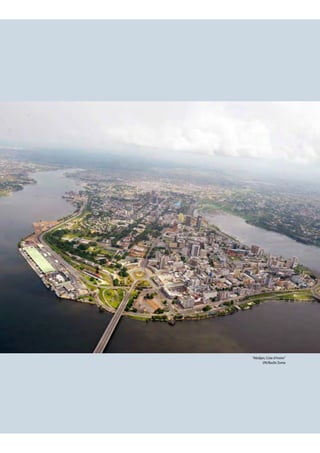
“Abidjan, Cote d'Ivoire”
UN/Basile Zoma
1
World Urbanization Trends 2014: Key Facts
Globally, more people live in urban areas than in
rural areas, with 54 per cent of the world’s popu-
lation residing in urban areas in 2014. In 1950, 30
per cent of the world’s population was urban, and
by 2050, 66 per cent of the world’s population is
projected to be urban.
Today, the most urbanized regions include North-
ern America (82 per cent living in urban areas in
2014), Latin America and the Caribbean (80 per
cent), and Europe (73 per cent). In contrast, Africa
and Asia remain mostly rural, with 40 and 48 per
cent of their respective populations living in ur-
ban areas. All regions are expected to urbanize
further over the coming decades. Africa and Asia
are urbanizing faster than the other regions and
are projected to become 56 and 64 per cent urban,
respectively, by 2050.
The rural population of the world has grown slowly
since 1950 and is expected to reach its peak in a
few years. The global rural population is now close
to 3.4 billion and is expected to decline to 3. bil-
lion by 2050. Africa and Asia are home to nearly 90
per cent of the world’s rural population. India has
the largest rural population (857 million), followed
by China (635 million).
The urban population of the world has grown rap-
idly since 1950, from 746 million to 3.9 billion in
2014. Asia, despite its lower level of urbanization,
is home to 53 per cent of the world’s urban popu-
lation, followed by Europe (14 per cent) and Latin
America and the Caribbean (13 per cent).
Continuing population growth and urbaniza-
tion are projected to add 2.5 billion people to the
world’s urban population by 2050, with 90
per cent of the increase concentrated in Asia and
Africa.
Just three countries—India, China and Nigeria—
together are expected to account for 37 per cent of
the projected growth of the world’s urban popula-
tion between 2014 and 2050. India is projected to
add 404 million urban dwellers, China 292 million
and Nigeria 212 million.
Close to half of the world’s urban dwellers reside
in relatively small settlements of less than 500,000
inhabitants, while only around one in eight live
in the 28 mega-cities with more than 10 million
inhabitants.
Tokyo is the world’s largest city with an agglom-
eration of 38 million inhabitants, followed by Delhi
with 25 million, Shanghai with 23 million, and
Mexico City, Mumbai and São Paulo, each with
around 21 million inhabitants. By 2030, the world
is projected to have 41 mega-cities with more than
10 million inhabitants. Tokyo is projected to re-
main the world’s largest city in 2030 with 37 mil-
lion inhabitants, followed closely by Delhi where
the population is projected to rise swiftly to 36
million. Several decades ago most of the world’s
largest urban agglomerations were found in the
more developed regions, but today’s large cities
are concentrated in the global South. The fastest-
growing urban agglomerations are medium-sized
cities and cities with less than 1 million inhabitants
located in Asia and Africa.
Some cities have experienced population decline
in recent years. Most of these are located in the
low-fertility countries of Asia and Europe where
the overall population is stagnant or declining. Eco-
nomic contraction and natural disasters have con-
tributed to population losses in some cities as well.
As the world continues to urbanize, sustainable
development challenges will be increasingly con-
centrated in cities, particularly in the lower-mid-
dle-income countries where the pace of urbaniza-
tion is fastest. Integrated policies to improve the
lives of both urban and rural dwellers are needed.
World Urbanization Prospects: The 2014 Revision2
Introduction
In today’s increasingly global and interconnected world, over half of the world’s popula-
tion (54 per cent) lives in urban areas although there is still substantial variability in the
levels of urbanization across countries (figure 1). The coming decades will bring further
profound changes to the size and spatial distribution of the global population. The con-
tinuing urbanization and overall growth of the world’s population is projected to add 2.5
billion people to the urban population by 2050, with 90 per cent of the increase
concentrated in Asia and Africa. At the same time, the proportion of the world’s
population living in urban areas is expected to increase, reaching 66 per cent by 2050.
There is great diversity in the characteristics of the world’s urban environs: close to half
of urban dwellers reside in relatively small settlements of less than 500,000 inhabitants, while
nearly one in eight live in the 28 mega-cities of 10 million inhabitants or more. The number of
mega-cities has nearly tripled since 1990; and by 2030, 41 urban agglomerations are projected
to house at least 10 million inhabitants each. Whereas several decades ago most of the world’s
largest urban agglomerations were found in the more developed regions, today’s large cities
are concentrated in the global South, and the fastest-growing agglomerations are medium-
sized cities and cities with 500,000 to 1 million inhabitants located in Asia and Africa.
Figure 1.
Percentage of population residing in urban areas in 2014, selected countries or areas
OceaniaNorthern AmericaLatin America and the CarribeanAfrica EuropeAsia
100
80
60
40
30
50
90
70
20
10
0
100
90
TrinidadandTobago
Burundi
PapuaNewGuinea
Uganda
Malawi
Nepal
SriLanka
Niger
SaintLucia
SouthSudan
Ethiopia
Samoa
Cambodia
Swaziland
SolomonIslands
Eritrea
Chad
Micronesia(Fed.Statesof)
Tonga
AntiguaandBarbuda
Kenya
Vanuatu
Afghanistan
Tajikistan
Lesotho
Rwanda
Comoros
Guyana
BurkinaFaso
UnitedRepublicofTanzania
ChannelIslands
Barbados
Mozambique
Timor-Leste
India
Zimbabwe
VietNam
Bangladesh
Myanmar
Sudan
Yemen
Madagascar
Grenada
Kyrgyzstan
Uzbekistan
Guinea
LaoPeople'sDemocraticRepublic
Bhutan
Pakistan
Somalia
Mali
Togo
SierraLeone
BosniaandHerzegovina
EquatorialGuinea
CentralAfricanRepublic
Mauritius
Zambia
Aruba
DemocraticRepublicoftheCongo
Egypt
Angola
Senegal
Benin
Belize
Kiribati
Philippines
Maldives
RepublicofMoldova
Namibia
Nigeria
Mayotte
Guinea-Bissau
Thailand
Liberia
Turkmenistan
Slovenia
SaintVincentandtheGrenadines
Guatemala
Indonesia
Kazakhstan
Fiji
Ghana
Georgia
Côted'Ivoire
Seychelles
Slovakia
Cameroon
Honduras
Azerbaijan
Romania
China
Jamaica
Serbia
FrenchPolynesia
Albania
TFYRMacedonia
Botswana
SyrianArabRepublic
Haiti
Nicaragua
Proportion urban (per cent)
3
The process of urbanization historically has been associated with other important
economic and social transformations, which have brought greater geographic mobility,
lower fertility, longer life expectancy and population ageing. Cities are important drivers
of development and poverty reduction in both urban and rural areas, as they concentrate
much of the national economic activity, government, commerce and transportation, and
provide crucial links with rural areas, between cities, and across international borders.
Urban living is often associated with higher levels of literacy and education, better health,
greater access to social services, and enhanced opportunities for cultural and political
participation.
Nevertheless, rapid and unplanned urban growth threatens sustainable development
when the necessary infrastructure is not developed or when policies are not implemented
to ensure that the benefits of city life are equitably shared. Today, despite the comparative
advantage of cities, urban areas are more unequal than rural areas and hundreds of mil-
lions of the world’s urban poor live in sub-standard conditions. In some cities, unplanned
or inadequately managed urban expansion leads to rapid sprawl, pollution, and environ-
mental degradation, together with unsustainable production and consumption patterns.
Urbanization is integrally connected to the three pillars of sustainable development:
economic development, social development and environmental protection. The outcome
of the Rio+20 United Nations Conference on Sustainable Development, “The future we
want” (http://www.un.org/en/sustainablefuture/), recognized both the plight of the urban
poor and the need for sustainable cities as matters of great urgency for the United Nations
development agenda. Building on that momentum, the third United Nations Conference
on Human Settlements (Habitat III), planned for 2016, will bring together world leaders
OceaniaNorthern AmericaLatin America and the CarribeanAfrica EuropeAsia
100
80
60
40
30
50
90
70
20
10
0
100
80
60
40
30
50
90
70
20
10
0
Croatia
Gambia
Mauritania
Paraguay
Morocco
Poland
Dem.People'sRepublicofKorea
Armenia
Portugal
Ireland
Ecuador
Montenegro
SouthAfrica
SaoTomeandPrincipe
CaboVerde
Congo
Austria
Suriname
ElSalvador
Panama
Lithuania
Tunisia
Cyprus
Latvia
Estonia
Bolivia(PlurinationalStateof)
Italy
Iraq
Ukraine
NewCaledonia
Algeria
Hungary
Mongolia
Iran(IslamicRepublicof)
Turkey
CzechRepublic
Bulgaria
Switzerland
RussianFederation
Malaysia
StateofPalestine
Germany
CostaRica
Colombia
Belarus
Othernon-specifiedareas
BruneiDarussalam
Cuba
Oman
Djibouti
Greece
DominicanRepublic
Peru
Libya
Mexico
France
Spain
Norway
WesternSahara
UnitedStatesofAmerica
Canada
UnitedKingdom
RepublicofKorea
Bahamas
SaudiArabia
Jordan
Finland
FrenchGuiana
UnitedArabEmirates
Brazil
Sweden
NewZealand
Gabon
Denmark
Lebanon
Bahrain
Martinique
Venezuela(BolivarianRepublicof)
Australia
Chile
Curaçao
Luxembourg
Netherlands
Argentina
Israel
Japan
PuertoRico
Iceland
Guam
Réunion
Uruguay
UnitedStatesVirginIslands
Malta
Belgium
Kuwait
Guadeloupe
Qatar
China,MacaoSAR
Singapore
China,HongKongSAR
TrinidadandTobago
Burundi
PapuaNewGuinea
Uganda
Malawi
Nepal
SriLanka
Niger
SaintLucia
SouthSudan
Ethiopia
Samoa
Cambodia
Swaziland
SolomonIslands
Eritrea
Chad
Micronesia(Fed.Statesof)
Tonga
AntiguaandBarbuda
Kenya
Vanuatu
Afghanistan
Tajikistan
Lesotho
Rwanda
Comoros
Guyana
BurkinaFaso
UnitedRepublicofTanzania
ChannelIslands
Barbados
Mozambique
Timor-Leste
India
Zimbabwe
VietNam
Bangladesh
Myanmar
Sudan
Yemen
Madagascar
Grenada
Kyrgyzstan
Uzbekistan
Guinea
LaoPeople'sDemocraticRepublic
Bhutan
Pakistan
Somalia
Mali
Togo
SierraLeone
BosniaandHerzegovina
EquatorialGuinea
CentralAfricanRepublic
Mauritius
Zambia
Aruba
DemocraticRepublicoftheCongo
Egypt
Angola
Senegal
Benin
Belize
Kiribati
Philippines
Maldives
RepublicofMoldova
Namibia
Nigeria
Mayotte
Guinea-Bissau
Thailand
Liberia
Turkmenistan
Slovenia
SaintVincentandtheGrenadines
Guatemala
Indonesia
Kazakhstan
Fiji
Ghana
Georgia
Côted'Ivoire
Seychelles
Slovakia
Cameroon
Honduras
Azerbaijan
Romania
China
Jamaica
Serbia
FrenchPolynesia
Albania
TFYRMacedonia
Botswana
SyrianArabRepublic
Haiti
Nicaragua
Proportion urban (per cent)
Note: Countries or areas with 90,000 inhabitants or more in 2014.
World Urbanization Prospects: The 2014 Revision4
to review the global urban agenda and to forge a new model of urban development that
integrates all facets of sustainable development, to promote equity, welfare and shared
prosperity in an urbanizing world.
Accurate, consistent and timely data on global trends in urbanization and city
growth are critical for assessing current and future needs with respect to urban growth
and for setting policy priorities to promote inclusive and equitable urban and rural devel-
opment. In order to systematically track levels and trends in urbanization around the
world, the Population Division of the Department of Economic and Social Affairs of the
United Nations has issued, since 1988, biennial estimates and projections of the urban and
rural populations of all countries and of the populations of major urban agglomerations.
This report presents the highlights of the 2014 Revision of World Urbanization Pros-
pects, which contains the latest estimates of the urban and rural populations of 233 coun-
tries or areas from 1950 to 2014 and projections to 2050, as well as estimates of population
size from 1950 to 2014 and projections to 2030 for all urban agglomerations with 300,000
inhabitants or more in 2014.1
The annex tables in these Highlights provide data on the
estimated and projected urban and rural populations, the percentage of the population
that live in urban areas and the annual growth rate of the percentage urban for 233 coun-
tries or areas of the world. The tables also show the rank and annual growth rate of urban
agglomerations with 5 million inhabitants or more in 2014.
Data and methods
The estimates of the proportion of the population that is urban and the size of urban
agglomerations presented in World Urbanization Prospects: The 2014 Revision are based
on national statistics. Population censuses are the most commonly used sources of data,
although estimates obtained from population registers or administrative statistics are also
incorporated for some countries.
There is no common global definition of what constitutes an urban settlement. As
a result, the urban definition employed by national statistical offices varies widely across
countries, and in some cases has changed over time within a country. The criteria for clas-
sifying an area as urban may be based on one or a combination of characteristics, such as: a
minimum population threshold; population density; proportion employed in non-agricul-
tural sectors; the presence of infrastructure such as paved roads, electricity, piped water or
sewers; and the presence of education or health services.
In estimating the proportion urban for World Urbanization Prospects, adjust-
ments are made to the national estimates only to ensure consistency of the definitions of
urban settlements within countries across time. No attempt is made to impose consist-
ency in definitions across countries. Several efforts are underway at various institutions
to produce globally comparable estimates of the urban population with uniform criteria
to define urban areas based on satellite imagery of land cover or night-time lights, for
example. However, these approaches have not generated, to date, the long historical time
series of urbanization estimates required for this report. In interpreting the estimates and
projections from World Urbanization Prospects: The 2014 Revision, readers should keep in
mind the heterogeneity of the urban definition across countries.
1
The full report, descriptions of the data, methodology, and complete data tables representing all coun-
tries and areas, regions, income groups, development groups, and periods can be accessed at http://esa.
un.org/unpd/wup/index.htm.
5
In compiling information on city population size, the Population Division has
endeavoured to use data or estimates based on the concept of urban agglomeration. When
those data are not consistently available, population data that refer to the city as defined by
its administrative boundaries were used. However, when the administrative boundaries
of cities remain fixed for long periods of time, they are likely to misrepresent the actual
growth of a city with respect to both its territory and its population. For a number of cit-
ies, the data available refer to two concepts: the city proper as defined by administrative
boundaries and its metropolitan area. In those instances, the data referring to the met-
ropolitan area were usually preferred because they are thought to approximate better the
territory associated with the urban agglomeration. For any given city, an effort was made
to ensure that the time series of population estimates derived from national sources con-
forms to the same definition over time. Adjustments were made when necessary to achieve
internal consistency.
Since censuses are usually taken every 5 or 10 years, to fill the data gaps within
the period 1950–2014, the estimates of the proportion urban and the city populations are
interpolated or, for the interval between the last data point and 2014, the estimates are
extrapolated from the last observed data point. For years beyond 2014, the proportion
urban is projected to 2050 and the city populations are projected to 2030. The projection
of the proportion urban is based on a projection of the urban-rural growth differential. It
is assumed that the urban-rural growth difference for the most recent period available in
a given country converges, over a period of 25 years, to a hypothetical urban-rural growth
difference, or world norm, that is consistent with historical experience. The method to
project city populations is similar, as the last observed city growth rate converges towards
an expected value, estimated on the basis of the city population and the growth rate of the
overall urban population in the country.
The estimated and projected values of the proportion urban from 1950 to 2050 for
each country or area were then applied to the total population as estimated or projected
in the medium variant in World Population Prospects: The 2012 Revision (United Nations,
2013a) in order to obtain country-level estimates of the urban and rural populations. The
2014 Revision of World Urbanization Prospects updates and supersedes all previous esti-
mates and projections of urban and rural populations and of urban agglomerations pub-
lished by the United Nations.
“Urbanization in Asia”
UN Photo/Kibae Park
7
Trends in urbanization
Globally, more people live in urban areas than in rural areas. In 2007, for the first time in
history, the global urban population exceeded the global rural population, and the world
population has remained predominantly urban thereafter (figure 2). The planet has gone
through a process of rapid urbanization over the past six decades. In 1950, more than two-
thirds (70 per cent) of people worldwide lived in rural settlements and less than one-third
(30 per cent) in urban settlements. In 2014, 54 per cent of the world’s population is urban.
The urban population is expected to continue to grow, so that by 2050, the world will be one-
third rural (34 per cent) and two-thirds urban (66 per cent), roughly the reverse of the global
rural-urban population distribution of the mid-twentieth century (also see Annex Table I).
Figure 2.
Urban and rural population of the world, 1950–2050
2050
2045
2040
2035
2030
2025
2020
2015
2010
2005
2000
1995
1990
1985
1980
1975
1970
1965
1960
1955
Population(millions)
0
1000
2000
3000
4000
5000
6000
7000
1950
Urban
Rural
Levels of urbanization vary greatly across regions. In 2014, high levels of urbaniza-
tion, at or above 80 per cent, characterized Latin America and the Caribbean and North-
ern America. Europe, with 73 per cent of its population living in urban areas, is expected
to be over 80 per cent urban by 2050 (figure 3). Africa and Asia, in contrast, remain mostly
rural, with 40 per cent and 48 per cent of their respective populations living in urban
areas. Over the coming decades, the level of urbanization is expected to increase in all
regions (also referred to as major areas), with Africa and Asia urbanizing faster than the
rest. Nevertheless, these two regions, which are projected to reach 56 and 64 per cent
urban by mid-century, respectively, are still expected to be less urbanized than other
regions of the world.
A majority of the
world’s population
lives in urban areas
World Urbanization Prospects: The 2014 Revision8
Figure 3.
Urban and rural population as proportion of total population, by major areas, 1950–2050
In 2014, sixteen countries still have low levels of urbanization, i.e. below 20 per cent.
The largest among them, with total populations of 10 million inhabitants or more, include
Burundi, Ethiopia, Malawi, Niger, South Sudan and Uganda in Africa and Nepal and Sri
Lanka in Asia (see Map 1). By 2050, all of these countries are expected to become signifi-
cantly more urbanized, with as much as twice their respective proportions urban in 2014.
In contrast, 59 countries are already more than 80 per cent urban. Among those with
populations of at least 10 million inhabitants, the most highly urbanized countries are
Belgium (98 per cent urban), Japan (93 per cent), Argentina (92 per cent) and the Nether-
lands (90 per cent). By 2050, 89 countries are expected to become more than 80 per cent
urban. When interpreting the differences in levels of urbanization across countries, it is
important to keep in mind the heterogeneity of the urban definition across countries.
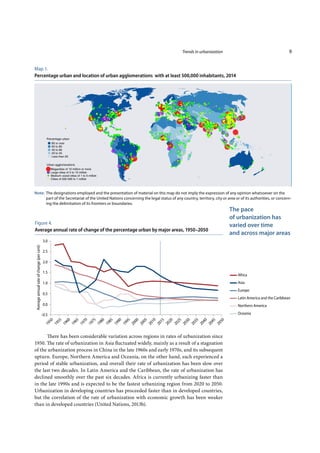
Africa and Asia are urbanizing more rapidly than other regions of the world. The
rate of urbanization, measured as the average annual rate of change of the percentage
urban, is highest in Asia and Africa, where currently the proportion urban is increasing
by 1.5 and 1.1 per cent per annum, respectively. Regions that already have relatively high
levels of urbanization are urbanizing at a slower pace, at less than 0.4 per cent annually
(figure 4). In general, the pace of urbanization tends to slow down as a population becomes
more urbanized.
Urbanization has
occurred in all major
areas, yet Africa and
Asia remain mostly
rural
2050
2040
2030
2020
2010
2000
1990
1980
1970
1960
1950
0
20
40
60
80
100
2050
2040
2030
2020
2010
2000
1990
1980
1970
1960
1950
2050
2040
2030
2020
2010
2000
1990
1980
1970
1960
1950
0
10
20
30
40
100
90
80
70
60
50
2050
2040
2030
2020
2010
2000
1990
1980
1970
1960
1950
2050
2040
2030
2020
2010
2000
1990
1980
1970
1960
1950
2050
2040
2030
2020
2010
2000
1990
1980
1970
1960
1950
Africa Asia Europe
Latin America and the Carribean Northern America Oceania
Urban population
Proportionoftotalpopulation(percent)Proportionoftotalpopulation(percent)
Rural population
90
70
50
30
10
40.0
47.5
73.4
79.5 81.5
70.8
Trends in urbanization 9
Map 1.
Percentage urban and location of urban agglomerations with at least 500,000 inhabitants, 2014
Note: The designations employed and the presentation of material on this map do not imply the expression of any opinion whatsoever on the
part of the Secretariat of the United Nations concerning the legal status of any country, territory, city or area or of its authorities, or concern-
ing the delimitation of its frontiers or boundaries.
There has been considerable variation across regions in rates of urbanization since
1950. The rate of urbanization in Asia fluctuated widely, mainly as a result of a stagnation
of the urbanization process in China in the late 1960s and early 1970s, and its subsequent
upturn. Europe, Northern America and Oceania, on the other hand, each experienced a
period of stable urbanization, and overall their rate of urbanization has been slow over
the last two decades. In Latin America and the Caribbean, the rate of urbanization has
declined smoothly over the past six decades. Africa is currently urbanizing faster than
in the late 1990s and is expected to be the fastest urbanizing region from 2020 to 2050.
Urbanization in developing countries has proceeded faster than in developed countries,
but the correlation of the rate of urbanization with economic growth has been weaker
than in developed countries (United Nations, 2013b).
-0.5
0.0
0.5
1.0
1.5
2.0
2.5
3.0
Oceania
Northern America
Latin America and the Caribbean
Europe
Asia
Africa
2050
2045
2040
2035
2030
2025
2020
2015
2010
2005
2000
1995
1990
1985
1980
1975
1970
1965
1960
1955
1950
Averageannualrateofchange(percent)
Figure 4.
Average annual rate of change of the percentage urban by major areas, 1950–2050
The pace
of urbanization has
varied over time
and across major areas
Urban agglomerations
Megacities of 10 million or more
Large cities of 5 to 10 million
ed cities of 1 to 5 million
Cities of 500 000 to 1 million
Percentage urban
80 or over
60 to 80
40 to 60
20 to 40
Less than 20
World Urbanization Prospects: The 2014 Revision10
0
10
20
30
40
50
60
70
80
90
100
Low income countries
Lower-middle-income countries
Upper-middle-income countries
High-income countries
2050
2045
2040
2035
2030
2025
2020
2015
2010
2005
2000
1995
1990
1985
1980
1975
1970
1965
1960
1955
1950
Proportionurban(percent)
While the high-income countries of today have been highly urbanized for several dec-
ades,upper-middle-incomecountrieshaveexperiencedthefastestpaceofurbanizationsince
1950. In 1950, a majority (57 per cent) of the population in high-income countries already
lived in urban areas (figure 5). Their level of urbanization is expected to rise further, from
80 per cent today to 86 per cent in 2050. By contrast, in the upper-middle-income countries
of today, only 20 per cent of the population lived in urban areas in 1950, but these countries
urbanized rapidly and are now 63 per cent urban. This percentage is expected to rise to 79
per cent urban by 2050. Countries such as Brazil, China, Iran and Mexico are in this group,
and have experienced both rapid urbanization and rapid growth of gross national income.
Figure 5.
Proportion urban by income groups, 1950–2050
In the lower-middle- and low-income countries, the pace of urbanization has been
slower until now. Nevertheless, this group of countries is expected to experience faster
urbanization than others in the coming decades. In 2014, the proportion of the population
living in urban areas was 39 percent in lower-middle-income countries and 30 per cent in
low-income countries. By 2050, these countries are expected to reach, on average, 57 and
48 per cent urban, respectively.
The rural population of the world has grown slowly since 1950 and is expected
to reach its peak in a few years. Approximately 3.4 billion people currently live in rural
areas around the world. That number is expected to remain relatively constant in the
coming years. However, sometime after 2020, the world’s rural population will start
to decline and is expected to 3.2 billion in 2050. This global trend is driven
mostly by the dynamics of rural population growth in Africa and Asia, which is home
today to nearly 90 per cent of the world’s rural population (figure 6a). The rural popula-
tion of the world resides in a relatively small number of countries. India has the largest
rural population (857 million), followed by China (635 million). Together, these two
countries account for 45 per cent of the world’s rural population. Bangladesh, Indo-
nesia and Pakistan follow, each with over 100 million rural inhabitants. In Africa, the
largest rural populations are located in Nigeria (95 million) and Ethiopia (78 million).
Between 2014 and 2050, the rural population is expected to increase in about one third
of the countries of the world. The largest increases w ill be registered in Nigeria (50
million), Ethiopia and Uganda (39 and 38 million). The remaining two thirds of coun-
tries are expected to have stable or declining rural populations. The largest declines
are expected in China, with a decline of 300 million, equivalent to more than one half
of their rural population in 2014, and in India, where the number of rural residents is
expected to decline by 52 million.
Upper-middle-income
countries have experi-
enced the fastest pace
of urbanization
Note: The country classification
by income level is based on
2012 GNI per capita from
the World Bank and it is kept
unchanged throughout the
estimates and projections.
Trends in urbanization 11
The urban population of the world is expected to increase by more than two thirds
by 2050, with nearly 90 per cent of the increase to take place in the urban areas of Africa
and Asia. The world’s urban population is now close to 3.9 billion and is expected to reach
6.3 billion in 2050. Asia, despite its lower level of urbanization, is today home to 53 per
cent of the urban population in the world. Europe has the second highest share of the
world’s urban population, at 14 per cent, followed by Latin America and the Caribbean
with 13 per cent (figure 6b). Over the next four decades, Africa and Asia will experience
a marked increase in their urban populations. By mid-century, the urban population of
Africa is likely to triple and that of Asia to increase by 61 per cent. As a consequence, close
to 90 per cent of the increase in the world’s urban population will take place in the urban
areas of Africa and Asia. In 2050, most of the urban population of the world will be con-
centrated in Asia (52 per cent) and Africa (21 per cent).
0
10
20
30
40
50
60
70
80
90
100
2050
2045
2040
2035
2030
2025
2020
2015
2010
2005
2000
1995
1990
1985
1980
1975
1970
1965
1960
1955
1950
Distributionofruralpopulation(percent)
Oceania
Northern America
Latin America and the Caribbean
Europe
Africa
Asia
Figure 6a.
A vast majority of the world’s rural inhabitants live in Asia, but projected growth is fastest
in Africa
Oceania
Northern America
Latin America and the Caribbean
Europe
Africa
Asia
0
10
20
30
40
50
60
70
80
90
100
2050
2045
2040
2035
2030
2025
2020
2015
2010
2005
2000
1995
1990
1985
1980
1975
1970
1965
1960
1955
1950
Distributionofurbanpopulation(percent)
Figure 6b.
Asia will continue to host nearly one half of the world’s urban population
World Urbanization Prospects: The 2014 Revision12
Just a few countries are home to half of the world’s urban population. China has
the largest urban population (758 million), followed by India (410 million). These two
countries account for 30 per cent of the world’s urban population and, with another five
countries, the United States of America (263 million), Brazil (173 million), Indonesia (134
million), Japan (118 million) and the Russian Federation (105 million), account for more
than half of the world’s urban population.
Future increases in the world’s urban population are also expected to be highly con-
centrated in just a few countries (figure 7). Taken together, China, India and Nigeria are
projected to account for 37 per cent of the increase of nearly 2.5 billion people in the urban
population by 2050. Between 2014 and 2050, the urban areas are expected to grow by 404
million people in India, 292 million in China and 212 million in Nigeria. Seven other
countries, the Democratic Republic of Congo, Ethiopia, the United Republic of Tanzania,
Bangladesh, Indonesia and Pakistan, and the United States of America, are projected to
contribute more than 50 million each to the urban increment and will constitute together
another 20 per cent of the total increase in urban population. In a few countries, the urban
population will decrease, despite projected increases in the level of urbanization. The larg-
est declines between 2014 and 2050 are projected for Japan, with a decline of 12 million
urban dwellers and for the Russian Federation, expected to decline by 7 million.
Figure 7.
Contribution to the increase in urban population by country, 2014 to 2050
China and India will
contribute more than
one third of the global
urban population
increase between 2014
and 2050
Note: The countries shown are projected to contribute 25 million or more to the global urban increment
between 2014 and 2050. The category “Other countries” includes countries with urban increments
of less than 25 million each.
0
500
1000
1500
2000
2500
Other countries
Democratic Republic of the Congo
China
India
nearly 2.5 billion
urban population increase
by 2050
50%
Nigeria
Indonesia
United States of America
Pakistan
Urbanpopulationincrease(millions)
Iraq
Angola
Viet Nam
Sudan
Iran (Islamic Republic of)
Uganda
Kenya
Egypt
Mexico
Brazil
Philippines
Ethiopia
United Republic of Tanzania
Bangladesh
13
Cities
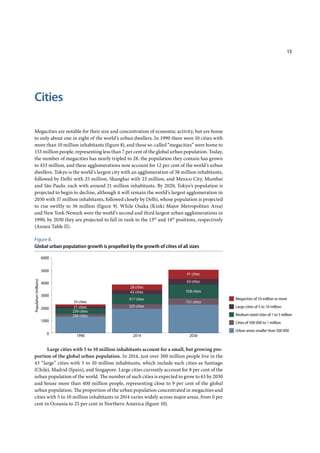
Megacities are notable for their size and concentration of economic activity, but are home
to only about one in eight of the world’s urban dwellers. In 1990 there were 10 cities with
more than 10 million inhabitants (figure 8), and these so-called “megacities” were home to
153 million people, representing less than 7 per cent of the global urban population. Today,
the number of megacities has nearly tripled to 28, the population they contain has grown
to 453 million, and these agglomerations now account for 12 per cent of the world’s urban
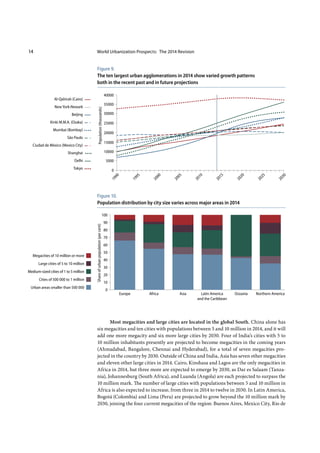
dwellers. Tokyo is the world’s largest city with an agglomeration of 38 million inhabitants,
followed by Delhi with 25 million, Shanghai with 23 million, and Mexico City, Mumbai
and São Paulo, each with around 21 million inhabitants. By 2020, Tokyo’s population is
projected to begin to decline, although it will remain the world’s largest agglomeration in
2030 with 37 million inhabitants, followed closely by Delhi, whose population is projected
to rise swiftly to 36 million (figure 9). While Osaka (Kinki Major Metropolitan Area)
and New York-Newark were the world’s second and third largest urban agglomerations in
1990, by 2030 they are projected to fall in rank to the 13th
and 14th
positions, respectively
(Annex Table II).
Figure 8.
Global urban population growth is propelled by the growth of cities of all sizes
Large cities with 5 to 10 million inhabitants account for a small, but growing pro-
portion of the global urban population. In 2014, just over 300 million people live in the
43 “large” cities with 5 to 10 million inhabitants, which include such cities as Santiago
(Chile), Madrid (Spain), and Singapore. Large cities currently account for 8 per cent of the
urban population of the world. The number of such cities is expected to grow to 63 by 2030
and house more than 400 million people, representing close to 9 per cent of the global
urban population. The proportion of the urban population concentrated in megacities and
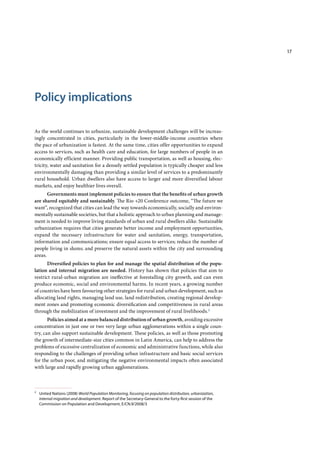
cities with 5 to 10 million inhabitants in 2014 varies widely across major areas, from 0 per
cent in Oceania to 25 per cent in Northern America (figure 10).
0
1000
2000
3000
4000
5000
6000
Megacities of 10 million or more
Large cities of 5 to 10 million
Medium-sized cities of 1 to 5 million
Cities of 500 000 to 1 million
Urban areas smaller than 500 000
203020141990
294 cities
239 cities
21 cities
10 cities
28 cities
43 cities
417 cities
525 cities
731 cities
558 cities
63 cities
41 cities
Population(millions)
World Urbanization Prospects: The 2014 Revision14
Figure 10.
Population distribution by city size varies across major areas in 2014
Most megacities and large cities are located in the global South. China alone has
six megacities and ten cities with populations between 5 and 10 million in 2014, and it will
add one more megacity and six more large cities by 2030. Four of India’s cities with 5 to
10 million inhabitants presently are projected to become megacities in the coming years
(Ahmadabad, Bangalore, Chennai and Hyderabad), for a total of seven megacities pro-
jected in the country by 2030. Outside of China and India, Asia has seven other megacities
and eleven other large cities in 2014. Cairo, Kinshasa and Lagos are the only megacities in
Africa in 2014, but three more are expected to emerge by 2030, as Dar es Salaam (Tanza-
nia), Johannesburg (South Africa), and Luanda (Angola) are each projected to surpass the
10 million mark. The number of large cities with populations between 5 and 10 million in
Africa is also expected to increase, from three in 2014 to twelve in 2030. In Latin America,
Bogotá (Colombia) and Lima (Peru) are projected to grow beyond the 10 million mark by
2030, joining the four current megacities of the region: Buenos Aires, Mexico City, Rio de
0
10000
15000
20000
25000
30000
35000
40000
Al-Qahirah (Cairo)
New York-Newark
Beijing
Kinki M.M.A. (Osaka)
Mumbai (Bombay)
São Paulo
Ciudad de México (Mexico City)
Shanghai
Delhi
Tokyo
2030
2025
2020
2015
2010
2005
2000
1995
1990
Population(thousands)
5000
0
20
40
60
80
100
90
70
50
30
10
Northern AmericaOceaniaLatin America
and the Caribbean
AsiaAfricaEurope
Megacities of 10 million or more
Large cities of 5 to 10 million
Medium-sized cities of 1 to 5 million
Cities of 500 000 to 1 million
Urban areas smaller than 500 000
Shareofurbanpopulation(percent)
Figure 9.
The ten largest urban agglomerations in 2014 show varied growth patterns
both in the recent past and in future projections
Cities 15
Janeiro, and São Paulo. Notably, there are varying degrees of uncertainty in the projec-
tions of cities, with greater uncertainty for cities like Kinshasa or Luanda where census
data have not been collected or reported in decades.
One in five urban dwellers worldwide lives in a medium-sized city with 1 million
to 5 million inhabitants. While considered medium-sized by global standards, these cit-
ies are, in fact, the largest cities in 79 countries or areas. Examples include Sydney (Aus-
tralia), Addis Ababa (Ethiopia), and Montevideo (Uruguay). The global population living
in medium-sized cities nearly doubled between 1990 and 2014, and is expected to increase
by another 36 per cent between 2014 and 2030, growing from 827 million to 1.1 billion.
The number of people living in cities of between 500,000 and 1 million inhabitants is
expected to grow at a similar pace, increasing from 363 million in 2014 to 509 million in
2030, but continuing to hold only around 10 per cent of the global urban population.
In 2014 close to one half of the world’s urban population lives in settlements with
fewer than 500,000 inhabitants. While this proportion is projected to shrink over time,
by 2030 these small cities and towns will still be home to around 45 per cent of urban
dwellers. The proportion of the urban population in small cities varies considerably across
regions. Close to two thirds of Europe’s urban dwellers reside in small urban places as do
more than half of Africa’s urban dwellers. In contrast, just one third of urban residents in
Northern America live in settlements with fewer than 500,000 people. Regional differ-
ences also reflect differences in settlement patterns, as well as variations in the definition
of urban areas across countries and regions.
The fastest growing urban agglomerations are medium-sized cities and cities with
less than 1 million inhabitants located in Asia and Africa. Between 2000 and 2014 the
world’s cities with more than 500,000 inhabitants grew at an average annual rate of 2.4 per
cent. However, 43 of these cities grew more than twice as fast, with average growth rates
in excess of 6 per cent per year (figure 11). Of these, 4 are located in Africa, 38 in Asia (18
in China alone), and 1 in Northern America. By way of comparison, Suzhou, in China’s
Jiangsu Province, is the only city with more than 5 million inhabitants to have experi-
enced such rapid growth. In general, most of the world’s fastest growing urban agglom-
erations are smaller cities: agglomerations with 500,000 to 1 million inhabitants in 2014
account for 26 of the 43 fastest-growing cities, while another 16 are medium-sized cities
with between 1 million and 5 million inhabitants.
Some cities have experienced population decline since 2000, most of which are
located in low-fertility countries of Asia and Europe with stagnating or declining popu-
lations. A few cities in Japan and the Republic of Korea (for example, Nagasaki and Busan)
have experienced population decline between 2000 and 2014. Several cities in the Russian
Federation and Ukraine have lost population since 2000 as well. In addition, several capital
cities around the world have seen their populations decline between 2000 and 2014, includ-
ing Bratislava (Slovakia), Riga (Latvia), Sarajevo (Bosnia and Herzegovina) and Yerevan
(Armenia). In addition to low fertility, emigration has also contributed to smaller popula-
tion sizes in some of these cities.
Economic contraction and natural disasters have contributed to population loss in
some cities. In the United States, for example, Buffalo and Detroit each experienced net
losses of population between 2000 and 2014, concurrent with a loss of industry and jobs
in those cities, while New Orleans experienced population decline in the wake of the 2005
Hurricane Katrina.
World Urbanization Prospects: The 2014 Revision16
Figure 11.
The world’s fastest growing cities are in Africa and Asia
−2024681012
Major area
Averageannualcitygrowthrate(percent),2000−2014
Africa Asia Europe
Latin America
and the Caribbean
Northern
America Oceania
City size class
Megacities of 10 million or more
Large cities of 5 to 10 million
e iu − i e citie o 1 to illion
Cities of 500 000 to 1 million
17
Policy implications
As the world continues to urbanize, sustainable development challenges will be increas-
ingly concentrated in cities, particularly in the lower-middle-income countries where
the pace of urbanization is fastest. At the same time, cities offer opportunities to expand
access to services, such as health care and education, for large numbers of people in an
economically efficient manner. Providing public transportation, as well as housing, elec-
tricity, water and sanitation for a densely settled population is typically cheaper and less
environmentally damaging than providing a similar level of services to a predominantly
rural household. Urban dwellers also have access to larger and more diversified labour
markets, and enjoy healthier lives overall.
Governments must implement policies to ensure that the benefits of urban growth
are shared equitably and sustainably. The Rio +20 Conference outcome, “The future we
want”, recognized that cities can lead the way towards economically, socially and environ-
mentally sustainable societies, but that a holistic approach to urban planning and manage-
ment is needed to improve living standards of urban and rural dwellers alike. Sustainable
urbanization requires that cities generate better income and employment opportunities,
expand the necessary infrastructure for water and sanitation, energy, transportation,
information and communications; ensure equal access to services; reduce the number of
people living in slums; and preserve the natural assets within the city and surrounding
areas.
Diversified policies to plan for and manage the spatial distribution of the popu-
lation and internal migration are needed. History has shown that policies that aim to
restrict rural-urban migration are ineffective at forestalling city growth, and can even
produce economic, social and environmental harms. In recent years, a growing number
of countries have been favouring other strategies for rural and urban development, such as
allocating land rights, managing land use, land redistribution, creating regional develop-
ment zones and promoting economic diversification and competitiveness in rural areas
through the mobilization of investment and the improvement of rural livelihoods.2
Policies aimed at a more balanced distribution of urban growth, avoiding excessive
concentration in just one or two very large urban agglomerations within a single coun-
try, can also support sustainable development. These policies, as well as those promoting
the growth of intermediate-size cities common in Latin America, can help to address the
problems of excessive centralization of economic and administrative functions, while also
responding to the challenges of providing urban infrastructure and basic social services
for the urban poor, and mitigating the negative environmental impacts often associated
with large and rapidly growing urban agglomerations.
2
United Nations (2008) World Population Monitoring, focusing on population distribution, urbanization,
internal migration and development. Report of the Secretary-General to the forty-first session of the
Commission on Population and Development, E/CN.9/2008/3
World Urbanization Prospects: The 2014 Revision18
Accurate, consistent and timely data on global trends in urbanization and city
growth are critical for assessing current and future needs with respect to urban growth
and for setting policy priorities to promote inclusive and equitable urban and rural devel-
opment. In order to systematically track levels and trends in urbanization around the
world and to monitor progress in sustainable development goals in urban and rural areas,
Governments, with the support of international cooperation, should continue their efforts
to produce more extensive and better quality data on the size, distribution and character-
istics of the population.
Successful sustainable urbanization requires competent, responsive and account-
able governments charged with the management of cities and urban expansion, as well
appropriate use of information and communication technologies (ICTs) for more efficient
service delivery. There is a need for building institutional capacities and applying inte-
grated approaches so as to attain urban sustainability.
19
References
United Nations (1974). Methods for the Projection of Urban and Rural Population.
Population Studies, No. 55 (United Nations publication, Sales No. E.74.XIII.3).
__________ (1980). Patterns of Urban and Rural Population Growth. Population
Studies No. 68 (United Nations publication, Sales No. E.79.XIII.9).
__________ (2013a). World Population Prospects: The Revision 2012. Volume 1,
Comprehensive Tables (United Nations publications ST/ESA/SER.A/336).
__________ (2013b). World Economic and Social Survey: Sustainable Development
Challenges (E/2013/50/Rev. 1 ST/ESA/344).
UN-Habitat (2012) State of the World’s Cities, 2012/2013. Nairobi, Kenya. ISBN: 978-
92-1-132494-5
Annex
TableI
Urbanandruralpopulation,proportionurbanandaverageannualrateofchangeoftheproportionurban
Major area, region, country or area
Population (thousands)
Proportion urban
(per cent)
Average
annual rate
of change
(per cent)Urban Rural
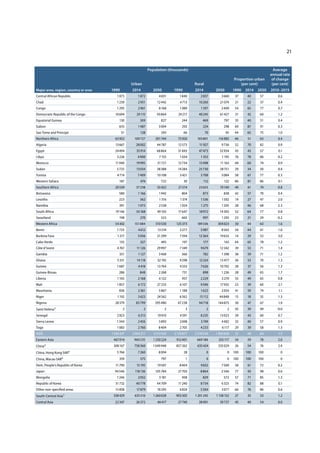
1990 2014 2050 1990 2014 2050 1990 2014 2050 2010–2015
WORLD 2285031 3880128 6338611 3035786 3363656 3212333 43 54 66 0.9
More developed regionsa 830952 980403 1113500 317326 275828 189610 72 78 85 0.3
Less developed regionsb 1454079 2899725 5225111 2718460 3087828 3022723 35 48 63 1.2
Least developed countriesc 107335 283855 895701 402019 635275 914889 21 31 49 1.7
Less developed regions,
excluding least developed countriesd
1346744 2615870 4329410 2316440 2452553 2107834 37 52 67 1.3
Less developed regions,
excluding China
1126378 2115652 4148069 1854345 2446901 2684617 38 46 61 0.9
High-income countriese 834931 1035404 1212666 287614 256311 185266 74 80 87 0.3
Middle-income countries 1325274 2555840 4284327 2346129 2484859 2139791 36 51 67 1.3
Upper-middle-income countries 793208 1541090 2155352 1153047 920812 562801 41 63 79 1.5
Lower-middle-income countries 532067 1014751 2128975 1193082 1564047 1576990 31 39 57 1.1
Low income countries 109850 268441 819856 394871 616562 883673 22 30 48 1.5
Sub-Saharan Africaf 132971 345617 1136822 357144 579083 937624 27 37 55 1.4
AFRICA 196923 455345 1338566 433064 682885 1054609 31 40 56 1.1
Eastern Africa 35564 96610 378763 162822 287296 490458 18 25 44 1.7
Burundi 352 1233 7025 5254 9250 19666 6 12 26 2.5
Comoros 115 212 576 298 540 932 28 28 38 0.3
Djibouti 448 685 1028 142 202 216 76 77 83 0.1
Eritrea 517 1451 6029 2755 5086 8284 16 22 42 1.9
Ethiopia 6064 18363 70522 41979 78143 117051 13 19 38 2.3
Kenya 3927 11476 42636 19520 34070 54536 17 25 44 1.7
Madagascar 2721 8125 30518 8825 15447 24979 24 34 55 1.9
Malawi 1092 2710 12437 8355 14119 28766 12 16 30 0.9
Mauritius1 464 497 570 592 752 661 44 40 46 -0.5
Mayotte 33 108 237 59 120 229 36 47 51 -0.8
Mozambique 3392 8454 29440 10176 18019 30490 25 32 49 0.8
Réunion 496 840 1089 115 46 36 81 95 97 0.2
Rwanda 391 3369 13349 6824 8731 12029 5 28 53 3.7
Seychelles 34 50 65 35 43 35 49 54 65 0.6
Somalia 1875 4223 15664 4447 6583 11412 30 39 58 1.2
South Sudan 765 2182 8403 4999 9556 16357 13 19 34 1.0
Uganda 1942 6124 33367 15593 32721 70711 11 16 32 2.1
United Republic of Tanzania2 4813 15685 68569 20672 35073 60848 19 31 53 2.3
Zambia 3091 6079 25759 4753 8942 18447 39 40 58 1.1
Zimbabwe 3033 4745 11479 7429 9854 14774 29 33 44 -0.5
Middle Africa 22566 60685 192108 47434 78798 124003 32 44 61 1.2
Angola 2644 9580 34676 7690 12558 19648 26 43 64 1.9
Cameroon 4787 12281 34003 7284 10538 14596 40 54 70 1.1
21
Major area, region, country or area
Population (thousands)
Proportion urban
(per cent)
Average
annual rate
of change
(per cent)Urban Rural
1990 2014 2050 1990 2014 2050 1990 2014 2050 2010–2015
Central African Republic 1073 1872 4831 1840 2837 3660 37 40 57 0.6
Chad 1239 2951 12442 4713 10260 21074 21 22 37 0.4
Congo 1295 2961 8168 1089 1597 2409 54 65 77 0.7
Democratic Republic of the Congo 10694 29115 93864 24217 40245 61427 31 42 60 1.2
Equatorial Guinea 130 309 827 244 469 797 35 40 51 0.4
Gabon 655 1487 3004 292 224 298 69 87 91 0.3
Sao Tome and Principe 51 128 293 66 70 95 44 65 75 1.0
Northern Africa 63952 109727 201744 75920 103801 116985 46 51 63 0.4
Algeria 13667 28002 44787 12573 11927 9736 52 70 82 0.9
Egypt 24494 35914 68864 31843 47473 52934 43 43 57 0.1
Libya 3226 4900 7155 1034 1353 1195 76 78 86 0.2
Morocco 11940 19995 31721 12734 13498 11163 48 60 74 0.9
Sudan 5725 13034 38388 14284 25730 38751 29 34 50 0.4
Tunisia 4714 7409 10108 3421 3708 3084 58 67 77 0.3
Western Sahara 187 474 722 30 112 122 86 81 86 0.1
Southern Africa 20539 37238 55422 21514 23653 19140 49 61 74 0.8
Botswana 580 1166 1942 804 873 838 42 57 70 0.4
Lesotho 223 562 1316 1374 1536 1502 14 27 47 2.0
Namibia 391 1073 2538 1024 1275 1205 28 46 68 2.3
South Africa 19146 34168 49103 17647 18972 14303 52 64 77 0.8
Swaziland 198 270 523 665 997 1293 23 21 29 -0.2
Western Africa 54302 151084 510530 125373 189336 304023 30 44 63 1.6
Benin 1725 4612 13574 3277 5987 8563 34 44 61 1.0
Burkina Faso 1217 5056 21299 7594 12364 19633 14 29 52 3.0
Cabo Verde 155 327 493 197 177 143 44 65 78 1.2
Côte d’Ivoire 4767 11126 29997 7349 9679 12342 39 53 71 1.4
Gambia 351 1127 3468 566 782 1398 38 59 71 1.2
Ghana 5331 14118 32192 9298 12324 13477 36 53 70 1.3
Guinea 1687 4418 13764 4333 7626 10702 28 37 56 1.3
Guinea-Bissau 286 848 2268 731 898 1236 28 49 65 1.7
Liberia 1165 2168 6122 937 2229 3270 55 49 65 0.8
Mali 1857 6172 27233 6107 9596 17935 23 39 60 2.1
Mauritania 836 2361 5867 1188 1623 2054 41 59 74 1.1
Niger 1192 3423 24562 6562 15112 44848 15 18 35 1.3
Nigeria 28379 83799 295480 67238 94718 144875 30 47 67 1.9
Saint Helena3 2 2 2 3 2 2 43 39 49 -0.0
Senegal 2923 6313 19910 4591 8235 13023 39 43 60 0.7
Sierra Leone 1344 2456 5893 2698 3749 4402 33 40 57 0.9
Togo 1083 2760 8404 2705 4233 6117 29 39 58 1.3
ASIA 1036247 2064211 3313424 2176877 2278044 1850638 32 48 64 1.5
Eastern Asia 467014 960235 1250224 912401 669186 355117 34 59 78 2.0
China4 308167 758360 1049948 857262 635424 335029 26 54 76 2.4
China, Hong Kong SAR5 5766 7260 8004 28 0 0 100 100 100 0
China, Macao SAR6 359 575 797 1 0 0 100 100 100 0
Dem. People’s Republic of Korea 11790 15195 19507 8404 9832 7569 58 61 72 0.2
Japan 94546 118136 105784 27703 8864 2546 77 93 98 0.6
Mongolia 1246 2052 3181 938 829 572 57 71 85 1.3
Republic of Korea 31732 40778 44709 11240 8734 6325 74 82 88 0.1
Other non-specified areas 13408 17879 18295 6824 5504 3077 66 76 86 0.6
South-Central Asia7 338429 635510 1260028 903305 1201245 1138152 27 35 53 1.2
Central Asia 22347 26372 46417 27740 38901 39737 45 40 54 0.0
World Urbanization Prospects: The 2014 Revision22
Major area, region, country or area
Population (thousands)
Proportion urban
(per cent)
Average
annual rate
of change
(per cent)Urban Rural
1990 2014 2050 1990 2014 2050 1990 2014 2050 2010–2015
Kazakhstan 9099 8850 13034 7073 7757 7151 56 53 65 -0.2
Kyrgyzstan 1660 2002 4052 2734 3623 3924 38 36 51 0.2
Tajikistan 1677 2245 6185 3620 6164 8907 32 27 41 0.2
Turkmenistan 1653 2637 4303 2015 2670 2266 45 50 66 0.7
Uzbekistan 8257 10638 18842 12298 18686 17488 40 36 52 0.1
Southern Asia 316082 609139 1213611 875565 1162343 1098415 27 34 52 1.2
Afghanistan 2149 8221 25642 9583 23059 30909 18 26 45 1.6
Bangladesh 21275 53127 112443 86111 105386 89504 20 34 56 2.4
Bhutan 88 290 539 448 475 441 16 38 55 2.1
India 221979 410204 814399 646911 857198 805652 26 32 50 1.1
Iran (Islamic Republic of) 31749 57170 84358 24613 21301 16241 56 73 84 0.8
Maldives 56 156 315 160 195 189 26 44 62 2.6
Nepal 1604 5130 12979 16508 22991 23501 9 18 36 2.0
Pakistan 33967 70912 155747 77124 114221 115335 31 38 57 1.1
Sri Lanka 3216 3929 7190 14108 17517 16644 19 18 30 0.0
South-Eastern Asia 140164 294409 507725 303571 331573 279810 32 47 64 1.4
Brunei Darussalam 169 325 458 88 98 88 66 77 84 0.4
Cambodia 1408 3161 8167 7649 12247 14402 16 21 36 0.9
Indonesia 54634 133999 227770 123999 118813 93607 31 53 71 1.5
Lao People’s Democratic Republic 655 2589 6435 3589 4305 4144 15 38 61 3.1
Malaysia8 9068 22342 36163 9143 7846 5950 50 74 86 1.0
Myanmar 10350 18023 32206 31773 35696 26439 25 34 55 1.6
Philippines 30101 44531 88381 31848 55566 68737 49 44 56 -0.4
Singapore 3016 5517 7065 0 0 0 100 100 100 0
Thailand 16649 33056 44335 39934 34167 17406 29 49 72 2.7
Timor-Leste 157 370 1007 595 782 1079 21 32 48 2.1
Viet Nam 13958 30495 55739 54952 62053 47958 20 33 54 2.0
Western Asia 90639 174057 295447 57600 76040 77558 61 70 79 0.5
Armenia 2390 1874 1961 1155 1110 821 67 63 70 -0.3
Azerbaijan9 3879 5172 7136 3338 4343 3356 54 54 68 0.5
Bahrain 437 1192 1684 59 152 151 88 89 92 0.1
Cyprus 512 773 977 255 380 379 67 67 72 -0.2
Georgia10 3005 2311 2350 2455 2011 1212 55 53 66 0.3
Iraq 12211 24116 55653 5307 10653 15683 70 69 78 0.1
Israel 4065 7202 11189 434 620 655 90 92 94 0.1
Jordan 2461 6263 10283 897 1242 1228 73 83 89 0.3
Kuwait 2018 3421 6268 42 58 74 98 98 99 0.0
Lebanon 2247 4354 4874 456 612 442 83 88 92 0.1
State of Palestine11 1409 3328 7408 672 1108 1499 68 75 83 0.3
Oman 1197 3030 4380 614 896 685 66 77 86 0.6
Qatar 442 2249 2978 34 19 6 93 99 100 0.1
Saudi Arabia 12411 24355 35839 3795 5015 4549 77 83 89 0.3
Syrian Arab Republic 6093 12588 26245 6359 9398 10461 49 57 72 0.7
Turkey 31966 55279 79189 22028 20559 15418 59 73 84 0.7
United Arab Emirates 1428 8054 14058 378 1392 1421 79 85 91 0.4
Yemen 2468 8496 22976 9322 16472 19520 21 34 54 1.7
EUROPE 505991 545382 581113 217257 197431 127954 70 73 82 0.3
Eastern Europe 211281 203201 191714 99482 90134 54809 68 69 78 0.1
Belarus 6770 7100 6274 3490 2208 1086 66 76 85 0.5
Bulgaria 5855 5277 4205 2966 1891 872 66 74 83 0.5
Czech Republic 7767 7843 8900 2559 2898 2318 75 73 79 -0.1
Hungary 6837 7030 7327 3548 2903 1628 66 71 82 0.7
Annex 23
Major area, region, country or area
Population (thousands)
Proportion urban
(per cent)
Average
annual rate
of change
(per cent)Urban Rural
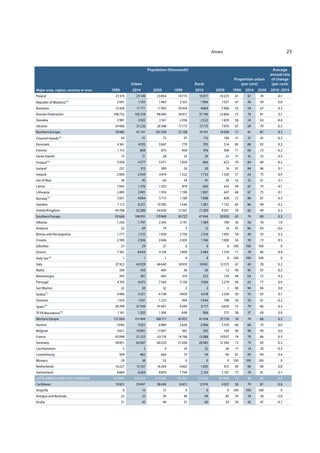
1990 2014 2050 1990 2014 2050 1990 2014 2050 2010–2015
Poland 23374 23149 23854 14775 15071 10225 61 61 70 -0.1
Republic of Moldova12 2041 1555 1463 2323 1906 1021 47 45 59 0.0
Romania 12438 11771 11903 10934 9869 5906 53 54 67 0.3
Russian Federation 108732 105318 98040 39417 37149 22856 73 74 81 0.1
Slovakia 2981 2932 3161 2296 2522 1829 56 54 63 -0.4
Ukraine 34486 31226 26588 17173 13715 7070 67 69 79 0.3
Northern Europe 70985 81747 101259 21128 19191 14509 77 81 87 0.3
Channel Islands13 44 51 73 97 112 106 31 31 41 0.3
Denmark 4361 4935 5847 779 705 514 85 88 92 0.2
Estonia 1115 868 815 450 416 306 71 68 73 -0.2
Faroe Islands 15 21 28 33 29 25 31 42 53 0.5
Finland14 3958 4577 5071 1029 866 622 79 84 89 0.2
Iceland 231 313 399 24 20 16 91 94 96 0.1
Ireland 2009 2944 4474 1522 1733 1520 57 63 75 0.4
Isle of Man 36 45 60 34 41 39 52 52 61 0.1
Latvia 1845 1376 1252 819 665 422 69 67 75 -0.1
Lithuania 2499 2001 1910 1199 1007 647 68 67 75 -0.1
Norway15 3051 4084 5717 1189 1008 838 72 80 87 0.3
Sweden 7113 8251 10782 1446 1381 1152 83 86 90 0.2
United Kingdom 44708 52280 64830 12507 11209 8301 78 82 89 0.3
Southern Europe 92660 108935 119969 50727 47068 30920 65 70 80 0.3
Albania 1256 1797 2345 2191 1389 749 36 56 76 1.9
Andorra 52 69 79 3 12 16 95 86 83 -0.6
Bosnia and Herzegovina 1777 1515 1839 2750 2310 1492 39 40 55 0.3
Croatia 2590 2506 2606 2203 1766 1000 54 59 72 0.5
Gibraltar 27 29 27 0 0 0 100 100 100 0
Greece 7261 8644 9158 2899 2484 1510 71 78 86 0.4
Holy See16 1 1 1 0 0 0 100 100 100 0
Italy 37922 42029 46640 18910 19041 13375 67 69 78 0.2
Malta 339 410 405 36 20 12 90 95 97 0.2
Montenegro 295 397 403 319 225 154 48 64 72 0.3
Portugal 4743 6675 7564 5156 3936 2279 48 63 77 0.9
San Marino 22 30 32 2 2 1 90 94 96 0.0
Serbia17 4906 5251 4738 4829 4218 2336 50 55 67 0.1
Slovenia 1010 1031 1225 994 1044 798 50 50 61 -0.2
Spain18 29299 37349 41601 9584 9717 6624 75 79 86 0.3
TFYR Macedonia19 1161 1202 1306 848 906 575 58 57 69 0.0
Western Europe 131064 151499 168171 45921 41038 27716 74 79 86 0.3
Austria 5044 5621 6984 2626 2906 2370 66 66 75 0.0
Belgium 9617 10901 11891 362 243 164 96 98 99 0.0
France 42098 51253 63174 14748 13388 10037 74 79 86 0.3
Germany 58851 62067 60220 21636 20585 12346 73 75 83 0.3
Liechtenstein 5 5 9 24 32 36 17 14 20 -0.2
Luxembourg 309 482 666 73 54 40 81 90 94 0.4
Monaco 29 38 53 0 0 0 100 100 100 0
Netherlands 10227 15107 16304 4663 1695 615 69 90 96 0.8
Switzerland 4884 6024 8870 1790 2134 2107 73 74 81 0.1
LATIN AMERICA AND THE CARIBBEAN 313876 495857 673631 131327 127565 107935 71 80 86 0.3
Caribbean 19851 29897 38440 14411 12916 9207 58 70 81 0.8
Anguilla 8 14 15 0 0 0 100 100 100 0
Antigua and Barbuda 22 22 30 40 69 85 35 24 26 -2.0
Aruba 31 43 49 31 60 54 50 42 47 -0.7
World Urbanization Prospects: The 2014 Revision24
Major area, region, country or area
Population (thousands)
Proportion urban
(per cent)
Average
annual rate
of change
(per cent)Urban Rural
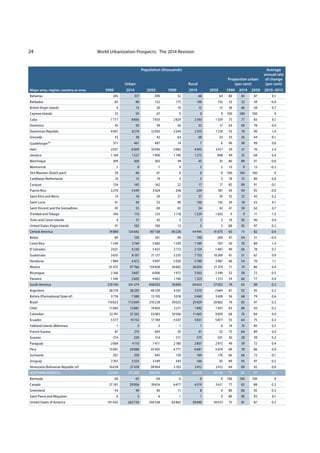
1990 2014 2050 1990 2014 2050 1990 2014 2050 2010–2015
Bahamas 205 317 430 52 66 64 80 83 87 0.1
Barbados 85 90 122 175 196 192 33 32 39 -0.4
British Virgin Islands 6 13 20 10 15 15 38 46 58 0.7
Cayman Islands 25 59 67 0 0 0 100 100 100 0
Cuba 7777 8666 7833 2824 2593 1559 73 77 83 0.1
Dominica 45 50 59 26 22 17 63 69 78 0.4
Dominican Republic 4001 8219 12003 3244 2310 1318 55 78 90 1.4
Grenada 32 38 42 64 68 53 33 36 44 -0.1
Guadeloupe20 371 461 487 14 7 6 96 98 99 0.0
Haiti 2027 6009 10936 5083 4453 3417 29 57 76 2.4
Jamaica 1169 1527 1900 1196 1272 908 49 55 68 0.4
Martinique 309 360 365 49 45 35 86 89 91 -0.0
Montserrat 1 0 1 9 5 5 13 9 13 -0.3
Sint Maarten (Dutch part) 29 46 61 0 0 0 100 100 100 0
Caribbean Netherlands 10 15 19 3 5 5 78 75 80 0.0
Curaçao 124 145 162 22 17 17 85 89 91 -0.1
Puerto Rico 3270 3449 3424 248 234 187 93 94 95 -0.0
Saint Kitts and Nevis 14 18 29 27 37 39 35 32 43 0.2
Saint Lucia 41 34 52 98 150 155 29 18 25 0.1
Saint Vincent and the Grenadines 45 55 69 63 54 42 41 50 62 0.7
Trinidad and Tobago 104 115 123 1118 1229 1032 9 9 11 -1.5
Turks and Caicos Islands 9 31 42 3 3 2 74 92 96 0.4
United States Virgin Islands 91 102 100 13 5 3 88 95 97 0.2
Central America 74880 124682 187158 40226 44995 41675 65 73 82 0.4
Belize 89 150 301 99 190 289 47 44 51 -0.4
Costa Rica 1539 3749 5482 1539 1189 707 50 76 89 1.4
El Salvador 2631 4230 5425 2713 2154 1487 49 66 78 0.7
Guatemala 3655 8107 21157 5235 7753 10269 41 51 67 0.9
Honduras 1984 4472 9497 2920 3789 3987 40 54 70 1.1
Mexico 61475 97766 134828 24602 26034 21274 71 79 86 0.4
Nicaragua 2166 3607 6006 1972 2563 2349 52 58 72 0.5
Panama 1340 2603 4462 1146 1323 1313 54 66 77 0.4
South America 219145 341279 448033 76690 69653 57052 74 83 89 0.3
Argentina 28378 38293 48339 4247 3510 2684 87 92 95 0.2
Bolivia (Plurinational State of) 3776 7388 13193 3018 3460 3428 56 68 79 0.6
Brazil 110623 172604 210238 39025 29429 20882 74 85 91 0.3
Chile 11003 15881 19403 2211 1892 1437 83 89 93 0.2
Colombia 22741 37265 53083 10566 11665 9859 68 76 84 0.4
Ecuador 5577 10152 17184 4547 5831 5877 55 64 75 0.3
Falkland Islands (Malvinas) 1 2 3 1 1 0 74 76 85 0.7
French Guiana 87 215 443 30 41 52 75 84 89 0.4
Guyana 214 229 314 511 575 501 30 28 39 0.2
Paraguay 2069 4110 7471 2180 2807 2975 49 59 72 0.4
Peru 15001 24088 35405 6771 6681 5679 69 78 86 0.4
Suriname 267 359 445 139 184 176 66 66 72 -0.1
Uruguay 2767 3253 3549 343 166 92 89 95 97 0.2
Venezuela (Bolivarian Republic of) 16638 27439 38964 3103 3412 3412 84 89 92 0.0
NORTHERN AMERICA 212935 291860 390070 69351 66376 56130 75 81 87 0.2
Bermuda 60 65 64 0 0 0 100 100 100 0
Canada 21181 29006 39616 6477 6519 5611 77 82 88 0.2
Greenland 44 49 46 11 8 4 80 86 92 0.5
Saint Pierre and Miquelon 6 5 6 1 1 0 89 90 93 0.1
United States of America 191645 262734 350338 62862 59849 50515 75 81 87 0.2
Annex 25
Major area, region, country or area
Population (thousands)
Proportion urban
(per cent)
Average
annual rate
of change
(per cent)Urban Rural
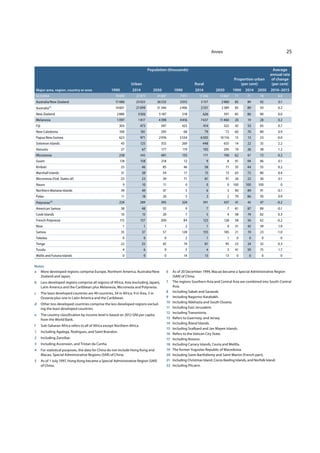
1990 2014 2050 1990 2014 2050 1990 2014 2050 2010–2015
OCEANIA 19059 27473 41807 7911 11356 15067 71 71 74 0.0
Australia/New Zealand 17480 25025 36533 3015 3157 2980 85 89 92 0.1
Australia21 14601 21099 31346 2496 2531 2389 85 89 93 0.2
New Zealand 2880 3926 5187 518 626 591 85 86 90 0.0
Melanesia 1097 1817 4398 4416 7637 11460 20 19 28 0.2
Fiji 303 473 597 425 414 322 42 53 65 0.7
New Caledonia 100 181 293 68 79 72 60 70 80 0.9
Papua New Guinea 623 971 2976 3534 6505 10116 15 13 23 -0.0
Solomon Islands 43 125 355 269 448 655 14 22 35 2.2
Vanuatu 27 67 177 119 192 295 19 26 38 1.2
Micronesia 258 343 481 155 171 190 62 67 72 0.2
Guam 118 158 218 12 9 8 91 94 96 0.1
Kiribati 25 46 85 46 58 71 35 44 55 0.2
Marshall Islands 31 38 54 17 15 13 65 72 80 0.4
Micronesia (Fed. States of) 25 23 39 71 81 91 26 22 30 0.1
Nauru 9 10 11 0 0 0 100 100 100 0
Northern Mariana Islands 39 49 47 5 6 5 90 89 91 -0.1
Palau 11 18 26 5 3 2 70 86 93 0.9
Polynesia22 224 289 395 324 391 437 41 42 47 -0.2
American Samoa 38 48 55 9 7 7 81 87 89 -0.1
Cook Islands 10 15 20 7 5 4 58 74 82 0.3
French Polynesia 115 157 209 84 123 128 58 56 62 -0.2
Niue 1 1 1 2 1 0 31 42 59 1.9
Samoa 35 37 57 128 155 185 21 19 23 -1.0
Tokelau 0 0 0 2 1 1 0 0 0 0
Tonga 22 25 45 74 81 95 23 24 32 0.3
Tuvalu 4 6 9 5 4 3 41 59 75 1.7
Wallis and Futuna Islands 0 0 0 14 13 13 0 0 0 0
Notes
a More developed regions comprise Europe, Northern America, Australia/New
Zealand and Japan.
b Less developed regions comprise all regions of Africa, Asia (excluding Japan),
Latin America and the Caribbean plus Melanesia, Micronesia and Polynesia.
c The least developed countries are 49 countries, 34 in Africa, 9 in Asia, 5 in
Oceania plus one in Latin America and the Caribbean.
d Other less developed countries comprise the less developed regions exclud-
ing the least developed countries.
e The country classification by income level is based on 2012 GNI per capita
from the World Bank.
f Sub-Saharan Africa refers to all of Africa except Northern Africa.
1 Including Agalega, Rodrigues, and Saint Brandon.
2 Including Zanzibar.
3 Including Ascension, and Tristan da Cunha.
4 For statistical purposes, the data for China do not include Hong Kong and
Macao, Special Administrative Regions (SAR) of China.
5 As of 1 July 1997, Hong Kong became a Special Administrative Region (SAR)
of China.
6 As of 20 December 1999, Macao became a Special Administrative Region
(SAR) of China.
7 The regions Southern Asia and Central Asia are combined into South-Central
Asia.
8 Including Sabah and Sarawak.
9 Including Nagorno-Karabakh.
10 Including Abkhazia and South Ossetia.
11 Including East Jerusalem.
12 Including Transnistria.
13 Refers to Guernsey, and Jersey.
14 Including Åland Islands.
15 Including Svalbard and Jan Mayen Islands.
16 Refers to the Vatican City State.
17 Including Kosovo.
18 Including Canary Islands, Ceuta and Melilla.
19 The former Yugoslav Republic of Macedonia.
20 Including Saint-Barthélemy and Saint-Martin (French part).
21 Including Christmas Island, Cocos Keeling Islands, and Norfolk Island.
22 Including Pitcairn.
World Urbanization Prospects: The 2014 Revision26
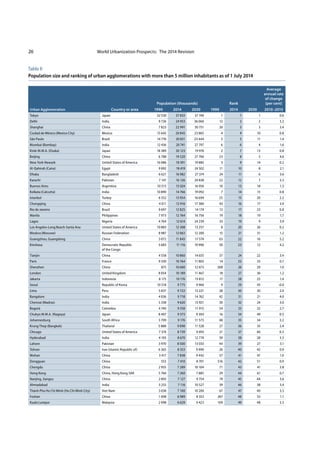
Table II
Population size and ranking of urban agglomerations with more than 5 million inhabitants as of 1 July 2014
Population (thousands) Rank
Average
annual rate
of change
(per cent)
Urban Agglomeration Country or area 1990 2014 2030 1990 2014 2030 2010–2015
Tokyo Japan 32 530 37 833 37 190 1 1 1 0.6
Delhi India 9 726 24 953 36 060 12 2 2 3.2
Shanghai China 7 823 22 991 30 751 20 3 3 3.4
Ciudad de México (Mexico City) Mexico 15 642 20 843 23 865 4 4 10 0.8
São Paulo Brazil 14 776 20 831 23 444 5 5 11 1.4
Mumbai (Bombay) India 12 436 20 741 27 797 6 6 4 1.6
Kinki M.M.A. (Osaka) Japan 18 389 20 123 19 976 2 7 13 0.8
Beijing China 6 788 19 520 27 706 23 8 5 4.6
New York-Newark United States of America 16 086 18 591 19 885 3 9 14 0.2
Al-Qahirah (Cairo) Egypt 9 892 18 419 24 502 11 10 8 2.1
Dhaka Bangladesh 6 621 16 982 27 374 24 11 6 3.6
Karachi Pakistan 7 147 16 126 24 838 22 12 7 3.3
Buenos Aires Argentina 10 513 15 024 16 956 10 13 18 1.3
Kolkata (Calcutta) India 10 890 14 766 19 092 7 14 15 0.8
Istanbul Turkey 6 552 13 954 16 694 25 15 20 2.2
Chongqing China 4 011 12 916 17 380 43 16 17 3.4
Rio de Janeiro Brazil 9 697 12 825 14 174 13 17 23 0.8
Manila Philippines 7 973 12 764 16 756 19 18 19 1.7
Lagos Nigeria 4 764 12 614 24 239 33 19 9 3.9
Los Angeles-Long Beach-Santa Ana United States of America 10 883 12 308 13 257 8 20 26 0.2
Moskva (Moscow) Russian Federation 8 987 12 063 12 200 15 21 31 1.2
Guangzhou, Guangdong China 3 072 11 843 17 574 63 22 16 5.2
Kinshasa Democratic Republic
of the Congo
3 683 11 116 19 996 50 23 12 4.2
Tianjin China 4 558 10 860 14 655 37 24 22 3.4
Paris France 9 330 10 764 11 803 14 25 33 0.7
Shenzhen China 875 10 680 12 673 308 26 29 1.0
London United Kingdom 8 054 10 189 11 467 18 27 36 1.2
Jakarta Indonesia 8 175 10 176 13 812 17 28 25 1.4
Seoul Republic of Korea 10 518 9 775 9 960 9 29 43 -0.0
Lima Peru 5 837 9 722 12 221 28 30 30 2.0
Bangalore India 4 036 9 718 14 762 42 31 21 4.0
Chennai (Madras) India 5 338 9 620 13 921 30 32 24 3.0
Bogotá Colombia 4 740 9 558 11 915 34 33 32 2.7
Chukyo M.M.A. (Nagoya) Japan 8 407 9 373 9 304 16 34 49 0.5
Johannesburg South Africa 3 709 9 176 11 573 48 35 34 3.2
Krung Thep (Bangkok) Thailand 5 888 9 098 11 528 27 36 35 2.4
Chicago United States of America 7 374 8 739 9 493 21 37 46 0.3
Hyderabad India 4 193 8 670 12 774 39 38 28 3.3
Lahore Pakistan 3 970 8 500 13 033 44 39 27 3.1
Tehran Iran (Islamic Republic of) 6 365 8 353 9 990 26 40 42 0.9
Wuhan China 3 417 7 838 9 442 57 41 47 1.0
Dongguan China 553 7 410 8 701 516 42 51 0.9
Chengdu China 2 955 7 289 10 104 71 43 41 3.8
Hong Kong China, Hong Kong SAR 5 766 7 260 7 885 29 44 61 0.7
Nanjing, Jiangsu China 2 893 7 127 9 754 74 45 44 3.6
Ahmadabad India 3 255 7 116 10 527 59 46 38 3.4
Thành Pho Ho Chí Minh (Ho Chi Minh City) Viet Nam 3 038 7 100 10 200 67 47 40 3.3
Foshan China 1 008 6 989 8 353 267 48 53 1.1
Kuala Lumpur Malaysia 2 098 6 629 9 423 109 49 48 3.3
Annex 27
Population (thousands) Rank
Average
annual rate
of change
(per cent)
Urban Agglomeration Country or area 1990 2014 2030 1990 2014 2030 2010–2015
Baghdad Iraq 4 092 6 483 9 710 41 50 45 2.4
Santiago Chile 4 616 6 472 7 122 36 51 64 0.7
Ar-Riyadh (Riyadh) Saudi Arabia 2 325 6 195 7 940 92 52 58 4.0
Shenyang China 3 651 6 194 7 911 51 53 59 2.1
Madrid Spain 4 414 6 133 6 707 38 54 70 1.4
Hangzhou China 1 476 6 121 8 822 163 55 50 4.6
Toronto Canada 3 807 5 901 6 957 46 56 65 1.7
Xi’an, Shaanxi China 2 157 5 867 7 904 102 57 60 3.2
Miami United States of America 3 969 5 771 6 554 45 58 74 1.1
Belo Horizonte Brazil 3 548 5 667 6 439 53 59 75 1.1
Dallas-Fort Worth United States of America 3 219 5 603 6 683 60 60 71 2.0
Pune (Poona) India 2 430 5 574 8 091 86 61 57 2.9
Philadelphia United States of America 4 725 5 571 6 158 35 62 78 0.5
Kitakyushu-Fukuoka M.M.A. Japan 5 269 5 528 5 355 31 63 95 -0.2
Singapore Singapore 3 016 5 517 6 578 69 64 73 2.0
Houston United States of America 2 922 5 516 6 729 72 65 68 2.5
Surat India 1 468 5 398 8 616 166 66 52 4.8
Haerbin China 2 392 5 351 6 860 87 67 67 2.2
Luanda Angola 1 390 5 288 10 429 175 68 39 4.0
Barcelona Spain 4 101 5 207 5 685 40 69 89 1.3
Suzhou, Jiangsu China 1 067 5 156 8 098 249 70 56 6.3
Atlanta United States of America 2 184 5 032 6 140 101 71 79 2.5
14-04178
ISBN 978-92-1-123195-3
Accurate, consistent and timely data on global trends in urbanization and
city growth are critical for assessing current and future needs with respect
to urban growth and for setting policy priorities to promote inclusive and
equitable urban and rural development. This report presents the highlights of
the 2014 Revision of World Urbanization Prospects, which contains the latest
estimates of the urban and rural populations of 233 countries or areas from
1950 to 2014 and projections to 2050, as well as estimates of population size
from 1950 to 2014 and projections to 2030 for all urban agglomerations with
300,000 inhabitants or more in 2014.
Entretien Emilie GERBAUD


I. Quelle est votre propre définition de la Smart City et des problèmes qu’elle
adresse ? Quels objectifs se fixe-t-elle ?
Beaucoup de villes se revendiquent « smart city », y’a-t-il des critères précis à
remplir ou c’est à l’appréciation de chacune de ces villes ? Existe-t-il un label
Smart City ?
Le quartier confluence est le premier éco-quartier certifié WWF, quel critère à
remplir ?
Les Smart city sont-elles une réponse au problème de la concentration des
villes ?
II. Le projet Lyon Smart Community 2011-2016
Il comprenait 4 volets (dernière page de Dossier Presse LSC) et l’intégralité du
projet a été réalisé Fin Juin 2016, avez-vous fait un bilan de ce projet ? Puis-je
le voir ? Quels sont les indicateurs de performance utilisés (qualité de vie,
économie d’énergie etc)


Montrer hiérarchie LSC (Page 7 Dossier Presse LSC) : Comment s’organise la
collaboration ? Quelles interactions ? Qui sont les décisionnaires finaux ? Appel
à projet ? Budget annuel ? Financement ?
Lundi 20 Mars, l’Etat a accordé plus de 10millions d’euros à Lyon pour le
développement de 11 projets innovants
I. Pouvez-vous me parler du projet numérique NEDA ?
II. J’ai été agréablement surpris de voir la quantité de Data générées par la Ville
et mise à disposition de tous citoyens,
Comment le générez et stockez-vous ?
Comment les différents services utilisent les données des uns et des
autres ?
Quel avenir pour le TUBA ?
Parler du problème évoqué avec H2Lyon
III. Le projet TRANSFORM (planification énergétique 2012-2015), quelle
coopération avec les autres villes partenaires ?
La problématique de l’hacking est-elle prise en compte ?
IV. Concernant le partenariat Smarter Together, du programme européen Horizon
2020, quels sont les principaux axes de développement concernant la ville de
Lyon ? Comment s’organise la collaboration ave Vienne et Munich ?
I. Si l’on réunit la Métrople Grand Lyon, Lyon Smart Community, Smarter
Together, Lyon Living Lab, cela fait des dizaines voir centaines d’acteurs à la
fois privés et publics,
Comment s’organise cette collaboration ?
Quel budget global cela représente-t-il ?
N’y-a-til pas des doublons ou des conflits d’intérêts parfois ?
Plus généralement, quelle est la vision et quels sont les projets relatifs à la Smart
Métropole qui vont être développés à Lyon dans le cadre du PPI 2015-2020 ?
(Programme Pluriannuel d’Investissements)
Quel est le futur de la Smart City à Lyon ?
Concernant le projet de Renouvellement Urbain, dont les 141millions €
concerne majoritairement des quartiers excentrés et pour certains défavorisés,
ces quartiers sont-ils intégrés à des projets Smart avec :
o Contrôle des consommations d’énergies ? Production d’énergies sur les
toits ? Agriculture urbaine ? Des efforts de management intelligents en
termes de consommation d’eau et d’électricité sont-ils faits ?
Les Halles Girard, le futur cœur de la French Tech à Lyon ? Pouvez-vous m’en
parler ?
La Ville veut favoriser le maintien de l’activité artisanale au cœur des villes, 4
projet sont notamment évoqués, pouvez-vous m’en parler ? Page 28, I
V. Le Pass Urbain et le Plan Piéton, pouvez-vous m’en parler ?
Considérez-vous comme possible à l’avenir la Presqu’île Lyonnaise
complètement fermée aux voitures comme cela est le cas dans de nombreuses
villes ?
En termes de mobilité au sein de la ville, quels sont les futurs axes de
développement ?
VI. Améliorer la qualité de vie dans la Métropole est un des 3 objectifs majeurs du
PPI 2015-2020 : Quels sont les indicateurs de performances utilisés :
consommation d’eau, d’énergie, amélioration qualité de la vie ?
De nombreuses études démontrent l’importance de l’engagement citoyens dans les
SC, notamment une étude de Vlerick Business School mené par Joachim Van
Den Bergh, qui dit que l’engagement citoyen est le facteur clés de succès
prédominant pour la réussite des SC, alors que faits la ville de Lyon dans ce
sens là ?
I. Caractère inclusif : comment rendre la SC accessible à tous ?
II. Concernant les citoyens de la Ville, selon vous, quel doit être la participation
du citoyen dans la SC ? Comment la rendre possible ?
E-gouvernance ?
Les livings labs, FabLab, TUBA (Martin CAHEN)
III. L’un des piliers qui me semble essentiel mais qui n’apparaît quasiment nulle
part, c’est l’alimentation
Y a-t-il des initiatives smart dans ce domaine à Lyon ?
La culture urbaine sur les toits ?
1M920-MT
StrategicOpportunityAnalysisoftheGlobal
SmartCityMarket
SmartCityMarketisLikelytobeWorthaCumulative$1.565Trillionby2020
2M920-MT
WhatisSmartCity?
SmartCityConcepts
Source:Frost&Sullivan
4G4G4G4G
Smartcitiesarecitiesbuilton
‘Smart’and‘Intelligent’
solutionsandtechnologythat
willleadtotheadoptionofat
least5ofthe8followingsmart
parameters—smartenergy,
smartbuilding,smartmobility,
smarthealthcare,smart
infrastructure,smart
technology,smartgovernance
andsmarteducation,smart
citizen
Smart
Energy
Smart
Building
Smart
Citizen
Smart
Technology
Smart
Healthcare
Smart
Mobility
SmartGovernanceand
SmartEducation
SmartInfrastructure
Note:SmartSecurityisincludedasapartofSmartInfrastructuresegmentinthisillustration.
3M920-MT
KeyParametersthatwillDefineaSmartCityin2020
ParameterDefinition
Smartenergy
Smartenergyusesdigitaltechnologythroughadvancedmeterinfrastructure(AMI),distributiongrid
management,andhigh-voltagetransmissionsystems,aswellasfordemandresponseforthe
intelligentandintegratedtransmissionanddistributionofpower.
Smartbuilding
Smartbuildingsaregreen,energyefficient,andintelligent,withadvancedautomatedinfrastructure
thatcontrolsandmanagesaspectssuchaslightingandtemperature,security,andenergy
consumptionindependentlyorwithminimalhumanintervention.
Smartmobility
Smartmobilityenablesintelligentmobilitythroughtheuseofinnovativeandintegratedtechnologies
andsolutions,suchaslowemissioncarsandmultimodaltransportsystems.
Smarttechnology
Smarttechnologywillconnectthehome,office,mobilephone,andcaronasinglewirelessIT
platform.Smarttechnologyincludesadoptionofasmartgridsystem,smarthomesolutions,ahigh-
speedbroadbandconnection,androll-outof4Gtechnology.
Smarthealthcare
SmarthealthcareistheuseofeHealthandmHealthsystemsandintelligentandconnectedmedical
devices.Italsoinvolvestheimplementationofpoliciesthatencouragehealth,wellness,andwell-
beingforitscitizens,inadditiontohealthmonitoringanddiagnosticsasopposedtotreatment.
Smartinfrastructure
Smartinfrastructureincludesintelligentandautomatedsystemsthatmanage,communicatewith,and
integrateintodifferenttypesofintelligentinfrastructure,suchasenergygrids,transportation
networks,waterandwastemanagementsystems,andtelecommunications.
Smartgovernance
andsmarteducation
Smartgovernanceandsmarteducationincludespoliciesanddigitalservicesfromthegovernment
thathelpandsupporttheadoptionofgreenandintelligentsolutionsthroughincentives,subsidies,or
otherpromotions.
Smartsecurity
Smartsecurityincludestechnologyandsolutionssuchasvideosurveillance,publicsafetyLTE,and
managedsecurityservicesthataredesignedtoprotectpeople,property,andinformation.
Smartcitizens
Smartcitizenspossessinterestinembracingsmartandgreensolutionsindailyactivities.More
citizenproactivityisexpectedinadoptingsmartconceptsandsmartproducts,includinglifestyle
choices.
Source:Frost&Sullivan
4M920-MT
UnderstandingtheDifferenceBetweenSmartCityandSustainableCity
SmartCitySustainableCity
•Smartcitiesarecitiesbuilton'Smart'and
'Intelligent'solutionsandtechnologythatwillleadto
adoptionofatleast5ofthe8followingsmart
parameters.
•Asof2011,thereisnosmartcity;however,26
smartcitiesareexpectedby2025.Smart'projects'
withinacityhavebeenexcludedinthiscount,as
theydonotapplytoanentirecity.
•Sustainablecitiesarecitiesthatarebuiltoneco-
friendlybasis.Thesemaynotnecessarilyinclude
'intelligent'systemsbutarebuiltmoreonan
energy-efficientorenvironment-friendlyobjective.
•92sustainablecitiesareexpectedby2025.
ImageSource:Dreamstime
Source:Frost&Sullivan
5M920-MT
IntroductiontoSmartCityConcept
SmartistheNewGreen—3LevelsofSmartProductsandTechnologies
Smart
Technology
SmartBuildingsSmartMobilitySmartWindowsSmartCloudsLEVEL3
Sensing
Mechanism+
Two-wayFlowof
Data
Communication
SmartChipSmartLightingLEVEL2
BasicSensing
Mechanism+
One-wayData
Communication
Smart
Bandages
LEVEL1
BasicSensing
Mechanism
ImageSource:DreamstimeandConnectedDigitalWorld
Asmartproductischaracterized
byanintelligentsensing
technologythatisincreasingly
beingintegratedwithInternet
technologies,therebyallowingthe
producttoreacttoand
communicatewiththechanging
environmentaroundit.Thisleads
tooptimaloperationsand
improvementinefficiency.
Source:Frost&Sullivan
6M920-MT
KeyParametersthatwillDefineaSmartCityin2020
•Smartgrids
•Smartmeters
•Intelligentenergy
storage
•BuildingAutomation
•IntelligentBuildings:
AdvancedHVAC,
LightingEquipment
•Advancedtraffic
managementsystem
(ATMS)
•Parkingmanagement
•ITS-enabled
transportationpricing
system
•Sensornetworks
•Digitalwaterand
wastemanagement
•eGovernment
•eEducation
•Disastermanagement
solutions
•UseofeHealthand
mHealthsystems
•Intelligentand
connectedmedical
devices
•Useofgreenmobility
options
•Smartlifestylechoices
•4Gconnectivity
•Superbroadband
•FreeWi-Fi
•1Gbpsdownload
speeds
SmartEnergy:DigitalManagementof
Energy
SmartBuildings:AutomatedIntelligent
Buildings
SmartMobility:IntelligentMobility
SmartInfrastructure:DigitalManagementof
Infrastructure
SmartGovernanceandSmartEducation:
Government-on-the-Go
SmartHealthcare:IntelligentHealthcare
Technology
SmartCitizen*:CivicDigitalNatives
SmartTechnology*:SeamlessConnectivity
*Smartcitizenandsmarttechnologyareintegratedandnotcoveredseparatelyinthisanalysis.
•Surveillance
•Biometrics
•Simulationmodeling
andcrimeprotection
•C2andresponse
SmartSecurity:NextGeneration911
Source:Frost&Sullivan
7M920-MT
ExecutiveSummary—GlobalSmartCitiesin2025
Morethan26globalcitieswillbesmartcitiesin2025,morethan50%ofwhichwillbefromEuropeandNorth
America.
Tianjin
Wuhan
Shenzhen
Glasgow
LosAngeles
NewYork
Toronto
SanFrancisco
Vancouver
Paris
LondonBerlin
Barcelona
Amsterdam
Seattle
Tokyo
Singapore
Calgary
Chicago
Vienna
Copenhagen
Oslo
Seoul
Beijing
Helsinki
Sydney
ImageSource:Dreamstime
Source:ForbesSmartCityList2009;InnovationCitiesGlobalIndex2012-2013;specificSmartProjectWebsitesforeachcity;Frost&Sullivan
Stockholm
SmartCities,Global,2025
Boston
SanDiego
Luxembourg
Chengdu
Johannesburg
Delhi
Jakarta
Smartcitiesin2025
Selectsmartcityprojects*in2025**
*SmartCityprojectsarecityprojectsthatarebeing
trialled/implementedwithinasmall-scaleforaspecific
industry/publicentity/industrycluster.e.g.,TheBuffalo
(UnitedStates)SmartEducationInitiative
**Thislistisnotexhaustive.Thecitieshighlightedhere
haveimplementedatleastoneofsixsmartcityaspectsin
theirsmartcityprojects.
8M920-MT
SmartMobility
SmartInfrastructure***
SmartHealthcare
SmartBuilding
24.6
13.5
15.8
13.1
8.7
14.6
9.7
SmartCityMarketbySegments*,Global,2012-2020
ExecutiveSummary—SummaryofSmartCityMarket
Smartcitiesareanticipatedtocreatehugebusinessopportunitieswithamarketvalueof$1.565trillionby
2020.
1
2
4
5
6
SmartGovernance
andSmartEducation**
SmartEnergy
7
Note:Thegraphrepresentthemarketshareofeach
segmentinthesmartcitymarket.
Formoreinformationonsmartcitymarketsectorsplease
refertoappendix.
SmartCityMarket
*Thesenumbersrepresenttheentiresmartsolutionseco-systemineachsegmentforbothurbanandnon-urbanpanoramas.
**SmartEducationincludeseLearningservicesforschools,universities,enterprises,andgovernmententities.
***SmartInfrastructureincludessensornetworksanddigitalmanagementofwaterutilitiesnotincludedinothersegments.
SmartSecurity
3
Source:Frost&Sullivan
9M920-MT
SmartConvergence
Companiesinthesmartcityspacewillnotonlypartnerandconvergeamongthemselvestooffer‘smart’
capabilitiesbutwouldalsostartconvergingwithdifferentparticipantsintheecosystem.
ITParticipants
•IPnetworks
•Digitaltechnology
•Analysissoftware
•Technologyintegration
•Networksecurity
EnergyandInfrastructure
Participants
•T&Dtechnology
•Powerelectronics
•Renewableenergy
•Integrateddistribution
management
•Substationautomation
•AMI-enabledmetering
AutomationandBuilding
ControlParticipants
•Buildingautomation
•Demand-sidemanagement
•Deviceconnectivity
•Monitoringandsensing
•Smartgridintegration
Security
•Firewalls,Internetprotocol
security
•Physicalimplementationof
systemsandmonitoring
•Managedandmonitoring
services
•Cloud-basedservices
•Identitymanagement,smart
cards
TelecomParticipants
•BroadbandandInternet
serviceproviders
•Phonelines
•Mobilecommunications
•NetworkedITservices
SAP
HP
ST
Electronics
Oracle
Google
Microsoft
Alcatel-
Lucent
IBM
CiscoSenergy
Eaton
ALSTOMGrid
SiemensAG
General
Electric
ABB
Honeywell
RockwellAutomation
JohnsonControls
SchneiderElectric
Verizon
O2
DeutscheTelekom
Ericsson
AT&T
Serco
Symantec
Tyco
PointofConvergence
Securitas
SmartCityMarket:ConvergenceofCompetition,Global,2012–2025
Source:Frost&Sullivan
10M920-MT
CaseStudy—AmsterdamSmartCity
IBM,Cisco,Accenture,Philips,VodafonearecomingtogethertopowerAmsterdamSmartCity.
Smart
ICT
Projects
•Shiptogrid
•Energymanagement
•Fuelcelltechnology
ProjectDevelopers
•Vattenfall-Nuon
•Liander
•Cisco
Smart
Communication
Smart
Energy
Projects
•SmartWorkplace
•TPEX-SmartAirmiles
•AlmereSmartSociety
•HealthLab
ProjectDevelopers
•Accenture
•IBM
•Cisco
Projects
•AlmereSmart
Society
•OnlinePortal
•Opennetwork
ProjectDevelopers
•Vodafone
•Philips
•Cisco
•IBMSource:Amsterdamsmartcity.com;Frost&Sullivan
SmartCityMarket:HighlightsofSmartProjectsandDevelopers,AmsterdamCity,2012
11M920-MT
UrbanSecurity
CriticalInfrastructureProtection
IDManagement
CyberSecurity
Security
50%reductionincrimerate
eGovernment
100%rateofaccesstoafullrangeofgovernment
servicesthroughdigitaltechnology
eAdministration
OnlineTransactions(eFilingoftaxreturns)
SmartGovernanceandSmartSecurity—Government-on-the-Go
ImageSource:Dreamstime
VirtualClassrooms
DistanceLearning
Computer-basedTraining
eEducation
Smartgovernanceandsmartsecurityincludesrollingoutofpoliciesanddigitalservicesfromthegovernmentthathelpand
supportadoptionofgreenandintelligentsolutionsthroughincentives,subsidies,orotherformsofpromotionalschemes.
Source:Frost&Sullivan
12M920-MT
SmartCitizen—TheDigizensoftheFuture
GreenMobility
Atleast70%ofcitizenstravellingtowork
bypublictransport,bicycle,orfoot
InitiativetoReduceAirPollution
Atleast40%ofcitizensfollowthecity's
greenactionplan;atleast30%of
citizenshavetakeninitiativetoreduceair
pollution
ImageSource:Dreamstime
SmartLifestyleChoices
RecyclingofWaste
ReductionofEnergyConsumption
PreferenceforEco-friendlyProductsandServices
Smartcitizenspossessinteresttoembracesmartandgreensolutionsintheirday-to-dayworkschedule.Moreproactiveness
ofcitizensinadoptingsmartconceptsandsmartproducts,whichincludesmaking'smart'lifestylechoices,isexpected.
Source:Frost&Sullivan
13M920-MT
ExecutiveSummary—SmartCityFundingMechanisms
Mostservicesarefinancedbyeitherthecentralgovernmentorthecityitself.
SmartCityMarket:MostAdoptedFundingMechanismsforSmartCityProjects*,2012
40%
37%
22%
1%
SpecialdevelopmentfundsPublic-privatepartnerships
Self-financing(Majority)Privateinvestment
*Basedonasamplesizeof15smartcityprojects.
FundingMechanism
SpecialDevelopment
Funds
Specificfundssetupforimplementingand
scalingupurbandevelopmentorsmartcity
initiatives(e.g.,EuropeanCommission
‘JESSICA’)
Public-private
Partnerships
Fundedandoperatedthrougha
partnershipofgovernmentandoneormore
privatesectorcompanies(e.g.,Cisco-
SongdoPartnership)
Self-financing
(majority)
Self-financingofsmartcityprojectsfrom
publicbudgetsincollaborationwithcentral
governmentsorstategovernments(e.g.,
SeoulSmartCity)
PrivateInvestment
Financedthroughcommercial
stakeholders,serviceproviders,private
investors,andventurecapitalists(e.g.,
AmsterdamSmartCityPlatform)
Source:Frost&Sullivan
14M920-MT
eServices
eSharing
eHealthcare
eExchange
ePayments
eBusiness
eCitizens
InformationsharingthroughInternet—
informationsharingcanbebetween
individuals,organizationsorfirmware(e.g.,
filessharing,eBookssharing,etc.)
Onlinetaxpayment,online
electronicpassportsystem,
eApplication,etc.
Onlinebankingpayments,online
billpayments,onlinecreditcard
payment,onlinedebitcard
payment,etc.
Onlinecurrencyexchange,
onlinefundtransfer,micro-
paymentandmicro-
commerce,etc.
Electronichealthrecord
system,telemedicine,
consumerhealthinformatics,
healthcareinformation
system,etc.
Digitalizedproductstores,
onlinecustomermanagement,
onlinemarketing,onlineorder
management,etc.
SmartCityServices—eService
Morethan60%ofcitizensinsmartcitieswillhavefullaccesstoeServicesbythenextdecade.
SmartCityMarket:TypesofeServicesDeliveredtoCitizensandBusiness,
Global,2012–2015
Source:Frost&Sullivan
15M920-MT
12345
Energy
Efficiency
CO2emissions
(<10%)
CO2emissions
(10%–50%)
CO2emissions
(>50%)
ZeroCO2emissionsInnovatingtoZero
Project
Timeline
Morethan20YearsUpto20YearsUpto15yearsUpto10yearsUpto5years
Infrastructure
Development
Lesserpossibilityto
linkexisting
infrastructure
Mediumpossibility
tolinkexisting
infrastructure
Highpossibilityof
linkingexisting
infrastructure
Upgradingexisting
infrastructure
Buildingnew
infrastructure
Technology
Approach
Secure,fast,and
wirelesstechnology
Cloud-based
services/
enterprise-grade
platform
Opendatacentral/
holisticplatforms
Betterassimilation
ofdatathrough
predictive
technologies
Fullynetworked,
openand
expandableICT
architecture
Business
Model
Onlypublic/only
privateinvestment
Contractor/vendor
model
Privateconsortiums
Public-private
partnershipsOpencollaboration
Governance
Maturity
Smartcityvision
Smartcity
strategy
Dedicated
organization
Smartcity
leadership
Smartcity
consortium
HowtoMeasureSmartCityPlans?
FactorsdescribingtheimpactofsmartcityinitiativesandpotentialscalabilityofICTinfrastructureserveas
keyefficiencymonitorsofcurrentsmartcityplans.
*ScorecardbasedonGuidanceDocumentpublishedbyEuropeanCommissionInitiative,SmartCitiesandCommunities.
SmartCityScoringCriteria*Global,2013
Source:Frost&Sullivan
16M920-MT
SmartCitizen
•Oneintworesidentstocommutetoworkby
publictransport
•100%populationwithaccesstosanitation
•Targettorecycle65%ofwasteby2020
SmartCitizen
•Oneintworesidentstocommutetoworkby
publictransport
•100%populationwithaccesstosanitation
•Targettorecycle65%ofwasteby2020
SmartHealthcare
•Integratedhealthinformationsystem
acrossSingapore
•Cloudcomputingmodelsusedinmost
healthcareorganizations
SmartHealthcare
•Integratedhealthinformationsystem
acrossSingapore
•Cloudcomputingmodelsusedinmost
healthcareorganizations
SmartTechnology
•100%broadbandpenetrationrate
•Initializationof4GLTEservice
•50%ofhouseholdstohavesmart
homesolutions
SmartTechnology
•100%broadbandpenetrationrate
•Initializationof4GLTEservice
•50%ofhouseholdstohavesmart
homesolutions
SmartGovernance
EstablishmentofInter-MinisterialCommittee
onSustainableDevelopmenttocreate
Singapore’snationalstrategyonsustainable
development
SmartGovernance
EstablishmentofInter-MinisterialCommittee
onSustainableDevelopmenttocreate
Singapore’snationalstrategyonsustainable
development
SmartBuildings
•80%ofallitsbuildingstomeetits
minimum'GreenMarkCertified'
energyefficiencystandardsby
2030
•Zeroenergybuildingsinthenext
fiveyears
SmartBuildings
•80%ofallitsbuildingstomeetits
minimum'GreenMarkCertified'
energyefficiencystandardsby
2030
•Zeroenergybuildingsinthenext
fiveyears
SmartMobility
•70%oftraffictobepublictransportby2020
•Availabilityofreal-timetravelinformationon
Internetandmobilephones
•40%rebateonpurchasesofgreen
vehicles,suchashybrid,electriccars,etc.
SmartMobility
•70%oftraffictobepublictransportby2020
•Availabilityofreal-timetravelinformationon
Internetandmobilephones
•40%rebateonpurchasesofgreen
vehicles,suchashybrid,electriccars,etc.
Singapore—TheNext-generationSmartCity
Singaporeaimstohave80%ofallitsbuildingsmeetitsminimum‘GreenMarkCertified'energyefficiency
standardsby2030.
Source:Siemen'sGreenIndex;Frost&Sullivan
KeyAspectsofSingaporeSmartCity,Asia-Pacific,2013
SmartEnergy
•90%to95%ofelectricitygenerated
fromnaturalgas
•Smartgridsystemsinstalledinmore
than30%ofthehouseholds
SmartEnergy
•90%to95%ofelectricitygenerated
fromnaturalgas
•Smartgridsystemsinstalledinmore
than30%ofthehouseholds
17M920-MT
SmartCities—KeyConclusionsandFutureOutlook
18M920-MT
FutureofTechnology
Innext10years,technologyadvancementwillleadtoautomationofnearly150,000electricutilitysubstations
anda$280millioninvestmentinvehicletobuildingtechnology.
Source:Futuretechnology500.com;IBM.com;bbc.com;Frost&Sullivan
EnergySmartHomes
Buildingand
AutomationInternetHealthcare
2015
Useofinductive
charges,bio-
enhancedfuels.
Smartappliances,such
asInternetrefrigerator,
Internetairconditioner,
next-generation
microwaveovenswill
beusedwidely.
Depthimaging
sensors,near-field
communication,
biometricsensors,and
smartpowermeters
willbeused.
Increaseduseof
cloudcomputing,
cyberwarfare,mesh
networking,and50%
deploymentof4Gis
likely.
Doctorswill
prescribemedical
appstopatients.
2020
Theadventof
multi-segmented
smartgrids,
photovoltaic
glass,and
piezoelectricity
isanticipatedby
2020.
Robotswillplaymore
activerolesas
replacementsforliving,
breathinghumans.
ConvergenceofICT
withBMSesandother
systemswithin
buildingswillreplace
traditionalnetworked
devices,withICT-
enabledbuilding
devices.
Zero-sizeintelligence
forcomputerchips,
riseincomputer
chipspoweredby
just5atoms,orjust
oneatom,and
launchof5Gare
likelytopropelthe
Interneteraeven
further.
Technologies
basedon
microelectronics
andminiaturization
willbeusedin
surgery,specialty
care,andprimary
care.
2025
Kineticenergy
fromwalkingor
cyclingwillbe
usedtopower
homes,offices,
andcities.
Compacthigh
performanceurban
housingwithmovable
walls,andtheuseof
wirelessapplicationsto
controllightingand
homesecuritydevices
willbewidelyprevalent.
Newlow-carbon
materials,smartand
biomimeticmaterials
aretobeusedin
constructingbuildings.
Thiswillreducewaste
andcounterresource
scarcity.
Endofdigital
divide—thegap
betweeninformation
havesandhave-nots
willnarrow
considerably.
Mergingofhealth
recordsandsocial
networkswill
createasharing
medicalsociety.
19M920-MT
ContactInformation
“TheGrowthPartnershipCompany”
MaximPerevezentsev
SalesManager,Russia,CIS,CEE
Tel:+7(925)3900844
Email:maxim.perevezentsev@frost.com
www.frost.com
Trends in Smart City
Development
NATIONAL
LEAGUE
OF CITIES
©2016NationalLeagueofCities.AllRightsReserved.
AboutThisPublication
Researchforthisguideandtheoriginaldraftofthedocumentwere
completedbygraduatestudentsattheAmericanUniversityDepartment
ofPublicAdministrationandPolicy.ContributorsincludeReenaShrestha,
CynthiaCastro,andFletcherSmith.Thesestudentsworkedinpartnership
withBrooksRainwaterandNicoleDuPuisattheNationalLeagueofCities
(NLC)toconductananalysisofsmartcityimplementationacrossthecountry
andaroundtheworld.ThefinalreportwaspreparedbyNicoleDuPuisand
EliasStahlatNLC.
TheNationalLeagueofCitiesisthenation’soldestandlargestorganization
devotedtostrengtheningandpromotingcitiesascentersofopportunity,
leadership,andgovernance.NLCisaresourceandadvocateformorethan
1,600membercitiesandthe49statemunicipalleagues,representing19,000
citiesandtownsandmorethan218millionAmericans.NLC’sCenterforCity
SolutionsandAppliedResearchprovidesresearchandanalysisonkeytopics
andtrendsimportanttocities,creativesolutionstoimprovethequalityof
lifeincommunities,inspirationandideasforlocalofficialstouseintackling
toughissues,andopportunitiesforcityleaderstoconnectwithpeers,share
experiencesandlearnaboutinnovativeapproachesincities.
Acknowledgements
ThankyoutoSorenMessner–Zidell,whocreatedthedatavisualizations,
coverillustrationandreportdesign,andtoPaulKonzforeditingthereport.
Wearealsogratefultoallofthecityofficials,thoughtleaders,andexperts
whotookthetimetospeaktousaboutsmartcities.Averyspecialthanksto
ourcolleaguesattheSmartCitiesCouncil,wholenttheirtimeandexpertise
asoutsidereviewersofthisreport:SarahBlanchard,StuartCowan,andLiz
Enbysk.Finally,thankstoSonjaWalti,AssistantProfessorintheDepartment
ofPublicAdministrationandPolicyatAmericanUniversity,whofacilitated
thispartnership.
TrendsinSmartCity
Development
CASESTUDIESANDRECOMMENDATIONS
NATIONAL
LEAGUE
OFCITIES
ExecutiveSummary10
Introduction
CaseStudies
Chicago,IL
Philadelphia,PA
Charlotte,NC
SanFrancisco,CA
NewDelhi,India
CaseStudyComparison
Recommendations
Appendix
12
16
17
22
25
27
30
33
34
39
TableofContents
Foreword
Citiesareever-changing;thedynamismoftheurbanenvironment
isamicrocosmofthesocietalinteractionsthatwehavebuilt
throughouthistory.
Technologyhasalwaysbeenacritical
forcedeeplyintertwinedwiththe
evolutionofcities.Fromthefirsthuman
settlementsmillenniaagototheindustrial
revolutiontotoday,technological
breakthroughshaveimpactedthe
buildingsweuse,thewaywegetaround,
andhowwelive,work,andplayinthe
urbanspace.
Now,asweareonthecuspoffurther
rapidshiftsincitiesprecipitatedby
technology,itisworthimaginingwhatthe
connectedsmartcityofthefuturewill
looklike–andtheassociatedimpactit
willhaveonoureverydaylives.
Takeatypicaldayinthelifeofa
communitymemberinthishypothetical
futurewhowakesupintheirconnected
housewithartificialintelligence
automatingeverythingfromtemperature
preferencetolightlevelstohealth
monitoringandmore–andscaleittothe
cityatlarge.
Citiesarebeginningto,andwillcontinue
to,integratetechnologicaldynamisminto
municipaloperations,fromtransportation
toinfrastructurerepairandmore.The
backendsofthesesystemsarenot
alwaysapparenttotheenduser–
butastheintegrationofsmartcities
technologiesbecomesmorevisiblein
oureverydaylives,wecouldbegintosee
largescalechangesinourcities.
Autonomousvehiclesonourroadways
andthedatathattheyprovidecould
createenvironmentswheretrafficlights
becomeobsolete,trafficitselfbecomes
athingofthepast,andcitiescanonce
againbeforpeopleratherthancars,as
differentmodesoftransportationwork
intandemandcommunicatewitheach
another.Wi-Fihotspotsatscalelikewe
arealreadystartingtoseeinNewYork
withLinkNYCcouldhelptransformthe
wayweaccessinformationandhelp
alleviatethedigitaldivide.
Thinkingevenfurtherout,wecan
imaginethatsecurityprotocolslike
facialrecognitiontechnologycouldhelp
transformbuildingsecurityincities,
makingentrancesandbuildingdesign
morefluidaswemoveawayfromthe
needtousherpeoplethroughfrontdoors.
Similarly,aswemovetowardgreater
usageofsharedvehicles,wecanmove
awayfromparkingeitherbelowbuildings
oronstreets,enablingcitiestorecapture
landforpeopleandallowingdevelopers
toreducethecostsofbuildingssince
parkinggarageswillbecomean
unnecessaryexpense.
Energysourcescouldbecompletely
renewableinthesmartcityofthefuture
aswell,withtechnologypavingtheway
BrooksRainwater
SeniorExecutiveandDirector
CenterforCitySolutions
NationalLeagueofCities
forbetterintegrationintoourcities
andtherebyhelpingtocreateacleaner
environmentforeveryone.Atthesame
time,thesmartcityofthefuturecanbe
saferwithstreetlightnetworksthatuse
embeddedsensorstodetectgunshots
orflashtheirlightsduringemergencies
–andthefurtherintegrationofthese
systemswillallowcitiestocollect
informationfromsourcessuchassmart
water,electric,andgasmeters.
Allofthisispredicatedonthepremise
thattechnologiescanhelpmakepeople’s
livesbetterincities.Attheendofthe
day,technologicaldevelopmentswill
enhanceoururbanexperience–butthey
alsoriskleavingmorepeoplebehind.To
thisend,wemustbedeliberateinthe
developmentofsmartcitiesandimbue
equityasaprimarygoalsothatthecity
ofthefutureisacityforeveryone.
Citiesarefocusedonthesegoals
rightnow,andtheyarebeginningto
thinkabouthowthesesystemscanbe
integratedtocreatefeedbackloopsthat
improveoperationsandenhancethe
experienceofcommunitymembers.Fully
connectedsmartcitiesarecoming,and
wewanttohelpcitiespreparefortheir
arrivalandprovidelocalleaderswithbest
practicesinthisarena.
TheNationalLeagueofCities(NLC)is
pleasedtosharewithyouTrendsinSmart
CityDevelopment,whichpresentscase
studiesanddiscusseshowsmartcities
aregrowingnationwideandglobally.It
isourhopethatthisreportwillspark
conversationandactionamongcity
leadersabouthowtoincorporatethese
strategiesintotheirowncommunities.
NLC’sCenterforCitySolutionsand
AppliedResearchstrivestostrengthen
communities,transformandimprove
cities,andassistcityleaders.Wedothis
byknowingandlearningaboutcities,
identifyingandsharingpromisingcity
practices,fosteringeffectivesolutionsand
innovation,andchallengingcityleadersto
lead.
Wewishtothankthecitieswho
participatedinthisstudy.Createdwith
ourpartnersattheAmericanUniversity
DepartmentofPublicAdministrationand
Policy,thisguidebookismeanttobea
resourceforcitiesastheyleadtheway
forwardinthisexcitingandever-evolving
space.
Smarttransportationsystemsusesensorstodetectcongestionandbottlenecks
intrafficpatterns.Theyalsorelyoncamerastoenforcespeedandtraffic
infractions.Indoingso,thesetoolsgatherrealtimeinformationthatcanbeused
bycityDOTstomakemobilitynetworkssaferandmoreefficient.
Monitoringdevicescandetectleaksaswellaschangesinwaterpressureto
determinewhetherwaterinfrastructureisworkingproperly.
Appscoordinatewithsmartparkingmeterstoinformdriversofwherethere
isparkingavailability.
Sensorsmonitorthestructuralsoundnessofbridgesandinform
cityengineersofanyissues.Dronesareusedtoinspecthardto
reachareas.
Self-drivingcarsshuttlepeopleinandoutofthecity,
providingridesforothersandmakingdeliverieswhiletheir
ownersareoccupiedwithworkorotheractivities.
Sensorsdetecttheamountofgarbage
inrecepticalsaroundthecitysothat
sanitationworkerscanmaximize
efficiencyintheirroutes.
LEDlightsareweather
adaptiveandcommunications
areautomaticallysenttothe
DepartmentofPublicWorks
whenthebulbsneedtobe
changed.
Publictransitandcityfleetvehiclescommunicate
withtheirhomeagencywhenitistimefor
maintenanceorreplacement.
Sensorsmonitorconditionsinpublicparksand
woodedareasthatmightbepronetofire.Sensors
canalsodetectfiresinbuildingsandinitiateacallto
thefiredepartmentinanemergency.
Powerplantscanbemonitoredforsafetyandcityofficialscan
beinformedofanyinfluxinradiationlevels.
Publicsafetyofficerscanwear
bodycamerasthatcapturefootage
ofinteractionsbetweenthemselves
andcityresidentstoensuresafety
forbothparties.
Camerasensuresecurityby
monitoringactivityinareasthatare
notfrequentedbypublicsafety
officers.Areasthatarenotopento
publicaccesscanbemonitoredto
keepunauthorizedpersonnelout.
Areliableinternetecosystemisthe
gluethatholdstheinternetofthings
together.
Citiescanbuildinsmartphoneand
wearabledetectionsensorssothat
peoplecanbeanactivepartofthe
internetecosystem,communicating
withthecity,andwitheachother.
1
2
3
4
4
5
5
6
6
7
7
12
8
8
9
9
15
14
14
15
17
16
16
veryconsumerproductand
pieceofinfrastructure
increasinglyhastheabilityto
sensesurroundingstimuli,to
communicatewithotherdevices
andpeople,andtodrawonthe
computingandstoragepowerof
thecloud.Thisphenomenonhas
beendubbedtheinternetof
things.Themoresmartdevices
andsharingplatformsthereare,
themoredataisgeneratedabout
consumer’spreferencesand
habits.Butwhatdoesthismean
forcities?Smartcitiesare
employingthesametechnology
toconnecttheirdisparateutility,
infrastructure,andpublicservice
grids,generatingreal-time
aggregatedata.This,inturn,can
TRANSPORTATIONCONGESTIONSENSORS
WATERANDWASTEWATERMONITORING
PARKINGAPPSANDKIOSKS
BRIDGEINSPECTIONSYSTEMS
SELF-DRIVINGCARS
WASTEMANAGEMENTSENSORS
LIGHTING
FIREDETECTION
ENERGYMONITORING
Solarpanelscanbemonitoredtodeterminehowmuchenergythey
areprovidingandwhethertheyneedmaintenance.10
10
SOLARPANELS
Platooningtruckscarryfreightefficientlyfromthe
porttotheirfinaldestination.Smartinventory
systemsinformoperatorsaboutwhenfreightis
movedbetweendifferentlocations.
11
11
SMARTLOGISTICS/FREIGHT
Dronescanbeusedforlaw
enforcementandfirefighting,as
ruralambulances,forinfrastructure
inspections,andforenvironmental
monitoring.Commercialuses
includeprecisionfarming,aerial
photography,andinthenear
future,packagedelivery.
13
13
DRONES
VEHICLEFLEETCOMMUNICATION
1
2
3
BODYCAMERAS
BROADBANDINFRASTRUCTURE
SURVEILLANCECAMERAS
WEARABLEDETECTION
12
helpcitiesmanagetheirprograms
andservicesmoreeffectivelyand
gaugetheirimpactimmediately.
Thecityofthefutureisan
interconnectedone,where
devicescommunicatewithone
anotherinaconstantstreamof
datathatprovidesreal-time
informationtothepublicandto
themunicipality.
INTERNETOFTHINGSINCONNECTEDCITIES
1011NATIONALLEAGUEOFCITIESTRENDSINSMARTCITYDEVELOPMENT
TrendsinSmartCityDevelopment
Hence,asmartcityisacitythat
hasdevelopedsometechnological
infrastructurethatenablesittocollect,
aggregate,andanalyzereal-timedataand
hasmadeaconcertedefforttousethat
datatoimprovethelivesofitsresidents.
Suchaneffortshouldincludeexplicit
policyrecommendationsregarding‘smart’
infrastructureanddata,afunctioning
administrativecomponent,andsome
formofcommunityengagement.
Tobetterunderstandsmartcitiesin
practice,thisreportoutlinessmartcity
initiativesinfivecities.Foreachcity,the
reportfocusesontheorganizationofthe
initiatives,thepolicyandadministrative
componentsguidingtheinitiatives,
andcommunityengagementaround
smartdevelopment.Thefindingsare
summarizedhere:
●	Chicago,IL:In2012,Chicago
MayorRahmEmanuelsigned
thecity’sopendatapolicy.It
createdanopendataplatform
andmandatedcross-functional
collaboration,allmanagedbythe
DepartmentofInnovationand
Technology.Thatpolicyandthe
administrativestructureitcreated
positionedthecitytopartnerwith
universitiesandtheprivatesector
onsensorprojectsliketheArrayof
Things,whichaimstocollectand
disseminatereal-timedata,thereby
catalyzinginnovationinthecity.
●	Philadelphia,PA:In2011,Mayor
MichaelNutterissuedanexecutive
orderestablishingtheOfficeof
InnovationandTechnology(OIT)
ofPhiladelphia.Thecreationofthis
officeallowedforcityleadersto
haveamorehands-onapproach
toICTinitiativesinthecity.City
oversightaswellaspartnerships
withprivateandpublicentitieshas
movedPhiladelphiatowardmany
smartcityconcepts.
ExecutiveSummary
Thisreportexaminesthemeaningsandpracticesassociated
withtheterm‘smartcities.’Smartcityinitiativesinvolvethree
components:informationandcommunicationtechnologies(ICTs)
thatgenerateandaggregatedata;analyticaltoolswhichconvert
thatdataintousableinformation;andorganizationalstructures
thatencouragecollaboration,innovation,andtheapplicationof
thatinformationtosolvepublicproblems.
●	Charlotte,NC:In2011,Envision
Charlottewasestablishedas
apublic-privatecollaboration
(PPC)tohelpthecitysustainits
acceleratingpopulationgrowth.
Asaneworganization,Envision
Charlotteiscurrentlyworking
onwaystoreduceenergyuse
incommercialbuildingsthrough
behavioralchanges.
●	SanFrancisco,CA:San
Franciscohasahistoryofstrong
leadershipinterestinmaking
thecitysmartandsustainable
throughenvironmentaland
transportationimprovement
measures.Furthermore,San
Francisco’sOpenDatainitiative,
launchedin2009,supportssmart
citiesinitiativesthataimtomeet
greenhousegasreductiongoals
andimproveandincreasepublic
transportationservice.
●	NewDelhi,India:NewDelhiisin
theinitialplanningstagesofits
smartcitiesinitiative,whichispart
ofthebroaderoverarchinggoal
ofIndia’ssmartcitiesprogram
thattiesintotheUnitedNation’s
SustainableDevelopmentGoals.
Thecityisfollowingtheleadof
thenation’sexistingenvironmental
policyandlandpoolingpolicies.
WhileICTinfrastructuremakesthe
technologicalaspectsofsmart
developmenteasier,theorganizational
componentsremainchallenging.Cities
shouldworktolaythegroundworkfor
smartdevelopment.Establishingthe
necessarypolicies(suchasopendataand
e-governancepolicies)andadministrative
capacity(forexample,adepartment
forinnovationandtechnology)in
advancewillbetterpositioncitiestotake
advantageofthesenewtechnologies.
Ratherthanlookingforsolutionsfirst,
citiesshouldconsidertheoutcomesthey
wanttoachieve.Theyshouldfindout
whattheirresidentsandlocalbusinesses
wanttoseehappen,andturnthose
desiresintoclearlydefinedobjectives
beforeproceedingwithsmartinitiatives.
Acity’sexistingcomprehensive,
transportation,andsustainability
planningdocumentscanhelpguidethe
establishmentofgoals.Conversely,smart
citiescanhelptoacceleratethegoals
outlinedinthosedocuments.Looking
toothercitiesforframeworksandbest
practicescanalsoprovidevaluable
guidance,butnotasetofinstructions.
Leveragingtechnologytoimprovethe
sustainabilityandequityofcitiesisa
powerfulideawithenormouspotential.
Thoseambitions,however,shouldbe
temperedbyrealism.Citiesshould
criticallyexaminesmartcitytechnologies
andtherhetoricthatsurroundsthem.
Citiesshouldbemindful,too,ofthe
organizationalchallengesthataccompany
smartcityimplementation.Functional
silos,thechallengesofcross-sector
collaboration,andpoliticalgridlockwill
notdisappearwiththearrivalofthese
new‘smarter’systems.Ifthesechallenges
canbeovercome,thensmartcity
developmentcanprovebeneficial.
1213NATIONALLEAGUEOFCITIESTRENDSINSMARTCITYDEVELOPMENT
TrendsinSmartCityDevelopment
IntroductionImprovementsininformationandcommunicationstechnologies
(ICTs)havemadepossibledecades-oldvisionsofsmartcities
wheredemocracyandcitymanagementareguidedby
ICT-generateddata.
AccordingtotheInternationalData
Corporation(IDC),thedigitaluniverse
(theamountofdigitalinformationcreated
andreplicatedinayear)increasedby
62percentin2009,reaching1.2million
petabytesin2010.By2020,theIDC
estimatedthatthedigitaluniverse
wouldbe44timeslargerthanin2009.
Connectivityhasalsogrown.Business
Insiderestimatedthattherewere1.9billion
devicesconnectedtotheinternetin2013,
andthatthenumberwouldgrowto9
billionby2018.Thisgrowthindataand
connectivitymakesitpossibletoimagine
aworldinwhichreal-timeinformation
canbegathered,analyzed,andused
toinfluencepublicpolicyandthebuilt
environmentinnew,‘smart’ways.
Foralloftheirpromise,somebelieve
thatsmartcitiesremainconceptually
vagueandundefined.Thoughgenerally
understoodtomeantheuseofnew
technologiesanddataplatformsto
improvethefunctioningofcities,thereare
alsoconcretepoliciesandpracticeshifts
involved.Thatis,inpart,becausethe
conceptof‘smartcities’isnotlimitedto
onesystem.Smartcitiesimplementation
andadoptioninvolvesaparadigmshift,
inwhichcitiescommitnotonlytousing
anewtechnologytoactmoreefficiently,
butalsotochangingtheirpoliciesand
operatingproceduresinawaythat
supportstheirgoal.Smartcityadoption
cancomprisemanydifferentsolutionsto
manydifferentpublicproblems.Smart
citiessystemsalsoofteninvolveactors
fromeachsector–public,private,and
nonprofit–formingpartnershipsand
workingtogetheroninnovativewaysto
improvecitylife.
1415NATIONALLEAGUEOFCITIESTRENDSINSMARTCITYDEVELOPMENT
TrendsinSmartCityDevelopment
Theemphasisoninnovationalsomeans
thathowwedefinesmartcitieschanges
continuously.WhenCiscoSystems
helpedSouthKoreaturnSongdointo
anautomatedurbanenvironmentin
2009,radiofrequencyidentification
(RFID)technologywascuttingedge.By
2012,withtheriseofsmartphones,RFID
wasconsideredsomewhatoutmoded.
Similarly,investmentinmunicipal
broadbandwasenoughtomake
LaGrange,GA,the“IntelligentCommunity
oftheYear”in2000,butisnotenough
toqualifyitasasmartcitytoday.The
technologyusedinsmartcitiesisoften
neworevolving,andpronetorapid
changeanddevelopment.
Theoverarchingobjectives,however,and
thepolicyandadministrativecomponents
requiredtorealizethoseobjectives,
aremoredurable.ThoughRFIDcards
maynolongerbethebestwaytoforge
adigitalconnection,enhancingthat
connectionisstillthepurposeofmuch
smartcitydevelopment.Citiesinterested
indevelopingsmartprogramsand
embracingthesmartcityparadigmshift
willneedtoconsiderhowtoinitiateand
governthoseprograms,addressthe
concernsoftheircitizens,andcopewitha
rapidlychangingenvironment.
Tobetterunderstandthesmartcitytrend,
thisreportwillofferfivecasestudies
detailingthewaysinwhichspecificcities
areimplementingsmartcityprojects
including:Chicago,IL;Philadelphia,PA;
Charlotte,NC;SanFrancisco,CA;and
NewDelhi,India.Thesecasestudies
willfocusonwhattheinitiativesare,
howtheyareorganized,structured,and
administered,andhowthecommunity
hasbeenengagedintheirdevelopment
andimplementation.Examinedtogether,
thecaseswillprovidelessonsforother
citiesconsideringsmartcityprograms.
Thisreportoffersfivecasestudiesdetailingtheways
inwhichspecificcitiesareimplementingsmartcity
projectsincluding:
Delhi,India
Philadelphia,PA
Chicago,IL
SanFrancisco,CA
Charlotte,NC
1617NATIONALLEAGUEOFCITIESTRENDSINSMARTCITYDEVELOPMENT
TrendsinSmartCityDevelopment
Chicagohasdecidedlyembracedsmartcityprinciples.AsMayor
RahmEmanuel’stoptechlieutenantputit,Chicagowantsto
become“themostdata-drivengovernmentintheworld.”
CaseStudies
Oneinitiativethataimstomakethat
aspirationrealistheArrayofThings
(AoT)project.TheAoTisanetwork
ofsensors(callednodes)thatwill
bemountedonstreetlighttraffic
signalpoles,wheretheywillmeasure
temperature,barometricpressure,light,
vibration,carbonmonoxide,nitrogen
dioxide,sulfurdioxide,ozone,ambient
soundintensity,pedestrianandvehicle
traffic,andsurfacetemperature.Forty-
twonodeswerescheduledforinstallation
duringthesummerof2016,withatotal
of500tobedeployedbytheendof2018.
Thestatedgoaloftheprojectisbroad
andambitious.Itaimsto,“measurethe
cityinsufficientdetailtoprovidedatato
helpengineers,scientists,policymakers
andresidentsworktogethertomake
Chicago…healthier,morelivableand
moreefficient.”Theconnectionbetween
thesensornetworkandhealthier,more
efficientcitylife,however,isanopen
question.Theimmediategoalofthe
projectistocollectdata,aggregateit
inacentralserver,andmakeitpublicly
available.CharlieCatlett,theproject
lead,thinksthatprovidingthisdata
tothepublicwillinspirepeopleto
create“allsortsofapplicationstaking
advantageofthedata.”Noteveryone
inChicago,however,isconvincedthat
theseapplicationswillbeasvaluable
tothecityashoped.AsTheChicago
Tribuneputit,it’sunclearwhetherthis,
“willleadtomeaningfulimprovements
inurbanlife…orjustenrichbigtech
vendors.”AdieTomer,afellowand
expertonsmartinfrastructureatthe
BrookingsInstitution’sMetropolitan
PolicyProgram,cautionedthatclaimsof
digitalinfrastructureinvestmentleading
toimprovedqualityoflifeoreconomic
performanceareuntested.Giventhat
nodesareonlynowbeingdeployed
throughoutthecity,thereisn’tyetany
evidencetoevaluatetheprogram’s
outcomes.Itwill,however,beevaluated
ninemonthsaftertheinitialinstallation
andevery12monthsfromthattimeon.
Policy
Chicagohasbeenlayingthepolicy
groundworkforitssmartcity
developmentforawhile.In2012,Mayor
Emanuelissuedanexecutiveorder
establishingthecity’sopendatapolicy.
Theorderwasintendedtoempower
residentsbyprovidingthemwith
informationtheyneedtoparticipate
ingovernment,solveproblems,and
promotesocialprogressandeconomic
growth.Tomakethedatapublic,the
orderrequiredthatanonlinedataportal
becreatedandmaintained(thesame
portalthatwillbeusedfortheAoTdata).
Chicago,IL
IndustryPartners
(e.g.Cisco,Microsoft,
Intel)
NationalScience
Foundation
Universityof
Chicago
UrbanCenterfor
Computationand
Data
ExecutiveOversight
Council
ScientificReview
Group
SecurityandPrivacy
Group
IndianaUniversity,
Ctr.forCybersecurity
Research
Chciago’sDept.
ofInnovationand
Technology
ChicagoInnovation
Exchage
ArgonneNational
Laboratory
OtherAcademic
Institutions(e.g.
Univ.ofIllinois)
CommunityGroups
Funding
Personnel
1819NATIONALLEAGUEOFCITIESTRENDSINSMARTCITYDEVELOPMENT
TrendsinSmartCityDevelopment
Thisexecutiveorderlaidthegroundwork
formanagingthedatagenerated
throughsensorprojects.Itestablished
transparencyandopengovernmentas
keycommitmentsforthecity.Italso
delineatedwhat,when,andhowdata
shouldbemadepublic,andinstituted
reportingrequirementstoincrease
municipalaccountability.Havingthose
policiesinplaceputthecityinastronger
positiontopartneronsmartcitysensor
projects.
TheAoThasalsohadtoestablishsome
ofitsownpolicies.Aprivacypolicy,
forexample,detailshowdatawith
personallyidentifiableinformation(PII)
willbemanagedandsecured.PIIwillnot
bemadepublic,butmaybecontained
indatausedtocalibrateandtestthe
machines.Anysuchdata,however,willbe
housedinasecurefacilityandaccesswill
berestricted.Thisemphasisonprivacy
extendstothedesignofthenodes
themselves.Imagescollectedbythe
sensorswillbeprocessedintonumerical
datawithinthenodeitself,andtheimage
datawillbedeleted.
Administration
Whetherornotitimprovescitylife,
theAoTisinstructiveinhowitwas
organizedanddeveloped.Theprojectis
apartnershipamongArgonneNational
Laboratory,theUniversityofChicago,
andthecitygovernment,withinput
andsupportfromanarrayofother
universitiesandprivatecorporations,
suchasAT&T,whichwillprovidethe
wirelessnetworktotransmitthedata
(seeFigure1).Theprojectisfundedin
partbya$3.1milliongrantfromthe
NationalScienceFoundation,partof
theWhiteHouse’sinvestmentinsmart
citydevelopment.ArgonneNational
Laboratoryhasalreadyinvestedover
$1millionininternalresearch,whilethe
ChicagoInnovationExchangeinvested
anadditional$150,000.Besidesproviding
administrativesupport,thecityfundsthe
installationofthenodesandprovidesthe
smallamountofelectricityneededtorun
them.
TheUniversityofChicagoandArgonne
NationalLaboratorywillbetheprogram’s
operators,responsibleforthedesign,
development,repair,replacement,
andsupportofthenodes,whilethe
citywillprovideoversight,policy
guidance,andsometechnicalsupport.
AnExecutiveOversightCouncil(EOC),
co-chairedbytheCommissionerofthe
City’sDepartmentofInnovationand
Technology(DOIT)andtheDirectorof
theUrbanCenterforComputationand
DataattheUniversityofChicago,willbe
responsibleforoverseeingtheprogram.
TherewillalsobeaSecurityandPrivacy
Group(SPG)toadvisetheEOCanda
ScientificReviewGroup(SRG).Thus,
thepartnershipbetweenthecityand
non-governmentalactorsisnotjustone
offunding,butwillincludehands-on
supportandoversight.
Inadditiontolayingthepolicy
groundworkforprogramsliketheAoT,
MayorEmanuel’sopendataexecutive
orderalsodevelopedtheadministrative
capacityneededtomanagethecity’s
smartinitiatives.Theordermadethe
DOITresponsibleforoverseeingthe
opendatapolicy.Toadministerit,the
mayordesignatedachiefdataofficerat
theDOIT,mandatedthateachagency
designateopendatacoordinators,and
createdanOpenDataAdvisoryGroup
toassesscomplianceandhelpagencies
decidewhatdatashouldbemade
availabletothepublic.Thatadministrative
structureprovidedChicagothepersonnel
itneededtoengagewiththeAoT.
Theopendatapolicyalsoprecipitated
Chicago’sSmartDataproject,whichwas
designedto“analyzeandaggregatedata,
identifytrendsandofferproblem-solving
predictions.”OperatedbytheDOIT,
theSmartDataprojectlookedthrough
departmentworkflowsinChicagofor
areaswherepredictiveanalyticscould
addvalue.Importantly,theanalytics
dashboardthattheDOITcreatedand
sharedwithalldepartmentsinthecity
wasbuilttobeopensourceandavailable
toanyinterestedcity.Bloomberg
Philanthropiesprovideda$1milliongrant
totheprojectwiththeexplicitgoalofit
spreadingtoothercities.
TheAoTprojectisnottheonlysmart
cityinitiativebeingdeployedinChicago.
CityDigital,anendeavorofUILabs,is
deployingtheirownsensorstomonitor
floodingandcreatevirtualmapsof
thecablesandpipesbeneaththecity.
Betweenthosetwoprojectsandthecity’s
existingopendatapolicy,Chicagomeets
someofthesmartcitycriteria,butnot
all.Ithasthecapacitytogenerateand
publicizedata,butisrelyingheavilyon
externalactorstoputthedatatouse.
Figure1:AoTPolicyFieldMap
AoTGovernanceBodies
2021NATIONALLEAGUEOFCITIESTRENDSINSMARTCITYDEVELOPMENT
TrendsinSmartCityDevelopment
CommunityEngagement
Theconcernoverprivacyisnotlimitedto
projectmanagers.Thereisstillaquestion
ofhowthecommunitywillrespondtothe
sensorsmonitoringtheirneighborhoods.
LeeTien,aseniorstaffattorneyatthe
ElectronicFrontierFoundation,likened
sensorprojectstoincreasedsurveillance
andwonderedhowmuchforcesuch
privacypolicieswillreallyhaveifthe
police,forexample,requestinformation
thatwouldviolatethem.Theproject
managersareawarethatconcernslike
thesecouldbeanissue.Aspartoftheir
governancedocument,they’veincluded
provisionsforcommunityoutreachin
anyareaswherenodesmightbeplaced.
Thatoutreachincludesmeetingwith
aldermenandwomenandcommunity
leaders,andholdingcommunitymeetings
withresidents.Inaddition,theyplanto
holdworkshopsto,“introduceconcepts,
rangingfromenvironmentalscienceto
electronicsdesigntodataanalytics,to
neighborhoodyouth.”
Thecity’sSmartCommunitiesinitiative
includesadigitalliteracyandoutreach
programthatincreasedratesof
broadbandadoptionandinternetusage,
includingjobsearch[es]inthecity’s
ninepredominatelyAfrican-American
andLatinolow-andmiddle-income
neighborhoods.Between2008(when
theprogramwasimplemented)and2013,
thoseneighborhoodsintheinitiativesaw
a13percentagepointincreaseininternet
usage.
Whilethisprogramdoesnotnecessarily
demonstratehigh-techdelivery,itworks
toincreaseconnectivityinthecity,
makingitmorelikelythattheresources
developedthroughprojectsliketheAoT
willbeutilizedbyandaccessibletoall
cityresidents.
TheInternetofThings
Aswireless,Bluetooth,andsensor
technologyhasbecomeincreasingly
sophisticatedandinexpensiveithas
movedfrombeingfoundexclusively
inexpensivehi-techproductssuch
ascomputersandcellphonesto
increasinglylow-tech,evenanalog,
itemssuchasthermostats,coffee
makers,andeventoys.Together
withtheadventofcloudnetworked
computer,whichhasminimalized
theneedforphysicalstorageand
computingpowerinadevice,the
devicesaroundusareundergoing
aconceptualreinvention.Every
consumerproductorpieceof
infrastructureincreasinglyhasthe
abilitytosensesurroundingstimuli,to
communicatewitheachother,andto
drawonthecomputingandstorage
powerofthecloud.Thisphenomenon
hasbeendubbedtheInternetof
Things(IoT).Essentially,theseismic
changethattheinternetbroughtto
computersisnowextendingitself
beyondcomputerstoincreasingly
simpleandinexpensivedevices.
Marketincentivesforthisshiftare
high.Themoresmartdevicesthere
are,themoredataisgenerated
aboutconsumer’spreferencesand
habits.Butwhatdoesthismeanfor
cities?Smartcitiesareemployingthe
sametechnologytoconnecttheir
disparateutility,infrastructure,and
publicservicegrids,generatingreal-
timeaggregatedata.Thisinturncan
helpcitiesmanagetheirprograms
andservicesmoreeffectivelyand
gaugetheirimpactimmediately.
Sensorsinstalledonwaterpipes
candetectleaksandcommunicate
themtothewaterutilityinstantly.
Smartparkingmeterscannotify
parkingagentswhentheyaretimed
out,aswellasresidentswhena
spaceisfree.Smartinfrastructure
communicatingwithitsutilitiesisjust
aone-sidedexchange.Increasingly,
asautonomousvehiclesanddrones
fillcitystreetsandskylines,smart
citieswillinvestininfrastructure
tovehicle(I2V)technology,where
trafficlightsandpublicinfrastructure
communicateswiththesmartdevices
aroundthem.Thecityofthefutureis
aninterconnectedone,wheredevices
communicatewithoneanotherina
constantstreamofdatathatprovides
real-timeinformationtothepublic
andthemunicipality.Asthistrend
accelerates,innovativecitieswill
becomemoreefficient,open,and
responsivetotheirresidents.
PhiladelphiaOffice
ofInnovationand
Technology
ITGovernance
Communication,
Contract
Processing,
DesignGuidance,
Legislation,
ComplianceReview,
Architecture,
HumanResources,
Network&
PerimeterSecurity,
Policy&Procedure,
Policy,Planning
andPerformance
Improvement
PublicComputing,
Innovation
Management
Backupand
Recovery,
DataBackup,
Department
Support,Document
ImagingSupport,
EnterpriseePay
GatewayService,
ERPPerformance,
Middleware
Support,
Operations,
ProductionControl
Services&Data
Operations
ProductionServices,
Dispatch,Voice&
Radio
Websites,Branding
Strategies,Content
Management
Service,Database
Support,Enterprise
ResourcePlanning
InnovationInfrastructureCommunicationsApplications
2223NATIONALLEAGUEOFCITIESTRENDSINSMARTCITYDEVELOPMENT
TrendsinSmartCityDevelopment
crimeareashaveseenadropinthecrime
ratesincetheimplementationofSPI
throughtheapplicationofdataanalysis
andanorganizationalchangewithinthe
PPD.Althoughhotspotpolicinghasbeen
partofthePPDsincethelate1990s,
recentadaptationsofanalyticalmethods,
suchasGIS,haveprovidedthePPDwith
anewwaytolookatexistingdata.As
of2014,thePPDhadtrained26police
officersasanalysts.2
CityofficialsinPhiladelphiahavealso
partneredwithoutsidesourcesto
helpresearchandimplementsmart
cityinitiatives.In2015,expertsfrom
DrexelUniversityandtheUniversity
ofPennsylvania’sInstituteforUrban
ResearchjoinedtheMetroLabNetwork
asparticipantsinaWhiteHouseinitiative
tomakeuniversitiesandtheirlocal
citiespartnersinusingtechnologyto
solvethechallengesthatfacegrowing
urbanareas.3
TheMetroLabNetworkis
supportedbya$1milliongrantfromthe
MacArthurFoundationthatwillfocuson
60smartcityprojectsstartingin2015.
Researchuniversitieshavethe“physical
andhumanresourcestohelptheircities
meetcomplexurbanchallengesthrough
undertakingresearch,developmentand
deploymentofinnovativeprojectsata
lowercost.”4
Thisnetworkofpartnerships
focusesonsharingdata,analytics,
andinnovativenewpractices.Pairing
universitieswithpolicymakersprovidesa
cost-effectivewayofimplementingsmart
cityinitiativeswithinacity.
AccordingtoCharlesHaas,headofthe
DepartmentofCivil,Environmentaland
ArchitecturalEngineeringatDrexel,
Philadelphia,PA
Philadelphiahasembracedsmartcityinitiativestohelppromoteequity
throughoutthecity.Muchofthecity’surbanpopulationdensityisaresultof
itshistoricallyindustrialeconomy,whichbythe1970shadlargelyrelocated
ordisappeared.
ThisdownturnleftPhiladelphiawitha
highpovertyrate.Sincethen,cityofficials
havebeenchallengedbybalancingthe
needsofresidents,“leftbehindbypost-
industrialeconomicrestructuringand
aggressivelytransformingPhiladelphia
intoacompetitivenodeintheglobalized
economy.”AccordingtotheCenterCity
District’s2015annualreport,Philadelphia
rankedsecondinurbandensityto
MidtownManhattan.Withhighurban
densityandapovertyrateof25.8
percent,Philadelphiastillstruggleswith
issuesofincomedisparityandbuilding
aninclusivemunicipaleconomy.Muchlike
manyolder,developedcitiesintheU.S.,
Philadelphiaofficialsarelookingfornew
waystomanageurbangrowthduringan
eraoftightbudgetsandoftenconflicting
priorities.
Policy
In2011,MayorMichaelNutterissuedan
executiveorderestablishingtheOffice
ofInnovationandTechnology(OIT)of
Philadelphia.OIT’smissionistooverseeall
ICTinitiativesforthecityofPhiladelphia.
Bycreatingthisoffice,cityofficialshope
toimprovetheeffectivenessofanyICT
initiativesinmeetingtheneedsofthecity.
TheOITfocusesonfivebranchesofICT:
ITgovernance,innovation,infrastructure,
communications,andapplications.Within
thosebranchesaresub-branchesthat
promotespecifictasksandgoals.Figure2
outlinesthestructureoftheOIT.
Administration
Additionally,PhiladelphiaisusingICTs
withinthePhiladelphiaPoliceDepartment
(PPD)todeveloppreventativemeasures
thatwilllowerthecity’scrimerate.
The“SmartPolicingInitiative”(SPI)or
“SMART”(StrategicMappingAnalysis
ResponseandTactics)isthecity’seffort
tocollectandanalyzedataoncrimes
withinthecity.Theprogramlooksat
wherecrimeisoccurringinthecity(also
knownashotspots)andattemptsto
determinewhy.Thisdatacollectionallows
thecitytouseitslimitedresourceson
areaswheretheywillhavethebiggest
impactonreducingcrime.1
Withgrants
providedbytheBureauofJustice
Assistance(BJA),theprogramusesdata
analysis,includinganalyticalmodels,
GISmapping,andpredictiveanalysisto
identifythesehotspotssothatatargeted
responsecanbedeployedtotheseareas
faster.
Asof2013,outofthe38police
departmentsaroundtheUnitedStates
thathaveimplementedSPI,Philadelphia
hasbeenamongthemostsuccessfulat
loweringcrimerates.Philadelphia’shigh
Figure2:PhiladelphiaOITStructure
2425NATIONALLEAGUEOFCITIESTRENDSINSMARTCITYDEVELOPMENT
TrendsinSmartCityDevelopment
theuniversity“hashadalonghistory
ofworkingwithagenciesoftheCityof
Philadelphiatoapplyknowledgeand
skillstohelpcontributetosolutions
tochallengesthatfacethecity.”5
In
collaborationwiththecityofPhiladelphia,
DrexelandtheUniversityofPennsylvania
willfocusonincorporatingtechnology
andanalyticstoimproveexistingpublic
serviceinfrastructure,tomeasurethe
impactofnewinfrastructures(toinclude
greeninfrastructure),andtoaddress
inclusiveeconomicdevelopment.
TheUniversityofPennsylvaniaisalso
partneringwiththecityofPhiladelphia
topromotedatacollectionviageospatial
technologiesthatareusedtovisualize,
measure,andanalyzetheearth’sfeatures.
ThetechnologiesincludeGPS,GIS,and
remotesensing(RS).TheOITprovides
GISservicesthathelp“developand
deliverstate-oftheart....technologyand
servicestotheenterprise(citywide).”6
GISServicesGroup(GSG)providescity
officialswiththetechnologytohelp
develop,deploy,andmaintainspatial
data,aswellasprovide30geospatialweb
services.Withover200,000hitsdaily,
thecity’sgeospatialwebservicesand
applicationsproviderelevantinformation
onurbandevelopmentandhavebroad
applicationsforPennsylvania’sbusinesses
andnonprofits.
CommunityEngagement
AnotherinitiativethattheOITis
workingtowardsisPhilly311,which
willopenthelinesofcommunication
betweenPhiladelphiaresidentsand
thegovernment.Philly311usessocial
mediaandphoneapplicationsasa
forumtocommunicatewithcitizens
inrealtime.7
Anexampleofthis
communicationincludescityleaders
usingTwittertocommunicatetocitizens
abouttrafficpatterns.AsPhiladelphia’s
urbanpopulationcontinuestogrow,
Philly311hasthepotentialtoimprove
communicationbetweenpublicofficials
andresidents.
Charlotte,NC
Overthepastdecade,Charlottehasundergonetremendous
growth.AccordingtotheU.S.CensusBureau,Charlottesawthe
10th
largestincreaseinpopulationamonglargecities.
Charlottegrewby17,695peoplefrom
July2014toJuly2015,resultinginatotal
populationof827,0978,9
.Whilemost
largecitiessuchasNewYork,Boston,
andChicagoareseeingslowornegative
growth,Charlottehasbecomeahub
formajorcorporateexpansionsaswell
asanexpandingsuburbanpopulation.
Withvastamountsofruralarea,warmer
weather,andlowercostsofliving,
southerncitiessuchasCharlottepresent
notonlyopportunityforbusinessowners
butalsoamorehospitableenvironment
forfamiliesaimingtomoveawayfrom
larger,overpopulated,andoldercities.
MuchofCharlotte’seconomicsuccessis
attributedtobeingthesecondbiggest
bankingcenterinthecountrybehind
NewYorkCity.Charlottehoststhe
headquartersofBankofAmerica,aswell
asmajorregionaloperationalfacilitiesfor
anumberofotherinstitutions,including
Citi,AllyFinancial,JPMorganChase,
andWellsFargo.Newjobsarequickly
beingaddedtoCharlotteasthese
bankinginstitutionscontributetoawider
economyinfinancialservices.10
Withan
increaseinavailablejobs,therehasbeen
aninfluxofyoungerpeoplemovingto
Charlotteforeducationandemployment
opportunities.11
Thecityiscurrentlyfacing
thepressuresofpopulationgrowth,andis
focusingonwaystosustainthisgrowth.
Policy
Unlikeothercities,wherethecity
governmentplaysalargeroleinmany
smartcityinitiatives,cityleadersin
Charlottehavetakenamorehands-off
approach.Insteadofactivelycollecting
dataandconstructingmetrics,the
municipalityhasembracedamarket-
orientedandfacilitativerole,aimingto
“encourageindependentactionsfrom
awiderangeofparticipants.”12
Thecity
ofCharlotteintendstouseoutside
resourcestoeducatecitizensonhow
theirbehaviorscontributetoproblems
suchasenergywaste,andhowtheycan
changethosebehaviors.13
Administration
OnesmartinitiativeisEnvision
Charlotte,anon-profitpublicprivate
collaborativeorganizationestablished
in2011andfundedbygrantsfromthe
DepartmentofEnergy.Envisionfocuses
onusingsustainabilitytopromote
economicdevelopment.Createdby
partnershipsbetweenDukeEnergy,
Cisco,andCharlotteCenterCity
Partners,EnvisionCharlotteaimsto
help“accelerate[initiatives]fueledby
civicandcorporateleaderscommitted
tofurthertransformingthecityinto
thecountry’smostsustainablecore.”14
2627NATIONALLEAGUEOFCITIESTRENDSINSMARTCITYDEVELOPMENT
TrendsinSmartCityDevelopment
Inastatementaboutpartneringwith
Envision,CiscoChairmanandformer
CEOJohnChamberssaid,“ascitiesall
overtheworldexperiencesignificant
populationgrowth,theneedto
sustainablybalancesocial,economic,and
environmentalresourcesbecomeseven
moreparamount…Ciscobelievesthat
technologycantransformhowtheworld
managestheseenergyandenvironmental
challenges.”
Envision’sfirstinitiativewasapartnership
withDukeEnergytofocusonreducing
energyuseinCharlotte’sCenterCity.
Theproject’sprimaryfocusison
reducingwastedenergyconsumptionin
commercialbuildingswithinCharlotte’s
downtownareathroughinnovative
technologiesthatencourageenergy
efficiencyandchangesinconsumer
behavior.15
Asoflate2015,theprogram
successfullyreducedpowerusagein
participatingbuildingsby8.4percentand
savedmorethan$10million.16
Althoughfairlynew,Envisionhasalready
impactedCharlotte.Frompartneringwith
DukeEnergyonthisinitialproject,Duke
Energyhasbeenabletocommercialize
“SmartEnergyinOffices”(SEiO).By
“adoptingateammindsetandfostering
ownership--twokeyelementsinany
successfulworkenvironment-SEiO
makesitsimple…forpropertymanagers,
buildingoperators,andtenantsto
minimizeworkplaceenergyuse.”17
SEiO
willhelpteamsreduceenergywastewith
thefollowingsteps:
1.Provideaccessibleinformation
aboutenergyuseinbuildings,load
factors,historicaltrends,andhow
tointerprettheinformation
2.Institutegoalsandopportunities
through“EnergyActionPlan”
3.Createcampaigns,gamesand
otherinitiativestomotivate
individualstobecome“Smart
EnergyWorkers”
4.Receiverecognitioninthe
communityastheirbuilding
advancesthrough“Levelsof
Achievement”18
CommunityEngagement
EnvisionCharlottehasalsobeenamodel
forothercitiesintheUnitedStatesto
engagetheirresidentstochangetheir
behaviorsandtopromotesustainable
communities.Aspin-offgroupcalled
EnvisionAmericawillhelpothercities
learnfromtheCharlottecampaign.Asof
2016,tencitieswereselectedtokickoff
EnvisionAmericainitiativesandtoattend
workshopsthatwillbringtogethercity
leaders,smartcityexperts,andcorporate
partnerstolearnaboutthesuccessesof
EnvisionCharlotteandtostartfacilitating
projectplanningandimplementation.
SanFrancisco,CA
SanFranciscoisaworldwidetouristdestinationthathousessome
oftheworld’slargestfinancialinstitutionsandisknownasacityof
innovationandtechnology.
In2011,SanFranciscowasdeclaredthe
GreenestCityintheU.S.andCanada
GreenCityIndexandtheCleantech
CapitalofNorthAmerica.19
Likeother
cities,SanFrancisco’sleaderswantto
makethecitysafer,moreaffordable
andequitable,andreduceitsemissions
footprint.Unfortunately,thedramatic
populationgrowthSanFranciscohas
witnessedforthepastdecadehasraised
thecost-of-livingtooneofthemost
expensivenationallyandstrainedthe
city’sinfrastructureandgovernance.For
thisreason,SanFranciscohasledtheway
inincorporatingsustainable,innovative,
andambitiousstrategiestoaccelerateits
smartcityadoption.
Inpursuitofthisgoal,SanFrancisco
focusesonusingtechnologytomake
buildingoperationsmoreefficient,
reduceenergyuse,streamlinewaste
managementsystems,andimprove
transportationsystems,allofwhich
contributetowardgreeningthecity.
Thecityaimstoachievezerowasteby
2020,becomecarbon-freeby2030,and
meettransportation-relateddemand
bycreatingasaferandmoreefficient
transportationexperienceforeveryone.
Toachievethesegoals,SanFrancisco
usesathree-prongedapproachthat
addressesbothpolicyandadministrative
challengesandworkstoactivelyengage
thecommunityinalloftheseinitiatives.
Policy
Toachieveitszerowastegoal,San
Franciscodisplayedgreatpolitical
determinationinpassingaraftof
legislation,20
includingResolution
SettingZeroWasteDate,theMandatory
Recycling&CompostingOrdinance,and
theMayor’sExecutiveOrderEnhancing
RecyclingandResourceConservation.
Thecityalsoprovidesonlinetoolsusing
opensourcesoftwareandanopendata
modeltoprovidelocalizedandaccurate
results.21
Tocomplementthesepolicies,
thecitypartnerswithlike-minded
organizationstodevelopnewprograms
andcreateacultureofrecyclingand
composting.
ToreachSanFrancisco’sgoalof
becomingcarbon-freeby2030,the
cityhasimplementedacomprehensive
setofincentiveprogramstoimprove
theperformanceofnewandexisting
buildings.Varioustechnologyapplications
havehelpedenhancetheseprograms.
Forexample,theSanFranciscoEnergy
Mapisatoolthattrackssolarandwind
installationsacrossthecity.Residentsor
businessescangotothewebsitetosee
theirroof’ssolarpotentialandaccess
rebates.Likewise,theHonestBuildings
programhelpsbuildingssaveenergyusing
asoftwareplatform.Theonlineportal
informspropertyowners,managers,and
2829NATIONALLEAGUEOFCITIESTRENDSINSMARTCITYDEVELOPMENT
TrendsinSmartCityDevelopment
tenantsabouttheirbuilding’sperformance
andprovidesthemosteffectiveenergy
efficiencystrategiestohelpthemreduce
utilitycosts.22
MuniForwardisaprojectthattakesa
holisticviewoftransportationinSan
Franciscobymakingthesystemsmarter.
Usingthe1973TransitFirstPolicy,which
gaveprioritytopublictransitvehicles
onSanFranciscostreets,alongwith
improvedtechnologyandinfrastructure,
SanFranciscoaimstomakegetting
aroundsaferandmorereliable.Muni
Forwardisreplacingtransitsignalsin
SanFranciscowithnewsignalsthatcan
detectanoncomingMunitrainorbus
andholdthegreenlight,allowingthe
transitvehicletomakeittothenextstop
faster,reducingtrafficcongestion,and
improvingreliability.Thecityhasalso
createdastate-of-the-artTransportation
ManagementCenter(TMC)toimprove
communicationwithMunibusand
traindrivers,helpingitmonitorand
improvetransitservices.Finally,theradio
communicationsystemwasmodernized
andincorporatedwithanIntelligent
TransportationSystem(ITS).
Theseareonlysomeexamplesofhow
SanFranciscoisbecomingasmartcity
leaderbyusingtechnologytoimprove
itspublicservices.Noneofthesesmart
cityinitiativeswouldhavebeenpossible
withoutthecity’sopendataplatform,
SanFranciscoOpenData.SanFrancisco
OpenDataisthecity’sopendataportal
andaproductoftheofficialopendata
programthatwaslaunchedin2009.23
DataSFisthecity’sone-stopwebsite
forgovernmentdata.Theopendata
legislationrequirescitydepartmentsto
makeallnon-confidentialdatasetsunder
theirauthorityavailableonDataSF.DataSF
usestransportationdatatoimprove
transportationneedsandcommute
times,andtohelpmeetgreenhouse
gasreductiongoals.Theplatformalso
providesanappforMunibusortrain
commutersthatletscommutersbuyMuni
ticketsandplantheirtrips.
Administration
SanFrancisco’ssmartcityprograms
arequiteambitiousandrequirestrong
partnershipsbetweenpublicagencies
andtheprivateandnon-profitsector.
Withitsstrongleadership,thecityis
attemptingacollectionofpragmatic
andeffectivepolicyreforms.TheSan
FranciscoMunicipalTransportation
Agency(SFMTA)andtheSanFrancisco
DepartmentoftheEnvironmentare
playingprominentrolesinthecity’ssmart
cityinitiativesandhavecrosscutting
goalsofimprovingSanFrancisco’stransit
whilepursuingenvironmentalgoalslike
zerocarbon.Thecityplanstoimplement
MuniForwardinphasestooptimize
financingandminimizeservicedisruption.
OnNovember4,2014,SanFrancisco
votersapprovedPropositionA,which
included$150millioninfundingtodesign
andbuildMuniForwardprojects.Future
fundingisexpectedfromothersources
foracombinedtotalfundingof$230
million.24
SFMTAalsomanagesSFparkto
improveparkinginthecitybycollecting
anddistributingreal-timeinformation
aboutavailableparkingspots.
CommunityEngagement
Thecity’sOpenDataPolicyhighlights
thesocialandeconomicbenefitsof
increasedgovernmentefficiencyand
civicengagement.25
Makingdatapublicly
availableisagreatwayforcitiesto
engagewiththeircommunities.SFMTA
proactivelysolicitscommunityinput
andsharesitsplans,data,andsuccess
widelyandvisibly.SFMTAusesits
interactiveperformancedashboardsto
collectfeedbackandtrackitsprogressin
meetingthegoalsandobjectivesoutlined
initsstrategicplan.SFMTAalsousesthe
‘capitalimprovements’maptoinformthe
projectsandprogramsacrossthecity.
Likewise,theSanFranciscoDepartment
oftheEnvironmentputitsmissioninto
actionbymobilizingcommunities.To
meetits2020goalofzerowaste,it
continuestodevelopnewprogramsand
expandcommunityoutreach.Theagency
believesthatcommunityengagement
enablescitystafftobetterunderstand
barriersandchallengestozerowasteand
carbonfreeprograms,createoradjust
programs,andplanforthefuture.
AnothersmartcityinitiativeMayorEdLee
introducedistheLivingInnovationZones
project.Theprojecthelpsbusinesses
transformprototypesintoproductsand
servicesbydesignatingzonesthroughout
thecitywherebusinessescanusecity
assetstodemonstratenewandemerging
technologies.Theprojectprovides
innovatorswithareal-worldsettingto
testnewideas,evaluatenextgeneration
technologies,andcollectdataabout
impact.Italsoencouragesbusinesses
toengageinadvancingthecity’s
sustainabilitygoals,promotesefficient
government,andensuresabetter
qualityoflifeforSanFranciscoresidents,
allwhileeducatingthepublicabout
innovativesolutionsintheprocess.26
MayorLee’sleadershipsupports
SanFrancisco’ssustainabilitygoals
bydevelopingthecity’sCleantech,
transportation,energy,waste,built
environment,andothersectors
formaximumeffectivenessand
environmentalbenefit.27
Withso
manysmartcityinitiativesonthe
groundandthecity’sreputationfor
beingtechnologicallyinnovative,itis
unsurprisingthatSanFranciscoisaglobal
leaderinsmartcitydevelopment
3031NATIONALLEAGUEOFCITIESTRENDSINSMARTCITYDEVELOPMENT
TrendsinSmartCityDevelopment
anotherattemptatenablingbetterliving
conditionsandachievinghighereconomic
growthin100Indiancities.37
Prime
MinisterNarendraModisawchallengesas
anopportunityandintroducedhissmart
citiesinitiative.38
InparalleltotheNewDelhiMunicipal
Council’ssmartcityproject
implementation,theDelhiDevelopment
Authority(DDA)hasintroducedaland
poolingpolicytoaddressoneofDelhi’s
primarychallenges:affordablehousing
toaccommodateitsgrowingpopulation
aswellastolaytheinfrastructureto
implementICTtechnologyasproposed
bythemunicipalcouncilforthe
smartcitieschallengegrant.Besides
regulatingthelandpoolingpolicy,DDA
isalsocommittedtoaccountability
andtransparencybyallowingthe
populationtomonitoritsinfrastructure
projectsonline.Allconstruction-related
dataareupdatedinreal-timeinonline
measurementbooksthatthenlink
themwithacontractor’spaymentand
customerfeedbacktoensurehigher
qualityofwork.39
Thesystemalsooffersa
libraryofGeneralPacketRadioServices
ofconstructionsitesandstatusreports.
NewDelhiresidentsandthelocal
governmentareusingsocialmedia
activelyduringplanningand
implementation.Inthewakeofsmart
citiesinitiativesandactivesocial
media,noenablinglegislationorpolicy
hasbeenformulatedbythecentral
government,apartfromreleasinga
“MissionStatementandGuidelines”for
thesmartcitiescompetition.Neither
thenationalnorthelocalgovernment
providesanyrelevantapplicablelaws
andpoliciesfortheinitiative.Likewise,
thereisnoinformationavailabletothe
publicregardingthedeploymentofopen
dataoruseofspecifictechnologieslike
cloudstorageorbigdata,asoutlined
bytherelevantpoliciesandlaws.40
Drawingonthepracticesadoptedby
citiesacrosstheworld,theCentrefor
Internet&Societysuggeststhatsmart
citiesinIndiashouldadoptrobust
regulatoryandgovernanceframeworks
regardingtechnicalstandards,opendata,
anddatasecurityanddataprotection
policies.41
Nevertheless,India’sOpenData
Policyanddataprotectionstandards
undersection43AoftheInformation
TechnologyAct(ITA)doapplyandhelp
toensurethesustainabilityandefficiency
ofthecounty’ssmartcitieswhile
safeguardingindividualrights.
Administration
Thecentralgovernmentapproveda
budgetofINR48,000crore(USD7.8
billion)tobespentoverafive-year
period(FY2016toFY2020)onsmart
citiesinitiativesin100designatedcities
inIndia.Thestateandlocalgovernments
areexpectedtoequallymatchthe
centralgovernmentfunds.According
totheSmartCityMissionStatement
&Guidelines(2015),India’sobjective
istopromotecitiesthatprovidecore
infrastructureandgiveadecentqualityof
lifetoitscitizens,acleanandsustainable
environment,andapplicationofsmart
solutions.Thefocusisonsustainableand
inclusivedevelopmentincompactareas
tocreateareplicablemodelforother
aspiringcities.42
Among100cities,NDMCreceivedagrant
fromthecentralgovernmenttofosterthe
efficientmanagementofurbanservices
NewDelhi,India
NewDelhiisthelargestcommercialcenterinnorthernIndia.Thepopulationof
Delhihasincreasedrapidlyoverthepastdecade,reaching18.6millionin2016,
anditisexpectedtogrowanother40percentby2020.28
Atthisrateofacceleratedurbanization,the
governmentisundertremendouspressure
todeliverpublicservicesliketransportation,
water,electricity,andaffordablehousing.
Inthepasttwodecades,Delhi’surbanarea
hasalmostdoubled,leadingtheaverage
commutetoincreasefrom8.5kilometers
to10.4kilometers.29
Distantcityresidents
relyonautomobiles,contributingto
trafficcongestion,risinggreenhousegas
emissions,airpollution,andpoorpublic
health.Withouttherightdesignand
planningbythecity,existingproblemsof
congestion,traffic,pollution,andsafetywill
onlymetastasizeandworsen.
ThegovernmentofIndiahashistorically
promotedvariousurbandevelopment
initiatives,suchastheIntegrated
DevelopmentofSmallandMedium
Towns(IDSMT)programin1979andthe
JawaharlalNehruNationalUrbanRenewal
Mission(JNNURM)in2005.However,
manyurbandevelopmentgoalshave
barelybeenmet.Duetoeithereconomic,
technological,orpoliticalreasons,onlya
fewlocalgovernmentshavebeenableto
takesufficientstepstowardsimplementing
bestpracticesandmeetingthesegoalsin
theircities.30
Policy
Aftermorethan40yearsofstudies
intoarail-basedmasstransitsystem,
DelhiMetroRailCorporation(DMRC)
wasestablishedin1995andbegan
constructiononOctober1,1998.31
TheDelhiMetroprojectbecamethe
firstrailwayprojectintheworldtobe
certifiedforcarboncreditsforreducing
greenhousegasemissionbytheUnited
Nations.32
Toimprovethetrainsystem’s
efficiency,DMRCpartneredwithGoogle
India(throughGoogleTransit)in2010
toprovidefreetrainscheduleandroute
informationtocommutersthroughmobile
deviceswithGoogleMaps.33
Bythe
second-halfof2016,DMRCisplanning
toprovidefreehigh-speedbroadband
internettoits2.7millionpassengers.34
Commuterswillthenbeabletoaccess
real-timeinformationregardingtrain
location,approach,anddestination,and
navigatebetweendifferentlines.The
DelhiGovernmentplanstointroduce
aCommonMobilityCard2016,which
willallowriderstoaccessMetrotrains,
DelhiTransportationCorporationbuses,
andclusterbuses.35
DelhiMetroisan
excellentexampleofacitytransportation
systemthatgraduallyadoptedsmartcity
systems.
Asthecountry’sgovernmentchanged
in2014,anemphasiswasplacedonthe
useofsmartprinciplesforimproving
conditionsinexistingtownsandcities
acrossthecountry.36
InJune2015,the
SmartCitiesMissionwaslaunchedasyet
3233NATIONALLEAGUEOFCITIESTRENDSINSMARTCITYDEVELOPMENT
TrendsinSmartCityDevelopment
throughtheapplicationoftechnology.
Theseservicesincludedwatersupply,
sanitation,housing,wastemanagement,
andurbanmobility.NDMCconsultedwith
NewDelhiresidentsontheirrequirement
asasmartcityandplanstodevelop
smartbusstops,app-integratedcycle
tracks,sensor-basedsmartparking,
e-surveillance,includingelectronictickets
fortrafficviolations,automaticsewer
cleaningmachinesandgeo-taggingof
bins.Otherprojectsincludeproviding
Wi-Fiaccesspoints,air-qualitysensors,
noise-pollutionsensors,andrenovating
Golemarket.43
AsNewDelhiprogresseswithitssmart
citiesinitiative,thecitygovernmenthas
tentativeplanstolaunchanapp-based
airconditionedbusservice.Thecity’s
TransportDepartmentstatedthatthe
newapp-basedserviceswouldenable
commuterstoreducewaittimesby
reservingseatsonbuses.Busesoperating
underthisserviceschemewillberequired
toinstalltwoCCTVcameras,Wi-Fi,
GPS,fireextinguishers,andfirst-aidkits.
Theoriginalannouncementofthisnew
serviceindicateddeploymentinJuneof
2016.However,theprojectiscurrently
placedonholdwhilethecityseekspublic
opinionontheproject’simplementation.44
CommunityEngagement
ThesmartcitiesinitiativeinNewDelhi
isinaveryearlystage.Themission
guidelinesstipulatethateachcity
needstoprepareaSmartCityPlan
thatcomprisesanareadevelopment
proposalandapan-cityinitiativeusing
smartsolutionsfordeliveryofurban
services.ItseemsanaturalfitforDDA
toimplementalandpoolingpolicy
aheadofNDMC’ssmartcityproject.This
approachgivesNDMCtheinfrastructure
toincorporatedigitalsolutionswhile
providingaffordablehousingtothe
NDMCresidents.
NewDelhi’ssmartcityinitiativeisa
partofIndia’sholisticsmartcitiesplan
thattapsintotheUN’sSustainable
DevelopmentGoals(SDGs).Areportby
PriceWaterhouseCoopersstatesthat
“thepillarsofasmartsustainablecityare
completelyalignedwiththeproposed
UN’sSustainableDevelopmentGoals
(SDGs)andtheclosertheintegrationof
sustainabilityintoIndia’s‘100SmartCities’
initiative,thegreaterwillbethelinkages
withtheSDGs.”45
AtPrimeMinister
Modi’srequest,theAsianDevelopment
Bank(ADB)hascommittedtosupport
theMinistryofUrbanDevelopmentinits
developmentofsmartcitiesonthearea-
baseddevelopmentcomponentofthe
smartcityguidelines.46
ADBhasagreed
inprincipletosetaside$1billionfor
extendingloanstothesmartcityprojects
andtheWorldBankcouldprovideupto
$500millioninlong-termloans.
CaseStudyComparison
CategoriesSub-CategoriesChicagoCharlotteDelhiPhiladelphia
San
Francisco
PolicyDomains
OpenData✓✓✓✓
Sustainability✓✓✓✓
Transportation✓✓
Administration
DesignatedDepartment
orOffice
✓✓✓
LevelofGovernment
Involvement
National✓✓✓✓
Regional✓✓
Local✓✓✓✓✓
Non-Governmental
Partners
Universities✓✓✓✓
PrivateCompanies✓✓✓✓✓
Instruments
BehavioralNudge✓✓
OpenSensorData✓✓
LandPooling✓
MarketCreation✓✓
Thefivecasestudiesinthisreport
onlycomposeasmallfractionofcities
implementingsmartcityinitiatives.While
thefivecitiescannotrepresentevery
smartcity,theircommonalitiesand
differencesareinstructive.Table1highlights
thesimilaritiesofeachcity,focusingon
thepolicydomainscovered,levelsof
governmentinvolved,non-governmental
partnersengaged,andinstrumentsused.
Fouroutofthefivecitiesfocusedon
makingdataopenandwidelyavailable.
InChicagoandPhiladelphia,forexample,
bothmayorshavesignedexecutive
ordersestablishinganopendatapolicy.In
addition,mostofthecitiesarepartnering
withnon-governmentalentities,including
universitiesandbusinesses,todevelop
smartcityprograms.Forexample,city
officialsinPhiladelphiahavepartnered
withtheUniversityofPennsylvaniato
researchdifferentdatacollectionsystems
suchasGIS.Severalofthecities,including
Philadelphia,Chicago,SanFrancisco,
andDelhi,alsopartneredwiththefederal
governmentintheirpursuitofsmartcity
projects,insomecasesreceivinggrant
supportforvarioussmartcityinitiatives.
Finally,themajorityofthecitiesareusing
smartcitytacticstopromotesustainability
andovercomechallengesassociatedwith
populationgrowth.
Thesecasecitiesareusingavarietyof
instrumentstoachievetheirpolicygoals.
Ratherthanlargepolicychanges,Charlotte
isencouragingpeopletochangetheir
behaviorandadoptenergy-savinghabits.
Chicago,ontheotherhand,isattempting
tocatalyzeinnovationbymakingmore
datapubliclyavailable.Whateverthe
method,allofthecitiesarehopingtouse
ICTstoimprovethelivesoftheirresidents.
3435NATIONALLEAGUEOFCITIESTRENDSINSMARTCITYDEVELOPMENT
TrendsinSmartCityDevelopment
Theprecedingcasestudiesprovideaglimpseintotheon-the-
groundrealityofsmartdevelopment.Citiesaretakingmany
differentapproachestosolvingpublicproblems,andthereisno
one-size-fits-allwaytoadoptandimplementsmartcitysystems.
Throughexaminationoftheexistingliteratureonsmartcitiesand
theexperienceswithsmartdevelopmentinourcasecities,wehave
arrivedatasetofgeneralrecommendationsaimedtohelpguide
othercitiesconsideringsimilarprojects.
Recommendations
Recommendation1:Citiesshouldconsiderthe
outcomestheywanttoachieve.
Datacollectionisnotanendinitself.To
beusefulandrelevant,itneedstobe
analyzed.Theinformationthatresults
fromthatanalysiscanthendrivereal
applicationstopublicproblems.Cities
shouldconsiderwhatpublicproblems
theywanttheinitiativetoaddressand
howthedatacollectedwillhelpaddress
thosepublicproblems.Additionally,
assessmentofpublicproblemsanddata
collectionshouldbederivedfromand
tiedtoexistingcitycomprehensiveplans,
visions,andsectorplanningdocuments.
TheimprovementinICTshasmadedata
collectionconsiderablyeasier.Insomeof
thecasecities,theeaseofdatacollection
appearstohaveinspiredcitiestoinvestin
smartinitiativeswithoutclearlydefining
whatinitiativestheyseektoachieve.
Thechallengeforcitiesisnotatechnical
oneofgatheringordisseminatingdata
–it’sanorganizationalone.Citiesneed
toconsiderhownewdatawillinfluence
publicpolicyandwhatadministrative
capacityisneededtoputthedatatouse.
Whatthatuseiswillvarybycity.Not
allcitiesfacethesamechallengesor
aresuitedtothesamesolutions.Before
investinginsmartcityinfrastructure,cities
shouldconsiderwhattheyneed,notjust
whatothercitiesaredoing.Smallcities
don’tnecessarilyfacethesameproblems
aslargecities.SanFrancisco’ssmart
parkingprogram,SFpark,forexample,
mightbeanappropriateresponseto
congestionproblemsinSanFranciscobut
wouldbeunnecessaryinsmallerurban
areasthatdon’thavethesameproblems.
Thoughtheconversationaroundsmart
citieshasbeenlargelydrivenbythe
privatesector,itisnottheirjobtodefine
thecity’sobjectives,onlytoprovidethem
withthetechnologyneededtoachieve
thoseobjectives.Citiesneedtoconsider
firstandforemostwhatproblemsthey
wanttosolve,andthendevelopamodel
3637NATIONALLEAGUEOFCITIESTRENDSINSMARTCITYDEVELOPMENT
TrendsinSmartCityDevelopment
forhowsmartcitytechnologycanhelp
themachievethoseends.Furthermore,
citiesshouldrigorouslyevaluatesmart
cityinvestmentsandlookatanarrayof
optionsbeforecommittingthemselves.
carefullyconsiderboththepublicand
privatesectorinterestsinherentinsmart
cityprojects,whethertheyalignwith
existinggoals,andwhethertheproject
theyhaveinmindisappropriate.There
canbebenefitsandopportunitiesinfairly
negotiatedpublic-privatepartnerships,
includingmaximizingscaremunicipal
budgets.Evenso,cityofficialsshouldnot
enterintothesepartnershipsinhaste,or
withoutaskingtherightquestionsabout
objectivesandpublicgood.
It’sbeennotedthat“whilemanyof
thetechnologiesofferclearbenefits,
the‘smart’conceptitselfsuggestsa
positiveanduncriticalstancetowards
urbandevelopment.”52
Citiesshouldlook
pasttherhetoricaldressingofsmart
citytechnologiesandfocusonwhat
isappropriatefortheircities.Astrong
administrativefoundationbackedby
establishedsmartcitypoliciesprovides
citieswithboththestructuretheyneed
totakeadvantageofpublic-private
partnerships,andtheknowledgetheyneed
tocriticallyexaminesmartcityproposals.
Furthermore,itisworthreiteratingthat
smartcitydevelopmentshouldbedriven
bydemandincities,nottop-downorby
supplyalone.53
Smartcitieshavebeen
criticizedfor“turningcitiesintodigital
marketplacesforlargemultinational
firms,blurringthelinesbetweenpublic
andprivateandconcealingnewforms
ofsocialandeconomicinequalities.”54
Thesmartcitydiscourseoftencenters
ontechnologicalquestionsnotwell
understoodbythepublicandtherefore
oftendominatedbyprivatecompanies.55
Bottom-up,democraticdevelopment
wouldobviatesomeoftheseconcerns
andleadtomoreequitablegrowth.
Recommendation2:Citiesshouldlookfor
waystopartnerwithuniversities,non-profits,
andtheprivatesector.
Manyofourcasecitiespartnered
withnon-governmentalactors.As
withChicago’sArrayofThings,those
partnershipscancutacrosssectorsand
includeawide-rangeofactors.Citiescan
evenpartnerwithothercitiesonsmart
cityinitiatives.
Partnershipsprovidemanybenefitsto
cities.Theygivecitiesaccesstofunding
andexpertisethatmightnototherwise
beavailable.Manypublicproblemsare
complexandcanbetoodiversefor
anysingleorganizationtotackle.That
makescollaborationadvantageous.
Organizationsareoftenabletodo
moretogetherthantheycouldalone.47
Partnershipsalsoallowcitiestoshare
therisksofdevelopment,whichis
especiallyvaluablegivingtheevolving
andoftenuntestednatureofsmartcity
technologies.Finally,partnershipsgive
projectscontinuity.Withoutexternal
commitmentsandsupport,shiftsin
politicalpowermightcauseaprojectto
becancelledorignored.
Thatdoesnotmeanthattherearenot
alsodrawbackstocollaboration.Thereare
differentorganizationalcultures,different
missions,anddifferentstakeholder
groupsthatneedtobenegotiatedand
alignedforacollaborationtowork.48
For
example,itisimportantthattherebea
clear,mutuallyagreeduponpurposeor
missionforthepartnership.Citiesshould
weighthemotivationandcommitment
oftheirpartners.Theyshouldconsider
thestructureandgovernanceofthe
collaboration,clearlydelineatingauthority
andresponsibility.Formalarrangements,
regularmeetings,andinformedpoints-of-
contactcanhelpensurethatpartnerships
stayontrack.49
Citiesshouldalsoconsider
howauthorityandresponsibilitywill
bebalancedandwhateachpartneris
accountablefor.50
Takingallofthese
organizationalpiecesintoaccountwill
improvethechancesofasuccessful
partnership.Furthermore,smartcity
partnershipscomewiththeirownset
ofspecificconsiderations,suchashow
rightstointellectualpropertydeveloped
bytheprojectwillbehandledandwho
ownsthephysicalinfrastructuredeployed.
Citiesneedtoconsidertheincentivesand
motivationsofprivateactors.Itisthejob
ofcompaniesinthesmartcitymarketto
developandselltechnologicalsolutions.
Aswiththeearlydaysofe-government,
citiesshouldbecautiousofunwarranted
optimismandrealisticaboutthepowersof
ICTsystems.51
Electedcityofficialsshould
Recommendation3:Citiesshouldcontinue
tolookforbestpracticesandframeworksfor
‘smartcity’development.
Thereisalotofvariabilityinthesmart
technologiesbeingdeployed.Some
citiesanduniversitiesaredeveloping
theirownpioneeringsensors,likethe
ArrayofThingsnodes.Othersarelooking
tolargeprivatefirmstosupplyICT
solutions.Thediversityintechnology
andthelackofagreeduponprinciples
forredesigningthebuiltenvironment
presentsachallengeforinterestedcities.
Thenewnessofsmartdevelopment
meansthatnotmuchhasbeencodified.
Thoughthisreportprovidesawindow
intowhatsomecitiesaredoingnow,
smartdevelopmentisarapidlychanging
field.Citiesinterestedinbecoming
smartshouldcontinuetolookforbest
practicesandframeworksforthistypeof
development.
Thoughnotyetfullyimplemented,
theNationalInstituteofStandards
andTechnology(NIST),partofthe
U.S.DepartmentofCommerce,is
3839NATIONALLEAGUEOFCITIESTRENDSINSMARTCITYDEVELOPMENT
TrendsinSmartCityDevelopment
workingonaframeworkforsmart
citydevelopment.56
Theframeworkis
designedtoaddresstwomainconcerns:
theinteroperabilityandportabilityof
ICTdevelopmentacrosscities,andthe
needforstandardarchitecturalprinciples.
Theirgoalistostandardizeenoughthat
systemscanbeintegratedacrosscities,
withoutstandardizingsomuchastobe
anobstacleforfurtherinnovation.57
In
addition,theSmartCitiesCouncilhas
developedaSmartCitiesReadiness
Frameworkthathasbeenusedbydozens
ofcitiesinternationallytosetastrategic
direction.58
Citiesshouldmonitorprogress
onframeworkslikethatbeingdeveloped
bytheNISTandtheSCC.
Continuallykeepingapprisedofnew
developmentsandinnovationsinthe
smartdevelopmentarenawillalsohelp
citiesmanagethepath-dependent
dynamicsoftechnologicaldevelopment.59
FrameworkslikeNIST’scaninfluence
thewaycitiesapproachsmartcity
development,helpingthemavoid
beinglimitedtothesuiteofproprietary
technologiesinwhichtheyinitiallyinvest
byensuringthatthosetechnologiescan
beintegratedwithnewones.60
LeveragingICTtechnologytoimprove
thesustainabilityandequityofcitiesisa
powerfulideawithenormouspotential.
Thoseambitions,however,shouldbe
temperedbyrealism.Citiesshould
criticallyexaminesmartcitytechnologies
andtherhetoricthatsurroundsthem.
Citiesshouldbemindful,too,ofthe
organizationalchallengesthataccompany
smartcitydevelopment.Functional
silos,thechallengesofcross-sector
collaboration,andpoliticalgridlockwill
notdisappearwiththearrivalofICT
technology.However,ifthesechallenges
canbeacknowledgedandovercome,
thensmartcitydevelopmentcannotonly
increaseacity’sefficiency,accountability,
andtransparency,butalsoleavebehind
anorganizationallegacyofinnovation
andcollaborationthatwillcontinueto
improvelocalgovernance.
Appendix
Definition
Theconceptualuncertaintyofsmart
citieshasnotstoppedtheiradvance.
InSeptemberof2015theWhiteHouse
announcedasmartcitiesinitiativethat
willinvest$160millioninfederalresearch
tohelplocalcommunitiestackletheir
challenges.
Intheannouncement,theWhiteHouse
definedsmartcitiesas,“communities
thatarebuildinganinfrastructureto
continuouslyimprovethecollection,
aggregation,anduseofdatatoimprove
thelifeoftheirresidents.”TheInitiative
aimstoharnessthepowersofthe,
“growingdatarevolution,low-cost
sensors,andresearchcollaborations,”to
assistthosecommunities.
AccordingtotheSmartCitiesCouncil
(SCC),aleadingindustryassociation,
“asmartcityusesinformationand
communicationstechnologyto
enhanceitslivability,workability,and
sustainability.”Smartcitieshavebeen
broadlycharacterizedasemployingICTs
tosolveproblemsinawiderangeof
publicpolicydomains,includingenergy,
wastemanagement,transportation,
healthcare,security,publicadministration,
education,andmore.ICTsystemscan
collect,transmit,andaggregatedatafrom
theenvironment,allowingthatdatato
beanalyzedandputtouse.ICTsystems
canalsoenableobjectsandenvironments
tosense,communicate,network,and
produceinformation,formingtheInternet
ofThings(IoT).
AstheWhiteHouseInitiativesuggests,
smartcitiesarenotexclusively
technological,butalsoinvolvecreating
collaborativeenvironmentsandmaking
thehumancapitalinvestmentsnecessary
tocatalyzelearningandinnovation.
Thus,smartcitieshavetwodistinct
focuses:
1.leveragingICTsystemstosolve
publicproblems;and
2.developingorganizational
structuresthatencourage
thespreadofknowledgeand
innovation.
ThetechnologicalevolutionofICT
systemshasfacilitatedthisfirstfocus.
GlobalbusinesseslikeSiemens,Cisco,
IBM,andMicrosofthavedevelopedand
pushedtechnologiestosupportsmart
citydevelopment,creatingaglobal
marketthat’sexpectedtogrowto$1.4
trillionby2020.
Asthesupplyofnew,smartICTsystems
hasgrown,sohaveurbanpopulations
andtheproblemsofefficiencyandsocial
sustainability.Thebarrierstosmartcity
successesareoftenmoreorganizational
thantechnological.Inmostcases,
citiesneedtoconsiderthepolicies
andadministrativecomponentsthat
undergird,enable,andguidesmartcity
initiatives.
4041NATIONALLEAGUEOFCITIESTRENDSINSMARTCITYDEVELOPMENT
TrendsinSmartCityDevelopment
Forthepurposeofthisreport,smartcity
initiativesaredefinedasinvolvingthree
components:ICTsystemstogenerate
andaggregatedata;analyticaltools
whichconvertthatdataintousable
information;andorganizationalstructures
thatencouragecollaboration,innovation,
andtheapplicationofthatinformation
tosolvepublicproblems.Hence,asmart
cityisacitythathasdevelopedsome
technologicalinfrastructurethatenables
ittocollect,aggregate,andanalyzereal-
timedata,andhasmadeaconcerted
efforttousethatdatatoimprovethe
livesofresidents.Suchaneffortshould
includeanexplicitpolicyfor‘smart’
infrastructureanddata,afunctioning
administrativecomponent,andsome
formofcommunityengagement.
Itisimportanttorememberthatbeing
smartisaprocessandnotanend-state.
Therearemanystepstodeveloping
smartenvironmentsandsolutions,
someofwhichmaynotregisteras
smartcityinitiatives.Forexample,
expandingbroadbandaccessthrough
communityoutreachorthecreationof
newnetworksincreasesconnectivity
andlaysthegroundworkforfuture
smartdevelopment,butdoesnotitself
constitutesmartcityimplementation.
Otherprogramsmeetsomebutnot
allofthecriteria.Thedevelopment
ofopendatapoliciesandplatforms
toshareexistingdatacanencourage
innovationandpreparecitiestohandle
futureICT-generateddatapools,butdo
notnecessarilyincludetheanalytical
toolsnecessarytoqualifyassmartcity
initiatives.Alternatively,manyofthese
endeavorsrepresentimportantsteps
alongtheway.
CaseStudyMethodology
Thecasestudycomparisonexplores
howavarietyofcitieshaveapproached
smartcitydevelopment.Whileconsidered
leaders,thecasecitiesaremostlyinthe
earlystagesofthesmartcitysystem
adoption.Whilesomearefurtheralong
thanothers,manyoftheprograms
discussedarerecentlydeployed.NLCis
not,therefore,inthepositiontorigorously
evaluatetheoutcomesoftheseinitiatives.
Instead,thisreportfocusesonanswering
thefollowingquestions:
●	Whataretheinitiative’sobjectives
andinstruments?
●	Howistheinitiativefundedand
organized?
●	Whatpoliciesstructureanddirect
theinitiative?
●	Howistheinitiativeadministered?
●	Howhasthecommunitybeen
engagedandrespondedtothe
initiative?
Caseswereselectedfortheirdiversity
insize,demographics,andgeography.
Thistypeofcaseselectionensuresthat
thebestpracticesimplementedinthese
citiesanddescribedinthisreportwill
bebroadlyapplicabletoothercities
interestedinsmartdevelopment.To
answerthekeyquestionsabove,we
reviewedacademicarticles,censusdata,
policypapers,governmentdocuments,
andnewspaperarticlesfromthecase
cities.Inaddition,weinterviewedtwo
subjectmatterexperts(SMEs)onsmart
cities,aswellaslocalleadersfromthe
casecities.
4243NATIONALLEAGUEOFCITIESTRENDSINSMARTCITYDEVELOPMENT
TrendsinSmartCityDevelopment
Endnotes
1Ebi,Kevin(2014).Philadelphiacreditssmartpolicingfor
lowercrimerates.SmartCitiesCouncil.Retrievedfromhttp://
smartcitiescouncil.com/article/philadelphia-credits-smart-
policing-lower-crime-rates
2Richey,Erin(2014).HowDataAnalysisHelpsPolice
DepartmentsFightCrime.Forbes.Retrievedfromhttp://www.
forbes.com/sites/emc/2014/06/03/data-analysis-helps-police-
departments-fight-crime/#2a75624043e8
3Faulstick,Britt(2015).DrexelandPennJoinWhiteHouseSmart
CitiesInitiative.DrexelNow.Retrievedfromhttp://drexel.edu/now/
archive/2015/September/MetroLab-Network/
4Lang,Deborah(2015).UniversityofPennsylvaniaAnnounces
CollaborationwithPhiladelphiainNewWhiteHouseMetroLab
Network.PennNews.Retrievedfromhttps://news.upenn.edu/
news/university-pennsylvania-announces-collaboration-city-
philadelphia-new-white-house-metro-lab-net
5Seenote48
6OfficeofInnovationandTechnology,GISServicesGroup.
Retrievedfromhttp://www.phila.gov/it/aboutus/units/Pages/
GISServicesGroup.aspx
7Philly311.Retrievedfromhttp://www.phila.gov/311/Pages/
default.aspx
8U.SCensusBureau
9Off,Gavinet.al(2016).Areyou1inamillion?Charlotte’sgetting
there.TheCharlotteObserver.Retrievedfromhttp://www.
charlotteobserver.com/news/local/article78623577.html
10Christie,Les(2014).10fastestgrowingcities.CNN
Money.Retrievedfromhttp://money.cnn.com/gallery/real_
estate/2014/03/27/fastest-growing-cities/8.html
11Off,GavinandPurvis,Kathleen(2014).Charlottesjoinsnation’s
fastest-growingcities.TheCharlotteObserver.Retrievedfrom
http://www.charlotteobserver.com/news/local/article9241220.html
12Graves,Bob(2016).Charlotte,N.C.:TheMakingofa‘Smart
City.’FutureStructure.Retrievedfromhttp://www.govtech.com/
fs/perspectives/Charlotte-NC-The-Making-of-a-Smart-City.html
13Pentland,William(2011).HowCharlotteBusinessesAreTackling
EnergyWasteThroughData.Forbes.Retrievedfromhttp://www.
forbes.com/sites/williampentland/2011/12/22/energy-data-the-
keys-to-the-utility-kingdom/#21b671673032
14HelpingthecityofCharlotteEnvisionaMoreSustainable
Future(2015).Verizon.Retrievedfromhttp://www.
verizonenterprise.com/resources/casestudies/cs_helping-the-city-
of-charlotte_en_xg.pdf
15http://www.duke-energy.com/news/releases/2010092301.asp
16http://www.baselinemag.com/innovation/charlotte-envisions-a-
smart-future.html
17DukeEnergy,SmartEnergyinOfficesretrievedfromhttp://
www.smartenergyinoffices.com/
18Ibid.
19SFEnvironment.(2012,November12).DesigningaSmarter,
MoreSustainableSanFrancisco.RetrievedAugust06,2016,from
http://sfenvironment.org/news/update/designing-a-smarter-and-
more-sustainable-san-francisco
20SanFranciscoclosertoturningzero-wasteambitioninto
reality.(n.d.).Retrievedfromhttps://www.theguardian.com/
environment/2014/jun/17/san-francisco-zero-waste-recycling-
composting
21SFEnvironment.(2012,November12).DesigningaSmarter,
MoreSustainableSanFrancisco.RetrievedAugust06,2016,from
http://sfenvironment.org/news/update/designing-a-smarter-and-
more-sustainable-san-francisco
22Ibid
23SanFranciscoOpenData.(n.d.).AboutSanFrancisco
OpenData.RetrievedJuly28,2016,fromhttps://data.sfgov.org/
about
24SFMTAMunicipalTransportationAgency.(2015,April22).Muni
Forward.ImplementationWorkbook.RetrievedAugust15,2016,
fromhttps://www.sfmta.com/sites/default/files/projects/2015/
About,%20TEP,%20MF_0.pdf
25Chong,R.(2013,May1).SFMayorSignsLandmarkOpenData
PolicyandProceduresLegislation.
26SFMayor’sOfficeofCivicInnovation.OfficeofMayorEdwin
M.Lee.(n.d.).LivingInnovationZones.RetrievedAugust2,2016,
fromhttp://innovatesf.com/projects/living-innovation-zones/
27DesigningSmarter,MoreSustainableSanFrancisco.(n.d.)
Retrievedfromhttp://sfenvironment.org/news/update/designing-
a-smarter-and-more-sustainable-san-francisco
28Indiaonlinepages.com.(n.d.).PopulationofDelhi2016.
RetrievedAugust14,2016,fromhttp://www.indiaonlinepages.
com/population/delhi-population.html
29Ibid
30MinistryofUrbanDevelopmentGovernmentofIndia.(2015).
SmartCities.MissionStatements&Guidelines.Retrievedfrom
http://smartcityludhiana.in/
31DelhiMetro-RailwayTechnology.n.d.Retrievedfromhttp://
www.railway-technology.com/projects/delhi-metro/
32Railway-Technology.com.(n.d.).DelhiMetro,India.Retrieved
August12,2016,fromhttp://www.railway-technology.com/
projects/delhi-metro/
33Ibid
34Ibid
35DelhiMetro.(2016,May4).DelhiGovt.todispatchCommon
MobilityCardformetroandtransportbusesfromJuly.Retrieved
fromhttp://www.delhimetrorails.com/delhi-govt-to-
36Aijaz,R.,&Hoelscher,K.(2015,December).India’sSmartCities
Mission:AnAssessment.ORFIssueBrief.
37Ibid
38Ibid
39EletsNewsNetwork.(2016,March).DDAlaunchestoolfor
onlinemonitoringofprojects.Retrievedfromhttp://smartcity.
eletsonline.com/dda-launches-tool-for-online-monitoring-of-
projects/
40TheCentreforInternet&Society.(2016,June).SmartCity
PoliciesandStandards:OverviewofProjects,DataPolicies,and
StandardsacrossFiveInternationalSmartCities.Retrievedfrom
http://cis-india.org/internet-governance/blog/policies-and-
standards-overview-of-five-international-smart-cities
41TheCentreforInternet&Society.(2016,June).SmartCity
PoliciesandStandards:OverviewofProjects,DataPolicies,and
StandardsacrossFiveInternationalSmartCities.Retrievedfrom
http://cis-india.org/internet-governance/blog/policies-and-
standards-overview-of-five-international-smart-cities
42MinistryofUrbanDevelopmentGovernmentofIndia.(2015).
SmartCities.MissionStatements&Guidelines.Retrievedfrom
http://smartcityludhiana.in/
43Gupta,M.D.(2016,January).Delhi’sVIPzoneonlistof20for
smartcityproject.HindustanTimes,NewDelhi.
44http://www.business-standard.com/article/politics/
delhi-govt-to-seek-public-opinion-on-app-based-bus-
service-116060301223_1.html
45PricewaterhouseCoopersIndia.(2015).Makingcitiessmartand
sustainable.
46EletsNewsNetwork.(2016,May).WorldBank,ADBgearup
forfundingsmartcityprojectsinIndia.http://smartcity.eletsonline.
com/world-bank-adb-gear-up-for-funding-smart-city-projects-in-
india/
47O’Leary,R.&Vij,N.(2012).Collaborativepublicmanagement:
Wherehavewebeenandwherearewegoing?AmericanReview
ofPublicAdministration,42(5),p.509-510.
48Ibid.
49Ebi,K.(2Aug2016).The#1overlookedsmartcityresource
(andit’susuallyfree).SmartCitiesCouncil.Retrievedfromhttp://
smartcitiescouncil.com/article/1-overlooked-smart-city-resource-
and-its-usually-free.
50Ibid.,p.512-513.Seealso:EmersonK,NabatchiT,BaloghS
(2012).An
IntegrativeFrameworkforCollaborativeGovernance.Journal
ofPublicAdministrationResearchandTheory,22(1),p.20,
particularlytheirdiscussionoftheimportanceofshared
motivation.
51CourseyD.,NorrisD.F.(2008),ModelsofE-Government:Are
TheyCorrect?AnEmpiricalAssessment.
PublicAdministrationReview,68(3),p.533;Vanolo,A.(2013).
Smartmentality:Thesmartcityasdisciplinary
strategy.UrbanStudies,51(5),p.892.
52McLean,A.,Bulkeley,H.,&Crang,M.(2015).Negotiatingthe
urbansmartgrid:Socio-technical
experimentationinthecityofAustin.UrbanStudies(1)18,p.8.
53Ibid.,p.529;Angelidou,M.,op.cit.,p.104[seenote1]
54McLeanetal.,op.cit.,p.2[seenote102].
55Vanolo.,op.cit.,p.891[seenote101].
56U.S.DepartmentofCommerce,NationalInstituteofStandards
andTechnology.(2016).IoT-enabledsmart
cityframework[Whitepaper].Retrievedfrom
https://s3.amazonaws.com/nist-sgcps/smartcityframework/files/
IoT-EnabledSmartCityFrameworkWP.pdf
57Ibid.,p.3.
58SmartCitiesCouncil,SmartCitiesReadinessGuide(Redmond,
WA:SmartCitiesCouncil,2015).
59Neirotti,etal.,op.cit.,p.29[seenote5].
60Ibid.,p.34;Luque-Ayala,A.,&Marvin,S.(2015).Develop
criticalunderstandingofsmarturbanism?Urban
Studies(52)12,p.2110.
NATIONAL
LEAGUE
OF CITIES
International Case Studies of
Smart Cities
Songdo, Republic of Korea
Sang Keon Lee
Heeseo Rain Kwon
HeeAh Cho
Jongbok Kim
Donju Lee
IDB-DP-463
Institutions for
Development Sector
Fiscal and Municipal
Management Division
DISCUSSION
PAPER Nº
June 20 16
International Case Studies of Smart Cities
Songdo, Republic of Korea
Sang Keon Lee
Heeseo Rain Kwon
HeeAh Cho
Jongbok Kim
Donju Lee
June 20 16
Contact: Mauricio Simon Bouskela, mbouskela@iadb.org.
Copyright © Inter-American Development Bank. This work is licensed under a Creative Commons IGO 3.0
Attribution-NonCommercial-NoDerivatives (CC-IGO BY-NC-ND 3.0 IGO) license (http:/ / creativecommons.org/
licenses/ by-nc-nd/ 3.0 / igo/ legalcode) and may be reproduced with attribution to the IDB and for any non-
commercial purpose. No derivative work is allowed.
Any dispute related to the use of the works of the IDB that cannot be settled amicably shall be submitted to
arbitration pursuant to the UNCITRAL rules. The use of the IDB's name for any purpose other than for attribution,
and the use of IDB's logo shall be subject to a separate written license agreement between the IDB and the user and
is not authorized as part of this CC-IGO license.
Note that link provided above includes additional terms and conditions of the license.
The opinions expressed in this publication are those of the authors and do not necessarily reflect the views of the
Inter-American Development Bank, its Board of Directors, or the countries they represent.
http:/ / www.iadb.org
20 16
Executive Summary .......................................................................................................................................1
1. Introduction.................................................................................................................................................3
2. Service spectrum..............................................................................................................................................6
3. System Configuration...........................................................................................................................14
4. Organizational Structure.....................................................................................................................29
5. Lessons Learned...........................................................................................................................................31
6. Conclusion.................................................................................................................................................32
Annex A – Bibliography...........................................................................................................................33
Following the establishment of Incheon International Airport, three new town developments were
pursued in the city of Incheon. Songdo, as a part of Incheon Free Economic Zone, became an iconic
new smart city town of Korea. Smart city project in Songdo developed and still is developing quickly;
it was originally initiated by UPS (U-city Strategy Plan) in 2008, and is still ongoing with its
construction to aim for completion by 2017. Currently, this new city is striving to become a leader of
smart cities of the world by actively hosting international business events, and to attract IT, BT, R&D
related facilities to be located in the city.
The smart city project of Songdo is largely divided into six sectors including transport, crime
prevention, disaster prevention, environment and citizen interaction, to provide smart applications.
Other services relating to Home, Store, Learning, Health, Money and Car are also actively being
developed.
Specialized service in Songdo is utilizing RFID/USN technology to provide environmentally friendly
(for example, U-bike, or U-street) services. RFID/USN technology is also used for crime prevention
through the use of vehicle registration number detection camera that is able to filter out stolen
vehicles, unpaid tax vehicles, and criminal vehicles. The CCTVs installed around Songdo uses
advanced motion detecting technology to monitor, in real-time, for any unusual activities Moreover,
the operation center is readily connected with various disaster-related organizations to prevent for
any disasters and to effectively engage with citizens. Songdo has the most advanced Integrated
Operations Command Center in Korea and their integrated smart city services are provided, not only
for Songdo, but for nearby cities too.
A special attention should be drawn at establishment of Incheon U-city Corporation. Incheon U-city
Corporation holds private-public partnership (PPP) formation, where the city of Incheon holds 28.6%
of the share and the rest are held by private firms. The ultimate purpose of such PPP was to create
stable and efficient smart city construction, securing funding for system operation and management,
forming an effective business model, and maximizing benefits for citizens. Incheon U-city Corporation
is currently handling general system construction, maintenance business, as well as international
consulting business for countries that wishes to create smart cities. It is important to emphasize that
the success factor of Songdo had perhaps been this attempts to maximize public-private partnership.
For sustainable development of the smart city projects, not only public initiatives are important, but it
should be developed along with private companies and their business ideas, engaging with other
parts of the society.
Songdo international city is part of the Incheon
Free Economic Zone (IFEZ) along with
Yeongjong and Cheongna, and it is located
southwest of Incheon Metropolitan City.
The city was built on reclaimed land based on
the Basic Plan of Public Waters Reclamation for
Songdo area established in 1979. The
Governmental office of Songdo International
City was opened in November 2003 in
accordance with the newly introduced law on
IFEZ. KRW 45,269 billion has been invested in
three districts under the IFEZ, Songdo,
Yeongjong, and Cheongna (total area of
132.92km2) to build infrastructure for the new
city.
The function of each district is as follows.
Songdo is in charge of international business
relating to IT, BT and R&D, Yeongjong focuses
on aviation logistics, tourism, leisure, and
Cheongna concentrates on international finance,
high-tech industry, and distribution.
Geographically, the IFEZ is located where 61
foreign cities with over 1 million people can be
reached within 3.5 hours flying distance. Thus,
making one-day business based on 2.5 billion
people possible. In terms of useful infrastructure,
the area consists of Incheon International
Airport, which functions as the hub airport of
northeast Asia. Incheon airport has been
globally ranked number 1 for 10 consecutive
years for airport services, and ranked number 2
for international cargo transportation. Also,
Incheon Harbor which consists of cutting-edge
harbor infrastructures is located at a 20-minute
car distance from the IFEZ. On top of this
impressive connectivity, the area lies only an
hour away with Korea's metropolitan area
(Seoul).
Songdo is still under development with plans to
invest KRW 21,544 billion over 53.4km2 area
until 2022 in order to contain 101,780
households and 259,669 people.
As part of the nation's project to build a cutting-
edge green city as a new growth power, Songdo
is being developed into a ubiquitous city. This
plays a pivotal role in the IFEZ's vision and
realization strategy. The project began with the
philosophy to build and provide citizens with a
living environment that is convenient, pleasant,
and healthy. Songdo international city's smart
city project is carried out according to strict and
thorough plans.
In 2008, the validity of the project was examined
and a ubiquitous service platform (USP) was
established, and in 2009 the working design was
completed. Based on this, 5-step Intelligent
Transport System (ITS) pilot project was
implemented between 2009 and 2014. In 2012,
Incheon U-City Corporation, which is a private
and public joint corporation, was established to
exclusively take care of the IFEZ's U-City
business. The corporation was established by
CENTIOS, a joint corporation of Incheon city, KT,
and CISCO. Then in 2014, MOLIT's (Ministry of
Land, Infrastructure and Transport) pilot
project was carried out. With implementation of
pilot project, the integrated operations center of
Songdo city was established in 2014, and it has
been operating in real-time until the present day
Duration Project content
2007~2008 Examine validity & establish USP
2009 Complete working design service
2009~2014
Attract MOLIT's demonstration project &
carry out project (stage 5)
2012 Establish Incheon U-City corporation
2013~2014
Close contract with agencies to develop
Songdo zone1~zone4
& begin project
2014 Open City Integrated Operations Center
2016
Expect to complete project at
zone1~zone4
2017
Expect to carry out project at
zone5~zone7
Songdo plans to invest KRW 164.7 billion and
establish U-City at zone1~zone4 by the end of
2016. Yeongjong is currently running a U-City
project at Yeongjong Sky City and Midan City,
whereas Cheongna has already completed
establishing in 2014 and is currently in
operation. Once, U-City infrastructure is
completed at Songdo's zone1~zone4, the three
districts (Songdo, Yeongjong, Cheongna) are
planned to be connected and managed as one.
The IFEZ plans to spread private-public joint
service models and expand exports.
The IFEZ has set its goal to be ranked number
one in the global city competitiveness by 2020.
Through this the IFEZ's vision is to realize a
global leading U-City. In order to achieve this
goal, the IFEZ has set 5 core strategies: i)
establishing and operating a public IFEZ U-City;
ii) developing cooperation model with private
sector services; iii) strengthening the foundation
of public-private cooperation; iv) expanding
overseas export of IFEZ U-City; v) building high-
tech clusters and inviting international events.
i) To establish and operate a public IFEZ U City,
U-infrastructures are being constructed on-site
and are being connected to the U-City operation
center through communication networks. In the
future, the U-infrastructures of Yeongjong and
Cheongna will be connected with Songdo's to
establish an integrated operating system.
ii) U-City services are enhanced by developing
cooperation models with private sector services.
Also, specialized services of public-private
corporations are being distributed. The goal is to
acquire U-City's investment and operation costs
by collaborating with global corporations when
developing public-private cooperation models,
as well as to establish an IFEZ U-City that can be
sustain its development and attract foreign
capital. To achieve this, a public-private U-City
corporation was established for the first time in
2012 in order to utilize privately owned
technologies and resources.
iii) Global U-City R&D center and private
cooperative corporations are established to
strengthen the foundation of public-private
cooperation and to activate private investments.
The 'GCoE(Global Center of Excellence) , which
is the U-City R&D center of CISCO, is built at
Songdo to develop new technology with the
objective to lead the overseas smart city market
in the long term.
iv) Past development experiences are made into
models and networks between countries are
reinforced to expand overseas export of IFEZ U-
City. The smart city projects of developing
countries such as China, Philippine, and
countries of the Middle East are carried out as
national projects and the IFEZ is working to
attract exports and to invite companies into the
area.
v) The city attempts in holding various
international events and making mid-long term
master plans to create cutting-edge clusters and
international events.
The Songdo Knowledge and Information
Industrial Complex contains world class level
RFID/USN facilities and provide high quality
services based on sharing. Through this, the city
is forming the basis for establishing a cluster
network of the RFID/USN industry, including
inviting core corporations, accumulating
support facilities etc.
The U-City International Conference that has
been held since 2008, provides the future
direction of future cities, city regeneration
models, and shares the vision of a happy future
technology city. By hosting international
meeting related to U-IT and carrying out Songdo
tours, the IFEZ is appraised as having
established its status as a 'Global Leading U-City'.
The city has also been hosting the Incheon
Digital Art Festival(Indaf) every year since
September 2009. This event is planned to be
developed into a world-wide culture content
business that integrates cutting-edge technology,
cultural and artistic factors that are applied to
the U-City model.
Songdo U-City can be divided into public
services and private services. Public service
sectors are designed to provide 24 services in 6
categories including traffic, crime prevention,
facility management, disaster prevention,
environment, and providing information to
citizens. Private service sectors are to provide
services relating to home, store, learning, money,
health, and car.
Environmentally friendly services are to be
provided as specialized services by utilizing U-IT
such as RFID/USN. The services include U-Bike,
U-Street, U-Foreigner Support Mobile Service etc.
Sondgo U-City collects 24-hours real-time data
from on-site equipment such as CCTV, various
sensor devices, traffic detectors. Systems in
Songdo are being built so that the collected data
is stored at the data base through the integrated
platform and analyzed by application services
and big data analysis to provide citizens with
useful services.
U-IT technology based on wire-wireless
communication infrastructure is applied to
existing traffic components such as roads, traffic
facilities, vehicles, to enhance the efficiency of
traffic infrastructure, and to increase the safety
and convenience of users.
In order to maximize the convenience of using
public buses, bus arrival information is provided
at bus stops along with subway information of
nearby stations. The information is not only
provided in Korean but also in various
languages for foreigners to use.
The CCTVs installed at bus stops not only
monitor in real-time possible facility problems
that may arise, but also check for unexpected
situations that may arise nearby. If a citizen
presses the alarm bell in such emergency, it is
immediately connected to the operator at the
center.
During the night time automatic power-saving
functions operate by using movement detection
sensors that turn on the system when someone
approaches and turn off when no one is there.
In case for illegally parked vehicle, the driver is
informed through announcements or SNS and
guided to other public parking where spaces are
available. If the driver refuses to follow
directions, then illegal parking control is
enforced. During the night time surveillance
cameras used for controlling illegal parking are
used as crime prevention CCTVs to monitor
crimes.
The upgraded version of the COSMOS (Cycle
Offset Split Model of Seoul) system is applied to
the Songdo traffic signal control system. During
the peak hours, Time Based Control (TBC) is
implemented where all signal indications are
operated as regular signals. During non-peak
hours, Traffic Response Control (TRC) is
implemented where detectors at left turn lanes
detect the flow of traffic and flexibly manages
signal indications by sometimes skipping left
turns when there are no cars that need to turn
left. Also, if urgent situations where fire trucks
or 119 emergency vehicles need to pass through
occur during non-peak hours, operator
intervention control is implemented by using
detectors at left turn lanes to allow the
continuous traffic flow of emergency vehicles.
To provide citizens with a safer living
environment, the IFEZ collects and integrates all
footage from crime prevention, disaster
prevention, environment, and traffic
surveillance cameras of Songdo, Yeongjong, and
Cheongna, and monitors them all together at one
spot. By sharing these video footage, the sources
can be used for various purposes.
Cameras loaded with Automatic Number Plate
Recognition (ANPR) are installed in at major
intersections of Songdo International City. These
cameras collect license plate number
information of passing vehicles in real-time. The
collected data is sorted to find wanted vehicles
or vehicles of delinquent tax payers. The
information is then sent to police stations, tax
offices, or related organizations for swift
responses.
Through the image recognition function,
cameras can actively monitor and detect
whether the detected object(s) is in fight, has
collapsed, is wandering, or is trespassing etc. If
an abnormal activity is detected, it is
immediately alarmed to the operator and the
CCTVs near the area function together to form a
net to monitor such abnormal behaviour. The
location and situation are sent to police stations,
119 for immediate actions.
If a citizen shouts or screams in an urgent
situation, sound sensors detect this and CCTVs
nearby automatically turn their angle to show
center operators images of the situation on hand.
The center operator checks the situation
through video footage and spreads the location
and content of the emergency to related
organizations for swift action.
Songdo collects information in real-time on
emergencies such as disasters by connecting and
integrating with external agencies such as
Incheon Fire Department, National Emergency
Management, and Incheon LNG production base.
Information is also collected from the
emergency rooms of public & private buildings
and from Songdo U-City's U-Crime Prevention
system. Information on natural disasters such as
earthquake, tsunami, typhoon etc. are collected
from the Incheon Fire Department and National
Emergency Management. Information collected
from Incheon LNG production base consist of
information on emergencies within the base,
explosions or fires. The U-Disaster Prevention
service system collects real-time information on
the level of floods, subsidence etc.
The center gathers all the information to
monitor for disaster situations. At times of
emergencies, the situation is broadcasted to
citizens through VMSs installed on site or
through web and mobile applications. At places
such as parks, plazas or waterside areas,
evacuation announcements are made through
crime prevention speakers.
Environment detecting sensors are installed at
Songdo's parks, shopping areas, schools, and
housing areas to measure weather and
atmosphere conditions. Weather sensors
measure wind direction, wind velocity,
temperature & humidity. Whereas environment
sensors measure the level of fine dust, carbon
monoxide, nitrogenous compound, sulfur oxides,
and ozone amount.
Road surface detecting sensors & weather
sensors are installed at main roads and Songdo
bridges 1~3, to collect information on road
environments that are related to traffic safety
such as frozen surfaces, fogs etc. The
information collected from these sensors are
then reorganized as spatial-temporal
information and combined with the analysis
results of big data from the past, to produce
predictive information that is passed onto
citizens through various information delivery
channels.
IoT sensors are installed at houses and buildings
to provide real-time information to users, of
how much energy has been consumed and what
measures can be taken to minimize utility bills,
through mobile applications. Using smart
applications, users are able to manually turn off
electric devices just by touching their
smartphones and control the temperature and
lighting of their houses before they return to
their home.
Through mobile devices citizens are provided
with information regarding public
administration, processes of civil affairs in order
to increase the efficiency of operations, and to
enhance citizen satisfaction.
Citizen communication services such as mobile
civil affairs administration service, customized
administration service for citizens, on-site
administration service etc. are provided to
citizens and the system is currently being
expanded.
On-site facilities installed at Songdo
International City have various sensors attached
to them. If something goes wrong with these
facilities, the center can detect conditions from
afar.
If irregularity is confirmed the center and ward
officials work together to send maintenance
workforce on-site to solve the problem and the
information is recorded at the facility history
management system. Also, the situation is
informed to citizens while facilities are being
repaired, so that is does not cause any
inconvenience.
Sondgo U-City collects 24-hour real-time data
from on-site equipment such as CCTV, various
sensor devices, traffic detectors. The data is
stored at the data base through the integrated
platform and analyzed by application services
and big data analysis to provide useful services
to citizens. Various ubiquitous technology (BcN,
USN, RFID etc.) have been adopted and applied
all around the city from the city planning and
development stage. The IFEZ is planning to
construct a futuristic city of new concepts and
prepare an innovative milestone for creating a
new growth power.
The city is connected by a single communication
network and individual services in
administration, traffic, crime prevention,
disaster prevention, environment, underground
utilities etc. are interconnected. Also, by
providing cutting-edge services and controlling
through integrated systems, the IFEZ is realizing
a smart city that has the competencies to lead
the world's U-City market.
In Korea, city management and traffic
information centers are built in city units and
categorized as district centers. City unit centers
are vertically linked to provincial unit centers
and provincial unit centers are vertically
connected to the national center which is the
highest level center in Korea. In terms of
hierarchy, Songdo U-City integrated operation
center is under the Incheon metropolitan city
center. However due to the IFEZ city's
characteristics, many parts of the city will be
managed independently to enhance efficiency. In
other words, Songdo center directly collects
information on emergencies such as disasters in
real-time, by connecting and integrating with
external organizations such as Incheon Fire
Department, National Emergency Management,
and Incheon LNG production base, without
having to go through the Incheon metropolitan
city center.
However, in spite of this, all the information that
is linked is strictly guarded by the Korean
government's designated technical information
exchange standard according to type, definition,
characteristic, exchange method, information
provider's rank, and authorization. Information
sharing and connecting is operated based on the
standard node system defined by the Korean
government. Depending on the characteristic of
linked information, the exchange cycle can range
from second unit cycles when short to 5 minute
cycles when long. Of course in an emergency
situation, swift response system through
immediate transmission is devised.
Songdo U-City system is a part of the IFEZ's
integrated U-City system. The IFEZ's integrated
U-City system connects and integrates the U-City
systems of Songdo, Cheongna, Yeongjong/Midan,
and control them as a single system. Therefore,
the center system is composed of integrated
platform, integrated management server,
integrated web system, integrated operation
storage and backup equipment. This not only
reduces construction costs but also enhances
control efficiency. Also, decision making is
possible with only minimum working personnel,
therefore significantly reducing maintenance
and administration fees.
Songdo U-City system forms the U-City
integrated platform for U-services in traffic,
crime prevention, disaster prevention,
environment, facility management etc. Through
this the system provides citizens with
information and converged services.
The IFEZ integrated U-City system forms an
integrated platform for integrated U-services
and manages the integrated image system and
integrated web system. The center
infrastructure is composed of center system
infrastructure, ICT infrastructure and base
facility. Figure 15 is a layout of the center H/W
of Songdo & IFEZ U-City system. The center
system consists of integrated platform domain,
integrated image processing domain, integrated
web domain, and other servers etc. U-traffic, U-
crime prevention, security and operation sectors
are in charge of controlling the center system in
real-time.
Real-time data is collected every minute by
information collecting equipment installed on-
site and condition detecting sensors that are
attached to various facilities. Collected
information is stored at the database through
integrated platform. Also, the data is
interconnected with information from public
institutions such as the Incheon City Traffic
Information Center, Institute of Health and
Environment, Korea Meteorological
Administration, Police Agency etc. Through this,
the completeness of the information is enhanced.
The manufactured information is provided to
public institutions & portal sites, and to private
businesses such as advertising agencies, content
offering enterprises etc.
Real-time information is manufactured
according to various intelligent algorithms to
provide various application services. During this
process, real-time information is interconnected
with results of big data analysis. Manufactured
data is displayed on the operator's screen and
provided to citizens through integrated controls.
As we have seen in the system layout, the
Songdo U-City system is a part of the IFEZ's
integrated operation center. The IFEZ's
integrated operation center connects and
integrates the U-City systems of Songdo,
Cheongna, Yeongjong/Midan, and control them
in real-time.
The IFEZ integrated operation center is located
on the 3rd and 4th floor of G-Tower at 175 Art
center-daero, Yeonsu-gu, Incheon city. The
center is composed of mainly integrated control
room, observatory, equipment room and
conference room, over a total area of 1,169.5 .
The center situation board consists of 85 cubes
(5 rows and 17 columns) and a 250mm x
8,000mm size 3 colored LED electronic display
is installed on top of the cubes to display
emergency messages. The integrated control
room has 22 operator seats and 24 seats for
visitors to use to watch.
Main equipment & S/W that are built within the
IFEZ U-City integrated operation center for
Songdo U-City services are as follows.
Item Name Function Quantity
Integrated Development Server
∙ Integrated DB, Server for integrating operations and
developing services
1
Integrated Web Service Server ∙ Server for integrated web services 2
Integrated Platform Development Server ∙ Server for developing integrated platform 1
Integrated Image Storage Server ∙ Server for storing/distributing camera images 5
Integrated Image Storage
Fail-over Server
∙ Server to back up when integrated image storage fails-over 5
Integrated Image Management Server ∙ Manages cameras/ Manages image storage server 2
Integrated Image Saving Storage ∙ Storage for saving images 1
SAN Switch for Integrated Image Saving
Storage
∙ Connect to image saving storage 2
Virtualization Solution ∙ Image saving server virtualization solution 1
DB Access Control S/W
∙ Real-time monitoring of DB access& DB information
∙ Analysis of access trend
1
Internal Information Leak Prevention
System
∙ Prevent internal information leakage through policies
∙ Function for examining protocol
1
Big data Security System
∙ Analysis of real-time conversational packet
∙ Network, application filtering
1
APT Response System
∙ Detect for malignant codes
∙ Analyze infected host's traffic
1
CCTV SSL VPN ∙ Certify based on authentication certificate 1
CCTV Water Marking System ∙ Manage for carrying out personal image information outside 1
Network Integration System ∙ Send data based on policies, communications relay function 1
Web Shell Detection Solution ∙ Real-time detection of web shell within server 1
At first the IFEZ planned to build and operate
separate centers at Songdo, Yeongjong, and
Cheongna. However, plans where changed to
integrate the U-City center systems of the 3
districts into a single IFEZ U-City integrated
operation center.
Integration process occured by integrating data
processing room, system integration through
integration platform, and equipment integration
through virtualization. By integrating the 3
systems into a single center, establishment costs
were reduced to KRW 14.6 billion from KRW
20.6 billion.
Roads, parks and main structures of Songdo are
installed with information collecting equipment
such as CCTC, sensors, and information
providing equipment such as VMS, media boards.
Also, wire-wireless communication equipment
are installed to connect the above equipment to
the center. Figure 19 shows the location of U-
City facilities that are being constructed at
Songdo zone1~4. RFID tags are installed at on-
site facilities that require concentrated
management to check and monitor conditions in
real-time. RFID tags are installed at 338 traffic
facilities, 117 crime prevention facilities, and 3
disaster prevention facilities
Songdo is constructing a wire-wireless
communication network to use as the integrated
U-City network. When taking a look at current
construction status, 71,085m of ABC-72C type
fiber-optic cable, 67,865m of ABC-48C type
fiber-optic cable, and 56,567m of ABC-4C type
fiber-optic cable are installed. Also, 75,380m of
DI 12/10 7way type micro duct, 25,300m of
LSZH 12/10 7way type micro duct, and 10,598m
of DB 12/10 2way type micro duct are installed.
Transmission equipment is composed of 14 COT
carrier Ethernet, 486 RT carrier Ethernet, 1 EMS
carrier Ethernet and 2 optical fiber monitoring
systems.
Along with wire fiber optic cable network,
wireless MESH network is densely established.
Broadband based networks are installed at 284
sites. What's significant is that citizens can have
free access to Wi-Fi by using the AP of
broadband based networks that are installed
near major parks such as central park and bus
stops. This makes managing facilities and
providing services to citizens happen at the
same time.
Songdo U-Traffic system is in charge of
providing customized traffic information,
intelligent management of traffic flow, and
active parking guidance. Main functions include,
collecting and providing public transportation
information, traffic information, controlling
traffic signals depending on real-time traffic
flow, managing unexpected situations, guiding
illegally parked vehicles and providing parking
information. To achieve this, on-site equipment
is connected to the center system through the U-
City based network to collect and provide
various information by controlling and
monitoring equipment. On-site equipment is
used to collect, control, and monitor the city;
recognition cameras are used to detect illegally
parked vehicles, CCTVs are used for monitoring
emergencies, and traffic controllers are used for
signal controlling. On-site equipment sends
information on road traffic flow, intersection
traffic flow, CCTV footage, real-time parking
availability, to the center. These equipment
work as two-way channel with the operation
center, which sends information on signal
control, facility control, automatic guidance
information of illegally parked vehicles, to on-
site equipment.
On-site equipment used for providing
information include, not only hard field-installed
devices, but various customized VMS, mobile
devices and online PC. Information regarding
traffic flow, public transportation, emergencies,
parking, and weather are sent from the center to
the field equipment. Most of the information are
exchanged by connecting to external
organizations such as Incheon Traffic
Information Center & Incheon Transit
Corporation.
U-Traffic field equipment can be divided into
customized type and intelligent type.
Customized equipment includes 61 Bus
Information Terminals (BIT) and 5 Various
Message Signs (VMS). Intelligent equipment
includes 432 real-time traffic signal control
devices, 10 video image detectors. 11 CCTVs
used for monitoring emergencies.
Service Item Name Function Quantity
Customized
BIT
• Provide bus arrival information
• Information guide service
61
VMS
• Provide communicative information
• Provide emergency information
5
Intelligent
Real time Signal Control
• Remote control traffic signals & manual control
• Collect information on traffic amount
432
Video Image Detector
• Collect traffic information
• Collect video image of vehicles
10
Emergency CCTV
• Collect traffic information
• Send footage of emergencies
11
Songdo U-Crime Prevention System is
responsible for city safety and prevention of
crime using vehicles. Main functions include
collecting video image information, storage &
management of monitoring footage, responding
to emergency calls, active monitoring, and
monitoring troubled vehicles etc. For such
system, on-site equipment is connected to the
center system by the U-City infrastructure
network. On-site video image related equipment
include, CCTV, warning lights, emergency alarms,
speakers, fixed type cameras, sound detectors
etc. If an event occurs, on-site equipment sends
to the center image information, emergency
alarm information, voice information of alarm
user, equipment condition information. The
center on the other hand sends to on-site
equipment, warning announcements, vocal
center order information, and equipment
control information. The center then finds the
location of the problem.
Based on the information collected from
cameras and sound detectors, video images and
on-site sounds are analyzed according to
patterns. Vehicle crime prevention facilities are
installed with vehicle number recognition
cameras and infrared light projectors. This
equipment sent vehicle footage information,
vehicle license number information, and
equipment condition information to the center.
The received information is them analyzed and
sorted to monitor problematic vehicles. Incheon
city and Yeonsu-gu office shares safe living video
images, vehicle number recognition information,
and the license numbers of problematic vehicles.
Information regarding on-site equipment,
pictures of passing vehicles, event related
information, CCTV images are shared in real-
time through integrated platforms and internal
center networks. If problems arise, location
information is spread and images are shared for
swift action.
The types and installment methods of U-Crime
prevention equipment differ depending on the
characteristics of the area. Speed dome cameras,
park type cameras, speakers, AMP, emergency
bells, warning lights, and switches are installed
on 15M poles for equipment installed at 18 park
sites. Speed dome cameras, fixed type cameras,
speakers, AMP, emergency bells, warning lights,
switches, and abnormal sound detecting
microphones are installed on 6M poles for
equipment installed at 19 school areas and 16
shopping areas. Speed dome cameras, speakers,
AMP, warning lights, abnormal sound detecting
microphones, and switches are installed on 6M
poles for equipment installed at 25 road sites
and 8 housing areas. Center services are
installed with data exporting servers, active
video image monitoring server, image
improvement servers and operator terminals to
process on-site collection equipment.
Area Contents Quantity
Park Area
•15M Pole
•Speed dome camera
•Park type camera
•Speaker, AMP, emergency alarm
•Warning light, Switch
18
School Area
•6M Pole
•Speed dome camera
•Fixed type camera
•Speaker, AMP, emergency alarm
•Warning light, Switch
•Abnormal sound detecting microphones(9 sites)
19
Shopping Area 16
Roads •6M Pole
•Speed dome camera
•Speaker, AMP
•Warning light,, Switch
•abnormal sound detecting microphones(4sites)
25
Housing area 8
Center Composition
•Data exporting server
•Active video image monitoring server
•Image improvement server
•Operator terminals
Based on center virtualization
Songdo U-disaster prevention system is in
charge of spreading information when disaster
occurs, monitoring for land subsidence, flooding,
and corresponding to fires etc. Main functions
include civil defense, spreading situation
information to the National Disaster
Management System, monitor weak lands for
subsidence/flooding, monitor using CCTVs with
high magnification during fires, and
corresponding to fires. Because Songdo is built
upon reclaimed land, monitoring for land
subsidence and flooding is important. On-site
equipment are connected to the center system
through the U-City infrastructure network to
control, monitor equipment and collect
information.
Crime prevention cameras are used to
correspond to fires by collecting and
intelligently analyzing collected information in
real-time. CCTVs installed on-site are used to
monitor land subsidence and flooding by
checking for important levels and using sensors
to measure and record on-site levels.
Administration networks, internet networks,
and hot-lines are connected to external
organizations such as Incheon fire department,
Incheon 119, LNG production site of Korea Gas
Corporation. On-site video footage, hot-line
voice records, disaster situation information are
shared with these organizations and civil
defense, disaster warnings, NDMS situations are
swiftly spread to these organizations in case of
emergencies. The center operator monitors fire
footage, send the situation to related
organizations and provide information and
guidance to citizens.
Equipment that are exclusively used for U-
disaster prevention are satellite dishes,
subsidence and flooding sensors, water level
monitoring cameras, as well as fire
corresponding cameras. The satellite dish is
1.2M and receives IF signals. This is then divided
into audio and data. 3 subsidence and flooding
sensors are installed to examine the level and
movements of grounds and measure the level of
land subsidence, the safety of the ground
depending on the level of water pressure etc. 3
water level monitoring cameras are installed
with functions in counter light correction, Day
and Night, waving image correction, OSD etc. 2
fire corresponding cameras are installed, the
cameras are high magnification EM CCD cameras
that can provide clear images even with little
light.
Equipment Name Function Quantity
Satellite Dish
•Dish size : 1.2M
•Receives IF signals and divided into audio and data
1
Subsidence/
Flood Sensor
•Detect subsidence by monitoring movement of land levels
•Detect ground safety according to water pressure levels with in grounds
•Detect changes in ground levels
3
Water level
Monitoring
Camera
•Correct counter light, Day &Night, correct waving images, realize OSD
function
3
Fire
Corresponding
Camera
•High magnification EM CCD camera
•Provide clear image with only little light
2
Songdo U-Environment system is in charge of
providing real-time environment information
and road weather information. Main functions
include collecting and providing real-time
information on environment, road visibility,
weather, and road condition. On-site sensor
equipment is connected to the center system
through the U-City infrastructure network to
control, monitor equipment and collect and
provide information. To collect weather
information, wind velocity sensors, temperature
and humidity sensors, insolation amount
measuring sensors, UV ray sensors, sunshine
sensors, rainfall sensors, air pressure sensors,
yellow dust measurement sensors, road surface
sensors, visibility sensors, visibility cameras are
each installed on-site in 3 quantities.
Information collected from this equipment
include real-time visibility, video image of
visibility, sunshine amount, wind direction and
velocity, yellow dust amount, temperature and
humidity, UV ray amount, air pressure, rainfall
amount etc. Real-time information is collected
and sent to the center.
Equipment Name Function Quantity
Wind Velocity Sensor
•Measure 15 samplings per second of wind direction/wind
velocity using ultrasonic waves
3
Temperature/Humidity Sensor •Measure temperature & humidity in wide scope 3
Insolation Amount Measuring Sensor •Measure precise insolation amount through high sensitivity 3
UV Ray Sensor •Measure UV A, B, C in wide scope 3
Sunshine Sensor
•Measure exact amount of sunshine by using rotating measuring
method
3
Rainfall Sensor
•Predict winter snowfall amount by using internally installed
heater
3
Air Pressure Sensor •Measure exact air pressure by using capacitance method 3
Yellow Dust Measurement Sensor •Measure yellow dust (PM10) using Beta-ray 3
Road Surface Sensor •Measure water thickness by using contact method radar 3
Visibility Sensor
•Observe exact visibility and fog my measuring size and velocity
of particles
3
Visibility Camera •Film if visibility falls below a certain level 3
Songdo U-City provides citizens with useful daily
living information through special purpose
terminals made especially for IFEZ. The duplex
media board not only provides citizens with
information on traffic, weather, disaster, and
living in real-time, but also allows for citizens to
search for the information that they need.
The information provided is prepared by
collecting real-time data on traffic, environment,
disaster prevention, and facility management
through the integrated platform. The collected
data is then analyzed and manufactured at the
U-Integrated Operation Center and provided to
citizens through media broadcast and control
servers. Songdo U-City is installing 6 duplex
media boards at 6 main subway stations within
the Songdo district.
Item Name Function Quantity
Duplex Media Board
• Provide weather information, air quality index
• Alarm incase of disaster & provide guidance
• Administration PR & provide information on IFEZ
• Provide traffic, living information & news etc.
6
The conditions of various facilities of Songdo U-
City are managed in real-time. Main functions of
U-facility management include integrated
monitor control, data management, real-time
field support, integrated management of
common duct etc. Taking a closer look, duties
include real-time and remote reset of facilities,
management of 2D spatial data, facility location
guides using RFID, maintenance support of on-
site equipment including history management,
and monitoring and situation notice of common
duct.
U-City facilities are traffic facilities, crime
prevention facilities, disaster prevention
facilities, environment facilities, media boards
and communication facilities that connect these
facilities to the center. Information on the
conditions of these facilities is sent to the center
and when there is a problem, the centers order
remote reset information to the facilities on-site.
Urban infrastructure facilities include common
duct, and street lamps. Video image information
and condition information are sent to the center.
Facility management information is shared with
Incheon City Facilities Management Corporation
and Common Duct Management Offices.
Information on monitoring for fires, information
on CCTV intruders are shared and actions are
taken.
As mentioned previously, Songdo plans to
establish a U-City at zone1~4, by investing KRW
164.7 billion by 2016. Construction is currently
led by Incheon U-City Corporation. Incheon
Metropolitan City & the IFE are in charge of
making plans and decisions regarding the U-City,
whereas related technology, construction, and
operation are outsourced to Incheon U-City
Corporation.
Incheon U-City Corporation was jointly
established with Incheon city, and two private
firms; KT, and CICSO, in May 2012, with capital
amount of KRW 3.5 billion. Incheon U-City
Corporation is established with a goal to carry
out a stable, efficient, and sustainable U-City
project, to ease financial burdens by raising U-
City operation costs, to enhance the convenience
of citizens by creating private-public synergy.
Incheon U-City Corporation is a private-public
cooperative corporation that is established
exclusively for U-City. Shareholders are
composed of Incheon Metropolitan City, Incheon
IT Corporation & Association. Incheon
Metropolitan City has 28.6% of shares whereas
the rest is divided among Incheon IT
Corporation & private corporations.
Main duties of the Incheon U-City Corporation
include establishing U-City within the IFEZ,
carrying out maintenance projects, designing
ICT of private city development projects,
operating by establishing & managing broad
area facilities, developing & providing private U-
service, and developing overseas U-City etc.
Incheon U-City Corporation provides stable U-
services with competitiveness, by fully utilizing
the vast amount of information asset acquired
from the public sector and combining this with
the expertise and capital of the private sector. U-
City service models are continuously developed
and established through efficient integration
between public and private sectors. Base on this
experience, developed city models are exported
overseas.
Currently, the consortium of Incheon U-City
Corporation and IFEZ is working on examining
the validity of establishing a U-City in Columbia.
This project was initiated by the IDB to support
the well balanced development of rapidly
expanding mid-small sized cities of Center and
South America, and to minimize the problems of
these cities. Two cities under the project are
Valledupar and Villavicencio. Main contents of
the project include, analyzing city problems and
the Information Communication Technology
(ICT) infrastructure status of the 2 new cities,
analyzing U-City establishment cases of Korea,
comparing the cases of Korea to the two cities of
Columbia, suggesting technological solutions in
building an IOCC, and training Columbia
government officials to strengthen their abilities.
Incheon U-City Corporation consists of 3
departments and 5 teams. 25 permanent
employees and 33 contract workers work at the
company as of October 2014. Table 8 shows the
main duties of Incheon U-City Corporation's
management support department, business
sales department, and operations department.
Management Support Department Business Sales Department Operations Department
· Business plan, organization,
management assessment duties
· Finance Duties(Manage budget, risk)
· Manage general affairs
· Manage investment related duties
· Manage purchase & contract duties
· Develop domestic & international projects
· Sales of public & private projects
· Find partners & acquire investments
· Find business models
· Manage duties regarding external
organizations
· Establish and operated U-City
· U-City related technology
consulting
· Manage/direct projects
Songdo U-City is still currently under
construction. When the on-site facilities and
center system are established by the end of
2016, the entire city will be connected by a
single communication network. Administration,
traffic, crime prevention, disaster prevention,
environment, and facility management services
will be mutually integrated to share information.
The future plan of Songdo U-City and IFEZ is to
unify control of Sondgo, Cheongna, Yeongjong at
a single location on an integrated platform.
Various information collected from on-site
equipment will be shared among each services.
Moreover, integrated networks for external
purpose, internet networks, and hot-lines will be
connected to organizations such as Incheon
Metropolitan City, Incheon Traffic Information
Center, Incheon Transit Corporation, Incheon
Institute of Health and Environment, LNG
production site of Korea Gas Corporation,
National Emergency Management Agency, and
Korea Meteorological Administration, in order
to share real-time information and to take swift
action if problems arise.
In terms of administrative system, Songdo
International city belongs to Yeonsu-gu of
Incheon Metropolitan City. However, since the
IFEZ is a special city that is developed in
accordance with the law regarding 'Designation
& Operation of Free Economic Area', the city is
guaranteed of its independence. For this reason,
Songdo U-City will have an independent
operation system that is different from other
centers of Korea. The average centers of Korea
are vertically connected to upper level centers,
whereas, Songdo U-City integrated operation
center is expected to have much independence
in operations and decision making. This will
make the daily lives of citizen's more convenient
and simplify decision making procedures when
problems arise thus making swift actions
possible.
Songdo U-City will finish establishment and
development by January 2016 and go through
unit and overall tests for 4 months. After all tests
are finished, services will be carried out in
November 2016.
As seen from above, Songdo U-City is carried out
according to detailed preparing, plans and
construction procedures. However, several
designs need to be altered before services are to
be implemented. The changes that are necessary
are as follows. Existing illegal parking detecting
cameras only function for that single purpose.
However, these cameras need to be changed to
function as crime prevention cameras during the
night time. In addition, environment sensors and
measurement equipment are checked before
installation to make sure locations do not
overlap with those of Korea Meteorological
Administration, and Institute of Health and
Environment.
Some problems as such tend to arise due to the
differences in requested and required levels at
the planning stage of the project and the
establishing stage of the project. Technologies
are rapidly developed and citizen's request
levels and standards also are increasing. Also,
the plans of related organizations and on-site
equipment need to be clearly identified to make
sure that no budgets is wasted due to duplicate
installations.
The U-city project of Songdo that followed the
construction of Incheon International Airport,
was planned and developed as a smart city from
the first step. Songdo wishes to promote its
symbolic reputation as global business city, and
currently, it is towards the end stage of smart
city construction (began in 2008, aims for
completion by the 2017). The city will continue
to strive to become an iconic smart international
city by establishing unique smart services such
as RFID/USN, U-bike, U-street, and smart CCTV.
Special attention should be drawn to the
establishment of Incheon U-city Corporation.
Incheon U-city Corporation holds private-public
partnership (PPP) formation, where the city of
Incheon holds 28.6% of the share and the rest
are held by private firms. The ultimate purpose
of such PPP was to create stable and efficient
smart city construction, securing funding for
system operation and management, forming an
effective business model, and maximizing
benefits for citizens. Incheon U-city Corporation
is currently handling general system
construction, maintenance business, as well as
international consulting business for countries
that wishes to create smart cities. It is important
to emphasize that the success factor of Songdo
had perhaps been this attempts to maximize
public-private partnership. For sustainable
development of the smart city projects, not only
public initiatives are important, but it should be
developed along with private companies and
their business ideas, engaging with other parts
of the society.
1. C. H. Park, D. S. Kim, Y. D. Yoon. 2015. “IFEZ, build to accelerate global competiveness
intelligence U-city”.
2. U-city infra team
3. Incheon. 2015. <Law on the operation of Incheon U-city corporation>
4. Incheon. 2015. “report on the operation records of 2015 Chungra U-city operation center”.
Incheon city hall
5. Department of U-city. 2015. “IFEZ U-city operation status”. Incheon city hall
6. Incheon U-city. 2015. “Songdo 1-4 district U-city facility construction mid-report”. Incheon U-
city
7. Y. J. Yoon. 2015. “U-city operation center service platform technology”. Electronics and
Telecommunications Research Institute.
8. IFEZ. 2011. “U-city business in IFEZ”. Incheon Free Economic Zone.
9. IFEZ. 2015. “IFEZ current status”. Incheon Free Economic Zone
10. Incheon City hall. 2015. Internal resources.
1. Mr. Jaeho Woo, IFEZ, Incheon City
LA TOUR
VIVANTE
Lauréat
Immeuble haut en zone urbaine comprenant logements,
bureaux, équipements, centre commercial et ferme
urbaine.
Lieu: Quartier de l’Alma, Rennes (35)
Maîtrise d’ouvrage: Ville de Rennes&Cimbéton
Maîtrise d’œuvre: SOA (mandataire),
Setec (BET structure)
SHON: 50471m² (R+30): 130 logements,
6750m² de commerces, 8675m² de bureaux, 7000m²
de serres hors-sol, une médiathèque, une crèche,
parking souterrain de 475 places
Qualités & Performances: Bâtiment à énergie
positive, démarche HQE
Mission: Concours d’idée
Site web: www.lua-paris.com
Concours 2005
La séparation entre ville et campagne, urbanisme
et espaces naturels, lieux de consommation, de vie
et de production est de plus en plus problématique
pour l’aménagement du territoire.
L’idée séduisante d’une ville hyper dense opposée
à un paysage naturel ne va pas aujourd’hui sans
la création de gigantesques espaces de productions
indispensables à l’homme. Pourquoi dès lors,
la production agricole ne trouverait pas sa place
au cœur de l’espace urbain?
La Tour Vivante vise à associer production agricole,
habitat et activités dans un système unique et vertical.
Ce système permettrait de redensifier la ville tout en lui
apportant une plus grande autonomie vis-à-vis des
plaines agricoles, réduisant du même coup les transports
entre territoires urbains et extra-urbains. La superposition
encore inhabituelle de ces programmes permet enfin
d’envisager de nouvelles relations fonctionnelles et
énergétiques entre culture agricole, espaces tertiaires,
logement et commerce induisant de très fortes
économies d’énergies.
La Tour Vivante est conçue comme une machine
écologique. La végétation fait partie du processus
de gestion énergétique du bâtiment. La superposition
verticale d’espaces habités et de serres automatisées
permet de produire des fruits et légumes en plein
centre ville. Les serres agricoles favorisent le contrôle
des apports solaires, la régulation thermique 
et hygrométrique du bâtiment. En hiver, la chaleur
est stockée dans les éléments massifs en béton;
en été, les espaces intérieurs sont rafraîchis par
l’évaporation de l’eau contenue dans les végétaux.
La continuité de cet espace déployé sur les 30 étages
génère un effet cheminée qui entraîne naturellement
le système de ventilation de la tour.
SOA ARCHITECTES
44, rue Amelot 75011 PARIS
www.soa-architectes.fr
Pour plus d’informations :
T +33 1 42 62 18 11
presse@soa-architectes.fr
www.soa-architectes.fr
Linéaire intérieur de cultures
Bureaux et logements ont aussi une vue sur un paysage intérieur.
Plan masse
0 30 50 M
N
Coupe longitudinale Est / Ouest
2 ÉOLIENNES : production électrique
et pompage des eaux de récupération
ÉTAGES TECHNIQUES :
visite panoramique et cycle de l’eau
MONTE-CHARGE : cultures hors-sol
DOUBLE CAGE D’ASCENSEUR :
logements et activités
CIRCUIT VERTICAL :
culture maraîchère hors-sol
CENTRE COMMERCIAL
TERRASSE VÉGÉTALISÉE
ET BAIES ZÉNITHALES :
poursuite de la visite des cultures hors-sol
30
29
28
27
26
25
24
23
22
21
20
19
18
17
16
15
14
13
12
11
10
9
8
7
6
5
4
3
2
1
0
-1
-2
-3
-4
BUREAUX
LOGEMENTS
CENTRE
COMMERCIAL
PARKING
+ 112 M
0 M
-12 M
0 5 10 M
Axonométrie
LAMPES «À DÉCHARGE»
pour éclairage nocturne
EFFET CHEMINÉE
CULTURE MARAÎCHÈRE
HYDROPONIQUE
CELLULES PHOTOVOLTAÏQUES
BAIE VITRÉE FAIBLE ÉMISSIVITÉ
GRILLE DE VENTILATION
ET CLIMATISATION
entraînée par l’effet cheminée
de la zone maraîchère
NOYAU CENTRAL STRUCTUREL
DOUBLE PEAU EN BHP
ATTRA
ATTRA
ATTRA
ATTRA
ATTRA
ATTRA
ATTRA
ATTRA
ATTRA
ATTRA
ATTRA
ATTRA
ATTRA
ATTRA
ATTRA
ATTRA
ATTRA
ATTRA
ATTRA
SERIE DE PHOTOS D’INITIATIVES DE FERMES URBAINES A TRAVERS LE MONDE
(5 PHOTOS).
SERIE DE PHOTOS DE LA VILLE DE SONGDO (4 PHOTOS).
Octobre 2012
SPLA Lyon Confluence
Dossier de presse
LA CONFLUENCE®
LYON
Dossier de presse
Octobre 2012
2
Octobre 2012
SPLA Lyon Confluence
Dossier de presse
La Confluence®, un quartier durable WWF
Octobre 2012
SPLA Lyon Confluence
Dossier de presse
SOMMAIRE
p.4 1 - HISTORIQUE
p.5 2 - UNE PREMIÈRE ÉTAPE CÔTÉ SAÔNE (ZAC 1)
Des espaces publics innovants et généreux
Un programme de construction équilibré
Nedo-Grand Lyon, une coopération unique pour un projet
démonstrateur et innovant
L’embellissement des rives de Saône
L’attractivité économique et commerciale de la Confluence®
p.15 3 - UNE DEUXIÈME PHASE CÔTÉ RHÔNE (ZAC 2)
Le quartier du marché
Le champ
Les liens
p.18 4 - MUTATIONS ET ÉCO-RÉNOVATION POUR LE
QUARTIER ANCIEN
L’écorénovation : pour une sobriété énergétique
La reconversion des prisons
Traverser Perrache
p.21 5 - LYON CONFLUENCE, PREMIER QUARTIER
DURABLE EN FRANCE
Un partenariat tripartite
Une convention signée sur 5 ans
Le premier plan d’action durabilité, ses objectifs
p.24 6 - INFORMER, DIALOGUER, DIFFUSER
Le projet urbain en dialogue
La concertation
p.26 7 - ANNEXES (chiffres clés, calendrier, concepteurs, lexique)
4
Octobre 2012
SPLA Lyon Confluence
Dossier de presse
1. HISTORIQUE
Dans le prolongement de l’hypercentre, le territoire de La Confluence®, conquis
sur les eaux par remblai entre 1770 et 1850, correspond à la moitié sud de la
« Presqu’île de Lyon » entre la place Carnot et la pointe du confluent Rhône/
Saône. Coupé du reste de la ville par deux fleuves, une autoroute et une voie
ferrée, il s’est développé sur le mode d’un faubourg industriel. La moitié des 150
hectares était occupée par des activités industrielles ou logistiques, déclinantes
au cours de la 2e moitié du 20e siècle, offrant ainsi des disponibilités foncières
considérables. L’autre moitié est composée d’un quartier d’habitations, autour
de l’église Sainte-Blandine, qui compte aujourd’hui 7000 habitants. Les atouts
de ce territoire sont nombreux : une situation centrale dans l’agglomération, un
site paysager d’une grande qualité : les berges douces de la Saône, de grands
paysages collinaires, 5 kilomètres de quais (aucun point n’est éloigné de l’eau
de plus de 400 mètres), l’attrait unique d’un confluent puissant, un quartier
habité depuis le 19ème siècle et une desserte très performante (une gare SNCF,
une ligne de métro, deux lignes de tramway).
L’histoire nouvelle de ce territoire démarre en 1998. Le Grand Lyon présente aux
Lyonnais un premier projet signé Bohigas Melot Mosbach et décide d’engager
le processus de reconquête de la presqu’île, aujourd’hui en phase de réalisation.
En 1999, le Grand Lyon et la Ville de Lyon créent la Société d’Economie Mixte
Lyon Confluence (devenue Société publique locale d’aménagement en 2008).
Elle confiera en 2000 à l’architecte François Grether et au paysagiste Michel
Desvigne, la mission de l’assister dans la mise en œuvre du projet. Les études et
la concertation engagées conduiront à l’approbation, en avril 2003, d’un projet
de première phase sous la forme d’une Zone d’Aménagement Concerté sur une
superficie de 41 hectares, côté Saône. En 2009, la conception d’une deuxième
phase, côté Rhône, est confiée aux architectes-urbanistes suisses Herzog & de
Meuron ; elle sera approuvée en septembre 2010, en conseil communautaire.
5
Octobre 2012
SPLA Lyon Confluence
Dossier de presse
2. UNE PREMIÈRE ÉTAPE
CÔTÉ SAÔNE
Lancée en 2003, la première phase tournée vers la Saône met d’emblée en
application les grands principes du projet d’ensemble :
générosité et rôle structurant des espaces publics
une ville pour tous qui favorise la mixité sociale
équilibre des fonctions (habitat, bureaux, commerces, loisirs...)
développement durable de la ville.
Cette première phase représente près de 40 % du projet global, avec
un investissement global évalué à 1,2 milliard d’euros. Le programme de
construction porte sur 400 000 m2 Shon (Surface hors œuvre net) équilibrés
entre toutes les fonctions d’un centre-ville, sur une superficie de 41 hectares. Elle
est aujourd’hui engagée à plus de 80% et sera achevée en 2016.
Plusieurs secteurs sont concernés : les bords de Saône jusqu’au cours
Charlemagne, la pointe du confluent et les abords de la gare de Perrache.
Les nouveaux aménagements se situent dans le prolongement du quartier
historique qui bénéficie ainsi de manière immédiate et directe du projet Lyon
Confluence. Cette phase 1, démarrée dès la libération des premières emprises,
comprend un programme particulièrement important de constructions à usage
résidentiel et tertiaire, ainsi que plusieurs espaces publics majeurs (Place des
Archives, Place Nautique, Place Denuzière et de nombreux espaces ouverts
entre les nouveaux immeubles).
1. Des espaces publics généreux
Lyon est reconnue pour la qualité de ses espaces publics. La Confluence® n’y
fait pas exception, associant étroitement fleuves et constructions, notamment
grâce aux promenades. Equilibrant la densité des îlots construits, les espaces
publics sont exceptionnellement étendus (25 ha). Faisant écho aux collines
boisées bordant la Saône, ils font entrer la nature dans la ville : ils mettent en
valeur les qualités du site et structurent fortement le projet d’ensemble. Ils
irriguent la ville, facilitent la déambulation et invitent les habitants à se promener
en bord de Saône.
La place Nautique, longée au nord par les îlots ABC
6
Octobre 2012
SPLA Lyon Confluence
Dossier de presse
Le Parc de Saône constitue l’épine dorsale du projet. Cette trame verte irriguant
l’ensemble de La Confluence® s’étire le long de la rivière. Une bande principale
destinée à la promenade piétonne et cycliste traverse des jardins aquatiques ;
directement reliées, des ramifications plus ou moins boisées pénètrent dans la
profondeur du quartier. Il se poursuit au sud par les espaces publics de l’ancien
port Rambaud qui introduisent, sur 4 hectares, la nature et l’eau du nord au sud
du port, et réutilisent les matériaux d’origine : l’ossature d’anciens entrepôts est
transformée en pergolas géantes et pierres de taille et béton constituent une
partie des revêtements, sorte de patchwork issu de la récupération des matériaux
existants. Au nord, le parc se prolonge par les Rives de Saône ; sa première
séquence le relie au centre-ville historique.
La Place Nautique, indissociable du Parc de Saône, mesure 4 hectares dont 2
hectares de bassin, sur 340 mètres de longueur ; elle fait pénétrer la rivière dans
la ville et apporte au sud de la presqu’île un espace public comparable à celui
de la place Bellecour. Symbole de la reconquête des fleuves, ce grand espace,
inauguré en juin 2010, crée une ouverture vers le grand paysage de la Saône.
Une halte fluviale accueille les plaisanciers de passage tandis que l’essentiel
du bassin est réservé aux pratiques nautiques d’initiation et exceptionnellement
à de grands événements sur l’eau. Le vaporetto, navette fluviale du centre
commercial Confluence, y fait également escale chaque jour, reliant le centre
historique de Lyon à La Confluence®. Les 2 hectares de quais et gradins, offerts
à la déambulation, descendent jusqu’au bassin et facilitent le contact direct des
habitants avec l’eau. Les quais sont reliés par deux passerelles du nord au sud.
La Place des Archives, et son parc de stationnement en sous sol de 648 places,
à la fois espace public de quartier, parvis de la gare de Perrache et des Archives
Municipales, améliore le cadre de vie du quartier d’habitation existant. En cela,
elle est représentative de la logique de mise en œuvre du projet Lyon Confluence,
dont chaque étape est conçue pour apporter un bénéfice direct au territoire. Elle
a été inaugurée à l’automne 2010.
La Place Denuzière, dans le prolongement de la rue Ravat, offrira un accès direct
au théâtre de verdure du bord de Saône. Rythmée par des percées visuelles
entre les immeubles, la place tout en longueur permettra une déambulation
agréable faite de placettes et de végétation. Début des travaux en 2013, livraison
de la première partie en 2014 et de la totalité de la place en 2015.
L’esplanade François Mitterrand prolonge la place Nautique au-delà du cours
Charlemagne et participe au même geste urbain. Cette place classique du
quartier du marché, plantée d’arbres au nord, joue le rôle de parvis de l’hôtel de
Région au sud.
Le parc de Saône, juin 2012
7
Octobre 2012
SPLA Lyon Confluence
Dossier de presse
2. Un programme de construction équilibré
Extension du centre-ville, le programme de construction respecte trois grands
objectifs :
- Diversités des fonctions
L’ensemble des fonctions de la ville trouve sa place à La Confluence®. Environ
2000 logements pour 130 000 m2, les 270 000 m2 restants sont destinés à
accueillir bureaux, commerces, services, notamment sous forme d’activités
installées en pied d’immeubles (150 000 m2 pour les activités tertiaires, 120 000
m2 pour les commerces, loisirs, services et hôtels). A l’image caractéristique
des centres-villes, cette mixité fonctionnelle s’exerce dans chaque îlot, excluant
de fait toute idée de zonage par type d’activité. Lieu de vie et de travail, mais
aussi destination pour les loisirs, les commerces, la culture, le tourisme urbain,
la promenade, La Confluence® est conçue comme un espace de rencontres et
d’animations, multifonctionnel, au cœur de la ville.
- Mixité sociale
C’est un objectif fort du projet ; conformément à la volonté politique du Grand
Lyon, la proportion globale du logement social (locatif et en accession) sur la
première phase est de 23 %. Pour chacun des lots à construire, les promoteurs
ont été invités à respecter, en fonction des clés de répartition attribuées par
l’aménageur, une proportion de logements sociaux, intermédiaires, innovants
et haut de gamme. Cette mixité sociale s’exerce à l’échelle de l’îlot, comme
en témoignent les îlots ABC, qui accueillent 150 logements locatifs sociaux ou
en accession et 47 logements en locatif intermédiaire sur les 660 logements
programmés. Cet objectif est conforté pour les îlots E et F (240 logements) : ils
comptent 50% de logements sociaux, en accession sociale ou intermédiaires.
- Une haute qualité environnementale : premiers logements lauréats du
programme européen Concerto
Tous les bureaux et logements de La Confluence® répondent à des cahiers
des charges très stricts en matière de haute qualité environnementale qui
s’imposent aux promoteurs. L’effort porte sur la performance énergétique
des bâtiments et sur le recours aux énergies renouvelables. L’énergie la
moins coûteuse demeure l’énergie que l’on ne consomme pas. Les bâtiments
consomment entre 30 et 90 kwh/m2, soit 3 à 10 fois moins que les bâtiments
anciens (200 à 400 kwh/m2/an) et 2 à 4 fois moins que la règlementation
thermique (120 kwh/m2/an). Les 660 logements et 15 000 m2 de bureaux des
îlots ABC, inaugurés en octobre 2010, sont lauréats du programme européen
Concerto, lequel récompense le recours massif aux énergies renouvelables et
la conception bioclimatique des bâtiments. Résultat : ils fonctionnent à 80 %
aux énergies renouvelables (chaufferies bois, chauffe-eau et panneaux solaires)
et consomment 50 % de moins que ne l’impose la réglementation thermique.
La commission européenne a alloué, via ce programme, 4 millions d’euros de
subventions. L’Ademe et la Région Rhône-Alpes ont également contribué à sa
réalisation (voir encadré page 8).
8
Octobre 2012
SPLA Lyon Confluence
Dossier de presse
ZOOM SUR...
LES PROGRAMMES EUROPÉENS CONCERTO ET NEXT-BUILDINGS
Une démarche européenne
A travers le protocole de Kyoto, l’Union européenne s’est engagée à réduire
les émissions de gaz à effet de serre, en diminuant la consommation
d’énergies fossiles et incitant à recourir aux énergies renouvelables. En 2003, la
Commission européenne lance le programme Concerto (dans le cadre du 6e
programme cadre de recherche et développement).
Ce programme encourage les communautés territoriales à développer des
projets urbains majeurs et exemplaires en matière d’efficacité énergétique
et d’emploi d’énergie renouvelable. Les bâtiments étant les plus gros
consommateurs d’énergie (plus de 40 % des consommations énergétiques
nationales), Concerto intervient sur les méthodes de construction, avec deux
objectifs :
- promouvoir l’efficacité énergétique et l’utilisation des énergies renouvelables
- démontrer et diffuser les bénéfices environnementaux mais aussi
économiques et sociaux qui en découlent.
Concerto vise également à :
- sensibiliser les habitants sur les conditions d’utilisation de ces nouveaux
logements et à les préparer aux changements de comportement pour mieux
maitriser leur consommation d’énergie,
- encourager la formation des professionnels de la construction sur les
nouvelles techniques, les conditions de maintenance et de gestion des
ouvrages et équipements à haute qualité environnementale,
- expérimenter des pratiques innovantes qui pourront servir de modèles pour
d’autres collectivités.
NEXT-Buildings
Ce projet de l’Union Européenne porte sur une nouvelle génération de
bâtiments performants d’un point de vue énergetique. Il s’agit à travers ce
programme de construire et de tester les performances de bâtiments à très
basse consommation énergétique, voire à énergie positive, qui s’appuient sur
de nouvelles technologies intégrant des composantes actives.
L’objectif est également de démontrer que ces solutions sont abordables
et peuvent participer à terme et à grande échelle à la performance
environnementale des bâtiments.
Next-Buildings porte sur 3 projets pilotes en europe : Amsterdam, Helsingborg
et Lyon (projet Hikari voir page 10) qui comptent parmi les projets les plus
réussis du programme Concerto. Ce programme associe également des
instituts de recherche prestigieux : l’école polytechnique fédérale de Lausanne
et l’université de Kassel en Allemagne.
9
Octobre 2012
SPLA Lyon Confluence
Dossier de presse
3. Nedo - Grand Lyon, une coopération unique pour un projet
démonstrateur et innovant
Date clé : 15 décembre 2011
Gérard Collomb en sa qualité de Président du Grand Lyon et Hideo Hato,
Président de NEDO (New Energy and industrial technology Development
Organization), signent une convention d’engagement pour le projet
démonstrateur «Smart community» dans lequel les technologies japonaises
avancées contribueront au développement durable du projet urbain Lyon
Confluence d’ici à 2015.
La coopération
NEDO est une agence publique japonaise, équivalent de l’ADEME en France,
responsable du soutien à l’innovation et à la R&D dans les nouvelles formes
d’énergies et les technologies environnementales et industrielles.
NEDO a ainsi identifié le Grand Lyon et le site de la Confluence comme
le terrain d’expérimentation européen idéal pour la mise en œuvre d’un
démonstrateur « smart community». Ce projet sera le premier démonstrateur
smart-community de NEDO en Europe. Pour le Grand Lyon, ce partenariat
s’inscrit dans sa démarche de maîtrise de l’énergie et dans son Plan Climat.
Un projet, quatre tâches
Suite à un appel à projets du NEDO, Toshiba et Toshiba Solutions ont été
sélectionnés pour mener le consortium japonais chargé de la réalisation du
projet de démonstration dans son ensemble.
Le projet de démonstrateur, exemplaire par son ampleur et la qualité de ses
innovations, repose sur 4 tâches :
- La réalisation de l’îlot P comme bâtiment-modèle (Bâtiment à Energie Positive)
en termes d’efficacité énergétique et d’intégration d’énergies renouvelables (voir
page 10).
- Le déploiement d’une flotte de véhicules électriques en auto-partage,
alimentés principalement par un système photovoltaïque, pour les entreprises
présentes sur le site de la Confluence.
- L’installation d’energy-boxes pour assister les habitants dans la maîtrise de
leur consommation énergétique. Tout particulièrement dans la Cité Perrache,
HBM des années 30, inscrit dans un projet d’éco-rénovation.
- La mise en place d’un CMS (Community Management System), outil de gestion
et de contrôle global des données liées à la consommation énergétique de
l’ensemble du projet.
10
Octobre 2012
SPLA Lyon Confluence
Dossier de presse
UN ÎLOT DÉMONSTRATEUR POUR ACHEVER LA PLACE
NAUTIQUE : L’ÎLOT P
Jusqu’alors, la mesure de la consommation portait sur le chauffage, l’eau
chaude sanitaire et l’électricité des parties communes. La nouvelle génération
de bâtiments « intelligents » va au-delà. Elle prend en compte la consommation
électrique des logements et donc les usages des habitants : compteurs
intelligents (« smart meters »), qui mesurent en temps réel la production d’énergie
renouvelable et la consommation, appareils électroménagers de dernière
génération : technologie et gestes verts du quotidien sont les nouvelles sources
d’économie d’énergie.
Bâtiment à énergie positive, « Hikari* » s’appuie sur des innovations
technologiques visant à trouver de nouvelles sources d’économies d’énergie. Il est
d’ores et déjà soutenu par des partenaires français et internationaux : l’ADEME et
le Conseil régional Rhône-Alpes, L’Union européenne avec le programme NEXT-
Buildings et le NEDO (ADEME japonais). La contribution japonaise s’inscrit dans un
partenariat conclu entre NEDO et le Grand Lyon pour améliorer les performances
énergétiques de La Confluence®. Dans ce cadre, le NEDO met à la disposition
de l’îlot P de nouvelles technologies de production d’énergie renouvelable et de
maitrise de la consommation énergétique. Ces technologies sont proposées par
un consortium d’entreprises japonaises aux équipes lauréates de la consultation.
Hikari, réalisé par Bouygues et l’architecte Kengo Kuma, atteint la performance de
42 kWh/m2/an. Situé à l’angle de cours Charlemagne et du quai Rambaud, il est
composé de trois bâtiments mixtes (logements et bureaux) pour un total de plus
de 120 000 m2.
* «lumière» en japonais
ZOOM SUR...
Vue virtuelle de l’îlot P, Hikari, depuis l’Hôtel de Région cours Charlemagne
11
Octobre 2012
SPLA Lyon Confluence
Dossier de presse
4. L’embellissement des rives de Saône
La qualité du paysage environnant est un des atouts du site. La Confluence®
bénéficie de 5 km de berges, de grandes vues dégagées. Le projet s’attache
à valoriser cet environnement, jusqu’à le faire pénétrer dans le territoire même.
Place Nautique et parc de Saône sont autant d’espaces de contact entre la ville
et la nature, entre la ville et les fleuves. L’ensemble des quais, dont le linéaire
est encore étendu par la création des bassins intérieurs, est aménagé pour la
promenade et l’accostage de bateaux.
Après l’aménagement des berges du Rhône, les rives de Saône de
l’agglomération lyonnaise sont aujourd’hui revalorisées. Du bas-port Rambaud,
à partir du square Gensoul, au nord des ponts Kitchener - Marchand jusqu’au
Cours Bayard, les rives seront ainsi aménagées afin de relier la Presqu’île
nordà La Confluence®, à pied ou à vélo. Cinq séquences Lyon intra-muros
seront aménagées et émaillées d’un projet artistique. L’enjeu est de reconquérir
le bas-port Rambaud pour lui conférer un rôle majeur de trait d’union entre
La Confluence®, nouvelle centralité urbaine, le parc de Saône et le centre
historique de Lyon. La promenade paysagère met en valeur les qualités
patrimoniales, architecturales, paysagères et historiques du site avec une
exigence forte de qualité et de préservation de l’environnement.
Chiffres clés
Linéaire de promenades : 1,5 km
Linéaire d’estacades : 220 m
Acteurs
L’équipe d’architectes-paysagistes retenue en avril 2011 est ADR Georges
Descombes (Genève) associée au bureau d’études Cap vert.
Calendrier
2010 : Présentation des grandes lignes de l’aménagement
2011 : Conduite des études pour la conception finalisée de l’aménagement
2013 : Premiers travaux d’aménagement des rives de Saône
2014 : Livraison de la partie sud de la promenade
Ambiance des rives de Saône après les aménagements
12
Octobre 2012
SPLA Lyon Confluence
Dossier de presse
5. L’attractivité économique et commerciale
de La Confluence®
Le 21e siècle signe le retour des entreprises en centre-ville. La Confluence®
offre dans un même espace un cadre de vie, de travail et de loisirs. La
programmation de la première phase prévoit 150 000 m2 de bureaux, la
seconde 229 000m2.
Parfaitement desservi, le territoire dispose de nombreux atouts pour le
développement d’une activité économique en centre-ville. 6 000 personnes
travaillaient sur le site avant la réalisation des premiers bureaux. Depuis
le lancement du projet, 6 000 emplois supplémentaires ont été créés ou
délocalisés à La Confluence®. A terme, le territoire accueillera 25 000
emplois. Cœur créatif de la métropole, extension du centre ville historique,
La Confluence® se positionne comme un espace d’exception au service de
l’innovation, économique, sociétale et environnementale.
Lieu de gouvernance
Quittant Charbonnières, en périphérie lyonnaise, le Conseil Régional Rhône-
Alpes (1 400 agents) s’est installé à La Confluence®. Les 44 000 m2 de l’édifice
largement ouvert sur le cours Charlemagne ont été conçus par l’Atelier de
Portzamparc. Les institutions satellites de la Région (le Comité Régional de
Tourisme, le Pôle Rhône-Alpes de l’Orientation, la Transalpine, l’association
internationale des régions francophones, l’association Rhône-Alpes pour
l’orientation et la promotion des métiers...) sont également regroupées dans le
quartier.
La Chambre Régionale de Commerce et d’Industrie de Rhône-Alpes a choisi
les quais du Rhône (quai Perrache) et la Banque de France, la proximité avec
le quartier de Sainte-Blandine : elle s’installe début 2013 dans l’immeuble neuf
Le Bayard. Un déménagement qui confirme - et renforce - la centralité du
quartier, la situation au cœur de la ville dans un environnement mixte étant un
critère essentiel pour les implantations de cet organisme bicentenaire.
Le Musée des Confluences construit par le Département du Rhône et conçu
par l’agence autrichienne Coop Himmelblau, est en chantier à la pointe sud de
la presqu’île. Dédié aux «Sciences et Sociétés », il traitera des grands enjeux
scientifiques, éthiques et sociaux, comme les origines de l’univers, le vivant et
la place de l’humain, ou encore les inventions, les créations, les technologies.
Arrêt Montrochet pour le tram T1, devant l’hôtel de région Rhône-Alpes
13
Octobre 2012
SPLA Lyon Confluence
Dossier de presse
Lieu de communication et d’information
Avec Le Progrès (presse quotidienne régionale), des agences de
communication et galeries d’art (Les Douanes), Espace Group (groupe privé
de radios), GL Events en 2012, et l’arrivée du siège de la chaîne internationale
d’information Euronews en 2013, les «docks» de l’ancien Port Rambaud
reconvertis sont devenus un pôle de média, culture et communication de
premier plan.
Les entreprises implantent leurs directions régionales
La Confluence® accueille aussi des sièges régionaux d’entreprises : des
services de la SNCF sont installés depuis 2008 place des Archives, Eiffage a
regroupé l’ensemble des filiales du groupe au sud du pôle de loisirs (2009),
et le siège régional de GDF SUEZ a emménagé en 2010 dans le Monolithe au
bord de la place Nautique. Le bâtiment des Salins du midi, reconverti par les
architectes Jakob et Mac Farlane, compte près de 5000 m2 de bureaux, dont le
groupe Cardinal.
Lieu de commerces
Si l’essentiel des commerces de la première phase porte sur le pôle de
commerces et de loisirs, la programmation des pieds d’immeubles prévoit
l’installation de commerces et activités, particulièrement emblématiques pour
les îlots ABC donnant sur la place Nautique.
Le cube orange dessiné par les architectes Jakob et Mac Farlane, siège du groupe Cardinal
14
Octobre 2012
SPLA Lyon Confluence
Dossier de presse
Conçu par UNIBAIL-RODAMCO (architecte Jean-Paul Viguier), «Confluence»
propose une nouvelle vision du commerce à l’image du projet architectural :
l’ensemble est organisé dans 7 pavillons en bois, autour d’une rue à l’air libre,
sous une toiture en gonflable (polyéthylène EFTE) portée par de fins poteaux
en inox. 60 boutiques, 15 surfaces moyennes, 18 restaurants avec terrasses
panoramiques, un cinéma UGC Ciné Cité de 14 salles et 3 480 fauteuils, des
équipements de loisirs urbains - salles de sport, mur d’escalade, spa, un grand
espace dédié aux jeux et aux jouets porté par le Ludopole… Ce nouveau lieu
« dedans /dehors » ouvert le 4 avril 2012 prolonge naturellement la promenade
au bord de la place Nautique. Un parking de 1 500 places et un hôtel **** de
150 chambres (Novotel) complètent la programmation.
Chiffres clés
2,2 millions de visiteurs pour les 12 premières semaines
une moyenne de 20 000 visiteurs par jour en semaine
33 000 le samedi, 8000 le dimanche
30 % de part modale automobile, 55 % en transports publics, 4 % en navette
fluviale
ZOOM SUR...
UN PÔLE DE LOISIRS ET DE COMMERCES SUR LE QUAI SUD
DE LA PLACE NAUTIQUE
«C’est le temps des cerises à La Confluence», juin 2012
15
Octobre 2012
SPLA Lyon Confluence
Dossier de presse
Dernière pièce du puzzle, le territoire libéré en 2009 par le départ du Marché
d’Intérêt National offre de nouvelles perspectives pour poursuivre le chantier
d’extension du centre-ville de Lyon. Sur 35 hectares, cette deuxième étape
est appelée à réaliser un nouveau pan de l’hypercentre, abritant logements,
bureaux, commerces, espaces et équipements publics.
Volontairement dense (420 000 m2 projetés), ce territoire impose aux
concepteurs une réflexion sur sa morphologie. Laquelle s’adapte aux exigences
du développement durable : ensoleillement, confort de vue, végétalisation,
énergies renouvelables, ville «marchable ».
Les principes d’aménagement urbain
La proposition de l’équipe d’architectes-urbanistes suisses Herzog & de
Meuron associée au paysagiste Michel Desvigne, s’est appuyée sur une étude
phénoménologique du lieu et de son histoire. Respectueuse de l’identité de
Lyon et de l’histoire industrielle et logistique de La Confluence®, elle renouvelle
la ville sur elle-même. Le concept développé présente deux parties aux
caractéristiques urbaines distinctes :
le « quartier du marché » prolonge le tissu urbain lyonnais dense dans la
dernière zone non développée du centre-ville
le « champ », à prédominance verte, complète le noyau de la ville à la pointe
sud de la presqu’île, entre Rhône et Saône. Enfin, les liens sont constitués de
ponts et passerelles pour relier le quartier au reste de la ville.
1. Le quartier du marché, la ville dense
La proposition dessine une nouvelle forme de ville, variée, ouverte, surprenante.
Ici, pas de standard de hauteur ; certains bâtiments s’élèvent pour offrir aux
futurs habitants des vues inédites sur leur ville et l’environnement. D’autres, plus
bas, offrent intimité et douceur. Les îlots urbains aux typologies variées, destinés
à accueillir logements et bureaux, occupent en grande partie l’emprise de
l’ancien marché de gros. 30% des anciennes halles du marché sont conservées,
contribuant ainsi, avec leur caractère industriel, à l’identité du nouveau quartier
et à l’installation d’équipements et d’activités adaptés, comme un groupe
scolaire ou des équipements sportifs. Les nouveaux bâtiments présentent
un choix important de typologies : des structures basses correspondent à
l’échelle des halles existantes (R+2), des constructions de hauteur intermédiaire
s’inscrivent dans la continuité de la ville historique (R+5 à 7) ; enfin, des
immeubles plus hauts offrent des vues panoramiques et libèrent de l’espace au
sol (R+ 9 à 16). Au sud du quartier du marché, l’implantation de la Maison de la
danse nouvelle génération est à l’étude.
Des cours jardinées : espaces ouverts au caractère intime, ils sont
interconnectés par des cheminements piétons à travers tout le quartier. Une
forte présence végétale est assurée par des bosquets d’arbres d’espèce noble
- chênes et frênes - qui laissent passer la lumière.
3. UNE DEUXIÈME PHASE
CÔTÉ RHÔNE
16
Octobre 2012
SPLA Lyon Confluence
Dossier de presse
2. Le champ
La pointe sud de La Confluence® constitue un espace singulier dans la
géographie lyonnaise. Sur le plan paysager, le « champ » s’assimile à un grand
espace vert dans lequel viennent s’insérer des bâtiments de faible hauteur.
Le projet s’inspire de la situation historique du site avant le remblaiement, où
les bras du Rhône et de la Saône s’enchevêtraient. Ce paysage de méandres
implique à la fois un réseau hydraulique et une structure végétale. Le projet
propose de conserver et de rénover des entrepôts existants ; leur reconversion
permettra d’installer des activités rapidement. Un ensemble de bâtiments de
hauteur variable (R+2 à R+7) pourront accueillir des résidences pour chercheurs
et des activités économiques. Enfin, deux tours à usage mixte sont proposées
par les concepteurs. Finement proportionnées, leur implantation marque la
fin de l’axe principal de la ville (cours Charlemagne, rue Victor Hugo, rue de la
République...) et la porte d’entrée sud de Lyon.
3. Les liens
Nouveaux ponts, nouvelles rues et nouveaux itinéraires piétons : ces liens
facilitent l’accès à La Confluence® et relient le projet au reste de la ville. Ce
thème de travail prend en compte la question centrale des accès et des
déplacements. La traduction urbaine résulte d’une analyse du territoire, des
flux, des besoins projetés, d’une réflexion sur l’ambiance urbaine, de la place de
la voiture dans la ville, des attentes des habitants largement exprimées dans la
période de concertation... Deux ponts et passerelles sont aujourd’hui prévus :
une passerelle «modes doux », au sud du pont Pasteur, prolonge la ligne 1
du tramway pour la relier au métro (Ligne B, station Debourg, livraison fin
2013) à Gerland, quartier voisin, à l’est du Rhône, où sont implantées de
grandes entreprises dans le secteur pharmaceutique et des établissements
d’enseignement supérieur et de recherche (Ecole normale supérieure..) ;
un pont interquartiers dit «pont des Girondins» destiné à relier le quartier du
marché à Gerland.
Ambiance dans le futur quartier du marché
17
Octobre 2012
SPLA Lyon Confluence
Dossier de presse
La transversale : le quartier et le champ se rejoignent le long d’un nouveau
boulevard qui se prolonge par deux passerelles, l’une traversant le Rhône,
l’autre la Saône. Ce boulevard et ces passerelles constituent ensemble un
nouveau passage d’est en ouest reliant les quatre rives en enjambant le fleuve
et la rivière. Un ponton piéton sur le Rhône, accessible depuis les passerelles,
est destiné à offrir un premier accès au fleuve.
L’autoroute A7 : l’axe autoroutier longe le territoire de la deuxième phase.
La réalisation projetée du tronçon ouest du périphérique (TOP) conduira à
transformer à terme l’autoroute en boulevard urbain connectant le quartier au
centre historique de Lyon. Ce dernier scénario, étudié par les concepteurs, vise
à terme à renouer avec la façade du Rhône.
Lancement opérationnel en 2012
Démolition de 70 % des halles, dépollution des anciennes stations service,
réalisation des premières rues prolongées, choix des équipes de maitrise
d’œuvre pour les espaces publics, lancement des premières consultations
de promoteurs : la 2e phase est entrée en phase opérationnelle, avec
la désignation fin 2012 des équipes qui réaliseront le premier grand îlot,
à l’angle du cours Charlemagne et de la rue Casimir Perier. L’îlot A3 est
composé de 8 bâtiments de hauteur variée (R+2 à R+16), pour un total de
28 200 m2. Il inclut la rénovation de l’ancienne halle aux fleurs destinée à
accueillir des équipements sportifs. Un passage public traverse le cœur de
l’îlot, très végétalisé.
Parallèlement, le plan local d’urbanisme a été modifié (zone UAC) et le
programme des équipements publics défini ; il intègre un groupe scolaire,
une crèche, des équipements sportifs, la Maison de la danse 2e génération
et deux parkings mutualisés sur le quai Perrache.
La transversale piétonne, enjambant Rhône et Saône
18
Octobre 2012
SPLA Lyon Confluence
Dossier de presse
Avec 7 000 habitants et plus de 6 000 emplois, le quartier «ancien » de
Perrache-Sainte-Blandine, construit au 19e et au 20e siècle, est en pleine
mutation. Depuis le début des années 2000, il a ainsi connu la reconversion
d’un ancien centre de tri postal en archives municipales, la création de la place
des archives, et accueille progressivement nouveaux bureaux, logements et
commerces. Le transfert des prisons en périphérie lyonnaise en mai 2009 a
également offert de nouvelles perspectives urbaines à un quartier irrigué par le
tramway et desservi par la gare TGV et TER de Perrache.
1. L’éco-rénovation : pour une sobriété énergétique
Élaboré avec l’ensemble des acteurs du territoire, le Plan Climat du Grand Lyon
vise à lutter contre l’augmentation des émissions des gaz à effet de serre (GES),
et améliorer ainsi le bilan carbone de l’agglomération. Dès 2005, Le Grand Lyon
s’est fixé des objectifs en la matière, en adéquation avec ceux poursuivis par
l’Europe : moins 20 % d’émissions de GES d’ici 2020 et une division par 4 de
celles-ci à l’horizon 2050. Il s’agit d’identifier les provenances des gaz à effet
de serre, les consommations d’énergie et le potentiel de développement des
énergies renouvelables pour définir les pistes d’actions par secteur.
L’un des engagements prioritaires est l’habitat. Il est la cause de 17 % des
émissions de CO2
. Celles-ci proviennent essentiellement de la combustion des
énergies fossiles (fioul, gaz...) pour le chauffage. Le chauffage représentant
plus de 90 % des émissions du secteur résidentiel (source COPARLY 2006).
Les bâtiments d’avant 1980 consomment en moyenne entre 200 et 400 KWh/
m2/an. Les efforts de la collectivité se concentrent donc principalement sur les
bâtiments existants où les enjeux sont considérables en termes de performance
énergétique et dans lesquels les possibilités d’amélioration trouvent d’autant
plus d’impact économique. Cela signifie par exemple d’isoler les murs et les
parois vitrées, de limiter les déperditions (les ponts thermiques), etc.
Le quartier Sainte-Blandine s’inscrit dans cette démarche volontariste de
réhabilitation du parc existant. Une étude conduite en 2010 par les bureaux
Urbanis/Tribu/Hespul a permis d’opérer des choix techniques (l’isolation
thermique par l’extérieur), des faisabilités administratives et financières,
s’appuyant sur trois sources de financement (ou mesures fiscales) : le
propriétaire, l’Etat (mesures fiscales) et les collectivités (dans le cadre du plan
climat).
Sur les 4 500 logements du quartier, 1 logement sur 2 a été construit avant
1948. Logements HLM, locaux tertiaires, logements privés : 2 000 équivalents
logements sont concernés. L’objectif principal de cette éco-rénovation est de
réduire la consommation énergétique des bâtiments du quartier et d’atteindre
les 50 KWh/m2/an, en s’appuyant sur l’isolation thermique par l’extérieur. Deux
opérations pilote sont en cours sur la cité Perrache (construction des années
1930, 275 logements, gérés par Grand Lyon Habitat) et sur un bâtiment de
bureaux, (le Milky Way, Cours Suchet), représentatives du quartier.
4. MUTATIONS ET
ÉCO-RÉNOVATION POUR
LE QUARTIER ANCIEN
19
Octobre 2012
SPLA Lyon Confluence
Dossier de presse
2. Les prisons : un pôle de connaissances en devenir
Au pied de la gare et à proximité du Rhône, les prisons Saint-Joseph et
Saint-Paul occupent une situation privilégiée. Construites au XIXe siècle
sous la direction des architectes Louis-Pierre Baltard (pour la prison Saint-
Jospeh ouverte en 1830) et Antonin Louvier (pour la prison Saint-Paul ouverte
en 1860), les prisons ont accueilli des détenus jusqu’en mai 2009. Après
leur désaffectation, l’Etat, leur propriétaire, a lancé un appel d’offres pour
leur reconversion, souhaitant que leur emplacement dans le quartier de La
Confluence®, suscite des projets exemplaires, tant sur le plan architectural
qu’environnemental.
La Commission chargée d’examiner les projets a retenu celui de « La Vie
grande ouverte », un groupement formé de SOFADE et de sa filiale OGIC,
auquel différents acteurs ont apporté leur contribution : en premier lieu,
l’Université Catholique de Lyon, Habitat et Humanisme, l’Opac du Rhône, les
architectes Garbit et Blondeau et le studio Ory, l’urbaniste conseil Thierry Roche
et l’architecte en chef des monuments historiques, Frédéric Didier, architecte
conseil.
Le projet l’a emporté notamment pour l’attention portée au respect du
patrimoine. Tous les panoptiques de la prison Saint-Paul seront conservés, de
même que l’essentiel des bâtiments caractéristiques de l’architecture carcérale
du XIXe siècle. Les architectes ont opté pour l’ouverture des îlots sur la ville
depuis la place des Archives jusqu’au quai Perrache, via une rue traversante
recouverte en partie par une verrière. L’Université Catholique de Lyon, des
logements en accession, des logements sociaux locatifs, des chambres pour
étudiants, des bureaux et des commerces de proximité prendront place dans
ces nouveaux bâtiments en 2015.
Début des travaux en septembre 2012.
Ambiance devant l’Université Cathlolique de Lyon, place des Archives
20
Octobre 2012
SPLA Lyon Confluence
Dossier de presse
3. Traverser Perrache
Entre la place Carnot et la place des Archives, piétons et cyclistes ont des
difficultés à se frayer un chemin et à accéder aux transports en commun de
ce pôle multimodal (TGV et TER, métro, tramways, bus). Le projet conduit par
l’urbaniste Gérard Penot (atelier Ruelle) invite à faciliter les liens, redonner
de la qualité au franchissement de « Perrache » et apporter de la continuité
aux espaces publics. Toutes les parties prenantes (RFF, SNCF, Grand Lyon,
SYTRAL, Région Rhône-Alpes) sont aujourd’hui coordonnées par la SPLA Lyon
Confluence pour définir le schéma d’ensemble et les travaux à engager à
l’horizon 2015.
« Le centre d’échanges est là pour encore des années. Notre idée est de
l’ajourer, de le creuser. Toutes les trémies et tous les murs ne sont pas
fonctionnels, loin de là. » Gérard Penot
Traverser Perrache, ou comment passer de la
place des Archives à la place Carnot plus aisément ?
21
Octobre 2012
SPLA Lyon Confluence
Dossier de presse
1. Un partenariat tripartite
WWF-France souhaitait accompagner le développement d’un quartier durable
en France, alliant réduction de l’empreinte écologique et excellente qualité de
vie. Un pré-requis : le quartier ne devait pas être qu’une vitrine mais s’inscrire
dans un projet global du territoire. Le Grand Lyon s’est engagé depuis plusieurs
années dans un projet d’aménagement et de développement durable :
agenda 21 adopté en 2005, référentiel habitat durable, très bonne desserte
en transports en commun et pistes cyclables, planification pilote à travers le
Schéma de Cohérence Territorial, valorisation et protection de la nature en ville,
accompagnement des plans de déplacement des entreprises, etc.
Dans le prolongement de cet engagement, le Grand Lyon et la Société Publique
Locale d’Aménagement (SPLA) ont souhaité que le projet de régénération
urbaine de Lyon Confluence, un des plus importants de l’agglomération mais
aussi d’Europe, réponde au double enjeu de la qualité de vie et de la réduction
de l’empreinte écologique. Après une phase de diagnostic (2009), cette envie
commune s’est concrétisée par un partenariat innovant entre l’agglomération,
l’aménageur et l’ONG. La démarche «quartiers durables WWF» concerne
l’ensemble du projet Lyon Confluence : la phase 1 du projet lancé en 2003, la
phase 2 en cours de conception et le quartier de Sainte Blandine.
Pour la phase 1, pour laquelle les bâtiments sont déjà en partie livrés, les actions
se focalisent sur l’animation de la réduction de l’empreinte écologique de la vie
du quartier.
2. Une convention signée sur 5 ans
Avec la signature d’une convention sur cinq ans, le Grand Lyon et la SPLA Lyon
Confluence s’engagent auprès du WWF-France à élaborer et à mettre en œuvre
un Plan d’action durabilité (PAD), pilote sur le projet Lyon Confluence. Le rôle
du WWF-France est de challenger ses partenaires au regard de l’urgence des
enjeux environnementaux, en co-élaborant et en validant le PAD, en participant
à la sensibilisation des acteurs, mais aussi en disséminant les bonnes pratiques.
Des contacts avec les autres quartiers durables WWF permettront des
échanges d’expérience fructueux. La durée du partenariat s’adapte à celle du
projet et porte sur cinq ans renouvelables. Les performances du quartier au
regard des 10 objectifs de durabilité sont évaluées annuellement. Ce suivi sera
complété par :
- un audit indépendant par un bureau d’études tiers, des actions de durabilité
mises en œuvre,
- une analyse de l’empreinte écologique du projet Lyon Confluence.
5. LYON
CONFLUENCE,
PREMIER QUARTIER
DURABLE WWF EN FRANCE
22
Octobre 2012
SPLA Lyon Confluence
Dossier de presse
3. Le premier plan d’action durabilité : les objectifs de
durabilité WWF du quartier La Confluence®
La démarche «quartiers durables WWF» repose sur un Plan d’action de
durabilité (PAD) structuré autour des 10 principes et objectifs internationaux
One Planet Living. Un premier Plan d’action de durabilité est développé avec
l’ensemble des partenaires du projet, sur la base d’une analyse du WWF du
projet Lyon Confluence.
Zéro carbone, la grande ambition
Avec 1 million de m2 d’espaces construits répondant à des exigences
environnementales élevées, le déploiement d’un réseau de chaleur, l’éco-
rénovation du quartier ancien et la sensibilisation des habitants, les bâtiments
du territoire n’émettront au quotidien pas plus de gaz à effet de serre
supplémentaires en 2020 qu’en 2000.
Zéro déchets
Une étude est engagée pour favoriser la réduction et la valorisation des
déchets ménagers, en particulier par la mise en place de compost urbain.
Mobilité durable
La Confluence® concentre tous les efforts pour faciliter les modes de transport
alternatifs : un tramway relie le territoire à La Part-Dieu et à Gerland en 2014, un
plan de déplacement inter-entreprises déployé à grande échelle, le covoiturage
renforcé, des parcours cyclables confortés, des navettes fluviales privées,
une organisation du stationnement innovante et mutualisée entre habitants,
salariés et visiteurs. La proximité des commerces et des équipements publics
encourage la déambulation piétonne.
Matériaux locaux et durables
Les cahiers des charges destinés aux promoteurs-constructeurs intègrent
progressivement des recommandations environnementales privilégiant
l’utilisation de matériaux locaux, sains et recyclables. Ils demandent aux maîtres
d’ouvrage de calculer le bilan carbone des matériaux utilisés.
Alimentation locale et durable
Un réseau d’acteurs et d’associations locales incite les habitants à opter
pour une alimentation durable : citons les AMAP et producteurs locaux, une
association pour des jardins partagés… En rendant accessibles et conviviales
l’information et la consommation de produits locaux et de saison, les circuits
courts deviennent une alternative crédible à l’échelle d’un quartier.
23
Octobre 2012
SPLA Lyon Confluence
Dossier de presse
Gestion durable de l’eau
Les espaces publics sont conçus pour permettre la rétention des eaux de pluie,
utilisées ensuite pour l’arrosage des espaces verts. Les réseaux séparatifs
deviennent la norme : les eaux usées sont transportées jusqu’à la station
d’épuration de Pierre-Bénite, au sud de l’agglomération, tandis que le trop-plein
des eaux de pluie est rendu au milieu naturel, la Saône, après avoir cheminé
dans des noues*.
Habitat naturel et biodiversité
La transformation des friches industrielles en centre-ville prolongé s’est fondée
sur des choix ambitieux : 60 % des espaces en contact avec la Saône ont
été reconvertis en parcs, jardins aquatiques et en une grande place réalisée
autour d’un bassin naturel relié à la rivière. L’ensemble constitue un biotope
propice au retour de la biodiversité. Il est suivi à la loupe par les associations
environnementalistes et constitue un «observatoire» de la biodiversité en ville.
Culture et patrimoine local
A La Confluence®, la culture urbaine a été marquée par l’activité industrielle,
logistique et portuaire. La mutation récente de ce territoire intègre des
bâtiments industriels du siècle dernier : centre de tri postal transformé en
archives municipales, bâtiments de stockage du port Rambaud reconvertis en
restaurants, bureaux et lieux d’exposition culturelle... Demain, une partie des
anciennes halles sera intégrée au «quartier du marché »pour accueillir des
activités artisanales, commerciales et culturelles. Les prisons érigées au 19e
siècle vont connaitre une nouvelle vie, en accueillant l’Université catholique de
Lyon et des logements étudiants et sociaux.
Equité et développement économique
Des logements pour toutes les bourses, de l’emploi, des commerces, des
équipements : la Confluence est conçue comme un quartier de centre-ville où
la mixité, sociale et fonctionnelle, est la norme. La redensification du centre
-ville s’accompagne d’une volonté de faire de La Confluence® un cœur créatif,
source d’activités économiques et d’innovation.
Qualité de vie et bien-être
La conception du quartier et l’orientation des bâtiments respectent
l’ensoleillement de l’ensemble des logements. L’apport solaire constitue un
double gain : bien-être et économies de chauffage. Les cœurs d’îlot, en pleine
terre et plantés d’arbres apportent ombre et fraicheur pendant l’été.
Le jardin partagé, au coeur des îlots ABC
24
Octobre 2012
SPLA Lyon Confluence
Dossier de presse
6. INFORMER, DIALOGUER,
DIFFUSER
1. Le projet urbain en dialogue
La concertation est inscrite dans le processus d’aménagement depuis le début
du projet urbain pour assurer le lien entre les publics experts, les élus et les
habitants Des chargés de concertation formés à l’école de l’aménagement
urbain (géographes, économistes en Master à l’institut d’urbanisme) reçoivent le
public et expliquent les partis pris urbains et paysagers à partir de maquettes et
de panneaux explicatifs.
Ouverture d’un lieu dédié à l’information et la concertation
Le tournant est donné en 2006 avec l’ouverture de la Maison de la Confluence,
destinée à accueillir un public plus nombreux dans une phase de démarrage
des chantiers de grande ampleur et de commercialisation. Dans ce lieu
s’installent des expositions, un lieu de projection et se tiennent les ateliers de
concertation et tables rondes professionnelles. La maison ouvre ses portes le
samedi après-midi et parfois même le dimanche. Résultat, 5 ans après : en 2011,
la Maison de la Confluence a reçu 13 000 visiteurs dont 253 délégations qui
représentent environ 50% de l’ensemble des personnes accueillies, l’autre moitié
est constituée de visiteurs individuels.
Ces visiteurs individuels sont des habitants de l’agglomération, des habitants du
quartier ancien et de plus en plus des nouveaux habitants ou salariés. Ce lieu
d’échange permet non seulement d’informer sur le projet mais aussi d’écouter le
grand public et de faire remonter les observations/ questionnements en interne
auprès de la Direction et des chefs de projets.
La Maison de la Confluence est également un lieu de découverte et
d’explications sur la ville durable. Ainsi, elle accueille des formations « gestes
verts » dispensés par l’Agence Locale de l’Energie pour les nouveaux habitants
et tous les jeudis une AMAP pour une distribution de paniers maraichers locaux
ou des conférences sur la biodiversité à La Confluence.
2. La concertation
La concertation préalable à la 2e phase d’aménagement
Entre 2007 et 2009, une longue période de concertation a été menée en vue
de la création d’une deuxième phase d’aménagement. Cette concertation
approfondie s’est appuyée sur un dispositif interactif intitulé « Ma ville
demain ». Le débat a été riche et constructif : il a fait participer un grand
nombre d’habitants et d’acteurs métropolitains et donné lieu à plus de 3000
contributions écrites et autant de commentaires sur le site dédié :
www.laconfluenceonendiscute.fr
25
Octobre 2012
SPLA Lyon Confluence
Dossier de presse
Création du comité de suivi participatif
Pendant la phase d’élaboration des grandes lignes de la 2e phase, un
dispositif d’accompagnement permanent s’installe en juillet 2009 : le comité
de suivi participatif. Présidé par le vice-président du Grand Lyon en charge
de la démocratie participative, sa composition reflète la participation active
d’acteurs riverains et métropolitains et la composition spécifique du quartier. Il
regroupe 30 personnes : élus, associations de riverains, acteurs institutionnels,
représentants des utilisateurs du site… Son rôle n’est pas d’assumer la
concertation mais de réfléchir aux sujets sur lesquels il est opportun de
concerter. Il se réunit trois fois par an.
Une concertation au quotidien
Aujourd’hui, la phase de concertation réglementaire est terminée. Le bilan de
la concertation a été adopté en conseil de communauté urbaine en juin 2010.
La SPLA Lyon Confluence est dotée d’une solide culture de la concertation
et il lui parait essentiel de faire dialoguer les « fabricants de la ville » et les
« usagers du quotidien ». Elle appuie son action sur dix ans de relations de
travail et de confiance avec les habitants, riverains, commerçants, associations
métropolitaines et acteurs de la société civile. Le processus actif et continu de
concertation répond à deux objectifs :
- rendre le projet accessible et transparent
- accueillir et accompagner les nouveaux habitants et usagers, en relation
étroite avec les riverains installés, vers la pratique des gestes verts.
Les sujets de concertation sont variés et portent aussi bien sur l’aménagement
d’un espace public que sur la réhabilitation d’un bâtiment ancien ou sur la
présence d’équipements publics.
Concerter pour sensibiliser : premier quartier durable WWF
La concertation s’adresse également aux nouveaux habitants et usagers du site,
tout particulièrement en ce qui concerne les « gestes verts » : Lyon Confluence,
signataire d’une convention avec le WWF- France, s’est engagée dans un plan
d’action durabilité qui porte aussi sur le comportement des habitants vis-à-
vis de leurs logements, des modes de déplacements ou de leurs habitudes
alimentaires.
Lyon Confluence est également l’initiateur d’événements fédérateurs autour
de la thématique de la ville durable, permettant de franchir les limites du
territoire de la Confluence, d’intéresser le public lyonnais et de conforter le
positionnement de Lyon Confluence à la pointe du développement durable et
de la qualité de vie en centre-ville. La tenue de forums, du Temps des cerises en
juin va dans ce sens.
26
Octobre 2012
SPLA Lyon Confluence
Dossier de presse
Territoire du projet 150 ha
Foncier mutable 70 ha
ZAC 1re phase 41 ha
Lancée en 2003
Constructibilité : 400 000 m2
En 2012 : 300 000 m2 livrés
Logements : 140 000 m2
soit 1 900 logements / 4000 habitants
En 2012 : 1 000 logements livrés / 2 500
habitants
Activités (bureaux) : 150 000 m2 ShON,
soit 7 500 emplois
Commerces : 77 000 m2
Equipements publics : 31 500 m2
Part des espaces publics phase 1
(incluant les voiries) : 22,5 ha (35 dans le
projet global)
Part des espaces verts phase 1 : 17 ha
(25 à 30 dans le projet global)
ZAC 2e phase 35 ha
Lancée en septembre 2010
Constructibilité : 400 000 m2
Programmation : logements (138 500
m2), bureaux et activités (229 000 m2),
commerces (17 000 m2) et équipements
publics (35 600 m2).
25 % de logements sociaux (PLUS et
PLAI), 15 % de logements intermédiaires
(PLS et accession sociale à la propriété),
10 % de logements à prix maîtrisés, 50 %
de logements libres.
Quartier Sainte-Blandine
600 000 m2 (actuellement)
Logements : 350 000 m2, soit 7500
habitants
Activités : 200 000 m2 soit 6000
emplois.
Constructibilité nouvelle (mutations) :
130 000 m2
Logements : 45 000 m2, soit 1000
habitants
Activités : 75 000 m2, soit 2500 emplois
Constructibilité globale du territoire
1 million m2 supplémentaires
25 000 emplois à terme
16 000 habitants à terme
1,165 milliard € d’investissements
pour la phase 1
Investissements privés : 680 millions €
Investissements publics : 485 millions €
.Grand Lyon : 153 millions €
.Ville de Lyon : 25 millions €
.SYTRAL : 37 millions €
.Conseil général (Musée) : 150 millions €
.Conseil régional : 150 millions €
Production d’énergie renouvelables
Phase 1 : 3 megawatt.
Phase 2 (objectif) : 5 megawatt.
Quartier Perrache-Sainte Blandine : 2,5
megawatt
ANNEXE 1
LYON CONFLUENCE, CHIFFRES CLÉS
27
Octobre 2012
SPLA Lyon Confluence
Dossier de presse
2009
Transfert du Marché d’Intérêt National à Corbas (Sud-est de Lyon). Livraison
partielle du quartier de la place Nautique (premiers logements). Déménagement
des prisons à Corbas. Pose des passerelles de la place Nautique. Ouverture
d’un kilomètre de promenade de Saône : espaces publics du port Rambaud.
Réalisation du jardin aquatique nord (parc de Saône). Livraison de sièges
d’entreprise : groupe Eiffage, Espace Group, Cardinal et restaurant LeBec.
2010
Signature de la convention avec le WWF-France (accompagnement 2010-
2015). Ouverture des rues Casimir Perier et Cours Bayard prolongés jusqu’à la
Saône. Livraison finale des îlots ABC (660 logements et 15000 m2 de bureaux).
Ouverture du Parc de Saône.
Création de la ZAC 2e phase (35 hectares). Démarrage des chantiers des îlots E
et F. Livraison de la place des Archives (+ parking de 632 places) et des bureaux
« Espace Confluence».
2011
Livraison du siège de la Région Rhône-Alpes. Révision simplifiée du plan local
d’urbanisme. Dossier de réalisation de la ZAC 2e phase. Livraison partielle des
îlots E et F.
2012
Ouverture du pôle de commerces et de loisirs. . Livraison des îlots E et F
(240 logements). Ouverture du groupe scolaire Germaine Tillion (9 classes).
Lancement des consultations architectes/promoteurs pour la 2e phase.
Démarrage des chantiers des îlots H et K.
2013
Livraison du siège de GL Events. Inauguration de la direction régionale de la
Banque de France. Livraison de la MJC et de la capitainerie. Ouverture de
l’institut supérieur d’Ostéopathie de Lyon.
2014
Achèvement du siège d’Euronews. Ouverture de la ligne de tramway prolongée
jusqu’à Gerland et de la passerelle Raymond Barre sur le Rhône. Ouverture du
musée des Confluences. Achèvement des îlots H et K. Livraison de l’esplanade
François Mitterrand. Démarrage des travaux îlot A3 2e phase.
2015
Ouverture de l’Université Catholique de Lyon et des programmes de logements
et bureaux dans les anciennes prisons. Achèvement d’Hikari (îlot P).
2016
Livraison de l’îlot A3
ANNEXE 2
CALENDRIER
28
Octobre 2012
SPLA Lyon Confluence
Dossier de presse
L’équipe Herzog & de Meuron associée au paysagiste Michel Desvigne a
été retenue le 11 juin 2009 pour la deuxième phase du projet urbain. Pour la
première phase, la cohérence du projet a été assurée par l’architecte urbaniste
François Grether et le paysagiste Michel Desvigne.
L’atelier Ruelle a été retenu en mai 2009 pour une mission d’urbanisme du
secteur de la gare de Perrache, en mutation (départ des prisons, aménagement
des rives de Saône...).
ANNEXE 3
CONCEPTEURS (ESPACES PUBLICS) ET ARCHITECTES (BÂTI)
Rives de Saône - Georges Descombes -
ADR Architectes - Cap Vert - Sogreah -
Acogec - LEA
Place des Archives - HYL - Berim
Parking des Archives - Atelier Arche
« Time Square », 8 - 10 cours Charlemagne
- Sagittaire Architectes Associés
« Espace Confluence », 3 cours
Charlemagne - Unanime Architectes
« Le K » (îlot K) - Vera & Barrand - Arto -
Benoît Crepet
Voiries et place Denuzière - Opus - Axe
Saône
Îlot H1 - Hamonic & Masson
« Le Denuzière » (îlot H2) - AFAA
Îlot H3 - Atelier Régis Gachon
Terrain de football Sonny Anderson et
club house - Adequation - Jean-Jacques
Hollard
« Au fil de l’eau » (îlot E1) - Rue Royale
Îlot E2 - Soho Architecture et Urbanisme
« Amplia » (îlot E3) - Integral Lipsky +
Rollet Architectes
« L’Escale » (îlot E4) - Herman Kaufmann -
Hervé Vincent
Poste RTE (extension) - Rue Royale
« La Croisée des Eaux » (îlot F1) -
Emmanuelle Colboc
Pôle enfance (îlot F2) - Garbit & Blondeau
Piste d’athlétisme - Samoe
Parc de Saône - ADR Architectes -
Georges Descombes - Cap vert
« Saône Park » (îlot A) - Tania Concko -
Dusapin - Leclercq - Hervé Vincent
« Lyon Islands » (îlot B) - Massimiliano
Fuksas - Vincenzo Amantea - HTVS
Architecture - Clément Vergély
« Le Monolithe » (îlot C) - MVRDV - Winy
Maas - Manuelle Gautrand - Erick van
Egeraat - Combarel - Marrec - Pierre
Gautier
« Hikari » (îlot P) - Kengo Kuma
MJC et capitainerie - Marcillon Thuillier
Architecte
Place Nautique - ADR Architectes -
Georges Descombes - E2CA
Passerelle fixe de la place Nautique - RFR
Passerelle mobile de la place Nautique -
Alto - Pccp
Pôle de loisirs et de commerces - Jean-
Paul Viguier
Hôtel de Région - Atelier de Portzamparc
Rue Paul Montrochet - Agnès Deldon -
Coteba
29
Octobre 2012
SPLA Lyon Confluence
Dossier de presse
Le Progrès - Xanadu
Eiffage - Atelier de la Rize
Îlot M3 - RAU
Pavillon « des Radios » - AAMCO
Pavillon des Salins - Jakob - Mac Farlane
Pavillon des Douanes - Wilmotte et
associés
«La Sucrière » - Z Architecture
Pavillon 6 - Ruddy Ricciotti
Euronews, Pavillon 7 - Jakob + MacFarlane
« Dark point », Pavillon 8 - Decq - Cornette
Pavillon Z - B+B
Espaces Publics du Port Rambaud - Latz
und Partners - Egis Aménagement
Prisons Saint-Paul et Saint-Joseph
(réhabilitation+construction) : « La vie
grande ouverte » - Coord. : Thierry Roche
- St-Paul : Garbit & Blondeau - St-Joseph :
JJ Ory
“ Milky Way ”, 42 cours Suchet - Audard et
Favaro AFAA
17 - 18 - 19 quai Perrache - Sud architectes
« La cure », cours Charlemagne - Atelier de
la Rize
« Empreinte », 28 - 31 quai Perrache - Soho
Aurea
« Patio Presqu’île », angle Bayard /
Delandine - Agrega Architectes
CRCI, quai Perrache - Cardinal
Esplanade F. Mitterrand - Michel Desvigne
Paysagiste - Herzog & de Meuron
Le quartier du marché et Le Champ -
Herzog & de Meuron - Michel Desvigne
paysagiste
Pont Raymond Barre - Alain Spielmann
Musée des Confluences - Coop
Himmelblau
30
Octobre 2012
SPLA Lyon Confluence
Dossier de presse
ANNEXE 4
LEXIQUE
Cogénération
Principe de production simultanée
de deux énergies différentes dans
le même processus. Le cas le plus
fréquent est la production d’électricité
et de chaleur.
Concertation
Politique de consultation des
personnes concernées par une
décision avant que celle-ci soit
prise. En urbanisme, elle consiste, a
minima, à confronter les propositions
du maître d’ouvrage à la critique des
habitants, riverains, associations, etc. À
La Confluence, la concertation se fait
en amont : on sollicite le point de vue
de tous les acteurs avant la mise en
forme d’une proposition.
Estacade
Ouvrage assimilé à un pont ou à
un viaduc, dont la caractéristique
principale est d’être long et
relativement bas.
Maître d’ouvrage
On appelle maître d’ouvrage (parfois
maîtrise d’ouvrage, notée MOA) l’entité
porteuse du besoin, définissant
l’objectif du projet, son calendrier
et le budget consacré à ce projet.
Le résultat attendu du projet est
la réalisation d’un produit, appelé
ouvrage.
La maîtrise d’ouvrage maîtrise l’idée de
base du projet, et représente à ce titre
les utilisateurs finaux à qui l’ouvrage
est destiné.
Ainsi, le maître d’ouvrage est
responsable de l’expression
fonctionnelle des besoins mais n’a
pas forcément les compétences
techniques liées à la réalisation de
l’ouvrage.
Maître d’œuvre
Le maître d’oeuvre (ou maîtrise
d’oeuvre, notée MOE) est l’entité
retenue par le maître d’ouvrage pour
réaliser l’ouvrage, dans les conditions
de délais, de qualité et de coût fixées
par ce dernier conformément à un
contrat. La maîtrise d’oeuvre est donc
responsable des choix techniques
inhérents à la réalisation de l’ouvrage
conformément aux exigences de la
maîtrise d’ouvrage. Le maître d’oeuvre
(en anglais Project Supervisor) a ainsi
la responsabilité dans le cadre de sa
mission de désigner une personne
physique chargée du bon déroulement
du projet (on parle généralement de
maîtrise du projet), il s’agit du chef de
projet.
Nedo
Agence paragouvernementale
japonaise, l’équivalent de l’ADEME en
France (Agence de l’Environnement
et de la Maîtrise de l’Energie), qui
s’engage dans différents projets à la
Confluence (îlot P, energy boxes).
31
Octobre 2012
SPLA Lyon Confluence
Dossier de presse
Noue
Fossé peu profond et large, végétalisé,
qui recueille provisoirement de
l’eau, soit pour l’évacuer via un
trop-plein, soit pour l’évaporer
(évapotranspiration) ou l’infiltrer sur
place.
PLAI
Prêt locatif aidé d’intégration. Destiné
aux personnes en difficulté, il accueille
des ménages disposant de ressources
inférieures de 55 à 60 % au plafond
de ressources exigé à l’entrée dans un
logement PLUS.
Plan climat
Face au changement climatique,
le Grand Lyon prend part aux
engagements internationaux et
nationaux. D’ici 2020, sur son territoire,
il vise l’objectif de réduire de 20 %
les gaz à effet de serre (GES) et sa
consommation en énergie, et de porter
à 20 % la part d’énergie renouvelable
dans sa consommation totale. À
l’horizon 2050, les émissions de GES
pourraient être réduites par quatre.
PLI
Prêt locatif intermédiaire. Créés
pour répondre aux besoins de
catégories à revenus intermédiaires
entre les plafonds PLA (ex-PLUS)
et ceux qui permettent de louer
un logement à loyer libre dans les
grandes agglomérations. Les plafonds
de ressources correspondent
généralement à 1,5 fois ceux des PLUS.
PLS
Prêt locatif social. Les loyers
applicables sont plafonnés et
dépendent d’un zonage géographique.
Les PLS sont destinés aux ménages
dont les ressources ne dépassent pas
un certain montant.
L’investisseur peut ainsi louer son bien
à un ménage qui présente un revenu
jusqu’à 30 % supérieur aux plafonds
du logement social classique.
PLUS
Prêt locatif à usage social destiné aux
organismes de logement social (HLM)
et aux sociétés d’économie mixte
(SEM). Les opérations financées par
le PLUS doivent accueillir au moins
30 % de locataires dont les revenus
sont inférieurs à 60 % du plafond des
ressources et 10 % de locataires dont
les revenus sont supérieurs de 20 %
maximum au plafond. Les logements
sociaux ainsi réalisés sont accessibles
à 75 % de la population.
SHON
Surface hors œuvre nette. Correspond
à la somme des surfaces de plancher
de chaque niveau, déduction faite
des surfaces non habitables (caves,
greniers, balcons…). La première
phase d’aménagement de La
Confluence atteint 400 000 m² SHON
et la deuxième 420 000 m² SHON.
Octobre 2012
SPLA Lyon Confluence
Dossier de presse
CONTACTS PRESSE
SPLA Lyon Confluence
Flavie Cluzel
04 78 38 74 00
fcluzel@lyon-confluence.fr
Grand Lyon
Attachée de presse du Président
Agnès Benoist
06 87 72 05 01
abenoist@grandlyon.org

Annexes