The World Trade Organization with a focus on Small and Developing States Historical roots of the WTO and GATT
WTO membership and its rules/norms
Main areas of WTO negotiation
A Brief look at small states within the WTO
Arguments for and against the WTO
The Future of the WTO?
What is the WTO? The World Trade organization (WTO) is the principal international organization governing world trade.
It comprises 153 member countries, representing over 95% of world trade.
It is an organization for liberalizing international trade, a forum for governments to negotiate trade agreements and to resolve trade disputes.
The WTO was formed in 1995 and was an extension of the General Agreement on Tariffs and Trade (GATT).
Origins of (GATT) In the mid-1940s, at Bretton Woods, New Hampshire, the IMF and World Bank were created.
The US also tried to create an International Trade Organization (ITO).
The main justification for a multilateral trade agreement was to prevent protectionism, which was seen as one of the main reasons for the outbreak of the Second World War.
However, only an interim agreement, (GATT), was agreed and this then governed post-war trade policy by default.
Negotiations under GATT Despite attempts during the 1950s and 1960s to create some form of institutional mechanism to govern international trade, the GATT continued to operate for almost half a century as a semi-institutionalized multilateral treaty regime on a provisional basis.
There were eight rounds of negotiations under GATT.
The first five rounds of negotiations focused exclusively on tariff reductions in order to increase international trade.
The Kennedy round (mid-60s), focused on tariff reductions, and an anti-dumping agreement and also included a section on development.
The Tokyo Round (1973-79) focused on tariff reductions as well as non-tariff barriers to trade.
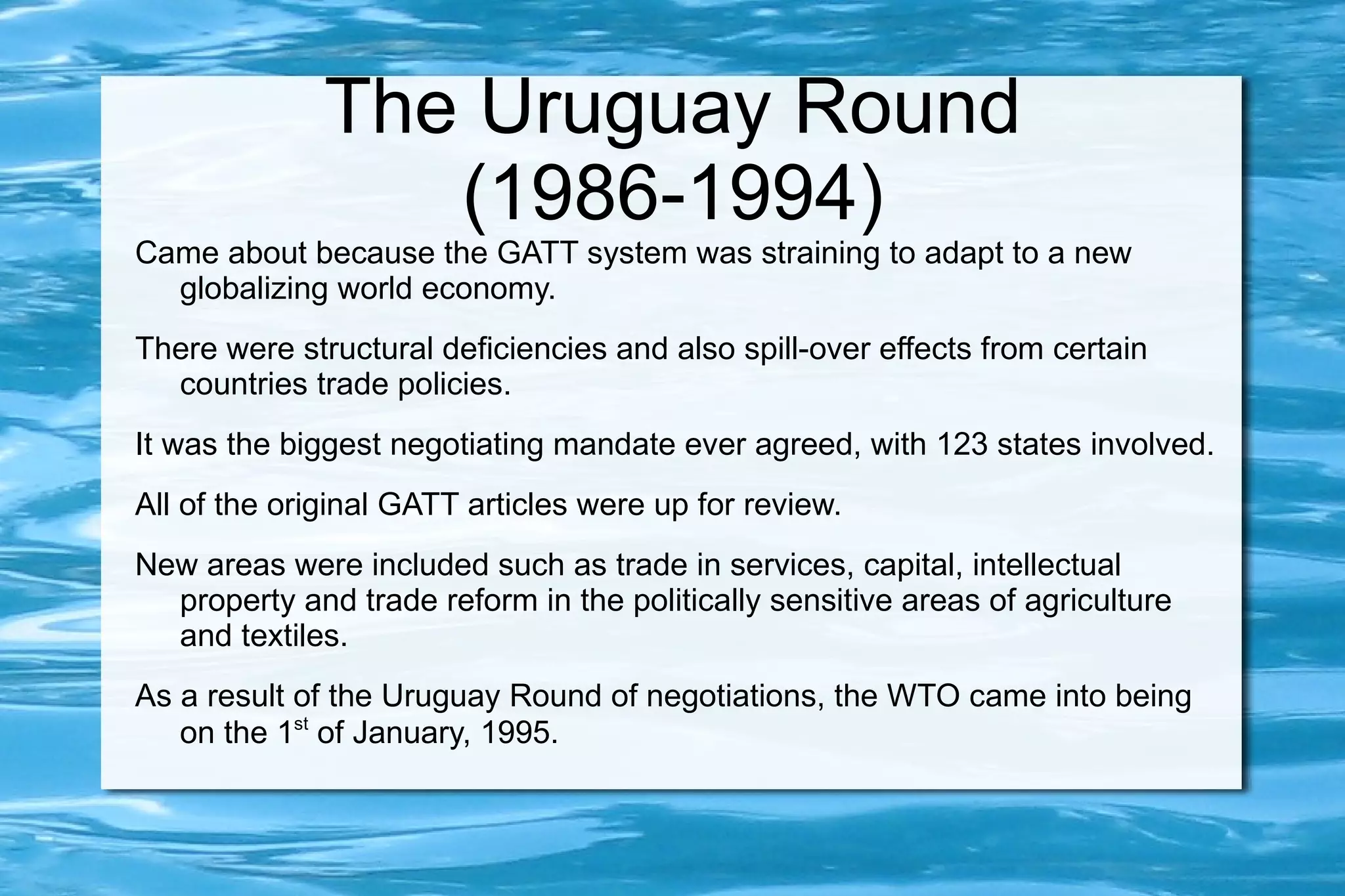
The Uruguay Round (1986-1994) Came about because the GATT system was straining to adapt to a new globalizing world economy.

Wto and implications for small and developing countries

  • 1.
    The World TradeOrganization with a focus on Small and Developing States Historical roots of the WTO and GATT
  • 2.
    WTO membership andits rules/norms
  • 3.
    Main areas ofWTO negotiation
  • 4.
    A Brief lookat small states within the WTO
  • 5.
    Arguments for andagainst the WTO
  • 6.
    The Future ofthe WTO?
  • 7.
    What is theWTO? The World Trade organization (WTO) is the principal international organization governing world trade.
  • 8.
    It comprises 153member countries, representing over 95% of world trade.
  • 9.
    It is anorganization for liberalizing international trade, a forum for governments to negotiate trade agreements and to resolve trade disputes.
  • 10.
    The WTO wasformed in 1995 and was an extension of the General Agreement on Tariffs and Trade (GATT).
  • 11.
    Origins of (GATT)In the mid-1940s, at Bretton Woods, New Hampshire, the IMF and World Bank were created.
  • 12.
    The US alsotried to create an International Trade Organization (ITO).
  • 13.
    The main justificationfor a multilateral trade agreement was to prevent protectionism, which was seen as one of the main reasons for the outbreak of the Second World War.
  • 14.
    However, only aninterim agreement, (GATT), was agreed and this then governed post-war trade policy by default.
  • 15.
    Negotiations under GATTDespite attempts during the 1950s and 1960s to create some form of institutional mechanism to govern international trade, the GATT continued to operate for almost half a century as a semi-institutionalized multilateral treaty regime on a provisional basis.
  • 16.
    There were eightrounds of negotiations under GATT.
  • 17.
    The first fiverounds of negotiations focused exclusively on tariff reductions in order to increase international trade.
  • 18.
    The Kennedy round(mid-60s), focused on tariff reductions, and an anti-dumping agreement and also included a section on development.
  • 19.
    The Tokyo Round(1973-79) focused on tariff reductions as well as non-tariff barriers to trade.
  • 20.
    The Uruguay Round(1986-1994) Came about because the GATT system was straining to adapt to a new globalizing world economy.
  • 21.
    There were structuraldeficiencies and also spill-over effects from certain countries trade policies.
  • 22.
    It was thebiggest negotiating mandate ever agreed, with 123 states involved.
  • 23.
    All of theoriginal GATT articles were up for review.
  • 24.
    New areas wereincluded such as trade in services, capital, intellectual property and trade reform in the politically sensitive areas of agriculture and textiles.
  • 25.
    As a resultof the Uruguay Round of negotiations, the WTO came into being on the 1 st of January, 1995.
  • 26.
  • 27.
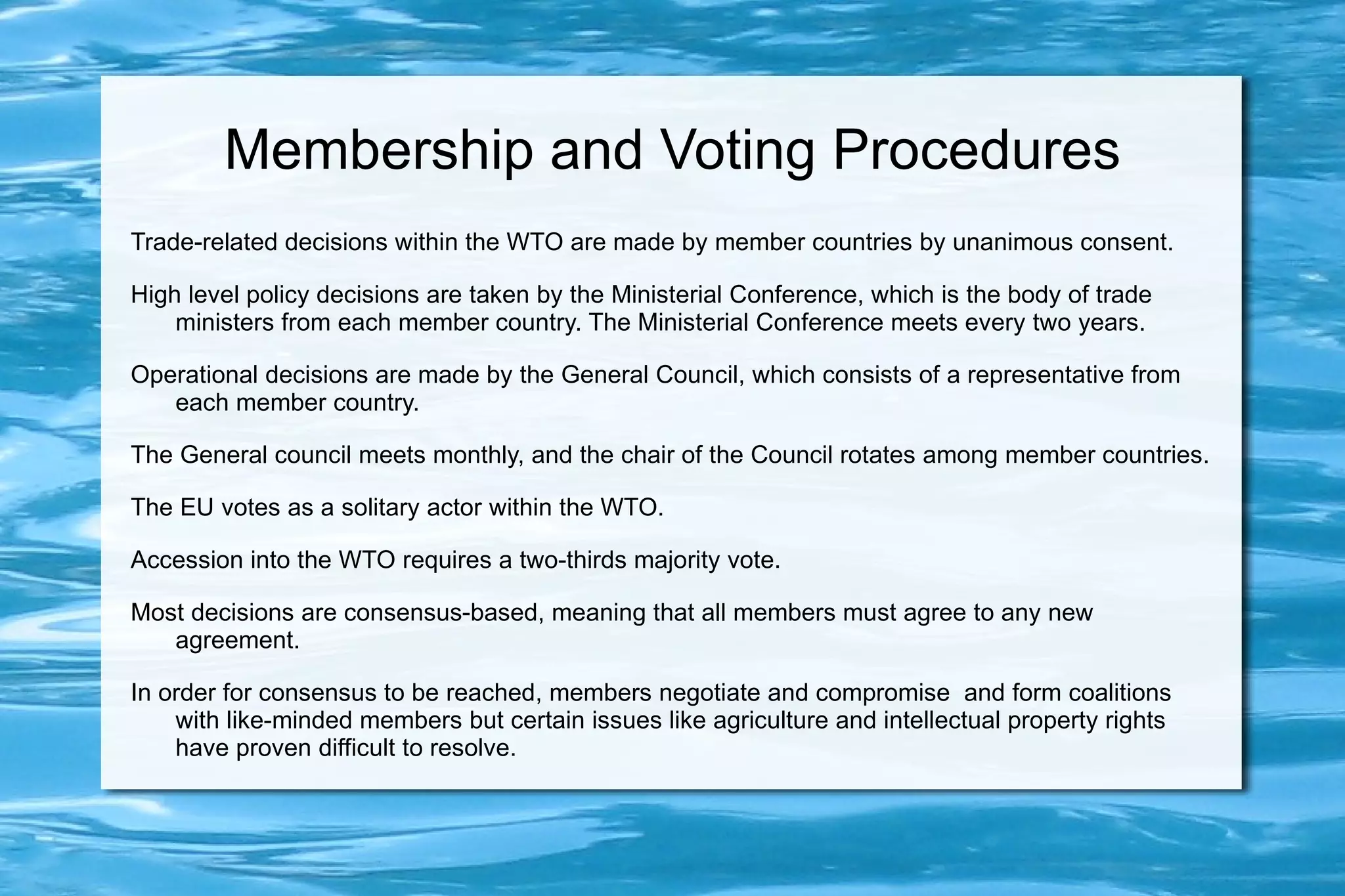
    Membership and VotingProcedures Trade-related decisions within the WTO are made by member countries by unanimous consent.
  • 28.
    High level policydecisions are taken by the Ministerial Conference, which is the body of trade ministers from each member country. The Ministerial Conference meets every two years.
  • 29.
    Operational decisions aremade by the General Council, which consists of a representative from each member country.
  • 30.
    The General councilmeets monthly, and the chair of the Council rotates among member countries.
  • 31.
    The EU votesas a solitary actor within the WTO.
  • 32.
    Accession into theWTO requires a two-thirds majority vote.
  • 33.
    Most decisions areconsensus-based, meaning that all members must agree to any new agreement.
  • 34.
    In order forconsensus to be reached, members negotiate and compromise and form coalitions with like-minded members but certain issues like agriculture and intellectual property rights have proven difficult to resolve.
  • 35.
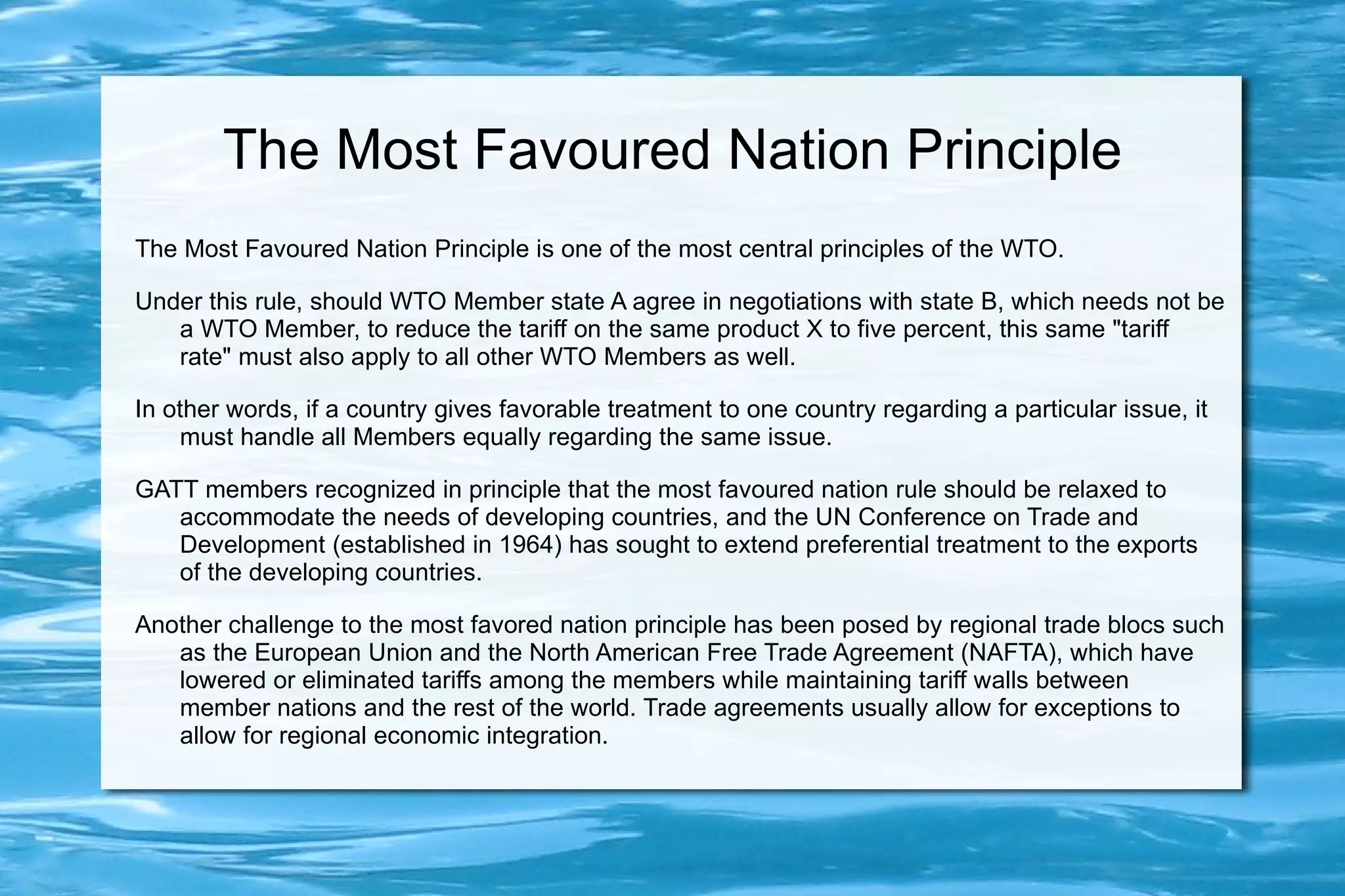
    The Most FavouredNation Principle The Most Favoured Nation Principle is one of the most central principles of the WTO.
  • 36.
    Under this rule,should WTO Member state A agree in negotiations with state B, which needs not be a WTO Member, to reduce the tariff on the same product X to five percent, this same "tariff rate" must also apply to all other WTO Members as well.
  • 37.
    In other words,if a country gives favorable treatment to one country regarding a particular issue, it must handle all Members equally regarding the same issue.
  • 38.
    GATT members recognizedin principle that the most favoured nation rule should be relaxed to accommodate the needs of developing countries, and the UN Conference on Trade and Development (established in 1964) has sought to extend preferential treatment to the exports of the developing countries.
  • 39.
    Another challenge tothe most favored nation principle has been posed by regional trade blocs such as the European Union and the North American Free Trade Agreement (NAFTA), which have lowered or eliminated tariffs among the members while maintaining tariff walls between member nations and the rest of the world. Trade agreements usually allow for exceptions to allow for regional economic integration.
  • 40.
    Reasons for theDoha Round of Negotiations The Doha Development Round is the current trade negotiation round of the WTO, which commenced in November, 2001.
  • 41.
    The US wantedto expand the agriculture and services talks to allow trade-offs and thus achieve greater liberalization of trade.
  • 42.
    The 9/11 attackson the World Trade Centre had occurred just weeks before the Doha ministerial Conference, and many officials called for greater political cohesion and saw trade negotiations as a means towards that end.
  • 43.
    World trade hadcontracted in 2001 due to recession, and many believed that new, multilateral trade negotiation would help the world economy.
  • 44.
    Also, countries haveincreasingly been engaged in bilateral or regional trade agreements. As of October, 2006, 366 regional trade agreements were notified to the WTO. Many argue that these regional trade agreements violate the general nondiscrimination principle of the WTO, they deny benefits to many poor countries that are often not party to the arrangements and they distract resources away from WTO negotiations.
  • 45.
    The Doha negotiationsare still unresolved, however.
  • 46.
    Issues preventing DohaAgreement There are four main issues which are central to the current round of negotiations
  • 47.
  • 48.
  • 49.
    Special and Differentialtreatment for small and developing Countries
  • 50.
  • 51.
    Agriculture The USis being asked by the EU and developing countries to reduce trade-distorting domestic support for agriculture.
  • 52.
    The US isinsisting that the EU and developing countries agree to make more substantial reductions in tariffs and to limit the number of import-sensitive and special products that would be exempt from cuts.
  • 53.
    Import sensitive productsare of most concern to developed countries like the EU, while developing countries are concerned with special products which are exempt from both tariff cuts and subsidy reductions because of development, food security or livelihood considerations.
  • 54.
    Intellectual Property RightsAnother major topic at the Doha Round of negotiations regards the Trade-Related aspects of Intellectual Property Rights, (TRIPS).
  • 55.
    The issue involvesthe balance of interests between the pharmaceutical companies in developed countries that hold medical patents, and the public health needs in small and developing countries.
  • 56.
    On the 30th of August, 2003, WTO members reached agreement on the TRIPS and medicines issue. Voting in the General Council, member governments approved a decision that offered an interim waiver under the TRIPS agreement allowing a member country to export pharmaceutical products made under compulsory licences to least developed and certain other members.
  • 57.
    Implementation Issues Smalland developing countries have claimed that they have had problems with the implementation of the agreements reached in the Uruguay Round because of limited capacity or a lack of technical assistance.
  • 58.
    They also haveclaimed that they have not realized certain benefits that they expected from the round such as increased access for their textiles and apparel in developed-country markets.
  • 59.
    Before the DohaMinisterial conference, WTO members resolved a small number of these issues.
  • 60.
    However, outstanding implementationissues are found in the area of market access, investment measures, safeguards, rules of origin and subsidies and countervailing measures, among others.
  • 61.
    The third issuewhich has yet to be resolved deals with a review of provisions giving special and differential treatment to developing countries.
  • 62.
    Small states withinthe WTO Small countries within the WTO are often isolated geographically, either by being landlocked, or by being small isolated islands.
  • 63.
    For this reasonthere needs to be more done to give special treatment to these countries as a special category with tariff rule exemptions because within the present system, these countries have not grown as much as they should have.
  • 64.
    These countries areless able to deal with economic shocks, usually relying on large export sectors.
  • 65.
    Also, these countriesare more vulnerable and less able to deal with environmental shocks, for example Tsunamis and Hurricanes which can wreak havoc on these countries.
  • 66.
    Small States withinthe WTO (continued) Even though countries have an equal vote within the WTO, in reality the real power is between the US, the EU and the large developing nations of China, Brazil and India.
  • 67.
    Small countries donot have large domestic market access to offer in reciprocal negotiations with larger countries, and so cannot gain much through the WTO.
  • 68.
    It is possible,however, for these countries to join together in their own free trade agreements in order that they could then bargain more attractively with larger markets.
  • 69.
    Positives Aspects ofthe WTO The WTO has increased economic interdependence and this is believed to reduce the likelihood of war.
  • 70.
    It makes it'srules through a democratic consensus with each country having an equal vote.
  • 71.
    Freer trade cutsthe cost of living
  • 72.
    It gives consumersmore choice and a broader range of products to choose from.
  • 73.
    Trade raises incomesand increases employment.
  • 74.
    The basic principlesare said to make the system economically more efficient.
  • 75.
    The WTO allowsdisputes to be settled constructively.
  • 76.
    Criticisms of theWTO The WTO is for free trade at any cost.
  • 77.
  • 78.
    The WTO causeseconomic dislocation, and hence destroys jobs.
  • 79.
    The WTO isseen as the tool of powerful lobbies.
  • 80.
    The WTO increasesinefficient trading which exacerbates global warming.
  • 81.
    Weaker countries areeffectively forced to join the WTO.
  • 82.
    Small and developingcountries are said to be effectively powerless in the WTO, due to the fact that they do not have large markets to offer in trade negotiations.
  • 83.
    Future of theWTO? The current Doha Round of negotiations have so far taken ten years and there is no end in sight.
  • 84.
    The most significantdifferences are between developed nations led by the EU, the US, and Japan, and the major developing countries led and represented mainly by Brazil, China, India, South Korea, and South Africa.
  • 85.
    There is alsoconsiderable contention against and between the EU and the USA over their maintenance of agricultural subsidies which are seen to operate effectively as trade barriers.
  • 86.
    Future of theWTO (continued) Several countries have called for negotiations to start again.
  • 87.
    One of theconsequences of the economic crisis, however, is the desire of political leaders to shelter their constituents from the increasingly competitive market experienced during market contractions.
  • 88.
    Some have calledfor a reversion to a two-tiered system, whereby members states who wish to proceed with liberalization could proceed on their own, and this possibility seems more likely as negotiations continue to falter.
  • 89.
    Bibliography www.wto.org Matoo, A and Subramanian, A (2004) The WTO and the Poorest Countries: The Stark Reality IMF Working Paper @ www.wto.org http://www.ppl.nl/bibliographies/wto/files/7503.pdf retrieved on 17/05/2011. http://www.usaid.gov/our_work/agriculture/food_security.htm http://www.wto.org/english/tratop_e/agric_e/negs_bkgrnd14_devopcount_e.htm Fergusson, I. F., (2008) World Trade Organization Negotiations: The Doha Development Agenda @ http://www.nationalaglawcenter.org/assets/crs/RL32060.pdf , retrieved on 16/05/2011. http://www.meti.go.jp/english/report/data/gCT9901e.html