
WT4603 Wood Processing Safety & PracticeAutumn 2011Lecture Unit 2 (Week 3)Personal Protective Equipment (PPE) & Week 3 Labs (Component A - Processing)
 Lecturer: Mr. Joseph Lyster
joseph.lyster@ul.ie
 Notes prepared by: Mr. Joseph Lyster
 Notes available on www.slideshare.net/WT4603WT4603WT4603 	Wood Processing Safety and PracticePPEPERSONAL PROTECTIVE EQUIPMENTDepartment of Manufacturing & Operations Engineering
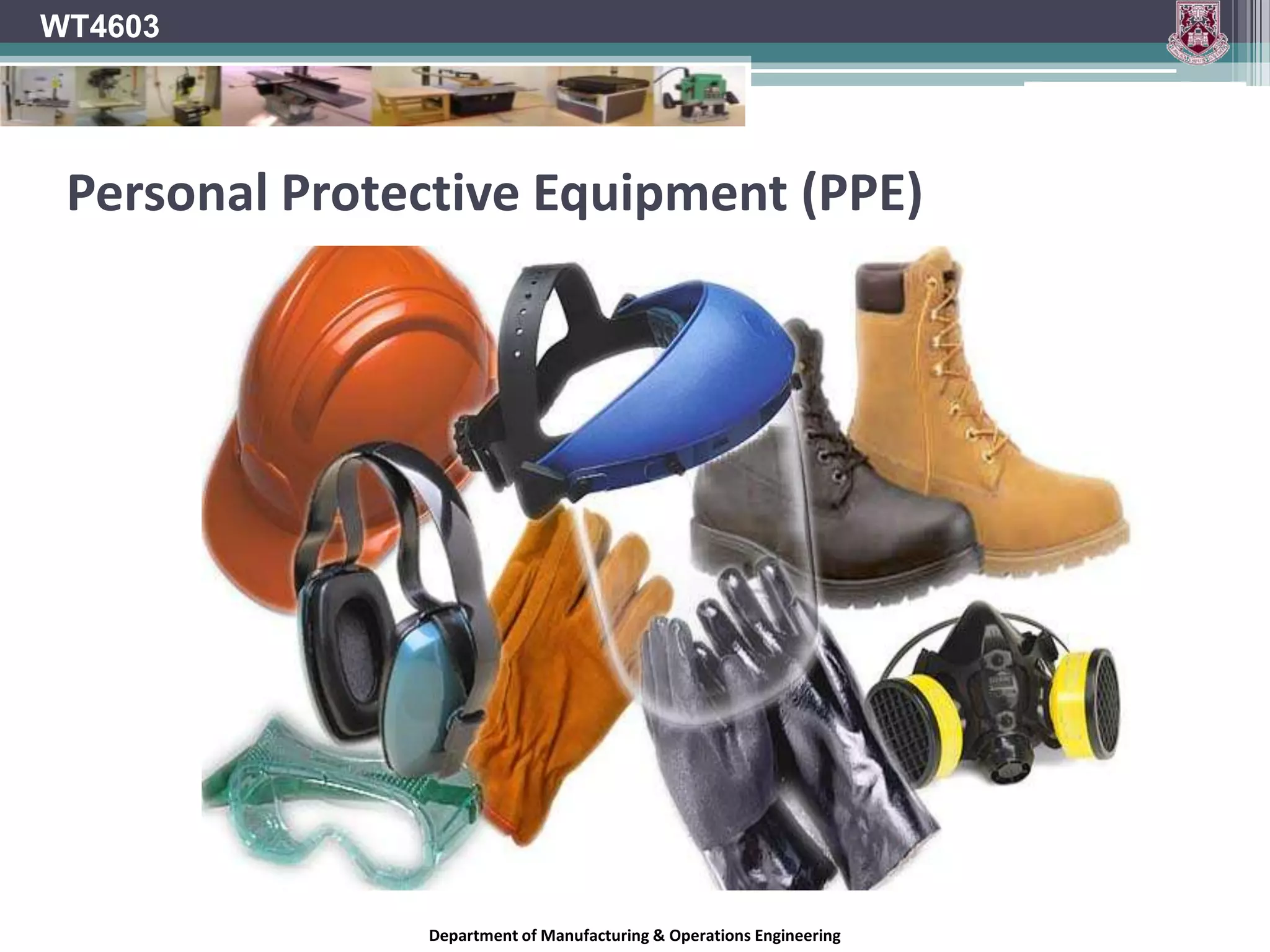
WT4603Personal Protective Equipment (PPE)Department of Manufacturing & Operations Engineering
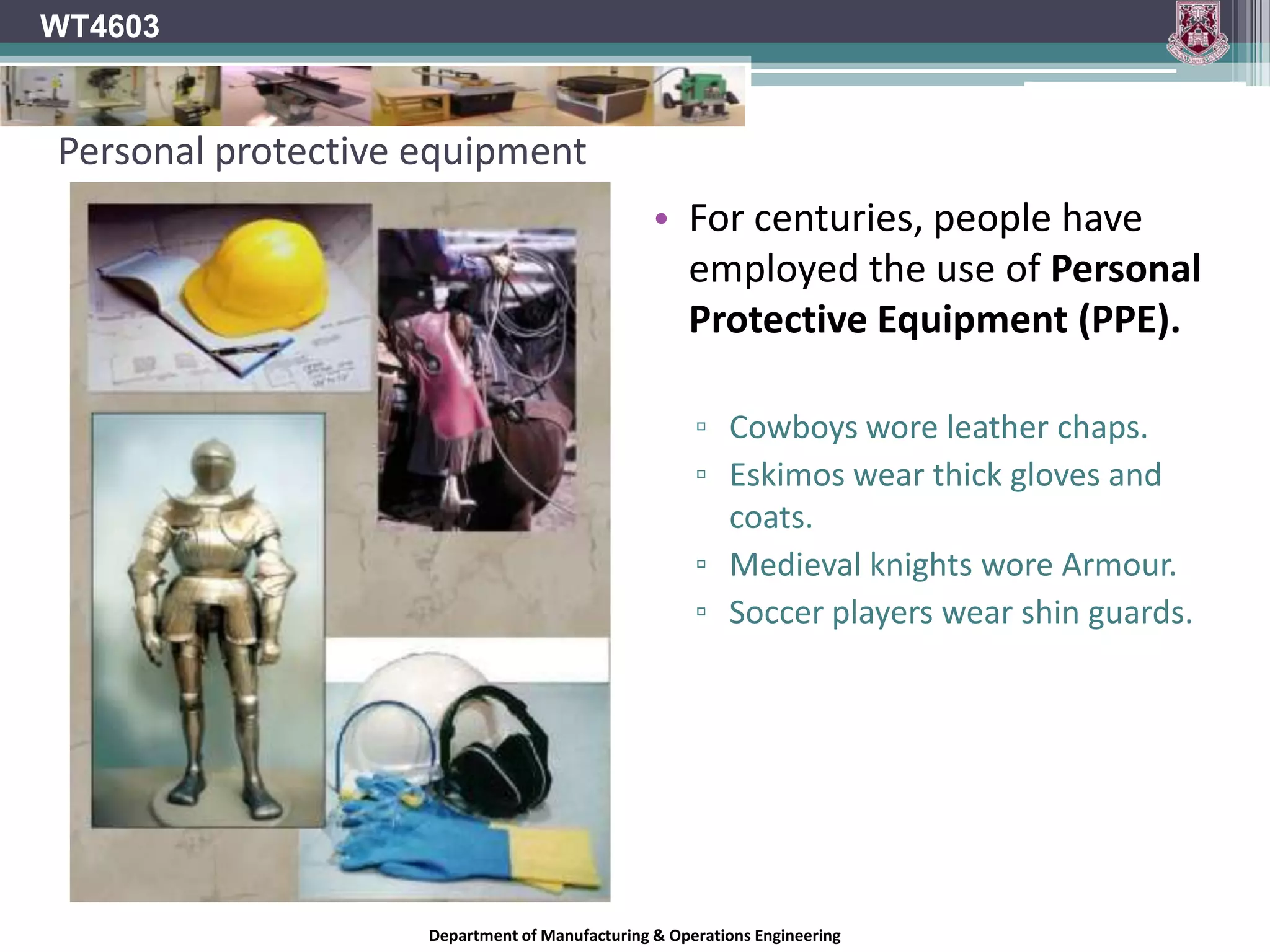
WT4603Personal protective equipmentFor centuries, people have employed the use of Personal Protective Equipment (PPE).Cowboys wore leather chaps.Eskimos wear thick gloves and coats.Medieval knights wore Armour.Soccer players wear shin guards.Department of Manufacturing & Operations Engineering
WT4603What is PPE?“All equipment which is held or worn at work to protect a person from any harm or environmental hazards encountered.”http://en.wikipedia.org/wiki/Personal_protective_equipmentDepartment of Manufacturing & Operations Engineering
WT4603Environmental HazardsNoiseDustSmokeUnsafe MachineryEtc.There are 5 main classes of environmental hazard:ChemicalPhysicalMechanicalBiologicalPsychologicalDepartment of Manufacturing & Operations Engineering
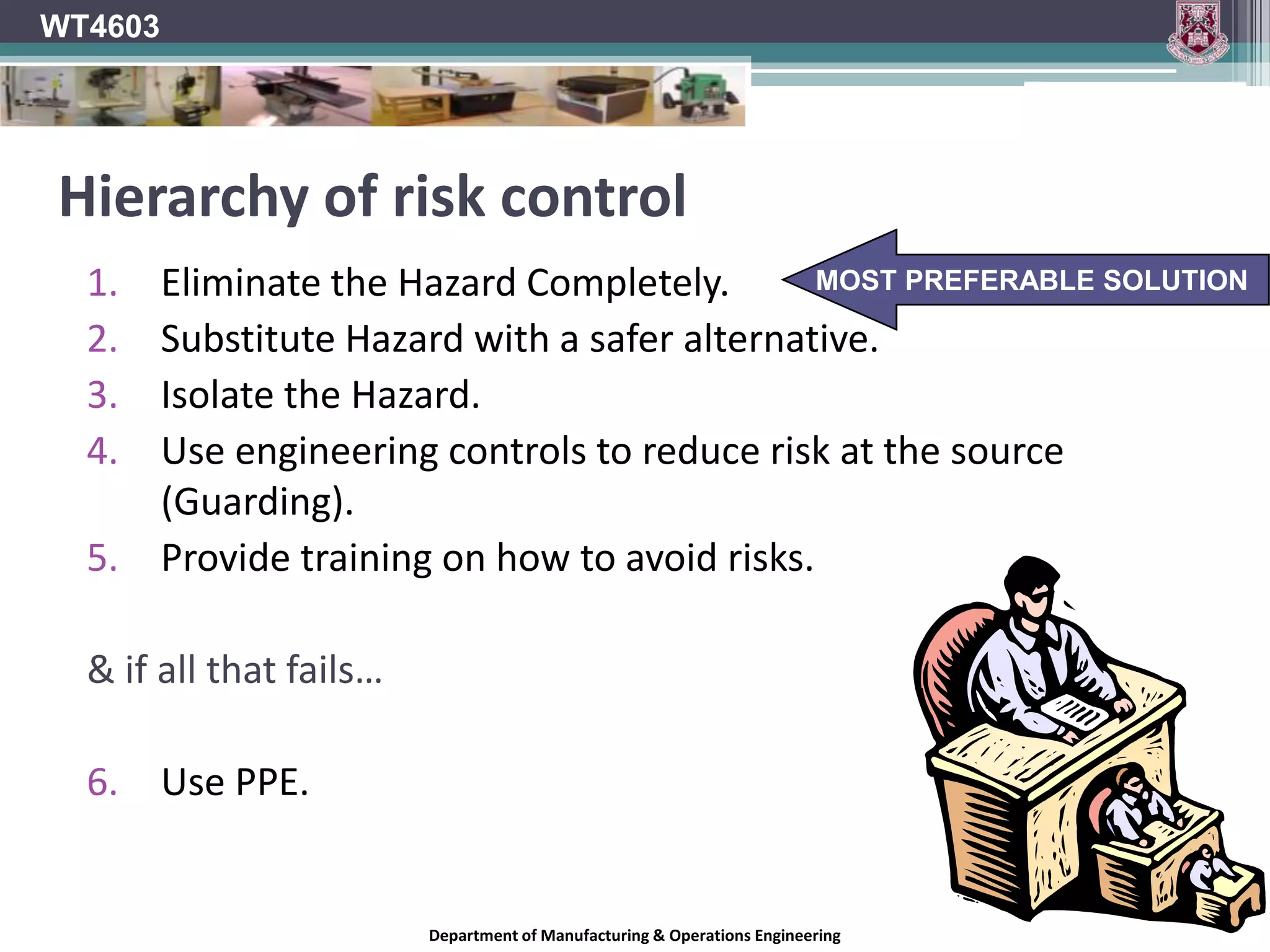
WT4603Hierarchy of risk controlEliminate the Hazard Completely.Substitute Hazard with a safer alternative.Isolate the Hazard.Use engineering controls to reduce risk at the source (Guarding).Provide training on how to avoid risks.& if all that fails…Use PPE.MOST PREFERABLE SOLUTIONDepartment of Manufacturing & Operations Engineering
WT4603Using P.P.E.The use of PPE is a last resort!It should only be relied upon for protection when all other means of controlling a hazard have been eliminated as possibilities.It is much more desirable to completely eliminate the hazard than to safeguard against it.Prevention is better than cure!!!PPE should be used:Where Engineering (Guarding) or Administrative (Training, Rules) controls are not feasible.As a short-term measure during periods of time when engineering or administrative controls are being implemented.During emergency response situations.Department of Manufacturing & Operations Engineering
WT4603PPE LegislationSafety Health and Welfare at Work (Control of Noise at Work) Regulations 2006.Act specifically outlining the requirements to protect the hearing of employees in the workplace.Safety, Health and Welfare at Work Act 2005. (Formerly 1989 Act)General Act Governing health and Safety at work in IrelandThe Safety, Health and Welfare at work (General Application) Regulations 2007.Among other things, this Act outlines the legal responsibilities in relation to the use of PPE in the workplace & schools.European Communities (Personal Protective Equipment) Regulations, 1993.Aimed more specifically at the selection, use and manufacturing quality of PPE.Department of Manufacturing & Operations Engineering
WT4603Responsibilities of Employers*All employers must conduct a Hazard Identification and risk assessment to determine if the use of PPE is necessary.Risk control; this may be through the use of PPE.Provision of PPE on the basis of the Hazard Identification.Provision of Training on using necessary PPE.The Safety, Health and Welfare at work (General Application) Regulations 2007 requires schools to provide suitable PPE if a risk to health and safety cannot be avoided or sufficiently controlled through other means.*The Safety, Health and Welfare at work (General Application) Regulations 2007.*The Safety, Health and Welfare at Work Act 2005.Department of Manufacturing & Operations Engineering
WT4603Responsibilities of PrincipalsThey should:Carry out a risk assessment to identify the possible need for PPE.Provide, free of charge, adequate PPE to employees (Teachers) who may be exposed to hazards at work that have not been controlled by other means.Make an assessment before choosing any form of PPE.Ensure that PPE is well maintained and cared for.Provide storage for PPE when not in use.Provide teachers with training in the use, limitations and care of their of PPEDepartment of Manufacturing & Operations Engineering
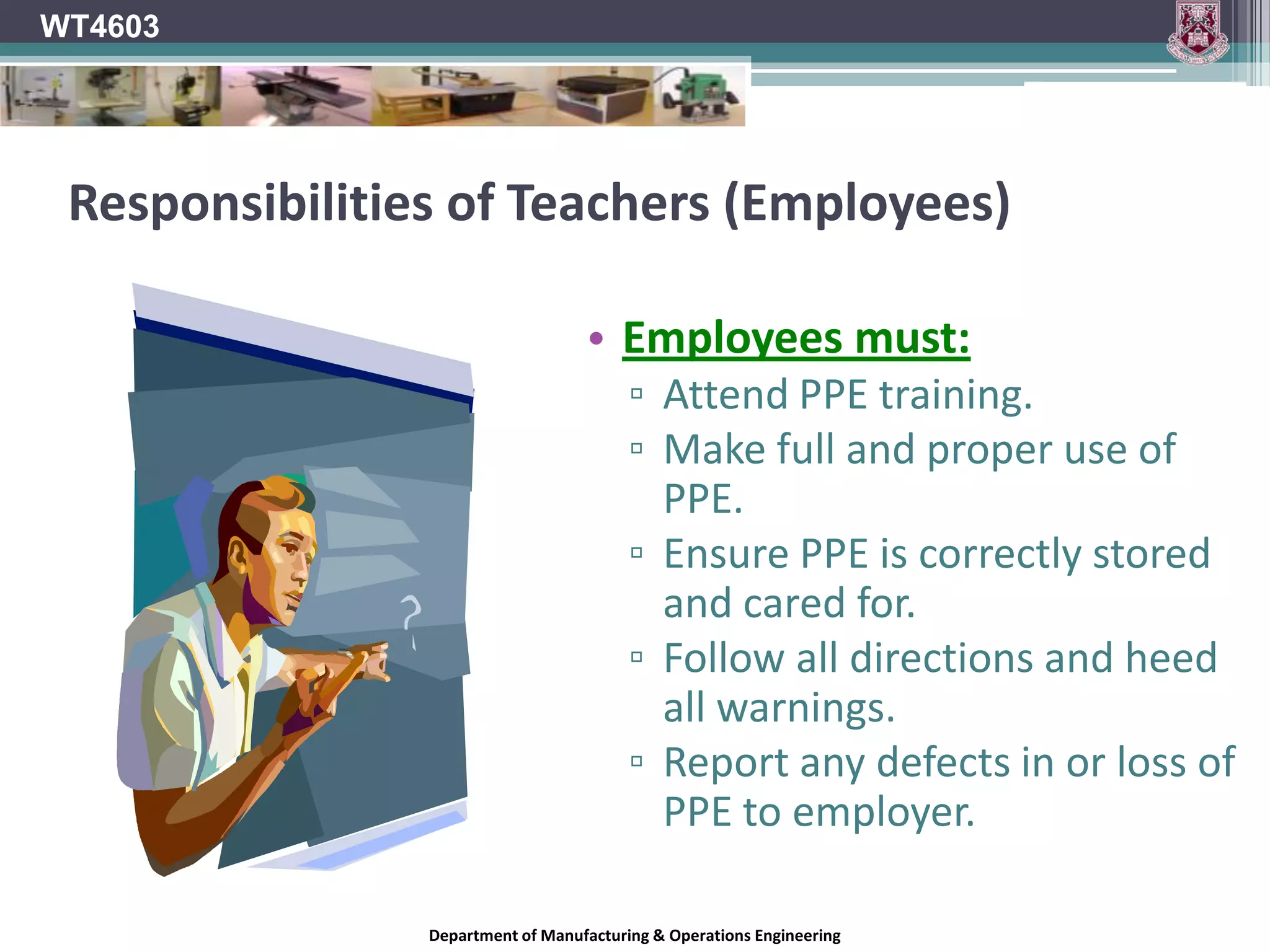
WT4603Responsibilities of Teachers (Employees)Employees must:Attend PPE training.Make full and proper use of PPE.Ensure PPE is correctly stored and cared for.Follow all directions and heed all warnings.Report any defects in or loss of PPE to employer.Department of Manufacturing & Operations Engineering
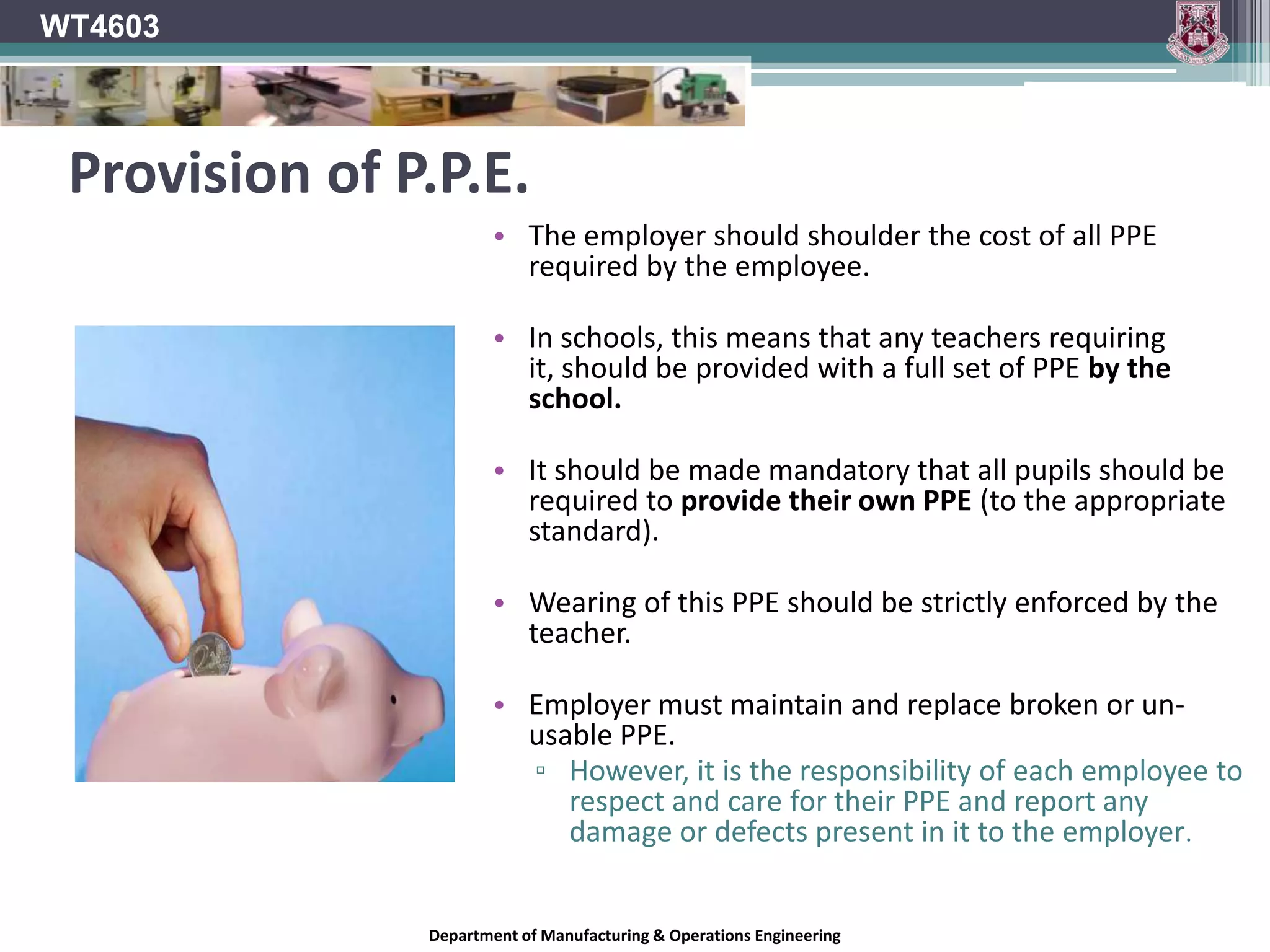
WT4603Provision of P.P.E.  The employer should shoulder the cost of all PPE required by the employee.In schools, this means that any teachers requiring it, should be provided with a full set of PPE by the school.It should be made mandatory that all pupils should be required to provide their own PPE (to the appropriate standard).Wearing of this PPE should be strictly enforced by the teacher.Employer must maintain and replace broken or un-usable PPE.However, it is the responsibility of each employee to respect and care for their PPE and report any damage or defects present in it to the employer.Department of Manufacturing & Operations Engineering
WT4603PPE Training*Employers must provide the following training in relation to PPE:Proper use of PPE.When to use PPE.Adequate PPE Storage.Importance of using PPE.How to spot defects in PPETeachers should also provide training to their pupils on how to use their PPE correctly.Part of a teachers demonstrations should place an emphasis on The correct use of PPEImportance of PPECare of PPE.Department of Manufacturing & Operations Engineering
Sharing PPEWT4603Under no circumstances should pupils be allowed to share PPE.Why Not?Associated hygiene issues.Swapping PPE may limit the level of protection offered:Different size/Setting.Make sure everyone has their own!!!Department of Manufacturing & Operations Engineering
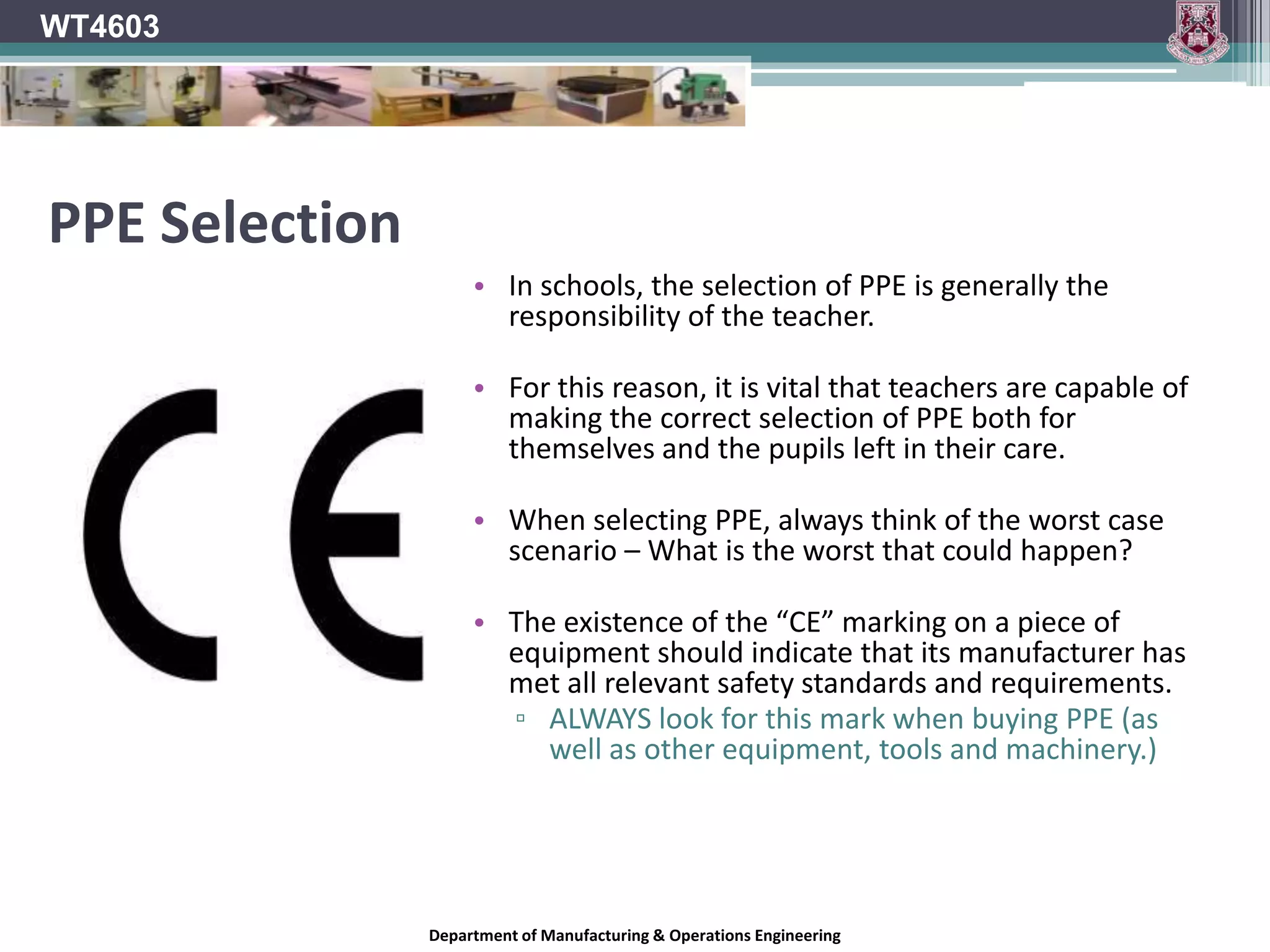
WT4603PPE SelectionIn schools, the selection of PPE is generally the responsibility of the teacher.For this reason, it is vital that teachers are capable of making the correct selection of PPE both for themselves and the pupils left in their care.When selecting PPE, always think of the worst case scenario – What is the worst that could happen?The existence of the “CE” marking on a piece of equipment should indicate that its manufacturer has met all relevant safety standards and requirements.ALWAYS look for this mark when buying PPE (as well as other equipment, tools and machinery.)Department of Manufacturing & Operations Engineering
WT4603PPE – Some Factors to ConsiderDEGRADATIONHarmful change of physical properties of a protective clothing material when subjected to a chemical or wear and tear over time.PENETRATIONFlow of chemicals/ hazardous substances through seals such as zips, seams or pinholes.PERMEATIONMovement of the hazardous substance through the protective material itself.Always consult manufacturer’s instructions.Department of Manufacturing & Operations Engineering
WT4603Eye & Face ProtectionThousands of people are blinded in the workplace every year for no reason.Simple and inexpensive face and eye protection could have prevented it.The human eye is very sensitive organ and is highly susceptible to injury from many sources:Impact ChemicalsDust/ foreign particles.Etc..Department of Manufacturing & Operations Engineering
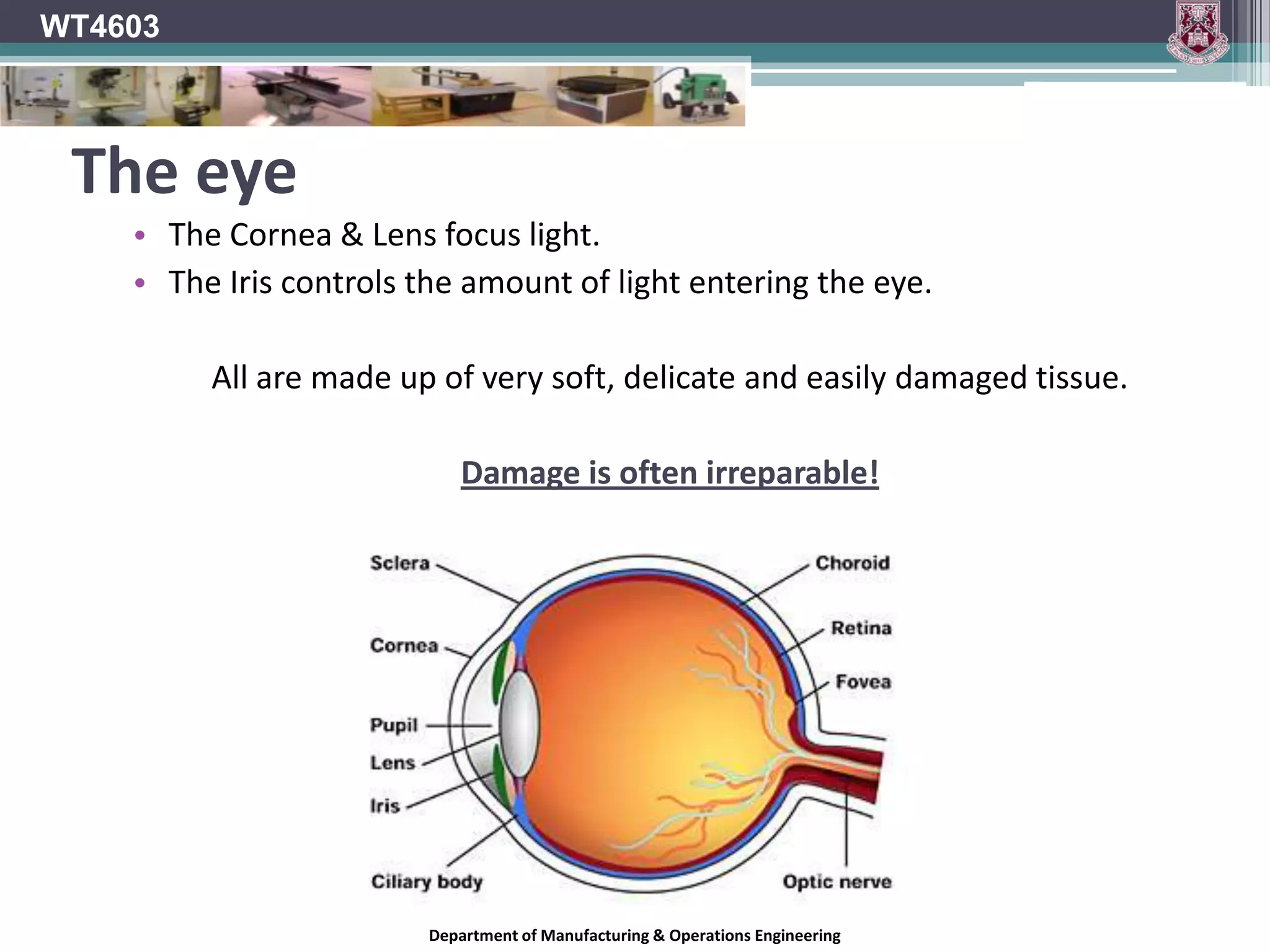
WT4603The eyeThe Cornea & Lens focus light.The Iris controls the amount of light entering the eye.All are made up of very soft, delicate and easily damaged tissue.Damage is often irreparable!Department of Manufacturing & Operations Engineering
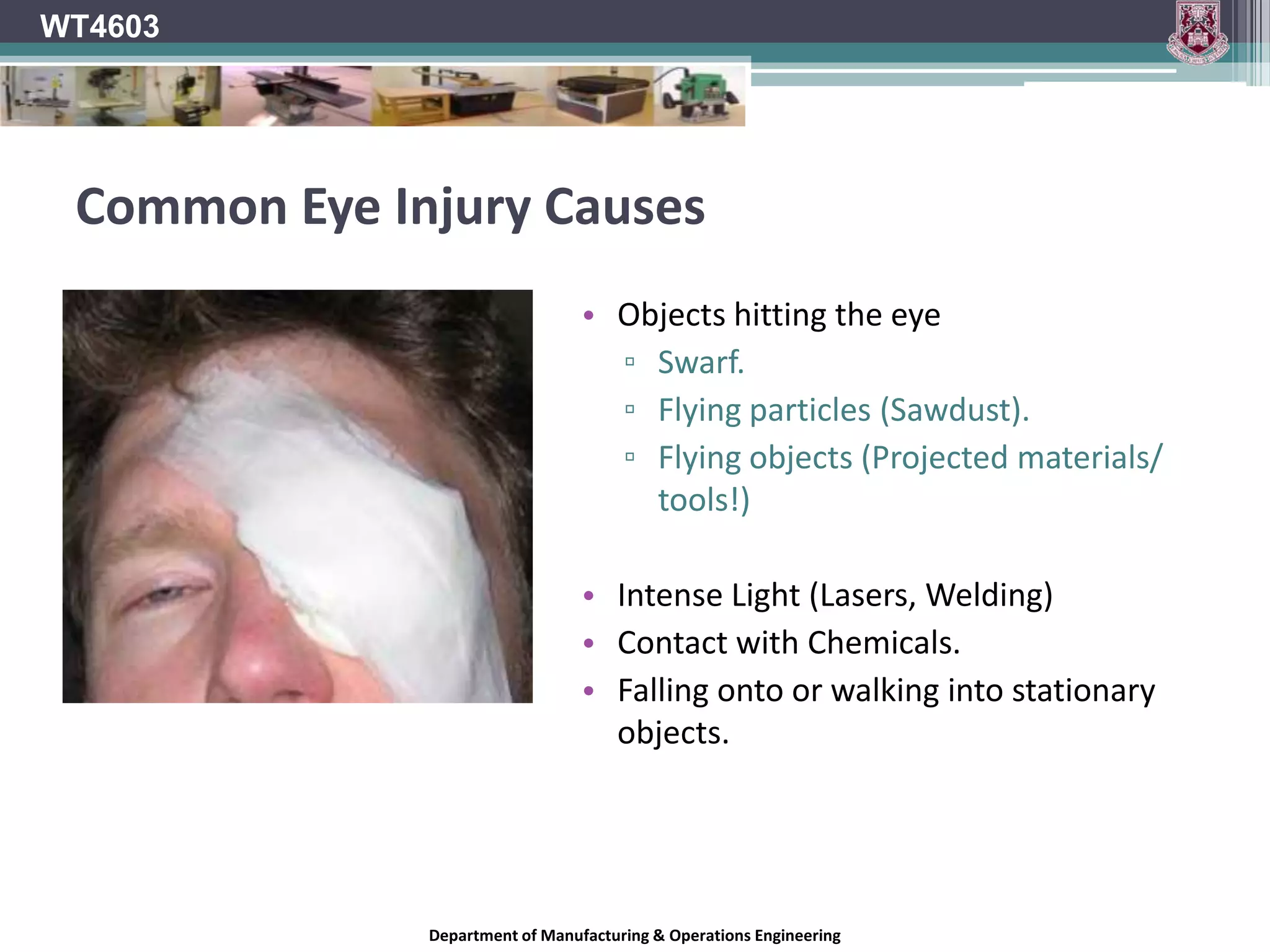
WT4603Common Eye Injury CausesObjects hitting the eye Swarf.Flying particles (Sawdust).Flying objects (Projected materials/ tools!)Intense Light (Lasers, Welding)Contact with Chemicals.Falling onto or walking into stationary objects.Department of Manufacturing & Operations Engineering
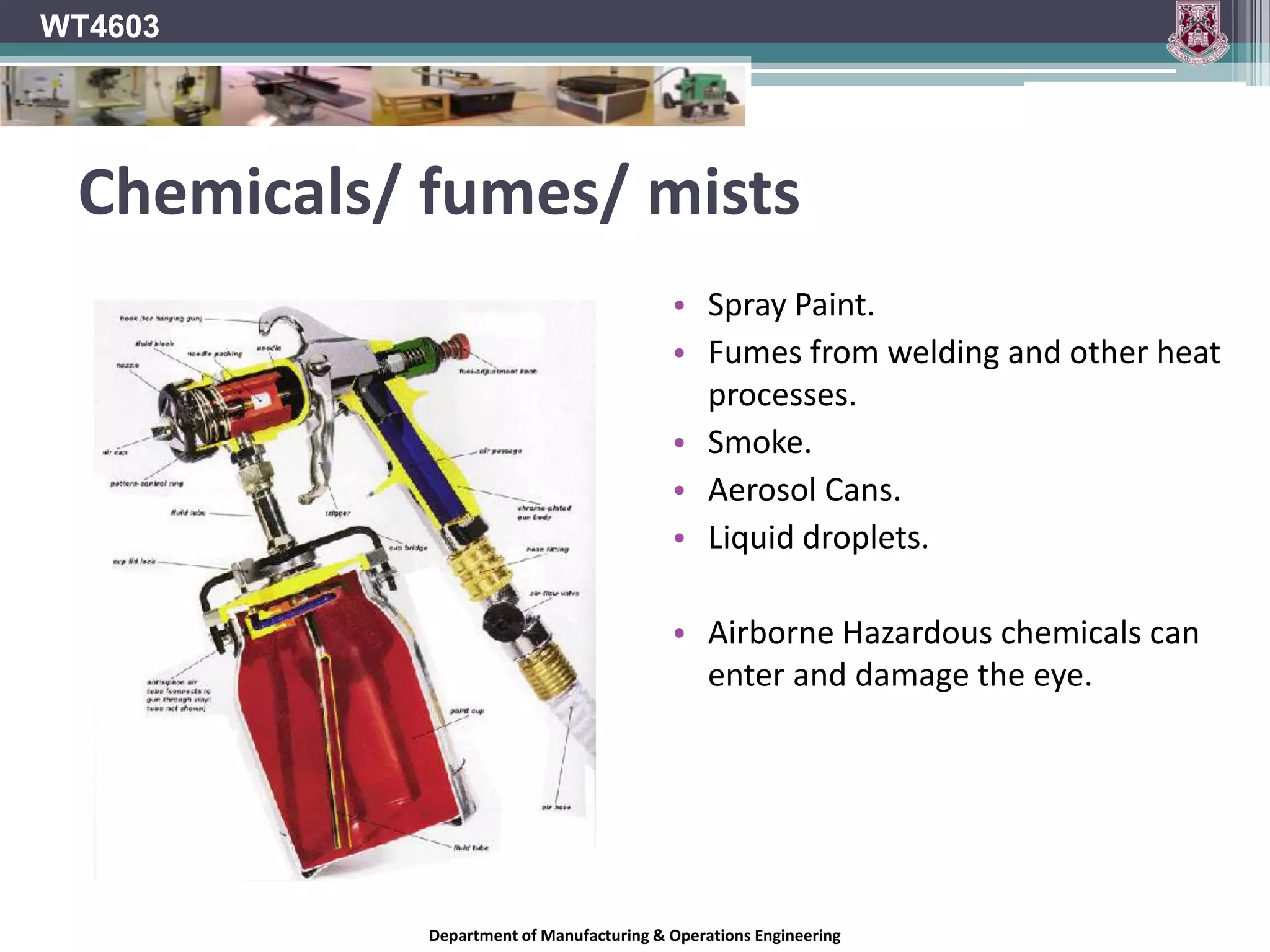
WT4603Chemicals/ fumes/ mistsSpray Paint.Fumes from welding and other heat processes.Smoke.Aerosol Cans.Liquid droplets.Airborne Hazardous chemicals can enter and damage the eye.Department of Manufacturing & Operations Engineering
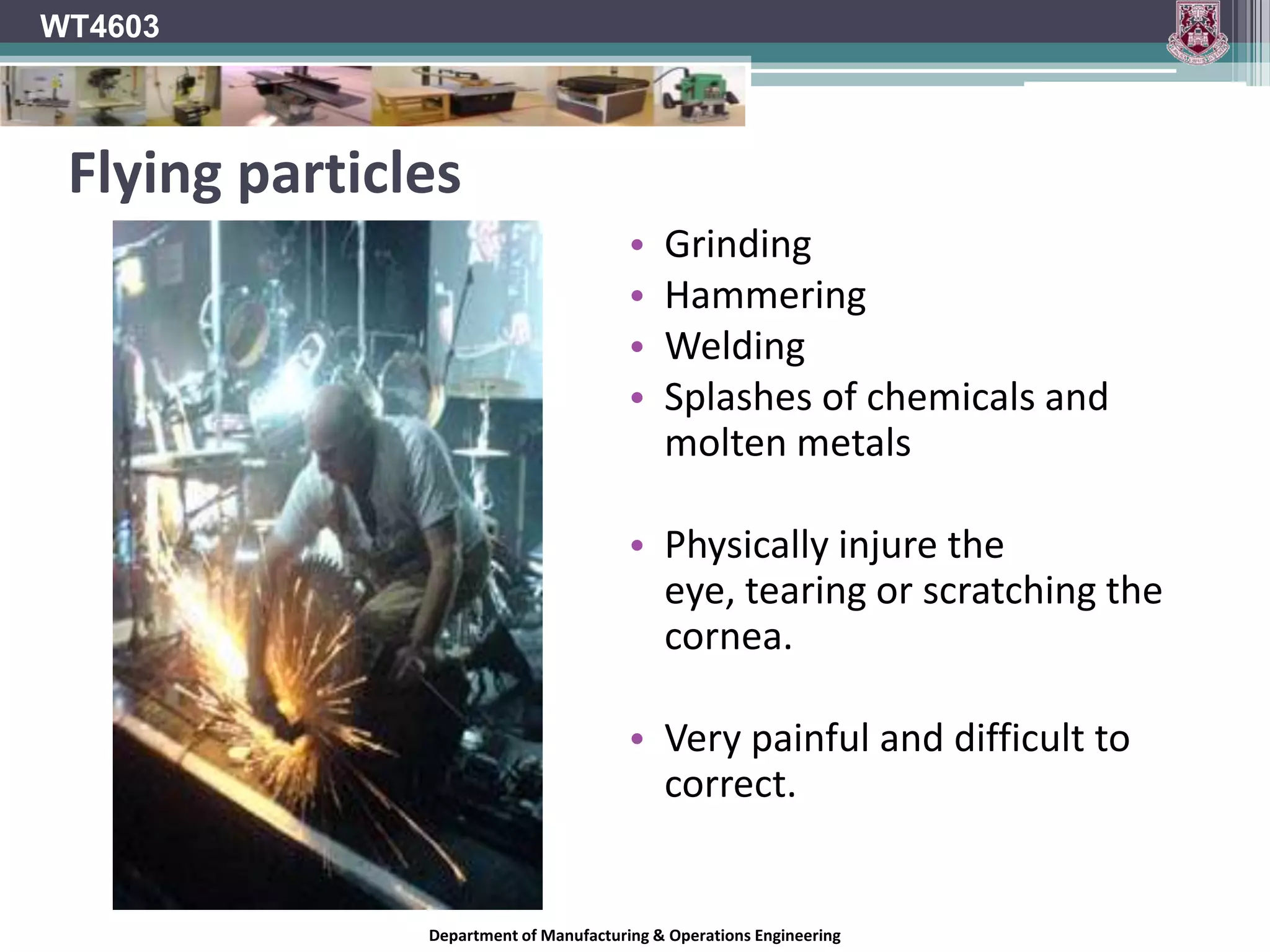
WT4603Flying particlesGrinding Hammering WeldingSplashes of chemicals and molten metalsPhysically injure the eye, tearing or scratching the cornea.Very painful and difficult to correct.Department of Manufacturing & Operations Engineering
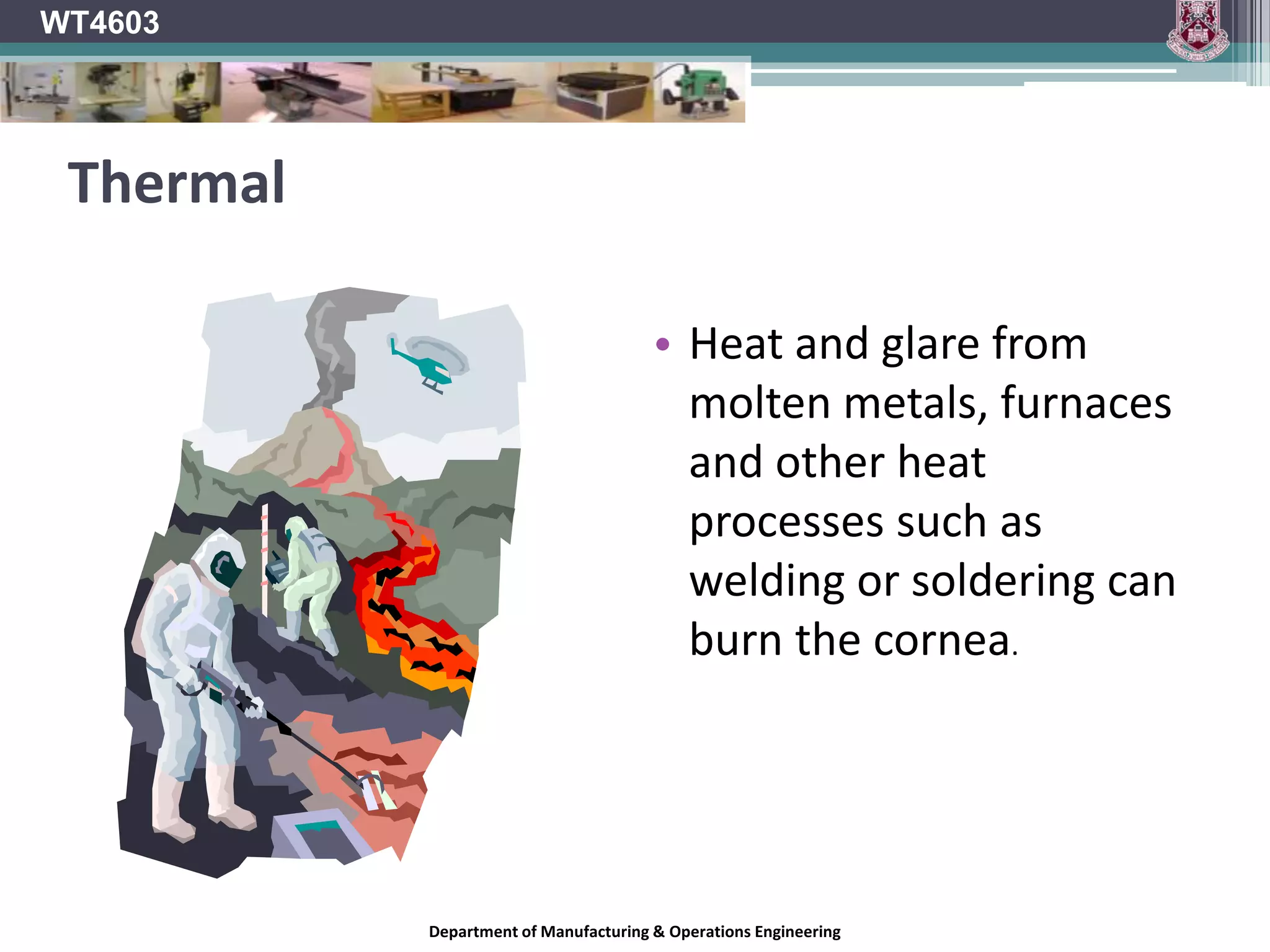
WT4603ThermalHeat and glare from molten metals, furnaces and other heat processes such as welding or soldering can burn the cornea.Department of Manufacturing & Operations Engineering
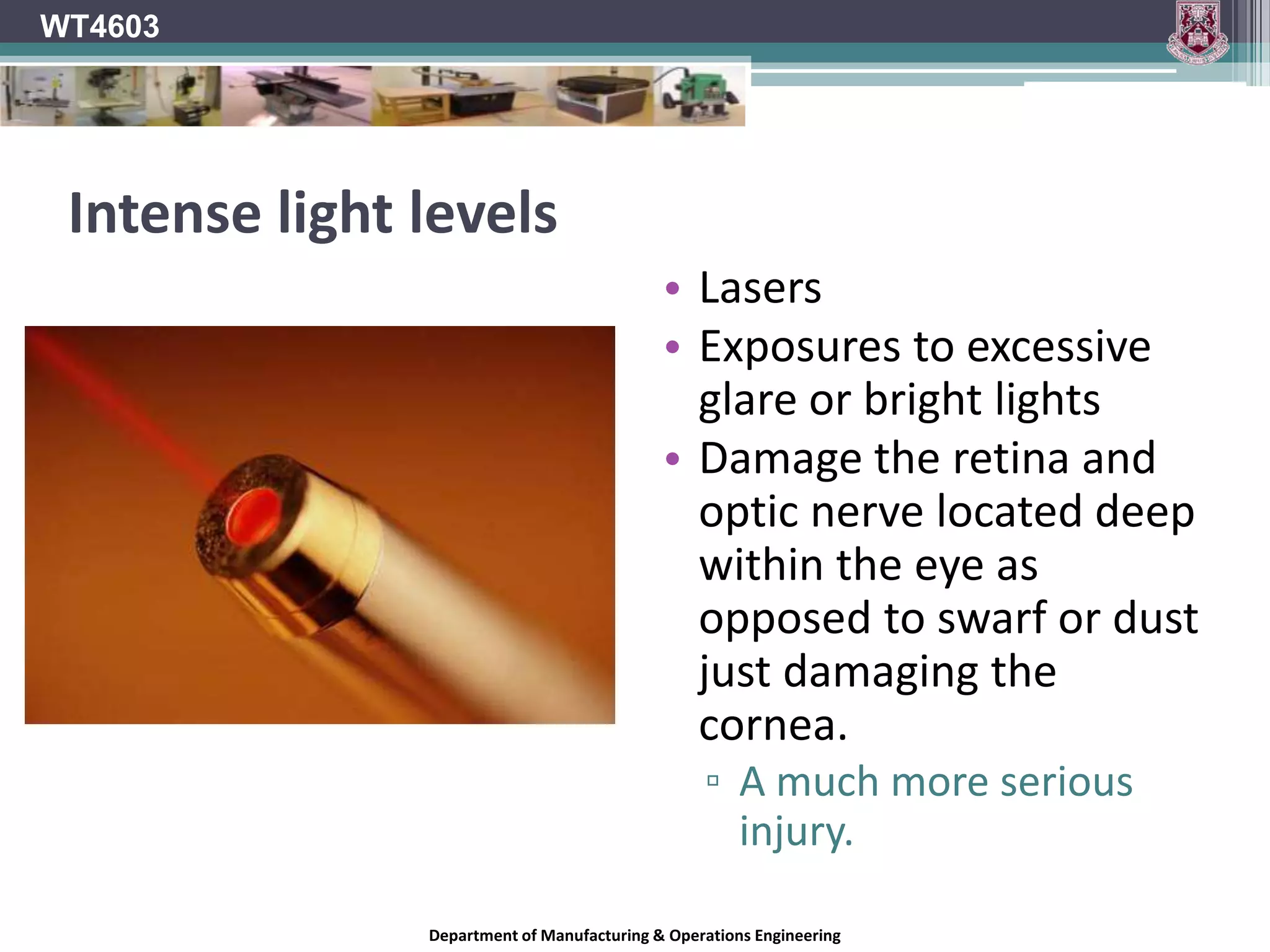
WT4603Intense light levelsLasersExposures to excessive glare or bright lights Damage the retina and optic nerve located deep within the eye as opposed to swarf or dust just damaging the cornea.A much more serious injury.Department of Manufacturing & Operations Engineering
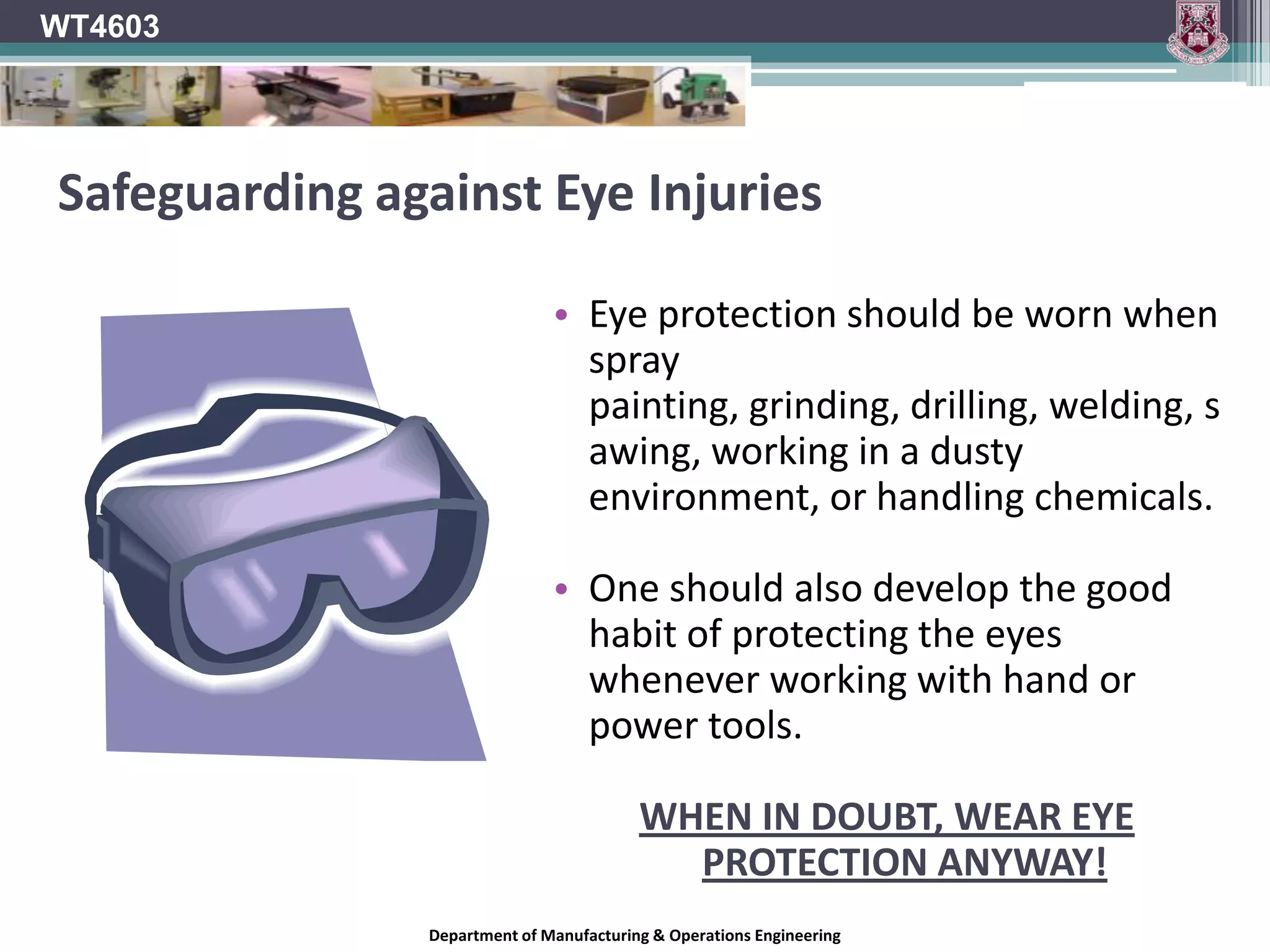
WT4603Safeguarding against Eye InjuriesEye protection should be worn when spray painting, grinding, drilling, welding, sawing, working in a dusty environment, or handling chemicals.One should also develop the good habit of protecting the eyes whenever working with hand or power tools.WHEN IN DOUBT, WEAR EYE PROTECTION ANYWAY!Department of Manufacturing & Operations Engineering
Machinery GuardingWT4603Because it is much more preferable to eliminate the hazard at the source, guarding is often added.This is not usually enough to fully reduce the risk so wear safety glasses as well!!Department of Manufacturing & Operations Engineering
WT4603VentilationVentilation is the movement of air, usually between the inside and outside of enclosed spaces.Ventilation is necessary when people or animals are present to remove carbon dioxide and replace it with oxygen.Ventilation must also be used to remove dangerous pollutants such as smoke, fumes, chemicals and fine particles suspended in the air.Department of Manufacturing & Operations Engineering
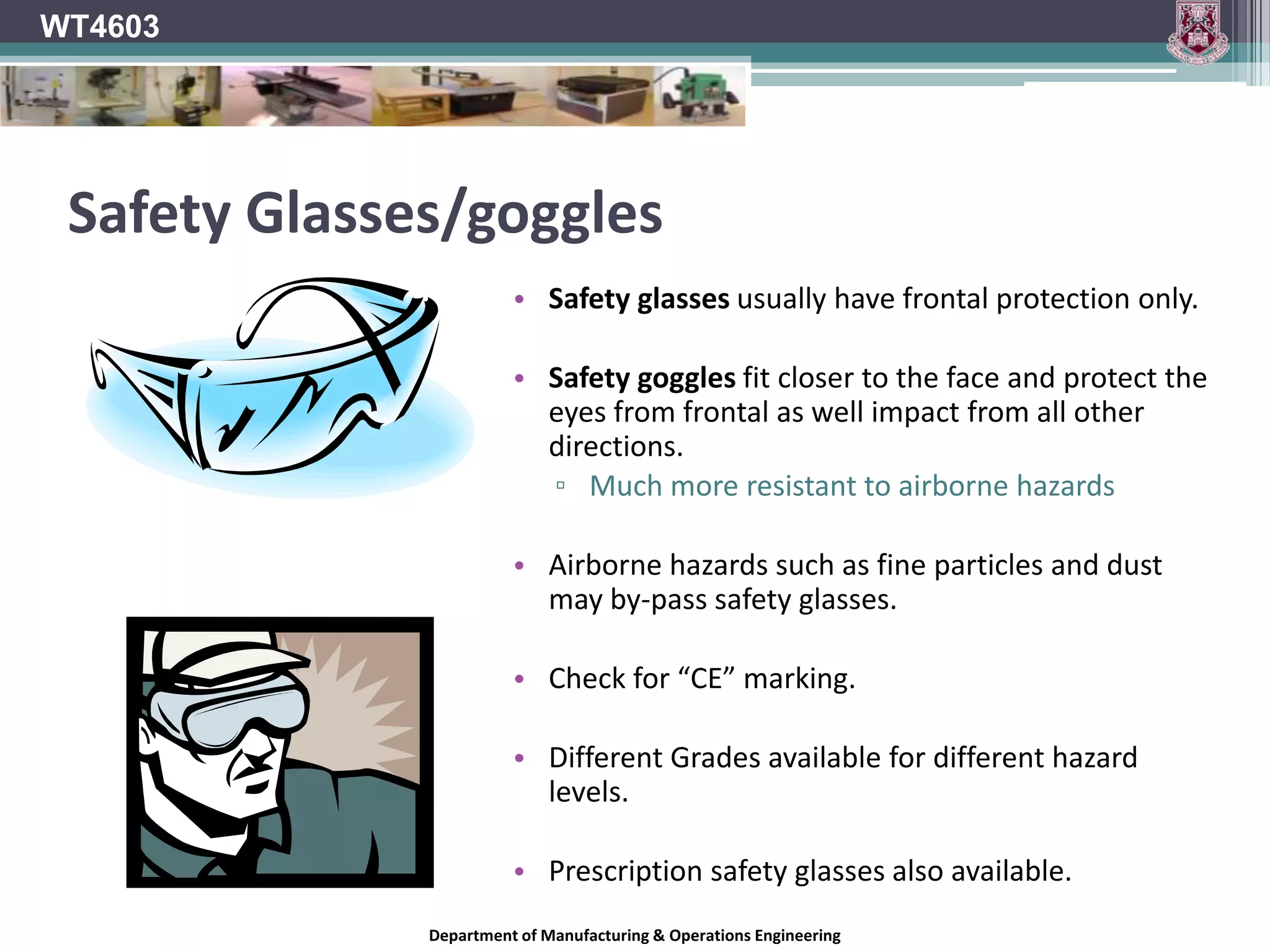
WT4603Safety Glasses/gogglesSafety glasses usually have frontal protection only.Safety goggles fit closer to the face and protect the eyes from frontal as well impact from all other directions.Much more resistant to airborne hazardsAirborne hazards such as fine particles and dust may by-pass safety glasses.Check for “CE” marking.Different Grades available for different hazard levels.Prescription safety glasses also available.Department of Manufacturing & Operations Engineering
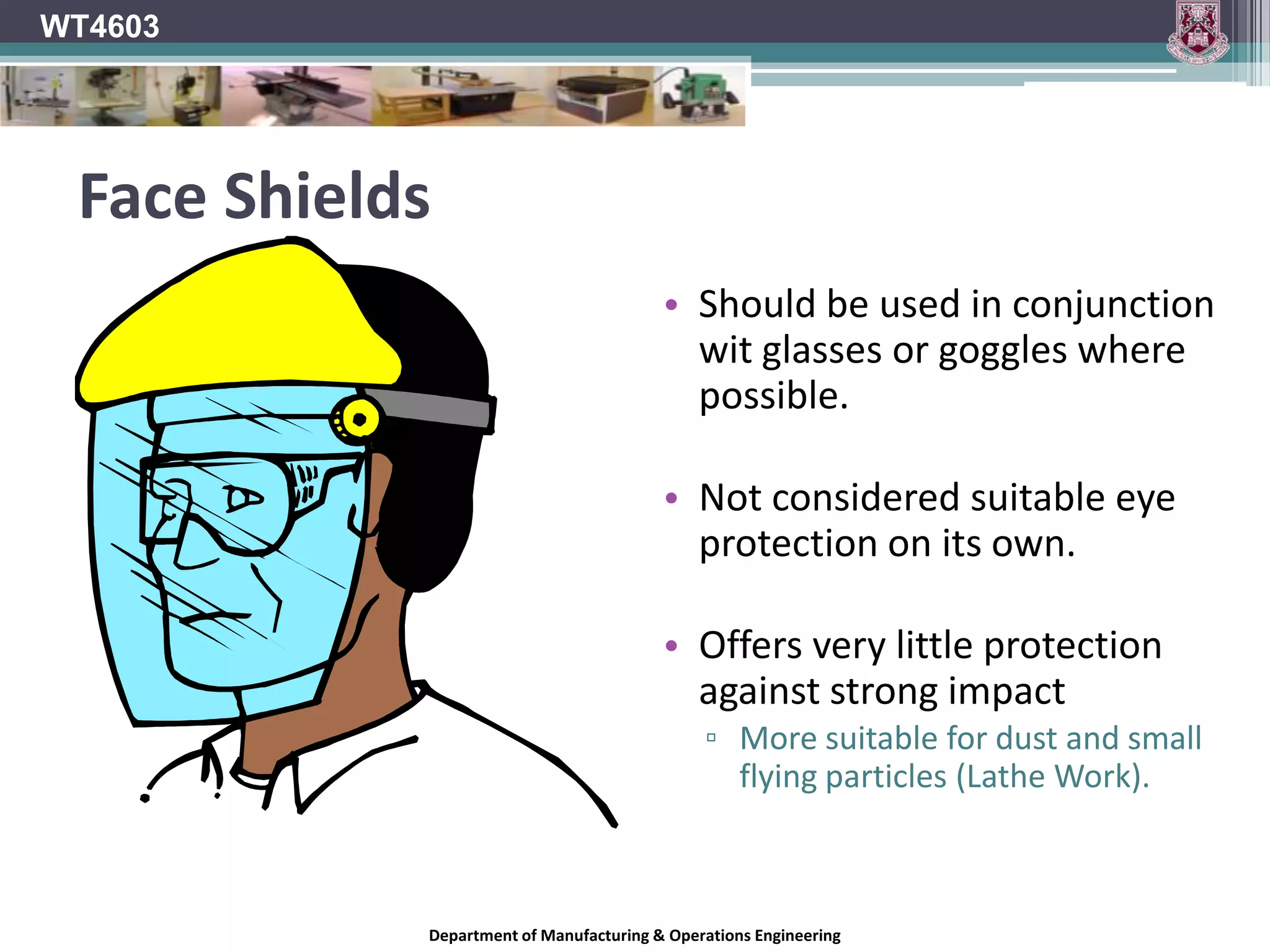
WT4603Face ShieldsShould be used in conjunction wit glasses or goggles where possible. Not considered suitable eye protection on its own.Offers very little protection against strong impact  More suitable for dust and small flying particles (Lathe Work).Department of Manufacturing & Operations Engineering
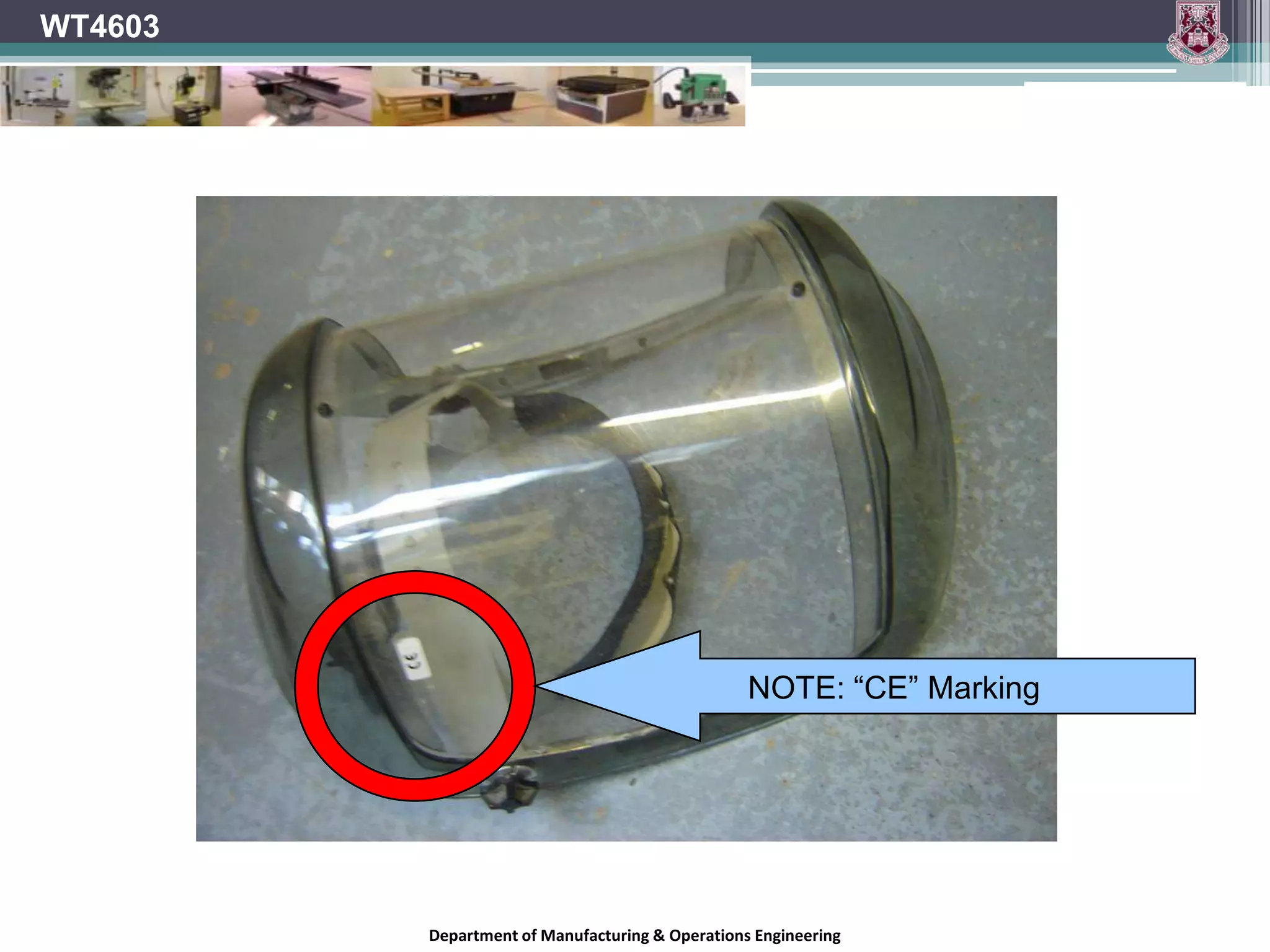
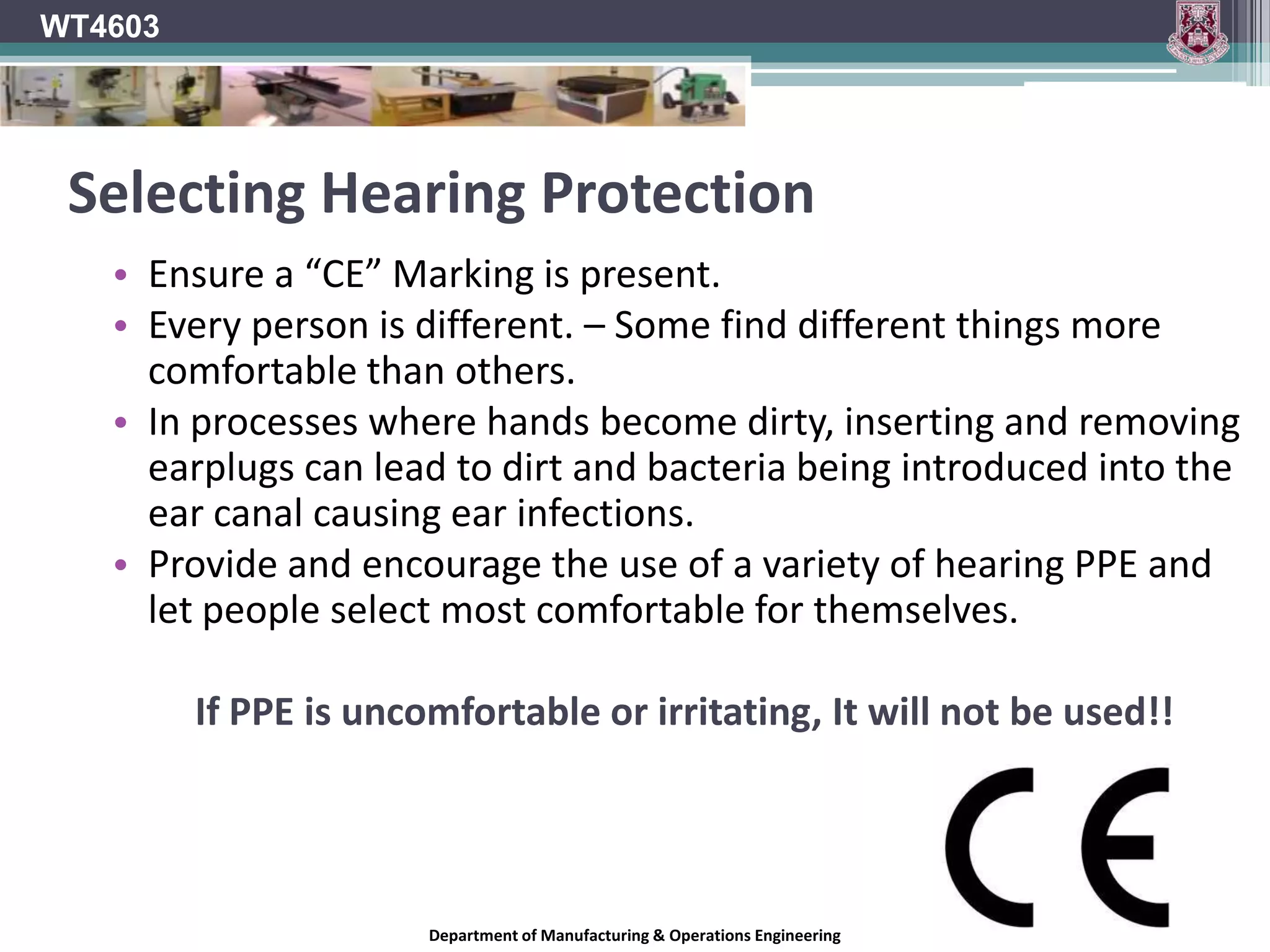
WT4603NOTE: “CE” MarkingDepartment of Manufacturing & Operations Engineering
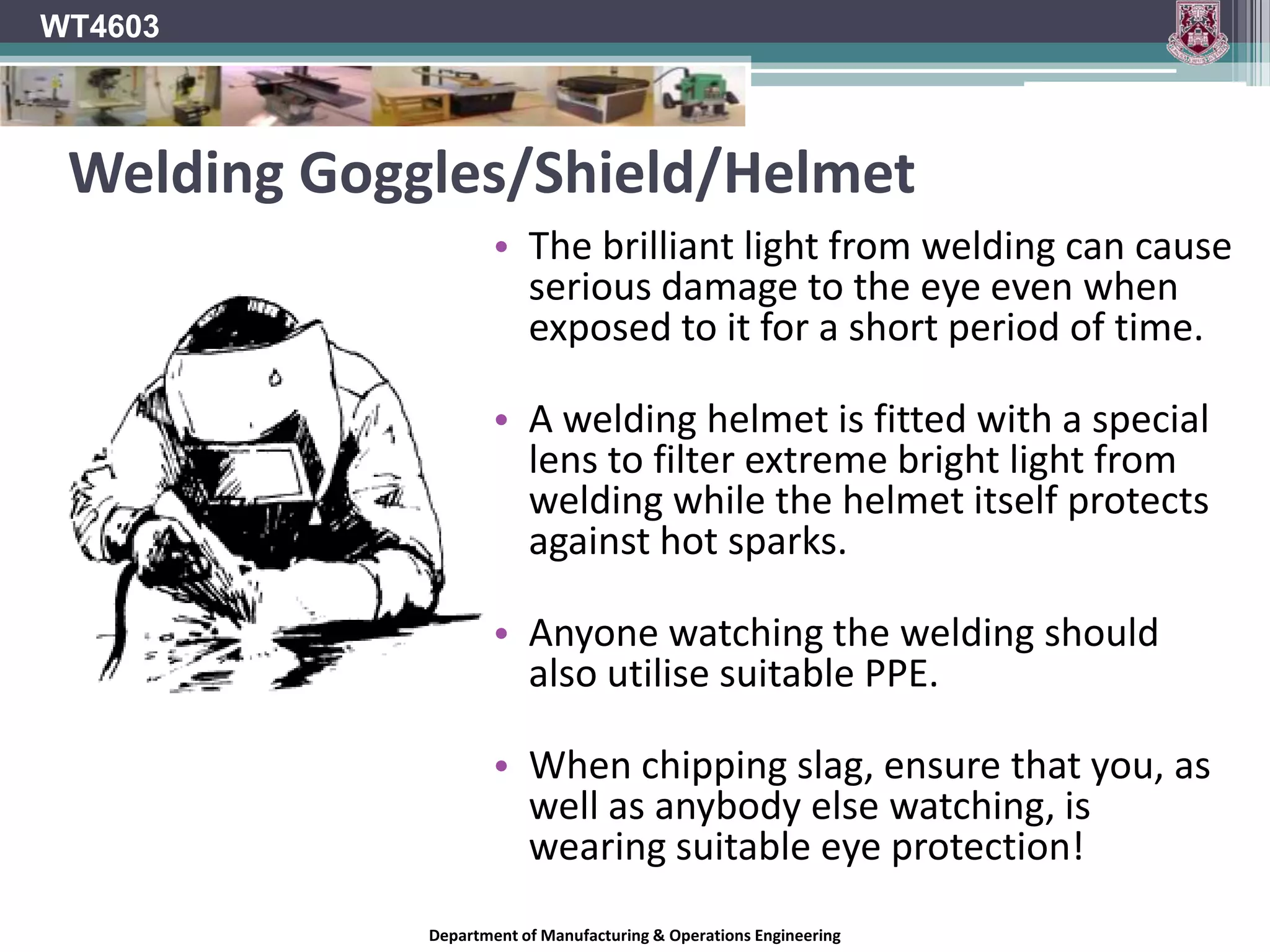
WT4603Welding Goggles/Shield/HelmetThe brilliant light from welding can cause serious damage to the eye even when exposed to it for a short period of time.A welding helmet is fitted with a special lens to filter extreme bright light from welding while the helmet itself protects against hot sparks.Anyone watching the welding should also utilise suitable PPE.When chipping slag, ensure that you, as well as anybody else watching, is wearing suitable eye protection!Department of Manufacturing & Operations Engineering
WT4603Care of Eye ProtectionClean with wipes or water.Don’t use abrasive soaps.Store in a clean, dry and dust-free place.Department of Manufacturing & Operations Engineering
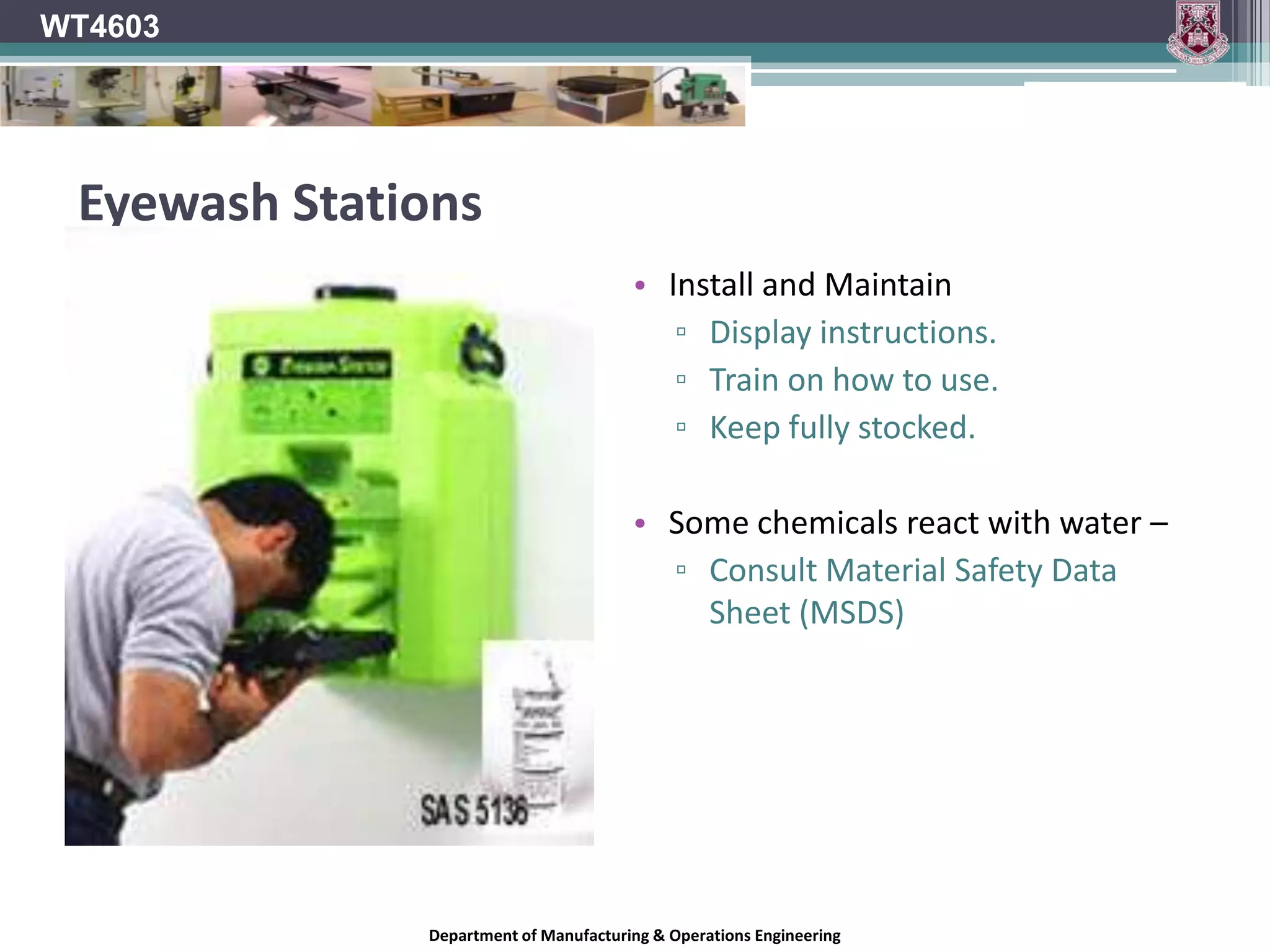
WT4603Eyewash StationsInstall and Maintain Display instructions.Train on how to use.Keep fully stocked.Some chemicals react with water – Consult Material Safety Data Sheet (MSDS)Department of Manufacturing & Operations Engineering
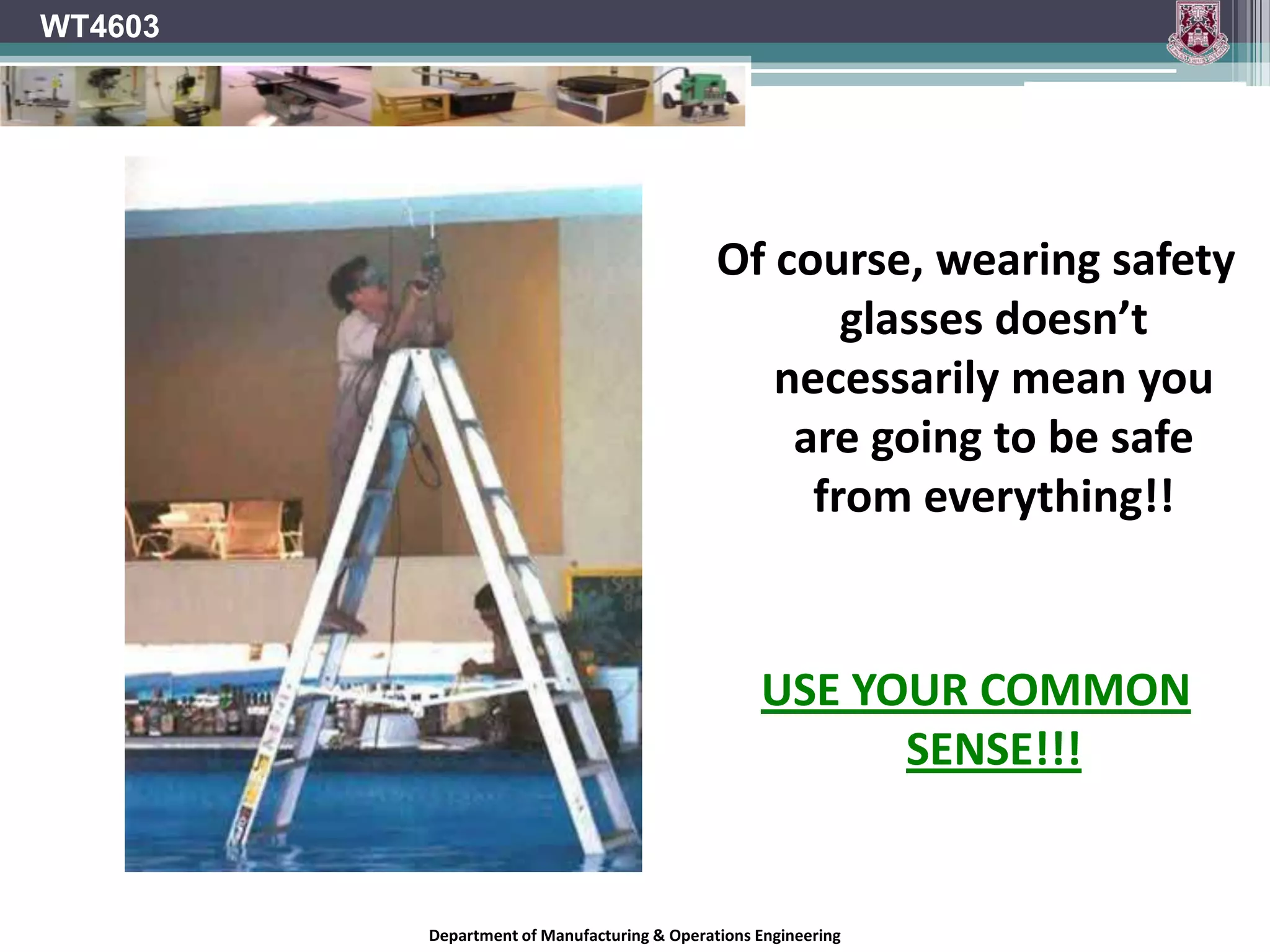
WT4603Of course, wearing safety glasses doesn’t necessarily mean you are going to be safe from everything!!USE YOUR COMMON SENSE!!!Department of Manufacturing & Operations Engineering
WT4603Respiratory ProtectionDepartment of Manufacturing & Operations Engineering
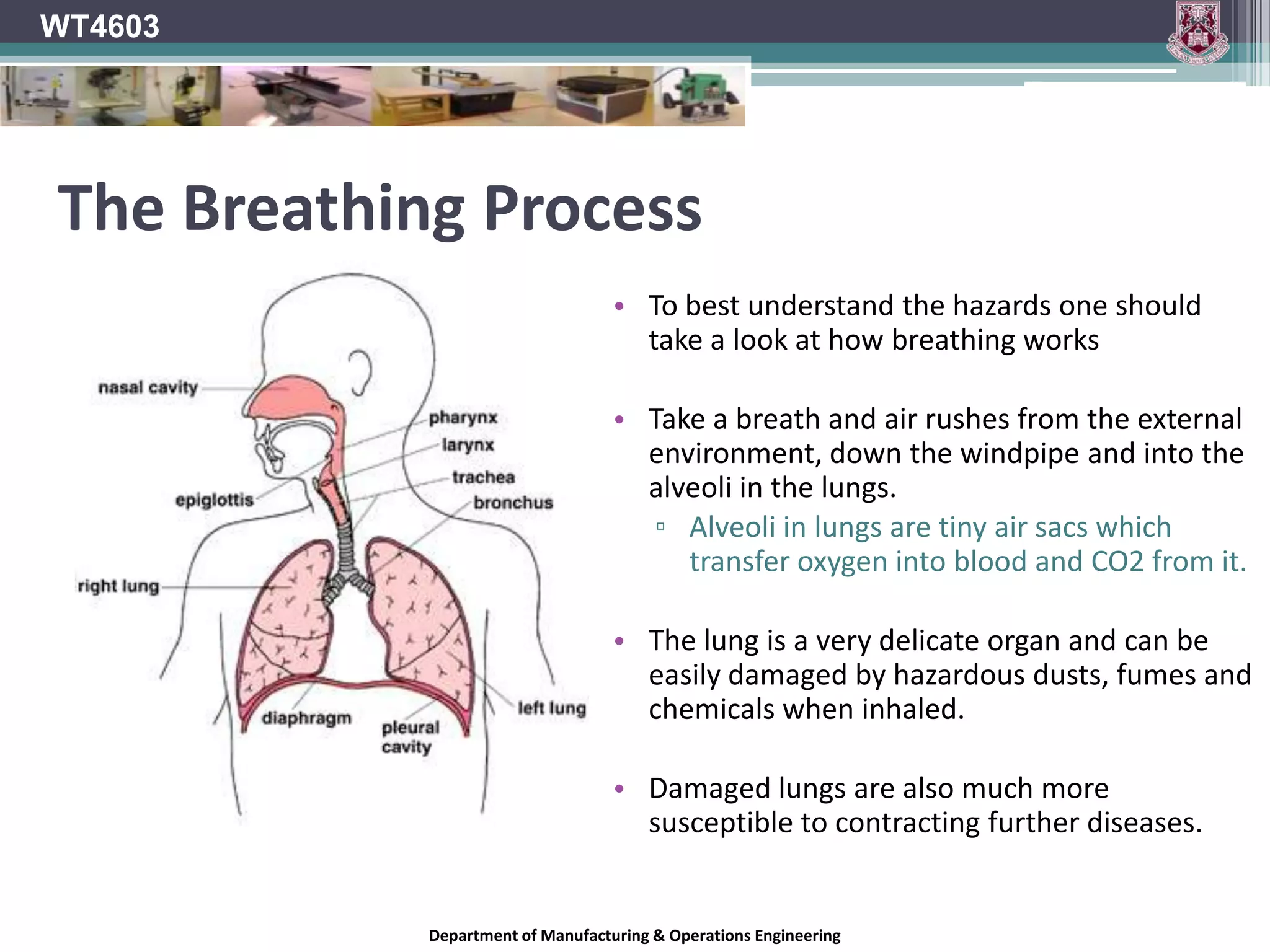
WT4603The Breathing ProcessTo best understand the hazards one should take a look at how breathing worksTake a breath and air rushes from the external environment, down the windpipe and into the alveoli in the lungs.Alveoli in lungs are tiny air sacs which transfer oxygen into blood and CO2 from it.The lung is a very delicate organ and can be easily damaged by hazardous dusts, fumes and chemicals when inhaled.Damaged lungs are also much more susceptible to contracting further diseases.Department of Manufacturing & Operations Engineering
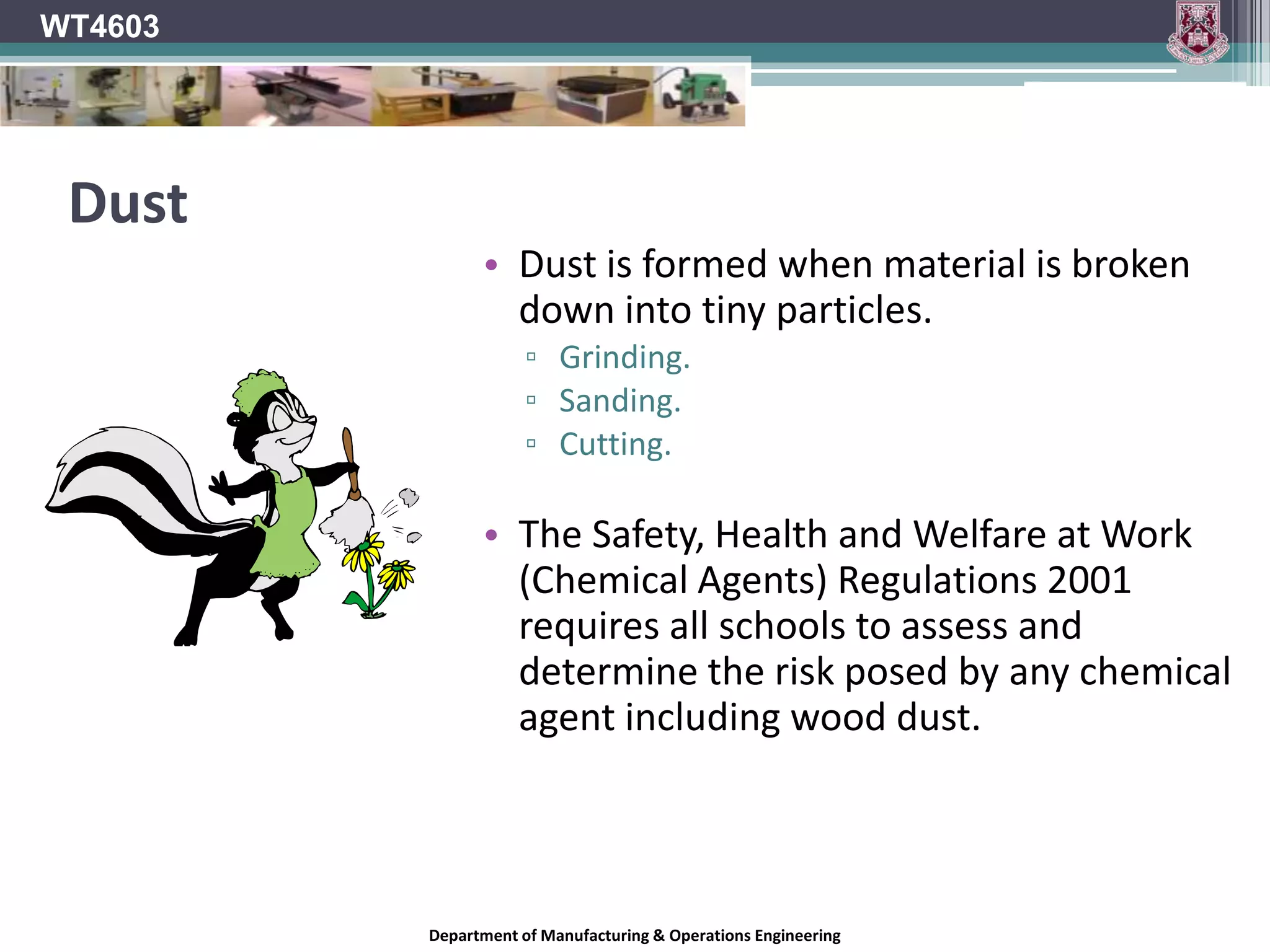
WT4603DustDust is formed when material is broken down into tiny particles.Grinding.	Sanding.Cutting.The Safety, Health and Welfare at Work (Chemical Agents) Regulations 2001 requires all schools to assess and determine the risk posed by any chemical agent including wood dust.Department of Manufacturing & Operations Engineering
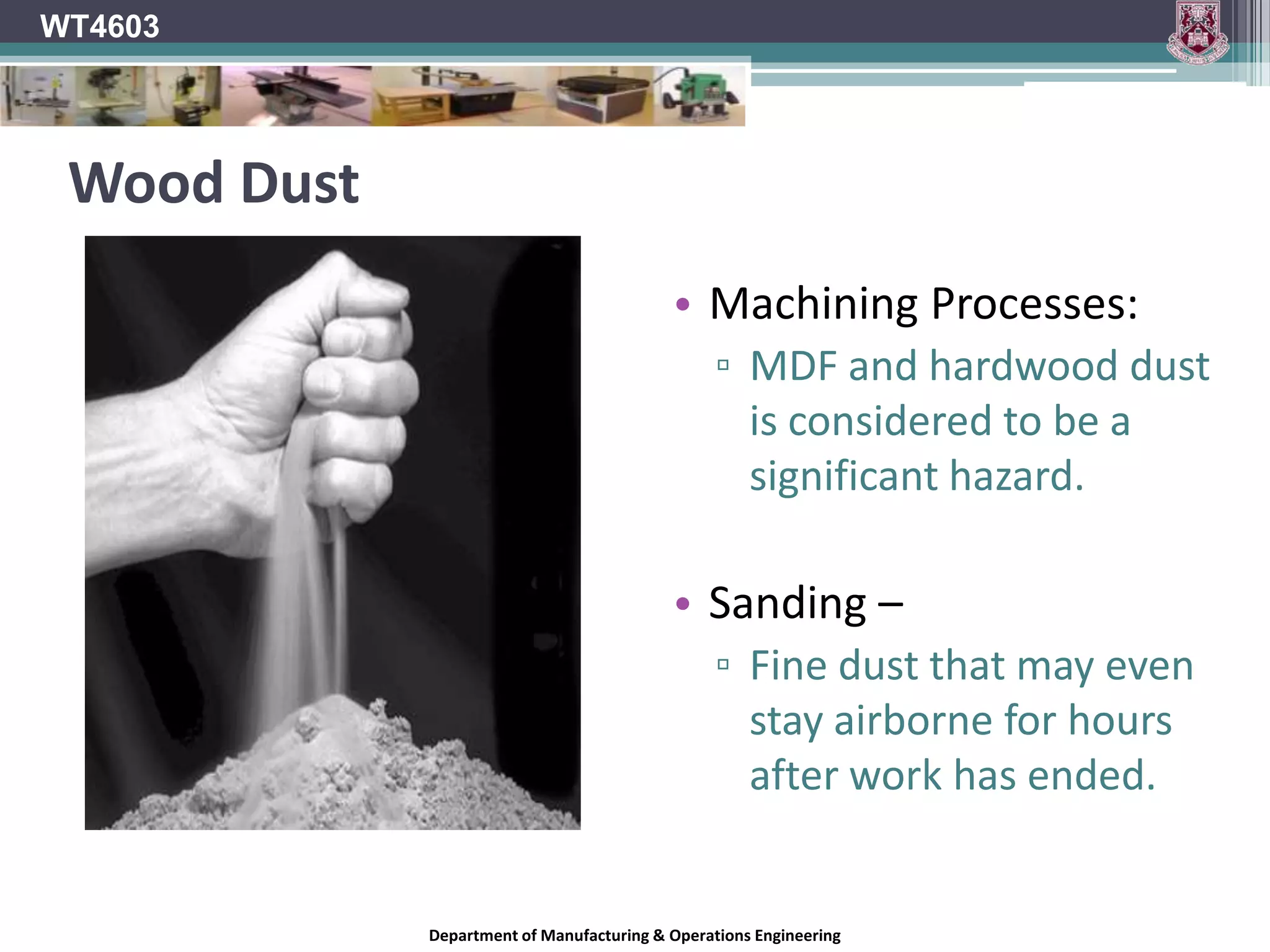
WT4603Wood DustMachining Processes:MDF and hardwood dust is considered to be a significant hazard.Sanding – Fine dust that may even stay airborne for hours after work has ended.Department of Manufacturing & Operations Engineering
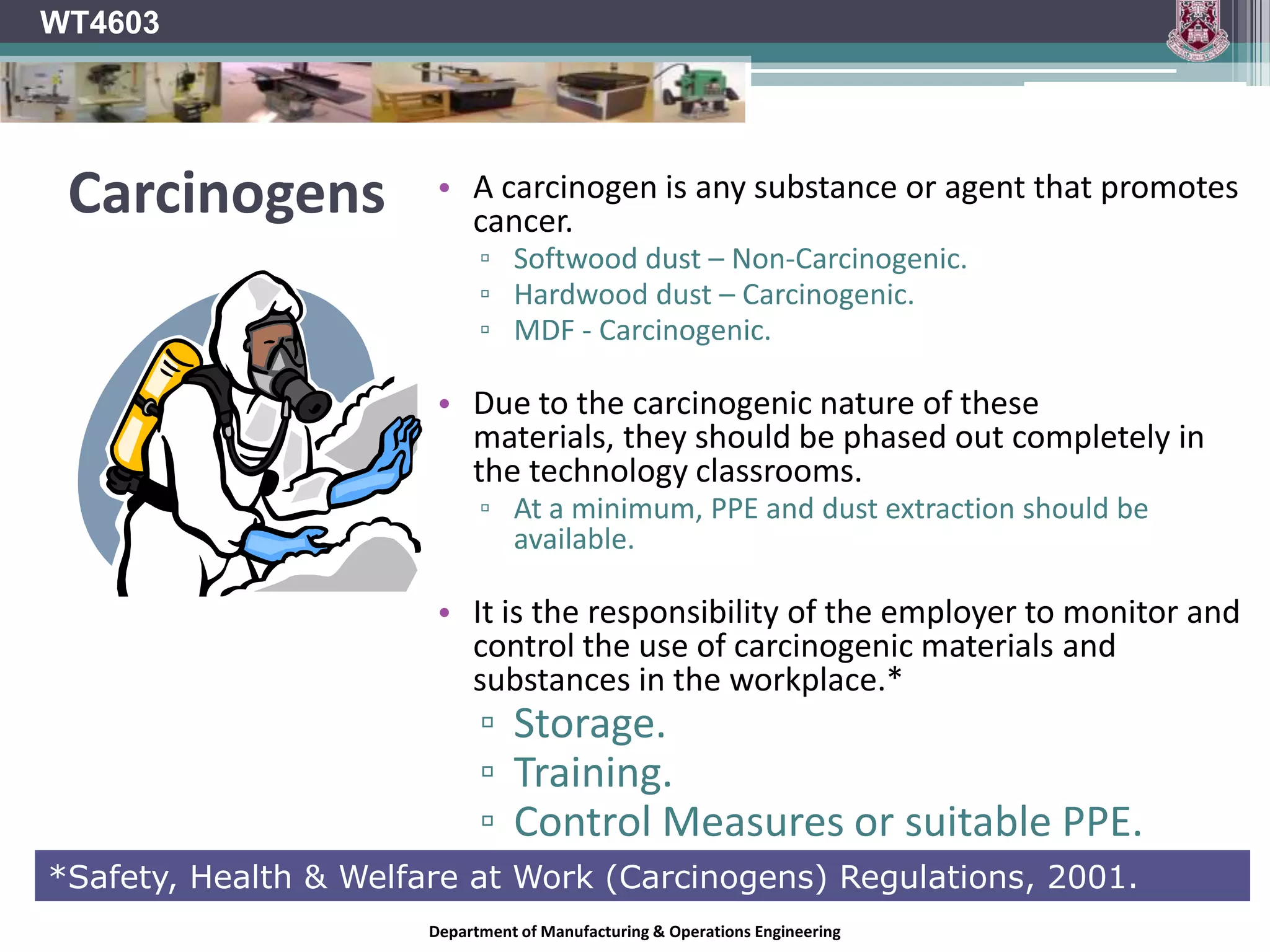
WT4603Carcinogens A carcinogen is any substance or agent that promotes cancer.Softwood dust – Non-Carcinogenic.Hardwood dust – Carcinogenic.MDF - Carcinogenic.Due to the carcinogenic nature of these materials, they should be phased out completely in the technology classrooms.At a minimum, PPE and dust extraction should be available.It is the responsibility of the employer to monitor and control the use of carcinogenic materials and substances in the workplace.*Storage.Training.Control Measures or suitable PPE.*Safety, Health & Welfare at Work (Carcinogens) Regulations, 2001.Department of Manufacturing & Operations Engineering
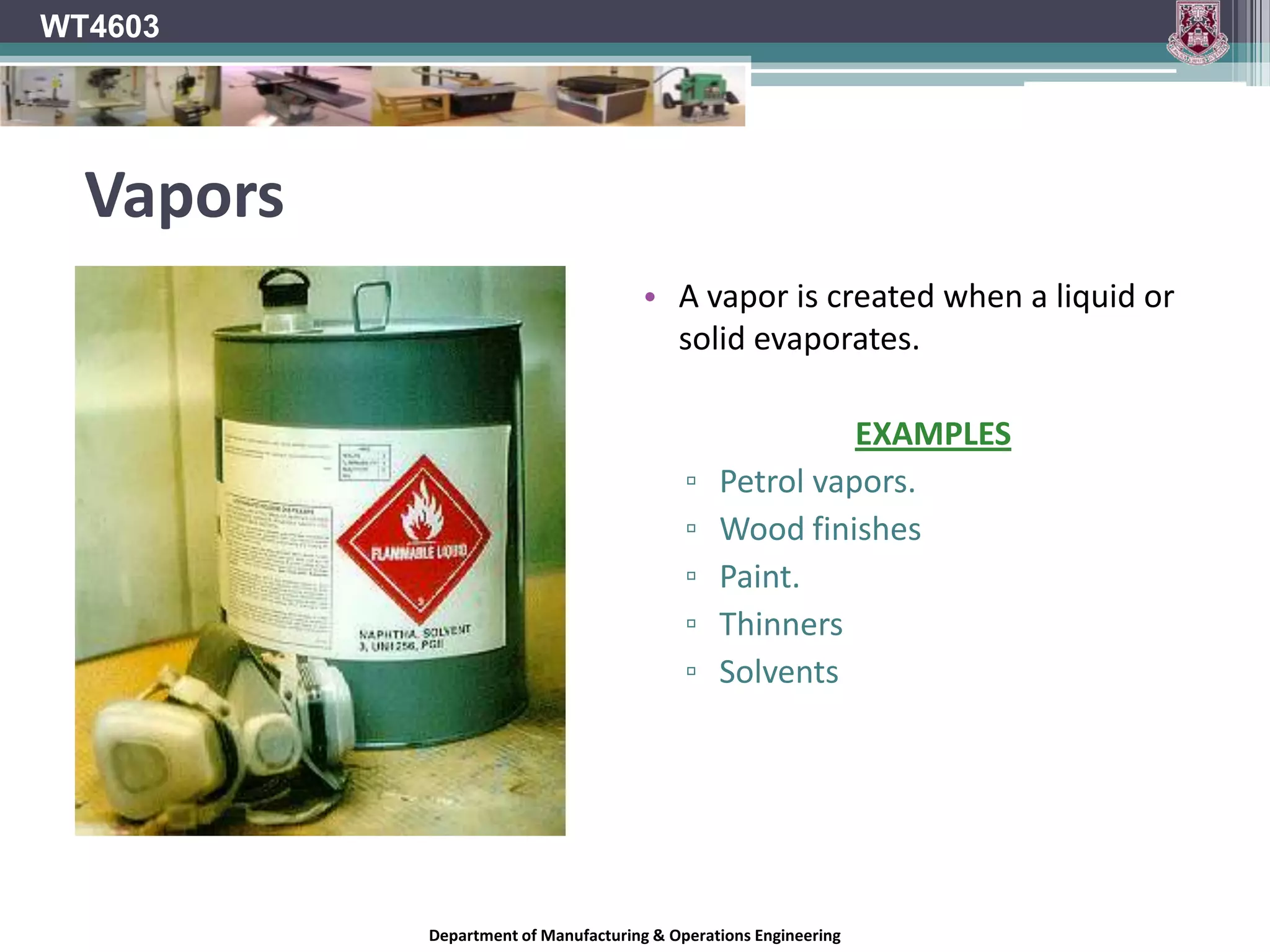
WT4603VaporsA vapor is created when a liquid or solid evaporates.EXAMPLESPetrol vapors.Wood finishesPaint.ThinnersSolventsDepartment of Manufacturing & Operations Engineering
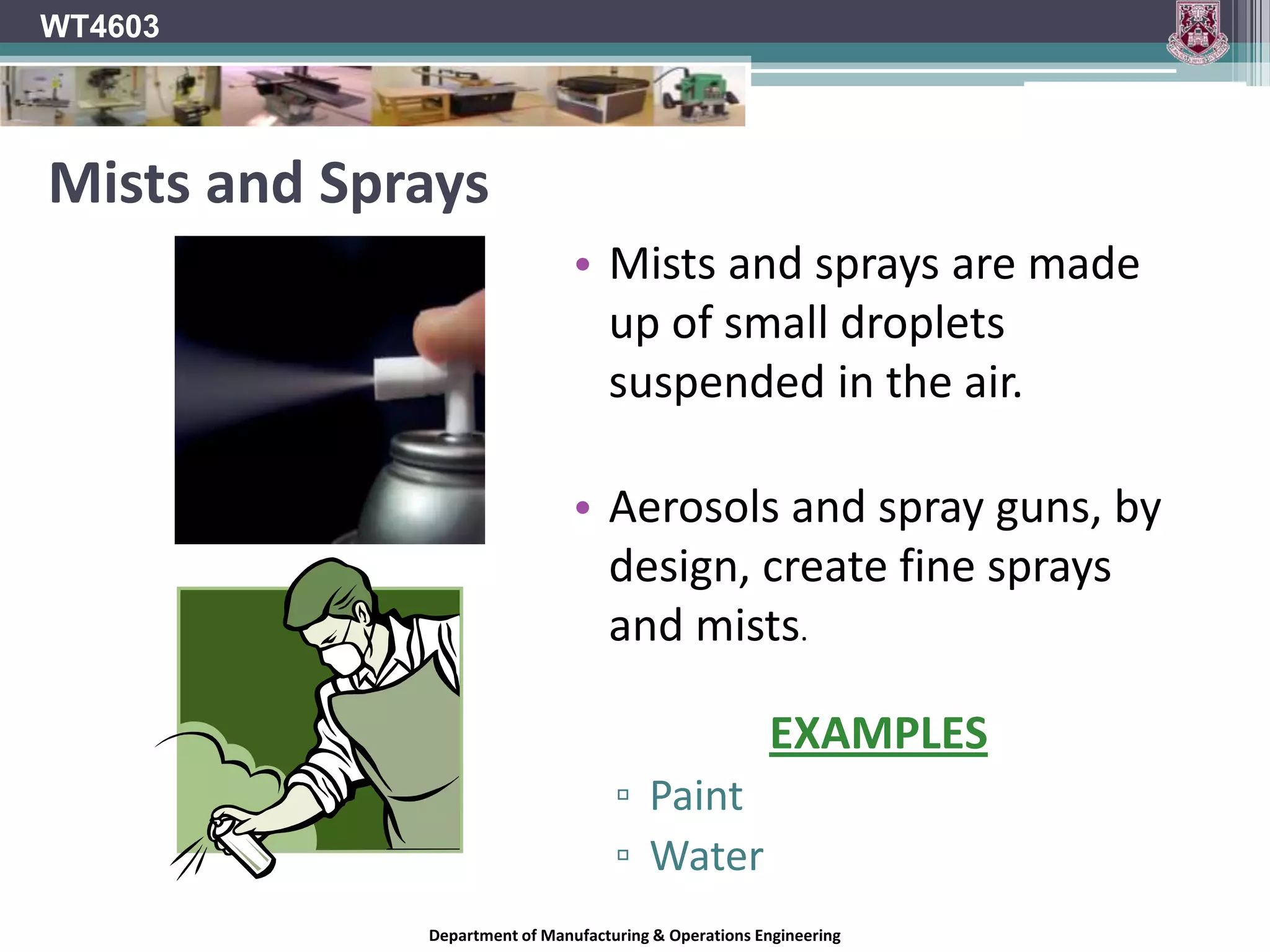
WT4603Mists and SpraysMists and sprays are made up of small droplets suspended in the air.Aerosols and spray guns, by design, create fine sprays and mists. EXAMPLESPaintWaterDepartment of Manufacturing & Operations Engineering
Gases, fumes & SmokeWT4603GASMay or may not have a smell.May or may not be visible.FUMESOccur during high heat process such as welding or soldering.SMOKEThe suspension in air of small particles resulting from the incomplete combustion of a fuel.Department of Manufacturing & Operations Engineering
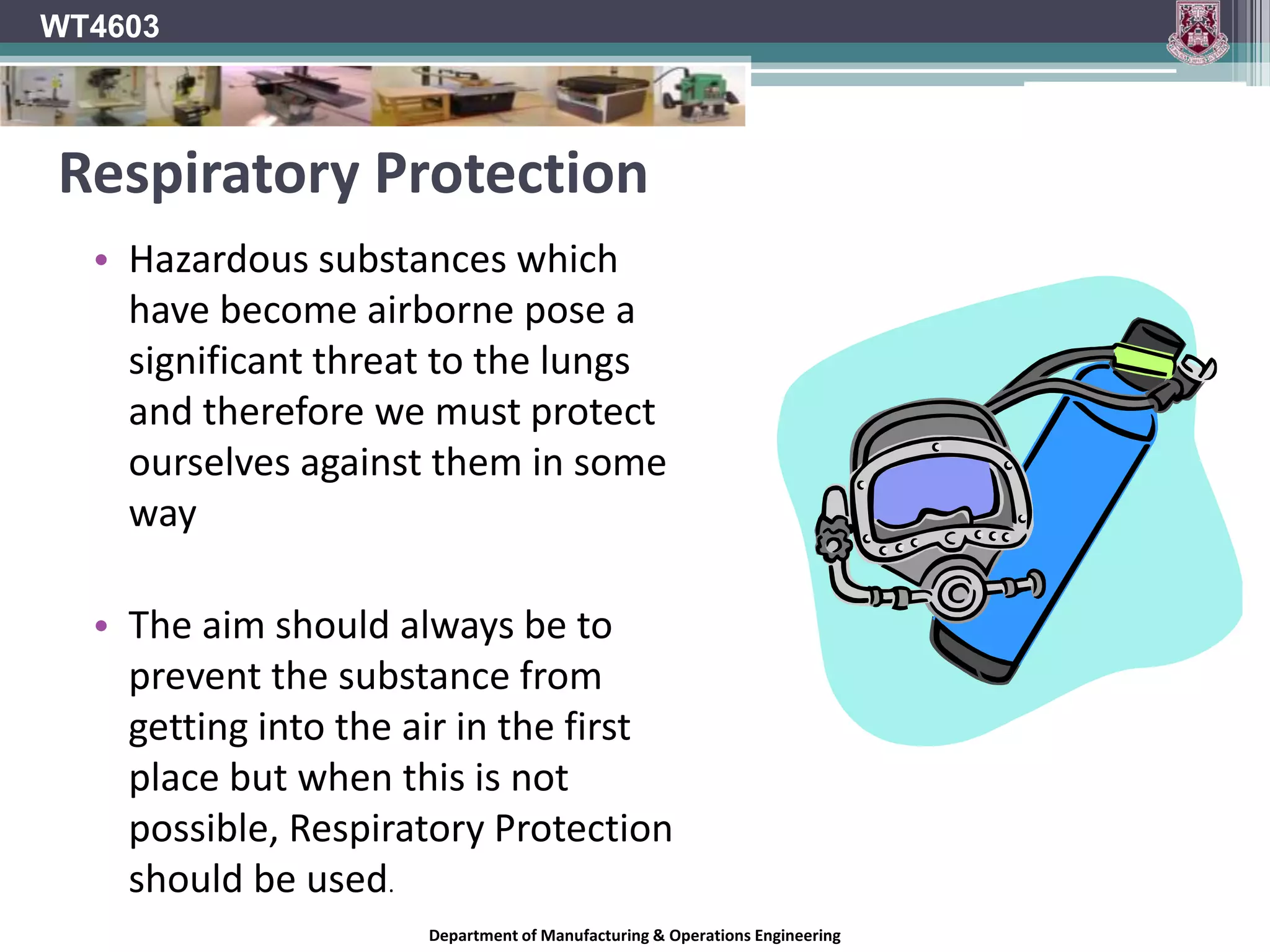
WT4603Respiratory ProtectionHazardous substances which have become airborne pose a significant threat to the lungs and therefore we must protect ourselves against them in some wayThe aim should always be to prevent the substance from getting into the air in the first place but when this is not possible, Respiratory Protection should be used.Department of Manufacturing & Operations Engineering
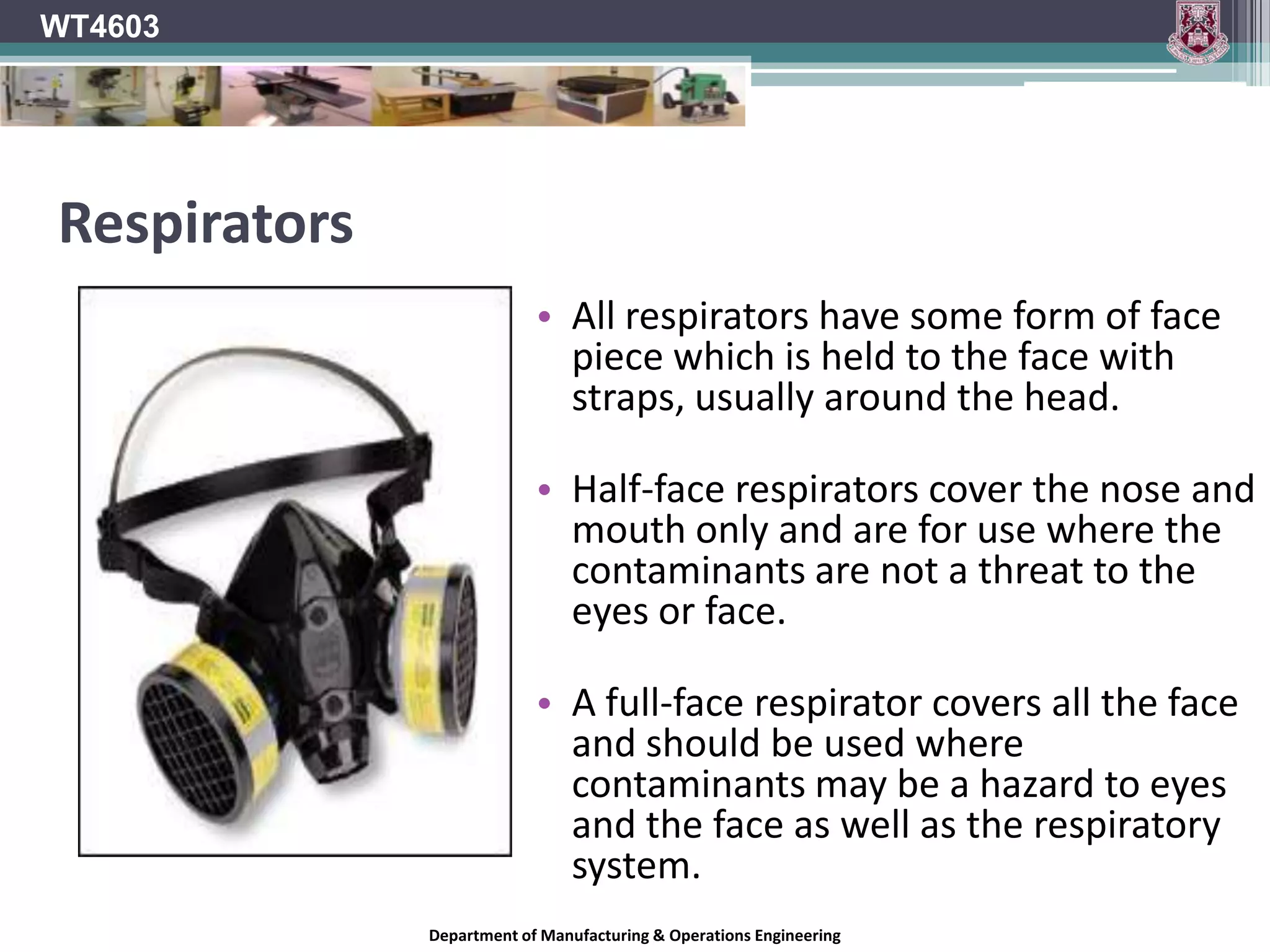
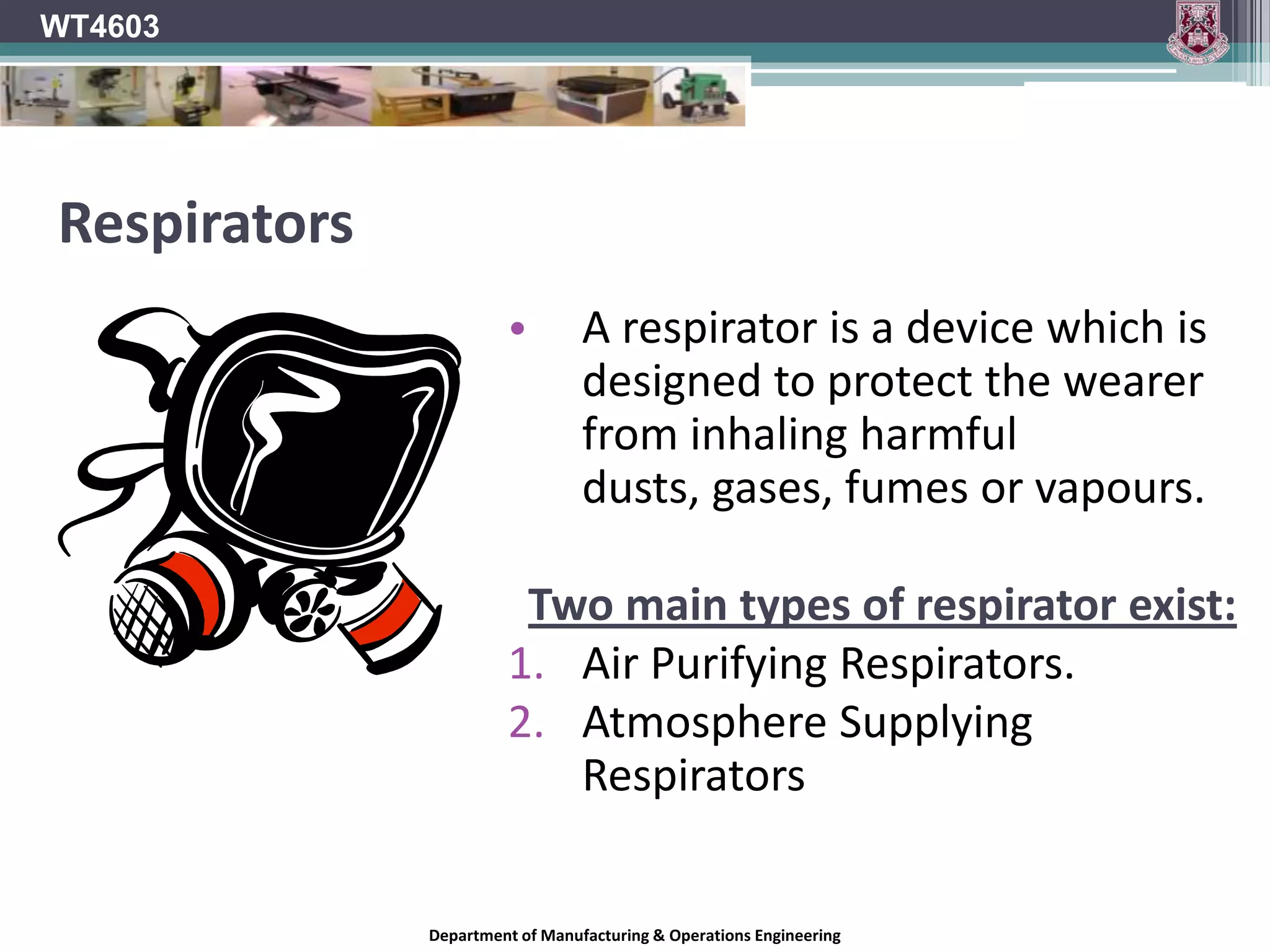
WT4603RespiratorsAll respirators have some form of face piece which is held to the face with straps, usually around the head.Half-face respirators cover the nose and mouth only and are for use where the contaminants are not a threat to the eyes or face.A full-face respirator covers all the face and should be used where contaminants may be a hazard to eyes and the face as well as the respiratory system.Department of Manufacturing & Operations Engineering
WT4603RespiratorsA respirator is a device which is designed to protect the wearer from inhaling harmful dusts, gases, fumes or vapours.Two main types of respirator exist:Air Purifying Respirators.Atmosphere Supplying RespiratorsDepartment of Manufacturing & Operations Engineering
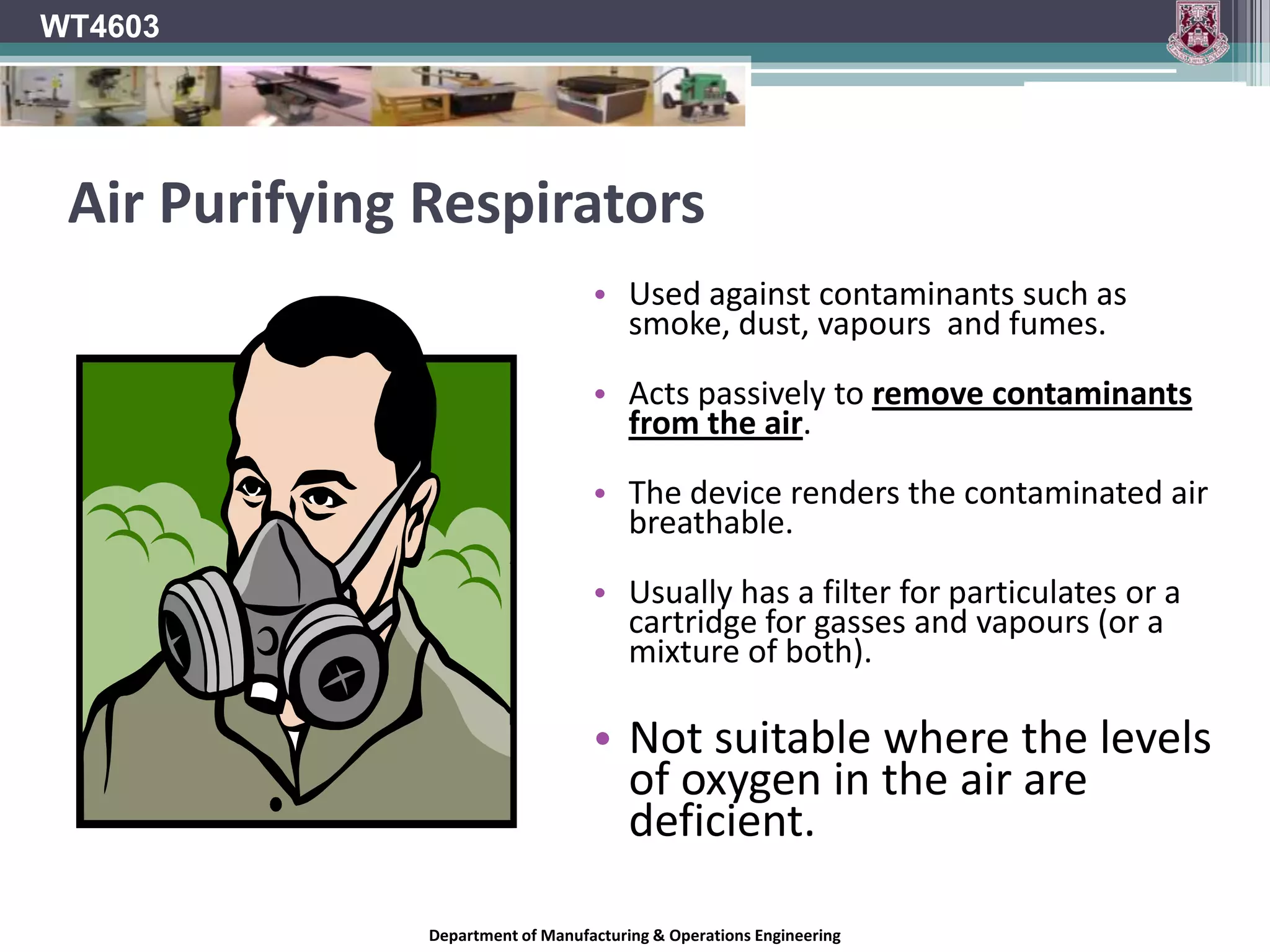
WT4603Air Purifying RespiratorsUsed against contaminants such as smoke, dust, vapours  and fumes.Acts passively to remove contaminants from the air.The device renders the contaminated air breathable.Usually has a filter for particulates or a cartridge for gasses and vapours (or a mixture of both).Not suitable where the levels of oxygen in the air are deficient.Department of Manufacturing & Operations Engineering
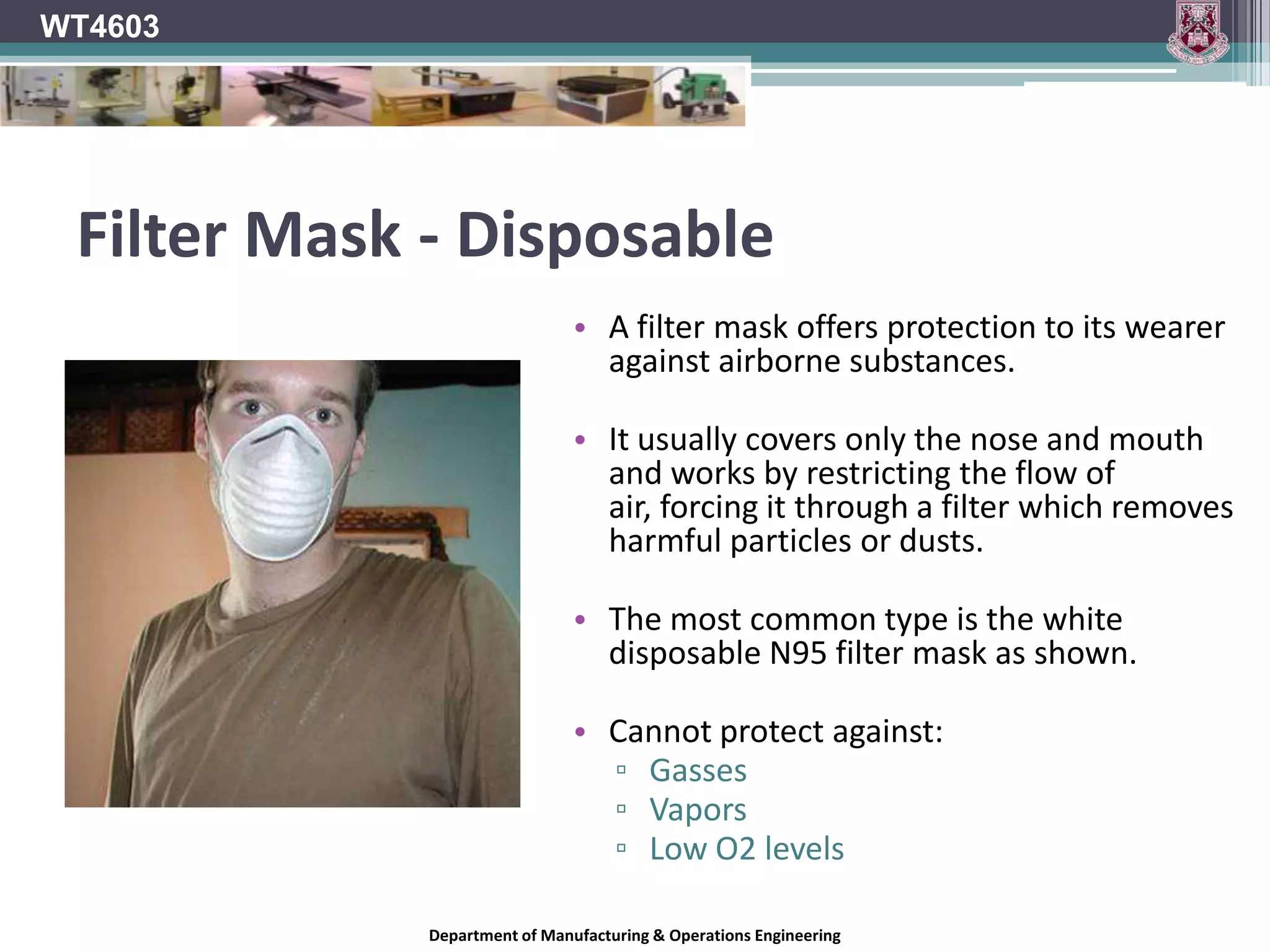
Filter Mask - DisposableWT4603A filter mask offers protection to its wearer against airborne substances.It usually covers only the nose and mouth and works by restricting the flow of air, forcing it through a filter which removes harmful particles or dusts.The most common type is the white disposable N95 filter mask as shown.Cannot protect against:GassesVaporsLow O2 levelsDepartment of Manufacturing & Operations Engineering
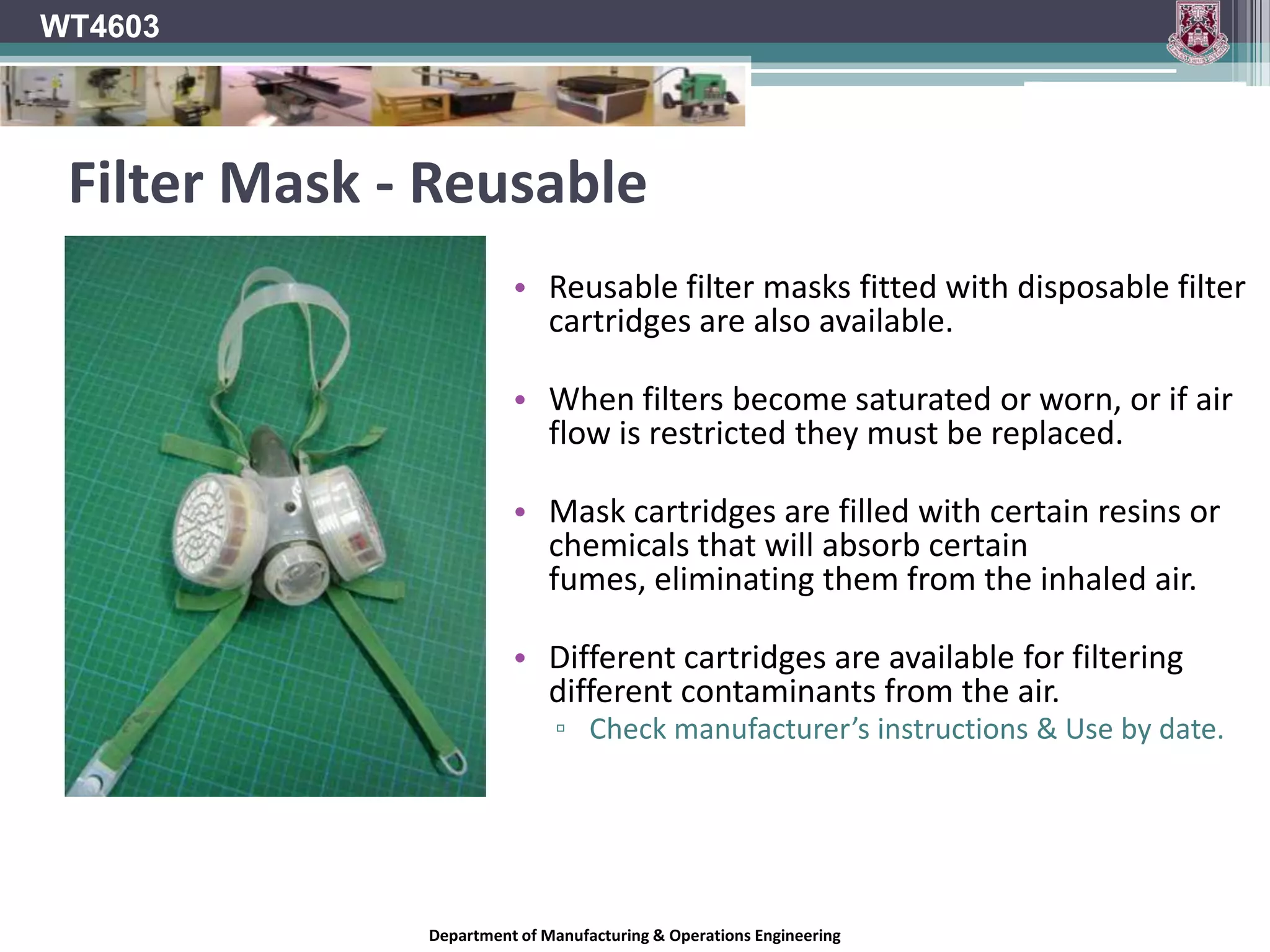
WT4603Filter Mask - ReusableReusable filter masks fitted with disposable filter cartridges are also available.When filters become saturated or worn, or if air flow is restricted they must be replaced.Mask cartridges are filled with certain resins or chemicals that will absorb certain fumes, eliminating them from the inhaled air.Different cartridges are available for filtering different contaminants from the air. Check manufacturer’s instructions & Use by date.Department of Manufacturing & Operations Engineering
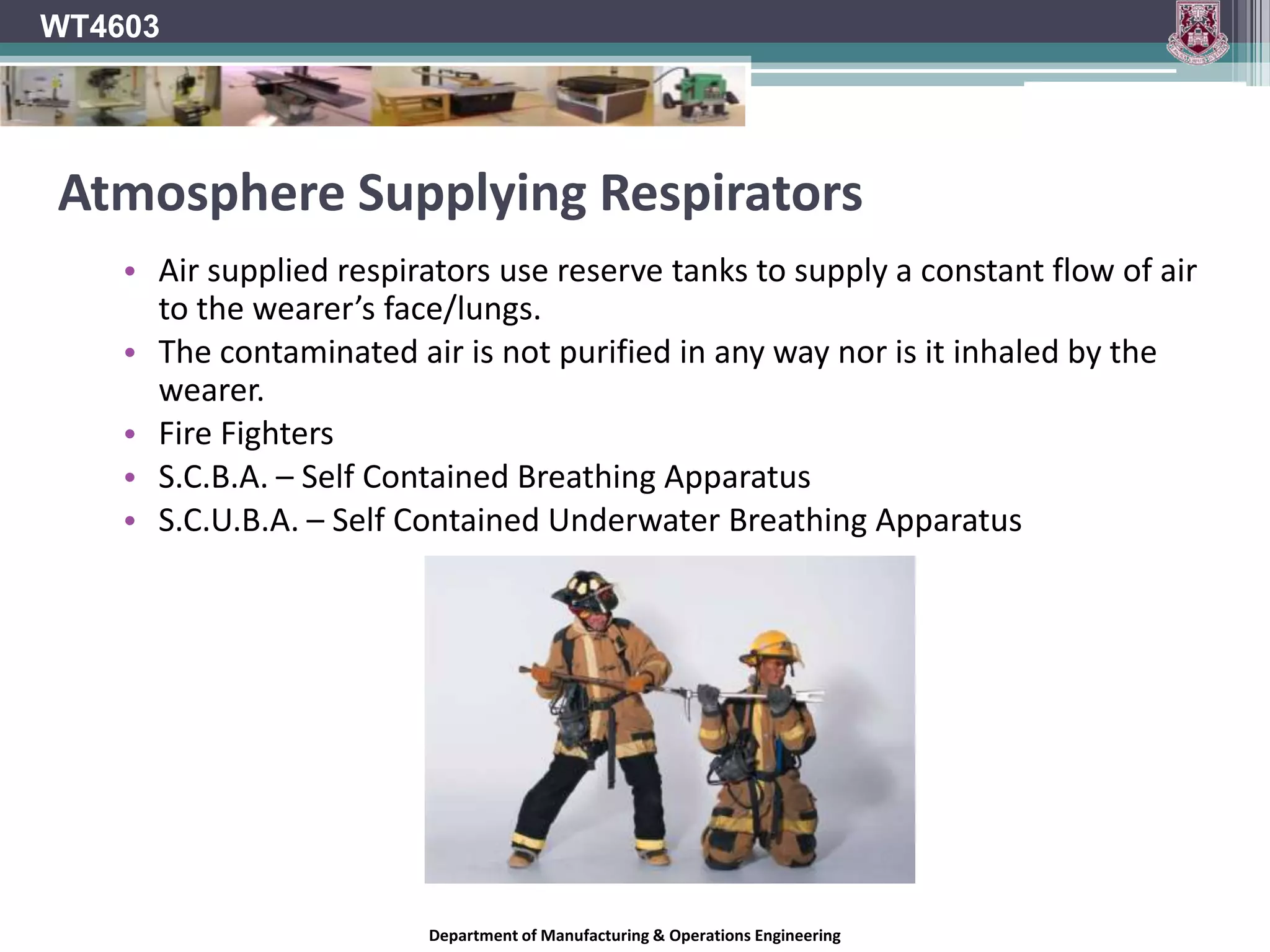
WT4603Atmosphere Supplying RespiratorsAir supplied respirators use reserve tanks to supply a constant flow of air to the wearer’s face/lungs.The contaminated air is not purified in any way nor is it inhaled by the wearer.Fire FightersS.C.B.A. – Self Contained Breathing ApparatusS.C.U.B.A. – Self Contained Underwater Breathing ApparatusDepartment of Manufacturing & Operations Engineering
WT4603Respirator SelectionHazard level should be determine and adequate level of protection selected accordingly by a competent person.	Determined largely by the hazard present.E.g. - Dust PPE will give no protection against fumes and vapours.Supplied air respirators in schools SHOULD NOT BE USED. If any such risk should exist, find an alternative for it!Department of Manufacturing & Operations Engineering
WT4603Inspection Before UseCheck Respirators before you them every time.Look out for;Wear and damage.CracksLoose fittings.Use by dates.Department of Manufacturing & Operations Engineering
Monitoring the RespiratorWT4603As you work- you must stay aware of your respirators operation.Signs of it not working are:Feeling dizzy or sick.Being able to smell or taste the contaminant in the air.Difficulty breathing.Filter/ cartridge has expired.Respirator is damaged.Department of Manufacturing & Operations Engineering
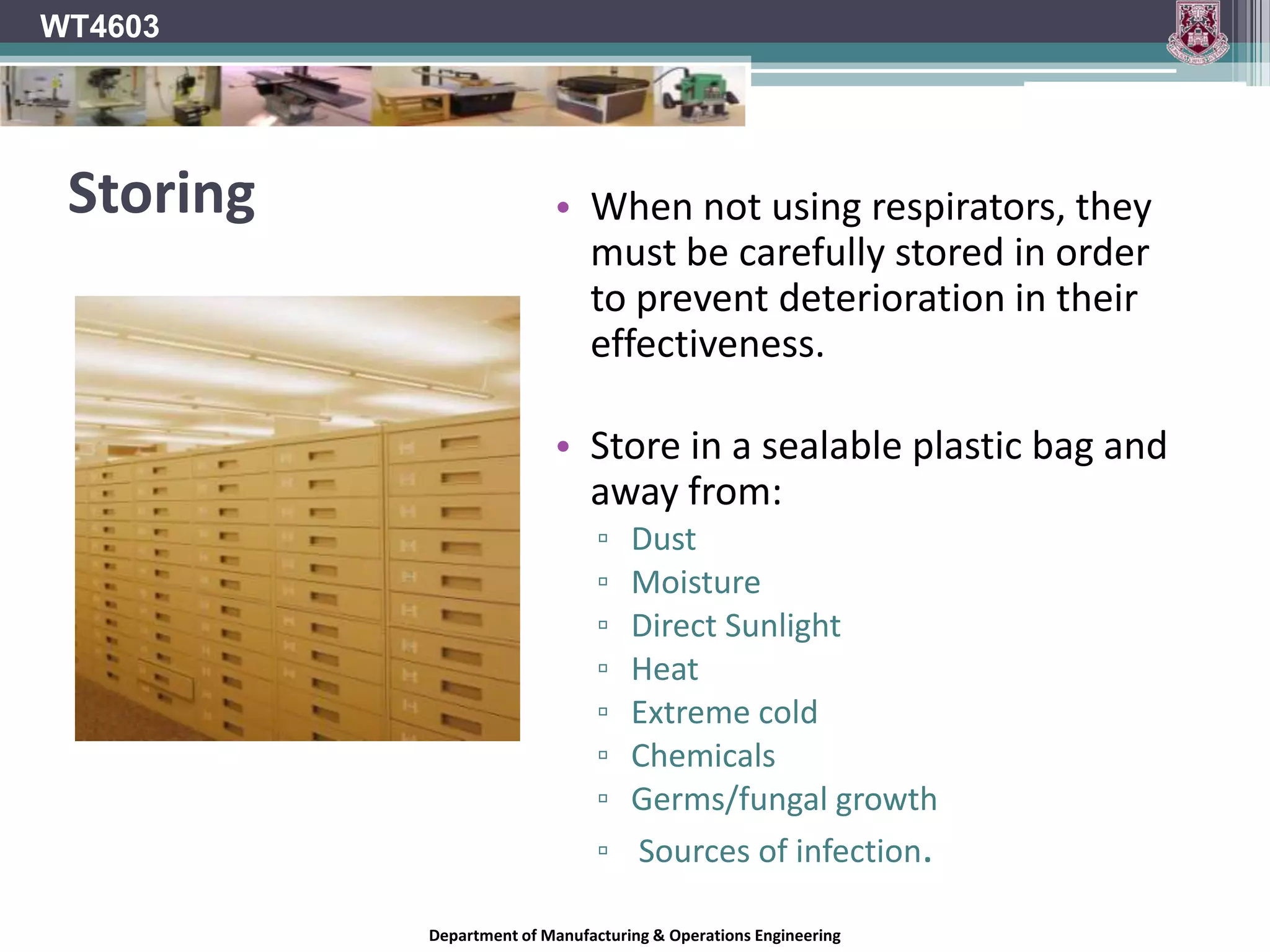
WT4603StoringWhen not using respirators, they must be carefully stored in order to prevent deterioration in their effectiveness.Store in a sealable plastic bag and away from:DustMoistureDirect SunlightHeatExtreme coldChemicalsGerms/fungal growth Sources of infection.Department of Manufacturing & Operations Engineering
WT4603Hearing ProtectionDepartment of Manufacturing & Operations Engineering
WT4603NoiseNoise is often described as being sound that people would prefer not to hear. What may be important  or welcome sound to you may be noise to others exposed to it.Department of Manufacturing & Operations Engineering
WT4603Is Noise harming you?If you experience any of the following, you may be exposed to excessive noise levels on a daily basis:You experience ringing or other noises in your ears.You have difficulty hearing people talking.You are unable to hear high pitched or soft sounds.Department of Manufacturing & Operations Engineering
Remember!WT4603Becoming used to a loud noise is a sign of gradual hearing loss.You do not become used to it, you merely lose your ability to hear it!!Department of Manufacturing & Operations Engineering
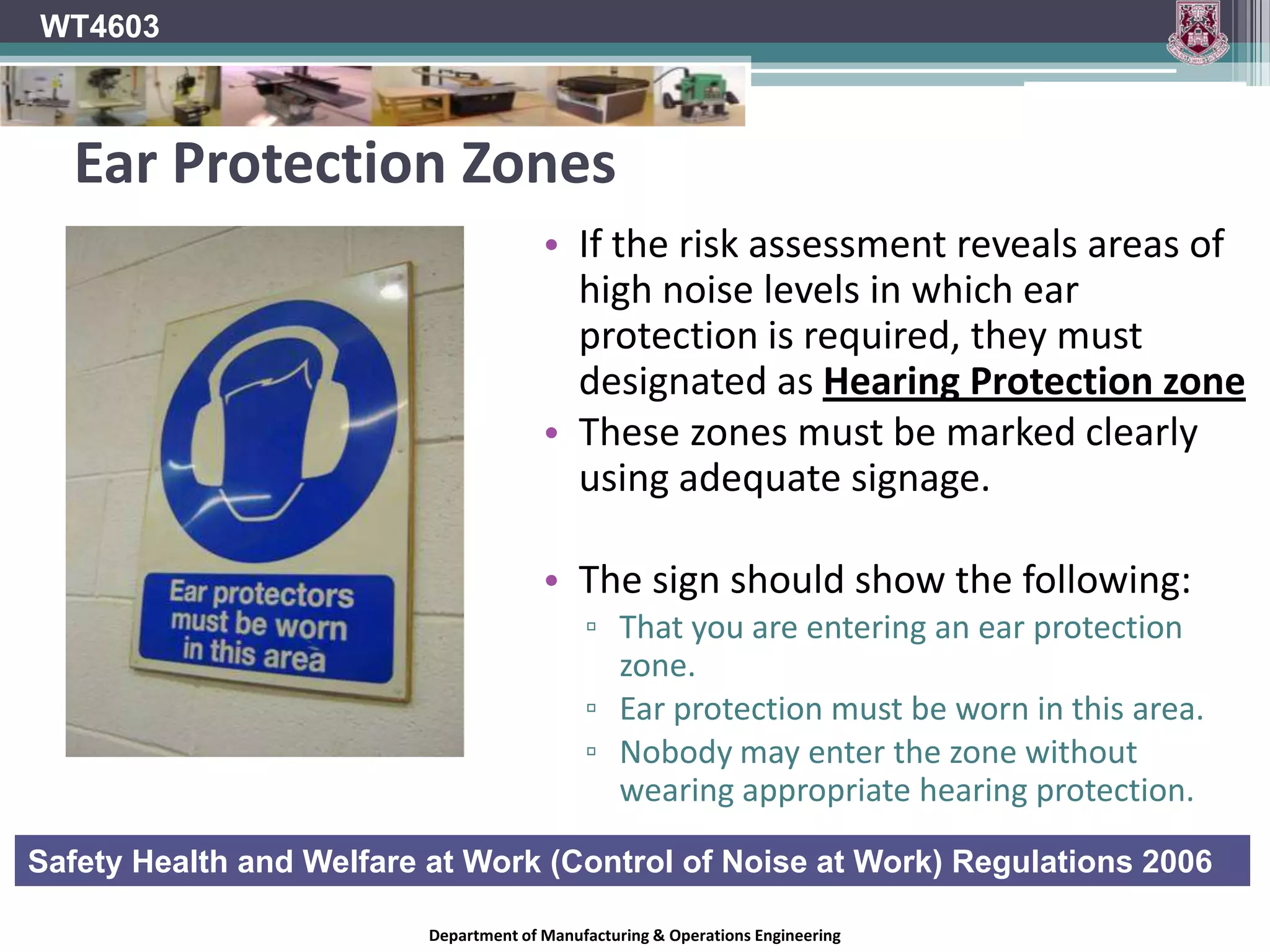
WT4603Ear Protection ZonesIf the risk assessment reveals areas of high noise levels in which ear protection is required, they must designated as Hearing Protection zoneThese zones must be marked clearly using adequate signage.The sign should show the following:That you are entering an ear protection zone.Ear protection must be worn in this area.Nobody may enter the zone without wearing appropriate hearing protection.Safety Health and Welfare at Work (Control of Noise at Work) Regulations 2006Department of Manufacturing & Operations Engineering
WT4603As a Rule!If you must shout in order for someone 2 meters  away from you to hear you, YOU SHOULD BE WEARING HEARING PROTECTION!Department of Manufacturing & Operations Engineering
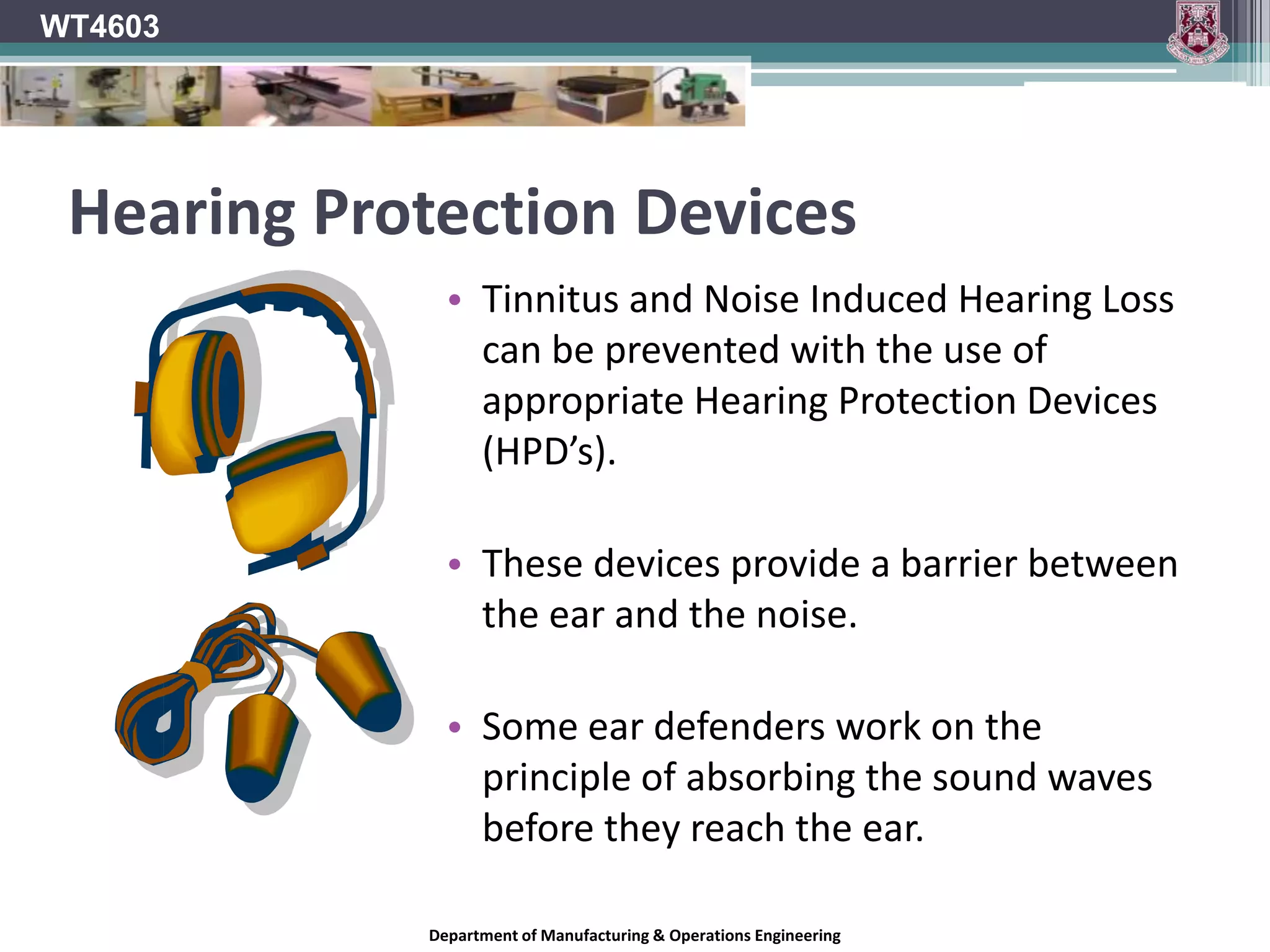
WT4603Hearing Protection DevicesTinnitus and Noise Induced Hearing Loss can be prevented with the use of appropriate Hearing Protection Devices (HPD’s).These devices provide a barrier between the ear and the noise.Some ear defenders work on the principle of absorbing the sound waves before they reach the ear.Department of Manufacturing & Operations Engineering
WT4603Selecting Hearing ProtectionEnsure a “CE” Marking is present.Every person is different. – Some find different things more comfortable than others.In processes where hands become dirty, inserting and removing earplugs can lead to dirt and bacteria being introduced into the ear canal causing ear infections.Provide and encourage the use of a variety of hearing PPE and let people select most comfortable for themselves.If PPE is uncomfortable or irritating, It will not be used!!Department of Manufacturing & Operations Engineering
WT4603Noise Reduction RatingsEarplugs and earmuffs come rated with “Noise Reduction Ratings” (NRR’s).This rating tells the user what level of sound protection they can expect from the device in a noisy environment.The NRR of hearing protection devices should be consulted when selecting them for use.However, NRR’s are developed under controlled laboratory conditions and the “real-life” NRR rating is usually lower. Therefore it is always best to error on the side of caution and select the PPE with a higher NRR than is required.Department of Manufacturing & Operations Engineering
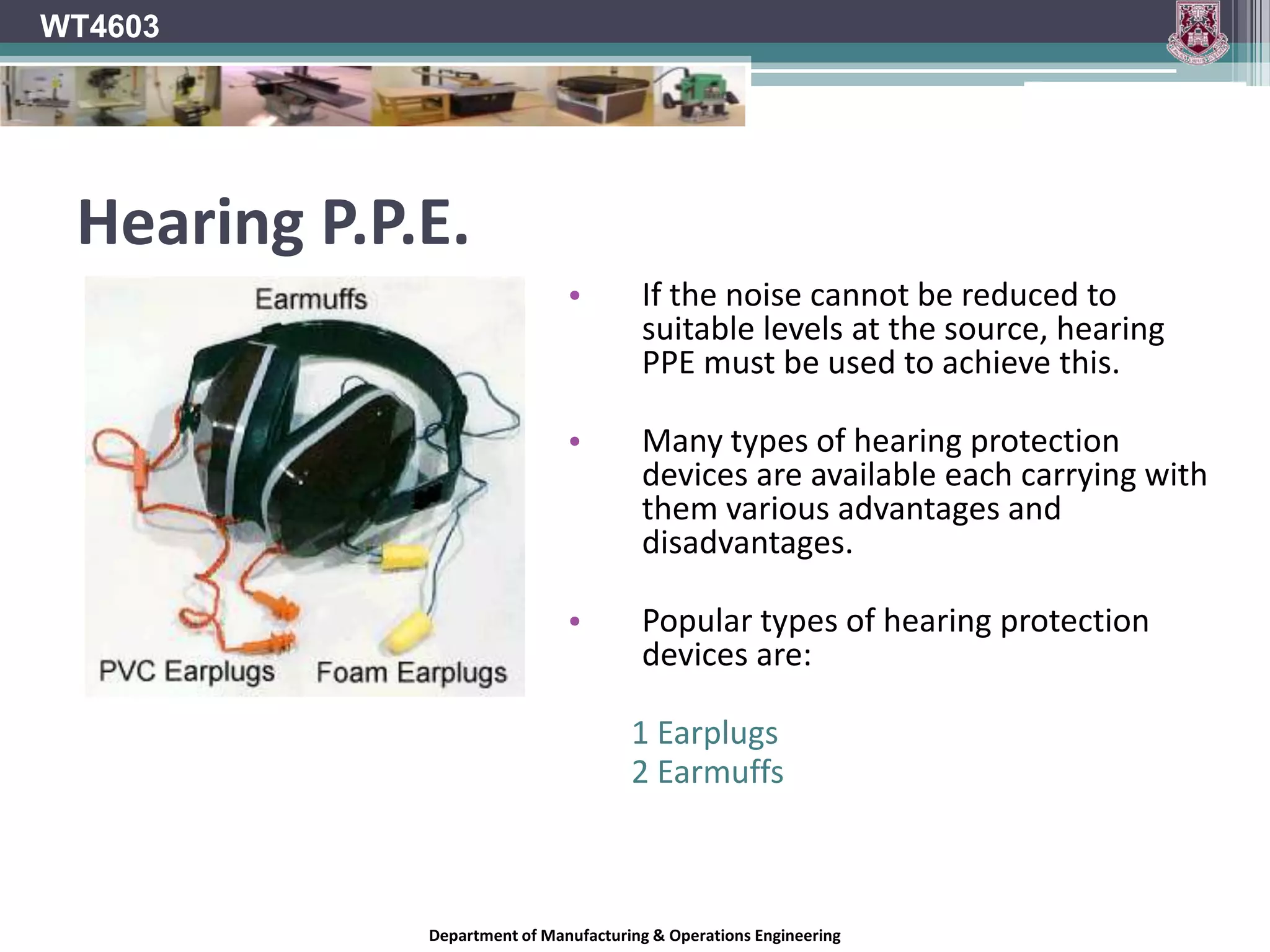
WT4603Hearing P.P.E.If the noise cannot be reduced to suitable levels at the source, hearing PPE must be used to achieve this.Many types of hearing protection devices are available each carrying with them various advantages and disadvantages.Popular types of hearing protection devices are: 1 Earplugs 2 EarmuffsDepartment of Manufacturing & Operations Engineering
WT4603When to Wear Hearing Protection.You should consider wearing Hearing Protection if;You work in an environment where you are exposed to continuous decibel levels of 80dB or greater over an 8 hour period.You are unusually fatigued after being in a noisy area.You experience ringing in your ears after being in a noisy area.You feel nervous or anxious after being in a noisy area.In order to be fully effective, hearing protection devices must be worn at all times in noisy environments.Removing for even a short period of time can decrease their effects substantially.Department of Manufacturing & Operations Engineering
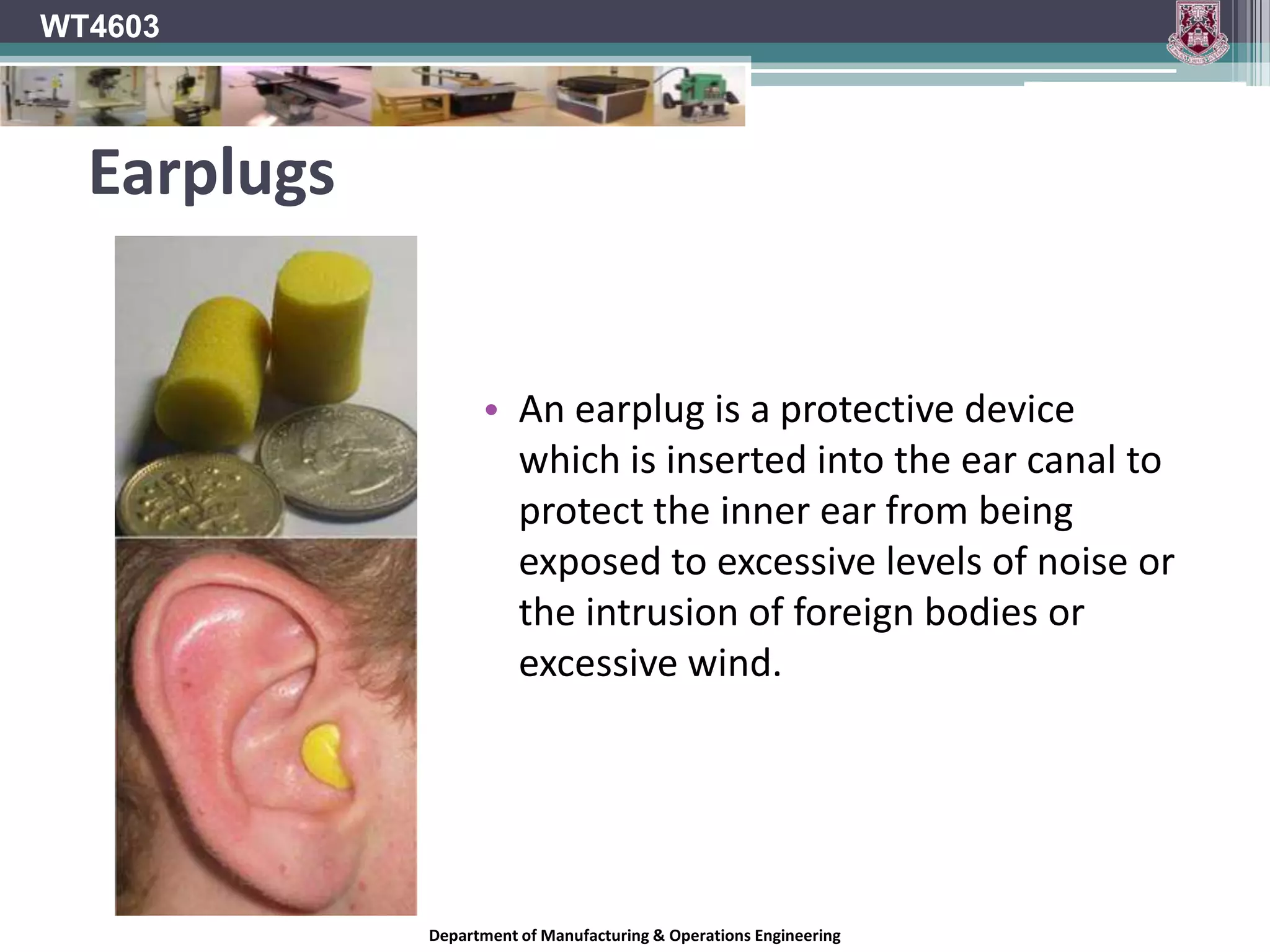
WT4603EarplugsAn earplug is a protective device which is inserted into the ear canal to protect the inner ear from being exposed to excessive levels of noise or the intrusion of foreign bodies or excessive wind.Department of Manufacturing & Operations Engineering
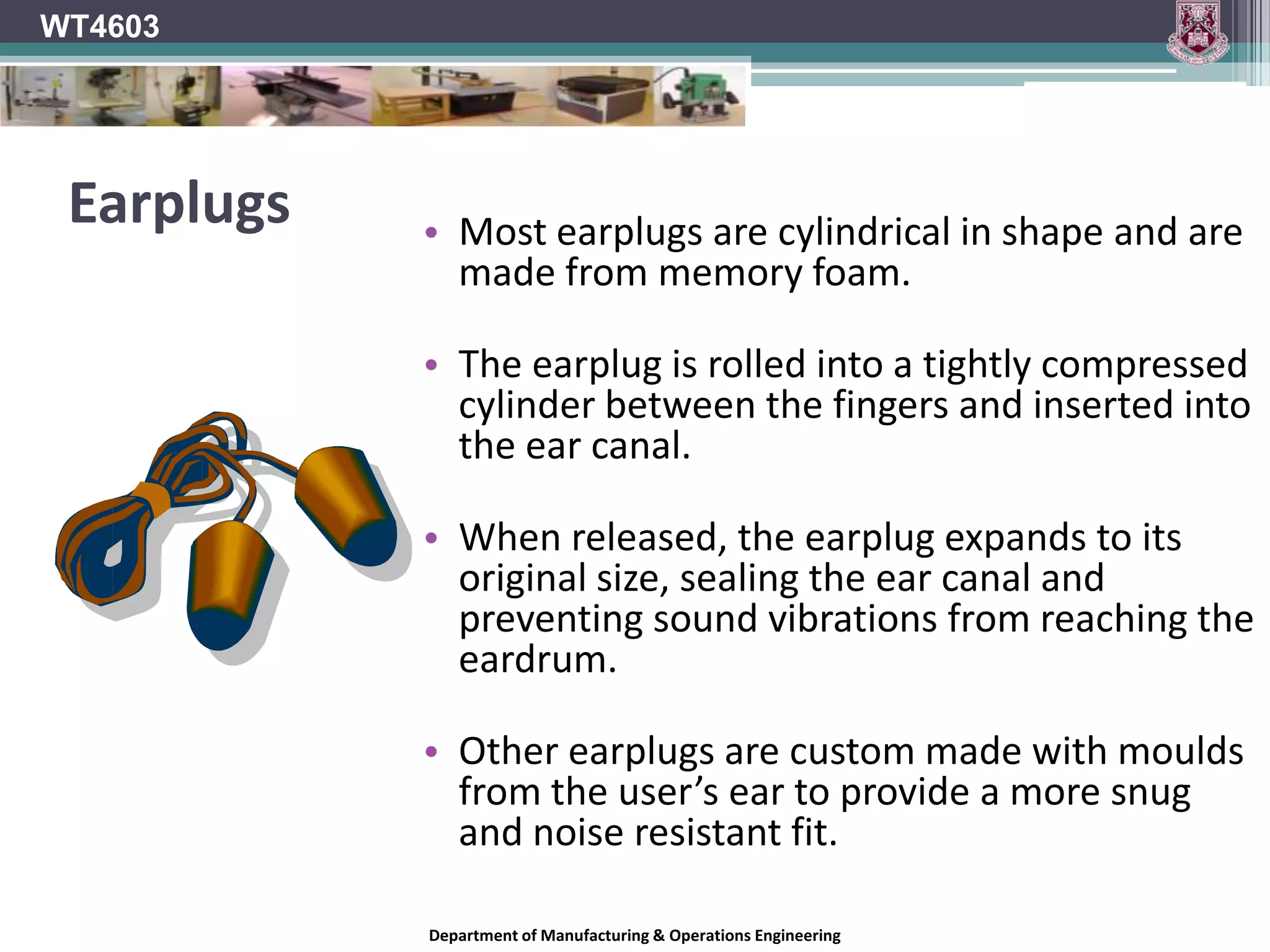
WT4603EarplugsMost earplugs are cylindrical in shape and are made from memory foam.The earplug is rolled into a tightly compressed cylinder between the fingers and inserted into the ear canal.When released, the earplug expands to its original size, sealing the ear canal and preventing sound vibrations from reaching the eardrum.Other earplugs are custom made with moulds from the user’s ear to provide a more snug and noise resistant fit.Department of Manufacturing & Operations Engineering
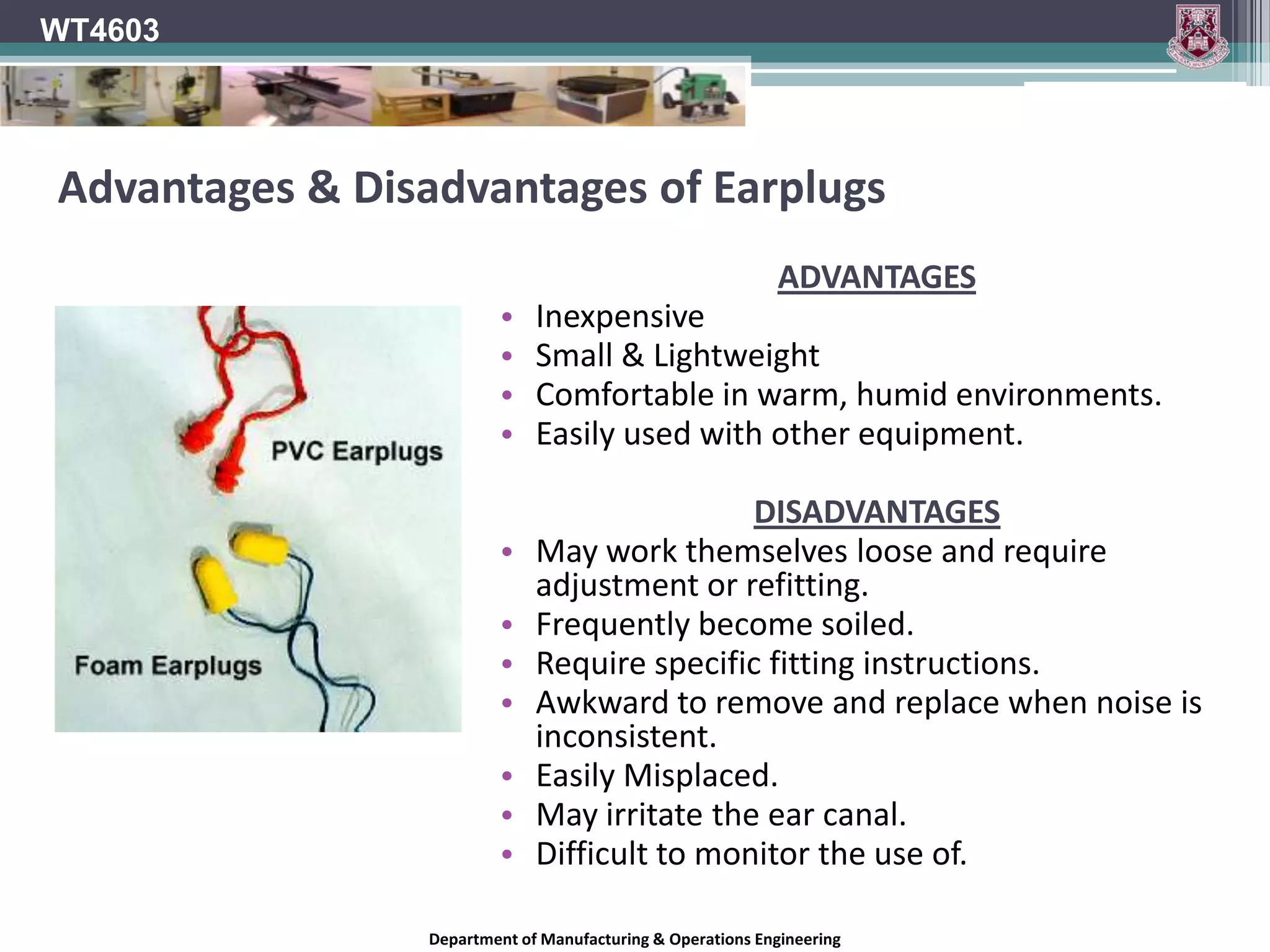
WT4603Advantages & Disadvantages of EarplugsADVANTAGESInexpensiveSmall & LightweightComfortable in warm, humid environments.Easily used with other equipment.DISADVANTAGESMay work themselves loose and require adjustment or refitting.Frequently become soiled.Require specific fitting instructions.Awkward to remove and replace when noise is inconsistent.Easily Misplaced.May irritate the ear canal.Difficult to monitor the use of.Department of Manufacturing & Operations Engineering
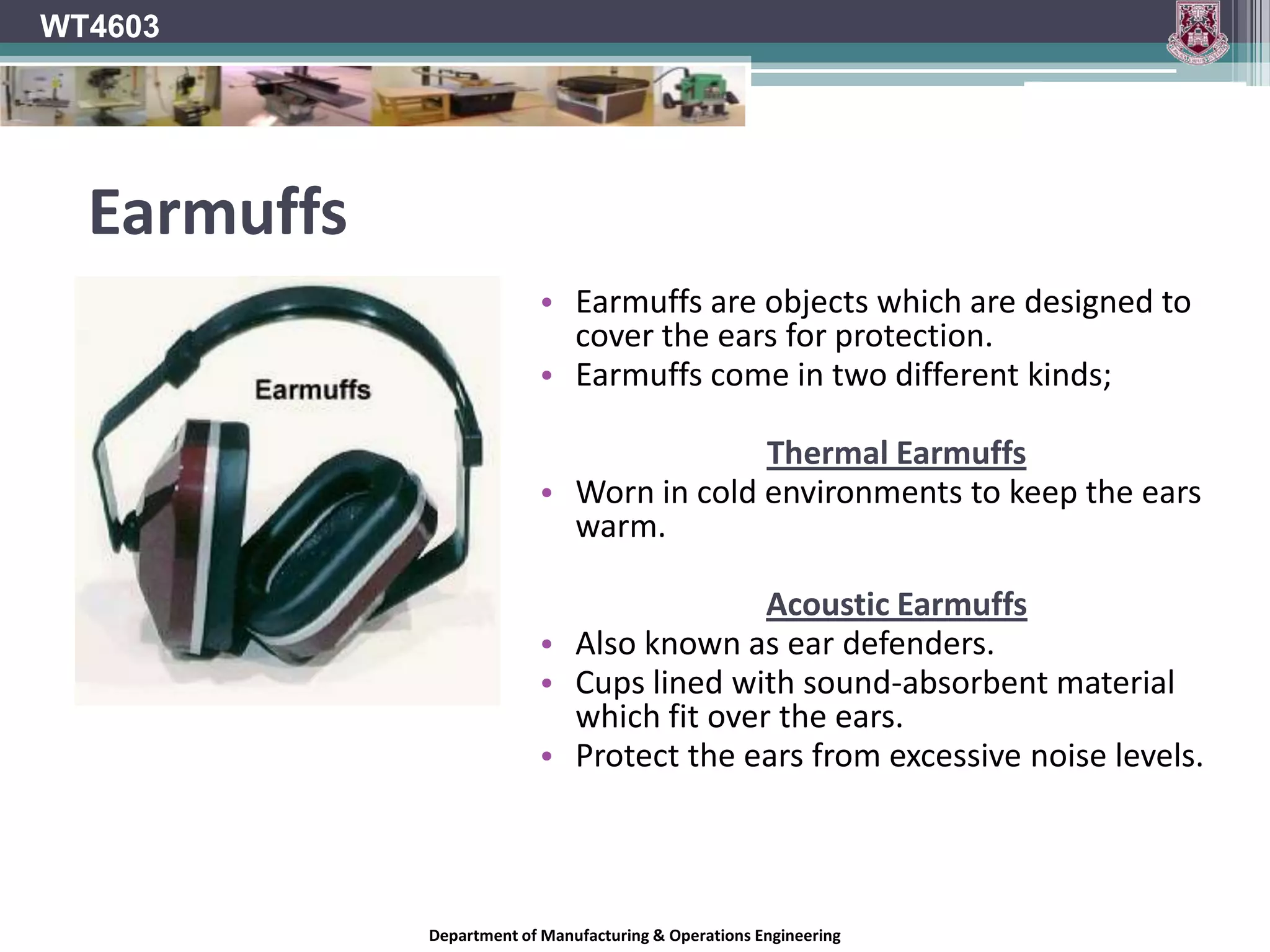
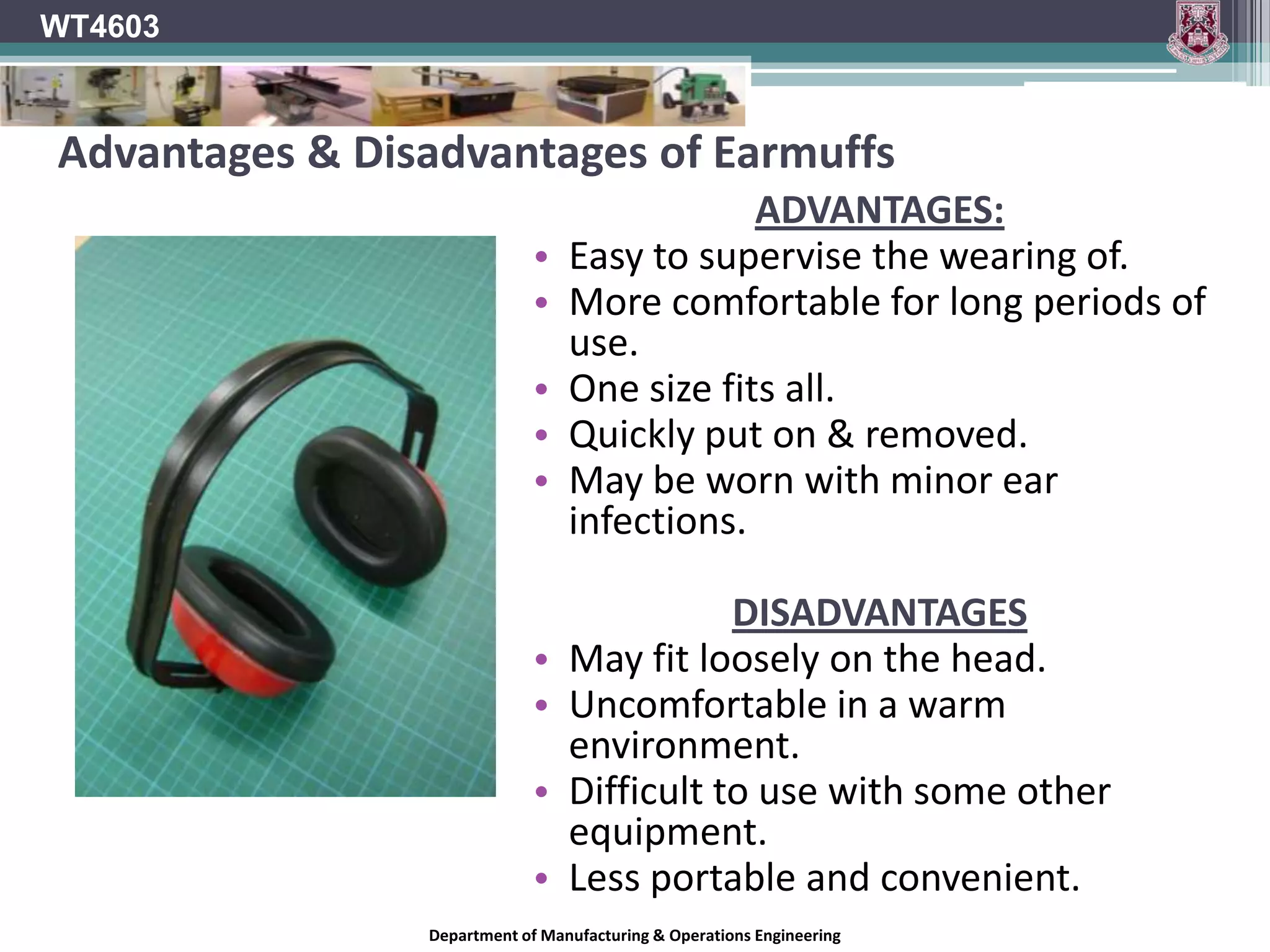
WT4603EarmuffsEarmuffs are objects which are designed to cover the ears for protection.Earmuffs come in two different kinds;Thermal EarmuffsWorn in cold environments to keep the ears warm.Acoustic EarmuffsAlso known as ear defenders.Cups lined with sound-absorbent material which fit over the ears.Protect the ears from excessive noise levels.Department of Manufacturing & Operations Engineering
WT4603Advantages & Disadvantages of EarmuffsADVANTAGES:Easy to supervise the wearing of.More comfortable for long periods of use.One size fits all.Quickly put on & removed.May be worn with minor ear infections.DISADVANTAGESMay fit loosely on the head.Uncomfortable in a warm environment.Difficult to use with some other equipment.Less portable and convenient.Department of Manufacturing & Operations Engineering
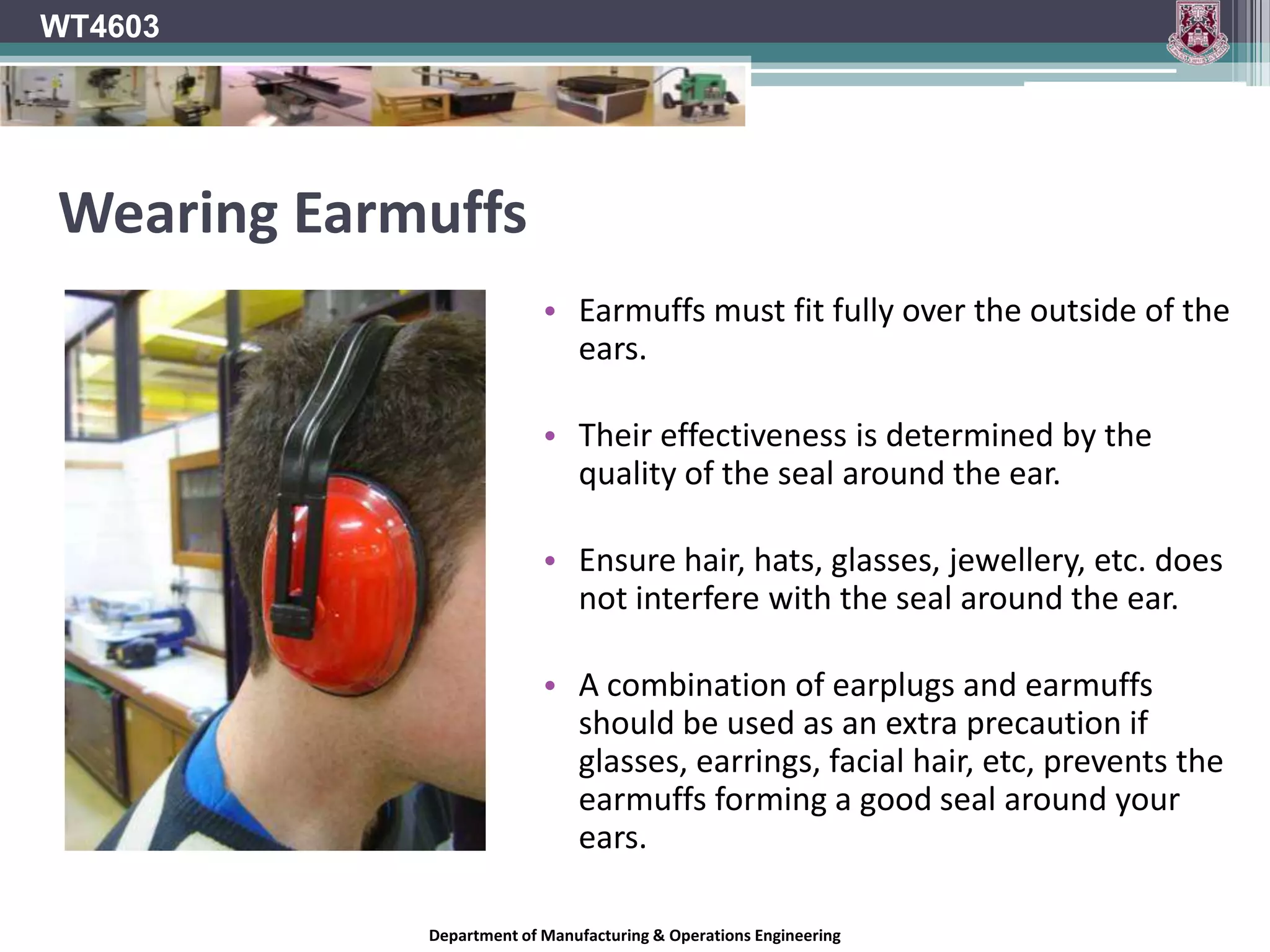
WT4603Wearing EarmuffsEarmuffs must fit fully over the outside of the ears.Their effectiveness is determined by the quality of the seal around the ear.Ensure hair, hats, glasses, jewellery, etc. does not interfere with the seal around the ear.A combination of earplugs and earmuffs should be used as an extra precaution if glasses, earrings, facial hair, etc, prevents the earmuffs forming a good seal around your ears.Department of Manufacturing & Operations Engineering
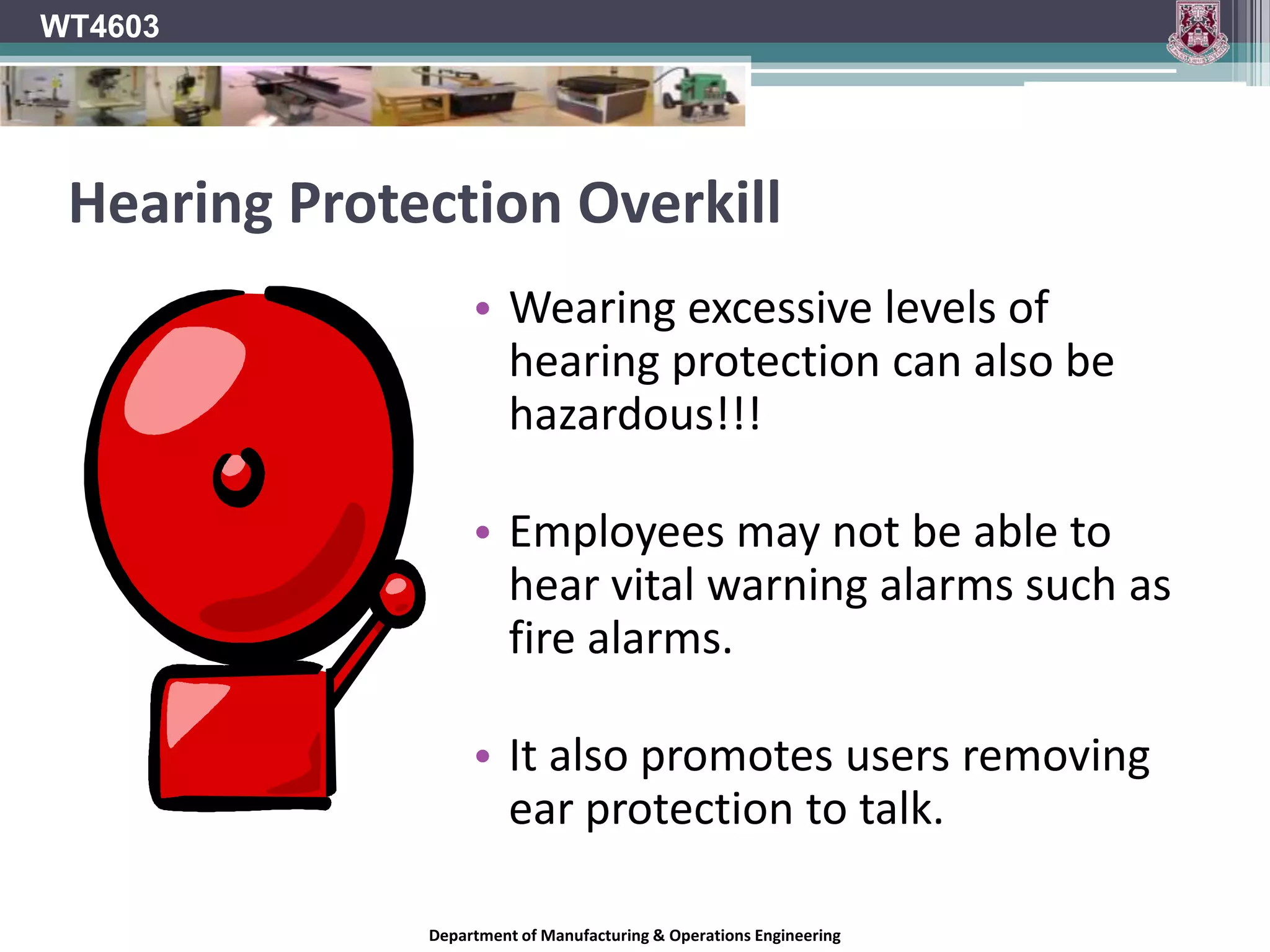
WT4603Hearing Protection OverkillWearing excessive levels of hearing protection can also be hazardous!!!Employees may not be able to hear vital warning alarms such as fire alarms.It also promotes users removing ear protection to talk.Department of Manufacturing & Operations Engineering
WT4603Caring for hearing protection devices - EarplugsWhen not using earplugs, they should be stored in a clean, cool and dry place.If Foam earplugs become soiled, they should be discarded and replaced with a clean pair.Soiled PVC earplugs can often be cleaned with soap and water.Replace PVC earplugs if they become torn or brittle.Check manufacturer’s instructions regarding washing earplugs.Department of Manufacturing & Operations Engineering
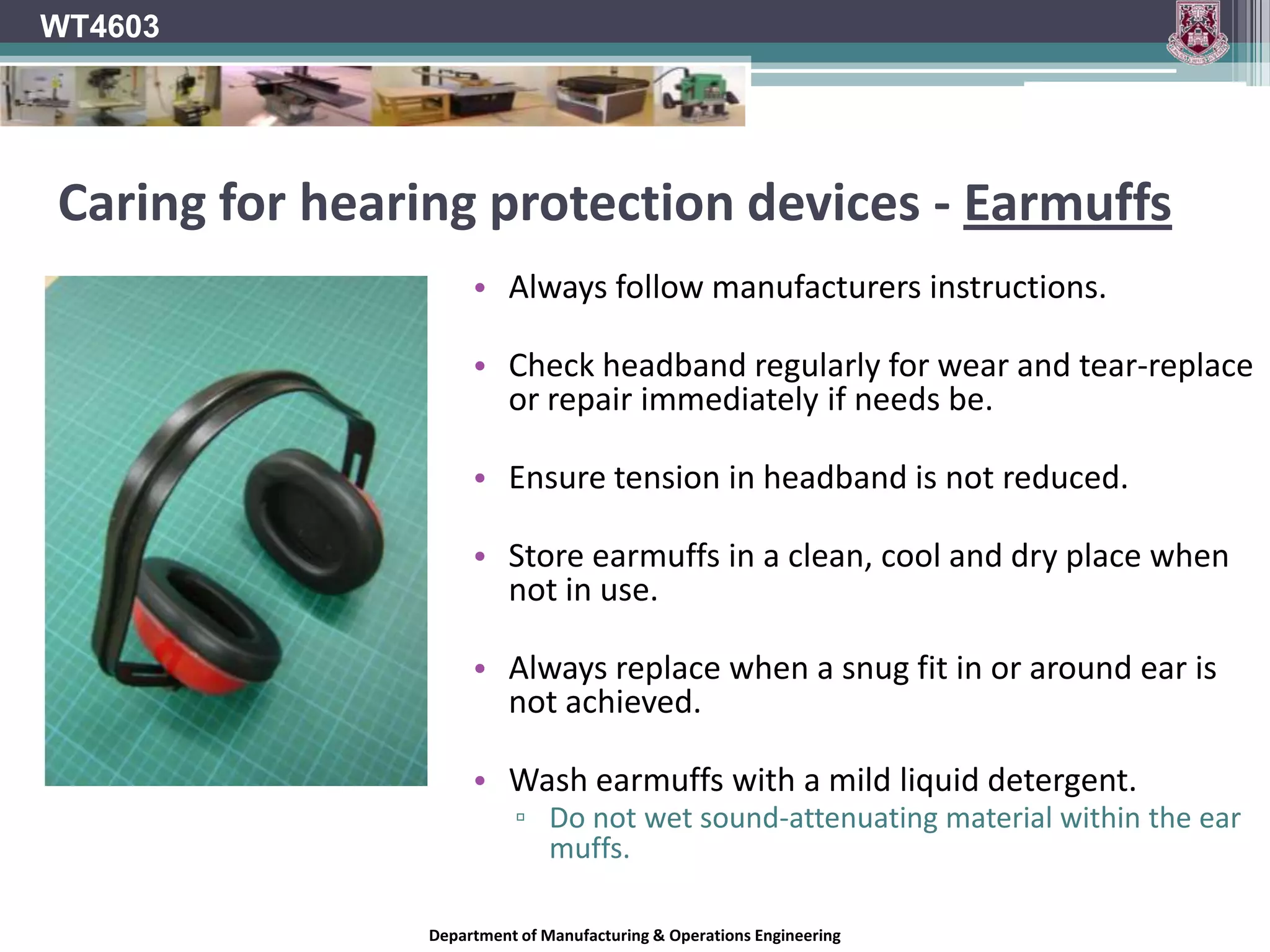
WT4603Caring for hearing protection devices - EarmuffsAlways follow manufacturers instructions.Check headband regularly for wear and tear-replace or repair immediately if needs be.Ensure tension in headband is not reduced.Store earmuffs in a clean, cool and dry place when not in use.Always replace when a snug fit in or around ear is not achieved.Wash earmuffs with a mild liquid detergent. Do not wet sound-attenuating material within the ear muffs.Department of Manufacturing & Operations Engineering
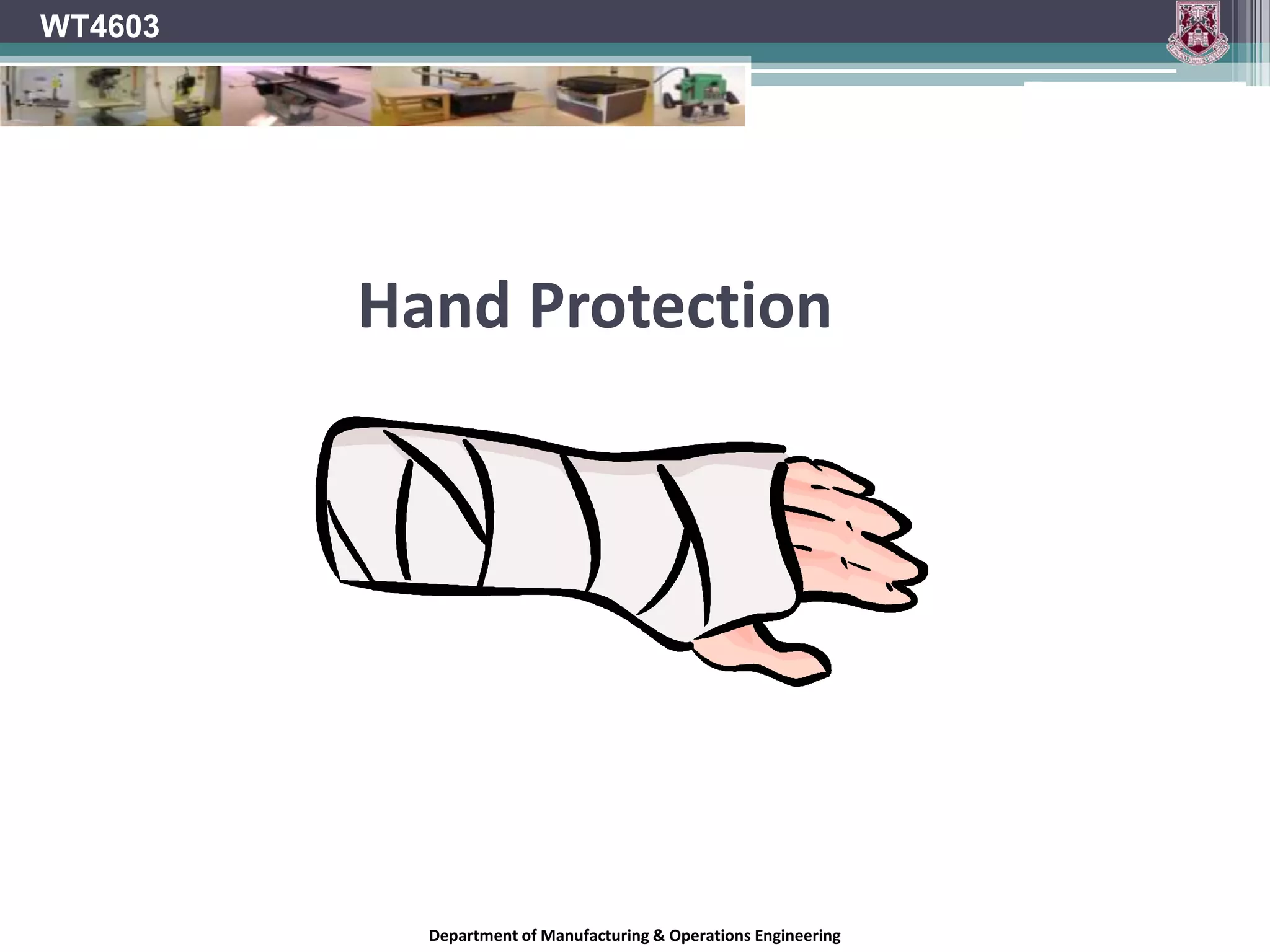
WT4603Hand ProtectionDepartment of Manufacturing & Operations Engineering
WT4603Hand ProtectionLook at your hands! They are the only two you will ever have. SO MIND THEM!Without the use of your fingers or hands, your ability to work or lead a normal life would be dramatically reduced.Department of Manufacturing & Operations Engineering
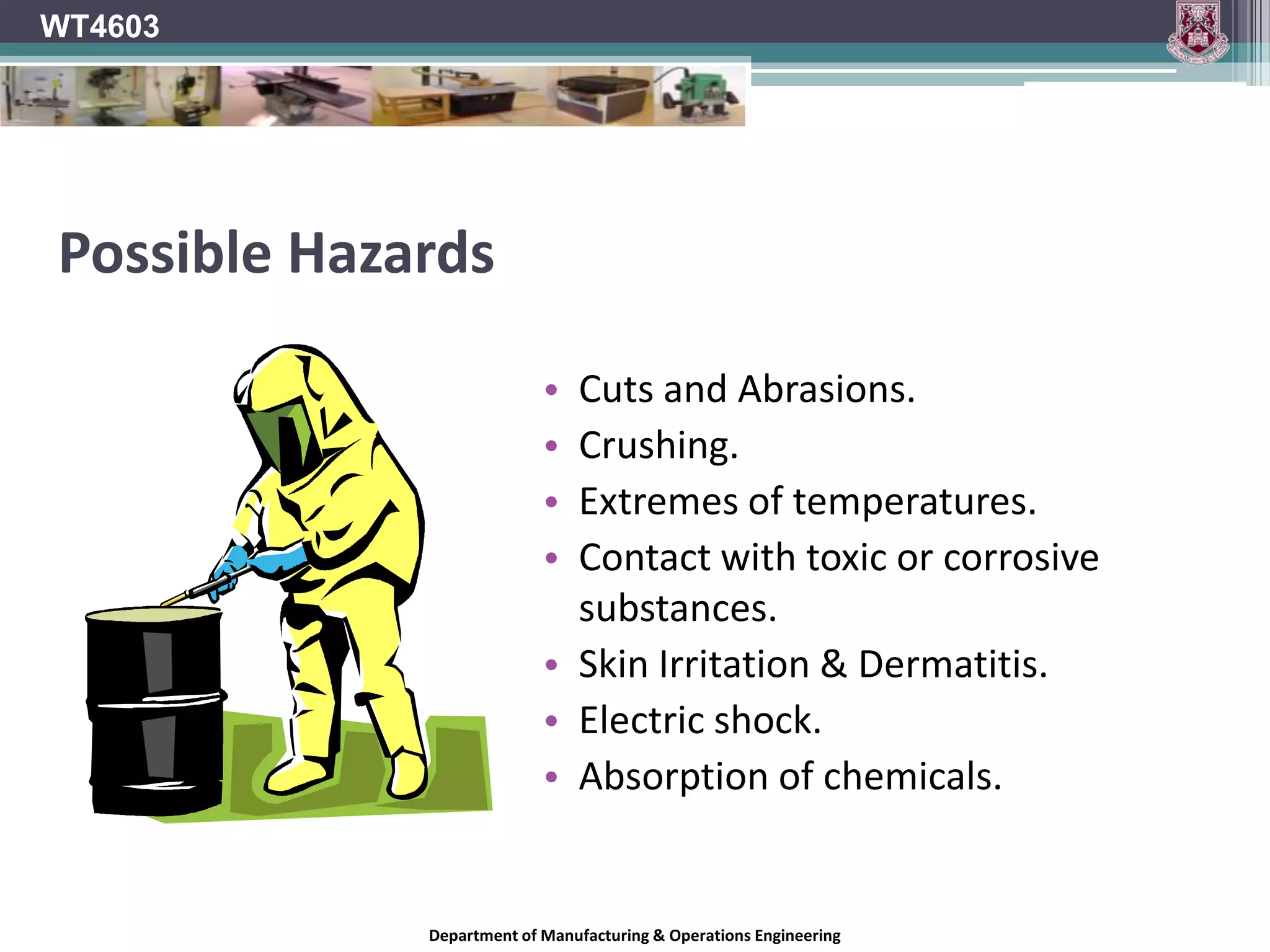
WT4603Possible HazardsCuts and Abrasions.Crushing.Extremes of temperatures.Contact with toxic or corrosive substances.Skin Irritation & Dermatitis.Electric shock.Absorption of chemicals.Department of Manufacturing & Operations Engineering
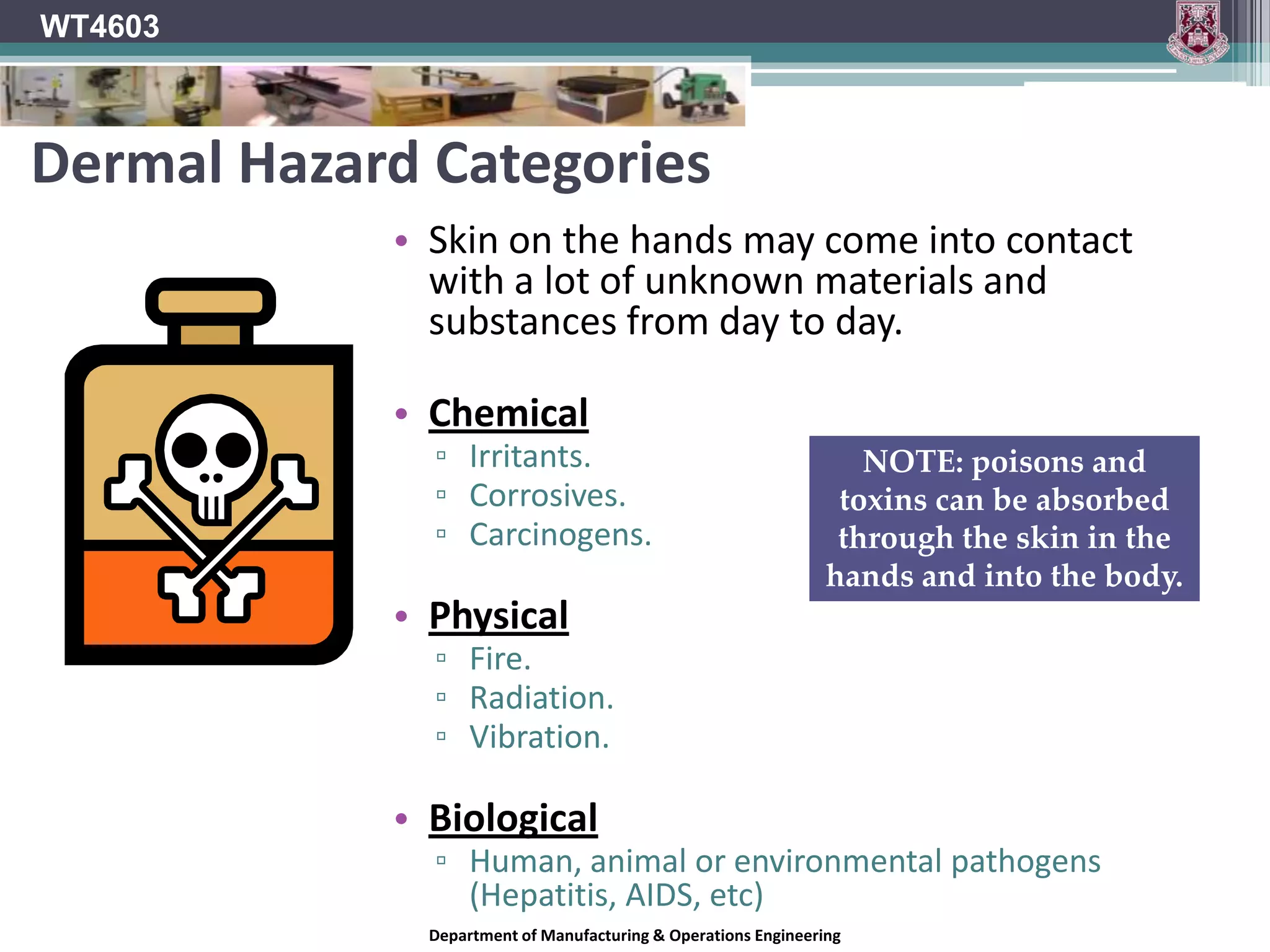
WT4603Dermal Hazard CategoriesSkin on the hands may come into contact with a lot of unknown materials and substances from day to day.ChemicalIrritants.Corrosives.Carcinogens.Physical Fire.Radiation.Vibration.BiologicalHuman, animal or environmental pathogens (Hepatitis, AIDS, etc)NOTE: poisons and toxins can be absorbed through the skin in the hands and into the body.Department of Manufacturing & Operations Engineering
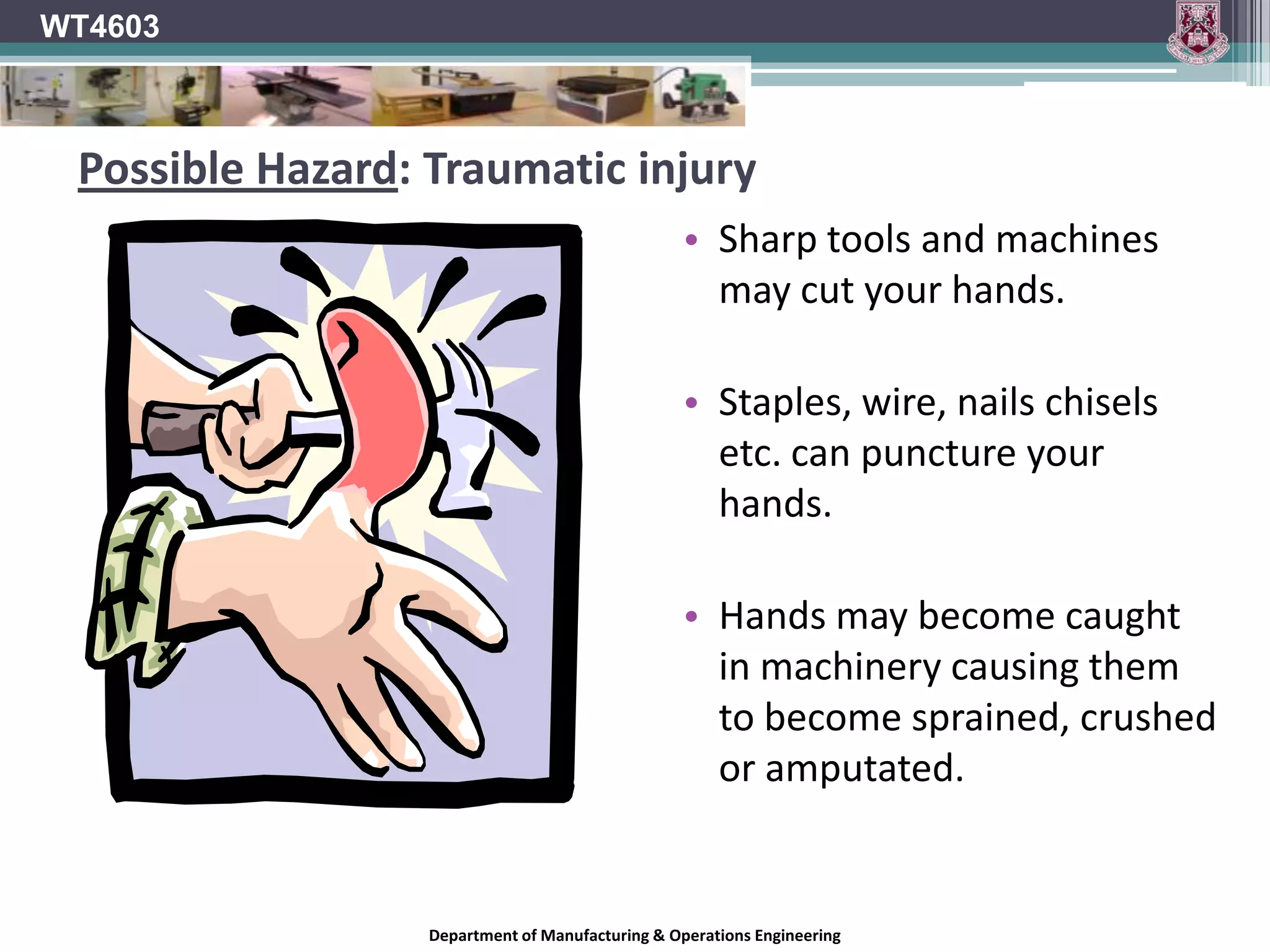
WT4603Possible Hazard: Traumatic injurySharp tools and machines may cut your hands.Staples, wire, nails chisels etc. can puncture your hands.Hands may become caught in machinery causing them to become sprained, crushed or amputated.Department of Manufacturing & Operations Engineering
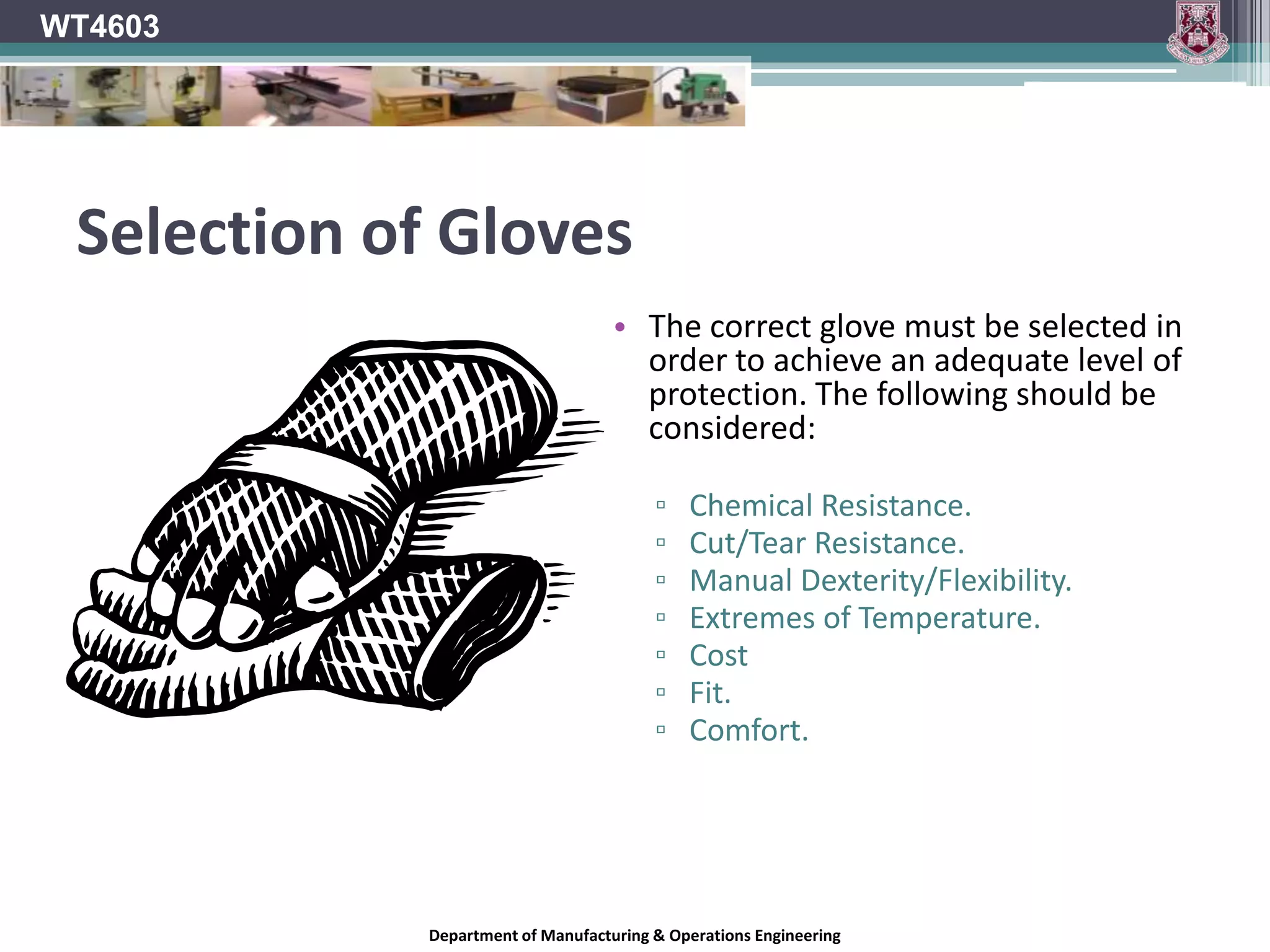
WT4603Selection of GlovesThe correct glove must be selected in order to achieve an adequate level of protection. The following should be considered:Chemical Resistance.Cut/Tear Resistance.Manual Dexterity/Flexibility.Extremes of Temperature.CostFit.Comfort.Department of Manufacturing & Operations Engineering
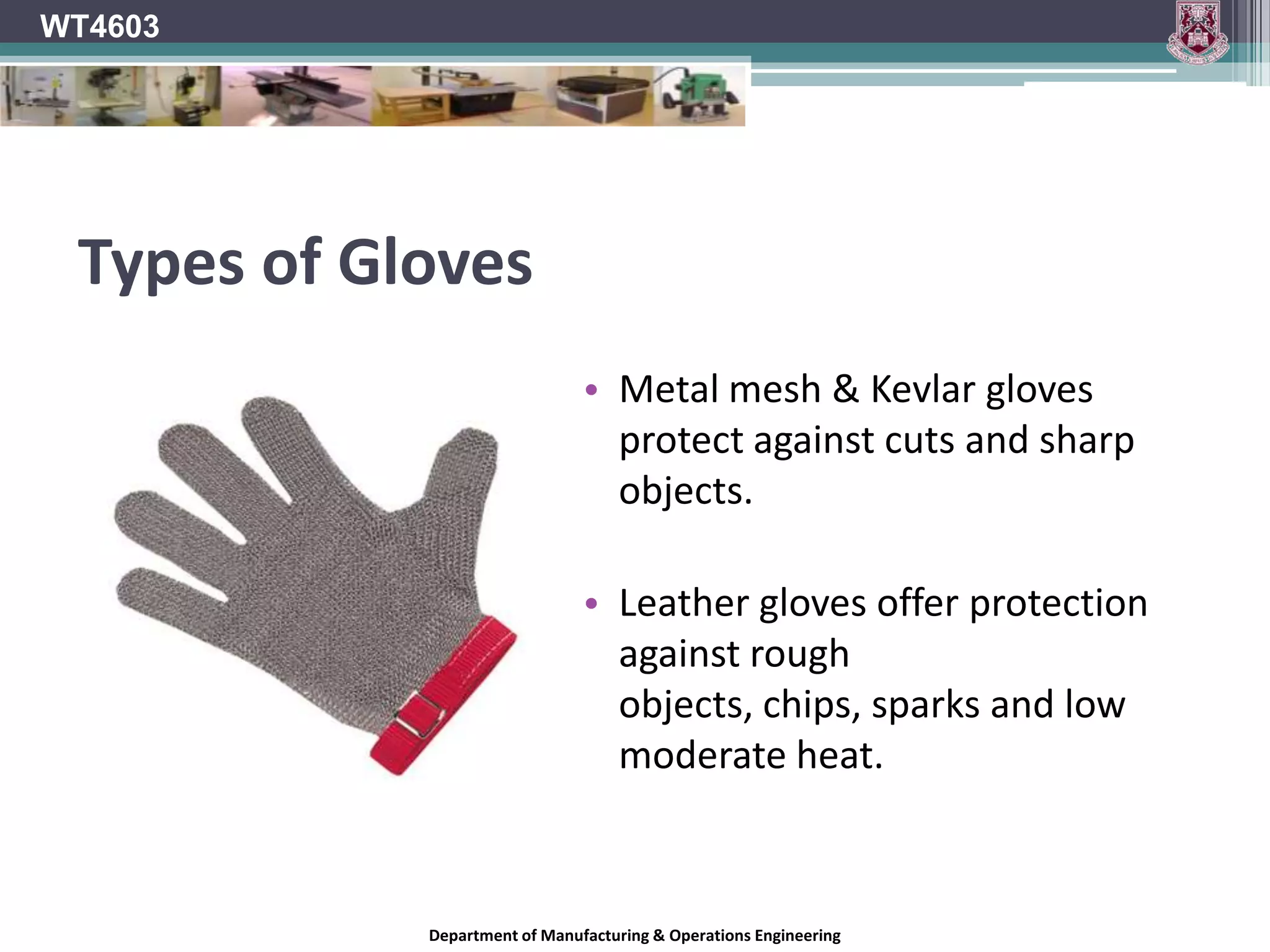
WT4603Types of GlovesMetal mesh & Kevlar gloves protect against cuts and sharp objects.Leather gloves offer protection against rough objects, chips, sparks and low moderate heat.Department of Manufacturing & Operations Engineering
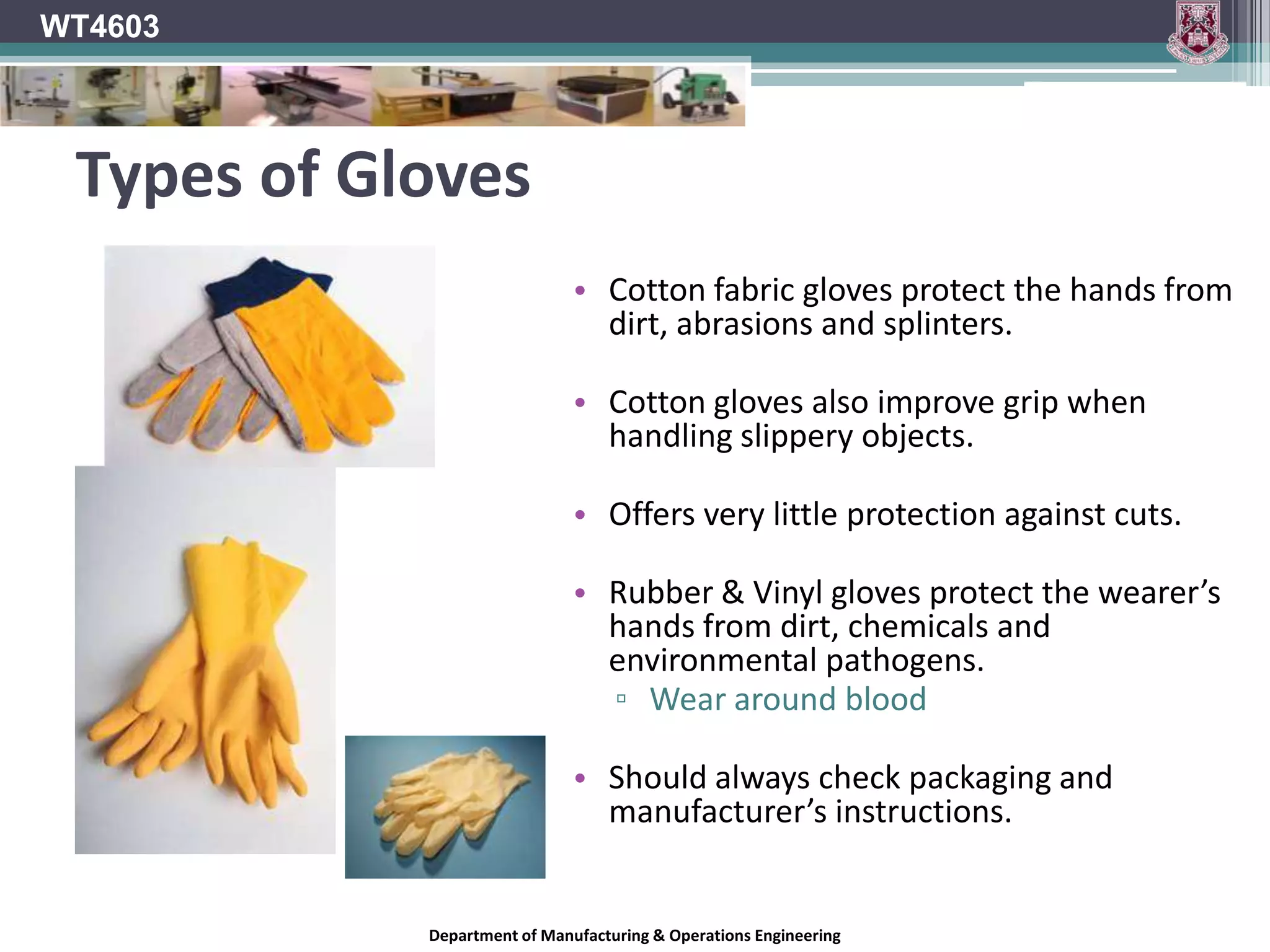
WT4603Types of GlovesCotton fabric gloves protect the hands from dirt, abrasions and splinters. Cotton gloves also improve grip when handling slippery objects.Offers very little protection against cuts.Rubber & Vinyl gloves protect the wearer’s hands from dirt, chemicals and environmental pathogens.Wear around bloodShould always check packaging and manufacturer’s instructions.Department of Manufacturing & Operations Engineering
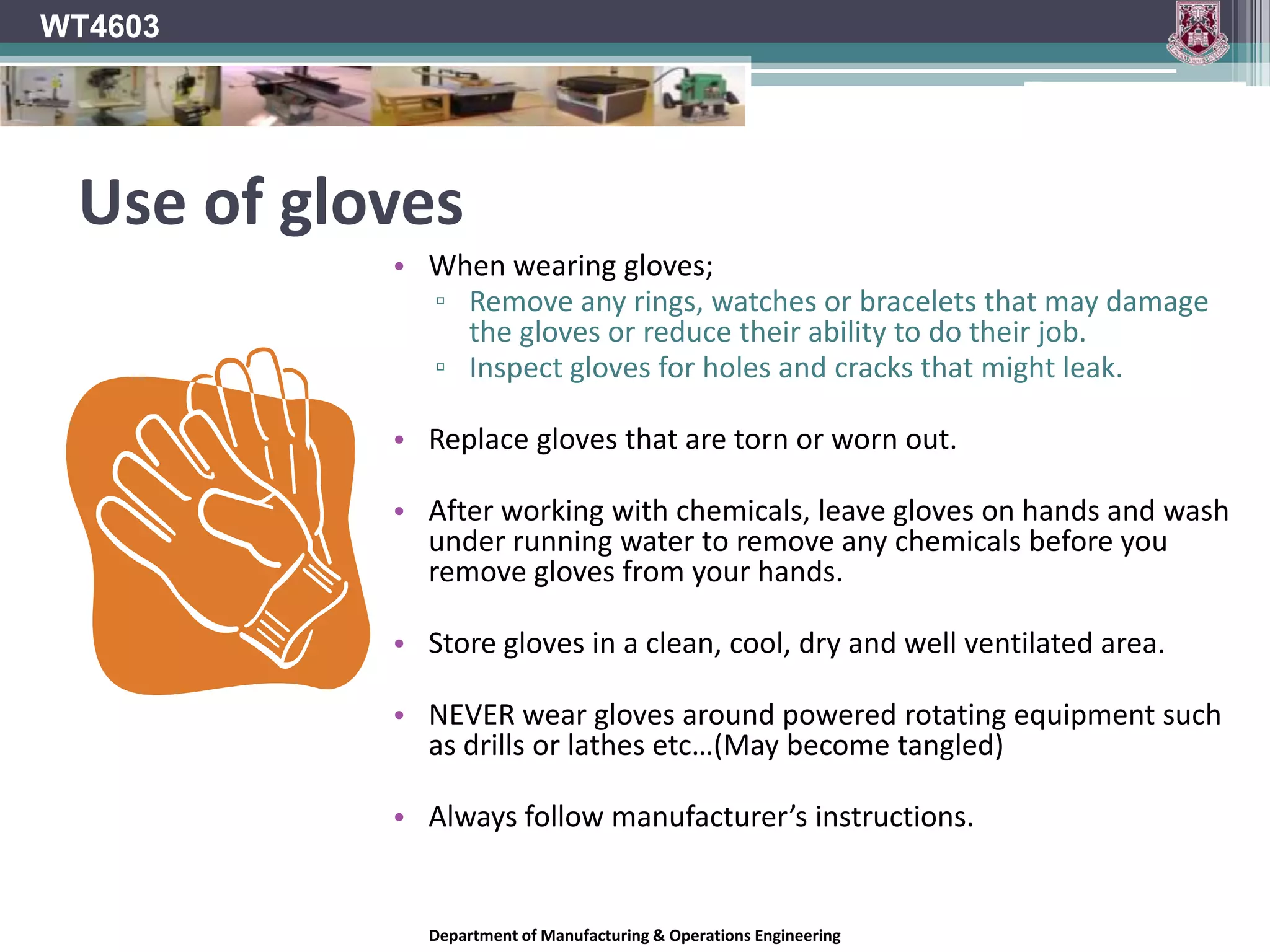
WT4603 Use of glovesWhen wearing gloves;Remove any rings, watches or bracelets that may damage the gloves or reduce their ability to do their job.Inspect gloves for holes and cracks that might leak.Replace gloves that are torn or worn out.After working with chemicals, leave gloves on hands and wash under running water to remove any chemicals before you remove gloves from your hands.Store gloves in a clean, cool, dry and well ventilated area.NEVER wear gloves around powered rotating equipment such as drills or lathes etc…(May become tangled)Always follow manufacturer’s instructions.Department of Manufacturing & Operations Engineering
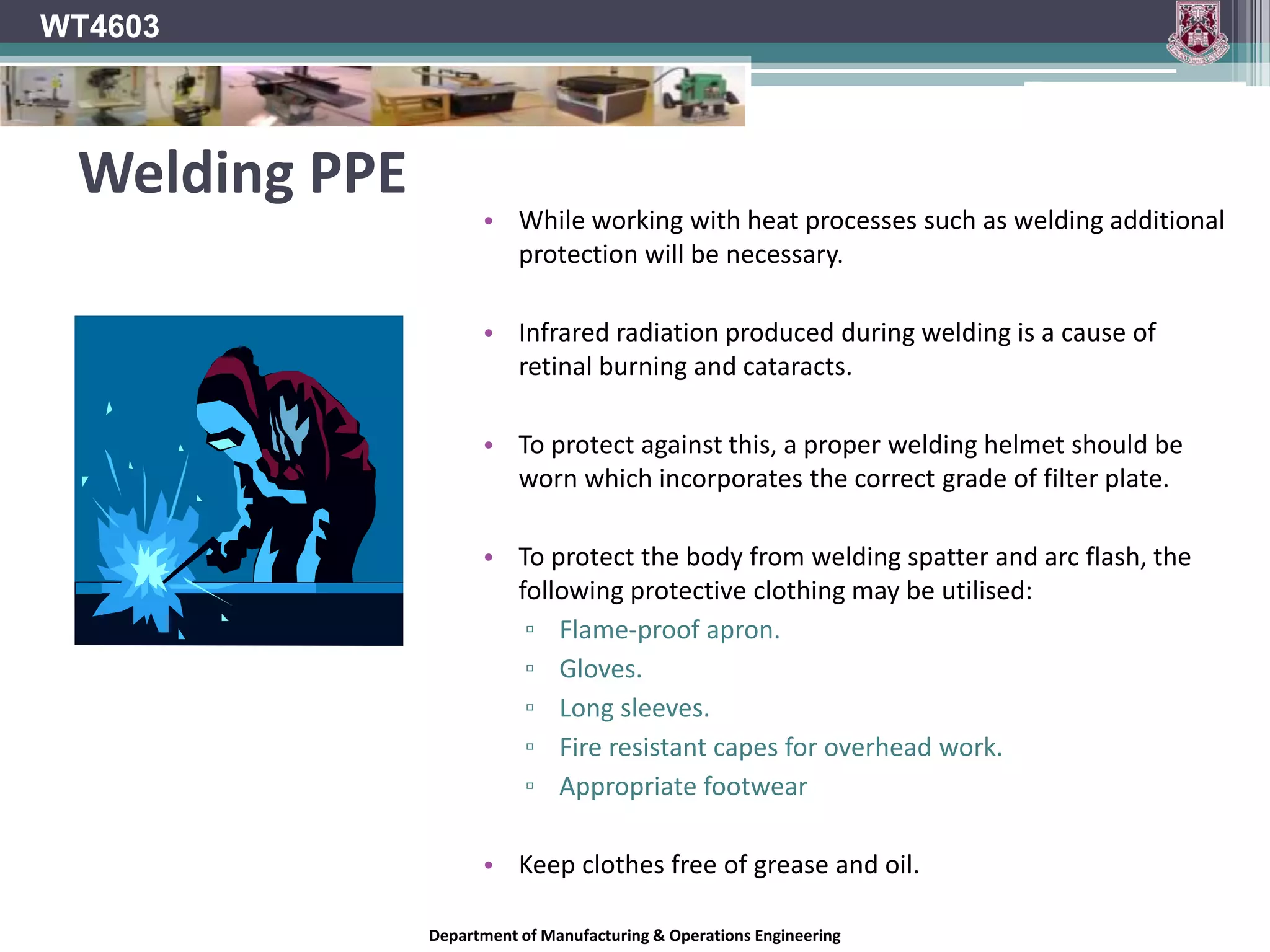
WT4603Welding PPEWhile working with heat processes such as welding additional protection will be necessary.Infrared radiation produced during welding is a cause of retinal burning and cataracts.To protect against this, a proper welding helmet should be worn which incorporates the correct grade of filter plate.To protect the body from welding spatter and arc flash, the following protective clothing may be utilised:Flame-proof apron.Gloves.Long sleeves.Fire resistant capes for overhead work.Appropriate footwearKeep clothes free of grease and oil.Department of Manufacturing & Operations Engineering
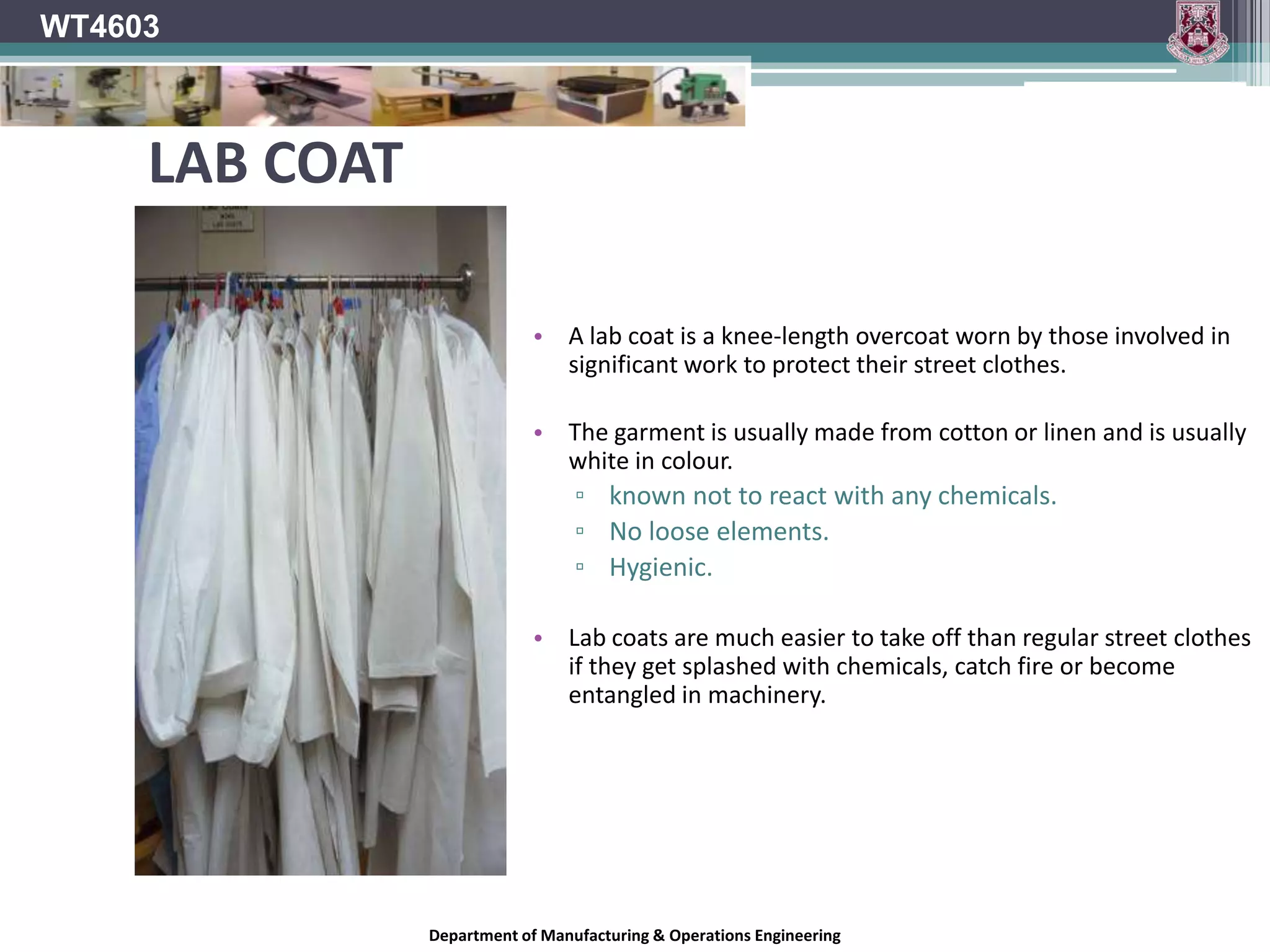
WT4603LAB COATA lab coat is a knee-length overcoat worn by those involved in significant work to protect their street clothes.The garment is usually made from cotton or linen and is usually white in colour.known not to react with any chemicals.No loose elements.Hygienic.Lab coats are much easier to take off than regular street clothes if they get splashed with chemicals, catch fire or become entangled in machinery.Department of Manufacturing & Operations Engineering
WT4603Encouraging use of PPEStudents should benefit from good example.Teacher should wear PPE whenever appropriate.Signage.Highlight importance of PPE using strategically placed safety signs.Teach safety as part of working, not just an add-on.Department of Manufacturing & Operations Engineering
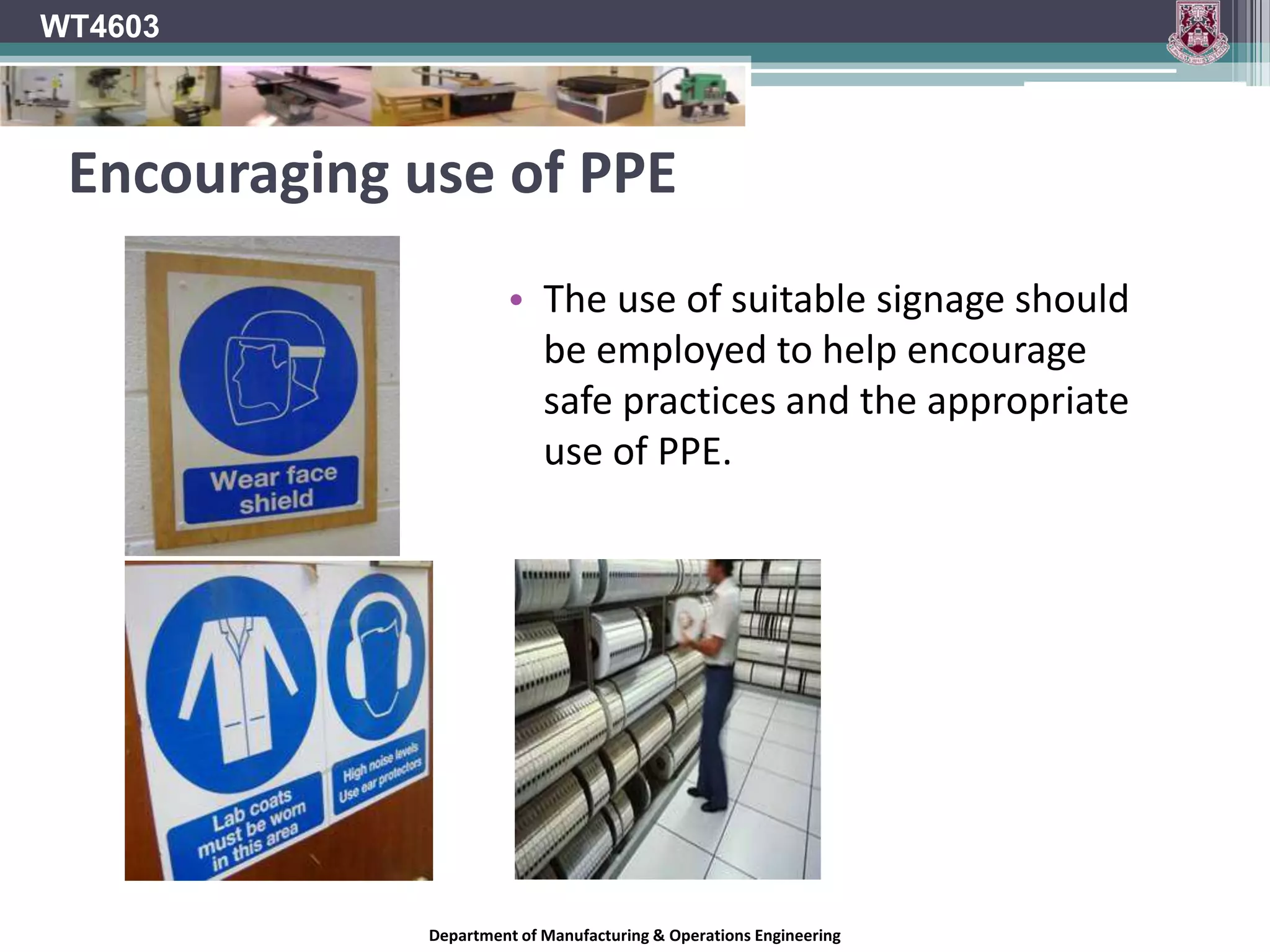
WT4603Encouraging use of PPEThe use of suitable signage should be employed to help encourage safe practices and the appropriate use of PPE.Department of Manufacturing & Operations Engineering
WT4603Process SheetsDepartment of Manufacturing & Operations Engineering
WT4603Department of Manufacturing & Operations Engineering
WT4603Creating a Cutting ListDepartment of Manufacturing & Operations Engineering
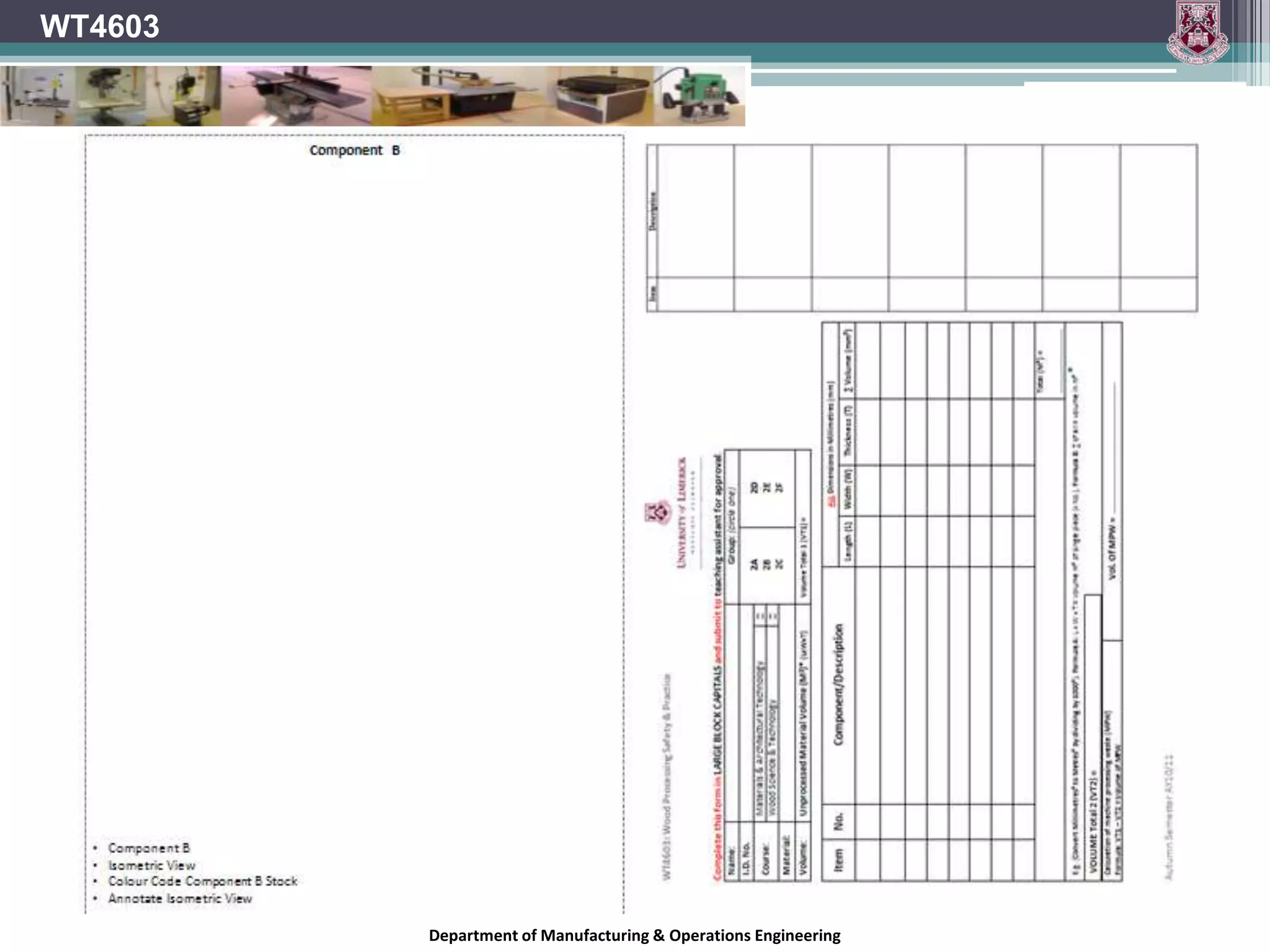
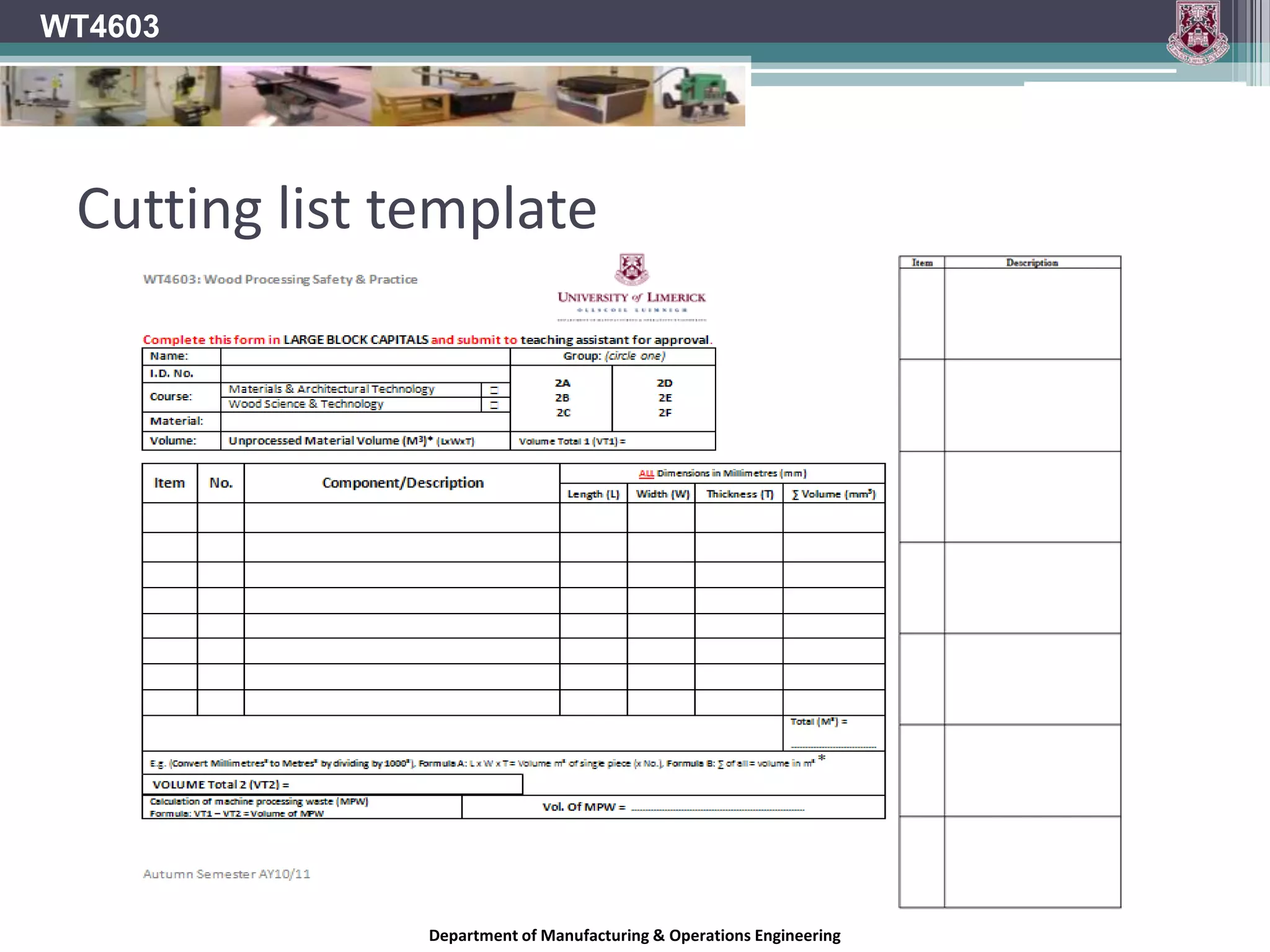
WT4603Creating a cutting listA cutting list is a document that allows the material processor to calculate volumes of material and to formulate a processing procedureThe list must contain the critical dimensions of the materialCutting lists must have a standard format to enable the processor to operate efficientlyThe next slide shows the UL format for compiling a cutting list.This template must be used when making a submission for material.Lists that are outside this template will not be processed.Department of Manufacturing & Operations Engineering
WT4603Cutting list templateDepartment of Manufacturing & Operations Engineering
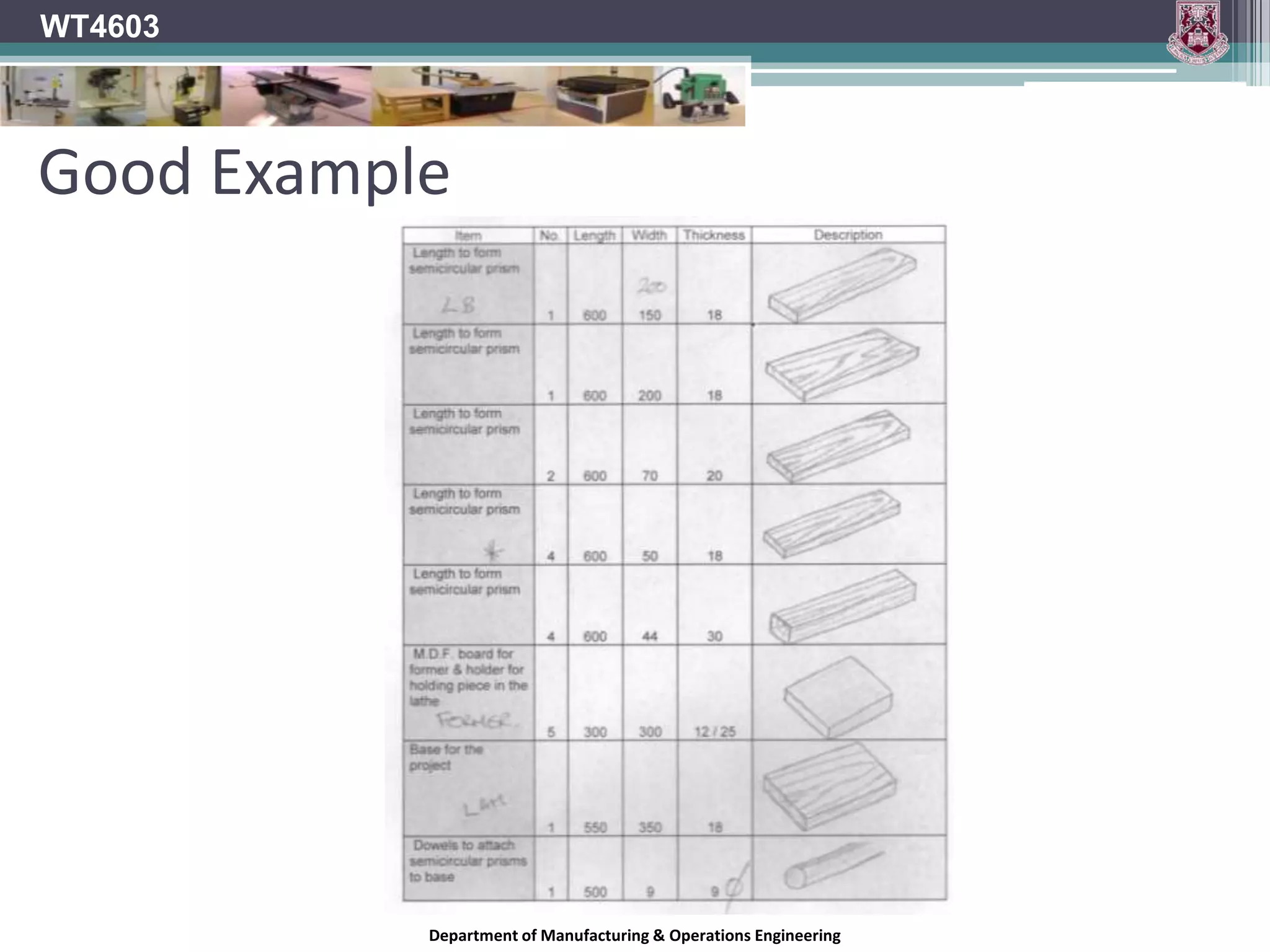
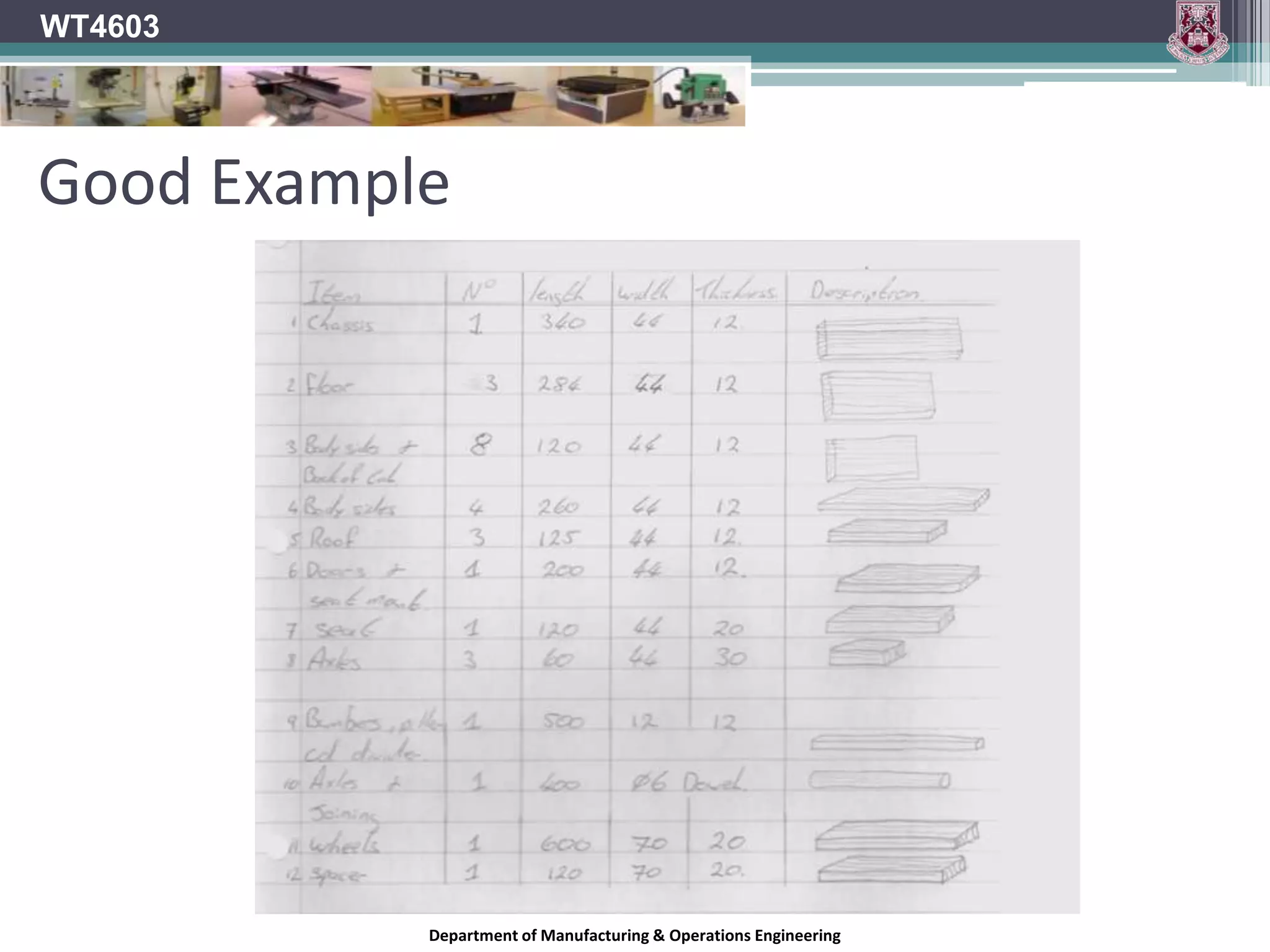
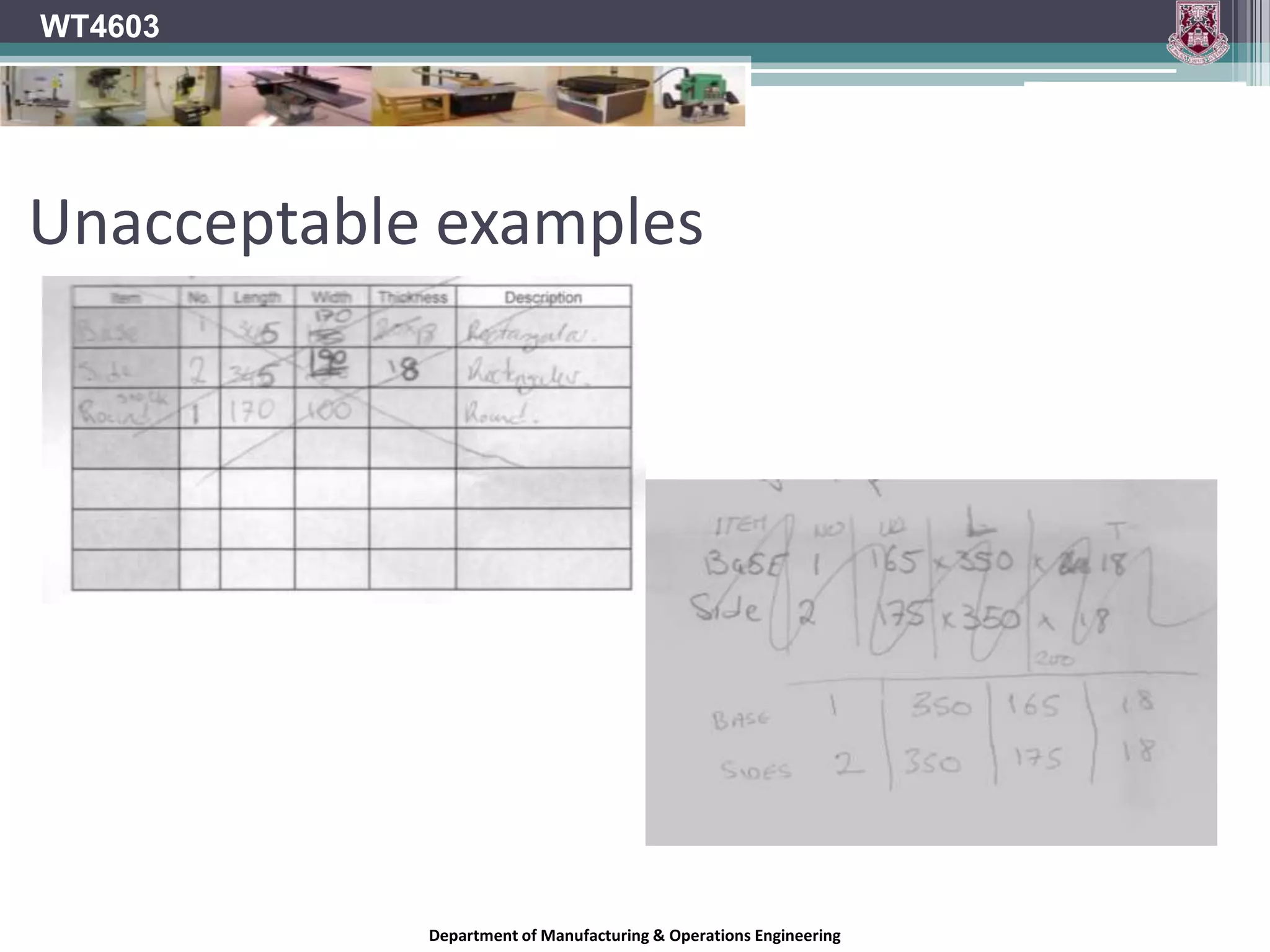
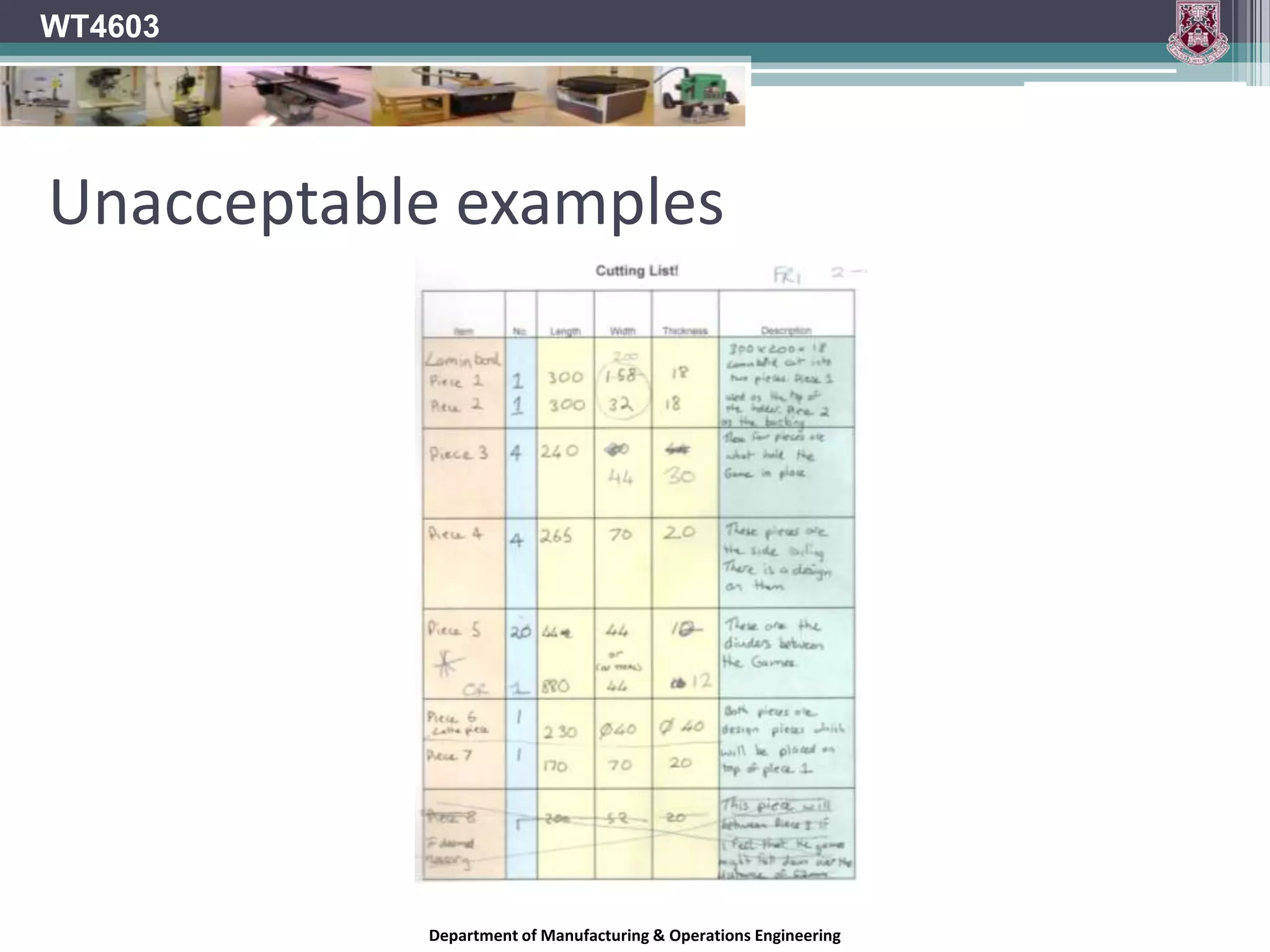
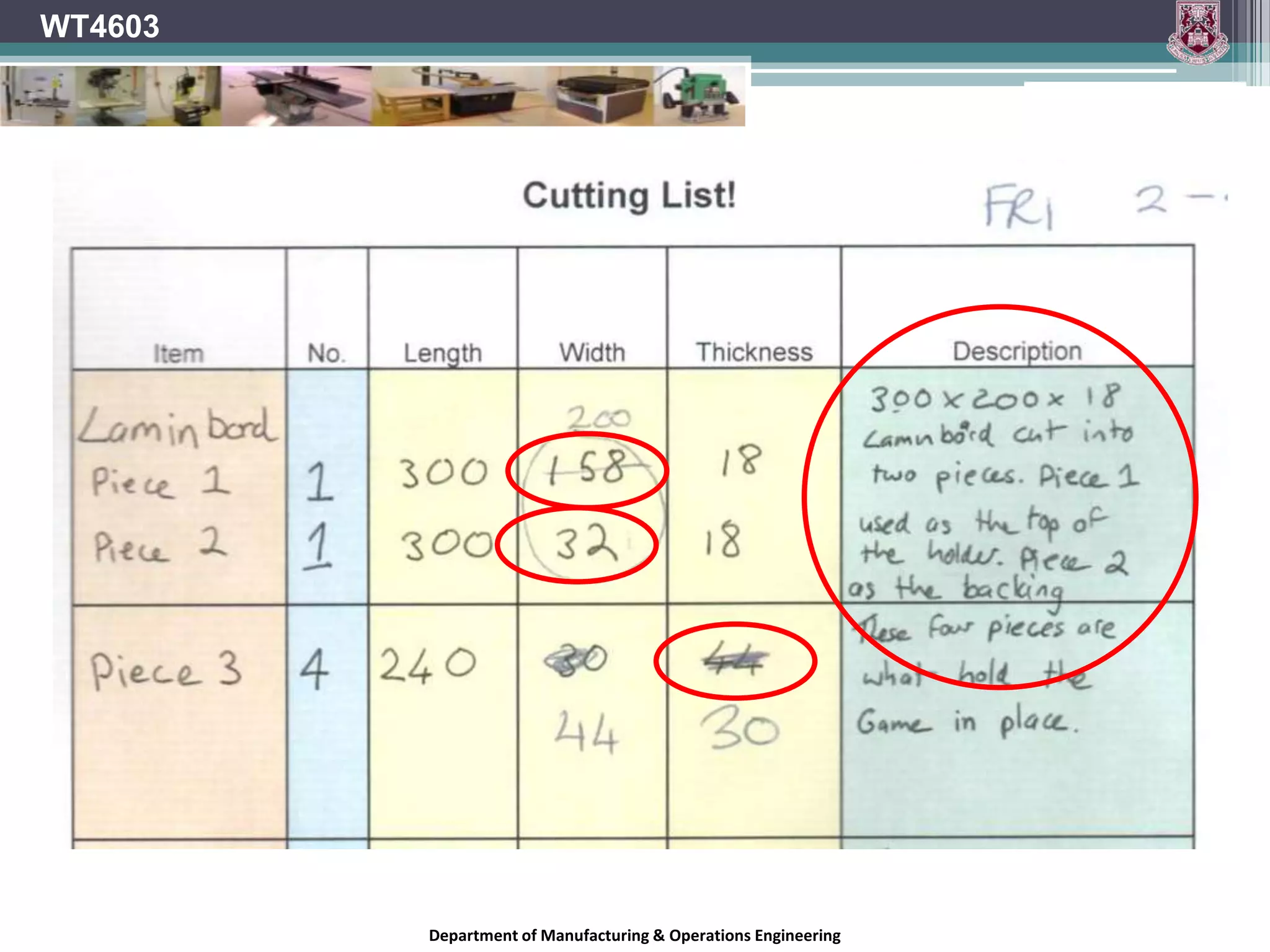
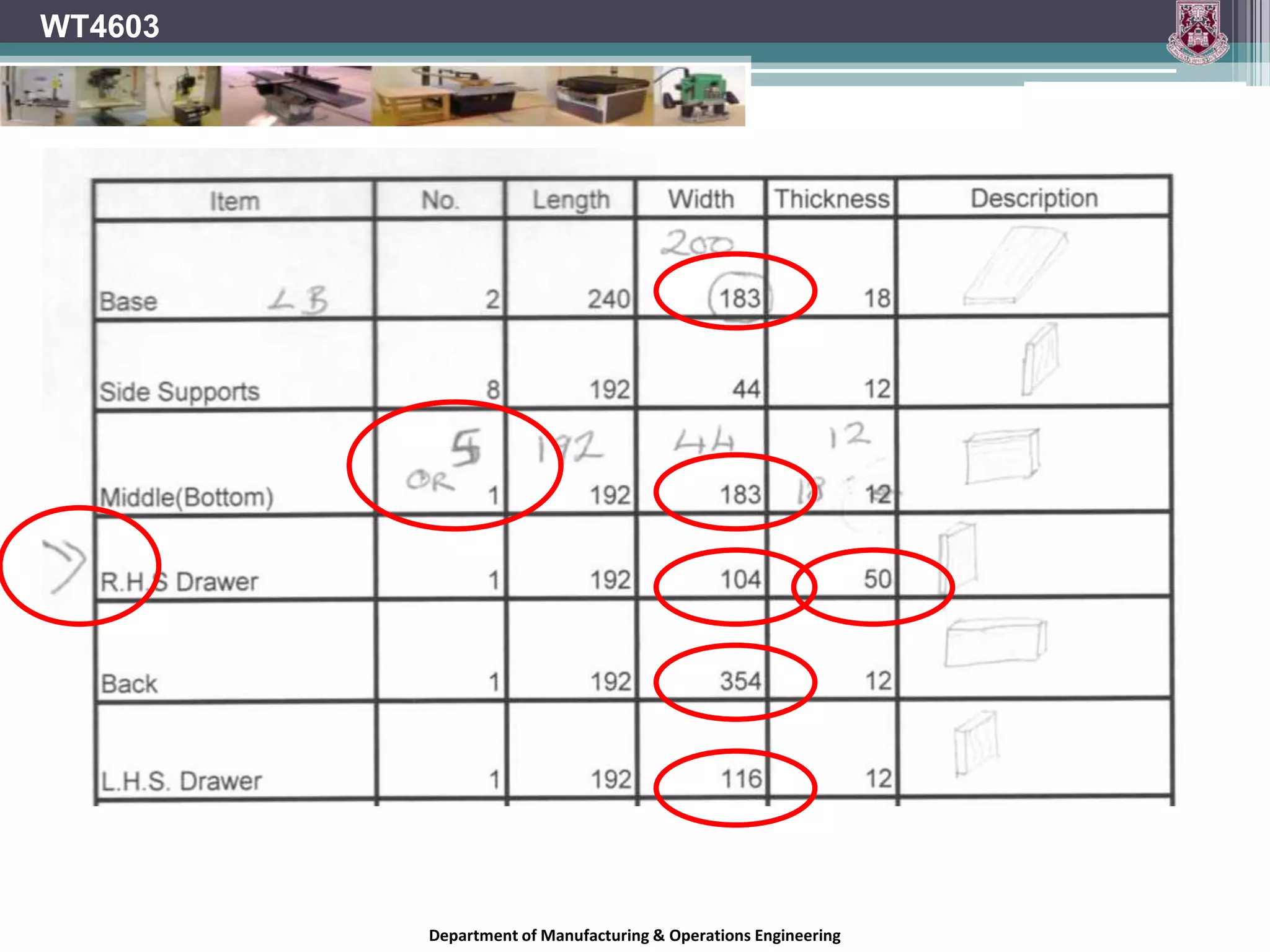
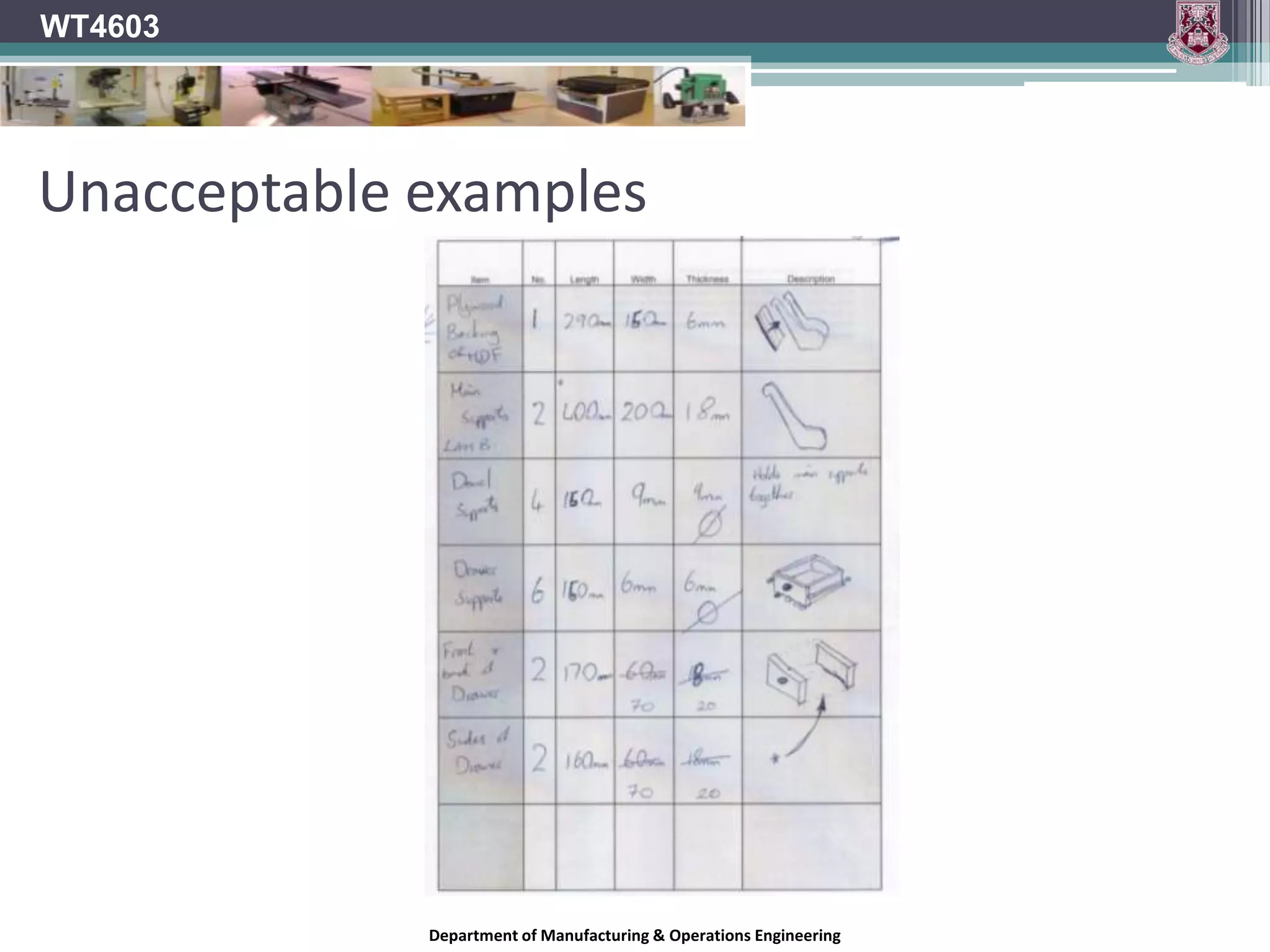
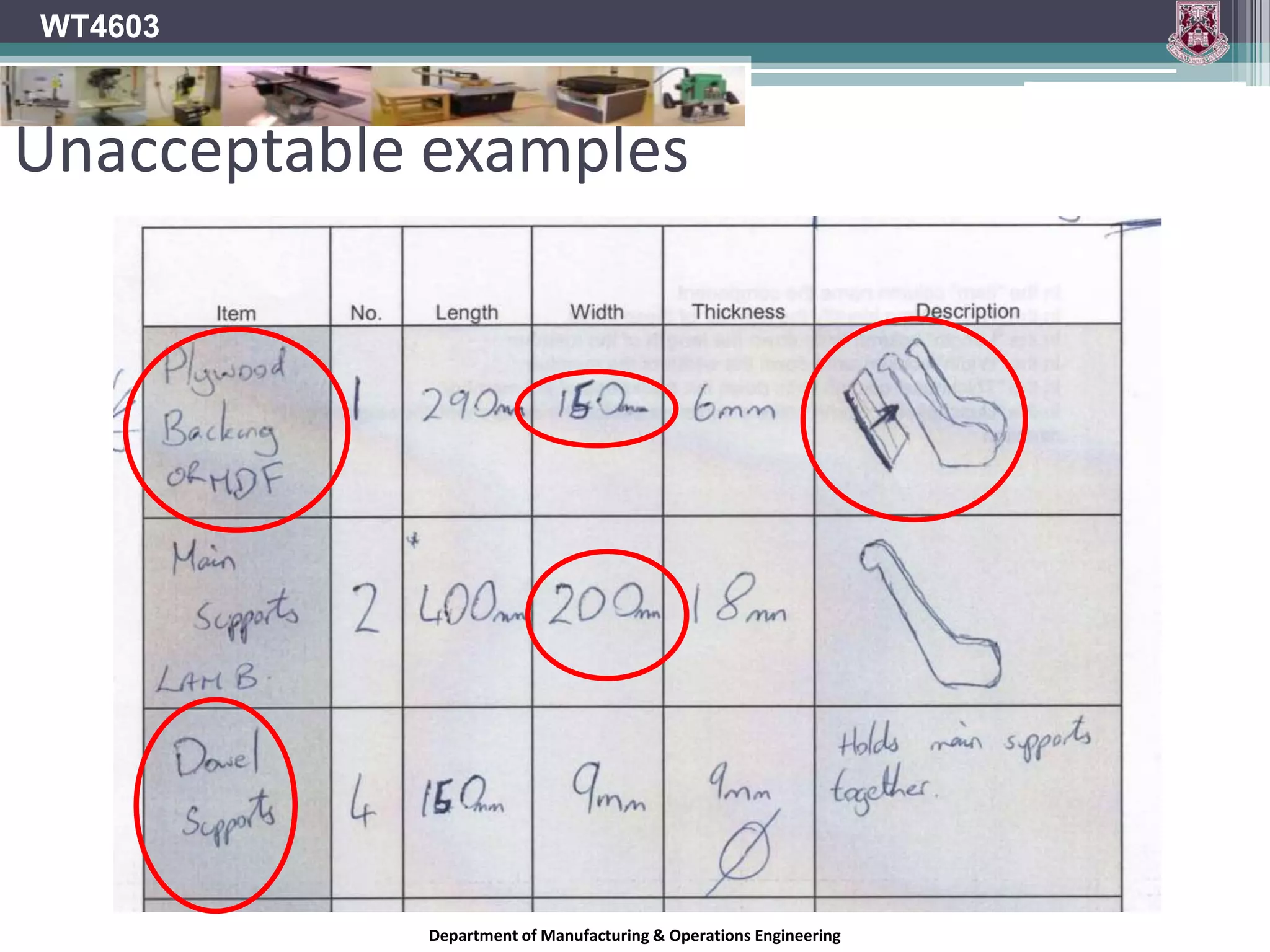
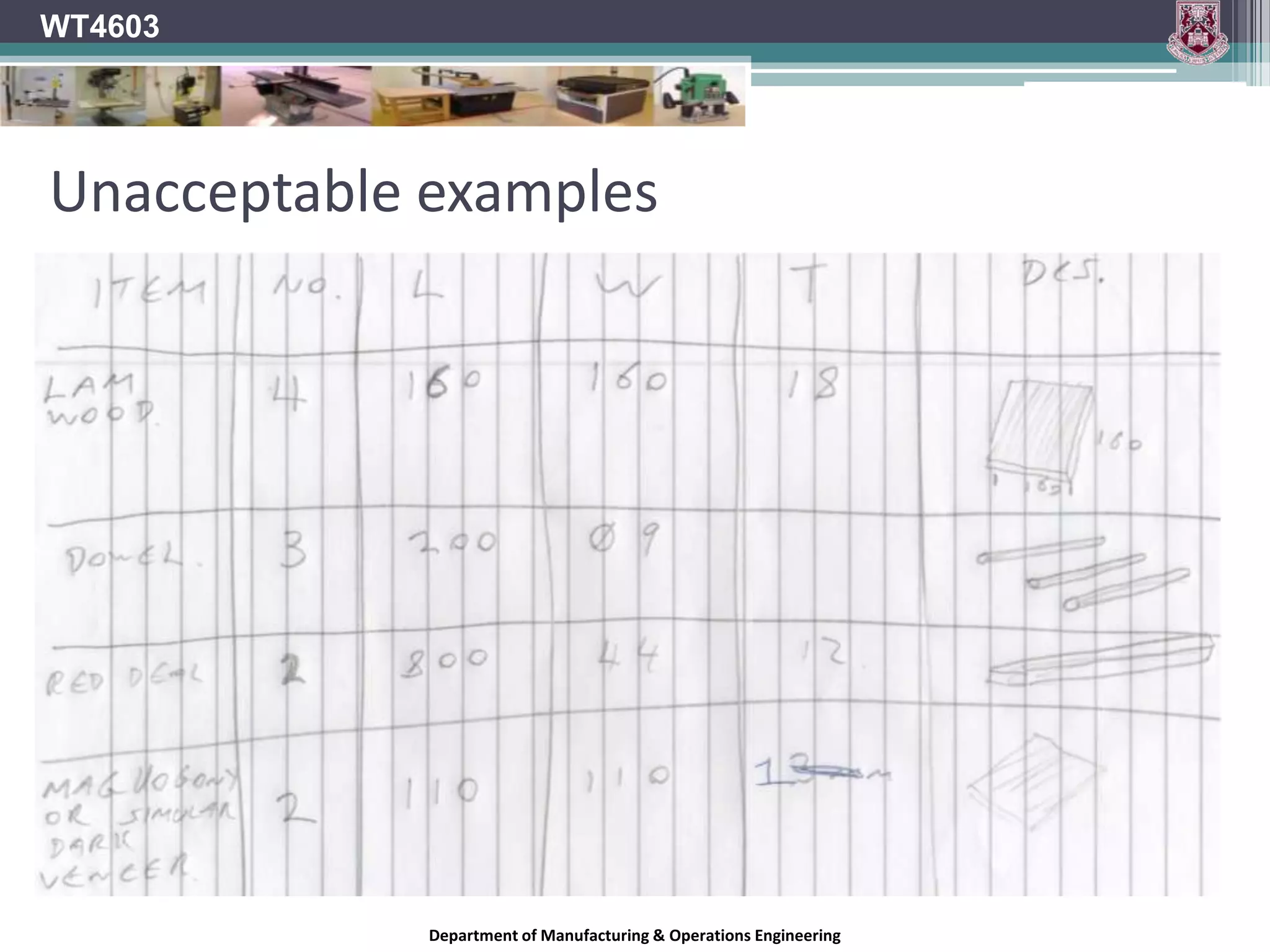
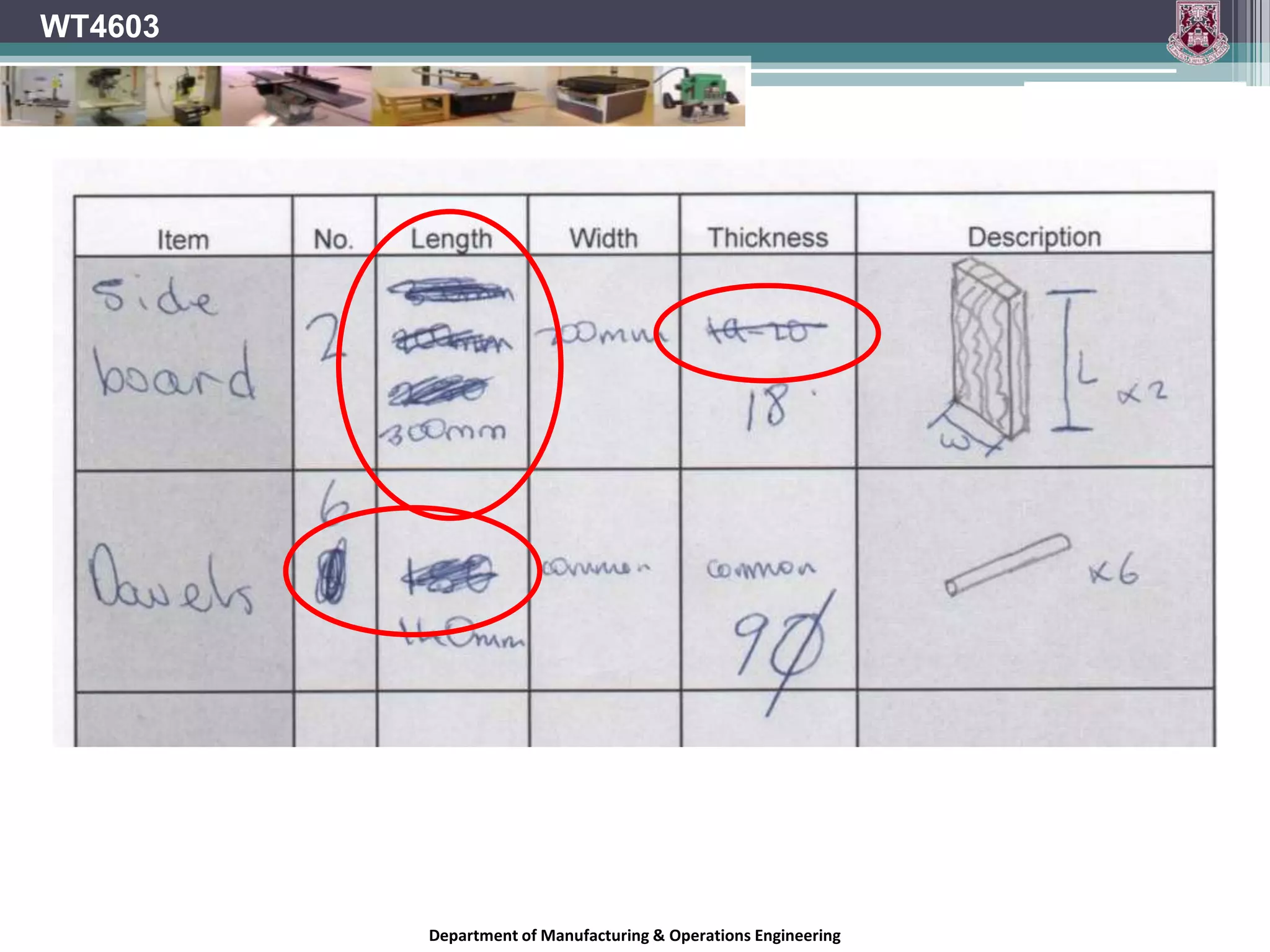
StandardsCutting list must be submitted on an A4 sheet(s) of paperStudents must use the UL templateSubmissions must be printed or typedSubmissions that are sloppy, untidy, scribbled, crossed out or outside the standard format will not be accepted.The descriptions section must illustrate the shape and detail of the piece.Secondary processing should be illustrated in this section e.g. grooving etc.Lists should be filled out beginning with larger cross-sections and working your way down in cross-sectional size.(This can aid material optimisation)WT4603Department of Manufacturing & Operations Engineering
WT4603Good ExampleDepartment of Manufacturing & Operations Engineering
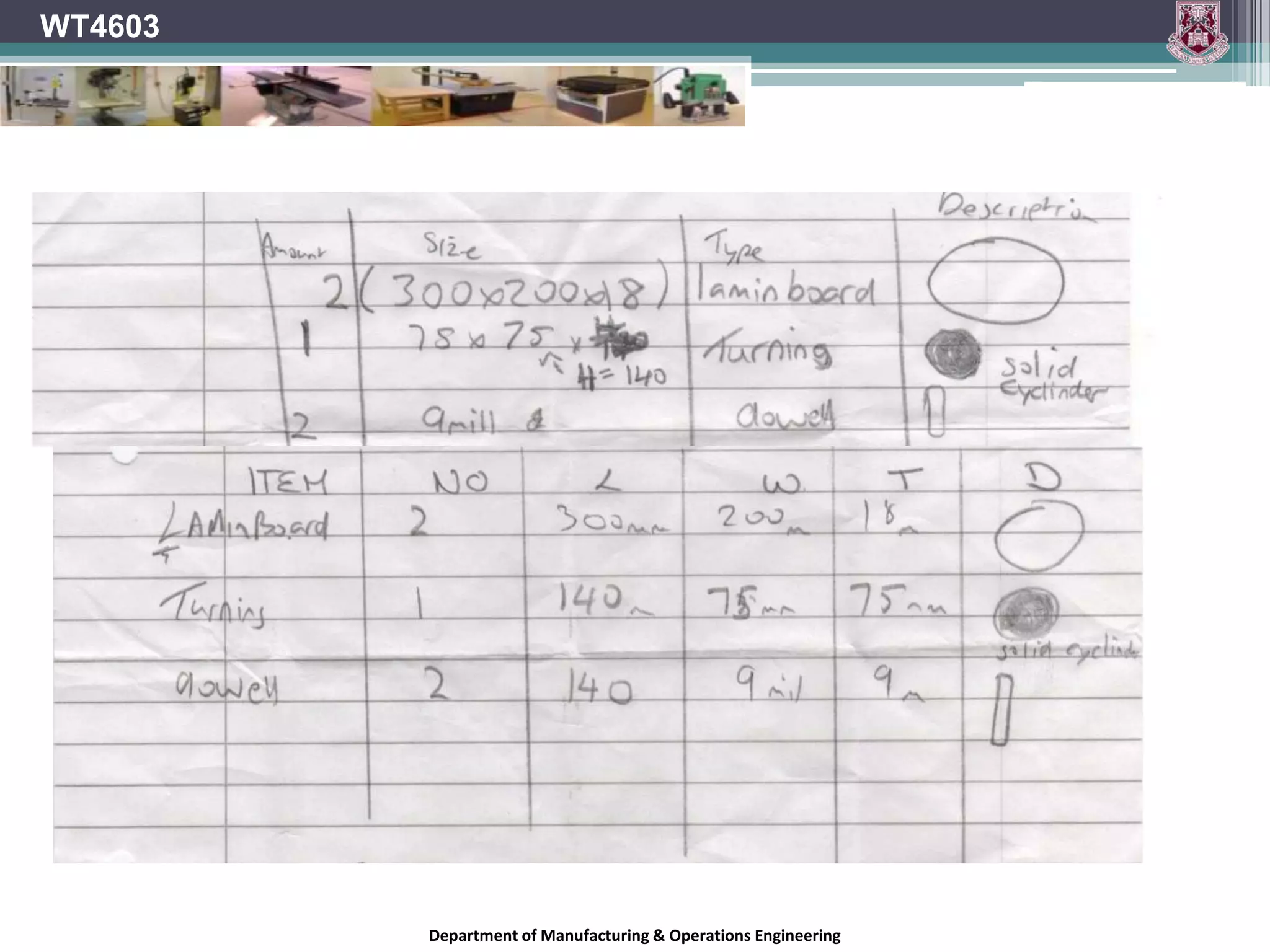
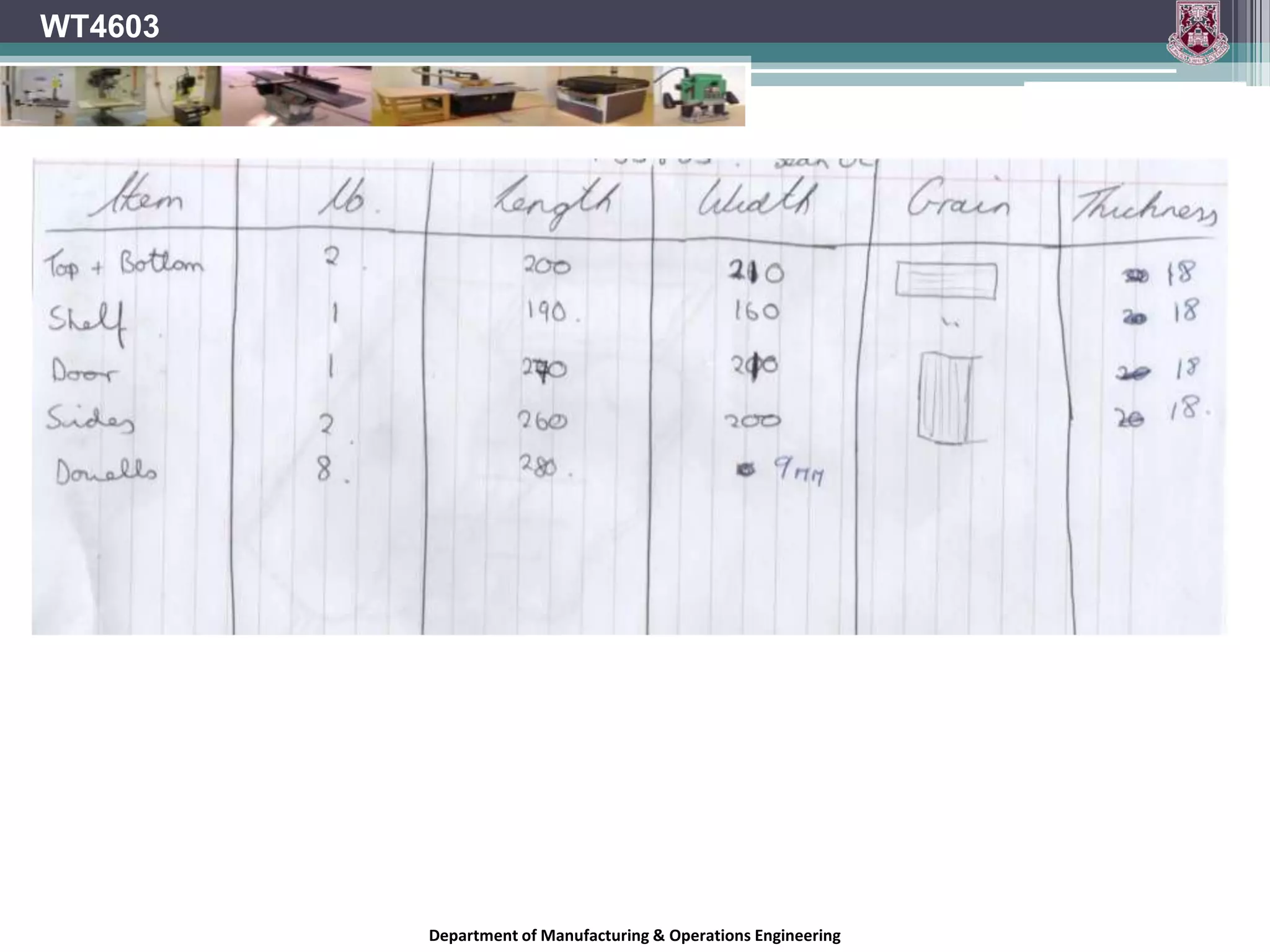
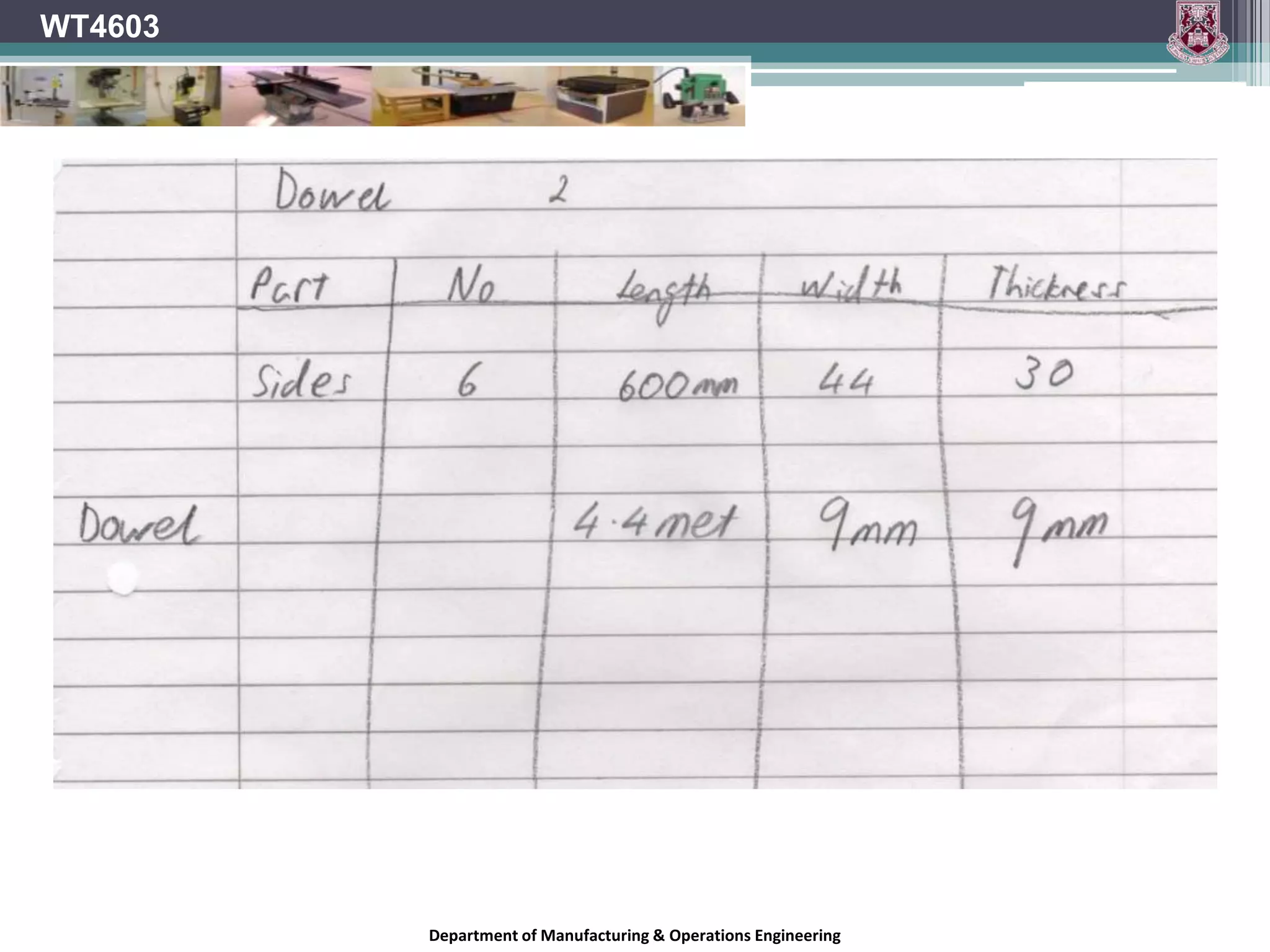
WT4603Unacceptable examplesDepartment of Manufacturing & Operations Engineering
Unacceptable examplesWT4603Department of Manufacturing & Operations Engineering
WT4603Unacceptable examplesDepartment of Manufacturing & Operations Engineering
Unacceptable examplesWT4603Department of Manufacturing & Operations Engineering
WT4603Unacceptable examplesDepartment of Manufacturing & Operations Engineering
Unacceptable examplesWT4603Department of Manufacturing & Operations Engineering
WT4603Working DrawingsDepartment of Manufacturing & Operations Engineering
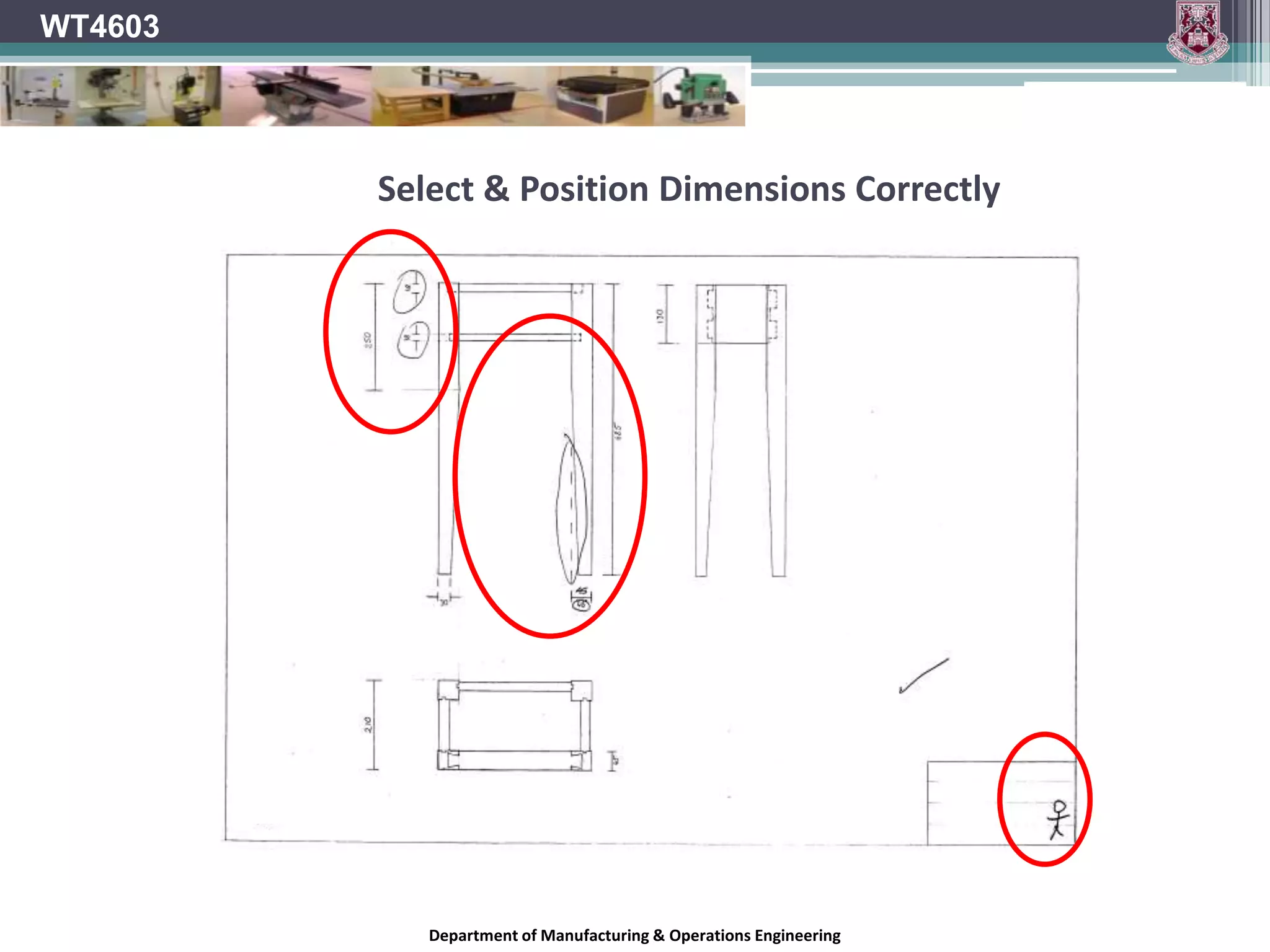
WT4603Select & Position Dimensions CorrectlyDepartment of Manufacturing & Operations Engineering
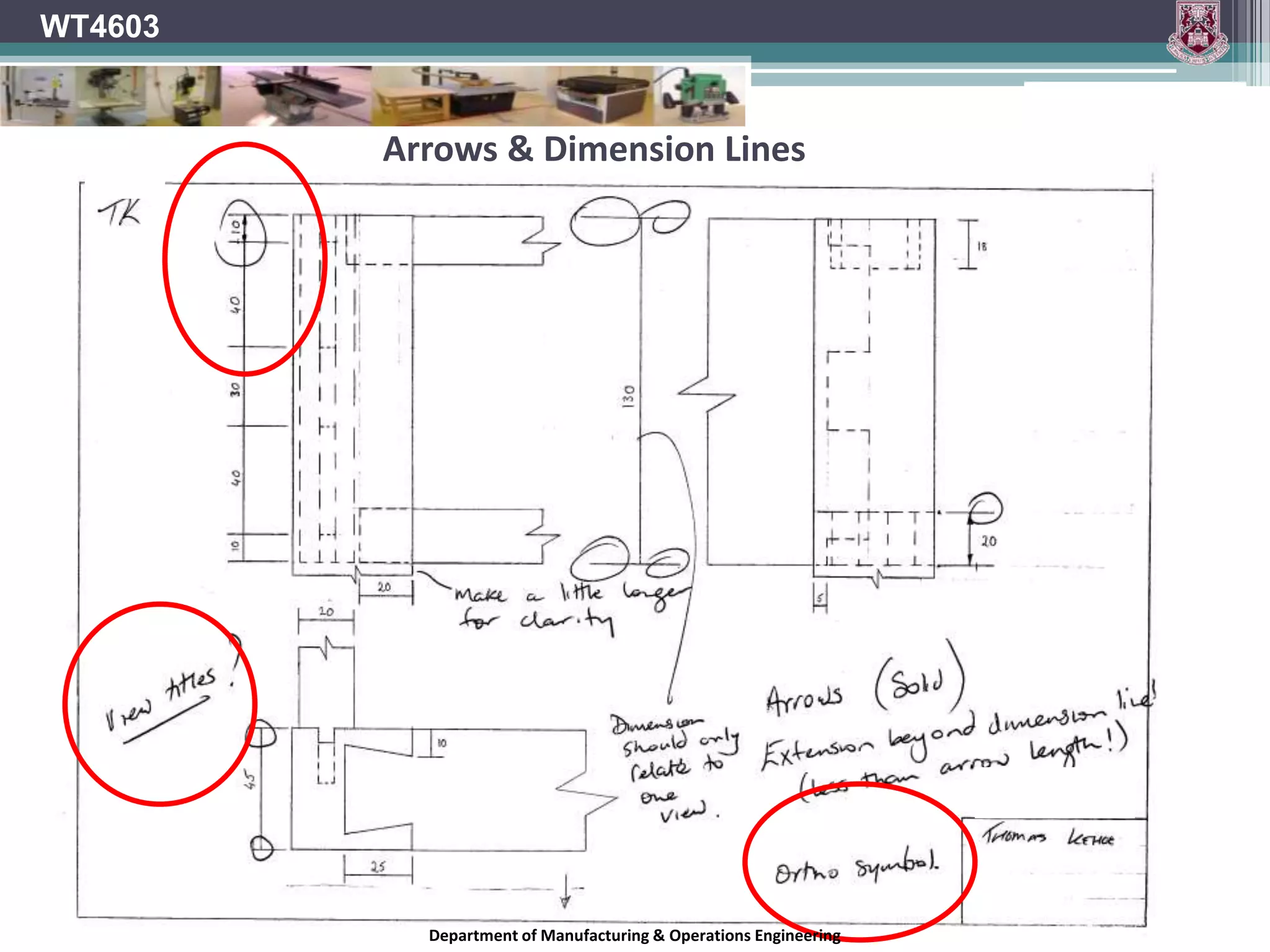
WT4603Arrows & Dimension LinesDepartment of Manufacturing & Operations Engineering
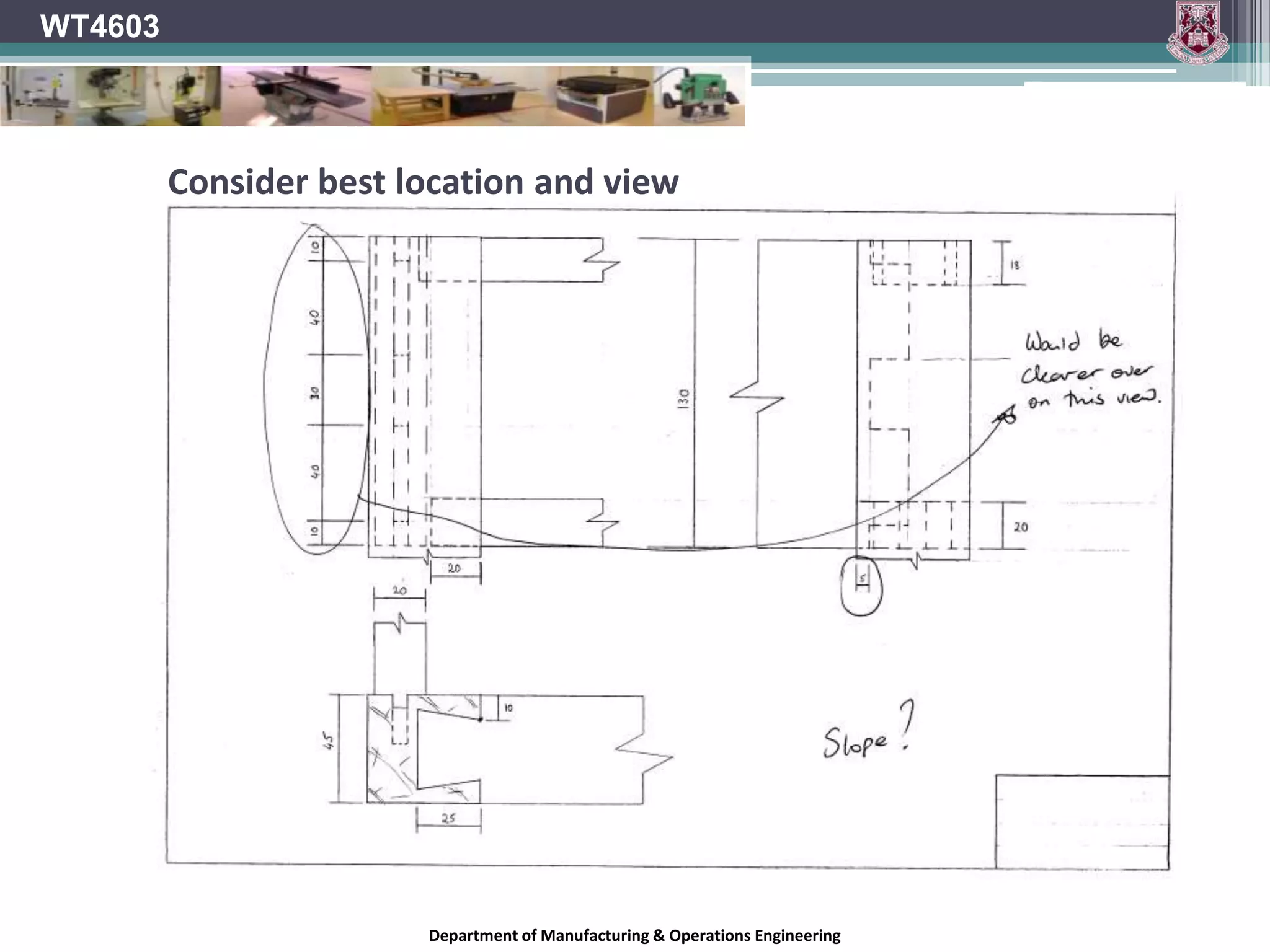
WT4603Consider best location and viewDepartment of Manufacturing & Operations Engineering
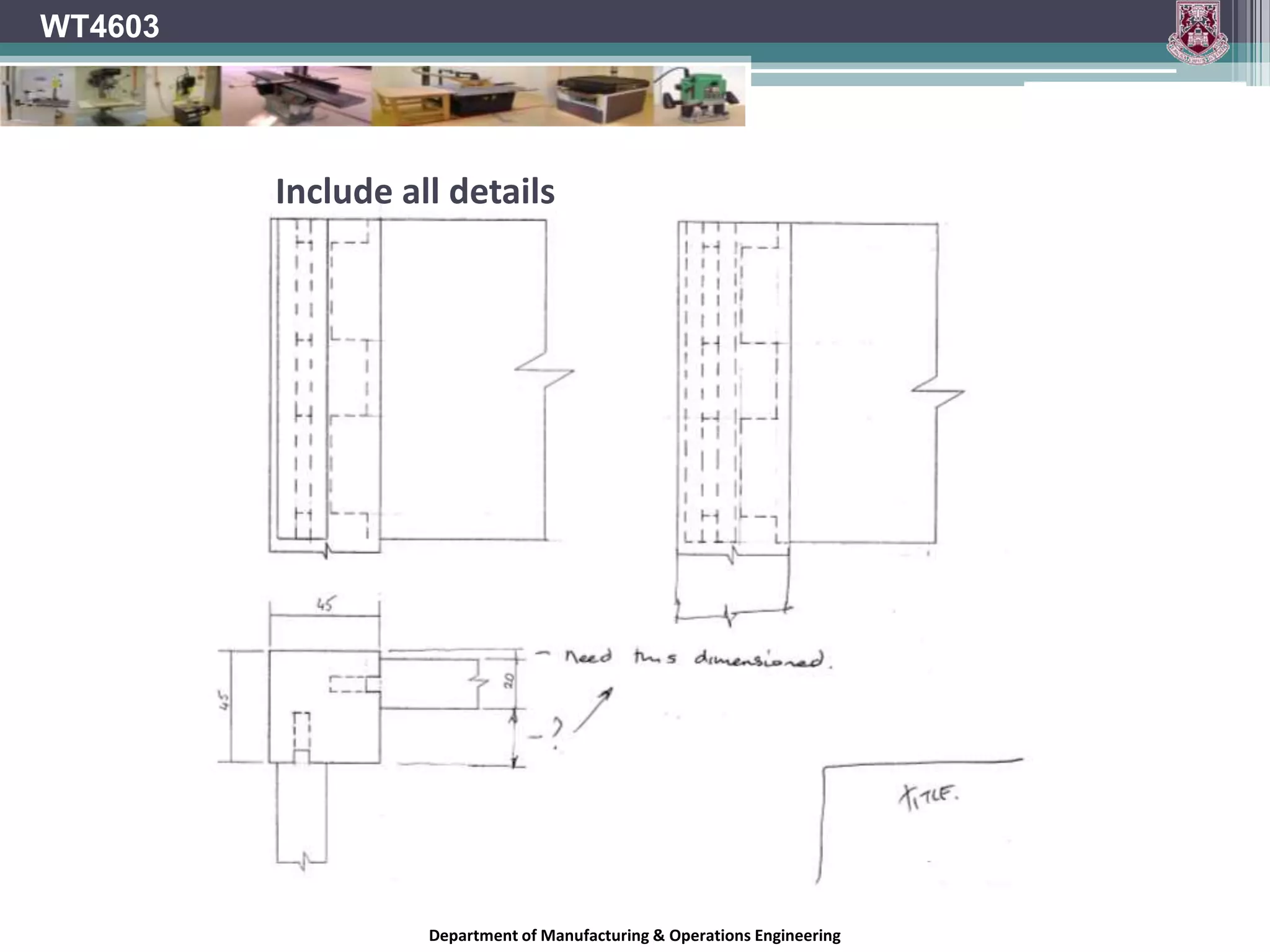
WT4603Include all detailsDepartment of Manufacturing & Operations Engineering
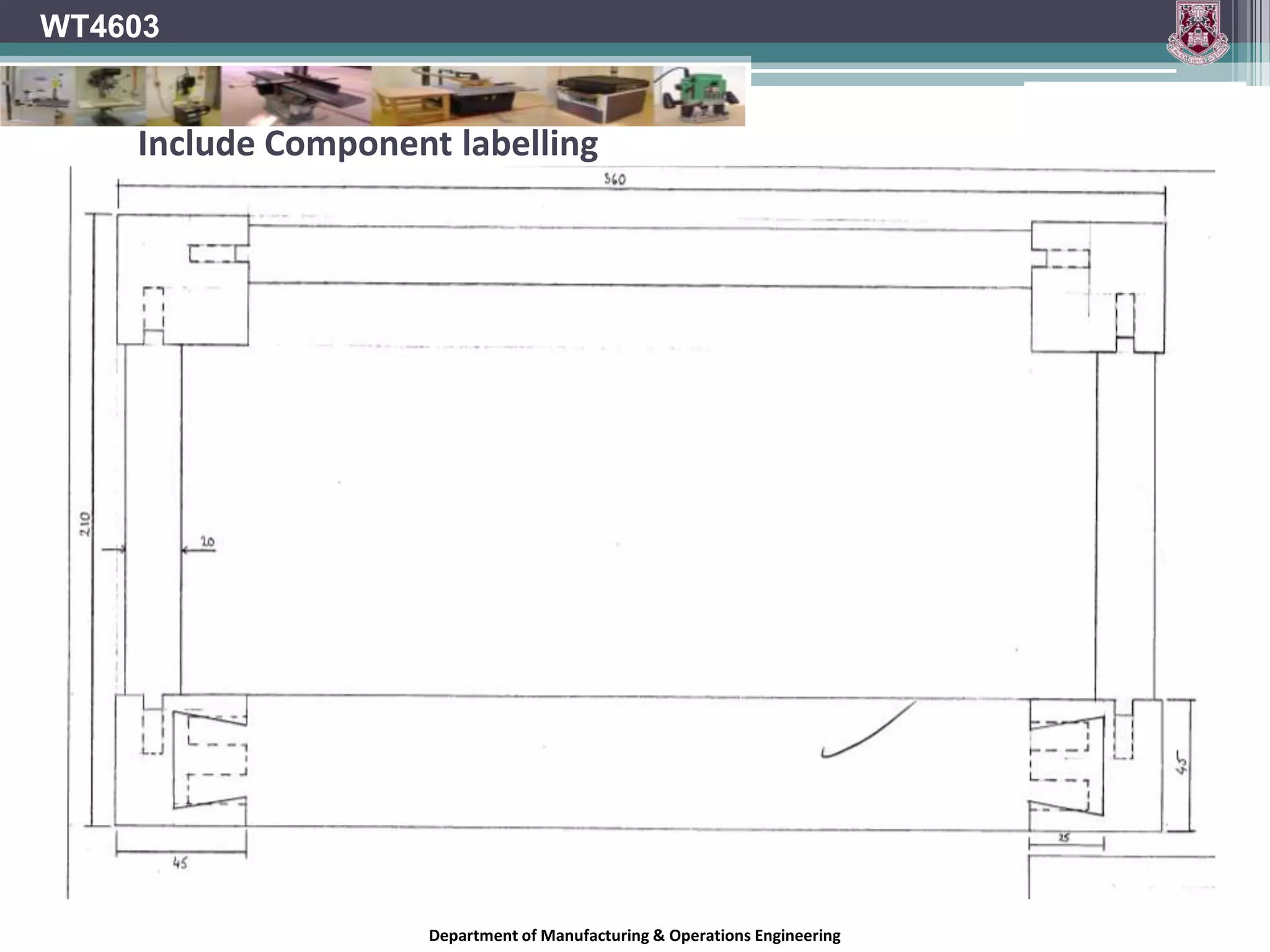
WT4603Include Component labellingDepartment of Manufacturing & Operations Engineering
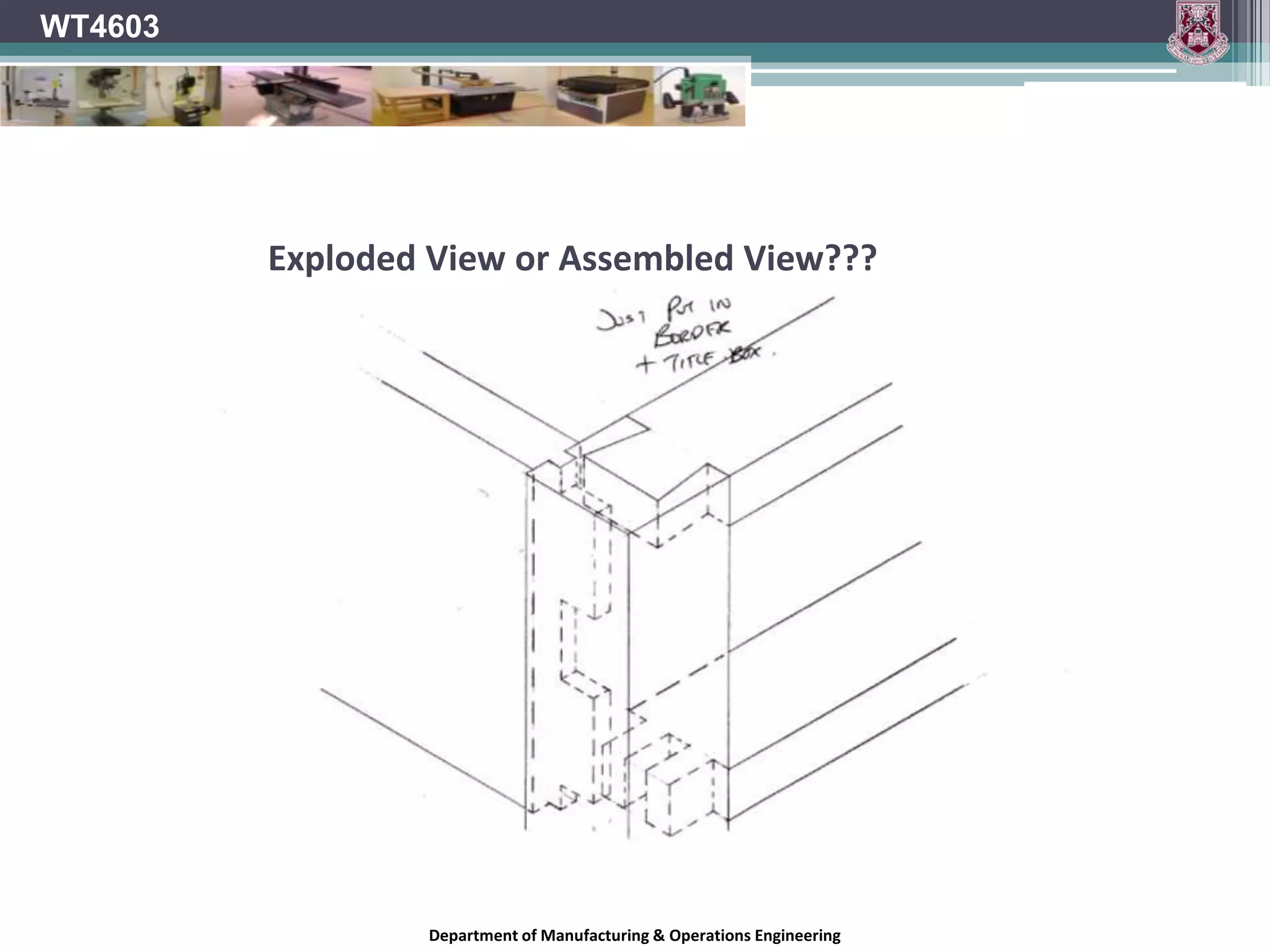
WT4603Exploded View or Assembled View???Department of Manufacturing & Operations Engineering
WT4603LABS WEEK 3Processing plan for Section A of the Table project.Department of Manufacturing & Operations Engineering
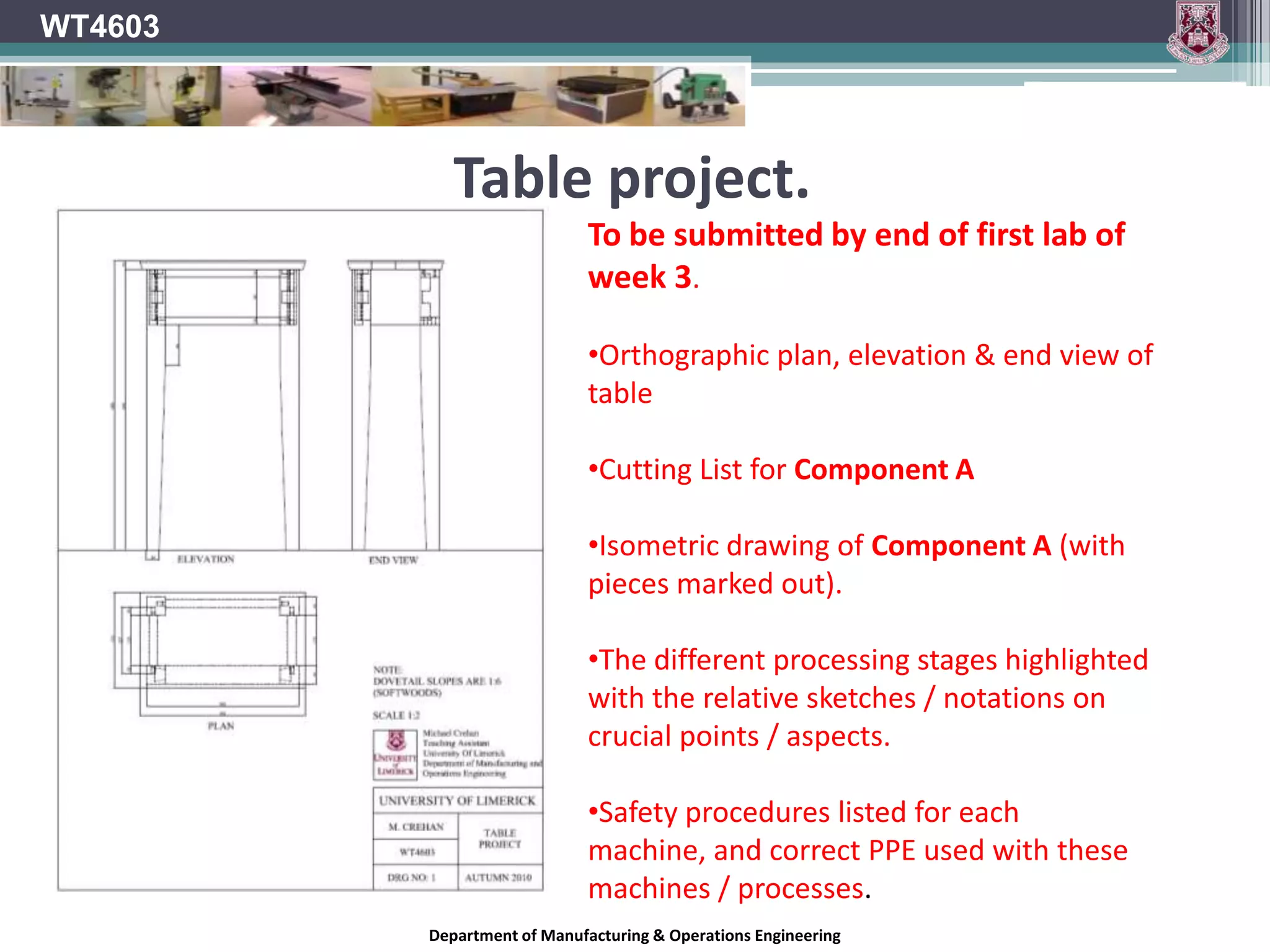
WT4603Table project.To be submitted by end of first lab of week 3.Orthographic plan, elevation & end view of table
Cutting List for Component A
Isometric drawing of Component A (with pieces marked out).
The different processing stages highlighted with the relative sketches / notations on crucial points / aspects.
Safety procedures listed for each machine, and correct PPE used with these machines / processes.Department of Manufacturing & Operations Engineering
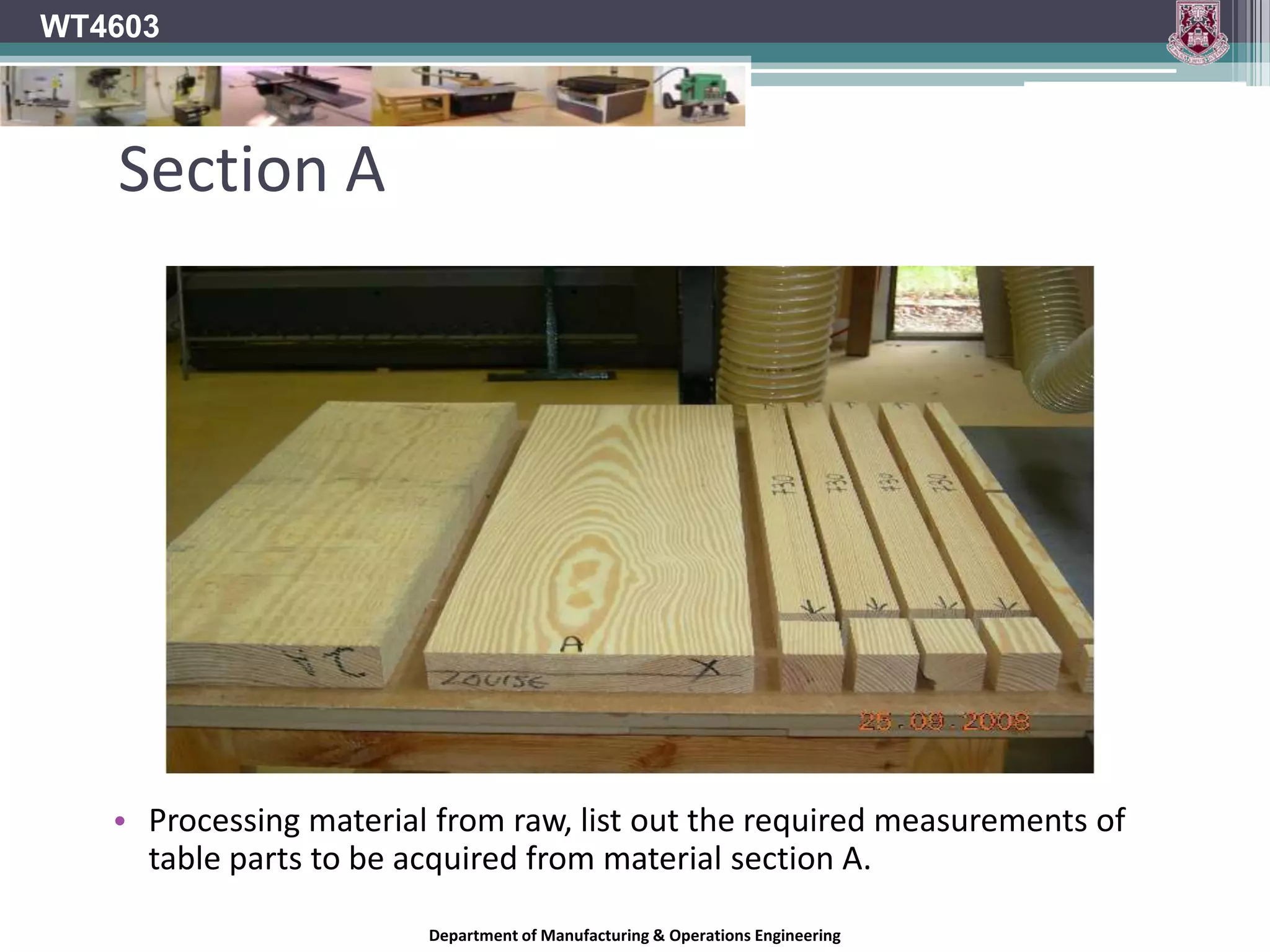
WT4603Section AProcessing material from raw, list out the required measurements of table parts to be acquired from material section A.Department of Manufacturing & Operations Engineering
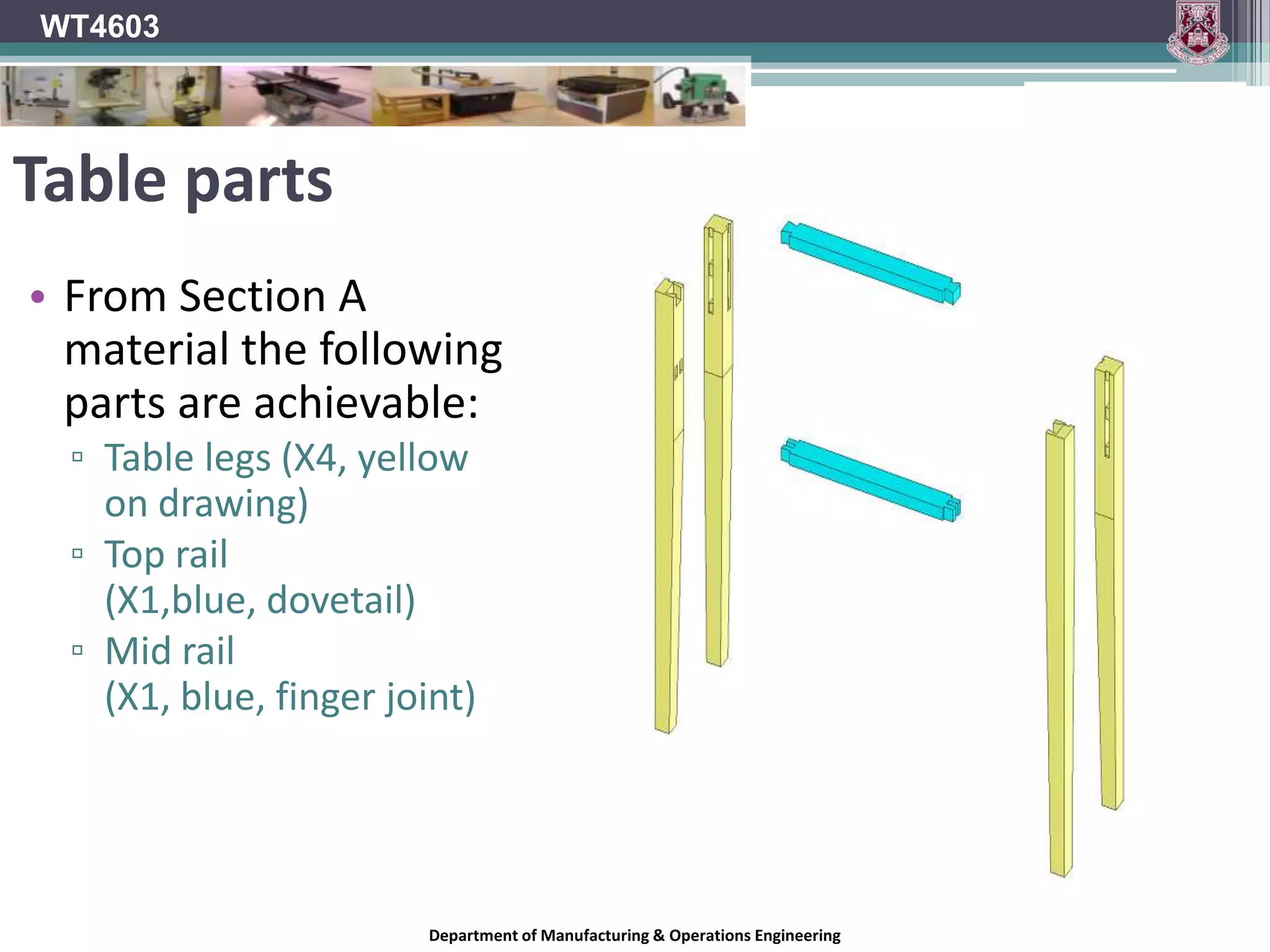
WT4603Table parts From Section A material the following parts are achievable:Table legs (X4, yellow on drawing)Top rail (X1,blue, dovetail)Mid rail (X1, blue, finger joint)Department of Manufacturing & Operations Engineering
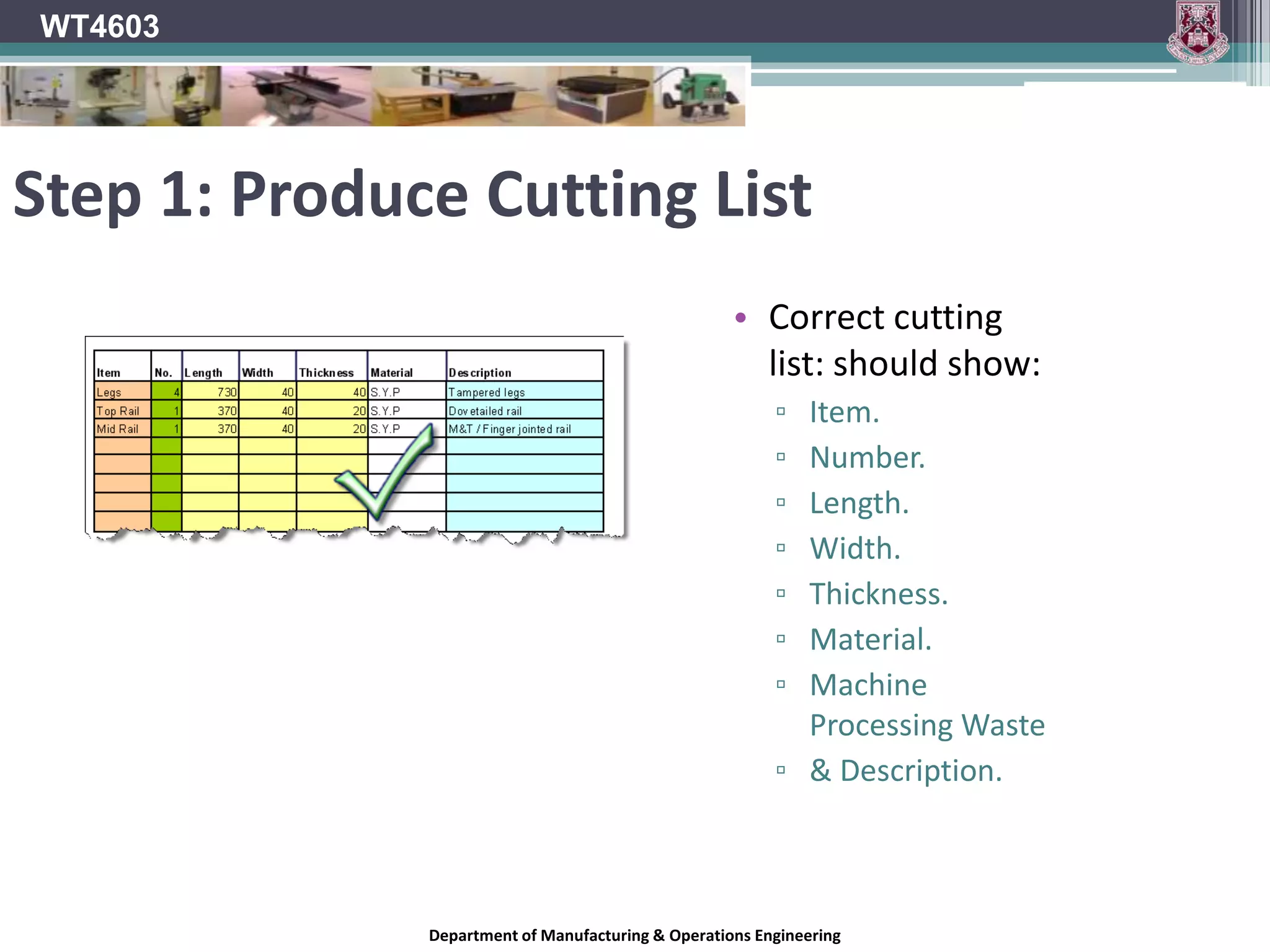
WT4603Step 1: Produce Cutting ListCorrect cutting list: should show:Item.Number.Length.Width.Thickness.Material.Machine Processing Waste& Description.Department of Manufacturing & Operations Engineering
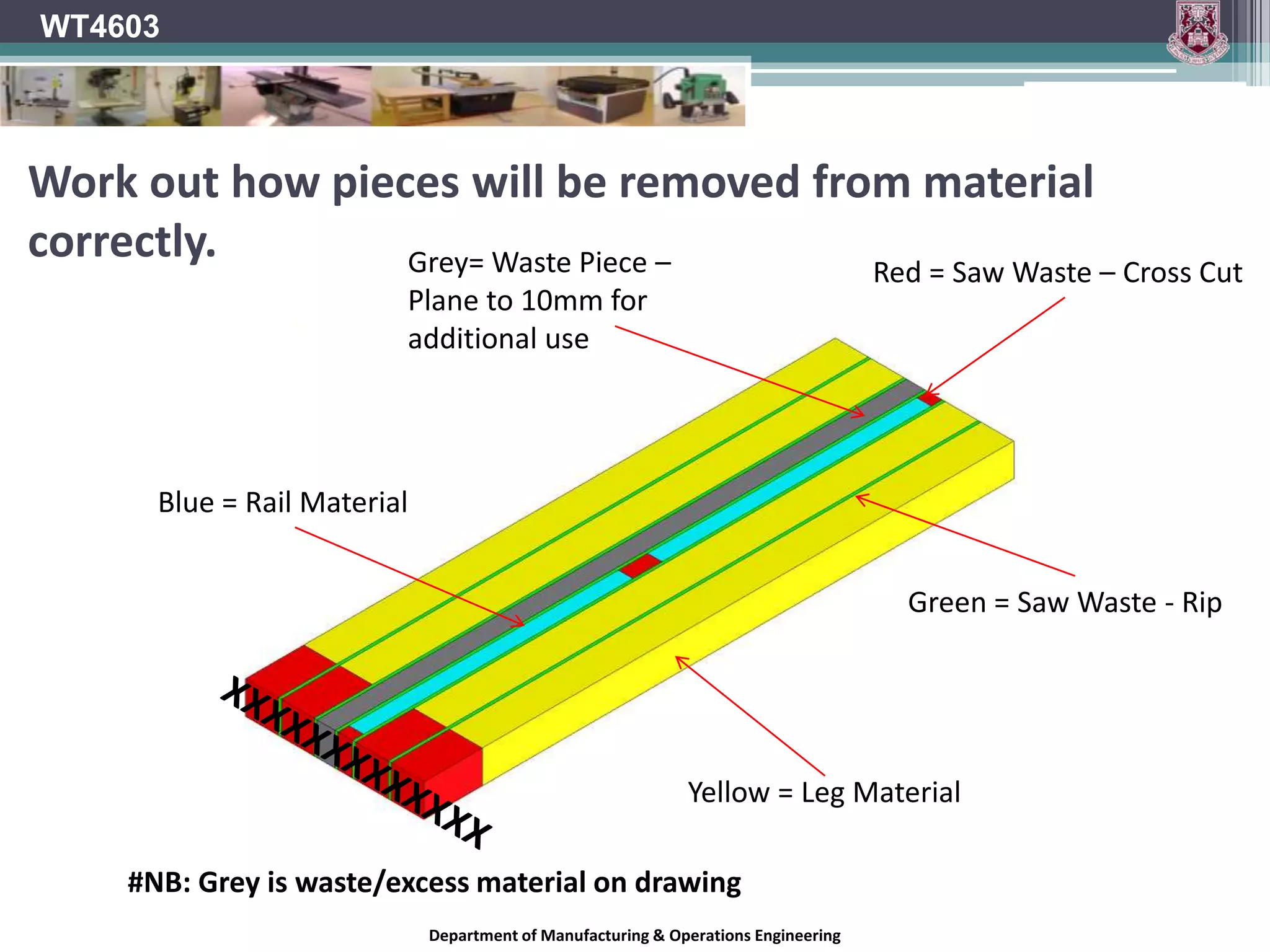
WT4603Work out how pieces will be removed from material correctly.Grey= Waste Piece – Plane to 10mm for additional useRed = Saw Waste – Cross CutBlue = Rail MaterialGreen = Saw Waste - RipXXXXXXXXXXXXXYellow = Leg Material#NB: Grey is waste/excess material on drawingDepartment of Manufacturing & Operations Engineering
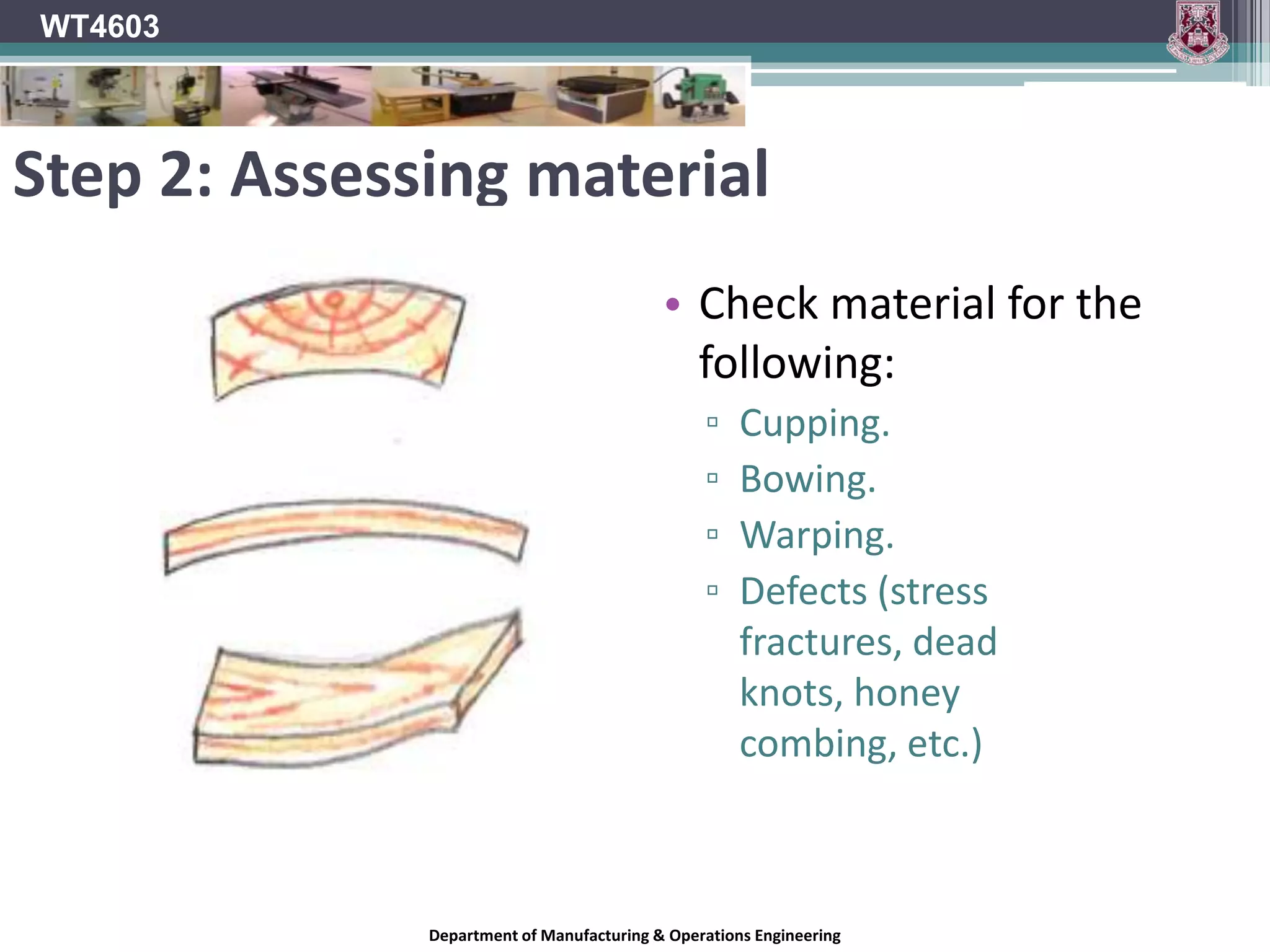
WT4603Step 2: Assessing materialCheck material for the following:Cupping.Bowing.Warping.Defects (stress fractures, dead knots, honey combing, etc.)Department of Manufacturing & Operations Engineering
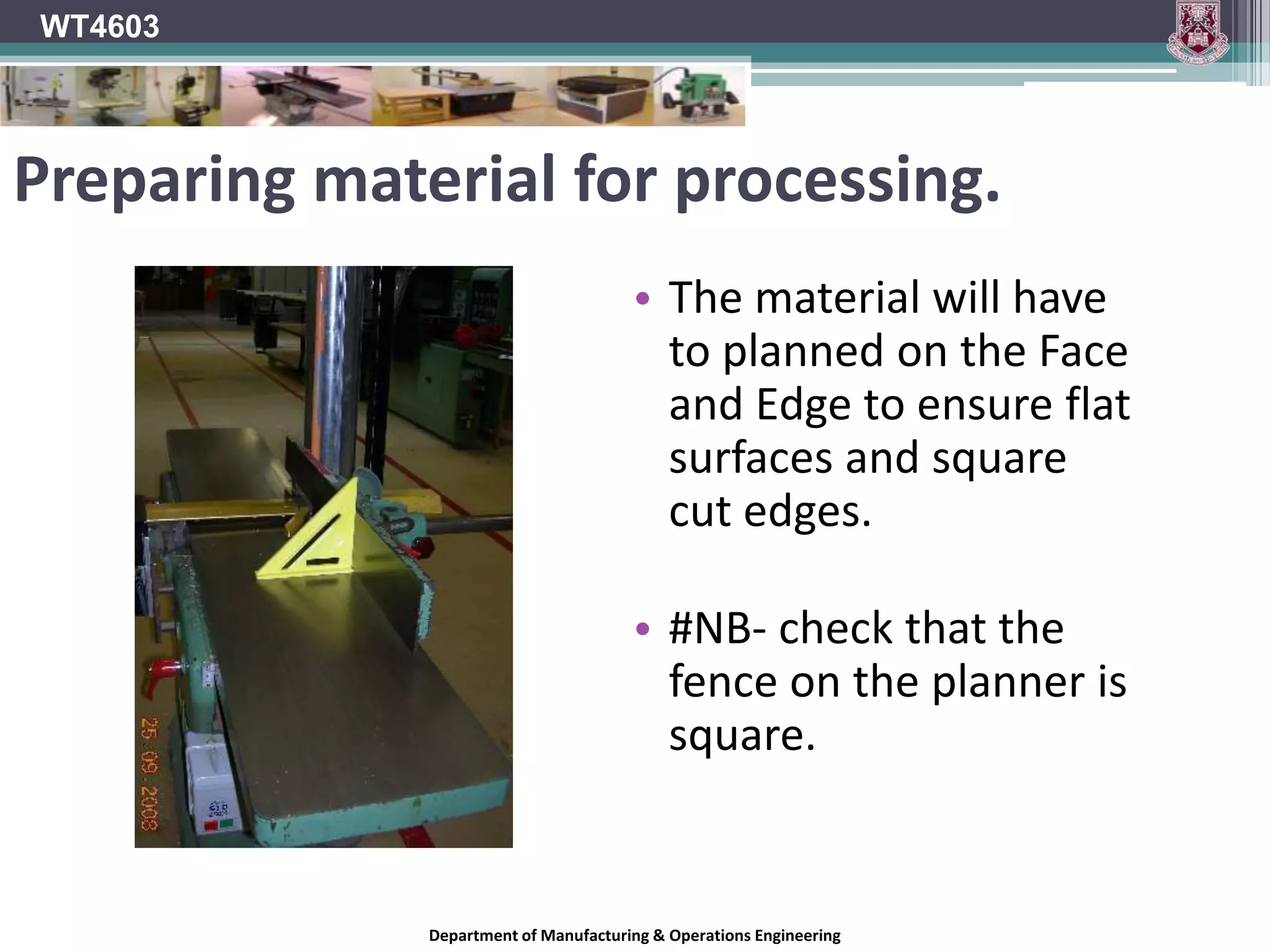
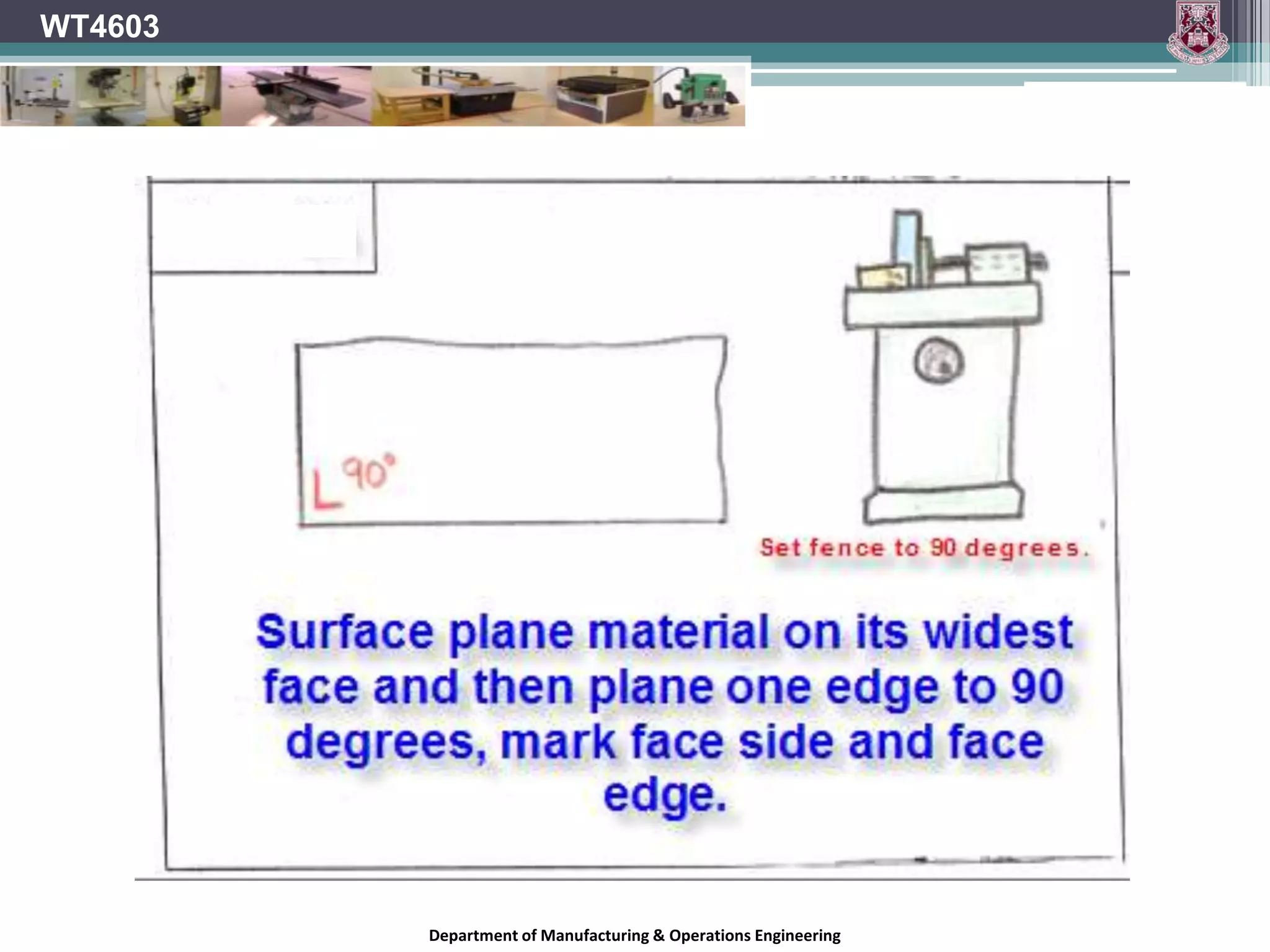
WT4603Preparing material for processing.The material will have to planned on the Face and Edge to ensure flat surfaces and square cut edges.#NB- check that the fence on the planner is square.Department of Manufacturing & Operations Engineering
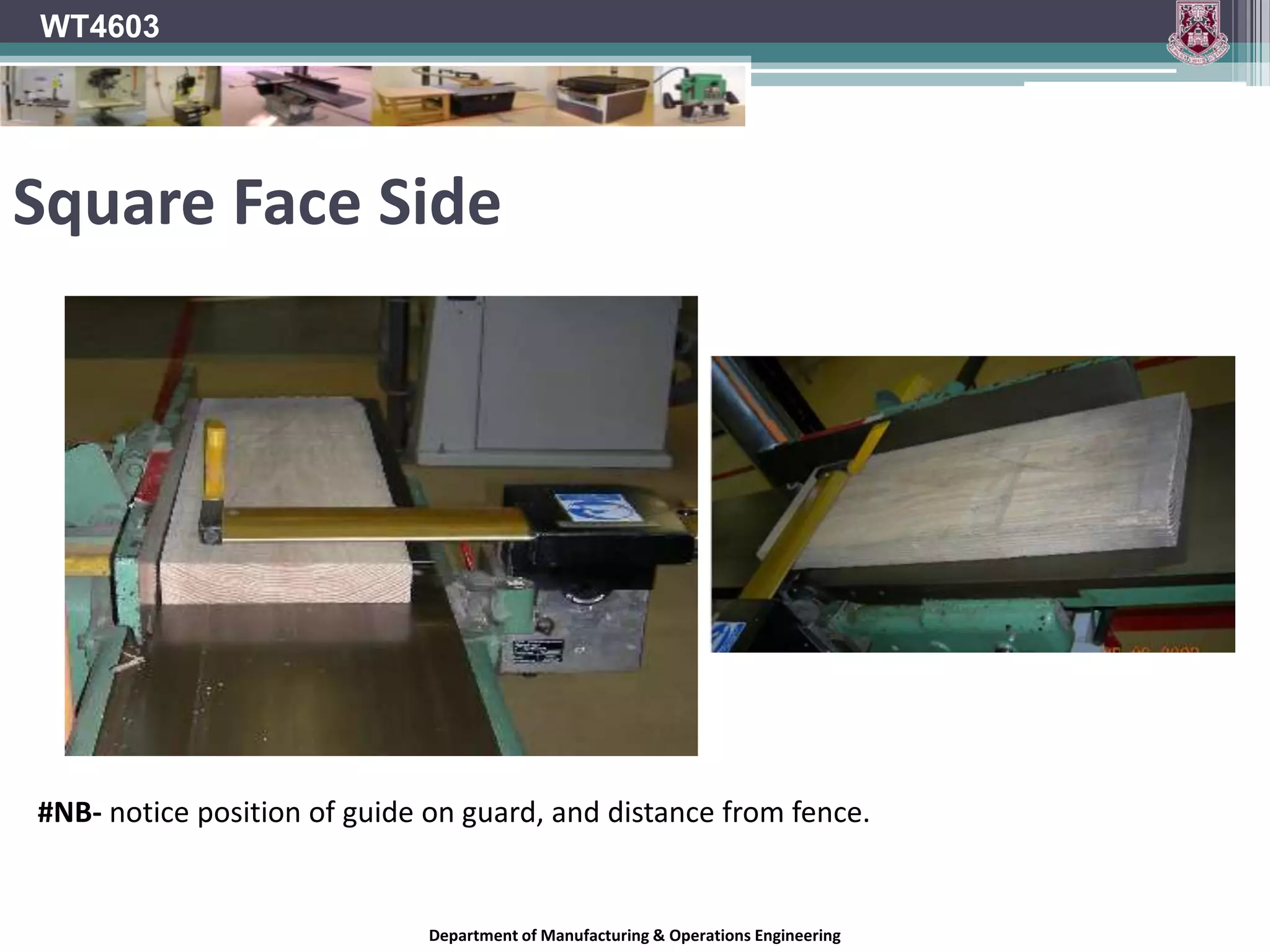
WT4603Square Face Side#NB- notice position of guide on guard, and distance from fence.Department of Manufacturing & Operations Engineering
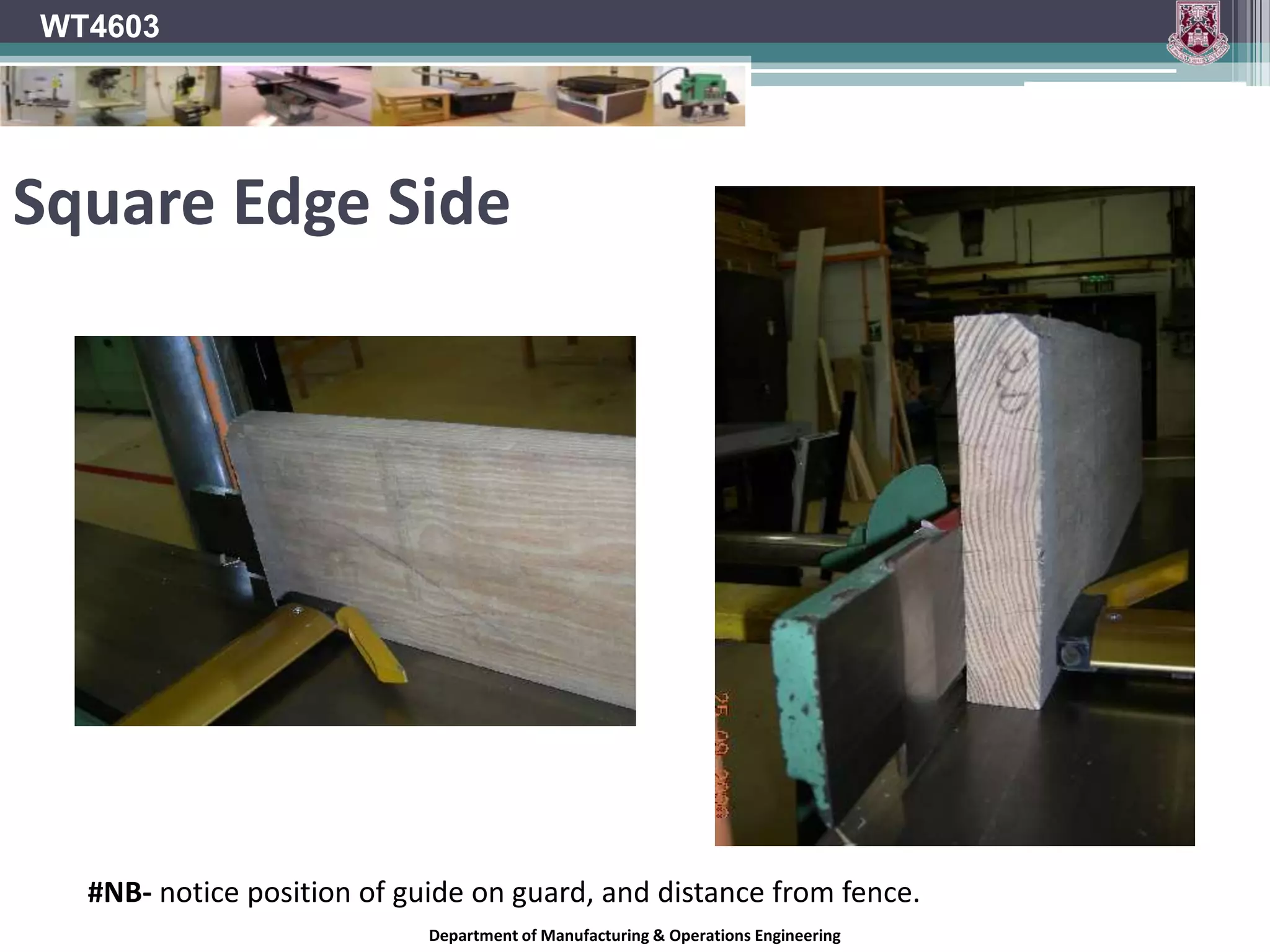
WT4603Square Edge Side#NB- notice position of guide on guard, and distance from fence.Department of Manufacturing & Operations Engineering
WT4603Department of Manufacturing & Operations Engineering
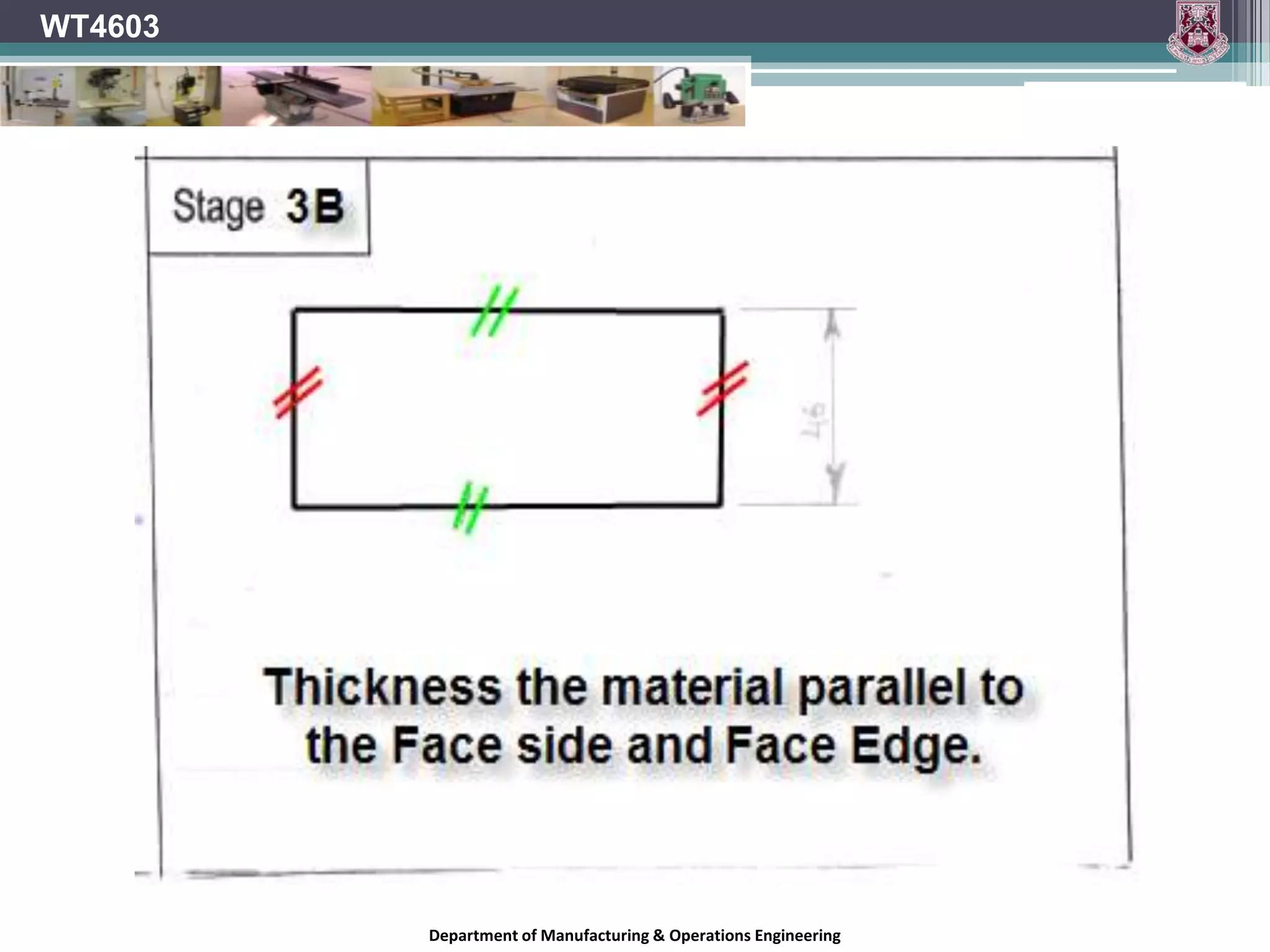
WT4603Step 3A: Planning material.Plane edges parallel to each other.Thickness material to accommodate the largest piece/part required (in this case, material should be reduced to 46mm to allow for legs, (1mm extra for future planning).Department of Manufacturing & Operations Engineering
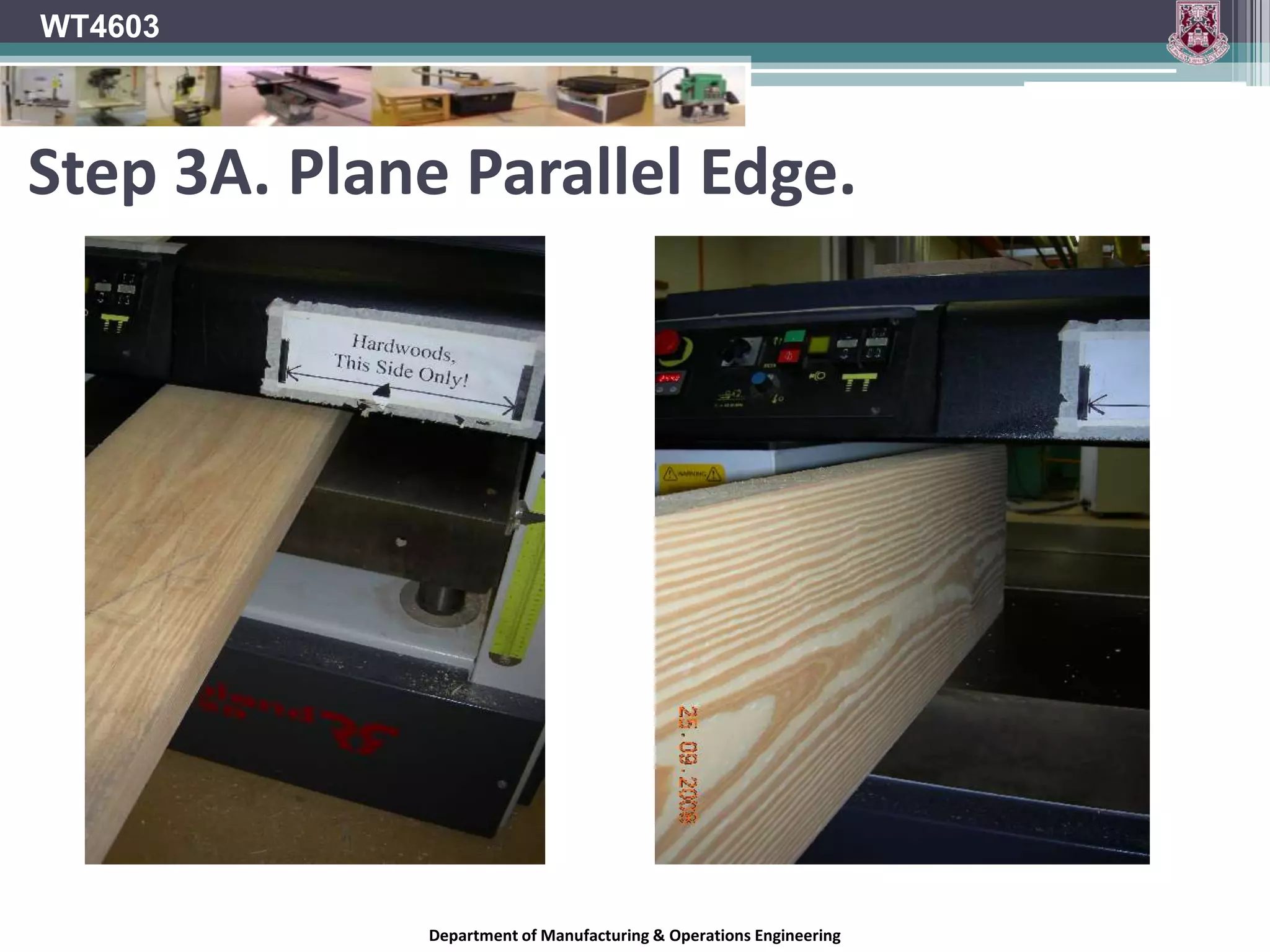
WT4603Step 3A. Plane Parallel Edge.Department of Manufacturing & Operations Engineering
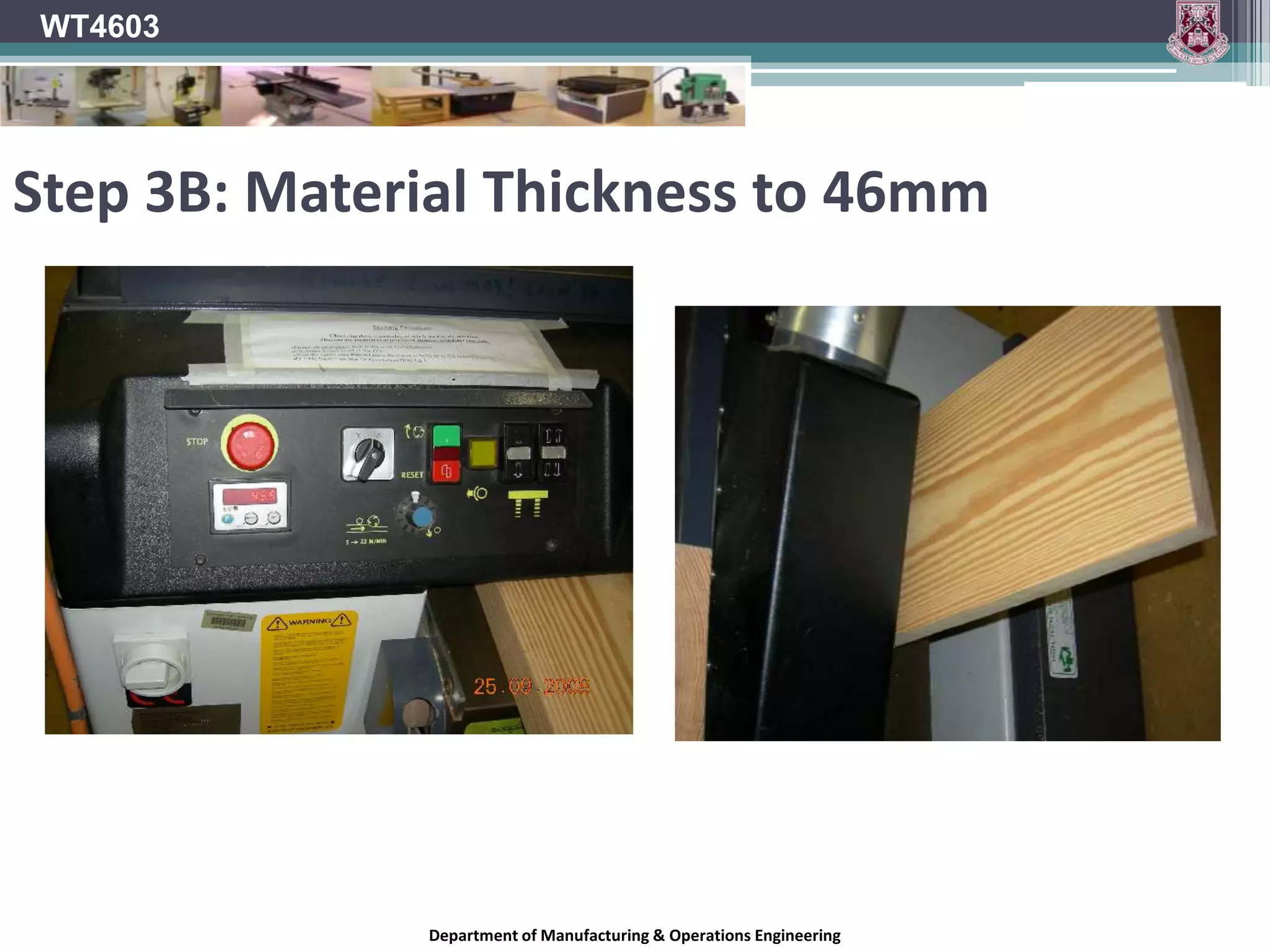
WT4603Step 3B: Material Thickness to 46mmDepartment of Manufacturing & Operations Engineering
WT4603Department of Manufacturing & Operations Engineering
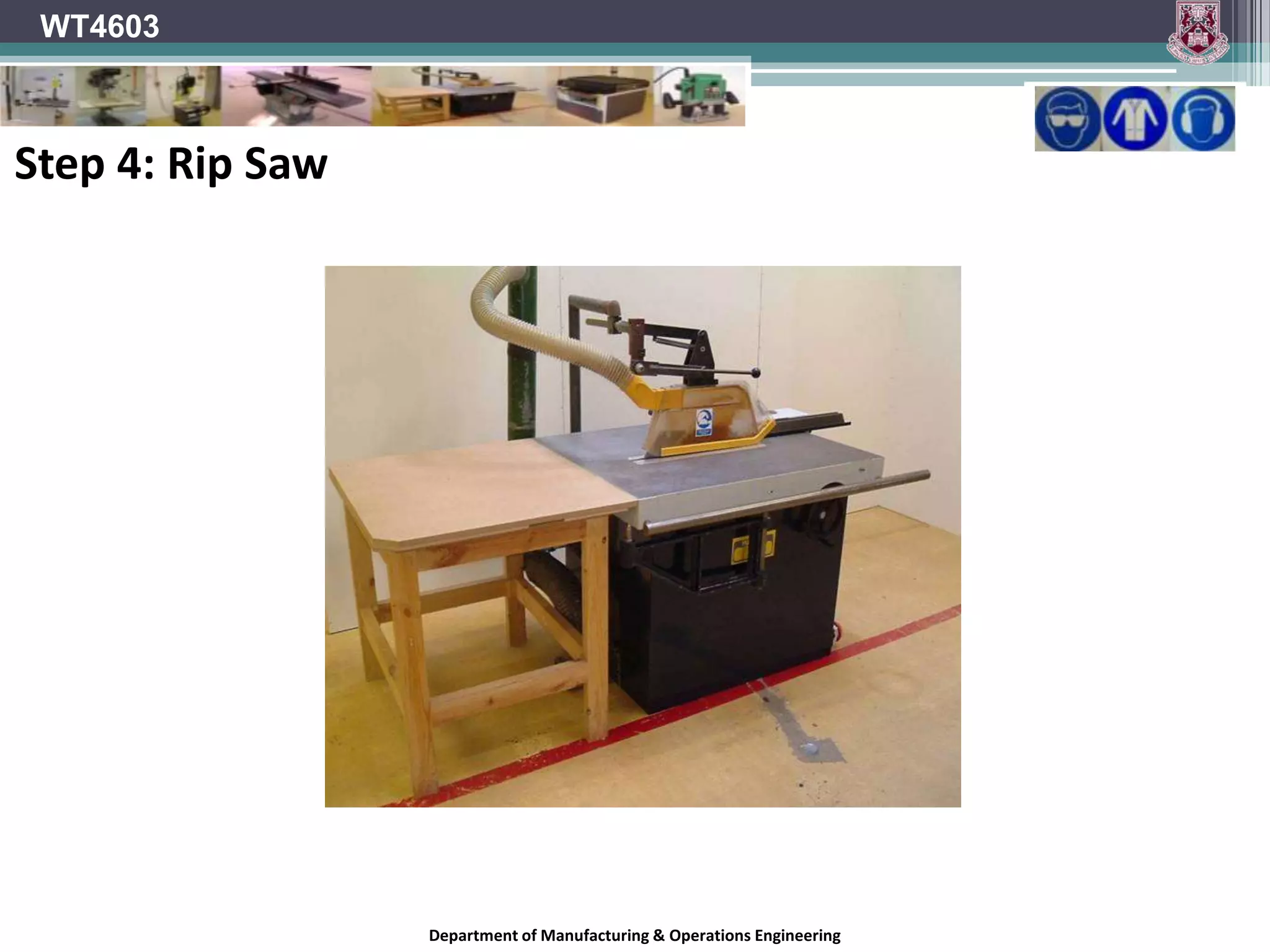
WT4603Step 4: Rip SawDepartment of Manufacturing & Operations Engineering
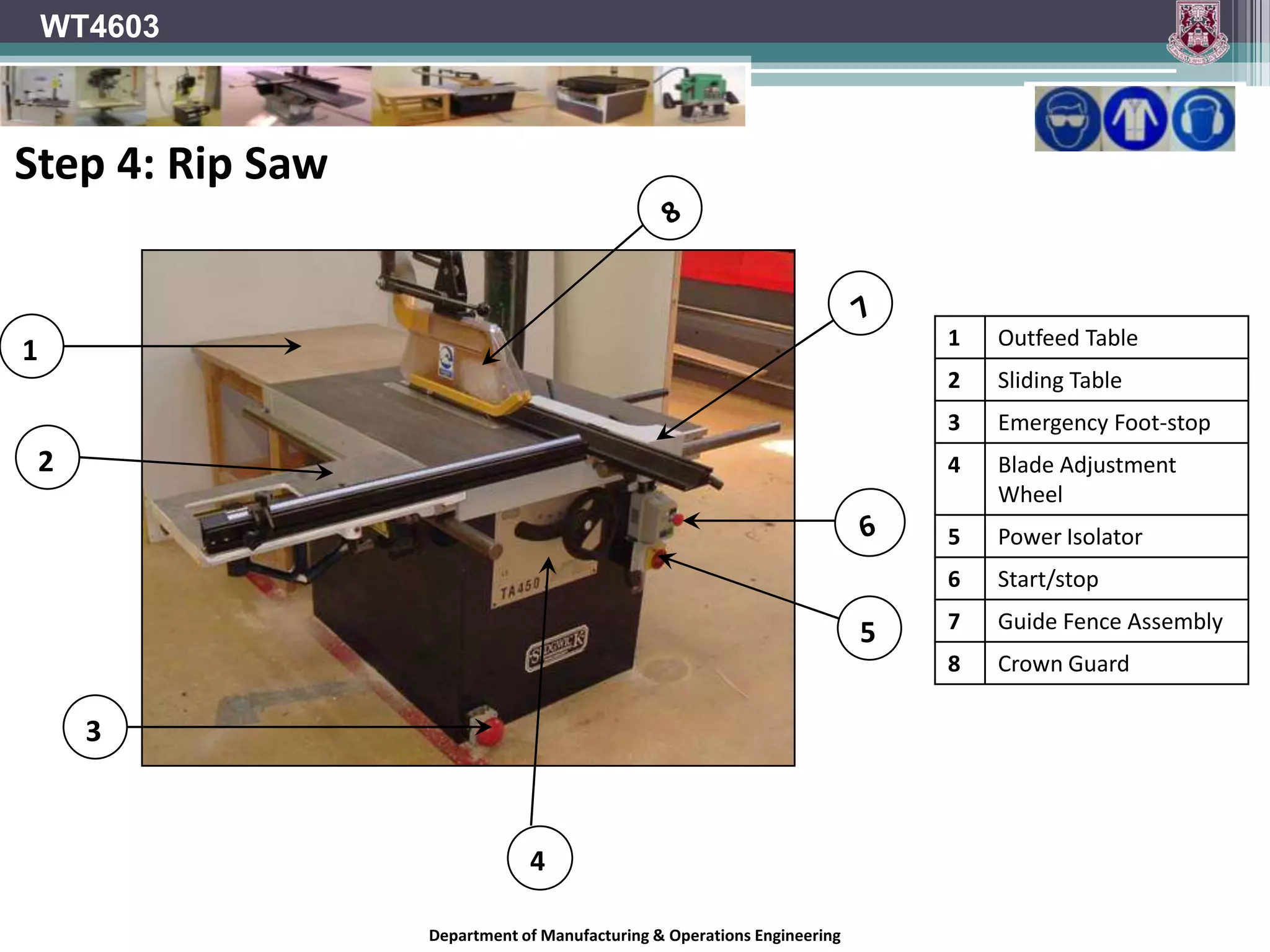
WT460387126534Step 4: Rip SawDepartment of Manufacturing & Operations Engineering
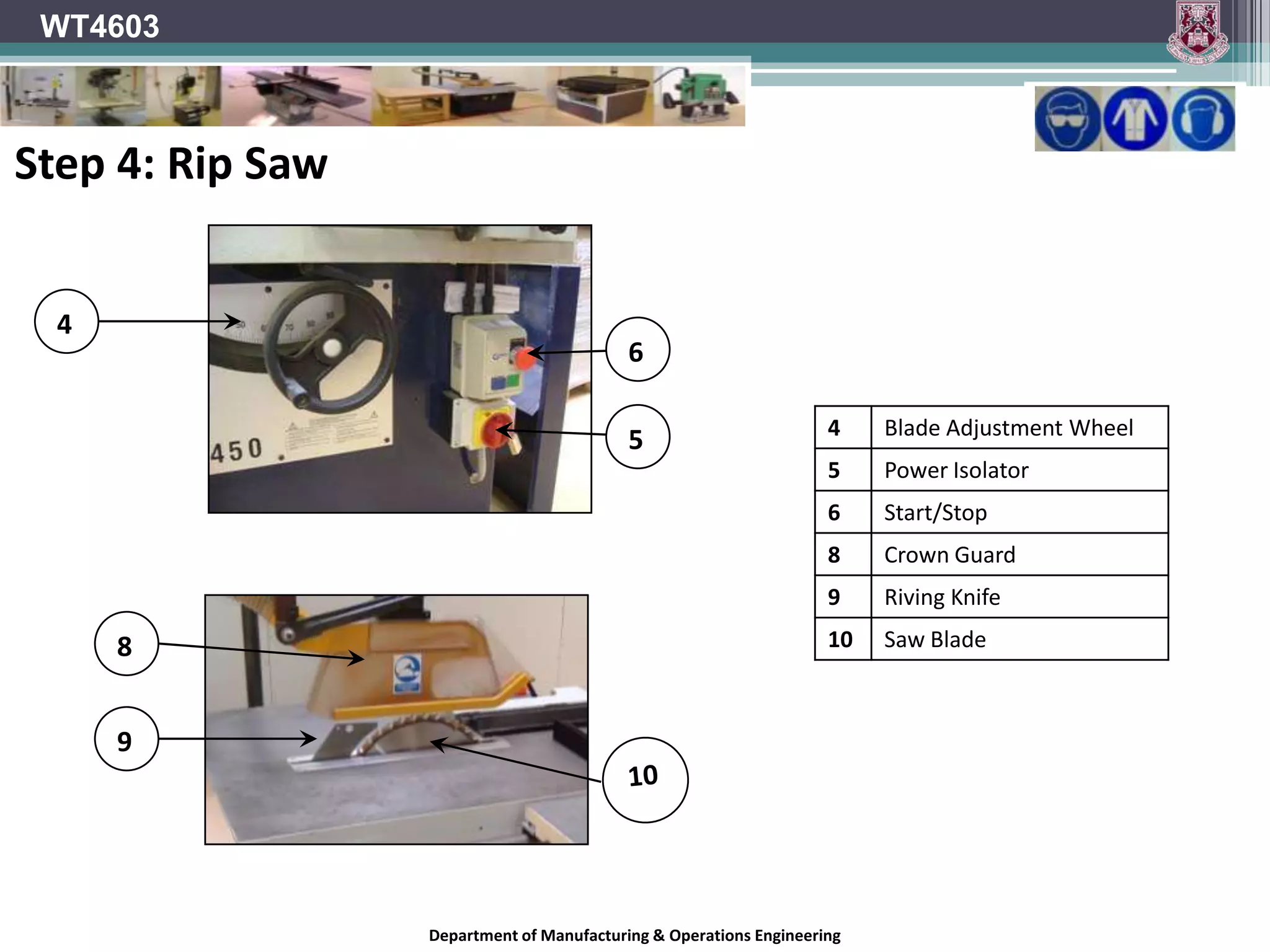
WT46034658910Step 4: Rip SawDepartment of Manufacturing & Operations Engineering
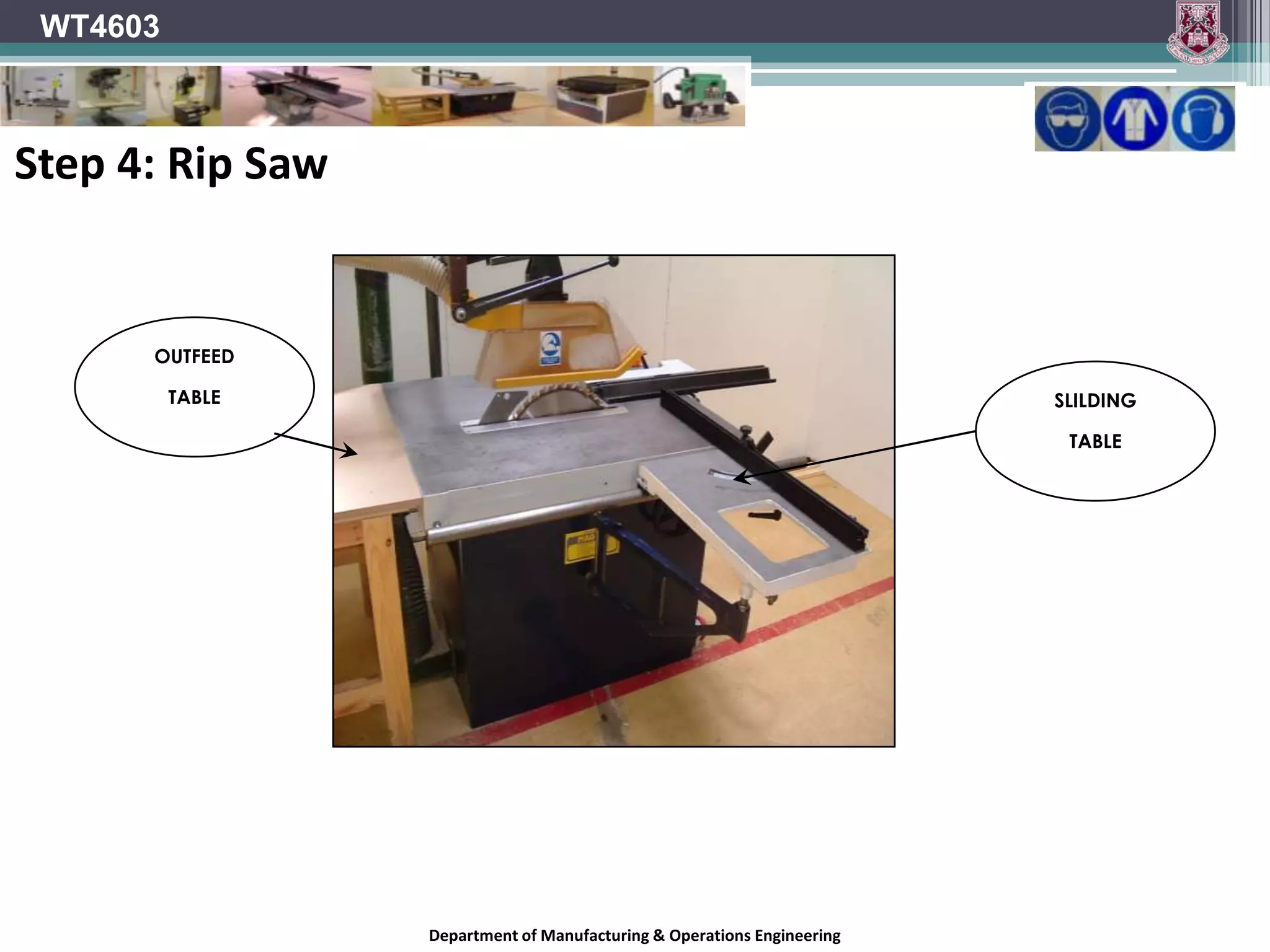
WT4603OUTFEEDTABLESLILDINGTABLEStep 4: Rip SawDepartment of Manufacturing & Operations Engineering
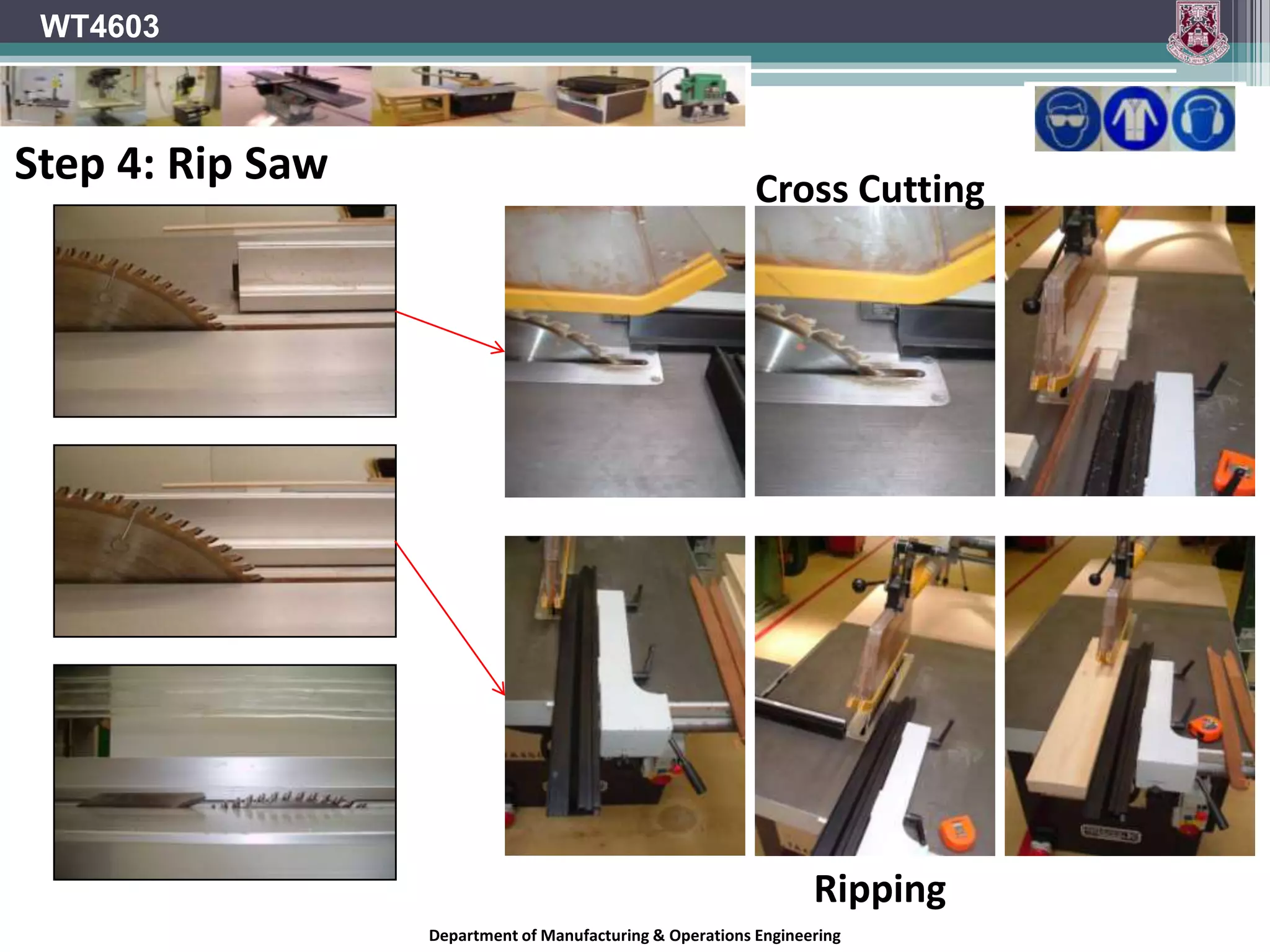
WT4603Step 4: Rip SawCross CuttingRippingDepartment of Manufacturing & Operations Engineering
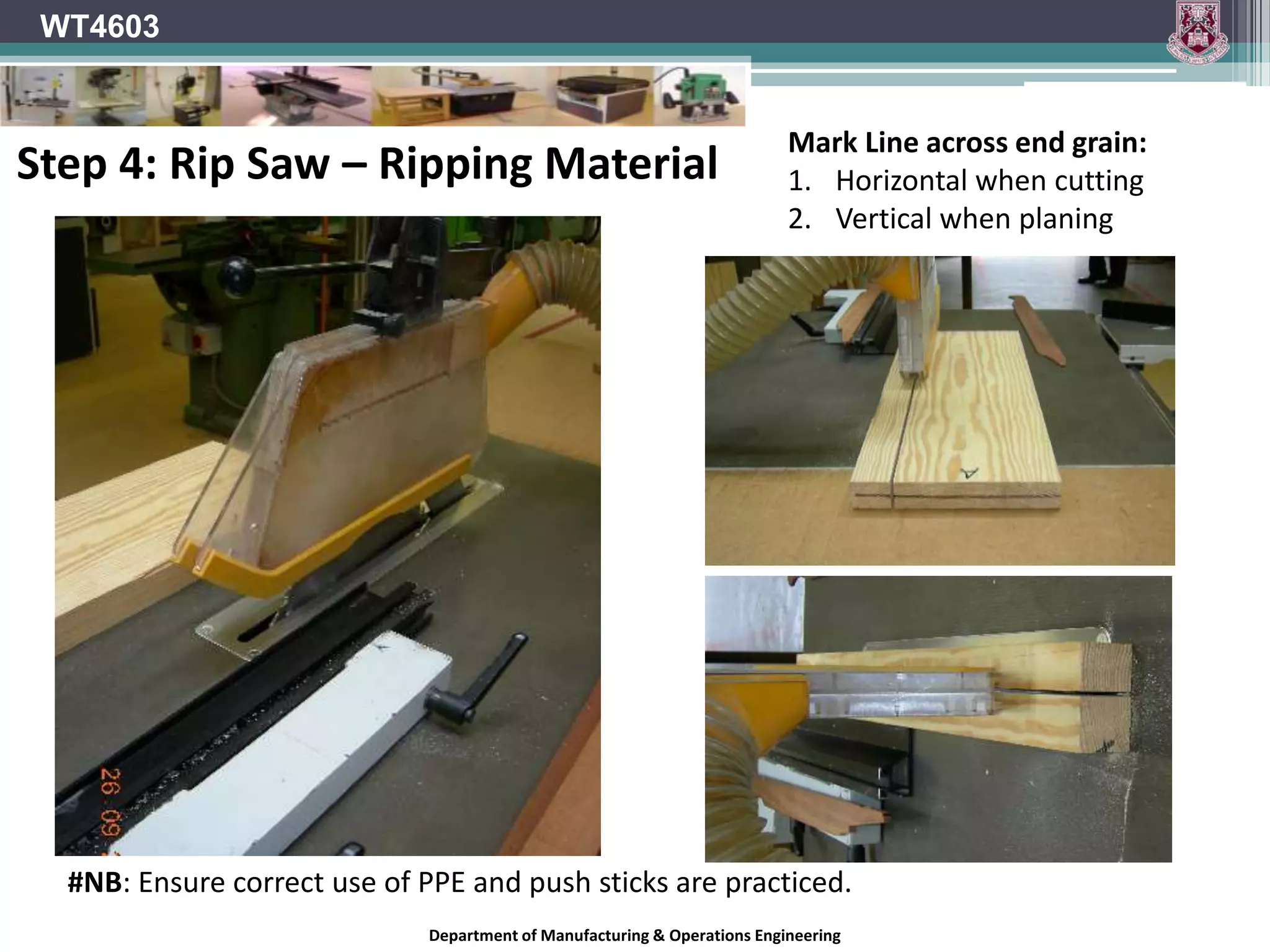
WT4603Mark Line across end grain:Horizontal when cuttingVertical when planingStep 4: Rip Saw – Ripping Material#NB: Ensure correct use of PPE and push sticks are practiced.Department of Manufacturing & Operations Engineering
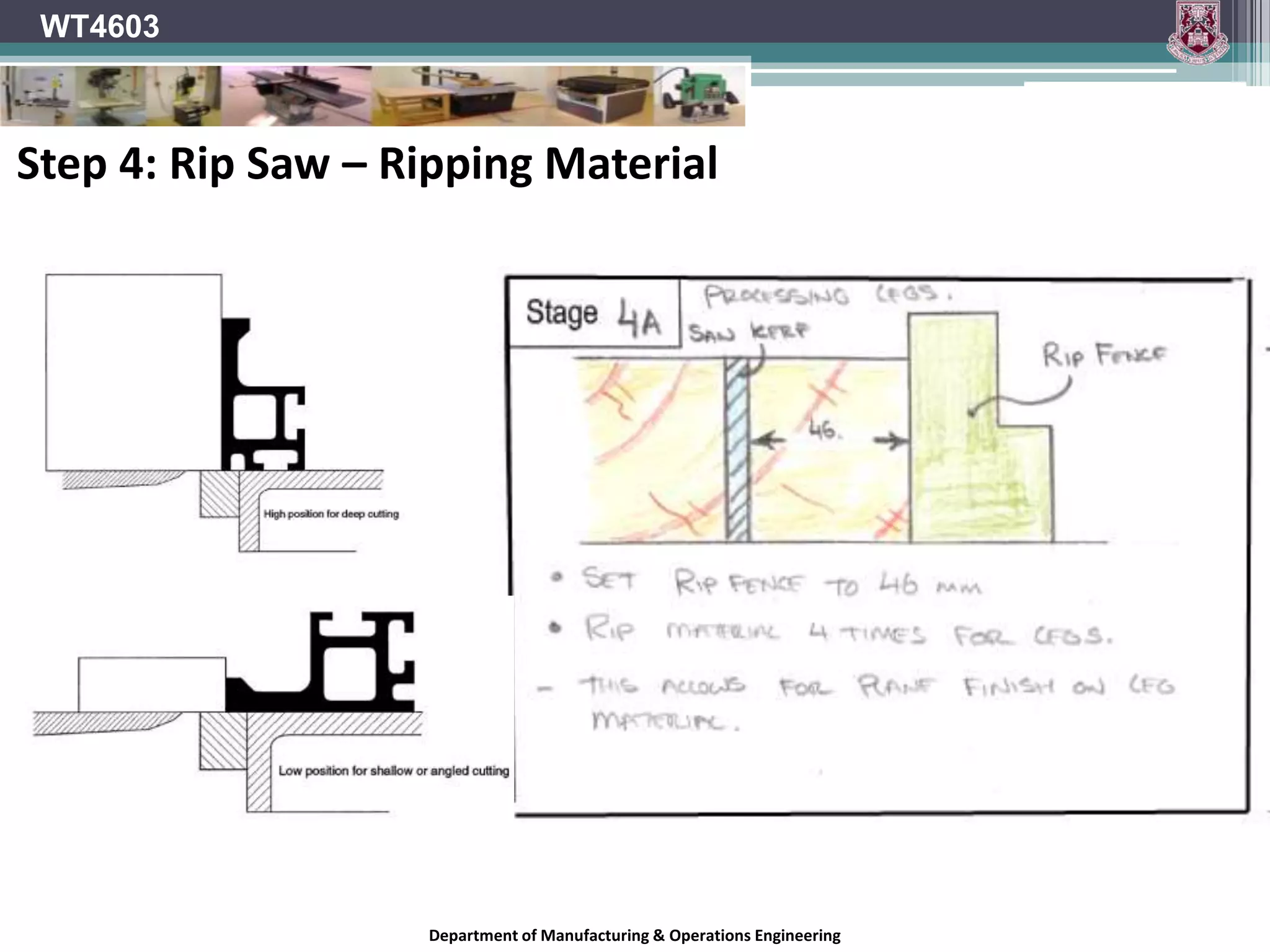
WT4603Step 4: Rip Saw – Ripping MaterialDepartment of Manufacturing & Operations Engineering
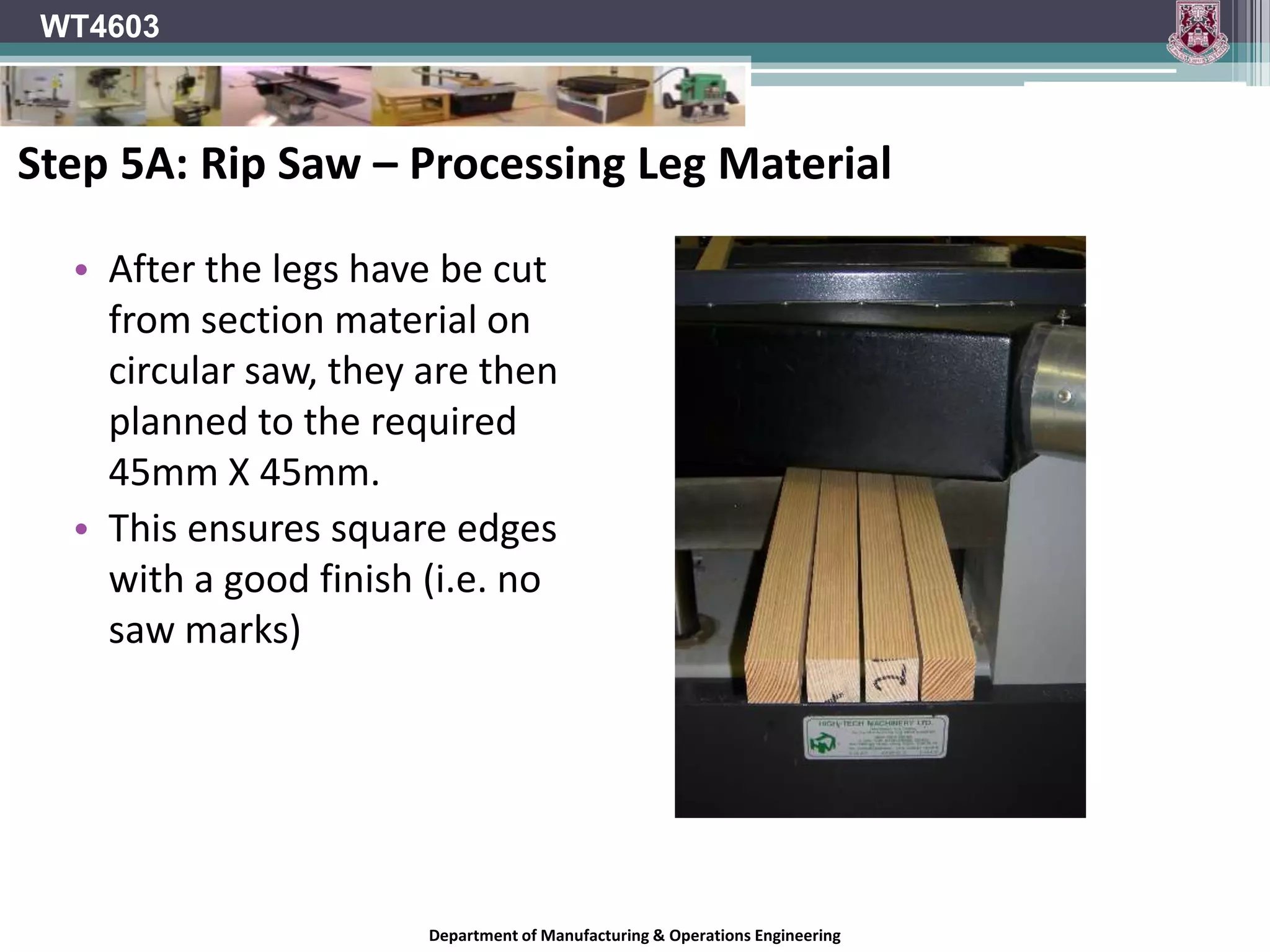
WT4603Step 5A: Rip Saw – Processing Leg MaterialAfter the legs have be cut from section material on circular saw, they are then planned to the required 45mm X 45mm.This ensures square edges with a good finish (i.e. no saw marks)Department of Manufacturing & Operations Engineering
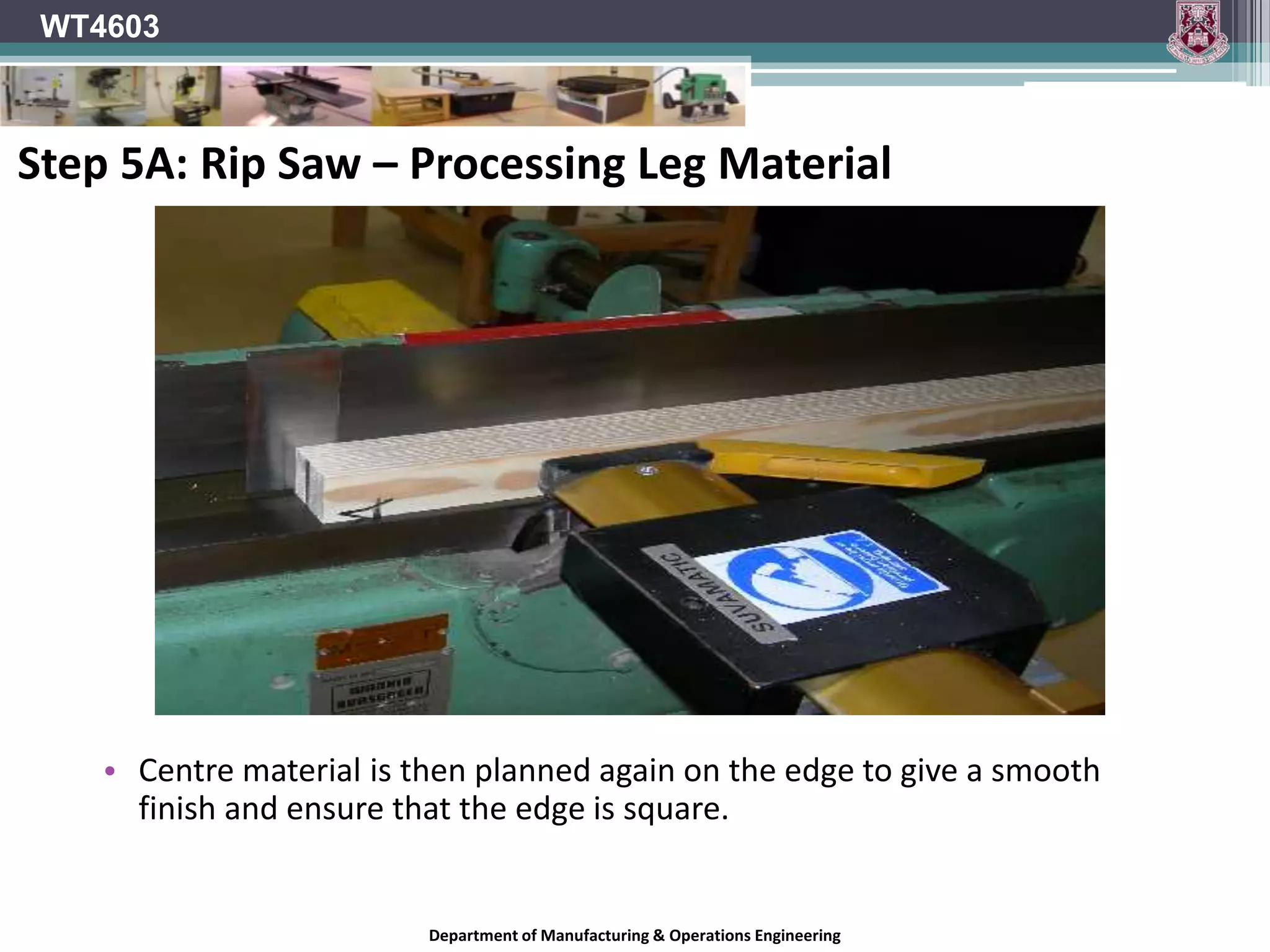
WT4603Step 5A: Rip Saw – Processing Leg MaterialCentre material is then planned again on the edge to give a smooth finish and ensure that the edge is square.Department of Manufacturing & Operations Engineering
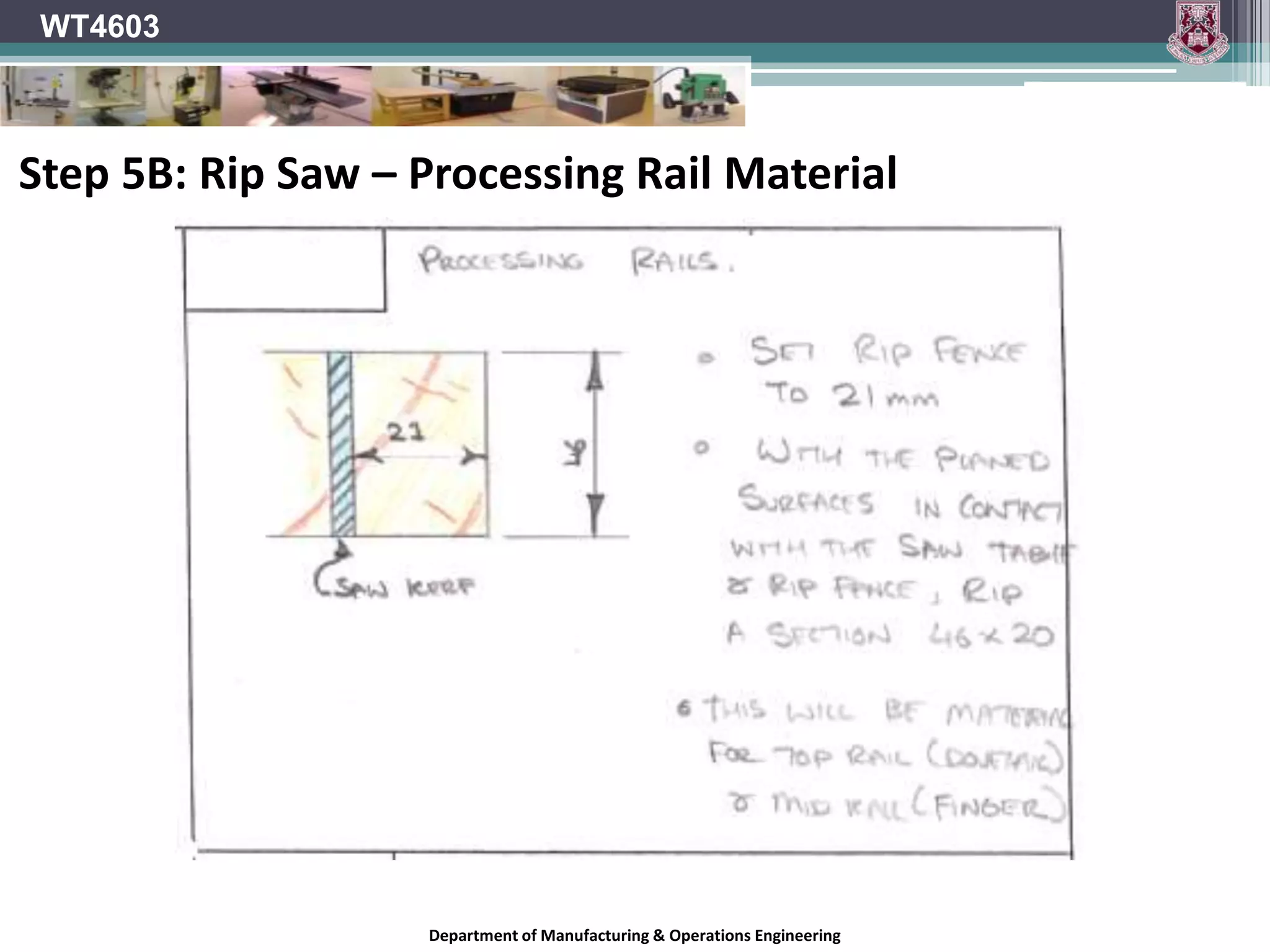
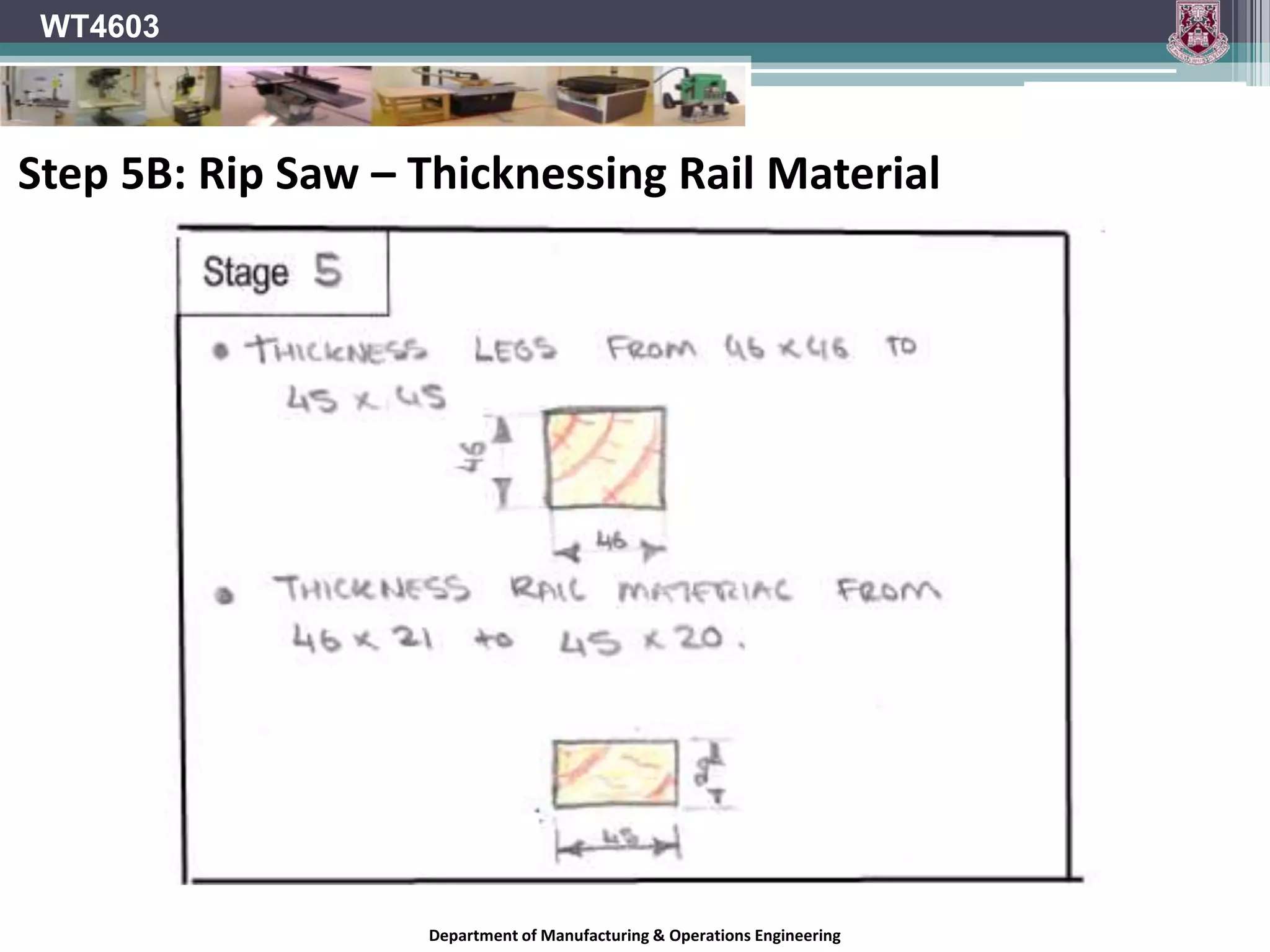
WT4603Step 5B: Rip Saw – Processing Rail MaterialDepartment of Manufacturing & Operations Engineering
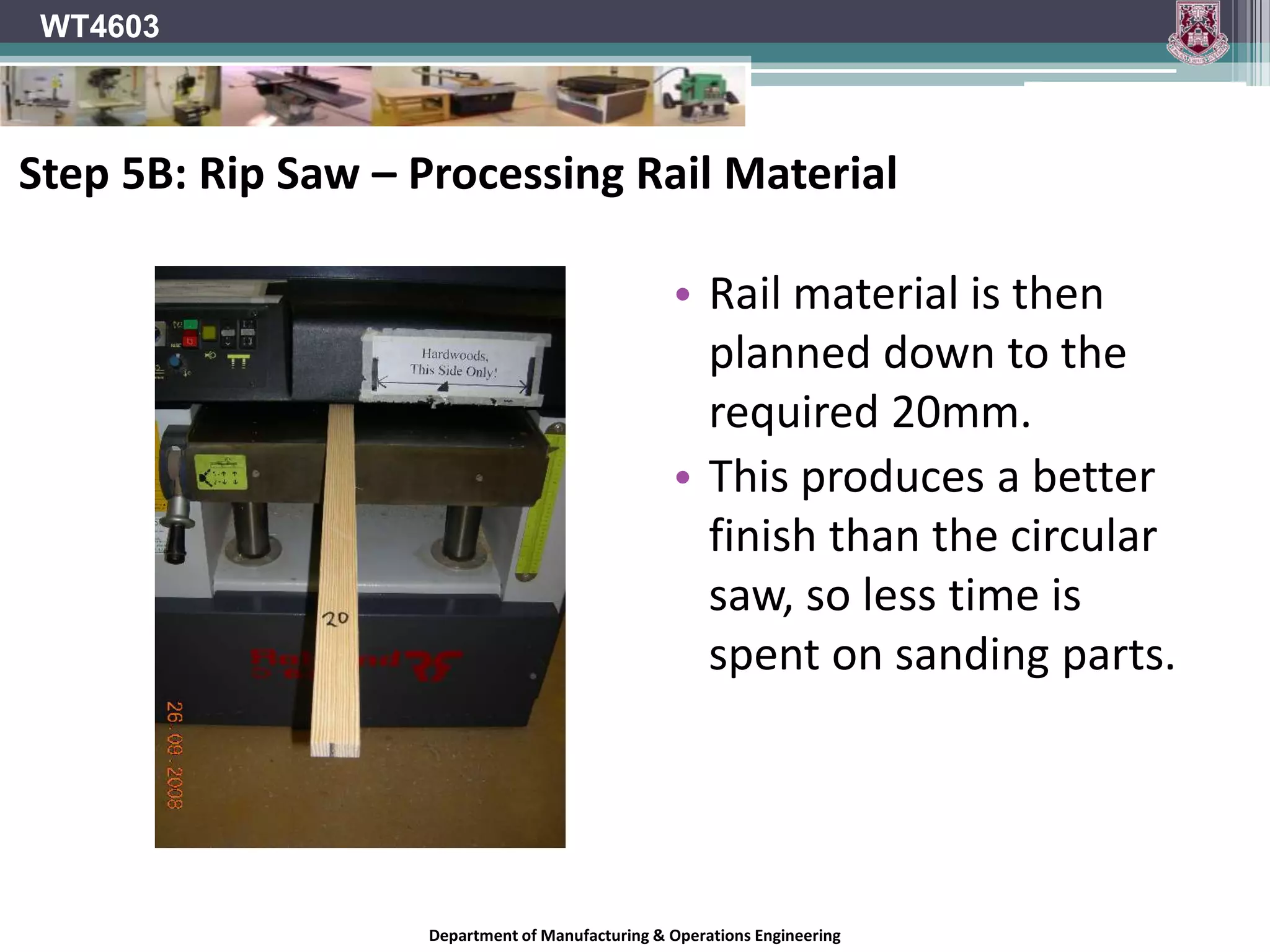
WT4603Step 5B: Rip Saw – Processing Rail MaterialRail material is then planned down to the required 20mm. This produces a better finish than the circular saw, so less time is spent on sanding parts.Department of Manufacturing & Operations Engineering
WT4603Step 5B: Rip Saw – Thicknessing Rail MaterialDepartment of Manufacturing & Operations Engineering
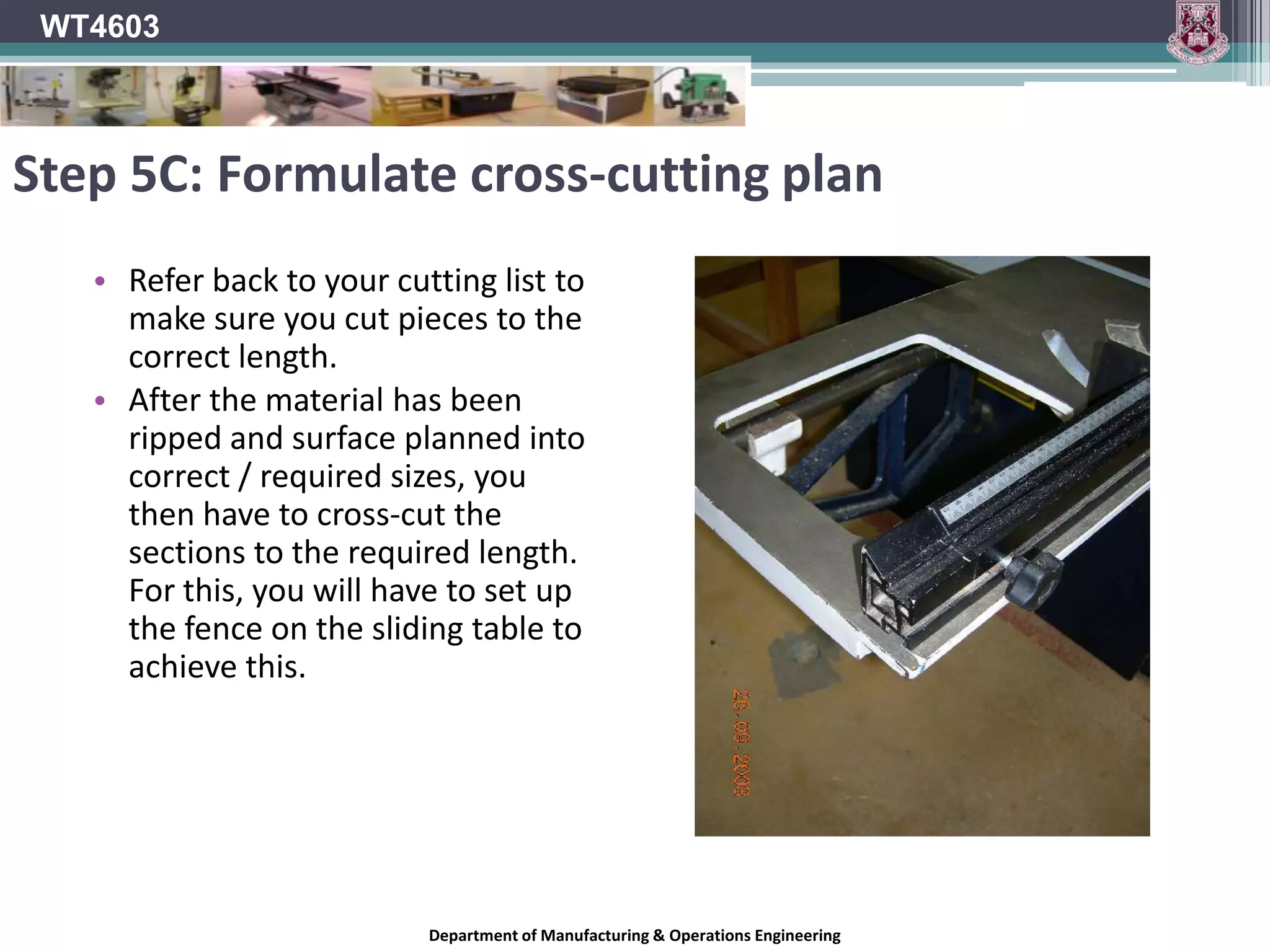
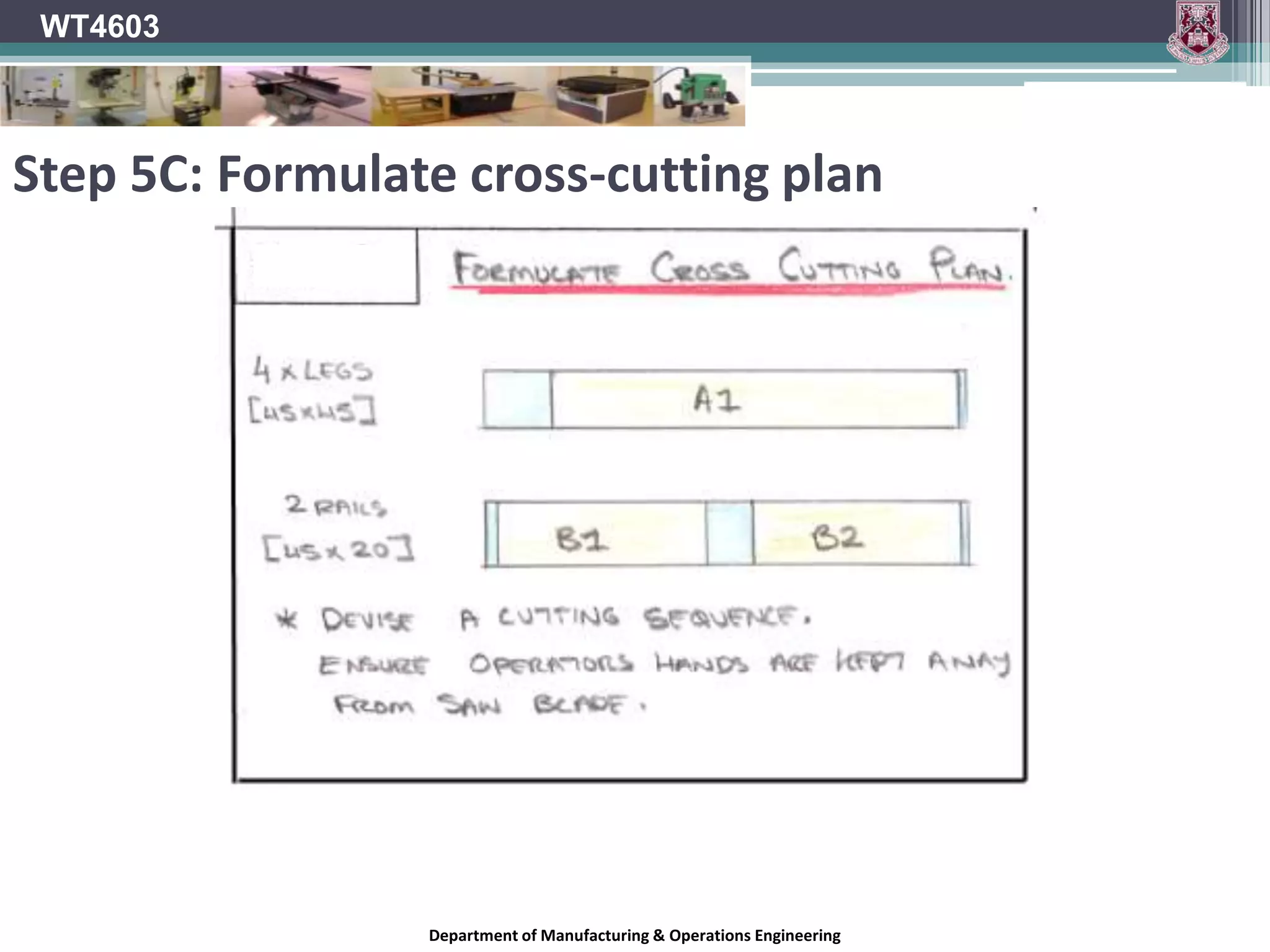
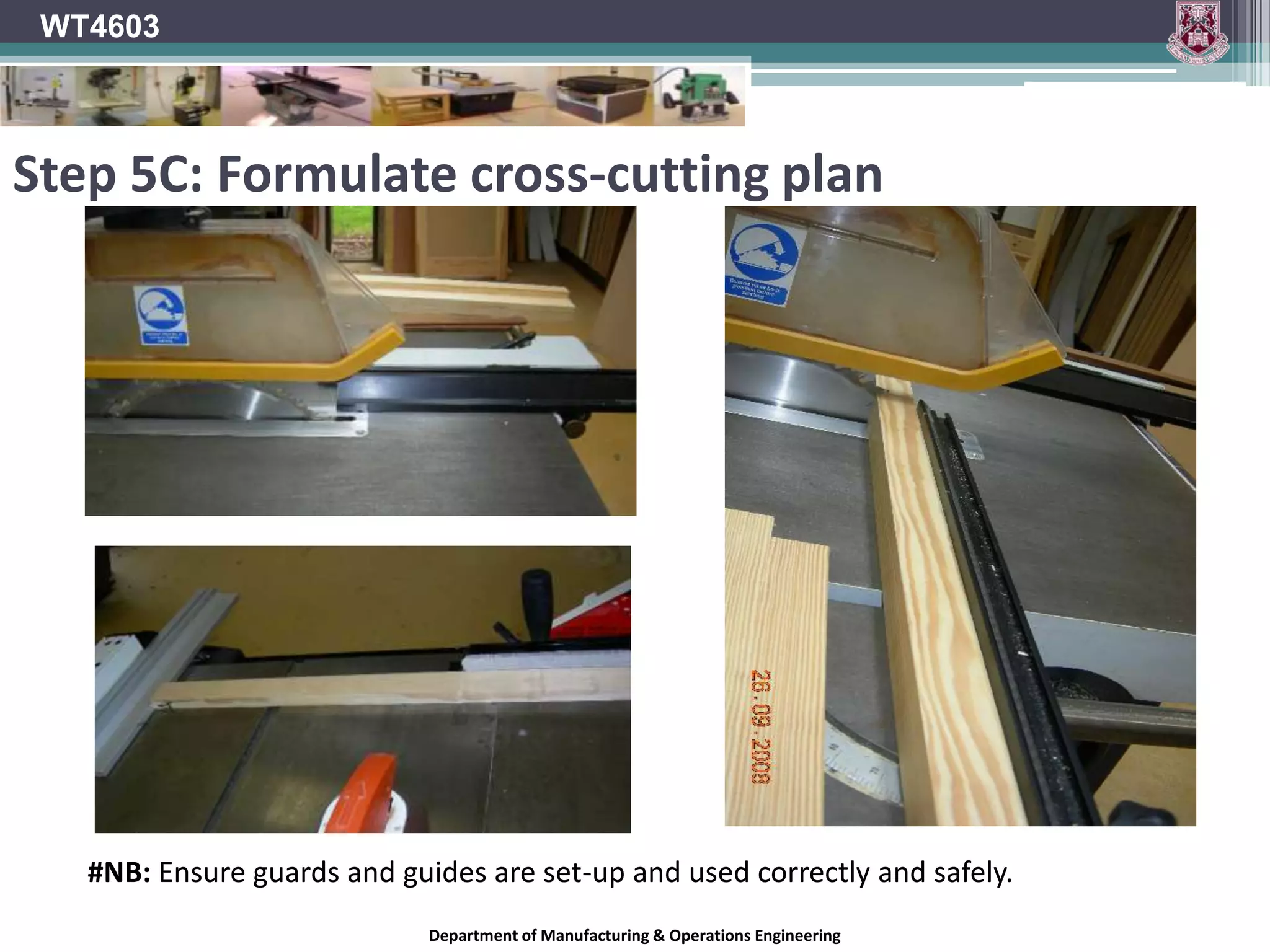
WT4603Step 5C: Formulate cross-cutting planRefer back to your cutting list to make sure you cut pieces to the correct length.After the material has been ripped and surface planned into correct / required sizes, you then have to cross-cut the sections to the required length. For this, you will have to set up the fence on the sliding table to achieve this.Department of Manufacturing & Operations Engineering

Wt4603 unit2 week3_19-09-2011

  • 1.
    WT4603 Wood ProcessingSafety & PracticeAutumn 2011Lecture Unit 2 (Week 3)Personal Protective Equipment (PPE) & Week 3 Labs (Component A - Processing)
  • 2.
    Lecturer: Mr.Joseph Lyster
  • 3.
  • 4.
    Notes preparedby: Mr. Joseph Lyster
  • 5.
    Notes availableon www.slideshare.net/WT4603WT4603WT4603 Wood Processing Safety and PracticePPEPERSONAL PROTECTIVE EQUIPMENTDepartment of Manufacturing & Operations Engineering
  • 6.
    WT4603Personal Protective Equipment(PPE)Department of Manufacturing & Operations Engineering
  • 7.
    WT4603Personal protective equipmentForcenturies, people have employed the use of Personal Protective Equipment (PPE).Cowboys wore leather chaps.Eskimos wear thick gloves and coats.Medieval knights wore Armour.Soccer players wear shin guards.Department of Manufacturing & Operations Engineering
  • 8.
    WT4603What is PPE?“Allequipment which is held or worn at work to protect a person from any harm or environmental hazards encountered.”http://en.wikipedia.org/wiki/Personal_protective_equipmentDepartment of Manufacturing & Operations Engineering
  • 9.
    WT4603Environmental HazardsNoiseDustSmokeUnsafe MachineryEtc.Thereare 5 main classes of environmental hazard:ChemicalPhysicalMechanicalBiologicalPsychologicalDepartment of Manufacturing & Operations Engineering
  • 10.
    WT4603Hierarchy of riskcontrolEliminate the Hazard Completely.Substitute Hazard with a safer alternative.Isolate the Hazard.Use engineering controls to reduce risk at the source (Guarding).Provide training on how to avoid risks.& if all that fails…Use PPE.MOST PREFERABLE SOLUTIONDepartment of Manufacturing & Operations Engineering
  • 11.
    WT4603Using P.P.E.The useof PPE is a last resort!It should only be relied upon for protection when all other means of controlling a hazard have been eliminated as possibilities.It is much more desirable to completely eliminate the hazard than to safeguard against it.Prevention is better than cure!!!PPE should be used:Where Engineering (Guarding) or Administrative (Training, Rules) controls are not feasible.As a short-term measure during periods of time when engineering or administrative controls are being implemented.During emergency response situations.Department of Manufacturing & Operations Engineering
  • 12.
    WT4603PPE LegislationSafety Healthand Welfare at Work (Control of Noise at Work) Regulations 2006.Act specifically outlining the requirements to protect the hearing of employees in the workplace.Safety, Health and Welfare at Work Act 2005. (Formerly 1989 Act)General Act Governing health and Safety at work in IrelandThe Safety, Health and Welfare at work (General Application) Regulations 2007.Among other things, this Act outlines the legal responsibilities in relation to the use of PPE in the workplace & schools.European Communities (Personal Protective Equipment) Regulations, 1993.Aimed more specifically at the selection, use and manufacturing quality of PPE.Department of Manufacturing & Operations Engineering
  • 13.
    WT4603Responsibilities of Employers*Allemployers must conduct a Hazard Identification and risk assessment to determine if the use of PPE is necessary.Risk control; this may be through the use of PPE.Provision of PPE on the basis of the Hazard Identification.Provision of Training on using necessary PPE.The Safety, Health and Welfare at work (General Application) Regulations 2007 requires schools to provide suitable PPE if a risk to health and safety cannot be avoided or sufficiently controlled through other means.*The Safety, Health and Welfare at work (General Application) Regulations 2007.*The Safety, Health and Welfare at Work Act 2005.Department of Manufacturing & Operations Engineering
  • 14.
    WT4603Responsibilities of PrincipalsTheyshould:Carry out a risk assessment to identify the possible need for PPE.Provide, free of charge, adequate PPE to employees (Teachers) who may be exposed to hazards at work that have not been controlled by other means.Make an assessment before choosing any form of PPE.Ensure that PPE is well maintained and cared for.Provide storage for PPE when not in use.Provide teachers with training in the use, limitations and care of their of PPEDepartment of Manufacturing & Operations Engineering
  • 15.
    WT4603Responsibilities of Teachers(Employees)Employees must:Attend PPE training.Make full and proper use of PPE.Ensure PPE is correctly stored and cared for.Follow all directions and heed all warnings.Report any defects in or loss of PPE to employer.Department of Manufacturing & Operations Engineering
  • 16.
    WT4603Provision of P.P.E. The employer should shoulder the cost of all PPE required by the employee.In schools, this means that any teachers requiring it, should be provided with a full set of PPE by the school.It should be made mandatory that all pupils should be required to provide their own PPE (to the appropriate standard).Wearing of this PPE should be strictly enforced by the teacher.Employer must maintain and replace broken or un-usable PPE.However, it is the responsibility of each employee to respect and care for their PPE and report any damage or defects present in it to the employer.Department of Manufacturing & Operations Engineering
  • 17.
    WT4603PPE Training*Employers mustprovide the following training in relation to PPE:Proper use of PPE.When to use PPE.Adequate PPE Storage.Importance of using PPE.How to spot defects in PPETeachers should also provide training to their pupils on how to use their PPE correctly.Part of a teachers demonstrations should place an emphasis on The correct use of PPEImportance of PPECare of PPE.Department of Manufacturing & Operations Engineering
  • 18.
    Sharing PPEWT4603Under nocircumstances should pupils be allowed to share PPE.Why Not?Associated hygiene issues.Swapping PPE may limit the level of protection offered:Different size/Setting.Make sure everyone has their own!!!Department of Manufacturing & Operations Engineering
  • 19.
    WT4603PPE SelectionIn schools,the selection of PPE is generally the responsibility of the teacher.For this reason, it is vital that teachers are capable of making the correct selection of PPE both for themselves and the pupils left in their care.When selecting PPE, always think of the worst case scenario – What is the worst that could happen?The existence of the “CE” marking on a piece of equipment should indicate that its manufacturer has met all relevant safety standards and requirements.ALWAYS look for this mark when buying PPE (as well as other equipment, tools and machinery.)Department of Manufacturing & Operations Engineering
  • 20.
    WT4603PPE – SomeFactors to ConsiderDEGRADATIONHarmful change of physical properties of a protective clothing material when subjected to a chemical or wear and tear over time.PENETRATIONFlow of chemicals/ hazardous substances through seals such as zips, seams or pinholes.PERMEATIONMovement of the hazardous substance through the protective material itself.Always consult manufacturer’s instructions.Department of Manufacturing & Operations Engineering
  • 21.
    WT4603Eye & FaceProtectionThousands of people are blinded in the workplace every year for no reason.Simple and inexpensive face and eye protection could have prevented it.The human eye is very sensitive organ and is highly susceptible to injury from many sources:Impact ChemicalsDust/ foreign particles.Etc..Department of Manufacturing & Operations Engineering
  • 22.
    WT4603The eyeThe Cornea& Lens focus light.The Iris controls the amount of light entering the eye.All are made up of very soft, delicate and easily damaged tissue.Damage is often irreparable!Department of Manufacturing & Operations Engineering
  • 23.
    WT4603Common Eye InjuryCausesObjects hitting the eye Swarf.Flying particles (Sawdust).Flying objects (Projected materials/ tools!)Intense Light (Lasers, Welding)Contact with Chemicals.Falling onto or walking into stationary objects.Department of Manufacturing & Operations Engineering
  • 24.
    WT4603Chemicals/ fumes/ mistsSprayPaint.Fumes from welding and other heat processes.Smoke.Aerosol Cans.Liquid droplets.Airborne Hazardous chemicals can enter and damage the eye.Department of Manufacturing & Operations Engineering
  • 25.
    WT4603Flying particlesGrinding HammeringWeldingSplashes of chemicals and molten metalsPhysically injure the eye, tearing or scratching the cornea.Very painful and difficult to correct.Department of Manufacturing & Operations Engineering
  • 26.
    WT4603ThermalHeat and glarefrom molten metals, furnaces and other heat processes such as welding or soldering can burn the cornea.Department of Manufacturing & Operations Engineering
  • 27.
    WT4603Intense light levelsLasersExposuresto excessive glare or bright lights Damage the retina and optic nerve located deep within the eye as opposed to swarf or dust just damaging the cornea.A much more serious injury.Department of Manufacturing & Operations Engineering
  • 28.
    WT4603Safeguarding against EyeInjuriesEye protection should be worn when spray painting, grinding, drilling, welding, sawing, working in a dusty environment, or handling chemicals.One should also develop the good habit of protecting the eyes whenever working with hand or power tools.WHEN IN DOUBT, WEAR EYE PROTECTION ANYWAY!Department of Manufacturing & Operations Engineering
  • 29.
    Machinery GuardingWT4603Because itis much more preferable to eliminate the hazard at the source, guarding is often added.This is not usually enough to fully reduce the risk so wear safety glasses as well!!Department of Manufacturing & Operations Engineering
  • 30.
    WT4603VentilationVentilation is themovement of air, usually between the inside and outside of enclosed spaces.Ventilation is necessary when people or animals are present to remove carbon dioxide and replace it with oxygen.Ventilation must also be used to remove dangerous pollutants such as smoke, fumes, chemicals and fine particles suspended in the air.Department of Manufacturing & Operations Engineering
  • 31.
    WT4603Safety Glasses/gogglesSafety glassesusually have frontal protection only.Safety goggles fit closer to the face and protect the eyes from frontal as well impact from all other directions.Much more resistant to airborne hazardsAirborne hazards such as fine particles and dust may by-pass safety glasses.Check for “CE” marking.Different Grades available for different hazard levels.Prescription safety glasses also available.Department of Manufacturing & Operations Engineering
  • 32.
    WT4603Face ShieldsShould beused in conjunction wit glasses or goggles where possible. Not considered suitable eye protection on its own.Offers very little protection against strong impact More suitable for dust and small flying particles (Lathe Work).Department of Manufacturing & Operations Engineering
  • 33.
    WT4603NOTE: “CE” MarkingDepartmentof Manufacturing & Operations Engineering
  • 34.
    WT4603Welding Goggles/Shield/HelmetThe brilliantlight from welding can cause serious damage to the eye even when exposed to it for a short period of time.A welding helmet is fitted with a special lens to filter extreme bright light from welding while the helmet itself protects against hot sparks.Anyone watching the welding should also utilise suitable PPE.When chipping slag, ensure that you, as well as anybody else watching, is wearing suitable eye protection!Department of Manufacturing & Operations Engineering
  • 35.
    WT4603Care of EyeProtectionClean with wipes or water.Don’t use abrasive soaps.Store in a clean, dry and dust-free place.Department of Manufacturing & Operations Engineering
  • 36.
    WT4603Eyewash StationsInstall andMaintain Display instructions.Train on how to use.Keep fully stocked.Some chemicals react with water – Consult Material Safety Data Sheet (MSDS)Department of Manufacturing & Operations Engineering
  • 37.
    WT4603Of course, wearingsafety glasses doesn’t necessarily mean you are going to be safe from everything!!USE YOUR COMMON SENSE!!!Department of Manufacturing & Operations Engineering
  • 38.
    WT4603Respiratory ProtectionDepartment ofManufacturing & Operations Engineering
  • 39.
    WT4603The Breathing ProcessTobest understand the hazards one should take a look at how breathing worksTake a breath and air rushes from the external environment, down the windpipe and into the alveoli in the lungs.Alveoli in lungs are tiny air sacs which transfer oxygen into blood and CO2 from it.The lung is a very delicate organ and can be easily damaged by hazardous dusts, fumes and chemicals when inhaled.Damaged lungs are also much more susceptible to contracting further diseases.Department of Manufacturing & Operations Engineering
  • 40.
    WT4603DustDust is formedwhen material is broken down into tiny particles.Grinding. Sanding.Cutting.The Safety, Health and Welfare at Work (Chemical Agents) Regulations 2001 requires all schools to assess and determine the risk posed by any chemical agent including wood dust.Department of Manufacturing & Operations Engineering
  • 41.
    WT4603Wood DustMachining Processes:MDFand hardwood dust is considered to be a significant hazard.Sanding – Fine dust that may even stay airborne for hours after work has ended.Department of Manufacturing & Operations Engineering
  • 42.
    WT4603Carcinogens A carcinogenis any substance or agent that promotes cancer.Softwood dust – Non-Carcinogenic.Hardwood dust – Carcinogenic.MDF - Carcinogenic.Due to the carcinogenic nature of these materials, they should be phased out completely in the technology classrooms.At a minimum, PPE and dust extraction should be available.It is the responsibility of the employer to monitor and control the use of carcinogenic materials and substances in the workplace.*Storage.Training.Control Measures or suitable PPE.*Safety, Health & Welfare at Work (Carcinogens) Regulations, 2001.Department of Manufacturing & Operations Engineering
  • 43.
    WT4603VaporsA vapor iscreated when a liquid or solid evaporates.EXAMPLESPetrol vapors.Wood finishesPaint.ThinnersSolventsDepartment of Manufacturing & Operations Engineering
  • 44.
    WT4603Mists and SpraysMistsand sprays are made up of small droplets suspended in the air.Aerosols and spray guns, by design, create fine sprays and mists. EXAMPLESPaintWaterDepartment of Manufacturing & Operations Engineering
  • 45.
    Gases, fumes &SmokeWT4603GASMay or may not have a smell.May or may not be visible.FUMESOccur during high heat process such as welding or soldering.SMOKEThe suspension in air of small particles resulting from the incomplete combustion of a fuel.Department of Manufacturing & Operations Engineering
  • 46.
    WT4603Respiratory ProtectionHazardous substanceswhich have become airborne pose a significant threat to the lungs and therefore we must protect ourselves against them in some wayThe aim should always be to prevent the substance from getting into the air in the first place but when this is not possible, Respiratory Protection should be used.Department of Manufacturing & Operations Engineering
  • 47.
    WT4603RespiratorsAll respirators havesome form of face piece which is held to the face with straps, usually around the head.Half-face respirators cover the nose and mouth only and are for use where the contaminants are not a threat to the eyes or face.A full-face respirator covers all the face and should be used where contaminants may be a hazard to eyes and the face as well as the respiratory system.Department of Manufacturing & Operations Engineering
  • 48.
    WT4603RespiratorsA respirator isa device which is designed to protect the wearer from inhaling harmful dusts, gases, fumes or vapours.Two main types of respirator exist:Air Purifying Respirators.Atmosphere Supplying RespiratorsDepartment of Manufacturing & Operations Engineering
  • 49.
    WT4603Air Purifying RespiratorsUsedagainst contaminants such as smoke, dust, vapours and fumes.Acts passively to remove contaminants from the air.The device renders the contaminated air breathable.Usually has a filter for particulates or a cartridge for gasses and vapours (or a mixture of both).Not suitable where the levels of oxygen in the air are deficient.Department of Manufacturing & Operations Engineering
  • 50.
    Filter Mask -DisposableWT4603A filter mask offers protection to its wearer against airborne substances.It usually covers only the nose and mouth and works by restricting the flow of air, forcing it through a filter which removes harmful particles or dusts.The most common type is the white disposable N95 filter mask as shown.Cannot protect against:GassesVaporsLow O2 levelsDepartment of Manufacturing & Operations Engineering
  • 51.
    WT4603Filter Mask -ReusableReusable filter masks fitted with disposable filter cartridges are also available.When filters become saturated or worn, or if air flow is restricted they must be replaced.Mask cartridges are filled with certain resins or chemicals that will absorb certain fumes, eliminating them from the inhaled air.Different cartridges are available for filtering different contaminants from the air. Check manufacturer’s instructions & Use by date.Department of Manufacturing & Operations Engineering
  • 52.
    WT4603Atmosphere Supplying RespiratorsAirsupplied respirators use reserve tanks to supply a constant flow of air to the wearer’s face/lungs.The contaminated air is not purified in any way nor is it inhaled by the wearer.Fire FightersS.C.B.A. – Self Contained Breathing ApparatusS.C.U.B.A. – Self Contained Underwater Breathing ApparatusDepartment of Manufacturing & Operations Engineering
  • 53.
    WT4603Respirator SelectionHazard levelshould be determine and adequate level of protection selected accordingly by a competent person. Determined largely by the hazard present.E.g. - Dust PPE will give no protection against fumes and vapours.Supplied air respirators in schools SHOULD NOT BE USED. If any such risk should exist, find an alternative for it!Department of Manufacturing & Operations Engineering
  • 54.
    WT4603Inspection Before UseCheckRespirators before you them every time.Look out for;Wear and damage.CracksLoose fittings.Use by dates.Department of Manufacturing & Operations Engineering
  • 55.
    Monitoring the RespiratorWT4603Asyou work- you must stay aware of your respirators operation.Signs of it not working are:Feeling dizzy or sick.Being able to smell or taste the contaminant in the air.Difficulty breathing.Filter/ cartridge has expired.Respirator is damaged.Department of Manufacturing & Operations Engineering
  • 56.
    WT4603StoringWhen not usingrespirators, they must be carefully stored in order to prevent deterioration in their effectiveness.Store in a sealable plastic bag and away from:DustMoistureDirect SunlightHeatExtreme coldChemicalsGerms/fungal growth Sources of infection.Department of Manufacturing & Operations Engineering
  • 57.
    WT4603Hearing ProtectionDepartment ofManufacturing & Operations Engineering
  • 58.
    WT4603NoiseNoise is oftendescribed as being sound that people would prefer not to hear. What may be important or welcome sound to you may be noise to others exposed to it.Department of Manufacturing & Operations Engineering
  • 59.
    WT4603Is Noise harmingyou?If you experience any of the following, you may be exposed to excessive noise levels on a daily basis:You experience ringing or other noises in your ears.You have difficulty hearing people talking.You are unable to hear high pitched or soft sounds.Department of Manufacturing & Operations Engineering
  • 60.
    Remember!WT4603Becoming used toa loud noise is a sign of gradual hearing loss.You do not become used to it, you merely lose your ability to hear it!!Department of Manufacturing & Operations Engineering
  • 61.
    WT4603Ear Protection ZonesIfthe risk assessment reveals areas of high noise levels in which ear protection is required, they must designated as Hearing Protection zoneThese zones must be marked clearly using adequate signage.The sign should show the following:That you are entering an ear protection zone.Ear protection must be worn in this area.Nobody may enter the zone without wearing appropriate hearing protection.Safety Health and Welfare at Work (Control of Noise at Work) Regulations 2006Department of Manufacturing & Operations Engineering
  • 62.
    WT4603As a Rule!Ifyou must shout in order for someone 2 meters away from you to hear you, YOU SHOULD BE WEARING HEARING PROTECTION!Department of Manufacturing & Operations Engineering
  • 63.
    WT4603Hearing Protection DevicesTinnitusand Noise Induced Hearing Loss can be prevented with the use of appropriate Hearing Protection Devices (HPD’s).These devices provide a barrier between the ear and the noise.Some ear defenders work on the principle of absorbing the sound waves before they reach the ear.Department of Manufacturing & Operations Engineering
  • 64.
    WT4603Selecting Hearing ProtectionEnsurea “CE” Marking is present.Every person is different. – Some find different things more comfortable than others.In processes where hands become dirty, inserting and removing earplugs can lead to dirt and bacteria being introduced into the ear canal causing ear infections.Provide and encourage the use of a variety of hearing PPE and let people select most comfortable for themselves.If PPE is uncomfortable or irritating, It will not be used!!Department of Manufacturing & Operations Engineering
  • 65.
    WT4603Noise Reduction RatingsEarplugsand earmuffs come rated with “Noise Reduction Ratings” (NRR’s).This rating tells the user what level of sound protection they can expect from the device in a noisy environment.The NRR of hearing protection devices should be consulted when selecting them for use.However, NRR’s are developed under controlled laboratory conditions and the “real-life” NRR rating is usually lower. Therefore it is always best to error on the side of caution and select the PPE with a higher NRR than is required.Department of Manufacturing & Operations Engineering
  • 66.
    WT4603Hearing P.P.E.If thenoise cannot be reduced to suitable levels at the source, hearing PPE must be used to achieve this.Many types of hearing protection devices are available each carrying with them various advantages and disadvantages.Popular types of hearing protection devices are: 1 Earplugs 2 EarmuffsDepartment of Manufacturing & Operations Engineering
  • 67.
    WT4603When to WearHearing Protection.You should consider wearing Hearing Protection if;You work in an environment where you are exposed to continuous decibel levels of 80dB or greater over an 8 hour period.You are unusually fatigued after being in a noisy area.You experience ringing in your ears after being in a noisy area.You feel nervous or anxious after being in a noisy area.In order to be fully effective, hearing protection devices must be worn at all times in noisy environments.Removing for even a short period of time can decrease their effects substantially.Department of Manufacturing & Operations Engineering
  • 68.
    WT4603EarplugsAn earplug isa protective device which is inserted into the ear canal to protect the inner ear from being exposed to excessive levels of noise or the intrusion of foreign bodies or excessive wind.Department of Manufacturing & Operations Engineering
  • 69.
    WT4603EarplugsMost earplugs arecylindrical in shape and are made from memory foam.The earplug is rolled into a tightly compressed cylinder between the fingers and inserted into the ear canal.When released, the earplug expands to its original size, sealing the ear canal and preventing sound vibrations from reaching the eardrum.Other earplugs are custom made with moulds from the user’s ear to provide a more snug and noise resistant fit.Department of Manufacturing & Operations Engineering
  • 70.
    WT4603Advantages & Disadvantagesof EarplugsADVANTAGESInexpensiveSmall & LightweightComfortable in warm, humid environments.Easily used with other equipment.DISADVANTAGESMay work themselves loose and require adjustment or refitting.Frequently become soiled.Require specific fitting instructions.Awkward to remove and replace when noise is inconsistent.Easily Misplaced.May irritate the ear canal.Difficult to monitor the use of.Department of Manufacturing & Operations Engineering
  • 71.
    WT4603EarmuffsEarmuffs are objectswhich are designed to cover the ears for protection.Earmuffs come in two different kinds;Thermal EarmuffsWorn in cold environments to keep the ears warm.Acoustic EarmuffsAlso known as ear defenders.Cups lined with sound-absorbent material which fit over the ears.Protect the ears from excessive noise levels.Department of Manufacturing & Operations Engineering
  • 72.
    WT4603Advantages & Disadvantagesof EarmuffsADVANTAGES:Easy to supervise the wearing of.More comfortable for long periods of use.One size fits all.Quickly put on & removed.May be worn with minor ear infections.DISADVANTAGESMay fit loosely on the head.Uncomfortable in a warm environment.Difficult to use with some other equipment.Less portable and convenient.Department of Manufacturing & Operations Engineering
  • 73.
    WT4603Wearing EarmuffsEarmuffs mustfit fully over the outside of the ears.Their effectiveness is determined by the quality of the seal around the ear.Ensure hair, hats, glasses, jewellery, etc. does not interfere with the seal around the ear.A combination of earplugs and earmuffs should be used as an extra precaution if glasses, earrings, facial hair, etc, prevents the earmuffs forming a good seal around your ears.Department of Manufacturing & Operations Engineering
  • 74.
    WT4603Hearing Protection OverkillWearingexcessive levels of hearing protection can also be hazardous!!!Employees may not be able to hear vital warning alarms such as fire alarms.It also promotes users removing ear protection to talk.Department of Manufacturing & Operations Engineering
  • 75.
    WT4603Caring for hearingprotection devices - EarplugsWhen not using earplugs, they should be stored in a clean, cool and dry place.If Foam earplugs become soiled, they should be discarded and replaced with a clean pair.Soiled PVC earplugs can often be cleaned with soap and water.Replace PVC earplugs if they become torn or brittle.Check manufacturer’s instructions regarding washing earplugs.Department of Manufacturing & Operations Engineering
  • 76.
    WT4603Caring for hearingprotection devices - EarmuffsAlways follow manufacturers instructions.Check headband regularly for wear and tear-replace or repair immediately if needs be.Ensure tension in headband is not reduced.Store earmuffs in a clean, cool and dry place when not in use.Always replace when a snug fit in or around ear is not achieved.Wash earmuffs with a mild liquid detergent. Do not wet sound-attenuating material within the ear muffs.Department of Manufacturing & Operations Engineering
  • 77.
    WT4603Hand ProtectionDepartment ofManufacturing & Operations Engineering
  • 78.
    WT4603Hand ProtectionLook atyour hands! They are the only two you will ever have. SO MIND THEM!Without the use of your fingers or hands, your ability to work or lead a normal life would be dramatically reduced.Department of Manufacturing & Operations Engineering
  • 79.
    WT4603Possible HazardsCuts andAbrasions.Crushing.Extremes of temperatures.Contact with toxic or corrosive substances.Skin Irritation & Dermatitis.Electric shock.Absorption of chemicals.Department of Manufacturing & Operations Engineering
  • 80.
    WT4603Dermal Hazard CategoriesSkinon the hands may come into contact with a lot of unknown materials and substances from day to day.ChemicalIrritants.Corrosives.Carcinogens.Physical Fire.Radiation.Vibration.BiologicalHuman, animal or environmental pathogens (Hepatitis, AIDS, etc)NOTE: poisons and toxins can be absorbed through the skin in the hands and into the body.Department of Manufacturing & Operations Engineering
  • 81.
    WT4603Possible Hazard: TraumaticinjurySharp tools and machines may cut your hands.Staples, wire, nails chisels etc. can puncture your hands.Hands may become caught in machinery causing them to become sprained, crushed or amputated.Department of Manufacturing & Operations Engineering
  • 82.
    WT4603Selection of GlovesThecorrect glove must be selected in order to achieve an adequate level of protection. The following should be considered:Chemical Resistance.Cut/Tear Resistance.Manual Dexterity/Flexibility.Extremes of Temperature.CostFit.Comfort.Department of Manufacturing & Operations Engineering
  • 83.
    WT4603Types of GlovesMetalmesh & Kevlar gloves protect against cuts and sharp objects.Leather gloves offer protection against rough objects, chips, sparks and low moderate heat.Department of Manufacturing & Operations Engineering
  • 84.
    WT4603Types of GlovesCottonfabric gloves protect the hands from dirt, abrasions and splinters. Cotton gloves also improve grip when handling slippery objects.Offers very little protection against cuts.Rubber & Vinyl gloves protect the wearer’s hands from dirt, chemicals and environmental pathogens.Wear around bloodShould always check packaging and manufacturer’s instructions.Department of Manufacturing & Operations Engineering
  • 85.
    WT4603 Use of glovesWhenwearing gloves;Remove any rings, watches or bracelets that may damage the gloves or reduce their ability to do their job.Inspect gloves for holes and cracks that might leak.Replace gloves that are torn or worn out.After working with chemicals, leave gloves on hands and wash under running water to remove any chemicals before you remove gloves from your hands.Store gloves in a clean, cool, dry and well ventilated area.NEVER wear gloves around powered rotating equipment such as drills or lathes etc…(May become tangled)Always follow manufacturer’s instructions.Department of Manufacturing & Operations Engineering
  • 86.
    WT4603Welding PPEWhile workingwith heat processes such as welding additional protection will be necessary.Infrared radiation produced during welding is a cause of retinal burning and cataracts.To protect against this, a proper welding helmet should be worn which incorporates the correct grade of filter plate.To protect the body from welding spatter and arc flash, the following protective clothing may be utilised:Flame-proof apron.Gloves.Long sleeves.Fire resistant capes for overhead work.Appropriate footwearKeep clothes free of grease and oil.Department of Manufacturing & Operations Engineering
  • 87.
    WT4603LAB COATA labcoat is a knee-length overcoat worn by those involved in significant work to protect their street clothes.The garment is usually made from cotton or linen and is usually white in colour.known not to react with any chemicals.No loose elements.Hygienic.Lab coats are much easier to take off than regular street clothes if they get splashed with chemicals, catch fire or become entangled in machinery.Department of Manufacturing & Operations Engineering
  • 88.
    WT4603Encouraging use ofPPEStudents should benefit from good example.Teacher should wear PPE whenever appropriate.Signage.Highlight importance of PPE using strategically placed safety signs.Teach safety as part of working, not just an add-on.Department of Manufacturing & Operations Engineering
  • 89.
    WT4603Encouraging use ofPPEThe use of suitable signage should be employed to help encourage safe practices and the appropriate use of PPE.Department of Manufacturing & Operations Engineering
  • 90.
    WT4603Process SheetsDepartment ofManufacturing & Operations Engineering
  • 91.
    WT4603Department of Manufacturing& Operations Engineering
  • 92.
    WT4603Department of Manufacturing& Operations Engineering
  • 93.
    WT4603Creating a CuttingListDepartment of Manufacturing & Operations Engineering
  • 94.
    WT4603Creating a cuttinglistA cutting list is a document that allows the material processor to calculate volumes of material and to formulate a processing procedureThe list must contain the critical dimensions of the materialCutting lists must have a standard format to enable the processor to operate efficientlyThe next slide shows the UL format for compiling a cutting list.This template must be used when making a submission for material.Lists that are outside this template will not be processed.Department of Manufacturing & Operations Engineering
  • 95.
    WT4603Cutting list templateDepartmentof Manufacturing & Operations Engineering
  • 96.
    StandardsCutting list mustbe submitted on an A4 sheet(s) of paperStudents must use the UL templateSubmissions must be printed or typedSubmissions that are sloppy, untidy, scribbled, crossed out or outside the standard format will not be accepted.The descriptions section must illustrate the shape and detail of the piece.Secondary processing should be illustrated in this section e.g. grooving etc.Lists should be filled out beginning with larger cross-sections and working your way down in cross-sectional size.(This can aid material optimisation)WT4603Department of Manufacturing & Operations Engineering
  • 97.
    WT4603Good ExampleDepartment ofManufacturing & Operations Engineering
  • 98.
    WT4603Good ExampleDepartment ofManufacturing & Operations Engineering
  • 99.
    WT4603Unacceptable examplesDepartment ofManufacturing & Operations Engineering
  • 100.
    WT4603Unacceptable examplesDepartment ofManufacturing & Operations Engineering
  • 101.
    Unacceptable examplesWT4603Department ofManufacturing & Operations Engineering
  • 102.
    WT4603Unacceptable examplesDepartment ofManufacturing & Operations Engineering
  • 103.
    Unacceptable examplesWT4603Department ofManufacturing & Operations Engineering
  • 104.
    WT4603Unacceptable examplesDepartment ofManufacturing & Operations Engineering
  • 105.
    WT4603Unacceptable examplesDepartment ofManufacturing & Operations Engineering
  • 106.
    WT4603Unacceptable examplesDepartment ofManufacturing & Operations Engineering
  • 107.
    Unacceptable examplesWT4603Department ofManufacturing & Operations Engineering
  • 108.
    Unacceptable examplesWT4603Department ofManufacturing & Operations Engineering
  • 109.
    Unacceptable examplesWT4603Department ofManufacturing & Operations Engineering
  • 110.
    Unacceptable examplesWT4603Department ofManufacturing & Operations Engineering
  • 111.
    WT4603Working DrawingsDepartment ofManufacturing & Operations Engineering
  • 112.
    WT4603Select & PositionDimensions CorrectlyDepartment of Manufacturing & Operations Engineering
  • 113.
    WT4603Arrows & DimensionLinesDepartment of Manufacturing & Operations Engineering
  • 114.
    WT4603Consider best locationand viewDepartment of Manufacturing & Operations Engineering
  • 115.
    WT4603Include all detailsDepartmentof Manufacturing & Operations Engineering
  • 116.
    WT4603Include Component labellingDepartmentof Manufacturing & Operations Engineering
  • 117.
    WT4603Exploded View orAssembled View???Department of Manufacturing & Operations Engineering
  • 118.
    WT4603LABS WEEK 3Processingplan for Section A of the Table project.Department of Manufacturing & Operations Engineering
  • 119.
    WT4603Table project.To besubmitted by end of first lab of week 3.Orthographic plan, elevation & end view of table
  • 120.
    Cutting List forComponent A
  • 121.
    Isometric drawing ofComponent A (with pieces marked out).
  • 122.
    The different processingstages highlighted with the relative sketches / notations on crucial points / aspects.
  • 123.
    Safety procedures listedfor each machine, and correct PPE used with these machines / processes.Department of Manufacturing & Operations Engineering
  • 124.
    WT4603Section AProcessing materialfrom raw, list out the required measurements of table parts to be acquired from material section A.Department of Manufacturing & Operations Engineering
  • 125.
    WT4603Table parts FromSection A material the following parts are achievable:Table legs (X4, yellow on drawing)Top rail (X1,blue, dovetail)Mid rail (X1, blue, finger joint)Department of Manufacturing & Operations Engineering
  • 126.
    WT4603Step 1: ProduceCutting ListCorrect cutting list: should show:Item.Number.Length.Width.Thickness.Material.Machine Processing Waste& Description.Department of Manufacturing & Operations Engineering
  • 127.
    WT4603Work out howpieces will be removed from material correctly.Grey= Waste Piece – Plane to 10mm for additional useRed = Saw Waste – Cross CutBlue = Rail MaterialGreen = Saw Waste - RipXXXXXXXXXXXXXYellow = Leg Material#NB: Grey is waste/excess material on drawingDepartment of Manufacturing & Operations Engineering
  • 128.
    WT4603Step 2: AssessingmaterialCheck material for the following:Cupping.Bowing.Warping.Defects (stress fractures, dead knots, honey combing, etc.)Department of Manufacturing & Operations Engineering
  • 129.
    WT4603Preparing material forprocessing.The material will have to planned on the Face and Edge to ensure flat surfaces and square cut edges.#NB- check that the fence on the planner is square.Department of Manufacturing & Operations Engineering
  • 130.
    WT4603Square Face Side#NB-notice position of guide on guard, and distance from fence.Department of Manufacturing & Operations Engineering
  • 131.
    WT4603Square Edge Side#NB-notice position of guide on guard, and distance from fence.Department of Manufacturing & Operations Engineering
  • 132.
    WT4603Department of Manufacturing& Operations Engineering
  • 133.
    WT4603Step 3A: Planningmaterial.Plane edges parallel to each other.Thickness material to accommodate the largest piece/part required (in this case, material should be reduced to 46mm to allow for legs, (1mm extra for future planning).Department of Manufacturing & Operations Engineering
  • 134.
    WT4603Step 3A. PlaneParallel Edge.Department of Manufacturing & Operations Engineering
  • 135.
    WT4603Step 3B: MaterialThickness to 46mmDepartment of Manufacturing & Operations Engineering
  • 136.
    WT4603Department of Manufacturing& Operations Engineering
  • 137.
    WT4603Step 4: RipSawDepartment of Manufacturing & Operations Engineering
  • 138.
    WT460387126534Step 4: RipSawDepartment of Manufacturing & Operations Engineering
  • 139.
    WT46034658910Step 4: RipSawDepartment of Manufacturing & Operations Engineering
  • 140.
    WT4603OUTFEEDTABLESLILDINGTABLEStep 4: RipSawDepartment of Manufacturing & Operations Engineering
  • 141.
    WT4603Step 4: RipSawCross CuttingRippingDepartment of Manufacturing & Operations Engineering
  • 142.
    WT4603Mark Line acrossend grain:Horizontal when cuttingVertical when planingStep 4: Rip Saw – Ripping Material#NB: Ensure correct use of PPE and push sticks are practiced.Department of Manufacturing & Operations Engineering
  • 143.
    WT4603Step 4: RipSaw – Ripping MaterialDepartment of Manufacturing & Operations Engineering
  • 144.
    WT4603Step 5A: RipSaw – Processing Leg MaterialAfter the legs have be cut from section material on circular saw, they are then planned to the required 45mm X 45mm.This ensures square edges with a good finish (i.e. no saw marks)Department of Manufacturing & Operations Engineering
  • 145.
    WT4603Step 5A: RipSaw – Processing Leg MaterialCentre material is then planned again on the edge to give a smooth finish and ensure that the edge is square.Department of Manufacturing & Operations Engineering
  • 146.
    WT4603Step 5B: RipSaw – Processing Rail MaterialDepartment of Manufacturing & Operations Engineering
  • 147.
    WT4603Step 5B: RipSaw – Processing Rail MaterialRail material is then planned down to the required 20mm. This produces a better finish than the circular saw, so less time is spent on sanding parts.Department of Manufacturing & Operations Engineering
  • 148.
    WT4603Step 5B: RipSaw – Thicknessing Rail MaterialDepartment of Manufacturing & Operations Engineering
  • 149.
    WT4603Step 5C: Formulatecross-cutting planRefer back to your cutting list to make sure you cut pieces to the correct length.After the material has been ripped and surface planned into correct / required sizes, you then have to cross-cut the sections to the required length. For this, you will have to set up the fence on the sliding table to achieve this.Department of Manufacturing & Operations Engineering
  • 150.
    WT4603Step 5C: Formulatecross-cutting planDepartment of Manufacturing & Operations Engineering
  • 151.
    WT4603Step 5C: Formulatecross-cutting plan#NB: Ensure guards and guides are set-up and used correctly and safely.Department of Manufacturing & Operations Engineering
  • 152.
    WT4603Your Processing planshould have:To be submitted by end of first lab of week 3.Orthographic plan, elevation & end view of tableCutting List for Component AIsometric drawing of Component A (with pieces marked out).The different processing stages highlighted with the relative sketches / notations on crucial points / aspects.Safety procedures listed for each machine, and correct PPE used with these machines / processes.Department of Manufacturing & Operations Engineering
  • 153.
  • 154.
  • 155.
    WT4603MORTISECHISELESCAPE WINDOWMortiserDepartment ofManufacturing & Operations Engineering
  • 156.