WSO2	API	Manager:	Building	an	
Effective	API	Architecture
Nuwan	Dias	
Architect	
WSO2
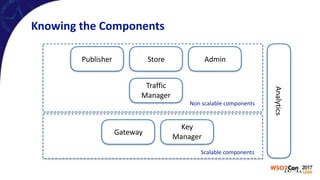
Knowing	the	Components
Publisher Store Admin
Traffic	
Manager
Gateway
Key	
Manager
Non	scalable	components
Analytics
Scalable	components
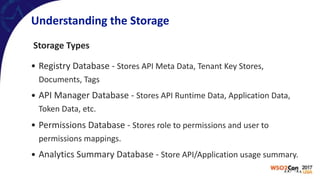
Understanding	the	Storage
	Storage	Types	
• Registry	Database	-	Stores	API	Meta	Data,	Tenant	Key	Stores,	
Documents,	Tags	
• API	Manager	Database	-	Stores	API	Runtime	Data,	Application	Data,	
Token	Data,	etc.	
• Permissions	Database	-	Stores	role	to	permissions	and	user	to	
permissions	mappings.	
• Analytics	Summary	Database	-	Store	API/Application	usage	summary.
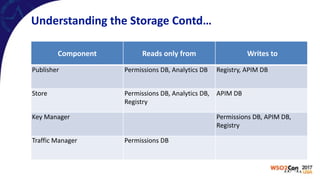
Understanding	the	Storage	Contd…
Component Reads	only	from 	Writes	to
Publisher Permissions	DB,	Analytics	DB Registry,	APIM	DB
Store Permissions	DB,	Analytics	DB,	
Registry
APIM	DB
Key	Manager Permissions	DB,	APIM	DB,	
Registry
Traffic	Manager Permissions	DB
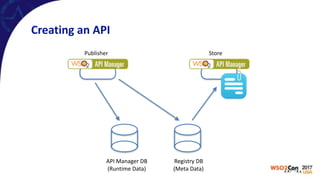
Creating	an	API
Publisher Store
API	Manager	DB	
(Runtime	Data)
Registry	DB	
(Meta	Data)
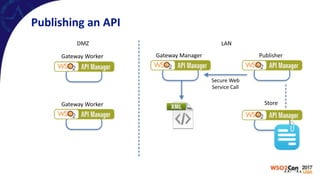
Publishing	an	API
LANDMZ
PublisherGateway	ManagerGateway	Worker
Gateway	Worker
Secure	Web		
Service	Call
Store
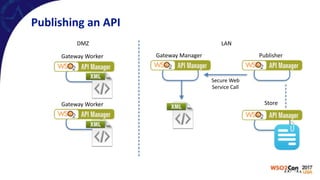
Publishing	an	API
LANDMZ
PublisherGateway	ManagerGateway	Worker
Gateway	Worker
Secure	Web		
Service	Call
Store
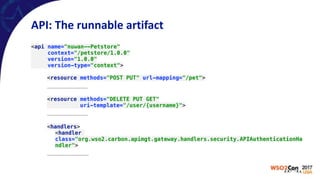
API:	The	runnable	artifact
<api name="nuwan--Petstore"

context="/petstore/1.0.0"

version="1.0.0"

version-type="context">

<resource methods="POST PUT" url-mapping="/pet">
…………………………..	
<resource methods="DELETE PUT GET"

uri-template="/user/{username}">
…………………………..	
<handlers>
<handler
class="org.wso2.carbon.apimgt.gateway.handlers.security.APIAuthenticationHa
ndler">
……………………………
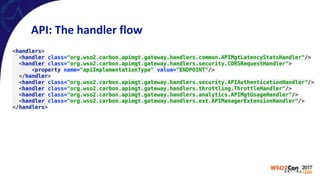
API:	The	handler	flow
<handlers>

<handler class="org.wso2.carbon.apimgt.gateway.handlers.common.APIMgtLatencyStatsHandler"/>

<handler class="org.wso2.carbon.apimgt.gateway.handlers.security.CORSRequestHandler">

<property name="apiImplementationType" value="ENDPOINT"/>

</handler>

<handler class="org.wso2.carbon.apimgt.gateway.handlers.security.APIAuthenticationHandler"/>

<handler class="org.wso2.carbon.apimgt.gateway.handlers.throttling.ThrottleHandler"/>

<handler class="org.wso2.carbon.apimgt.gateway.handlers.analytics.APIMgtUsageHandler"/>

<handler class="org.wso2.carbon.apimgt.gateway.handlers.ext.APIManagerExtensionHandler"/>

</handlers>
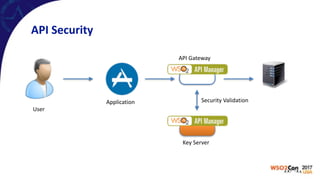
API	Security
Security	Validation
API	Gateway
Application
User
Key	Server
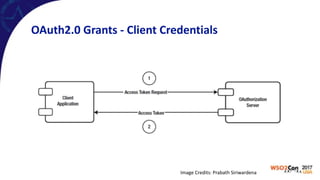
OAuth2.0	Grants	-	Client	Credentials
Image	Credits:	Prabath	Siriwardena
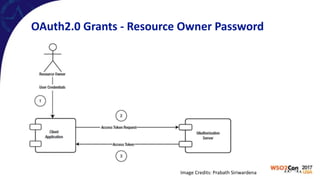
OAuth2.0	Grants	-	Resource	Owner	Password
Image	Credits:	Prabath	Siriwardena
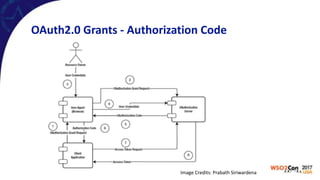
OAuth2.0	Grants	-	Authorization	Code
Image	Credits:	Prabath	Siriwardena
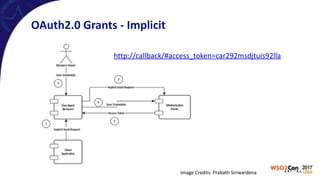
OAuth2.0	Grants	-	Implicit
Image	Credits:	Prabath	Siriwardena
http://callback/#access_token=car292msdjtuis92lla
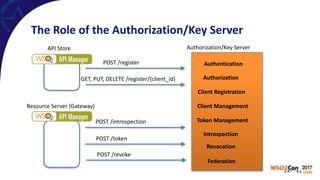
The	Role	of	the	Authorization/Key	Server
POST	/register
GET,	PUT,	DELETE	/register/{client_id}
POST	/introspection
POST	/token
POST	/revoke
API	Store
Resource	Server	(Gateway)
Authorization/Key	Server
Authentication
Authorization
Client	Registration
Client	Management
Introspection
Revocation
Token	Management
Federation
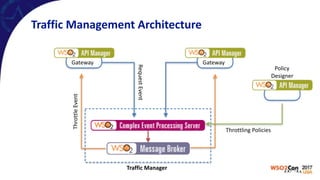
Traffic	Management	Architecture
Gateway Gateway
Policy		
Designer
Request	Event
Throttle	Event
Throttling	Policies
Traffic	Manager
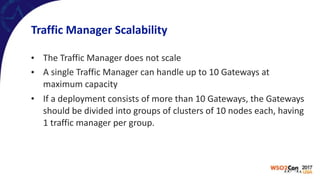
Traffic	Manager	Scalability
• The	Traffic	Manager	does	not	scale	
• A	single	Traffic	Manager	can	handle	up	to	10	Gateways	at	
maximum	capacity	
• If	a	deployment	consists	of	more	than	10	Gateways,	the	Gateways	
should	be	divided	into	groups	of	clusters	of	10	nodes	each,	having	
1	traffic	manager	per	group.
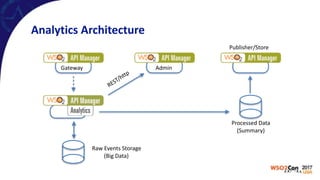
Analytics	Architecture
Gateway Admin
Publisher/Store
REST/http
Raw	Events	Storage	
(Big	Data)
Processed	Data

(Summary)
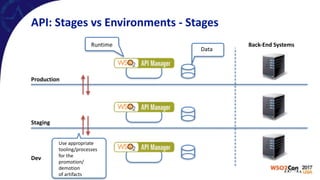
API:	Stages	vs	Environments	-	Stages
Production
Staging
Dev
Back-End	Systems
Data
Runtime
Use	appropriate		
tooling/processes		
for	the		
promotion/
demotion		
of	artifacts
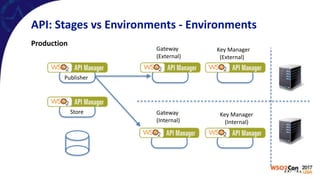
API:	Stages	vs	Environments	-	Environments
Gateway	
(External)
Production
Gateway	
(Internal)
Key	Manager	
		(External)
Key	Manager	
(Internal)
Publisher
Store
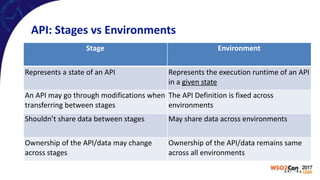
API:	Stages	vs	Environments
Stage Environment
Represents	a	state	of	an	API Represents	the	execution	runtime	of	an	API	
in	a	given	state
An	API	may	go	through	modifications	when	
transferring	between	stages
The	API	Definition	is	fixed	across	
environments
Shouldn’t	share	data	between	stages May	share	data	across	environments
Ownership	of	the	API/data	may	change	
across	stages
Ownership	of	the	API/data	remains	same	
across	all	environments
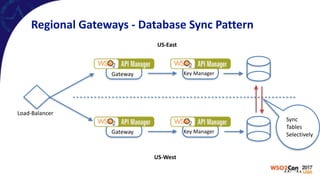
Regional	Gateways	-	Database	Sync	Pattern
US-East
US-West
Load-Balancer
Gateway
Gateway
Key	Manager
Key	Manager
Sync	
Tables	
Selectively
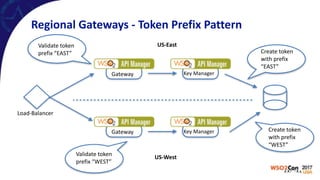
Regional	Gateways	-	Token	Prefix	Pattern
US-East
US-West
Load-Balancer
Gateway
Gateway
Key	Manager
Key	Manager
Create	token		
with	prefix		
“EAST”
Create	token		
with	prefix		
“WEST”
Validate	token		
prefix	“WEST”
Validate	token		
prefix	“EAST”
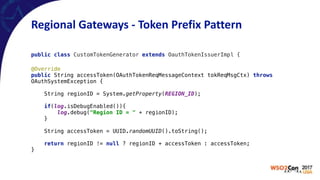
Regional	Gateways	-	Token	Prefix	Pattern
public class CustomTokenGenerator extends OauthTokenIssuerImpl {
@Override

public String accessToken(OAuthTokenReqMessageContext tokReqMsgCtx) throws
OAuthSystemException {


String regionID = System.getProperty(REGION_ID);


if(log.isDebugEnabled()){

log.debug("Region ID = " + regionID);

}


String accessToken = UUID.randomUUID().toString();


return regionID != null ? regionID + accessToken : accessToken;

}
Regional	Gateways	-	Token	Prefix	Pattern
public class RegionValidator extends AbstractHandler {
public boolean handleRequest(MessageContext messageContext) {


String regionId = System.getProperty(REGION_ID);


if (log.isDebugEnabled()) {

log.debug("Region ID = " + regionId);

}
. . . . . . . . .
if(bearerToken == null || bearerToken.split(" ")[1].startsWith(regionId)){

//No bearer token provided or the provided bearer token is of the expected region.

return true;

}


handleAuthFailure(messageContext);
return false;
API	Manager:	Multi	Datacenter	Deployment
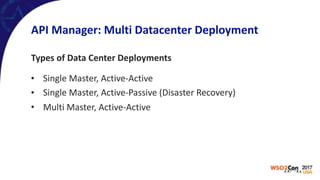
Types	of	Data	Center	Deployments	
• Single	Master,	Active-Active	
• Single	Master,	Active-Passive	(Disaster	Recovery)	
• Multi	Master,	Active-Active
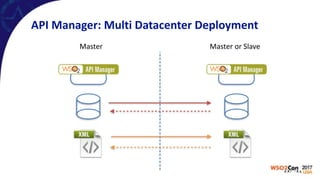
API	Manager:	Multi	Datacenter	Deployment
Master Master	or	Slave
Thank	You!

WSO2Con USA 2017: Building an Effective API Architecture