By: Rashid Hussain
Academic Writing Skills
SINDH MADRESATUL ISLAM UNIVERSITY
Goals & Objectives:
 Understanding of Writing a effective
communication
 Understanding of written communication
 Understanding of importance of good
writing skills
 Basic rules of writing skills
What is an writing?
 It is an important part of
communication
 Good writing skills allow you to
communicate your message with
clarity and correctness.
 It makes good impression on people
around you.
Why we need written scripts?
 It creates a permanent record
 It allows you to store information for
future reference
 Easily distributed
 All recipients receive the same
information
 Necessary for legal and binding
documentation
Importance of writing skills:
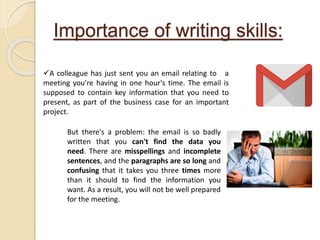
A colleague has just sent you an email relating to a
meeting you're having in one hour's time. The email is
supposed to contain key information that you need to
present, as part of the business case for an important
project.
But there's a problem: the email is so badly
written that you can't find the data you
need. There are misspellings and incomplete
sentences, and the paragraphs are so long and
confusing that it takes you three times more
than it should to find the information you
want. As a result, you will not be well prepared
for the meeting.
Basic rules for good writing skills:
 Audience and Format
 Follow the 7c’s.
 Clear ideas
 Structure
 Avoid grammatical errors
 Avoid Misspelling
 Proper use of punctuation
 Proofing
Audience and Format:
The audience and format, will define your
"writing voice" – that is, how formal or
relaxed the tone should be.
For instance,
if you write an email to a boss, should it
have the same tone as an email to a friend?
Audience and Format:
And then, The first step to writing clearly
is choosing the appropriate format:
Weather you need to send a formal or
informal mail/letter:
• A report
• Assignment
• Summary
• advertising copy
Follow the 7c’s for effective
writing:
 Completeness: Convey all facts required by the receiver.
 Conciseness: Communicate your message in least
possible words.
 Consideration: You must take the audience into
consideration
 Clarity: Message should be clear
 Concreteness: Be particular and clear
 Courtesy: Message should show the sender’s
expression as well as should respect the receiver.
 Correctness: No grammatical errors and misspellings
Structure:
Your document should be as
"reader friendly" as possible. Use:
• headings
• subheadings
• bullet points
• numbering
And break up the text whenever
possible.
Grammar, Spelling and
Punctuation:
 Correct grammar, punctuation and
spelling are key in written
communications.
 The reader will form an opinion of you,
the author, based on both the content
and presentation, and errors are likely
to lead them to form a negative
impression.
Proofing:
 Proof your headers and sub headers.
 Read the document out loud.
 Use your finger to follow text as you
read
Conclusion:
 So, the better your writing skills are,
the better the impression you'll make
on the people around you: including
 Your teacher
 your boss
 your colleagues
 your clients
And You never know how far these
good impressions will take you!
academic writing skills of

academic writing skills of

  • 1.
    By: Rashid Hussain AcademicWriting Skills SINDH MADRESATUL ISLAM UNIVERSITY
  • 2.
    Goals & Objectives: Understanding of Writing a effective communication  Understanding of written communication  Understanding of importance of good writing skills  Basic rules of writing skills
  • 3.
    What is anwriting?  It is an important part of communication  Good writing skills allow you to communicate your message with clarity and correctness.  It makes good impression on people around you.
  • 4.
    Why we needwritten scripts?  It creates a permanent record  It allows you to store information for future reference  Easily distributed  All recipients receive the same information  Necessary for legal and binding documentation
  • 5.
    Importance of writingskills: A colleague has just sent you an email relating to a meeting you're having in one hour's time. The email is supposed to contain key information that you need to present, as part of the business case for an important project. But there's a problem: the email is so badly written that you can't find the data you need. There are misspellings and incomplete sentences, and the paragraphs are so long and confusing that it takes you three times more than it should to find the information you want. As a result, you will not be well prepared for the meeting.
  • 6.
    Basic rules forgood writing skills:  Audience and Format  Follow the 7c’s.  Clear ideas  Structure  Avoid grammatical errors  Avoid Misspelling  Proper use of punctuation  Proofing
  • 7.
    Audience and Format: Theaudience and format, will define your "writing voice" – that is, how formal or relaxed the tone should be. For instance, if you write an email to a boss, should it have the same tone as an email to a friend?
  • 8.
    Audience and Format: Andthen, The first step to writing clearly is choosing the appropriate format: Weather you need to send a formal or informal mail/letter: • A report • Assignment • Summary • advertising copy
  • 9.
    Follow the 7c’sfor effective writing:  Completeness: Convey all facts required by the receiver.  Conciseness: Communicate your message in least possible words.  Consideration: You must take the audience into consideration  Clarity: Message should be clear  Concreteness: Be particular and clear  Courtesy: Message should show the sender’s expression as well as should respect the receiver.  Correctness: No grammatical errors and misspellings
  • 10.
    Structure: Your document shouldbe as "reader friendly" as possible. Use: • headings • subheadings • bullet points • numbering And break up the text whenever possible.
  • 11.
    Grammar, Spelling and Punctuation: Correct grammar, punctuation and spelling are key in written communications.  The reader will form an opinion of you, the author, based on both the content and presentation, and errors are likely to lead them to form a negative impression.
  • 12.
    Proofing:  Proof yourheaders and sub headers.  Read the document out loud.  Use your finger to follow text as you read
  • 13.
    Conclusion:  So, thebetter your writing skills are, the better the impression you'll make on the people around you: including  Your teacher  your boss  your colleagues  your clients And You never know how far these good impressions will take you!