


Writing Research
Articles and
Textbooks in
ELT/ESP/EAP
2
1. Writing a
research article
for publication
Differences: Authors and
Readers
- Authors are journal focused
- Readers are article focused
- Publish more/read less dichotomy
4
Author versus Reader
Behaviour
Reader behaviour
-Browsing is crucial
-Quality information
important
-Want to read less
Author behaviour
-Want to publish
more
-Quick peer review
-Wider dissemination
5
Reader’s priorities
- Quality articles
- Ease of access
- Rapid delivery
- Convenient format
- Linking of information
- Up-to-date information
6
Key Elements of Publishing
- Ethical Issues
- Style and language
- Structure of paper
- Components of paper
- Article submission/journal selection
- Publisher’s process/peer review
7
Style and Language
- Refer to the journal’s author guide for notes on
style
○ Some authors write their paper with a
specific journal in mind
○ Others write the paper and then adapt it to
fit the style of a journal they subsequently
choose
- Objective is to report your findings and
conclusions as clearly and concisely as
possible 8
Style and Language
- If English is not your first language, find
a native English speaker (if possible) to review the
content and language of the paper before
submitting it
- Regardless of primary language, find a
colleague/editor to review the content and
language of the paper
9
Structure of a Paper
-Research writing follows a rigid structure –
a format developed over hundreds of years
-Consequently, a paper can be read at several
levels:
○ Some people will just refer to the title
○ Others may read only the title and abstract
○ Others will read the paper for a deeper
understanding
10
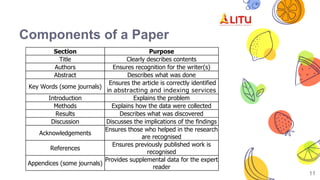
Components of a Paper
11
Section Purpose
Title Clearly describes contents
Authors Ensures recognition for the writer(s)
Abstract Describes what was done
Key Words (some journals)
Ensures the article is correctly identified
in abstracting and indexing services
Introduction Explains the problem
Methods Explains how the data were collected
Results Describes what was discovered
Discussion Discusses the implications of the findings
Acknowledgements
Ensures those who helped in the research
are recognised
References
Ensures previously published work is
recognised
Appendices (some journals)
Provides supplemental data for the expert
reader
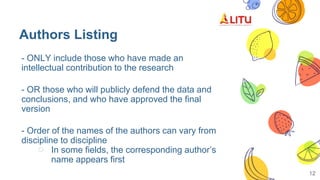
Authors Listing
12
- ONLY include those who have made an
intellectual contribution to the research
- OR those who will publicly defend the data and
conclusions, and who have approved the final
version
- Order of the names of the authors can vary from
discipline to discipline
○ In some fields, the corresponding author’s
name appears first
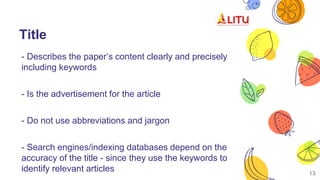
Title
- Describes the paper’s content clearly and precisely
including keywords
- Is the advertisement for the article
- Do not use abbreviations and jargon
- Search engines/indexing databases depend on the
accuracy of the title - since they use the keywords to
identify relevant articles 13
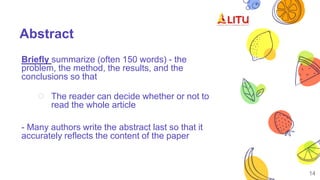
Abstract
Briefly summarize (often 150 words) - the
problem, the method, the results, and the
conclusions so that
○ The reader can decide whether or not to
read the whole article
- Many authors write the abstract last so that it
accurately reflects the content of the paper
14
Introduction
- Clearly state the:
○ Problem being investigated
○ Background that explains the problem
○ Reasons for conducting the research
- Summarize relevant research to provide context
- State how your work differs from published work
- Identify the questions you are answering
- Explain what other findings, if any, you are challenging or
extending
- Briefly describe the experiment, hypothesis(es), research
question(s); general experimental design or method
15
Methods
- Provide the reader enough details so they can
understand and replicate your research
- Explain how you studied the problem, identify the
procedures you followed, and order these
chronologically where possible
- Explain methodology in detail; otherwise name the
method and cite the previously published work
- Describe the types of data, how they were recorded,
etc.
- Be precise in describing measurements and include
errors of measurement or research design limits
16
Results
- Objectively present your findings, and explain
what was found
- Show that your new results are contributing to the
body of scientific knowledge
- Follow a logical sequence based on the tables
and figures presenting the findings to answer the
question or hypothesis
- Figures should have a brief description (a
legend), providing the reader sufficient information
to know how the data were produced
17
Discussion/Conclusion
- Describe what your results mean in context of what
was already known about the subject
- Indicate how the results relate to expectations and to
the literature previously cited
- Explain how the research has moved the body of
knowledge forward
- Do not extend your conclusions beyond what is directly
supported by your results - avoid undue speculation
- Outline the next steps for further study
18
References
- Whenever you draw upon previously published
work, you must acknowledge the source
- Any information not from your experiment and not
‘common knowledge’ should be recognized by a
citation
- How references are presented varies
considerably - refer to notes for authors for the
specific journal
- Avoid references that are difficult to find
- Avoid listing related references that were not
important to the study
19
Article Submission
- Select your journal carefully
- Read the aims and scope
- Think about your target audience and the level of
your work – do you have a realistic chance of
being accepted?
- Follow the guidelines in the notes for authors
and include everything they ask – it makes the
editor’s job easier…
- Articles should not be submitted to more than
one journal at a time
20
Author Priorities for Journal
Selection
Key factors
○ Impact Factor
○ Reputation
○ Access to the target audience
○ Overall editorial standard
○ Publication speed
○ International coverage
○ Open Access
21
2.Writing a
textbook in
ELT/EAP/ESP
Textbooks can achieve impact
through:
- novelty (e.g. unusual topics, illustrations and activities);
- variety (e.g. breaking up the monotony of a unit routine with
an unexpected activity; using many different text-types taken
from many different types of sources; using a number of
different instructor voices on a CD);
- attractive presentation (e.g. use of attractive colours; lots of
white space; use of photographs);
- appealing content (e.g. topics of interest to the target learners;
topics which offer the possibility of learning something new;
engaging stories; universal themes; local references);
- achievable challenge (e.g. tasks which challenge the learners
to think).
23
Textbooks should help learners to feel at
ease
Most learners
- feel more comfortable with written materials with lots of
white space than they do with materials in which lots of
different activities are crammed together on the same
page;
- are more at ease with texts and illustrations that they
can relate to their own culture than they are with those
which appear to them to be culturally alien;
- are more relaxed with materials which are obviously
trying to help them to learn
24
Features of orality in textbooks
- informal discourse features (e.g. contracted
forms, informal lexis);
• the active rather than the passive voice;
• concreteness (e.g. examples, anecdotes);
• inclusiveness (e.g. not signalling intellectual,
linguistic or cultural superiority over learners).
25
What should textbooks do?
- Textbooks should help learners to develop
confidence
- What is being taught should be perceived by
learners as relevant and useful
- Textbooks should require and facilitate learner
self-investment
- Learners must be ready to acquire the points
being taught
26
27
What should textbooks do?
- Textbooks should expose the learners to
language in authentic use
- Textbooks should provide the learners with
opportunities to use the target language to achieve
communicative purposes
28
What should textbooks do?
- Textbooks should not rely too much on
controlled practice
- Textbooks should provide opportunities
for outcome feedback
Interaction can be achieved
through
- information or opinion gap activities which require learners to
communicate with each other and/or the teacher in order to
close the gap (e.g. finding out what food and drink people
would like at a party);
• post-listening and post-reading activities which require the
learners to use information from the text to achieve a
communicative purpose (e.g. deciding what television programs
to watch, discussing who to vote for, writing a review of a book
or film);
• creative writing and creative speaking activities such as
writing a story or improvising a drama;
29
30
Textbooks should take into account
that learners differ in learning styles
· visual (e.g. learners prefer to see the language written down);
· auditory (e.g. learners prefer to hear the language).
· kinesthetic (e.g. learners prefer to do something physical,
such as following instructions for a game);
· studial (e.g. learners like to pay conscious attention to the
linguistic features of the language and want to be correct);
· experiential (e.g. learners like to use the language and are
more concerned with communication than with correctness);
31
Textbooks should take into account
that learners differ in learning styles
· analytic (e.g. learners prefer to focus on discrete bits of the
language and to learn them one by one);
· global (e.g. learners are happy to respond to whole chunks of
language at a time and to pick up from them whatever
language they can);
· dependent (e.g. learners prefer to learn from a teacher and
from a book);
· independent (e.g. learners are happy to learn from their own
experience of the language and to use autonomous learning
strategies).
Textbooks writers should consider
· providing choices of different types of text
· providing choices of different types of activities
· providing optional extras for the more positive and
motivated learners
· providing variety
· researching and catering for the diverse interests of the
identified target learners
· being aware of the cultural sensitivities of the target
learners
32
Considerations for Textbook Writing
- Clear approach
- Well-structured
- Clear and thorough
explanations
- Adequate examples
- Lots of exercises not
enough
33
- Integrate linguistic
techniques (discourse
analysis, corpus
analysis)
- Refer to research
- Address World
Englishes issues
- Refer to CEFR levels
34
Thanks!
Any questions?
35

Writing research and textbooks

  • 1.
  • 2.
  • 3.
    1. Writing a researcharticle for publication
  • 4.
    Differences: Authors and Readers -Authors are journal focused - Readers are article focused - Publish more/read less dichotomy 4
  • 5.
    Author versus Reader Behaviour Readerbehaviour -Browsing is crucial -Quality information important -Want to read less Author behaviour -Want to publish more -Quick peer review -Wider dissemination 5
  • 6.
    Reader’s priorities - Qualityarticles - Ease of access - Rapid delivery - Convenient format - Linking of information - Up-to-date information 6
  • 7.
    Key Elements ofPublishing - Ethical Issues - Style and language - Structure of paper - Components of paper - Article submission/journal selection - Publisher’s process/peer review 7
  • 8.
    Style and Language -Refer to the journal’s author guide for notes on style ○ Some authors write their paper with a specific journal in mind ○ Others write the paper and then adapt it to fit the style of a journal they subsequently choose - Objective is to report your findings and conclusions as clearly and concisely as possible 8
  • 9.
    Style and Language -If English is not your first language, find a native English speaker (if possible) to review the content and language of the paper before submitting it - Regardless of primary language, find a colleague/editor to review the content and language of the paper 9
  • 10.
    Structure of aPaper -Research writing follows a rigid structure – a format developed over hundreds of years -Consequently, a paper can be read at several levels: ○ Some people will just refer to the title ○ Others may read only the title and abstract ○ Others will read the paper for a deeper understanding 10
  • 11.
    Components of aPaper 11 Section Purpose Title Clearly describes contents Authors Ensures recognition for the writer(s) Abstract Describes what was done Key Words (some journals) Ensures the article is correctly identified in abstracting and indexing services Introduction Explains the problem Methods Explains how the data were collected Results Describes what was discovered Discussion Discusses the implications of the findings Acknowledgements Ensures those who helped in the research are recognised References Ensures previously published work is recognised Appendices (some journals) Provides supplemental data for the expert reader
  • 12.
    Authors Listing 12 - ONLYinclude those who have made an intellectual contribution to the research - OR those who will publicly defend the data and conclusions, and who have approved the final version - Order of the names of the authors can vary from discipline to discipline ○ In some fields, the corresponding author’s name appears first
  • 13.
    Title - Describes thepaper’s content clearly and precisely including keywords - Is the advertisement for the article - Do not use abbreviations and jargon - Search engines/indexing databases depend on the accuracy of the title - since they use the keywords to identify relevant articles 13
  • 14.
    Abstract Briefly summarize (often150 words) - the problem, the method, the results, and the conclusions so that ○ The reader can decide whether or not to read the whole article - Many authors write the abstract last so that it accurately reflects the content of the paper 14
  • 15.
    Introduction - Clearly statethe: ○ Problem being investigated ○ Background that explains the problem ○ Reasons for conducting the research - Summarize relevant research to provide context - State how your work differs from published work - Identify the questions you are answering - Explain what other findings, if any, you are challenging or extending - Briefly describe the experiment, hypothesis(es), research question(s); general experimental design or method 15
  • 16.
    Methods - Provide thereader enough details so they can understand and replicate your research - Explain how you studied the problem, identify the procedures you followed, and order these chronologically where possible - Explain methodology in detail; otherwise name the method and cite the previously published work - Describe the types of data, how they were recorded, etc. - Be precise in describing measurements and include errors of measurement or research design limits 16
  • 17.
    Results - Objectively presentyour findings, and explain what was found - Show that your new results are contributing to the body of scientific knowledge - Follow a logical sequence based on the tables and figures presenting the findings to answer the question or hypothesis - Figures should have a brief description (a legend), providing the reader sufficient information to know how the data were produced 17
  • 18.
    Discussion/Conclusion - Describe whatyour results mean in context of what was already known about the subject - Indicate how the results relate to expectations and to the literature previously cited - Explain how the research has moved the body of knowledge forward - Do not extend your conclusions beyond what is directly supported by your results - avoid undue speculation - Outline the next steps for further study 18
  • 19.
    References - Whenever youdraw upon previously published work, you must acknowledge the source - Any information not from your experiment and not ‘common knowledge’ should be recognized by a citation - How references are presented varies considerably - refer to notes for authors for the specific journal - Avoid references that are difficult to find - Avoid listing related references that were not important to the study 19
  • 20.
    Article Submission - Selectyour journal carefully - Read the aims and scope - Think about your target audience and the level of your work – do you have a realistic chance of being accepted? - Follow the guidelines in the notes for authors and include everything they ask – it makes the editor’s job easier… - Articles should not be submitted to more than one journal at a time 20
  • 21.
    Author Priorities forJournal Selection Key factors ○ Impact Factor ○ Reputation ○ Access to the target audience ○ Overall editorial standard ○ Publication speed ○ International coverage ○ Open Access 21
  • 22.
  • 23.
    Textbooks can achieveimpact through: - novelty (e.g. unusual topics, illustrations and activities); - variety (e.g. breaking up the monotony of a unit routine with an unexpected activity; using many different text-types taken from many different types of sources; using a number of different instructor voices on a CD); - attractive presentation (e.g. use of attractive colours; lots of white space; use of photographs); - appealing content (e.g. topics of interest to the target learners; topics which offer the possibility of learning something new; engaging stories; universal themes; local references); - achievable challenge (e.g. tasks which challenge the learners to think). 23
  • 24.
    Textbooks should helplearners to feel at ease Most learners - feel more comfortable with written materials with lots of white space than they do with materials in which lots of different activities are crammed together on the same page; - are more at ease with texts and illustrations that they can relate to their own culture than they are with those which appear to them to be culturally alien; - are more relaxed with materials which are obviously trying to help them to learn 24
  • 25.
    Features of oralityin textbooks - informal discourse features (e.g. contracted forms, informal lexis); • the active rather than the passive voice; • concreteness (e.g. examples, anecdotes); • inclusiveness (e.g. not signalling intellectual, linguistic or cultural superiority over learners). 25
  • 26.
    What should textbooksdo? - Textbooks should help learners to develop confidence - What is being taught should be perceived by learners as relevant and useful - Textbooks should require and facilitate learner self-investment - Learners must be ready to acquire the points being taught 26
  • 27.
    27 What should textbooksdo? - Textbooks should expose the learners to language in authentic use - Textbooks should provide the learners with opportunities to use the target language to achieve communicative purposes
  • 28.
    28 What should textbooksdo? - Textbooks should not rely too much on controlled practice - Textbooks should provide opportunities for outcome feedback
  • 29.
    Interaction can beachieved through - information or opinion gap activities which require learners to communicate with each other and/or the teacher in order to close the gap (e.g. finding out what food and drink people would like at a party); • post-listening and post-reading activities which require the learners to use information from the text to achieve a communicative purpose (e.g. deciding what television programs to watch, discussing who to vote for, writing a review of a book or film); • creative writing and creative speaking activities such as writing a story or improvising a drama; 29
  • 30.
    30 Textbooks should takeinto account that learners differ in learning styles · visual (e.g. learners prefer to see the language written down); · auditory (e.g. learners prefer to hear the language). · kinesthetic (e.g. learners prefer to do something physical, such as following instructions for a game); · studial (e.g. learners like to pay conscious attention to the linguistic features of the language and want to be correct); · experiential (e.g. learners like to use the language and are more concerned with communication than with correctness);
  • 31.
    31 Textbooks should takeinto account that learners differ in learning styles · analytic (e.g. learners prefer to focus on discrete bits of the language and to learn them one by one); · global (e.g. learners are happy to respond to whole chunks of language at a time and to pick up from them whatever language they can); · dependent (e.g. learners prefer to learn from a teacher and from a book); · independent (e.g. learners are happy to learn from their own experience of the language and to use autonomous learning strategies).
  • 32.
    Textbooks writers shouldconsider · providing choices of different types of text · providing choices of different types of activities · providing optional extras for the more positive and motivated learners · providing variety · researching and catering for the diverse interests of the identified target learners · being aware of the cultural sensitivities of the target learners 32
  • 33.
    Considerations for TextbookWriting - Clear approach - Well-structured - Clear and thorough explanations - Adequate examples - Lots of exercises not enough 33 - Integrate linguistic techniques (discourse analysis, corpus analysis) - Refer to research - Address World Englishes issues - Refer to CEFR levels
  • 34.
  • 35.