


Communicating Bad
News Effectively….
Submitted to:
Dr. Manish Siddhpuriya
Introduction
Bad News/Negative
Message
A negative message is a message written to convey an
unpleasant and unfavorable information without
provoking the annoyance of the readers.”
Purposes To Communicate Bad News
 To convey the bad news
 To gain acceptance for it
 To maintain as much good will as possible
 To maintain a good image for our organization
 To eliminate the need for future correspondence on the matter,
if appropriate.
Two approaches
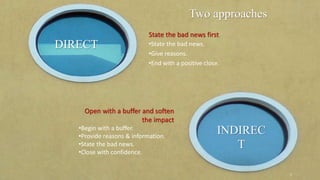
DIRECT
INDIREC
T
State the bad news first
•State the bad news.
•Give reasons.
•End with a positive close.
Open with a buffer and soften
the impact
•Begin with a buffer.
•Provide reasons & information.
•State the bad news.
•Close with confidence.
5
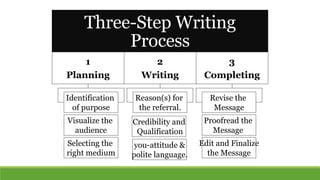
Three-Step Writing
Process
1
Planning
3
Completing
2
Writing
Identification
of purpose
Visualize the
audience
Selecting the
right medium
Reason(s) for
the referral.
Credibility and
Qualification
Revise the
Message
Proofread the
Message
Edit and Finalize
the Message
you-attitude &
polite language.
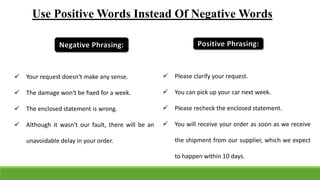
Use Positive Words Instead Of Negative Words
 Your request doesn't make any sense.
 The damage won't be fixed for a week.
 The enclosed statement is wrong.
 Although it wasn't our fault, there will be an
unavoidable delay in your order.
 Please clarify your request.
 You can pick up your car next week.
 Please recheck the enclosed statement.
 You will receive your order as soon as we receive
the shipment from our supplier, which we expect
to happen within 10 days.
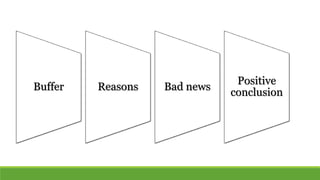
Indirect Method
Buffer Reasons Bad news
Positive
conclusion
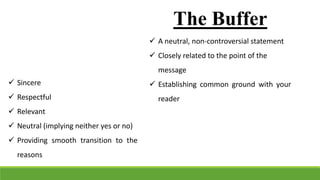
The Buffer
 A neutral, non-controversial statement
 Closely related to the point of the
message
 Establishing common ground with your
reader
 Sincere
 Respectful
 Relevant
 Neutral (implying neither yes or no)
 Providing smooth transition to the
reasons
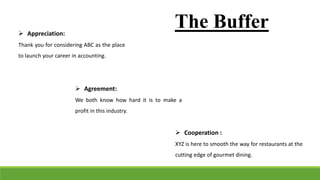
The Buffer Appreciation:
Thank you for considering ABC as the place
to launch your career in accounting.
 Agreement:
We both know how hard it is to make a
profit in this industry.
 Cooperation :
XYZ is here to smooth the way for restaurants at the
cutting edge of gourmet dining.
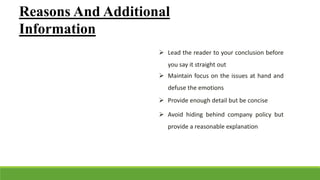
Reasons And Additional
Information
 Lead the reader to your conclusion before
you say it straight out
 Maintain focus on the issues at hand and
defuse the emotions
 Avoid hiding behind company policy but
provide a reasonable explanation
 Provide enough detail but be concise
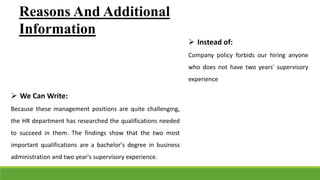
Reasons And Additional
Information
 Instead of:
Company policy forbids our hiring anyone
who does not have two years' supervisory
experience
 We Can Write:
Because these management positions are quite challenging,
the HR department has researched the qualifications needed
to succeed in them. The findings show that the two most
important qualifications are a bachelor's degree in business
administration and two year's supervisory experience.
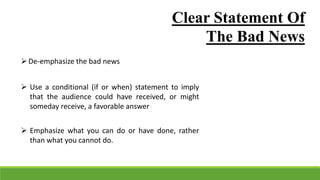
Clear Statement Of
The Bad News
De-emphasize the bad news
 Use a conditional (if or when) statement to imply
that the audience could have received, or might
someday receive, a favorable answer
 Emphasize what you can do or have done, rather
than what you cannot do.
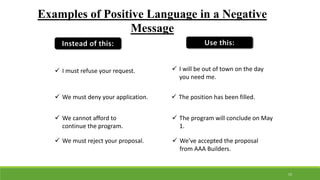
Examples of Positive Language in a Negative
Message
 I must refuse your request.  I will be out of town on the day
you need me.
 We must deny your application.  The position has been filled.
 We cannot afford to
continue the program.
 The program will conclude on May
1.
 We must reject your proposal.  We've accepted the proposal
from AAA Builders.
15
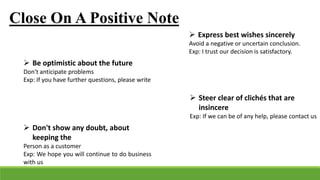
Close On A Positive Note
 Express best wishes sincerely
Avoid a negative or uncertain conclusion.
Exp: I trust our decision is satisfactory.
 Be optimistic about the future
Don't anticipate problems
Exp: If you have further questions, please write
 Steer clear of clichés that are
insincere
Exp: If we can be of any help, please contact us
 Don't show any doubt, about
keeping the
Person as a customer
Exp: We hope you will continue to do business
with us
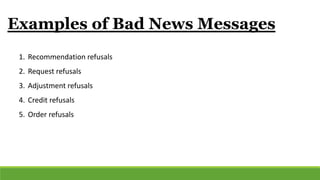
Examples of Bad News Messages
1. Recommendation refusals
2. Request refusals
3. Adjustment refusals
4. Credit refusals
5. Order refusals
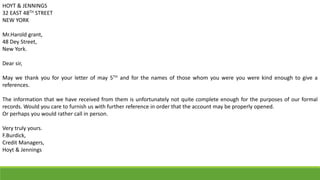
Example Of Refusing Credit letter
HOYT & JENNINGS
32 EAST 48TH STREET
NEW YORK
Mr.Harold grant,
48 Dey Street,
New York.
Dear sir,
May we thank you for your letter of may 5TH and for the names of those whom you were you were kind enough to give a
references.
The information that we have received from them is unfortunately not quite complete enough for the purposes of our formal
records. Would you care to furnish us with further reference in order that the account may be properly opened.
Or perhaps you would rather call in person.
Very truly yours.
F.Burdick,
Credit Managers,
Hoyt & Jennings
How to communicate bad newz effectively???

How to communicate bad newz effectively???

  • 1.
  • 2.
  • 3.
    Bad News/Negative Message A negativemessage is a message written to convey an unpleasant and unfavorable information without provoking the annoyance of the readers.”
  • 4.
    Purposes To CommunicateBad News  To convey the bad news  To gain acceptance for it  To maintain as much good will as possible  To maintain a good image for our organization  To eliminate the need for future correspondence on the matter, if appropriate.
  • 5.
    Two approaches DIRECT INDIREC T State thebad news first •State the bad news. •Give reasons. •End with a positive close. Open with a buffer and soften the impact •Begin with a buffer. •Provide reasons & information. •State the bad news. •Close with confidence. 5
  • 6.
    Three-Step Writing Process 1 Planning 3 Completing 2 Writing Identification of purpose Visualizethe audience Selecting the right medium Reason(s) for the referral. Credibility and Qualification Revise the Message Proofread the Message Edit and Finalize the Message you-attitude & polite language.
  • 7.
    Use Positive WordsInstead Of Negative Words  Your request doesn't make any sense.  The damage won't be fixed for a week.  The enclosed statement is wrong.  Although it wasn't our fault, there will be an unavoidable delay in your order.  Please clarify your request.  You can pick up your car next week.  Please recheck the enclosed statement.  You will receive your order as soon as we receive the shipment from our supplier, which we expect to happen within 10 days.
  • 8.
  • 9.
    Buffer Reasons Badnews Positive conclusion
  • 10.
    The Buffer  Aneutral, non-controversial statement  Closely related to the point of the message  Establishing common ground with your reader  Sincere  Respectful  Relevant  Neutral (implying neither yes or no)  Providing smooth transition to the reasons
  • 11.
    The Buffer Appreciation: Thankyou for considering ABC as the place to launch your career in accounting.  Agreement: We both know how hard it is to make a profit in this industry.  Cooperation : XYZ is here to smooth the way for restaurants at the cutting edge of gourmet dining.
  • 12.
    Reasons And Additional Information Lead the reader to your conclusion before you say it straight out  Maintain focus on the issues at hand and defuse the emotions  Avoid hiding behind company policy but provide a reasonable explanation  Provide enough detail but be concise
  • 13.
    Reasons And Additional Information Instead of: Company policy forbids our hiring anyone who does not have two years' supervisory experience  We Can Write: Because these management positions are quite challenging, the HR department has researched the qualifications needed to succeed in them. The findings show that the two most important qualifications are a bachelor's degree in business administration and two year's supervisory experience.
  • 14.
    Clear Statement Of TheBad News De-emphasize the bad news  Use a conditional (if or when) statement to imply that the audience could have received, or might someday receive, a favorable answer  Emphasize what you can do or have done, rather than what you cannot do.
  • 15.
    Examples of PositiveLanguage in a Negative Message  I must refuse your request.  I will be out of town on the day you need me.  We must deny your application.  The position has been filled.  We cannot afford to continue the program.  The program will conclude on May 1.  We must reject your proposal.  We've accepted the proposal from AAA Builders. 15
  • 16.
    Close On APositive Note  Express best wishes sincerely Avoid a negative or uncertain conclusion. Exp: I trust our decision is satisfactory.  Be optimistic about the future Don't anticipate problems Exp: If you have further questions, please write  Steer clear of clichés that are insincere Exp: If we can be of any help, please contact us  Don't show any doubt, about keeping the Person as a customer Exp: We hope you will continue to do business with us
  • 17.
    Examples of BadNews Messages 1. Recommendation refusals 2. Request refusals 3. Adjustment refusals 4. Credit refusals 5. Order refusals
  • 18.
    Example Of RefusingCredit letter
  • 19.
    HOYT & JENNINGS 32EAST 48TH STREET NEW YORK Mr.Harold grant, 48 Dey Street, New York. Dear sir, May we thank you for your letter of may 5TH and for the names of those whom you were you were kind enough to give a references. The information that we have received from them is unfortunately not quite complete enough for the purposes of our formal records. Would you care to furnish us with further reference in order that the account may be properly opened. Or perhaps you would rather call in person. Very truly yours. F.Burdick, Credit Managers, Hoyt & Jennings