Wrangling Rogues: A Case Study on
Managing Experimental Post-Moore
Architectures
Will Powell, Jason Riedy, Jeffrey Young, Tom Conte
Center for Research into Novel Computing Hierarchies at Georgia Tech
1 August 2019
Outline
What is the CRNCH Rogues Gallery?
Current Rogues
Emu Chick
3D Stacked Memories and FPGAs
Neuromorphic / Analog Hardware (FPAA)
Management lessons learned
Helpful points
Painful points
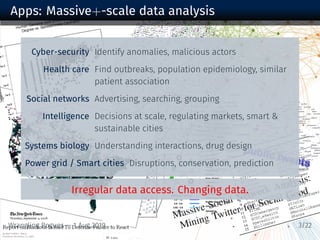
Apps: Massive+-scale data analysis
Cyber-security Identify anomalies, malicious actors
Health care Find outbreaks, population epidemiology, similar
patient association
Social networks Advertising, searching, grouping
Intelligence Decisions at scale, regulating markets, smart &
sustainable cities
Systems biology Understanding interactions, drug design
Power grid / Smart cities Disruptions, conservation, prediction
Irregular data access. Changing data.
Wrangling Rogues — 1 Aug 2019 3/22
High-Performance Data Analysis (HPDA)
Novel applications:
• Data at scale and speed needs new ideas for
computing analysis.
• “Big data” platforms fare poorly v. a single thread
plus large SSD even for static data sets. (McSherry,
Isard, Murray. “Scalability! But at what COST?” HotOS
XV, 2015.)
• Many high-level codes are written and re-written to
answer one question: need flexibility.
• Some primitives may be tuned and re-used.
Wrangling Rogues — 1 Aug 2019 4/22
Why do we need rogues?
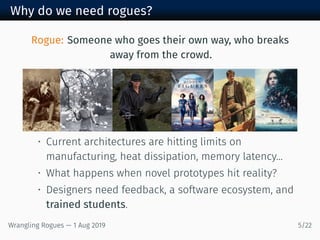
Rogue: Someone who goes their own way, who breaks
away from the crowd.
• Current architectures are hitting limits on
manufacturing, heat dissipation, memory latency...
• What happens when novel prototypes hit reality?
• Designers need feedback, a software ecosystem, and
trained students.
Wrangling Rogues — 1 Aug 2019 5/22
What is the Rogues Gallery?
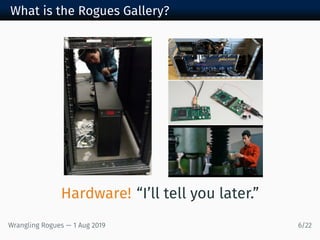
Hardware! “I’ll tell you later.”
Wrangling Rogues — 1 Aug 2019 6/22
Introducing the CRNCH Rogues Gallery
CRNCH Rogues Gallery
A physical & virtual space for hosting novel computing
architectures, systems, and accelerators since fall 2017.
Host / manage remote access for novel architectures to
• kick-start software ecosystems (e.g. Kokkos),
• leverage real applications to train students, and
• provide rapid feedback to architects.
Amortize effort and cost of trying novel architectures.
Break the “but it’s too much work” barrier.
http://crnch.gatech.edu/rogues-gallery
Wrangling Rogues — 1 Aug 2019 7/22
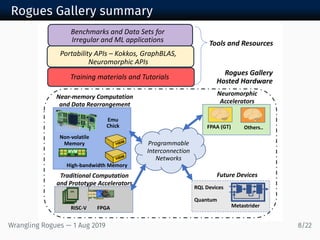
Rogues Gallery summary
Programmable
Interconnection
Networks
Neuromorphic
Accelerators
FPGA
Traditional Computation
and Prototype Accelerators
Near-memory Computation
and Data Rearrangement
Portability APIs – Kokkos, GraphBLAS,
Neuromorphic APIs
Training materials and Tutorials
Emu
Chick FPAA (GT) Others..
Future Devices
RISC-V
RQL Devices
Quantum
Benchmarks and Data Sets for
Irregular and ML applications
Rogues Gallery
Hosted Hardware
Metastrider
Tools and Resources
Non-volatile
Memory
High-bandwidth Memory
Wrangling Rogues — 1 Aug 2019 8/22
Current Rogues
Current Rogues
Emu Chick
3D Stacked Memories and FPGAs
Neuromorphic / Analog Hardware (FPAA)
Wrangling Rogues — 1 Aug 2019 9/22
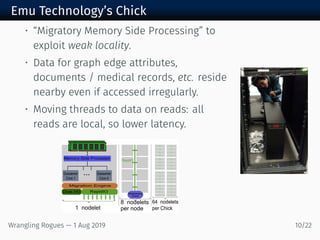
Emu Technology’s Chick
• “Migratory Memory Side Processing” to
exploit weak locality.
• Data for graph edge attributes,
documents / medical records, etc. reside
nearby even if accessed irregularly.
• Moving threads to data on reads: all
reads are local, so lower latency.
1 nodelet
Gossamer
Core 1
Memory-Side Processor
Gossamer
Core 4
...
Migration Engine
RapidIODisk I/O
8 nodelets
per node
64 nodelets
per Chick
RapidIO
Stationary
Core
Wrangling Rogues — 1 Aug 2019 10/22
Emu Chick: Ongoing Results
512 1024 2048 4096 8192 16384 32768 DBLP (0)
Graph sizes
0
50
100
150
200
250
300
350
Bandwith(Mb/s)
BLK-ALL
HCB-ALL
BLK-PAIR
HCB-PAIR
Platform:
• Application direction.
• Demo-able code.
• Debugging.
• Connections.
People:
• GT → Emu: One
employee, one intern.
• Emu → GT: One
graduate student.
Wrangling Rogues — 1 Aug 2019 11/22
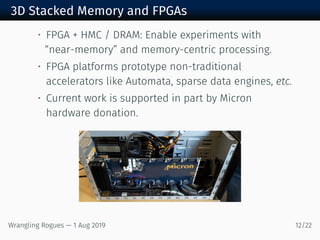
3D Stacked Memory and FPGAs
• FPGA + HMC / DRAM: Enable experiments with
“near-memory” and memory-centric processing.
• FPGA platforms prototype non-traditional
accelerators like Automata, sparse data engines, etc.
• Current work is supported in part by Micron
hardware donation.
Wrangling Rogues — 1 Aug 2019 12/22
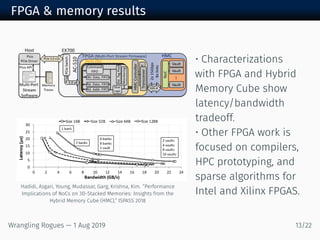
FPGA & memory results
Hadidi, Asgari, Young, Mudassar, Garg, Krishna, Kim. “Performance
Implications of NoCs on 3D-Stacked Memories: Insights from the
Hybrid Memory Cube (HMC),” ISPASS 2018
• Characterizations
with FPGA and Hybrid
Memory Cube show
latency/bandwidth
tradeoff.
• Other FPGA work is
focused on compilers,
HPC prototyping, and
sparse algorithms for
Intel and Xilinx FPGAS.
Wrangling Rogues — 1 Aug 2019 13/22
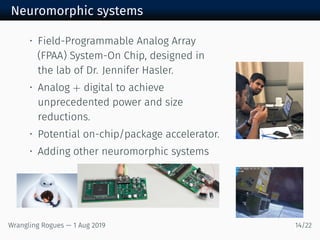
Neuromorphic systems
• Field-Programmable Analog Array
(FPAA) System-On Chip, designed in
the lab of Dr. Jennifer Hasler.
• Analog + digital to achieve
unprecedented power and size
reductions.
• Potential on-chip/package accelerator.
• Adding other neuromorphic systems
Wrangling Rogues — 1 Aug 2019 14/22
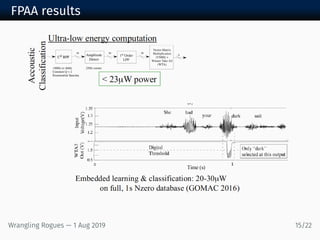
FPAA results
Wrangling Rogues — 1 Aug 2019 15/22
Management lessons learned
Helpful points
Painful points
Wrangling Rogues — 1 Aug 2019 16/22
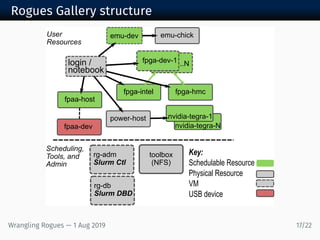
Rogues Gallery structure
login /
notebook
rg-adm
Slurm Ctl
toolbox
(NFS)
Scheduling,
Tools, and
Admin
Key:
Schedulable Resource
Physical Resource
VM
USB device
User
Resources
fpaa-host
power-host
nvidia-tegra-N
nvidia-tegra-1
fpaa-dev
rg-db
Slurm DBD
emu-dev emu-chick
..Nfpga-dev-1
fpga-hmcfpga-intel
Wrangling Rogues — 1 Aug 2019 17/22
Management lessons learned
• Invest in rogues, but realize some technology may be
short-lived.
• Minimize custom management effort.
• Physical hardware resources not dedicated to
rogues should be kept to a minimum.
• Don’t spend $ on non-rogues.
• Collaboration and commiseration is key.
• Rogues need a community to succeed.
• Licensing and appropriate identity management are
tough but necessary challenges.
• Use network isolation when needed.
Wrangling Rogues — 1 Aug 2019 18/22
Helpful points
• Network isolation provides security.
• Well, enough given limited usefulness.
• Singularity is great for build environments.
• HW start-ups cannot afford supporting every
OS/arch.
• IT cannot afford supporting every OS/arch.
• Companies must be friendly...
• Inspired undergrads are wonderful!
• Modernizing tools (FPAA)
• Building out demonstrations
• http://www.vip.gatech.edu/teams/
rogues-gallery
Wrangling Rogues — 1 Aug 2019 19/22
Painful points
• SLURM aspects:
• Managing slurmd.conf.
• Building on all the OS/arch combos.
• Few light-weight management options.
• salt-ssh, ansible on some
• Hardware access for rebooting, reseating.
• Many programming interfaces, few people
• Kokkos, TENNLab, more...
• Still need to tackle “sensitive” data, including some
FPGA IP
• Reproducible / replicable / audit-able results
Wrangling Rogues — 1 Aug 2019 20/22
Rogues Gallery: Active and Growing
• Integrating FPAAs and toolchain
• Tight development loop with Emu
• Active research projects and publications
• Community building via tutorials & talks
• New approaches to benchmarking, quantum
software stacks, neuromorphic toolchains, ...
CRNCH Rogues Gallery connects researchers and
students with novel architectures and architects with
upcoming applications.
Let us host / manage your neat stuff!
http://crnch.gatech.edu/rogues-gallery
Wrangling Rogues — 1 Aug 2019 21/22
Acknowledgments
Fantastic students and colleagues:
• Srinivas Eswar (GT CSE)
• Dr. Eric Hein (GT ECE ⇒ Emu)
• Patrick Lavin (GT CSE)
• Dr. Jiajia Li (GT CSE ⇒ PNNL)
• Abdurrahman Yaşar (GT CSE)
• Chunxing Yin (GT CSE)
• Dr. Jeffrey S. Young (GT CS)
• Dr. Tom Conte (GT CS/ECE)
• Dr. Vivek Sarkar (GT CS)
• Dr. Ümit Çatalürek (GT CSE)
• Dr. Bora Uçar (ENS Lyon CNRS)
• Dr. Rich Vuduc (GT CSE)
Code (ideally will have links from crnch.gatech.edu):
• https://gitlab.com/crnch-rg
• https://github.com/ehein6/emu-microbench
Other testbeds:
• ORNL: ExCL
• PNNL: CENATE
• Argonne
• Sandia HAAPS
• Berkeley: AQCT
• (others?)
Wrangling Rogues — 1 Aug 2019 22/22
External Image Credits
• “What’s that watermelon doing there?”: copyright MGM, used for identification
• Oscar Wilde: public domain, obtained from Wikipedia
• Edna St. Vincent Millay: public domain, obtained from Wikipedia
• Dread Pirate Roberts: copyright 20th
Century Fox, used for identification
• Mary Jackson, Katherine Goble Johnson, Dorothy Vaughan (Hidden Figures): copyright 20th
Century Fox,
used for identification
• Malcolm Reynolds: copyright Universal Pictures, used for identification
• Rogue One: copyright Walt Disney Studios Motion Pictures, used for identification
• The Story of Karrawingi, the Emu (cover): copyright estate of Leslie Rees, used for identification
• Big Hero 6: copyright Walt Disney Studios Motion Pictures, used for identification
Wrangling Rogues — 1 Aug 2019

PEARC19: Wrangling Rogues: A Case Study on Managing Experimental Post-Moore Architectures

  • 1.
    Wrangling Rogues: ACase Study on Managing Experimental Post-Moore Architectures Will Powell, Jason Riedy, Jeffrey Young, Tom Conte Center for Research into Novel Computing Hierarchies at Georgia Tech 1 August 2019
  • 2.
    Outline What is theCRNCH Rogues Gallery? Current Rogues Emu Chick 3D Stacked Memories and FPGAs Neuromorphic / Analog Hardware (FPAA) Management lessons learned Helpful points Painful points
  • 3.
    Apps: Massive+-scale dataanalysis Cyber-security Identify anomalies, malicious actors Health care Find outbreaks, population epidemiology, similar patient association Social networks Advertising, searching, grouping Intelligence Decisions at scale, regulating markets, smart & sustainable cities Systems biology Understanding interactions, drug design Power grid / Smart cities Disruptions, conservation, prediction Irregular data access. Changing data. Wrangling Rogues — 1 Aug 2019 3/22
  • 4.
    High-Performance Data Analysis(HPDA) Novel applications: • Data at scale and speed needs new ideas for computing analysis. • “Big data” platforms fare poorly v. a single thread plus large SSD even for static data sets. (McSherry, Isard, Murray. “Scalability! But at what COST?” HotOS XV, 2015.) • Many high-level codes are written and re-written to answer one question: need flexibility. • Some primitives may be tuned and re-used. Wrangling Rogues — 1 Aug 2019 4/22
  • 5.
    Why do weneed rogues? Rogue: Someone who goes their own way, who breaks away from the crowd. • Current architectures are hitting limits on manufacturing, heat dissipation, memory latency... • What happens when novel prototypes hit reality? • Designers need feedback, a software ecosystem, and trained students. Wrangling Rogues — 1 Aug 2019 5/22
  • 6.
    What is theRogues Gallery? Hardware! “I’ll tell you later.” Wrangling Rogues — 1 Aug 2019 6/22
  • 7.
    Introducing the CRNCHRogues Gallery CRNCH Rogues Gallery A physical & virtual space for hosting novel computing architectures, systems, and accelerators since fall 2017. Host / manage remote access for novel architectures to • kick-start software ecosystems (e.g. Kokkos), • leverage real applications to train students, and • provide rapid feedback to architects. Amortize effort and cost of trying novel architectures. Break the “but it’s too much work” barrier. http://crnch.gatech.edu/rogues-gallery Wrangling Rogues — 1 Aug 2019 7/22
  • 8.
    Rogues Gallery summary Programmable Interconnection Networks Neuromorphic Accelerators FPGA TraditionalComputation and Prototype Accelerators Near-memory Computation and Data Rearrangement Portability APIs – Kokkos, GraphBLAS, Neuromorphic APIs Training materials and Tutorials Emu Chick FPAA (GT) Others.. Future Devices RISC-V RQL Devices Quantum Benchmarks and Data Sets for Irregular and ML applications Rogues Gallery Hosted Hardware Metastrider Tools and Resources Non-volatile Memory High-bandwidth Memory Wrangling Rogues — 1 Aug 2019 8/22
  • 9.
    Current Rogues Current Rogues EmuChick 3D Stacked Memories and FPGAs Neuromorphic / Analog Hardware (FPAA) Wrangling Rogues — 1 Aug 2019 9/22
  • 10.
    Emu Technology’s Chick •“Migratory Memory Side Processing” to exploit weak locality. • Data for graph edge attributes, documents / medical records, etc. reside nearby even if accessed irregularly. • Moving threads to data on reads: all reads are local, so lower latency. 1 nodelet Gossamer Core 1 Memory-Side Processor Gossamer Core 4 ... Migration Engine RapidIODisk I/O 8 nodelets per node 64 nodelets per Chick RapidIO Stationary Core Wrangling Rogues — 1 Aug 2019 10/22
  • 11.
    Emu Chick: OngoingResults 512 1024 2048 4096 8192 16384 32768 DBLP (0) Graph sizes 0 50 100 150 200 250 300 350 Bandwith(Mb/s) BLK-ALL HCB-ALL BLK-PAIR HCB-PAIR Platform: • Application direction. • Demo-able code. • Debugging. • Connections. People: • GT → Emu: One employee, one intern. • Emu → GT: One graduate student. Wrangling Rogues — 1 Aug 2019 11/22
  • 12.
    3D Stacked Memoryand FPGAs • FPGA + HMC / DRAM: Enable experiments with “near-memory” and memory-centric processing. • FPGA platforms prototype non-traditional accelerators like Automata, sparse data engines, etc. • Current work is supported in part by Micron hardware donation. Wrangling Rogues — 1 Aug 2019 12/22
  • 13.
    FPGA & memoryresults Hadidi, Asgari, Young, Mudassar, Garg, Krishna, Kim. “Performance Implications of NoCs on 3D-Stacked Memories: Insights from the Hybrid Memory Cube (HMC),” ISPASS 2018 • Characterizations with FPGA and Hybrid Memory Cube show latency/bandwidth tradeoff. • Other FPGA work is focused on compilers, HPC prototyping, and sparse algorithms for Intel and Xilinx FPGAS. Wrangling Rogues — 1 Aug 2019 13/22
  • 14.
    Neuromorphic systems • Field-ProgrammableAnalog Array (FPAA) System-On Chip, designed in the lab of Dr. Jennifer Hasler. • Analog + digital to achieve unprecedented power and size reductions. • Potential on-chip/package accelerator. • Adding other neuromorphic systems Wrangling Rogues — 1 Aug 2019 14/22
  • 15.
    FPAA results Wrangling Rogues— 1 Aug 2019 15/22
  • 16.
    Management lessons learned Managementlessons learned Helpful points Painful points Wrangling Rogues — 1 Aug 2019 16/22
  • 17.
    Rogues Gallery structure login/ notebook rg-adm Slurm Ctl toolbox (NFS) Scheduling, Tools, and Admin Key: Schedulable Resource Physical Resource VM USB device User Resources fpaa-host power-host nvidia-tegra-N nvidia-tegra-1 fpaa-dev rg-db Slurm DBD emu-dev emu-chick ..Nfpga-dev-1 fpga-hmcfpga-intel Wrangling Rogues — 1 Aug 2019 17/22
  • 18.
    Management lessons learned •Invest in rogues, but realize some technology may be short-lived. • Minimize custom management effort. • Physical hardware resources not dedicated to rogues should be kept to a minimum. • Don’t spend $ on non-rogues. • Collaboration and commiseration is key. • Rogues need a community to succeed. • Licensing and appropriate identity management are tough but necessary challenges. • Use network isolation when needed. Wrangling Rogues — 1 Aug 2019 18/22
  • 19.
    Helpful points • Networkisolation provides security. • Well, enough given limited usefulness. • Singularity is great for build environments. • HW start-ups cannot afford supporting every OS/arch. • IT cannot afford supporting every OS/arch. • Companies must be friendly... • Inspired undergrads are wonderful! • Modernizing tools (FPAA) • Building out demonstrations • http://www.vip.gatech.edu/teams/ rogues-gallery Wrangling Rogues — 1 Aug 2019 19/22
  • 20.
    Painful points • SLURMaspects: • Managing slurmd.conf. • Building on all the OS/arch combos. • Few light-weight management options. • salt-ssh, ansible on some • Hardware access for rebooting, reseating. • Many programming interfaces, few people • Kokkos, TENNLab, more... • Still need to tackle “sensitive” data, including some FPGA IP • Reproducible / replicable / audit-able results Wrangling Rogues — 1 Aug 2019 20/22
  • 21.
    Rogues Gallery: Activeand Growing • Integrating FPAAs and toolchain • Tight development loop with Emu • Active research projects and publications • Community building via tutorials & talks • New approaches to benchmarking, quantum software stacks, neuromorphic toolchains, ... CRNCH Rogues Gallery connects researchers and students with novel architectures and architects with upcoming applications. Let us host / manage your neat stuff! http://crnch.gatech.edu/rogues-gallery Wrangling Rogues — 1 Aug 2019 21/22
  • 22.
    Acknowledgments Fantastic students andcolleagues: • Srinivas Eswar (GT CSE) • Dr. Eric Hein (GT ECE ⇒ Emu) • Patrick Lavin (GT CSE) • Dr. Jiajia Li (GT CSE ⇒ PNNL) • Abdurrahman Yaşar (GT CSE) • Chunxing Yin (GT CSE) • Dr. Jeffrey S. Young (GT CS) • Dr. Tom Conte (GT CS/ECE) • Dr. Vivek Sarkar (GT CS) • Dr. Ümit Çatalürek (GT CSE) • Dr. Bora Uçar (ENS Lyon CNRS) • Dr. Rich Vuduc (GT CSE) Code (ideally will have links from crnch.gatech.edu): • https://gitlab.com/crnch-rg • https://github.com/ehein6/emu-microbench Other testbeds: • ORNL: ExCL • PNNL: CENATE • Argonne • Sandia HAAPS • Berkeley: AQCT • (others?) Wrangling Rogues — 1 Aug 2019 22/22
  • 23.
    External Image Credits •“What’s that watermelon doing there?”: copyright MGM, used for identification • Oscar Wilde: public domain, obtained from Wikipedia • Edna St. Vincent Millay: public domain, obtained from Wikipedia • Dread Pirate Roberts: copyright 20th Century Fox, used for identification • Mary Jackson, Katherine Goble Johnson, Dorothy Vaughan (Hidden Figures): copyright 20th Century Fox, used for identification • Malcolm Reynolds: copyright Universal Pictures, used for identification • Rogue One: copyright Walt Disney Studios Motion Pictures, used for identification • The Story of Karrawingi, the Emu (cover): copyright estate of Leslie Rees, used for identification • Big Hero 6: copyright Walt Disney Studios Motion Pictures, used for identification Wrangling Rogues — 1 Aug 2019