Introducing Lucata’s GraphBLAS
v1.0 is tagged! And tested!
Jason Riedy and Shannon Kuntz
13 Oct 2021
Lucata Corporation
Parallel Graph Analysis
Known issues:
• Scattered memory access w/ small(?) seq. bursts
• Cache lines provide fraction of avail. BW
• Prefetechers fire up then mis-predict
• Large bursts (high degree) ⇒ load imbalance
• Combined with 90% diameter ≤ 8.
• Plenty of load-balancing pre-processing...
• Streaming: The graph is changing.
• Pre-processing can hurt where and when changes
are interesting.
CPU+cache systems have one set of coping mechanisms.
GPGPUs / flex. vectors another. And Lucata has yet more...
Lucata — Riedy, Kuntz — 13 Oct 2021 2/10
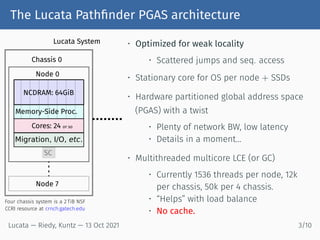
The Lucata Pathfinder PGAS architecture
NCDRAM: 64GiB
Memory-Side Proc.
Cores: 24 or so
Migration, I/O, etc.
SC
Node 0
Node 7
Chassis 0
Lucata System
Four chassis system is a 2 TiB NSF
CCRI resource at crnch.gatech.edu
• Optimized for weak locality
• Scattered jumps and seq. access
• Stationary core for OS per node + SSDs
• Hardware partitioned global address space
(PGAS) with a twist
• Plenty of network BW, low latency
• Details in a moment...
• Multithreaded multicore LCE (or GC)
• Currently 1536 threads per node, 12k
per chassis, 50k per 4 chassis.
• “Helps” with load balance
• No cache.
Lucata — Riedy, Kuntz — 13 Oct 2021 3/10
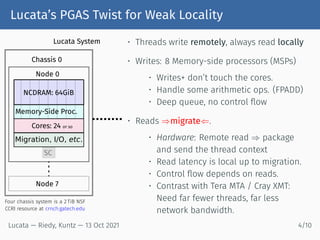
Lucata’s PGAS Twist for Weak Locality
NCDRAM: 64GiB
Memory-Side Proc.
Cores: 24 or so
Migration, I/O, etc.
SC
Node 0
Node 7
Chassis 0
Lucata System
Four chassis system is a 2 TiB NSF
CCRI resource at crnch.gatech.edu
• Threads write remotely, always read locally
• Writes: 8 Memory-side processors (MSPs)
• Writes+ don’t touch the cores.
• Handle some arithmetic ops. (FPADD)
• Deep queue, no control flow
• Reads ⇒migrate⇐.
• Hardware: Remote read ⇒ package
and send the thread context
• Read latency is local up to migration.
• Control flow depends on reads.
• Contrast with Tera MTA / Cray XMT:
Need far fewer threads, far less
network bandwidth.
Lucata — Riedy, Kuntz — 13 Oct 2021 4/10
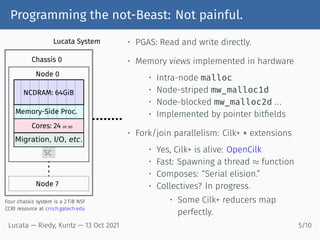
Programming the not-Beast: Not painful.
NCDRAM: 64GiB
Memory-Side Proc.
Cores: 24 or so
Migration, I/O, etc.
SC
Node 0
Node 7
Chassis 0
Lucata System
Four chassis system is a 2 TiB NSF
CCRI resource at crnch.gatech.edu
• PGAS: Read and write directly.
• Memory views implemented in hardware
• Intra-node malloc
• Node-striped mw_malloc1d
• Node-blocked mw_malloc2d ...
• Implemented by pointer bitfields
• Fork/join parallelism: Cilk+ + extensions
• Yes, Cilk+ is alive: OpenCilk
• Fast: Spawning a thread ≈ function
• Composes: “Serial elision.”
• Collectives? In progress.
• Some Cilk+ reducers map
perfectly.
Lucata — Riedy, Kuntz — 13 Oct 2021 5/10
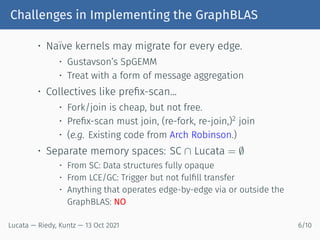
Challenges in Implementing the GraphBLAS
• Naïve kernels may migrate for every edge.
• Gustavson’s SpGEMM
• Treat with a form of message aggregation
• Collectives like prefix-scan...
• Fork/join is cheap, but not free.
• Prefix-scan must join, (re-fork, re-join,)2 join
• (e.g. Existing code from Arch Robinson.)
• Separate memory spaces: SC ∩ Lucata = ∅
• From SC: Data structures fully opaque
• From LCE/GC: Trigger but not fulfill transfer
• Anything that operates edge-by-edge via or outside the
GraphBLAS: NO
Lucata — Riedy, Kuntz — 13 Oct 2021 6/10
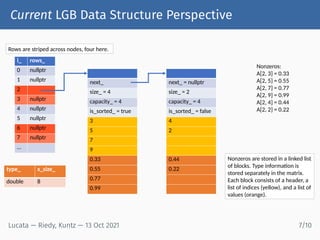
Current LGB Data Structure Perspective
Lucata — Riedy, Kuntz — 13 Oct 2021 7/10
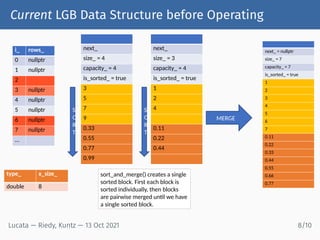
Current LGB Data Structure before Operating
Lucata — Riedy, Kuntz — 13 Oct 2021 8/10
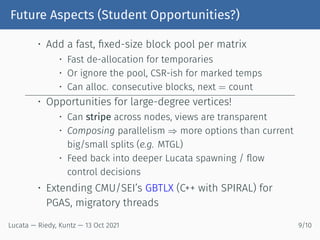
Future Aspects (Student Opportunities?)
• Add a fast, fixed-size block pool per matrix
• Fast de-allocation for temporaries
• Or ignore the pool, CSR-ish for marked temps
• Can alloc. consecutive blocks, next = count
• Opportunities for large-degree vertices!
• Can stripe across nodes, views are transparent
• Composing parallelism ⇒ more options than current
big/small splits (e.g. MTGL)
• Feed back into deeper Lucata spawning / flow
control decisions
• Extending CMU/SEI’s GBTLX (C++ with SPIRAL) for
PGAS, migratory threads
Lucata — Riedy, Kuntz — 13 Oct 2021 9/10
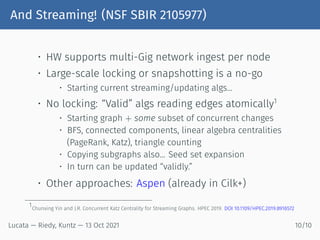
And Streaming! (NSF SBIR 2105977)
• HW supports multi-Gig network ingest per node
• Large-scale locking or snapshotting is a no-go
• Starting current streaming/updating algs...
• No locking: “Valid” algs reading edges atomically1
• Starting graph + some subset of concurrent changes
• BFS, connected components, linear algebra centralities
(PageRank, Katz), triangle counting
• Copying subgraphs also... Seed set expansion
• In turn can be updated “validly.”
• Other approaches: Aspen (already in Cilk+)
1
Chunxing Yin and J.R. Concurrent Katz Centrality for Streaming Graphs. HPEC 2019. DOI 10.1109/HPEC.2019.8916572
Lucata — Riedy, Kuntz — 13 Oct 2021 10/10

LAGraph 2021-10-13

  • 1.
    Introducing Lucata’s GraphBLAS v1.0is tagged! And tested! Jason Riedy and Shannon Kuntz 13 Oct 2021 Lucata Corporation
  • 2.
    Parallel Graph Analysis Knownissues: • Scattered memory access w/ small(?) seq. bursts • Cache lines provide fraction of avail. BW • Prefetechers fire up then mis-predict • Large bursts (high degree) ⇒ load imbalance • Combined with 90% diameter ≤ 8. • Plenty of load-balancing pre-processing... • Streaming: The graph is changing. • Pre-processing can hurt where and when changes are interesting. CPU+cache systems have one set of coping mechanisms. GPGPUs / flex. vectors another. And Lucata has yet more... Lucata — Riedy, Kuntz — 13 Oct 2021 2/10
  • 3.
    The Lucata PathfinderPGAS architecture NCDRAM: 64GiB Memory-Side Proc. Cores: 24 or so Migration, I/O, etc. SC Node 0 Node 7 Chassis 0 Lucata System Four chassis system is a 2 TiB NSF CCRI resource at crnch.gatech.edu • Optimized for weak locality • Scattered jumps and seq. access • Stationary core for OS per node + SSDs • Hardware partitioned global address space (PGAS) with a twist • Plenty of network BW, low latency • Details in a moment... • Multithreaded multicore LCE (or GC) • Currently 1536 threads per node, 12k per chassis, 50k per 4 chassis. • “Helps” with load balance • No cache. Lucata — Riedy, Kuntz — 13 Oct 2021 3/10
  • 4.
    Lucata’s PGAS Twistfor Weak Locality NCDRAM: 64GiB Memory-Side Proc. Cores: 24 or so Migration, I/O, etc. SC Node 0 Node 7 Chassis 0 Lucata System Four chassis system is a 2 TiB NSF CCRI resource at crnch.gatech.edu • Threads write remotely, always read locally • Writes: 8 Memory-side processors (MSPs) • Writes+ don’t touch the cores. • Handle some arithmetic ops. (FPADD) • Deep queue, no control flow • Reads ⇒migrate⇐. • Hardware: Remote read ⇒ package and send the thread context • Read latency is local up to migration. • Control flow depends on reads. • Contrast with Tera MTA / Cray XMT: Need far fewer threads, far less network bandwidth. Lucata — Riedy, Kuntz — 13 Oct 2021 4/10
  • 5.
    Programming the not-Beast:Not painful. NCDRAM: 64GiB Memory-Side Proc. Cores: 24 or so Migration, I/O, etc. SC Node 0 Node 7 Chassis 0 Lucata System Four chassis system is a 2 TiB NSF CCRI resource at crnch.gatech.edu • PGAS: Read and write directly. • Memory views implemented in hardware • Intra-node malloc • Node-striped mw_malloc1d • Node-blocked mw_malloc2d ... • Implemented by pointer bitfields • Fork/join parallelism: Cilk+ + extensions • Yes, Cilk+ is alive: OpenCilk • Fast: Spawning a thread ≈ function • Composes: “Serial elision.” • Collectives? In progress. • Some Cilk+ reducers map perfectly. Lucata — Riedy, Kuntz — 13 Oct 2021 5/10
  • 6.
    Challenges in Implementingthe GraphBLAS • Naïve kernels may migrate for every edge. • Gustavson’s SpGEMM • Treat with a form of message aggregation • Collectives like prefix-scan... • Fork/join is cheap, but not free. • Prefix-scan must join, (re-fork, re-join,)2 join • (e.g. Existing code from Arch Robinson.) • Separate memory spaces: SC ∩ Lucata = ∅ • From SC: Data structures fully opaque • From LCE/GC: Trigger but not fulfill transfer • Anything that operates edge-by-edge via or outside the GraphBLAS: NO Lucata — Riedy, Kuntz — 13 Oct 2021 6/10
  • 7.
    Current LGB DataStructure Perspective Lucata — Riedy, Kuntz — 13 Oct 2021 7/10
  • 8.
    Current LGB DataStructure before Operating Lucata — Riedy, Kuntz — 13 Oct 2021 8/10
  • 9.
    Future Aspects (StudentOpportunities?) • Add a fast, fixed-size block pool per matrix • Fast de-allocation for temporaries • Or ignore the pool, CSR-ish for marked temps • Can alloc. consecutive blocks, next = count • Opportunities for large-degree vertices! • Can stripe across nodes, views are transparent • Composing parallelism ⇒ more options than current big/small splits (e.g. MTGL) • Feed back into deeper Lucata spawning / flow control decisions • Extending CMU/SEI’s GBTLX (C++ with SPIRAL) for PGAS, migratory threads Lucata — Riedy, Kuntz — 13 Oct 2021 9/10
  • 10.
    And Streaming! (NSFSBIR 2105977) • HW supports multi-Gig network ingest per node • Large-scale locking or snapshotting is a no-go • Starting current streaming/updating algs... • No locking: “Valid” algs reading edges atomically1 • Starting graph + some subset of concurrent changes • BFS, connected components, linear algebra centralities (PageRank, Katz), triangle counting • Copying subgraphs also... Seed set expansion • In turn can be updated “validly.” • Other approaches: Aspen (already in Cilk+) 1 Chunxing Yin and J.R. Concurrent Katz Centrality for Streaming Graphs. HPEC 2019. DOI 10.1109/HPEC.2019.8916572 Lucata — Riedy, Kuntz — 13 Oct 2021 10/10