Augmented Arithmetic Operations
Proposed for IEEE 754-2018
E. Jason Riedy
Georgia Institute of Technology
25th IEEE Symposium on Computer Arithmetic, 26 June 2018
Outline
History and Definitions
Decisions
Testing
Summary
Augmented Arith Ops — ARITH 25, 26 June 2018 1/18
History and Definitions
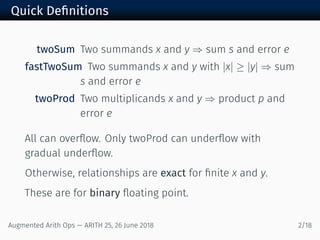
Quick Definitions
twoSum Two summands x and y ⇒ sum s and error e
fastTwoSum Two summands x and y with |x| ≥ |y| ⇒ sum
s and error e
twoProd Two multiplicands x and y ⇒ product p and
error e
All can overflow. Only twoProd can underflow with
gradual underflow.
Otherwise, relationships are exact for finite x and y.
These are for binary floating point.
Augmented Arith Ops — ARITH 25, 26 June 2018 2/18
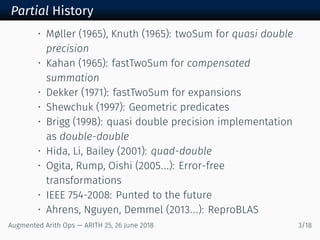
Partial History
• Møller (1965), Knuth (1965): twoSum for quasi double
precision
• Kahan (1965): fastTwoSum for compensated
summation
• Dekker (1971): fastTwoSum for expansions
• Shewchuk (1997): Geometric predicates
• Brigg (1998): quasi double precision implementation
as double-double
• Hida, Li, Bailey (2001): quad-double
• Ogita, Rump, Oishi (2005...): Error-free
transformations
• IEEE 754-2008: Punted to the future
• Ahrens, Nguyen, Demmel (2013...): ReproBLAS
Augmented Arith Ops — ARITH 25, 26 June 2018 3/18
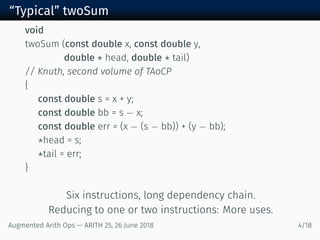
“Typical” twoSum
void
twoSum (const double x, const double y,
double * head, double * tail)
// Knuth, second volume of TAoCP
{
const double s = x + y;
const double bb = s − x;
const double err = (x − (s − bb)) + (y − bb);
*head = s;
*tail = err;
}
Six instructions, long dependency chain.
Reducing to one or two instructions: More uses.
Augmented Arith Ops — ARITH 25, 26 June 2018 4/18
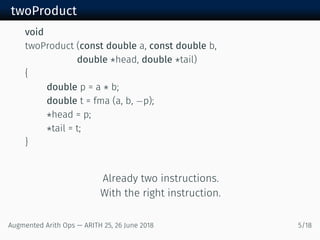
twoProduct
void
twoProduct (const double a, const double b,
double *head, double *tail)
{
double p = a * b;
double t = fma (a, b, −p);
*head = p;
*tail = t;
}
Already two instructions.
With the right instruction.
Augmented Arith Ops — ARITH 25, 26 June 2018 5/18
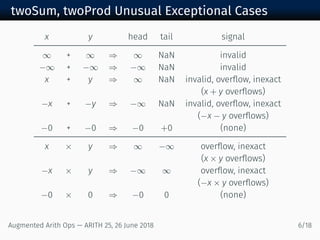
twoSum, twoProd Unusual Exceptional Cases
x y head tail signal
∞ + ∞ ⇒ ∞ NaN invalid
−∞ + −∞ ⇒ −∞ NaN invalid
x + y ⇒ ∞ NaN invalid, overflow, inexact
(x + y overflows)
−x + −y ⇒ −∞ NaN invalid, overflow, inexact
(−x − y overflows)
−0 + −0 ⇒ −0 +0 (none)
x × y ⇒ ∞ −∞ overflow, inexact
(x × y overflows)
−x × y ⇒ −∞ ∞ overflow, inexact
(−x × y overflows)
−0 × 0 ⇒ −0 0 (none)
Augmented Arith Ops — ARITH 25, 26 June 2018 6/18
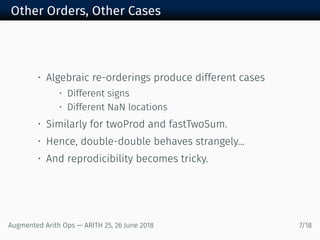
Other Orders, Other Cases
• Algebraic re-orderings produce different cases
• Different signs
• Different NaN locations
• Similarly for twoProd and fastTwoSum.
• Hence, double-double behaves strangely...
• And reprodicibility becomes tricky.
Augmented Arith Ops — ARITH 25, 26 June 2018 7/18
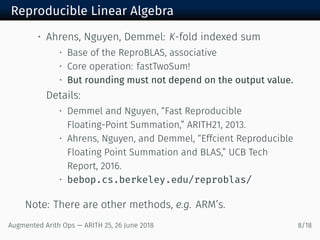
Reproducible Linear Algebra
• Ahrens, Nguyen, Demmel: K-fold indexed sum
• Base of the ReproBLAS, associative
• Core operation: fastTwoSum!
• But rounding must not depend on the output value.
Details:
• Demmel and Nguyen, “Fast Reproducible
Floating-Point Summation,” ARITH21, 2013.
• Ahrens, Nguyen, and Demmel, “Effcient Reproducible
Floating Point Summation and BLAS,” UCB Tech
Report, 2016.
• bebop.cs.berkeley.edu/reproblas/
Note: There are other methods, e.g. ARM’s.
Augmented Arith Ops — ARITH 25, 26 June 2018 8/18
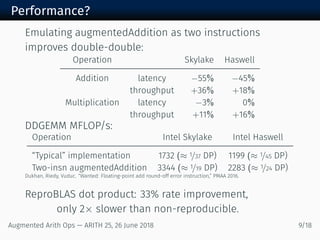
Performance?
Emulating augmentedAddition as two instructions
improves double-double:
Operation Skylake Haswell
Addition latency −55% −45%
throughput +36% +18%
Multiplication latency −3% 0%
throughput +11% +16%
DDGEMM MFLOP/s:
Operation Intel Skylake Intel Haswell
“Typical” implementation 1732 (≈ 1/37 DP) 1199 (≈ 1/45 DP)
Two-insn augmentedAddition 3344 (≈ 1/19 DP) 2283 (≈ 1/24 DP)
Dukhan, Riedy, Vuduc. “Wanted: Floating-point add round-off error instruction,” PMAA 2016.
ReproBLAS dot product: 33% rate improvement,
only 2× slower than non-reproducible.
Augmented Arith Ops — ARITH 25, 26 June 2018 9/18
Decisions
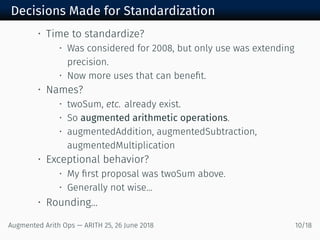
Decisions Made for Standardization
• Time to standardize?
• Was considered for 2008, but only use was extending
precision.
• Now more uses that can benefit.
• Names?
• twoSum, etc. already exist.
• So augmented arithmetic operations.
• augmentedAddition, augmentedSubtraction,
augmentedMultiplication
• Exceptional behavior?
• My first proposal was twoSum above.
• Generally not wise...
• Rounding...
Augmented Arith Ops — ARITH 25, 26 June 2018 10/18
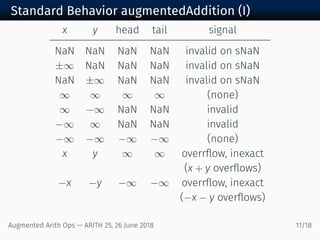
Standard Behavior augmentedAddition (I)
x y head tail signal
NaN NaN NaN NaN invalid on sNaN
±∞ NaN NaN NaN invalid on sNaN
NaN ±∞ NaN NaN invalid on sNaN
∞ ∞ ∞ ∞ (none)
∞ −∞ NaN NaN invalid
−∞ ∞ NaN NaN invalid
−∞ −∞ −∞ −∞ (none)
x y ∞ ∞ overrflow, inexact
(x + y overflows)
−x −y −∞ −∞ overrflow, inexact
(−x − y overflows)
Augmented Arith Ops — ARITH 25, 26 June 2018 11/18
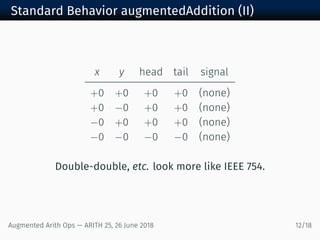
Standard Behavior augmentedAddition (II)
x y head tail signal
+0 +0 +0 +0 (none)
+0 −0 +0 +0 (none)
−0 +0 +0 +0 (none)
−0 −0 −0 −0 (none)
Double-double, etc. look more like IEEE 754.
Augmented Arith Ops — ARITH 25, 26 June 2018 12/18
Rounding
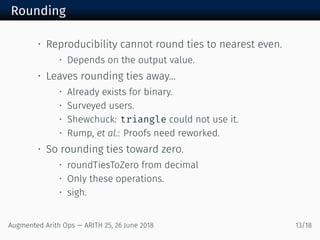
• Reproducibility cannot round ties to nearest even.
• Depends on the output value.
• Leaves rounding ties away...
• Already exists for binary.
• Surveyed users.
• Shewchuck: triangle could not use it.
• Rump, et al.: Proofs need reworked.
• So rounding ties toward zero.
• roundTiesToZero from decimal
• Only these operations.
• sigh.
Augmented Arith Ops — ARITH 25, 26 June 2018 13/18
Testing
Testing augmentedAddition
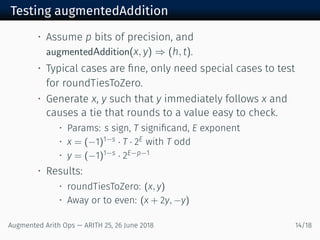
• Assume p bits of precision, and
augmentedAddition(x, y) ⇒ (h, t).
• Typical cases are fine, only need special cases to test
for roundTiesToZero.
• Generate x, y such that y immediately follows x and
causes a tie that rounds to a value easy to check.
• Params: s sign, T significand, E exponent
• x = (−1)1−s · T · 2E with T odd
• y = (−1)1−s · 2E−p−1
• Results:
• roundTiesToZero: (x, y)
• Away or to even: (x + 2y, −y)
Augmented Arith Ops — ARITH 25, 26 June 2018 14/18
Testing augmentedMultiplication: Rounding
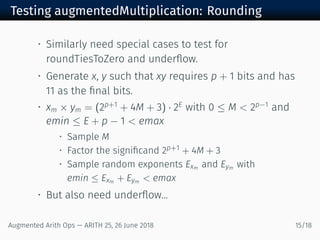
• Similarly need special cases to test for
roundTiesToZero and underflow.
• Generate x, y such that xy requires p + 1 bits and has
11 as the final bits.
• xm × ym = (2p+1
+ 4M + 3) · 2E
with 0 ≤ M < 2p−1
and
emin ≤ E + p − 1 < emax
• Sample M
• Factor the significand 2p+1 + 4M + 3
• Sample random exponents Exm and Eym with
emin ≤ Exm + Eym < emax
• But also need underflow...
Augmented Arith Ops — ARITH 25, 26 June 2018 15/18
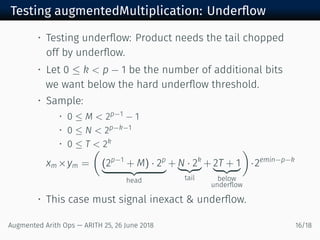
Testing augmentedMultiplication: Underflow
• Testing underflow: Product needs the tail chopped
off by underflow.
• Let 0 ≤ k < p − 1 be the number of additional bits
we want below the hard underflow threshold.
• Sample:
• 0 ≤ M < 2p−1 − 1
• 0 ≤ N < 2p−k−1
• 0 ≤ T < 2k
xm ×ym =
(
(2p−1
+ M) · 2p
head
+ N · 2k
tail
+ 2T + 1
below
underflow
)
·2emin−p−k
• This case must signal inexact & underflow.
Augmented Arith Ops — ARITH 25, 26 June 2018 16/18
Reference Code
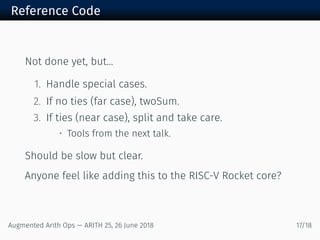
Not done yet, but...
1. Handle special cases.
2. If no ties (far case), twoSum.
3. If ties (near case), split and take care.
• Tools from the next talk.
Should be slow but clear.
Anyone feel like adding this to the RISC-V Rocket core?
Augmented Arith Ops — ARITH 25, 26 June 2018 17/18
Summary
Summary
• Three “new” recommended ops in draft IEEE
754-2018
• augmentedAddition, augmentedSubtraction,
augmentedMultiplication
• Specified to support extending precision (double
double), reproducible linear algebra
• Two instruction implementation can provide good
performance benefits.
• Quite easily testible
• Future: Decimal? Hardware?
Augmented Arith Ops — ARITH 25, 26 June 2018 18/18
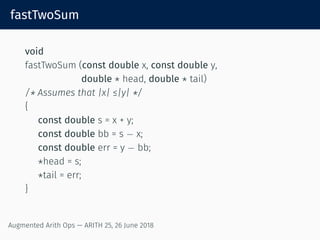
fastTwoSum
void
fastTwoSum (const double x, const double y,
double * head, double * tail)
/* Assumes that |x| ≤|y| */
{
const double s = x + y;
const double bb = s − x;
const double err = y − bb;
*head = s;
*tail = err;
}
Augmented Arith Ops — ARITH 25, 26 June 2018
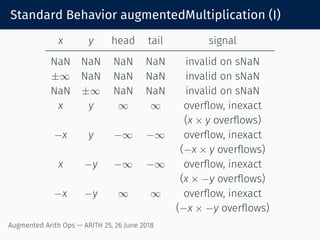
Standard Behavior augmentedMultiplication (I)
x y head tail signal
NaN NaN NaN NaN invalid on sNaN
±∞ NaN NaN NaN invalid on sNaN
NaN ±∞ NaN NaN invalid on sNaN
x y ∞ ∞ overflow, inexact
(x × y overflows)
−x y −∞ −∞ overflow, inexact
(−x × y overflows)
x −y −∞ −∞ overflow, inexact
(x × −y overflows)
−x −y ∞ ∞ overflow, inexact
(−x × −y overflows)
Augmented Arith Ops — ARITH 25, 26 June 2018
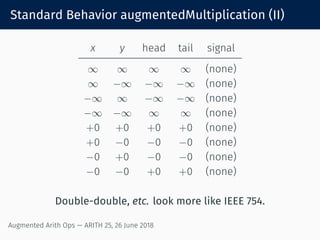
Standard Behavior augmentedMultiplication (II)
x y head tail signal
∞ ∞ ∞ ∞ (none)
∞ −∞ −∞ −∞ (none)
−∞ ∞ −∞ −∞ (none)
−∞ −∞ ∞ ∞ (none)
+0 +0 +0 +0 (none)
+0 −0 −0 −0 (none)
−0 +0 −0 −0 (none)
−0 −0 +0 +0 (none)
Double-double, etc. look more like IEEE 754.
Augmented Arith Ops — ARITH 25, 26 June 2018

Augmented Arithmetic Operations Proposed for IEEE-754 2018

  • 1.
    Augmented Arithmetic Operations Proposedfor IEEE 754-2018 E. Jason Riedy Georgia Institute of Technology 25th IEEE Symposium on Computer Arithmetic, 26 June 2018
  • 2.
  • 3.
  • 4.
    Quick Definitions twoSum Twosummands x and y ⇒ sum s and error e fastTwoSum Two summands x and y with |x| ≥ |y| ⇒ sum s and error e twoProd Two multiplicands x and y ⇒ product p and error e All can overflow. Only twoProd can underflow with gradual underflow. Otherwise, relationships are exact for finite x and y. These are for binary floating point. Augmented Arith Ops — ARITH 25, 26 June 2018 2/18
  • 5.
    Partial History • Møller(1965), Knuth (1965): twoSum for quasi double precision • Kahan (1965): fastTwoSum for compensated summation • Dekker (1971): fastTwoSum for expansions • Shewchuk (1997): Geometric predicates • Brigg (1998): quasi double precision implementation as double-double • Hida, Li, Bailey (2001): quad-double • Ogita, Rump, Oishi (2005...): Error-free transformations • IEEE 754-2008: Punted to the future • Ahrens, Nguyen, Demmel (2013...): ReproBLAS Augmented Arith Ops — ARITH 25, 26 June 2018 3/18
  • 6.
    “Typical” twoSum void twoSum (constdouble x, const double y, double * head, double * tail) // Knuth, second volume of TAoCP { const double s = x + y; const double bb = s − x; const double err = (x − (s − bb)) + (y − bb); *head = s; *tail = err; } Six instructions, long dependency chain. Reducing to one or two instructions: More uses. Augmented Arith Ops — ARITH 25, 26 June 2018 4/18
  • 7.
    twoProduct void twoProduct (const doublea, const double b, double *head, double *tail) { double p = a * b; double t = fma (a, b, −p); *head = p; *tail = t; } Already two instructions. With the right instruction. Augmented Arith Ops — ARITH 25, 26 June 2018 5/18
  • 8.
    twoSum, twoProd UnusualExceptional Cases x y head tail signal ∞ + ∞ ⇒ ∞ NaN invalid −∞ + −∞ ⇒ −∞ NaN invalid x + y ⇒ ∞ NaN invalid, overflow, inexact (x + y overflows) −x + −y ⇒ −∞ NaN invalid, overflow, inexact (−x − y overflows) −0 + −0 ⇒ −0 +0 (none) x × y ⇒ ∞ −∞ overflow, inexact (x × y overflows) −x × y ⇒ −∞ ∞ overflow, inexact (−x × y overflows) −0 × 0 ⇒ −0 0 (none) Augmented Arith Ops — ARITH 25, 26 June 2018 6/18
  • 9.
    Other Orders, OtherCases • Algebraic re-orderings produce different cases • Different signs • Different NaN locations • Similarly for twoProd and fastTwoSum. • Hence, double-double behaves strangely... • And reprodicibility becomes tricky. Augmented Arith Ops — ARITH 25, 26 June 2018 7/18
  • 10.
    Reproducible Linear Algebra •Ahrens, Nguyen, Demmel: K-fold indexed sum • Base of the ReproBLAS, associative • Core operation: fastTwoSum! • But rounding must not depend on the output value. Details: • Demmel and Nguyen, “Fast Reproducible Floating-Point Summation,” ARITH21, 2013. • Ahrens, Nguyen, and Demmel, “Effcient Reproducible Floating Point Summation and BLAS,” UCB Tech Report, 2016. • bebop.cs.berkeley.edu/reproblas/ Note: There are other methods, e.g. ARM’s. Augmented Arith Ops — ARITH 25, 26 June 2018 8/18
  • 11.
    Performance? Emulating augmentedAddition astwo instructions improves double-double: Operation Skylake Haswell Addition latency −55% −45% throughput +36% +18% Multiplication latency −3% 0% throughput +11% +16% DDGEMM MFLOP/s: Operation Intel Skylake Intel Haswell “Typical” implementation 1732 (≈ 1/37 DP) 1199 (≈ 1/45 DP) Two-insn augmentedAddition 3344 (≈ 1/19 DP) 2283 (≈ 1/24 DP) Dukhan, Riedy, Vuduc. “Wanted: Floating-point add round-off error instruction,” PMAA 2016. ReproBLAS dot product: 33% rate improvement, only 2× slower than non-reproducible. Augmented Arith Ops — ARITH 25, 26 June 2018 9/18
  • 12.
  • 13.
    Decisions Made forStandardization • Time to standardize? • Was considered for 2008, but only use was extending precision. • Now more uses that can benefit. • Names? • twoSum, etc. already exist. • So augmented arithmetic operations. • augmentedAddition, augmentedSubtraction, augmentedMultiplication • Exceptional behavior? • My first proposal was twoSum above. • Generally not wise... • Rounding... Augmented Arith Ops — ARITH 25, 26 June 2018 10/18
  • 14.
    Standard Behavior augmentedAddition(I) x y head tail signal NaN NaN NaN NaN invalid on sNaN ±∞ NaN NaN NaN invalid on sNaN NaN ±∞ NaN NaN invalid on sNaN ∞ ∞ ∞ ∞ (none) ∞ −∞ NaN NaN invalid −∞ ∞ NaN NaN invalid −∞ −∞ −∞ −∞ (none) x y ∞ ∞ overrflow, inexact (x + y overflows) −x −y −∞ −∞ overrflow, inexact (−x − y overflows) Augmented Arith Ops — ARITH 25, 26 June 2018 11/18
  • 15.
    Standard Behavior augmentedAddition(II) x y head tail signal +0 +0 +0 +0 (none) +0 −0 +0 +0 (none) −0 +0 +0 +0 (none) −0 −0 −0 −0 (none) Double-double, etc. look more like IEEE 754. Augmented Arith Ops — ARITH 25, 26 June 2018 12/18
  • 16.
    Rounding • Reproducibility cannotround ties to nearest even. • Depends on the output value. • Leaves rounding ties away... • Already exists for binary. • Surveyed users. • Shewchuck: triangle could not use it. • Rump, et al.: Proofs need reworked. • So rounding ties toward zero. • roundTiesToZero from decimal • Only these operations. • sigh. Augmented Arith Ops — ARITH 25, 26 June 2018 13/18
  • 17.
  • 18.
    Testing augmentedAddition • Assumep bits of precision, and augmentedAddition(x, y) ⇒ (h, t). • Typical cases are fine, only need special cases to test for roundTiesToZero. • Generate x, y such that y immediately follows x and causes a tie that rounds to a value easy to check. • Params: s sign, T significand, E exponent • x = (−1)1−s · T · 2E with T odd • y = (−1)1−s · 2E−p−1 • Results: • roundTiesToZero: (x, y) • Away or to even: (x + 2y, −y) Augmented Arith Ops — ARITH 25, 26 June 2018 14/18
  • 19.
    Testing augmentedMultiplication: Rounding •Similarly need special cases to test for roundTiesToZero and underflow. • Generate x, y such that xy requires p + 1 bits and has 11 as the final bits. • xm × ym = (2p+1 + 4M + 3) · 2E with 0 ≤ M < 2p−1 and emin ≤ E + p − 1 < emax • Sample M • Factor the significand 2p+1 + 4M + 3 • Sample random exponents Exm and Eym with emin ≤ Exm + Eym < emax • But also need underflow... Augmented Arith Ops — ARITH 25, 26 June 2018 15/18
  • 20.
    Testing augmentedMultiplication: Underflow •Testing underflow: Product needs the tail chopped off by underflow. • Let 0 ≤ k < p − 1 be the number of additional bits we want below the hard underflow threshold. • Sample: • 0 ≤ M < 2p−1 − 1 • 0 ≤ N < 2p−k−1 • 0 ≤ T < 2k xm ×ym = ( (2p−1 + M) · 2p head + N · 2k tail + 2T + 1 below underflow ) ·2emin−p−k • This case must signal inexact & underflow. Augmented Arith Ops — ARITH 25, 26 June 2018 16/18
  • 21.
    Reference Code Not doneyet, but... 1. Handle special cases. 2. If no ties (far case), twoSum. 3. If ties (near case), split and take care. • Tools from the next talk. Should be slow but clear. Anyone feel like adding this to the RISC-V Rocket core? Augmented Arith Ops — ARITH 25, 26 June 2018 17/18
  • 22.
  • 23.
    Summary • Three “new”recommended ops in draft IEEE 754-2018 • augmentedAddition, augmentedSubtraction, augmentedMultiplication • Specified to support extending precision (double double), reproducible linear algebra • Two instruction implementation can provide good performance benefits. • Quite easily testible • Future: Decimal? Hardware? Augmented Arith Ops — ARITH 25, 26 June 2018 18/18
  • 24.
    fastTwoSum void fastTwoSum (const doublex, const double y, double * head, double * tail) /* Assumes that |x| ≤|y| */ { const double s = x + y; const double bb = s − x; const double err = y − bb; *head = s; *tail = err; } Augmented Arith Ops — ARITH 25, 26 June 2018
  • 25.
    Standard Behavior augmentedMultiplication(I) x y head tail signal NaN NaN NaN NaN invalid on sNaN ±∞ NaN NaN NaN invalid on sNaN NaN ±∞ NaN NaN invalid on sNaN x y ∞ ∞ overflow, inexact (x × y overflows) −x y −∞ −∞ overflow, inexact (−x × y overflows) x −y −∞ −∞ overflow, inexact (x × −y overflows) −x −y ∞ ∞ overflow, inexact (−x × −y overflows) Augmented Arith Ops — ARITH 25, 26 June 2018
  • 26.
    Standard Behavior augmentedMultiplication(II) x y head tail signal ∞ ∞ ∞ ∞ (none) ∞ −∞ −∞ −∞ (none) −∞ ∞ −∞ −∞ (none) −∞ −∞ ∞ ∞ (none) +0 +0 +0 +0 (none) +0 −0 −0 −0 (none) −0 +0 −0 −0 (none) −0 −0 +0 +0 (none) Double-double, etc. look more like IEEE 754. Augmented Arith Ops — ARITH 25, 26 June 2018