





Process Improvement within a
Wicked Problem Environment

         Stephen Hacker
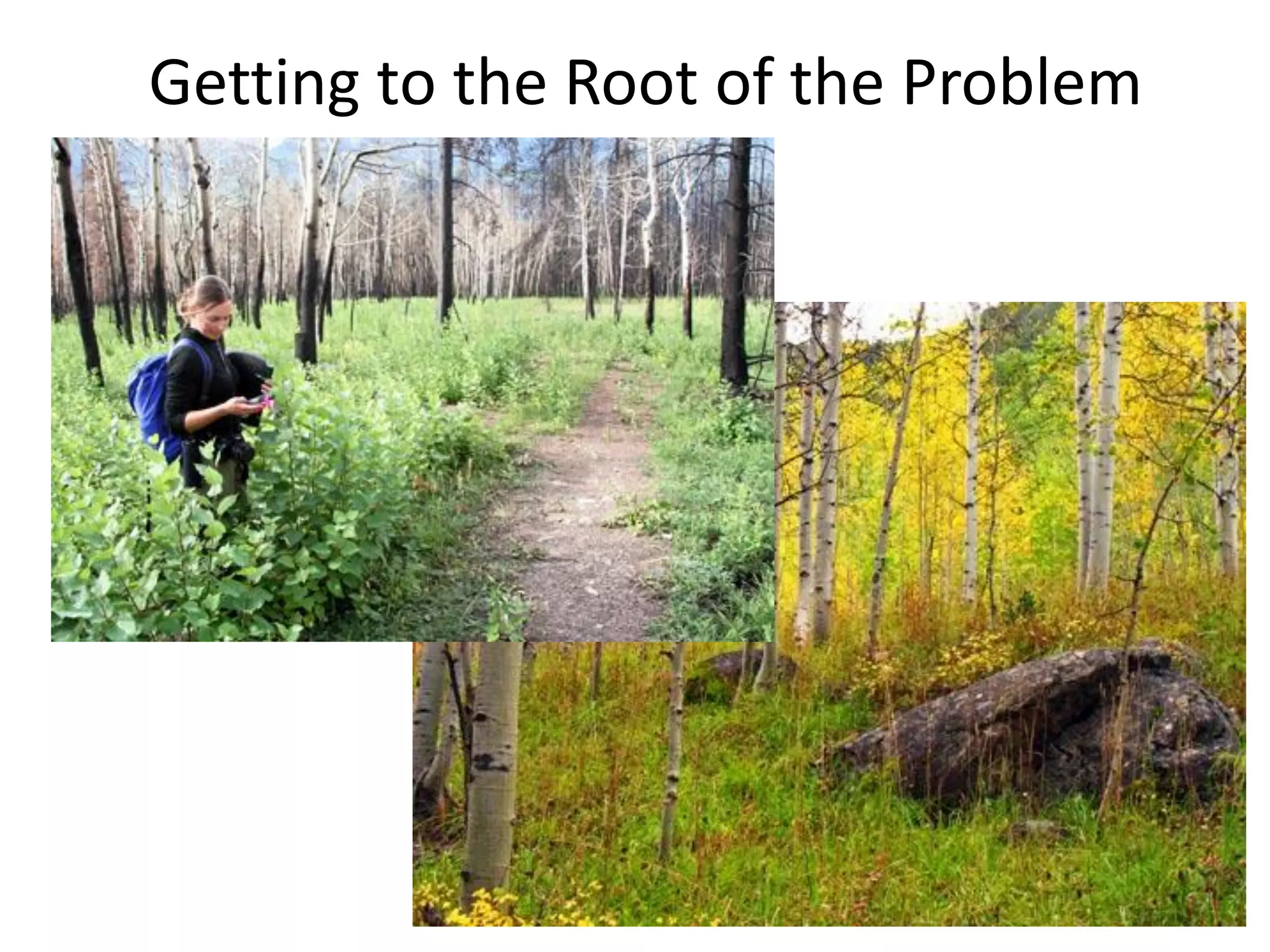
Getting to the Root of the Problem
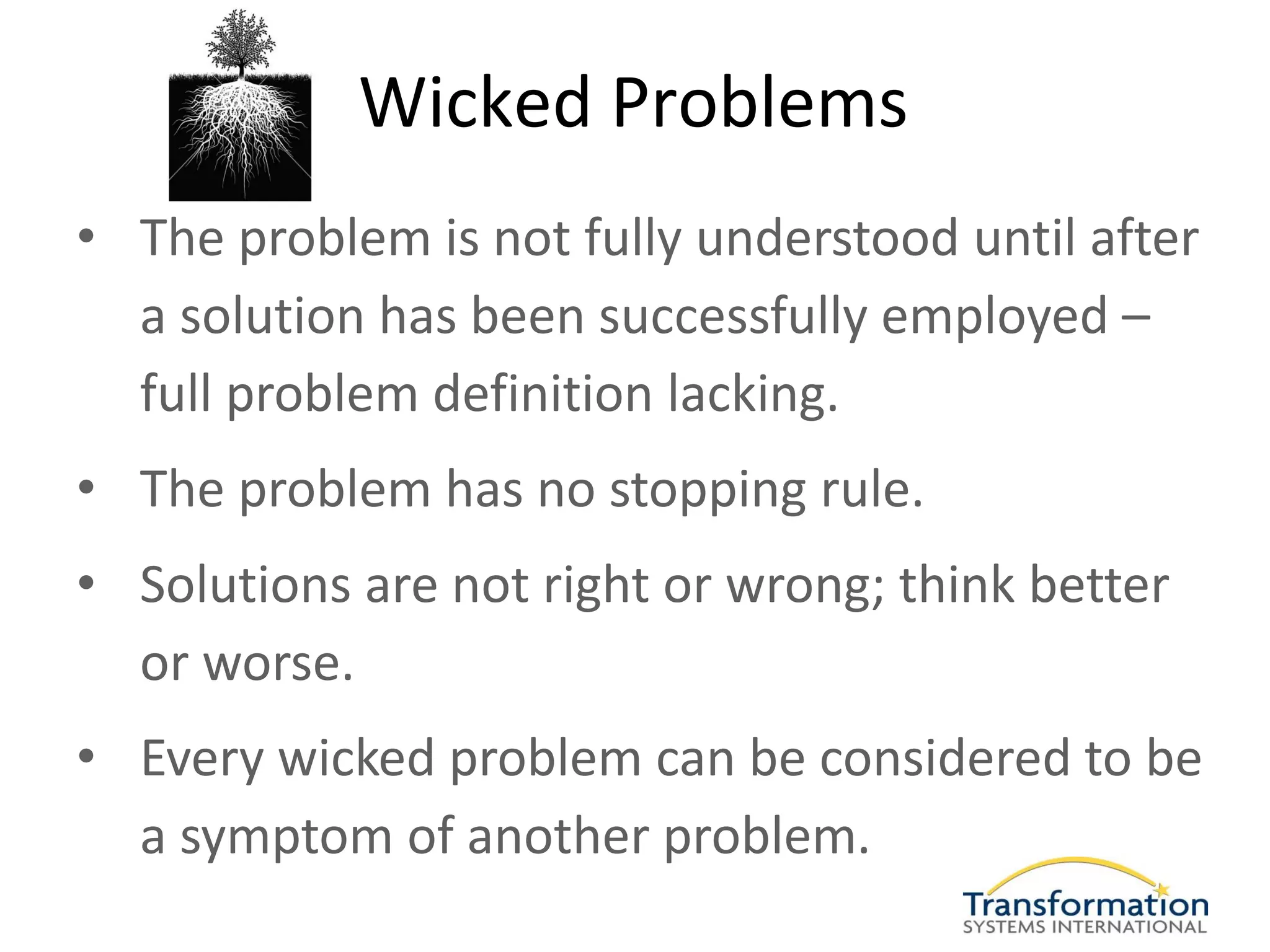
Wicked Problems
Wicked Problems
• Stakeholders have radically different world
  views and different frames.
• Constraints and resources change over time.
• Problem is never solved definitively.
• Every problem is essentially novel and unique.
• Economic, environmental, political
  problems…requiring many to change mindsets
  and behaviors.
Wicked Problems
• The problem is not fully understood until after
  a solution has been successfully employed –
  full problem definition lacking.
• The problem has no stopping rule.
• Solutions are not right or wrong; think better
  or worse.
• Every wicked problem can be considered to be
  a symptom of another problem.
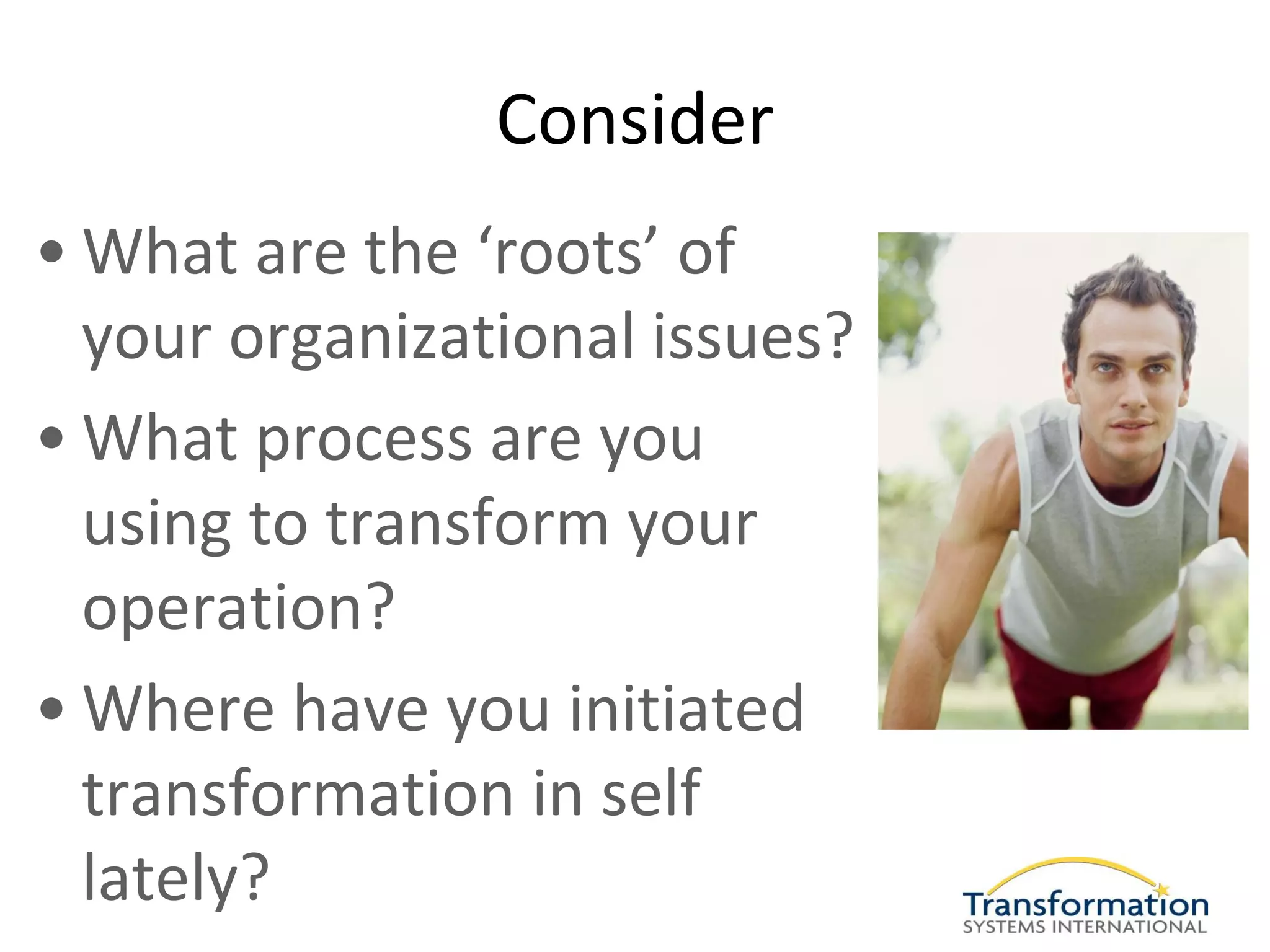
Consider
• What are the ‘roots’ of
  your organizational issues?
• What process are you
  using to transform your
  operation?
• Where have you initiated
  transformation in self
  lately?
We are taught to
look at the ROOT
 of the Problem
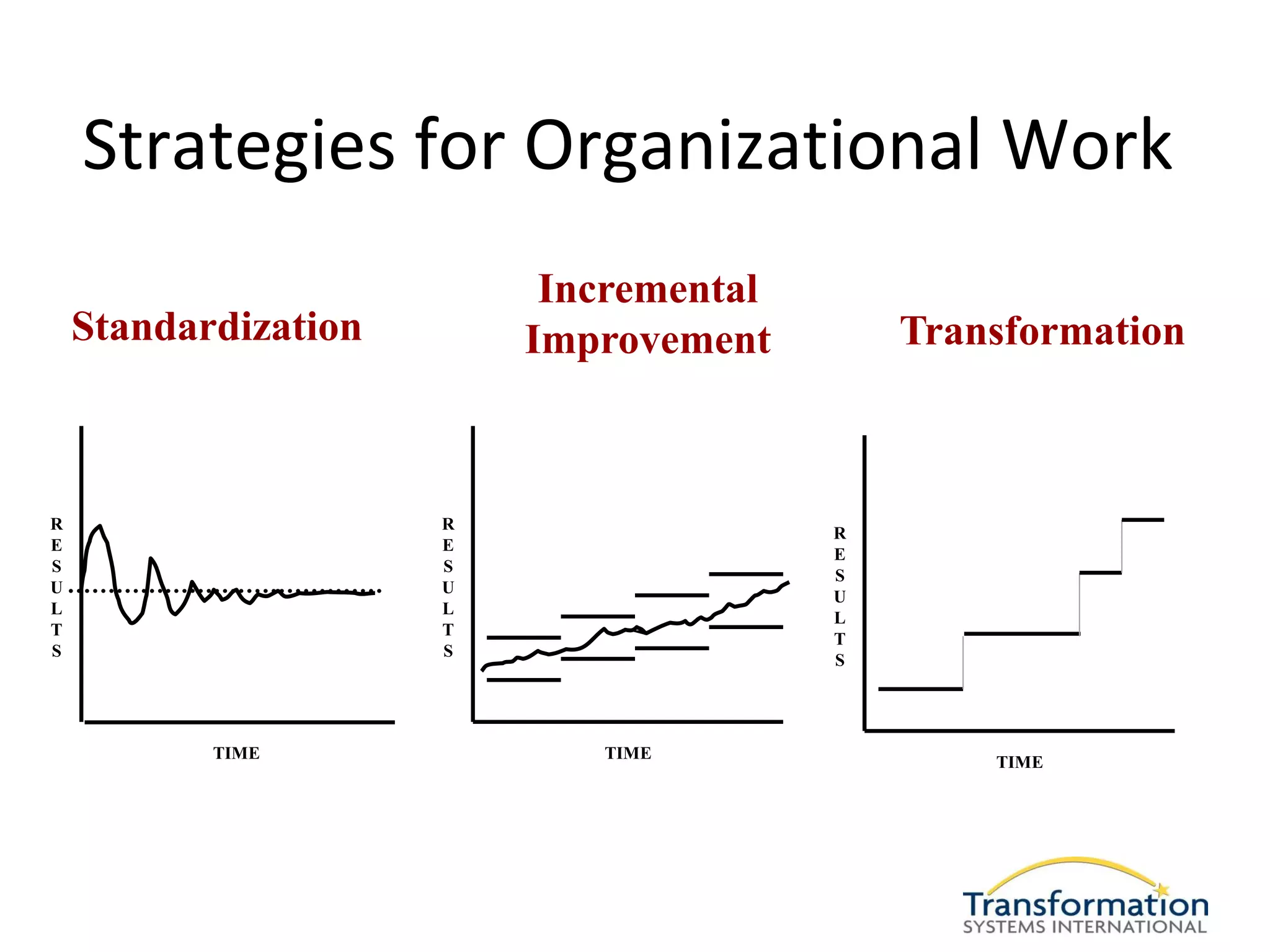
Strategies for Organizational Work
                           Incremental
    Standardization       Improvement        Transformation


R                     R
                                         R
E                     E
                                         E
S                     S
                                         S
U                     U
                                         U
L                     L
                                         L
T                     T
                                         T
S                     S
                                         S


           TIME              TIME
                                                 TIME
What is
  Transformation?
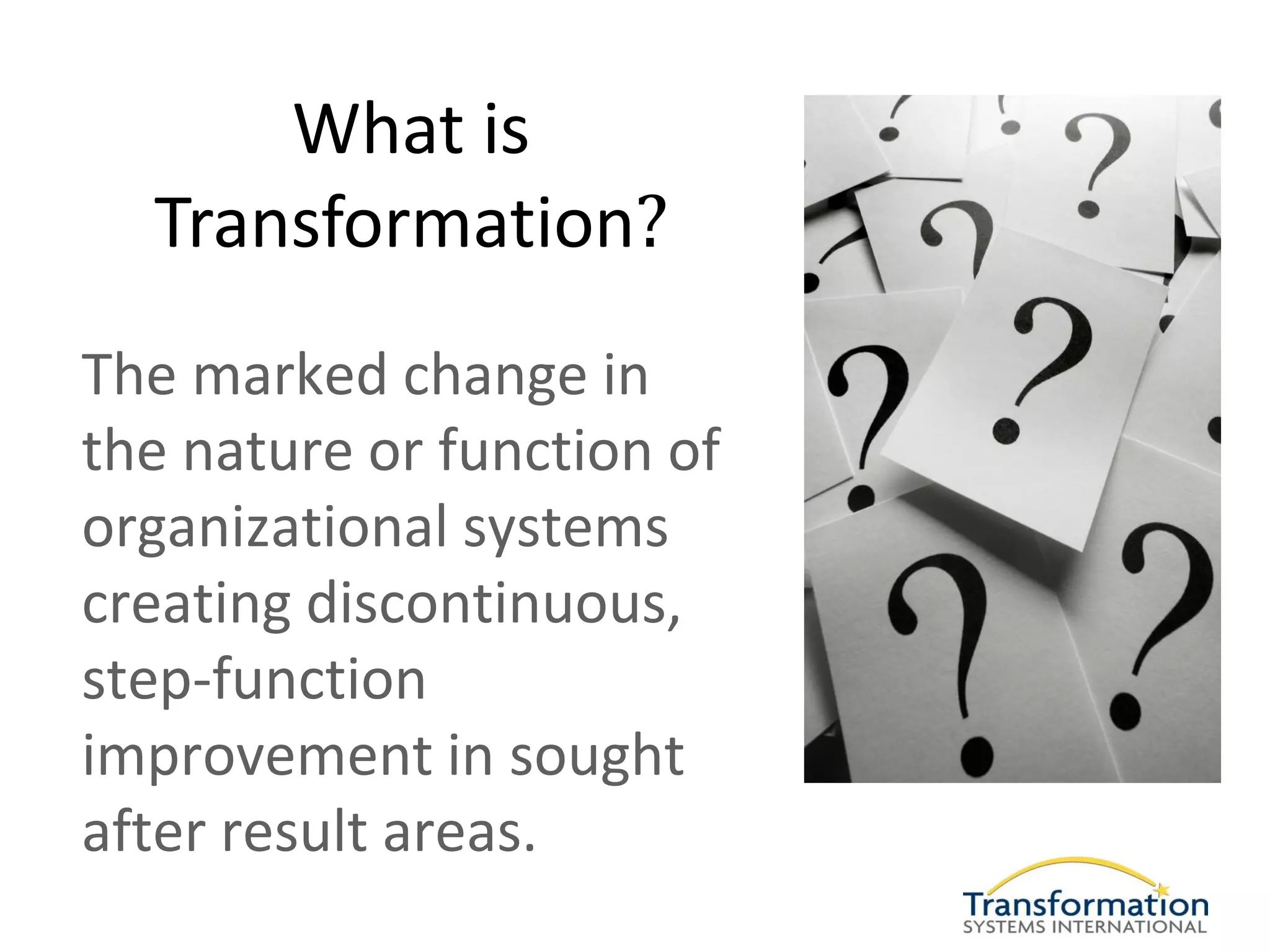
The marked change in
the nature or function of
organizational systems
creating discontinuous,
step-function
improvement in sought
after result areas.
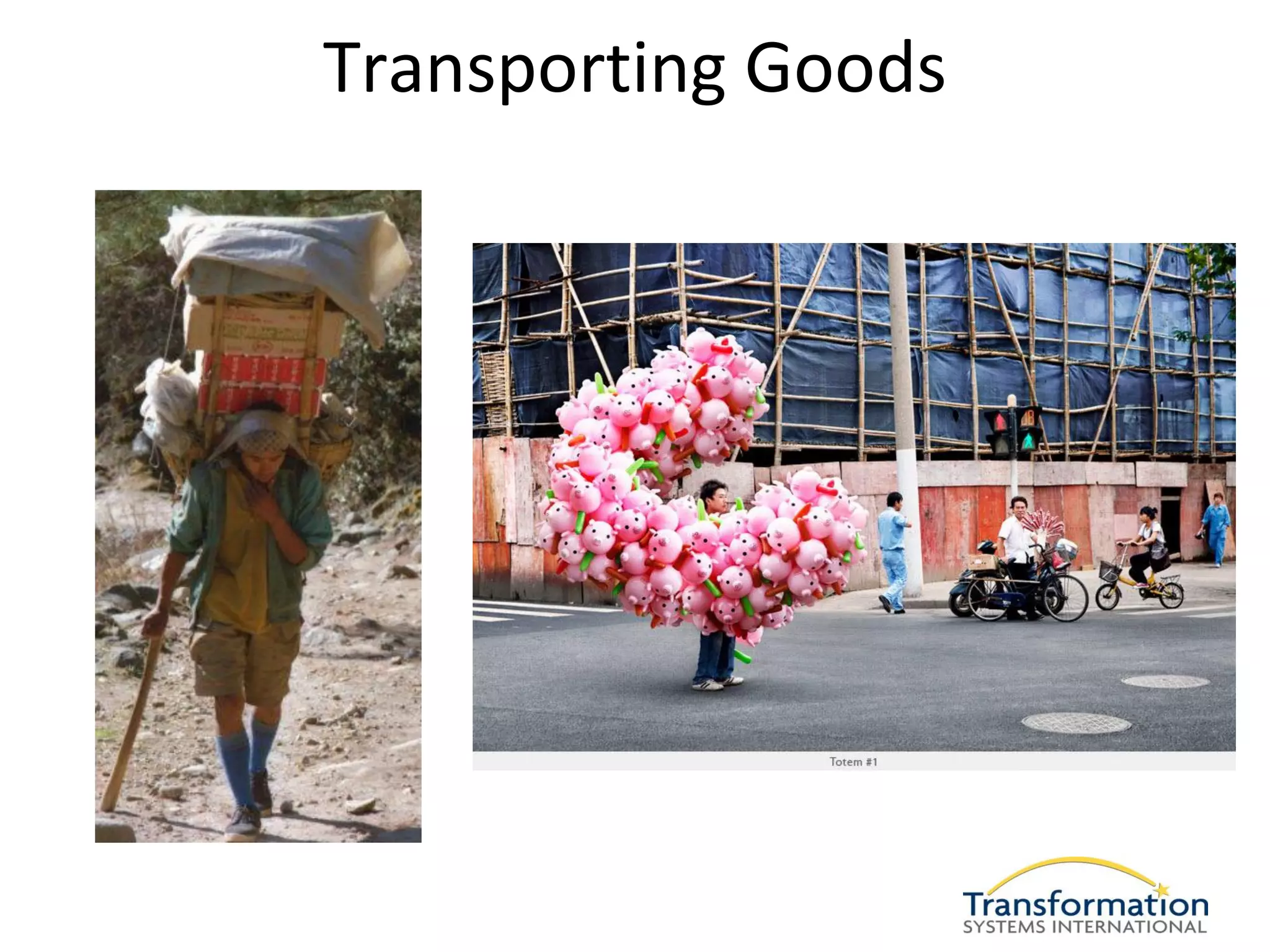
Transporting Goods
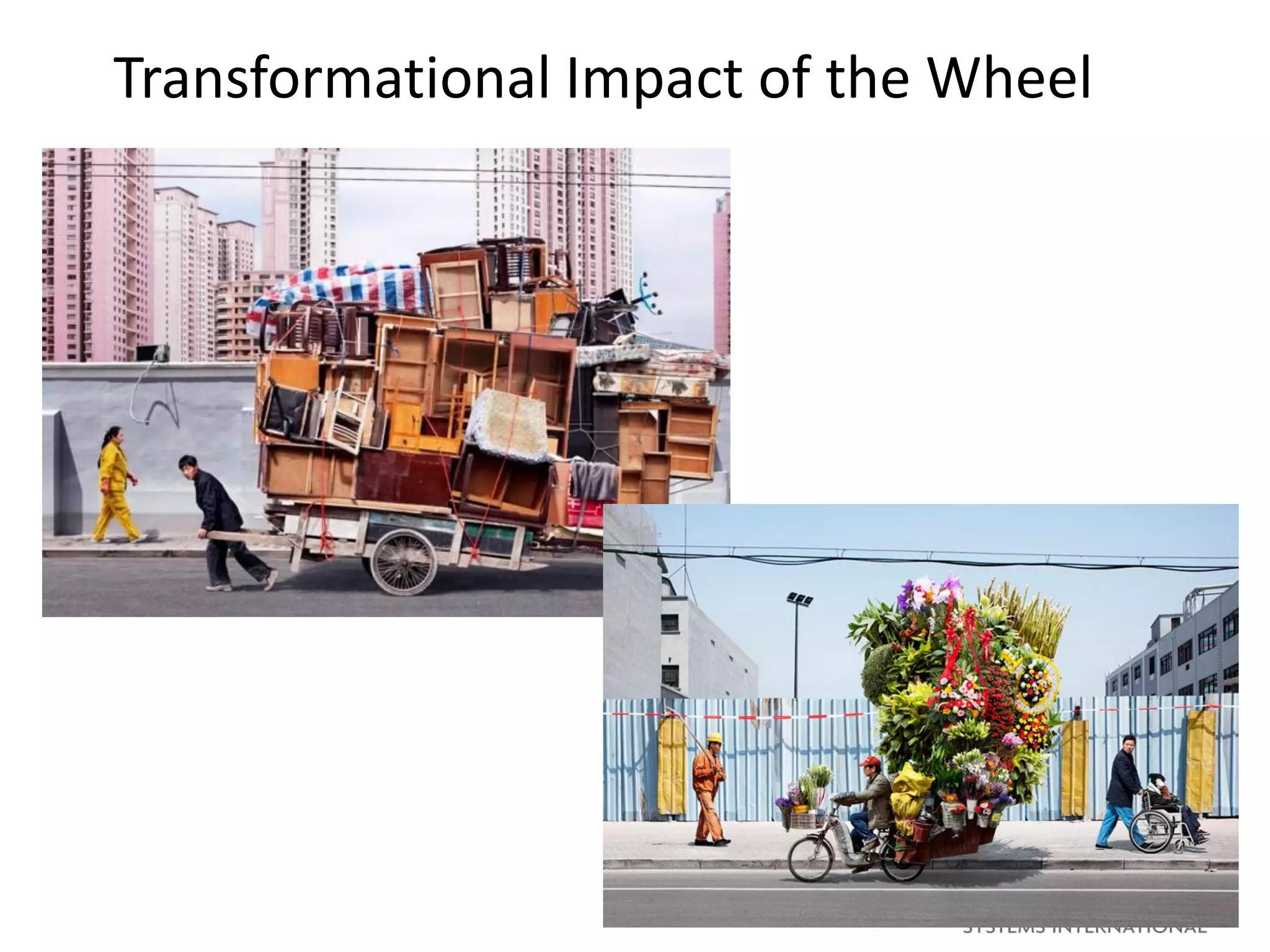
Transformational Impact of the Wheel
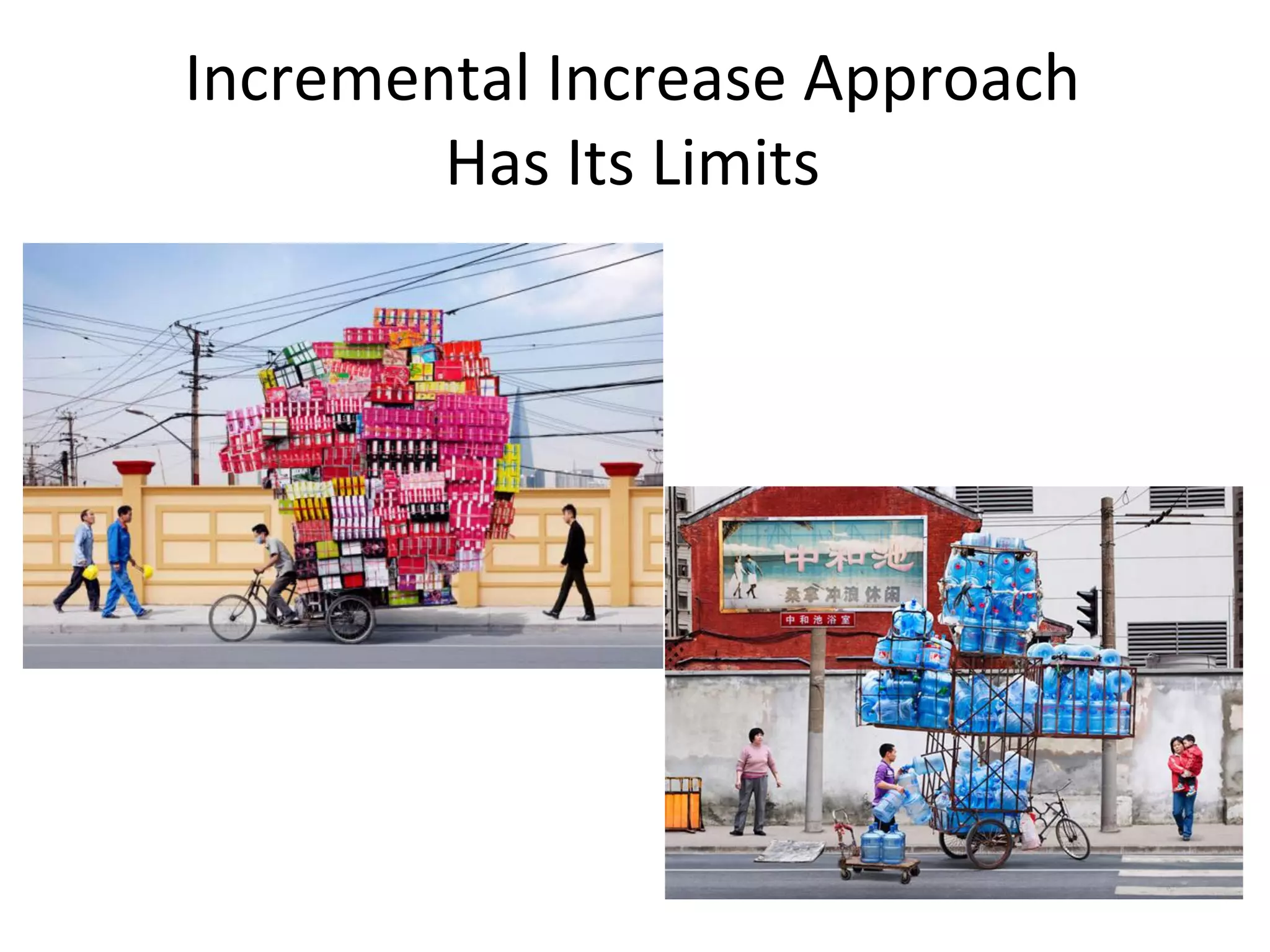
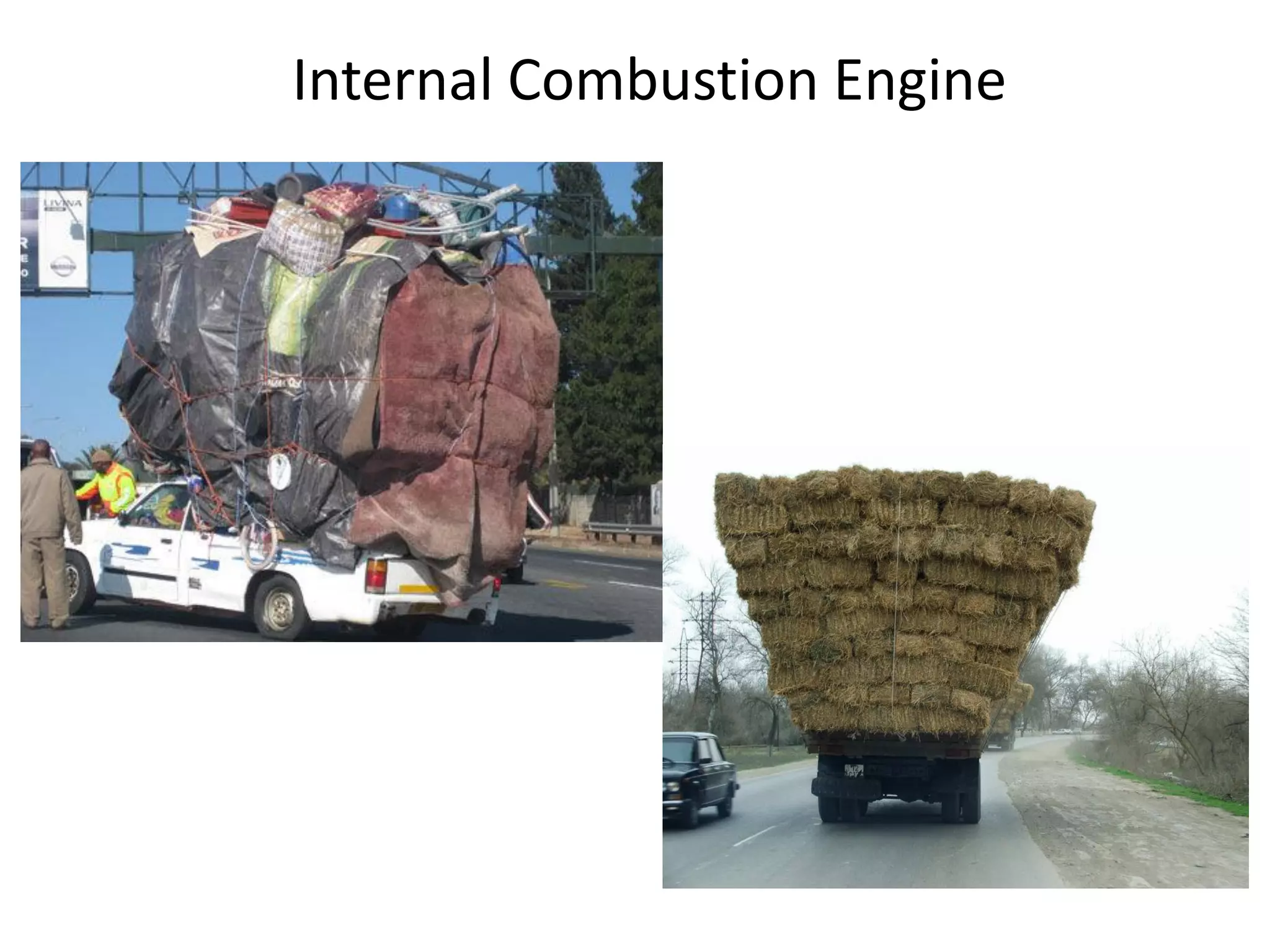
Incremental Increase Approach
        Has Its Limits
Internal Combustion Engine
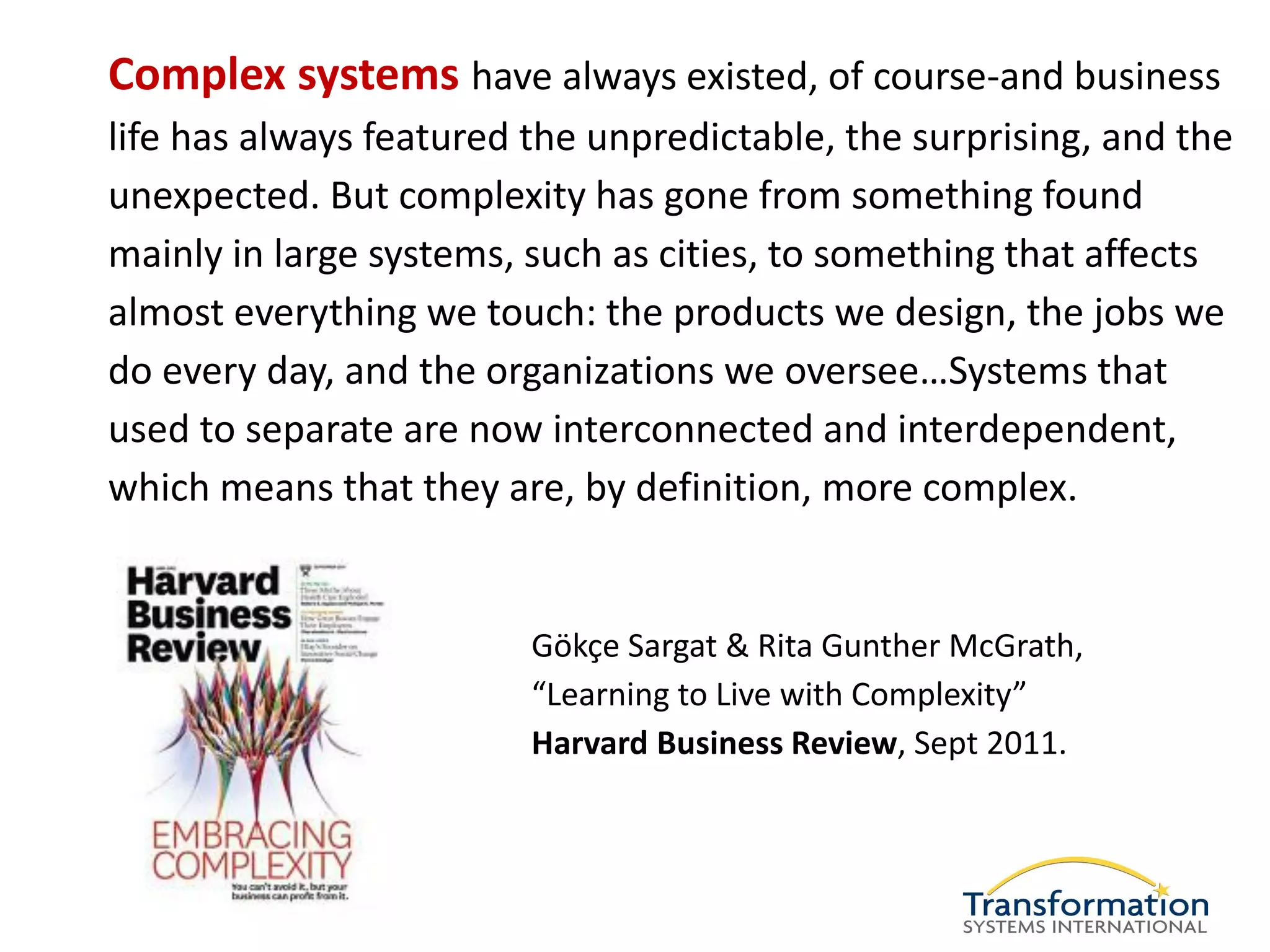
Complex systems have always existed, of course-and business
life has always featured the unpredictable, the surprising, and the
unexpected. But complexity has gone from something found
mainly in large systems, such as cities, to something that affects
almost everything we touch: the products we design, the jobs we
do every day, and the organizations we oversee…Systems that
used to separate are now interconnected and interdependent,
which means that they are, by definition, more complex.


                         Gökçe Sargat & Rita Gunther McGrath,
                         “Learning to Live with Complexity”
                         Harvard Business Review, Sept 2011.
From complicated (many moving part but operate in
patterned ways) to complex (interactions that are
continually changing). Complicated systems can be
seen in the electrical grid that powers a community or
flying a commercial aircraft. Six Sigma process and
traditional quality tools can be applied.

Complex environments have three elements:
Multiplicity – number of potentially interacting elements.
Interdependence – relates to extent elements are connected.
Diversity – the degree of their heterogeneity.
The Transforming
  Environment
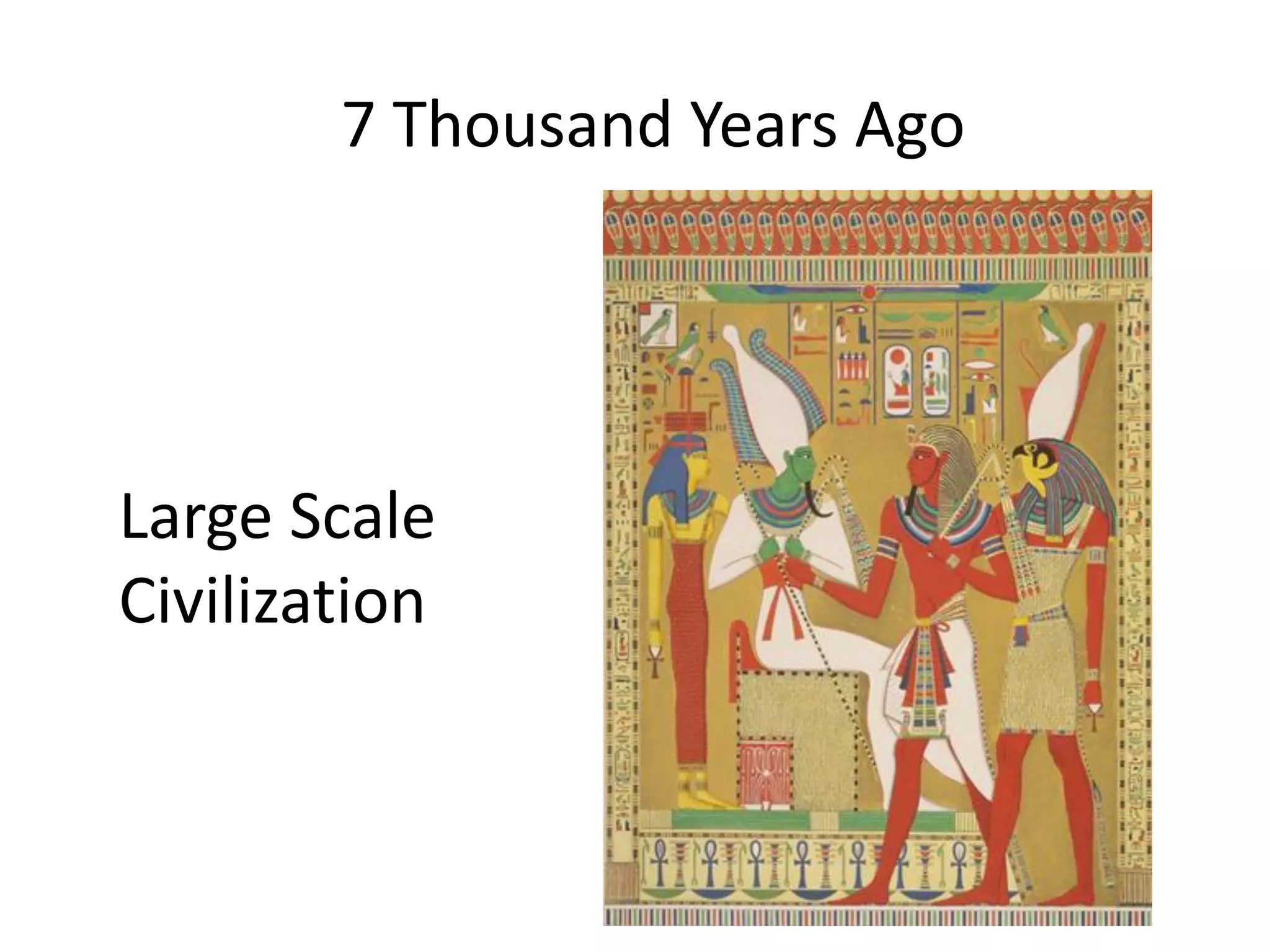
7 Thousand Years Ago


Large Scale
Civilization
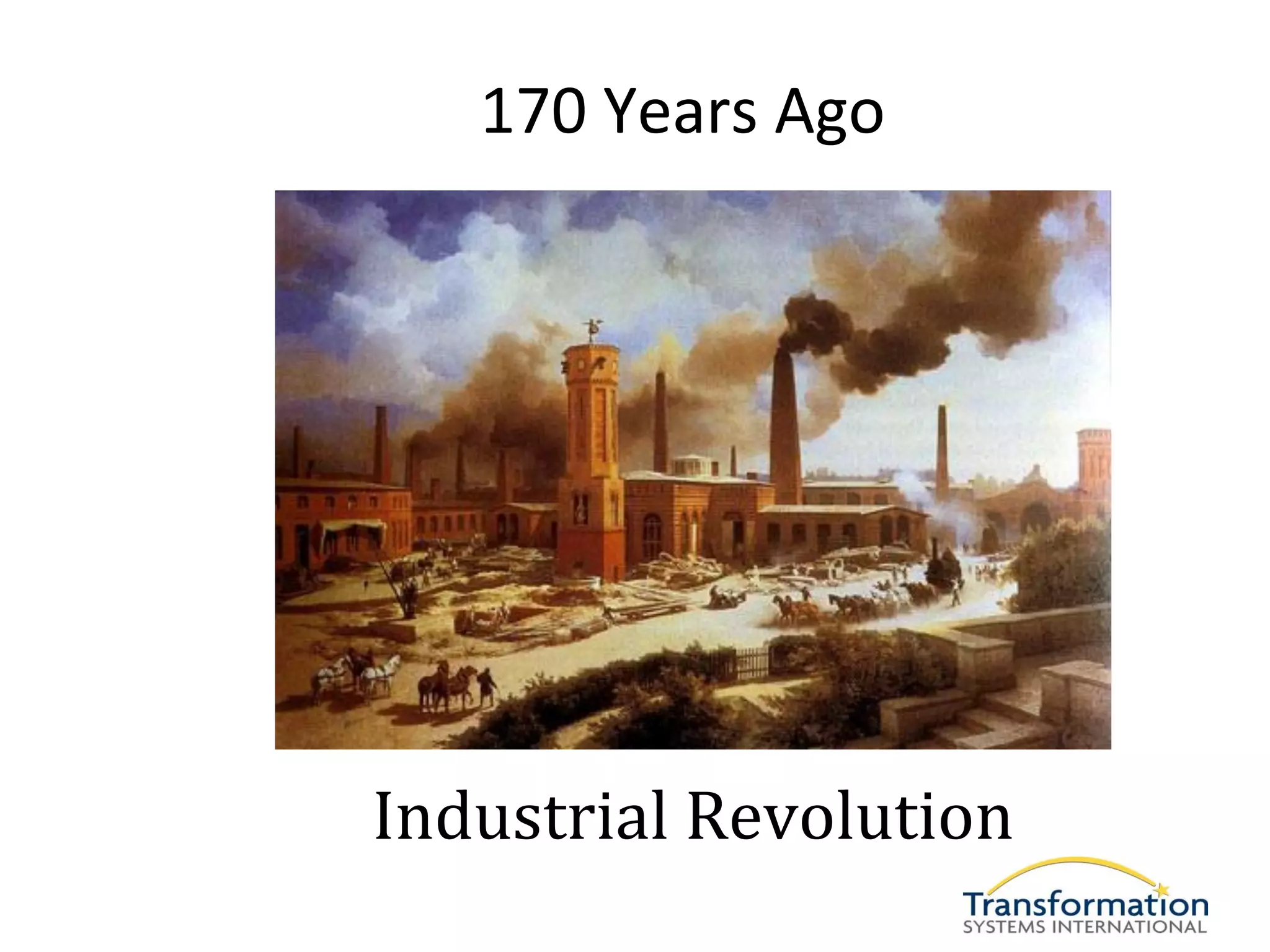
170 Years Ago


Industrial Revolution
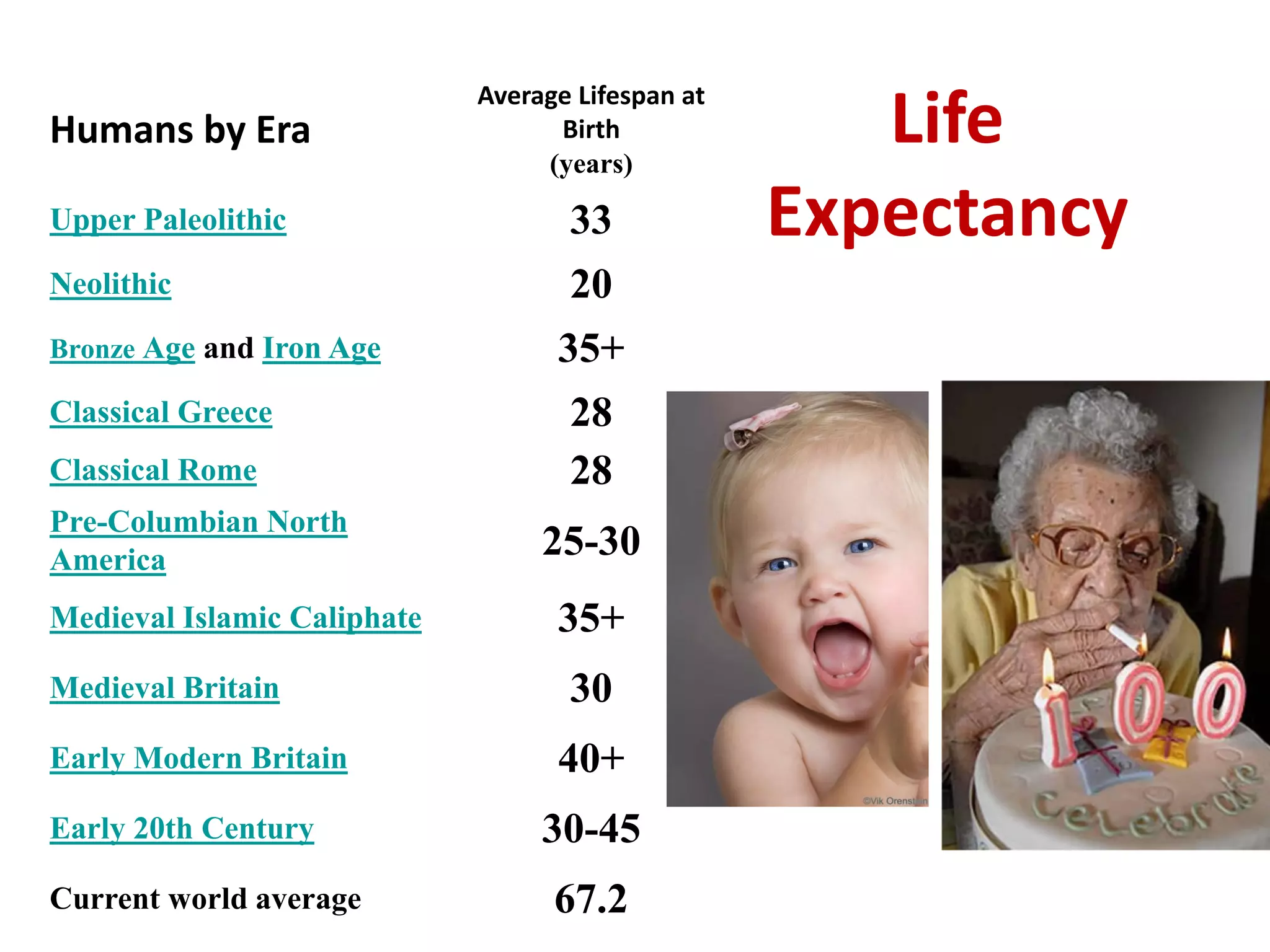
Average Lifespan at
Humans by Era                      Birth
                                  (years)
                                                      Life
Upper Paleolithic                   33             Expectancy
Neolithic                           20
Bronze Age and Iron Age            35+
Classical Greece                    28
Classical Rome                      28
Pre-Columbian North
America                           25-30
Medieval Islamic Caliphate         35+
Medieval Britain                    30
Early Modern Britain               40+
Early 20th Century                30-45
Current world average              67.2
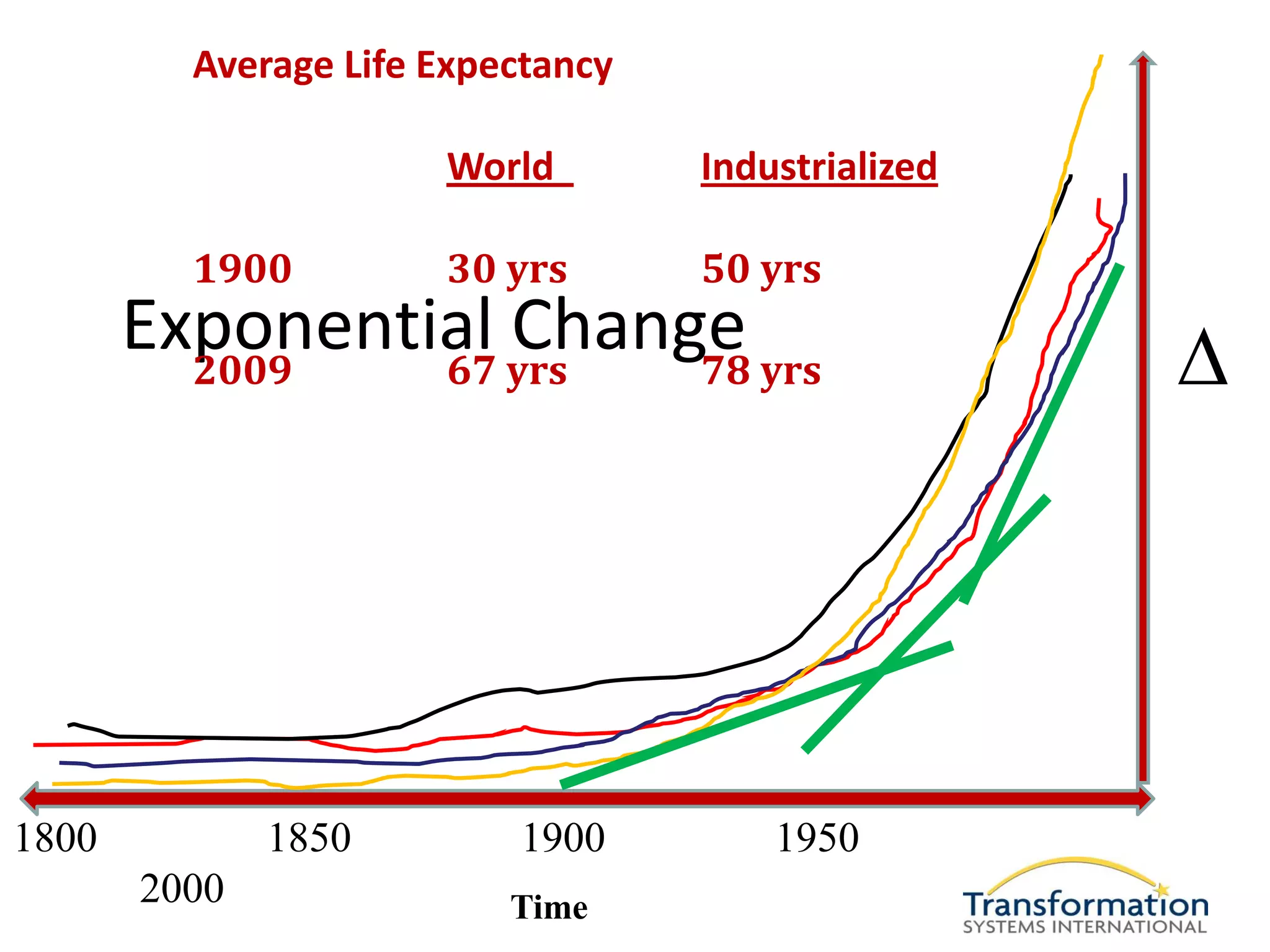
Average Life Expectancy

                      World        Industrialized

         1900         30 yrs       50 yrs
       Exponential yrs
         2009   67
                   Change yrs
                        78                          ∆


1800          1850        1900         1950
       2000               Time
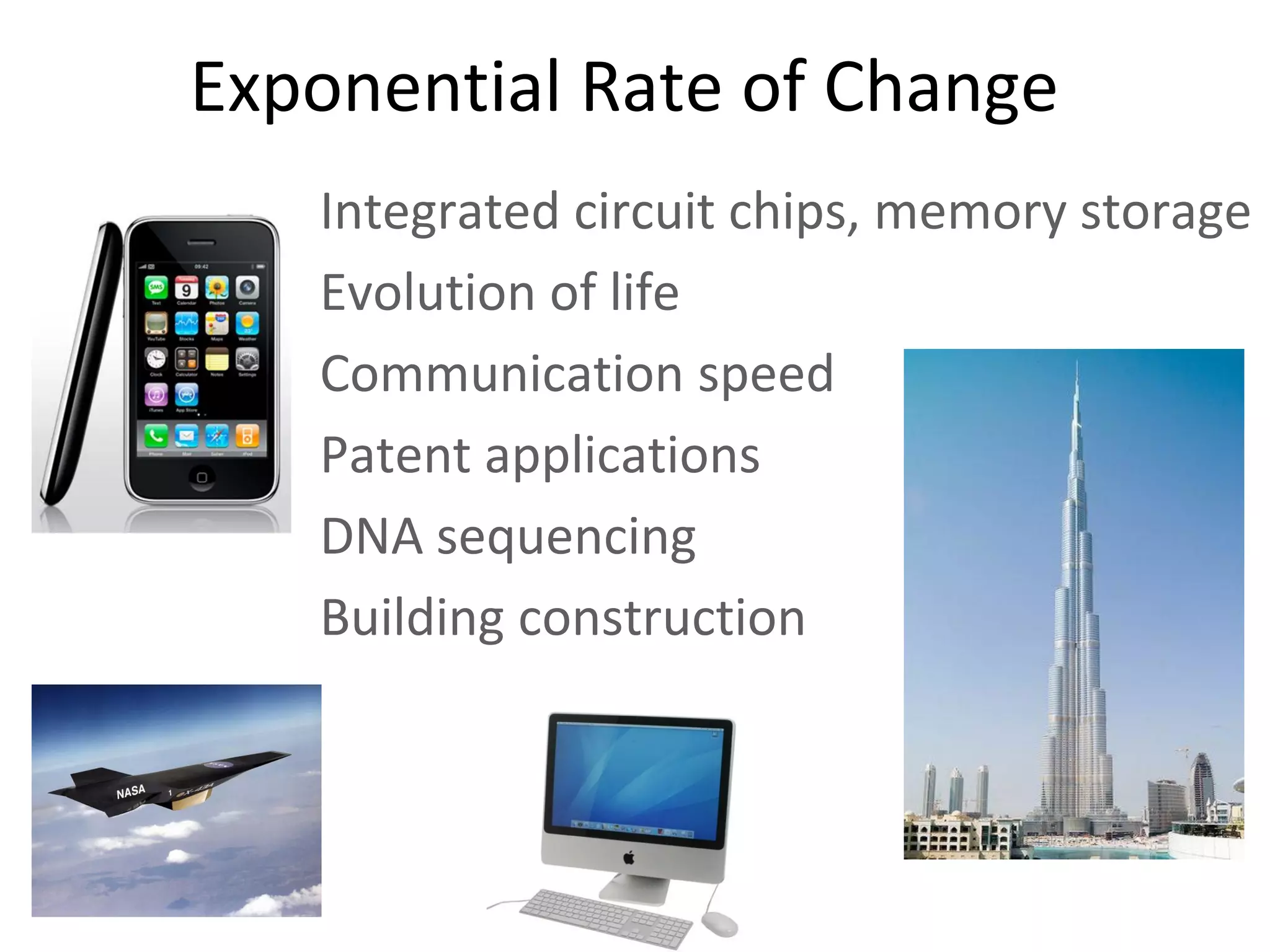
Exponential Rate of Change
   Integrated circuit chips, memory storage
   Evolution of life
   Communication speed
   Patent applications
   DNA sequencing
   Building construction
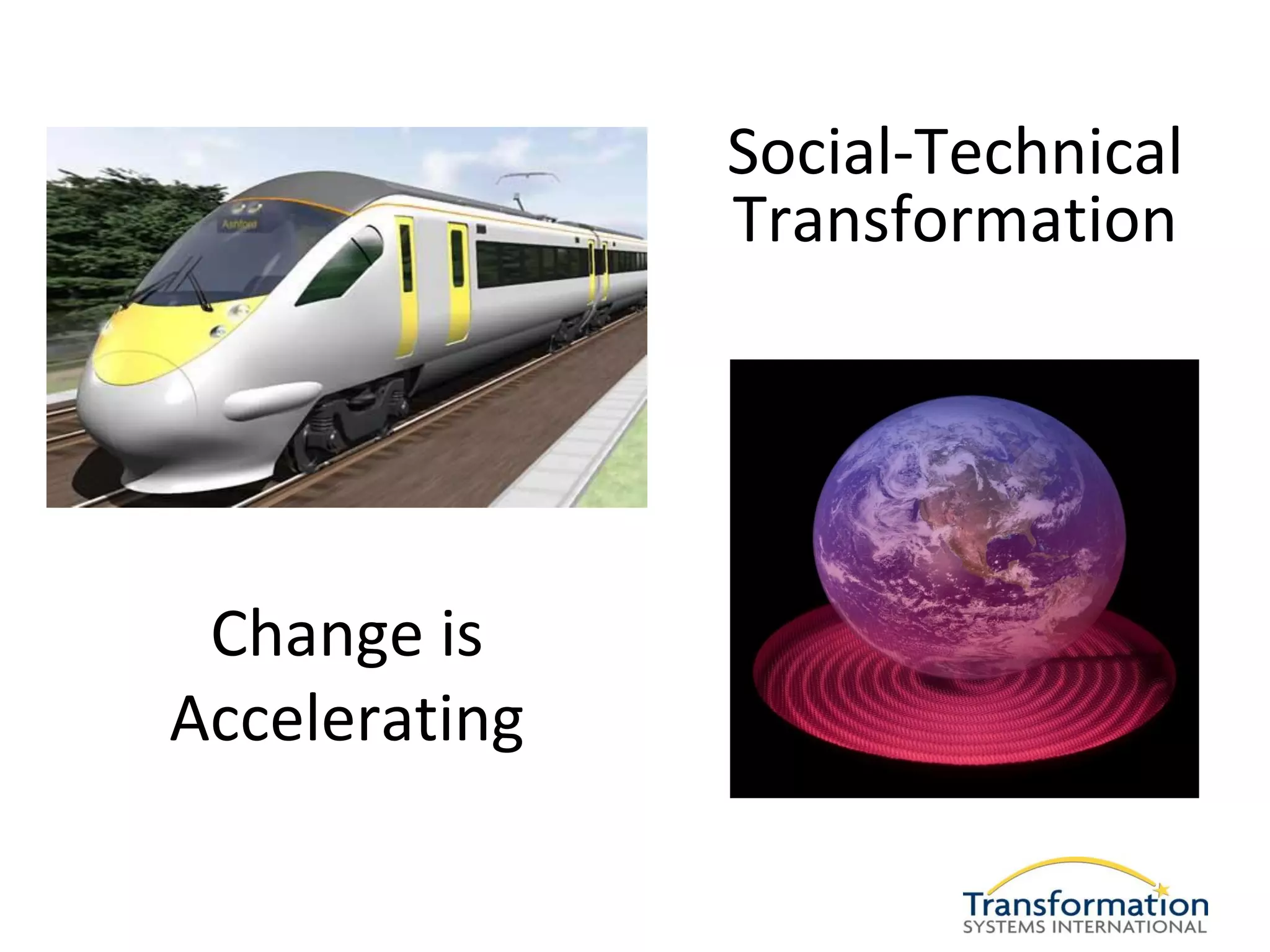
Social-Technical
               Transformation


 Change is
Accelerating
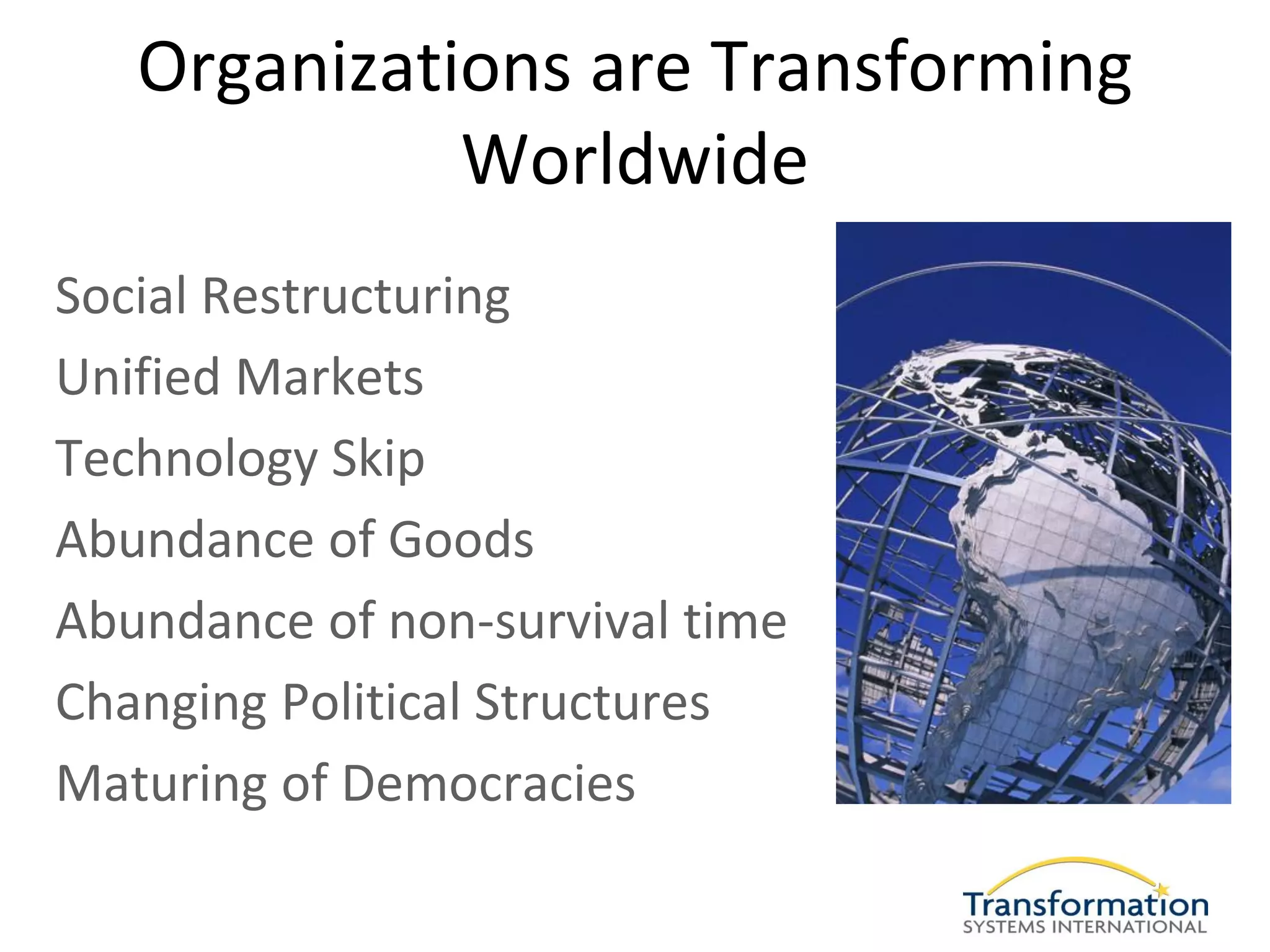
Organizations are Transforming
             Worldwide
Social Restructuring
Unified Markets
Technology Skip
Abundance of Goods
Abundance of non-survival time
Changing Political Structures
Maturing of Democracies
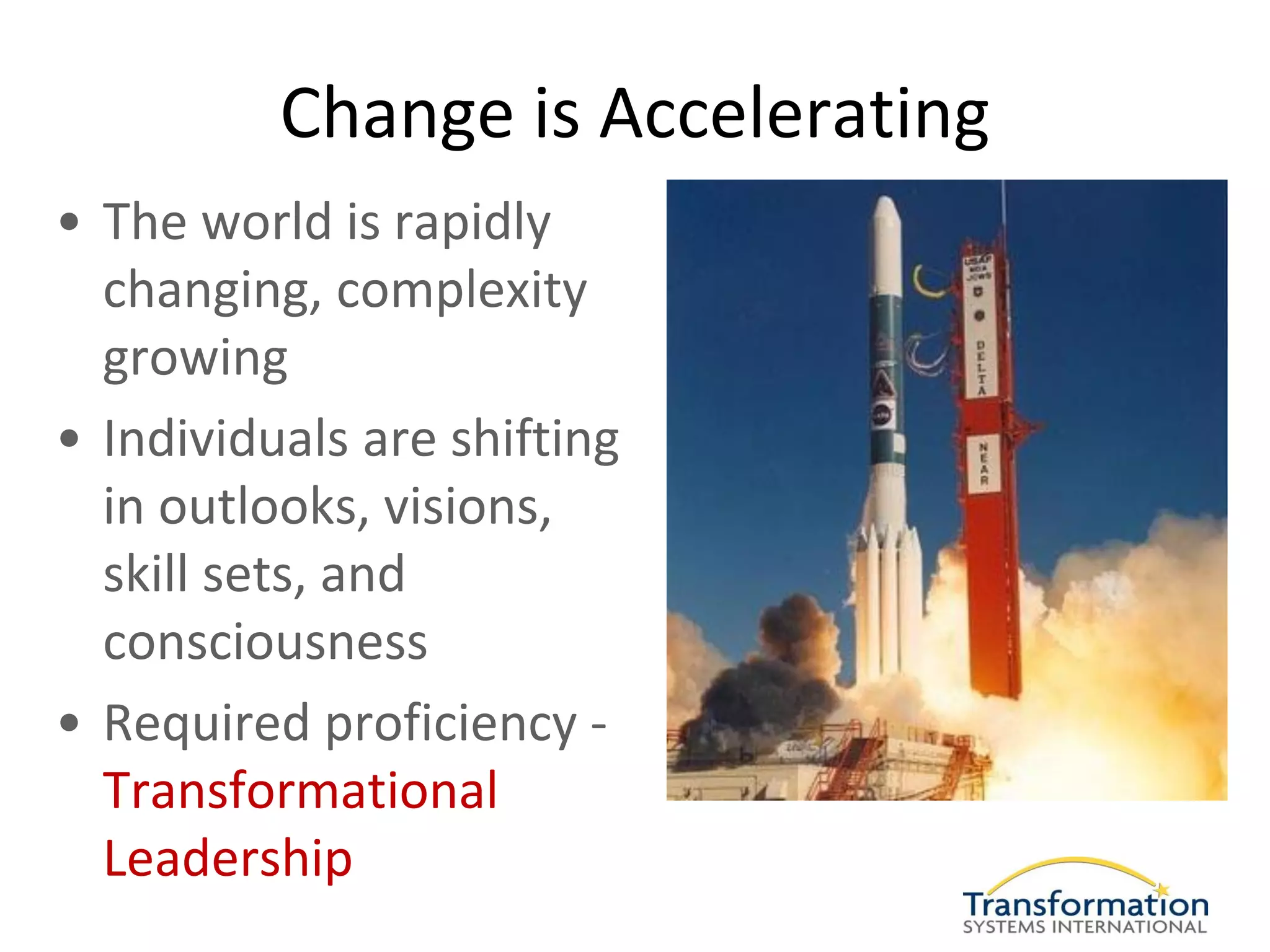
Change is Accelerating
• The world is rapidly
  changing, complexity
  growing
• Individuals are shifting
  in outlooks, visions,
  skill sets, and
  consciousness
• Required proficiency -
  Transformational
  Leadership
Social-Technical
Change is
Accelerating
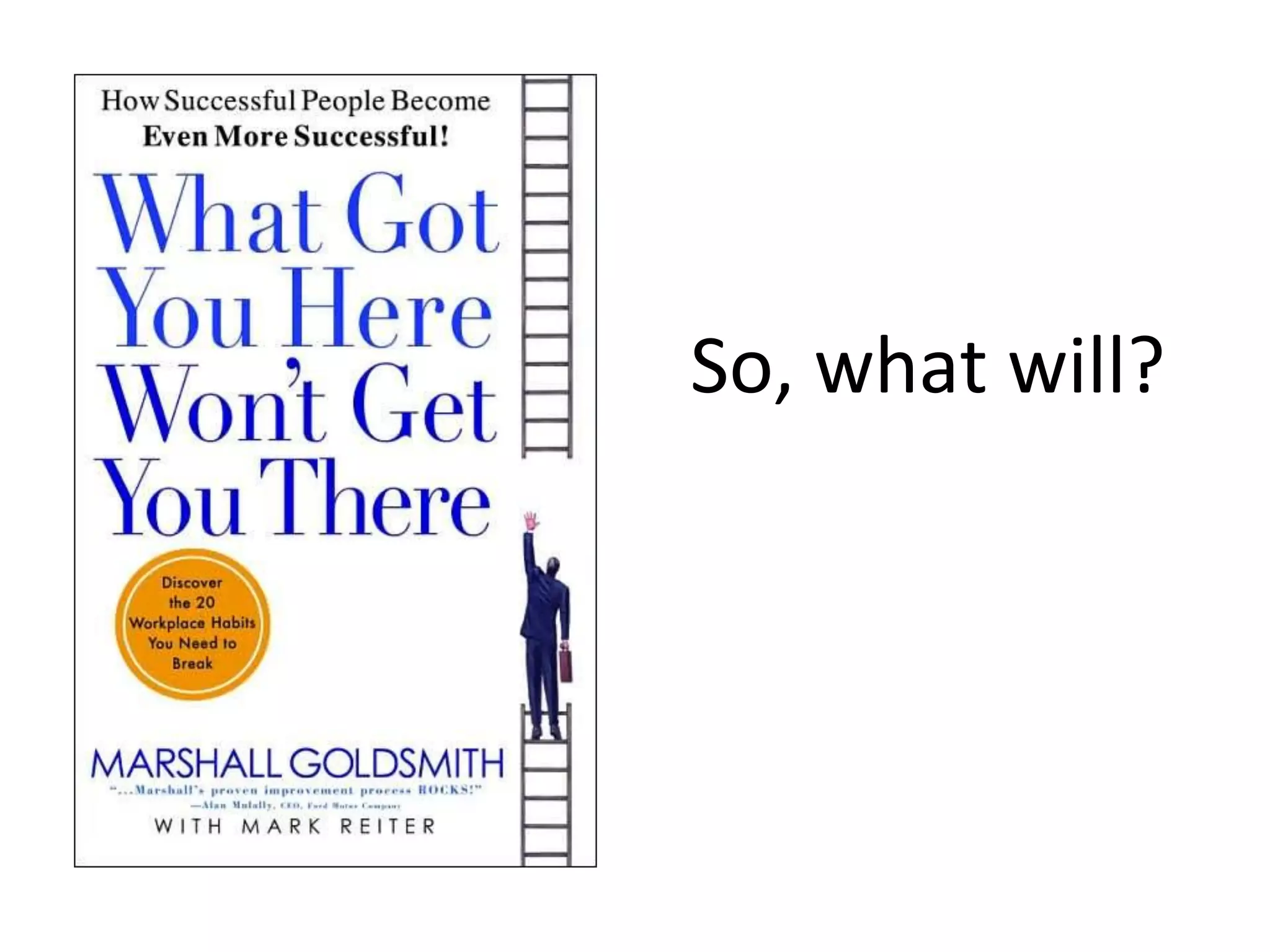
So, what will?
The Five Critical Elements
Cast a Transformative Vision

• Not incremental but transcends current
  state
• Full in expression and time targeted
• A measurable destination
• Has the taste and feel of a creation
  worthy of your life’s energy
• In alignment with individual purposes
Expose the Burning Platform

• Answer the question, ‘Why do anything?’
• Paint realistic scenarios of non-action
• Recognize individuals have varying
  intensities given their situations
• Leadership can present update
  performance consequences
• Do not manufacture false burning
  platforms
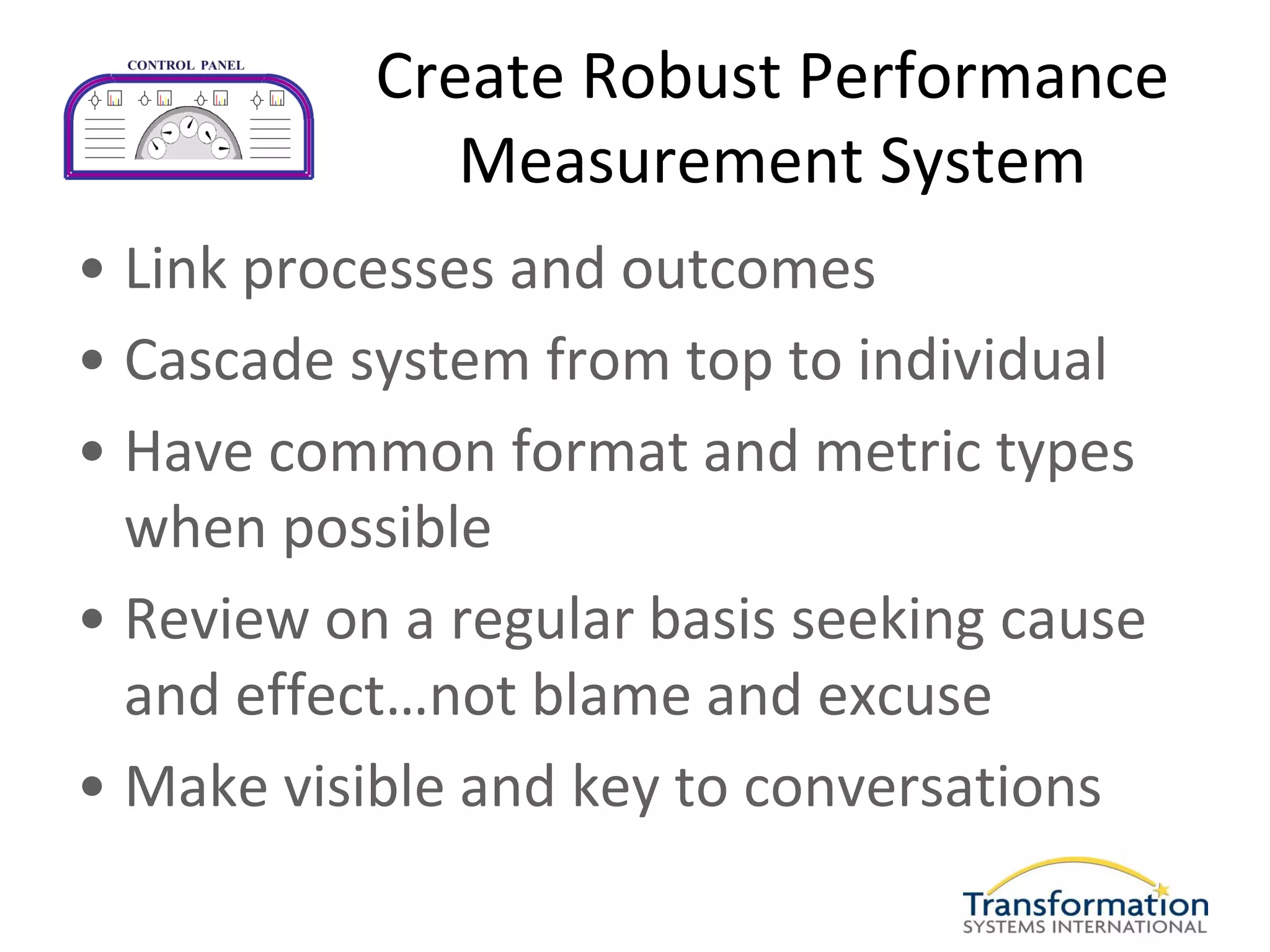
Create Robust Performance
              Measurement System
• Link processes and outcomes
• Cascade system from top to individual
• Have common format and metric types
  when possible
• Review on a regular basis seeking cause
  and effect…not blame and excuse
• Make visible and key to conversations
Address Culture Directly

• Results are where they are based upon
  culture
• Leadership has formed a culture
  requiring coaching
• Work mindsets. Of the performance
  mindsets, intentional creation is most
  important to establish
• Engage the person
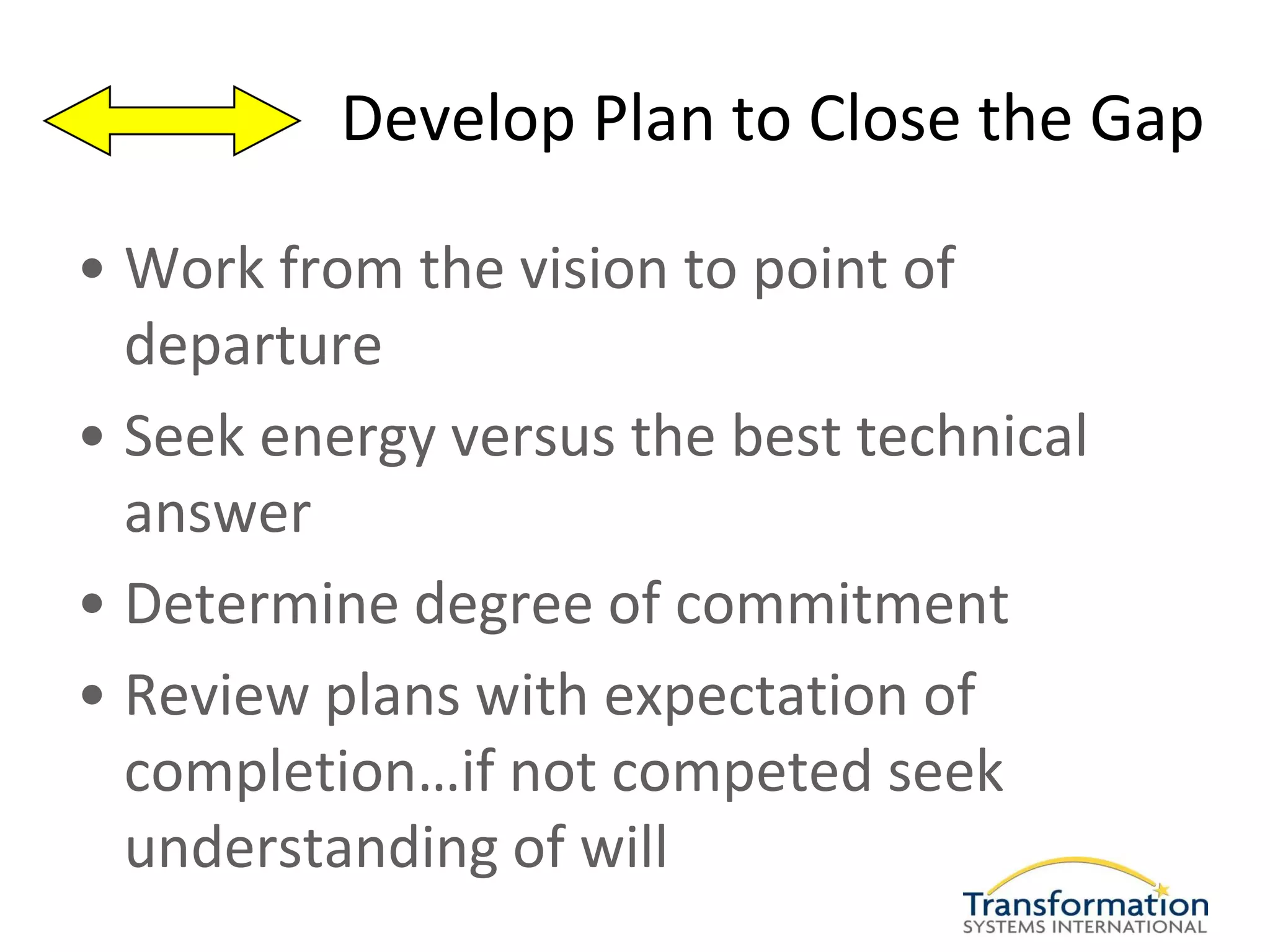
Develop Plan to Close the Gap

• Work from the vision to point of
  departure
• Seek energy versus the best technical
  answer
• Determine degree of commitment
• Review plans with expectation of
  completion…if not competed seek
  understanding of will
Transformational Design
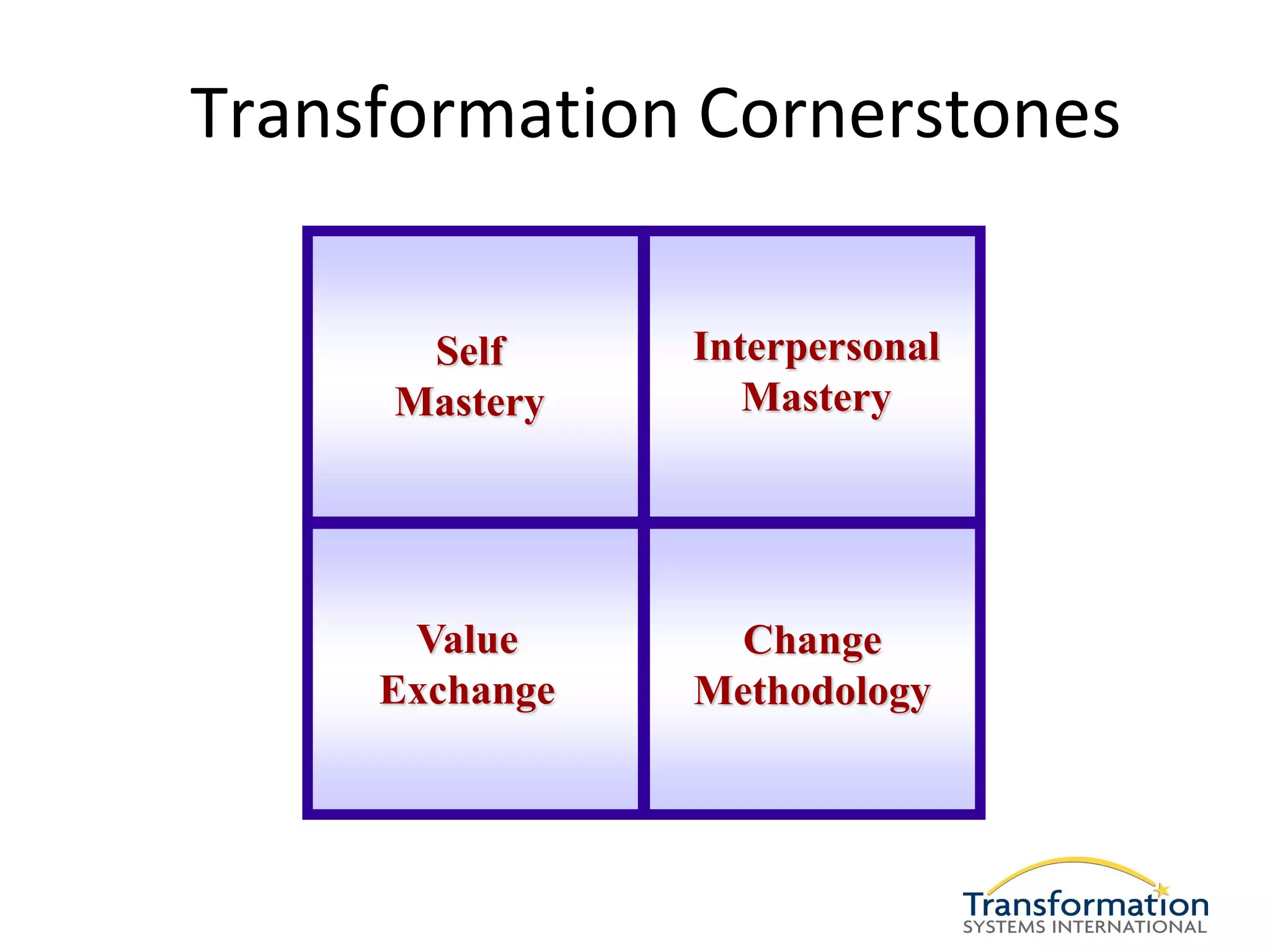
Transformation Cornerstones

      Self      Interpersonal
     Mastery       Mastery


      Value       Change
     Exchange   Methodology
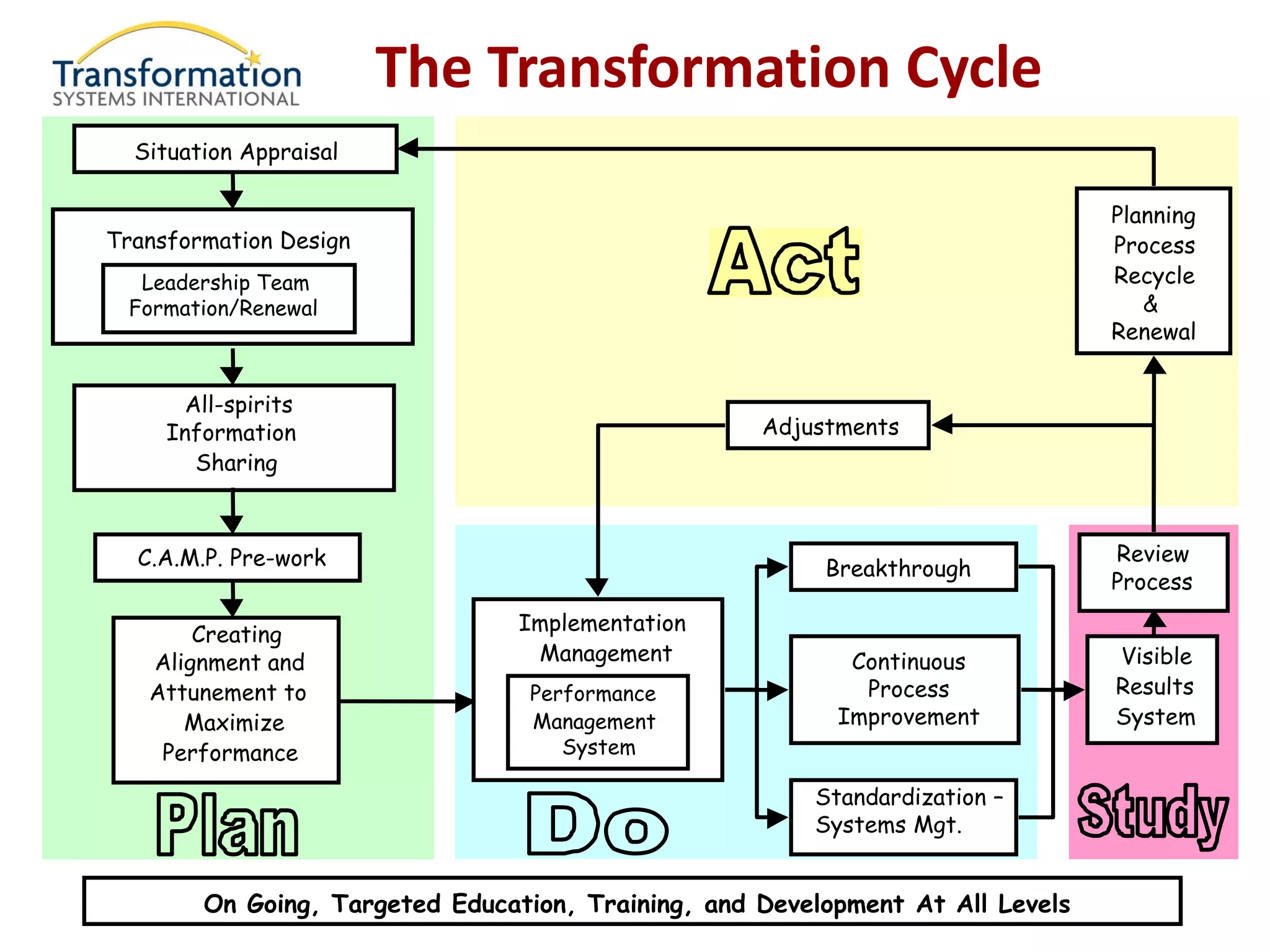
The Transformation Cycle
  Situation Appraisal

                                                                                Planning
Transformation Design                                                           Process
  Leadership Team                                                               Recycle
 Formation/Renewal                                                                 &
                                                                                Renewal


      All-spirits
     Information                                    Adjustments
       Sharing


  C.A.M.P. Pre-work                                                             Review
                                                         Breakthrough
                                                                                Process
                                 Implementation
       Creating
   Alignment and                  Management               Continuous           Visible
   Attunement to                 Performance                Process             Results
      Maximize                   Management               Improvement           System
    Performance                     System

                                                        Standardization –
                                                        Systems Mgt.


        On Going, Targeted Education, Training, and Development At All Levels
hackers@tsi4results.com


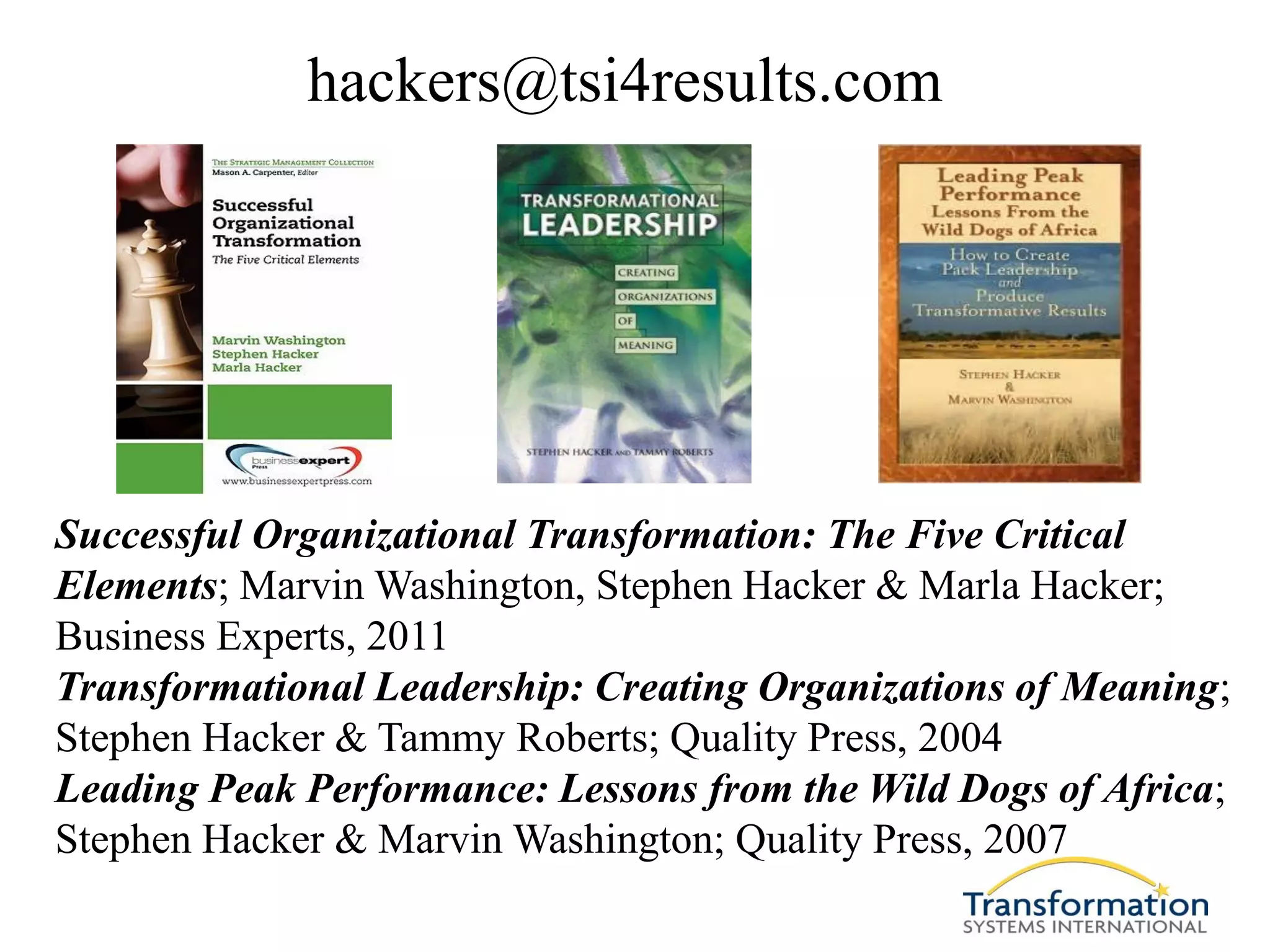
Successful Organizational Transformation: The Five Critical
Elements; Marvin Washington, Stephen Hacker & Marla Hacker;
Business Experts, 2011
Transformational Leadership: Creating Organizations of Meaning;
Stephen Hacker & Tammy Roberts; Quality Press, 2004
Leading Peak Performance: Lessons from the Wild Dogs of Africa;
Stephen Hacker & Marvin Washington; Quality Press, 2007
What is you Program of the Month?
“Process Improvement within a Wicked Problem Environment” by Stephen Hacker (Chair, ASQ Global)

“Process Improvement within a Wicked Problem Environment” by Stephen Hacker (Chair, ASQ Global)

  • 1.
    Process Improvement withina Wicked Problem Environment Stephen Hacker
  • 7.
    Getting to theRoot of the Problem
  • 8.
  • 9.
    Wicked Problems • Stakeholdershave radically different world views and different frames. • Constraints and resources change over time. • Problem is never solved definitively. • Every problem is essentially novel and unique. • Economic, environmental, political problems…requiring many to change mindsets and behaviors.
  • 10.
    Wicked Problems • Theproblem is not fully understood until after a solution has been successfully employed – full problem definition lacking. • The problem has no stopping rule. • Solutions are not right or wrong; think better or worse. • Every wicked problem can be considered to be a symptom of another problem.
  • 11.
    Consider • What arethe ‘roots’ of your organizational issues? • What process are you using to transform your operation? • Where have you initiated transformation in self lately?
  • 12.
    We are taughtto look at the ROOT of the Problem
  • 13.
    Strategies for OrganizationalWork Incremental Standardization Improvement Transformation R R R E E E S S S U U U L L L T T T S S S TIME TIME TIME
  • 14.
    What is Transformation? The marked change in the nature or function of organizational systems creating discontinuous, step-function improvement in sought after result areas.
  • 15.
  • 16.
  • 17.
  • 18.
  • 19.
    Complex systems havealways existed, of course-and business life has always featured the unpredictable, the surprising, and the unexpected. But complexity has gone from something found mainly in large systems, such as cities, to something that affects almost everything we touch: the products we design, the jobs we do every day, and the organizations we oversee…Systems that used to separate are now interconnected and interdependent, which means that they are, by definition, more complex. Gökçe Sargat & Rita Gunther McGrath, “Learning to Live with Complexity” Harvard Business Review, Sept 2011.
  • 20.
    From complicated (manymoving part but operate in patterned ways) to complex (interactions that are continually changing). Complicated systems can be seen in the electrical grid that powers a community or flying a commercial aircraft. Six Sigma process and traditional quality tools can be applied. Complex environments have three elements: Multiplicity – number of potentially interacting elements. Interdependence – relates to extent elements are connected. Diversity – the degree of their heterogeneity.
  • 21.
    The Transforming Environment
  • 22.
    7 Thousand YearsAgo Large Scale Civilization
  • 23.
  • 25.
    Average Lifespan at Humansby Era Birth (years) Life Upper Paleolithic 33 Expectancy Neolithic 20 Bronze Age and Iron Age 35+ Classical Greece 28 Classical Rome 28 Pre-Columbian North America 25-30 Medieval Islamic Caliphate 35+ Medieval Britain 30 Early Modern Britain 40+ Early 20th Century 30-45 Current world average 67.2
  • 26.
    Average Life Expectancy World Industrialized 1900 30 yrs 50 yrs Exponential yrs 2009 67 Change yrs 78 ∆ 1800 1850 1900 1950 2000 Time
  • 27.
    Exponential Rate ofChange Integrated circuit chips, memory storage Evolution of life Communication speed Patent applications DNA sequencing Building construction
  • 28.
    Social-Technical Transformation Change is Accelerating
  • 29.
    Organizations are Transforming Worldwide Social Restructuring Unified Markets Technology Skip Abundance of Goods Abundance of non-survival time Changing Political Structures Maturing of Democracies
  • 30.
    Change is Accelerating •The world is rapidly changing, complexity growing • Individuals are shifting in outlooks, visions, skill sets, and consciousness • Required proficiency - Transformational Leadership
  • 31.
  • 32.
  • 33.
  • 34.
    Cast a TransformativeVision • Not incremental but transcends current state • Full in expression and time targeted • A measurable destination • Has the taste and feel of a creation worthy of your life’s energy • In alignment with individual purposes
  • 35.
    Expose the BurningPlatform • Answer the question, ‘Why do anything?’ • Paint realistic scenarios of non-action • Recognize individuals have varying intensities given their situations • Leadership can present update performance consequences • Do not manufacture false burning platforms
  • 36.
    Create Robust Performance Measurement System • Link processes and outcomes • Cascade system from top to individual • Have common format and metric types when possible • Review on a regular basis seeking cause and effect…not blame and excuse • Make visible and key to conversations
  • 37.
    Address Culture Directly •Results are where they are based upon culture • Leadership has formed a culture requiring coaching • Work mindsets. Of the performance mindsets, intentional creation is most important to establish • Engage the person
  • 38.
    Develop Plan toClose the Gap • Work from the vision to point of departure • Seek energy versus the best technical answer • Determine degree of commitment • Review plans with expectation of completion…if not competed seek understanding of will
  • 39.
  • 40.
    Transformation Cornerstones Self Interpersonal Mastery Mastery Value Change Exchange Methodology
  • 41.
    The Transformation Cycle Situation Appraisal Planning Transformation Design Process Leadership Team Recycle Formation/Renewal & Renewal All-spirits Information Adjustments Sharing C.A.M.P. Pre-work Review Breakthrough Process Implementation Creating Alignment and Management Continuous Visible Attunement to Performance Process Results Maximize Management Improvement System Performance System Standardization – Systems Mgt. On Going, Targeted Education, Training, and Development At All Levels
  • 42.
    hackers@tsi4results.com Successful Organizational Transformation:The Five Critical Elements; Marvin Washington, Stephen Hacker & Marla Hacker; Business Experts, 2011 Transformational Leadership: Creating Organizations of Meaning; Stephen Hacker & Tammy Roberts; Quality Press, 2004 Leading Peak Performance: Lessons from the Wild Dogs of Africa; Stephen Hacker & Marvin Washington; Quality Press, 2007
  • 43.
    What is youProgram of the Month?