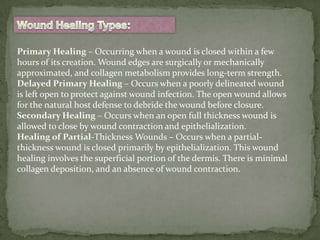
Occurring when a wound is closed within a few
hours of its creation. Wound edges are surgically or mechanically
approximated, and collagen metabolism provides long-term strength.
                                Occurs when a poorly delineated wound
is left open to protect against wound infection. The open wound allows
for the natural host defense to debride the wound before closure.
                         Occurs when an open full thickness wound is
allowed to close by wound contraction and epithelialization.
                      Thickness Wounds – Occurs when a partial-
thickness wound is closed primarily by epithelialization. This wound
healing involves the superficial portion of the dermis. There is minimal
collagen deposition, and an absence of wound contraction.
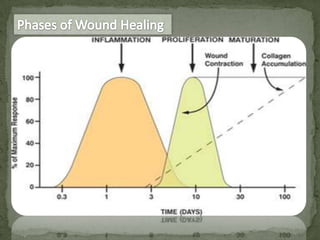
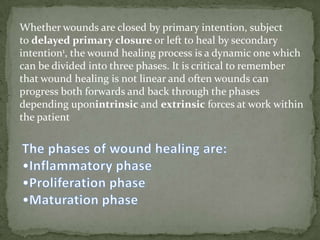
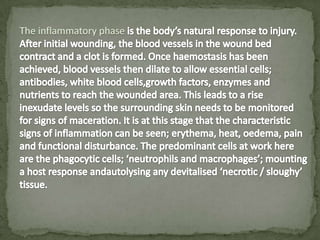
Whether wounds are closed by primary intention, subject
to delayed primary closure or left to heal by secondary
intention1, the wound healing process is a dynamic one which
can be divided into three phases. It is critical to remember
that wound healing is not linear and often wounds can
progress both forwards and back through the phases
depending uponintrinsic and extrinsic forces at work within
the patient
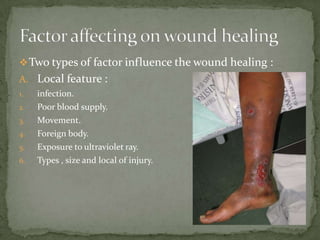
 Two types of factor influence the wound healing :
A. Local feature :
1.   infection.
2.   Poor blood supply.
3.   Movement.
4.   Foreign body.
5.   Exposure to ultraviolet ray.
6.   Types , size and local of injury.
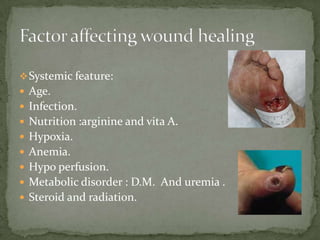
 Systemic feature:
 Age.
 Infection.
 Nutrition :arginine and vita A.
 Hypoxia.
 Anemia.
 Hypo perfusion.
 Metabolic disorder : D.M. And uremia .
 Steroid and radiation.
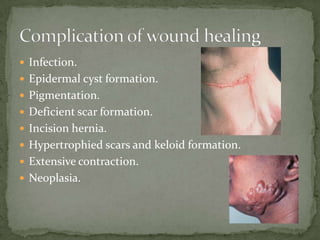
 Infection.
 Epidermal cyst formation.
 Pigmentation.
 Deficient scar formation.
 Incision hernia.
 Hypertrophied scars and keloid formation.
 Extensive contraction.
 Neoplasia.
Growth factor                 Abbreviation   Main origin        Effects
Epidermal growth factor       EGF            •Macrophages.      Granulation
                                             •Salivary gland.   tissue formation.
                                             •Keratinocytes.
Transforming growth           TGF-α                             •Hepatocyte and
factor-α                                                        epithelial cell
                                                                proliferation.
                                             •Activated
                                                                •Expression of
                                             macrophages
                                                                antimicrobial
                                             •T-lymphocytes
                                                                peptides.
                                             •Keratinocytes
                                                                •Expression of
                                                                chemotactic
                                                                cytokines.
Hepatocyte growth factor      HGF            Mesenchymal        Epithelial
                                             cells              and endothelial
                                                                cell proliferation
                                                                Hepatocyte
                                                                motility

Vascular endothelial growth   VEGF           Mesenchymal        Vascular
factor                                       cells              permeability
                                                                Endothelial cell
                                                                proliferation
Platelet derived growth      PDGF                            Granulocyte,
factor                                                       macrophage,
                                                             fibroblast and
                                                             smooth muscle
                                         •Platelets          cell chemotaxis
                                         •Macrophages        Granulocyte,
                                         •Endothelial        macrophage and
                                         cells               fibroblast
                                         •Smooth muscle      activation
                                         cells               Fibroblast,
                                         •Keratinocytes      endothelial cell
                                                             and smooth
                                                             muscle cell


Fibroblast growth factor 1   FGF-1, -2   Macrophages         Fibroblast
and 2                                    Mast cells          chemotaxis
                                         T-lymphocytes       Fibroblast and
                                         Endothelial cells   keratinocyte
                                         Fibroblasts         proliferation
                                                             Keratinocyte
                                                             migration
                                                             Angiogenesis
Wound healing

Wound healing

  • 2.
    Occurring when awound is closed within a few hours of its creation. Wound edges are surgically or mechanically approximated, and collagen metabolism provides long-term strength. Occurs when a poorly delineated wound is left open to protect against wound infection. The open wound allows for the natural host defense to debride the wound before closure. Occurs when an open full thickness wound is allowed to close by wound contraction and epithelialization. Thickness Wounds – Occurs when a partial- thickness wound is closed primarily by epithelialization. This wound healing involves the superficial portion of the dermis. There is minimal collagen deposition, and an absence of wound contraction.
  • 4.
    Whether wounds areclosed by primary intention, subject to delayed primary closure or left to heal by secondary intention1, the wound healing process is a dynamic one which can be divided into three phases. It is critical to remember that wound healing is not linear and often wounds can progress both forwards and back through the phases depending uponintrinsic and extrinsic forces at work within the patient
  • 8.
     Two typesof factor influence the wound healing : A. Local feature : 1. infection. 2. Poor blood supply. 3. Movement. 4. Foreign body. 5. Exposure to ultraviolet ray. 6. Types , size and local of injury.
  • 9.
     Systemic feature: Age.  Infection.  Nutrition :arginine and vita A.  Hypoxia.  Anemia.  Hypo perfusion.  Metabolic disorder : D.M. And uremia .  Steroid and radiation.
  • 10.
     Infection.  Epidermalcyst formation.  Pigmentation.  Deficient scar formation.  Incision hernia.  Hypertrophied scars and keloid formation.  Extensive contraction.  Neoplasia.
  • 14.
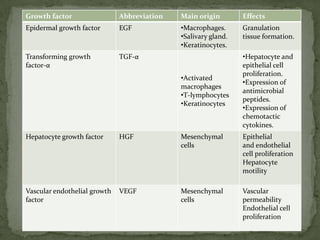
    Growth factor Abbreviation Main origin Effects Epidermal growth factor EGF •Macrophages. Granulation •Salivary gland. tissue formation. •Keratinocytes. Transforming growth TGF-α •Hepatocyte and factor-α epithelial cell proliferation. •Activated •Expression of macrophages antimicrobial •T-lymphocytes peptides. •Keratinocytes •Expression of chemotactic cytokines. Hepatocyte growth factor HGF Mesenchymal Epithelial cells and endothelial cell proliferation Hepatocyte motility Vascular endothelial growth VEGF Mesenchymal Vascular factor cells permeability Endothelial cell proliferation
  • 15.
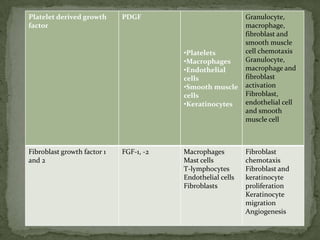
    Platelet derived growth PDGF Granulocyte, factor macrophage, fibroblast and smooth muscle •Platelets cell chemotaxis •Macrophages Granulocyte, •Endothelial macrophage and cells fibroblast •Smooth muscle activation cells Fibroblast, •Keratinocytes endothelial cell and smooth muscle cell Fibroblast growth factor 1 FGF-1, -2 Macrophages Fibroblast and 2 Mast cells chemotaxis T-lymphocytes Fibroblast and Endothelial cells keratinocyte Fibroblasts proliferation Keratinocyte migration Angiogenesis