
Introduction to BioMAP® Systems


           Bridging the Gap From In Vitro to In Vivo


1
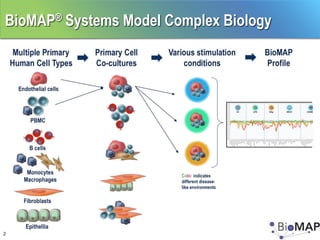
BioMAP® Systems Model Complex Biology


2
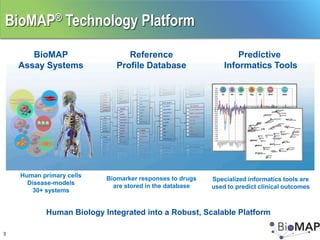
BioMAP® Technology Platform
       BioMAP                    Reference                        Predictive
    Assay Systems             Profile Database                Informatics Tools


    Human primary cells    Biomarker responses to drugs   Specialized informatics tools are
      Disease-models         are stored in the database   used to predict clinical outcomes
       30+ systems


            Human Biology Integrated into a Robust, Scalable Platform

3
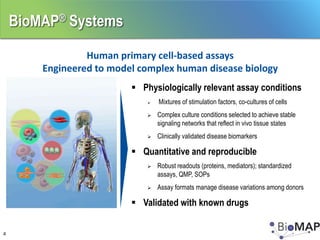
BioMAP® Systems

                 Human primary cell-based assays
        Engineered to model complex human disease biology
                           Physiologically relevant assay conditions
                                 Mixtures of stimulation factors, co-cultures of cells
                                 Complex culture conditions selected to achieve stable
                                  signaling networks that reflect in vivo tissue states
                                 Clinically validated disease biomarkers

                           Quantitative and reproducible
                                 Robust readouts (proteins, mediators); standardized
                                  assays, QMP, SOPs
                                 Assay formats manage disease variations among donors

                           Validated with known drugs


4
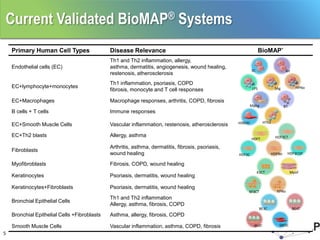
Current Validated BioMAP® Systems
    Primary Human Cell Types                  Disease Relevance                                                   BioMAP*
                                              Th1 and Th2 inflammation, allergy,
    Endothelial cells (EC)                    asthma, dermatitis, angiogenesis, wound healing,
                                                                                                            3C                   4H
                                              restenosis, atherosclerosis
                                              Th1 inflammation, psoriasis, COPD
    EC+lymphocyte+monocytes                                                                                 LPS            SAg          HPNo
                                              fibrosis, monocyte and T cell responses

    EC+Macrophages                            Macrophage responses, arthritis, COPD, fibrosis
                                                                                                        Mphg                     BT
    B cells + T cells                         Immune responses

                                                                                                    HSM3C           HTh2
    EC+Smooth Muscle Cells                    Vascular inflammation, restenosis, atherosclerosis

    EC+Th2 blasts                             Allergy, asthma                                                              HDF3CT
                                                                                                            HDFT

                                              Arthritis, asthma, dermatitis, fibrosis, psoriasis,
    Fibroblasts
                                              wound healing                                         HDF3C                HDFNo     HDF3CGF

    Myofibroblasts                            Fibrosis, COPD, wound healing
                                                                                                                 K3CT                 MyoF
    Keratinocytes                             Psoriasis, dermatitis, wound healing

    Keratinocytes+Fibroblasts                 Psoriasis, dermatitis, wound healing
                                                                                                        KF3CT               KFNo
                                              Th1 and Th2 inflammation
    Bronchial Epithelial Cells
                                              Allergy, asthma, fibrosis, COPD
                                                                                                                  BE3C                 BE4T
    Bronchial Epithelial Cells +Fibroblasts   Asthma, allergy, fibrosis, COPD

    Smooth Muscle Cells                       Vascular inflammation, asthma, COPD, fibrosis                  BF4T            SM3C

5
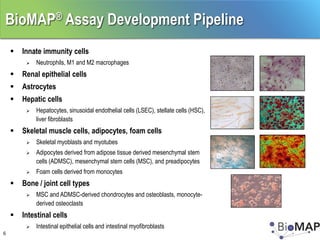
BioMAP® Assay Development Pipeline
       Innate immunity cells
            Neutrophils, M1 and M2 macrophages
       Renal epithelial cells
       Astrocytes
       Hepatic cells
            Hepatocytes, sinusoidal endothelial cells (LSEC), stellate cells (HSC),
             liver fibroblasts
       Skeletal muscle cells, adipocytes, foam cells
            Skeletal myoblasts and myotubes
            Adipocytes derived from adipose tissue derived mesenchymal stem
             cells (ADMSC), mesenchymal stem cells (MSC), and preadipocytes
            Foam cells derived from monocytes
       Bone / joint cell types
            MSC and ADMSC-derived chondrocytes and osteoblasts, monocyte-
             derived osteoclasts
       Intestinal cells
            Intestinal epithelial cells and intestinal myofibroblasts
6
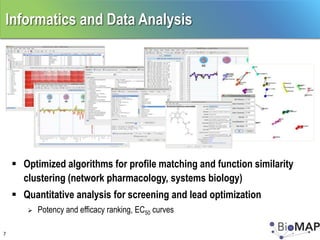
Informatics and Data Analysis


     Optimized algorithms for profile matching and function similarity
      clustering (network pharmacology, systems biology)
     Quantitative analysis for screening and lead optimization
          Potency and efficacy ranking, EC50 curves

7
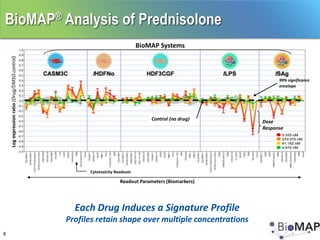
BioMAP® Analysis of Prednisolone
                                                                             BioMAP Systems
    Log expression ratio (Drug/DMSO control)


                                                                                                            99% significance
                                                                                                            envelope


                                                                                 Control (no drug)
                                                                                                      Dose
                                                                                                      Response


                                                     Cytotoxicity Readouts

                                                                    Readout Parameters (Biomarkers)


                                                 Each Drug Induces a Signature Profile
                                               Profiles retain shape over multiple concentrations
8
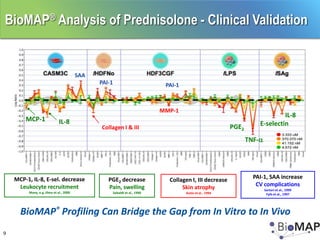
BioMAP® Analysis of Prednisolone - Clinical Validation


                                         SAA
                                               PAI-1                       PAI-1


                                                                          MMP-1
                                                                                                                            IL-8
        MCP-1                 IL-8
                                                                                                        PGE2       E-selectin
                                               Collagen I & III

                                                                                                               TNF-


    MCP-1, IL-8, E-sel. decrease                  PGE2 decrease             Collagen I, III decrease             PAI-1, SAA increase
     Leukocyte recruitment                        Pain, swelling                 Skin atrophy                     CV complications
                                                                                                                       Sartori et al., 1999
         Many, e.g. Jilma et al., 2000             Sebaldt et al., 1990            Autio et al., 1994                   Fyfe et al., 1997


      BioMAP® Profiling Can Bridge the Gap from In Vitro to In Vivo
9
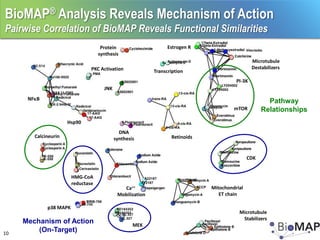
BioMAP® Analysis Reveals Mechanism of Action
Pairwise Correlation of BioMAP Reveals Functional Similarities
                                     Protein                      Estrogen R
                                    synthesis
                                                                                                 Microtubule
                                PKC Activation                                                   Destabilizers
                                                            Transcription
                                                                                         PI-3K
                                      JNK
      NFkB
                                                                                                       Pathway
                                                                                        mTOR         Relationships
                      Hsp90
                                              DNA
        Calcineurin                         synthesis              Retinoids


                                                                                               CDK


                        HMG-CoA
                        reductase
                                               Ca++                            Mitochondrial
                                             Mobilization                         ET chain

             p38 MAPK
                                                                                          Microtubule
                                                                                           Stabilizers
     Mechanism of Action                            MEK
10
         (On-Target)
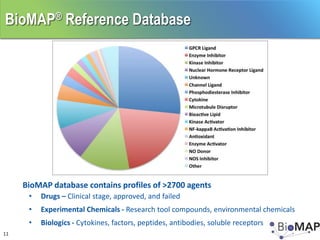
BioMAP® Reference Database


     BioMAP database contains profiles of >2700 agents
      •   Drugs – Clinical stage, approved, and failed
      •   Experimental Chemicals - Research tool compounds, environmental chemicals
      •   Biologics - Cytokines, factors, peptides, antibodies, soluble receptors
11
BioMAP® Applications

      Screening and lead optimization using primary cells
         Phenotypic screening and Indication Discovery
         Screening for second-generation drugs


      Biological annotation of compounds
         Target and compound validation in human cells
         Benchmarking to standard of care
         Safety assessment


      Translational biology
         Specialized assays, also with patient cells, patient classification
         Testing drug combinations
         Annotation for pharmacodynamic markers
12                                                                12
Contacts


                  Ellen Berg, PhD
                  General Manager
                  BioSeek, LLC
                  eberg@bioseekinc.com
                  650-416-7621
                                Bridging the Gap From In Vitro to In Vivo


BioSeek, LLC
310 Utah, #100
South San Francisco, CA 94080

Introduction to BioMAP<sup>®</sup> Systems

  • 1.
    Introduction to BioMAP®Systems Bridging the Gap From In Vitro to In Vivo 1
  • 2.
    BioMAP® Systems ModelComplex Biology 2
  • 3.
    BioMAP® Technology Platform BioMAP Reference Predictive Assay Systems Profile Database Informatics Tools Human primary cells Biomarker responses to drugs Specialized informatics tools are Disease-models are stored in the database used to predict clinical outcomes 30+ systems Human Biology Integrated into a Robust, Scalable Platform 3
  • 4.
    BioMAP® Systems Human primary cell-based assays Engineered to model complex human disease biology  Physiologically relevant assay conditions  Mixtures of stimulation factors, co-cultures of cells  Complex culture conditions selected to achieve stable signaling networks that reflect in vivo tissue states  Clinically validated disease biomarkers  Quantitative and reproducible  Robust readouts (proteins, mediators); standardized assays, QMP, SOPs  Assay formats manage disease variations among donors  Validated with known drugs 4
  • 5.
    Current Validated BioMAP®Systems Primary Human Cell Types Disease Relevance BioMAP* Th1 and Th2 inflammation, allergy, Endothelial cells (EC) asthma, dermatitis, angiogenesis, wound healing, 3C 4H restenosis, atherosclerosis Th1 inflammation, psoriasis, COPD EC+lymphocyte+monocytes LPS SAg HPNo fibrosis, monocyte and T cell responses EC+Macrophages Macrophage responses, arthritis, COPD, fibrosis Mphg BT B cells + T cells Immune responses HSM3C HTh2 EC+Smooth Muscle Cells Vascular inflammation, restenosis, atherosclerosis EC+Th2 blasts Allergy, asthma HDF3CT HDFT Arthritis, asthma, dermatitis, fibrosis, psoriasis, Fibroblasts wound healing HDF3C HDFNo HDF3CGF Myofibroblasts Fibrosis, COPD, wound healing K3CT MyoF Keratinocytes Psoriasis, dermatitis, wound healing Keratinocytes+Fibroblasts Psoriasis, dermatitis, wound healing KF3CT KFNo Th1 and Th2 inflammation Bronchial Epithelial Cells Allergy, asthma, fibrosis, COPD BE3C BE4T Bronchial Epithelial Cells +Fibroblasts Asthma, allergy, fibrosis, COPD Smooth Muscle Cells Vascular inflammation, asthma, COPD, fibrosis BF4T SM3C 5
  • 6.
    BioMAP® Assay DevelopmentPipeline  Innate immunity cells  Neutrophils, M1 and M2 macrophages  Renal epithelial cells  Astrocytes  Hepatic cells  Hepatocytes, sinusoidal endothelial cells (LSEC), stellate cells (HSC), liver fibroblasts  Skeletal muscle cells, adipocytes, foam cells  Skeletal myoblasts and myotubes  Adipocytes derived from adipose tissue derived mesenchymal stem cells (ADMSC), mesenchymal stem cells (MSC), and preadipocytes  Foam cells derived from monocytes  Bone / joint cell types  MSC and ADMSC-derived chondrocytes and osteoblasts, monocyte- derived osteoclasts  Intestinal cells  Intestinal epithelial cells and intestinal myofibroblasts 6
  • 7.
    Informatics and DataAnalysis  Optimized algorithms for profile matching and function similarity clustering (network pharmacology, systems biology)  Quantitative analysis for screening and lead optimization  Potency and efficacy ranking, EC50 curves 7
  • 8.
    BioMAP® Analysis ofPrednisolone BioMAP Systems Log expression ratio (Drug/DMSO control) 99% significance envelope Control (no drug) Dose Response Cytotoxicity Readouts Readout Parameters (Biomarkers) Each Drug Induces a Signature Profile Profiles retain shape over multiple concentrations 8
  • 9.
    BioMAP® Analysis ofPrednisolone - Clinical Validation SAA PAI-1 PAI-1 MMP-1 IL-8 MCP-1 IL-8 PGE2 E-selectin Collagen I & III TNF- MCP-1, IL-8, E-sel. decrease PGE2 decrease Collagen I, III decrease PAI-1, SAA increase Leukocyte recruitment Pain, swelling Skin atrophy CV complications Sartori et al., 1999 Many, e.g. Jilma et al., 2000 Sebaldt et al., 1990 Autio et al., 1994 Fyfe et al., 1997 BioMAP® Profiling Can Bridge the Gap from In Vitro to In Vivo 9
  • 10.
    BioMAP® Analysis RevealsMechanism of Action Pairwise Correlation of BioMAP Reveals Functional Similarities Protein Estrogen R synthesis Microtubule PKC Activation Destabilizers Transcription PI-3K JNK NFkB Pathway mTOR Relationships Hsp90 DNA Calcineurin synthesis Retinoids CDK HMG-CoA reductase Ca++ Mitochondrial Mobilization ET chain p38 MAPK Microtubule Stabilizers Mechanism of Action MEK 10 (On-Target)
  • 11.
    BioMAP® Reference Database BioMAP database contains profiles of >2700 agents • Drugs – Clinical stage, approved, and failed • Experimental Chemicals - Research tool compounds, environmental chemicals • Biologics - Cytokines, factors, peptides, antibodies, soluble receptors 11
  • 12.
    BioMAP® Applications  Screening and lead optimization using primary cells  Phenotypic screening and Indication Discovery  Screening for second-generation drugs  Biological annotation of compounds  Target and compound validation in human cells  Benchmarking to standard of care  Safety assessment  Translational biology  Specialized assays, also with patient cells, patient classification  Testing drug combinations  Annotation for pharmacodynamic markers 12 12
  • 13.
    Contacts Ellen Berg, PhD General Manager BioSeek, LLC eberg@bioseekinc.com 650-416-7621 Bridging the Gap From In Vitro to In Vivo BioSeek, LLC 310 Utah, #100 South San Francisco, CA 94080