Math Dictionary# 2By. Derek Marsh and Tyler Henderson
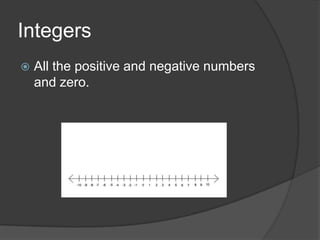
IntegersAll the positive and negative numbers and zero.
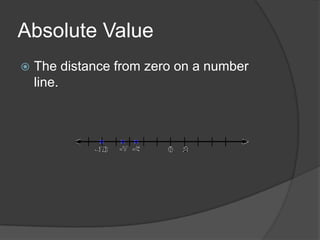
Absolute ValueThe distance from zero on a number line.
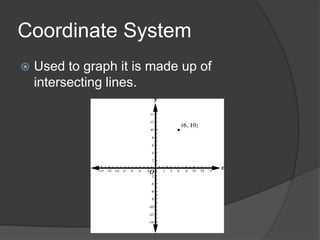
Coordinate SystemUsed to graph it is made up of intersecting lines.
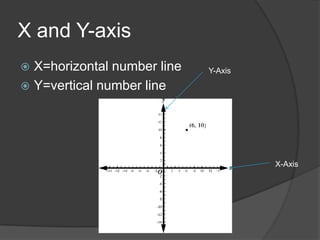
X and Y-axisX=horizontal number lineY=vertical number lineY-AxisX-Axis
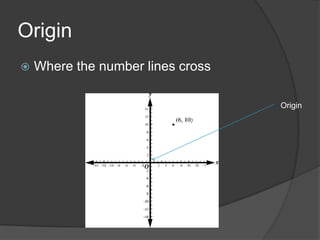
OriginWhere the number lines crossOrigin
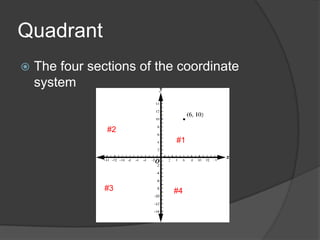
QuadrantThe four sections of the coordinate system#2#1#3#4
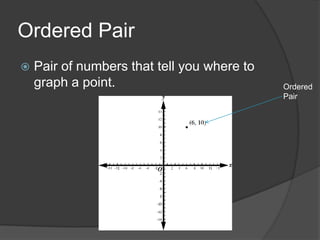
Ordered PairPair of numbers that tell you where to graph a point.Ordered Pair
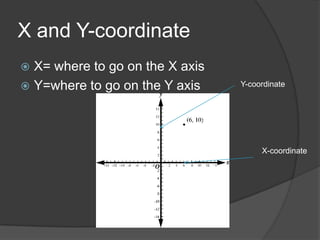
X and Y-coordinateX= where to go on the X axisY=where to go on the Y axisY-coordinateX-coordinate
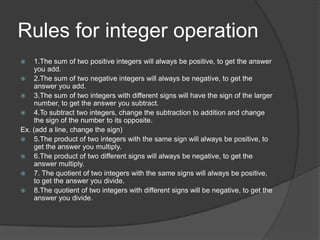
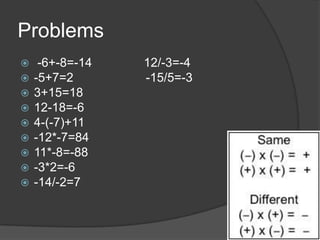
Rules for integer operation1.The sum of two positive integers will always be positive, to get the answer you add.2.The sum of two negative integers will always be negative, to get the answer you add.3.The sum of two integers with different signs will have the sign of the larger number, to get the answer you subtract.4.To subtract two integers, change the subtraction to addition and change the sign of the number to its opposite.Ex. (add a line, change the sign)5.The product of two integers with the same sign will always be positive, to get the answer you multiply.6.The product of two different signs will always be negative, to get the answer multiply.7. The quotient of two integers with the same signs will always be positive, to get the answer you divide.8.The quotient of two integers with different signs will be negative, to get the answer you divide.
Problems -6+-8=-14               12/-3=-4-5+7=2                     -15/5=-33+15=1812-18=-64-(-7)+11            -12*-7=8411*-8=-88-3*2=-6-14/-2=7
MeanThe average of a group of numbers.24+345+-23+45+57=448 and then you divide 448 by 5.
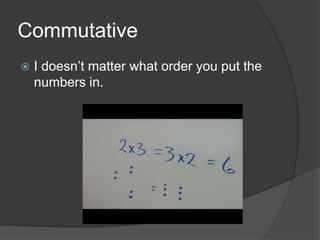
CommutativeI doesn’t matter what order you put the numbers in.
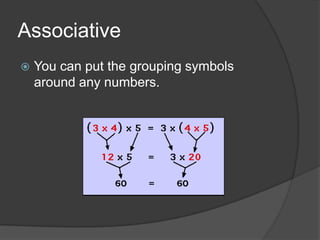
AssociativeYou can put the grouping symbols around any numbers.
IdentityAnything added by 0 or multiplied by 1 is the number it is to begin with5+0=55*1=5
Multiplicative InverseIt is the reciprocal or the opposite of the number.1/5’s reciprocal(multiplicative inverse) is 5/1
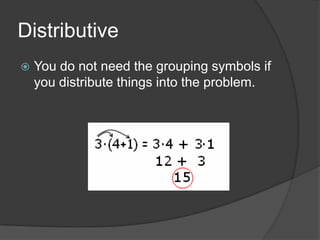
DistributiveYou do not need the grouping symbols if you distribute things into the problem.

Math Dictionary

  • 1.
    Math Dictionary# 2By.Derek Marsh and Tyler Henderson
  • 2.
    IntegersAll the positiveand negative numbers and zero.
  • 3.
    Absolute ValueThe distancefrom zero on a number line.
  • 4.
    Coordinate SystemUsed tograph it is made up of intersecting lines.
  • 5.
    X and Y-axisX=horizontalnumber lineY=vertical number lineY-AxisX-Axis
  • 6.
    OriginWhere the numberlines crossOrigin
  • 7.
    QuadrantThe four sectionsof the coordinate system#2#1#3#4
  • 8.
    Ordered PairPair ofnumbers that tell you where to graph a point.Ordered Pair
  • 9.
    X and Y-coordinateX=where to go on the X axisY=where to go on the Y axisY-coordinateX-coordinate
  • 10.
    Rules for integeroperation1.The sum of two positive integers will always be positive, to get the answer you add.2.The sum of two negative integers will always be negative, to get the answer you add.3.The sum of two integers with different signs will have the sign of the larger number, to get the answer you subtract.4.To subtract two integers, change the subtraction to addition and change the sign of the number to its opposite.Ex. (add a line, change the sign)5.The product of two integers with the same sign will always be positive, to get the answer you multiply.6.The product of two different signs will always be negative, to get the answer multiply.7. The quotient of two integers with the same signs will always be positive, to get the answer you divide.8.The quotient of two integers with different signs will be negative, to get the answer you divide.
  • 11.
    Problems -6+-8=-14 12/-3=-4-5+7=2 -15/5=-33+15=1812-18=-64-(-7)+11 -12*-7=8411*-8=-88-3*2=-6-14/-2=7
  • 12.
    MeanThe average ofa group of numbers.24+345+-23+45+57=448 and then you divide 448 by 5.
  • 13.
    CommutativeI doesn’t matterwhat order you put the numbers in.
  • 14.
    AssociativeYou can putthe grouping symbols around any numbers.
  • 15.
    IdentityAnything added by0 or multiplied by 1 is the number it is to begin with5+0=55*1=5
  • 16.
    Multiplicative InverseIt isthe reciprocal or the opposite of the number.1/5’s reciprocal(multiplicative inverse) is 5/1
  • 17.
    DistributiveYou do notneed the grouping symbols if you distribute things into the problem.