Pre-School Analysis

     English Area
      Pre-School
         2012
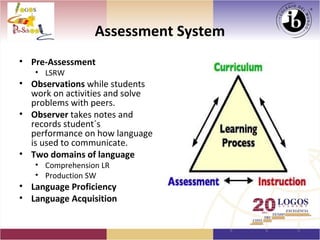
Assessment System
• Pre-Assessment
   • LSRW
• Observations while students
  work on activities and solve
  problems with peers.
• Observer takes notes and
  records student´s
  performance on how language
  is used to communicate.
• Two domains of language
   • Comprehension LR
   • Production SW
• Language Proficiency
• Language Acquisition
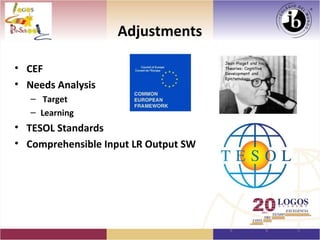
Adjustments

• CEF
• Needs Analysis
   – Target
   – Learning
• TESOL Standards
• Comprehensible Input LR Output SW
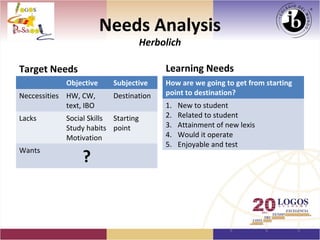
Needs Analysis
                                      Herbolich

Target Needs                               Learning Needs
             Objective     Subjective      How are we going to get from starting
Neccessities HW, CW,       Destination     point to destination?
             text, IBO                     1.   New to student
Lacks        Social Skills Starting        2.   Related to student
             Study habits point            3.   Attainment of new lexis
             Motivation                    4.   Would it operate
                                           5.   Enjoyable and test
                  ?
Wants
TESOL Standards
• Goal 1, Standard 1
   – To use English to communicate in social settings: Students will use English
     to participate in social interactions
• Goal 2, Standard 1
   – To use English to achieve academically in all content areas: Students will
     use English to interact in the classroom
• Goal 3, Standard 2
   – To use English in socially and culturally appropriate ways: Students will use
     nonverbal communication appropriate to audience, purpose, and setting
• Goal 3, Standard 3
   – To use English in socially and culturally appropriate ways: Students will use
     appropriate learning strategies to extend their sociolinguistic and socio-
     cultural competence
Language Acquisition vs
              Language Learning
Teacher LL                 Student LA
• Grammar rules   • Oral “natural” communication
  for teachers        – Classroom talk
  proficiency         – Teacher talk
• Not                 – Play talk
  communicative   •   Pre-reading
• Direct          •   Vocabulary
  instruction     •   Pre-Writing
• Talk about      •   Grammar at this age students are
  knowledge vs        unaware of rules
  communication
Cognitive Science
                        Language Acquisition
•   Modularity
     – "mental organ,” (Chomsky, 1975,
       1991; Fodor, 1983)
•   Human Uniqueness
     – Combinatorial rule system
•   Language and Thought
     – Learning to think. Cognitive
       psychology has shown that people
       think not just in words but in images.
•   Learning and Innateness
     – The sensorimotor abilities
     – Laws of learning organism's
       behavioral repertoire.
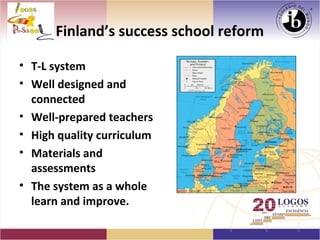
Finland’s success school reform

• T-L system
• Well designed and
  connected
• Well-prepared teachers
• High quality curriculum
• Materials and
  assessments
• The system as a whole
  learn and improve.
Strategies
•   Systematic methods
•   Autonomy
•   Thinking curriculum
•   Cooperative learning
•   Would you be able to
    learn Japanese by
    sitting in a Japanese
    classroom?
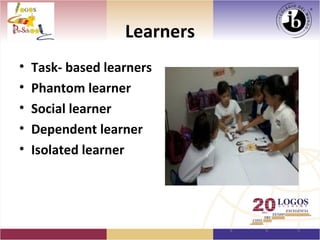
Learners
•   Task- based learners
•   Phantom learner
•   Social learner
•   Dependent learner
•   Isolated learner
Reflexión

• Metodología
   – Whole Language
   – Communicative Approach
• Calificaciones vs Aprendizaje
• Motores fríos
• Leche con chocolate
Tips
• Preguntemos
   – ¿Cómo fue la explicación?
   – ¿Qué pasó?
   – ¿Cómo lo harías tu?
• Afirmaciones
   – “Quiero que …”
   – “Es importante que …”
It parent director conference june 29

It parent director conference june 29

  • 1.
    Pre-School Analysis English Area Pre-School 2012
  • 2.
    Assessment System • Pre-Assessment • LSRW • Observations while students work on activities and solve problems with peers. • Observer takes notes and records student´s performance on how language is used to communicate. • Two domains of language • Comprehension LR • Production SW • Language Proficiency • Language Acquisition
  • 3.
    Adjustments • CEF • NeedsAnalysis – Target – Learning • TESOL Standards • Comprehensible Input LR Output SW
  • 4.
    Needs Analysis Herbolich Target Needs Learning Needs Objective Subjective How are we going to get from starting Neccessities HW, CW, Destination point to destination? text, IBO 1. New to student Lacks Social Skills Starting 2. Related to student Study habits point 3. Attainment of new lexis Motivation 4. Would it operate 5. Enjoyable and test ? Wants
  • 5.
    TESOL Standards • Goal1, Standard 1 – To use English to communicate in social settings: Students will use English to participate in social interactions • Goal 2, Standard 1 – To use English to achieve academically in all content areas: Students will use English to interact in the classroom • Goal 3, Standard 2 – To use English in socially and culturally appropriate ways: Students will use nonverbal communication appropriate to audience, purpose, and setting • Goal 3, Standard 3 – To use English in socially and culturally appropriate ways: Students will use appropriate learning strategies to extend their sociolinguistic and socio- cultural competence
  • 6.
    Language Acquisition vs Language Learning Teacher LL Student LA • Grammar rules • Oral “natural” communication for teachers – Classroom talk proficiency – Teacher talk • Not – Play talk communicative • Pre-reading • Direct • Vocabulary instruction • Pre-Writing • Talk about • Grammar at this age students are knowledge vs unaware of rules communication
  • 7.
    Cognitive Science Language Acquisition • Modularity – "mental organ,” (Chomsky, 1975, 1991; Fodor, 1983) • Human Uniqueness – Combinatorial rule system • Language and Thought – Learning to think. Cognitive psychology has shown that people think not just in words but in images. • Learning and Innateness – The sensorimotor abilities – Laws of learning organism's behavioral repertoire.
  • 8.
    Finland’s success schoolreform • T-L system • Well designed and connected • Well-prepared teachers • High quality curriculum • Materials and assessments • The system as a whole learn and improve.
  • 9.
    Strategies • Systematic methods • Autonomy • Thinking curriculum • Cooperative learning • Would you be able to learn Japanese by sitting in a Japanese classroom?
  • 10.
    Learners • Task- based learners • Phantom learner • Social learner • Dependent learner • Isolated learner
  • 11.
    Reflexión • Metodología – Whole Language – Communicative Approach • Calificaciones vs Aprendizaje • Motores fríos • Leche con chocolate
  • 12.
    Tips • Preguntemos – ¿Cómo fue la explicación? – ¿Qué pasó? – ¿Cómo lo harías tu? • Afirmaciones – “Quiero que …” – “Es importante que …”

Editor's Notes

  • #3 Poliza citizens