University of Salford
Postgraduate Study Guide
Applying, Courses, and Finance
1
Contents
Types of Postgraduate Study 2
Should you do a Postgraduate Course? 3
Choosing Your Course 5
Fees, Funding, and Finance 6
Home/EU Students 6
Postgraduate Taught & Research Loans 8
International Students 9
Making Your Application 11
Writing a Research Proposal 11
Example Titles 12
2
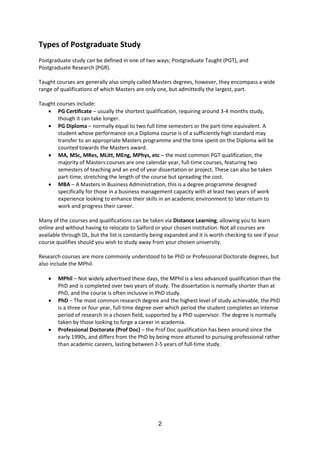
Types of Postgraduate Study
Postgraduate study can be defined in one of two ways; Postgraduate Taught (PGT), and
Postgraduate Research (PGR).
Taught courses are generally also simply called Masters degrees, however, they encompass a wide
range of qualifications of which Masters are only one, but admittedly the largest, part.
Taught courses include:
 PG Certificate – usually the shortest qualification, requiring around 3-4 months study,
though it can take longer.
 PG Diploma – normally equal to two full time semesters or the part-time equivalent. A
student whose performance on a Diploma course is of a sufficiently high standard may
transfer to an appropriate Masters programme and the time spent on the Diploma will be
counted towards the Masters award.
 MA, MSc, MRes, MLitt, MEng, MPhys, etc – the most common PGT qualification, the
majority of Masters courses are one calendar year, full-time courses, featuring two
semesters of teaching and an end of year dissertation or project. These can also be taken
part-time, stretching the length of the course but spreading the cost.
 MBA – A Masters in Business Administration, this is a degree programme designed
specifically for those in a business management capacity with at least two years of work
experience looking to enhance their skills in an academic environment to later return to
work and progress their career.
Many of the courses and qualifications can be taken via Distance Learning, allowing you to learn
online and without having to relocate to Salford or your chosen institution. Not all courses are
available through DL, but the list is constantly being expanded and it is worth checking to see if your
course qualifies should you wish to study away from your chosen university.
Research courses are more commonly understood to be PhD or Professional Doctorate degrees, but
also include the MPhil.
 MPhil – Not widely advertised these days, the MPhil is a less advanced qualification than the
PhD and is completed over two years of study. The dissertation is normally shorter than at
PhD, and the course is often inclusive in PhD study.
 PhD – The most common research degree and the highest level of study achievable, the PhD
is a three or four year, full-time degree over which period the student completes an intense
period of research in a chosen field, supported by a PhD supervisor. The degree is normally
taken by those looking to forge a career in academia.
 Professional Doctorate (Prof Doc) – the Prof Doc qualification has been around since the
early 1990s, and differs from the PhD by being more attuned to pursuing professional rather
than academic careers, lasting between 2-5 years of full-time study.
3
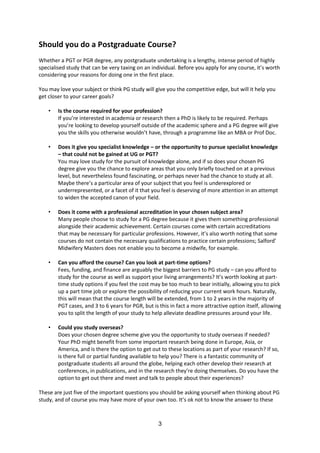
Should you do a Postgraduate Course?
Whether a PGT or PGR degree, any postgraduate undertaking is a lengthy, intense period of highly
specialised study that can be very taxing on an individual. Before you apply for any course, it’s worth
considering your reasons for doing one in the first place.
You may love your subject or think PG study will give you the competitive edge, but will it help you
get closer to your career goals?
• Is the course required for your profession?
If you’re interested in academia or research then a PhD is likely to be required. Perhaps
you’re looking to develop yourself outside of the academic sphere and a PG degree will give
you the skills you otherwise wouldn’t have, through a programme like an MBA or Prof Doc.
• Does it give you specialist knowledge – or the opportunity to pursue specialist knowledge
– that could not be gained at UG or PGT?
You may love study for the pursuit of knowledge alone, and if so does your chosen PG
degree give you the chance to explore areas that you only briefly touched on at a previous
level, but nevertheless found fascinating, or perhaps never had the chance to study at all.
Maybe there’s a particular area of your subject that you feel is underexplored or
underrepresented, or a facet of it that you feel is deserving of more attention in an attempt
to widen the accepted canon of your field.
• Does it come with a professional accreditation in your chosen subject area?
Many people choose to study for a PG degree because it gives them something professional
alongside their academic achievement. Certain courses come with certain accreditations
that may be necessary for particular professions. However, it’s also worth noting that some
courses do not contain the necessary qualifications to practice certain professions; Salford’
Midwifery Masters does not enable you to become a midwife, for example.
• Can you afford the course? Can you look at part-time options?
Fees, funding, and finance are arguably the biggest barriers to PG study – can you afford to
study for the course as well as support your living arrangements? It’s worth looking at part-
time study options if you feel the cost may be too much to bear initially, allowing you to pick
up a part time job or explore the possibility of reducing your current work hours. Naturally,
this will mean that the course length will be extended, from 1 to 2 years in the majority of
PGT cases, and 3 to 6 years for PGR, but is this in fact a more attractive option itself, allowing
you to split the length of your study to help alleviate deadline pressures around your life.
• Could you study overseas?
Does your chosen degree scheme give you the opportunity to study overseas if needed?
Your PhD might benefit from some important research being done in Europe, Asia, or
America, and is there the option to get out to these locations as part of your research? If so,
is there full or partial funding available to help you? There is a fantastic community of
postgraduate students all around the globe, helping each other develop their research at
conferences, in publications, and in the research they’re doing themselves. Do you have the
option to get out there and meet and talk to people about their experiences?
These are just five of the important questions you should be asking yourself when thinking about PG
study, and of course you may have more of your own too. It’s ok not to know the answer to these
4
questions and more, but over time you should start to formulate an idea of where you want to be,
and how you want to get there, and answering these questions can certainly help.
If you would like a little more guidance about your PG options, or just want to talk it through with
someone at the university, get in touch with Tom Pinder and arrange an informal appointment via
t.w.pinder@salford.ac.uk or on 0161 295 5514.
5
Choosing Your Course
The quality, cost, and teaching style of each course will vary across institutions. Some universities
may have specialisms in areas that others do not, while some courses may only be available at
particular establishments.
University websites are almost certainly going to be your first port of call, and you can often find a
wealth of information on them about any courses you may be interested in. Often the names of
some of the academics who teach or supervise those degrees will be included here, and it’s perfectly
ok to email them and strike up a conversation about the course in a bit more detail.
As well as the university websites, there are many third-party websites that can also help with
narrowing down your choice. Those listed below can be excellent resources when embarking on
your search:
 FindAMasters
 FindAPhD
 Universities Worldwide
 TARGETPostgrad
 Prospects
For both PGT and PGR it’s important to see if the tutors and supervisors are available for your
chosen year of entry. Many universities will publish a list of all the PGT courses and modules they
offer, but due to staff research and sabbaticals they may not run all the time. Equally, whilst some
university may be ideally situated to help supervise your PhD, ensure that they are not on research
leave for your year of entry.
One of the best resources for evaluating a course is to speak to current students on that course.
Students are often available at PG Open Days and similar events to speak to people about their own
experiences on the course. Additionally, feel free to email the tutors on the course to speak to them
in more detail about specific modules, or to find out more about their key areas of research. Portals
such as Salford’s SEEK can also provide some illuminating information on this.
Also consider who else may be teaching on the course; is it also taught by industry professionals?
Many of Salford’s PG degrees come with the opportunity to undertake a placement to gain further
practical skills in relation to your academic ones, allowing you to gain academic knowledge from
your tutors and professional expertise from those already working in the field. This can be invaluable
when it comes to employment, but will also help you decide if you prefer a more theoretical or
practical approach to your subject.
When thinking about professional qualifications gained as a part of your degree it’s also worth
bearing in mind where that qualification allows you to practice if you’re thinking about moving
overseas. Professional bodies themselves can often provide this information, so it’s worth exploring
if you know your course comes with accreditation and you want to take it overseas upon graduating.
What are the employment rates like upon completing the course? This may be more prevalent those
not looking at PGR degrees, but websites like Prospects can give a good indication on what
graduates do after their postgraduate study.
6
Fees, Funding, and Finance
Cost is often the biggest barrier to PG study, but there are a wealth of funding options available that
can help alleviate the financial burden. Whilst this section won’t deal with all options exhaustively, it
will highlight some of the main funding avenues available, and provide pointers on where to get the
best funding information.
Home/EU Students
The cost of a postgraduate degree can vary across institutions, and from degree to degree. Fees at
Salford currently range from £4,845 - £7,650 for postgraduate taught courses, with the MBA rising to
£13,945 (all 2016 entry). Those undertaking their degree part-time would pay between £807 - £1340
per 30 credits or module. Full details of specific course fees can be found on the individual degree
webpage through Coursefinder.
Postgraduate Research fees display a greater range based on a number of different factors. The
varying costs for entry into the different research schemes are listed below:
Type Fee
Full-time £4,052
Part-time £2,026
Split-site £5,655
Split-site School of Built Environment £7,500
PhD Online Programme (MERIT) £6,525
Online Doctorate £6,525
Online PhD: Business and Management full-
time
£4.052
Online PhD: Business and Management
part-time
£2,026
Professional Doctorate in the Built
Environment
£3,900 per year for years 1 & 2,
plus £2,026 per year for years
3,4 & 5
Professional Doctorate in Health & Social
Care
£2,755 per year for 5 years
7
Thankfully, there are options to help alleviate the cost of your degree:
These aren’t the only options available to you, and you may wish to explore other funding avenues
to help with your finances. Most PhD students will be expected to teach as part of their research,
and this will come with its own remuneration. Equally, you may wish to pick up a part-time job, but
it’s important to remain realistic about how much you can do, especially if you choose to do your
research full-time.
For those considering a PhD in a science or business field, many employers will look to sponsor
research into specific areas, and it’s worth investigating if your research may be eligible for employer
funded study.
Lastly, Professional Career Development Loans are a popular option with many students, though
these will likely see a fall in take up because of the introduction of the Postgraduate Taught Loans
scheme (see below). A PCDL is only available to those on a vocational course, and can be for any
amount between £300 - £10,000, but the repayments can be off-putting for many student. For more
information on the PCDL, visit www.gov.uk/career-development-loans/overview.
Vice Chancellor’s Excellence Scholarship
If you have a 2:1 honours degree or above (or
equivalent) you will automatically be awarded
the Vice Chancellor’s Excellence scholarship
when you begin your Masters course at Salford.
 £1,500 tuition fee discount (all Masters
courses)
 £4,000 tuition fee discount for the MBA
programme
University of Salford Loyalty Discount
UK/EU graduates of the University of Salford
returning for postgraduate taught or research
study receive 25% discount off the tuition fee.
If you are a University of Salford graduate and
are eligible for the Vice Chancellor's Excellence
Scholarship you will receive the £1,500 discount
(for full-time study) on your fee PLUS the further
discount of 25% off the remaining fee.
External Funding Resources
Postgraduate Funding
Research Councils UK
Postgraduate Studentships
FindAMasters
FindAPhD
There are many bodies that provide external
funding, and many websites that can help you
find it. These are just a handful of those out
there so be sure to dig around. You can even get
funding for being a vegetarian!
For more information…
Check out our website where you can find even
more pointers to help you fund your degree.
Taught Courses
Research Courses
8
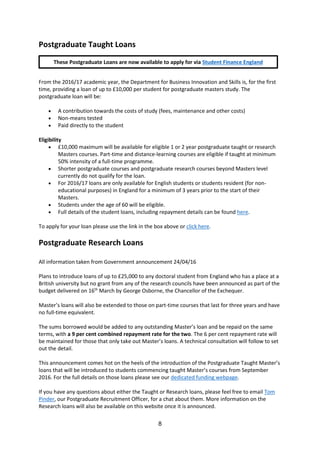
Postgraduate Taught Loans
From the 2016/17 academic year, the Department for Business Innovation and Skills is, for the first
time, providing a loan of up to £10,000 per student for postgraduate masters study. The
postgraduate loan will be:
 A contribution towards the costs of study (fees, maintenance and other costs)
 Non-means tested
 Paid directly to the student
Eligibility
 £10,000 maximum will be available for eligible 1 or 2 year postgraduate taught or research
Masters courses. Part-time and distance-learning courses are eligible if taught at minimum
50% intensity of a full-time programme.
 Shorter postgraduate courses and postgraduate research courses beyond Masters level
currently do not qualify for the loan.
 For 2016/17 loans are only available for English students or students resident (for non-
educational purposes) in England for a minimum of 3 years prior to the start of their
Masters.
 Students under the age of 60 will be eligible.
 Full details of the student loans, including repayment details can be found here.
To apply for your loan please use the link in the box above or click here.
Postgraduate Research Loans
All information taken from Government announcement 24/04/16
Plans to introduce loans of up to £25,000 to any doctoral student from England who has a place at a
British university but no grant from any of the research councils have been announced as part of the
budget delivered on 16th
March by George Osborne, the Chancellor of the Exchequer.
Master’s loans will also be extended to those on part-time courses that last for three years and have
no full-time equivalent.
The sums borrowed would be added to any outstanding Master’s loan and be repaid on the same
terms, with a 9 per cent combined repayment rate for the two. The 6 per cent repayment rate will
be maintained for those that only take out Master’s loans. A technical consultation will follow to set
out the detail.
This announcement comes hot on the heels of the introduction of the Postgraduate Taught Master’s
loans that will be introduced to students commencing taught Master’s courses from September
2016. For the full details on those loans please see our dedicated funding webpage.
If you have any questions about either the Taught or Research loans, please feel free to email Tom
Pinder, our Postgraduate Recruitment Officer, for a chat about them. More information on the
Research loans will also be available on this website once it is announced.
These Postgraduate Loans are now available to apply for via Student Finance England
9
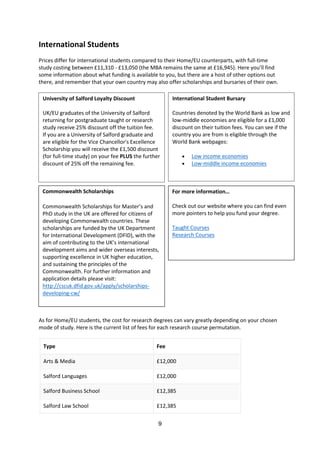
International Students
Prices differ for international students compared to their Home/EU counterparts, with full-time
study costing between £11,310 - £13,050 (the MBA remains the same at £16,945). Here you’ll find
some information about what funding is available to you, but there are a host of other options out
there, and remember that your own country may also offer scholarships and bursaries of their own.
As for Home/EU students, the cost for research degrees can vary greatly depending on your chosen
mode of study. Here is the current list of fees for each research course permutation.
Type Fee
Arts & Media £12,000
Salford Languages £12,000
Salford Business School £12,385
Salford Law School £12,385
University of Salford Loyalty Discount
UK/EU graduates of the University of Salford
returning for postgraduate taught or research
study receive 25% discount off the tuition fee.
If you are a University of Salford graduate and
are eligible for the Vice Chancellor's Excellence
Scholarship you will receive the £1,500 discount
(for full-time study) on your fee PLUS the further
discount of 25% off the remaining fee.
Commonwealth Scholarships
Commonwealth Scholarships for Master’s and
PhD study in the UK are offered for citizens of
developing Commonwealth countries. These
scholarships are funded by the UK Department
for International Development (DFID), with the
aim of contributing to the UK’s international
development aims and wider overseas interests,
supporting excellence in UK higher education,
and sustaining the principles of the
Commonwealth. For further information and
application details please visit:
http://cscuk.dfid.gov.uk/apply/scholarships-
developing-cw/
International Student Bursary
Countries denoted by the World Bank as low and
low-middle economies are eligible for a £1,000
discount on their tuition fees. You can see if the
country you are from is eligible through the
World Bank webpages:
 Low income economies
 Low-middle income economies
For more information…
Check out our website where you can find even
more pointers to help you fund your degree.
Taught Courses
Research Courses
10
Type Fee
Environment & Life Sciences £13,050
Built Environment £13,050
Computing, Science and Engineering £13,050
Health and Social Care £13,050
Split-site £5,655
Split-site School of the Built Environment £7,500
PhD online programme (MERIT) £6,525
Online Doctorate £6,525
Online PhD: Business and Management full-
time
£12,385
Online PhD: Business and Management
part-time
£6,193
Professional Doctorate in the Built
Environment
£3900 per year for years 1 & 2;
£2026 per year for years 3, 4 & 5
11
Making Your Application
Unlike undergraduate study where you would apply to a limited number of institutions through
UCAS, postgraduate applications are made directly to the university, almost exclusively through your
chosen institution’s website. You can apply for as many courses across as many universities as you
like, but your choices will probably be quite similar at course level, regardless of institution.
As part of your application you need the following documents:
 Two references, at least one of which is academic. It may be that one of the tutors you use
for a reference may also be teaching on your course, or you may ask tutors who you have
only been taught by at undergraduate level. Work references are also fine should you be
returning to study after a period of employment.
 Transcripts or certificates demonstrating that you meet or are predicted to meet the entry
requirements for your course.
 Evidence, if English is not your first language, that your command of English meets the
standards required for postgraduate study (an IELTS score of 6.5, or the equivalent, is the
norm)
 A copy of your passport, if you are coming to us from outside the EU and will require a
student visa.
For most universities there are no closing dates for applications, and you can apply all year round.
For Salford, we have multiple entry dates that vary based on your specific course, but in general we
advise to leave it no later than 6 weeks before the start date of your course.
If you are applying for funding then bear in mind that this does have strict deadlines, and in the
majority of cases you won’t be able to apply for funding until you have applied for your course.
If you would like further information on making your application, please contact Tom Pinder.
Writing a Research Proposal
The research proposal is a crucial part of your PhD or research application. You should discuss your
proposal with the Postgraduate Research Admissions Contact of the School to which you are
applying, to make sure you understand what is expected in your subject area.
When submitting an application, make sure that the specialist area you wish to study is covered by a
member of staff at the University:
• Check individual staff entries on the Research Centre sites that relate to your area
• Explore staff profiles and check current research interests
• Take note of the relevant Research Administrator as you will need their details when
completing your online application
There is no upper or lower limit on how long your proposal should be, but traditionally 1000-2000
words should be sufficient. It should not be too long or too short, and should provide an accurate
overview of your thesis. Make it clear, concise, and coherent, and, most importantly, love what you
do, as this is a project you will be undertaking for at least three years, and at times can prove to be a
very independent and isolating experience.
12
• A clear working title for your research project.
• A clear statement about what you want to work on and why it is important, interesting,
relevant, and realistic.
• Some background knowledge and context of the area in which you wish to work, including
key literature, key people, key research findings.
• Consideration of the methods/approach you might use.
• Indication of the strategy and timetable for your research project and any research
challenges you may face.
• A list of the key references which support your research proposal.
Example Titles
The titles below indicate just how diverse a range of subjects can be explored at postgraduate level,
research in particular, and also the niche and hyper-specific nature that you can take your study to.
All titles listed here are real research projects that have been completed by Salford Students within
the last five years.
• The Importance of Culture on Competitive Advantage of Nations
• Destination Branding: An Analytical Study Applied on Libya as a Tourism Destination
• The Power Struggles at Play During the Photographic Social Exchange
• Implementing Green Business Models in the UK Construction Industry: Opportunities and
Challenges
• A Novel Technique for Measuring and Sensing Rain
• The use of Molecular Tools for Pan-Trypansoma Analysis and Epigenetics of the Host
• Analysis of the Gut Microbiome of the Common Black Slug: In Search of Novel Lignocellulose
Degrading Enzymes
• The Effects of Heel Height, Shoe Volume, and Upper Stiffness on Shoe Comfort and Plantar
Pressure
• Kinematics and Kinetics of Maximal Velocity Sprinting and Specificity of Training in Elite
Athletes

Postgraduate Study Guide v3 0

  • 1.
    University of Salford PostgraduateStudy Guide Applying, Courses, and Finance
  • 2.
    1 Contents Types of PostgraduateStudy 2 Should you do a Postgraduate Course? 3 Choosing Your Course 5 Fees, Funding, and Finance 6 Home/EU Students 6 Postgraduate Taught & Research Loans 8 International Students 9 Making Your Application 11 Writing a Research Proposal 11 Example Titles 12
  • 3.
    2 Types of PostgraduateStudy Postgraduate study can be defined in one of two ways; Postgraduate Taught (PGT), and Postgraduate Research (PGR). Taught courses are generally also simply called Masters degrees, however, they encompass a wide range of qualifications of which Masters are only one, but admittedly the largest, part. Taught courses include:  PG Certificate – usually the shortest qualification, requiring around 3-4 months study, though it can take longer.  PG Diploma – normally equal to two full time semesters or the part-time equivalent. A student whose performance on a Diploma course is of a sufficiently high standard may transfer to an appropriate Masters programme and the time spent on the Diploma will be counted towards the Masters award.  MA, MSc, MRes, MLitt, MEng, MPhys, etc – the most common PGT qualification, the majority of Masters courses are one calendar year, full-time courses, featuring two semesters of teaching and an end of year dissertation or project. These can also be taken part-time, stretching the length of the course but spreading the cost.  MBA – A Masters in Business Administration, this is a degree programme designed specifically for those in a business management capacity with at least two years of work experience looking to enhance their skills in an academic environment to later return to work and progress their career. Many of the courses and qualifications can be taken via Distance Learning, allowing you to learn online and without having to relocate to Salford or your chosen institution. Not all courses are available through DL, but the list is constantly being expanded and it is worth checking to see if your course qualifies should you wish to study away from your chosen university. Research courses are more commonly understood to be PhD or Professional Doctorate degrees, but also include the MPhil.  MPhil – Not widely advertised these days, the MPhil is a less advanced qualification than the PhD and is completed over two years of study. The dissertation is normally shorter than at PhD, and the course is often inclusive in PhD study.  PhD – The most common research degree and the highest level of study achievable, the PhD is a three or four year, full-time degree over which period the student completes an intense period of research in a chosen field, supported by a PhD supervisor. The degree is normally taken by those looking to forge a career in academia.  Professional Doctorate (Prof Doc) – the Prof Doc qualification has been around since the early 1990s, and differs from the PhD by being more attuned to pursuing professional rather than academic careers, lasting between 2-5 years of full-time study.
  • 4.
    3 Should you doa Postgraduate Course? Whether a PGT or PGR degree, any postgraduate undertaking is a lengthy, intense period of highly specialised study that can be very taxing on an individual. Before you apply for any course, it’s worth considering your reasons for doing one in the first place. You may love your subject or think PG study will give you the competitive edge, but will it help you get closer to your career goals? • Is the course required for your profession? If you’re interested in academia or research then a PhD is likely to be required. Perhaps you’re looking to develop yourself outside of the academic sphere and a PG degree will give you the skills you otherwise wouldn’t have, through a programme like an MBA or Prof Doc. • Does it give you specialist knowledge – or the opportunity to pursue specialist knowledge – that could not be gained at UG or PGT? You may love study for the pursuit of knowledge alone, and if so does your chosen PG degree give you the chance to explore areas that you only briefly touched on at a previous level, but nevertheless found fascinating, or perhaps never had the chance to study at all. Maybe there’s a particular area of your subject that you feel is underexplored or underrepresented, or a facet of it that you feel is deserving of more attention in an attempt to widen the accepted canon of your field. • Does it come with a professional accreditation in your chosen subject area? Many people choose to study for a PG degree because it gives them something professional alongside their academic achievement. Certain courses come with certain accreditations that may be necessary for particular professions. However, it’s also worth noting that some courses do not contain the necessary qualifications to practice certain professions; Salford’ Midwifery Masters does not enable you to become a midwife, for example. • Can you afford the course? Can you look at part-time options? Fees, funding, and finance are arguably the biggest barriers to PG study – can you afford to study for the course as well as support your living arrangements? It’s worth looking at part- time study options if you feel the cost may be too much to bear initially, allowing you to pick up a part time job or explore the possibility of reducing your current work hours. Naturally, this will mean that the course length will be extended, from 1 to 2 years in the majority of PGT cases, and 3 to 6 years for PGR, but is this in fact a more attractive option itself, allowing you to split the length of your study to help alleviate deadline pressures around your life. • Could you study overseas? Does your chosen degree scheme give you the opportunity to study overseas if needed? Your PhD might benefit from some important research being done in Europe, Asia, or America, and is there the option to get out to these locations as part of your research? If so, is there full or partial funding available to help you? There is a fantastic community of postgraduate students all around the globe, helping each other develop their research at conferences, in publications, and in the research they’re doing themselves. Do you have the option to get out there and meet and talk to people about their experiences? These are just five of the important questions you should be asking yourself when thinking about PG study, and of course you may have more of your own too. It’s ok not to know the answer to these
  • 5.
    4 questions and more,but over time you should start to formulate an idea of where you want to be, and how you want to get there, and answering these questions can certainly help. If you would like a little more guidance about your PG options, or just want to talk it through with someone at the university, get in touch with Tom Pinder and arrange an informal appointment via t.w.pinder@salford.ac.uk or on 0161 295 5514.
  • 6.
    5 Choosing Your Course Thequality, cost, and teaching style of each course will vary across institutions. Some universities may have specialisms in areas that others do not, while some courses may only be available at particular establishments. University websites are almost certainly going to be your first port of call, and you can often find a wealth of information on them about any courses you may be interested in. Often the names of some of the academics who teach or supervise those degrees will be included here, and it’s perfectly ok to email them and strike up a conversation about the course in a bit more detail. As well as the university websites, there are many third-party websites that can also help with narrowing down your choice. Those listed below can be excellent resources when embarking on your search:  FindAMasters  FindAPhD  Universities Worldwide  TARGETPostgrad  Prospects For both PGT and PGR it’s important to see if the tutors and supervisors are available for your chosen year of entry. Many universities will publish a list of all the PGT courses and modules they offer, but due to staff research and sabbaticals they may not run all the time. Equally, whilst some university may be ideally situated to help supervise your PhD, ensure that they are not on research leave for your year of entry. One of the best resources for evaluating a course is to speak to current students on that course. Students are often available at PG Open Days and similar events to speak to people about their own experiences on the course. Additionally, feel free to email the tutors on the course to speak to them in more detail about specific modules, or to find out more about their key areas of research. Portals such as Salford’s SEEK can also provide some illuminating information on this. Also consider who else may be teaching on the course; is it also taught by industry professionals? Many of Salford’s PG degrees come with the opportunity to undertake a placement to gain further practical skills in relation to your academic ones, allowing you to gain academic knowledge from your tutors and professional expertise from those already working in the field. This can be invaluable when it comes to employment, but will also help you decide if you prefer a more theoretical or practical approach to your subject. When thinking about professional qualifications gained as a part of your degree it’s also worth bearing in mind where that qualification allows you to practice if you’re thinking about moving overseas. Professional bodies themselves can often provide this information, so it’s worth exploring if you know your course comes with accreditation and you want to take it overseas upon graduating. What are the employment rates like upon completing the course? This may be more prevalent those not looking at PGR degrees, but websites like Prospects can give a good indication on what graduates do after their postgraduate study.
  • 7.
    6 Fees, Funding, andFinance Cost is often the biggest barrier to PG study, but there are a wealth of funding options available that can help alleviate the financial burden. Whilst this section won’t deal with all options exhaustively, it will highlight some of the main funding avenues available, and provide pointers on where to get the best funding information. Home/EU Students The cost of a postgraduate degree can vary across institutions, and from degree to degree. Fees at Salford currently range from £4,845 - £7,650 for postgraduate taught courses, with the MBA rising to £13,945 (all 2016 entry). Those undertaking their degree part-time would pay between £807 - £1340 per 30 credits or module. Full details of specific course fees can be found on the individual degree webpage through Coursefinder. Postgraduate Research fees display a greater range based on a number of different factors. The varying costs for entry into the different research schemes are listed below: Type Fee Full-time £4,052 Part-time £2,026 Split-site £5,655 Split-site School of Built Environment £7,500 PhD Online Programme (MERIT) £6,525 Online Doctorate £6,525 Online PhD: Business and Management full- time £4.052 Online PhD: Business and Management part-time £2,026 Professional Doctorate in the Built Environment £3,900 per year for years 1 & 2, plus £2,026 per year for years 3,4 & 5 Professional Doctorate in Health & Social Care £2,755 per year for 5 years
  • 8.
    7 Thankfully, there areoptions to help alleviate the cost of your degree: These aren’t the only options available to you, and you may wish to explore other funding avenues to help with your finances. Most PhD students will be expected to teach as part of their research, and this will come with its own remuneration. Equally, you may wish to pick up a part-time job, but it’s important to remain realistic about how much you can do, especially if you choose to do your research full-time. For those considering a PhD in a science or business field, many employers will look to sponsor research into specific areas, and it’s worth investigating if your research may be eligible for employer funded study. Lastly, Professional Career Development Loans are a popular option with many students, though these will likely see a fall in take up because of the introduction of the Postgraduate Taught Loans scheme (see below). A PCDL is only available to those on a vocational course, and can be for any amount between £300 - £10,000, but the repayments can be off-putting for many student. For more information on the PCDL, visit www.gov.uk/career-development-loans/overview. Vice Chancellor’s Excellence Scholarship If you have a 2:1 honours degree or above (or equivalent) you will automatically be awarded the Vice Chancellor’s Excellence scholarship when you begin your Masters course at Salford.  £1,500 tuition fee discount (all Masters courses)  £4,000 tuition fee discount for the MBA programme University of Salford Loyalty Discount UK/EU graduates of the University of Salford returning for postgraduate taught or research study receive 25% discount off the tuition fee. If you are a University of Salford graduate and are eligible for the Vice Chancellor's Excellence Scholarship you will receive the £1,500 discount (for full-time study) on your fee PLUS the further discount of 25% off the remaining fee. External Funding Resources Postgraduate Funding Research Councils UK Postgraduate Studentships FindAMasters FindAPhD There are many bodies that provide external funding, and many websites that can help you find it. These are just a handful of those out there so be sure to dig around. You can even get funding for being a vegetarian! For more information… Check out our website where you can find even more pointers to help you fund your degree. Taught Courses Research Courses
  • 9.
    8 Postgraduate Taught Loans Fromthe 2016/17 academic year, the Department for Business Innovation and Skills is, for the first time, providing a loan of up to £10,000 per student for postgraduate masters study. The postgraduate loan will be:  A contribution towards the costs of study (fees, maintenance and other costs)  Non-means tested  Paid directly to the student Eligibility  £10,000 maximum will be available for eligible 1 or 2 year postgraduate taught or research Masters courses. Part-time and distance-learning courses are eligible if taught at minimum 50% intensity of a full-time programme.  Shorter postgraduate courses and postgraduate research courses beyond Masters level currently do not qualify for the loan.  For 2016/17 loans are only available for English students or students resident (for non- educational purposes) in England for a minimum of 3 years prior to the start of their Masters.  Students under the age of 60 will be eligible.  Full details of the student loans, including repayment details can be found here. To apply for your loan please use the link in the box above or click here. Postgraduate Research Loans All information taken from Government announcement 24/04/16 Plans to introduce loans of up to £25,000 to any doctoral student from England who has a place at a British university but no grant from any of the research councils have been announced as part of the budget delivered on 16th March by George Osborne, the Chancellor of the Exchequer. Master’s loans will also be extended to those on part-time courses that last for three years and have no full-time equivalent. The sums borrowed would be added to any outstanding Master’s loan and be repaid on the same terms, with a 9 per cent combined repayment rate for the two. The 6 per cent repayment rate will be maintained for those that only take out Master’s loans. A technical consultation will follow to set out the detail. This announcement comes hot on the heels of the introduction of the Postgraduate Taught Master’s loans that will be introduced to students commencing taught Master’s courses from September 2016. For the full details on those loans please see our dedicated funding webpage. If you have any questions about either the Taught or Research loans, please feel free to email Tom Pinder, our Postgraduate Recruitment Officer, for a chat about them. More information on the Research loans will also be available on this website once it is announced. These Postgraduate Loans are now available to apply for via Student Finance England
  • 10.
    9 International Students Prices differfor international students compared to their Home/EU counterparts, with full-time study costing between £11,310 - £13,050 (the MBA remains the same at £16,945). Here you’ll find some information about what funding is available to you, but there are a host of other options out there, and remember that your own country may also offer scholarships and bursaries of their own. As for Home/EU students, the cost for research degrees can vary greatly depending on your chosen mode of study. Here is the current list of fees for each research course permutation. Type Fee Arts & Media £12,000 Salford Languages £12,000 Salford Business School £12,385 Salford Law School £12,385 University of Salford Loyalty Discount UK/EU graduates of the University of Salford returning for postgraduate taught or research study receive 25% discount off the tuition fee. If you are a University of Salford graduate and are eligible for the Vice Chancellor's Excellence Scholarship you will receive the £1,500 discount (for full-time study) on your fee PLUS the further discount of 25% off the remaining fee. Commonwealth Scholarships Commonwealth Scholarships for Master’s and PhD study in the UK are offered for citizens of developing Commonwealth countries. These scholarships are funded by the UK Department for International Development (DFID), with the aim of contributing to the UK’s international development aims and wider overseas interests, supporting excellence in UK higher education, and sustaining the principles of the Commonwealth. For further information and application details please visit: http://cscuk.dfid.gov.uk/apply/scholarships- developing-cw/ International Student Bursary Countries denoted by the World Bank as low and low-middle economies are eligible for a £1,000 discount on their tuition fees. You can see if the country you are from is eligible through the World Bank webpages:  Low income economies  Low-middle income economies For more information… Check out our website where you can find even more pointers to help you fund your degree. Taught Courses Research Courses
  • 11.
    10 Type Fee Environment &Life Sciences £13,050 Built Environment £13,050 Computing, Science and Engineering £13,050 Health and Social Care £13,050 Split-site £5,655 Split-site School of the Built Environment £7,500 PhD online programme (MERIT) £6,525 Online Doctorate £6,525 Online PhD: Business and Management full- time £12,385 Online PhD: Business and Management part-time £6,193 Professional Doctorate in the Built Environment £3900 per year for years 1 & 2; £2026 per year for years 3, 4 & 5
  • 12.
    11 Making Your Application Unlikeundergraduate study where you would apply to a limited number of institutions through UCAS, postgraduate applications are made directly to the university, almost exclusively through your chosen institution’s website. You can apply for as many courses across as many universities as you like, but your choices will probably be quite similar at course level, regardless of institution. As part of your application you need the following documents:  Two references, at least one of which is academic. It may be that one of the tutors you use for a reference may also be teaching on your course, or you may ask tutors who you have only been taught by at undergraduate level. Work references are also fine should you be returning to study after a period of employment.  Transcripts or certificates demonstrating that you meet or are predicted to meet the entry requirements for your course.  Evidence, if English is not your first language, that your command of English meets the standards required for postgraduate study (an IELTS score of 6.5, or the equivalent, is the norm)  A copy of your passport, if you are coming to us from outside the EU and will require a student visa. For most universities there are no closing dates for applications, and you can apply all year round. For Salford, we have multiple entry dates that vary based on your specific course, but in general we advise to leave it no later than 6 weeks before the start date of your course. If you are applying for funding then bear in mind that this does have strict deadlines, and in the majority of cases you won’t be able to apply for funding until you have applied for your course. If you would like further information on making your application, please contact Tom Pinder. Writing a Research Proposal The research proposal is a crucial part of your PhD or research application. You should discuss your proposal with the Postgraduate Research Admissions Contact of the School to which you are applying, to make sure you understand what is expected in your subject area. When submitting an application, make sure that the specialist area you wish to study is covered by a member of staff at the University: • Check individual staff entries on the Research Centre sites that relate to your area • Explore staff profiles and check current research interests • Take note of the relevant Research Administrator as you will need their details when completing your online application There is no upper or lower limit on how long your proposal should be, but traditionally 1000-2000 words should be sufficient. It should not be too long or too short, and should provide an accurate overview of your thesis. Make it clear, concise, and coherent, and, most importantly, love what you do, as this is a project you will be undertaking for at least three years, and at times can prove to be a very independent and isolating experience.
  • 13.
    12 • A clearworking title for your research project. • A clear statement about what you want to work on and why it is important, interesting, relevant, and realistic. • Some background knowledge and context of the area in which you wish to work, including key literature, key people, key research findings. • Consideration of the methods/approach you might use. • Indication of the strategy and timetable for your research project and any research challenges you may face. • A list of the key references which support your research proposal. Example Titles The titles below indicate just how diverse a range of subjects can be explored at postgraduate level, research in particular, and also the niche and hyper-specific nature that you can take your study to. All titles listed here are real research projects that have been completed by Salford Students within the last five years. • The Importance of Culture on Competitive Advantage of Nations • Destination Branding: An Analytical Study Applied on Libya as a Tourism Destination • The Power Struggles at Play During the Photographic Social Exchange • Implementing Green Business Models in the UK Construction Industry: Opportunities and Challenges • A Novel Technique for Measuring and Sensing Rain • The use of Molecular Tools for Pan-Trypansoma Analysis and Epigenetics of the Host • Analysis of the Gut Microbiome of the Common Black Slug: In Search of Novel Lignocellulose Degrading Enzymes • The Effects of Heel Height, Shoe Volume, and Upper Stiffness on Shoe Comfort and Plantar Pressure • Kinematics and Kinetics of Maximal Velocity Sprinting and Specificity of Training in Elite Athletes