
MADE BY:
UDAY YADAV
3RD YR – B
ROLL NO.19
LIFE HISTORY
• James Wines (born 1932) is an American
artist/architect associated with Environmental
design.

•

Wines is founder and president of SITE, a New
York City -based architecture and environmental
arts organization chartered in 1970.

• The main focus of his design work is on green
issues and the integration of buildings with their
surrounding contexts.
PHILOSOPHY ON HAND DRAWING
• Wines strongly advocates hand drawing as a key to
conceptual processes, along side computer-aided tools.
• For most architects graphic representation is notional,
technical, or illustrative and mainly used as an analytical
tool to record design intentions, but he considers drawing
more as a way of exploring the physical and psychological
state of inclusion, suggesting that buildings can be
fragmentary and ambiguous, as opposed to conventionally
functional and determinate.
• The fluidity of connection between mind and hand
determines the quality of the architect you become.
• It shapes your thinking and, therefore, the kind of firm in
which you practice, including the creative level of people
with whom you choose to associate.
• A high aptitude in hand drawing influences the character
and innovative level of the work you produce.
• A number of his drawings explore the integration of
architecture and landscape. As a result, buildings often
appear to be consumed by their own environment—or,
seen more perversely, as victims of nature’s revenge.
• In other examples, the renderings describe the need for
more forested areas, water sources, and urban
agriculture in the cityscape.
• The primary purpose is to explore the integration of
architecture with context to a degree where it becomes
difficult to discern where a building ends and the
environment begins.
• In this way, vegetation, topography, and climatic
conditions can become as much a part of the
aesthetic/functional fabric of a structure as masonry,
glass, and steel.
• The BEST Products
Company of Richmond,
Virginia - a retail
merchandiser of hard
goods in the USA. The
Peeling Project
showroom was first of
nine commercial
buildings designed for
the company.

THE BEST PRODUCTS COMPANY
• Portions of the brick
veneer of the facade are
peeled away precariously
into space, revealing the
beyond. This sculptural
innovation produces the
effect of architecture in a
state of tentativeness and
instability.
• Since the project is not
about formalist design, it
explores the alternative
relationships between art
and buildings.

THE BEST PRODUCTS COMPANY
• The Peeling Project
was followed by a
series of eight more
retail showrooms.
• Each of these
architectural concepts
treated the standard
"big box" prototype as
the subject matter for
an art statement.

THE BEST PRODUCTS COMPANY
• By means of inversion,
fragmentation,
displacement, distortions
of scale, and invasions of
nature and by engaging
people's reflex
identification with
commonplace buildings,
the BEST showrooms
also explore the social,
psychological and
aesthetic aspects of
architecture.

THE BEST PRODUCTS COMPANY
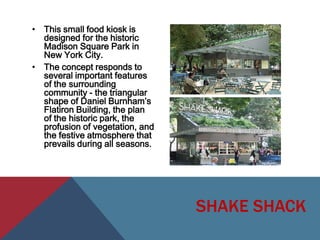
• This small food kiosk is
designed for the historic
Madison Square Park in
New York City.
• The concept responds to
several important features
of the surrounding
community - the triangular
shape of Daniel Burnham’s
Flatiron Building, the plan
of the historic park, the
profusion of vegetation, and
the festive atmosphere that
prevails during all seasons.

SHAKE SHACK
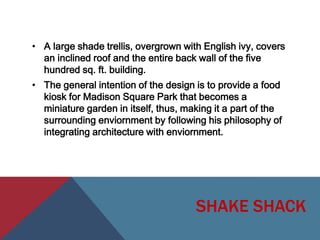
• A large shade trellis, overgrown with English ivy, covers
an inclined roof and the entire back wall of the five
hundred sq. ft. building.

• The general intention of the design is to provide a food
kiosk for Madison Square Park that becomes a
miniature garden in itself, thus, making it a part of the
surrounding enviornment by following his philosophy of
integrating architecture with enviornment.

SHAKE SHACK
• This environmental center explores all aspects of waterrelated science and culture.
• The concept, entitled “AQUATORIUM” is intended to
inspire a profound appreciation of humanity's
relationship to the earth's most precious resource.
• By means of sight, sound, and touch, the building and
its exhibition spaces are designed to tell the story of
water and people.

AQUATORIUM
CONCEPT
•

•

Located on top of hill,
this new facility is
integrated with its
circular site as an over
and underground
experience.
The building is
composed of lateral
information walls that
carry the exhibitions
from interior to exterior
and fuse with the
surrounding
topography.

AQUATORIUM
CONCEPT
•

These animated walls
divide the sections of
the museum into
culture, science,
habitat, technology, and
agriculture, using such
exhibit devices as
video, water events,
virtual reality
experiences, gardens,
natural phenomena and
hands-on displays that
explain the value of
water in the history of
civilization.

AQUATORIUM
CONCEPT
James Wines

James Wines

  • 1.
    MADE BY: UDAY YADAV 3RDYR – B ROLL NO.19
  • 2.
    LIFE HISTORY • JamesWines (born 1932) is an American artist/architect associated with Environmental design. • Wines is founder and president of SITE, a New York City -based architecture and environmental arts organization chartered in 1970. • The main focus of his design work is on green issues and the integration of buildings with their surrounding contexts.
  • 3.
    PHILOSOPHY ON HANDDRAWING • Wines strongly advocates hand drawing as a key to conceptual processes, along side computer-aided tools. • For most architects graphic representation is notional, technical, or illustrative and mainly used as an analytical tool to record design intentions, but he considers drawing more as a way of exploring the physical and psychological state of inclusion, suggesting that buildings can be fragmentary and ambiguous, as opposed to conventionally functional and determinate.
  • 4.
    • The fluidityof connection between mind and hand determines the quality of the architect you become. • It shapes your thinking and, therefore, the kind of firm in which you practice, including the creative level of people with whom you choose to associate. • A high aptitude in hand drawing influences the character and innovative level of the work you produce.
  • 5.
    • A numberof his drawings explore the integration of architecture and landscape. As a result, buildings often appear to be consumed by their own environment—or, seen more perversely, as victims of nature’s revenge. • In other examples, the renderings describe the need for more forested areas, water sources, and urban agriculture in the cityscape.
  • 6.
    • The primarypurpose is to explore the integration of architecture with context to a degree where it becomes difficult to discern where a building ends and the environment begins. • In this way, vegetation, topography, and climatic conditions can become as much a part of the aesthetic/functional fabric of a structure as masonry, glass, and steel.
  • 8.
    • The BESTProducts Company of Richmond, Virginia - a retail merchandiser of hard goods in the USA. The Peeling Project showroom was first of nine commercial buildings designed for the company. THE BEST PRODUCTS COMPANY
  • 9.
    • Portions ofthe brick veneer of the facade are peeled away precariously into space, revealing the beyond. This sculptural innovation produces the effect of architecture in a state of tentativeness and instability. • Since the project is not about formalist design, it explores the alternative relationships between art and buildings. THE BEST PRODUCTS COMPANY
  • 10.
    • The PeelingProject was followed by a series of eight more retail showrooms. • Each of these architectural concepts treated the standard "big box" prototype as the subject matter for an art statement. THE BEST PRODUCTS COMPANY
  • 11.
    • By meansof inversion, fragmentation, displacement, distortions of scale, and invasions of nature and by engaging people's reflex identification with commonplace buildings, the BEST showrooms also explore the social, psychological and aesthetic aspects of architecture. THE BEST PRODUCTS COMPANY
  • 12.
    • This smallfood kiosk is designed for the historic Madison Square Park in New York City. • The concept responds to several important features of the surrounding community - the triangular shape of Daniel Burnham’s Flatiron Building, the plan of the historic park, the profusion of vegetation, and the festive atmosphere that prevails during all seasons. SHAKE SHACK
  • 13.
    • A largeshade trellis, overgrown with English ivy, covers an inclined roof and the entire back wall of the five hundred sq. ft. building. • The general intention of the design is to provide a food kiosk for Madison Square Park that becomes a miniature garden in itself, thus, making it a part of the surrounding enviornment by following his philosophy of integrating architecture with enviornment. SHAKE SHACK
  • 14.
    • This environmentalcenter explores all aspects of waterrelated science and culture. • The concept, entitled “AQUATORIUM” is intended to inspire a profound appreciation of humanity's relationship to the earth's most precious resource. • By means of sight, sound, and touch, the building and its exhibition spaces are designed to tell the story of water and people. AQUATORIUM CONCEPT
  • 15.
    • • Located on topof hill, this new facility is integrated with its circular site as an over and underground experience. The building is composed of lateral information walls that carry the exhibitions from interior to exterior and fuse with the surrounding topography. AQUATORIUM CONCEPT
  • 16.
    • These animated walls dividethe sections of the museum into culture, science, habitat, technology, and agriculture, using such exhibit devices as video, water events, virtual reality experiences, gardens, natural phenomena and hands-on displays that explain the value of water in the history of civilization. AQUATORIUM CONCEPT