The document discusses critical thinking, 21st century learning skills, and how they relate to teaching and learning. It provides:
1) Learning intentions and success criteria for developing an understanding of critical thinking, linking it to 21st century skills and using technology resources.
2) Quotes about 21st century learning skills like problem solving, collaboration, and developing flexible thinkers; and how critical thinking benefits students and is important for employers.
3) A definition of critical thinking as recognizing and developing arguments using evidence to draw reasoned conclusions and solve problems.
In this document
Powered by AI
Defines critical thinking, links it to 21st Century learning, and outlines success criteria.
Describes teaching strategies to develop student understanding and collaborative working.
A group activity discussing 21st Century Learning quotes and their implications for learning.
Highlights the importance of liberal education, access to information, and benefits of critical thinking skills.
Emphasizes the need for deep thinking, creativity, and communication in modern workplaces.
Discusses critical thinking's significance in management roles and its desirability in employees.
Provides a definition of critical thinking as per The Australian National Curriculum, emphasizing its role in problem-solving.
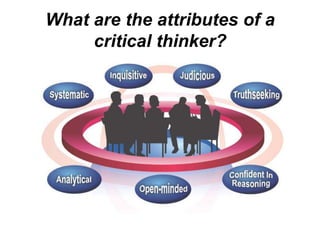
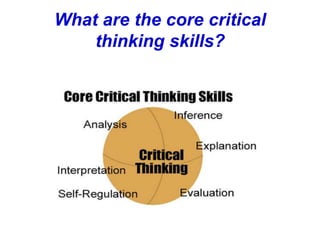
Questions about the qualities of critical thinkers and identifies core critical thinking skills.
Learning Intentions
• Todefine critical thinking
• Link critical thinking skills to 21st Century
Learning
• To develop an understanding of key
research, strategies, tools and available
resources using GRreader
• To understand where critical thinking sits
within the Tfel
4.
Success Criteria
We will:
•Define critical thinking
• Use critical thinking skills to complete a
group activity
• Use technology to access relevant
resources
5.
Tfel
3.1 Teach studentshow to learn
The teacher develops student understanding of learning
and expands their strategies for thinking, learning and
working collaboratively
3.3 Explore the construction of knowledge
The teacher shows that knowledge is open to question,
serves particular purposes and is shaped by culture and
experience
6.
Group Activity:
Read the quotes about 21st Century
Learning and critical thinking
Discuss and report:
a) What does the quote mean to you?
b) What implications does it have for learning at
RHS?
7.
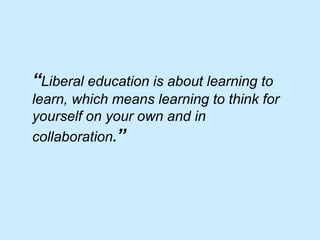
“Liberal education isabout learning to
learn, which means learning to think for
yourself on your own and in
collaboration.”
8.
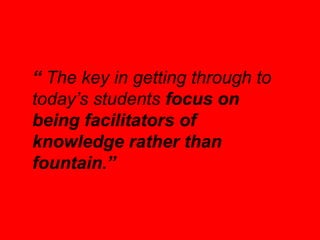
“ The keyin getting through to
today’s students focus on
being facilitators of
knowledge rather than
fountain.”
9.
“A teenager todaywith access to
the internet has more information
at their fingertips than entire
countries did just fifty years ago.”
10.
“ In general,students who develop
critical thinking skills are more able to:
• achieve better marks
• become less dependent on teachers and
textbooks
• create knowledge
• evaluate, challenge and change the
structures in society ”
11.
“To hold information-agejobs, though,
students also need to think deeply about
issues, solve problems creatively, work
in teams, communicate clearly in many
media, learn ever-changing technologies,
and deal with a flood of information.
The rapid changes in our world require
students to be flexible, to take the
initiative and lead when necessary, and to
produce something new and useful.”
12.
“Employers want workerswho
can think critically, solve
problems
creatively, innovate, collaborate,
and communicate.”
13.
“Critical thinking isessential in the
workplace, particularly for employees in
management roles. Their decisions can
affect an individual employee, a
department or the entire workforce.
Therefore, critical thinking skills are
sought-after professional
characteristics for employees with
high-level responsibilities and authority.”
14.
Definition of CriticalThinking in the
context of The Australian National
Curriculum
“Critical thinking is at the core of most intellectual
activity that involves students in learning to
recognise or develop an argument, use evidence in
support of that argument, draw reasoned
conclusions, and use information to solve
problems.”
“I prefer jobswhere the supervisor says
exactly what to do and exactly how to do it.“
“No matter how complex the problem, you
can bet there will be a simple solution.”
"I don't waste time looking things up.“
“I hate when teachers discuss problems
instead of just giving the answers.”
“If my belief is truly sincere, evidence to the
contrary is irrelevant.“
“Selling an idea is like selling cars, you say
whatever works."