WORK DONE
TEACHER: Mr. TRISTAN RYAN TINGSON
OBJECTIVES
At the end of this lesson, you will be able to:
1. calculate the dot or scalar product of vectors;
2. determine the work done by a force acting on a
system;
3. define work as a scalar or dot product of force and
displacement; and
4. interpret the work done by a force in one- dimension
as an area under a Force vs. Position curve.
2
MULTIPLICATION OF VECTORS
DOT PRODUCT
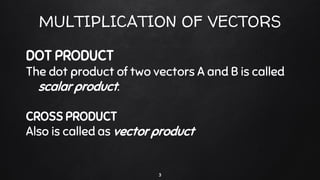
The dot product of two vectors A and B is called
scalar product.
CROSS PRODUCT
Also is called as vector product
3
DOT PRODUCT
4
4
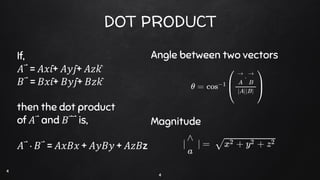
If,
𝐴⃑ = 𝐴𝑥𝑖̂+ 𝐴𝑦𝑗̂+ 𝐴𝑧𝑘̂
𝐵⃑ = 𝐵𝑥𝑖̂+ 𝐵𝑦𝑗̂+ 𝐵𝑧𝑘̂
then the dot product
of 𝐴⃑ and 𝐵⃑⃑ is,
𝐴⃑ ∙ 𝐵⃑ = 𝐴𝑥𝐵𝑥 + 𝐴𝑦𝐵𝑦 + 𝐴𝑧𝐵z
Angle between two vectors
Magnitude
5
EXAMPLE
MAGNITUDE OF INDIVIDUAL VECTORS
MAGNITUDE
SOLVE FOR THE COS θ
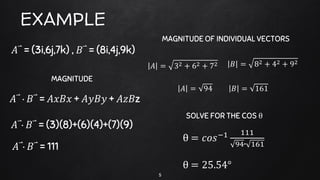
𝐴⃑ = (3i,6j,7k) , 𝐵⃑ = (8i,4j,9k)
𝐴⃑· 𝐵⃑ = (3)(8)+(6)(4)+(7)(9)
𝐴⃑· 𝐵⃑ = 111
𝐴 = 32 + 62 + 72 𝐵 = 82 + 42 + 92
𝐴 = 94 𝐵 = 161
θ = 𝑐𝑜𝑠−1 111
94· 161
θ = 25.54°
𝐴⃑ ∙ 𝐵⃑ = 𝐴𝑥𝐵𝑥 + 𝐴𝑦𝐵𝑦 + 𝐴𝑧𝐵z
CROSS PRODUCT
STEP 1: WRITE THE CROSS PRODUCT IN MATRIX FORMAT
STEP 2: WRITE THE COMPONENT USING THE DETERMINANT FROM THE STEP 1.
STEP 3: SIMPLIFY THE DETERMINANT
STEP 4: SIMPLIFY
𝐴⃑ × 𝐵⃑ =
𝑖 𝑗 𝑘
𝐴𝑥 𝐴𝑦 𝐴𝑧
𝐵𝑥 𝐵𝑦 𝐵𝑧
𝐴⃑ × 𝐵⃑ =
𝐴𝑦 𝐴𝑧
𝐵𝑦 𝐵𝑧
𝑖 −
𝐴𝑥 𝐴𝑧
𝐵𝑥 𝐵𝑧
j+
𝐴𝑥 𝐴𝑦
𝐵𝑥 𝐵𝑦
k
𝐴⃑ × 𝐵⃑ = [(𝐴𝑦𝐵𝑧 − 𝐴𝑧𝐵𝑦)𝑖̂ - (𝐴x𝐵z − 𝐴z𝐵x)𝑗̂ + (𝐴𝑥𝐵𝑦 − 𝐴𝑦𝐵𝑥)𝑘̂]
EXAMPLE
𝐴⃑ = -2𝑖̂+ 4𝑗̂-7 𝑘̂
𝐵⃑ = -4𝑖̂+ 10𝑗̂+ 5𝑘̂
𝐴⃑ × 𝐵⃑ =
𝑖 𝑗 𝑘
−2 4 −7
−4 10 5
𝐴⃑ × 𝐵⃑ =
4 −7
10 5
𝑖 −
−2 −7
−4 5
j+
−2 4
−4 10
k
𝐴⃑ × 𝐵⃑ = [(4·5 − (-7)·10)𝑖̂ - (-2·5 − (-7)·(-4))𝑗̂ + (-2·10 − 4·(-4))𝑘̂]
𝐴⃑ × 𝐵⃑ = [(20+70)𝑖̂ - (-10-28)𝑗̂ + (-20+16)𝑘̂] = [90𝑖̂ ,38 𝑗̂ ,-4 𝑘̂]
𝐴⃑ × 𝐵⃑ =
𝑖 𝑗 𝑘
−2 4 −7
−4 10 5
𝐴⃑ × 𝐵⃑ =
𝑖 𝑗 𝑘
−2 4 −7
−4 10 5
WORK
8
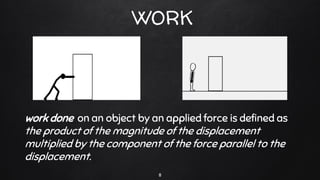
work done on an object by an applied force is defined as
the product of the magnitude of the displacement
multiplied by the component of the force parallel to the
displacement.
9
WORK
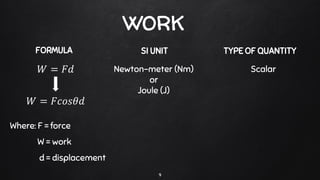
FORMULA SI UNIT TYPE OF QUANTITY
𝑊 = 𝐹𝑐𝑜𝑠𝜃𝑑
𝑊 = 𝐹𝑑
Where: F = force
W = work
d = displacement
Newton-meter (Nm)
or
Joule (J)
Scalar
10
WORK
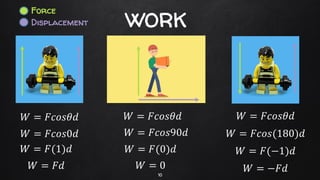
𝑊 = 𝐹𝑐𝑜𝑠𝜃𝑑
𝑊 = 𝐹𝑐𝑜𝑠0𝑑
𝑊 = 𝐹(1)𝑑
𝑊 = 𝐹𝑑
𝑊 = 𝐹𝑐𝑜𝑠𝜃𝑑
𝑊 = 𝐹𝑐𝑜𝑠90𝑑
𝑊 = 𝐹(0)𝑑
𝑊 = 0
𝑊 = 𝐹𝑐𝑜𝑠𝜃𝑑
𝑊 = 𝐹𝑐𝑜𝑠(180)𝑑
𝑊 = 𝐹(−1)𝑑
𝑊 = −𝐹𝑑
Force
Displacement
11
EXAMPLE 1
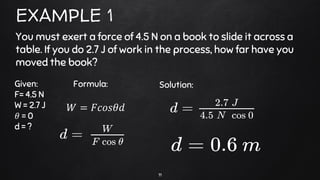
You must exert a force of 4.5 N on a book to slide it across a
table. If you do 2.7 J of work in the process, how far have you
moved the book?
Given:
F= 4.5 N
W = 2.7 J
𝜃 = 0
d = ?
Solution:
𝑊 = 𝐹𝑐𝑜𝑠𝜃𝑑
Formula:
12
EXAMPLE 2
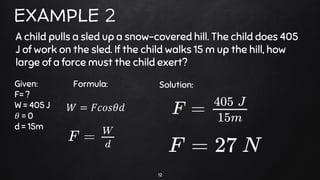
A child pulls a sled up a snow-covered hill. The child does 405
J of work on the sled. If the child walks 15 m up the hill, how
large of a force must the child exert?
Given:
F= ?
W = 405 J
𝜃 = 0
d = 15m
Solution:
𝑊 = 𝐹𝑐𝑜𝑠𝜃𝑑
Formula:
13
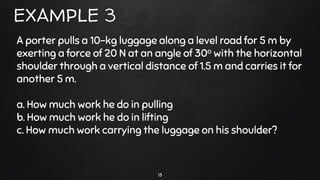
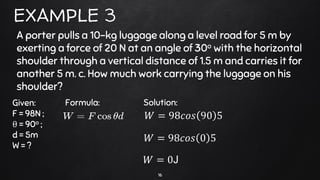
EXAMPLE 3
A porter pulls a 10-kg luggage along a level road for 5 m by
exerting a force of 20 N at an angle of 30o with the horizontal
shoulder through a vertical distance of 1.5 m and carries it for
another 5 m.
a. How much work he do in pulling
b. How much work he do in lifting
c. How much work carrying the luggage on his shoulder?
14
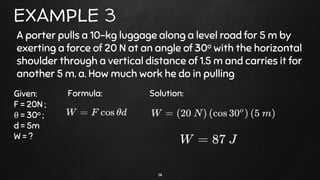
EXAMPLE 3
A porter pulls a 10-kg luggage along a level road for 5 m by
exerting a force of 20 N at an angle of 30o with the horizontal
shoulder through a vertical distance of 1.5 m and carries it for
another 5 m. a. How much work he do in pulling
Given:
F = 20N ;
θ = 30o ;
d = 5m
W = ?
Formula: Solution:
15
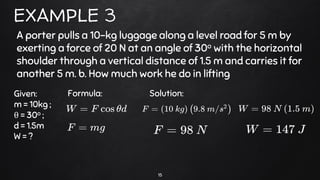
EXAMPLE 3
A porter pulls a 10-kg luggage along a level road for 5 m by
exerting a force of 20 N at an angle of 30o with the horizontal
shoulder through a vertical distance of 1.5 m and carries it for
another 5 m. b. How much work he do in lifting
Given:
m = 10kg ;
θ = 30o ;
d = 1.5m
W = ?
Formula: Solution:
16
EXAMPLE 3
A porter pulls a 10-kg luggage along a level road for 5 m by
exerting a force of 20 N at an angle of 30o with the horizontal
shoulder through a vertical distance of 1.5 m and carries it for
another 5 m. c. How much work carrying the luggage on his
shoulder?
Given:
F = 98N ;
θ = 90o ;
d = 5m
W = ?
Formula: Solution:
𝑊 = 98𝑐𝑜𝑠 90 5
𝑊 = 98𝑐𝑜𝑠 0 5
𝑊 = 0J
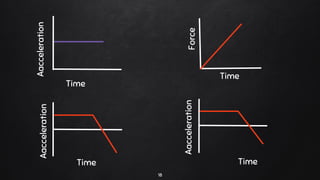
AREA UNDER THE
LINE ON THE GRAPH
18
Aacceleration
Time
Time
Force
Aacceleration
Time
Aacceleration
Time
19
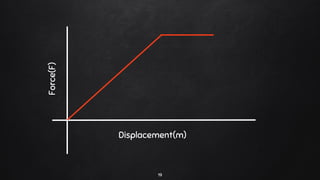
Force(F)
Displacement(m)
20
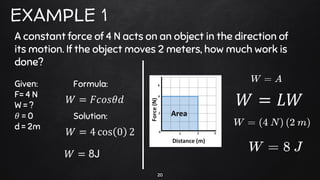
EXAMPLE 1
A constant force of 4 N acts on an object in the direction of
its motion. If the object moves 2 meters, how much work is
done?
Given:
F= 4 N
W = ?
𝜃 = 0
d = 2m
Solution:
𝑊 = 𝐹𝑐𝑜𝑠𝜃𝑑
Formula:
𝑊 = 4 cos 0 2
𝑊 = 8J
𝑊 = 𝐿𝑊
21
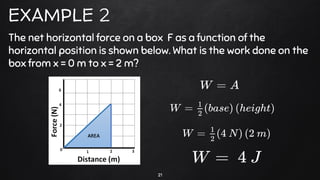
EXAMPLE 2
The net horizontal force on a box F as a function of the
horizontal position is shown below. What is the work done on the
box from x = 0 m to x = 2 m?
22
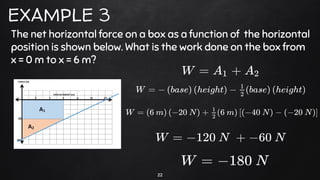
EXAMPLE 3
The net horizontal force on a box as a function of the horizontal
position is shown below. What is the work done on the box from
x = 0 m to x = 6 m?

WORK.pdf

  • 1.
    WORK DONE TEACHER: Mr.TRISTAN RYAN TINGSON
  • 2.
    OBJECTIVES At the endof this lesson, you will be able to: 1. calculate the dot or scalar product of vectors; 2. determine the work done by a force acting on a system; 3. define work as a scalar or dot product of force and displacement; and 4. interpret the work done by a force in one- dimension as an area under a Force vs. Position curve. 2
  • 3.
    MULTIPLICATION OF VECTORS DOTPRODUCT The dot product of two vectors A and B is called scalar product. CROSS PRODUCT Also is called as vector product 3
  • 4.
    DOT PRODUCT 4 4 If, 𝐴⃑ =𝐴𝑥𝑖̂+ 𝐴𝑦𝑗̂+ 𝐴𝑧𝑘̂ 𝐵⃑ = 𝐵𝑥𝑖̂+ 𝐵𝑦𝑗̂+ 𝐵𝑧𝑘̂ then the dot product of 𝐴⃑ and 𝐵⃑⃑ is, 𝐴⃑ ∙ 𝐵⃑ = 𝐴𝑥𝐵𝑥 + 𝐴𝑦𝐵𝑦 + 𝐴𝑧𝐵z Angle between two vectors Magnitude
  • 5.
    5 EXAMPLE MAGNITUDE OF INDIVIDUALVECTORS MAGNITUDE SOLVE FOR THE COS θ 𝐴⃑ = (3i,6j,7k) , 𝐵⃑ = (8i,4j,9k) 𝐴⃑· 𝐵⃑ = (3)(8)+(6)(4)+(7)(9) 𝐴⃑· 𝐵⃑ = 111 𝐴 = 32 + 62 + 72 𝐵 = 82 + 42 + 92 𝐴 = 94 𝐵 = 161 θ = 𝑐𝑜𝑠−1 111 94· 161 θ = 25.54° 𝐴⃑ ∙ 𝐵⃑ = 𝐴𝑥𝐵𝑥 + 𝐴𝑦𝐵𝑦 + 𝐴𝑧𝐵z
  • 6.
    CROSS PRODUCT STEP 1:WRITE THE CROSS PRODUCT IN MATRIX FORMAT STEP 2: WRITE THE COMPONENT USING THE DETERMINANT FROM THE STEP 1. STEP 3: SIMPLIFY THE DETERMINANT STEP 4: SIMPLIFY 𝐴⃑ × 𝐵⃑ = 𝑖 𝑗 𝑘 𝐴𝑥 𝐴𝑦 𝐴𝑧 𝐵𝑥 𝐵𝑦 𝐵𝑧 𝐴⃑ × 𝐵⃑ = 𝐴𝑦 𝐴𝑧 𝐵𝑦 𝐵𝑧 𝑖 − 𝐴𝑥 𝐴𝑧 𝐵𝑥 𝐵𝑧 j+ 𝐴𝑥 𝐴𝑦 𝐵𝑥 𝐵𝑦 k 𝐴⃑ × 𝐵⃑ = [(𝐴𝑦𝐵𝑧 − 𝐴𝑧𝐵𝑦)𝑖̂ - (𝐴x𝐵z − 𝐴z𝐵x)𝑗̂ + (𝐴𝑥𝐵𝑦 − 𝐴𝑦𝐵𝑥)𝑘̂]
  • 7.
    EXAMPLE 𝐴⃑ = -2𝑖̂+4𝑗̂-7 𝑘̂ 𝐵⃑ = -4𝑖̂+ 10𝑗̂+ 5𝑘̂ 𝐴⃑ × 𝐵⃑ = 𝑖 𝑗 𝑘 −2 4 −7 −4 10 5 𝐴⃑ × 𝐵⃑ = 4 −7 10 5 𝑖 − −2 −7 −4 5 j+ −2 4 −4 10 k 𝐴⃑ × 𝐵⃑ = [(4·5 − (-7)·10)𝑖̂ - (-2·5 − (-7)·(-4))𝑗̂ + (-2·10 − 4·(-4))𝑘̂] 𝐴⃑ × 𝐵⃑ = [(20+70)𝑖̂ - (-10-28)𝑗̂ + (-20+16)𝑘̂] = [90𝑖̂ ,38 𝑗̂ ,-4 𝑘̂] 𝐴⃑ × 𝐵⃑ = 𝑖 𝑗 𝑘 −2 4 −7 −4 10 5 𝐴⃑ × 𝐵⃑ = 𝑖 𝑗 𝑘 −2 4 −7 −4 10 5
  • 8.
    WORK 8 work done onan object by an applied force is defined as the product of the magnitude of the displacement multiplied by the component of the force parallel to the displacement.
  • 9.
    9 WORK FORMULA SI UNITTYPE OF QUANTITY 𝑊 = 𝐹𝑐𝑜𝑠𝜃𝑑 𝑊 = 𝐹𝑑 Where: F = force W = work d = displacement Newton-meter (Nm) or Joule (J) Scalar
  • 10.
    10 WORK 𝑊 = 𝐹𝑐𝑜𝑠𝜃𝑑 𝑊= 𝐹𝑐𝑜𝑠0𝑑 𝑊 = 𝐹(1)𝑑 𝑊 = 𝐹𝑑 𝑊 = 𝐹𝑐𝑜𝑠𝜃𝑑 𝑊 = 𝐹𝑐𝑜𝑠90𝑑 𝑊 = 𝐹(0)𝑑 𝑊 = 0 𝑊 = 𝐹𝑐𝑜𝑠𝜃𝑑 𝑊 = 𝐹𝑐𝑜𝑠(180)𝑑 𝑊 = 𝐹(−1)𝑑 𝑊 = −𝐹𝑑 Force Displacement
  • 11.
    11 EXAMPLE 1 You mustexert a force of 4.5 N on a book to slide it across a table. If you do 2.7 J of work in the process, how far have you moved the book? Given: F= 4.5 N W = 2.7 J 𝜃 = 0 d = ? Solution: 𝑊 = 𝐹𝑐𝑜𝑠𝜃𝑑 Formula:
  • 12.
    12 EXAMPLE 2 A childpulls a sled up a snow-covered hill. The child does 405 J of work on the sled. If the child walks 15 m up the hill, how large of a force must the child exert? Given: F= ? W = 405 J 𝜃 = 0 d = 15m Solution: 𝑊 = 𝐹𝑐𝑜𝑠𝜃𝑑 Formula:
  • 13.
    13 EXAMPLE 3 A porterpulls a 10-kg luggage along a level road for 5 m by exerting a force of 20 N at an angle of 30o with the horizontal shoulder through a vertical distance of 1.5 m and carries it for another 5 m. a. How much work he do in pulling b. How much work he do in lifting c. How much work carrying the luggage on his shoulder?
  • 14.
    14 EXAMPLE 3 A porterpulls a 10-kg luggage along a level road for 5 m by exerting a force of 20 N at an angle of 30o with the horizontal shoulder through a vertical distance of 1.5 m and carries it for another 5 m. a. How much work he do in pulling Given: F = 20N ; θ = 30o ; d = 5m W = ? Formula: Solution:
  • 15.
    15 EXAMPLE 3 A porterpulls a 10-kg luggage along a level road for 5 m by exerting a force of 20 N at an angle of 30o with the horizontal shoulder through a vertical distance of 1.5 m and carries it for another 5 m. b. How much work he do in lifting Given: m = 10kg ; θ = 30o ; d = 1.5m W = ? Formula: Solution:
  • 16.
    16 EXAMPLE 3 A porterpulls a 10-kg luggage along a level road for 5 m by exerting a force of 20 N at an angle of 30o with the horizontal shoulder through a vertical distance of 1.5 m and carries it for another 5 m. c. How much work carrying the luggage on his shoulder? Given: F = 98N ; θ = 90o ; d = 5m W = ? Formula: Solution: 𝑊 = 98𝑐𝑜𝑠 90 5 𝑊 = 98𝑐𝑜𝑠 0 5 𝑊 = 0J
  • 17.
    AREA UNDER THE LINEON THE GRAPH
  • 18.
  • 19.
  • 20.
    20 EXAMPLE 1 A constantforce of 4 N acts on an object in the direction of its motion. If the object moves 2 meters, how much work is done? Given: F= 4 N W = ? 𝜃 = 0 d = 2m Solution: 𝑊 = 𝐹𝑐𝑜𝑠𝜃𝑑 Formula: 𝑊 = 4 cos 0 2 𝑊 = 8J 𝑊 = 𝐿𝑊
  • 21.
    21 EXAMPLE 2 The nethorizontal force on a box F as a function of the horizontal position is shown below. What is the work done on the box from x = 0 m to x = 2 m?
  • 22.
    22 EXAMPLE 3 The nethorizontal force on a box as a function of the horizontal position is shown below. What is the work done on the box from x = 0 m to x = 6 m?