WORKING JOURNALIST ACT IN NEPAL
                          2013, January


Siromani Dhungana
Lecturer (Journalism and Mass Communication)
Tribhuvan University
Kathmandu, Nepal
Email: siromanidhungana@gmail.com | meshiromani@gmail.com
Definition of Working Journalist

   "working journalist" means a person who does
    communication related business or service as a main
    business and is engaged either whole-time or part-time in
    a communication enterprise in consideration for
    remuneration, other than a person who has managerial and
    administrative powers in a communication enterprise, and
    this term also includes a person who is related with the
    profession of journalism such as a chief editor, editor who
    collects, produces, edits or transmits news items in, or a
    correspondent, stringer, news reader, program director,
    translator, web designer, columnist, photo journalist, press
    cameraperson, cartoonist, program producer or operator,
    audio or language editor, in a communication enterprise.
                            - Working Journalists Act – 1993 (2051 BS)
Major provisions in law

   Not to engage in work without making appointment:
     Working Journalists Act – 1993 has ensured that
      media owner cannot engage any person in the
        functions of the post of working journalist without
        making appointment according to the law
   Posts to be filled by open competition
       Another provision of the act is that the media houses
        should fill the posts of working journalists required for
        company by making selection through open competition,
        in accordance with the prescribed procedures.
Major provisions in law
   Provision of Appointment in Contract Basis
       Media houses can appoint a person to the post of
        working journalist on the contract basis, specifying a
        specific period of time. However, according to the act,
        such appointments may be made only up to Fifteen
        percent of the total number of working journalists
        engaged in the concerned communication enterprise.
   Six months of Probation Period
       The act has provided a probation period of Six months.
        If performance of concerned journalist is not
        satisfactory during that period, the appointment may be
        voided.
Major provisions in law
   Working hours
     The time of work to be done by a working journalist
      in a week shall not exceed forty eight hours, and he
      or she shall get one day of weekly leave by rotation
      in each week
   Subject of Additional Facilities
     Ifany working journalist is engaged in work for
      more time than that specified pursuant to Sub-
      section (2), such additional facility as prescribed
      shall be provided to him or her.
Minimum Remuneration Fixation
Committee (MRFC)
   The act has envisaged a Minimum Remuneration
    Fixation Committee to make recommendation to the
    Government of Nepal as to the fixation of minimum
    remuneration to which working journalists are
    entitled and the review of such remuneration as
    required.
   If for any reason, the Committee is not able to fix the
    minimum remuneration of working journalists &
    recommend it to the Government, the government
    itself may fix the minimum remuneration of working
    journalists.
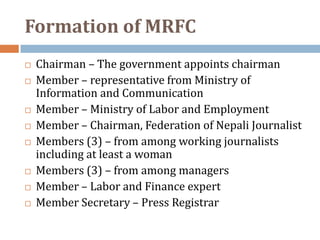
Formation of MRFC
   Chairman – The government appoints chairman
   Member – representative from Ministry of
    Information and Communication
   Member – Ministry of Labor and Employment
   Member – Chairman, Federation of Nepali Journalist
   Members (3) – from among working journalists
    including at least a woman
   Members (3) – from among managers
   Member – Labor and Finance expert
   Member Secretary – Press Registrar
Welfare Fund
   The act has made media houses liable to establish a
    welfare fund as prescribed for the rights, interests and
    security of working journalists.
   The act says, “Gratuity, provident fund and medial
    treatment and other facilities to which working
    journalists are entitled shall be as prescribed.”
   No change in the ownership of a communication
    enterprise shall be prejudicial to the service,
    conditions of service and facilities of working
    journalists serving in such a communication
    enterprise.
Minimum wages
   The government has approved the revision of minimum
    wage for working journalists in the country as proposed
    by the Minimum Wage Fixation Committee (MWFC) in
    2011.
   The government approved a minimum of 10,008 rupees
    as wage for a journalist working in a national level
    media house, whereas the minimum wage of staff
    working in such organization should be Rs 7,367.
   Likewise, the minimum wages proposed for journalists
    working in other publication houses other than national
    level media houses is Rs 7,228 while the minimum wage
    staff working in such organizations get is Rs 6,405.
Working Journalists Act and Its
Implementation
   Various media experts said the condition of working journalists in the
    nation have not improved even after the implementation of minimum
    wage system in media houses, adding that media owners are yet to
    change their age old mentality.
             - From http://www.nepalnews.com/archive/2011/mar/mar27/news09.php
   One needs to wait some time to see if the multimillion media houses
    are capable of implementing the act.
     - From http://www.groundreport.com/World/First-to-implement-working-journalist-
                                                                      act/2895600
   The new Working Journalists Act has been adopted and it provides for
    a minimum wage for journalists, but it is not being implemented
    properly. The wage commission has submitted a report to the
    government on how to decide the minimum wage.
      - From: An Agenda for Change: The Right to Freedom of Expression in Nepal
Freedom House Says:
   Many workers at Nepal’s news outlets do not receive
    professional training, are informally employed, and are
    paid well below prescribed minimum wages. In
    November 2010, a committee was established under
    Nepal’s Working Journalists’ Act to review journalists’
    extremely low wages, as well as their lack of retirement
    benefits, medical coverage, and insurance. There was no
    tangible progress on this subject in 2011. Since the
    government is a major source of advertising, journalists
    are often forced to self-censor their reporting in order to
    avoid any conflict with the ruling party.

            - From: http://www.freedomhouse.org/report/freedom-press/2012/nepal
Committee for the Fixation of
Minimum Wages reports:
   A committee formed under the Working
    Journalist Act pointed out in a report submitted
    November 24, 2010, that 37 percent of the
    country’s journalists are paid below the
    prescribed minimum wage, while 45 percent are
    working without letters of appointment. Among
    the media houses surveyed, 48 percent had
    failed to introduce basic measures such as
    retirement and welfare funds, medical cover and
    insurance.
Problem in Government-run Media

   Among the media groups reported by the FNJ to be
    in default on basic obligations under the Working
    Journalist Act is the government-owned
    Gorkhapatra Sansthan. Though statutory wage
    levels are formally notified within this group, which
    publishes the Nepali language Gorkhapatra and the
    English-language Rising Nepal, a large number of
    working journalists – well beyond the 15 percent
    limit sanctioned under the WJA – are believed to be
    employed contract.
        -From: http://asiapacific.ifj.org/en/articles/in-defence-of-press-
             freedom-in-south-asia-journalists-organise-for-a-new-deal
What is way forward?

   Journalism is not just like other profession. It
    has enormous social responsibility. In Nepal,
    however, journalism is yet to be a lucrative
    profession. Sincere effort from government,
    media owners, trade unions and even journalists
    is needed to implement the act effectively.
    Otherwise, journalism will be a profession of
    emotion rather than maturity.
Paper presented at MBMC under
 Tribhuvan University, Kathmandu, Nepal


Siromani Dhungana
Researcher, Journalist & Media Educator
Kathmandu, Nepal
Email: siromanidhungana@gmail.com | meshiromani@gmail.com

Working journalist act in nepal

  • 1.
    WORKING JOURNALIST ACTIN NEPAL 2013, January Siromani Dhungana Lecturer (Journalism and Mass Communication) Tribhuvan University Kathmandu, Nepal Email: siromanidhungana@gmail.com | meshiromani@gmail.com
  • 2.
    Definition of WorkingJournalist  "working journalist" means a person who does communication related business or service as a main business and is engaged either whole-time or part-time in a communication enterprise in consideration for remuneration, other than a person who has managerial and administrative powers in a communication enterprise, and this term also includes a person who is related with the profession of journalism such as a chief editor, editor who collects, produces, edits or transmits news items in, or a correspondent, stringer, news reader, program director, translator, web designer, columnist, photo journalist, press cameraperson, cartoonist, program producer or operator, audio or language editor, in a communication enterprise. - Working Journalists Act – 1993 (2051 BS)
  • 3.
    Major provisions inlaw  Not to engage in work without making appointment:  Working Journalists Act – 1993 has ensured that media owner cannot engage any person in the functions of the post of working journalist without making appointment according to the law  Posts to be filled by open competition  Another provision of the act is that the media houses should fill the posts of working journalists required for company by making selection through open competition, in accordance with the prescribed procedures.
  • 4.
    Major provisions inlaw  Provision of Appointment in Contract Basis  Media houses can appoint a person to the post of working journalist on the contract basis, specifying a specific period of time. However, according to the act, such appointments may be made only up to Fifteen percent of the total number of working journalists engaged in the concerned communication enterprise.  Six months of Probation Period  The act has provided a probation period of Six months. If performance of concerned journalist is not satisfactory during that period, the appointment may be voided.
  • 5.
    Major provisions inlaw  Working hours  The time of work to be done by a working journalist in a week shall not exceed forty eight hours, and he or she shall get one day of weekly leave by rotation in each week  Subject of Additional Facilities  Ifany working journalist is engaged in work for more time than that specified pursuant to Sub- section (2), such additional facility as prescribed shall be provided to him or her.
  • 6.
    Minimum Remuneration Fixation Committee(MRFC)  The act has envisaged a Minimum Remuneration Fixation Committee to make recommendation to the Government of Nepal as to the fixation of minimum remuneration to which working journalists are entitled and the review of such remuneration as required.  If for any reason, the Committee is not able to fix the minimum remuneration of working journalists & recommend it to the Government, the government itself may fix the minimum remuneration of working journalists.
  • 7.
    Formation of MRFC  Chairman – The government appoints chairman  Member – representative from Ministry of Information and Communication  Member – Ministry of Labor and Employment  Member – Chairman, Federation of Nepali Journalist  Members (3) – from among working journalists including at least a woman  Members (3) – from among managers  Member – Labor and Finance expert  Member Secretary – Press Registrar
  • 8.
    Welfare Fund  The act has made media houses liable to establish a welfare fund as prescribed for the rights, interests and security of working journalists.  The act says, “Gratuity, provident fund and medial treatment and other facilities to which working journalists are entitled shall be as prescribed.”  No change in the ownership of a communication enterprise shall be prejudicial to the service, conditions of service and facilities of working journalists serving in such a communication enterprise.
  • 9.
    Minimum wages  The government has approved the revision of minimum wage for working journalists in the country as proposed by the Minimum Wage Fixation Committee (MWFC) in 2011.  The government approved a minimum of 10,008 rupees as wage for a journalist working in a national level media house, whereas the minimum wage of staff working in such organization should be Rs 7,367.  Likewise, the minimum wages proposed for journalists working in other publication houses other than national level media houses is Rs 7,228 while the minimum wage staff working in such organizations get is Rs 6,405.
  • 10.
    Working Journalists Actand Its Implementation  Various media experts said the condition of working journalists in the nation have not improved even after the implementation of minimum wage system in media houses, adding that media owners are yet to change their age old mentality. - From http://www.nepalnews.com/archive/2011/mar/mar27/news09.php  One needs to wait some time to see if the multimillion media houses are capable of implementing the act. - From http://www.groundreport.com/World/First-to-implement-working-journalist- act/2895600  The new Working Journalists Act has been adopted and it provides for a minimum wage for journalists, but it is not being implemented properly. The wage commission has submitted a report to the government on how to decide the minimum wage. - From: An Agenda for Change: The Right to Freedom of Expression in Nepal
  • 11.
    Freedom House Says:  Many workers at Nepal’s news outlets do not receive professional training, are informally employed, and are paid well below prescribed minimum wages. In November 2010, a committee was established under Nepal’s Working Journalists’ Act to review journalists’ extremely low wages, as well as their lack of retirement benefits, medical coverage, and insurance. There was no tangible progress on this subject in 2011. Since the government is a major source of advertising, journalists are often forced to self-censor their reporting in order to avoid any conflict with the ruling party. - From: http://www.freedomhouse.org/report/freedom-press/2012/nepal
  • 12.
    Committee for theFixation of Minimum Wages reports:  A committee formed under the Working Journalist Act pointed out in a report submitted November 24, 2010, that 37 percent of the country’s journalists are paid below the prescribed minimum wage, while 45 percent are working without letters of appointment. Among the media houses surveyed, 48 percent had failed to introduce basic measures such as retirement and welfare funds, medical cover and insurance.
  • 13.
    Problem in Government-runMedia  Among the media groups reported by the FNJ to be in default on basic obligations under the Working Journalist Act is the government-owned Gorkhapatra Sansthan. Though statutory wage levels are formally notified within this group, which publishes the Nepali language Gorkhapatra and the English-language Rising Nepal, a large number of working journalists – well beyond the 15 percent limit sanctioned under the WJA – are believed to be employed contract. -From: http://asiapacific.ifj.org/en/articles/in-defence-of-press- freedom-in-south-asia-journalists-organise-for-a-new-deal
  • 14.
    What is wayforward?  Journalism is not just like other profession. It has enormous social responsibility. In Nepal, however, journalism is yet to be a lucrative profession. Sincere effort from government, media owners, trade unions and even journalists is needed to implement the act effectively. Otherwise, journalism will be a profession of emotion rather than maturity.
  • 15.
    Paper presented atMBMC under Tribhuvan University, Kathmandu, Nepal Siromani Dhungana Researcher, Journalist & Media Educator Kathmandu, Nepal Email: siromanidhungana@gmail.com | meshiromani@gmail.com