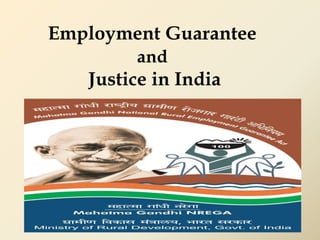
Employment Guarantee
and
Justice in India
Contents:
 Historical evolution of ‘Employment Guarantee
Schemes’
 Shifts in theoretical understanding
 Court Judgments
 Laws
 Policy documents
Historical Evolution of
employment Guarantee
Schemes
Employment Guarantee in the
International Perspective
• Structural adjustment, financial liberalization
and globalization have resulted in uneven and
often disappointing patterns of socioeconomic
development.
• inability of the private sector to create a
sufficient number of jobs to absorb surplus
labour.
• Various other reasons for joblessness
Employment Guarantee in the
International Perspective
• Structural adjustment, financial liberalization
and globalization have resulted in uneven and
often disappointing patterns of socioeconomic
development.
• inability of the private sector to create a
sufficient number of jobs to absorb surplus
labour.
• Various other reasons for joblessness
Contd...
• Over the years, many countries have undertaken
what has variably been known as “employment
guarantee schemes,” public employment
programs,” “food for work,” and “public works
programs.”
• projects have been implemented to provide the
means of survival to those most affected by
natural disasters and economic crises
Contd...
• 1930- Period of Great Depression
• Widespread unemployment in the US
• President Franklin D Roosevelt provided funds
either directly to recipients or to the states for
maintaining a minimum standard of living.
• federal programs were established that
provided additional welfare benefits, including
medical care (medicaid), public housing, food
stamps, and Supplemental Security Income
(SSI).
Theoretical Understanding
• Government as ‘Employer of last Resort’
• Redistribution of Income
Theories in Practice
• Employment Generation Programs during
Pre liberalisation Period.
• Employment Generation Programs during
Post liberalisation Period
Laws
Labour Laws
• Articles 14-16, 19(1)(c), 23-24, 38, and 41-43A concerned
with labour rights.
•Article 16 extends the right of "equality of opportunity" for
employment or appointment under the state.
•Article 23 prohibits all types of trafficking and forced labour.
•Article 24 prohibits child labour under 14 years old in
factories, mines etc.
•Article 41 creates a "right to work", which the National rural
employment Act 2005 guarantees
•Article 42 requires the state to "make provision for securing
just and human conditions of work and for maternity relief.”
•Article 43 talks about right to a living wage and condition of
work.
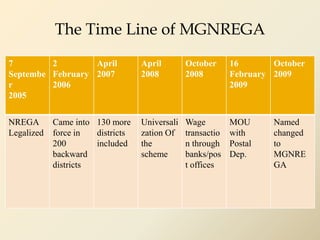
The Time Line of MGNREGA
7
Septembe
r
2005
2
February
2006
April
2007
April
2008
October
2008
16
February
2009
October
2009
NREGA
Legalized
Came into
force in
200
backward
districts
130 more
districts
included
Universali
zation Of
the
scheme
Wage
transactio
n through
banks/pos
t offices
MOU
with
Postal
Dep.
Named
changed
to
MGNRE
GA
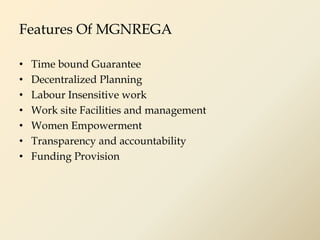
Features Of MGNREGA
• Time bound Guarantee
• Decentralized Planning
• Labour Insensitive work
• Work site Facilities and management
• Women Empowerment
• Transparency and accountability
• Funding Provision
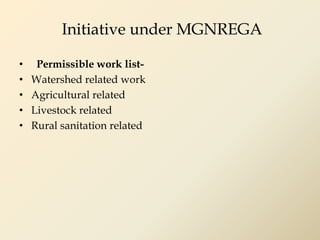
Initiative under MGNREGA
• Permissible work list-
• Watershed related work
• Agricultural related
• Livestock related
• Rural sanitation related
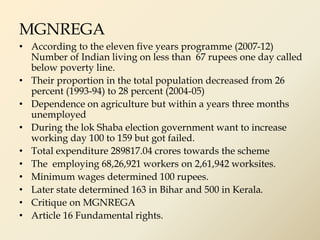
MGNREGA
• According to the eleven five years programme (2007-12)
Number of Indian living on less than 67 rupees one day called
below poverty line.
• Their proportion in the total population decreased from 26
percent (1993-94) to 28 percent (2004-05)
• Dependence on agriculture but within a years three months
unemployed
• During the lok Shaba election government want to increase
working day 100 to 159 but got failed.
• Total expenditure 289817.04 crores towards the scheme
• The employing 68,26,921 workers on 2,61,942 worksites.
• Minimum wages determined 100 rupees.
• Later state determined 163 in Bihar and 500 in Kerala.
• Critique on MGNREGA
• Article 16 Fundamental rights.
Protective Provisions for Women
Employees
• Maternity Benefit Act, 1961.
• The maternity leave got increase as for the central Civil
Service- 1972.
• Section 22(2) of the Factories Act, 1948.
• Section 66(1)(b) of the Factories Act, 1948
• Section 46(1)(b) of the Mines Act, 1952
Critique. No modification after 1972.
Employment and Disability Act
• Act may be called the Persons With Disabilities (Equal
Opportunities, Protection of Rights and Full Participation) Act, 1995.
• 3% of vacancies in government employment shall be reserved for
people with disabilities.
• 1% each for the persons suffering from
– Blindness or low vision
– Hearing impairment
– Locomotor Disabilities & Cerebral Palsy etc.
• Critique on disability act
 Comparison with the Americans with Disabilities Act, 1990"
(ADA).
Provision for SC/ST in Employment
• The 85th amendment of the Constitution restores
reservation in promotion in government jobs to member
of Scheduled Castes and Scheduled Tribes.
• Article 335 provides that the State shall consider the
claim of members of SC/ST for making reservation in
services, keeping in mind the efficiency of the
administration.
Court Judgments
Vishaka and others
vs
State of Rajasthan and others
Date of Decision: 13 August 1997
• In 1992, Bhanwari Devi a social worker
in Rajasthan was brutally gang raped by a number of
upper class men
• Vishakha and other women groups filed PIL against
State of Rajasthan and Union of India to enforce the
fundamental rights of working women
• The petition, resulted in what are popularly known as
the Vishaka Guidelines.
Continued…
• In India, before 1997, there were no formal guidelines for
how an incident involving sexual harassment at
workplace should be dealt by an employer
• The Vishaka Guidelines were a set of procedural
guidelines for use in India in cases of sexual harassment
• provide a safe working environment
• Sexual harassment should be affirmatively discussed at
workers' meetings, employer-employee meetings, etc.
• The employer should assist persons affected in cases of
sexual harassment by outsiders.
• Names and contact numbers of members of the
complaints committee must be prominently displayed
Ranjit Kumar Rajak
Vs
State Bank of India
DOJ- 26/5/2009
Judgment of the Bombay High court:
The Petitioner in this case underwent a renal transplant
in 2004. he applied to the post of a probationary officer
in the State Bank of India. After a medical test, the bank
rejected him on the ground that he was found medically
unfit for the post.
Continued…
• The petitioner approached the Bombay High Court by a writ petition
claiming that despite medical reports that indicate his fitness to perform
his duties, he was denied being considered for employment.
• The main question, according to the Court, was “whether a person who is
fully qualified for a post because of his past or present medical condition which
otherwise did not interfere with his fitness to dispense the duties of his post, be
denied employment because of the financial burden that would be cast on the
employer.”
• The court recognized that India had signed and ratified the CRPD and
that Article 27 of the Convention recognizes the right of persons with
disability to be "accepted in the labour market and work environment
that is open, inclusive and accessible to persons with disabilities.
Continued…
• The court incorporated the right to reasonable
accommodation by declaring that “Reasonable
accommodation, if read into Article 21, based on the U.N
Protocol, would not be in conflict with municipal law. It
would give added life and dimension to the ever
expanding concept of life and its true enjoyment.”
• Following this, the court concluded that the bank has a
duty to provide reasonable accommodation to the
petitioner subject to any undue burden.
• Consequently, the court allowed the petition and directed
that the Petitioner be offered appointment and allowed to
join the post.
Policy Documents
Directive Principle of State Policy:
• (38)State to secure a social order for the promotion of
welfare of the people.
• The state shall strive to promote the welfare of the people
by securing and protecting as effectively as it may a social
order in which justice, social, economic and political, shall
inform all the institutions of the national life.
• The state shall, in particular , strive to minimise the
inequalities in income, and endeavour to eliminate
inequalities in status , facilities and opportunities, not
only amongst individuals but also amongst groups of
people residing in different areas or engaged in different
vocations.
Contd…
• (39) Certain principles of policy to be followed by the state. The
state shall, in particular, direct its policy towards securing—
a) That the citizens, men and women equally, have the right to an
adequate means of livelihood;
d) That there is equal pay for equal work for both men and
women;
• (43) living wage, etc, for workers.- The state shall endeavour to
secure, by suitable legislation or economic organization or in
any other way, to all workers, agricultural, industrial or
otherwise, work a living wage, conditions of work ensuring a
decent standard of life and full enjoyment of leisure, social and
cultural opportunities, in particular, the state shall endeavour to
promote cottage industries on an individual or co-operative
basis in rural areas.
• (Source: The Constitution of India.)
Reservation as a Policy – Employment:
• The Indian Government’s make special provisions to
promote the educational and economic interest of the
SCs/STs and to provide legal and other safeguards
against discrimination in multiple spheres.
• The State to make provision for reservation in matters of
promotion to any group or groups of posts in the
services under the State in favor of the SCs and STs.
(Source: www.dpe.nic.in)
MGNREGA
• Wage Rate policy-
I. Balance a wage rate that provides a strong social net
without competing with market rates.
II. Section 6(1) specifically authorizes the central
government to notify a wage rate, notwithstanding
anything contained in the minimum Wages Act.
III. There is considerable discussion challenging delinking
MGNREGA wage rates form minimum wages for
agricultural labourers, as nothing should be less than
the minimum.
Contd…
• Institutional Accounts for wage disbursement
Towards this end, schedule II of the Act was amended to make
wage payments through institutional accounts statutory.
• Model for timely wage disbursement
NREGA workers were opened to reduce leakages in cash transfer,
payments have been delayed both because of delayed
measurements, or lack of financial services outreach.
• Establishing a Technical Support Unit at Gram
Panchayat
The skills of existing staff will be upgraded through training. Priority
is being given to extremism affected districts, and districts where the
annual MGNREGA expenditure is above Rs. 1 billion.
Contd…
• Convergence
Primary earth-work under MGNREGA can be firmed up under
another Programme for roads like PMGSY, tanks and check-bunds
under irrigation schemes.
• Professional Institutional Network
This system has the advantage of relating problem analysis with
possible solutions, assessing what factors work positively to promote
the Act’s objectives, and to document and share insights and practices
for cross- learning.
• Knowledge Resource Center
MGNREGA has shown that transparency in the processes can be
enhanced if proper infrastructure for transaction is put in place.
(Source: Sharma A.(2010).Right- based Legal Guarantee as Development
Policy: The Mahatma Gandhi Rural Employment Guarantee Act.)
On a Concluding Note
• Employment security
• Budget allocation for MNREGA
• Women and employment
• Disabled persons and employment
• Policies regarding the employment
Thank You
H2015RDGM031 Ms. P. Shravani
H2015RDGM032 Ms. Aashna Singh
H2015RDGM033 Mr. Md. Tanveer R
H2015RDG034 Mr. Mahamood. M.K
H2015RDG035 Ms. Minakshi Patel
Reference;
• R. M. U. SULEMAN(1976),Employment, Income Distribution and
Social Justice, Pakistan Economic and Social Review , Vol. 14, No. 1/4,
pp. 101-118
•Sharma A.(2010).Right- based Legal Guarantee as Development Policy:
The Mahatma Gandhi Rural Employment Guarantee Act.
•http://ethesis.nitrkl.ac.in/3620/1/Soumya_Mohanty_410HS1006.pdf
•http://www.ifmr.co.in/blog/2013/05/08/an-overview-of-the-features-of-the-
•mahatma-gandhi-national-rural-employment-guarantee-act-2005/
• http://indiatogether.org/health/disability/dact.htm
• http://socialjustice.nic.in/pwdact1995.php?pageid=5

Final sj se presentation group no 7 (1)

  • 1.
  • 2.
    Contents:  Historical evolutionof ‘Employment Guarantee Schemes’  Shifts in theoretical understanding  Court Judgments  Laws  Policy documents
  • 3.
  • 4.
    Employment Guarantee inthe International Perspective • Structural adjustment, financial liberalization and globalization have resulted in uneven and often disappointing patterns of socioeconomic development. • inability of the private sector to create a sufficient number of jobs to absorb surplus labour. • Various other reasons for joblessness
  • 5.
    Employment Guarantee inthe International Perspective • Structural adjustment, financial liberalization and globalization have resulted in uneven and often disappointing patterns of socioeconomic development. • inability of the private sector to create a sufficient number of jobs to absorb surplus labour. • Various other reasons for joblessness
  • 6.
    Contd... • Over theyears, many countries have undertaken what has variably been known as “employment guarantee schemes,” public employment programs,” “food for work,” and “public works programs.” • projects have been implemented to provide the means of survival to those most affected by natural disasters and economic crises
  • 7.
    Contd... • 1930- Periodof Great Depression • Widespread unemployment in the US • President Franklin D Roosevelt provided funds either directly to recipients or to the states for maintaining a minimum standard of living. • federal programs were established that provided additional welfare benefits, including medical care (medicaid), public housing, food stamps, and Supplemental Security Income (SSI).
  • 8.
  • 9.
    • Government as‘Employer of last Resort’ • Redistribution of Income
  • 10.
    Theories in Practice •Employment Generation Programs during Pre liberalisation Period. • Employment Generation Programs during Post liberalisation Period
  • 11.
  • 12.
    Labour Laws • Articles14-16, 19(1)(c), 23-24, 38, and 41-43A concerned with labour rights. •Article 16 extends the right of "equality of opportunity" for employment or appointment under the state. •Article 23 prohibits all types of trafficking and forced labour. •Article 24 prohibits child labour under 14 years old in factories, mines etc. •Article 41 creates a "right to work", which the National rural employment Act 2005 guarantees •Article 42 requires the state to "make provision for securing just and human conditions of work and for maternity relief.” •Article 43 talks about right to a living wage and condition of work.
  • 13.
    The Time Lineof MGNREGA 7 Septembe r 2005 2 February 2006 April 2007 April 2008 October 2008 16 February 2009 October 2009 NREGA Legalized Came into force in 200 backward districts 130 more districts included Universali zation Of the scheme Wage transactio n through banks/pos t offices MOU with Postal Dep. Named changed to MGNRE GA
  • 14.
    Features Of MGNREGA •Time bound Guarantee • Decentralized Planning • Labour Insensitive work • Work site Facilities and management • Women Empowerment • Transparency and accountability • Funding Provision
  • 15.
    Initiative under MGNREGA •Permissible work list- • Watershed related work • Agricultural related • Livestock related • Rural sanitation related
  • 16.
    MGNREGA • According tothe eleven five years programme (2007-12) Number of Indian living on less than 67 rupees one day called below poverty line. • Their proportion in the total population decreased from 26 percent (1993-94) to 28 percent (2004-05) • Dependence on agriculture but within a years three months unemployed • During the lok Shaba election government want to increase working day 100 to 159 but got failed. • Total expenditure 289817.04 crores towards the scheme • The employing 68,26,921 workers on 2,61,942 worksites. • Minimum wages determined 100 rupees. • Later state determined 163 in Bihar and 500 in Kerala. • Critique on MGNREGA • Article 16 Fundamental rights.
  • 17.
    Protective Provisions forWomen Employees • Maternity Benefit Act, 1961. • The maternity leave got increase as for the central Civil Service- 1972. • Section 22(2) of the Factories Act, 1948. • Section 66(1)(b) of the Factories Act, 1948 • Section 46(1)(b) of the Mines Act, 1952 Critique. No modification after 1972.
  • 18.
    Employment and DisabilityAct • Act may be called the Persons With Disabilities (Equal Opportunities, Protection of Rights and Full Participation) Act, 1995. • 3% of vacancies in government employment shall be reserved for people with disabilities. • 1% each for the persons suffering from – Blindness or low vision – Hearing impairment – Locomotor Disabilities & Cerebral Palsy etc. • Critique on disability act  Comparison with the Americans with Disabilities Act, 1990" (ADA).
  • 19.
    Provision for SC/STin Employment • The 85th amendment of the Constitution restores reservation in promotion in government jobs to member of Scheduled Castes and Scheduled Tribes. • Article 335 provides that the State shall consider the claim of members of SC/ST for making reservation in services, keeping in mind the efficiency of the administration.
  • 20.
  • 21.
    Vishaka and others vs Stateof Rajasthan and others Date of Decision: 13 August 1997 • In 1992, Bhanwari Devi a social worker in Rajasthan was brutally gang raped by a number of upper class men • Vishakha and other women groups filed PIL against State of Rajasthan and Union of India to enforce the fundamental rights of working women • The petition, resulted in what are popularly known as the Vishaka Guidelines.
  • 22.
    Continued… • In India,before 1997, there were no formal guidelines for how an incident involving sexual harassment at workplace should be dealt by an employer • The Vishaka Guidelines were a set of procedural guidelines for use in India in cases of sexual harassment • provide a safe working environment • Sexual harassment should be affirmatively discussed at workers' meetings, employer-employee meetings, etc. • The employer should assist persons affected in cases of sexual harassment by outsiders. • Names and contact numbers of members of the complaints committee must be prominently displayed
  • 23.
    Ranjit Kumar Rajak Vs StateBank of India DOJ- 26/5/2009 Judgment of the Bombay High court: The Petitioner in this case underwent a renal transplant in 2004. he applied to the post of a probationary officer in the State Bank of India. After a medical test, the bank rejected him on the ground that he was found medically unfit for the post.
  • 24.
    Continued… • The petitionerapproached the Bombay High Court by a writ petition claiming that despite medical reports that indicate his fitness to perform his duties, he was denied being considered for employment. • The main question, according to the Court, was “whether a person who is fully qualified for a post because of his past or present medical condition which otherwise did not interfere with his fitness to dispense the duties of his post, be denied employment because of the financial burden that would be cast on the employer.” • The court recognized that India had signed and ratified the CRPD and that Article 27 of the Convention recognizes the right of persons with disability to be "accepted in the labour market and work environment that is open, inclusive and accessible to persons with disabilities.
  • 25.
    Continued… • The courtincorporated the right to reasonable accommodation by declaring that “Reasonable accommodation, if read into Article 21, based on the U.N Protocol, would not be in conflict with municipal law. It would give added life and dimension to the ever expanding concept of life and its true enjoyment.” • Following this, the court concluded that the bank has a duty to provide reasonable accommodation to the petitioner subject to any undue burden. • Consequently, the court allowed the petition and directed that the Petitioner be offered appointment and allowed to join the post.
  • 26.
  • 27.
    Directive Principle ofState Policy: • (38)State to secure a social order for the promotion of welfare of the people. • The state shall strive to promote the welfare of the people by securing and protecting as effectively as it may a social order in which justice, social, economic and political, shall inform all the institutions of the national life. • The state shall, in particular , strive to minimise the inequalities in income, and endeavour to eliminate inequalities in status , facilities and opportunities, not only amongst individuals but also amongst groups of people residing in different areas or engaged in different vocations.
  • 28.
    Contd… • (39) Certainprinciples of policy to be followed by the state. The state shall, in particular, direct its policy towards securing— a) That the citizens, men and women equally, have the right to an adequate means of livelihood; d) That there is equal pay for equal work for both men and women; • (43) living wage, etc, for workers.- The state shall endeavour to secure, by suitable legislation or economic organization or in any other way, to all workers, agricultural, industrial or otherwise, work a living wage, conditions of work ensuring a decent standard of life and full enjoyment of leisure, social and cultural opportunities, in particular, the state shall endeavour to promote cottage industries on an individual or co-operative basis in rural areas. • (Source: The Constitution of India.)
  • 29.
    Reservation as aPolicy – Employment: • The Indian Government’s make special provisions to promote the educational and economic interest of the SCs/STs and to provide legal and other safeguards against discrimination in multiple spheres. • The State to make provision for reservation in matters of promotion to any group or groups of posts in the services under the State in favor of the SCs and STs. (Source: www.dpe.nic.in)
  • 30.
    MGNREGA • Wage Ratepolicy- I. Balance a wage rate that provides a strong social net without competing with market rates. II. Section 6(1) specifically authorizes the central government to notify a wage rate, notwithstanding anything contained in the minimum Wages Act. III. There is considerable discussion challenging delinking MGNREGA wage rates form minimum wages for agricultural labourers, as nothing should be less than the minimum.
  • 31.
    Contd… • Institutional Accountsfor wage disbursement Towards this end, schedule II of the Act was amended to make wage payments through institutional accounts statutory. • Model for timely wage disbursement NREGA workers were opened to reduce leakages in cash transfer, payments have been delayed both because of delayed measurements, or lack of financial services outreach. • Establishing a Technical Support Unit at Gram Panchayat The skills of existing staff will be upgraded through training. Priority is being given to extremism affected districts, and districts where the annual MGNREGA expenditure is above Rs. 1 billion.
  • 32.
    Contd… • Convergence Primary earth-workunder MGNREGA can be firmed up under another Programme for roads like PMGSY, tanks and check-bunds under irrigation schemes. • Professional Institutional Network This system has the advantage of relating problem analysis with possible solutions, assessing what factors work positively to promote the Act’s objectives, and to document and share insights and practices for cross- learning. • Knowledge Resource Center MGNREGA has shown that transparency in the processes can be enhanced if proper infrastructure for transaction is put in place. (Source: Sharma A.(2010).Right- based Legal Guarantee as Development Policy: The Mahatma Gandhi Rural Employment Guarantee Act.)
  • 33.
    On a ConcludingNote • Employment security • Budget allocation for MNREGA • Women and employment • Disabled persons and employment • Policies regarding the employment
  • 34.
    Thank You H2015RDGM031 Ms.P. Shravani H2015RDGM032 Ms. Aashna Singh H2015RDGM033 Mr. Md. Tanveer R H2015RDG034 Mr. Mahamood. M.K H2015RDG035 Ms. Minakshi Patel
  • 35.
    Reference; • R. M.U. SULEMAN(1976),Employment, Income Distribution and Social Justice, Pakistan Economic and Social Review , Vol. 14, No. 1/4, pp. 101-118 •Sharma A.(2010).Right- based Legal Guarantee as Development Policy: The Mahatma Gandhi Rural Employment Guarantee Act. •http://ethesis.nitrkl.ac.in/3620/1/Soumya_Mohanty_410HS1006.pdf •http://www.ifmr.co.in/blog/2013/05/08/an-overview-of-the-features-of-the- •mahatma-gandhi-national-rural-employment-guarantee-act-2005/ • http://indiatogether.org/health/disability/dact.htm • http://socialjustice.nic.in/pwdact1995.php?pageid=5