Key Contents
1. LABOURLEGISLATIONS : INTRODUCTION
2. HISTORY/EVOLUTION OF LABOUR LAWS
3. THE NATURE OF LABOUR LEGISLATIONS
4. OBJECTIVES OF THE LABOUR LEGISLATIONS
5. NEED AND IMPORTANCE OF LABOUR
LEGISLATION IN INDIA
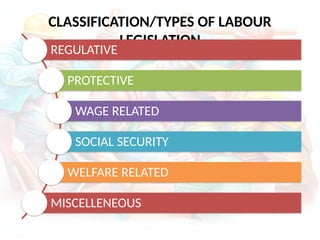
6. CLASSIFICATION/TYPES OF LABOUR
LEGISLATION
3.
WHAT IS LABOURLEGISLATION?
Labour law also known as
employment law is the body
of laws, administrative rulings,
and precedents which address
the legal rights of, and
restrictions on, working
people and their
organizations.
4.
• The term‘Labour
Legislation’ is used to
cover all the laws which
have been enacted to
deal with “employment
and non-employment”
wages, working
conditions, industrial
relations, social security
and welfare of persons
employed in industries.
5.
Labour Law Covers:
•Industrial relations – certification of unions,
labour-management relations, collective
bargaining and unfair labour practices;
• Workplace Health and Safety;
• Employment standards, including general
holidays, annual leave, working hours, unfair
dismissals, minimum wage, layoff procedures
and severance pay.
6.
Categories of LabourLaws
• Two broad categories of labour law.
–First, collective labour law relates to the
tripartite relationship between employee,
employer and union.
–Second, individual labour law concerns with
employees’ right at work and through the
contract for work.
History of LabourLaws across World
• Labour law arose due to the demands
of workers for better conditions, the
right to organize, and the simultaneous
demands of employers to restrict the
powers of workers in many
organizations and to keep labour costs
low
• International Labour Organization (ILO)
was one of the first organizations to
deal with labour issues.
9.
• Post-war reconstructionand the protection of
labour unions occupied the attention of many
nations during and immediately after World
War I, In Great Britain, the Whitley
Commission, a subcommittee of the
Reconstruction Commission, recommended in
its July 1918 Final Report that “industrial
councils” be established throughout the
world.
10.
• The BritishLabour Party had issued its own
reconstruction programme in the documents titled
Labour and the New Social Order.
• In February 1918, the third Inter-Allied Labour and
Socialist Conference (representing delegates from
Great Britain, France, Belgium and Italy) issued its
report, advocating an international labour rights
body, an end to secret diplomacy, and other goals.
• And in December 1918, the American Federation
of Labour (AFL) issued its own distinctively
apolitical report, which called for the achievement
of numerous incremental improvements via the
collective bargaining process.
11.
• The Britishproposed establishing an
international parliament to enact labour laws
which each member of the League would be
required to implement.
• Each nation would have two delegates to the
parliament, one each from labour and
management.
• An INTERNATIONAL LABOUR OFFICE would
collect statistics on labour issues and enforce
the new international laws.
12.
• The Americansmade 10 proposals. Three were
adopted without change:
– That labour should not be treated as a commodity;
– that all workers had the right to a wage sufficient to
live on; and
– that women should receive equal pay for equal work.
• A proposal protecting the freedom of speech,
press, assembly, and association was amended to
include only freedom of association.
• A proposed ban on the international shipment of
goods made by children under the age of 16 was
amended to ban goods made by children under
the age of 14.
13.
• A proposalto require an eight-hour work day
was amended to require the eight-hour work
day or the 40-hour work week (an exception was
made for countries where productivity was low).
• Four other American proposals were rejected.
Meanwhile, international delegates proposed
three additional clauses, which were adopted:
– one or more days for weekly rest;
– equality of laws for foreign worker; and
– regular and frequent inspection of factory
conditions.
14.
• The firstannual conference (referred to as the
International Labour Conference, or ILC) began on 29th
October 1919 in Washington DC and adopted the first
six International Labour Conventions, which dealt with
– HOURS OF WORK IN INDUSTRY,
– UNEMPLOYMENT,
– MATERNITY PROTECTION,
– NIGHT WORK FOR WOMEN,
– MINIMUM AGE AND
– NIGHT WORK FOR YOUNG PERSONS IN INDUSTRY.
• The prominent French socialist Albert Thomas
became its first Director General. The ILO became a
member of the United Nations system after the
demise of the League in 1946.
15.
Evolution of LabourLaws in India
• The history of labour legislation in India is
interwoven with the history of British
colonialism.
• The industrial/labour legislations enacted by
the British were primarily intended to protect
the interests of the British employers
• Considerations of British political economy were
naturally paramount in shaping some of these
early laws.
16.
• Thus camethe Factories Act. It is well known
that Indian textile goods offered stiff
competition to British textiles in the export
market and hence in order to make India
labour costlier the Factories Act was first
introduced in 1883 because of the pressure
brought on the British parliament by the textile
magnates of Manchester and Lancashire.
• Thus India received the first stipulation of eight
hours of work, the abolition of child labour, and
the restriction of women in night employment,
and the introduction of overtime wages for
work beyond eight hours.
17.
• While theimpact of this measure was clearly
welfarist the real motivation was undoubtedly
protectionist.
• The earliest Indian statute to regulate the
relationship between employer and his workmen
was the Trade Dispute Act, 1929 (Act 7 of 1929).
Provisions were made in this Act for restraining
the rights of strike and lock out but no machinery
was provided to take care of disputes.
• The original colonial legislation underwent
substantial modifications in the post-colonial era
because independent India called for a clear
partnership between labour and capital.
18.
• The contentof this partnership was unanimously
approved in a tripartite conference in December
1947 in which it was agreed that labour would be
given a fair wage and fair working conditions and in
return capital would receive the fullest co-operation
of labour for uninterrupted production and higher
productivity as part of the strategy for national
economic development and that all concerned
would observe a truce period of three years free
from strikes and lockouts.
• Ultimately the Industrial Disputes Act (the Act)
brought into force on 01.04.1947 repealing the
Trade Disputes Act 1929 has since remained on
statute book.
19.
• Thus 2acts which primarily came into existence
– The Factories Act.
– To regulate the relationship between employer
and his workmen was the Trade Dispute Act, 1929
• The original colonial legislation underwent
substantial modifications in the post-colonial
era because independent India called for a
clear partnership between labour and capital.
• Ultimately the Industrial Disputes Act (the Act)
brought into force on 01.04.1947 repealing the
Trade Disputes Act 1929 has since remained on
statute book.
20.
• In Indiaall laws emanate from Constitution of
India. Under Constitution, LABOUR is a
CONCURRENT subject which means that both
Central Government and State Government
can enact labour legislation with the clause
that state legislature cannot enact a law which
is repugnant/offensive to the central law.
• A rough estimate places the total number of
enactments in india to be around 160.
21.
HISTORY OF LABOURLEGISLATION IN INDIA
• Pre-Independence British Era
• Post Independence
22.
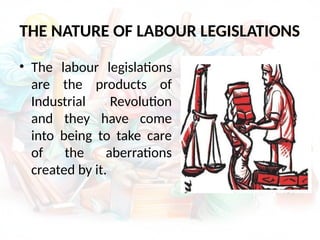
THE NATURE OFLABOUR LEGISLATIONS
• The labour legislations
are the products of
Industrial Revolution
and they have come
into being to take care
of the aberrations
created by it.
23.
• They aredifferent from common legislations,
because they come to alleviate special
disorders created by specific circumstances.
Therefore, they are specific and not general in
orientation, philosophy, concept and even in
practice.
• Labour legislation regards individuals as
workers, whereas the general legislation
regards him a citizen.
24.
• The principlesgoverning labour
legislations are more influenced by the
postulates of social justice than general
justice.
• Workers are the weaker class of industrial
society and have suffered long at the
hands of employers. Therefore, these sets
of legislations go out of the way in
protecting workers and securing justice to
them.
25.
• Labour legislationseeks to deal with
problems arising out of occupational
status of the individual.
• Consequently, such problems as hours of
work, wages, working conditions, trade
unions, industrial disputes etc. come to
be the main subject matter of labour
legislations.
26.
• Individuals havedifferent roles to perform and
different laws are designed for regulating the
different roles.
• It is the role-relation that determines whether a
particular legislation falls under the category of
labour legislation, social legislation or general
legislation.
• All these legislations try to meet the specific
objectives of their respective target groups that is
– (a) to provide subsistence,
– (b) to aim at abundance,
– (c) to encourage equality, and
– (d) to maintain security.
27.
• As labourlegislations are to regulate the
conditions of labour in the industrial milieu, it
is required to be adjusted as per the changing
requirements of industry.
• This has to be done more frequently than the
general legislation where changes are not that
swift. Unless labour legislations are subjected
to frequent revision and not left to continue as
they are, they become obsolete and
irrelevant.
OBJECTIVES
• Establishment ofjustice – Social, Political and
Economic.
• Provision of opportunities to all workers;
irrespective of caste, creed, religion, beliefs;
for the development of their personality.
• Protection of weaker sections in the
community.
• Maintenance of Industrial Peace.
30.
• Creation ofconditions for economic growth.
• Protection and improvement of labour
standards.
• Protect workers from exploitation.
• Guarantee right of workmen to combine and
form association or unions
31.
• Ensure rightof workmen to bargain
collectively for the betterment of their service
conditions.
• Make state interfere as protector of social
wellbeing than to remain an onlooker.
• Ensure human rights and human dignity.
32.
NEED AND IMPORTANCEOF LABOUR
LEGISLATION IN INDIA
• It is necessary for the health, safety and welfare
of workers.
• It is necessary to protect workers against
oppressive terms as individual worker is
economically weak and has little bargaining
power.
• It encourages and facilitates the workers in the
organization.
• It provides a mechanism to settle industrial
disputes of various nature.
33.
• It helpsin enforcing social insurance and
labour welfare schemes.
• It is instrumental in improving industrial
relation i.e. employee-employer relations
and minimized industrial disputes.
• It helps workers in getting fair wages
• It helps in minimizing labour unrest.
34.
• It ensuresjob security for workers
• It promotes welcome environment conditions
in the industrial system
• It helps in fixing rest pauses and work hours
etc.
• It helps in providing appropriate compensation
to workers, who are victims of accidents.
REGULATIVE LEGISLATIONS
• TheTrade Unions Act, 1926
• The Industrial Disputes Act,
1947
• Industrial Relations
Legislations enacted by
states of Maharashtra, MP,
Gujarat, UP, etc.
• Industrial Employment
(Standing Orders) Act, 1946.
37.
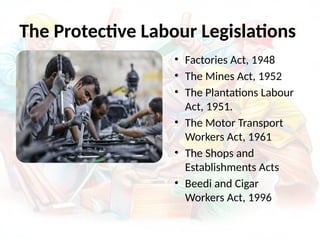
The Protective LabourLegislations
• Factories Act, 1948
• The Mines Act, 1952
• The Plantations Labour
Act, 1951.
• The Motor Transport
Workers Act, 1961
• The Shops and
Establishments Acts
• Beedi and Cigar
Workers Act, 1996
38.
Wage-Related Labour Legislations
•The Payment of
Wages Act, 1936
• The Minimum
Wages Act, 1948
• The Payment of
Bonus Act, 1965
• The Equal
Remuneration Act,
1976
39.
Social Security LabourLegislations
• The Workmen’s Compensation Act,
1923
• The Employees’ State Insurance
Act, 1948
• The Coal Mines PF Act, 1948
• The Employees PF and
Miscellaneous Provisions Act, 1952
• The Maternity Benefit Act, 1961
• Payment of Gratuity Act, 1972
40.
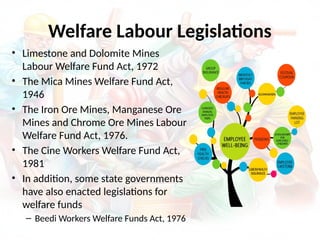
Welfare Labour Legislations
•Limestone and Dolomite Mines
Labour Welfare Fund Act, 1972
• The Mica Mines Welfare Fund Act,
1946
• The Iron Ore Mines, Manganese Ore
Mines and Chrome Ore Mines Labour
Welfare Fund Act, 1976.
• The Cine Workers Welfare Fund Act,
1981
• In addition, some state governments
have also enacted legislations for
welfare funds
– Beedi Workers Welfare Funds Act, 1976
41.
Miscellaneous
• The ContractLabour (Regulation and Abolition)
Act, 1970
• Child Labour (Prohibition and Regulation) Act,
1986
• Building and other construction workers
(Regulation of Employment and Conditions of
Service) Act, 1996
• Apprentices Act, 1961
• Emigration Act, 1983
42.
Miscellaneous
• Employment Exchange(Compulsory Notification
of Vacancies) Act, 1959
• Inter State Migrant Workmen (Regulation of
Employment and Condition of Service) Act, 1979
• Sales Promotion Employees (Condition of
Service) Act, 1976
• Working Journalists and other Newspapers
Employees (Condition of Service and
Miscellaneous Provision) Act, 1955.