Print Media
M.A.Jamseeth
Year 3 Semester II
B.A. in Communication Studies and
Linguistics
Trincomalee Campus
Eastern University
Sri Lanka
14.02.2016
Lectured by Ms.Shalika Boyagoda (Madam)
Contents
• What Is Journalism?
• Lippmann’s point of view on Role of a journalist
• Common point of views on Role of a journalist
• The elements of journalism
₋ Journalism’s first obligation
₋ Journalism’s first loyalty is to citizens
₋ Journalists must maintain an independence
₋ Journalism must provide a forum for public criticism and
comment.
₋ Journalists must make significant relevant and interesting.
₋ Journalists should keep the news in proportion and make it
comprehensive.
₋ Journalists have an obligation to personal conscience.
• Functions of journalism
• Specialist tasks for journalists within different media
What Is Journalism?
DEFINITION
(according to Merriam-Webster online dictionary
1. a: the collection and editing of news for presentation through the media
b: the public press c: an academic study concerned with the collection and
editing of news or the management of a news medium.
2. a: writing designed for publication in a newspaper or magazine
b: writing characterized by a direct presentation of facts or
description of events without an attempt at interpretation
c: writing designed to appeal to current popular taste or public
interest.
1. Journalism
It is a form of writing that tells people about things that truly
happened, but that they might not have known about already.
Role of a journalist
 Lippmann understood that journalist's role at
the time was to act as a mediator or translator
between the public and policy making elites.
 In Lippmann's world, the journalist's role was to
inform the public of what the elites were doing.
It was also to act as a watchdog over the elite, as the
public had the final say with their votes.
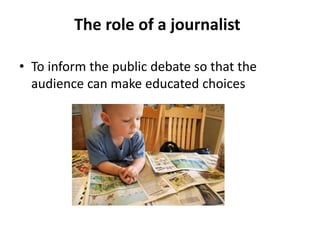
The role of a journalist
• To inform the public debate so that the
audience can make educated choices
 To deliver facts ...
 Verified
 Attributed
 Sourced
 Tested
• To find stories that...
Had it not been for you, the world
would never have known.
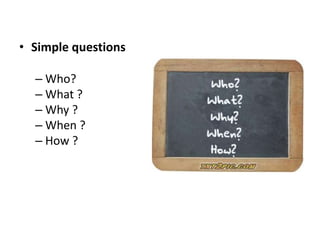
• Simple questions
– Who?
– What ?
– Why ?
– When ?
– How ?
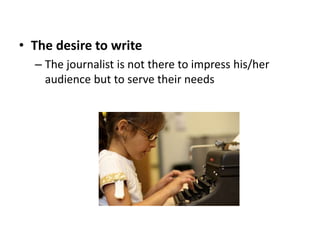
• The desire to write
– The journalist is not there to impress his/her
audience but to serve their needs
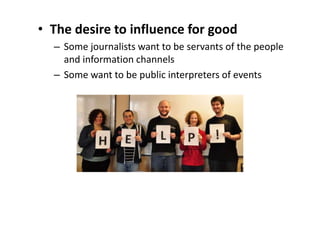
• The desire to influence for good
– Some journalists want to be servants of the people
and information channels
– Some want to be public interpreters of events
• The desire for knowledge
– Curiosity is a vital ingredient for any journalist
– Most journalists tend to know a little bit about a
lot of things, rather than a lot about one subject.
• An interest in life
– He/ She must be
interested in the world
around him/ her.
– He/ She must want to find
things out and share
his/her discoveries with
his/her readers or
listeners
– He /She should have a
broad range of interests
• Love of language
– He/ She cannot be a great journalist
without having a love of language
– He/ She must understand the
meaning and flow of words and
enjoy using them
• Alert and ordered
₋ People trust journalists with facts.
₋ He/ She must not be careless with
them.
₋ All journalists must aim for accuracy.
₋ Without it He/ She will lose trust,
readers and ultimately your job
• Suspicious mind
– He/ She will be given
information for many
reasons
– He/ She must develop the
ability to recognise when
you are being given false
information
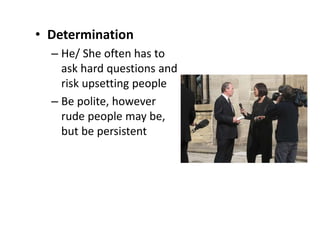
• Determination
– He/ She often has to
ask hard questions and
risk upsetting people
– Be polite, however
rude people may be,
but be persistent
• Polite
– He/ She needs to be able to
get on well with all sorts of
people.
– He/ She cannot pick and
choose who to interview in
the way you choose friends.
• Honest
– Be there when He/ She
say He/ She will
– Only report what He/
She knows to be true
– Never lie to the public
• The primary purpose of journalism is to provide citizens with
the information they need to be free and self-governing.
 The news media helps us to define our community.
 It helps us create a common knowledge and language
rooted in reality.
 It helps a community identify its goals, heroes and
villains.
 The real meaning of the 1st Amendment means that
journalism must be an independent institution
The elements of journalism
Journalism's first obligation is to the truth.
Its first loyalty is to the citizens.
Its essence is discipline of verification.
Its practitioners must maintain an independence from
those they cover.
It must serve as an independent monitor of power.
Journalism's first obligation is to the truth.
Its first loyalty is to the citizens.
Its essence is discipline of verification.
Its practitioners must maintain an independence from
those they cover.
It must serve as an independent monitor of power.
• Journalism’s first obligation is to the truth.
 Our primary duty is to get the facts right.
 News is the material that people use to learn
and think about the world beyond themselves.
 Because of this, the information must be
usable and reliable.
 For truth to prevail, journalists must make clear
to whom they owe their first loyalty
• Journalism’s first loyalty is to citizens.
 This gave birth to the phrase “journalistic
independence.”
 Consumers know that the restaurant review they
are reading was not influenced by that same
restaurant's ad in the paper, online or on their
broadcast.
 Because of this, journalists must maintain ethical
guidelines by not accepting gifts, etc. by those
whom they cover.
• Journalists must maintain an independence
from those they cover.
 We move in their world but it is THEIR world.
 Conflict of interest: when a journalist covers a
story about an event, place, person, etc. in
which they are personally involved.
 This independence is even more important
when you consider…
• Journalists must serve as an independent
monitor of power.
 Watergate – 1972 – President Nixon is
caught involved in a break-in of the
Democratic National Committee and
resigns as president.
 More than just government, it extends to
all powerful institutions in society.
 Journalism gives voice to the voiceless.
• Journalism must provide a forum for public
criticism and comment.
 Journalism serves as a public forum, a place for
the sharing of information, ideas and the debate
of those ideas.
 This comes in the form of letters to the editor,
phone forums, guest columnists, etc.
 This forum must adhere to all other principles
and relate to the role journalism plays in a
democracy.
• Journalists must make significant
relevant and interesting.
 There is no such thing as a boring story,
there are only boring reporters.
 Journalists are storytellers, with a
purpose.
• Journalists should keep the news in
proportion and make it comprehensive.
 A front page story that is fun and interesting but by
no reasonable definition contains anything
significant is a distortion.
 Consumers should ask:
1. Can we see the whole community in the
coverage?
2. Do I see myself?
3. Does the report include a fair mix of what most
people would consider either interesting or
significant.
• Journalists have an obligation to personal
conscience.
 Every journalist must have a sense of personal ethics
and responsibility – a moral compass.
 They must recognize a personal obligation to disagree
with editors, owners, advertisers, and even citizens.
Functions of journalism
Inform
Interpret
Mold opinion
Enable decision making
Agent of change
Entertain
Specialist tasks for journalists within different media
In large organisations, the journalists may specialise in
specialist tasks for journalists within different media
only one task. In small organisations, each journalist
may have to do many different tasks. Here are some of
the jobs journalists do.
• Reporters
• Sub-editors
• Photojournalists
• The editor
• The news editor
• Feature writers
• Specialist writers
Thank you

Presentation role of jounalist

  • 1.
    Print Media M.A.Jamseeth Year 3Semester II B.A. in Communication Studies and Linguistics Trincomalee Campus Eastern University Sri Lanka 14.02.2016 Lectured by Ms.Shalika Boyagoda (Madam)
  • 2.
    Contents • What IsJournalism? • Lippmann’s point of view on Role of a journalist • Common point of views on Role of a journalist • The elements of journalism ₋ Journalism’s first obligation ₋ Journalism’s first loyalty is to citizens ₋ Journalists must maintain an independence ₋ Journalism must provide a forum for public criticism and comment. ₋ Journalists must make significant relevant and interesting. ₋ Journalists should keep the news in proportion and make it comprehensive. ₋ Journalists have an obligation to personal conscience. • Functions of journalism • Specialist tasks for journalists within different media
  • 3.
    What Is Journalism? DEFINITION (accordingto Merriam-Webster online dictionary 1. a: the collection and editing of news for presentation through the media b: the public press c: an academic study concerned with the collection and editing of news or the management of a news medium. 2. a: writing designed for publication in a newspaper or magazine b: writing characterized by a direct presentation of facts or description of events without an attempt at interpretation c: writing designed to appeal to current popular taste or public interest. 1. Journalism It is a form of writing that tells people about things that truly happened, but that they might not have known about already.
  • 4.
    Role of ajournalist  Lippmann understood that journalist's role at the time was to act as a mediator or translator between the public and policy making elites.  In Lippmann's world, the journalist's role was to inform the public of what the elites were doing. It was also to act as a watchdog over the elite, as the public had the final say with their votes.
  • 5.
    The role ofa journalist • To inform the public debate so that the audience can make educated choices
  • 6.
     To deliverfacts ...  Verified  Attributed  Sourced  Tested
  • 7.
    • To findstories that... Had it not been for you, the world would never have known.
  • 8.
    • Simple questions –Who? – What ? – Why ? – When ? – How ?
  • 9.
    • The desireto write – The journalist is not there to impress his/her audience but to serve their needs
  • 10.
    • The desireto influence for good – Some journalists want to be servants of the people and information channels – Some want to be public interpreters of events
  • 11.
    • The desirefor knowledge – Curiosity is a vital ingredient for any journalist – Most journalists tend to know a little bit about a lot of things, rather than a lot about one subject.
  • 12.
    • An interestin life – He/ She must be interested in the world around him/ her. – He/ She must want to find things out and share his/her discoveries with his/her readers or listeners – He /She should have a broad range of interests
  • 13.
    • Love oflanguage – He/ She cannot be a great journalist without having a love of language – He/ She must understand the meaning and flow of words and enjoy using them
  • 14.
    • Alert andordered ₋ People trust journalists with facts. ₋ He/ She must not be careless with them. ₋ All journalists must aim for accuracy. ₋ Without it He/ She will lose trust, readers and ultimately your job
  • 15.
    • Suspicious mind –He/ She will be given information for many reasons – He/ She must develop the ability to recognise when you are being given false information
  • 16.
    • Determination – He/She often has to ask hard questions and risk upsetting people – Be polite, however rude people may be, but be persistent
  • 17.
    • Polite – He/She needs to be able to get on well with all sorts of people. – He/ She cannot pick and choose who to interview in the way you choose friends. • Honest – Be there when He/ She say He/ She will – Only report what He/ She knows to be true – Never lie to the public
  • 18.
    • The primarypurpose of journalism is to provide citizens with the information they need to be free and self-governing.  The news media helps us to define our community.  It helps us create a common knowledge and language rooted in reality.  It helps a community identify its goals, heroes and villains.  The real meaning of the 1st Amendment means that journalism must be an independent institution
  • 19.
    The elements ofjournalism Journalism's first obligation is to the truth. Its first loyalty is to the citizens. Its essence is discipline of verification. Its practitioners must maintain an independence from those they cover. It must serve as an independent monitor of power. Journalism's first obligation is to the truth. Its first loyalty is to the citizens. Its essence is discipline of verification. Its practitioners must maintain an independence from those they cover. It must serve as an independent monitor of power.
  • 20.
    • Journalism’s firstobligation is to the truth.  Our primary duty is to get the facts right.  News is the material that people use to learn and think about the world beyond themselves.  Because of this, the information must be usable and reliable.  For truth to prevail, journalists must make clear to whom they owe their first loyalty
  • 21.
    • Journalism’s firstloyalty is to citizens.  This gave birth to the phrase “journalistic independence.”  Consumers know that the restaurant review they are reading was not influenced by that same restaurant's ad in the paper, online or on their broadcast.  Because of this, journalists must maintain ethical guidelines by not accepting gifts, etc. by those whom they cover.
  • 22.
    • Journalists mustmaintain an independence from those they cover.  We move in their world but it is THEIR world.  Conflict of interest: when a journalist covers a story about an event, place, person, etc. in which they are personally involved.  This independence is even more important when you consider…
  • 23.
    • Journalists mustserve as an independent monitor of power.  Watergate – 1972 – President Nixon is caught involved in a break-in of the Democratic National Committee and resigns as president.  More than just government, it extends to all powerful institutions in society.  Journalism gives voice to the voiceless.
  • 24.
    • Journalism mustprovide a forum for public criticism and comment.  Journalism serves as a public forum, a place for the sharing of information, ideas and the debate of those ideas.  This comes in the form of letters to the editor, phone forums, guest columnists, etc.  This forum must adhere to all other principles and relate to the role journalism plays in a democracy.
  • 25.
    • Journalists mustmake significant relevant and interesting.  There is no such thing as a boring story, there are only boring reporters.  Journalists are storytellers, with a purpose.
  • 26.
    • Journalists shouldkeep the news in proportion and make it comprehensive.  A front page story that is fun and interesting but by no reasonable definition contains anything significant is a distortion.  Consumers should ask: 1. Can we see the whole community in the coverage? 2. Do I see myself? 3. Does the report include a fair mix of what most people would consider either interesting or significant.
  • 27.
    • Journalists havean obligation to personal conscience.  Every journalist must have a sense of personal ethics and responsibility – a moral compass.  They must recognize a personal obligation to disagree with editors, owners, advertisers, and even citizens.
  • 28.
    Functions of journalism Inform Interpret Moldopinion Enable decision making Agent of change Entertain
  • 29.
    Specialist tasks forjournalists within different media In large organisations, the journalists may specialise in specialist tasks for journalists within different media only one task. In small organisations, each journalist may have to do many different tasks. Here are some of the jobs journalists do. • Reporters • Sub-editors • Photojournalists • The editor • The news editor • Feature writers • Specialist writers
  • 30.