WORKING
CAPITAL
MANAMENT
PARVESH AGHI
Profile
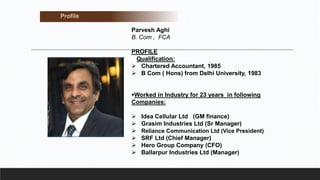
Parvesh Aghi
B. Com , FCA
PROFILE
Qualification:
 Chartered Accountant, 1985
 B Com ( Hons) from Delhi University, 1983
Worked in Industry for 23 years in following
Companies:
 Idea Cellular Ltd (GM finance)
 Grasim Industries Ltd (Sr Manager)
 Reliance Communication Ltd (Vice President)
 SRF Ltd (Chief Manager)
 Hero Group Company (CFO)
 Ballarpur Industries Ltd (Manager)
Teaching Experience
Working as Visiting faculty with Fore school of management ,Shiv Nadar university , Adjunct Faculty with O.P Jindal
Global University & Law school , Haryana , Bennett University ,Greater Noida , Munjal University ( HERO GROUP) ,
Gurgaon and also conducting management development workshops for various corporate on subjects like GST and
business laws etc.
Visiting professor for many Institutes & associated with various recognized business schools in New Delhi /NCR
mentioned below:
Also giving online lectures for ICAI & other universities
I. Institute of Chartered Accountant of India – My video recordings on finance subjects are available on cloud
campus of ICAI for CA students
II. Association of Certified Chartered Accountants of England (ACCA)
III. Apeejay School of Management, Dawarka
IV. BM Munjal University
V. Fortune International Institute of Business
VI. Grant Thornton
VII. UNVERSITY 18 Gurgaon
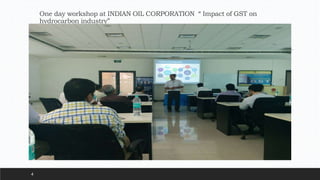
One day workshop at INDIAN OIL CORPORATION “ Impact of GST on
hydrocarbon industry”
4
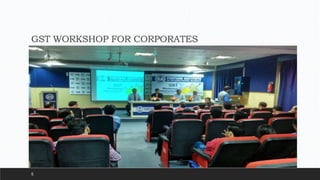
GST WORKSHOP FOR CORPORATES
5
Working Capital Management
it is a business strategy designed
to ensure that a company
operates efficiently by monitoring
and using its current assets and
liabilities to the best effect.
Efficient Working Capital
Management
Efficient working capital
management helps maintain
smooth operations and can also
help to improve the company's
earnings and profitability
Efficient Working Capital
Management
Management of working
capital includes
inventory management and managem
ment of accounts receivables and
accounts payables.
What is a Working Capital Cycle?
The Working Capital Cycle for a
business is the length of time it
takes to convert the total net
working capital (current
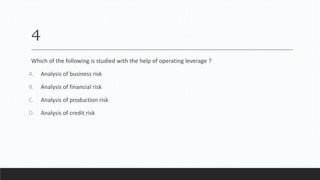
assets less current liabilities)
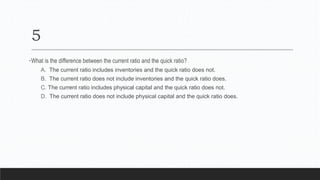
into cash.
Businesses typically try to
manage this cycle by
selling inventory quickly,
collecting revenue from
customers quickly, and paying
bills slowly to optimize cash
flow.
Working capital cycle
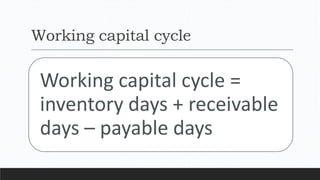
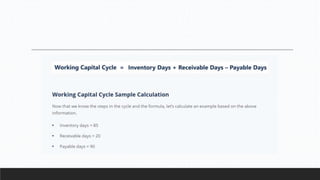
Working capital cycle =
inventory days + receivable
days – payable days
Working capital cycle sample
calculation
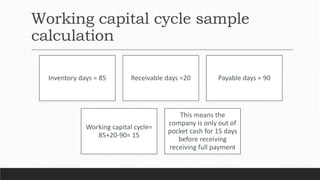
Inventory days = 85 Receivable days =20 Payable days = 90
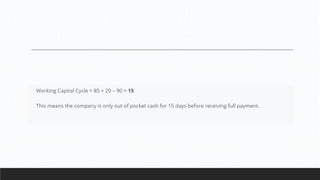
Working capital cycle=
85+20-90= 15
This means the
company is only out of
pocket cash for 15 days
before receiving
receiving full payment
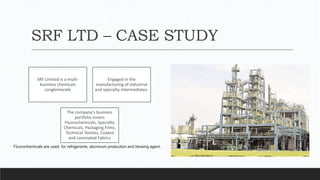
SRF LTD – CASE STUDY
SRF Limited is a multi-
business chemicals
conglomerate
Engaged in the
manufacturing of industrial
and specialty intermediates.
The company’s business
portfolio covers
Fluorochemicals, Specialty
Chemicals, Packaging Films,
Technical Textiles, Coated
and Laminated Fabrics
Fluorochemicals are used for refrigerants, aluminum production and blowing agent.
SRF LTD
12 manufacturing
plants in India, 2 in
Thailand and one in
South Africa.
Exports its products to
more than 75 countries
Incorporated on 9th
January 1970
Nylon Tyre Cord Fabric
Plant at Manali Chennai
& Malanpur , Gwalior ,
Gummidipoondi in
Chennai
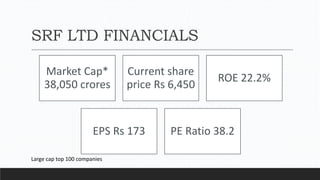
SRF LTD FINANCIALS
Market Cap*
38,050 crores
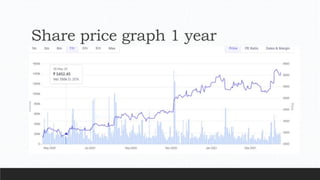
Current share
price Rs 6,450
ROE 22.2%
EPS Rs 173 PE Ratio 38.2
Large cap top 100 companies
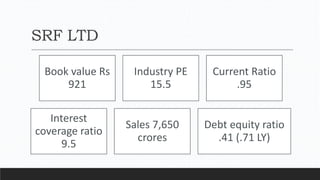
SRF LTD
Book value Rs
921
Industry PE
15.5
Current Ratio
.95
Interest
coverage ratio
9.5
Sales 7,650
crores
Debt equity ratio
.41 (.71 LY)
Share price graph 1 year
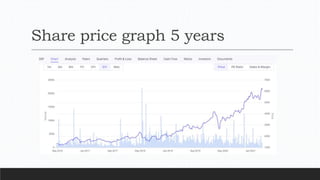
Share price graph 5 years
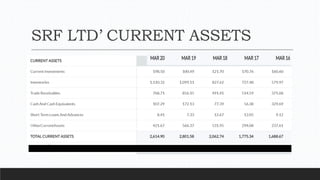
SRF LTD’ CURRENT ASSETS
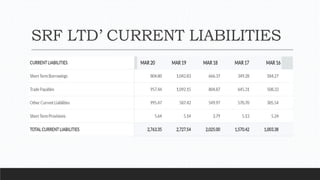
SRF LTD’ CURRENT LIABILITIES
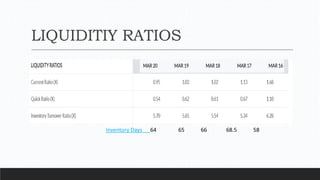
LIQUIDITIY RATIOS
Inventory Days 64 65 66 68.5 58
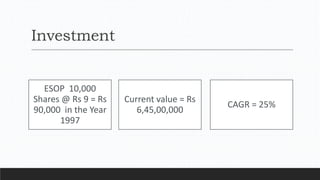
Investment
ESOP 10,000
Shares @ Rs 9 = Rs
90,000 in the Year
1997
Current value = Rs
6,45,00,000
CAGR = 25%
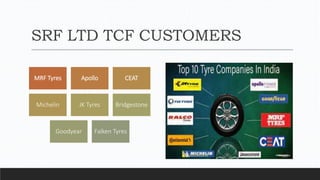
SRF LTD TCF CUSTOMERS
MRF Tyres Apollo CEAT
Michelin JK Tyres Bridgestone
Goodyear Falken Tyres
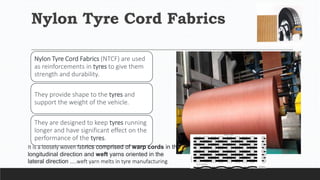
Nylon Tyre Cord Fabrics
Nylon Tyre Cord Fabrics (NTCF) are used
as reinforcements in tyres to give them
strength and durability.
They provide shape to the tyres and
support the weight of the vehicle.
They are designed to keep tyres running
longer and have significant effect on the
performance of the tyres.
It is a loosely woven fabrics comprised of warp cords in the
longitudinal direction and weft yarns oriented in the
lateral direction …..weft yarn melts in tyre manufacturing
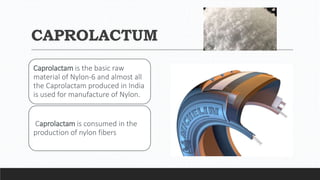
CAPROLACTUM
Caprolactam is the basic raw
material of Nylon-6 and almost all
the Caprolactam produced in India
is used for manufacture of Nylon.
Caprolactam is consumed in the
production of nylon fibers
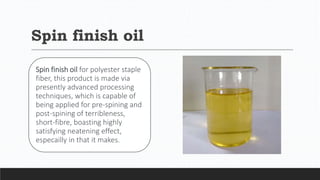
Spin finish oil
Spin finish oil for polyester staple
fiber, this product is made via
presently advanced processing
techniques, which is capable of
being applied for pre-spining and
post-spining of terribleness,
short-fibre, boasting highly
satisfying neatening effect,
especailly in that it makes.
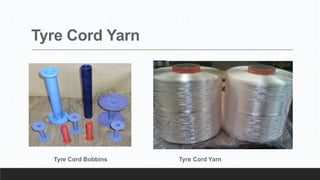
Tyre Cord Yarn
Tyre Cord Bobbins Tyre Cord Yarn
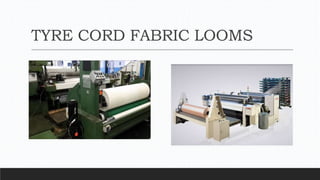
TYRE CORD FABRIC LOOMS
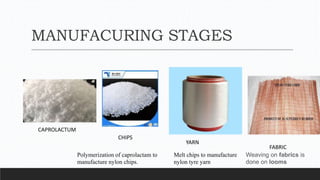
MANUFACURING STAGES
CAPROLACTUM
CHIPS
YARN
FABRIC
Polymerization of caprolactam to
manufacture nylon chips.
Melt chips to manufacture
nylon tyre yarn
Weaving on fabrics is
done on looms
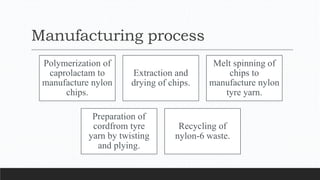
Manufacturing process
Polymerization of
caprolactam to
manufacture nylon
chips.
Extraction and
drying of chips.
Melt spinning of
chips to
manufacture nylon
tyre yarn.
Preparation of
cordfrom tyre
yarn by twisting
and plying.
Recycling of
nylon-6 waste.
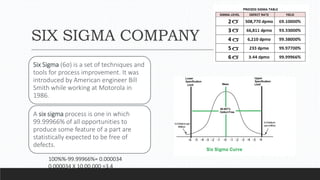
SIX SIGMA COMPANY
Six Sigma (6σ) is a set of techniques and
tools for process improvement. It was
introduced by American engineer Bill
Smith while working at Motorola in
1986.
A six sigma process is one in which
99.99966% of all opportunities to
produce some feature of a part are
statistically expected to be free of
defects.
100%%-99.99966%= 0.000034
0.000034 X 10,00,000 =3.4
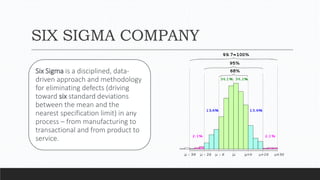
SIX SIGMA COMPANY
Six Sigma is a disciplined, data-
driven approach and methodology
for eliminating defects (driving
toward six standard deviations
between the mean and the
nearest specification limit) in any
process – from manufacturing to
transactional and from product to
service.
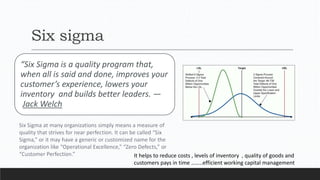
Six sigma
“Six Sigma is a quality program that,
when all is said and done, improves your
customer’s experience, lowers your
inventory and builds better leaders. —
Jack Welch
Six Sigma at many organizations simply means a measure of
quality that strives for near perfection. It can be called “Six
Sigma,” or it may have a generic or customized name for the
organization like “Operational Excellence,” “Zero Defects,” or
“Customer Perfection.” It helps to reduce costs , levels of inventory , quality of goods and
customers pays in time ……..efficient working capital management
The statistical representation of Six Sigma describes quantitatively how a process is performing.
To achieve Six Sigma — statistically — a process must not produce more than 3.4 defects per
million opportunities. A Six Sigma defect is defined as anything outside of customer
specifications. A Six Sigma opportunity is then the total quantity of chances for a defect. Process
sigma can easily be calculated using a Six Sigma calculator.
The fundamental objective of the Six Sigma methodology is the implementation of a
measurement-based strategy that focuses on process improvement and variation reduction
through the application of Six Sigma improvement projects. This is accomplished through the
use of two Six Sigma sub-methodologies: DMAIC and DMADV.
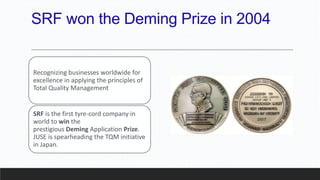
SRF won the Deming Prize in 2004
Recognizing businesses worldwide for
excellence in applying the principles of
Total Quality Management
SRF is the first tyre-cord company in
world to win the
prestigious Deming Application Prize.
JUSE is spearheading the TQM initiative
in Japan.
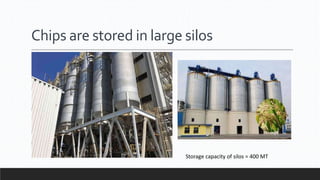
Chips are stored in large silos
Storage capacity of silos = 400 MT
Inventory Management
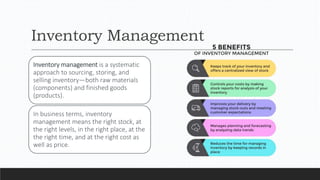
Inventory management is a systematic
approach to sourcing, storing, and
selling inventory—both raw materials
(components) and finished goods
(products).
In business terms, inventory
management means the right stock, at
the right levels, in the right place, at the
the right time, and at the right cost as
well as price.
Inventory Management
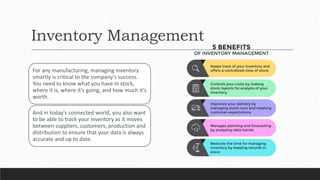
For any manufacturing, managing inventory
smartly is critical to the company's success.
You need to know what you have in stock,
where it is, where it's going, and how much it's
worth.
And in today's connected world, you also want
to be able to track your inventory as it moves
between suppliers, customers, production and
distribution to ensure that your data is always
accurate and up to date.
Oracle Cloud Inventory Management
Gain full visibility and control
of the flow of goods across
an organization’s global
supply network enabling
them to optimize inventory,
service levels and working
capital while decreasing
costs and increasing
customer satisfaction.
you can optimize the flow of goods throughout your organization and efficiently manage
your global inventory. Whether you are a small company or a global company
organization
Oracle Cloud Inventory Managemen
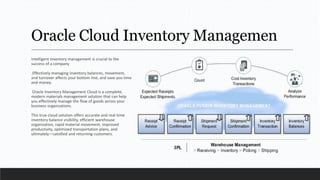
Intelligent inventory management is crucial to the
success of a company
.Effectively managing inventory balances, movement,
and turnover affects your bottom line, and save you time
and money.
Oracle Inventory Management Cloud is a complete,
modern materials management solution that can help
you effectively manage the flow of goods across your
business organizations.
This true cloud solution offers accurate and real-time
inventory balance visibility, efficient warehouse
organization, rapid material movement, improved
productivity, optimized transportation plans, and
ultimately—satisfied and returning customers.
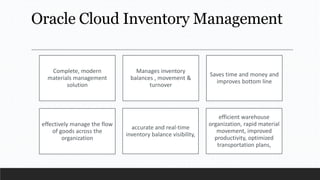
Oracle Cloud Inventory Management
Complete, modern
materials management
solution
Manages inventory
balances , movement &
turnover
Saves time and money and
improves bottom line
effectively manage the flow
of goods across the
organization
accurate and real-time
inventory balance visibility,
efficient warehouse
organization, rapid material
movement, improved
productivity, optimized
transportation plans,
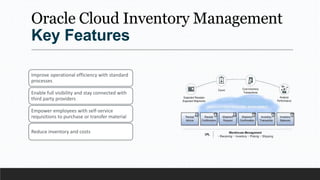
Oracle Cloud Inventory Management
Key Features
Improve operational efficiency with standard
processes
Enable full visibility and stay connected with
third party providers
Empower employees with self-service
requisitions to purchase or transfer material
Reduce inventory and costs
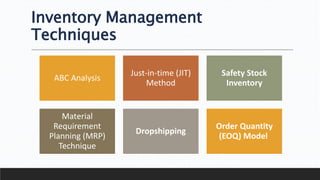
Inventory Management
Techniques
ABC Analysis
Just-in-time (JIT)
Method
Safety Stock
Inventory
Material
Requirement
Planning (MRP)
Technique
Dropshipping
Order Quantity
(EOQ) Model
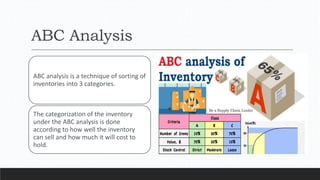
ABC Analysis
ABC analysis is a technique of sorting of
inventories into 3 categories.
The categorization of the inventory
under the ABC analysis is done
according to how well the inventory
can sell and how much it will cost to
hold.
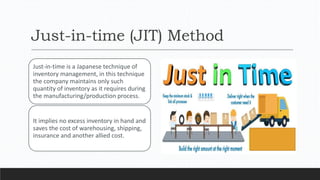
Just-in-time (JIT) Method
Just-in-time is a Japanese technique of
inventory management, in this technique
the company maintains only such
quantity of inventory as it requires during
the manufacturing/production process.
It implies no excess inventory in hand and
saves the cost of warehousing, shipping,
insurance and another allied cost.
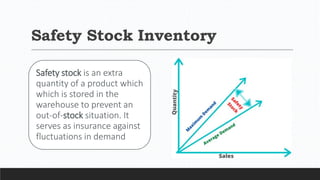
Safety Stock Inventory
Safety stock is an extra
quantity of a product which
which is stored in the
warehouse to prevent an
out-of-stock situation. It
serves as insurance against
fluctuations in demand
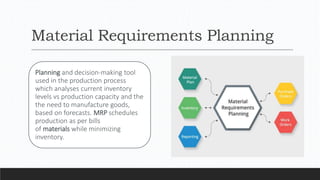
Material Requirements Planning
Planning and decision-making tool
used in the production process
which analyses current inventory
levels vs production capacity and the
the need to manufacture goods,
based on forecasts. MRP schedules
production as per bills
of materials while minimizing
inventory.
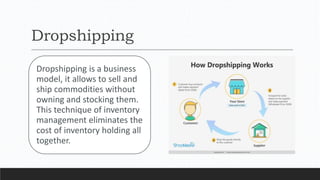
Dropshipping
Dropshipping is a business
model, it allows to sell and
ship commodities without
owning and stocking them.
This technique of inventory
management eliminates the
cost of inventory holding all
together.
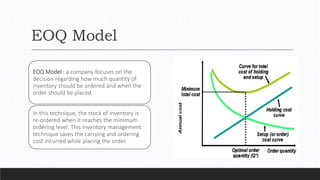
EOQ Model
EOQ Model : a company focuses on the
decision regarding how much quantity of
inventory should be ordered and when the
order should be placed.
In this technique, the stock of inventory is
re-ordered when it reaches the minimum
ordering level. This inventory management
technique saves the carrying and ordering
cost incurred while placing the order.
Zero Working Capital Approach
All times the current
assets shall equal the
current liabilities.
Excess investment in
current assets is avoided
and firm meets its current
liabilities out of the
matching current assets.
As current ratio is 1 and
the quick ratio below 1,
Interest costs are saved.
Zero Working Capital Approach
The firm saves opportunity cost on excess investments in current assets
and as bank cash credit limits are linked to the inventory levels, interest
costs are also saved.
Zero working capital also ensure a smooth and uninterrupted working
capital cycle, and it would pressure the Finance Managers to improve
the quality of the current assets at all times, to keep them 100%
realizable.
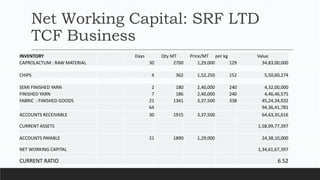
Net Working Capital: SRF LTD
TCF Business
CHIPS 4 362 1,52,250 152 5,50,60,274
INVENTORY Days Qty MT Price/MT per kg Value
CAPROLACTUM : RAW MATERIAL 30 2700 1,29,000 129 34,83,00,000
ACCOUNTS RECEIVABLE 30 1915 3,37,500 64,63,35,616
CURRENT ASSETS 1,58,99,77,397
SEMI FINISHED YARN 2 180 2,40,000 240 4,32,00,000
FINISHED YARN 7 186 2,40,000 240 4,46,46,575
FABRIC : FINISHED GOODS 21 1341 3,37,500 338 45,24,34,932
64 94,36,41,781
ACCOUNTS PAYABLE 21 1890 1,29,000 24,38,10,000
NET WORKING CAPITAL 1,34,61,67,397
CURRENT RATIO 6.52
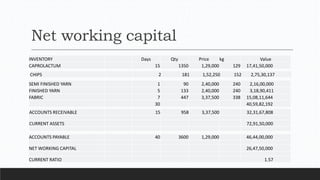
Net working capital
ACCOUNTS RECEIVABLE 15 958 3,37,500 32,31,67,808
CURRENT ASSETS 72,91,50,000
INVENTORY Days Qty Price kg Value
CAPROLACTUM 15 1350 1,29,000 129 17,41,50,000
CHIPS 2 181 1,52,250 152 2,75,30,137
SEMI FINISHED YARN 1 90 2,40,000 240 2,16,00,000
FINISHED YARN 5 133 2,40,000 240 3,18,90,411
FABRIC 7 447 3,37,500 338 15,08,11,644
30 40,59,82,192
ACCOUNTS PAYABLE 40 3600 1,29,000 46,44,00,000
NET WORKING CAPITAL 26,47,50,000
CURRENT RATIO 1.57
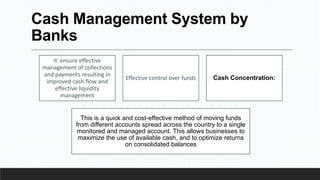
Cash Management System by
Banks
It ensure effective
management of collections
and payments resulting in
improved cash flow and
effective liquidity
management
Effective control over funds Cash Concentration:
This is a quick and cost-effective method of moving funds
from different accounts spread across the country to a single
monitored and managed account. This allows businesses to
maximize the use of available cash, and to optimize returns
on consolidated balances
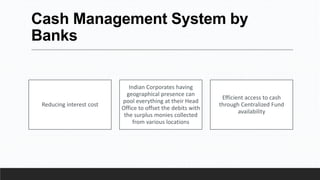
Cash Management System by
Banks
Reducing interest cost
Indian Corporates having
geographical presence can
pool everything at their Head
Office to offset the debits with
the surplus monies collected
from various locations
Efficient access to cash
through Centralized Fund
availability
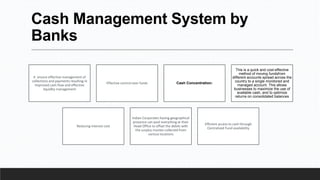
Cash Management System by
Banks
It ensure effective management of
collections and payments resulting in
improved cash flow and effective
liquidity management
Effective control over funds Cash Concentration:
This is a quick and cost-effective
method of moving fundsfrom
different accounts spread across the
country to a single monitored and
managed account. This allows
businesses to maximize the use of
available cash, and to optimize
returns on consolidated balances
Reducing interest cost
Indian Corporates having geographical
presence can pool everything at their
Head Office to offset the debits with
the surplus monies collected from
various locations
Efficient access to cash through
Centralized Fund availability
RECEIVABLE MANAGEMENT
e-Invoicing
e-
payments
RECEIVABLE MANAGEMENT
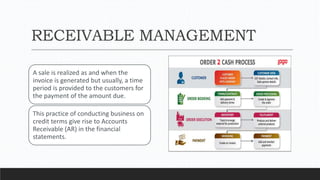
A sale is realized as and when the
invoice is generated but usually, a time
period is provided to the customers for
the payment of the amount due.
This practice of conducting business on
credit terms give rise to Accounts
Receivable (AR) in the financial
statements.
RECEIVABLE MANAGEMENT
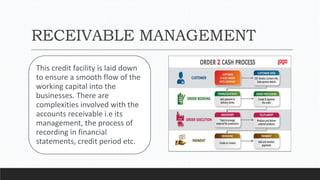
This credit facility is laid down
to ensure a smooth flow of the
working capital into the
businesses. There are
complexities involved with the
accounts receivable i.e its
management, the process of
recording in financial
statements, credit period etc.
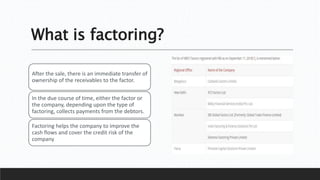
What is factoring?
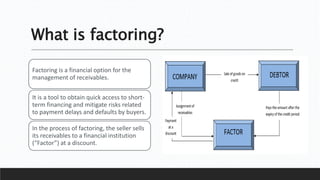
Factoring is a financial option for the
management of receivables.
It is a tool to obtain quick access to short-
term financing and mitigate risks related
to payment delays and defaults by buyers.
In the process of factoring, the seller sells
its receivables to a financial institution
(“Factor”) at a discount.
What is factoring?
After the sale, there is an immediate transfer of
ownership of the receivables to the factor.
In the due course of time, either the factor or
the company, depending upon the type of
factoring, collects payments from the debtors.
Factoring helps the company to improve the
cash flows and cover the credit risk of the
company
QUIZ
1
Working capital management is a business strategy designed to ensure that a company
operates efficiently by monitoring and using its ……………….to the best effect.
A. current assets and liabilities
B. Day to day expense
C. Non current assets & non current liabilities
D. None of the above
2
Working capital is a financial metric which represents operating liquidity available to a
business entity along with fixed assets such as plant and equipment, working capital is
considered a part of ……
A. operating capital
B. finance capital
C. working capital
D. net current asset management
3
Efficient management of working capital in an important prerequisite for the successful working of a business
concern it reduces the chances of business failure generates a feeling of security and confidence in the minds of
personnel in the organization it assures …………….. of organization.
A. Solvency
B. Improved Liquidity
C. Increased profits
D. Operational efficiency
E. All the above
4
Which of the following is studied with the help of operating leverage ?
A. Analysis of business risk
B. Analysis of financial risk
C. Analysis of production risk
D. Analysis of credit risk
5
•What is the difference between the current ratio and the quick ratio?
A. The current ratio includes inventories and the quick ratio does not.
B. The current ratio does not include inventories and the quick ratio does.
C. The current ratio includes physical capital and the quick ratio does not.
D. The current ratio does not include physical capital and the quick ratio does.
Nylon Tyre Cord Fabrics (NTCF) are used as
reinforcements in tyres to give them strength and
durability. They provide shape to the tyres and
support the weight of the vehicle. They are
designed to keep tyres running longer and have
significant effect on the performance of the tyres.
INVENTORY MAINTAINED AT
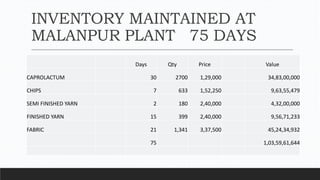
MALANPUR PLANT 75 DAYS
Days Qty Price Value
CAPROLACTUM 30 2700 1,29,000 34,83,00,000
CHIPS 7 633 1,52,250 9,63,55,479
SEMI FINISHED YARN 2 180 2,40,000 4,32,00,000
FINISHED YARN 15 399 2,40,000 9,56,71,233
FABRIC 21 1,341 3,37,500 45,24,34,932
75 1,03,59,61,644
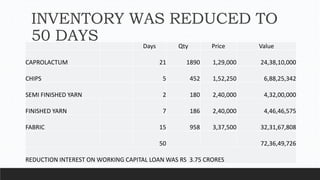
INVENTORY WAS REDUCED TO
50 DAYS Days Qty Price Value
CAPROLACTUM 21 1890 1,29,000 24,38,10,000
CHIPS 5 452 1,52,250 6,88,25,342
SEMI FINISHED YARN 2 180 2,40,000 4,32,00,000
FINISHED YARN 7 186 2,40,000 4,46,46,575
FABRIC 15 958 3,37,500 32,31,67,808
50 72,36,49,726
REDUCTION INTEREST ON WORKING CAPITAL LOAN WAS RS 3.75 CRORES
Used 140 MTPD Nylon 6 Polymer Chip Plant built in 1999. Designed to
make polymer in cylindrical chip form byreacting caprolactam in VK
tube reactors. Caprolactam is polymerized under elevated temperature
andmoderate pressure, under the strict exclusion ofoxygen andin
presence of water toa high viscous melt. The plant includes two(2)
production lines with capacity of100 MTPD and40 MTPD,respectively.
Each line includes 6 majorprocess sections: lactam / additive preparation
anddosing, continuous polymerization, chip production, continuous
extraction, continuous drying and extract water evaporation.
Polymerisation:
Nylon is made by polymerisation of caprolactam with certain additives like
amino acids and dicarboxylic acid salts and certain heat stabiliser such as
copper based organic compounds. The polymerisation process involves ring
opening polycondensation and polyaddition reactions. All the three polymerisation
reaction steps are equilibrium reactions.
A typical process of polymerisation of nylon can be either a batch or a
continuous process. The continuous process, developed after the batch process
was commercialised, offers simplicity of design, ease of operation and control
and high capacity.
An optimal polymerisation process would involve two stages, wherein, the first
stage involves pressure at high initial water concentration. In the second stage
a rapid transition from high water content to a low water content is achieved
by release of pressure and subsequent application of vacuum.
Industrial grade nylon-6 with relative viscosity 3.2 to 3.5 has higher degree of
polymerisation compared to textile grade nylon-6 with relative viscosity 2.2 to
2.6.
Extrusion and Drying of Chips:
The nylon chips are washed to remove water soluble impurities and then dried.
The process maybe batch or continuous.
Melt Spinning:
The polymer chips are melt in extruder. The molten polymer is then spun
through a spinnerette. The molten filaments are quenched or cooled by a
laminar flow of air.
The spin finish is applied on filament and then wound on spin bobbins and
drawn to make tyre yarns.
In the conventional process, the spinning and drawing was done in two steps.
In the spin-draw process, a step is reduced compared to 2-step conventional
process. As a consequence, some sources of process disturbances are eliminated
which results in improved yarn uniformity.
Preparation of Cord:
Nylon tyre yarns are then twisted in S or Z direction and plied having 2 or 3 plies
to form a tyre cord.
Recovery of Nylon-6 Waste:
Depending on the quality of waste, any of the following method may be used
for recycling of nylon waste.
Direct use of fibre waste
Regrannulation- i) without melting
ii) with melting.
Polymer Powder- i) deploymerisationandfilteration
ii) precipitation from solutions
Recovery of caprolactam by deploymerisatio
Raw Materials, (Catalysts, Additives, Spin Finish Etc.):
For nylon-6, the only major raw material required is caprolactam. Water is
required as an initiator for ring opening during polymerisation. Nitrogen gas
is required for blanketing, drying and conveying of polymer.
Working capital management

Working capital management

  • 1.
  • 2.
    Profile Parvesh Aghi B. Com, FCA PROFILE Qualification:  Chartered Accountant, 1985  B Com ( Hons) from Delhi University, 1983 Worked in Industry for 23 years in following Companies:  Idea Cellular Ltd (GM finance)  Grasim Industries Ltd (Sr Manager)  Reliance Communication Ltd (Vice President)  SRF Ltd (Chief Manager)  Hero Group Company (CFO)  Ballarpur Industries Ltd (Manager)
  • 3.
    Teaching Experience Working asVisiting faculty with Fore school of management ,Shiv Nadar university , Adjunct Faculty with O.P Jindal Global University & Law school , Haryana , Bennett University ,Greater Noida , Munjal University ( HERO GROUP) , Gurgaon and also conducting management development workshops for various corporate on subjects like GST and business laws etc. Visiting professor for many Institutes & associated with various recognized business schools in New Delhi /NCR mentioned below: Also giving online lectures for ICAI & other universities I. Institute of Chartered Accountant of India – My video recordings on finance subjects are available on cloud campus of ICAI for CA students II. Association of Certified Chartered Accountants of England (ACCA) III. Apeejay School of Management, Dawarka IV. BM Munjal University V. Fortune International Institute of Business VI. Grant Thornton VII. UNVERSITY 18 Gurgaon
  • 4.
    One day workshopat INDIAN OIL CORPORATION “ Impact of GST on hydrocarbon industry” 4
  • 5.
    GST WORKSHOP FORCORPORATES 5
  • 6.
    Working Capital Management itis a business strategy designed to ensure that a company operates efficiently by monitoring and using its current assets and liabilities to the best effect.
  • 7.
    Efficient Working Capital Management Efficientworking capital management helps maintain smooth operations and can also help to improve the company's earnings and profitability
  • 8.
    Efficient Working Capital Management Managementof working capital includes inventory management and managem ment of accounts receivables and accounts payables.
  • 9.
    What is aWorking Capital Cycle? The Working Capital Cycle for a business is the length of time it takes to convert the total net working capital (current assets less current liabilities) into cash. Businesses typically try to manage this cycle by selling inventory quickly, collecting revenue from customers quickly, and paying bills slowly to optimize cash flow.
  • 10.
    Working capital cycle Workingcapital cycle = inventory days + receivable days – payable days
  • 11.
    Working capital cyclesample calculation Inventory days = 85 Receivable days =20 Payable days = 90 Working capital cycle= 85+20-90= 15 This means the company is only out of pocket cash for 15 days before receiving receiving full payment
  • 12.
    SRF LTD –CASE STUDY SRF Limited is a multi- business chemicals conglomerate Engaged in the manufacturing of industrial and specialty intermediates. The company’s business portfolio covers Fluorochemicals, Specialty Chemicals, Packaging Films, Technical Textiles, Coated and Laminated Fabrics Fluorochemicals are used for refrigerants, aluminum production and blowing agent.
  • 13.
    SRF LTD 12 manufacturing plantsin India, 2 in Thailand and one in South Africa. Exports its products to more than 75 countries Incorporated on 9th January 1970 Nylon Tyre Cord Fabric Plant at Manali Chennai & Malanpur , Gwalior , Gummidipoondi in Chennai
  • 14.
    SRF LTD FINANCIALS MarketCap* 38,050 crores Current share price Rs 6,450 ROE 22.2% EPS Rs 173 PE Ratio 38.2 Large cap top 100 companies
  • 15.
    SRF LTD Book valueRs 921 Industry PE 15.5 Current Ratio .95 Interest coverage ratio 9.5 Sales 7,650 crores Debt equity ratio .41 (.71 LY)
  • 16.
  • 17.
  • 18.
  • 19.
    SRF LTD’ CURRENTLIABILITIES
  • 20.
  • 21.
    Investment ESOP 10,000 Shares @Rs 9 = Rs 90,000 in the Year 1997 Current value = Rs 6,45,00,000 CAGR = 25%
  • 22.
    SRF LTD TCFCUSTOMERS MRF Tyres Apollo CEAT Michelin JK Tyres Bridgestone Goodyear Falken Tyres
  • 23.
    Nylon Tyre CordFabrics Nylon Tyre Cord Fabrics (NTCF) are used as reinforcements in tyres to give them strength and durability. They provide shape to the tyres and support the weight of the vehicle. They are designed to keep tyres running longer and have significant effect on the performance of the tyres. It is a loosely woven fabrics comprised of warp cords in the longitudinal direction and weft yarns oriented in the lateral direction …..weft yarn melts in tyre manufacturing
  • 24.
    CAPROLACTUM Caprolactam is thebasic raw material of Nylon-6 and almost all the Caprolactam produced in India is used for manufacture of Nylon. Caprolactam is consumed in the production of nylon fibers
  • 25.
    Spin finish oil Spinfinish oil for polyester staple fiber, this product is made via presently advanced processing techniques, which is capable of being applied for pre-spining and post-spining of terribleness, short-fibre, boasting highly satisfying neatening effect, especailly in that it makes.
  • 26.
    Tyre Cord Yarn TyreCord Bobbins Tyre Cord Yarn
  • 27.
  • 28.
    MANUFACURING STAGES CAPROLACTUM CHIPS YARN FABRIC Polymerization ofcaprolactam to manufacture nylon chips. Melt chips to manufacture nylon tyre yarn Weaving on fabrics is done on looms
  • 29.
    Manufacturing process Polymerization of caprolactamto manufacture nylon chips. Extraction and drying of chips. Melt spinning of chips to manufacture nylon tyre yarn. Preparation of cordfrom tyre yarn by twisting and plying. Recycling of nylon-6 waste.
  • 30.
    SIX SIGMA COMPANY SixSigma (6σ) is a set of techniques and tools for process improvement. It was introduced by American engineer Bill Smith while working at Motorola in 1986. A six sigma process is one in which 99.99966% of all opportunities to produce some feature of a part are statistically expected to be free of defects. 100%%-99.99966%= 0.000034 0.000034 X 10,00,000 =3.4
  • 31.
    SIX SIGMA COMPANY SixSigma is a disciplined, data- driven approach and methodology for eliminating defects (driving toward six standard deviations between the mean and the nearest specification limit) in any process – from manufacturing to transactional and from product to service.
  • 32.
    Six sigma “Six Sigmais a quality program that, when all is said and done, improves your customer’s experience, lowers your inventory and builds better leaders. — Jack Welch Six Sigma at many organizations simply means a measure of quality that strives for near perfection. It can be called “Six Sigma,” or it may have a generic or customized name for the organization like “Operational Excellence,” “Zero Defects,” or “Customer Perfection.” It helps to reduce costs , levels of inventory , quality of goods and customers pays in time ……..efficient working capital management
  • 33.
    The statistical representationof Six Sigma describes quantitatively how a process is performing. To achieve Six Sigma — statistically — a process must not produce more than 3.4 defects per million opportunities. A Six Sigma defect is defined as anything outside of customer specifications. A Six Sigma opportunity is then the total quantity of chances for a defect. Process sigma can easily be calculated using a Six Sigma calculator. The fundamental objective of the Six Sigma methodology is the implementation of a measurement-based strategy that focuses on process improvement and variation reduction through the application of Six Sigma improvement projects. This is accomplished through the use of two Six Sigma sub-methodologies: DMAIC and DMADV.
  • 34.
    SRF won theDeming Prize in 2004 Recognizing businesses worldwide for excellence in applying the principles of Total Quality Management SRF is the first tyre-cord company in world to win the prestigious Deming Application Prize. JUSE is spearheading the TQM initiative in Japan.
  • 35.
    Chips are storedin large silos Storage capacity of silos = 400 MT
  • 36.
    Inventory Management Inventory managementis a systematic approach to sourcing, storing, and selling inventory—both raw materials (components) and finished goods (products). In business terms, inventory management means the right stock, at the right levels, in the right place, at the the right time, and at the right cost as well as price.
  • 37.
    Inventory Management For anymanufacturing, managing inventory smartly is critical to the company's success. You need to know what you have in stock, where it is, where it's going, and how much it's worth. And in today's connected world, you also want to be able to track your inventory as it moves between suppliers, customers, production and distribution to ensure that your data is always accurate and up to date.
  • 38.
    Oracle Cloud InventoryManagement Gain full visibility and control of the flow of goods across an organization’s global supply network enabling them to optimize inventory, service levels and working capital while decreasing costs and increasing customer satisfaction. you can optimize the flow of goods throughout your organization and efficiently manage your global inventory. Whether you are a small company or a global company organization
  • 39.
    Oracle Cloud InventoryManagemen Intelligent inventory management is crucial to the success of a company .Effectively managing inventory balances, movement, and turnover affects your bottom line, and save you time and money. Oracle Inventory Management Cloud is a complete, modern materials management solution that can help you effectively manage the flow of goods across your business organizations. This true cloud solution offers accurate and real-time inventory balance visibility, efficient warehouse organization, rapid material movement, improved productivity, optimized transportation plans, and ultimately—satisfied and returning customers.
  • 40.
    Oracle Cloud InventoryManagement Complete, modern materials management solution Manages inventory balances , movement & turnover Saves time and money and improves bottom line effectively manage the flow of goods across the organization accurate and real-time inventory balance visibility, efficient warehouse organization, rapid material movement, improved productivity, optimized transportation plans,
  • 41.
    Oracle Cloud InventoryManagement Key Features Improve operational efficiency with standard processes Enable full visibility and stay connected with third party providers Empower employees with self-service requisitions to purchase or transfer material Reduce inventory and costs
  • 42.
    Inventory Management Techniques ABC Analysis Just-in-time(JIT) Method Safety Stock Inventory Material Requirement Planning (MRP) Technique Dropshipping Order Quantity (EOQ) Model
  • 43.
    ABC Analysis ABC analysisis a technique of sorting of inventories into 3 categories. The categorization of the inventory under the ABC analysis is done according to how well the inventory can sell and how much it will cost to hold.
  • 44.
    Just-in-time (JIT) Method Just-in-timeis a Japanese technique of inventory management, in this technique the company maintains only such quantity of inventory as it requires during the manufacturing/production process. It implies no excess inventory in hand and saves the cost of warehousing, shipping, insurance and another allied cost.
  • 45.
    Safety Stock Inventory Safetystock is an extra quantity of a product which which is stored in the warehouse to prevent an out-of-stock situation. It serves as insurance against fluctuations in demand
  • 46.
    Material Requirements Planning Planningand decision-making tool used in the production process which analyses current inventory levels vs production capacity and the the need to manufacture goods, based on forecasts. MRP schedules production as per bills of materials while minimizing inventory.
  • 47.
    Dropshipping Dropshipping is abusiness model, it allows to sell and ship commodities without owning and stocking them. This technique of inventory management eliminates the cost of inventory holding all together.
  • 48.
    EOQ Model EOQ Model: a company focuses on the decision regarding how much quantity of inventory should be ordered and when the order should be placed. In this technique, the stock of inventory is re-ordered when it reaches the minimum ordering level. This inventory management technique saves the carrying and ordering cost incurred while placing the order.
  • 49.
    Zero Working CapitalApproach All times the current assets shall equal the current liabilities. Excess investment in current assets is avoided and firm meets its current liabilities out of the matching current assets. As current ratio is 1 and the quick ratio below 1, Interest costs are saved.
  • 50.
    Zero Working CapitalApproach The firm saves opportunity cost on excess investments in current assets and as bank cash credit limits are linked to the inventory levels, interest costs are also saved. Zero working capital also ensure a smooth and uninterrupted working capital cycle, and it would pressure the Finance Managers to improve the quality of the current assets at all times, to keep them 100% realizable.
  • 51.
    Net Working Capital:SRF LTD TCF Business CHIPS 4 362 1,52,250 152 5,50,60,274 INVENTORY Days Qty MT Price/MT per kg Value CAPROLACTUM : RAW MATERIAL 30 2700 1,29,000 129 34,83,00,000 ACCOUNTS RECEIVABLE 30 1915 3,37,500 64,63,35,616 CURRENT ASSETS 1,58,99,77,397 SEMI FINISHED YARN 2 180 2,40,000 240 4,32,00,000 FINISHED YARN 7 186 2,40,000 240 4,46,46,575 FABRIC : FINISHED GOODS 21 1341 3,37,500 338 45,24,34,932 64 94,36,41,781 ACCOUNTS PAYABLE 21 1890 1,29,000 24,38,10,000 NET WORKING CAPITAL 1,34,61,67,397 CURRENT RATIO 6.52
  • 52.
    Net working capital ACCOUNTSRECEIVABLE 15 958 3,37,500 32,31,67,808 CURRENT ASSETS 72,91,50,000 INVENTORY Days Qty Price kg Value CAPROLACTUM 15 1350 1,29,000 129 17,41,50,000 CHIPS 2 181 1,52,250 152 2,75,30,137 SEMI FINISHED YARN 1 90 2,40,000 240 2,16,00,000 FINISHED YARN 5 133 2,40,000 240 3,18,90,411 FABRIC 7 447 3,37,500 338 15,08,11,644 30 40,59,82,192 ACCOUNTS PAYABLE 40 3600 1,29,000 46,44,00,000 NET WORKING CAPITAL 26,47,50,000 CURRENT RATIO 1.57
  • 53.
    Cash Management Systemby Banks It ensure effective management of collections and payments resulting in improved cash flow and effective liquidity management Effective control over funds Cash Concentration: This is a quick and cost-effective method of moving funds from different accounts spread across the country to a single monitored and managed account. This allows businesses to maximize the use of available cash, and to optimize returns on consolidated balances
  • 54.
    Cash Management Systemby Banks Reducing interest cost Indian Corporates having geographical presence can pool everything at their Head Office to offset the debits with the surplus monies collected from various locations Efficient access to cash through Centralized Fund availability
  • 55.
    Cash Management Systemby Banks It ensure effective management of collections and payments resulting in improved cash flow and effective liquidity management Effective control over funds Cash Concentration: This is a quick and cost-effective method of moving fundsfrom different accounts spread across the country to a single monitored and managed account. This allows businesses to maximize the use of available cash, and to optimize returns on consolidated balances Reducing interest cost Indian Corporates having geographical presence can pool everything at their Head Office to offset the debits with the surplus monies collected from various locations Efficient access to cash through Centralized Fund availability
  • 56.
  • 57.
    RECEIVABLE MANAGEMENT A saleis realized as and when the invoice is generated but usually, a time period is provided to the customers for the payment of the amount due. This practice of conducting business on credit terms give rise to Accounts Receivable (AR) in the financial statements.
  • 58.
    RECEIVABLE MANAGEMENT This creditfacility is laid down to ensure a smooth flow of the working capital into the businesses. There are complexities involved with the accounts receivable i.e its management, the process of recording in financial statements, credit period etc.
  • 59.
    What is factoring? Factoringis a financial option for the management of receivables. It is a tool to obtain quick access to short- term financing and mitigate risks related to payment delays and defaults by buyers. In the process of factoring, the seller sells its receivables to a financial institution (“Factor”) at a discount.
  • 60.
    What is factoring? Afterthe sale, there is an immediate transfer of ownership of the receivables to the factor. In the due course of time, either the factor or the company, depending upon the type of factoring, collects payments from the debtors. Factoring helps the company to improve the cash flows and cover the credit risk of the company
  • 61.
  • 62.
    1 Working capital managementis a business strategy designed to ensure that a company operates efficiently by monitoring and using its ……………….to the best effect. A. current assets and liabilities B. Day to day expense C. Non current assets & non current liabilities D. None of the above
  • 63.
    2 Working capital isa financial metric which represents operating liquidity available to a business entity along with fixed assets such as plant and equipment, working capital is considered a part of …… A. operating capital B. finance capital C. working capital D. net current asset management
  • 64.
    3 Efficient management ofworking capital in an important prerequisite for the successful working of a business concern it reduces the chances of business failure generates a feeling of security and confidence in the minds of personnel in the organization it assures …………….. of organization. A. Solvency B. Improved Liquidity C. Increased profits D. Operational efficiency E. All the above
  • 65.
    4 Which of thefollowing is studied with the help of operating leverage ? A. Analysis of business risk B. Analysis of financial risk C. Analysis of production risk D. Analysis of credit risk
  • 66.
    5 •What is thedifference between the current ratio and the quick ratio? A. The current ratio includes inventories and the quick ratio does not. B. The current ratio does not include inventories and the quick ratio does. C. The current ratio includes physical capital and the quick ratio does not. D. The current ratio does not include physical capital and the quick ratio does.
  • 70.
    Nylon Tyre CordFabrics (NTCF) are used as reinforcements in tyres to give them strength and durability. They provide shape to the tyres and support the weight of the vehicle. They are designed to keep tyres running longer and have significant effect on the performance of the tyres.
  • 71.
    INVENTORY MAINTAINED AT MALANPURPLANT 75 DAYS Days Qty Price Value CAPROLACTUM 30 2700 1,29,000 34,83,00,000 CHIPS 7 633 1,52,250 9,63,55,479 SEMI FINISHED YARN 2 180 2,40,000 4,32,00,000 FINISHED YARN 15 399 2,40,000 9,56,71,233 FABRIC 21 1,341 3,37,500 45,24,34,932 75 1,03,59,61,644
  • 72.
    INVENTORY WAS REDUCEDTO 50 DAYS Days Qty Price Value CAPROLACTUM 21 1890 1,29,000 24,38,10,000 CHIPS 5 452 1,52,250 6,88,25,342 SEMI FINISHED YARN 2 180 2,40,000 4,32,00,000 FINISHED YARN 7 186 2,40,000 4,46,46,575 FABRIC 15 958 3,37,500 32,31,67,808 50 72,36,49,726 REDUCTION INTEREST ON WORKING CAPITAL LOAN WAS RS 3.75 CRORES
  • 73.
    Used 140 MTPDNylon 6 Polymer Chip Plant built in 1999. Designed to make polymer in cylindrical chip form byreacting caprolactam in VK tube reactors. Caprolactam is polymerized under elevated temperature andmoderate pressure, under the strict exclusion ofoxygen andin presence of water toa high viscous melt. The plant includes two(2) production lines with capacity of100 MTPD and40 MTPD,respectively. Each line includes 6 majorprocess sections: lactam / additive preparation anddosing, continuous polymerization, chip production, continuous extraction, continuous drying and extract water evaporation.
  • 74.
    Polymerisation: Nylon is madeby polymerisation of caprolactam with certain additives like amino acids and dicarboxylic acid salts and certain heat stabiliser such as copper based organic compounds. The polymerisation process involves ring opening polycondensation and polyaddition reactions. All the three polymerisation reaction steps are equilibrium reactions. A typical process of polymerisation of nylon can be either a batch or a continuous process. The continuous process, developed after the batch process was commercialised, offers simplicity of design, ease of operation and control and high capacity.
  • 75.
    An optimal polymerisationprocess would involve two stages, wherein, the first stage involves pressure at high initial water concentration. In the second stage a rapid transition from high water content to a low water content is achieved by release of pressure and subsequent application of vacuum. Industrial grade nylon-6 with relative viscosity 3.2 to 3.5 has higher degree of polymerisation compared to textile grade nylon-6 with relative viscosity 2.2 to 2.6.
  • 76.
    Extrusion and Dryingof Chips: The nylon chips are washed to remove water soluble impurities and then dried. The process maybe batch or continuous.
  • 77.
    Melt Spinning: The polymerchips are melt in extruder. The molten polymer is then spun through a spinnerette. The molten filaments are quenched or cooled by a laminar flow of air. The spin finish is applied on filament and then wound on spin bobbins and drawn to make tyre yarns. In the conventional process, the spinning and drawing was done in two steps. In the spin-draw process, a step is reduced compared to 2-step conventional process. As a consequence, some sources of process disturbances are eliminated which results in improved yarn uniformity.
  • 78.
    Preparation of Cord: Nylontyre yarns are then twisted in S or Z direction and plied having 2 or 3 plies to form a tyre cord.
  • 79.
    Recovery of Nylon-6Waste: Depending on the quality of waste, any of the following method may be used for recycling of nylon waste. Direct use of fibre waste Regrannulation- i) without melting ii) with melting. Polymer Powder- i) deploymerisationandfilteration ii) precipitation from solutions Recovery of caprolactam by deploymerisatio
  • 80.
    Raw Materials, (Catalysts,Additives, Spin Finish Etc.): For nylon-6, the only major raw material required is caprolactam. Water is required as an initiator for ring opening during polymerisation. Nitrogen gas is required for blanketing, drying and conveying of polymer.