

WORKING BETTER WITH AGE
REPORT ON OLDER WORKERS IN DENMARK
Copenhagen, 21 October 2015
Mark Keese, Head of Division
Anne Sonnet, Project Leader
Directorate for Employment, Labour and Social Affairs, OECD
1. Working Better with Age: the OECD
review
2. Major challenges in Denmark
3. Key recommendations
Outline of the presentation
2
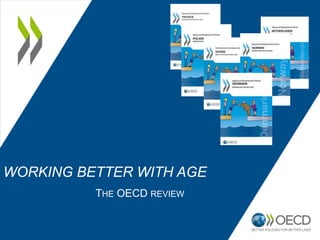
WORKING BETTER WITH AGE
THE OECD REVIEW
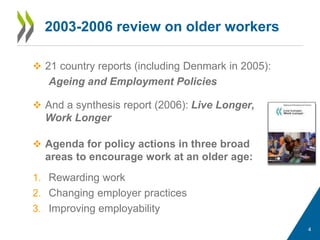
2003-2006 review on older workers
 21 country reports (including Denmark in 2005):
Ageing and Employment Policies
 And a synthesis report (2006): Live Longer,
Work Longer
 Agenda for policy actions in three broad
areas to encourage work at an older age:
1. Rewarding work
2. Changing employer practices
3. Improving employability
4
• Comparative policy review of recent reforms and
measures and a scoreboard for older workers:
www.oecd.org/els/employment/olderworkers
• Seven country case studies: Norway (June 2013),
France (January 2014), Netherlands (April 2014),
Switzerland (October 2014), Poland (March 2015),
Denmark (October 2015) and Korea (2016)
• Recommendation on Ageing and Employment Policies to
promote longer working lives to be presented at the
OECD Labour Ministerial meeting in January 2016
• Synthesis report Working Better with Age (2016)
A follow-up review launched in 2011 to assess
progress and what still needs to be done
5
 In response to the OECD recommendations in 2005,
Denmark implemented several substantial policy
initiatives to encourage work at an older age.
 The aims of this report are to:
 Assess these policy initiatives and their impact on the
employment situation of older workers.
 Identify specific areas for further action, covering
both supply- and demand-side aspects.
Ageing and employment policies:
Denmark
6
MAJOR CHALLENGES IN DENMARK
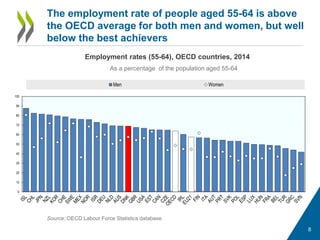
The employment rate of people aged 55-64 is above
the OECD average for both men and women, but well
below the best achievers
Employment rates (55-64), OECD countries, 2014
As a percentage of the population aged 55-64
Source: OECD Labour Force Statistics database.
8
0
10
20
30
40
50
60
70
80
90
100
Men Women
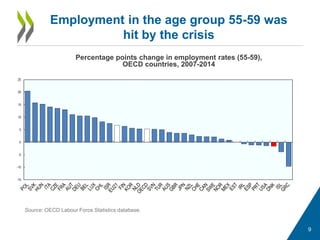
Employment in the age group 55-59 was
hit by the crisis
Percentage points change in employment rates (55-59),
OECD countries, 2007-2014
Source: OECD Labour Force Statistics database.
9
-15
-10
-5
0
5
10
15
20
25
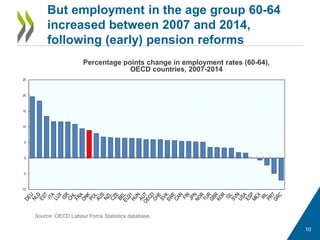
But employment in the age group 60-64
increased between 2007 and 2014,
following (early) pension reforms
Percentage points change in employment rates (60-64),
OECD countries, 2007-2014
Source: OECD Labour Force Statistics database.
10
-10
-5
0
5
10
15
20
25
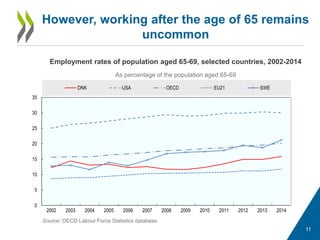
However, working after the age of 65 remains
uncommon
Employment rates of population aged 65-69, selected countries, 2002-2014
As percentage of the population aged 65-69
Source: OECD Labour Force Statistics database.
11
0
5
10
15
20
25
30
35
2002 2003 2004 2005 2006 2007 2008 2009 2010 2011 2012 2013 2014
DNK USA OECD EU21 SWE
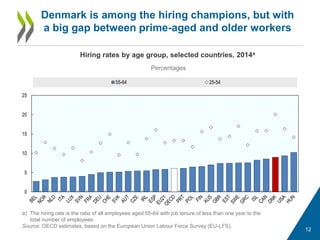
Denmark is among the hiring champions, but with
a big gap between prime-aged and older workers
Hiring rates by age group, selected countries, 2014a
Percentages
a) The hiring rate is the ratio of all employees aged 55-64 with job tenure of less than one year to the
total number of employees.
Source: OECD estimates, based on the European Union Labour Force Survey (EU-LFS).
12
0
5
10
15
20
25
55-64 25-54
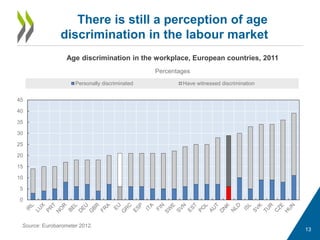
There is still a perception of age
discrimination in the labour market
Age discrimination in the workplace, European countries, 2011
Percentages
Source: Eurobarometer 2012.
0
5
10
15
20
25
30
35
40
45
Personally discriminated Have witnessed discrimination
13
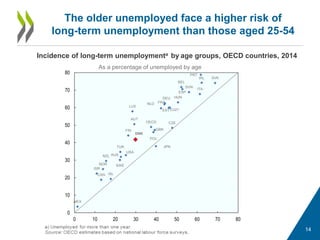
The older unemployed face a higher risk of
long-term unemployment than those aged 25-54
Incidence of long-term unemploymenta by age groups, OECD countries, 2014
As a percentage of unemployed by age
14
AUS
AUT
BEL
CAN
CZE
DNK
EST
FIN
FRA
DEU HUN
ISL
IRL
ISR
ITA
JPN
LUX
MEX
NLD
NZL
NOR
POL
PRT
SVK
SVN
ESP
SWE
TUR
GBR
USA
OECD
EU21
0
10
20
30
40
50
60
70
80
0 10 20 30 40 50 60 70 80
Aged 25-54
Aged55+
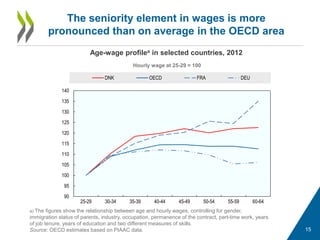
The seniority element in wages is more
pronounced than on average in the OECD area
Age-wage profilea in selected countries, 2012
Hourly wage at 25-29 = 100
a) The figures show the relationship between age and hourly wages, controlling for gender,
immigration status of parents, industry, occupation, permanence of the contract, part-time work, years
of job tenure, years of education and two different measures of skills.
Source: OECD estimates based on PIAAC data. 15
90
95
100
105
110
115
120
125
130
135
140
25-29 30-34 35-39 40-44 45-49 50-54 55-59 60-64
DNK OECD FRA DEU
KEY RECOMMENDATIONS
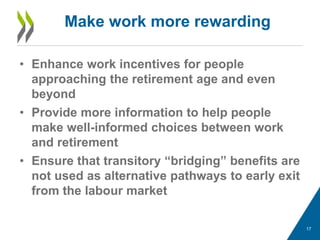
• Enhance work incentives for people
approaching the retirement age and even
beyond
• Provide more information to help people
make well-informed choices between work
and retirement
• Ensure that transitory “bridging” benefits are
not used as alternative pathways to early exit
from the labour market
Make work more rewarding
17
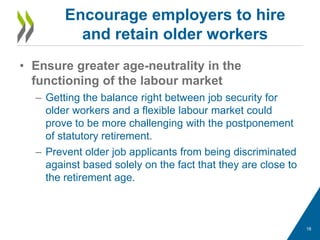
• Ensure greater age-neutrality in the
functioning of the labour market
– Getting the balance right between job security for
older workers and a flexible labour market could
prove to be more challenging with the postponement
of statutory retirement.
– Prevent older job applicants from being discriminated
against based solely on the fact that they are close to
the retirement age.
Encourage employers to hire
and retain older workers
18
• Move ahead with abolishing mandatory
retirement age in the public and private sectors
– This is especially crucial in those sectors and occupations
facing labour shortages, such as the health and care
sector and the trade sector.
• Focus wage-setting procedures more on
performance and skills and less on age and
tenure, particularly in the public sector
• Evaluate which measures work best to promote
longer working lives and create networks for
sharing experience among employers
Encourage employers to hire
and retain older workers (cont.)
19
• Improve access to suitably flexible work
arrangements
– Encourage social dialogue to better integrate
working-hour arrangements, organisation of work
tasks, technologies and personnel management
• More work-focused continuous learning
– Training courses should have a short or flexible
payback period
– Give VET teachers incentives to regularly spend time
in a firm within their professional field
Strengthen the employability of
older workers
20
• Co-ordination between health care and employment
services could be improved to increase the likelihood
of return to work
– The potential of the “Senior starter kit” should be
evaluated
• Encourage transitions back to regular jobs and
prevent inactive periods and early exit from the
labour market
– Phase out seniorjobs or at least reform them to give
stronger incentives to return to regular jobs
– Provide regular assessment of employability for
flexjobs
Strengthen the employability of
older workers (cont.)
21
Thank you!
For further information:
Mark Keese mark.keese@oecd.org
Anne Sonnet anne.sonnet@oecd.org
http://www.oecd.org/els/employment/olderworkers
22

Working better with age in Denmark

  • 1.
    WORKING BETTER WITHAGE REPORT ON OLDER WORKERS IN DENMARK Copenhagen, 21 October 2015 Mark Keese, Head of Division Anne Sonnet, Project Leader Directorate for Employment, Labour and Social Affairs, OECD
  • 2.
    1. Working Betterwith Age: the OECD review 2. Major challenges in Denmark 3. Key recommendations Outline of the presentation 2
  • 3.
    WORKING BETTER WITHAGE THE OECD REVIEW
  • 4.
    2003-2006 review onolder workers  21 country reports (including Denmark in 2005): Ageing and Employment Policies  And a synthesis report (2006): Live Longer, Work Longer  Agenda for policy actions in three broad areas to encourage work at an older age: 1. Rewarding work 2. Changing employer practices 3. Improving employability 4
  • 5.
    • Comparative policyreview of recent reforms and measures and a scoreboard for older workers: www.oecd.org/els/employment/olderworkers • Seven country case studies: Norway (June 2013), France (January 2014), Netherlands (April 2014), Switzerland (October 2014), Poland (March 2015), Denmark (October 2015) and Korea (2016) • Recommendation on Ageing and Employment Policies to promote longer working lives to be presented at the OECD Labour Ministerial meeting in January 2016 • Synthesis report Working Better with Age (2016) A follow-up review launched in 2011 to assess progress and what still needs to be done 5
  • 6.
     In responseto the OECD recommendations in 2005, Denmark implemented several substantial policy initiatives to encourage work at an older age.  The aims of this report are to:  Assess these policy initiatives and their impact on the employment situation of older workers.  Identify specific areas for further action, covering both supply- and demand-side aspects. Ageing and employment policies: Denmark 6
  • 7.
  • 8.
    The employment rateof people aged 55-64 is above the OECD average for both men and women, but well below the best achievers Employment rates (55-64), OECD countries, 2014 As a percentage of the population aged 55-64 Source: OECD Labour Force Statistics database. 8 0 10 20 30 40 50 60 70 80 90 100 Men Women
  • 9.
    Employment in theage group 55-59 was hit by the crisis Percentage points change in employment rates (55-59), OECD countries, 2007-2014 Source: OECD Labour Force Statistics database. 9 -15 -10 -5 0 5 10 15 20 25
  • 10.
    But employment inthe age group 60-64 increased between 2007 and 2014, following (early) pension reforms Percentage points change in employment rates (60-64), OECD countries, 2007-2014 Source: OECD Labour Force Statistics database. 10 -10 -5 0 5 10 15 20 25
  • 11.
    However, working afterthe age of 65 remains uncommon Employment rates of population aged 65-69, selected countries, 2002-2014 As percentage of the population aged 65-69 Source: OECD Labour Force Statistics database. 11 0 5 10 15 20 25 30 35 2002 2003 2004 2005 2006 2007 2008 2009 2010 2011 2012 2013 2014 DNK USA OECD EU21 SWE
  • 12.
    Denmark is amongthe hiring champions, but with a big gap between prime-aged and older workers Hiring rates by age group, selected countries, 2014a Percentages a) The hiring rate is the ratio of all employees aged 55-64 with job tenure of less than one year to the total number of employees. Source: OECD estimates, based on the European Union Labour Force Survey (EU-LFS). 12 0 5 10 15 20 25 55-64 25-54
  • 13.
    There is stilla perception of age discrimination in the labour market Age discrimination in the workplace, European countries, 2011 Percentages Source: Eurobarometer 2012. 0 5 10 15 20 25 30 35 40 45 Personally discriminated Have witnessed discrimination 13
  • 14.
    The older unemployedface a higher risk of long-term unemployment than those aged 25-54 Incidence of long-term unemploymenta by age groups, OECD countries, 2014 As a percentage of unemployed by age 14 AUS AUT BEL CAN CZE DNK EST FIN FRA DEU HUN ISL IRL ISR ITA JPN LUX MEX NLD NZL NOR POL PRT SVK SVN ESP SWE TUR GBR USA OECD EU21 0 10 20 30 40 50 60 70 80 0 10 20 30 40 50 60 70 80 Aged 25-54 Aged55+
  • 15.
    The seniority elementin wages is more pronounced than on average in the OECD area Age-wage profilea in selected countries, 2012 Hourly wage at 25-29 = 100 a) The figures show the relationship between age and hourly wages, controlling for gender, immigration status of parents, industry, occupation, permanence of the contract, part-time work, years of job tenure, years of education and two different measures of skills. Source: OECD estimates based on PIAAC data. 15 90 95 100 105 110 115 120 125 130 135 140 25-29 30-34 35-39 40-44 45-49 50-54 55-59 60-64 DNK OECD FRA DEU
  • 16.
  • 17.
    • Enhance workincentives for people approaching the retirement age and even beyond • Provide more information to help people make well-informed choices between work and retirement • Ensure that transitory “bridging” benefits are not used as alternative pathways to early exit from the labour market Make work more rewarding 17
  • 18.
    • Ensure greaterage-neutrality in the functioning of the labour market – Getting the balance right between job security for older workers and a flexible labour market could prove to be more challenging with the postponement of statutory retirement. – Prevent older job applicants from being discriminated against based solely on the fact that they are close to the retirement age. Encourage employers to hire and retain older workers 18
  • 19.
    • Move aheadwith abolishing mandatory retirement age in the public and private sectors – This is especially crucial in those sectors and occupations facing labour shortages, such as the health and care sector and the trade sector. • Focus wage-setting procedures more on performance and skills and less on age and tenure, particularly in the public sector • Evaluate which measures work best to promote longer working lives and create networks for sharing experience among employers Encourage employers to hire and retain older workers (cont.) 19
  • 20.
    • Improve accessto suitably flexible work arrangements – Encourage social dialogue to better integrate working-hour arrangements, organisation of work tasks, technologies and personnel management • More work-focused continuous learning – Training courses should have a short or flexible payback period – Give VET teachers incentives to regularly spend time in a firm within their professional field Strengthen the employability of older workers 20
  • 21.
    • Co-ordination betweenhealth care and employment services could be improved to increase the likelihood of return to work – The potential of the “Senior starter kit” should be evaluated • Encourage transitions back to regular jobs and prevent inactive periods and early exit from the labour market – Phase out seniorjobs or at least reform them to give stronger incentives to return to regular jobs – Provide regular assessment of employability for flexjobs Strengthen the employability of older workers (cont.) 21
  • 22.
    Thank you! For furtherinformation: Mark Keese mark.keese@oecd.org Anne Sonnet anne.sonnet@oecd.org http://www.oecd.org/els/employment/olderworkers 22

Editor's Notes

  • #20  A special chapter on EPL in EmO 2013.