Workflow Management Coalition
(WFMC) Standards
 Presented by:
 khansa abubkr
 Lemia alamin
 Alaa basheer
 Sara dafa’allah
 Haleema Mustafa

Background
 What’s Workflow Management Coalition (WFMC)
Standards
 WfMC Structure and Refrence Model
 What’s XPDL
 What’s Wf-XML
 What’s BPAF
Overview of Process
Definition Interchange :
 A Process Definition is defined as:
The representation of a business process in a form that supports
automated manipulation, such as modeling, or enactment by a
workflow management system. The process definition consists of
a network of activities and their relationships, criteria to indicate
the start and termination of the process, and information about the
individual activities, such as participants, associated IT
applications and data, etc.
Cont..
The process definition provides an environment for a
rich description of a process that can be used for the
following:
 Act as a template for the creation and control of
instances of that process during process enactment.
 For simulation and forecasting.
 As a basis to monitor and analyse enacted processes.
 For documentation, visualization, and knowledge
management.
What’s Workflow Management
Coalition Standards Definition :
  is a consortium formed to define standards for the
interoperability of workflow management systems. It
was founded in May 1993 with original members
including IBM, Hewlett-
Packard , Fujitsu, ICL, Staffware and approximately
300 software and services firms in the business
software sector.
Cont..
 Created to:
 Educate
 Define Common Language
 Encourage Usage
 Minimize risk
Advantages:
 Increase the value of customers’ investment
with workflow technology
 Decrease the risk of using workflow products
 Expand the workflow market through
increasing awareness for workflow
Structure
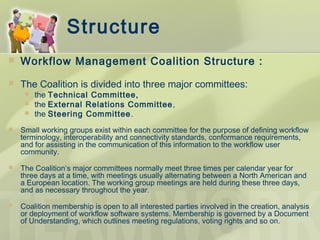
 Workflow Management Coalition Structure :
 The Coalition is divided into three major committees:
 the Technical Committee,
 the External Relations Committee,
 the Steering Committee.
 Small working groups exist within each committee for the purpose of defining workflow
terminology, interoperability and connectivity standards, conformance requirements,
and for assisting in the communication of this information to the workflow user
community.
 The Coalition’s major committees normally meet three times per calendar year for
three days at a time, with meetings usually alternating between a North American and
a European location. The working group meetings are held during these three days,
and as necessary throughout the year.
 Coalition membership is open to all interested parties involved in the creation, analysis
or deployment of workflow software systems. Membership is governed by a Document
of Understanding, which outlines meeting regulations, voting rights and so on.
Cont..
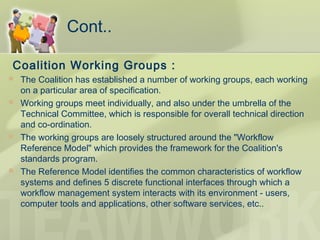
Coalition Working Groups :
 The Coalition has established a number of working groups, each working
on a particular area of specification.
 Working groups meet individually, and also under the umbrella of the
Technical Committee, which is responsible for overall technical direction
and co-ordination.
 The working groups are loosely structured around the "Workflow
Reference Model" which provides the framework for the Coalition's
standards program.
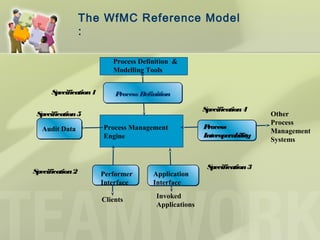
 The Reference Model identifies the common characteristics of workflow
systems and defines 5 discrete functional interfaces through which a
workflow management system interacts with its environment - users,
computer tools and applications, other software services, etc..
The WfMC Reference Model
:
Process Definition &
Modelling Tools
Process Management
Engine
Specification3
Invoked
Applications
Specification1 Process Definition
Audit Data
Specification5
Specification4
Other
Process
Management
Systems
Specification2 Performer
Interface
Process
Interoperability
Application
Interface
Clients
Major Deliverables :
 Definition
 Glossary of terms
 Reference Model
 Specifications to support the Ref. Model
WFMC Standers:
 XPDL
 WF- XML
 BPAF
What’s XPDL
 XML Process Definition Language:
 standardized by the Workflow Management
Coalition to interchange Business Process
definitions between different workflow product
s.
  XPDL defines an XML schema for
specifying the declarative part of workflow /
business process.
Cont..
  designed to exchange the process definition.
 Best file format for exchange of BPMN
diagrams
 designed specifically to store all aspects of a
BPMN diagram.
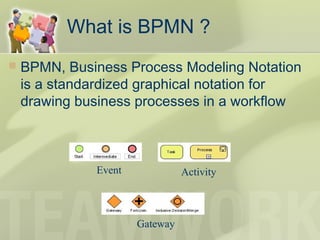
What is BPMN ?
 BPMN, Business Process Modeling Notation
is a standardized graphical notation for
drawing business processes in a workflow
Event Activity
Gateway
Cont..
The goal of XPDL :
is to provide a Lingua Franca for the
workflow domain allowing for :
 store and exchange the process diagram
 allow one tool to model a process diagram
 read the diagram and edit
What is Wf-XML?
• is designed and implemented as an extension
to the OASIS Asynchronous Service Access
Protocol (ASAP). ASAP provides a
standardized way that a program can start
and monitor a program that might take a long
time to complete.
• Is derived from the Simple Workflow Access
Protocol (SWAP) which had it’s origin in early
WfMC work.
• Uses the WfMC abstract specification that
defines what needs to pass between
workflows.
• Specifies how to use the XML language to
make it happen.
• It provide interface between such a design
tool and the PPM engine.
Wf-XML Specifics
• Request - Response Model
• Message Structure: Transport, Header, Body
• Operations:
• CreateProcessInstance
• GetProcessInstanceData
• ChangeProcessInstanceState
• Also - Provides a Framework for Making Necessary Business
Agreements
usage
 Wf-XML is an ideal way for a BPM engine to
invoke a process in another BPM engine, and
to wait for it to completed.
 the protocol doesnot automatically
convert the Process Definition Format
It communicates the process definition to and
from the client and server.  The process
design tool and the process engine must be
able to agree on a format to exchange.
Is it really a web
service?
The common definition of a web service is that
the messages that are to be exchanged are
defined using WSDL. 
Since Wf-XML is defined using WSDL, we
say that Wf-XML is a standard web service.
BPAF-Definition
 A business process that describes the day-to-day activities
and job duties an employee performs. (Job duties =
processes)
 A business process is a picture of workflow with a beginning,
middle and end.
 Work often crosses over departments. BPA requires
cooperation and a willingness to assess the ownership of
duties/tasks.
Business Process Analytics
Format (BPAF) 
  
Business Process Analytics
provides process participants and
decision makers with insight about
the efficiency and effectiveness of
organizational processes.
Cont..
There are three reasons why we might
want to measure different aspects of
business processes:
1. To evaluate what has happened in the past,
2. to understand what is happening currently, or
3. to build an understanding of what might happen
in the future.
Reasons to Use BPA
 Elimination of activities that do not add value;
 Simplification of tasks and activities;
 Integration of jobs or job groups;
 Automation of task and activities (technology).
Cont..
 If no documented process model exists, or if
the scope of the process extends across
multiple systems and process domains such
a model may be inductively generated
through Process Mining. Leading research on
this topic is being conducted by Wil van der
Aalst
MXML
 is an XML-based user interface markup
language first introduced by Macromedia in
March 2004. Application developers use
MXML in combination with ActionScript to
develop rich Internet applications, with
products .
References :
 http://www.wfmc.org/about-us/wfmc-structure.
 https://en.wikipedia.org/wiki/Workflow_Managem
ent_Coalition.
 https://www.google.com/url?
sa=t&rct=j&q=&esrc=s&source=web&cd=2&cad=rja&uact=8&ved=0ahUK
EwiHuczrg-vLAhXBORQKHdRQD5EQFggiMAE&url=https%3A%2F
%2Fwww.oasis-open.org%2Fevents%2Fforum%2F2005%2Fslides
%2FPyke.ppt&usg=AFQjCNFDC5asw-Hz9T1ZtXnaqEzXlM-
p8g&bvm=bv.118353311,d.d24.
 http://kswenson.workcast.org/2010/MIZU.KESW-BPAF-V1R2.pdf
Question ?

Workflow management coalition (wfmc) standards

  • 1.
  • 2.
     Presented by: khansa abubkr  Lemia alamin  Alaa basheer  Sara dafa’allah  Haleema Mustafa 
  • 3.
    Background  What’s WorkflowManagement Coalition (WFMC) Standards  WfMC Structure and Refrence Model  What’s XPDL  What’s Wf-XML  What’s BPAF
  • 4.
    Overview of Process DefinitionInterchange :  A Process Definition is defined as: The representation of a business process in a form that supports automated manipulation, such as modeling, or enactment by a workflow management system. The process definition consists of a network of activities and their relationships, criteria to indicate the start and termination of the process, and information about the individual activities, such as participants, associated IT applications and data, etc.
  • 5.
    Cont.. The process definitionprovides an environment for a rich description of a process that can be used for the following:  Act as a template for the creation and control of instances of that process during process enactment.  For simulation and forecasting.  As a basis to monitor and analyse enacted processes.  For documentation, visualization, and knowledge management.
  • 6.
    What’s Workflow Management CoalitionStandards Definition :   is a consortium formed to define standards for the interoperability of workflow management systems. It was founded in May 1993 with original members including IBM, Hewlett- Packard , Fujitsu, ICL, Staffware and approximately 300 software and services firms in the business software sector.
  • 7.
    Cont..  Created to: Educate  Define Common Language  Encourage Usage  Minimize risk
  • 8.
    Advantages:  Increase thevalue of customers’ investment with workflow technology  Decrease the risk of using workflow products  Expand the workflow market through increasing awareness for workflow
  • 9.
    Structure  Workflow ManagementCoalition Structure :  The Coalition is divided into three major committees:  the Technical Committee,  the External Relations Committee,  the Steering Committee.  Small working groups exist within each committee for the purpose of defining workflow terminology, interoperability and connectivity standards, conformance requirements, and for assisting in the communication of this information to the workflow user community.  The Coalition’s major committees normally meet three times per calendar year for three days at a time, with meetings usually alternating between a North American and a European location. The working group meetings are held during these three days, and as necessary throughout the year.  Coalition membership is open to all interested parties involved in the creation, analysis or deployment of workflow software systems. Membership is governed by a Document of Understanding, which outlines meeting regulations, voting rights and so on.
  • 10.
    Cont.. Coalition Working Groups:  The Coalition has established a number of working groups, each working on a particular area of specification.  Working groups meet individually, and also under the umbrella of the Technical Committee, which is responsible for overall technical direction and co-ordination.  The working groups are loosely structured around the "Workflow Reference Model" which provides the framework for the Coalition's standards program.  The Reference Model identifies the common characteristics of workflow systems and defines 5 discrete functional interfaces through which a workflow management system interacts with its environment - users, computer tools and applications, other software services, etc..
  • 11.
    The WfMC ReferenceModel : Process Definition & Modelling Tools Process Management Engine Specification3 Invoked Applications Specification1 Process Definition Audit Data Specification5 Specification4 Other Process Management Systems Specification2 Performer Interface Process Interoperability Application Interface Clients
  • 12.
    Major Deliverables : Definition  Glossary of terms  Reference Model  Specifications to support the Ref. Model
  • 13.
  • 14.
    What’s XPDL  XML ProcessDefinition Language:  standardized by the Workflow Management Coalition to interchange Business Process definitions between different workflow product s.   XPDL defines an XML schema for specifying the declarative part of workflow / business process.
  • 15.
    Cont..   designed toexchange the process definition.  Best file format for exchange of BPMN diagrams  designed specifically to store all aspects of a BPMN diagram.
  • 16.
    What is BPMN?  BPMN, Business Process Modeling Notation is a standardized graphical notation for drawing business processes in a workflow Event Activity Gateway
  • 17.
    Cont.. The goal ofXPDL : is to provide a Lingua Franca for the workflow domain allowing for :  store and exchange the process diagram  allow one tool to model a process diagram  read the diagram and edit
  • 18.
    What is Wf-XML? •is designed and implemented as an extension to the OASIS Asynchronous Service Access Protocol (ASAP). ASAP provides a standardized way that a program can start and monitor a program that might take a long time to complete. • Is derived from the Simple Workflow Access Protocol (SWAP) which had it’s origin in early WfMC work.
  • 19.
    • Uses theWfMC abstract specification that defines what needs to pass between workflows. • Specifies how to use the XML language to make it happen. • It provide interface between such a design tool and the PPM engine.
  • 20.
    Wf-XML Specifics • Request- Response Model • Message Structure: Transport, Header, Body • Operations: • CreateProcessInstance • GetProcessInstanceData • ChangeProcessInstanceState • Also - Provides a Framework for Making Necessary Business Agreements
  • 21.
    usage  Wf-XML isan ideal way for a BPM engine to invoke a process in another BPM engine, and to wait for it to completed.  the protocol doesnot automatically convert the Process Definition Format It communicates the process definition to and from the client and server.  The process design tool and the process engine must be able to agree on a format to exchange.
  • 22.
    Is it reallya web service? The common definition of a web service is that the messages that are to be exchanged are defined using WSDL.  Since Wf-XML is defined using WSDL, we say that Wf-XML is a standard web service.
  • 23.
    BPAF-Definition  A businessprocess that describes the day-to-day activities and job duties an employee performs. (Job duties = processes)  A business process is a picture of workflow with a beginning, middle and end.  Work often crosses over departments. BPA requires cooperation and a willingness to assess the ownership of duties/tasks.
  • 24.
    Business Process Analytics Format(BPAF)     Business Process Analytics provides process participants and decision makers with insight about the efficiency and effectiveness of organizational processes.
  • 25.
    Cont.. There are threereasons why we might want to measure different aspects of business processes: 1. To evaluate what has happened in the past, 2. to understand what is happening currently, or 3. to build an understanding of what might happen in the future.
  • 26.
    Reasons to UseBPA  Elimination of activities that do not add value;  Simplification of tasks and activities;  Integration of jobs or job groups;  Automation of task and activities (technology).
  • 27.
    Cont..  If nodocumented process model exists, or if the scope of the process extends across multiple systems and process domains such a model may be inductively generated through Process Mining. Leading research on this topic is being conducted by Wil van der Aalst
  • 28.
    MXML  is anXML-based user interface markup language first introduced by Macromedia in March 2004. Application developers use MXML in combination with ActionScript to develop rich Internet applications, with products .
  • 29.
    References :  http://www.wfmc.org/about-us/wfmc-structure. https://en.wikipedia.org/wiki/Workflow_Managem ent_Coalition.  https://www.google.com/url? sa=t&rct=j&q=&esrc=s&source=web&cd=2&cad=rja&uact=8&ved=0ahUK EwiHuczrg-vLAhXBORQKHdRQD5EQFggiMAE&url=https%3A%2F %2Fwww.oasis-open.org%2Fevents%2Fforum%2F2005%2Fslides %2FPyke.ppt&usg=AFQjCNFDC5asw-Hz9T1ZtXnaqEzXlM- p8g&bvm=bv.118353311,d.d24.  http://kswenson.workcast.org/2010/MIZU.KESW-BPAF-V1R2.pdf
  • 30.