BPMN Primer 
Razvan Radulian, MBA 
Independent Consultant/Coach/Trainer 
Why-What-How Consulting, LLC 
razvan.radulian@why-what-how.com 
Webinar hosted by ASPE SDLC Training
Introductions 
Razvan Radulian, MBA 
• Independent Consultant/Coach/Trainer 
• 15+ years of Business/System + Process 
Analysis, Design, and Implementation 
• Certified… 
– Business Analyst 
– Expert in Business Process Management (OCEB) 
– Project Management 
– Lean Management
Agenda 
Why BPMN? 
– Problems it tries to address 
– Strengths & Weaknesses 
• BPMN vs. “alternatives” 
What it is 
– Core elements 
– Symbols, Syntax, Semantics 
How (only the tip of the iceberg) 
– BPMN by example
What do BPM & BPMN stand for? 
• BPM = Business Process Management 
• Business Process Modeling Notation (BPMN 1.x) 
• Business Process Model & Notation (BPMN 2.0) 
Is that important?!?
Problems BPMN addresses 
• Communication & understanding issues: 
– Business 
– IT 
– Business AND IT 
• Lack of precision, accuracy, consistency at 
at least 1 of the 3 communication levels: 
– Symbols, words 
– Syntax 
– Semantics
Alternatives to BPMN 
… each with advantages and, mostly, disadvantages 
• Expanded Event-driven Process Chains 
(EPC/ARIS) 
• Activity diagrams (UML) 
• Traditional flowcharts, aka. Swimlanes, Cross-functional, 
etc.
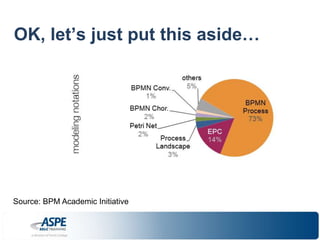
OK, let’s just put this aside… 
Source: BPM Academic Initiative
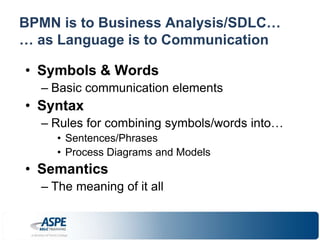
BPMN is to Business Analysis/SDLC… 
… as Language is to Communication 
• Symbols & Words 
– Basic communication elements 
• Syntax 
– Rules for combining symbols/words into… 
• Sentences/Phrases 
• Process Diagrams and Models 
• Semantics 
– The meaning of it all
Try this… 
Try to explain the “Pull a cat by the tail” process and why 
it’s not such a good idea: 
• to a 2-year old child: 
– Mostly Semantics 
– Simple or no [standard] Symbols and/or Syntax 
• to a Business Partner/Executive: 
– Should be standard/precise Symbols, Syntax, and Semantics… 
…BUT, often times, it’s a mix of inconsistent Symbols, confusing 
“Syntax”, and imprecise & implied Semantics 
As you can guess, talking with Business Partners/Execs is 
(should be) a “bit” more complex… 
… does our communication meet that requirement?
CAUTION: BPMN does not ensure 
GOOD SEMANTICS! 
BPMN Specification can enforce: 
• Symbols & Syntax (IF analysts create valid BPMN 
Models) 
BUT, to ensure GOOD BPMN Models, 
Process Analysts/Designers must also 
implement/enforce Process Modeling BEST 
PRACTICES* 
* Recommended book: BPMN Method & Style, 2nd edition, by Bruce Silver
Critics to BPMN 
“Too complex for business people” 
“Not expressive enough” 
“There are a lot of bad BPMN models” 
…so “BPMN is [must be] bad for Business People!” 
But, does that make any sense?!? 
Compare that with… 
– Is English bad for communication only because many 
college applicants submit bad essays (i.e. misspelled 
words, wrong syntax, unclear message, messy, etc.)?
Advantages of BPMN 
De-facto Standard 
– Managed by Object Management Group (OMG) 
– Open specification, free to all (public) 
Multiple levels of abstraction, addressing multiple concerns/perspectives: 
– Descriptive 
– Analytical 
– Executable 
Simple, yet sophisticated enough to allows nuanced definition/interpretation: 
– Hierarchical/progressive elaboration (see both the forest and the trees) 
– Life-like Event processing 
– Process/participants collaboration 
– Rich set of task, gateway, and event types 
Closest match to pre-defined WORKFLOW PATTERNS* 
Model interchange & execution (BPMN 2.0) 
* See http://workflowpatterns.com/
IMPOSSIBLE to cover BPMN in 1-hour*… 
Fundamentals (Descriptive level): 
– Flow elements: Activities, Gateways, Events 
– Connectors: Sequence & Message Flow, Associations 
– Pools & Lanes 
– Data & Artifacts 
Some [of the many] unique features: 
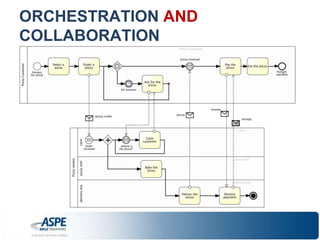
– Orchestration (internal) AND collaboration between 
Participants/Processes 
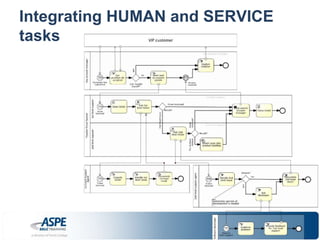
– Integrating Human Tasks/Workflow AND Automated Services 
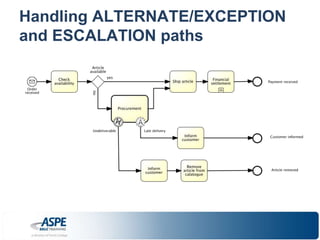
– “Happy path” AND Alternate/Exceptions paths 
– Escalations & Compensations 
– Fit for communication (business & IT) AND process execution 
* A full BPMN class will be offered starting spring of 2014
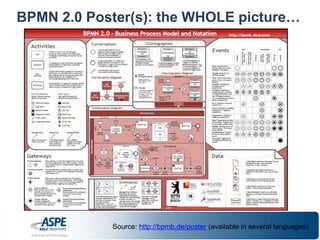
BPMN 2.0 Poster(s): the WHOLE picture… 
Source: http://bpmb.de/poster (available in several languages)
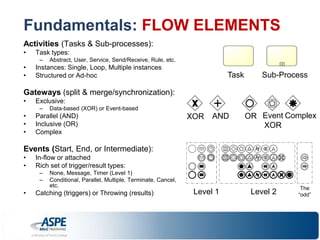
Fundamentals: FLOW ELEMENTS 
Activities (Tasks & Sub-processes): 
• Task types: 
– Abstract, User, Service, Send/Receive, Rule, etc. 
• Instances: Single, Loop, Multiple instances 
• Structured or Ad-hoc 
Gateways (split & merge/synchronization): 
• Exclusive: 
– Data-based (XOR) or Event-based 
• Parallel (AND) 
• Inclusive (OR) 
• Complex 
Events (Start, End, or Intermediate): 
• In-flow or attached 
• Rich set of trigger/result types: 
– None, Message, Timer (Level 1) 
– Conditional, Parallel, Multiple, Terminate, Cancel, 
etc. 
Task Sub-Process 
• Catching (triggers) or Throwing (results) Level 1 Level 2 The 
“odd” 
XOR AND OR Event 
XOR 
Complex
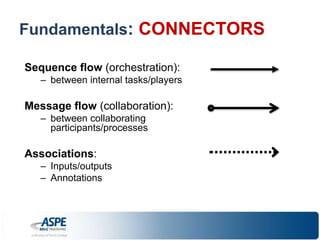
Fundamentals: CONNECTORS 
Sequence flow (orchestration): 
– between internal tasks/players 
Message flow (collaboration): 
– between collaborating 
participants/processes 
Associations: 
– Inputs/outputs 
– Annotations
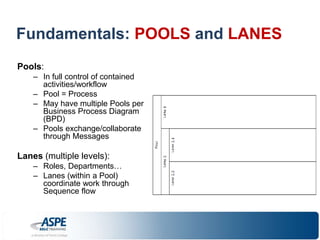
Fundamentals: POOLS and LANES 
Pools: 
– In full control of contained 
activities/workflow 
– Pool = Process 
– May have multiple Pools per 
Business Process Diagram 
(BPD) 
– Pools exchange/collaborate 
through Messages 
Lanes (multiple levels): 
– Roles, Departments… 
– Lanes (within a Pool) 
coordinate work through 
Sequence flow
Fundamentals: DATA & ARTIFACTS 
Data: 
– Data Objects 
• Input & Output 
• Have state (e.g. 
Request[Approved]) 
• Process-data 
– Data Store: 
• Permanent storage (e.g. 
database, repository, etc.) of the 
process data 
Artifacts: 
– Annotations 
– Group
Useful concept: TOKENS 
• Visual representation of how work would 
flow through a process 
• Not part of BPMN specification 
• For examples, see Workflow Patterns 
website (workflowpatterns.com/)
Some of [the many] UNIQUE features! 
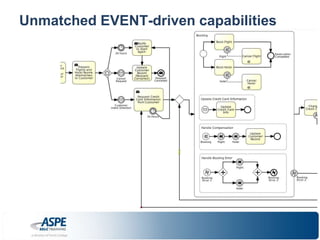
• Rich/unmatched event-driven capabilities 
• Explicit definition/description of BOTH… 
– Orchestration of internal activities/tasks AND 
– Collaboration between Participants/Processes 
• Integration of BOTH… 
– Human Tasks/Workflow AND 
– Automated Services (heard of SOA?) 
• Going beyond the “Happy path”, in a clear and 
concise way: 
– Alternate/Exceptions paths: 
• attached events: Interrupting and Non-interrupting (BPMN 2.0) 
– Escalations & compensations
Unmatched EVENT-driven capabilities
ORCHESTRATION AND 
COLLABORATION
Integrating HUMAN and SERVICE 
tasks
Handling ALTERNATE/EXCEPTION 
and ESCALATION paths
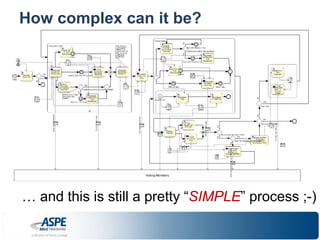
How complex can it be? 
… and this is still a pretty “SIMPLE” process ;-)
Things we haven’t talked about… 
• Levels 2 (Analytical) & 3 (Executable) 
• Transactions & compensations 
• BPMN in the context of: 
– BPM (Business Process Management) 
– Business & Enterprise Architecture 
– Agile 
• BPMN vs. Use Cases 
• BPMN Analysis & Simulations 
• BPM & BPMN Certification 
… and MUCH MORE!
Some useful Resources 
• BPMN 2.0 Specification (www.omg.org/spec/BPMN/2.0/) 
• Workflow Patterns (workflowpatterns.com/) 
• Books: 
• BPMN Method and Style, 2nd edition, by Bruce Silver 
• Real-Life BPMN, by J. Freund & B. Rucker 
• The MicroGuide to Process Modeling, by T. Debevoise & R. Geneva 
• BPM Academic Initiative (bpmai.org/BPMAcademicInitiative/) 
• Business Process Incubator (articles, eLearning, tools, etc.) 
• Camunda BPMN Framework (www.camunda.org/) 
• ASPE SDLC Website (webinars, classes, articles/blog, etc.) 
Contact me: Razvan.Radulian@why-what-how.com :-)
Q & A
Thanks :-) 
Contact: razvan.radulian@why-what-how.com

BPMN Primer (Razvan Radulian, ASPE Webinar, 2013)

  • 1.
    BPMN Primer RazvanRadulian, MBA Independent Consultant/Coach/Trainer Why-What-How Consulting, LLC razvan.radulian@why-what-how.com Webinar hosted by ASPE SDLC Training
  • 2.
    Introductions Razvan Radulian,MBA • Independent Consultant/Coach/Trainer • 15+ years of Business/System + Process Analysis, Design, and Implementation • Certified… – Business Analyst – Expert in Business Process Management (OCEB) – Project Management – Lean Management
  • 3.
    Agenda Why BPMN? – Problems it tries to address – Strengths & Weaknesses • BPMN vs. “alternatives” What it is – Core elements – Symbols, Syntax, Semantics How (only the tip of the iceberg) – BPMN by example
  • 4.
    What do BPM& BPMN stand for? • BPM = Business Process Management • Business Process Modeling Notation (BPMN 1.x) • Business Process Model & Notation (BPMN 2.0) Is that important?!?
  • 5.
    Problems BPMN addresses • Communication & understanding issues: – Business – IT – Business AND IT • Lack of precision, accuracy, consistency at at least 1 of the 3 communication levels: – Symbols, words – Syntax – Semantics
  • 6.
    Alternatives to BPMN … each with advantages and, mostly, disadvantages • Expanded Event-driven Process Chains (EPC/ARIS) • Activity diagrams (UML) • Traditional flowcharts, aka. Swimlanes, Cross-functional, etc.
  • 7.
    OK, let’s justput this aside… Source: BPM Academic Initiative
  • 8.
    BPMN is toBusiness Analysis/SDLC… … as Language is to Communication • Symbols & Words – Basic communication elements • Syntax – Rules for combining symbols/words into… • Sentences/Phrases • Process Diagrams and Models • Semantics – The meaning of it all
  • 9.
    Try this… Tryto explain the “Pull a cat by the tail” process and why it’s not such a good idea: • to a 2-year old child: – Mostly Semantics – Simple or no [standard] Symbols and/or Syntax • to a Business Partner/Executive: – Should be standard/precise Symbols, Syntax, and Semantics… …BUT, often times, it’s a mix of inconsistent Symbols, confusing “Syntax”, and imprecise & implied Semantics As you can guess, talking with Business Partners/Execs is (should be) a “bit” more complex… … does our communication meet that requirement?
  • 10.
    CAUTION: BPMN doesnot ensure GOOD SEMANTICS! BPMN Specification can enforce: • Symbols & Syntax (IF analysts create valid BPMN Models) BUT, to ensure GOOD BPMN Models, Process Analysts/Designers must also implement/enforce Process Modeling BEST PRACTICES* * Recommended book: BPMN Method & Style, 2nd edition, by Bruce Silver
  • 11.
    Critics to BPMN “Too complex for business people” “Not expressive enough” “There are a lot of bad BPMN models” …so “BPMN is [must be] bad for Business People!” But, does that make any sense?!? Compare that with… – Is English bad for communication only because many college applicants submit bad essays (i.e. misspelled words, wrong syntax, unclear message, messy, etc.)?
  • 12.
    Advantages of BPMN De-facto Standard – Managed by Object Management Group (OMG) – Open specification, free to all (public) Multiple levels of abstraction, addressing multiple concerns/perspectives: – Descriptive – Analytical – Executable Simple, yet sophisticated enough to allows nuanced definition/interpretation: – Hierarchical/progressive elaboration (see both the forest and the trees) – Life-like Event processing – Process/participants collaboration – Rich set of task, gateway, and event types Closest match to pre-defined WORKFLOW PATTERNS* Model interchange & execution (BPMN 2.0) * See http://workflowpatterns.com/
  • 13.
    IMPOSSIBLE to coverBPMN in 1-hour*… Fundamentals (Descriptive level): – Flow elements: Activities, Gateways, Events – Connectors: Sequence & Message Flow, Associations – Pools & Lanes – Data & Artifacts Some [of the many] unique features: – Orchestration (internal) AND collaboration between Participants/Processes – Integrating Human Tasks/Workflow AND Automated Services – “Happy path” AND Alternate/Exceptions paths – Escalations & Compensations – Fit for communication (business & IT) AND process execution * A full BPMN class will be offered starting spring of 2014
  • 14.
    BPMN 2.0 Poster(s):the WHOLE picture… Source: http://bpmb.de/poster (available in several languages)
  • 15.
    Fundamentals: FLOW ELEMENTS Activities (Tasks & Sub-processes): • Task types: – Abstract, User, Service, Send/Receive, Rule, etc. • Instances: Single, Loop, Multiple instances • Structured or Ad-hoc Gateways (split & merge/synchronization): • Exclusive: – Data-based (XOR) or Event-based • Parallel (AND) • Inclusive (OR) • Complex Events (Start, End, or Intermediate): • In-flow or attached • Rich set of trigger/result types: – None, Message, Timer (Level 1) – Conditional, Parallel, Multiple, Terminate, Cancel, etc. Task Sub-Process • Catching (triggers) or Throwing (results) Level 1 Level 2 The “odd” XOR AND OR Event XOR Complex
  • 16.
    Fundamentals: CONNECTORS Sequenceflow (orchestration): – between internal tasks/players Message flow (collaboration): – between collaborating participants/processes Associations: – Inputs/outputs – Annotations
  • 17.
    Fundamentals: POOLS andLANES Pools: – In full control of contained activities/workflow – Pool = Process – May have multiple Pools per Business Process Diagram (BPD) – Pools exchange/collaborate through Messages Lanes (multiple levels): – Roles, Departments… – Lanes (within a Pool) coordinate work through Sequence flow
  • 18.
    Fundamentals: DATA &ARTIFACTS Data: – Data Objects • Input & Output • Have state (e.g. Request[Approved]) • Process-data – Data Store: • Permanent storage (e.g. database, repository, etc.) of the process data Artifacts: – Annotations – Group
  • 19.
    Useful concept: TOKENS • Visual representation of how work would flow through a process • Not part of BPMN specification • For examples, see Workflow Patterns website (workflowpatterns.com/)
  • 20.
    Some of [themany] UNIQUE features! • Rich/unmatched event-driven capabilities • Explicit definition/description of BOTH… – Orchestration of internal activities/tasks AND – Collaboration between Participants/Processes • Integration of BOTH… – Human Tasks/Workflow AND – Automated Services (heard of SOA?) • Going beyond the “Happy path”, in a clear and concise way: – Alternate/Exceptions paths: • attached events: Interrupting and Non-interrupting (BPMN 2.0) – Escalations & compensations
  • 21.
  • 22.
  • 23.
    Integrating HUMAN andSERVICE tasks
  • 24.
  • 25.
    How complex canit be? … and this is still a pretty “SIMPLE” process ;-)
  • 26.
    Things we haven’ttalked about… • Levels 2 (Analytical) & 3 (Executable) • Transactions & compensations • BPMN in the context of: – BPM (Business Process Management) – Business & Enterprise Architecture – Agile • BPMN vs. Use Cases • BPMN Analysis & Simulations • BPM & BPMN Certification … and MUCH MORE!
  • 27.
    Some useful Resources • BPMN 2.0 Specification (www.omg.org/spec/BPMN/2.0/) • Workflow Patterns (workflowpatterns.com/) • Books: • BPMN Method and Style, 2nd edition, by Bruce Silver • Real-Life BPMN, by J. Freund & B. Rucker • The MicroGuide to Process Modeling, by T. Debevoise & R. Geneva • BPM Academic Initiative (bpmai.org/BPMAcademicInitiative/) • Business Process Incubator (articles, eLearning, tools, etc.) • Camunda BPMN Framework (www.camunda.org/) • ASPE SDLC Website (webinars, classes, articles/blog, etc.) Contact me: Razvan.Radulian@why-what-how.com :-)
  • 28.
  • 29.
    Thanks :-) Contact:razvan.radulian@why-what-how.com