Except for a member's personal use, this document may not be printed or copied without written permission from HR On-Line.
                                                              Copyright © 2000 HR On-Line. All Rights Reserved.


                               Creating A Self-renewing Framework for
                               Corporate Transformation: The Worker's
                               Microcosm
                               by Terry Jabali


                               We were half way through an IT implementation for this call center that supports in excess of
                               3,000 of internal customers. Leading practices in change management plans were already in
                               place including the communication plan. The workers showed all signs of embracing what these
                               IT changes meant for them. As we proceeded with end-user training, retention and applicability
                               among participants appeared to be better than expected. We used a combination of workshop and
                               on-site training approaches in addition to performance systems. Yet, with select employee
CONTENTS
                               groups, frustration was high, frequent mistakes were common, and tensions continued to build
• Transformation               affecting the rest of the employees body, and threatening the success of the overall project.
  Initiatives in an Era of
  Undefined Territory          Where did we go wrong? We puzzled with this lingering question! To establish a separate
• A Process-based              coaching plan for these individuals meant going off course, plus, we were on a tight budget. We
  Organization & W-M           needed to understand these emerging patterns and design a holistic approach that addresses these
                               challenges at the root level without dedicating significant one-on-one activities.
• Performance
  Management and W-
  M                            As we went back and reviewed the change management strategies; we had effectively assessed
                               stakeholders alignment, communication needs, and subsequent training, among other solution
• The Manager as               activities. However, the patterns that were emerging appeared to be of individual idiosyncrasies
  Guardian of
  Prosperity                   in nature.

• E-business, Virtual          For instance, Joe, a client's Team Lead had a tolerance for ambiguity that was significantly less
  Organization and W-          than that of Mary, in same capacity of another unit. Sandra, a Manager of Client Relations,
  M
                               showed high level of endurance for customer-related stress than that of Tom, a Manager of
• Sustaining Self-             Programming of Financial Systems who mostly interfaced with IT and a handful of direct reports
  Renewal                      on a daily basis. Other signs such as frustrations, tolerance, among other indicators existed in a
                               wide variance among managers and employees. We were slightly off schedule, however, as we
                               understood and pursued compatible change management plans for these dispersed groups, the
project went from a troubleshooting mode to true integration mode while successfully exceeding
engagement's ROI.

What did we learn from this experience? In order to cultivate a real transformation in the
workplace, there is more to just communicating and selling the worker on change benefits, we
must attempt to understand the workers' dominant traits beforehand. With an ever increasing
pressure on the worker to cope with evolving changes while continuing to produce, where do we
turn to fuel the worker's energy-house in order to keep him/her glowing instead of burning-up?

To understand the variables of human dynamics which play into the performance of today's
worker prior to any change initiative, we had to understand and leverage the worker's
environment — we called it the Worker's Microcosm ® (W-M).1

The W-M framework proved to be highly beneficial in the engagements that followed
particularly in a time when today's worker is bombarded with corporate acquisition, internal
restructuring, and IT initiatives among others. W-M is about framing all key corporate drivers of
people and systems while aligning and balancing human needs with such drivers. At its core, it is
intended to build synergy between people and systems as well as intra -people and systems. It
fosters systems alignment with workers' profile for long term compatibility. Using behavioral-
based and profiling tools prior to any change initiatives will not only yield group performance
predictors, but also aid in creating and sustaining an optimal environment for long term worker
productivity. Illustrations I and II are intended to aid in the design and the assessment
administration of the Worker's Microcosm.


 Illustration Ia


Worker's Environment "W-Microcosm" (IT may be integrated in most of above). The premise for W-M
self-renewal is for the worker to be aligned at the job hub starting with his/her daily roles and extending
with congruent alignment across all corporate systems.
Illustration Ib
                                                                                            Project
Worker's Microcosm                                                                          Mgmt.
                                                                                            Notes

Corporate/Business          Organization Design/Process Flow
Unit Directives             (the dictating body)

Corporate Values,           Job Design: The Balanced
Norms & Management          Hub                                Performance Mgmt
Practices:                  (Compatibility Alignment)

       Goals               Worker's         Job Design               Balanced
       Accepted            Profile &        &                         Dashboard (ex
        Behaviors           Performance      Performance               BSC, Kaplan,
       Ideal Leadership    Drivers          Alignment                 Norton, 1991)
        Traits                                                        Succession
                            Interest                                   Planning
       What tasks                           Technical
                            Inventory                                 Career
        (technical and                       Skills
                            Assessment                                 Development
        functional) are
        most rewarded                                                  Plan
                            Personality
        in this culture                      Functional
                            Indicator
                                             Skills
                            Assessment

                            Merit-based      Leadership
                            Assessment       Skills
All gray shaded areas directly or indirectly shape the Job Hub, the center of the W-M framework as
either an Enabler or a Barrier to overall corporate performance — it all starts at the Job Hub
Alignment


 Illustration II

 W-M Element Analysis
Understanding the underlying premise of the W-M elements will significantly aid in building a sound
foundation for any transformation initiative.


Transformation Initiatives in an Era of Undefined Territory

Many behaviorists advocate that "we are a product of our environment. To change, we must
change the environment." Similarly, with the average worker spending two third of his/her life at
work, the environment we create is either an enabler or a barrier to worker/corporate
actualization, and, the environment itself is determined and shaped by the degree of our
understanding of its variables. If we perpetuate an environment of isolationism, we will reap
isolated results. If we idolize technology without consideration to how different workers respond
to its various segments, again, we are only reaping limited technology integration. To achieve
optimal technology integration, people must feel at home with it. What if the systems in W-M
were already imbalanced? Then, simply, the IT solution will follow the same pattern. Here are
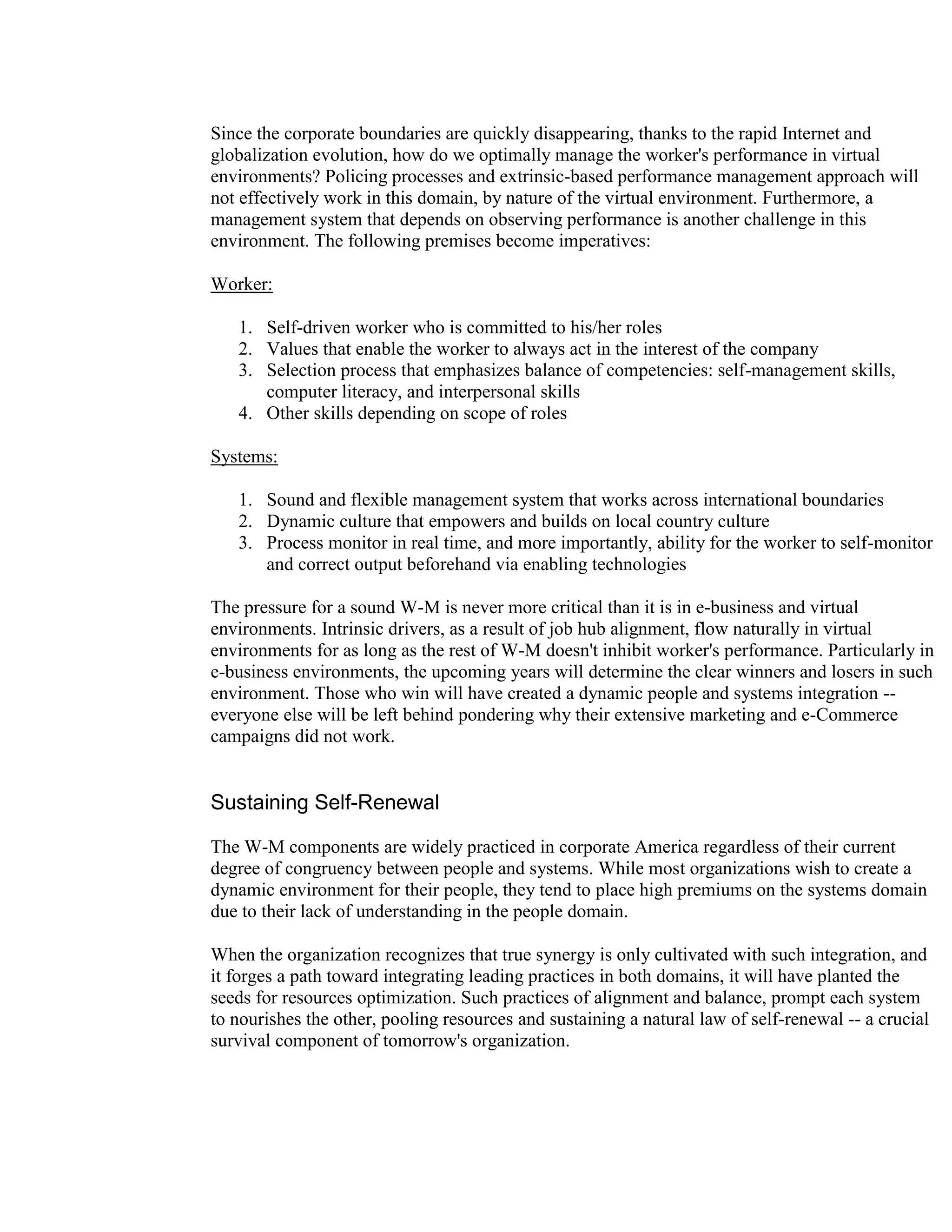
some combination examples (Illustration III):

 Illustration III
 Combination examples when balance and alignment in W-M are ignored
                                                            Outcome: Worker's Behavior to the
     Element             Shortcoming Examples               Detriment of the Customer and the
                                                                      Organization
 Corporate          No clear guiding or imbalanced        Wide range of performance
Strategy          values and principles (decision    idiosyncrasies, missed opportunities, lack
                   making...)                         of fostering group synergy
                   Long vertical hierarchy,           Slow response to market changes,
 Org. Design &
                   segregated, departmentalized,      product launch, cycle times...(boxed job
 Process Flow
                   turf driven                        hubs)
                                                      Skewed performance, unexplained gaps,
 Performance                                          high level of frustrations (an example
                   Balanced Dashboard without
 Management                                           would be a sleek sport car design with a
                   worker's alignment
 System                                               low-powered diesel engine—the mix
                                                      don't produce the promised potential)
                                                  Worker is constantly having to adjust and
                   No clear or ill-designed
 Management                                       avoid being caught in error, stifling
                   management system with respect
 System                                           innovation and worker's self-
                   to guidance, delegation, and
 Practiced                                        actualization (Maslow's Hierarchy of
                   decision making model
                                                  Needs, 1998)
                                                      Disparate and unexplained wide range of
                                                      performance outputs even when
                   Do as I say, not as I do, turf
 Culture                                              compared with another worker at the
                   protected
                                                      same level, CYA behavior instead of
                                                      rallying entire organization resources
                                                      Unexplained symptoms with various
                   Traditional job design without
                                                      groups such as worker frustration, low
                   consideration of
 Job Design                                           creativity and inspiration, limited short
                   worker/environment
                                                      term wins due to exterior pressure
                   compatibility
                                                      (Scattered job hub)


A Process-based Organization & W-M

As many organizations recognize the significance of sound process redesign as basis for
competitive leverage, the revolution continues to shape the corporate infrastructure of tomorrow.
But, how frequently is the profile alignment taken into the design of assigned roles? In the
decade I've consulted, seldom! Furthermore, at the job hub, traditional job designs that overlook
congruency with corresponding systems will fall significantly short of yielding desired
performance as illustrated in the table above (Illustration III). Particularly with a booming
economy, where employers are scrambling for quality workers — you stand to lose your good
people quickly.

W-M framework on the other hand, will significantly aid in the organizational process
management via adequate worker's alignment. It provides the blue prints for selecting
compatible workers with respective process roles while reinforcing the process with compatible
systems aimed at cultivating performance synergy. One would contend that lumping workers
into leading edge processes aimed at increasing organizational agility while using traditional job
designs, is like building a fast train fueled by yesterday's steam engine technology.

Leading practices on process management suggest that an organization be built around value-
driven processes aimed at meeting and exceeding client and market drivers while keeping the
latter at the center of it all. Again, if the worker is suffering due his/her misalignment with the
corresponding process, so will be the process output.

W-M as a guiding template

Here is an ERP integration example using a financials process, Order to Cash. From the time
customer places the order until the time a payment is received, some of the steps include:

   1.   Manage Customer Order,
   2.   Distribute Order,
   3.   Manage Payment.

If Sandra and Tom in the above case example are the staff members in the "Order to Cash"
process, Sandra would be most fit for the "Manage Order" sub-process since it entails substantial
customer interface. Tom would be most fit for "Manage Payment" sub process. Identifying these
traits maybe obvious from the descriptions made above. However, the W-M balanced job hub
core will yield much more knowledge about each worker such as Energy Source, Information
Processing Method, Decision-Making Approach, Interests with respect to People, Things, and
Data, as well as Ideal Work Environment/Tasks and Learning Style. These indicators are easily
revealed by administering custom made profiling tools or accredited instruments such as the
Myers Briggs Type Indicators (CPP), SDS Interest Inventory (PAR) among others. Since the
purpose here is to illustrate the value of a holistic understanding of the worker's environment
using profiling tools, I won't dive into the make-up of these instruments at this point.


Performance Management and W-M

Extrinsic motivators are limited in their ability to sustain long term results. Accordingly, any
system that undermines the energy-house of the very people who are making it happen, is also
limited. In his famous study of Workplace Motivators, Herzberg, identified the top three to be
"Work Itself, Recognition, and Responsibility" while Compensation was considered a Hygiene
factor (ex. fringe benefits), not a Motivator (Herzberg, 1988).

Organization measurement system such as the Balanced Scorecard (Kaplan, Norton 1991) offers
an applauded measurement balance of the whole organizational body while enabling leaders to
navigate with knowledge. However, what we do with that knowledge has to do with the
framework of the W-M. For instance, take Learning & Innovation, if the worker is misaligned to
begin with, thereby inhibiting utilization of both sides of the brain, innovation across the
organization will remain significantly hindered regardless of how much we reward it. The same
holds true if the worker performing a given task within a process is frustrated with his/her role,
performance will remain hindered regardless of how much we reward proper process execution.

Applying extrinsic measurement systems without understanding the building blocks of the
knowledge it is yielding, is like navigating a plane knowing what the gauges are saying without
understanding what is causing the problem or how to go about identifying the problem. Worse,
often leaders fix the problem by adding another control system, adding more layers to the very
issue, and making it even harder to detect from all the layers that piled on top.

Another classic blunder is attempting to measure a given process to the hilt because performance
gaps has occurred. One might present a convincing argument that such approach took care of
these gaps, however, the truth is as soon as these controls are removed, gaps will reappear —
such practices are termed as "Police Controls." We all know from experience any true
breakthrough in performance comes freely from within, not policed!

Intrinsic motivators on the other hand, make the basis for long term performance excellence
because the system is designed on the foundation of inner drive. Simply, when the worker enjoys
his/her work, he/she does not view it as work any longer, it is viewed as "being" with all its
components of passion, initiative, zest, commitment, and the list goes on.

Leading practices suggest that Key Performance Indicators (KPIs) should be process-centered
and integrated in the job design itself. Profiling tools will yield invaluable data about worker's
motivational and energy sources which may be integrated to further bridge KPIs. Therefore,
while the framework of performance management system should be unified across the
organization, its components should be flexible to allow the manager to add other compatible
rewards with perspective teams and workgroups.


The Manager as Guardian of Prosperity

In the U.S. Marine Corp., there is a famous slogan: "There are no bad people, only bad leaders."
Indeed, it is never truer in this case where the manager plays a vital role in influencing the make-
up of W-M, formal or informal. Daniel Goleman, author of Emotional IQ asserts: "A manager
who is unaware of his or her blind spots of how he or she impacts others is a walking disaster in
the workplace, a leader who may lead the troops over the cliff" (Emotional Intelligence, 1995).
Indeed, managers' grasp of the W-M components as well how they contribute to the components'
make-up is essential. The managers' ability as a leader to permeate or inhibit such balance will
determine the effectiveness of the whole organizational body of structures, processes, and
people. The same profiling tools may be used to aid the manager in learning of what to delegate
to whom particularly where team-based job design is prevalent as well as identifying worker's
motivational sources, among other indicators.


E-business, Virtual Organization and W-M
Since the corporate boundaries are quickly disappearing, thanks to the rapid Internet and
globalization evolution, how do we optimally manage the worker's performance in virtual
environments? Policing processes and extrinsic-based performance management approach will
not effectively work in this domain, by nature of the virtual environment. Furthermore, a
management system that depends on observing performance is another challenge in this
environment. The following premises become imperatives:

Worker:

   1. Self-driven worker who is committed to his/her roles
   2. Values that enable the worker to always act in the interest of the company
   3. Selection process that emphasizes balance of competencies: self-management skills,
      computer literacy, and interpersonal skills
   4. Other skills depending on scope of roles

Systems:

   1. Sound and flexible management system that works across international boundaries
   2. Dynamic culture that empowers and builds on local country culture
   3. Process monitor in real time, and more importantly, ability for the worker to self-monitor
      and correct output beforehand via enabling technologies

The pressure for a sound W-M is never more critical than it is in e-business and virtual
environments. Intrinsic drivers, as a result of job hub alignment, flow naturally in virtual
environments for as long as the rest of W-M doesn't inhibit worker's performance. Particularly in
e-business environments, the upcoming years will determine the clear winners and losers in such
environment. Those who win will have created a dynamic people and systems integration --
everyone else will be left behind pondering why their extensive marketing and e-Commerce
campaigns did not work.


Sustaining Self-Renewal

The W-M components are widely practiced in corporate America regardless of their current
degree of congruency between people and systems. While most organizations wish to create a
dynamic environment for their people, they tend to place high premiums on the systems domain
due to their lack of understanding in the people domain.

When the organization recognizes that true synergy is only cultivated with such integration, and
it forges a path toward integrating leading practices in both domains, it will have planted the
seeds for resources optimization. Such practices of alignment and balance, prompt each system
to nourishes the other, pooling resources and sustaining a natural law of self-renewal -- a crucial
survival component of tomorrow's organization.
About Packaged Assessment Tools

  There are numerous validated assessment tools that may be administered in a group format such as the
  Team MBTI (copyright, Consulting Psychologist Press, Palto Alto, CA) and SDS Interest Inventory
  (Copyright, Psychological Assessment Resources, Inc., Odessa, FL). While there are limitations with
  respect to administering such tools to people of different cultural background, empirical evidence is
  abundant in support of information validity. The tools' output will yield effective behavioral and
  performance predicators which are in turn reframed as potential Enablers or Barriers to workplace
  performance/reengineering initiatives, depending on the scope of engagement.


  About the Author

  Terry Jabali is a Principal at Computer Sciences Corporation (CSC), Business Transformation Group,
  4760 S. Wadsorth Blvd., #D-107, Litleton, Colorado 80123. Tel: 303-932-1900; Fax 303-973-9600; E-
  mail: TJabali@aol.com


  NOTE

      1. Worker's Microcosm is a registered trademark of FGC and Terry Jabali


                 Copyright © 2000 HR On-Line. All Rights Reserved.
                          Except for a member's personal use,
this document may not be printed or copied without written permission from HR On-Line.

Worker microcosm hr online

  • 1.
    Except for amember's personal use, this document may not be printed or copied without written permission from HR On-Line. Copyright © 2000 HR On-Line. All Rights Reserved. Creating A Self-renewing Framework for Corporate Transformation: The Worker's Microcosm by Terry Jabali We were half way through an IT implementation for this call center that supports in excess of 3,000 of internal customers. Leading practices in change management plans were already in place including the communication plan. The workers showed all signs of embracing what these IT changes meant for them. As we proceeded with end-user training, retention and applicability among participants appeared to be better than expected. We used a combination of workshop and on-site training approaches in addition to performance systems. Yet, with select employee CONTENTS groups, frustration was high, frequent mistakes were common, and tensions continued to build • Transformation affecting the rest of the employees body, and threatening the success of the overall project. Initiatives in an Era of Undefined Territory Where did we go wrong? We puzzled with this lingering question! To establish a separate • A Process-based coaching plan for these individuals meant going off course, plus, we were on a tight budget. We Organization & W-M needed to understand these emerging patterns and design a holistic approach that addresses these challenges at the root level without dedicating significant one-on-one activities. • Performance Management and W- M As we went back and reviewed the change management strategies; we had effectively assessed stakeholders alignment, communication needs, and subsequent training, among other solution • The Manager as activities. However, the patterns that were emerging appeared to be of individual idiosyncrasies Guardian of Prosperity in nature. • E-business, Virtual For instance, Joe, a client's Team Lead had a tolerance for ambiguity that was significantly less Organization and W- than that of Mary, in same capacity of another unit. Sandra, a Manager of Client Relations, M showed high level of endurance for customer-related stress than that of Tom, a Manager of • Sustaining Self- Programming of Financial Systems who mostly interfaced with IT and a handful of direct reports Renewal on a daily basis. Other signs such as frustrations, tolerance, among other indicators existed in a wide variance among managers and employees. We were slightly off schedule, however, as we understood and pursued compatible change management plans for these dispersed groups, the
  • 2.
    project went froma troubleshooting mode to true integration mode while successfully exceeding engagement's ROI. What did we learn from this experience? In order to cultivate a real transformation in the workplace, there is more to just communicating and selling the worker on change benefits, we must attempt to understand the workers' dominant traits beforehand. With an ever increasing pressure on the worker to cope with evolving changes while continuing to produce, where do we turn to fuel the worker's energy-house in order to keep him/her glowing instead of burning-up? To understand the variables of human dynamics which play into the performance of today's worker prior to any change initiative, we had to understand and leverage the worker's environment — we called it the Worker's Microcosm ® (W-M).1 The W-M framework proved to be highly beneficial in the engagements that followed particularly in a time when today's worker is bombarded with corporate acquisition, internal restructuring, and IT initiatives among others. W-M is about framing all key corporate drivers of people and systems while aligning and balancing human needs with such drivers. At its core, it is intended to build synergy between people and systems as well as intra -people and systems. It fosters systems alignment with workers' profile for long term compatibility. Using behavioral- based and profiling tools prior to any change initiatives will not only yield group performance predictors, but also aid in creating and sustaining an optimal environment for long term worker productivity. Illustrations I and II are intended to aid in the design and the assessment administration of the Worker's Microcosm. Illustration Ia Worker's Environment "W-Microcosm" (IT may be integrated in most of above). The premise for W-M self-renewal is for the worker to be aligned at the job hub starting with his/her daily roles and extending with congruent alignment across all corporate systems.
  • 3.
    Illustration Ib Project Worker's Microcosm Mgmt. Notes Corporate/Business Organization Design/Process Flow Unit Directives (the dictating body) Corporate Values, Job Design: The Balanced Norms & Management Hub Performance Mgmt Practices: (Compatibility Alignment)  Goals Worker's Job Design  Balanced  Accepted Profile & & Dashboard (ex Behaviors Performance Performance BSC, Kaplan,  Ideal Leadership Drivers Alignment Norton, 1991) Traits  Succession Interest Planning  What tasks Technical Inventory  Career (technical and Skills Assessment Development functional) are most rewarded Plan Personality in this culture Functional Indicator Skills Assessment Merit-based Leadership Assessment Skills All gray shaded areas directly or indirectly shape the Job Hub, the center of the W-M framework as either an Enabler or a Barrier to overall corporate performance — it all starts at the Job Hub Alignment Illustration II W-M Element Analysis
  • 4.
    Understanding the underlyingpremise of the W-M elements will significantly aid in building a sound foundation for any transformation initiative. Transformation Initiatives in an Era of Undefined Territory Many behaviorists advocate that "we are a product of our environment. To change, we must change the environment." Similarly, with the average worker spending two third of his/her life at work, the environment we create is either an enabler or a barrier to worker/corporate actualization, and, the environment itself is determined and shaped by the degree of our understanding of its variables. If we perpetuate an environment of isolationism, we will reap isolated results. If we idolize technology without consideration to how different workers respond to its various segments, again, we are only reaping limited technology integration. To achieve optimal technology integration, people must feel at home with it. What if the systems in W-M were already imbalanced? Then, simply, the IT solution will follow the same pattern. Here are some combination examples (Illustration III): Illustration III Combination examples when balance and alignment in W-M are ignored Outcome: Worker's Behavior to the Element Shortcoming Examples Detriment of the Customer and the Organization Corporate No clear guiding or imbalanced Wide range of performance
  • 5.
    Strategy values and principles (decision idiosyncrasies, missed opportunities, lack making...) of fostering group synergy Long vertical hierarchy, Slow response to market changes, Org. Design & segregated, departmentalized, product launch, cycle times...(boxed job Process Flow turf driven hubs) Skewed performance, unexplained gaps, Performance high level of frustrations (an example Balanced Dashboard without Management would be a sleek sport car design with a worker's alignment System low-powered diesel engine—the mix don't produce the promised potential) Worker is constantly having to adjust and No clear or ill-designed Management avoid being caught in error, stifling management system with respect System innovation and worker's self- to guidance, delegation, and Practiced actualization (Maslow's Hierarchy of decision making model Needs, 1998) Disparate and unexplained wide range of performance outputs even when Do as I say, not as I do, turf Culture compared with another worker at the protected same level, CYA behavior instead of rallying entire organization resources Unexplained symptoms with various Traditional job design without groups such as worker frustration, low consideration of Job Design creativity and inspiration, limited short worker/environment term wins due to exterior pressure compatibility (Scattered job hub) A Process-based Organization & W-M As many organizations recognize the significance of sound process redesign as basis for competitive leverage, the revolution continues to shape the corporate infrastructure of tomorrow. But, how frequently is the profile alignment taken into the design of assigned roles? In the decade I've consulted, seldom! Furthermore, at the job hub, traditional job designs that overlook congruency with corresponding systems will fall significantly short of yielding desired performance as illustrated in the table above (Illustration III). Particularly with a booming economy, where employers are scrambling for quality workers — you stand to lose your good people quickly. W-M framework on the other hand, will significantly aid in the organizational process management via adequate worker's alignment. It provides the blue prints for selecting
  • 6.
    compatible workers withrespective process roles while reinforcing the process with compatible systems aimed at cultivating performance synergy. One would contend that lumping workers into leading edge processes aimed at increasing organizational agility while using traditional job designs, is like building a fast train fueled by yesterday's steam engine technology. Leading practices on process management suggest that an organization be built around value- driven processes aimed at meeting and exceeding client and market drivers while keeping the latter at the center of it all. Again, if the worker is suffering due his/her misalignment with the corresponding process, so will be the process output. W-M as a guiding template Here is an ERP integration example using a financials process, Order to Cash. From the time customer places the order until the time a payment is received, some of the steps include: 1. Manage Customer Order, 2. Distribute Order, 3. Manage Payment. If Sandra and Tom in the above case example are the staff members in the "Order to Cash" process, Sandra would be most fit for the "Manage Order" sub-process since it entails substantial customer interface. Tom would be most fit for "Manage Payment" sub process. Identifying these traits maybe obvious from the descriptions made above. However, the W-M balanced job hub core will yield much more knowledge about each worker such as Energy Source, Information Processing Method, Decision-Making Approach, Interests with respect to People, Things, and Data, as well as Ideal Work Environment/Tasks and Learning Style. These indicators are easily revealed by administering custom made profiling tools or accredited instruments such as the Myers Briggs Type Indicators (CPP), SDS Interest Inventory (PAR) among others. Since the purpose here is to illustrate the value of a holistic understanding of the worker's environment using profiling tools, I won't dive into the make-up of these instruments at this point. Performance Management and W-M Extrinsic motivators are limited in their ability to sustain long term results. Accordingly, any system that undermines the energy-house of the very people who are making it happen, is also limited. In his famous study of Workplace Motivators, Herzberg, identified the top three to be "Work Itself, Recognition, and Responsibility" while Compensation was considered a Hygiene factor (ex. fringe benefits), not a Motivator (Herzberg, 1988). Organization measurement system such as the Balanced Scorecard (Kaplan, Norton 1991) offers an applauded measurement balance of the whole organizational body while enabling leaders to navigate with knowledge. However, what we do with that knowledge has to do with the framework of the W-M. For instance, take Learning & Innovation, if the worker is misaligned to begin with, thereby inhibiting utilization of both sides of the brain, innovation across the
  • 7.
    organization will remainsignificantly hindered regardless of how much we reward it. The same holds true if the worker performing a given task within a process is frustrated with his/her role, performance will remain hindered regardless of how much we reward proper process execution. Applying extrinsic measurement systems without understanding the building blocks of the knowledge it is yielding, is like navigating a plane knowing what the gauges are saying without understanding what is causing the problem or how to go about identifying the problem. Worse, often leaders fix the problem by adding another control system, adding more layers to the very issue, and making it even harder to detect from all the layers that piled on top. Another classic blunder is attempting to measure a given process to the hilt because performance gaps has occurred. One might present a convincing argument that such approach took care of these gaps, however, the truth is as soon as these controls are removed, gaps will reappear — such practices are termed as "Police Controls." We all know from experience any true breakthrough in performance comes freely from within, not policed! Intrinsic motivators on the other hand, make the basis for long term performance excellence because the system is designed on the foundation of inner drive. Simply, when the worker enjoys his/her work, he/she does not view it as work any longer, it is viewed as "being" with all its components of passion, initiative, zest, commitment, and the list goes on. Leading practices suggest that Key Performance Indicators (KPIs) should be process-centered and integrated in the job design itself. Profiling tools will yield invaluable data about worker's motivational and energy sources which may be integrated to further bridge KPIs. Therefore, while the framework of performance management system should be unified across the organization, its components should be flexible to allow the manager to add other compatible rewards with perspective teams and workgroups. The Manager as Guardian of Prosperity In the U.S. Marine Corp., there is a famous slogan: "There are no bad people, only bad leaders." Indeed, it is never truer in this case where the manager plays a vital role in influencing the make- up of W-M, formal or informal. Daniel Goleman, author of Emotional IQ asserts: "A manager who is unaware of his or her blind spots of how he or she impacts others is a walking disaster in the workplace, a leader who may lead the troops over the cliff" (Emotional Intelligence, 1995). Indeed, managers' grasp of the W-M components as well how they contribute to the components' make-up is essential. The managers' ability as a leader to permeate or inhibit such balance will determine the effectiveness of the whole organizational body of structures, processes, and people. The same profiling tools may be used to aid the manager in learning of what to delegate to whom particularly where team-based job design is prevalent as well as identifying worker's motivational sources, among other indicators. E-business, Virtual Organization and W-M
  • 8.
    Since the corporateboundaries are quickly disappearing, thanks to the rapid Internet and globalization evolution, how do we optimally manage the worker's performance in virtual environments? Policing processes and extrinsic-based performance management approach will not effectively work in this domain, by nature of the virtual environment. Furthermore, a management system that depends on observing performance is another challenge in this environment. The following premises become imperatives: Worker: 1. Self-driven worker who is committed to his/her roles 2. Values that enable the worker to always act in the interest of the company 3. Selection process that emphasizes balance of competencies: self-management skills, computer literacy, and interpersonal skills 4. Other skills depending on scope of roles Systems: 1. Sound and flexible management system that works across international boundaries 2. Dynamic culture that empowers and builds on local country culture 3. Process monitor in real time, and more importantly, ability for the worker to self-monitor and correct output beforehand via enabling technologies The pressure for a sound W-M is never more critical than it is in e-business and virtual environments. Intrinsic drivers, as a result of job hub alignment, flow naturally in virtual environments for as long as the rest of W-M doesn't inhibit worker's performance. Particularly in e-business environments, the upcoming years will determine the clear winners and losers in such environment. Those who win will have created a dynamic people and systems integration -- everyone else will be left behind pondering why their extensive marketing and e-Commerce campaigns did not work. Sustaining Self-Renewal The W-M components are widely practiced in corporate America regardless of their current degree of congruency between people and systems. While most organizations wish to create a dynamic environment for their people, they tend to place high premiums on the systems domain due to their lack of understanding in the people domain. When the organization recognizes that true synergy is only cultivated with such integration, and it forges a path toward integrating leading practices in both domains, it will have planted the seeds for resources optimization. Such practices of alignment and balance, prompt each system to nourishes the other, pooling resources and sustaining a natural law of self-renewal -- a crucial survival component of tomorrow's organization.
  • 9.
    About Packaged AssessmentTools There are numerous validated assessment tools that may be administered in a group format such as the Team MBTI (copyright, Consulting Psychologist Press, Palto Alto, CA) and SDS Interest Inventory (Copyright, Psychological Assessment Resources, Inc., Odessa, FL). While there are limitations with respect to administering such tools to people of different cultural background, empirical evidence is abundant in support of information validity. The tools' output will yield effective behavioral and performance predicators which are in turn reframed as potential Enablers or Barriers to workplace performance/reengineering initiatives, depending on the scope of engagement. About the Author Terry Jabali is a Principal at Computer Sciences Corporation (CSC), Business Transformation Group, 4760 S. Wadsorth Blvd., #D-107, Litleton, Colorado 80123. Tel: 303-932-1900; Fax 303-973-9600; E- mail: TJabali@aol.com NOTE 1. Worker's Microcosm is a registered trademark of FGC and Terry Jabali Copyright © 2000 HR On-Line. All Rights Reserved. Except for a member's personal use, this document may not be printed or copied without written permission from HR On-Line.