WORK - LIFE BALANCE
Presented by: Jaisha K J & Jubiya Romwald
Concept
• The concept became popular since the launch of a
major government campaign in 2000 -
“Changing Patterns in a Changing World”
- an initiative intended to persuade employers to
accept flexible working arrangements, so that their
employees can achieve a better balance between the
demands of their paid employment as well as those of
private life.
• Considered as modern tool of dealing with changing
family demographics and life of workforce in an
organization.
What is work life balance?
• Work-life balance is about creating and maintaining a supportive and healthy
work environments, which will enable to have balance between work and
personal responsibilities and thus strengthen employee loyalty and
productivity.
• Work-life balance refers to the level of
prioritisation between personal and
professional activities in an individual’s
life and the level to which activities related
to their job are present in the home.
Components of work-life balance
• TIME MANAGEMENT
• STRESS MANAGEMENT
• SELF-MANAGEMENT
• CHANGE MANAGEMENT
• TECHNOLOGY MANAGEMENT
• LEISURE MANAGEMENT
Time
Stress
Technology
Leisure
Self
Change
COMPONENTS
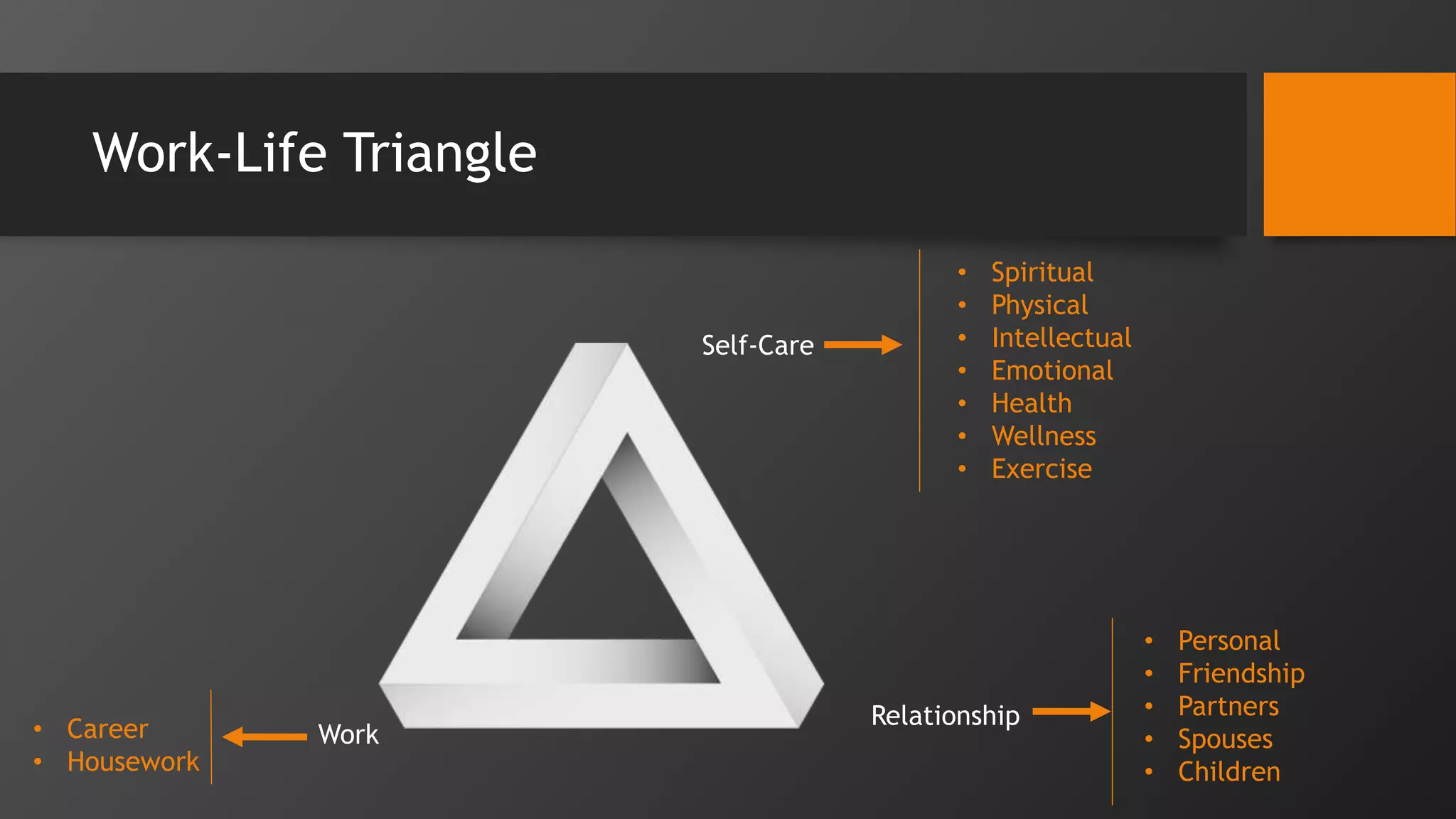
Work-Life Triangle
Self-Care
Work
Relationship
• Spiritual
• Physical
• Intellectual
• Emotional
• Health
• Wellness
• Exercise
• Personal
• Friendship
• Partners
• Spouses
• Children
• Career
• Housework
Benefits of work-life balance
1. Work life balance increases the motivation of employees and helps them
perform better at job.
2. It helps people to relieve their stress as they can spend leisure time with their
near and dear ones.
3. Companies can maximise productivity from an employee who is rejuvenated
and refreshed as compared to a over worked employee.
4. Healthy lifestyles can be maintained by having a work life balance. This
includes a good diet, regular exercises etc.,
5. Employees who are highly motivated can help the business grow as they are
more attached to their job and careers
Benefits of work-life balance
Benefits
To the
employees
To the
employers
Benefits to the employees
• Better Time Management
• Autonomy and Personal Employee Growth
• Increased Focus
• Employee Engagement
• Personal Well Being
Benefits to the employers
• Improved Productivity of Employees
• Reduced absenteeism and lateness
• Reduced Employee Turnover
• Reputation Build Up
Steps to improve work life balance
1. Creating a work leisure plan: Where an individual has to
schedule his tasks, and divide time appropriately so that
he has allocated appropriate time to his work and his
career development goals and at the same time allotted
time for leisure and personal development.
2. Leaving out activities that waste time and
energy: Individual should judiciously avoid wasteful
activities which demand large time and energy and in
return not produce output for either the work life or the
leisure life
3. Outsourcing work: Delegate or outsource time consuming
work to other individuals
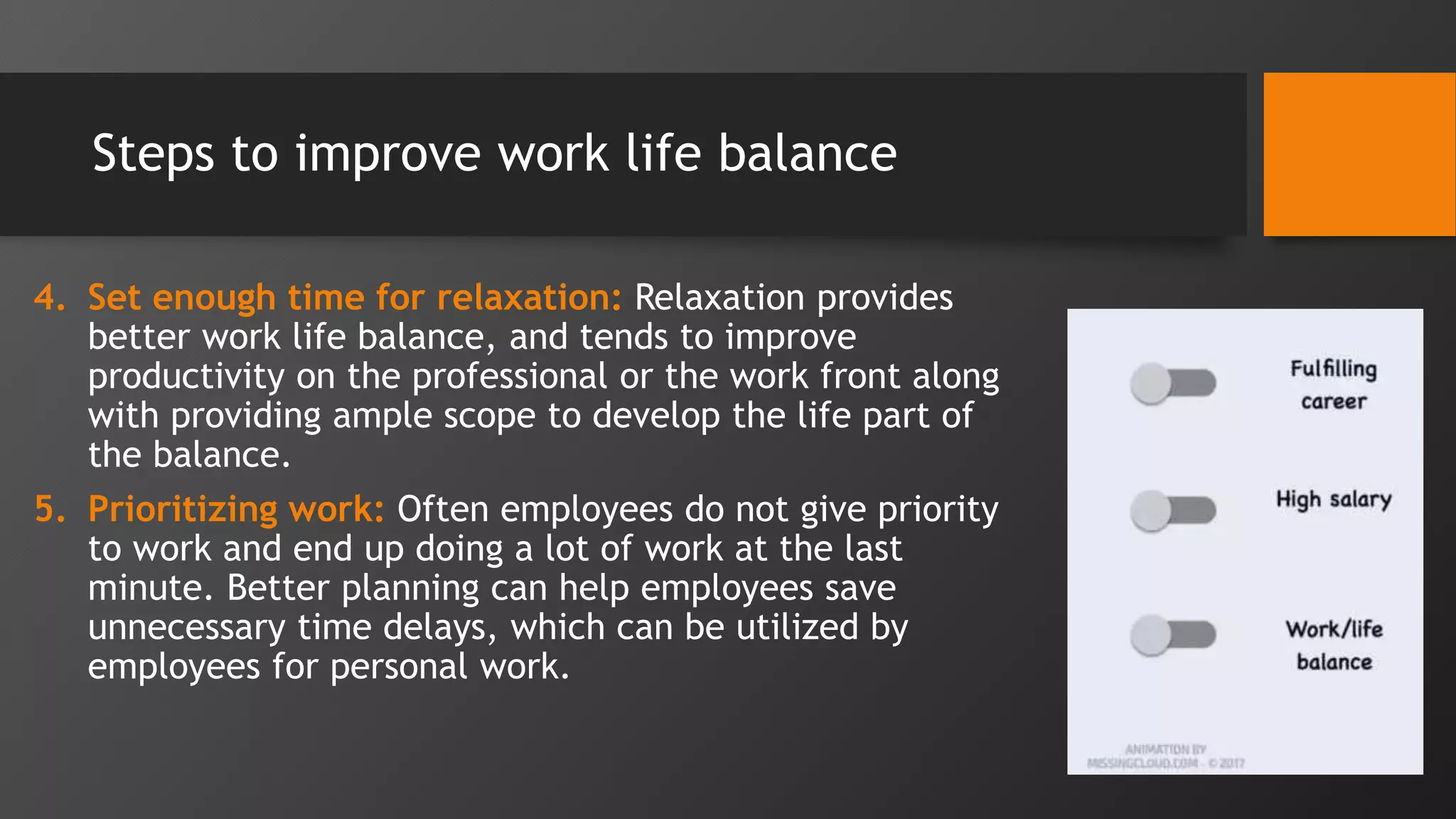
4. Set enough time for relaxation: Relaxation provides
better work life balance, and tends to improve
productivity on the professional or the work front along
with providing ample scope to develop the life part of
the balance.
5. Prioritizing work: Often employees do not give priority
to work and end up doing a lot of work at the last
minute. Better planning can help employees save
unnecessary time delays, which can be utilized by
employees for personal work.
Steps to improve work life balance
Role of HR in achieving work-life balance
• Planning the Work
• Job Analysis Specifications/Descriptions
• Providing a Flexi Approach Towards Work
• Being Empathetic Towards the Employees
• Providing Space for Personal Lives of the Employees
• Family Get-together’s at the Workplace
• Conduct Frequent Training Programs
• Effective Communication System
• Organizational Culture
• Worker’s Participation in Management
THANK YOU
“Never become so busy
making a living that you
forget to make a life…!!”

Work life balance

  • 1.
    WORK - LIFEBALANCE Presented by: Jaisha K J & Jubiya Romwald
  • 2.
    Concept • The conceptbecame popular since the launch of a major government campaign in 2000 - “Changing Patterns in a Changing World” - an initiative intended to persuade employers to accept flexible working arrangements, so that their employees can achieve a better balance between the demands of their paid employment as well as those of private life. • Considered as modern tool of dealing with changing family demographics and life of workforce in an organization.
  • 3.
    What is worklife balance? • Work-life balance is about creating and maintaining a supportive and healthy work environments, which will enable to have balance between work and personal responsibilities and thus strengthen employee loyalty and productivity. • Work-life balance refers to the level of prioritisation between personal and professional activities in an individual’s life and the level to which activities related to their job are present in the home.
  • 4.
    Components of work-lifebalance • TIME MANAGEMENT • STRESS MANAGEMENT • SELF-MANAGEMENT • CHANGE MANAGEMENT • TECHNOLOGY MANAGEMENT • LEISURE MANAGEMENT Time Stress Technology Leisure Self Change COMPONENTS
  • 5.
    Work-Life Triangle Self-Care Work Relationship • Spiritual •Physical • Intellectual • Emotional • Health • Wellness • Exercise • Personal • Friendship • Partners • Spouses • Children • Career • Housework
  • 6.
    Benefits of work-lifebalance 1. Work life balance increases the motivation of employees and helps them perform better at job. 2. It helps people to relieve their stress as they can spend leisure time with their near and dear ones. 3. Companies can maximise productivity from an employee who is rejuvenated and refreshed as compared to a over worked employee. 4. Healthy lifestyles can be maintained by having a work life balance. This includes a good diet, regular exercises etc., 5. Employees who are highly motivated can help the business grow as they are more attached to their job and careers
  • 7.
    Benefits of work-lifebalance Benefits To the employees To the employers
  • 8.
    Benefits to theemployees • Better Time Management • Autonomy and Personal Employee Growth • Increased Focus • Employee Engagement • Personal Well Being
  • 9.
    Benefits to theemployers • Improved Productivity of Employees • Reduced absenteeism and lateness • Reduced Employee Turnover • Reputation Build Up
  • 10.
    Steps to improvework life balance 1. Creating a work leisure plan: Where an individual has to schedule his tasks, and divide time appropriately so that he has allocated appropriate time to his work and his career development goals and at the same time allotted time for leisure and personal development. 2. Leaving out activities that waste time and energy: Individual should judiciously avoid wasteful activities which demand large time and energy and in return not produce output for either the work life or the leisure life 3. Outsourcing work: Delegate or outsource time consuming work to other individuals
  • 11.
    4. Set enoughtime for relaxation: Relaxation provides better work life balance, and tends to improve productivity on the professional or the work front along with providing ample scope to develop the life part of the balance. 5. Prioritizing work: Often employees do not give priority to work and end up doing a lot of work at the last minute. Better planning can help employees save unnecessary time delays, which can be utilized by employees for personal work. Steps to improve work life balance
  • 12.
    Role of HRin achieving work-life balance • Planning the Work • Job Analysis Specifications/Descriptions • Providing a Flexi Approach Towards Work • Being Empathetic Towards the Employees • Providing Space for Personal Lives of the Employees • Family Get-together’s at the Workplace • Conduct Frequent Training Programs • Effective Communication System • Organizational Culture • Worker’s Participation in Management
  • 13.
    THANK YOU “Never becomeso busy making a living that you forget to make a life…!!”