Work Energy Principle
and its
application on
connected bodies
Presented by
Nayel Biswas(34900721019)
K Dhanraj Rao(34900721016)
Mechanical Engineering,2nd Year, 3rd Sem
Topics
 Work done, Conservative and Non-conservative force
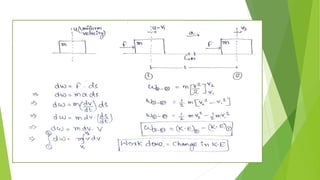
 Work Energy Theorem(KE)
 Its example
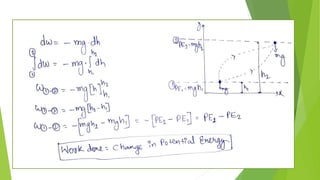
 Work Energy Theorem(PE)
 Its example
 Numericals related to Work Energy Theorem
Work:- The work done by a force can be defined as the product of the
displacement covered by an object when the force applied on it.
Conservative force:- A force said to be conservative when total work done
in moving a particle between two points is independent of the path taken by
particle.
Such as gravitational force
Non conservative force:- The work done by that force depends on the
path taken between the initial and final positions of the particle.
Example:- Frictional Force
dW = F . ds
Work Energy Theorem(KE)
The work done by the force acting on a particle during its
displacement is equal to change in kinetic energy in that
displacement.
Work Done = Change in Kinetic Energy
Work Energy Theorem(PE)
Work done by conservative force acting on a particle
during its displacement is equal to change in
potential energy in that displacement.
Work Done = Change in Potential Energy
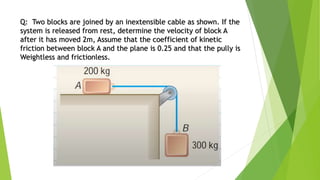
Q: Two blocks are joined by an inextensible cable as shown. If the
system is released from rest, determine the velocity of block A
after it has moved 2m, Assume that the coefficient of kinetic
friction between block A and the plane is 0.25 and that the pully is
Weightless and frictionless.
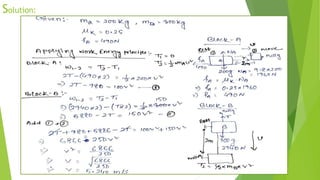
Solution:
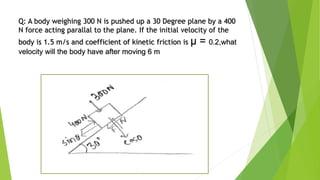
Q: A body weighing 300 N is pushed up a 30 Degree plane by a 400
N force acting parallal to the plane. If the initial velocity of the
body is 1.5 m/s and coefficient of kinetic friction is μ = 0.2,what
velocity will the body have after moving 6 m
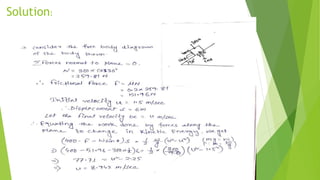
Solution:
THANK YOU

Work Energy Principle.pptx

  • 1.
    Work Energy Principle andits application on connected bodies
  • 2.
    Presented by Nayel Biswas(34900721019) KDhanraj Rao(34900721016) Mechanical Engineering,2nd Year, 3rd Sem
  • 3.
    Topics  Work done,Conservative and Non-conservative force  Work Energy Theorem(KE)  Its example  Work Energy Theorem(PE)  Its example  Numericals related to Work Energy Theorem
  • 4.
    Work:- The workdone by a force can be defined as the product of the displacement covered by an object when the force applied on it. Conservative force:- A force said to be conservative when total work done in moving a particle between two points is independent of the path taken by particle. Such as gravitational force Non conservative force:- The work done by that force depends on the path taken between the initial and final positions of the particle. Example:- Frictional Force dW = F . ds
  • 5.
    Work Energy Theorem(KE) Thework done by the force acting on a particle during its displacement is equal to change in kinetic energy in that displacement. Work Done = Change in Kinetic Energy
  • 7.
    Work Energy Theorem(PE) Workdone by conservative force acting on a particle during its displacement is equal to change in potential energy in that displacement. Work Done = Change in Potential Energy
  • 10.
    Q: Two blocksare joined by an inextensible cable as shown. If the system is released from rest, determine the velocity of block A after it has moved 2m, Assume that the coefficient of kinetic friction between block A and the plane is 0.25 and that the pully is Weightless and frictionless.
  • 11.
  • 12.
    Q: A bodyweighing 300 N is pushed up a 30 Degree plane by a 400 N force acting parallal to the plane. If the initial velocity of the body is 1.5 m/s and coefficient of kinetic friction is μ = 0.2,what velocity will the body have after moving 6 m
  • 13.
  • 14.