Wood for Energy Production


Technology - Environment - Economy


                                                          on
                                                          iti
                                                        Ed


        The Centre for Biomass Technology
                                                     ed
                                                     is
                                                   ev
                                                 R


                      2002
                                               n d
                                            co
                                            Se
Wood for Energy production was prepared in 2002 by the Centre for Biomass Technology (www.videncenter.dk) on behalf of the
Danish Energy Agency. The first edition was named “Wood Chips for Energy Production”. The publication can be found on the web
site: www.ens.dk. The paper edition can be ordered through the National Energy Information Centre or the Centre for Biomass Tech-
nology at the following addresses:

National Energy                Danish Technological     dk-TEKNIK ENERGY                  The Danish Forest and Landscape
Information Centre             Institute                & ENVIRONMENT                     Research Institute
EnergiOplysningen              Teknologisk Institut     dk-TEKNIK ENERGI & MILJØ          Forskningscentret for Skov & Landskab
Teknikerbyen 45                Kongsvang Allé 29        Gladsaxe Møllevej 15              Hørsholm Kongevej 11
DK-2830 Virum                  DK-8000 Århus C          DK-2860 Søborg                    DK-2970 Hørsholm
Tel. +45 70 21 80 10           Tel. +45 72 20 10 00     Tel. +45 39 55 59 99              Tel. +45 45 76 32 00
Fax +45 70 21 80 11            Fax +45 72 20 12 12      Fax +45 39 69 60 02               Fax +45 45 76 32 33
www.energioplysningen.dk       www.teknologisk.dk       www.dk-teknik.dk                  www.fsl.dk

Authors:       Helle Serup (Editor), The Danish Forest and Landscape Research Institute
               Hans Falster, dk-TEKNIK ENERGY& ENVIRONMENT
               Christian Gamborg, The Danish Forest and Landscape Research Institute
               Per Gundersen, The Danish Forest and Landscape Research Institute
               Leif Hansen, dk-TEKNIK ENERGY & ENVIRONMENT
               Niels Heding, The Danish Forest and Landscape Research Institute
               Henrik Houmann Jakobsen, dk-TEKNIK ENERGY & ENVIRONMENT
               Pieter Kofman, The Danish Forest and Landscape Research Institute
               Lars Nikolaisen, Danish Technological Institute
               Iben M. Thomsen, The Danish Forest and Landscape Research Institute

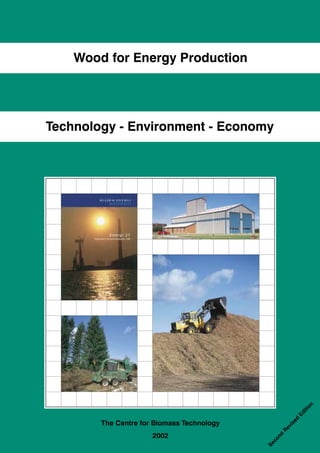
Cover:         The cover shows “Energiplan 21", Klaus Holsting and Torben Zenths Tegnestue
               Harboøre Varmeværk, Ansaldo Vølund A/S
               Chipper in operation, BioPress/Torben Skøtt
               Front-end loader on a wood chip pile at Måbjergværket, BioPress/Torben Skøtt
Layout:        BioPress
Printed by:    Trøjborg Bogtryk. Printed on 100% recycled paper
ISBN:          87-90074-28-9
Wood for Energy Production

Technology - Environment - Economy
         Second Revised Edition - 2002


                               The Centre for Bio-
                               mass Technology
Table of Contents
      Foreword. . . . . . . . . . . . . . . . . . . . . . . . . . . . . . . . . . . . . . . . . . . . . . . . . . . . . . . . . . . . . . . . . . . 5
1.    Danish Energy Policy . . . . . . . . . . . . . . . . . . . . . . . . . . . . . . . . . . . . . . . . . . . . . . . . . . . . . . . . . 6
2.    Wood as Energy Resource. . . . . . . . . . . . . . . . . . . . . . . . . . . . . . . . . . . . . . . . . . . . . . . . . . . . . 9
      2.1 Amount of Consumption and Resources . . . . . . . . . . . . . . . . . . . . . . . . . . . . . . . . . . . . . . . 9
      2.2 Afforestation and Wood for Energy . . . . . . . . . . . . . . . . . . . . . . . . . . . . . . . . . . . . . . . . . . 10
      2.3 Energy Plantation (Short Rotation Coppice) . . . . . . . . . . . . . . . . . . . . . . . . . . . . . . . . . . . 12
      2.4 Physical Characterisation of Wood Fuels . . . . . . . . . . . . . . . . . . . . . . . . . . . . . . . . . . . . . 14
3.    Production of Wood Fuels . . . . . . . . . . . . . . . . . . . . . . . . . . . . . . . . . . . . . . . . . . . . . . . . . . . . 17
4.    Purchase and Sale of Wood for Energy Production . . . . . . . . . . . . . . . . . . . . . . . . . . . . . . . . . 21
5.    Environmental Issues of Production and Handling of Wood Fuels . . . . . . . . . . . . . . . . . . . . . . 25
      5.1 Chipping and Sustainable Forestry . . . . . . . . . . . . . . . . . . . . . . . . . . . . . . . . . . . . . . . . . . 25
      5.2 Working Environment during the Handling of Chips and Pellets . . . . . . . . . . . . . . . . . . . . 27
6.    Theory of Wood Firing . . . . . . . . . . . . . . . . . . . . . . . . . . . . . . . . . . . . . . . . . . . . . . . . . . . . . . . 30
7.    Small Boilers. . . . . . . . . . . . . . . . . . . . . . . . . . . . . . . . . . . . . . . . . . . . . . . . . . . . . . . . . . . . . . . 33
8.    District Heating Plants . . . . . . . . . . . . . . . . . . . . . . . . . . . . . . . . . . . . . . . . . . . . . . . . . . . . . . . 37
9.    CHP and Power Plants . . . . . . . . . . . . . . . . . . . . . . . . . . . . . . . . . . . . . . . . . . . . . . . . . . . . . . . 48
10.   Gasification and other CHP Technologies . . . . . . . . . . . . . . . . . . . . . . . . . . . . . . . . . . . . . . . . 54
11.   Table of References . . . . . . . . . . . . . . . . . . . . . . . . . . . . . . . . . . . . . . . . . . . . . . . . . . . . . . . . . 60
12.   Further Information . . . . . . . . . . . . . . . . . . . . . . . . . . . . . . . . . . . . . . . . . . . . . . . . . . . . . . . . . . 63
13.   List of Manufacturers - Chipping. . . . . . . . . . . . . . . . . . . . . . . . . . . . . . . . . . . . . . . . . . . . . . . . 64
14.   List of Manufacturers - Wood-Firing . . . . . . . . . . . . . . . . . . . . . . . . . . . . . . . . . . . . . . . . . . . . . 65
15.   Survey of Chip and Wood Pellet-Fired Plants. . . . . . . . . . . . . . . . . . . . . . . . . . . . . . . . . . . . . . 67
16.   Units, Conversion Factors, and Calorific Values. . . . . . . . . . . . . . . . . . . . . . . . . . . . . . . . . . . . 69
Foreword
The emission of CO2 and other greenhouse gases is one of the greatest environmental problems of our
time. At the United Nations Climate Change Conference in 1997 in Japan, it was agreed that total world-
wide emissions should be reduced by 5.2% by the year 2012. The European Union has undertaken the
major reduction of 8% compared to the 1990 level.

Today only 6% of the European Union’s consumption of energy is covered by renewable energy, but the EU
Commission Renewable Energy White Paper, published in December 1997, prescribes a doubling of the
proportion of renewable energy by the end of the year 2010.

Biomass is the sector that must be developed most and fastest. It is estimated that in 2010 it should amount
to 74% of the European Union’s total consumption of renewable energy.

Danish experiences acquired in the field of biomass are already now significant. We have achieved much in
the field of both the individual and the collective energy supply. Denmark’s strongholds are in the field of col-
lective heating supply and decentralised CHP (combined heat and power) generation based on biomass,
and cost-effective fuel production, in particular.

This publication illustrates how Denmark has succeeded in utilising its wood resources in an environmentally
desirable and CO2-neutral energy production. It provides an introduction to the most recent Danish develop-
ments in the field of wood for energy production, both with regard to technology, environment, and economy.

At present more than 10% of Denmark is covered with forests, and the intention is a doubling of the area
within the next century. The forest trees are used for timber and for manufacturing in the wood industry. The
forest also provides thinning wood and other wood waste that can all be used for energy production.

The long-term perspective of the Government’s plan for a sustainable energy development in Denmark, En-
ergy 21 (Energi 21), is to develop an energy system where the proportion of renewable energy continuously
increases. This preconditions a continuous and gradual fitting in of renewable energy concurrent with the
technological and financial possibilities.

The enlargement will primarily take place by means of an increased application of bioenergy and wind power.
Therefore, biomass will contribute considerably to Denmark’s and the European Union’s energy production
in the next decades.

At the same time, biomass is an area of great potential for the Danish energy industry - also on the export
market.


Svend Auken
Minister for the Environment and Energy
Danish Energy Policy


1. Danish Energy Policy
Danish energy policy is in a constant                                                         fixed at 8% in 2012 compared to the
process of change. The Government’s                                                           1990 level.
Energy Action Plan of 1996, Energi 21,                                                              Denmark’s CO2 aim shall be achieved
is the fourth in a series of plans that                                                       by both improving the energy intensity by
all have or have had as their aim to                                                          50% up to the year 2030 and by renew-
optimise the Danish energy sector to                                                          able energy contributing by 35% of the
the present national and international                                                        gross energy consumption in 2030.
conditions in the field of energy.                                                                  Energy 21 assumes that renewable
                                                                                              energy covers 12-14% of the country’s
                                                                                              total energy consumption in 2005. By far
The Four Energy Plans                                                                         the most significant renewable energy
The aim of the first energy plan, Danish                                                      source is and will continue to be bio-
Energy Policy 1976 (Dansk Energipolitik                                                       mass. Biomass contributed with 61 PJ in
1976), was to safeguard Denmark                                                               1996, which should increase to 85 PJ in
against supply crises like the energy cri-                                                    2005 and 145 PJ in 2030. The increase
sis in 1973/74.                                                                               up to 2005 will primarily be achieved by
      The second energy plan, Energy                                                          the centralised power plants’ increased
Plan 81 (Energiplan 81), gave added                                                           use of straw and wood chips (see the
weight to socio-economic and environ-                                                         section on the Biomass Agreement). An
mental considerations, thus continuing         Energy 21(Energi 21) shall contribute to       increased use of biomass and landfill gas
the efforts of reducing the dependence         a sustainable development of the Danish        also contributes to achieving the aim of
on the import of fuels.                        society. The energy sector shall continue      85 PJ. In connection with Energy 21, the
      The third energy plan in the series is   to be a financially, vigorously, and tech-     Danish island Samsø has been declared
the action plan Energy 2000 (Energi            nologically efficient sector that forms part   a renewable energy island, and the is-
2000) /ref. 1/ of 1990. This plan is an am-    of a dynamic development of society.           land shall thus function as display win-
bitious attempt to increase the use of en-                                                    dow for Danish renewable energy tech-
vironmentally desirable fuels. At the same     The aims are achieved by means of a            nology.
time, the aim of a sustainable develop-        wide range of activities: Energy savings,            Thus the initiatives in the field of
ment of the energy sector is introduced. In    tax on CO2 emission, conversion to the         biomass are directed at the following par-
Energy 2000, the environmentally desir-        use of environmentally desirable fuels by      tial aims of Energy 21:
able fuels are defined as natural gas,         means of CHP generation, subsidised
                                                                                              • Increased use of straw and wood chips
solar energy, wind, and biomass (straw,        construction and operation of district
                                                                                               at centralised power plants.
wood, liquid manure, and household             heating systems, subsidised establishing
                                                                                              • Increased CHP generation based on
waste). The use of biomass is based on         of biofuel boilers in rural districts etc.
                                                                                                straw, wood chips, biogas, and landfill
the facts that it is CO2 neutral, that it            The fourth and last energy plan is
                                                                                                gas.
saves foreign currency, that it creates        Energy 21 (Energi 21) /ref. 2/ that was
                                                                                              • Conversion to the greatest possible ex-
Danish jobs, that it utilises waste products   introduced in 1996. The intention of this
                                                                                                tent of block heating units above 250
from agriculture, forestry, households,        plan is that the administration of our
                                                                                                kW in rural districts from fossil fuels to
trade and industry. The ambitious aim of       resources shall have a central role. Our
                                                                                                biofuels.
Energy 2000 is that Denmark compared           consumption of depletable, fossil energy
                                                                                              • Permission to establish biofuel systems
to the year 1988 shall achieve the follow-     sources, and emissions resulting from
                                                                                                and biogas production from collective
ing aims by the end of 2005:                   the consumption and energy production
                                                                                                systems, industrial systems, and landfill
                                               shall be further reduced. A significant
                                                                                                sites etc. in areas previously reserved
• Reduce the energy consumption by             aspect of Energy 21 is thus that the ex-
                                                                                                for natural gas.
    15%.                                       isting aim of Energy 2000, i.e., that Den-
• Increase the consumption of natural          mark should reduce its CO2 emission by         Figure 2 shows the distribution of the in-
    gas by 170%.                               20% in 2005 compared to the 1988 level,        dividual renewable energy sources.
•   Increase the consumption of renewable      is supplemented with a long-term aim.
    energy by 100%.                            The CO2 emission should be halved in
•   Reduce the consumption of coal by          2030 compared to 1998. In addition, in-
                                                                                              EU Influence
    45%.                                       ternational climate change negotiators         EU Commission Renewable Energy
•   Reduce the consumption of oil by 40%.      will advocate that the industrialised          White Paper 1997/ref. 3/ fixes an in-
•   Reduce the CO2 emission by at least        countries by 2030 halve their emissions        crease in the EU use of renewable en-
    20%.                                       of CO2 compared to the 1990 level. At          ergy from 6% to 12% up to the year
•   Reduce the SO2 emission by 60%.            the UN Climate Change Conference in            2010. It is estimated that the biomass
•   Reduce the NOx emission by 50%.            Kyoto in 1997, the EU reduction was            sector will be the fastest growing sector


Page 6       Wood for Energy Production
Danish Energy Policy


in the field of renewable energy technolo-       gas-fired CHP plants and the remaining                           able energy receive a total subsidy of
gies. The use of agricultural land is            district heating plants to biofuels. See                         DKK 0.27/kWh.
closely connected with the EU agricul-           also the section on the Biomass Agree-                         • “State-Subsidised Completion of Dis-
tural policy. The most recent EU draft           ment on the adjustment of the progress                           trict Heating Nets”. Under this act, up to
proposal for future agricultural policies        of the phase.                                                    50% of the construction costs could be
suggests that the legal obligation to fal-                                                                        subsidised. The scheme expired at the
low land shall be abolished, and that                                                                             end of 1997.
there shall be one rate for subsidies no
                                                 The CO2 Acts
matter the choice of crop. This will affect      The Heat Supply Act was followed by                            The present subsidies of DKK 0.10/kWh
the farmers’ managements also with re-           three new acts offering the prospective of                     and DKK 0.17/kWh respectively in con-
gard to growing energy crops on land, vol-       subsidising the process of conversion to                       nection with the electrical power reform
untarily left fallow. Energy 21 mentions ex-     environmentally more desirable fuels.                          will be financed via the consumption
plicitly that the aim of 45 PJ energy crops      The purpose was that the Minister of En-                       price in a transitional period. In the fu-
in 2030 can be achieved by other biomass         ergy could then counteract consumers                           ture, the electrical power generation sub-
use subject to EU modifying its agricul-         being charged higher heating prices as a                       sidies and the DKK 0.10/kWh from the
tural policy and subsidy schemes so as to        result of the conversion.                                      CO2 tax will be replaced by “green” re-
encourage this.                                       The three acts are Acts Nos. 2, 3,                        newable certificates with the minimum
                                                 and 4, 1992 and the titles are:                                price being DKK 0.10/kWh. The organi-
                                                                                                                sation and function of the “green” market
The Heat Supply Act                              • “State-Subsidised Promotion of Decen-                        will be clarified during 1999.
For the purpose of implementing the ac-            tralised Combined Heat and Power and
tivities suggested in Energy 2000 /ref. 1/,        Utilisation of Biomass Fuels Act”. Un-
                                                                                                                Development of Renewable
the Heat Supply Act June 3,1990 was                der this act, it is possible to receive
passed by the Danish parliament “Fol-              subsidies of up to 50% of the construc-
                                                                                                                Energy Scheme
ketinget”. This Act gave the Minister of           tion costs. In practice, subsidies have                      A 3-year bioenergy development
Energy wide powers to control the choice           been in the range of 20-30% of the                           programme for 1995-97 (BUP-95) /ref. 6/
of fuel in block heating units, district heat-     construction costs.                                          has had the aim to encourage the tech-
ing plants, and decentralised CHP plants.        • “State-Subsidised Electrical Power                           nological development in the field of bio-
This was accomplished by the so-called             Generation Act”. A subsidy of DKK 0.10                       mass-based systems. The programme
“Letters of Specific and General Precon-           /kWh is granted for electrical power                         recommends the following activities:
ditions” /ref. 5/ that are circulated to mu-       generation based on natural gas, and a
nicipalities and owners of plants in three         subsidy of DKK 0.17/kWh for electrical                       • The development of CHP technologies
staggered phases. The “Letters of Spe-             power generation based on straw and                            based on straw and wood chips as fu-
cific and General Preconditions” describe          wood chips. On January 1, 1997, an                             els. The technologies are steam, gasifi-
in details the conversion to environmen-           executive order was put into force re-                         cation, and the Stirling engine.
tally desirable fuels to selected munici-          quiring e.g. a biomass plant overall effi-                   • District heating systems should focus
palities and owners of plants. In addition,        ciency of 80% in order for the plant to                        on fuel flexibility and an environmen-
“Letters of General Preconditions” that            receive the max. subsidy. In addition,                         tally desirable handling of fuels.
describe the prospects of voluntary con-           the CO2 tax of DKK 0.10/kWh is re-                           • Environmentally desirable and
version from coal and oil to more envi-            funded in the case of renewable en-                            user-friendly boiler systems should be
ronmentally desirable fuels are circulated         ergy. Thus private producers of renew-                         developed for private dwellings.
to all Danish municipalities.
                                                 Øre/kWh
       The conversion was immediately            30                                                                                      Figure 1: Fuel
implemented. Phase 1 took place from
                                                                                                                                         prices at the be-
1990-1994 and included the conversion            25                                                                                      ginning of 1999
of a number of coal and natural gas-fired
                                                                                                                                         for district heating
district heating plants that should be con-
                                                 20                                                                                      purposes includ-
verted to natural gas-fired, decentralised
                                                                                                                                         ing taxes but ex-
CHP. Phase 2 took place from 1994-
                                                 15                                                                                      cluding VAT /ref.
1996 and included the remaining coal
                                                                                                                                         4/.
and natural gas-fired district heating
                                                 10
plants that are converted to natural
gas-fired, decentralised CHP. In addition,
small district heating plants outside the         5

large district heating systems should be
converted to biofuels. Phase 3 began in           0
                                                       Gas oil    Fuel oil     Natural        Coal    Wood         Wood      Straw
1996 and is not finished yet. The aim                                           gas                   pellets      chips
was that small, gas-fired district heating
plants should be converted to natural                  Price excluding taxes     Energy tax           CO2 tax          Sulphur tax


                                                                                                     Wood for Energy Production                    Page 7
Danish Energy Policy


• Energy crops should be investigated        PJ/per annum
 with a view to the growing, handling,       250                                                                    Wind energy
 and use of them.

                                                                                                                    Geothermic energy
The Danish Energy Agency’s scheme,
the “Development Scheme for Renew-           200
able Energy”, subsidises projects for the                                                                           Ambient heat
promotion of biomass in the energy sup-
ply and uses e.g. the Bioenergy Develop-                                                                            Solar heat
ment Programme (BUP)-95 as the basis         150
of their decisions when considering appli-                                                                          Biogas
cations for subsidies.
                                                                                                                    Waste
                                             100
The Plant Pool
                                                                                                                    Energy crops
The Government subsidises the promo-
tion of decentralised CHP generation
                                              50                                                                    Wood
and the utilisation of biofuels. The
scheme includes subsidies for the con-
                                                                                                                    Straw
version of district heating plants to CHP
plants based on biofuels and for the pro-
motion of an increased use of biofuels in       0
                                                    1975     1985       1995      2005      2015     2025
areas without collective heating supply.
Under this scheme, subsidies amount-         Figure 2: Energy 21(Energi 21) proposal for the use of renewable energy sources up
ing to DKK 25 million can be granted         to the year 2030 /ref. 2/.
per year.
                                               1998 if they choose biomass-based            • The centralised power plants are al-
                                               CHP.                                           lowed a freer hand when choosing
The Biomass Agreement                        • Six towns in Phase 3 may postpone the          among straw, wood chips, and willow
In order to ensure the achievement of          conversion to biomass-based CHP until          chips, since the consumption should in-
the aims of Energy 2000, the Govern-           2000.                                          clude 1.0 million tonnes of straw and 0.2
ment, the Conservative Party, the Lib-       • Approx. 60 small towns in Phase 3              million tonnes of wood chips but with the
eral Party, and the Socialist People’s         should be converted to biomass-based           remaining part being optional, but so as
Party entered into an agreement on             district heating by the end of 1998.           to make out a total of 19.5 PJ.
June 14, 1993, on an increased use of                                                       • Biomass-based CHP generation will be
biomass in the energy supply with a          The agreement has resulted in Sønder-            permitted in natural gas areas.
special view to use at centralised power     jyllands Højspændingsværk (electricity         • The municipalities shall give priority to
plants. The main points of the agree-        utility) having constructed a biomass-           CHP generation based on biogas,
ment are as follows:                         based power plant in Aabenraa with a             landfill gas, and other gasified biomass.
                                             consumption of 120,000 tonnes of straw         • Seven towns in Phase 3 may continue
• A gradual increase in the use of bio-      and 30,000 tonnes of wood chips per              the present district heating supply until
  mass at power plants shall take place      year. Sjællandske Kraftværker (elec-             a conversion to biomass-based CHP
  so that the consumption by the year        tricity utility group) has constructed a         generation is technically and financially
  2000 amounts to 1.2 million tonnes of      straw and wood chip-fired CHP plant in           appropriate.
  straw and 0.2 million tonnes of wood       Masnedø with an annual consumption
  chips per year equal to 19.5 PJ.           of 40,000 tonnes of straw and 5-10,000
• Eleven towns in natural gas districts      tonnes of wood chips, and is presently
                                                                                            Political Harmony
  that have not converted to natural         also constructing plants in Maribo-            It is characteristic that since the middle of
  gas-fired CHP generation within Phase      Sakskøbing and in Avedøre near Co-             the 1980s, changing governments, par-
  1 or Phase 2 may choose between            penhagen.                                      liamentary majorities, and ministers of
  biofuels and natural gas as fuels. It is          On July 1, 1997 the political parties   energy have persisted in the importance
  possible to wait until 2000 in order to    to the Biomass Agreement drafted a sup-        of an active energy policy thereby adding
  e.g. await the development and com-        plementary agreement with the intention        weight to the resource-based and envi-
  mercialisation of technologies in the      of improving the prospects of integrating      ronmentally responsible policy. Denmark
  field of biomass.                          biomass in the energy supply. In princi-       has a leading position in several fields of
• Phase 2 towns outside natural gas ar-      ple, the supplementary agreement               renewable energy, and Energy 21 will
  eas can postpone the conversion until      means that:                                    maintain this leading position.


Page 8      Wood for Energy Production
Wood as Energy Resource


2. Wood as Energy Resource
2.1 Amount of Consumption                        Annual harvesting, million m3 solid volume
                                                 4                                                                   Figure 3: Wood Har-
and Resources
                                                                                                                     vest 1950-1996 dis-
Wood is an important energy source                                                                                   tributed on commer-
all over the world. In Denmark energy            3                                                                   cial timber, fuelwood,
wood is available in the form of forest                                                                              and wood chips. The
chips, fuelwood, wood waste, wood                                                                                    wind breakages in
pellets, and also it is produced to a            2
                                                                                                                     1967 and 1981, in
very limited extent from willow crops                                                                                particular, resulted in
in short rotation forestry. The major                                                                                increased harvesting
part of wood harvested on the forest             1
                                                                                                                     /ref. 8/.
area of approx. 460,000 ha ends up as
energy wood directly or after having
been applied for other purposes first.           0
                                                 1950         1960        1970          1980      1990        2000
In the light of the Government’s aim to                                          Year
increase the forest area by doubling it
during a rotation, Denmark’s total                      Commercial timber               Wood chips
wood fuel resources will increase over                  Fuelwood                        Total
the years.
                                                 Wood chips result from first and second         is used primarily in the industry’s own
                                                 thinnings in spruce stands, from harvest-       boiler furnaces. Approx. 640,000 m3 s.
Consumption of Energy Wood                       ing overmature and partly dying pine            vol is used per year of which part of it is
According to the Danish Energy Agency’s          plantations, from harvesting in climate-        used for the production of wood pellets
survey of the energy production in 1997,         and insect damaged stands, from the             and wood briquettes, a rather new pro-
wood covers approx. 21,000 TJ which is           harvesting of nurse trees (species that         duction in Denmark. In addition to that, a
equal to 28% of the total production of re-      are planted at the same time of the pri-        huge amount of wood waste is imported
newable energy and equal to approx.              mary tree species in order to protect           for the purpose of this production. The
500,000 tonnes of oil. Table 1 illustrates the   them against e.g. frost and weeds), and         consumption of wood pellets and wood
distribution among the individual wood fuels.    from tops by clear-cutting (timber har-         briquettes amounts to approx. 200,000
       Since 1950, Statistics Denmark has        vesting of the whole stand at the end of        tonnes and approx. 20,000 tonnes re-
made detailed statistics classifying the         the rotation) in spruce stands. Wood            spectively per year.
wood harvest in Danish forests, and it           chips have become a still more important              Energy willow is grown in short ro-
amounts to approx. 2 million m3 s. vol           fuel over the two most recent decades,          tations (3-4 years) on farmland, but the
(solid volume) with fluctuations around          and the production amounts to approx.           production is not yet so widespread in
the wind breakage disasters in 1967              200,000 m3 s. vol per year.                     Denmark, where willow covers an area
and 1981. In 1996, an amount of                        Fuelwood is obtained primarily in         of only approx. 500 ha. The amount of
approx. 620,000 m3 s. vol, equal to              hardwood stands by thinning and by              fuel produced from willow is therefore
approx. 108,000 tonnes of oil, was used          clear-cutting in the form of tops, branches     not so important compared to other
for direct energy production, which is           and butt ends. Earlier, fuelwood was the        wood fuels.
approx. 33% of the total harvest.                most important product of the forest, but
                                                 around the turn of the century, wood as a
                                                 source of energy was substituted by coal
                                                                                                 Future Resources
Fuel             Consumed Proportion
                   1997      (%)                 and later by oil. The oil crisis in the 1970s   The Danish Forest and Landscape Re-
                    (TJ)                         and the increase in taxes imposed on oil        search Institute has calculated the
                                                 and coal in the middle of the 1980s re-         amount of available wood fuel resources
Forest chips        2,703            13          sulted in an increased interest in wood         (fuelwood and wood chips) from Danish
Fuelwood            9,603            46          for the purpose of energy production.           forests above 0.5 ha /ref. 10/. The re-
                                                       According to statistics, forestry pro-    sources have been calculated on the ba-
Wood waste          5,879            28
                                                 duces 420,000 m3 s. vol of fuel, but the        sis of information provided by the forest
Wood pellets        2,828            13          consumption of fuelwood from gardens,           inventory in 1990 of tree species, age-
                                                 parks, hedges/fringes etc. is not regis-        class determination, and wood production
Totalling           21,013          100
                                                 tered. The total consumption is estimated       of the individual forests. The calculations
Table 1: Consumption of wood fuels. By           at approx. 700,000 m3 s. vol per year           have been made in the form of annual av-
way of comparison, it may be mentioned           /ref. 9/.                                       erages from 1990-1999, 2000-2009, and
that the energy content of 1000 tonnes                 Wood waste consisting of bark,            2010-2019 based on hypotheses that are
of oil is 42 TJ /ref. 7/.                        sawdust, shavings, demolition wood etc.         deemed to be realistic under the prevail-


                                                                                          Wood for Energy Production               Page 9
Wood as Energy Resource


Annual harvesting, million m3 solid volume                            tion supply the necessary amount of             year in order to achieve the aim, of this
3.5                                                                   wood, i.e., 200,000 tonnes of wood chips        2,000-2,500 ha by private forest owners.
3.0                                                                   per year, which is equal to approx.             Since 1989, only approx. 50% of the
                                                                      250,000 m3 s. vol, which the power              plants has been planted.
2.5
                                                                      plants according to the Biomass Agree-                 In the Danish Energy Agency’s sur-
2.0                                                                   ment shall use as from the year 2004.           vey of 1996 on the wood chip amounts
1.5                                                                                                                   from Danish forests up to the year 2025,
1.0                                                                                                                   which is based on /ref. 10/, an increase
                                                                      2.2 Afforestation and Wood
                                                                                                                      of the forest area of 5,000 ha per year
0.5                                                                   for Energy                                      has been included. Energy wood produc-
  0                                                                   Afforestation includes the planting of          tion in the form of wood chips from affor-
        1990-99      2000-09    2010-19                               new forests on agricultural land. The           estation is estimated at 4 PJ per year out
        Commercial timber   Wood fuel                                 future supply of energy wood should             of a total energy contribution of almost 10
                                                                      be ensured partly through afforesta-            PJ per year from wood chips. Thus affor-
Figure 4: Forecast from 1994 of the po-                               tion. Here, the energy wood produc-             estation is expected to contribute consid-
tential annual harvesting of commercial                               tion can be increased by increasing             erably to the total consumption of energy
timber and wood fuel in the periods                                   the number of plants compared to the            wood in future /ref. 14/.
1990-99, 2000-09, and 2010-19. Har-                                   number of plants in normal stands,
vesting is expected to rise in a good two                             and by using nurse trees.
                                                                                                                      Energy Wood from Future
decades /ref. 10/.
                                                                                                                      Afforestation
ing outlets for cellulose wood and other
                                                                      The Energy Political Aim                        The energy wood production by future af-
competing products for wood fuel.                                     It says in the preamble to the Danish For-      forestation can be increased in propor-
      Total annual harvesting is expected                             estry Act that in addition to protect and       tion to the energy wood production in the
to increase in the next two decades to                                preserve the Danish forests and improve         existing forests by, e.g., increasing the
approx. 3.2 million m3 s. vol due to,                                 the stability of forestry, ownership struc-     number of plants in proportion to normal
among other things, afforestation (Figure                             ture, and productivity, the aim is to"...       practice, and by using nurse trees. An in-
4). Note that the total harvesting (Figure                            contribute to increasing the forest area"       crease in yield should not be at the ex-
3) according to Statistics Denmark is                                 /ref.12/. It is the aim of the Government       pense of the all-round forestry where the
approx. 500,000 m3 s. vol lower per year                              to double the forest area over the next         production of quality wood, preservation of
compared to the forecast for 1990-99.                                 rotation (80-100 years). This aim is also       nature, protection of the cultural heritage,
This apparent divergence is due to the                                in relation to the energy policy of political   and recreation are given high priority.
fact that forestry does not have sufficient                           interest, and it should be seen in connec-            A high stocking percentage results in
outlets for wood for energy. The annual                               tion with the Biomass Agreement of 1993         a faster plant cover of the area and thus a
commercial timber harvest is expected to                              and the Government’s action plan, En-           larger production. Calculations show that
increase in both periods after the year                               ergy 21, of which it appears that the use       the prospective spruce wood chip produc-
2000, while the harvesting of fuelwood                                of biomass in the energy sector should          tion can be increased by 30-50 % by in-
and wood chips is predicted to decrease                               be increased, including wood chips /ref.        creasing the number of plants from approx.
from approx. 950,000 m3 s. vol to approx.                             2/. In the Danish strategy for sustainable      4,500 to 6,500 plants per ha. As the cost
800,000 m3 s. vol, and then again in-                                 forestry, it is clearly stated that this dou-   of planting increases with the larger num-
crease to approx. 900,000 m3 s. vol in                                bling of the forest area should be              ber of plants, and the increased yield of
the last period (Figure 4). The change in                             achieved by “... aiming at a regular plant-     wood chips does not cover the cost of
harvesting is due to an unequal                                       ing intervals” /ref. 13/. This means that       more plants, the method of large numbers
age-class distribution of the spruce area,                            approx. 5,000 ha should be planted per          of plants will only be of interest if in addi-
the finishing of mountain- and contorta
pine wood stands, and an increase in the                                                                                                  Afforestation on agri-
harvesting of wood fuel in hardwood                                                                                                       cultural land. With the
stands /ref. 11/.                                                                                                                         present planting pro-
      While the total potential annual har-                                                                                               gram of 2,000-2,500
vesting can be forecast with great cer-                                                                                                   ha per year, it is nec-
tainty, the distribution among fuel and                                                                                                   essary to increase the
other products will be subject to a range                                                                                                 afforestation or in-
of outward circumstances. If the develop-                                                                                                 crease the energy
ment of the most recent years continues,                                                                                                  wood production from
                                              photo: søren fodgaard


the fuel proportion will increase.                                                                                                        the existing forest ar-
      Based on the figures of the survey,                                                                                                 eas in order to comply
the forests are capable of currently sup-                                                                                                 with the aim of the
plying the present chip-fired heating and                                                                                                 Danish Energy
CHP plants with wood chips and in addi-                                                                                                   Agency.


Page 10 Wood for Energy Production
Wood as Energy Resource


tion to the increased yield of wood chips,                                                                Wood chips production, cubic metre loose volume per ha.
the added benefit of improved wood qual-                                                                  600                                                 Figure 5: Production
ity, improved stand stability and reduced                                                                                                                     of wood chips in m3 l.
cost of weed control etc. can also be                                                                     500                                                 vol per ha for an un-
achieved.                                                                                                                                                     mixed Norway spruce
       Traditionally, nurse trees are planted                                                             400                                                 stand and a stand
at the same time of the primary tree spe-                                                                                                                     consisting of Norway
cies, which are normally more sensitive                                                                   300                                                 spruce with larch as
species, in order to protect against frost,                                                                                                                   nurse trees with vari-
weeds etc. As nurse trees are trees that                                                                  200                                                 ations in the number
are fast growing in their youth, the wood                                                                                                                     of plants in the East-
production increases resulting in larger                                                                  100                                                 ern part of Denmark.
quantities of wood chips produced from                                                                                                                        The wood chip pro-
the thinnings in immature stands that are                                                                   0                                                 duction increases
performed by harvesting the nurse trees                                                                         0     2,000 4,000 6,000 8,000 10,000 12,000
                                                                                                                                                              considerably by using
row by row. Relevant nurse tree species                                                                               Number of plants per ha (stand density)
                                                                                                                                                              nurse trees. /ref. 15/.
are e.g. hybrid larch, alder, poplar,                                                                               Unmixed Norway spruce       Norway spruce with larch
Scotch pine and birch. By using hybrid
larch as nurse trees in a spruce stand,
the yield of wood chips can be increased                                                                  an improvement of the wood quality.           The experiments are currently inspected
by approx. 35% with a number of plants                                                                    The demo - field experiments include          and measurements are taken, and the
of 6,400 per ha distributed on 4,200                                                                      nine different planting models using the      actual energy wood yield figures will be
spruce and 2,200 hybrid larch compared                                                                    following mixture of species:                 available in connection with thinning in
to an unmixed Norway spruce plantation                                                                                                                  immature stands in approx. 15-20 years.
                                                                                                          • Mixed softwoods (Sitka spruce/Norway
(Figure 5) /ref. 15/.                                                                                                                                   The results form the basis of the plan-
                                                                                                            spruce, and Douglas fir with or without
       Normally, wood chips are only har-                                                                                                               ning of future afforestation.
                                                                                                            larch as nurse trees).
vested in softwood stands, but by pro-
                                                                                                          • Pure hardwood stands and mixed
ducing wood chips from hardwood, such
as beech, the yield of wood chips can be
                                                                                                            hardwood stands (beech, oak, and oak        Legislation and Subsidies
                                                                                                            with alder).
greatly increased when using nurse                                                                                                                      In connection with afforestation, the
                                                                                                          • Mixed hardwood- and softwood stands
trees. By planting hybrid larch also, the                                                                                                               planting plans must be approved by the
                                                                                                            (beech with Douglas fir and beech with
yield of wood chips could be tripled in                                                                                                                 Directorate for Agricultural Development,
                                                                                                            larch).
proportion to a pure beech stand.                                                                                                                       and the afforestation must be shown to
       The calculations of the yield of wood                                                              A standard number of plants is chosen,        be in conformity with the counties’ desig-
chips are based on existing research data                                                                 which is doubled either with the primary      nations in their regional land use plans of
on spruce, but new requirements for the                                                                   tree species (beech, Norway                   plus and minus land for afforestation, i.e.,
forests in respect of increased diversity and                                                             spruce/Sitka spruce, oak, Douglas fir) or     the areas where afforestation is wanted
flexible stands may mean that more mixed                                                                  by using nurse tree species (alder, larch).   or not.
stands will be established in the future.
       The effect of increased stand den-
sity is investigated by research.


Demo - Field Experiments
                                                photo: the danish land development service/bert wiklund


In co-operation with The National Forest
and Nature Agency, the Danish Forest
and Landscape Research Institute estab-
lished in 1998-99 demo - field experi-
ments on three afforestation areas in
Denmark. The purpose of the experi-
ments is, among other things, to investi-
gate the energy wood production in
mixed stands on various soil types. The
experiments are aiming at demonstrating
the additional expenditure involved in in-
creasing the number of plants, prospec-
tive gains in the form of reduced need for
weed control and replanting (replanting                                                                   The Danish forest area will be doubled over the next 80-100 years. Many of the new fo-
after dead plants), and in the long term                                                                  rests will be hardwood forests with oak and beech being the primary species.


                                                                                                                                                  Wood for Energy Production Page 11
Wood as Energy Resource


The public authorities try to encourage
private forest owners to carry out affores-
tation via various subsidy schemes, but
so far they have only succeeded partly.
The major part of the afforestation takes
place on the National Forest and Nature
Agency’s own areas or on privately
owned properties without subsidies. At
the turn of the year 1996-97, a new sub-
sidy scheme under the Danish Forestry
Act came into force which has intensified
the interest in afforestation, e.g., due to
income compensation and increased
                                               photo: biopress/torben skøtt


possibilities of being subsidised. This has
resulted in applications exceeding the
means available within the schemes.
      The framework of afforestation and
the possibilities of being granted subsi-
dies are laid down in a range of acts and
executive orders. A precondition for be-
ing granted subsidies is, that the area is                                    The area has been carefully cleaned before planting the willow cuttings. The planting
designated as a forest reserve in order to                                    takes place by a two-furrow planting machine, and a tractor marking arm ensures quite
secure the existence of the forest in fu-                                     parallel rows. The dual wheels of the tractor distribute the ground pressure so that the
ture. In addition to that, there are certain                                  soil is not unnecessarily compressed.
requirements for the structural design
and the size of the forest. The subsidy                                       According to the Energy Action Plan of            winter months when harvesting takes
schemes include among other things                                            1996 (Energi 21), it is the intention that        place /ref. 17/.
subsidies for preparatory investigations                                      the contribution of energy crops or other               When establishing energy planta-
like locality mapping (investigations of                                      biomass, excluding straw, to the energy           tions in Denmark, cloned withy cuttings
soil) and land plotting, planting, and care                                   supply shall be increased from 0 in the           have so far proven to have the best pro-
of stands, establishing of hedges and in-                                     year 2005 to approx. 45 PJ in the year            duction potential. When planting, which
come compensation for a period of 20                                          2030. If not supplemented with other bio-         takes place in spring, traditionally approx.
years /ref. 16/. Further information can                                      mass, this is equal to the yield of approx.       15,000-20,000 cuttings taken from one
be obtained by contacting the State For-                                      500,000 ha willow. However, the growing           year old shoots are planted per ha. The
est Service.                                                                  of energy crops will to a high extent de-         cuttings are inserted in the ground by
                                                                              pend on the EU agricultural policy and            machine, and the 20 cm long cuttings are
2.3 Energy Plantation                                                         subsidy schemes. In order to estimate             forced straight into the ground so that
                                                                              the potential of the energy crops, a demo         only a few cm stand up. By way of com-
(Short Rotation Coppice)                                                      and development programme has been                parison, it may be mentioned that a new
Willow has been used as a cultivar for                                        implemented in order to analyse future            method has proven that the cost of plan-
centuries for the purpose of tools,                                           use of energy crops.                              ting can be reduced by 50% by horizon-
barrel hoops, basketry, and wattles.                                               In Denmark, willow is only grown on          tally spreading the material, cut in lengths
For the purpose of the production of                                          500 ha agricultural land /ref. 15/, while it is   of approx. 20 cm, and hence grooving it
wood chips for energy, willow has                                             estimated that willow is grown on approx.         down into the ground /ref. 18/. The first
only been cultivated for a few years in                                       17,000 ha land in Sweden. Willow is an            winter after planting, the shoots can be
Denmark, and at present willow wood                                           agricultural crop, which means that it is         cut off at a height of 5-8 cm in order to
chips are only used to a limited extent                                       possible to stop growing willow and               encourage more sprouting. Cutting down
at heating plants in Denmark.                                                 change to another crop if so desired.             is considered advantageous in thin
                                                                                                                                stands and where there are only 1-2
                                                                                                                                shoots per cutting /ref. 19/.
Energy Plantations in Denmark                                                 Willow Growing                                          The worst enemy during the initial
The term energy plantations applies to                                        Willow can be grown on various soil               phase is weeds, particularly grasses,
hardwood plantations (generally willow)                                       types. Soil types ensuring a good supply          and the area should therefore be thor-
that are growing fast in their juvenile                                       of water are suitable. Light soil types           oughly cleaned before planting e.g. by
phase and capable of multiplication by                                        without irrigation will result in unstable        subsoil ploughing. Weed control is easi-
cuttings and stump shooting. Through in-                                      yield. Willow roots may block drain sys-          est and best performed by means of
tensive cultivation, these properties are                                     tems. The area should be suitable for             herbicides combined with mechanical
utilised for the production of biomass that                                   mechanical equipment including being              weeding. At the time of harvesting,
can be used for energy production.                                            capable of bearing machines during the            which is done at a few years interval,


Page 12 Wood for Energy Production
Wood as Energy Resource


everything is removed except leaves                                                                           N              P              K           Table 2: Recom-
and roots, and that makes the applica-                                                                                                                  mended applica-
tion of fertiliser necessary in order to                                        Planting year                  -           0-30          80-130         tion of fertiliser to
maintain the level of production.                                                   st
                                                                                1 prod. year                 45-60           -               -          energy willow be-
       Table 2 illustrates the application of                                                                                                           fore and after first
                                                                                2nd prod. year              100-150          -               -
fertiliser to a willow cultivation over the                                                                                                             harvesting (kg per
individual years.                                                               3rd prod. year              90-120           -               -          ha). - means no
       The application of nutrients to en-                                          st                                                                  fertiliser applied.
                                                                                1 year after harv.           60-80         0-30          80-160
ergy willow with waste water, sewage                                                                                                                    The amount of fer-
                                                                                 nd
sludge or liquid manure is an alternative                                       2        year after harv.   90-110           -               -          tiliser varies with
to the application of fertiliser. The dense,                                    3rd year after harv.         60-80           -               -          the soil character-
deep striking willow root system is suit-                                                                                                               istic /ref. 19/.
able for capturing the plant nutrients and
heavy metal content of the sludge. Thus                                        storage means that willow wood chips
                                                                                                                                 The Production of
compared to wood chips, the fuel will                                          are normally hauled directly to the heat-
contain relatively large quantities of ni-                                     ing plant.
                                                                                                                                 Willow Chips
trogen and cadmium. Under ideal com-                                                                                             In plantations, the entire cost of produc-
bustion conditions, the major part of the                                                                                        tion should be paid by a low value prod-
nitrogen will be released in the form of
                                                                               Fuel Characteristics                              uct, i.e. willow chips. This makes the pro-
N2, and the heavy metals will remain in                                        Willow chips do not differ very much from         duction of energy willow chips vulnerable
the ash. This is an important precondi-                                        other types of wood chips, but may con-           compared to the production of straw or
tion for stating that using sludge for en-                                     tain more bark and more water. The                forest chips. By the production of straw
ergy willow will be environmentally ben-                                       lower calorific value of bone dry willow          for energy, the cereal production carries
eficial /ref. 20/.                                                             does not differ from that of other wood           all the costs including combine harvest-
                                                                               species, but is approx. 18 GJ per tonne           ing, and the straw will only have to pay
                                                                               of bone dry material. But compared to             for the collection, transport and storage.
Harvesting and Storage                                                         most other wood species, willow wood is           Similarly, the production of sawmill timber
The first harvesting on the area takes                                         relatively light. This means that one m3 l.       pays for tree growth, while the wood
place 3-4 years after planting when the                                        vol (loose volume) of willow chips con-           chips pay for chipping, storage, and
willow shoots are approx. 6 metres high.                                       tains less dry matter (approx. 120 kg/m3          transport to heating plant. Willow growing
It is done in winter, and the following                                        l. vol) than e.g. one m3 l. vol of beech          is therefore financially risky and depends
spring the plants start growing from the                                       chips (approx. 225 kg/m3 l. vol) This is of       to a high extent on the harvesting yield.
stumps, and after another 3-4 years, har-                                      importance to the amounts by volume a                   Therefore, the calculation of the pro-
vesting can take place again. It is ex-                                        heating plant must be capable of han-             duction level for willow plantations in
pected that the willows can grow for at                                        dling in order to achieve the same gener-         Denmark has received much attention.
least 20 years without any reduction in                                        ation of heat. The high moisture content          Occasionally, high yield figures of 10-12
the plant yield, and that means that har-                                      makes the wood chips particularly suit-           tonnes of dry matter per ha per year or
vesting can take place 4-5 times before                                        able at plants equipped with a flue gas           more are recorded, but they have often
new planting will be necessary.                                                condensation unit. If so, the evaporation         been achieved in individual, small and
       Research has shown that long-time                                       heat is recovered.                                very intensively cultivated willow stands
storage of willow chips is difficult to han-                                                                                     and are thus not a realistic estimate for
dle. This is due to the fact that the mois-                                                                                      yields in commercial stands. Yield mea-
ture content is approx. 55 - 58% of the                                                                                          surements, carried out in Danish culti-
total weight of green willow, and that                                                                                           vated willow stands from 1989 to 1994,
young willow shoots contain a large pro-                                                                                         show that the average yield is approx.
portion of bark and nutrients. In piles of                                                                                       7.5 tonnes of dry matter per ha per year,
                                                photo: biopress/torben skøtt


willow chips, a fast temperature develop-                                                                                        which is not as much as previously esti-
ment typically takes place resulting in a                                                                                        mated. The results of the yield measure-
considerable loss of dry matter. This de-                                                                                        ments have not been able to unambigu-
velopment depends on the size of the                                                                                             ously explain the influence of the stand
chips. The larger the chips are, the lesser                                                                                      factors on the production level, but this
is the decomposition. Long-term storage                                                                                          average yield has been achieved in wil-
is best if the willow has not been chipped                                                                                       low stands with fertiliser being intensively
but is stored in the form of whole shoots,                                     By harvesting of whole shoots which               applied and with half of the stands being
which is expensive. A different method                                         takes place by specially designed ma-             irrigated. Measurements of the yield have
that has proven successful during experi-                                      chines during the winter, everything, ex-         been carried out on clones, that were
ments is airtight sealing of willow chips.                                     cept leaves and roots, is removed. The            common at the beginning of the 1990s
Without oxygen, no decomposition takes                                         willow shoots are harvested close to the          /ref. 22/. Danish measurements on new
place /ref. 21/. The difficult long-time                                       soil surface.                                     clones form part of an EU project. Prelim-


                                                                                                                       Wood for Energy Production Page 13
Wood as Energy Resource


inary results indicate that the additional                                                        Fraction unit     Table 3: Require-
yield of the new clones is modest in com-                                                             (%)           ments for the size
parison with the old clones.                                                                                        classification of fine
                                               Name                    Screen tray                Fine    Coar.     and coarse fuel
                                               Overlarge               45 mm round holes           <5      < 15     chips according to
Willow Growing in the Future                                                                                        the old Standard
                                               Overthick               8 mm slats                 < 25     < 40
For the time being, there is good reason                                                                            No. 1 which is cur-
to follow the development of willow grow-      Accept                  7 mm round holes           > 40     > 23     rently being revised
ing in Sweden, who has taken the lead.                                                                              /ref. 26/.
                                               Pin chips               3 mm round holes           < 20     < 15
More and more information is obtained                                                                               * Diameter > 10 mm.
about cloning developments, harvesting         Fines                                              < 10     <7
yields, cost of harvesting, and soil types     Hereof:
preferred by willow. It may be possible for
agriculture to take up a niche production      Slivers 100-200*        100-200 mm length           <2      < 12
of willow on soils suitable for the growing    Slivers > 200*          > 200 mm length            < 0,5    <6
of willow, but less suitable for cereals.
Finally, willow may conquer a niche
where it can contribute to solving some        suitable for the majority of wood stoves.      wood chips. The new quality description
environmental problems in the form of          Firewood consists of wood and bark.            is therefore based on five types of wood
waste water and soil purification.                   The moisture content in green            chips, i.e., fine, coarse, extra coarse, air
                                               spruce is approx. 55-60% of the total          spout and gassifier. Note that the names
2.4 Physical Characteri-                       weight and correspondingly approx. 45%         refer to the size-grading only and not to
                                               for beech /ref. 24/. After drying during the   the quality.
sation of Wood Fuels                           summer season, the moisture content is               Concurrently with the preparation of
In Denmark, wood from forestry and from        reduced to approx. 15% of the total weight     a new Danish quality description, a Euro-
wood industry is used in the form of fire-     - depending on weather, stacking and           pean standardisation work in respect of
wood, wood chips, bark, shavings, bri-         covering - which is the recommended            solid biofuels has been implemented.
quettes, pellets, and demolition wood for      moisture content for use in wood stoves        The purpose of this work is to standard-
firing in, e.g., wood stoves, wood pel-        /ref. 25/. The ash content is often below      ise measuring methods and to arrive at
let-fired boilers, district heating plants,    2% of the dry matter.                          common quality descriptions.
and CHP plants. The technologies used                                                               Screen analyses indicate the weight
at these plants stipulate various require-                                                    distribution among various size catego-
ments in respect of the physical proper-
                                               Wood Chips                                     ries of wood chips. In the old standard,
ties of the wood i.e. size, size distribu-     Wood chips are comminuted wood in              these size categories were based on a
tion, moisture content, ash content, and       lengths of 5-50 mm in the fibre direction,     shaking screen that is also used for cellu-
pollutants (stones, soil, and sand).           longer twigs (slivers), and a fine fraction    lose- and chipboard chips. The new qual-
       A physical characterisation of wood     (fines). Whole-tree chips are chipped          ity description is based on a new rotating
fuels is important when choosing fuels for     from whole trees including branches in         screen unit that is more capable of
various boiler systems and technologies.       the first thinning of spruce stands or in      size-grading the wood chips.
In addition, information on the physical       connection with converting old mountain              The five types of wood chips are
properties of the wood fuels can be used       pine and contorta pine plantations. Wood       aimed at different types of consumers.
when drafting contracts for future deliver-    chips are also produced from top ends                Fine chips are suitable for small do-
ies, specifying the fuel in relation to cer-   and other residues in clear-cuttings.          mestic boilers where the chips are trans-
tain types of boiler systems, and the          Sawmill wood chips are a by-product of         ported from the silo to the boiler with a
drafting of quality descriptions of the        the sawing of logs. Furthermore willow         screw conveyor. The screws are of a
wood fuel. Knowledge of these proper-          wood chips are produced from short rota-       smaller dimension and very sensitive to
ties in relation to various types of wood      tion coppice grown on agricultural land.       large particles and slivers.
fuels thus contributes to a promotion of             The required type of wood chips                Coarse chips are suitable for larger
an environmentally and economically op-        depends on the type of heating system.         boilers that are able to handle a coarser
timal application of the fuel /ref. 23/.       A new system for the quality description       chip.
                                               of wood chips based on size classifica-              Extra coarse chips with a limited
                                               tion is currently underway because the         amount of fine material are suitable for
Fuelwood                                       old standard from 1987 no longer covers        heating plants with grates where the
Fuelwood is split, round or chopped            the kind of wood chips produced and            chips normally are forced into the boiler.
wood from delimbed stems, cut-off root         used today. The old standard divided                 Air spout chips are suitable for in-
ends, and tops and branches of hard-           wood chips into fine and coarse wood           stallations throwing the chips into the
wood or softwood. Ready-to-use fire-           chips (Table 3).                               combustion chamber. These installations
wood is normally split to 15-35 cm.                  The wood chips delivered to the          need a certain amount of “dust” and are
Chunks of 6-8 cm thickness are most            heating plants are coarser than coarse         sensitive to slivers.


Page 14 Wood for Energy Production
Wood as Energy Resource


Gassifier chip is an extra coarse type of                          Name          Hole size            Fine       Medium        Coarse    Air spout   Gassifier
chips with a very limited amount of “dust”
and other fine particles. This type of chip                        Dust          £ 3.15 mm           <10 %         <8 %         <8 %       >2 %        <4 %
is particularly suitable for smaller                               Small         3.15< ´ £    8 mm   <35 %        <30 %        <20 %       >5 %        <8 %
gassifiers.
                                                                   Medium        8< ´ £    16 mm        *            *            *       >60 %**      <25 %
      A detailed description of the various
quality classes can be found in Table 4.                           Large         16< ´ £     45 mm   <60 %           *            *       >60 %**     >60 %***
All size-distributions are measured with a
                                                                   Extra Large   45< ´ £     63 mm   <2.5 %        <6 %           *        <15 %      >60 %***
rotating screen that is developed with
support from the Danish Energy Agency.                             Overlarge     >63 mm              <0.25 %      <0.6 %        <3 %       <3 %       >60 %***
The screen sorts out the so-called over-                           Overlong 10   100-200 mm          <1.5 %        <3 %         <6 %      <4.5 %       <6 %
long particles before the remaining parti-
cles are distributed into the six classes                          Overlong 20   >200 mm****          0%          <0.5 %       <1.5 %     <0.8 %       <1.5 %
by means of five screens with round                                *        No demands
holes of 3.15, 8, 16, 45 and 63 mm diam-                           **       These two classes shall make up for minimum 60 %
eter respectively.                                                 ***      These three classes shall make up for minimum 60 %
                                                                   ****     Particles with the following dimensions are not allowed
      These holes are in accordance with
                                                                            - longer than 500 mm with a diameter >10 mm
the ISO Standard 3310/2. Particles larger                                   - larger than 30 ´ 50 ´ 200 mm
than 63 mm and smaller than 100 mm
are discharged from the end of the sieve.                          Table 4. The new quality description includes five types of chips. The table states the
The overlong particles are sorted by                               demands for size distribution in percentages of the total weight.
hand into two classes: 100 to 200 mm
length and over 200 mm length.                                     needles may exceed 5% of the dry mat-             bark cannot be regarded as wood chips,
      According to the old standard, sliv-                         ter weight, in branches and bark approx.          but size analyses of bark - based on
ers were defined as particles longer than                          3%, and in stemwood approx. 0.6% /ref.            wood chip standard - show that bark has
10 cm and at the same time thicker than                            27/. Wood fuel for small boilers and dis-         a very heterogeneous size distribution
1 cm. These particles can be very trou-                            trict heating plants has an ash content of        with a large proportion of fines /ref. 28/.
blesome in screw conveyors. In the new                             1-2% of the dry matter weight.                    Bark is very moist, approx. 55-60 % of
quality description, the term overlong                                                                               the total weight, and single firing with
covers all particles longer than 10 cm, ir-                                                                          bark normally takes place in special boil-
respective of diameter. These particles
                                                                   Bark                                              ers because of problems with the high
are problematic during feed stock han-                             Bark for energy production is produced            moisture content. Bark is the outermost
dling. The proportion of particles above                           by peeling of bark at softwood sawmills           layer of the tree, where pollutants are of-
10 cm length is of great importance to                             and by the cutting of slabs at hardwood           ten found in the form of soil, sand, and to
the wood chip bridging propensity.                                 sawmills. Strictly speaking, comminuted           a certain extent lead from cartriges.
      The moisture content in whole-tree
chips depends on the production method.
The moisture content of wood chips pro-
duced from green trees is approx. 50-
60% of total weight, but after summer
drying of the trees for 3-6 months, the
moisture content is reduced to approx.
35-45% of the total weight. Chip-fired
boilers with stoker for detached houses
etc. can manage wood chips with a mois-
ture content between 20 and 50% of the
total weight, while district heating plants
normally accept wood chips with a mois-
ture content of 30-55%. District heating
                                              photo: finn jensen


plants with flue gas condensation nor-
mally want wood chips with a high mois-
ture content in order to utilise the con-
densation heat.
      Wood chips may be polluted with                              The prototype of a new rotating classifier. Wood chips are filled into the hopper from
stones, soil, and sand which increase the                          the top, lengthwise orientated on a shaking table, and passed to the funnel tube (on
ash content. The ash content in whole                              the left), where the chips fall into the rotating drum. The round holes in the drum in-
trees depends on the wood species and                              crease in size from left to right. The content of the drawers is weighed. From left: Over-
the quantity of needles, branches, and                             long, fines, small, medium, large, extra large and overlarge.
stemwood. The natural ash content in


                                                                                                               Wood for Energy Production Page 15
Wood as Energy Resource


Sawdust and Shavings
Sawdust and shavings that are pro-
duced by planing, milling etc. are a
by-product or residue from wood indus-
tries. Sawdust and shavings are be-
tween 1 and 5 mm in diameter and


                                              photo: the danish forest and landscape research institute/flemming rune
length. The moisture content in sawdust
varies with the material that has been
sawed, originating from wood industries
that manufacture rafters and windows
etc., and may have a moisture content
of 6-10% of the dry matter weight, but
45-65% of the total weight if the wood
was green, recently harvested.
      Shavings are very dry with a mois-
ture content between 5 and 15% of the
total weight. Therefore, they are normally
used for the production of wood pellets
and wood briquettes. They contain few
pollutants, since it is normally stemwood
that is used, and the ash content is
therefore less than 0.5% of dry weight.
                                                                                                                        Forest chips, sawdust, and fresh bark from spruce, and wood pellets.
Wood Briquettes and Wood
                                                                                                                        approx. 8-10 % of the total weight /ref.    fore burning varies very much in size.
Pellets                                                                                                                 29/. Slagging problems are very limited     Demolition wood is often relatively dry
Wood briquettes are square or cylindrical                                                                               when burning briquettes and pellets, and    with a moisture content of approx. 10-
fuels in lengths of 10-30 cm and a diame-                                                                               the amount of ash is low, approx. 0.5-1%    20% of the total weight. The burning of
ter/width of 6-12 cm. Wood pellets are                                                                                  of the dry matter weight /ref. 30/.         demolition wood and other industrial
cylindrical in lengths of 5-40 mm and a                                                                                                                             wood waste may be problematic, since
diameter of 8-12 mm.                                                                                                                                                the wood may be polluted with residues
     Briquettes and pellets consist of dry,
                                                                                                                        Wood Waste                                  from paint, glue, wood preservatives,
comminuted wood, primarily consisting of                                                                                Wood waste is wood that has been used       metal, rubber, and plastic material de-
shavings and sawdust compressed at                                                                                      for other purposes e.g. constructions,      pending on the previous use. If the wood
high pressure. The size distribution is                                                                                 residues from new buildings or recon-       waste contains glue (more than 1% of
very uniform which makes the fuel easy                                                                                  structed buildings before being used as     the dry matter weight), paint etc., a waste
to handle. Pellets from the same con-                                                                                   fuelwood. Other types of recycling wood     tax should be paid, and the wood waste
signment will be of the same diameter.                                                                                  include disposable pallets and wood con-    cannot be burnt in conventional boilers
Moreover the moisture content is low,                                                                                   tainers. The wood that is comminuted be-    /ref. 31/.


Page 16 Wood for Energy Production
Production of Wood Fuels


3. Production of Wood Fuels
The utilisation of forest chips for fuel                                                                 Energy Agency /ref. 10/ that in addition       the estimated income of the new stand in
is of great importance to forestry,                                                                      to the amount of 553,000 m3 solid mass         the future. The sale of forest chips from a
since the production and sale of for-                                                                    of wood for energy production that was         conversion can normally more or less pay
est chips enable the necessary stand                                                                     consumed already in 1994, the produc-          for the clearing of the area so that the
care and also the conversion of                                                                          tion can be further increased by an            owner only has to pay for the restocking
stands from one species to another.                                                                      amount in the range of 400,000 and             of the area with forest trees.
For heating and CHP plants, wood is                                                                      720,000 m3 solid mass.
an easy fuel to handle.                                                                                        The sale of forest chips is a pre-       Clearing of Forest Residues
                                                                                                         requisite of carrying out early thinnings      After clear-cutting of stands, large
                                                                                                         at a low price or without any costs for        amounts of forest residues are left in the
Production of Forest Chips                                                                               the owner of the forest. Without the mar-      area, primarily tops from trees that have
The production of forest chips typically                                                                 ket outlets, thinnings would most often        been harvested, but also branches and
takes place in connection with three dif-                                                                be postponed until the trees have at-          logs that have been cut off due to rot.
ferent tasks:                                                                                            tained a size where a balance can be                  Normally it is necessary to clear the
                                                                                                         achieved between the cost of thinning          cultivation area for residues so as to fa-
• Thinning in immature softwood stands.
                                                                                                         and the income from the sale of the            cilitate restocking. Often residues are
• Conversion of stands.
                                                                                                         product. Thinning in due time is a pre-        gathered and arranged in long rows. The
• Clearing of logging residues.
                                                                                                         requisite of the production of high qual-      rows can be used as skidrows along
Quantitatively, the proportion of the                                                                    ity commercial timber. In other words, it      which vehicles can move later on in the
first-mentioned task is absolutely pre-                                                                  is not possible to maintain a production       life of the stand, but it takes at least 5-10
dominant, but the proportion of logging                                                                  of high quality commercial timber with-        years for the rows to rot away so as to
residues is growing. The conversion of                                                                   out at the same time producing (and            enable vehicles to pass along them.
mountain pine and contorta pine to other                                                                 selling) wood fuel.                                   Research has proven that tops from
more productive species is slowly being                                                                                                                 clear-cuttings can be profitably chipped
completed.                                                                                               Conversion of Stands                           and used for fuel. Thus chipping contrib-
                                                                                                         Today the conversion of pine wood              utes to the benefit of the harvesting, and
Thinning in Immature Softwood                                                                            stands (mountain pine and contorta pine)       often makes the clearing of the area un-
Stands                                                                                                   primarily takes place in order to make         necessary, since chipping removes a
Thinning in immature stands is made in                                                                   space for new, more productive stands,         large proportion of the residues /ref. 32/.
order to encourage the growth and thus                                                                   typically of spruce, Scotch pine or                   The annual clear-cutting in Denmark
increase the total yield of useful material                                                              broad-leaved trees (primarily oak). In ad-     amounts to approx. 2,500 ha of old
from the trees that remain in the stand.                                                                 dition, clear-cutting of certain older pine    spruce. With an estimated yield of the
Additional benefits of thinning are im-                                                                  stands is done with the purpose of restor-     tops of approx. 40 m3 l. vol per ha,
proved health of the stands and higher                                                                   ing heath or dune landscapes.                  approx. 100,000 m3 l. vol of wood chips
recreational value for the visiting public.                                                                    The sale of forest chips is an abso-     can be produced per year by the chip-
      In establishing a softwood stand, a                                                                lute prerequisite of carrying through the      ping of residues left after old spruce.
stock of 3,500-5,000 trees is planted per                                                                conversion in a financially justifiable way.
ha. First thinning is normally performed                                                                 Without market outlets for wood chips, the
when the trees are approx. 8 m high.                                                                     owner of the forest will have to pay for
                                                                                                                                                        Harvesting of Forest Chips
25-50% of the trees are removed,                                                                         both the forest clearing and restocking of     The production of forest chips can be di-
thereby reducing the number of stems to                                                                  the area, and thus the price is higher than    vided into several stages /ref. 33/:
2,000-2,500 trees per ha. When the trees
in the stand are approx. 10 m high, a                                                                                                                                          The feller-buncher,
second thinning is performed, often a se-                                                                                                                                      which is a narrow
                                              photo: the danish land development service/dorte thomsen


lective thinning, thereby reducing the                                                                                                                                         off-road machine
number of stems to approx. 1,000-1,500                                                                                                                                         with a crane
trees per ha.                                                                                                                                                                  mounted saw fell-
      The trees from first thinning are so                                                                                                                                     ing head, fells the
small that it is difficult to sell them as                                                                                                                                     thinning trees and
commercial timber, and chipping is there-                                                                                                                                      arranges them in
fore a widely used practice. In periods                                                                                                                                        rows, so that the
when the price of pulp is low, trees from                                                                                                                                      chipper can subse-
second thinning are also chipped.                                                                                                                                              quently chip them
      It appears from a survey made by                                                                                                                                         after drying for a
the Danish Forest and Landscape Re-                                                                                                                                            couple of months.
search Institute on behalf of the Danish


                                                                                                                                                 Wood for Energy Production Page 17
Production of Wood Fuels


                                                                                                                        with chain saw or by means of harvesting
                                                                                                                        machinery. During harvesting by a one
                                                                                                                        grip harvester, the tops can be placed in
                                                                                                                        the same direction in rows, after the pro-
                                                                                                                        cessing of commercial timber, thereby
                                                                                                                        making the chipping operation easier.
                                                                                                                        Harvesting should also be planned, so
                                                                                                                        that the greatest possible amount of tops
                                                                                                                        are placed in the rows /ref. 32/. It is of
                                                                                                                        great importance not to drive over the
                                                                                                                        tops during the haulage of the commer-
                                                                                                                        cial timber products, since it would result
                                                                                                                        in an increased amount of broken mate-
                                                                                                                        rial and an increase in the sand content.
photo: søren fodgaard


                                                                                                                        Chipping
                                                                                                                        A chipper consists of a self-propelled ba-
                                                                                                                        sic machine with cabin, chipper and
                                                                                                                        crane equipment mounted at the front
                                                                                                                        part of the machine. At the rear end of
                        Chipper in operation in a clear-cutting area in an old Norway spruce plantation at              the basic machine, a high-tipping con-
                        Gludsted Plantage. Residues consisting of tops are chipped. This ensures, among other           tainer is mounted. There are both spe-
                        things, a better passage when restocking the area with new forest trees.                        cialised machines designed for the pur-
                                                                                                                        pose of chipping only and also large agri-
                        •   Felling for chipping.                        should be inspected frequently. If the in-     cultural tractors equipped with a chipper
                        •   Chipping.                                    sect infestation is too serious, the chipper   and high-tipping trailer.
                        •   Off-road hauling.                            can at relatively short notice be ordered            The chipper has an infeed opening
                        •   Storage in the forest.                       to remove the trees that have been at-         with hydraulic rollers that push the logs
                        •   Road transport.                              tacked. So far, no serious insect infesta-     into the chipper. The chippers have under-
                                                                         tion of felled trees has been noticed in       gone a rapid development over the recent
                        Felling for Chipping                             Denmark, because they are normally             20 years. Thus their productivity has been
                        Felling for chipping is made in a way that       placed in the shade of the residual stand,     increased from approx. 80 m3 l. vol of
                        ensures that the wood chips produced             resulting in poor living conditions for the    wood chips per day in 1980 to approx.
                        are as dry as possible. The moisture con-        insects.                                       300-400 m3 l. vol per day in 1998.
                        tent of the trees is lowest from Janu-                 Felling is performed by chain saw or           Chippers can be classified in three
                        ary-March, and the felling of trees for          by a feller-buncher. The feller-buncher is     different categories: Disc chippers, drum
                        chipping should therefore take place in          a special machine equipped with a crane        chippers, and screw chippers. They differ
                        the first three months of the year. This         mounted saw felling head. During thin-         only in their way of chipping. All chippers
                        may also limit the risk of stump infection       ning, the feller-buncher requires a track      are equipped with a fan to blow the chips
                        by the decay fungus Heterobasidion               in order to travel in the stand. The estab-    out of the chipper housing through the
                        annosum which can subsequently spread            lishing of skid rows normally takes place      chute into the container. The screw chip-
                        from the roots of the stumps to the re-          by manual chain saw felling. The material      per is not used in Denmark anymore.
                        maining trees in the stand. The trees that       is dried over the summer and chipped                 The disc chipper consists of a
                        have been felled are left in the area for        one season before selective thinning           heavy, rotating disc with rectangular
                        the summer. This is done in order to             takes place.                                   holes in which chipper knives are
                        achieve drying of the trees to a certain               During the establishing of skid rows     mounted radially (Figure 6). Normally a
                        extent and in order to enable needles            and during felling, it must be remembered      disc chipper for fuel chips has 2-4
                        and small branches to detach before              that the chipper has limited movability on     knives.
                        chipping. The moisture content in wood           soft areas, when passing ditches or oper-            When rotating, the disc with the
                        chips is thus reduced from 50-55% to             ating on steep slopes. Also chippers have      chipper knives pass the anvil, which is a
                        approx. 35-45%, and the majority of the          large turning radii and require much space     fixed steel block, at short distance. The
                        nutrients in the trees - actually contained      for entering skid rows. The feller-buncher     size of the wood chips can be controlled
                        in the needles and small branches - re-          dumps the trees in rows, butt ends in the      by varying the anvil and knife position
                        mains in the area.                               same direction, enabling the chipper to        from 12 to 35 mm.
                              By felling of the trees in the early       easily take them by the crane and feed               The disc chipper is the most com-
                        part of the year for the purpose of chip-        them into the chipper, while the machine       mon type of chipper in Denmark. It pro-
                        ping after the summer season, there is a         simultaneously travels slowly forward.         duces a uniform quality wood chips and
                        certain risk of insect infestation in relation         During clear-cutting of old spruce       consumes less energy than a similar size
                        to softwood. In risk areas, the trees            stands, the felling is normally performed      drum chipper. The machine is suitable for


                        Page 18 Wood for Energy Production
Production of Wood Fuels


chipping whole trees and logs, but less                                                                                                                                                               Figure 6: The disc
suitable for logging residues.                                                                                                                   Disc Shaft                                           chipper principle
      The drum chipper consists of a ro-                                                                                                                                                              ensures that the
tating drum, in the curving of which 2-4                                                                                                                                                              wood chips are


                                                   graphics: linddana a/s/jørgen hüttel jakobsen
longitudinal holes are situated equipped                                                              Fan blade                                                                                       produced to a
with knives (Figure 7). The drum chipper                                                                                                                                                              rather uniform size,
knives also pass a fixed anvil. The size of                                                                                                                                                           since the entrance
the wood chips can be controlled in the                                                                   Knife                                                                                       angle in relation to
same way as described under the disc                                                                                                                                                                  the fibre direction
chipper, i.e., from 10 to 50 mm in fibre                                                                                                                                                              of the tree is the
length.                                                                                            Stick breaker                                                                                      same irrespective
                                                                                                                                          Tree
      There are only few drum chippers in                                                                                                                                                             of the thickness of
Denmark. These machines are suitable                                                                                                                                                                  the tree.
for comminuting whole trees, logs, and                                                                             Anvil
residues. A drum chipper cuts over the
whole knife width and is therefore less                                                            • During the summer more wood chips                                          If wood chips are stored with a view to re-
sensitive to sand and other pollutants                                                              are produced than consumed.                                                 ducing the moisture content, it should be
than the disc chipper.                                                                                                                                                          stored under roof. Experiments have
                                                                                                   Wood chips should preferably be pro-                                         shown that storage under roof for 4-6
Off-Road Hauling                                                                                   duced as the need for it arises at the                                       months may result in a reduction of the
As the chipper is a very expensive ma-                                                             heating plant. However, storage cannot                                       moisture content from approx. 45% to
chine, the work should to a high extent                                                            be avoided, as the forests have to meet                                      25-30 % /ref. 36/. In the case of outdoor
be arranged so as to comply with the re-                                                           larger demands for wood chips in cold                                        storage without tarpaulins, the wood chip
quirements of the machine. It is usual to                                                          periods and be capable of delivering                                         moisture content will increase, whereas
have a tractor with high-tipping trailer or                                                        wood chips even if stand conditions                                          the overall moisture content of chips
a specialised forwarder following the                                                              make working there impossible. Normally                                      stored under tarpaulins remains constant.
chipper, thereby enabling it to continue                                                           it is specified in the contract of supply,
chipping while the forwarder carries the                                                           how large quantities of wood chips, the                                      Road Transport
wood chips to the roadside.                                                                        forest has undertaken to store during the                                    Road transport of forest chips is normally
                                                                                                   heating season (normally 10-20% of the                                       performed by means of container trucks
Storage in the Forest                                                                              heating plant’s annual consumption).                                         which with a container on the tractor and
The storage of wood chips forms an im-                                                                    The storage site should be carefully                                  one on the trailer can transport approx.
portant part of the distribution of the fuel                                                       selected /ref. 35/. The wood chip pile                                       80 m3 l. vol at a time. If delivered at the
from forest to heating plant. It is neces-                                                         should first and foremost be placed close
sary to store wood chips for several rea-                                                          to an all-weather road that is capable of
sons:                                                                                              carrying trucks throughout the year. The
                                                                                                   road should be dry, since the pile would
• The consumption of wood chips varies                                                             otherwise be splattered when vehicles
 heavily with the time of the year.                                                                pass. The pile should be located higher
• There are periods when harvesting of                                                             than the road, as water would otherwise
 wood chips is not possible.                                                                       percolate from the road into the wood chip
                                                                                                   pile. The ground under the pile should be
                                                                                                   level and free of stumps, large stones or
                                                                                                   residues. Wood chip piles should be
                       Knives
                                                                                                   made as large as possible, since it mini-
        Tree                          Axial drum                                                   mises the loss at the bottom of the pile.
                                      movement                                                     However, wood chip piles must not be
                                                                                                   higher than 7-8 metres, due to the risk of
                                                                                                                                                 photo: biopress/torben skøtt


                          Drum                                                                     spontaneous combustion in piles.
                                                                                                          Chips for storing should be as dry
               Anvil
                                                                                                   as possible and of the best possible
                                                                                                   quality. If the wood chips are to be stored
Figure 7: The drum chipper circular                                                                for more than two weeks, the pile should
movements cause the knife entrance an-                                                             be covered with tarpaulins. A certain dry-
gle in relation to the tree fibre direction to                                                     ing takes place in the central part of a                                     The pile of wood chips releases vapour
change with the tree diameter. It there-                                                           wood chip pile that has been covered                                         due to the natural decomposition by fungi
fore produces wood chips of a more                                                                 with tarpaulins. The evaporated water                                        and bacteria. The decomposition breaks
non-uniform size than a disc chipper                                                               condenses in the outer wood chip layers,                                     down the wood into carbon dioxide, wa-
/ref. 34/.                                                                                         which thereby become equally wetter.                                         ter, and heat.


                                                                                                                                           Wood for Energy Production Page 19
Production of Wood Fuels


time of chipping, at least two containers,                                                                                                        Container being
preferably more, should be placed in the                                                                                                          loaded with wood
forest. The containers are filled as the                                                                                                          chips by means of
chips are produced, and the truck carries                                                                                                         a tractor equipped
the wood chips to the heating plant or                                                                                                            with a high-tipping
storage site concurrently. During loading                                                                                                         trailer. The truck
from storage, it is normal to use a wheel                                                                                                         picks up the con-
loader for filling the containers. With an                                                                                                        tainer subsequently
output of 30-50 m3 l. vol per hour, a chip-                                                                                                       in order to transport
per can fill up two containers in 2-3 hours                                                                                                       the wood chips to
/ref. 37/.                                                                                                                                        the heating plant.


Production of Wood Pellets
Wood pellets are normally produced from
dry industrial wood waste, as e.g. shav-
ings, sawdust and sander dust. Pulver-
ised material is forced through a die un-
der high pressure. The hole size of the
die determines the diameter of the pellets
                                               photo: biopress/torben skøtt


and is generally between 8 and 12 mm. It
is not necessary to use any agent for
binding the particles together into pellets,
but if an agent is added, this information
must be included at sale and delivery.
The pellets are cooled after pelletizing.
Then they are screened in order to sepa-
rate fines etc. from acceptable pellets,                                      products for surface treatment. If the pel-   Wood waste may be recycled wood, e.g.
and finally they are stored either in bulk                                    lets contain these substances, a waste        demolition wood, which has been used
or in bags. Pellets are delivered by tip-                                     tax (1999: DKK 350/tonne) shall be paid,      for applications before being burnt, or it
ping trailer or by fodder wagon using a                                       and the pellets should not be burnt on        may be residues from the forest product
fan to load the pellets into a silo at the                                    plants that have not been approved for        industries in the form of by-products etc.
consumer’s place.                                                             waste incineration.                           The wood that often varies a lot in size is
      If pellets are burnt as purify fuel-                                                                                  comminuted before burning. Wood waste
wood, it should comply with the executive                                                                                   falls under the provisions of the executive
                                                                              Production Based on Wood
order concerning bio-waste /ref. 31/. This                                                                                  order on biomass waste mentioned
executive order sets out that wood pel-
                                                                              Waste                                         above.
lets should not contain more than                                             Large amounts of wood waste are used
max.1% glue and no paint or any other                                         for energy production (see Chapter 2.1).


Page 20 Wood for Energy Production
Purchase and Sale of Wood for Energy Production


4. Purchase and Sale of Wood
for Energy Production
In Denmark, there are many different            wood depends on the density of the               haps stacked by crane, the wood content
wood fuels, e.g., firewood, wood                stack and the size of the pieces. The            is small. A stack consisting of short
chips, wood pellets, and wood bri-              larger the pieces are, the more wood is in       pieces of large diameters contains more
quettes, bark, sawdust and shavings.            the m3 stacked volume.                           wood than if it consists of long, thin
In the following chapter, the most                   A m3 stacked volume of whole-tree           pieces.
common methods for the purchase                 is wood that is stacked in the forest after            A loose volume cubic metre consists
and sale of these fuels will be de-                                                              of wood that is not stacked, but just
scribed.                                         Species           Kg dry      Compared          loaded into a cube of 1 × 1 × 1 m. This
                                                                   matter       to beech         gives space for a lot of air, because the
                                                                   per m3         in %           pieces are placed just anyhow. It is esti-
Firewood                                                                                         mated that a loose volume cubic metre of
Standard firewood is paid by the volume.        Hornbeam            640            110           firewood contains a solid mass amount-
There are many different volume indica-         Beech/oak           580            100           ing to between half and two thirds of a m3
tions for wood, but they all refer to princi-                                                    of sawn, split, and stacked wood.
                                                Ash                 570            98
pally different units:                                                                                 When fixing the value of a stacked
                                                Sycamore            540            93            m3 of firewood, regard should be taken to
• One cubic metre stacked volume in-                                                             the degree of processing of the firewood,
                                                Birch               510            88
  cluding air equals the content of a cube                                                       the tree species, and the solid mass or
  (with six equal sides) of 1 × 1 × 1 m,        Mount. pine         480            83            solid mass percentage.
  exterior measure.                             Spruce              390            67                  The degree of processing describes
• One cubic metre solid volume equals                                                            whether the firewood is cut in appropriate
  the amount of solid wood containing           Poplar              380            65            lengths and split. All Danish tree species
  exactly 1 m3, e.g., a solid block of wood     Table 5: The most common Danish wood             have more or less the same calorific
  with length, height, and width being 1 m.     species average content of dry wood per          value per kg dry matter, but with large
                                                cubic metre solid mass /ref. 39/.                variations in dry weight per volume unit
In Denmark firewood is sold primarily by                                                         (Table 5).
the stacked cubic metre (a m3 of sawn,          harvesting and shortening. It is often cut             Solid mass or solid mass percent-
split and stacked wood, a m3 stacked vol-       into two-meter pieces, but softwood also         age indicates the amount of solid mass
ume of whole-tree wood, or a loose vol-         in lengths of one and three meters. It is        of wood in a m3 stacked volume of fire-
ume cubic metre) /ref. 38/.                     typically wood that is delivered for the         wood. If the solid mass factor for exam-
      A m3 stacked volume of sawn, split,       purpose of do-it-yourself cutting/splitting.     ple is 0.65, then the solid mass percent-
and stacked wood contains the most              There may be a lot of air in such a stack.       age is 65, and both designate that one
wood of the three units, but the volume of      If the pieces are long or crooked and per-       stacked m3 of firewood contains 0.65 cu-

                                                                                                                              1m
                                                                          2m


                                                                                                                                       1m
                                         1m                                              0,5 m


                                                                                 1m
                                                                                                                               1m


                               1m               Figure 9: One cubic metre stacked volume
        1m                                      of whole-tree wood. A m3 stacked volume of       Figure 10: A loose volume cubic metre.
                                                beech consisting of 1-meter pieces contains      For beech and spruce with a moisture
                                                65% solid mass, while one m3 stacked vol-        content of 20% of the total weight, the
Figure 8: One cubic metre stacked volume        ume of 3-meter pieces contains 55% solid         solid mass content is 45%. The calorific
of sawn, split, and stacked wood. The calo-     mass. The calorific value of one stacked m3      value of a loose volume cubic metre of
rific value of a stacked m3 of beech with a     of beech in 2-meter pieces with a moisture       beech in 40 cm pieces with a moisture
moisture content of 20% is 7.6-8.6 GJ.          content of 20% is approx. 6.5 GJ.                content of 20% is approx. 4.8 GJ.


                                                                                          Wood for Energy Production Page 21
Purchase and Sale of Wood for Energy Production


bic metre of solid wood or 65% wood.
The remaining part is air.
      The solid mass varies a lot and the
care with which the firewood has been
stacked plays an important role. The tree
species and lenghts of the firewood
pieces also affect the solid mass, as illus-
trated by Table 6.
      The wood content for the same solid
mass figure is the same in a stacked m3
of firewood irrespective of the moisture
content. Thus, when purchasing and sell-
ing firewood, the moisture content is nor-
mally not taken into consideration. How-
ever, it is a prerequisite of firing with fire-
wood in a wood stove that the firewood is
dry. This means that the moisture content
in percentage of the total weight should
be below 20%.


Wood Chips
The sale of wood chips for firing requires
a measurement of the wood chips for the
purpose of fixing the price. However the
price must depend on the quality and cal-
orific value of the wood chips.
                                                  photo: biopress/torben skøtt


Quality
The quality of the wood chips depends
on the size distribution, moisture content,
and on impurities (soil, stone etc.). We
often associate the quality of wood chips                                        Processing of fuelwood, ingeniously stacked in old-fashioned, round stacks improving
with its handling and burning properties.                                        drying.
Thus a poor wood chip quality is often
tantamount to difficult handling, i.e. dis-                                      is termed the calorific value. There are         during combustion (approx. 0.5 kg water
advantageous properties of the chips as                                          different calorific values: gross calorific      per kg dry matter) being in a gaseous
to angle of friction, angle of slide, and its                                    value, net calorific value, and actual calo-     state. This means that the recovery of
propensity to bridging. The wood chip                                            rific value. The most commonly used cal-         heat by condensing the vapour in the flue
quality may also have an important influ-                                        orific value in Denmark and the one that         gas is not included. Unit: Often MJ per kg
ence on the combustion efficiency and                                            forms the basis of the sale and purchase         or GJ per tonne.
on the content of harmful substances in                                          of wood chips is the net calorific value.              The amount of water always con-
smoke/flue gas and ash.                                                                 Gross calorific value or, as it is also   tained in wood fuel in practice, will be
      In 1987, the Danish Forestry Soci-                                         termed, the calorimetric value, is defined       evaporated during the first stage of com-
ety published a standard for the determi-                                        as the heat units developed by the com-          bustion. The energy for that is produced
nation of the quality of fuel chips as re-                                       plete combustion of a well-defined               by the combustion of the wood. This
gards the size distribution of wood chips                                        amount of wood fuel at constant pressure         means that the amount of energy that
chipped in average lengths from 5 to 50                                          and with condensation of the original            can actually be utilised is reduced. The
mm /ref. 26/. Time and technological ad-                                         moisture content of the wood and the             influence of the moisture content on the
vances in the field of firing technology                                         water vapour that is formed during com-          calorific value can be calculated by the
have surpassed the standard, and it is                                           bustion (approx. 0.5 kg water per kg dry         following formula:
now being revised (see Chapter 2.4).                                             matter). Unit: Often MJ per kg or GJ per
                                                                                 tonne.                                               Hn,v = Hn ( 100 - F ) - 2.442 ´ F
                                                                                        Net calorific value is defined as the                      100          100
Calorific Value                                                                  units of heat produced by the complete
The number of heat units obtained either                                         combustion of a well-defined amount of           where:
per weight or volume unit by the com-                                            wood fuel with the moisture content in           • Hn,v is the net calorific value of wet
plete combustion of a unit mass of a fuel                                        the wood and the vapour that is formed            wood (GJ per tonne total weight)


Page 22 Wood for Energy Production
Purchase and Sale of Wood for Energy Production


• Hn is the net calorific value of dry wood         Firewood            Solid mass in           Solid mass in             Table 6: Figures for
  (GJ per tonne total weight)                       length m           beech fuelwood           spruce fuelw.             the solid mass con-
• F is the moisture content in percentage                                                                                 tained in one m3
  of total weight                                      0.40                   0.70                  0.80                  stacked volume of
• 2.442 is the latent heat of evaporation              1.00                   0.65                  0.75                  beech and spruce fire-
  of water at 25°C (GJ per tonne)                                                                                         wood, respectively,
                                                       2.00                   0.60                  0.70
                                                                                                                          stacked in different
The following conditions should be taken               3.00                   0.55                  0.65                  lengths /ref. 39/.
into account where calorific values are
stated /ref. 15/:                              For mixed wood chips of various origin            Water content =
                                                                                                                   fresh weight - kiln-dry weight
                                                                                                                                                  ´ 100%
                                                                                                                           fresh weight
                                               consisting primarily of hardwood of un-
• Whether the calorific value in question      known mixture
  is the: (1) gross calorific value, (2) net                                                     • The difference in weight between the
  calorific value of kiln-dry wood, or (3)          Hn,v = 19.0 - 0.2144 × F                       fresh sample and the dried sample ex-
  the net calorific value of wet wood.              (GJ per tonne total weight)                    pressed in percentage shows the mois-
• Pay attention to the fact that the term                                                          ture content in percentage (F) of the to-
  actual calorific value sometimes is          where F is the moisture content of the              tal weight.
  used instead of net calorific value for      wood chips in percentage of the total
  wet wood.                                    weight of the wood chips.                         Calorific Value of Load
• In the case of net calorific value, i.e.,          The calculation of the value of a truck-    The calorific value of the load in GJ per
  the calorific value with deduction of the    load of wood chips requires knowledge of          tonne total weight is determined by using
  condensed evaporation heat for the           the weight of the load and the moisture           one of the two above-mentioned formu-
  water vapour produced, the moisture          content. The weight of the load is deter-         lae for the net calorific value (Hn,v). Then
  content should be specified. Attention       mined by a weighbridge as the gross               the weight of the load in tonne total is
  should be paid to whether the moisture       weight of the loaded vehicle minus the            multiplied with the number of GJ per
  content is stated on the basis of (1) to-    weight of the vehicle itself. The difference      tonne and with the price agreed per GJ
  tal weight (F) or (2) dry matter (u). In     shows the total weight of the load, i.e. the      (e.g. in 1998 DKK 35 per GJ). Figure 11
  foreign and some Danish literature, the      content of dry matter + water of the load.        illustrates the net calorific value (total
  symbols “F” and “u” are not necessarily            In practice, the moisture content of        weight-basis) in GJ per tonne as a func-
  used, but may be indicated by “w” in-        the load is determined by taking repre-           tion of the moisture content in percent-
  stead of “F”.                                sentative samples totalling 5-10 litres           age of the total weight.
• In addition attention should be paid to      with a bucket at 3-5 places in the pile af-              Calculation example for softwood
  whether the net calorific value at the       ter unloading. Then the samples are               forest chips:
  given moisture content has been              mixed thoroughly, and one sample of
  stated: (1) per dry matter weight, (2)       approx. 3 litres is taken for the determi-        • Moisture content in wood chips: 55% of
  per total weight, (3) per m3 stacked vol-    nation of the average moisture content in           total weight
  ume or (4) per m3 solid volume.              the load. The moisture content is nor-            • Weight of load: 15 tonnes
                                               mally expressed in percentages of the to-         • Energy price (1998): DKK 35.00/GJ
                                               tal weight in the following way:                  • Wood chip calorific value Hn,v: 19.2 GJ/
Forest Chip Payment                                                                                tonne - (0.2164 × 55) = 7.30 GJ/tonne
For most Danish chip-fired heating and         • The sample is weighed after sampling.           • Wood chip energy content: 15 tonnes ×
CHP plants by far, the payment of forest       • The sample is dried in a drying cabinet           7.30 GJ/tonne = 109.50 GJ
chips is based on the energy content of         at 105 °C to constant weight. In prac-           • Wood chip price: DKK 35.00/GJ ×
the wood chips determined as the net            tice, the drying of three litres of wood           109.50 GJ = DKK 3,832.50
calorific value per tonne total weight. In a    chips distributed in a tray in a ventilated
few cases, there may be consignments            drying cabinet to constant weight takes          The Danish method that has been used
that are paid per m3 l. vol of wood chips.      16 hours.                                        since 1980 is simple and easy to use in
The net calorific value is calculated ac-                                                        practice, and there have only been minor
cording to the above-mentioned formulae                                    Dry matter            problems in practical use. The method
and can be converted to:                                                 calorific value         can be simplified if it has to do with a
     For forest chips of Scandinavian ori-                                in GJ/tonne            large number of truckloads from the
gin consisting of primarily pine, spruce        Pure wood                      19.5              same supplier. If so, the number of wood
and birch wood                                                                                   chip samples for the determination of the
                                                Forest chips                   19.2
                                                                                                 moisture content in the loads can be re-
     Hn,v = 19.2 - 0.2164 × F
                                                Bark                           18.0              duced. Deviations from the official sam-
     (GJ per tonne total weight)
                                                                                                 pling method can be agreed by the par-
                                                Wood pellets                   19.0
where F is the moisture content of the                                                           ties upon entering into the contract. It
wood chips in percentage of the total          Table 7: Net calorific value of different         can also be agreed who is to take the
weight of the wood chips.                      forms of biomass /ref. 40/.                       samples.


                                                                                           Wood for Energy Production Page 23
Purchase and Sale of Wood for Energy Production


                                                  Calorific value, MJ/kg
Wood Pellets and Wood
                                                  25
Briquettes                                                                                                      Figure 11: Gross and net
                                                                                                                calorific values of wood
Of those two categories of fuel, the              20
                                                                                                                without bark as a function
amount of wood pellets is the largest by
                                                  15                                                            of the moisture content in
far. Pellets are used in district heating
                                                                                                                percentage of total
plants and have the advantageous prop-
                                                  10                                                            weight /ref. 15/.
erty that they can be used in boilers de-
signed for coal-firing without any difficul-
                                                   5
ties. In addition to being used at district
heating plants, wood pellets are very
                                                   0
popular as a fuel in single-family houses              0    10       20     30     40      50     60      70
where they typically replace oil and elec-                       Moisture content, % of total weight
trical power for heating purposes. Wood
pellets and wood briquettes are sold per                   Gross calorific value of kiln-dry wood
                                                           Net calorific value of kiln-dry wood
kg total weight. The moisture content is
                                                           Net calorific value (net weight dry weight basis)
so small (5-10% of the total weight) and                   Net calorific value (total weight basis)
uniform that it is almost superfluous to de-
cide the moisture content in the individual
supply. So far, Denmark has no standard           way as for fuel chips. This means that the    by payment according to energy content,
or norm for the determination of the qual-        weight of the load and its moisture content   determined by the total weight of the fuel
ity of the pellets, but the law stipulates lim-   is determined, and the payment is per GJ.     and its moisture content. However, with
its beyond which impurities should not be         Since bark is often of poorer quality than    dry fuel with a moisture content below
found in wood pellets /ref. 31/.                  wood chips, the price per GJ is often         10-15 % of the total weight, it will often
                                                  lower than for wood chips.                    only be necessary to weigh the truckload
                                                                                                and then agree on a price per tonne total
Bark                                                                                            irrespective of minor variation in the al-
Danish bark is used to a great extent for
                                                  Sawdust and Shavings                          most dry material.
firing purposes at district heating plants,       Sawdust and shavings can be paid in the
and the payment is calculated in the same         same way as bark and wood chips, i.e.


Page 24 Wood for Energy Production
Environmental Issues During the Production and Handling of Wood Fuels


5. Environmental Issues
During the Production and
Handling of Wood Fuels
5.1 Chipping and                                contains a considerable amount. Figure             Danish practice therefore reduces the
                                                12 illustrates an example of the distribu-         amount of plant nutrients removed com-
Sustainable Forestry                            tion of biomass and of the most important          pared to the chipping of green trees. This
It is clearly advantageous to the envi-         nutrients. Thus the removal of nutrients           has been calculated in the example illus-
ronment to use wood fuels, but at the           by chipping depends to a high extent on            trated by Table 8 in relation to the most
same time chipping involves an in-              the parts of biomass that are removed.             commonly used practice of chipping of the
creased use of the forest ecosystem             The max. removal occurs by whole-tree              first two thinnings. The removal of the larg-
compared to conventional timber har-            harvesting of green chips (chips with nee-         est amount of nutrients occurs in connec-
vesting, since a greater part of the            dles and branches). This increases (for            tion with stems and bark by conventional
biomass is thereby removed. This use            the example illustrated in Figure 12) the          thinning and particularly by clear-cutting.
may perhaps affect the stability and            yield - 8% needles and 13% branches (in-           Whole-tree chipping following predrying of
growth of forests in a long term,               cluding a great proportion of bark) - but          the two thinnings increases the removal by
thereby creating the need for fertilisa-        by this increase in yield, 68% of the nitro-       approx. 4% and 26% respectively depend-
tion.                                           gen amount of the trees, 72% of the                ing on nutrient, while whole-tree chipping of
                                                phosphorus amount, 58% of the potas-               green wood will increase it 2-3 times from
An increased utilisation of the forest eco-     sium amount, and 50% of the calcium                12% to 48% (Table 8).
system by chipping of thinning trees and        amount are removed.                                       The removal of nutrients during the
logging residues may have conse-                      The absolutely predominant part of           entire rotation should be viewed in rela-
quences connected with the following            the Danish harvesting of wood chips is             tion to the capability of the area to sup-
two aspects, in particular:                     obtained by thinnings in immature                  plement these nutrients by the weather-
                                                stands. In practice, the thinning trees are        ing of soil minerals or in the form of fall-
• Chipping increases the removal of
                                                felled during the winter (in order to re-          out. On very nutrient-poor soil, conven-
  plant nutrients from the area, since a
                                                duce the danger of stump infection by              tional logging of stems removes more nu-
  major proportion of the nutrient-rich
                                                fungus H. annosum) and hence dry at                trients than is applied, thereby exhaust-
  parts (needles, branches, and bark) are
                                                the place of felling for four to six months.       ing the soil little by little resulting in a
  removed.
                                                By this method, the following is achieved:         state of nutrient deficiency. However, on
• A great proportion of organic material is
                                                                                                   the basis of the present knowledge, it is
  removed, which may reduce the humus
                                                • Evaporation of approx. 50% of the                not possible to point out these areas.
  content of the soil and thereby its capa-
                                                 moisture content of the trees.                    Stands close to the coast will be less ex-
  bility to support wood production.
                                                • Shedding of needles and a number of              posed, since these areas are currently
In order to avoid these effects, it is nec-      thin branches before the trees are fed            supplied with nutrients in sea salt being
essary to balance the utilisation with the       into the chipper.                                 carried over the country by storms.
yielding capacity of the soil or, e.g. to re-
                                                Percent
turn the wood chip ash to the forest in or-
                                                100
der to compensate for the loss of nutri-                                                                               Figure 12: The distribu-
ents.                                                                                                                  tion of biomass on
                                                 80                                                                    needles, branches, and
                                                                                                                       stems, and the relative
Plant Nutrients                                                                                                        content of plant nutri-
                                                 60
Historicaly, the exhaustion of the forests is                                                                          ents of the same parts
well-known. In certain German forest ar-                                                                               of wood for spruce /ref.
eas, a considerable soil depletion can still     40                                                                    41/.
be demonstrated due to the utilisation of
limbwood, branches, and leaves for fuel
                                                 20
and animal feed in the past century.
     The major part of the nutrients is
bound in the active parts of the tree (nee-       0
dles and bark) that make out a rather                   Biomass       N           P            K          Ca
small proportion of the biomass. An ex-
                                                          Stems                   Branches               Needles
ception is calcium of which the wood also


                                                                                        Wood for Energy Production Page 25
Environmental Issues During the Production and Handling of Wood Fuels


A range of experiments has been under-
taken in Sweden, Finland and Norway
with the purpose of clarifying the conse-
quences of increased removal of biofuels
from the forest.
      A test-series include sixteen locali-
ties with ten stands of Scotch Pine and
six stands with Norway Spruce.
      Ten years after green chipping of
the first-thinnings the increment was as-
sessed. The results varied from locality
to locality, with an average decrease in       photo: thy statsskovdistrikt/per kynde.

growth of 6 % and 5 % was found in the
Norway Spruce and Scotch Pine, respec-
tively /ref.81/.
      Drilling tests show hat the reduction
in growth begins approximately 4 years
after the green chipping and still remains
after 10 years. The growth reduction in
the Nordic test-series is referred to as an
increased nitrogen deficiency after                                                      An amount of approx. 2 tonnes of dry ash is spread per ha (which equals approx. 3
whole-tree utilisation. This will probably                                               tonnes of wet ash) after second or third thinning when the trees are 30-40 years old.
not be experienced in Denmark, where                                                     The nutrients that have been removed from the stand with the chips are returned by
the nitrogen absorption from the atmo-                                                   the ash.
sphere is capable of covering the nitro-
gen requirements of the trees. The con-                                                  On average, the pure ash content is esti-       Biomass and Biowaste for Soil Applica-
clusion drawn from the Nordic trials is                                                  mated at 2.5% by the combustion of              tions” was passed /ref.82/.
that the supply of other nutrients from                                                  whole-tree chips. The amount of crude
weathering and deposition is apparently-                                                 ash varies a lot, but the crude ash content
able to compensate for loss due to                                                       is estimated at 5% by the combustion of
                                                                                                                                         Humus Content
whole-tree utilisation. However, this is not                                             whole-tree chips /ref. 27/. Table 9 illus-      By whole-tree chips produced from
necessarily the case everywhere in Den-                                                  trates the estimated average amounts of         whole, predried trees, more wood is re-
mark. For instance the soils of the West-                                                plant nutrients in kg per tonne of dry          moved from the stand than by means of
ern Part of Denmark are poorer in phos-                                                  crude ash.                                      well-known, conventional harvesting of
phor than the other Nordic countries.                                                          Wood ash contains small amounts           delimbed roundwood. This means that
       The practice of drying the felled                                                 of heavy metals, e.g. cadmium 0-0.08            fewer branches and tops are left on the
trees in the stands before chipping re-                                                  g/kg dry ash and lead 0.02-0.6 g/kg dry         forest floor for natural decomposition.
duces the probability of growth reduction                                                ash. The content of such matter may be          Dead, organic matter contains the flora
due to whole-tree reduction. Particularly                                                problematic in connection with the recy-        and fauna involved in decomposition.
on nutrient poor localities a growth reduc-                                              cling of the ash for forest and field appli-    Whether or not chipping thus contributes
tion can not be prevented.                                                               cations. Until recently the application of      to reducing the biodiversity in the forests
      The ash from the combustion of                                                     wood chip ash in forests has been con-          is a highly debated issue which at pres-
wood chips contains more or less the                                                     trolled by the Executive Order on Waste         ent is uninvestigated.
amount of nutrients being removed from                                                   Products for Soil Application /ref. 31/, but          Another issue that is debated for the
the stand by chipping (with the exception,                                               in 2000 the “Executive Order on Ash             time being is the embedment of carbon in
though, of nitrogen). It is therefore obvi-                                              from Gasification and the Combustion of         the soil content of stable humus matter
ous to solve the nutrient problem by re-
turning the wood chip ash to the forest.                                                 Removal of nutrients (kg/ha)            Nitrogen Phospho- Potas-    Magne- Calcium
                                                                                                                                    (N)    rus (P) sium (K) sium (Mg) (Ca)
      The amount of ash that is produced
by the combustion of wood is often ex-                                                   1. Stems                                  170       54        205         23        234
pressed in percentage of the dry weight                                                  2. Chipping with predrying                214       58        213         26        259
of the wood (0% water). Here, pure wood                                                  3. Chipping of green trees                252       61        230         30        294
ash should be distinguished from crude                                                   Increased removal of nut. (% of 1) by
ash. By pure wood ash is understood the                                                  2. Chipping with predrying                26        7          4          13         11
pure ash without a content of sand, un-
                                                                                         3. Green trees                            48        13         12         30         26
burned wood, or other substances. By
crude ash is understood the pure ash                                                     Table 8: Total removal of nutrients (kg/ha) over a rotation of 70 years by different chip-
plus the inevitable content of other sub-                                                ping strategies for the two first thinnings in spruce stands at Gludsted Plantage /ref.
stances.                                                                                 42/.


Page 26 Wood for Energy Production
Environmental Issues During the Production and Handling of Wood Fuels


(humus formation). Any stand of trees pro-
duces a continuous stream of dead, biolog-
ical material ending on the forest floor. It
may be leaves, needles, branches, twigs,
dead trees etc. By conventional harvesting
of delimbed roundwood, branches and
tops are left on the forest floor, but by
whole-tree chipping, a larger proportion
of the total biomass production of the
stand is removed. However, by normal
Danish chipping primarily taking place in
connection with the two first thinnings in
the stands, only a small extra proportion
                                                photo: biopress/torben skøtt


of wood is removed from the stand com-
pared to roundwood logging.
      The major part of the dead, organic
matter is mineralised, i.e. it is decom-
posed into plant nutrients, carbon dioxide,
and water, while a minor proportion, of
varying and unknown size, enters into the                                      Wood chip storage with crane for the feeding of the wood chip boiler furnace at Harboøre.
soil content of permanent humus matter.                                        The crane can be automatically controlled and monitored from a screened control room.
The proportion and importance of this en-
tering is currently being debated and in-                                      tion should be paid to the need for sup-       small particles are breathed in with the air
vestigated. Based on the first measure-                                        plementary fertiliser                          passing through the throat to the lungs.
ments of the carbon pool in mineral soils                                                                                     Dust, fungal spores, and bacteria, are
after 25 years of chipping there is no con-                                                                                   generally the size of 1-5 µm i.e. 1-5 thou-
clusive evidence showing a reduced con-                                        5.2 Working Environment                        sandth mm. They are easily whirled up
tent of humus matter. However, it is still                                     During the Handling of                         and may be suspended in the air for a
unknown whether long-term chipping will                                                                                       long time. Besides the direct irritation of
reduce the soils content of permanent hu-                                      Chips and Pellets                              the mucous membranes and lung tissue,
mus matter, and whether or not it is of any                                    The handling of biofuels, as e.g. wood         many fungal spores and bacteria cause
importance to the growth and health of the                                     chips, may cause working environment           allergy.
trees.                                                                         problems especially in relation to dust              The typical symptoms are respira-
                                                                               and micro organisms, such as fungi and         tory trouble, colds, fever, shivers, cough,
                                                                               bacteria. With regard to wood chips, es-       headache, muscle pain, pain in the joints,
Sustainable Utilisation                                                        pecially the propagation of fungi and bac-     stomach trouble, loss of weight, and gen-
Harvesting of whole trees in first and sec-                                    teria in stored wood chips may be prob-        eral malaise and tiredness. Disease
ond thinning where the trees are left to                                       lematic, while dust is considered the          caused by breathing in bacteria and fun-
dry in the stands before chipping causes                                       greatest risk factor involved in the hand-     gal spores may be either acute or
a modest extra drain on nutrients. It is                                       ling of wood pellets.                          chronic.
only on nutrient poor localities that loss of
nutrients may cause concern. Clear-cut-
ting cleaning by chipping of logging resi-
                                                                               Health Problems                                Acute Disease
dues often substitutes a normal cleaning                                       Health problems in connection with the         The acute disease is often termed ODTS
by burning the logging waste. The extra                                        handling of biofuels typically occur when      or “organic dust toxic syndrome”. This dis-
drain of nutrients due to removal of log-                                                                                     ease typically occurs when exposed to a
ging residues after clear-cutting is more                                      Phosphorus (P)                 13 kg           high concentration of spores and/or dust
extensive than the extra drain due to the                                      Potassium (K)                  48 kg           in the air, often amounting to 9-10 million
thinnings. However, the extra drain from                                                                                      particles per litre of air or more. By way of
the thinnings can prove to be as impor-                                        Calcium (Ca)                  137 kg           comparison, it may be mentioned that air
tant as an extra drain from clear-cutting.                                     Magnesium (Mg)                 17 kg           normally contains 10-30,000 spores per
The reason for this is that new-planted                                                                                       litre /ref. 43/. The ODTS is characterised
                                                                               Iron (Fe)                      12 kg
trees are unable to exploit the amount of                                                                                     by symptoms like those of influenza,
nutrients, which are released from the                                         Sodium (Na)                    20 kg           such as fever, shivers, muscle pain, pain
logging residues in the first years after a                                                                                   in the joints, perhaps accompanied by
                                                                               Manganese (Mn)                 13 kg
clear-cutting. If the logging residues dry                                                                                    cough and slight difficulty in breathing.
for at least one summer before chipping,                                       Table 9: The content of plant nutrients        The symptoms often occur 4-8 hours af-
there should be no immediate risk in that                                      in kg per tonne of dry crude ash /ref.         ter exposure and they seldom last longer
respect by chipping. In both cases, atten-                                     27/.                                           than 1-3 days. The disease does not re-


                                                                                                                       Wood for Energy Production Page 27
Environmental Issues During the Production and Handling of Wood Fuels


quire treatment and does not cause per-                                such storages that may cause working             means of an automatic crane, and the
manent injury, but repeated exposures                                  environment problems due to bacteria             process can be monitored from outside.
should be avoided. The reasons are both                                and fungal spores.                               Staying in the wood chip storage takes
the unpleasant symptoms and sickness                                         Wood pellets consist of shavings           place only in connection with repair
absence suffered by the victim, and also                               and sawdust in compressed form. Dust             work or the solution of other problems.
the risk of developing a chronic disease                               problems are assumed to be associated            Persons who are staying in the wood
/ref. 44, 45/.                                                         with the handling of wood pellets, but the       chip storage are therefore highly ex-
                                                                       issue has not been further investigated.         posed to the risk of breathing in large
                                                                       Anyhow, a range of working situations in-        amounts of particles if not protected.
Chronic Disease                                                        volving the risk of problems in connection     • In small wood chip heating systems,
The chronic bronchial problems are nor-                                with dust and micro-organisms can be             the feeding system of the furnace is of-
mally named after the connection in                                    pointed out in relation to both wood chips       ten manual, and wood chips are moved
which they originally occurred, i.e.                                   and wood pellets.                                from the intermediate storage by tractor
thresher lung. The international name of                                                                                or manually. Persons who perform this
the chronic disease is “allergic alveolitis”                           • During the moving of chip storages in          work frequently run a certain risk of be-
(AA), i.e. an allergic reaction in the lung                              forests and at heating plants, a tractor       ing exposed to pathogenic amounts of
tissue. This does normally not occur be-                                 or tractor loader may often be used. As        dust and micro-organisms. Locating
fore having been exposed to air with an                                  the wood chips are lifted, spores and          wood chip storages in connection with
average content of fungal spores or bac-                                 bacteria are whirled up in the air. With-      dwellings should definitely be avoided.
teria, generally at least 2-3 million mi-                                out an enclosed cabin, the driver will be    • If wood chips are stored in silos, ensi-
cro-organisms per litre of air for a pro-                                exposed to micro-organisms in the air.         lage processes may occur, thereby us-
longed period of time. Among the most                                    The same applies to the unloading of           ing up the oxygen of the air so that ni-
important symptoms of AA are respira-                                    wood chips.                                    trous gases are formed.
tory trouble, cough, fever, and loss of                                • When wood chips arrive at the heating        • For wood pellets, dust problems may
weight, perhaps accompanied by a com-                                    plant, samples are taken for the deter-        be expected during unloading, moving,
bination of the other symptoms. As with                                  mination of the moisture content. Sam-         and during the loading of the wood pel-
ODTS, the symptoms do not occur until                                    pling is done by a shovel by which the         lets into the heating system.
6-8 hours after exposure. The disease                                    chips are taken out from the loaded or
often develops insidiously, and it gradu-                                unloaded pile. The person taking out
ally becomes a chronic disease that is                                   the samples is exposed to micro-
                                                                                                                      Countermeasures
aggravated if the person is again ex-                                    organisms in the air.                        If wood chips have been stored (for a
posed to fungal spores and bacteria                                    • The indoor wood chip storage is no           long time) under conditions encouraging
/ref. 46, 44/.                                                           doubt the place with most dust and           the growth of fungi and bacteria, the per-
       The chronic disease is very rare and                              most micro-organisms in the air. The         sons handling the chips should be pro-
probably requires a predisposition in the                                feeding of wood chips into the heating       tected. This applies to both storage in the
victim. When occurring, however, the con-                                system is normally performed by              forest and at the consumer’s place. The
sequences are rather serious. This is due
to both the permanent injuries of the lungs
and that AA often causes a higher sensi-
tivity to micro-organisms in the air /ref.
46/. The symptoms and illness may then
occur at lower spore concentrations than
those originally causing the disease. Per-
sons with allergic alveolitis may thus be
forced to find a new job that does not in-
volve the risk of being exposed to spores.
Allergic alveolitis must be reported to The
National Board of Industrial Injuries.


Hazardous Working
Processes
                                               photo: nils rosenvold


If wood chips are used shortly after chip-
ping, problems with micro-organisms will
seldom occur. The storage of wood chips
in the forest or at heating plants will nor-
mally be in the form of uncovered chip
piles, in the forest also covered with tar-                            Worker at Måbjergværket wearing P3 filter respirator for toxic particles during the puri-
paulins or plastic. It is wood chips from                              fying of machinery.


Page 28 Wood for Energy Production
Environmental Issues During the Production and Handling of Wood Fuels


same applies if wood pellets cause dust          drawn into the boiler furnace, thereby            mance of which the person is staying for
problems.                                        creating a slight negative pressure.              a short period of time in an area with high
      The first step is to find the places and        Shielding is not possible in practice        dust and spore concentrations. Persons
work situations involving elements of risk.      during sampling for the determination of          involved should be equipped with a P3
The scope of the problem may perhaps be          moisture content or during unloading. In          filter respirator for toxic particles. This
assessed by means of a spore trapping test.      these instances, the persons involved             equipment is typically portable, i.e. with
Wood chips undergoing a heavy attack by          should be equipped with a personal respi-         filter and fan attached to a belt. Persons
mould fungi often discharge a “mouldy”           ratory protection equipment. Truck drivers        who often work in polluted environments,
odour. The next step is to distinguish be-       who frequently transport wood chips               or who are hypersensitive, should be
tween the long-time effect of moderate to        should be informed about the problem.             equipped with a breathing apparatus with
high spore levels and the effect of a large           In relation to chip-fired plants, it is of   fresh air supply. These consist of a unit
amount of spores for a short period of time.     great importance to inform about the              with a compressor at a fixed place in the
      Where the constant presence of             problem of dust and micro-organisms. Al-          building and an air supply hose that can
suspended dust and harmful micro-                ready during installation, the subject            be connected at different places. During
organisms in the air may be expected,            should be in focus in order for the boiler        working in silos with wood chips, a
working processes should be automated            and the storage to be located appropri-           breathing apparatus and a life line should
so as to be performed or controlled from         ately in an extension, and so that the            be used /ref. 47/.
screened areas. The indoor storage with          manual handling will be reduced. The                     As individual protection equipment
a crane feeding the heating system is            ventilation system should be designed so          typically is unpleasant to wear, it should
probably the most important place to iso-        as to drive spores out of areas, fre-             only be used during short-time exposures.
late from employees at the heating plant.        quented by the operators during                   Protection equipment is no solution to a
To accomplish this task, monitoring              day-to-day work. A course instructing in          constant level of pollutants, such as dust
takes place from enclosed areas in which         how to use individual protection equip-           and spores. In that respect, measures
the air pressure is kept slightly above the      ment would be useful.                             should be taken in the form of changes in
atmospheric standard. Alternatively, the              Crane repair work in indoor storage          working conditions and ventilation.
air from the wood chip storage may bee           is an example of a task during the perfor-


                                                                                            Wood for Energy Production Page 29
Theory of Wood Firing


6. Theory of Wood Firing
Efficient and complete combustion is              technology in a natural gas or oil-fired        Fuel Size
a prerequisite of utilising wood as an            heating system.
environmentally desirable fuel. In ad-                                                            The larger the fuel particle is, the longer
dition to a high rate of energy utilisa-                                                          is the combustion process. Imagine a
tion, the combustion process should
                                                  Stages of Combustion                            handful of sawdust quickly burning if it is
therefore ensure the complete de-                 In order for combustion to occur, the fuel      thrown into a hot fire. There is a good
struction of the wood and avoid the               must pass through three stages, which           contact between fuel and air, since the
formation of environmentally undesir-             are shown in Figure 13.                         small particles quickly dry, give off gases
able compounds.                                                                                   and burn, resulting in a high combustion
                                                  • Drying                                        intensity.
In order for combustion to continue, there        • Gasification and combustion                          If instead you throw a log into a hot
are certain basic conditions to be com-           • Charcoal burnout                              fire, it will take a long time before it is
plied with /ref. 48/.                                                                             burnt out. It can be compared to a roast
                                                  When wood is heated, water begins               that is put in the oven. Although it has
• An adequate mixture of fuel and oxy-
                                                  evaporating from the surface of the             roasted for an hour in the oven, it is still
  gen (air) in a controlled ratio should be
                                                  wood. Hence two things occur: Gasifica-         raw in the middle. The size of the fuel,
  ensured.
                                                  tion occurs at the wood surface - pyroly-       therefore, is of great importance to the
• The fire already started in the boiler fur-
                                                  sis (the heating of a fuel without the intro-   speed of combustion.
  nace should transfer some of its heat to
                                                  duction of gasification medium, i.e. oxy-
  the infeed in order to ensure a continu-
                                                  gen and water, is termed pyrolysis) - and
  ous combustion process.
                                                  the temperature deeper inside the wood
                                                                                                  Moisture Content
It is important to understand that gases          will increase resulting in evaporation of       The moisture content in fuel reduces the
burn like flames, that solid particles glow,      moisture from the interior of the wood. As      energy content expressed by the calorific
and that during the combustion of wood,           the water evaporates and is passed              value, Hn,v (see Chapter 4), since part of
approx. 80% of the energy is released in          away, the area that is pyrolysed spreads        the energy will be used for evaporation of
the form of gas and the remaining part            into the wood.                                  the water. Dry wood has a high calorific
from the charcoal.                                       The gas thus produced is ignited         value, and the heat from the combustion
       During mixing of the fuel and air, it is   above the fuel and transfers heat to the        should be drawn away from the combus-
important to achieve good contact be-             ongoing evaporation and pyrolysis. The          tion chamber in order to prevent over-
tween the oxygen of the air and the com-          combustion process is continuous. The           heating and consequent damage to ma-
bustible constituents of the wood. The            gasified wood becomes glowing char-             terial. Wet wood has a low calorific value
better the contact is, the faster and more        coal, transformed by oxygen, until only         per kg total weight, and the combustion
complete is the combustion. If the fuel is        ash is left.                                    chamber should be insulated so as to
in the form of gas, such as natural gas,
the mixing is optimal, since we have two
gaseous substances that can be mixed                                     Gasification and combustion
to exactly the desired ratio. The combus-
tion may then occur rapidly, and thus the
control is fast too, since we can introduce
more or less fuel. In order to achieve ap-
proximately the same situation with
wood, it may be necessary to pulverise
the wood to very small particle size (like
that of flour). These fine particles will fol-         Wood                Drying
low the movements of the air. A good                  particle                                                                Ash
mixture can thus be achieved with a
combustion resembling a gas or oil
flame. The production of wood powder is
very expensive, though, and therefore
wood powder is only used to a limited ex-
tent in Denmark. In practice, fuel is there-
fore marketed in sizes varying from wood
                                                                                     Charcoal burnout
chips to logs.
       Firing technology for wood and             Figure 13. A wood particle combustion route. The green wood particle undergoes dry-
other solid fuels is thus difficult and more      ing and gasification, thereby producing flames. The particle burns out and ends as an
complicated than for example the firing           ash particle /ref. 49/.


Page 30 Wood for Energy Production
Theory of Wood Firing


avoid reduction in boiler efficiency and                                               Wood        Straw        Variation according to spec.
enable a continuous combustion pro-                                                    chips      (wheat)
                                                                                                               Beech        Pine      Spruce
cess. This is typically accomplished by
                                                 Carbon                   C % of DM      50         47.4        49.3           51      50.9
using refractory linings round the walls of
                                                 Hydrogen                 H % of DM      6.2         6          5.8            6.1      5.8
the chamber so as to conserve the heat
which is generated. The boiler chamber           Oxygen                   O % of DM      43          40         43.9        42.3       41.3
will therefore normally be designed for          Nitrogen                 N % of DM      0.3         0.6        0.22           0.1     0.39
burning wood within a certain moisture           Sulphur                  S % of DM     0.05        0.12        0.04        0.02       0.06
interval.                                        Chlorine                 Cl % of DM    0.02         0.4        0.01        0.01       0.03
      A moisture content in wood above           Ash                      a % of DM       1          4.8        0.7            0.5      1.5
55-60% of the total weight will make it          Volatiles                 % of DM       81          81         83.8         81.8       80
very difficult to maintain the combustion
                                                 Actual calorific value   MJ/kg DM      19.4        17.9        18.7        19.4       19.7
process.
                                                 Typical content              %         35-45      10-15
                                                 Actual calorific value     MJ/kg      9.7-11.7   14.8-15.8
Ash Content
                                                 Table 10: Fuel data for wood chips and a comparison with straw. Note that the ele-
The fuel contains various impurities in the      ments of dry matter (DM) in the wood vary both with species and the conditions of
form of incombustible component parts -          growth. As an example, Table 10 illustrates the variation between beech, pine wood,
ash. Ash itself is undesirable, since it re-     and spruce. For wood chips the bark fraction contains approx. 6% ash and the wood
quires purifying of the flue gas for particles   fraction only approx. 0.25% ash /ref. 50, 51/.
with a subsequent ash and slag disposal
as the result. The ash contained in wood
comes primarily from soil and sand ab-           boiler unit. The Na and K content in             e.g. l is equal to 2, twice as much air is
sorbed in the bark. A minor proportion           wood is normally so low that it will not         introduced as necessary for the combus-
also comes from salts absorbed during            cause problems with traditional heating          tion of the fuel.
the period of growth of the tree.                technologies.                                           In practice, combustion will always
      The ash also contains heavy met-                                                            take place at an excess air figure higher
als, causing an undesirable environmen-                                                           than 1, since it is not possible to achieve
tal effect, but the content of heavy metals
                                                 Volatiles                                        complete combustion at a stoichiometric
is normally lower than in other solid fuels.     Wood and other types of biomass con-             amount of air. In Table 12, the typical ex-
      A special characteristic of ash is its     tain approx. 80% volatiles (in percentage        cess air figures are shown together with
heat conservation property. For wood             of dry matter). This means that the com-         the corresponding, resulting oxygen per-
stoves, the ash layer at the bottom of the       ponent part of wood will give up 80% of          centage in the flue gas.
stove forms a heating surface, transfer-         its weight in the form of gases, while the              As shown in Table 12, the excess
ring heat to the final burnout of the char.      remaining part will be turned into char-         air figure depends to a high extent on the
For heating systems using a grate, the           coal. This is one reason why a sack of           heating technology and to some extent
ash content is important in order to pro-        charcoal seems light compared to the vi-         on the fuel.
tect the grate against heat from the             sual volume. The charcoal has more or
flames.                                          less kept the original volume of the green
      Wood also contains salts that are of       wood, but has lost 80% of its weight.
                                                                                                  Environment
importance to the combustion process. It               The high content of volatiles means        The fuel has an influence on the com-
is primarily potassium (K) and partly so-        that the combustion air should generally         bustion efficiency. At complete combus-
dium (Na), based salts resulting in sticky       be introduced above the fuel bed (sec-
                                                                                                                       Excess air      O2
ash which may cause deposits in the              ondary air), where the gases are burnt,
                                                                                                                         ratio l     dry (%)
                                                 and not under the fuel bed (primary air).
                                                                                                   Fireplace              >3          >14
                                 % of DM                                                           open
 Potassium (K)                   0.1             Excess Air                                        Wood                 2.1-2.3      11-12
 Sodium (Na)                     0.015           A given fuel requires a given amount of           stove
                                                 air (oxygen) in order to be converted             District heating     1.4-1.6       6-8
 Phosphurus (P)                  0.02
                                                 stoichiometrically, i.e. the amount of ex-        forest chips
 Calcium (Ca)                    0.2             cess air l (lambda) should be equal to 1.         District heating     1.2-1.3       4-5
                                                 The fuel is converted stoichiometrically          wood pellets
 Magnesium (Mg)                  0.04
                                                 when the exact amount of oxygen that is
                                                                                                   CHP wood             1.1-1.2       2-3
Table 11: Typical mineral fractions in wood      required for the conversion of all of the
                                                                                                   powder
chips expressed in percentage of the dry         fuel under ideal conditions is present. If
matter (DM) of the wood. Compared to             more oxygen is introduced than an                Table 12: Typical excess air figures, l,
straw, the K content in wood chips is            amount corresponding to l is equal to 1,         and the resulting oxygen content in the
approx. 10 times lower /ref. 50, 51/.            oxygen will be present in the flue gas. At,      flue gas /ref. 23/.


                                                                                           Wood for Energy Production Page 31
Theory of Wood Firing


tion, carbon dioxide (CO2) and water          Percentage in dry flue gas
(H2O) are formed. An incorrect mixture of     25                                                                 Figure 14: Ideal
fuel, type of heating system, and intro-
                                                                                                                 combustion of wood
duction of air may result in an unsatisfac-
                                              20                                                                 takes place at an ex-
tory utilisation of the fuel and a conse-
                                                                                                                 cess air figure l be-
quent undesirable environmental effect.
                                                                                                                 tween 1.4 and 1.6.
       An efficient combustion requires       15                                                                 The oxygen percent-
sufficient:
                                                                                                                 age in the flue gas
                                              10                                                                 will thus be 7.5%.
•   High temperature
                                                                                                                 The curve illustrates
•   Excess oxygen
                                                                                                                 that the carbon diox-
•   Combustion time                            5                                                                 ide percentage is
•   Mixture
                                                                                                                 approx. 13% and
                                               0                                                                 the excess air 1.5.
This ensures a low emission of carbon
monoxide (CO), hydrocarbons, polyaro-
                                               1.0      1.2      1.4      1.6  1.8          2.0    2.2     2.4
matic hydrocarbons (PAH), and a small                                      Lambda
amount of unburned carbon in the slag.
Unfortunately, these conditions (high
                                                      Carbon dioxide CO2             Oxygen O2
temperature, a high amount of excess
air, long combustion time) are also di-       a technology applying methods resulting        high or low amount of undesirable reac-
rectly related to the formation of NOx.       in a reduced NOx emission.                     tion products, such as CO, hydrocar-
The technology applied should therefore             In addition to CO2 and H2O, the flue     bons, PAH, NOx etc.
be a so-called “low-NOx” technology, i.e.,    gas will contain air (O2 , N2 and Ar) and a


Page 32 Wood for Energy Production
Small Boilers


7. Small Boilers
The present number of small boilers                neously with the output demand of the           able combustion at the boiler rated out-
for solid fuel in Denmark is approx.               dwelling.                                       put (at full load). At individual plants with
80,000 of which approx. 70,000 are                      Great advances have been made              oxygen control, the load can, however,
fired with firewood, wood chips, or                over the recent 10 years for both boiler        be reduced to approx. 50% of the nomi-
wood pellets. In addition to that, there           types in respect of higher efficiency and       nal output without thereby influencing
are approx. 300,000 wood stoves.                   reduced emission from the chimney (dust         neither the efficiency nor emissions to
Since the introduction of the state-sub-           and carbon monoxide (CO)). Improve-             any appreciable extent. By oxygen con-
sidised scheme for approved boilers                ments have been achieved particularly in        trol, a lambda probe measures the oxy-
for solid fuels in 1995, more than 8,000           respect of the design of combustion             gen content in the flue gas, and the auto-
subsidised systems have been in-                   chamber, combustion air supply, and the         matic boiler control varies the combus-
stalled. In addition to that, 3,000-4,000          automatics controlling the process of           tion air inlet. The same system is used in
systems have been installed without                combustion. In the field of manually fired      cars. In order for the boiler not to need
subsidies. Approx. 30% of the new in-              boilers, an increase in the efficiency has      feeding at intervals of 2-4 hours a day,
stallations are manually fired boilers             been achieved from below 50% to                 during the coldest periods of the year,
for fuelwood with storage tank. The ef-            75-90%. For the automatically fired boil-       the fuelwood boiler nominal output is se-
ficiency of many of the old boilers is             ers, an increase in the efficiency from         lected so as to be up to 2-3 times the
insufficient and emissions too high.               60% to 85-92% has been achieved.                output demand of the dwelling. This
Thus it would be advantageous to re-                                                               means that the boiler efficiency figures
place them by new approved boilers.                                                                shown in Figure 15 and 16 should be
                                                   Nominal output                                  multiplied by 2 or 3 in the case of manu-
Destinctions should be made between                The boiler nominal output (at full load)        ally fired boilers.
manually fired boilers for fuelwood and            can be calculated on the basis of the                  Boilers designed for fuelwood
automatically fired boilers for wood chips         known annual consumption of oil or the          should always be equipped with storage
and wood pellets. Manually fired boilers           floor space and age of the dwelling (and        tank. This ensures both the greatest
should be installed with storage tank so           insulation).                                    comfort for the user and the least finan-
as to accumulate the heat energy from                                                              cial and environmental strain. In case of
one infeed of fuel (a full magazine). Auto-                                                        no storage tank, an increased corrosion
matic boilers are equipped with a silo
                                                   Manually Fired Boilers                          of the boiler is often seen due to varia-
containing wood pellets or wood chips. A           The principal rule is that manually fired       tions in water and flue gas temperatures,
screw feeder feeds the fuel simulta-               boilers for fuelwood only have an accept-       and in addition to that, the manufacturer

Boiler output - kW                                                          Boiler output - kW
25                                                                          50

20                                                                          40

15                                                                          30

10                                                                          20

 5                                                                          10

 0                                                                           0
  0        1,000 2,000 2,500 3,000 3,500                         6,000        0         50       100    150     200              250        300
             Annual consumption of oil in litres                                                 Heated space - m2
         Rated heat loss                                                            Dwellings constructed before 1920
         75% of rated heat loss                                                     Dwellings constructed before 1985
                                                                                    75% of rated heat loss in dwellings constructed after
                                                                                    1985

Figure 15: Boiler nominal output based on an annual consump-                Figure 16: Boiler nominal output based on the age of the dwell-
tion of oil in a relatively new, well-insulated dwelling. Output for        ing and floor space to be heated. If a relatively old dwelling is
hot water and loss (2 kW) included. If an oil-fired furnace is also         re-insulated, an estimated reduction in the boiler nominal output
installed, it will be sufficient to, install a boiler for 75% of the out-   should be made. As shown in Figure 15, an oil-fired furnace
put demand in the case of automatic boilers. Thereby a more                 may be installed /ref. 52/.
stable operation is achieved during the summer /ref.52/.


                                                                                             Wood for Energy Production Page 33
Small Boilers


warranty may also lapse. The size of the                                                                                       Figure 17: “X-ray” of manually fired
storage tank can be determined on the                                                                                          boiler. The magazine is almost half full of
basis of Figure 18.                                                                                                            fuelwood, and the combustion is in the
                                                                                                                               form of downdraft combustion, i.e., the
                                                                                                                               burning gases pass down through a lined
Automatically Fired Boilers                                                                                                    chamber, where the combustion is com-
Despite an often simple construction,                                                                                          pleted. The combustion air is introduced
most of the automatically fired boilers                                                                                        through inlets in the gate and is pre-
can achieve an efficiency of 80-90% and                                                                                        heated. The flue gases move backwards
a CO emission of approx. 100 ppm (100                                                                                          and pass the tubes (the convection unit).
ppm = 0.01 volume %) . For some boil-                                                                                          The tubes are equipped with spirals so
ers, the figures are 92% and 20 ppm, re-                                                                                       as to increase the amount of heat being
spectively. An important condition for                                                                                         given off to the boiler water. An exhaust
                                               graphics: hs boilers - tarm a/s


achieving these good results is that the                                                                                       fan at the back of the boiler ensures a
boiler efficiency during day-to-day opera-                                                                                     correct negative pressure in the combus-
tion is close to full load.                                                                                                    tion chamber.
       For automatic boilers, it is of great
importance that the boiler nominal output
(at full load) does not exceed the max.
output demand in winter periods. In the
transition periods (3-5 months) spring                                           dealing with fire protection of equipment     joint European standard for solid fuel
and autumn, the output demand of the                                             and boiler room.                              systems. However, the requirements in
dwelling will typically be approx. 20-40%                                              With the introduction of the subsidy    respect of efficiency and emissions have
of the boiler nominal output, which means                                        schemes for small biofuel boilers in 1995,    been made more rigorous and grouped
a deteriorated operating result. During the                                      type testing immediately became of great      according to firing technology (manual or
summer period, the output demand of the                                          interest to the manufacturers. This is due    automatic) and fuel type (straw or wood).
dwelling will often be in the range of 1-3                                       to the Danish Energy Agency requiring         The requirements are established in a
kW, since only the hot water supply will be                                      as a precondition for granting subsidies a    joint collaboration between the manufac-
maintained. This equals 5 -10% of the                                            type approval of the boiler in order for it   turers of biofuel boilers, the Test Labora-
boiler nominal output. This operating                                            to comply with a wide range of require-       tory for Small Biofuel Boilers, the Danish
method reduces the efficiency - typically                                        ments in respect of low emissions and         Energy Agency, and the Danish Environ-
20-30% lower than that of the nominal                                            high energy utilisation. The type testing     mental Protection Agency /ref. 55/.
output - and an increased negative effect                                        was carried out at the Test Laboratory for          The type testing can be carried out
on the environment. The alternative to the                                       Small Biofuel Boilers in accordance with      on the basis of various fuels, e.g.: Fuel-
deteriorated summer operating is to com-                                         test directions setting out in detail the     wood, straw, wood pellets, wood chips,
bine the installation with a storage tank,                                       guidelines for testing, and the require-      cereals, or sawdust/shavings. The type
oil-fired furnace, electrical power heated                                       ments to be met in order to achieve a         approval only applies to the fuel that was
hot water supply or solar heat.                                                  type approval. The directions are drafted     used during the testing. The scheme ap-
                                                                                 on the basis of recommendations for a         plies to automatic boilers up to 250 kW
Type Testing of Small                                                            Storage tank (litres)
Biofuel Boilers                                                                  8,000
                                                                                                                                                    Figure 18: When
So far, there has been no tradition in                                                                                                              knowing the boiler
Denmark for systematic type testing of                                                                                                              magazine size (i.e.
                                                                                 6,000
heating systems for solid fuels - apart                                                                                                             the unit of the boiler
from boilers for straw that have been                                                                                                               that is filled with
type tested at Research Centre Bygholm,                                                                                                             fuelwood), the nec-
                                                                                 4,000
Horsens, in connection with previous                                                                                                                essary size of the
subsidy schemes. The market for small                                                                                                               storage tank can be
heating systems has been uncontrolled,                                           2,000                                                              determined /ref. 52/.
i.e. so far there have been no statutory
requirements in respect of type testing of
energy, environmental, or safety proper-                                              0
ties. The only statutory requirements are                                              0        25        50      75    100       125        150
safety requirements laid down in the Di-                                                        Silo or tank storage capacity in litres
rectory of Labour Inspection Publication
No. 42 /ref. 53/, dealing with safety sys-                                                  Cereals, wood pellets (automatically fired boiler)
                                                                                            Handwood, fuelwood (manually fired boiler)
tems for fired hot-water systems, and in
                                                                                            Softwood, fuelwood (manually fired boiler)
Brandteknisk vejledning nr. 32 /ref. 54/,


Page 34 Wood for Energy Production
Small Boilers


                                                                                                     Tubes                             Figure 19: Automatic chip-fired system.
                                                                                                                                       The chips are loaded onto a conveyor
                                                                                                                                       and screw feeder from the silo, then pass
                                              Screw conveyor
                                                                                                                                       onto the grate, where the combustion
                                                                                                                                       takes place. The movements of the grate
                                                                                                                                       push the ash towards the ash chute and
                                                                                                                                       further out with the ash conveyor. The
                                                  Rotary
                                               gate feeder                                                                             flue gases are cooled by passing through
                                                                                                                                       the tubes that are surrounded by boiler
                                      BS 60 Mauer                                                                                      water.
graphics: maskinfabrikken reka a/s


                                              Screw feeder

                                              Primary and secondary air

                                              Step grate                                                                Ash conveyor

                                              Firebrick combustion
                                              chamber


                                     and for manually fired (batch-fired) boil-       • Max. allowable surface temperatures.           heat demand of ordinary dwellings. This
                                     ers up to 400 kW. By raising the level to        • Leakage tightness so as to prevent flue        resulted in an obvious disparity between
                                     400 kW, a reasonable combustion time is           gas penetrating into the room.                  the actual demand of the consumers and
                                     achieved for big bales for boiler systems        • Documentation, e.g. technical informa-         the supply of heat by the heating sys-
                                     for farms. A list of type-approved systems        tion, operating and installation manual         tems with an output of less than 20 kW.
                                     is published approx. 5 times per year /ref.       etc.                                            The situation has changed since then,
                                     56/.                                                                                              and the greater number of manufacturers
                                           The values for CO emission, dust           The subsidy scheme applies to biofuel            by far now offer systems with outputs in
                                     emission, and efficiency are determined          boilers that are installed in areas without      the range of 10-20 kW, or are developing
                                     during the type testing as the mean value        district heating supply. The subsidy per-        new systems. The small systems are of-
                                     over 2 x 6 hours at nominal output. The          centage is calculated on the basis of the        ten designed for wood pellets or perhaps
                                     nominal output should be stated by the           testing result, and the amount of money          for cereals.
                                     manufacturer and is an expression of the         is calculated in proportion to the con-                There is still a need for improve-
                                     boiler optimal output with the efficiency        sumer’s expenses for boiler plant and in-        ments of boiler efficiencies. Several con-
                                     being high and emissions low.                    stallations. The subsidy scheme is ad-           cepts are being developed at present,
                                           In addition to testing at nominal out-     ministered by the Danish Energy Agency.          e.g.:
                                     put, type testing also includes testing at low
                                     load, which is max. 30% of the nominal                                                            • Improvements of the boiler convection
                                                                                      Experiences and Future De-
                                     output. The requirements in respect of dust                                                         unit so as to reduce the flue gas tem-
                                     emissions and CO-emission are listed in
                                                                                      velopmental Requirements                           perature from the present 250-300 °C
                                     Table 13, while the efficiency should at         Since the introduction and implementa-             to 150-200 °C.
                                     least be such as listed in Figure 20.            tion of systematic type testing in 1995, a       • Improvements of the lining (for wet fu-
                                           Other important requirements are:          wide range of experiences has been ac-             els) and the design of air nozzles so as
                                                                                      quired from small heating systems. It was          to keep constant the excess air and
                                     • Securing against backfire/burn-back in         obvious at the beginning that many man-            CO, contained in the flue gas thus at
                                      magazine (e.g. mechanical damper or             ufacturers were marketing heating sys-             the same time contributing to reduce
                                      by sprinkling with water).                      tems, whose output exceeded by far the             dust emissions. Note that dust emis-

                                     Fuel                                                             Feeding        CO emission           CO emission         Dust emission
                                                                                                                      at 10% O2,            at 10% O2            at 10% O2
                                                                                                                       30% load           nominal output         (mg/nm3)
                                     Fuelwood, pellets, shavings/powder, chips, cereals               Manual             0.50 %                0.50 %                300
                                     Fuelwood, pellets, shavings/powder, chips, cereals              Automatic           0.15 %                0.10 %                300
                                     Straw                                                            Manual             0.80 %                0.80 %                600
                                     Straw                                                           Automatic           0.40 %                0.30 %                600

                                     Table 13: Max. allowable CO emission and dust emission at nominal output and low load during type testing.


                                                                                                                                Wood for Energy Production Page 35
Small Boilers


                                                               90
  sions do not always depend on the                                                    Gavntræ           Brænde       Flis        Sum
  combustion. Variations in fuel quality
  may result in variations in emissions.                       85
                                                                                                             Automatic boilers
• Improvements of the boiler control                                                                         (wood, cereals)
  equipment so as to ensure an environ-                        80
  mentally desirable and energy efficient                                                                    Manually fired boilers
  optimal operation at the same time as                                                                      (wood, cereals)
                                                               75
  being highly user-friendly requiring only


                                              Efficiency (%)
  minimal weekly attendance. Note that                                                                       Automatic straw-fired
  several boilers have advanced controls                       70
                                                                                                             boilers
  with several output options, and some-
  times also oxygen control which to a                         65
  high extent can handle the variations in                                                                   Manual batch-fired
  consumption in a typical central heating                                                                   (straw) boilers
                                                               60
  installation. The Danish Energy Agency
  is funding a research and development
                                                               55
  project aiming at developing an inex-
  pensive, universal oxygen control unit
  that can be adapted to the majority of                       50
                                                                10       20      40   60   80 100          200        400     600 800
  small boilers on the market.
                                                                                           Output (kW)
• Improvements of the low-load proper-
  ties so as to maintain an acceptable         Figure 20: Minimum efficiencies depending on the type of system. An automatic 20 kW
  operation during the summer period.          system for wood should have an efficiency of at least 77.5% in order to be type approved.


Page 36 Wood for Energy Production
District Heating Plants


8. District Heating Plants
The term district heating plants refers                                       nities, wherefore wood chip-fired boilers      demand of the district heating system.
to plants with own generation of heat,                                        used here are smaller than the average         The method is the same for straw and
but without power generation. The                                             of 3.5 MW mentioned above.                     wood chip plants, so the example in /ref.
heat is distributed to a district heating                                           About 7 to 9 manufacturers in Den-       60/ can be transferred directly to wood
system to which all consumers living                                          mark are making turn-key wood                  chip-fired heating plants.
within the system have the opportu-                                           chip-fired district heating systems. In ad-          It is important for new district heat-
nity of being connected.                                                      dition a large number of manufacturers         ing plants, in particular, to pay attention
                                                                              are supplying small systems for farms          to the distribution loss. In Danish District
The use of forest chips at district heating                                   and institutions or parts of systems (see      Heating Association’s statistics from
plants has increased significantly since                                      List of Manufacturers).                        1995/96, information is given on distribu-
the first systems came into operation at                                            The biomass technology has re-           tion losses for 19 wood chip-fired heating
the beginning of the 1980s. While there                                       cently received increased interest by          plants. The average distribution loss in
were only three wood chip-fired district                                      trade compagnies and industries. This is       that period was 26% with the highest dis-
heating plants in 1984, the number has                                        due to the fact that the compagnies no         tribution loss being 36% and the lowest
increased to approx. 50 plants today. The                                     longer can deduct energy and environ-          being 19%. There were approx. 3,300
consumption of wood chips in the same                                         mental taxes on indoor heating. Trade          degree days in 1995/96. When correcting
period has increased to approx. 725,000                                       and industry are also offered the opportu-     to a normal year, the average distribution
m3 l. vol per year which is equal to an                                       nity of being granted subsidies from the       loss of the 19 plants is approx. 28%.
amount of energy of approx. 1,800 TJ. At                                      Danish Energy Agency for investments in
the end of the publication, there is a list                                   installations which may reduce emissions
of wood chip-fired district heating plants                                    of e.g. CO2 /ref. 58, 59/.
                                                                                                                             Plant Technology
in Denmark.                                                                                                                  The typical wood chip plant is con-
       Seen in an international perspec-                                                                                     structed around a solid fuel boiler with
tive, the use of wood chips at district
                                                                              Choice of System Size                          step grate or travelling grate. The boiler
heating plants has increased tremen-                                          When deciding the size of a new chip-          has refractory linings round the walls of
dously during a relative short period of                                      fired system at a district heating plant, it   the chamber in order to ensure the com-
time. Only in few other countries, such as                                    is necessary to know the annual heating        bustion temperature despite the relatively
Sweden, Finland, and Austria, has the                                         demand of the district heating system. It      wet fuel. The plant designs are highly au-
use of wood chips at district heating                                         is also necessary to know the changes in       tomated so that e.g. the feeding system
plants increased more than in Denmark.                                        the heating demand of the district heat-       of wood chips from the storage onto the
       Wood chip-fired district heating                                       ing system per day and per year.               grate is carried out by means of a com-
plants are established either in order to                                           /Ref. 60/ describes how to decide        puter controlled crane that simulta-
replace oil- or coal-fired district heating                                   the boiler size in relation to the heating     neously keeps track of the storage.
plants, connected to old district heating
systems, or as new plants and systems
(the so-called “urbanisation” projects).
Wood chip-fired boilers at Danish district
heating plants are designed for the gen-
eration of heat in the range of 1 MW and
10 MW; the average being 3.5 MW.
       Subsidies are granted under the
State-Subsidised Promotion of Decentral-
ised Combined Heat and Power and Utili-
sation of Biomass Fuels Act /ref. 57/. It is
obvious that this is financially beneficial
to these projects, and it is assumed that
                                               photo: biopress/torben skøtt


the subsidy scheme is of great impor-
tance to the continuos enlargement of
the district heating supply based on bio-
mass. “Urbanisation” projects are started
from scratch. The heating plant, the dis-
trict heating system and the consumer
service installations thus all have to be
established. These plants require a con-                                      When a district heating plant has its own outdoor storage as in Ebeltoft, it seems as if
siderable total investment and have typi-                                     the forest has entered the town. There are advantages in relation to management and
cally been implemented in small commu-                                        economy, but it requires adequate distance to neighbours.


                                                                                                                       Wood for Energy Production Page 37
District Heating Plants


                               All the systems have the same main                 of wood chips. Due to the risk of sponta-      Crane Transport
                               components:                                        neous fire, the wood chips are piled to a      Between the indoor wood chip storage
                                                                                  height of max. 7-8 metres, and this also       and boiler feeding system, a crane is of-
                               •   Wood chip storage
                                                                                  applies to indoor storages. Wood chip          ten used for the transport of wood chips.
                               •   Crane or other chip handling
                                                                                  storages are discussed in Chapter 3.           The crane is flexible, has a high capacity,
                               •   Feeding system
                                                                                       During work in the wood chip stor-        and is also the transport equipment that
                               •   Combustion chamber and boiler
                                                                                  age, there may be a risk of breathing in al-   best tolerates a poor wood chip quality.
                               •   Flue gas purifying
                                                                                  lergy-causing dust and micro-organisms,        However, it is important for the crane
                               •   Flue gas condensation
                                                                                  such as fungi and bacteria. It must be         shovel to be toothed. If not toothed, it is
                               •   Chimney
                                                                                  strongly recommended never to work             difficult to fill and it easily turns over on
                               •   Handling of ash
                                                                                  alone in wood chip silos. Working envi-        top of the pile. For relatively large plants,
                               The following describes the main princi-           ronment issues are also discussed in           the crane is also relatively inexpensive,
                               ples of the technique that is typically            Chapter 5.2.                                   while it is a too expensive solution for
                               used at wood chip-fired district heating                                                          very small systems.
                               plants.
                                                                                  Handling of Fuel                               Hydraulic Push Conveyor
                                                                                  The majority of operating problems expe-       The hydraulic push conveyor is used for
                               Wood Chip Storage                                  rienced is no doubt caused by the plant        unloading rectangular silos with level
                               The size of the fuel storage depends on            system for transport of wood chips from        floors. It is normally not as technically re-
                               various factors, e.g. the contract made            storage to the feeding system. The entire      liable as the crane solution. The hydrau-
                               with the fuel supplier. However, a storage         transport system from storage to boiler        lic push conveyor is relatively inexpen-
                               of wood chips that equals the consump-             should be viewed as a chain in which the       sive and is therefore particularly suitable
                               tion of minimum 5 days and nights at               reliability of operation of the individual     for small systems (0.1-1 MW boiler nomi-
                               max. heat production should always be              links is equally important. The entire dis-    nal output).
                               available for the purposes of operation            trict heating plant stops in case of a
                               during week-ends and for security of sup-          “missing link” in the transport chain, e.g.    Tower Silos
                               ply during extreme weather conditions.             a defective crane wire.                        Tower silos with rotating screw conveyor
                                     Most plants settle for an indoor stor-                                                      should not be used for wood chips. The
                               age and leave the handling of larger               Wheel Loader                                   silo is time-consuming to fill due to the
                               storages to the suppliers of wood chips.           At plants with outdoor storage, it is nor-     great tower height, and the mechanical
                               However, a few plants also have an out-            mal to use a wheel loader with a large         parts in the silo bottom are not very ac-
                               door storage of their own and may there-           shovel for the transport of wood chips to      cessible for the purposes of maintenance
                               fore receive a discount from the supplier          the indoor wood chip storage.                  and repair work. Technical problems nor-


                                               Crane


                                                                                                                                                Flue gas
                                                                                                            Multi-                            condensation
                                                                                               Boiler      cyclone

                                                                 Combustion
                                                                  chamber


                                      Hopper


                                                                              Grate
graphics: vølund systems a/s


                                                                                                                                                                  Chimney
                                                                                                 Ash
                                                 Push                                          Conveyor
                                               conveyor


                               Figure 21: In Thyborøn the district heating is supplied by a 4 MW chip-fired boiler. The system flue gas condenser produces an addi-
                               tional 0.8 MW heat at 50% moisture contained in the wood chips.


                               Page 38 Wood for Energy Production
District Heating Plants


                                                                                                                                           construction of the system is of decisive
                                                                                                                                           importance to its reliability. If correctly de-
                                                                                                                                           signed as most often seen today, it is
                                                                                                                                           among the best feeding systems for
                                                                                                                                           wood chips.

                                                                                                                                           Stoking
                                                                                                                                           Small systems (0.1-1 MW boiler nominal
                                                                                                                                           output) often have screw stokers feeding
                                                                                                                                           the boiler. At some plants, the screw
photo: dk-teknik/henrik houmann jakobsen


                                                                                                                                           stoker is positioned across the longitudi-
                                                                                                                                           nal direction of the grate. This gives a
                                                                                                                                           good distribution of the fuel over the
                                                                                                                                           width of the grate.

                                                                                                                                           Grate with Feed Hopper
                                                                                                                                           Some wood chip plants have a simple
                                                                                                                                           hopper that feeds the wood chips on to
                                                                                                                                           the grate. The system is known from
                                                                                                                                           coal-fired boilers with travelling grate and
                                           Mist eliminator in brilliant blue and insulating jackets with glittering surfaces situated on   requires that the height of the wood chips
                                           the flue gas condenser. The boiler room at Græsted Varmeværk being demonstrated                 in the hopper will be high enough so as
                                           to a foreign visitor look like a “sittingroom”.                                                 to function as an airtight plug between
                                                                                                                                           the feeding system and the boiler. The
                                           mally arise when the silo is full of wood       Belt Conveyors                                  problem of the blocking of the hopper
                                           chips. Before starting any repair work, it      Belt conveyors are rather insensitive to        can be remedied by an appropriate de-
                                           must be emptied - manually or preferably        foreign matter. At this point, they are         sign of the hopper, and as a last resort
                                           with crane grab. For storage of wood pel-       better than screw conveyors, but unless         by mechanical stirring/scraping systems.
                                           lets, the equipment used in animal feed         equipped with barriers, the belt conveyor
                                           industry is normally suitable.                  cannot manage as high inclinations as           Spreader Stoker
                                                                                           the screw conveyor. High price and dust         Wood chips are thrown into the combus-
                                           Screw Conveyors                                 emissions (which may necessitate cover-         tion chamber by a rotating drum in a
                                           Conveyors are inexpensive, but vulner-          ing) are the major drawbacks of the belt        spreader stoker. Only a few plants use
                                           able to foreign matter and slivers. In          conveyor.                                       the system.
                                           general, screw conveyors with bolted-
                                           on top are recommended instead of               Pneumatic Conveyors                             Pneumatic Stoker
                                           conveyors enclosed in tubes. The re-            In general, wood chips are not suitable         Wood chips are blown into the combus-
                                           commendation is easily understood af-           for transport in pneumatic systems. If          tion chamber and fall on to the grate.
                                           ter just one experience of manually             wood chips are available in a particularly      Spreaders and pneumatic stokers are of-
                                           emptying of a tube conveyor blocked             uniform size, however, transport by             ten used in connection with combustion
                                           by slivers or foreign matter. Similarly, it     pneumatic conveyors may be a possibil-          of wood chips with a high moisture con-
                                           may be considered erroneous project-            ity, but the energy consumption of pneu-        tent.
                                           ing if screw conveyors are embedded             matic conveyors is great.
                                           in concrete floors or otherwise located
                                           so that repair work and replacement of
                                                                                                                                           Combustion Chamber and
                                           parts are impossible. Like other me-
                                                                                           Feeding Systems                                 Boiler
                                           chanical conveyors, screw conveyors             There are several types of feeding sys-         Wood chips are introduced for combustion
                                           should be considered a part prone to            tems for wood chip-fired boilers. The           on the grate in the combustion chamber
                                           wearing and must be easily accessible           choice of feeding system depends on the         that is often situated immediately below
                                           for maintenance work.                           size of the plant and whether the use of        the boiler. The most common type of grate
                                                 Correctly dimensioned, screw con-         other solid fuels than wood chips is de-        in wood chip-fired systems in district heat-
                                           veyors are an acceptable solution at            sired.                                          ing plants is the step grate/inclined grate
                                           small plants (0.1-1 MW boiler nominal                                                           and the chain grate/travelling grate. For
                                           output). But unless hardened steel is           Hydraulic Feeding System                        both grate types, the primary air that is
                                           used, normal wear and tear will result in       Many plants use this quite reliable             needed for the combustion is supplied
                                           a relatively short life of the screw con-       feeding system. Wood chips fall from a          from underneath the grate and passed up
                                           veyor. Screw conveyors are seldom used          hopper into a horizontal, square box,           through the grate.
                                           as transport equipment at large district        from where hydraulic feeding devices                  The step grate has the advantage
                                           heating plants.                                 force wood chips on to the grate. The           that wood chips are turned upside down


                                                                                                                                     Wood for Energy Production Page 39
District Heating Plants


when tumbling down the “steps”, which           stalled that cools the flue gas down to a         The fly ash from the combustion of wood
increases the air mixing and burnout.           temperature of approx. 100 °C. The in-            consists primarily of relatively large parti-
The travelling grate is known from              creased cooling improves the efficiency.          cles that can be trapped by means of a
coal-fired systems. There the wood chips        The boiler room should be large enough            multicyclone. Most plants are equipped
lie without moving in a uniform layer,          for repair work and for ordinary mainte-          with multicyclones. A well-dimensioned
whose thickness is controlled by a sliding      nance work, including boiler purifying, to        system can purify to a level of approx.
gate. During combustion the grate and           be carried out in a proper way. The build-        200 mg/m3n /ref. 61/ (1 m3n is a normal
the chips move towards the ash chute.           ing round the boiler should be designed           cubic metre, i.e., a cubic metre of gas
      Air for combustion is introduced by       so as to give room for purifying of the           converted to standard conditions 0 °C
two air fans in the form of primary and         boiler tubes and replacements of tubes.           and 1 bar). Multicyclones that are inex-
secondary air (see Chapter 6). For the          With respect to the boiler life, it is impor-     pensive to buy and maintain, are used for
combustion of moist wood chips, the             tant that the temperature of the return           precleaning before the flue gas conden-
combustion chamber has refractory lin-          water to the boiler is sufficiently high. It is   sation unit.
ings round the walls. This insulation en-       recommended to keep a return water                      Bag filters can purify to a level of
sures a high combustion temperature             temperature of at least 75-80 °C in order         10-50 mg/m3n. Normally, bag filters are
and suspended arches radiating heat to          to reduce the corrosion of the boiler             only capable of withstanding flue gas
the wood chips. The amount and the de-          tubes in particular. The life of tubes var-       temperatures of up to approx. 180 °C. In
sign of the lining are factors of great im-     ies a lot at the various wood chip-fired          order to avoid embers and sparks in the
portance to the combustion quality during       plants. In addition to the operating tem-         bag filters, the flue gas must pass cy-
the combustion of wet fuels. When firing        perature, the boiler life depends on the          clones or a filter chamber situated before
with dry fuels, e.g. wood pellets, the lin-     operational patterns, fuel, combustion            the bag filters. Bag filters are automati-
ing is of no benefit to the combustion          quality, and choice of material.                  cally deactivated if the max. temperature
quality. Rather the opposite, since the                                                           or the max. value for the oxygen content
combustion temperature will be too high,        Flue Gas Purifying - Fly Ash                      in the flue gas are exceeded.
thereby risking soot in the flue gas and        The fly ash is the part of the ash that re-             Like the bag filter, the electrostatic
grate slagging. Therefore, the type of fuel     mains in the flue gases on its way                precipitator (ESP) cleans efficiently, but it
and its water content should be deter-          through the boiler. Flue gas purifying is         is more expensive to install in relatively
mined before choosing installation.             first and foremost a question of reducing         small wood chip-fired systems. However,
                                                the amount of fly ash emitted through the         operating costs are lower, however, than
                                                chimney. The emission of other pollut-            those of the bag filters. Bag filters, ESPs
Combustion Quality                              ants is discussed later on in this chapter.       etc. are not extensively used today at
Chapter 6 sets out in detail the require-              The fly ash is transported from the        wood chip-fired district heating plants.
ments for a good combustion quality.            flue gas purifying unit to the remaining
These requirements can be “boiled down          part of the ash system by screws. The             Flue Gas Condensation
to” “the 3 T’s” (Temperature, Turbulence        separation of fly ash from the flue gas           Flue gas condensation units are now in
and Time). The temperature should be            may be accomplished either by means of            general use in both new and existing sys-
sufficiently high to enable efficient drying,   multicyclone, bag filter, or other flue gas       tems. It is a technique that both purifies
gasification, and combustion. Air and           purifying equipment.                              the smoke/flue gas for particles to a level
combustible gases should be mixed ade-
quately (turbulence), and finally there         Increased heat ouput in percent
should be space and time for the gases          40                                                                      Figure 22: Flue gas
to burn out before they are cooled too                                                                                  condensation in-
much by the boiler water.
                                                35
                                                                                                                        creases the genera-
                                                30                                                                      tion of heat and the
Boiler                                                                                                                  efficiency of the
The flue gases pass from the combustion         25                                                                      plant. The graph il-
chamber to the part of the boiler, where                                                                                lustrates how the
the heat is given off to the circulating        20
                                                                                                                        additional heat
boiler water. Most often, the boiler is situ-   15                                                                      output depends on
ated above the grate. The flue gas flows                                                                                the flue gas temper-
inside the tubes that are water cooled on       10                                                                      ature and on the
the outside surface.                                                                                                    wood chip moisture
      In small systems, the combustion           5
                                                                                                                        content.
unit and the boiler may be completely            0
separated, since wood chips are burnt in             10    20       30    40     50   60      70           80      90
a separate pre-combustor, from where                                  Flue gas temperature ° C
the flue gases are passed into the boiler.
      In the boiler unit or as a section af-              55% water             45% water           30% water
ter this unit, an economiser may be in-                   50% water             40% water           10% water


Page 40 Wood for Energy Production
District Heating Plants


almost similar to that of bag filters at the
same time of increasing the energy effi-
ciency. Most of the Danish wood chip-
fired district heating plants have either
been delivered with flue gas condensa-
tion or have had the equipment installed
with the boiler system.
      Like most other fuels, wood con-
tains hydrogen. Together with oxygen


                                                photo: dk-teknik/henrik houmann jakobsen
from the air, the hydrogen is converted to
water vapour by combustion, and the wa-
ter vapour forms part of the flue gas to-
gether with other products of combustion.
Furthermore, wood chips used at district
heating plants typically have a moisture
content of 40-55% of the total weight. By
the combustion, this water is also con-
verted to water vapour in the flue gas.
      The flue gas water vapour content is
interesting because it represents unutil-                                                  Fly ash from the cyclone is stored in the ash container to the left, while bottom ash
ised energy that can be released by con-                                                   from the heating plant is deposited in the large container.
densation. The theoretical amount of en-
ergy that can be released by the conden-                                                   rific value of the fuel which does not in-     reach a level exceeding the limit values
sation of water vapour is equal to the                                                     clude the condensation heat).                  for discharge. Investigations have shown
heat of evaporation for water plus the                                                            The return water from the district      that the large amount of cadmium con-
thermal energy from the cooling.                                                           heating system is used for cooling the         tained in the condensate is found in the
      When flue gas is cooled to a tem-                                                    flue gas. The water should be as cold as       condensate particles and not in dissolved
perature below the dew point tempera-                                                      possible. The flue gas cooling unit is         form in the water. The particles can be
ture, the water vapour will start condens-                                                 therefore the first unit the water passes      removed from the condensate liquid by
ing. The more the flue gas is cooled                                                       when it returns from the district heating      filtering, so that the cadmium content is
down, the larger is the amount of water                                                    system.                                        reduced to below the limit values for dis-
that is condensed, and the amount of                                                                                                      charge /ref. 63/. This is the reason why
heat that is released is increased. The                                                    Condensate                                     filtration equipment for the separation of
lowering in temperature from the normal                                                    Condensate consists of water with a            condensate particles is being installed in
flue gas temperature of the system to                                                      small content of dust particles and or-        an increasing number of plants right now.
dew point temperature automatically in-                                                    ganic compounds from incomplete com-           After treatment and neutralisation, the
creases the heat output. The effect in-                                                    bustion. There is also a minor content of      condensate is generally discharged into
creases, however, when the condensa-                                                       mineral and heavy metal compounds,             the municipal sewage system.
tion starts, and the heat of evaporation is                                                and of chlorine and sulphur from the                  When the flue gas leaves the flue
released. Figure 22 illustrates in percent-                                                wood.                                          gas condenser, it should pass through an
ages the increased generation of heat                                                             The pH value of the condensate          efficient mist eliminator for the collection
that can be achieved by lowering the flue                                                  varies a lot from system to system, and it     of entrapped droplets, thereby avoiding
gas temperature. The normal operating                                                      also varies with the operational pattern. A    mist being carried further into the tube,
situation that forms the basis of the cal-                                                 typical value lies between pH 6-7, but         exhaust fan, and chimney.
culations is a flue gas temperature of 130                                                 there have been measured pH values                    The first prerequisite of success
°C with CO2 being 12%. The various                                                         from 2.7 to above 8. The dust particles        with flue gas condensation is a return
lines in the figure illustrate various values                                              contained in the condensate affects the        flow temperature in the district heating
for the wood chip moisture content in                                                      pH value heavily. High pH values are           system that is so low that the vapour in
percentage of the total weight.                                                            connected with large particle contents -       the flue gas can be condensed. In addi-
      The curves show the theoretical im-                                                  i.e. the fly ash seems to be alkaline/ba-      tion, the fuel should have a high moisture
provement of the efficiency that can be                                                    sic, and the majority of it by far is dis-     content. Wetter fuel increases the overall
calculated on the basis of the moisture                                                    solved in the condensate. Indissoluble         efficiency of the plant! This applies only
content and the flue gas temperature.                                                      particles only contribute 10%.                 as long as the moisture content is not so
Experiences acquired from condensation                                                            The condensate should be treated        high as to result in incomplete combus-
units in operation indicate that an in-                                                    before being discharged. The minerals          tion. Forest chips with a moisture content
crease in efficiencies can also be                                                         and heavy metals contained in wood,            in the range of 40 and 50% are ideal for
achieved in practice /ref. 62/. Thus, the                                                  such as cadmium that has been ab-              systems with flue gas condenser.
annual efficiencies for almost all plants                                                  sorbed during the growth in the forest,               The installation of flue gas condens-
are above 100% (based on the net calo-                                                     concentrate in the condensate and may          ers may often make the installation of


                                                                                                                                  Wood for Energy Production Page 41
District Heating Plants


other equipment for flue gas purifying un-       Cate-             Description                    Max. Cd content         Max. amount of
necessary. If the installation of a bag filter   gory                                             (mg Cd/kg DM)         application (tonnes
can be avoided, the money thereby                                                                                          DM/ha/year)
saved can often pay the investment in
the flue gas condensation unit. Conse-           H1              Straw ash, mixed                        5                       0.56
quently, the energy saved is almost free.        H2              Straw ash, mixed                       2.5                      1.12
                                                 H3           Straw ash, bottom ash                     0.5                      5.6
Chimney                                          F1           Wood chip ash, mixed                      15                       0.19
Before chimney and flue gas condenser
                                                 F2           Wood chip ash, mixed                       8                       0.35
an exhaust fan is installed, which creates
negative pressure throughout the flue            F3        Wood chip ash, bottom ash                    0.5                      5.6
gas passes of the heating system. A con-         H+F       Mixed straw/wood chip ash                 5 (as H1)                   0.56
trol device ensures that the exhaust fan
in interaction with the combustion air fans      Table 14: Limit values for cadmium and the max. allowable amount of application ac-
keeps a preset negative pressure in the          cording to the ”Executive Order on Ash from Gasification and the Combustion of Bio-
combustion chamber. The exhaust fan              mass and Biomass Residual Products for Agricultural Applications”, submitted to the
then forces the flue gas into the flue gas       Ministry. DM stands for dry matter.
condenser and the chimney. Individual
chimney heights should be determined             system. The sludge from the flue gas               Executive Order No. 823 September 16,
on the basis of the environmental re-            condensate contains a large amount of              1996 on Residual Products for Agricul-
quirements. Further information about            heavy metal and is collected separately            tural Applications /ref. 66/. However, this
chimney heights can be found in /ref. 64/.       for later disposal.                                executive order is primarily directed to-
For small plants with flue gas condenser,               The ash system may be arranged              wards industrial residual products, sew-
the chimney should be designed so as to          as a wet or dry ash system. A wet ash              age sludge, compost etc., and is not par-
avoid corrosion damage, i.e., glass fibre        system is a dual function system, since it         ticularly suitable for the administration of
or rust-proof materials should be used.          is efficient as a trap hindering false air         the application of ash. The low cadmium
       Soot emission from chimneys of            entering the boiler at the same time as            limit values make it difficult for biomass
systems with flue gas condensation               extinguishing glowing ash. A drawback of           heating plants to comply with the execu-
causes problems at some heating plants.          the system is the heavy weight ash in the          tive order, and the use of the ash has
The smoke is saturated with water                ash container and the corrosion resulting          therefore to a high extent been based on
vapour. It also contains dissolved salts         from the wet ash. The emptying of the              exemptions granted by The Danish Envi-
and perhaps impurities from the flue gas         containers varies with the consumption of          ronmental Protection Agency and per-
condensate, which may be deposited in            wood chips, i.e., from approx. every sec-          missions from the county. In the event of
the chimney. Soot emission occurs when           ond week to once every three months.               no exemption being granted, the ash
the deposits in the chimney loosen and                                                              should be dumped at a controlled dis-
are passed along with the flue gas flow.         Disposal                                           posal site. However, in the long term per-
Efficient mist eliminators, low velocities in    Ash contains the unburned constituents             spective basing waste disposals on ex-
the chimney, and perhaps the installation        of fuel, including a range of nutrients,           emptions is an unwise solution, and
of a wash-down system in the chimney             such as potassium, magnesium and                   therefore an independent executive order
can be recommended so as to eliminate            phosphorus, and it can therefore be used           for ash has recently been submitted to
the problem /ref. 65/.                           as fertiliser in the forests if the content of     the Ministry of Environment and Energy.
                                                 other substances that are problematic to           The coming executive order “Executive
                                                 the environment is not too high. When              Order on Ash from Gasification and the
Handling of Ash                                  the biomass agreement is fully imple-
Wood chips contain 0.5-2.0% of the dry           mented in the year 2005, the annual                 Heavy                Limit value
weight in the form of incombustible min-         amount of biomass ash produced will be              metals          (mg per kg dry matter)
erals which are turned into ash in the           in the range of 80 to 100,000 tonnes.               Mercury                    0.8
combustion process. The ash is handled           With the amount of ash being that huge,
                                                                                                     Lead           120 (private gardening 60)
automatically at all district heating plants.    it is important to find a reasonable and
The manual work in connection with the           environmentally acceptable use of it,               Nickel                     30
ash system is limited to ordinary inspec-        thereby utilising the nutrients of the ash
                                                                                                     Chromium                  100
tions and intervention in case of opera-         in the best possible way.
tions stoppage. The composition of wood                 Using the ash in agriculture requires       Table 15: Limit values for the remaining
ash means that slagging is not a wide-           permission from the county. Applications           heavy metals according to the ” Execu-
spread phenomenon at wood chip-fired             submitted to the county are being consid-          tive Order on Ash from Gasification and
heating plants.                                  ered at the time of writing (at the begin-         the Combustion of Biomass and Biomass
     The ash drops from the grate onto           ning of 1999), thereby also having regard          Residual Products for Agricultural Appli-
an ash conveyor or other ash collection          to the Department of the Environment               cations”, submitted to the Ministry.


Page 42 Wood for Energy Production
District Heating Plants


                                              Cut-off levels (mg per kg dry matter)        PAH analysis must be made immedi-
                                                                                           ately.
Sum of Acenaphthene, Phenanthrene, Fluor-                                                       When the new executive order has
ene, Fluoranthene, Pyrene, Benzofluoranthe-                      6                         come into force, it is expected to offer
nes (b+j+k), Benzo-a-pyrene, Benzo-g-h-i-        (From July 1, 2000, the value is 3)       better outlets for a reasonable and envi-
perylene, Indole-1-2-3-cd-pyrene                                                           ronmentally acceptable use of the bio-
Table 16: In addition to heavy metals, the ash may also contain the so-called polyaro-     mass ash.
matic hydrocarbons (PAH), which typically occur in connection with incomplete com-
bustion. The concentration cut-off levels for PAH as designated in the Executive Order     Environmental Conditions
on Ash from Gasification and the Combustion of Biomass and Biomass Residual Prod-
ucts for Agricultural Applications”, which is at the reading stage, are listed here.       This section describes the impact on the
                                                                                           air environment in connection with firing
                                                                                           with fuel chips at district heating plants.
Combustion of Biomass and Biomass             Pure straw ash should only be applied to     Table 17 illustrates typical emission val-
Residual Products for Agricultural Appli-     agricultural land, while pure wood chip      ues for chip-firing.
cations” is based on the view that it         ash should only be applied to forest ar-
seems to be reasonable to return straw        eas. Mixtures of wood chip and straw ash     Dust
and wood chip ash to the areas from           can be applied to both forests and agri-     After intensifying the emission standards
where the straw and wood chips come.          cultural land. Ash applied to agricultural   in 1990 for air pollution, most of the mu-
With straw or wood chips remaining in         land can be dosed as an average over 5       nicipalities decided to require lower emis-
the field or in the forest, heavy metals      years, while ash applied to forest areas     sion levels for dust from small wood
would remain in the soil. When burning        can be dosed as an average over 10           chip-fired heating systems than earlier.
the straw or wood chips the heavy met-        years. The max. allowable application to     Emission standards for dust from heating
als in the ash will of course concentrate,    forest areas is 7.5 tonnes of dry matter     systems are described in the Danish En-
but if the ash is returned in reasonable      per ha per rotation (100 years).             vironmental Protection Agency’s guide,
amounts, the heavy metal impact will               As there is a certain connection be-    Limitation of Industrial Air Pollution /ref.
not be different from the situation where     tween the combustion quality and the         64/. The guide designates emission lev-
the straw and wood chips remain in the        PAH contained in the ash, an analysis of     els for a range of heating systems, but
field/forest. The limit values in the new     unburned carbon in the ash must be           not for wood, though.
executive order are therefore modified        made in connection with each of the                When dealing with applications for
according to the existing executive or-       heavy metal analyses according to the        wood-fired systems, the approving au-
der, while the max. allowable application     suggested executive order. If the resid-     thorities have most often used the limit
amount secures that the application of        ual carbon in the ash is below 5%, PAH       values for “other dust pollutants” in
heavy metals to the areas will not ex-        analyses must be made every second           which the limit value for dust is fixed in
ceed the amount that is normally re-          year, but if the result of an analysis of    proportion to the size of the mass flow
moved with the biofuel during the har-        unburned carbon exceeds 5%, thus indi-       before purifying. In some instances re-
vesting of it.                                cating incomplete combustion, then a         gard has also been had to the recom-
                                                                                           mended limit values for straw-fired sys-
                                                                                           tems larger than 1 MW input, designat-
                                    Unit         Typical value      Typical variation
                                                                                           ing not only dust but also the recom-
SOx as SO2                          g/GJ               15                  5 - 30          mended limit value for a carbon monox-
                                                                                           ide content not to exceed a volume per-
NOx as NO2                          g/GJ               90                  40 -140
                                                                                           centage of 0.05 at 10% O2. In 1996 the
                                          3
Dust, multicyclone                 mg/m n             300                200 - 400         Danish Environmental Protection Agency
Dust, flue gas condensation        mg/m n 3
                                                       50                  20 - 90         had a report prepared, Dust Emission
                                                                                           Standards for Wood-fired systems smaller
CO2 (see text)                                         0                     0             than 50 MW /ref. 61/, designating the re-
Table 17: Typical emission values in connection with wood chip firing. The figures vary    commended limit values for wood-fired
very much in practice, even beyond the typical variations listed /ref. 67/.                systems, in particular.
                                                                                                 When fixing the limit values for dust,
                                                                                           the report suggests that regard should be
Size of system            Recommended limit value for dust mg/m3n at 10% O2                had to both the size of the system and
Input in MW                                                                                the technology applied to firing and dust
                          Systems with dust filters      Systems with condensing or
                                                                                           purification.
                                                        technology without dust filters
> 0,12 < 1                          100                              300                   Carbon Monoxide (CO)
                                                                                           A high CO content is a certain indication
> 1 < 50                             40                              100
                                                                                           of incomplete combustion and should be
Table 18: Recommended limit values for dust from wood-fired systems /ref. 61/.             as low as possible, because:


                                                                                       Wood for Energy Production Page 43
District Heating Plants


• CO is a combustible gas. A high CO         proportion to the dry matter content in         considerable part of the HCl contained in
  content results in poor efficiency.        the fuel) /ref. 67/.                            the flue gas.
• Odour nuisance and a high CO value              Firing with wood chips at heating
  go together.                               plants causes much less SO2 emission            Noise
• PAH, dioxin and a high CO value go to-     than the fuel oil or coal the wood chips        The heating plant must comply with the
  gether.                                    often replace. If the alternative is natural    conditions of the environmental authori-
• Exposure to high concentrations of CO      gas, and if it is sulphur-free at production,   ties regarding the limitation of noise - cf.
  is hazardous.                              there will be no SO2 advantage by using         the Danish Environmental Protection
                                             wood chips as a fuel.                           Agency Guide No. 5/1984 /ref. 71/. The
According to The Danish Environmental                                                        noise level load should be measured ac-
Protection Agency’s guide /ref. 64/, the     Nitrogenoxides (NOx)                            cording to the Danish Environmental Pro-
CO content in the flue gas may not ex-       During the combustion of wood chips,            tection Agency Guide No. 6/1984 /ref.
ceed 0.05% for straw-fired heating           approx. the same amounts of NOx are             72/ No. 5 respectively /1993 /ref. 73/.
plants. The same requirements apply to       produced as during the combustion of                  If the heating plant is located in a
the environmental approval of many           other fuels. NOx is the sum of NO and           residential neighbourhood, the noise lim-
wood chip-fired heating plants. During       NO2.                                            its here will normally be:
normal operating the wood chip-fired              The formation of nitrogenoxides oc-
                                                                                             • 45 dB(A) during days (weekdays from
heating plants can comply with this, but     curs on the basis of the nitrogen con-
                                                                                               07:00 - 18:00, Saturdays from 07:00 -
in connection with starting up, very wet     tained in the air and the fuel. Both nitro-
                                                                                               14:00)
fuel and other unusual operating situa-      gen contained in the fuel and the design
                                                                                             • 40 dB(A) during evenings (weekdays
tions, problems may arise.                   of the system combustion chamber play
                                                                                               from 18:00 - 22:00, Saturdays from
                                             an important role in the production of
                                                                                               14:00 - 22:00, Sundays and non-
Carbon Dioxide (CO2)                         NOx. Of important parameters for low
                                                                                               working days from 07:00 - 22:00)
The emission of CO2 to the atmosphere        NOx formation can be mentioned:
                                                                                             • 35 dB(A) during nights (all days from
is problematic, since CO2 is considered a
                                                                                               22:00 - 07:00)
major cause of the greenhouse effect.        • Low nitrogen content of the fuel.
During the combustion of wood chips and      • Staged combustion at low excess air           The noise limits vary with the various
other wood fuels, not more CO2 is devel-       during the first stage /ref. 69/.             types of area and may not be exceeded
oped than bound during the growth of the     • Low flame temperature.                        at any point in the neighbourhoods. If the
tree. Furthermore, during combustion the     • Recirculation of flue gases.                  heating plant is located in an industrial
same amount of CO2 is developed as                                                           area, where the noise limit is 60 dB(A)
during the decomposition that is the final   Other Pollutants                                during all periods of the day and year,
alternative to the use of the wood for en-   In addition to particles, SO2, NOx and          the noise limits in an adjacent residential
ergy purposes. Wood chips are thus con-      CO, flue gases may contain other pollut-        neighbourhood may be decisive. The
sidered CO2-neutral.                         ants, such as polyaromatic hydrocarbons         noise comes primarily from fans and air
                                             (PAH), dioxins, hydrogen chloride (HCl),        inlets or exhaust systems (including the
Sulphur Dioxide (SO2)                        etc.                                            chimney), but also from other machines
Sulphur from the combustion of wood                PAH is a joint designation for a          (compressors, cranes, belt conveyors,
chips comes from sulphur compounds           range of chemical compounds consisting          screw conveyors, and hydraulic systems)
that have been absorbed by the tree          of carbon and hydrogen. It occurs by in-        and from all the traffic on the plant site.
during its growth. Therefore, the com-       complete combustion. Some of them are           For most areas, the noise limit is lowest
bustion of wood chips does not change        noxious (some even cancer-causing) and          during the night, and it will therefore nor-
the total amount of sulphur present in       should therefore be avoided. Since 1985         mally be this limit that will form the basis
the environment, but it entails that the     several investigations have been carried        of the dimensioning. However, the deliv-
emission of sulphur with the smoke con-      out all showing that there is a close con-      ery of fuel may often give rise to prob-
tributes to the pollution of the air. How-   nection between the formation of PAH            lems, although it takes place during the
ever, pure wood from the forestry con-       and CO. Low CO content and low PAH              day if the driveway of the plant is inexpe-
tains only a very limited amount of sul-     content go together /ref. 70/.                  diently located.
phur. During combustion approx. 75 %               Like sulphurdioxide, hydrogen chlo-              It is important already at the stage
of the sulphur in the wood will be cap-      ride (HCl) contributes to the acidification,    of planning to take into account the noise
tured in the bottom and fly ash, so that     but condenses faster (to hydrochloric           emissions, since subsequent antinoise
only the remaining 25 % will end as SO2      acid) and can therefore locally contribute      measures are often very expensive, and
in the flue gas /ref. 68/.                   to damage to materials in particular, but       also operational restrictions (such as how
      Many analyses of the sulphur con-      also to plants. The emission of HCl de-         to avoid all traffic during evening and
tent in fuel chips show values that are      pends on both the condition of the wood         night periods) may be problematic. Today
below the laboratory equipment limits of     chips (wood chips from nearshore forests        it is possible to forecast the noise in the
detection. The average of a range of         contain salt from sea fog) and on com-          surrounding neighbourhood, so that the
analyses shows a sulphur content of          bustion conditions and flue gas purifying,      suppliers should warrant not to exceed
approx. 0.05% (percentage by weight in       including condensation, which removes a         the noise limits.


Page 44 Wood for Energy Production
District Heating Plants


Fire Protection                                  • The control ensures that the system        In-Plant Safety
                                                   performs according to a preselected
When firing with forest wood chips, the            sequential order.                          In-plant safety includes fire safety and
risk of fire is lesser than by firing with dry   • The adjustment unit ensures that the       personnel safety. Before commencing
fuels. However, certain safety regulations         preselected values for pressure, tem-      production, the plant must be approved
must be complied with.                             perature etc. are complied with.           by the local fire authorities.
       The fuel system should be equipped        • The supervision unit sets off alarms in          In-plant personnel safety must be
with an airtight dividing wall, thereby pre-       case of malfunctions.                      approved by the Danish Working Envi-
venting fire from spreading backwards                                                         ronment Service. It includes safety mea-
from the combustion chamber to the stor-         The SRO system enables automatic             sures against scalding, burn, poisoning
age. At most plants, the feeding systems         operation of the plant, thereby making       with flue gas or dust, and injuries caused
are designed with an airtight “plug” of          the permanent pressence of operators         by cranes or other machinery.
wood chips and a sprinkler system lo-            unnecessary. In case of operation fail-
cated just before the combustion cham-           ures, the remote supervisory and moni-
ber.                                             toring unit calls in the operators via the
                                                                                              Organisational Structures
      Attention should be paid to the risk of    public telephone network. In emer-           Wood chip-fired heating plants can be
flue gas explosions. Unburned gases in           gency situations, an oil-fired furnace is    established as:
an incorrect mixture with atmospheric air        automatically started, taking over the
                                                                                              • An A.m.b.a. - i.e. a co-operative society
may cause extremely violent explosions if        supply of heat.
                                                                                               with limited liability.
gases, e.g. due to a positive pressure in
                                                                                              • An ApS - i.e. a private limited liability
the combustion chamber leaking into the
boiler room or the feeding system. Flue
                                                 Plant Manpower                                company.
                                                                                              • An A/S - i.e. a limited liability company.
gas explosions may also occur in the             The manpower necessary for the opera-
                                                                                              • A public corporation.
combustion chamber if, e.g. the fuel due         tion of the plant naturally depends on the
to suspension of operations has been             degree of automation, the scope of own       The wood chip-fired district heating
smouldering with too little atmospheric air,     wood chip handling, the age of the heat-     plants in Denmark are typically organised
and air is suddenly introduced.                  ing plant etc. Individual small heating      as local user-owned co-operative societ-
      In the wood chip storage one should        plants are designed so as to remove the      ies with limited liability (A.m.b.a), where
beware of the risk of spontaneous com-           need for permanent on-site attendance        all users connected to the district heating
bustion. Here storage height, wood chip          even during the day. By being on call via    system are attached to the company. The
storage time, moisture content, and the          telephone and daily inspections, the         owners are only liable to the extent of
access to air will be a decisive parame-         plant manager can occupy another job at      their contribution, and they are all placed
ter. During firing with wood pellets and         the same time.                               on an equal footing. In addition the or-
dry wood waste, there is a risk of dust                When estimating the manpower re-       ganisational structure is already known
explosion in the storage and the feeding         quired, the calculation can be based on      by many people. Almost all wood chip-
system. Here fire extinguishing equip-           systems from approx. 1.5 MW to 5 MW          fired heating plants in Denmark are or-
ment should be built in just before the          requiring approx. 1-2 man-years for the      ganised in the form of an A.m.b.a.. The
boiler. The risk of fire in the fuel storage     operation. Systems above 5 MW will re-       organisational structure of the user-
also applies to pellets.                         quire approx. 2-3 man-years for the oper-    owned companies are democratic so that
                                                 ation. The construction of the system is     all users have the possibility of participat-
                                                 of decisive importance to the amount of      ing in decision making via the annual
Control, Adjustment,
                                                 maintenance work.                            owners’ meeting of the heating plant.
and Supervision
Control, adjustment, and supervision             Million of DKK (1997 level)
(Styring, Regulering og Overvågning) is
                                                 25
                                                                                                                     Figure 23: Initial cap-
called the SRO system. The system is                                                                                 ital investment re-
designed on the basis of two computers:          20                                                                  garding chip-fired
                                                                                                                     district heating
• A PLC (Programmable Logic Control)
                                                                                                                     plants at 1997 prices
  with system data recording controls the        15
                                                                                                                     in Denmark. The
  plant’s various flows according to
                                                                                                                     dots show the indi-
  pre-set operating values.
                                                 10                                                                  vidual initial capital
• An ordinary computer displays the flow
                                                                                                                     investments, while
  of data from the PLC to the operators’
                                                                                                                     the line shows an
  monitor. The preselected operating val-         5                                                                  approximate price
  ues in the PLC can be changed via the
                                                                                                                     formula /ref. 28/.
  computer.
                                                  0
The system is divided into three main                 0   1     2    3    4     5     6    7     8     9       10
functions covering the following:                             MW output boiler + flue gas cooling unit


                                                                                         Wood for Energy Production Page 45
District Heating Plants


                                                                                                                              earlier practice, energy and environmen-
                                                                                                                              tal taxes in connection with indoor heat-
                                                                                                                              ing will not be refunded to industrial en-
                                                                                                                              terprises and liberal professions, which
                                                                                                                              will therefore also be a target group.
                                                                                                                                    The data of the example are:

                                                                                                                              260 small consumers 4,550 MWh/year
                                                                                                                              10 large consumers       3,300 MWh/year
                                                                                                                              Distribution loss                   30%
                                                                                                                              Generation of heat           11,200 MWh
                                                                                                                              Heat from wood chips                93%
                                                                                                                              Heat from oil                        7%
                                                                                                                              Max. output demand                 3 MW
                                                                                                                              Chip boiler rated output           2 MW
                                                                                                                              Annual efficiency (wood chips)     100%
                                                                                                                              Annual efficiency (oil)             80%

                                                                                                                              For a densely built-up town, the distribu-
                                                                                                                              tion loss is 30% in a year with approx.
                                                                                                                              3,112 “ELO” degree days" (ELO stands
                                                                                                                              for EnergiLedelsesOrdningen (Energy
                                                                                                                              Control Scheme)). If the area is not so
                                                                                                                              densely built-up or smaller towns are
                                                                                                                              connected via a transmission line, the
                                                                                                                              distribution loss will increase to above
                                                                                                                              35%.
                                                                                                                                    It is possibly to apply to the Danish
photo: biopress/torben skøtt


                                                                                                                              Energy Agency for subsidies to be
                                                                                                                              granted for “urbanisation” projects ac-
                                                                                                                              cording to the CO2 statute /ref. 57/.
                                                                                                                                    The initial capital investment is as
                                                                                                                              follows:
                                                                                                                                                             Million of DKK
                                                                                                                              The heating plant                          6.8
                               Trustrup-Lyngby Varmeværk at Djursland is a “urbanisation” project established in 1997.        Street piping/advisory service            10.0
                                                                                                                              Consumer service pipes                     4.0
                               A few plants are owned and operated by          Capital investment                             Consumer house installations               4.0
                               the municipality.                               In the report Initial Capital Investment       Unpredictable expenses                     1.0
                                     It is also possible to choose a pri-      and Efficiencies of Wood chip-fired            Total initial capital investment          25.8
                               vate limited liability company (ApS) or a       Heating Plants /ref. 28/, information has      Danish Energy Agency subsidised            4.4
                               limited liability company (A/S), where the      been collected in respect of initial capital   Loan requirement                          21.4
                               participants are liable to the extent of        investment regarding site, land develop-
                               their invested share capital.                   ment, buildings, installation of machines,     The initial capital investment can be
                                                                               and projecting. All prices are in terms of     mortgaged in full by means of index-
                                                                               1994 prices so that they are comparable        linked loan. An index-linked loan is a type
                               Investment and Operation                        with one another. The curve in Figure 23       of loan that is repaid by annual payments
                               The following example illustrates the plant     shows projected 1997 prices for the indi-      that increase concurrently with inflation. It
                               operating efficiency of a given 2 MW wood       vidual heating plants in proportion to the     is a cheaper type of loan than the con-
                               chip-fired heating plant established right      total nominal output of the wood chip          ventional loans, repayable by equal
                               from the beginning as a so-called “urbani-      boiler and flue gas condenser.                 semi-annual instalments or annuity
                               sation” project. By “urbanisation” project is         It is important for a new project to     loans, as long as inflation is below 7%
                               meant a town where both a new heating           get “a head start”. Therefore, at least        per annum. The structure of index-linked
                               plant and a complete district heating sys-      80% of the previously oil-fired furnaces       loans is set out in more detail in the fol-
                               tem for the supply of heat to the consum-       and all public large-scale consumers           lowing references /ref. 74, 75/. The real
                               ers are established. The wood chip price is     should participate in the project right from   rate of return on index-linked loans,
                               fixed at DKK 36/GJ, and the oil price at        the beginning. Public large-scale con-         which was introduced with the govern-
                               DKK 95/GJ. All figures in the example are       sumers are local government offices,           ment’s economic intervention in the
                               exclusive of value added tax (VAT).             schools, sports centres, etc. Contrary to      spring of 1998, is expected to be of deci-


                               Page 46 Wood for Energy Production
District Heating Plants


sive importance to whether or not this         Expenses:               Thousand of DKK      Approval by the Authorities
type of loan will continue being attractive    Wood chips, DKK 36/GJ             1,350      As early as possible during the first stage
to the financing of new heating plants.        Oil, 87,000 litres                   295     of the project, it should be investigated
                                               Maintenance, heating plant           130     whether either the local environmental or
Operating Costs and Income                     Maintenance, distribution system     200     building restrictions or preservation regu-
The heating plant’s income derives from        Electrical power consumption          85     lations will constitute a hindrance to a
the sale of heat and is distributed on         Water and chemicals etc.              30     new or retrofit heating plant. In order to
fixed contributions and consumer charge        Other costs                           70     be able to establish a district heating
for the heat. The standard charge for the      Personnel and administration         500     plant, the following approvals should be
sale of heat to consumers may, e.g., be:       Depreciation (20 years)           1,070      obtained from the authorities:
                                               Depreciation (indexation)             21
Variable charge           DKK 350/MWh                                                       • Planning permission.
                                               Interest and contribution            570
Fixed annual charge       DKK 1,000/con                                                     • Approval of draft project according to
                                               Total expenses                    4,321
Capacity charge, private     30 DKK/m2                                                       the Heat Supply Act.
                                               Net result                            61
Capacity charge, industry    30 DKK/m2                                                      • Environmental approval.
                                                                                            • Perhaps local planning.
Add to that value added tax (25%). For a       With regard to accounting principles, a
private consumer in a single family house      straight line method of depreciation         Matters concerning the approval by the
of 120-130 m2 with an average consump-         which charges an equal sum each year,        authorities are described in more detail in
tion of 17.5 MWh (equal to approx. 2,500       more adequately reflects the decrease in     /ref. 76/.
litres of oil), the heating expenses will      value during the life of the heating plant
amount to DKK 13,800. This expenditure         than does the other practice where the
is more or less equal to the operating         depreciation is booked as being equal to
costs of oil firing: Oil, chimney sweeping,    the instalments on the loan. By the last-
and maintenance.                               mentioned method, the expenses will in-
      This rate will yield the following in-   crease as the instalments increase over
come and expenses:                             the period of repayment. The indexation
                                               of instalments is the expense for the an-
Income:                Thousand of DKK         nual appreciation of instalments with the
Sale of heat, 7,850 MWh          2,748         index of net prices. The remaining debt is
Fixed annual charge                 270        also revalued according to the index of
Capacity charge, private cons.   1,014         net prices. This item is booked in an ex-
Capacity charge, industry           350        change equalisation fund under the eq-
Total income                     4,382         uity capital /ref. 75/.


                                                                                      Wood for Energy Production Page 47
CHP and Power Plants


9. CHP and Power Plants
In 1986 the Danish Government made             cal power generation, the total utilisation     A number of industrial enterprises re-
an energy policy agreement on the con-         of energy increases, but as a whole the         quire steam for their manufacturing pro-
struction of decentralised CHP plants          electrical power output will be reduced.        cesses. Several large enterprises have
with a total power output of 450 MW,                  Another advantage of a back pres-        realised the advantage of establishing
fired with domestic fuels such as straw,       sure CHP plant instead of a power plant is      steam production plants, so that in addi-
wood, waste, biogas, and natural gas,          that there is no need for seawater for          tion to the process steam, electrical
to be completed by the year 1995. In           cooling. The plant can therefore be lo-         power can also be generated. Espe-
1990 the government made another               cated near large towns (decentralised)          cially in forest product industries, this
agreement on the increased use of nat-         with sufficient demand and a distribution       opportunity is quite evident, since wood
ural gas and biofuels to be accom-             system to cope with demands. The opera-         waste can then be utilised as a fuel on
plished primarily by means of the con-         tion of a CHP plant depends on the heat         the spot. The energy can naturally only
struction of new CHP plants and retro-         demand of the district heating system. In       be utilised once, so when energy is
fitting the existing coal and oil-fired dis-   case of a small heat demand, the power          drawn off in the form of process steam,
trict heating plants to natural gas and        generation will also be small, because the      the electrical power output and perhaps
biomass-based CHP generation.                  district heating water cannot cool the          also the generation of heat are reduced.
                                               steam cycle to that extent at the CHP           The process steam is normally extracted
                                               plant. For the purpose of equalising the        from a special type of steam turbine
CHP Generation Principle                       variations in the cooling of the district       termed an extraction turbine. Depending
At a traditional steam-based, coal-fired       heating water, the CHP plants are often         on the steam requirement, steam can be
CHP plant with condensation operation,         equipped with storage tanks for the stor-       withdrawn at various high-pressure
40-45% of the energy input is converted        age of “heat” during periods with little dis-   stages of the turbine, thereby applying
to electrical power, while the remaining       trict heating demand.                           various methods for the adjustment of
part is not utilised. It disappears with the          It is the system steam data on pres-     the steam pressure.
cooling water into the sea and with the        sure and temperature that determine the               Heating plants owned by electrical
hot flue gas from the boiler up through        electrical power utilisation of the system.     power companies are under the obliga-
the chimney into thin air.                     With equal steam data for a coal-fired          tion to supply electrical power to the sup-
      A back pressure CHP plant gener-         power plant and a biomass-fired power           ply mains. Decentralised CHP plants
ates electrical power in the same way as       plant, the electrical power efficiency will     owned by district heating companies and
a power plant, but instead of discharging      also be the same. However, the risk of          industrial enterprises are not likewise
the condensation heat from the steam to-       slagging and corrosion during firing with       committed. Heating plants owned by
gether with the cooling water into the         biofuels has deterred boiler engineers and      electrical power companies must there-
sea, the steam is cooled by means of the       manufacturers from applying steam data          fore be constructed so as to include
recycling water from a district heating        to biomass-fired heating plants at the          greater operational reliability which re-
distribution system and thus used for the      same level as coal-fired heating plants.        sults in larger capital investment.
generation of heat. The advantage of           The most recent advances in the field of
combined heat and power production is          heating system technologies and design
                                                                                               Plants Owned by Electrical
that up to 85-90% of the energy in the         have constituted a break-through, and a
fuel input can be utilised. Of this approx.    couple of new heating plants demonstrate
                                                                                               Power Corporations
20-30 % of the energy input will be con-       that high steam data can also be achieved
verted to electrical power, while 55-70 %      by biofuels. This is set out in more detail     Måbjergværket, Holstebro
of the energy input will be converted to       under the description of the heating plants     In Måbjerg near Holstebro, Vestkraft
heat. Thus by combining heat and electri-      at Masnedø, Ensted, and Avedøre.                A.m.b.a. has constructed a CHP plant,


               Electrical power                                                                                  Electrical power
                                                                                                                 generation 25%
                                                                                                 Decentralised
                                               heating plant


               generation 40%
Power plant


                                                                                                  CHP plant


                                                                          Generation
                                                 District


                                                                          of heat 85%
                                                                                                                                 Generation
                                                                                                                                 of heat 60%
                     Loss 60%
                                                               Loss 15%                                               Loss 15%


Figure 24: By separate electrical power generation and generation of heat at a power plant and at a district heating plant, total
losses are much larger than by combined heat and power production at a CHP plant.


Page 48 Wood for Energy Production
CHP and Power Plants


                                                                             Bag filter               Flue gas                                                                                                                     Electrical
                                                                                                                                                                                                                                    power
                                                       .
                                                    Exhaust
                                                      fan                    Fly ash
                                                                                                                                                                                                                    60 kV
                                                                                                                                                                                     Steam turbine                  Transformer
                                                              Flue gas cleaning                                                                                                                                     10 kV
                                                       .                                                                                                                                             Gear
                                                    Exhaust                          Electrofilter
                                                                                                      Flue gas
                                                      fan
                                                        Water                                                                                                                                                         Generator
                                                                                                                                                      Steam                                                                              Air cooling equipment

                                                                         Waste product
                                                              Flue gas cleaning
                                                       .
                                                                                     Electrofilter                          Natural
                                                     Exhaust                                          Flue gas                                                                                                                                    Heating
                                                                                                                           gas-fired                                                                       District
                                                       fan                                                                                                                                                                                      storage tank
                                                                                                                          superheater                                                                     heating
                                                           Water                                                                                                                                         exchanger
                                                                                                                                                                                                                        75-90°C
                                                                                                                                                                                                     Bypass heat                                 5000 m3
                                                                        Waste product                                                                                                                 exchanger
                          Flue gas
                                                                                                                                                        Straw/                                         35-55°C
                                                                                                     Waste                  Waste
                                                                                                     boiler 1               boiler 2                    chip
                                                                                                                                                        section             Pump              Pump           Pump

                             Straw/wood chips, if necessary

                                                                                                                Furnace                Furnace                    Furnace

                                                                                                                                                                                                                                  Pump                Holstebro
                                                                                                                                                 Straw table                   Straw table
                                                                Waste silo
graphics: i/s vestkraft


                                                                                                                             Wood chip                                                                                                              District heating
                                                                                                                              storage                                                                                                                    water
                                                                                                                                                               Straw storage                                                      Pump
                                                                                                                                                                                                                                                        Struer


                          Figure 25: Schematic diagram of Måbjergværket.

                          fired with waste, straw, wood chips, and                                         The flue gas from the straw and chip-                                             Vølund A/S, can be fired with either
                          natural gas.                                                                     fired boiler is cleaned in a bag filter to a                                      waste, straw, wood chips, or pulverised
                                The plant is noteworthy because it                                         dust content of max. 40 mg/m3n. In the                                            coal.
                          demonstrates the combined application                                            case of the waste-fired boilers, the flue                                               The output of the system is 3.1 MWe
                          of renewable and fossil fuels in a way in                                        gas purifying is supplemented with lime                                           and 9 MJ/s heat at a steam production of
                          which one of the positive properties of                                          reactors for the purpose of reducing hy-                                          15.7 tonnes per hour at 50 bar and 425
                          natural gas (low content of impurities) is                                       drogen chloride, hydrogen fluoride and                                            °C. The turbine is an AEG Kanis manu-
                          utilised so as to increase the aggregate                                         sulphur oxide emissions. The three boil-                                          facture.
                          energy output. Furthermore, the increase                                         ers have separate flues in the 117 metre                                                Wood chips and waste are fed
                          in the energy output is achieved without                                         high chimney. The straw and chip-fired                                            on to a Vølund Miljø waste grate (sec-
                          wasteful use of gas, which as known is a                                         boiler can operate 100% on either wood                                            tional step grate). Straw can be fired
                          limited resource.                                                                chips or straw or combined wood chips                                             as whole big bales in a single “cigar
                                The system is divided into three                                           and straw.                                                                        burner”. The plant’s annual consump-
                          boiler lines, two for waste and one for                                                The waste-fired boilers (traditional                                        tion of wood was originally estimated
                          straw and wood chips.                                                            grate-fired Vølund waste-fired boilers)                                           at approx. 1,200 tonnes per year. The
                                The boilers were delivered by                                              have an input capacity of 9 tonnes of                                             idea was to use wood as a supplemen-
                          Ansaldo Vølund A/S, and all three boilers                                        waste per hour (calorific value 10.5 GJ                                           tary fuel in periods with too low calorific
                          are equipped with a separate natural                                             per ton), and the capacity of the straw                                           value of the waste. However, the an-
                          gas-fired superheater so as to increase the                                      and chip-fired boiler is 12 tonnes per                                            nual consumption of wood chips is esti-
                          steam temperature from 410 °C to 520 °C                                          hour with the average calorific value be-                                         mated to be reduced significantly, since
                          at a pressure of 65 bar. By superheating                                         ing 14 GJ per tonne.                                                              the waste input has been of a suffi-
                          the steam, a more energy efficient process                                             The electrical power output is 30                                           ciently high calorific value and at the
                          is achieved in the form of increased electri-                                    MWe and 67 MJ/s heat. The system is                                               same time, sufficient quantities of
                          cal power efficiency with reduced risks of                                       equipped with district heating storage                                            waste are available.
                          corrosion of the superheater tubes.                                              tank the size of approx. 5,000 m3.                                                      As a consequence, it is the intention
                                Straw is fired in the form of whole                                        Heating is supplied to the district heating                                       in the future only to use wood during the
                          big bales into six “cigar burners”, in-                                          systems in Holstebro and Struer.                                                  starting up and closing down of the sys-
                          stalled three and three opposite one an-                                                                                                                           tem. Environmental considerations pro-
                          other. The wood chips are fed by means                                           Vejen CHP Plant                                                                   hibit the use of waste during those peri-
                          of a pneumatic feeding system on to an                                           The CHP plant in Vejen is a special com-                                          ods, because the temperature in the
                          oscillating grate, where unburned straw                                          bined fuel system, because the steam                                              combustion chamber is too low for com-
                          and wood chips burn out.                                                         producing boiler, delivered by Ansaldo                                            plete combustion to take place.


                                                                                                                                                                               Wood for Energy Production Page 49
CHP and Power Plants


                                                                                                                                                                                             Figure 26: Sche-
                                                                                                                                                                    630 MW                   matic diagram of
                                                                                                                                                                                             Enstedværket’s
                                                                                                Desulphur-
                                                                                                                                                          Steam-                             bio-boiler of 40
                                                                                                 igation         Electro-
                                                                   Electrofilters                  unit           filters                                 turbine                            MWe and coal-
                                                               .                                             .                                                                               boiler of 630 MWe.
                                                          Exhaust                                                                                                                            The bio-boiler re-
                                                                                                       Exhaust
                                                            fan                                          fan                                                                                 places the con-
                                                                                                                                     DeNOx
                                                                                                                                                                                             sumption of 80,000
                                                                      Bio-ash                    Gypsum          Coal ash                                                                    tonnes of coal per
                                                                                                                                                                                             year, thus reducing
                                                                     Super-                                                                                                                  CO2 emissions to
                                                                     heater              Bio-boiler                                   Coal-fired                                             the atmosphere by
                                                                                                                                       boiler
                                                                                                                                                                                             192,000 tonnes per
                                                       Wood                                                                                                                                  year.
                                                       chips                                                                                       Coal
graphics: sønderjyllands højspændingsværk


                                                                                                                                                                              Condenser


                                                       Straw


                                                                              Bio-slag                                      Cinder


                                            Masnedøværket (CHP Plant)                                 screw feeders in the bottom of the silo to                     pected to be a little lower due to the incor-
                                            Masnedø CHP plant that is owned by I/S                    the straw-fired unit. The wood chips are                       poration with Unit 3 and varying load con-
                                            Sjællandske Kraftværker (electrical                       mixed with the straw and fired together                        ditions. It is the intention that the biomass
                                            power corporation), was put into opera-                   on to a water-cooled oscillating grate.                        boiler will operate 6,000 hours per year at
                                            tion in 1995. It is a biomass-fired back                                                                                 full load. With a storage capacity of only
                                            pressure system for electrical power and                  Enstedværket                                                   1,008 bales, equal to the daily consump-
                                            district heating supply to Vordingborg.                   Denmark’s largest electrical power plant                       tion, deliveries of 914 big bales will be re-
                                            The boiler is designed for straw with 20%                 boiler exclusively fired with biofuel was                      quired on average a day, equal to 4 truck-
                                            of the energy supplied by supplementary                   put into operation in 1998 at Ensted-                          loads per hour for 9.5 hours a day.
                                            firing with wood chips. The annual con-                   værket near Aabenraa.                                                 The straw boiler is equipped with
                                            sumption of fuel amounts to 40,000                              The system that has been delivered                       four straw lines. However, only three sys-
                                            tonnes of straw and 5-10,000 tonnes of                    by FSL Miljø A/S and Burmeister & Wain                         tem lines can operate 100% (at full load).
                                            wood chips.                                               Energi A/S, is located in the old building of                  Each of the straw lines consists of a fire-
                                                  The steam data of the plant are 92                  the earlier coal-fired Unit 2. The system                      proof tunnel, chain conveyors, straw
                                            bar and a steam temperature of 522 °C.                    consists of two boilers, a straw-fired boiler                  shredder, fire damper, screw stoker, and
                                            The electrical power efficiency is 9.5 MW,                that produces steam at 470 °C, and a                           a feed tunnel. Like the straw shredder at
                                            while the heat output that can be sup-                    chip-fired boiler that superheats the steam                    Masnedøværket, the straw shredder is
                                            plied to the district heating system is 20.8              from the straw boiler further to 542 °C.                       designed as two coupled, conical, verti-
                                            MJ/s. The input is 33.2 MW.                               The superheated steam is passed to the                         cal screws towards which the straw bale
                                                  The boiler, constructed by Burmeister               high-pressure system (200 bar) of                              is pressed. From the straw shredder, the
                                            & Wain Energy A/S, is a shell boiler with                 Enstedværket’s coal-fired Unit 3. With an                      shredded straw is dosed via the fire
                                            natural circulation. It is a retrofit system,             annual consumption of 120,000 tonnes of                        damper into the screw stoker, which
                                            where the steam data have been boldly                     straw and 30,000 tonnes of wood chips,                         presses the straw as a plug through the
                                            set close to standard coal-fired plants of                equal to an input of 95.2 MJ/s, the thermal                    feed tunnel on to the grate.
                                            the same size, despite the fact that the                  efficiency of the biomass boiler is 88 MW                             The chip boiler is equipped with two
                                            primary fuel here is straw. Experiences                   of which a proportion of 39.7 MW electri-                      spreader stokers that throw the wood
                                            acquired from operating the system in                     cal power is generated (approx. 6.6% of                        chips on to a grate. The feeding of wood
                                            practice suggest that the system concept                  the total electrical power generation of                       chips is performed by a screw feeder
                                            is successful.                                            Unit 3). The biomass boiler is thus consid-                    from an intermediate silo.
                                                  The boiler has two feeding systems,                 erably larger than the largest of the de-                             The flue gas is purified in electro-
                                            one consisting of a straw shredder fol-                   centralised biomass-fired CHP systems.                         filters. In order to be able to apply the bot-
                                            lowed by a screw feeder. The chip                         The gross electrical power efficiency is                       tom ash from the biomass boiler as ferti-
                                            feeding system consists of transport and                  approx. 41%. Annual efficiency is ex-                          liser, the fly ash from the filters that con-


                                            Page 50 Wood for Energy Production
CHP and Power Plants


                                                                                                                              Steam:   300 bar/582 °C (KAD steam
                                                                                                                                       boiler and biomass boiler)
                                                                                                                              Outputs: 365 MWe net in back pressure
                                                                                                                                       operation, 480 MJ/s heat
                                                                                                                              Fuels:   Natural gas, biomass (straw
                                                                                                                                       and wood chips ) and fuel oil
                                                                                                                                       (the total input of straw and
                                                                                                                                       wood chips is 100 MJ/s)

                                                                                                                              The system biomass capacity will amount
graphics: ansaldo vølund a/s


                                                                                                                              to 150,000 tonnes per year. If the high
                                                                                                                              steam temperature cannot be achieved
                                                                                                                              without too high risk of corrosion, the
                                                                                                                              wood chip proportion can be increased,
                                                                                                                              or it could be arranged for part of the
                                                                                                                              superheating to take place in a natural
                               Figure 27: Schematic diagram of the biomass-based CHP plant in Assens.                         gas-fired superheater. The design esti-
                                                                                                                              mates an electrical power efficiency of
                               tain the majority of the heavy metals of the    the middle of the construction phase, but      the biomass unit of 43%.
                               ash, is kept apart from the bottom ash.         since the design is a large, specialised,
                                                                               and highly efficient CHP plant with bio-
                                                                                                                              Systems at District Heating
                               Østkraft A.m.b.a., Rønne                        mass playing an important role, it de-
                               At Østkraft, Unit 6 was put into operation      serves a brief description here.
                                                                                                                              Plants
                               in 1995. At loads varying from 0-65%, the             The design is a steam-power plant
                               boiler is coal-fired on grate with supple-      with turbine and boiler system and             Assens Fjernvarme
                               mentary firing with wood chips. At boiler       desulphurization and deNOx system.             In January 1999 a new wood-fired CHP
                               loads above approx. 65% of the boiler           A separate biomass boiler and a gas tur-       plant, constructed by Ansaldo Vølund
                               nominal output, the boiler is fired with oil.   bine, coupled in parallel, are added. The      A/S, will be installed at the district heat-
                               The boiler and the pre-combustor for            boiler system is a so-called KAD system        ing plant Assens Fjernvarme. Two pneu-
                               wood-firing have been delivered by              (power plant with advanced steam               matic feeders throw fuel on to a wa-
                               Ansaldo Vølund A/S.                             data), i.e. a high pressure and a high         ter-cooled oscillating grate. The fuel is
                                     Coal-firing takes place by means of       temperature of the steam from the boiler       primarily wood chips, but depending on
                               four spreaders on to a travelling grate,        to the steam turbine providing high elec-      the market conditions, wood waste and
                               while the wood chips are fired by means         trical power efficiencies. The gas turbine     residual products will be utilised as fuels.
                               of four pneumatic feeders situated above        will be coupled to the steam system, so              The plant’s steam data are 77 bar
                               the coal spreaders.                             that the flue gas from the gas turbine         and 525 °C steam temperature. The
                                     The system electrical power output        can be used to preheat the feed water          electrical power efficiency is 4.7 MW with
                               (gross) is 16 MWe and the heat output is        to the steam boiler. At the same time the      a heat output of 10.3 MJ/s for the district
                               35 MJ/s. The boiler operates at a pres-         gas turbine generates electrical power         heating system. An installed flue gas
                               sure of 80 bar, and the steam temperature       and gives off heat. This special coupling      condenser can increase the generation
                               is 525 °C. The boiler is capable of being       creates a synergy effect that results in       of heat to 13.8 MJ/s. The input is 17.3
                               fired with a combination of coal and wood       the high degree of utilisation of the fu-      MW. The fuel is pure wood fuels with a
                               chips in the ratio 80% coal and 20% wood        els.                                           moisture content in the range of 5 to
                               chips in terms of energy contribution. The            The biomass is burnt in a separate       55%. The system is designed with an in-
                               combustion takes place both while the           boiler system that produces steam. The         door storage capacity of up to 5,800 m3,
                               fuel is suspended in the combustion             steam passes to the KAD system, where          equal to approx. 10 days’ consumption.
                               chamber and on the grate, where the             the steam is used for the generation of        Furthermore there is an outdoor fuel stor-
                               larger fuel pieces are thrown furthest          electrical power in the steam turbine. In      age equal to approx. 50 days’ consump-
                               backwards on the slat grate that travels        this way the biomass utilisation efficiency    tion.
                               from the back-end plate to the slag/ash pit     is much better than in a separate bio-               After the electro static precipitator
                               at the front wall under the fuel feeders.       mass-fired CHP plant. The design repre-        the combined wet scrubber/condenser
                                     The system is equipped with an            sents a major step forward in that it offers   unit is installed. Here the flue gas tem-
                               electro static precipitator.                    the possibility of utilising three different   perature is reduced to approx. 70 °C,
                                                                               fuels, ensuring both a more flexible en-       and the efficiency is considerably in-
                               Avedøre 2.                                      ergy production and more reliable sup-         creased.
                               Avedøre 2 that is owned by I/S                  plies. The combination of three different
                               Sjællandske Kraftværker (electrical             power plant technologies also makes            Hjordkær CHP Plant
                               power corporation) and expected to be           Avedøre 2 the world’s most energy effi-        The CHP plant at Hjordkær is the small-
                               put into operation in 2001, is presently in     cient and flexible plant so far.               est steam turbine system installed at a


                                                                                                                       Wood for Energy Production Page 51
CHP and Power Plants


district heating plant in Denmark. One of          The boiler design is a pre-combustor                  Junckers’ Boiler Unit 7
the ideas behind the plant is to demon-            coupled as a vaporiser, containing a step             At the beginning of 1987 a new power
strate whether steam turbines this size            grate, refractory reflection surfaces, and            station was put into operation at Junc-
are remunerative, which is also the rea-           a superheater divided into two sections,              kers Industrier in Køge, fired with wood
son why the Danish Energy Agency has               a fire tube section as a convective vapor-            waste from the production. The system
subsidised the construction of it. It was          iser and an economiser in steel plate                 was delivered turn-key by B&W Energi
constructed in 1997, in order to obtain            casing, standing apart.                               A/S.
guarantee data on the use of forest chips                The grate that is hydraulically oper-                 Until 1998 the system was the larg-
with a moisture content of up to 50%. In           ated, consists of a bottom frame of steel,            est Danish system fired with wood only.
addition to that, the fuel spectrum is a           which to some extent is water-cooled.                 The boiler produces 55 tonnes of steam
wide range of combustible materials, in-           The grate itself consists of elements in              per hour at 93 bar and 525 °C. The
cluding a number of residual products              special cast iron.                                    steam operates an AEG Kanis back
from industries.                                                                                         pressure turbine with a steam extraction
      The system steam data are 30 bar                                                                   of 14 bar and a back pressure of 4 bar.
and 396 °C steam temperature. The                                                                        The max. electrical power efficiency is
electrical power efficiency is 0.6 MW with
                                                   Industrial Systems                                    9.4 MW.
a heat output of 2.7 MJ/s for the district                                                                     The fuel is wood waste from the
heating system. The input is 3.8 MW.               Junckers Industrier A/S                               production and consists of shavings,
The relatively low steam data were not             At Junckers Industrier in Køge two large              sawdust, bark, and wood chips. The
selected due to it being a biofuel system,         wood-fired boiler systems have been in-               boiler can also be fired with fuel oil at
but due to the fact that for systems that          stalled, called Unit 7 and Unit 8, respec-            max. 75% load. Sawdust, wood chips,
size, it is rather expensive to produce            tively. They were put into operation in               and bark are fired via three pneumatic
boilers with higher steam data.                    1987 and 1998 respectively.                           spreader stokers on a water-cooled grate


Data                        Unit     Junckers Junckers Novopan Enstedv. Masnedø               Vejen        Måbjerg Østkraft Hjordkær Assens
                                       K-71)    K-81)     1)
                                                                EV32) Unit 122)                   2)          2) 6)      2)       3) 5)          3)


Power output (gross)        MW          9.4       16.5        4.2          39.7        9.5      3.1           30         16        0.6       4.7
Heat output                 MJ/s      process    process    process                   20.8      9.0           67         35        2.7      10.3 8)
                                       steam      steam     steam +
                                                           dist. heat.
Steam pressure              bar         93         93          71          200         92        50           65         80        30         77
Steam temperature            °C         525        525        450         542 4)      522      425           520        525       396        525
Max. steam production     Tonnes/h      55         64          35          120         43        16          125        140        4,4        19
Storage tank                 m3       process    process    process                   5,000    1,500        5,000       6,700    1,000     2 x 2,500
                                       steam      steam      steam
Flue gas temperature         °C                    140                                110                     95        165     160/120     110/70
Flue gas purifying            -        ESP9)      ESP9)      ESP9)        ESP9)       ESP9)     bag         straw:      ESP9)    multi-    ESP7) 9)
                                                                                                filter     bag filter           cyclone
                                                                                                            waste:                bag
                                                                                                            ESP9)                 filter
Fuels                                  chips       chips       chips     straw        straw    waste        waste       coal      chips   various
                                        bark        bark        bark     chips        chips    straw        straw       chips   bio-waste bio-fuels
                                      sawdust sawdust sawdust (0-20%)                          chips        N-gas        oil                chips
                                     sander dust sander dust sander dust                                    chips
Turbine                    Make        AEG      Siemens                  ex. unit 3   ABB     Blohm +        W.H.       ABB     Kaluga/    Blohm +
                                       Kanis                                                   Voss          Allen              Siemens     Voss
Electrical eff. (gross)      %                                                         28        21           27         35        16        27
Overall efficiency           %                                                         91        83           88         88        86        878)

Table 19: Operating data on ten biomass-fired plants and systems.
Notes:
1) Industrial systems.
2) Owned by power corporations.
3) District heating plants.
4) Steam temperature increased from 470 °C to 542 °C in separate wood chip-fired superheater.
5) Special flue gas boiler with superheater and pre-combustor for wood chips and industrial residual products.
6) 2 waste lines and 1 line for straw and wood chips. All 3 lines are equipped with separate natural gas-fired superheater (410 °C to 520 °C).
7) The system is also equipped with flue gas condenser.
8) Without flue gas condensation in operation. 13.8 MJ/s with flue gas condensation.
9) ESP - electro static precipitator.


Page 52 Wood for Energy Production
CHP and Power Plants


with inclined oscillating steps. The            Wood chips and sawdust etc. are fired on      while an amount of 40 tonnes of steam
spreaders are fed from the fuel silos via       to a water-cooled oscillating grate by        per hour is cooled off in the condenser.
screw conveyors.                                means of three spreaders. Sander dust
      The system is guaranteed an overall       and shavings are fed through separate         Novopan Træindustri A/S
efficiency of 89.4% (before deductions          Low NOx dust burners higher up in the         In 1980 Novopan Træindustri A/S con-
for own consumption) at 100% load.              boiler room. The storage tank and return      structed a CHP plant for firing with wood
      The flue gas is purified to a guaran-     pipes are located outside with the            waste from the chip board production.
teed max. solid matter content of 100           Eckrohr boiler. The three boiler super-       The system consists of two boilers, of
mg/m3 at 12% CO2 in a Research                  heater sections are equipped with water       which a Vølund Eckrohr boiler produces
Cottrell electrofilter. The flue gas tem-       inlets for steam temperature control. In      35 tonnes of steam per hour at a pres-
perature before the filter is approx.           order to keep the boiler heating surfaces     sure of 62 bar and a steam temperature
130 °C.                                         purify, the boiler is equipped with steam     of 450 °C.
                                                soot blowers that are activated 3-4 times           The boiler is equipped with two
Junckers’ Boiler Unit 8                         a day. In order to comply with the envi-      superheaters, economiser and air
Boiler Unit 8, delivered by Ansaldo             ronmental requirements, the boiler is de-     preheater.
Vølund A/S, is coupled in parallel to the       signed for approx. 15% flue gas recircu-            The fuel consists of sander dust,
company’s existing Boiler Unit 7. The in-       lation.                                       bark, wet wood waste, and residues from
put of Boiler Unit 8 is 50 MW equal to 64             The SIEMENS turbine is designed         chipboards, clippings, and milling waste
tonnes of steam per hour. The steam             for the full steam amount with a max.         that are fed via an air sluice on to an in-
data are 93 bar at 525 °C. Flue gas tem-        electrical power output of 16.5 MWe. The      clined Lambion grate. A total of approx.
perature at full load is 140 °C. Boiler effi-   turbine has an uncontrolled steam ex-         150 tonnes of wood waste is consumed
ciency is 90%.                                  traction at 13 bar and a controlled extrac-   per day.
      Boiler Unit 8 and Boiler Unit 7 to-       tion at 3 bar. Both provide process steam           The energy input contained in the
gether are designed for burning the total       for the factory’s manufacturing process.      fuel distributed on utilised energy and
amount of secondary waste products              The turbine is also equipped with a sea       loss is as follows:
from the production. The fuels are wood         water-cooled condenser unit capable of
                                                                                              Electrical power (4.2 MW):              19%
chips, sawdust, sander dust, and shav-          receiving max. 40 tonnes of steam per
                                                                                              Heat for drying process:                64%
ings. In addition to that also smaller          hour. In an operating situation with the
                                                                                              District heating:                        5%
amounts of granulated material, medium-         max. electrical power output, the electri-
                                                                                              Loss:                                   12%
density fibreboard chips, bottom logs etc.      cal power efficiency is approx. 33% si-
In emergency situations, the system can         multaneously with extracting 24 tonnes of     The flue gas is purified for particles in a
be fired with fuel oil (up to 80% load).        steam per hour at a pressure of 3 bar,        Rothemühle electro static precipitator.


                                                                                       Wood for Energy Production Page 53
Gasification and Other CHP Technologies


10. Gasification and Other
CHP Technologies
Small scale CHP generation is of im-            the forest. In addition fuel chips are not so   have been developed over the approx.
mediate interest to district heating            much cheaper than gas and oil that in-          100 years the technology has been
plants, large institutions, and indus-          vesting in the large-scale technology           known. Normally, gas generators are
tries, and the technology has market            needed for a CHP-based gasification work        classified according to how fuel and air
potentialities both in Denmark and              is economically feasible.                       are fed in relation to one another. In the
abroad. The major driving force be-                   In order to produce combustible gas,      following, development projects will be
hind the development of gasification            the wood should first be heated. It is most     used, which apply updraft gasifiers and
systems is the prospect of higher               common to heat it by burning a small pro-       downdraft gasifiers. There are also other
electrical power efficiencies than, e.g.        portion of the wood. The heating dries the      gasification principles, e.g. fluidized bed
by means of steam turbine systems               fuel, and not until then will the tempera-      gasification, which has its stronghold in
the same size. This chapter deals with          ture be increased. At a temperature of          large systems. Atmospheric fluidized bed
Danish development projects in the              approx. 200 °C, the so-called pyrolysis         gasification of wood in large systems
field of pilot and demo systems, sup-           begins where the volatile constituents of       may be considered fully developed
ported by the Danish Energy Agency’s            the wood are given off. They consist of a       abroad. Also forced draught fluidized bed
Development Scheme for Renewable                mixture of gases and tars. When the py-         gasification is used for expensive demo
Energy among others. The projects               rolysis is completed, the wood has been         systems abroad. The international devel-
work in the field of CHP generation by          converted to volatile constituents and a        opment is monitored, but it has not yet
different systems such as updraft               solid carbon residual (the char).               been planned to have that type of system
gasification, several forms of down-                  The char can be converted into gas        constructed for wood in Denmark.
draft gasification, Stirling engine and         by adding a fluidising agent which may
steam engine.                                   typically be air, carbon dioxide, or water      Updraft Gasifiers (Counter
                                                vapour. If using CO2 or H2O, this process       Current Flow Gasification)
CHP with Thermal Gasification                   requires heat and will only occur at a rea-     In updraft gasifiers (gas generators) the
Small scale CHP plants using natural gas        sonably acceptable speed at tempera-            combustion air is drawn in underneath
as a fuel are easily designed just by let-      tures above approx. 800 °C. The com-            the grate in the bottom and passes the
ting a combustion engine operate a gen-         bustible constituents in the product gas        fuel from beneath and upward (Figure
erator for the generation of electrical         are primarily carbon monoxide, hydro-           28). Fuel is fed from the top of the
power and utilise the engine waste heat         gen, and a little methane. Together they        gasifier undergoing the various pro-
for district heating. However, it is not that   constitute approx. 40% of the volume of         cesses as it moves to the bottom of the
easy when the fuel is wood. Not even in         the gas when using air for the gasifica-        gasifier against the air and gas flow. In
the form of powder can wood be used di-         tion, while the residual part consists of in-   traditional types of gasifiers, all sub-
rectly as a fuel in a combustion engine or      combustible gases such as nitrogen and          stances that are produced during the
perhaps a turbine. First the wood must          carbon dioxide. The major part of the tars      heating of the fuel, including tar and ace-
be converted to gas. This can be accom-         from the pyrolysis can be converted to          tic acid, will leave the gas generator with-
plished in a gasification process in a gas      gas, if heated to 900-1,200 °C by passing       out having been decomposed first. Up to
generator that is also termed a gasifier.       through a hot char gasification zone.           20-40% of the energy may in that case
The secret of gasification is the conver-       Many different types of gas generators          be bound in this tar. The gas cannot be
sion of wood into gas at the least possi-
ble loss of energy and in a way that the                        A                               B                      Figure 28: Sche-
combustible gas thus produced - product                                                                                matic diagram of
gas - is as purify as possible. The gas                   Wood chips                        Wood chips                 the gas generator
engine is damaged if the gas contains tar                                                                              principles, A -
and particles, and the process must not                                                                                downdraft gasifier,
result in polluted water. Thus there are                                                                               B - updraft gasifier
many requirements to comply with at the                                       Gas                             Gas      /ref. 77/.
                                                 Air
same time.
       During World War II, dried beech
blocks the size of tobacco tins were used
for the operation of cars. Today this fuel
can only be obtained in very limited quan-
tities at reasonable prices. Commercial
fuel chips are available today, but they are                                            Air
normally wet when coming directly from                      Ash                                 Ash


Page 54 Wood for Energy Production
Gasification and Other CHP Technologies


                              Input (MWh)
                              2,500


                              2,000


                              1,500


                              1,000


                                500
graphics: vølund r&d center


                                   0
                                     94

                                          94

                                                94

                                                         em 94

                                                         em 94

                                                          nu 94

                                                            ar 5

                                                            M 5

                                                     Se Ju 5
                                                         em 95

                                                         em 95

                                                          nu 95

                                                            ar 6

                                                            M 6

                                                     Se Ju 6
                                                         em 96

                                                         em 96

                                                          nu 96

                                                            ar 7

                                                            M 7

                                                     Se Ju 7
                                                         em 97

                                                         em 97

                                                          nu 97

                                                            ar 8

                                                            M 8

                                                     Se Ju 8
                                                         em 98

                                                         em 98

                                                                   8
                                                                  9

                                                                  9

                                                                  9


                                                                  9

                                                                  9

                                                                  9


                                                                  9

                                                                  9

                                                                  9


                                                                  9

                                                                  9

                                                                  9


                                                                r9
                                   y
                                       ch

                                            ay

                                                  ly

                                                       ov ber

                                                        Ja er

                                                                y
                                                              ch

                                                              ay

                                                       pt ly

                                                       ov ber

                                                        Ja er

                                                                y
                                                              ch

                                                              ay

                                                       pt ly

                                                       ov ber

                                                        Ja er

                                                                y
                                                              ch

                                                              ay

                                                       pt ly

                                                       ov ber

                                                        Ja er

                                                                y
                                                              ch

                                                              ay

                                                       pt ly

                                                       ov ber
                                                             be
                                 ar


                                                             ar


                                                             ar


                                                             ar


                                                             ar
                                                  Ju


                                                             b


                                                             b


                                                             b


                                                             b
                                       ar

                                            M
                                nu
                                     M


                                                          M


                                                          M


                                                          M


                                                          M
                              Ja


                                                  pt
                                                  Se

                                                       N


                                                     N


                                                     N


                                                     N


                                                     N
                                            Oil                                                              Wood chips

                              Figure 29: When Harboøre Varmeværk was put into operation, a large amount of oil was consumed for the supply of heat and only a
                              small amount of wood chips, but now the situation has been reversed. The figure showing the fuel consumption of oil and wood chips
                              per month illustrates that the reversal took place during 1996. The most recent couple of years the gasification system has covered
                              more than 90% of the town’s heat demand, and the oil boiler now plays a minor part.

                              used for driving engines without an inten-     above the fuel storage (Open Core prin-          sity of Denmark, and with this design it
                              sive purification, so therefore the applica-   ciple) and passes downwards in the               has been possible to improve the weak
                              tion of updraft gasifiers in connection with   same direction as both the fuel and the          points of the downdraft gasifier.
                              wood makes heavy demands on the gas            gases so developed (Figure 28). For tar
                              purifying system. For the same reason,         forming fuel such as wood, this principle
                                                                                                                              Systems in Process of
                              updraft gasifiers in the 1940s were pri-       is particularly usable, because tar, or-
                              marily used for fuels with a low tar con-      ganic acids, and other pyrolysis products
                                                                                                                              Development
                              tent such as anthracite and coke. /ref.        pass down through the combustion zone
                              77/. The great advantage of the updraft        and decompose to light, combustible              Updraft Gasification (Counter Current
                              gasifier is its ability to gasify both very    gaseous compounds.                               Flow Gasification) System at Harboøre
                              wet fuels (up to a moisture content of               In its traditional design the down-        Ansaldo Vølund A/S has constructed the
                              approx. 50%) and fuels with a low slag         draft gasifier principle has the drawback        system and operates a full scale gasifica-
                              melting point such as straw.                   that it is not suitable for fuels with a low     tion system at Harboøre. The system is
                                                                             ash melting point. Straw will therefore not      designed for conventional forest chips
                              Downdraft Gasification (Co-Current             be suitable, while wood can be used with         that can be fired without prior drying. The
                              Flow Gasification)                             a good result. Another drawback is that it       system input is 4 MW and consists of an
                              Downdraft gasifiers fed with wood were         requires relatively dry fuels with a max.        updraft gasifier, gas purifying, and a gas
                              the predominant principle used for opera-      moisture content of 25-30%. When the             burner installed on a boiler, where the
                              tion of cars during World War II. The fuel     fuel is delivered directly from the forest, it   gas is burnt for the generation of heat.
                              is fed from the top of the gasifier, under-    should be dried before it can be fed into        The heat is supplied to Harboøre Varme-
                              going the various processes as it moves        a downdraft gasifier. A modified design of       værk. The plant has been in operation
                              downward to the bottom of the gasifier.        the downdraft gasifier according to a            since 1993 only producing heat and the
                              The air is injected either in the middle       two-stage principle is another option un-        plant holds the world record in respect of
                              section of the gasifier or from the top        der development at the Technical Univer-         unmanned hours of operation with forest


                                                                                                                       Wood for Energy Production Page 55
Gasification and Other CHP Technologies


chips as a fuel. At the same time ongoing                                                ered perfected. The practical tests have           fuel is dried blocks of industrial wood,
development has constantly increased                                                     shown that the system is capable of pro-           while it has not yet been possible to use
the system reliability, which currently                                                  ducing perhaps the cleanest gas ever               forest chips with a good result. The
tends to even surpass the reliability of                                                 produced by a gasification system. It is           gasifier was originally bought in France in
conventional chip-fired plants.                                                          also characterised by a high hydrogen              1993, but toward the end of 1997, it had
      The aim of the system is to produce                                                content. The two-stage system can man-             to be totally replaced. Only the gas en-
both electrical power and heat. This re-                                                 age higher moisture contents in the fuels          gine and fine filter from the French sys-
quires thorough gas and water purifying,                                                 than other downdraft gasifiers, and due            tem was kept. As a replacement a new
because wet wood chips produce a gas                                                     to the efficient gasification process, the         Danish construction of a downdraft
that contains relatively large amounts of                                                condensate from the gas purifying plant            gasifier from Hollensen Ingeniør- and
tarry condensate. Every effort has been                                                  is so purify that it most probably can be          Kedelfirma ApS (engineering and boiler
made to purify the gas to a level that                                                   discharged without any further treatment.          enterprise) was installed. The retrofit sys-
makes it fit for the purpose of gas en-                                                  As the process uses exhaust heat from a            tem was put into operation in January
gines. This aim has most probably been                                                   connected engine as energy source for              1998 and has already been operating for
achieved by now, so in 1999 two gas en-                                                  the pyrolysis, this gasifier has a high en-        more than 1,500 hours generating electri-
gines are being installed with output                                                    ergy efficiency.                                   cal power /ref. 78/. Thus it is the system
(guarantee data) of 1.3 MWe. The electri-                                                                                                   in Denmark so far (November 1998) with
cal power efficiency calculated from fuel                                                Downdraft Gasification (Co-Current                 most hours of generating electrical
to electrical power is estimated at                                                      Flow Gasification) in Høgild                       power. The input is approx. 500 kW,
approx. 32%, based on the operating                                                      The district heating system in the village         while the electrical power output is
data for the gasification system and the                                                 Høgild has a downdraft gasification sys-           approx. 120 kW. The electrical power ef-
data provided by the supplier of the en-                                                 tem as basic supply system. The system             ficiency is 19-22% according to informa-
gine. The future operating results shall                                                 was built by Herning Kommunale                     tion provided.
prove whether the updraft gasification                                                   Værker. When the gas from the gasifier
technology for CHP generation is now                                                     has been purified by passing a wet                 Open Core Downdraft Gasification
ready to be commercialised.                                                              scrubber and a fine filter, it is used as a        (Co-Current Flow Gasification)
                                                                                         fuel in a gas engine coupled to an elec-           The development project that started as
Two-Stage Downdraft Gasification                                                         tric generator. As with the original               a pilot project with dk-TEKNIK ENERGY
Systems                                                                                  downdraft gasifiers, the air is injected in        & ENVIRONMENT being the project
Since the middle of the 1980’s, the Tech-                                                the middle section of the system. The              manager, was based on the fuel charac-
nical University of Denmark in Lyngby
has carried out research work in the field
                                                                                                      Air


of the gasification of biomass. At the be-                                                                                     Evaporator
                                                                                                                                                 Water
ginning, the activities were concentrated
on the gasification of straw, and new pro-
cesses were developed. The two-stage                                                                                            Steam
                                                                                                                                                                            Feeder
process has been named so because py-                                                                                         superheater

rolysis and char gasification processes
                                                                                                       preheater


are kept separate from one another. A                                                                                                       Pyrolysis unit
                                                                                                          Air


system was constructed for 50 kW input,
and for the first time the researchers suc-
ceeded in demonstrating the operation of
                                                                                                                                                              LPG.
an engine by using straw. Since then the
                                              graphics: dtu, institut for energiteknik


                                                                                                                   Gasifier


researchers have focused on wood.
                                                                                          Cyclone


      At present a system set-up of 100
kW input with a test engine connected to
it has been installed at the Technical Uni-
versity of Denmark. Together with
Maskinfabrikken REKA A/S, a complete
system with 400 kW input capacity and a
100 kW gas engine has been con-
structed at a farm in Blære. The system                                                  Figure 30: The Technical University of Denmark’s 100 kW two-stage gasifier consists
in Blære has been operated for more                                                      of a feeding system, a preheated pyrolysis unit, a gasification reactor, and air- and
than 100 hours generating CHP from the                                                   steam inlet. Wood chips are transported from the feeder to the pyrolysis tube. In the
gas engine. The Technical University of                                                  test system the pyrolysis tube is heated by the gas from a LPG-gas burner flowing in a
Denmark has described in detail both the                                                 vessel outside the pyrolysis tube; (in “real” systems exhaust gas is used). The pyroly-
theoretical aspects and demonstrated the                                                 sis products and char are fed from the top of the gasifier where air and pyrolysis gas
gasification process applied in practice,                                                mix. The gas so produced passes though the char and out though the gasifier reactor,
so the process should now be consid-                                                     whereby a cyclone separates the largest particles.


Page 56 Wood for Energy Production
Gasification and Other CHP Technologies


teristics of forest chips and the Open                                                                                                               The gasification
Core principle of gasification that had                                                                                                              system in Høgild is
shown successful results abroad based                                                                                                                now a retrofit sys-
on wood chips.                                                                                                                                       tem which fully
      The concept behind the system is                                                                                                               meets the Danish
designed for ordinary wet forest chips                                                                                                               standard. Preben
that are dried in a rotary drum drier                                                                                                                Jensen from Her-
heated by residual heat from the gas en-                                                                                                             ning Kommunale
gine before it reaches the gasifier. In                                                                                                              Værker in front of
1995 the construction and testing of a pi-                                                                                                           the new gasifier.
lot system with a gas generator and gas
purifying at Zealand was implemented.
The system input is 210 kW, and it is ca-
pable of operating a gas engine with an
approx. 50 kW electric generator. In the
developed Open Core gas generator, the
air for the process is injected at several
stages, so that a partial combustion of
the pyrolysis gas takes place, similar to
that of the Danish Technical University
two-stage gasification system set-up, be-
fore it passes through the char bed.
      So far the test system has had
approx. 350 manned hours of operation
in connection with testing. In November
                                               photo: biopress/torben skøtt


1998 a gas engine was coupled to it in
order to also acquire practical operating
experiences with the engine. At the first
actual start-up of the engine, it was oper-
ated non-stop for 24 hours before it was
decided to stop the testing. This was fol-
lowed up by operating testing over five
days in December 1998, when 100                                               erated. The system rated output is 60          directly fired gas turbines, and (larger)
hours’ non-stop successful test operating                                     kWe, and it is financed by the Danish En-      Stirling engines. At present a test system
of the system was completed. Of the 100                                       ergy Agency and Thomas Koch Energy             is being constructed for inputs in the
hours, 86 hours were used for operating                                       A/S and is expected to be put into opera-      range of 50-75 kW at the Danish Techni-
the engine.                                                                   tion in August 1999.                           cal University, and the first operating ex-
                                                                                    Danish Fluid Bed Technology ApS          periences based on straw will be avail-
                                                                              (DFBT) and the Technical University of         able in the spring of 1999.
New Gasification Projects                                                     Denmark, Institute for Energy Technol-                KN Consult ApS has been granted
At the end of 1998, several new gasifica-                                     ogy, carry on a project supported by the       an amount of money by the Ministry of
tion projects were implemented.                                               Danish Energy Board for testing and fur-       Environment and Energy for dimensio-
      Thomas Koch Energy A/S is devel-                                        ther developing an innovative circulating      ning, constructing and testing a 150 kW
oping a downdraft (co-current) two-stage                                      fluidized bed (CFB) gasifier. Initially, the   test gasifier for the gasification of straw
Open Core gasifier based on De La                                             intention behind the gasifier is to use it     according to the principle of updraft gasi-
Cotte’s principle. The gasifier will gener-                                   as a so-called coupled gasifier, i.e. for      fication. The test gasifier is a pilot project
ate electrical power in the range of                                          co-firing with straw at power plants. The      of the actual project “Updraft gasification
50-1,000 kWe and use wood chips as a                                          gasifier can operate at relatively low tem-    of straw” that deals with dimensioning
fuel. The gasifier consists of an internally                                  peratures, thereby avoiding both prob-         and putting into operation a 500 kW test
heated pyrolysis unit that is situated                                        lematic ash melting and crude gas cool-        system for the gasification of straw. The
above a combustion chamber and en                                             ing. It is expected that the concept will be   work will be carried out in co-operation
char gasifier. In the pyrolysis unit the                                      suitable for other types of biomass, in-       with KN Consult Polska Sp. z o.o. in Po-
wood chips are separated into tarry gas                                       cluding pulverised dry wood. The con-          land, and the results of the 150 kW sys-
and char. The tarry gas is burnt in the                                       struction height will be considerably          tem will be available during 1999.
combustion chamber, and the char is                                           lower than in normal CFB-gasifiers which
gasified by means of the heat from the                                        will hopefully contribute to making the
burning of the gas. Gas passes via a cy-                                      gasifier competitive in sizes down to an
                                                                                                                             CHP with Combustion
clone, a cooler, and a filter to an engine,                                   input of 1-2 MW. Thus combustible gas          The hot flue gases from the conventional
where electrical power and heat are gen-                                      can be produced for e.g. small boilers, in-    combustion of biomass in boiler systems


                                                                                                                      Wood for Energy Production Page 57
Gasification and Other CHP Technologies


can also be utilised for small scale CHP                                                   working fluid (gas or oil) in the working             is 18-19% when operating on forest chips
generation. Two projects under develop-                                                    spaces, troubling other Stirling engine               with a moisture content of 49%. Overall
ment concerning a Stirling engine and a                                                    producers, have been avoided.                         fuel utilisation efficiency is more than
steam engine respectively will prove it in                                                        A high temperature at the heating              90%. It has only been necessary to purify
practice.                                                                                  surfaces is decisive for a high engine effi-          the engine heating surfaces once after
                                                                                           ciency. In practice this means 650-700 °C,            approx. 500 hours’ operation /ref. 79/.
Stirling Engine                                                                            so when the flue gas leaves the heating               With this construction the problems of
In the Stirling engine there is no combus-                                                 surface, it still contains much energy.               dust and slagging that can otherwise
tible gaseous fuel mixture in the engine                                                   When leaving the engine, the hot flue gas             close the heating surfaces by depositing,
cylinders, but only a gas as the working                                                   can be utilised for preheating the combus-            have been avoided, nor is there any sign
fluid which is heated and cooled by turns.                                                 tion air, and not until then is the remaining         of corrosion. The positive experiences
The heat for the Stirling engine working                                                   part of the flue gas heat used in a boiler.           acquired from this heating surface design
fluid comes from the combustion process                                                    The hot combustion air exhausted by the               are among the most important partial
as known from conventional grate fired                                                     engine increases the entire temperature               aims of the project. The testing has also
systems. The transfer of the heat from                                                     level in the combustion system and                    proven that the system is capable of us-
the combustion process to the engine                                                       makes heavy demands of the combustion                 ing wood chips and bark with a moisture
working fluid takes place by means of a                                                    chamber design and the choice of mate-                content of up to 60%. It is most probably
heat exchanger.                                                                            rial. The risks of slagging and deposits on           the powerful preheating of the air that
       At the Technical University of Den-                                                 the engine heating surfaces have been                 contributes to the system capability of
mark, a project is underway on the devel-                                                  taken into account when designing the                 coping with the above-mentioned fuel
opment of three engines with electrical                                                    combustion system for the engine. The                 moisture contents.
power outputs of 9, 35, and 150 kW re-                                                     heating surfaces have also been designed                    If including the initial engine testing
spectively. The 9 kWe engine is designed                                                   with the particle content in the flue gas in          on natural gas, the system has operated
for gaseous fuels, e.g. natural gas and                                                    mind. Large dimensions and large spaces               for more than 1,000 hours. This is an im-
biogas and will not be described in more                                                   between the heating surface tubes have                pressive performance that can be consid-
detail. The 35 kWe engine is supported                                                     been used in order to avoid depositions               ered a major breakthrough for the Stirling
by the Danish Energy Agency, and the                                                       clogging it.                                          engine, and the Danish Technical Univer-
project is carried through in co-operation                                                        A complete demo plant with 35 kWe              sity’s engine thus seems a really promis-
with the enterprises Danstoker a•s, I.B.                                                   engine for firing with forest chips has               ing system for small scale CHP genera-
Bruun, and Klee & Weilbach. Maskin-                                                        been developed and put into operation.                tion.
fabrikken REKA A/S, has developed the                                                      The system is set up at a farm in Salling,                  A new 35 kWe engine subsidised by
combustion unit for the first system in                                                    and so far it has operated for approx.                the Danish Energy Agency is being de-
co-operation with Planenergi A/S.                                                          700 hours (September 1998) for CHP                    veloped. Based on experiences acquired
Ansaldo Vølund R&D is developing the                                                       generation. It is perhaps the first Stirling          from the first 35 kWe engine, the engine
combustion unit for the next system.                                                       engine in the world that has demon-                   design has been modified. The new en-
       The design of a 150 kW engine was                                                   strated unmanned automatic operation                  gine is much simpler to construct and as-
carried out with support from ELKRAFT                                                      for a long period of time with forest chips           semble than the first prototype. At the
A.m.b.a., but in 1998, the work was sus-                                                   as a fuel. The electrical power efficiency            same time it is expected that the new en-
pended, the reason being that the deci-
                                                                                                            Chimney
sion whether or not to manufacture a pro-                                                                                                                                   Figure 31: The
totype is awaiting the experiences ac-                                                                                District                                              heating system of
                                                                                                                      heating
quired from operating the 35 kWe engines.                                                                                                                                   the first Stirling en-
       The Danish Technical University’s                                                                                                                                    gine is based on a
Stirling engine is designed for the pur-                                                                                                      Stirling engine               conventional boiler,
pose of utilising biomass only. The heat-                                                       T = 80° C                                                                   which has been
ing surface design is based on the expe-                                                                                                                                    modified so that the
riences acquired from the kind of bio-                                                                                                                          T = 60° C
                                                                                                                                                                            ash particles do not
mass systems that are working at high                                                                                                                                       deposit on the en-
temperatures. It is characteristic for the                                                                                 Air preheater                                    gine heating sur-
Danish Technical University’s engine that                                                                              T = 764° C                                           faces. The electric
it is hermetical in the same way as a her-                                                                                Chip-fired boiler                                 generator is built
                                                graphics: dtu, institut for energiteknik


metical refrigerator compressor. The                                                                                                          T = 1.200° C                  into the engine, so
                                                                                                                            Secondary air
electric cable is the only external connec-                                                                                                                                 that all its moving
                                                                                                             T = 600° C
tion, and even the cable entry point has                                                                                                                                    parts are under
been sealed. Inside the pressurised en-                                                                                                                                     pressure and leak-
gine casing are both the engine mechan-                                                                                                                                     age avoided.
ical parts, which have greased bearings,
and the electric generator itself. The diffi-                                                                                 Primary air
culties in connection with leakage of


Page 58 Wood for Energy Production
Gasification and Other CHP Technologies


gine has improved efficiencies. The en-        the machines of industry. Today there is    spoiled the steam quality, and that the
gine is equipped with a high temperature       still a potential of the steam engine in    old-fashioned slide-valve gear resulted in
gas burner and an updraft gasifier for         small scale CHP.                            low efficiencies.
wood chips, developed by Ansaldo                      With a view to producing a modern         A two cylinder prototype has been
Vølund R & D. The system is expected to        steam engine, a prototype is in the pro-    constructed with a steam pressure of 24
be ready for testing during the second         cess of development by Milton Andersen      bar and a steam temperature of 380 °C
half of 1999.                                  A/S and dk-TEKNIK ENERGY & ENVI-            with oil-free piston rings of graphite and
                                               RONMENT. The aim is to avoid the tech-      computer supervised servo-hydraulically
Steam Engine                                   nical drawbacks and low efficiencies        controlled valves. The prototype is rated
Steam engines represent a familiar tech-       which previously were connected with        for an output of 500 kWe. The initial test-
nique invented before the combustion           steam engines. The project is supported     ing of the prototype has been carried
engine. It is in fact considered the starter   by the Danish Energy Agency and EU.         through, and it is now being connected to
of the Western industrialisation, because             The main problems associated with    a steam supply at an industrial enterprise
it efficiently - by the standards of that      the old types of engines were that lubri-   with a view to load testing and perhaps
time - could supply mechanical energy to       cating oil leakages at the cylinders        long-time testing of the engine.


                                                                                     Wood for Energy Production Page 59
Table of References


11. Table of References
The table of references contains titles      10. Lind, C. H. 1994: Træbrændsels-          20. Nielsen, K. H. 1996: Virkning af
of literature referred to in this bro-           ressourcer fra danske skove over 1/2         slamgødskning på det omgivende
chure. Further references, table of              ha - Opgørelse og prognose. -                miljø og på biomassekvantitet og
books, prices etc. can be requested              Skovbrugsserien nr. 10. Forsknings-          -kvalitet i energiskove af pil. -
through the Centre for Biomass Tech-             centret for Skov & Landskab,                 Forskningsserien nr. 16-1996,
nology.                                          Landbrugsministeriet. 103 p. +               Forskningscentret for Skov &
                                                 appendiks A-P.                               Landskab, Hørsholm. 111 p. +
                                                                                              bilag.
1. Energiministeriet 1990: Energi 2000.      11. Lind, C. H. & K. Suadicani 1995:
   Handlingsplan for en bæredygtig               Træressourcer i de danske skove          21. Kofman, P. D. & Spinelli, R. 1997:
   udvikling. - Energiministeriet.               over 1/2 ha. - Videnblade Skovbrug           Storage and Handling of Willow
                                                 nr. 10.4-1. Forskningscentret                from Short Rotation Coppice.
2. Miljø- & Energiministeriet 1996:              for Skov & Landskab, Hørsholm.               118 p., ill.
   Energi 21. Regeringens                        2 p.
   energihandlingsplan 1996. - Miljø- &                                                   22. Morsing, M. & K. H. Nielsen
   Energiministeriet. 77 p.                  12. Miljø- og Energiministeriet 1989:            1995: Tørstofproduktionen i
                                                 Skovlov. Lov nr. 383 af 7.6.1989.            danske pilekulturer 1989-94. -
3. Kommissionen for de europæiske                Ændret ved lov nr. 392 af 22.5.1996.         Skovbrugsserien nr. 13-1995,
   fællesskaber 1997: Energi for                 - Miljø- og Energiministeriet.               Forskningscentret for Skov &
   fremtiden: Vedvarende energikilder.                                                        Landskab, Hørsholm 1995. 36 p.
   Hvidbog vedrørende en strategi og         13. Miljøministeriet 1994: Strategi for          + bilag.
   handlingsplan på fællesskabsplan. -           bæredygtig skovdrift. Betænkning
   Kommissionen for de europæiske                nr. 1267. - Miljøministeriet, Skov- og   23. Gamborg, C. & Stenholm, M. 1998:
   fællesskaber.                                 Naturstyrelsen. 217 p.                       Fysisk karakterisering af
                                                                                              træbrændsler. - Skovbrugsserien nr.
4. Danske Fjernvarmeværkers Forening         14. Energistyrelsen 1996: Danmarks               24-1998, Forskningscentret for Skov
   1999: Brændselsstatistik nr. 114 pr. 1.       vedvarende energiressourcer. -               & Landskab, Hørsholm. 133 p.
   januar 1999. - Danske                         Energistyrelsen, Miljø- og
   Fjernvarmeværkers Forening,                   Energiministeriet. 53 p.                 24. Heding, N. 1995. Granbrænde. -
   Kolding. 5 p. + bilag.                                                                     Videnblade Skovbrug nr. 7.4-2.
                                             15. Gamborg, C. 1996: Skovrejsning               Forskningscentret for Skov &
5. Energiministerens skrivelse af 13.            og energiskov - produktion, miljø            Landskab, Hørsholm. 2 p.
   september 1990 om generelle og                og økonomi. Skovbrugsserien nr.
   specifikke forudsætninger for                 17-1996, Forskningscentret for           25. Heding, N. 1994: Fornuftig
   brændselsvalg og samproduktion i              Skov & Landskab, Hørsholm 1996.              brændefyring. - Videnblade Skovbrug
   fjernvarmeværker.                             228 p., ill.                                 nr. 7.9-1. Forskningscentret for Skov
                                                                                              & Landskab, Hørsholm. 2 p.
6. Energistyrelsen 1995: Bioenergi           16. Skov- og Naturstyrelsen 1998:
   udviklingsprogram. -                          Skovrejsning. Vejledning. - Miljø- og    26. Danske Skoves Handelsudvalg
   Energistyrelsen.                              Energiministeriet. Skov- og                  1987: Norm nr. 1 for bestemmelse
                                                 Naturstyrelsen. 31 p.                        af kvaliteten på brændselsflis med
7. Energistyrelsen 1998: Energistatistik                                                      hensyn til størrelsesfordelingen. -
   1997. - Energistyrelsen, Miljø- &         17. Heding, N. & Matthesen, P. 1994:             Danske Skoves Handelsudvalg,
   Energiministeriet. 24 p.                      Energipil. - Videnblade Skovbrug nr.         Dansk Skovforening, Frederiksberg.
                                                 3.1-1. Forskningscentret for Skov &          2 p.
8. Danmarks Statistik (mange                     Landskab, Lyngby. 2 p.
   årgange): Landbrugsstatistik,                                                          27. Heding, N. 1996. Om træaske. -
   Hugsten i skove og plantager. -           18. Sunde, K. 1998: Pileplantning - Ny           Videnblade Skovbrug nr. 4.9-4.
   Danmarks Statistik.                           tilplantningsteknik. -                       Forskningscentret for Skov &
                                                 Forskningscentret for Skov &                 Landskab, Hørsholm. 2 p.
9. Houmøller, S. 1995: Kedler,                   Landskab, Hørsholm. 25 p. + bilag.
   brændeovne, pejse, forbrug af                                                          28. Videncenter for Halm- og Flisfyring
   brænde og forbrugsvaner - en del af       19. Landskontoret for Planteavl 1996:            1994: Anlægs- og driftsdata for
   informationskampagnen “Fyr bare               Dyrkningsvejledning - pil 1996. -            flisfyrede varmeværker 1993. -
   løs”. - dk-TEKNIK, Søborg. 21 p. +            Landskontoret for Planteavl,                 Videncenter for Halm- og Flisfyring.
   bilag.                                        Århus. 2 p.                                  40 p.


Page 60 Wood for Energy Production
Table of References


29. Ringman, M. 1996:                            41. Heding, N. & Løyche, M. 1984: Om          51. Videncenter for Halm- og Flisfyring
    Trädbränslesortiment. Definitioner               rødgrannåles mængde og                        1996: Træflis - kemisk sammen-
    och egenskaper. - Rapport nr. 250,               næringsindhold. - Dansk                       sætning. - Videnblad nr. 106.
    Institutionen för virkeslära, Sveriges           Skovforenings Tidsskrift 69: 302-306.          Videncenter for Halm- og Flisfyring.
    Lantbruksuniversitet (SLU), Uppsala.                                                           2 p.
    125 p.                                       42. Beier, C., Gundersen, P. & Møller, I.
                                                     S. 1995: Fjernelse af næringsstoffer      52. Dansk Teknologisk Institut 1997:
30. Vinterbäck, J. 1996: Pelleteldning i             med flisning. - Videnblade Skovbrug           Installationsvejledning - træfyring/
    villa - ett konkurrenskraftigt alternativ.       6.3-9, Forskningscentret for Skov &           oliefyring. 1. udgave. Dansk
    FaktaSkog nr. 17-1996, Sveriges                  Landskab, Hørsholm. 2 p.                      Teknologisk Institut, Århus.
    Lantbruksuniversitet, Alnarp. 4 p.                                                              51 p.
                                                 43. Malmberg, P. & Rask-Andersen, A.
31. Bekendtgørelse nr. 638 af 3. juli 1997           1988: Natural and adaptive immune         53. Arbejdstilsynet 1980: Forskrifter
    om biomasseaffald.                               reactions to inhaled microorganisms           for fyrede varmtvandsanlæg.
                                                     in the lungs of farmers. Scandinavian         2.udgave, Arbejdstilsynets
32. Kofman, P. D. 1989: Integreret                   Journal of Work, Environment and              publikation nr. 42.
    skovning af brændselsflis og                     Health, 14 (1):68-71.
    industritræ. Skovteknisk Institut                                                          54. Dansk Brandteknisk Institut
    1-1989. 37 p., ill.                          44. Lacey, J. & Crook, B. 1988: Fungal            1998: Biobrændselsfyrede
                                                     and actinomycete spores as                    centralvarmekedler. 1. udgave,
33. Hansen, E. B. 1995: Forsyningskæder              pollutants of the workplace and               Dansk Brandteknisk Instituts
    for træ. - Skovbrugsserien nr. 14-               occupational allergens. Annals of             publikation nr. 32.
    1995, Forskningscentret for Skov &               occupational Hygiene, 32
    Landskab, Hørsholm, 1995. 87 p., ill.            (4):515-533.                              55. Dansk Teknologisk Institut 1998:
                                                                                                   Prøvningsforskrift i forbindelse med
34. Kofman, P. D. 1992: Fyring med               45. Rask-Andersen, A. & Malmberg, P.              prøvning og godkendelse af mindre
    flis i varme- og kraftvarmeværker. -             1990: Organic Dust Toxic Syndrome             biobrændselskedler. 3. udgave. -
    Skovbrugsserien nr. 1-1992,                      in Swedish Farmers: Symptoms,                 Dansk Teknologisk Institut.
    Forskningscentret for Skov- &                    Clinical Findings, and Exposure in 98
    Landskab, Hørsholm, 1992.                        Cases. American Journal of Industrial     56. Informationssekretariatet for
    90 p., ill.                                      Medicine, 17, p. 116-117.                     Vedvarende Energi: Typegod-
                                                                                                   kendte og tilskudsberettigede
35. Kofman, P. D. 1989: Lagring af flis i        46. Butcher, B.T. & Doll, N.J. 1985:              biobrændselsanlæg. Informations-
    skoven. Skoven (6/7):236-237.                    Respiratory Responses to Inhaled              sekretariatet ændrede per 1.1.1999
                                                     Small Organic Molecules and Related           navn til EnergiOplysningen.
36. Nielsen, K. H. 1989: Storage of Chips            Agents Encountered in the
    under Roof. Research report nr. 6,               Workplace. Clinical Reviews in            57. Lov nr. 3 af 3. januar 1992 om
    Danish Institute of Forest Technology,           Allergy, 3:351-361.                           statstilskud til fremme af decentral
    36 p.                                                                                          kraftvarme og udnyttelse af
                                                 47. Lund-Larsen, J. 1996: Regler om               biobrændsler som ændret ved lov nr.
37. Kofman, P.D. 1993: Flishugning.                  arbejdsmiljø. Landbrug og                     143 af 3. marts 1992.
    Dokumentation af nuværende                       maskinstationer. Specialarbejder-
    systemer. Maskinrapport nr. 12,                  forbundet i Danmark, København.           58. Miljø- og energiministeriets
    Skov- og Naturstyrelsen. 39 p.                   99 p.                                         bekendtgørelse nr. 864 af 17.
                                                                                                   november 1995 om statstilskud til
38. Videncenter for Halm- og Flisfyring          48. Falster, H. 1989: Fyringsteknologi,           energibesparelser m.v. i
    1993: Opmåling af brænde. -                      andre brændsler. In: Bech, N. &               erhvervsvirksomheder.
    Videnblad nr. 68. Videncenter for                Dahlin, J. (ed.) 1989. Forbrænding i
    Halm- og Flisfyring. 2 p.                        teori og praksis. Polyteknisk Forlag.     59. Lovbekendtgørelse nr. 742 af 9
                                                                                                   august 1996 om statstilskud til
39. Heding, N. 1992: Brænde. -                   49. Falster, H. 1996: Brændsler,                  energibesparelser m.v. i
    Videnblade Skovbrug nr. 7.4-1,                   forbrændingsteknologi og rensning.            erhvervsvirksomheder som ændret
    Forskningscentret for Skov &                     Kompendium til kursus i Teknik og             ved lov nr. 188 af 12. marts 1997 og
    Landskab, Hørsholm, 2 p.                         grønne afgifter, dk-TEKNIK.                   lov nr. 480 af 1. juli 1998.

40. Videncenter for Halm- og Flisfyring          50. dk-TEKNIK, Elkraft, Elsam, Risø           60. Videncenter for Halm- og Flisfyring
    1996: Brændværdier. - Videnblad nr.              1996: Biomasses brændsels- og                 1998: Halm til energiformål. -
    107. Videncenter for Halm- og                    fyringskarakteristika. - dk-TEKNIK,           Videncenter for Halm- og Flisfyring.
    Flisfyring. 2 p.                                 Elkraft, Elsam, Risø.                         2. udgave. 55 p.


                                                                                           Wood for Energy Production Page 61
Table of References


61. dk-Teknik, Energi og Miljø 1996:            69. Nussbaumer, T. 1997: Primary and            77. Norup, P.A.F. 1942: Gasgenerator -
    Støvemissionsvilkår for træfyrede               secondary measures for NOx reduc-               Elektricitet. - Selskabet til udgivelse
    anlæg mindre end 50 MW. -                       tion in biomass combustion. In: De-             af kulturskrifter.
    dk-Teknik Energi & Miljø. 41 p.                 velopment in Thermochemical Bio-
                                                    mass Conversion. Blackie Academic,          78. Mouritsen, J. 1998: Forgasnings-
62. Jakobsen, H. H. 1995: Fyring med                Chapman & Hall, London. p.                      anlægget i Høgild. Præsenteret på
    våd skovflis. dk-TEKNIK ENERGI &                1447-1462.                                      efterårsmøde i “Opfølgnings-
    MILJØ. 83 p. + bilag.                                                                           programmet decentral kraftvarme på
                                                70. Videncenter for Halm- og Flisfyring             biobrændsler”. - Energistyrelsen nov.
63. Evald, A. 1998: Cadmium i aske fra              1991: Derfor er en lav kulilte emission         1998.
    halm og træ. - Fjernvarmen 37(9):               vigtig. Videnblad nr. 33. - Videncenter
    26-28.                                          for Halm- og Flisfyring. 2 p.               79. Carlsen, H. 1998: Status for
                                                                                                    stirlingmotor til flis. Præsenteret på
64. Miljøstyrelsen 1990: Begrænsning af         71. Miljøstyrelsens vejledning                      efterårsmøde i “Opfølgnings-
    luftforurening fra virksomheder.                nr. 5 1984.                                     programmet decentral kraftvarme på
    Vejledning nr. 6. - Miljøstyrelsen.                                                             biobrændsler.” - Energistyrelsen nov.
                                                72. Miljøstyrelsens vejledning                      1998.
65. Videncenter for Halm- og Flisfyring             nr. 6 1984.
    1998: Forholdsregler mod sodmed-                                                            80. Jacobsen, S., Kukkola, M., Mälkönen,
    rivning i våde skorstene. - Videnblad       73. Miljøstyrelsens vejledning                      E. and Tveite, B., 2000: Impact of
    nr. 124. Videncenter for Halm- og               nr. 5 1993.                                     whole-tree harvesting and
    Flisfyring, 1 p.                                                                                compensatory fertilization on growth
                                                74. Energistyrelsen 1988: Forsynings-               of coniferous thinning stands. Forest
66. Bekendtgørelse nr. 823 af 16. septem-           katlog 1988. - Udgivet af Styre-                Ecology and management 129,
    ber 1996 om anvendelse af affalds-              gruppen for Forsyningskataloget,                41-51.
    produkter til jordbrugsformål. Ændret           Energistyrelsen.
    ved BEK nr. 567 af 3. juli 1997.                                                            81 Miljø- og Energiministeriet, 2000:
                                                75. Videncenter for Halm- og Flisfyring            Bekrndtgørelse om anvendelse af
67. Videncenter for Halm- og Flisfyring             1997: Afskrivninger, henlæggelser, in-         aske fra forgasning og forbrænding
    1998: Svovlindhold i halm, træflis og           dexregulering. - Videnblad nr. 117. Vi-        af biomasseaffald til jordbrugsformål.
    træpiller. - Videnblad nr. 126. Videncen-       dencenter for Halm- og Flisfyring. 2 p.        Miljø- og Energiministeriet,
    ter for Halm- og Flisfyring, 1998. 2 p.                                                        København, 11s.
                                                76. Energistyrelsen 1992: Fra planlæg-
68. Houmøller, S. 1996: Svovlbinding i              ning til drift. Omstilling af fjernvarme-
    aske fra biobrændsler - forunder-               værker til kraftvarmeproduktion eller
    søgelse. - dk-Teknik, Energi & Miljø.           udnyttelse af biobrændsler. -
    11 p. + bilag.                                  Energistyrelsen. 77 p.


Page 62 Wood for Energy Production
Further Information


12. Further Information
The following list includes centres for      Danish Institute of Agricultural and    Electricity Utility Group ELSAM
technology, institutions, trade associ-      Fisheries Economics                     Overgade 45
ations, and authorities that can give        Gl. Køge Landevej 1-3                   DK-7000 Fredericia
information and guidelines on the            DK-2500 Valby                           Tel: +45 7622 2000 Fax: +45 7622 2009
application of wood as a source of           Tel: +45 3644 2080 Fax: +45 3644 1110   E-mail: info@elsam.dk
energy.                                      E-mail: diafe@sjfi.dk
                                                                                     Danish District Heating Association
 Centres for Biomass Technology are          Technical University of Denmark         Galgebjergvej 44
 found at the following addresses:           Institut for Energiteknik               DK-6000 Kolding
                                             Bygning 404                             Tel: +45 7630 8000 Fax: +45 7552 8962
 Danish Technological Institute              DK-2800 Lyngby                          E-mail: dff@dff.dk
 Teknologiparken                             Tel: +45 4593 2711 Fax: +45 4588 2421
 Kongsvang Allé 29                                                                   Association of Danish Manufacturers
 DK-8000 Århus C                             National Energy Information Centre      of Biomass Boilers
 Tel: +45 7220 1000 Fax: +45 7220 1212       Teknikerbyen 45                         c/o Håndværksrådet
 E-mail: biomass@dti.dk                      DK-2830 Virum                           Amaliegade 31
                                             Tel: +45 7021 8010 Fax: +45 7021 8011   DK-1256 Copenhagen K
 dk-TEKNIK ENERGY & ENVIRONMENT              E-mail: energioplysningen@ens.dk        Tel: +45 3393 2000 Fax: +45 3332 0174
 Gladsaxe Møllevej 15                                                                E-mail: hvr@hvr.dk
 DK-2860 Søborg                              Associated Energy and Environment
 Tel: +45 3955 5999 Fax: +45 3969 6002       Offices                                 The Association of Danish
 E-mail: viden@dk-TEKNIK.dk                  Preislers Plads 1                       Manufacturers of Stoves
                                             DK-8800 Viborg                          c/o Håndværksrådet
 Danish Institute of Agricultural Sciences   Tel: +45 8725 2170 Fax: +45 8725 2165   Amaliegade 31
 Research Centre Bygholm                     E-mail: sek@sek.dk                      DK-1256 Copenhagen K
 Dept. of Agricultural Engineering                                                   Tel: +45 3393 2000 Fax: +45 3332 0174
 Schüttesvej 17                              Danish Directorate for Development      E-mail: aagaard@hvr.dk
 DK-8700 Horsens                             Strukturdirektoratet
 Tel: +45 7560 2211 Fax: +45 7562 4880       Toldbogade 29                           Dansk Skoventreprenør Forening
 E-mail: villy.nielsen@agrsci.dk             DK-1253 Copenhagen K                    Illerbyvej 6
                                             Tel: +45 3363 7300 Fax: +45 3363 7333   DK-8643 Ans
 Danish Forest and Landscape                 E-mail: ub@strukdir.dk                  Tel: +45 8687 0982 Fax: +45 8687 0982
 Research Institute                                                                  E-mail: dsf@po.ia.dk
 Hørsholm Kongevej 11                        The Danish Forestry Society
 DK-2970 Hørsholm                            Amalievej 20                            Test Laboratory for Small Biofuel Boilers
 Tel: +45 4576 3200 Fax: +45 4576 3233       DK-1875 Frederiksberg C                 Danish Technological Institute
 E-mail: nih@fsl.dk                          Tel: +45 3324 4266 Fax: +45 3324 0242   Teknologiparken
                                             E-mail: info@skovenes-hus.dk            Kongsvang Allé 29
                                                                                     DK-8000 Århus C
Danish Energy Agency                         Danish Land Development Service         Tel: +45 8943 8556 Fax: +45 8943 8543
Amaliegade 44                                Klostermarken 12
DK-1256 Copenhagen K                         DK-8800 Viborg                          Dansk BioEnergi (magazine)
Tel: +45 3392 6700 Fax: +45 3311 4743        Tel: +45 8667 6111 Fax: +45 8667 5101   Forlaget BioPress
E-mail: ens@ens.dk                           E-mail: sl-drift@hedeselskabet.dk       Vestre Skovvej 8
                                                                                     DK-8240 Risskov
Danish Environmental Protection Agency       Danish Forestry Extension               Tel: +45 8617 3407 Fax: +45 8617 8507
Strandgade 29                                Amalievej 20                            E-mail: biopress@biopress.dk
DK-1401 Copenhagen K                         DK-1875 Frederiksberg C
Tel: +45 3266 0100 Fax: +45 3266 0479        Tel: +45 3324 4266 Fax: +45 3324 1844
E-mail: mst@mst.dk                           E-mail: skovdyrk@image.dk

National Forest and Nature Agency            ELKRAFT Power Company Ltd.
Haraldsgade 53                               Lautruphøj 5
DK-2100 Copenhagen Ø                         DK-2750 Ballerup
Tel: +45 3947 2000 Fax: +45 3927 9899        Tel: +45 4466 0022 Fax: +45 4465 6104
E-mail: sns@sns.dk                           E-mail: elkraft@elkraft.dk


                                                                                Wood for Energy Production Page 63
List of Manufacturers - Chipping


13. List of Manufacturers
- Chipping
Manufacturers, suppliers, and repair-      NHS Maskinfabrik A/S             Chippers and High-level Trailers
ers of chippers and high-level tipping     Bergsøesvej 6
trailers for chipping.                     DK-8600 Silkeborg                H. A. Agro Service ApS
                                           Tel: +45 8681 0922               Hvidegaardsparken 69
Chippers                                                                    DK-2800 Lyngby
                                           Nordisk Vermeer A/S              Tel: +45 4588 4422
Agro Maskinimport A/S                      Paltholmvej 100
Tranevej 4                                 P.O. Box 138                     Spragelse Maskinfabrik
DK-4100 Ringsted                           DK-3520 Farum                    Vejlemosevej 14
Tel: +45 5761 2100                         Tel: +45 4499 1188               DK-4160 Herlufmagle
                                                                            Tel: +45 5764 2105
Doppstadt Danmark ApS                      Retec
Lundagervej 30                             Chririansfeldvej 1
DK-8723 Løsning                            DK-6070 Christiansfeld           High-level Trailers
Tel: +45 7674 8586                         Tel: +45 7456 8106
                                                                            H-T Vogne
Hedetræ A/S                                SC - Svend Carlsen A/S           Thorsgade 4
Herningvej 144                             Lunden 10                        DK-9620 Ålestrup
DK-6950 Ringkøbing                         DK-5320 Agedrup                  Tel: +45 9864 8899
Tel: +45 9734 3111                         Tel: +45 6610 9200
                                                                            Tim Maskinfabrik A/S
Interforst K/S                             Silvatec Skovmaskiner ApS        Fabriksvej 13
Blåkildevej 8                              Fabriksvej 6                     DK-6980 Tim
DK-5610 Assens                             DK-9640 Farsø                    Tel: +45 9733 3144
Tel: +45 6479 1075                         Tel: +45 9863 2411

Linddana A/S                               Sønderup Maskinhandel
Ølholm Bygade 70                           Hjedsbæksvej 464
DK-7160 Tørring                            DK-9541 Suldrup
Tel: +45 7580 5200                         Tel: +45 9865 3255

Maskinfabrikken LOMA                       Tim Environment Products A/S
Lyngvejen 14                               Fabriksvej 13
DK-4350 Uggerløse                          DK-6980 Tim
Tel: +45 5918 8520                         Tel: +45 9674 7500


Page 64 Wood for Energy Production
List of Manufacturers - Wood-Firing


14. List of Manufacturers
- Wood-Firing
(T) = Supplier of wood-fired boilers with   TP 2000 Stokerfyr                          EB Kedler (T)
type approval (end 1998).                   Gilbjergvej 9, P.O. Box 23                 Slotsherrensvej 112
(DS) = Supplier of boilers with type ap-    DK-6623 Vorbasse                           DK-2720 Vanløse
proval according to Danish Standard (mid    Tel: +45 7533 3069                         Tel: +45 3871 3555
1998).
                                            Weiss A/S                                  E. H. Stoker (T)
                                            Plastvænget 13                             Hedevej 4
Large Boiler Systems                        DK-9560 Hadsund                            Barde
Manufacturers, suppliers, and repairers     Tel: +45 9652 0444                         DK-6920 Videbæk
of large, automatic feeding systems and                                                Tel: +45 9717 5427
boiler systems for wood chips and wood
pellets. Some of the companies also sup-
                                            Small Boiler Systems                       E.L. Projekt (T)
ply systems for other biofuels.             Manufacturers, suppliers, and repairers    Viborgvej 442
                                            of boiler systems below 1 MW for wood      DK-8900 Randers
Ansaldo Vølund A/S                          chips, wood pellets, and fuelwood. Some    Tel: +45 8645 0134
Falkevej 2                                  of the companies also supply boiler sys-
DK-6705 Esbjerg Ø                           tems for other biofuels.                   Fladså Smedie ApS (T)
Tel: +45 7614 3400                                                                     Hovedvejen 57
                                            Americoal Trading A/S                      DK-4733 Tappernøje
Danstoker a•s                               Langgade 33A                               Tel: +45 5596 6070
Industrivej Nord 13, P.O. Box 160           DK-8700 Horsens
DK-7400 Herning                             Tel: +45 7565 4833                         Himmestrup Smede- og
Tel: +45 9712 6444                                                                     Maskinværksted (T)
                                            Argusfyr Energiteknik A.S.                 Himmestrupvej 33
Euro Therm A/S                              Vibeholmsvej 16                            DK-8850 Bjerringbro
Søren Nymarksvej 25A                        DK-2605 Brøndby                            Tel: +45 8668 6332
DK-8270 Højbjerg                            Tel: +45 4343 2016
Tel: +45 8629 9299                                                                     Hollensen Ingeniør- og
                                            Bioenergirådgivning                        Kedelfirma ApS
FLS miljø a/s                               Hobro Landevej 142                         Drejervej 22
Teknikerbyen 25                             DK-8830 Tjele                              DK-7451 Sunds
DK-2830 Virum                               Tel: +45 9854 4432                         Tel: +45 9714 2022
Tel: +45 4585 7100
                                            Brændstrup Smede- og                       HS Kedler-Tarm A/S (T)
Hollensen Ingeniør- og Kedelfirma ApS       Maskinværksted (T)                         Smedevej 2
Drejervej 22                                Røddingvej 7                               DK-6880 Tarm
DK-7451 Sunds                               DK-6630 Rødding                            Tel: +45 9737 1511
Tel: +45 9714 2022                          Tel: +45 7482 1334
                                                                                       Interforst K/S
I.F. Energy Systems A/S                     Buskegård Skovmateriel                     Blåkildevej 8
Avedøre Holme 88                            Buskevej 8                                 DK-5610 Assens
DK-2650 Hvidovre                            DK-3751 Østermarie                         Tel: +45 6479 1075
Tel: +45 3678 6633                          Tel: +45 5647 0434
                                                                                       Jens Andersens
Passat Energi A/S                           Casus                                      Maskinfabrik ApS (T)
Vestergade 36                               Herstedøster Kirkestræde 1                 Klintebjergvej 13
DK-8830 Tjele                               DK-2620 Albertslund                        DK-5450 Otterup
Tel: +45 8665 2100                          Tel: +45 4342 0790                         Tel: +45 6482 1078

Tjæreborg Industri A/S                      Dan Trim A/S (T)                           Justsen Energiteknik A/S
Kærvej 19                                   Islandsvej 2                               Grimhøjvej 11
DK-6731 Tjæreborg                           DK-7480 Vildbjerg                          DK-8220 Brabrand
Tel: +45 7517 5244                          Tel: +45 9713 3400                         Tel: +45 8626 0500


                                                                                 Wood for Energy Production Page 65
List of Manufacturers - Wood-Firing


Jørna Stoker I/S (T)                     Nr. Nissum Maskinværksted                   Bandholm Maskinfabrik A/S (DS)
Engvej 19                                Ringvej 20                                  Birketvej 13
DK-7950 Erslev                           DK-7620 Lemvig                              DK-4941 Bandholm
Tel: +45 9774 6164                       Tel: +45 9789 1032                          Tel: +45 5388 8018

Karby Smede- og Maskinværksted I/S (T)   Overdahl Kedler ApS (T)                     Bioenergi (T)
Næssundvej 440                           Hjallerupvej 21                             Gammel Møllevej 39
DK-7960 Karby                            DK-9320 Hjallerup                           DK-9640 Farsø
Tel: +45 9776 1072                       Tel: +45 9828 1606                          Tel: +45 9863 6580

Kokholm Energi- & Miljøteknik A/S        Passat Energi A/S (T)                       Euro-flame A/S (DS)
Ådumvej 12                               Vestergade 36                               Ahornsvinget 9
DK-6880 Tarm                             DK-8830 Tjele                               DK-7500 Holstebro
Tel: +45 9737 2100                       Tel: +45 8665 2100                          Tel: +45 9740 6616

KV Varmeservice A/S                      Pilevang A/S (T)                            Heta A/S (T)(DS)
Engvangsvej 9                            Havrebjergvej 57                            Jupitervej 22
DK-8464 Galten                           DK-4100 Ringsted                            DK-7620 Lemvig
Tel: +45 8694 6665                       Tel: +45 5761 1956                          Tel: +45 9782 3666

LIN-KA Maskinfabrik A/S (T)              Primdahl & Haugesen I/S (T)                 Jydepejsen A/S (T)(DS)
Nylandsvej 38                            Holstebrovej 88                             Ahornsvinget 3-7
DK-6940 Lem                              DK-7600 Struer                              DK-7500 Holstebro
Tel: +45 9734 1655                       Tel: +45 8645 0082                          Tel: +45 9741 0099

Manna Stoker (T)                         Sydthy Maskincenter ApS (T)                 Krog Iversen & Co. A/S (DS)
Jens Thisevej 5                          Nørregade 15                                Glasvænget 3-9
DK-9700 Brønderslev                      DK-7760 Hurup Thy                           DK-5492 Vissenbjerg
Tel: +45 9888 7266                       Tel: +45 9795 1044                          Tel: +45 6447 3131

Maskinfabrikken Cormall A/S (T)          Twin Heat (T)                               Lotus Heating Systems A/S (T)
Tornholm 3                               T. T. Smede- og Maskinværksted I/S          Stæremosen 22
DK-6400 Sønderborg                       Nørrevangen 7                               DK-3250 Gilleleje
Tel: +45 7448 6111                       DK-9631 Gedsted                             Tel: +45 4830 1071
                                         Tel: +45 9864 5222
Maskinfabrikken Faust ApS (T)                                                        Morsø Jernstøberi A/S (DS)
Vester Fjordvej 2                        Varmehuset A/S                              Furvej 6
DK-9280 Storvorde                        Frichsvej 40A                               DK-7900 Nykøbing Mors
Tel: +45 9831 1055                       DK-8600 Silkeborg                           Tel: +45 9669 1900
                                         Tel: +45 8682 6355
Maskinfabrikken REKA A/S (T)                                                         Rais A/S (DS)
Vestvej 7                                Vølund Varmeteknik (T)                      Industrivej 20
DK-9600 Aars                             Brogårdsvej 7                               DK-9900 Frederikshavn
Tel: +45 9862 4011                       DK-6920 Videbæk                             Tel: +45 9847 9033
                                         Tel: +45 9717 2033
MS-Stoker (T)                                                                        Wiking A/S
Rebslagervej 22                          Fireplaces and Wood Stoves                  Nydamsvej 53-55
DK-7950 Erslev                           Manufacturers, suppliers and repairers of   DK-8362 Hørning
Tel: +45 9774 1760                       fireplaces and wood stoves.                 Tel: +45 8692 1833

Multiservice ApS (T)                     ABC Pejse Industri A/S (T)(DS)              Westfire A/S
Borgervej 41                             Nydamsvej 53-55                             Borgmester Niels Jensensvej 21
DK-9900 Frederikshavn                    DK-8362 Hørning                             DK-6800 Varde
Tel: +45 9847 3211                       Tel: +45 8692 1833                          Tel: +45 7522 5352


Page 66 Wood for Energy Production
Survey of Chip and Wood Pellet-Fired Plants


15. Survey of Chip and Wood
Pellet-Fired Plants
The list includes plants that supply heat and power for collective district heating systems primarily using wood chips
and wood pellets as a fuel. Several of the plants also use bark and wood waste from trade and industry, biogas, and
straw. Information about boiler equipment, consumption of fuel etc. concerning many of the plants is set out in detail in
/ref. 15.1/.


Wood-Chip-fired District Heating Plants

Plant                                          Address                     Postal Code/Town                Telephone
Allingåbro Varmeværk                           Granbakkevej 1              DK-8961 Allingaabro             +45 86480122
Assens Fjernvarme                              Fabriksvej 5                DK-9550 Mariager                +45 98583866
Blåhøj Energiselskab                           Sdr. Omme Vej 38            DK-7330 Brande                  +45 75345521
Byrum Varmeværk                                Gydensvej                   DK-9940 Byrum                   +45 30960817
Bækmarksbro Varmeværk                          Bækmarksbrovej 4            DK-7660 Bækmarksbro             +45 97881072
Farsø Fjernvarmeværk                           Johan Skjoldborgsvej 12     DK-9640 Farsø                   +45 98631419
Filskov Energiselskab                          Hjortlundvej 13B            DK-7200 Grindsted               +45 75348348
Fjerritslev Fjernvarme                         Industrivej 27              DK-9690 Fjerritslev             +45 98211309
Galten Varmeværk                               Skolebakken 29              DK-8464 Galten                  +45 86943320
Gilleleje Flisværk                             Fiskerengen 2               DK-3250 Gilleleje               +45 48300761
Glesborg Lokalvarmeværk                        Haandværkervej 3            DK-8585 Glesborg                +45 87390404
Græsted Fjernvarme                             Mesterbuen 8                DK-3230 Græsted                 +45 48394580
Gørding Varmeværk                              Nørregade 55                DK-6690 Gørding                 +45 75178036
Harboøre Varmeværk                             Industrivej 1               DK-7673 Harboøre                +45 97835200
Hemmet Varmeværk                               Bandsbølvej (Lyngbyvej 1)   DK-6893 Hemmet                  +45 97375413
Hinnerup Fjernvarme                            Fanøvej 15                  DK-8382 Hinnerup                +45 86985340
Hodsager Energiselskab                         Hestbjergvej 1A             DK-7490 Aulum                   +45 97476499
Hovedgaard Fjernvarmeværk                      Frydsvej 18                 DK-8732 Hovedgaard              +45 75661296
Hurup Fjernvarmeværk                           Nygade 22                   DK-7760 Hurup                   +45 97951522
Kibæk Varmeværk                                Energivej 6                 DK-6933 Kibæk                   +45 97191436
Kjellerup Fjernvarmeværk                       Tværgade 4                  DK-8620 Kjellerup               +45 86881390
Løkken Varmeværk                               Den skæve linie 7           DK-9480 Løkken                  +45 98991220
Nørre Nebel Fjernvarme                         Præstbølvej 9               DK-6830 Nørre Nebel             +45 75288040
Rosmus Skole                                   Bispemosevej 5              DK-8444 Balle                   +45 87390404
Sdr. Felding Varmeværk                         Bjergvej 33                 DK-7280 Sdr. Felding            +45 97198272
Skave Varmecentral                             Ravnshøjvej 1               DK-7500 Holstebro               +45 97468602
Skovsgård Varmeværk                            Poststrædet 28              DK-9460 Brovst                  +45 98231222
Skørping Varmeværk                             Møldrupvej 2                DK-9520 Skørping                +45 98391437
Snertinge, Serslev, Føllenslev Energiselskab   Kirkemosevej 13             DK-4591 Føllenslev              +45 59267091
Stenvad Varmeværk                              Stenvad Bygade 57           DK-8586 Ørum                    +45 87390404
Stubbekøbing Fjernvarmeselskab                 Asylvej 8A                  DK-4850 Stubbekøbing            +45 54441544
Studsgård Biogasanlæg                          Enghavevej 10               DK-7400 Herning                 +45 99268211
Svebølle-Viskinge Fjernvarmeselskab            Frederiksberg 1 D           DK-4470 Svebølle                +45 59294604
Søndbjerg Fjernvarme                           Ballevej 19                 DK-7790 Thyholm                 +45 97875762
Thorsminde Varmeværk                           Havnevej 11                 DK-6990 Ulfborg                 +45 97497313
Thyborøn Fjernvarme                            Ærøvej 83                   DK-7680 Thyborøn                +45 97832600


                                                                             Wood for Energy Production Page 67
Survey of Chip and Wood Pellet-Fired Plants


Trustrup-Lyngby Varmeværk             Tværvej 11                   DK-8570 Trustrup        +45 86334399
Uldum Varmeværk                       Industrisvinget 9            DK-7171 Uldum           +45 75678609
Ulfborg Fjernvarme                    Sportsvej 2                  DK-6990 Ulfborg         +45 97492458
Vemb Varmeværk                        Vestergade 17                DK-7570 Vemb            +45 97481699
Vesløs Fjernvarmeværk                 Møllebakvej 4                DK-7742 Vesløs          +45 97993033
Vestervig Fjernvarmeværk              Vestergade 14                DK-7770 Vestervig       +45 97941288
Vivild Holding A/S                    C. M. Rasmussens Vej 5       DK-8961 Allingaabro     +45 87867199
Ørum Lokalvarmeværk                   Industrivej 7                DK-8586 Ørum            +45 87390404
Østerild Fjernvarme                   Hedevej 1                    DK-7700 Thisted         +45 97997177
Aabybro Varmeværk                     Industrivej 40               DK-9440 Aabybro         +45 98242330
Aalestrup Varmeværk                   Elmegaardsvej 6              DK-9620 Aalestrup       +45 98641355


Wood-Pellet-Fired District Heating Plants

Ansager Varmeværk                     Østre Allé 2                 DK-6823 Ansager         +45 75297701
Balling Fjernvarmeværk                Anlægsvej 1                  DK-7860 Spøttrup        +45 97564505
Bedsted Fjernvarme                    Balsbyvej 3                  DK-7755 Bedsted         +45 97945046
Bøvlingbjerg Varmeværk                Marievej 3A                  DK-7650 Bøvlingbjerg    +45 97885544
Dybvad Varmeværk                      Jernbanegade 8A              DK-9352 Dybvad          +45 98864208
Ebeltoft Fjernvarmeværk               Hans Winthersvej 9-11        DK-8400 Ebeltoft        +45 86342655
Frederiksværk Kommunale Varmeværk     Havnevej 8                   DK-3300 Frederiksværk   +45 47771022
Gjern Varmeværk                       Bjerrehaven 7                DK-8883 Gjern           +45 86875293
Haunstrup Fjernvarmeværk              Fjelstervangvej 15           DK-7400 Herning         +45 99268211
Højslev Nr. Søby Fjernvarmeværk       Rolighedsvej 6               DK-7840 Højslev         +45 97535604
Lemvig Varmeværk                      Industrivej 10               DK-7620 Lemvig          +45 97810233
Løgstør Fjernvarmeværk                Blekingevej 8                DK-9670 Løgstør         +45 98671258
Maribo Varmeværk                      C. E. Christiansens Vej 40   DK-4930 Maribo          +45 53881226
Mørke Fjernvarmeselskab               Parkvej 10                   DK-8544 Mørke           +45 86377230
Ry Varmeværk                          Brunshøjvej 7                DK-8680 Ry              +45 86891365
Rødding Varmecentral                  Bakkevej 22                  DK-6630 Rødding         +45 74841670
Skive Fjernvarme                      Thorsvej 11                  DK-7800 Skive           +45 97520966
Skjern Fjernvarmecentral              Kongevej 41                  DK-6900 Skjern          +45 97351444
Spøttrup Fjernvarme                   Kærgaardsvej 2               DK-7861 Balling         +45 97561351
Sønder Omme Varmeværk                 Farvergade 18                DK-7620 Sønder Omme     +45 75341246
Tarm Varmeværk                        Skolegade 23                 DK-6880 Tarm            +45 97371087
Ulsted Varmeværk                      Stadionvej 11                DK-9370 Hals            +45 98254330


Wood-Chip-Fired CHP Plants

Assens Fjernvarme                     Stejlebjergvej 4             DK-5610 Assens          +45 64711024
Enstedværket                          Flensborgvej 185             DK-6200 Aabenraa        +45 74314141
Hjordkær Kraftvarmeværk               Grønhøj 13                   DK-6230 Rødekro         +45 74666747
Høgild Fjernvarmeværk                 Skomagerbakken15             DK-7400 Herning         +45 99268211
Masnedø Kraftvarmeværk                Brovejen 10                  DK-4760 Vordingborg     +45 55370777
Måbjergværket                         Energivej 2                  DK-7500 Holstebro       +45 97406080
Vejen Kraftvarme                      Koldingvej 30B               DK-6600 Vejen           +45 75367600
Østkraft, Rønne                       Skansen 2                    DK-3700 Rønne           +45 56951130


Page 68 Wood for Energy Production
Units, Conversion Factors, and Calorific Values


16. Units, Conversion Factors,
and Calorific Values
Conversion factors concerning units of energy

1 kilojoule [kJ] = 1000 J
1 megajoule [MJ] = 1000 kJ
1 gigajoule [GJ] = 1000 MJ
1 terajoule [TJ] = 1000 GJ
1 petajoule [PJ] = 1000 TJ

1 kWh (kilowatt-hour) = 3.6 MJ = 860 kcal (kilogram calories)
1 MWh (megawatt-hour) = 3.6 GJ
1 GWh (gigawatt-hour) = 3.6 TJ
1 TWh (terawatt-hour) = 3.6 PJ

Conversion factors concerning units of power

1 kilowatt [kW] = 1000 W
1 megawatt [MW] = 1000 kW
1 gigawatt [GW] = 1000 MW
1 megajoule per second [MJ/s] = 1 MW
1 horsepower [HP] = 632 kcal/h = 0.735 kW


Conversion factors concerning quantities of wood chips, energy, and calorific value

Cubic content/weight:
1 cubic metre of solid content of wood chips takes up approx. 2.8 cubic metres
1 cubic metre of wood chips contains approx. 0.35 cubic metre of solid content
1 cubic metre of wood chips weighs approx. 250 kg*
1 tonne of wood chips fills approx. 4.0 cubic metre*
1 tonne of wood chips contains approx. 1.4 cubic metre solid content wood*

Calorific value:
Calorific value in1 cubic metre of wood chips = 2.6 GJ*
Calorific value in1 cubic metre of solid content wood chips = 7.3 GJ*
Calorific value in1 tonne of wood chips = 10.4 GJ*
Calorific value in 1000 litres fuel oil = 14 cubic metre wood chips*
Calorific value in 1000 cubic metre natural gas = 15 cubic metre wood chips*
1 megatonne (Mt.) (1 million tonnes of oil equivalent, crude oil) = 41.868 PJ
1 tonne of fuel oil = 42.7 GJ
1000 litres of fuel oil = 36.0 GJ
1 litre of fuel oil = 36.0 MJ = 10 kWh

* The calculations are based on wood chips of Norway spruce. The starting point is Norway spruce with a specific gravity (solid mat-
ter content) of 400 kg per cubic metre of solid wood and wood chips with a moisture content of approx. 40% which is equal to the
moisture content in storage-dry wood chips.


                                                                                    Wood for Energy Production Page 69
“Wood for Energy Production”, second edition, is a readily under-
stood guide to the application of wood in the Danish energy supply.
The first edition was named Wood Chips for Energy Production”.

It describes the wood fuel from forest to consumer and provides a
concise introduction to technological, environmental, and financial
matters concerning heating systems for farms, institutions, district
heating plants, and CHP plants. The individual sections deal with
both conventional, well known technology, and the most recent tech-
nological advances in the field of CHP production as well.

The purpose of this publication is to reach the largest possible num-
bers of people, and it is so designed that the layman will find its back-
ground information of special relevance.

“Wood for Energy Production” is also available in German and Danish.

Wood

  • 1.
    Wood for EnergyProduction Technology - Environment - Economy on iti Ed The Centre for Biomass Technology ed is ev R 2002 n d co Se
  • 2.
    Wood for Energyproduction was prepared in 2002 by the Centre for Biomass Technology (www.videncenter.dk) on behalf of the Danish Energy Agency. The first edition was named “Wood Chips for Energy Production”. The publication can be found on the web site: www.ens.dk. The paper edition can be ordered through the National Energy Information Centre or the Centre for Biomass Tech- nology at the following addresses: National Energy Danish Technological dk-TEKNIK ENERGY The Danish Forest and Landscape Information Centre Institute & ENVIRONMENT Research Institute EnergiOplysningen Teknologisk Institut dk-TEKNIK ENERGI & MILJØ Forskningscentret for Skov & Landskab Teknikerbyen 45 Kongsvang Allé 29 Gladsaxe Møllevej 15 Hørsholm Kongevej 11 DK-2830 Virum DK-8000 Århus C DK-2860 Søborg DK-2970 Hørsholm Tel. +45 70 21 80 10 Tel. +45 72 20 10 00 Tel. +45 39 55 59 99 Tel. +45 45 76 32 00 Fax +45 70 21 80 11 Fax +45 72 20 12 12 Fax +45 39 69 60 02 Fax +45 45 76 32 33 www.energioplysningen.dk www.teknologisk.dk www.dk-teknik.dk www.fsl.dk Authors: Helle Serup (Editor), The Danish Forest and Landscape Research Institute Hans Falster, dk-TEKNIK ENERGY& ENVIRONMENT Christian Gamborg, The Danish Forest and Landscape Research Institute Per Gundersen, The Danish Forest and Landscape Research Institute Leif Hansen, dk-TEKNIK ENERGY & ENVIRONMENT Niels Heding, The Danish Forest and Landscape Research Institute Henrik Houmann Jakobsen, dk-TEKNIK ENERGY & ENVIRONMENT Pieter Kofman, The Danish Forest and Landscape Research Institute Lars Nikolaisen, Danish Technological Institute Iben M. Thomsen, The Danish Forest and Landscape Research Institute Cover: The cover shows “Energiplan 21", Klaus Holsting and Torben Zenths Tegnestue Harboøre Varmeværk, Ansaldo Vølund A/S Chipper in operation, BioPress/Torben Skøtt Front-end loader on a wood chip pile at Måbjergværket, BioPress/Torben Skøtt Layout: BioPress Printed by: Trøjborg Bogtryk. Printed on 100% recycled paper ISBN: 87-90074-28-9
  • 3.
    Wood for EnergyProduction Technology - Environment - Economy Second Revised Edition - 2002 The Centre for Bio- mass Technology
  • 4.
    Table of Contents Foreword. . . . . . . . . . . . . . . . . . . . . . . . . . . . . . . . . . . . . . . . . . . . . . . . . . . . . . . . . . . . . . . . . . . 5 1. Danish Energy Policy . . . . . . . . . . . . . . . . . . . . . . . . . . . . . . . . . . . . . . . . . . . . . . . . . . . . . . . . . 6 2. Wood as Energy Resource. . . . . . . . . . . . . . . . . . . . . . . . . . . . . . . . . . . . . . . . . . . . . . . . . . . . . 9 2.1 Amount of Consumption and Resources . . . . . . . . . . . . . . . . . . . . . . . . . . . . . . . . . . . . . . . 9 2.2 Afforestation and Wood for Energy . . . . . . . . . . . . . . . . . . . . . . . . . . . . . . . . . . . . . . . . . . 10 2.3 Energy Plantation (Short Rotation Coppice) . . . . . . . . . . . . . . . . . . . . . . . . . . . . . . . . . . . 12 2.4 Physical Characterisation of Wood Fuels . . . . . . . . . . . . . . . . . . . . . . . . . . . . . . . . . . . . . 14 3. Production of Wood Fuels . . . . . . . . . . . . . . . . . . . . . . . . . . . . . . . . . . . . . . . . . . . . . . . . . . . . 17 4. Purchase and Sale of Wood for Energy Production . . . . . . . . . . . . . . . . . . . . . . . . . . . . . . . . . 21 5. Environmental Issues of Production and Handling of Wood Fuels . . . . . . . . . . . . . . . . . . . . . . 25 5.1 Chipping and Sustainable Forestry . . . . . . . . . . . . . . . . . . . . . . . . . . . . . . . . . . . . . . . . . . 25 5.2 Working Environment during the Handling of Chips and Pellets . . . . . . . . . . . . . . . . . . . . 27 6. Theory of Wood Firing . . . . . . . . . . . . . . . . . . . . . . . . . . . . . . . . . . . . . . . . . . . . . . . . . . . . . . . 30 7. Small Boilers. . . . . . . . . . . . . . . . . . . . . . . . . . . . . . . . . . . . . . . . . . . . . . . . . . . . . . . . . . . . . . . 33 8. District Heating Plants . . . . . . . . . . . . . . . . . . . . . . . . . . . . . . . . . . . . . . . . . . . . . . . . . . . . . . . 37 9. CHP and Power Plants . . . . . . . . . . . . . . . . . . . . . . . . . . . . . . . . . . . . . . . . . . . . . . . . . . . . . . . 48 10. Gasification and other CHP Technologies . . . . . . . . . . . . . . . . . . . . . . . . . . . . . . . . . . . . . . . . 54 11. Table of References . . . . . . . . . . . . . . . . . . . . . . . . . . . . . . . . . . . . . . . . . . . . . . . . . . . . . . . . . 60 12. Further Information . . . . . . . . . . . . . . . . . . . . . . . . . . . . . . . . . . . . . . . . . . . . . . . . . . . . . . . . . . 63 13. List of Manufacturers - Chipping. . . . . . . . . . . . . . . . . . . . . . . . . . . . . . . . . . . . . . . . . . . . . . . . 64 14. List of Manufacturers - Wood-Firing . . . . . . . . . . . . . . . . . . . . . . . . . . . . . . . . . . . . . . . . . . . . . 65 15. Survey of Chip and Wood Pellet-Fired Plants. . . . . . . . . . . . . . . . . . . . . . . . . . . . . . . . . . . . . . 67 16. Units, Conversion Factors, and Calorific Values. . . . . . . . . . . . . . . . . . . . . . . . . . . . . . . . . . . . 69
  • 5.
    Foreword The emission ofCO2 and other greenhouse gases is one of the greatest environmental problems of our time. At the United Nations Climate Change Conference in 1997 in Japan, it was agreed that total world- wide emissions should be reduced by 5.2% by the year 2012. The European Union has undertaken the major reduction of 8% compared to the 1990 level. Today only 6% of the European Union’s consumption of energy is covered by renewable energy, but the EU Commission Renewable Energy White Paper, published in December 1997, prescribes a doubling of the proportion of renewable energy by the end of the year 2010. Biomass is the sector that must be developed most and fastest. It is estimated that in 2010 it should amount to 74% of the European Union’s total consumption of renewable energy. Danish experiences acquired in the field of biomass are already now significant. We have achieved much in the field of both the individual and the collective energy supply. Denmark’s strongholds are in the field of col- lective heating supply and decentralised CHP (combined heat and power) generation based on biomass, and cost-effective fuel production, in particular. This publication illustrates how Denmark has succeeded in utilising its wood resources in an environmentally desirable and CO2-neutral energy production. It provides an introduction to the most recent Danish develop- ments in the field of wood for energy production, both with regard to technology, environment, and economy. At present more than 10% of Denmark is covered with forests, and the intention is a doubling of the area within the next century. The forest trees are used for timber and for manufacturing in the wood industry. The forest also provides thinning wood and other wood waste that can all be used for energy production. The long-term perspective of the Government’s plan for a sustainable energy development in Denmark, En- ergy 21 (Energi 21), is to develop an energy system where the proportion of renewable energy continuously increases. This preconditions a continuous and gradual fitting in of renewable energy concurrent with the technological and financial possibilities. The enlargement will primarily take place by means of an increased application of bioenergy and wind power. Therefore, biomass will contribute considerably to Denmark’s and the European Union’s energy production in the next decades. At the same time, biomass is an area of great potential for the Danish energy industry - also on the export market. Svend Auken Minister for the Environment and Energy
  • 6.
    Danish Energy Policy 1.Danish Energy Policy Danish energy policy is in a constant fixed at 8% in 2012 compared to the process of change. The Government’s 1990 level. Energy Action Plan of 1996, Energi 21, Denmark’s CO2 aim shall be achieved is the fourth in a series of plans that by both improving the energy intensity by all have or have had as their aim to 50% up to the year 2030 and by renew- optimise the Danish energy sector to able energy contributing by 35% of the the present national and international gross energy consumption in 2030. conditions in the field of energy. Energy 21 assumes that renewable energy covers 12-14% of the country’s total energy consumption in 2005. By far The Four Energy Plans the most significant renewable energy The aim of the first energy plan, Danish source is and will continue to be bio- Energy Policy 1976 (Dansk Energipolitik mass. Biomass contributed with 61 PJ in 1976), was to safeguard Denmark 1996, which should increase to 85 PJ in against supply crises like the energy cri- 2005 and 145 PJ in 2030. The increase sis in 1973/74. up to 2005 will primarily be achieved by The second energy plan, Energy the centralised power plants’ increased Plan 81 (Energiplan 81), gave added use of straw and wood chips (see the weight to socio-economic and environ- section on the Biomass Agreement). An mental considerations, thus continuing Energy 21(Energi 21) shall contribute to increased use of biomass and landfill gas the efforts of reducing the dependence a sustainable development of the Danish also contributes to achieving the aim of on the import of fuels. society. The energy sector shall continue 85 PJ. In connection with Energy 21, the The third energy plan in the series is to be a financially, vigorously, and tech- Danish island Samsø has been declared the action plan Energy 2000 (Energi nologically efficient sector that forms part a renewable energy island, and the is- 2000) /ref. 1/ of 1990. This plan is an am- of a dynamic development of society. land shall thus function as display win- bitious attempt to increase the use of en- dow for Danish renewable energy tech- vironmentally desirable fuels. At the same The aims are achieved by means of a nology. time, the aim of a sustainable develop- wide range of activities: Energy savings, Thus the initiatives in the field of ment of the energy sector is introduced. In tax on CO2 emission, conversion to the biomass are directed at the following par- Energy 2000, the environmentally desir- use of environmentally desirable fuels by tial aims of Energy 21: able fuels are defined as natural gas, means of CHP generation, subsidised • Increased use of straw and wood chips solar energy, wind, and biomass (straw, construction and operation of district at centralised power plants. wood, liquid manure, and household heating systems, subsidised establishing • Increased CHP generation based on waste). The use of biomass is based on of biofuel boilers in rural districts etc. straw, wood chips, biogas, and landfill the facts that it is CO2 neutral, that it The fourth and last energy plan is gas. saves foreign currency, that it creates Energy 21 (Energi 21) /ref. 2/ that was • Conversion to the greatest possible ex- Danish jobs, that it utilises waste products introduced in 1996. The intention of this tent of block heating units above 250 from agriculture, forestry, households, plan is that the administration of our kW in rural districts from fossil fuels to trade and industry. The ambitious aim of resources shall have a central role. Our biofuels. Energy 2000 is that Denmark compared consumption of depletable, fossil energy • Permission to establish biofuel systems to the year 1988 shall achieve the follow- sources, and emissions resulting from and biogas production from collective ing aims by the end of 2005: the consumption and energy production systems, industrial systems, and landfill shall be further reduced. A significant sites etc. in areas previously reserved • Reduce the energy consumption by aspect of Energy 21 is thus that the ex- for natural gas. 15%. isting aim of Energy 2000, i.e., that Den- • Increase the consumption of natural mark should reduce its CO2 emission by Figure 2 shows the distribution of the in- gas by 170%. 20% in 2005 compared to the 1988 level, dividual renewable energy sources. • Increase the consumption of renewable is supplemented with a long-term aim. energy by 100%. The CO2 emission should be halved in • Reduce the consumption of coal by 2030 compared to 1998. In addition, in- EU Influence 45%. ternational climate change negotiators EU Commission Renewable Energy • Reduce the consumption of oil by 40%. will advocate that the industrialised White Paper 1997/ref. 3/ fixes an in- • Reduce the CO2 emission by at least countries by 2030 halve their emissions crease in the EU use of renewable en- 20%. of CO2 compared to the 1990 level. At ergy from 6% to 12% up to the year • Reduce the SO2 emission by 60%. the UN Climate Change Conference in 2010. It is estimated that the biomass • Reduce the NOx emission by 50%. Kyoto in 1997, the EU reduction was sector will be the fastest growing sector Page 6 Wood for Energy Production
  • 7.
    Danish Energy Policy inthe field of renewable energy technolo- gas-fired CHP plants and the remaining able energy receive a total subsidy of gies. The use of agricultural land is district heating plants to biofuels. See DKK 0.27/kWh. closely connected with the EU agricul- also the section on the Biomass Agree- • “State-Subsidised Completion of Dis- tural policy. The most recent EU draft ment on the adjustment of the progress trict Heating Nets”. Under this act, up to proposal for future agricultural policies of the phase. 50% of the construction costs could be suggests that the legal obligation to fal- subsidised. The scheme expired at the low land shall be abolished, and that end of 1997. there shall be one rate for subsidies no The CO2 Acts matter the choice of crop. This will affect The Heat Supply Act was followed by The present subsidies of DKK 0.10/kWh the farmers’ managements also with re- three new acts offering the prospective of and DKK 0.17/kWh respectively in con- gard to growing energy crops on land, vol- subsidising the process of conversion to nection with the electrical power reform untarily left fallow. Energy 21 mentions ex- environmentally more desirable fuels. will be financed via the consumption plicitly that the aim of 45 PJ energy crops The purpose was that the Minister of En- price in a transitional period. In the fu- in 2030 can be achieved by other biomass ergy could then counteract consumers ture, the electrical power generation sub- use subject to EU modifying its agricul- being charged higher heating prices as a sidies and the DKK 0.10/kWh from the tural policy and subsidy schemes so as to result of the conversion. CO2 tax will be replaced by “green” re- encourage this. The three acts are Acts Nos. 2, 3, newable certificates with the minimum and 4, 1992 and the titles are: price being DKK 0.10/kWh. The organi- sation and function of the “green” market The Heat Supply Act • “State-Subsidised Promotion of Decen- will be clarified during 1999. For the purpose of implementing the ac- tralised Combined Heat and Power and tivities suggested in Energy 2000 /ref. 1/, Utilisation of Biomass Fuels Act”. Un- Development of Renewable the Heat Supply Act June 3,1990 was der this act, it is possible to receive passed by the Danish parliament “Fol- subsidies of up to 50% of the construc- Energy Scheme ketinget”. This Act gave the Minister of tion costs. In practice, subsidies have A 3-year bioenergy development Energy wide powers to control the choice been in the range of 20-30% of the programme for 1995-97 (BUP-95) /ref. 6/ of fuel in block heating units, district heat- construction costs. has had the aim to encourage the tech- ing plants, and decentralised CHP plants. • “State-Subsidised Electrical Power nological development in the field of bio- This was accomplished by the so-called Generation Act”. A subsidy of DKK 0.10 mass-based systems. The programme “Letters of Specific and General Precon- /kWh is granted for electrical power recommends the following activities: ditions” /ref. 5/ that are circulated to mu- generation based on natural gas, and a nicipalities and owners of plants in three subsidy of DKK 0.17/kWh for electrical • The development of CHP technologies staggered phases. The “Letters of Spe- power generation based on straw and based on straw and wood chips as fu- cific and General Preconditions” describe wood chips. On January 1, 1997, an els. The technologies are steam, gasifi- in details the conversion to environmen- executive order was put into force re- cation, and the Stirling engine. tally desirable fuels to selected munici- quiring e.g. a biomass plant overall effi- • District heating systems should focus palities and owners of plants. In addition, ciency of 80% in order for the plant to on fuel flexibility and an environmen- “Letters of General Preconditions” that receive the max. subsidy. In addition, tally desirable handling of fuels. describe the prospects of voluntary con- the CO2 tax of DKK 0.10/kWh is re- • Environmentally desirable and version from coal and oil to more envi- funded in the case of renewable en- user-friendly boiler systems should be ronmentally desirable fuels are circulated ergy. Thus private producers of renew- developed for private dwellings. to all Danish municipalities. Øre/kWh The conversion was immediately 30 Figure 1: Fuel implemented. Phase 1 took place from prices at the be- 1990-1994 and included the conversion 25 ginning of 1999 of a number of coal and natural gas-fired for district heating district heating plants that should be con- 20 purposes includ- verted to natural gas-fired, decentralised ing taxes but ex- CHP. Phase 2 took place from 1994- 15 cluding VAT /ref. 1996 and included the remaining coal 4/. and natural gas-fired district heating 10 plants that are converted to natural gas-fired, decentralised CHP. In addition, small district heating plants outside the 5 large district heating systems should be converted to biofuels. Phase 3 began in 0 Gas oil Fuel oil Natural Coal Wood Wood Straw 1996 and is not finished yet. The aim gas pellets chips was that small, gas-fired district heating plants should be converted to natural Price excluding taxes Energy tax CO2 tax Sulphur tax Wood for Energy Production Page 7
  • 8.
    Danish Energy Policy •Energy crops should be investigated PJ/per annum with a view to the growing, handling, 250 Wind energy and use of them. Geothermic energy The Danish Energy Agency’s scheme, the “Development Scheme for Renew- 200 able Energy”, subsidises projects for the Ambient heat promotion of biomass in the energy sup- ply and uses e.g. the Bioenergy Develop- Solar heat ment Programme (BUP)-95 as the basis 150 of their decisions when considering appli- Biogas cations for subsidies. Waste 100 The Plant Pool Energy crops The Government subsidises the promo- tion of decentralised CHP generation 50 Wood and the utilisation of biofuels. The scheme includes subsidies for the con- Straw version of district heating plants to CHP plants based on biofuels and for the pro- motion of an increased use of biofuels in 0 1975 1985 1995 2005 2015 2025 areas without collective heating supply. Under this scheme, subsidies amount- Figure 2: Energy 21(Energi 21) proposal for the use of renewable energy sources up ing to DKK 25 million can be granted to the year 2030 /ref. 2/. per year. 1998 if they choose biomass-based • The centralised power plants are al- CHP. lowed a freer hand when choosing The Biomass Agreement • Six towns in Phase 3 may postpone the among straw, wood chips, and willow In order to ensure the achievement of conversion to biomass-based CHP until chips, since the consumption should in- the aims of Energy 2000, the Govern- 2000. clude 1.0 million tonnes of straw and 0.2 ment, the Conservative Party, the Lib- • Approx. 60 small towns in Phase 3 million tonnes of wood chips but with the eral Party, and the Socialist People’s should be converted to biomass-based remaining part being optional, but so as Party entered into an agreement on district heating by the end of 1998. to make out a total of 19.5 PJ. June 14, 1993, on an increased use of • Biomass-based CHP generation will be biomass in the energy supply with a The agreement has resulted in Sønder- permitted in natural gas areas. special view to use at centralised power jyllands Højspændingsværk (electricity • The municipalities shall give priority to plants. The main points of the agree- utility) having constructed a biomass- CHP generation based on biogas, ment are as follows: based power plant in Aabenraa with a landfill gas, and other gasified biomass. consumption of 120,000 tonnes of straw • Seven towns in Phase 3 may continue • A gradual increase in the use of bio- and 30,000 tonnes of wood chips per the present district heating supply until mass at power plants shall take place year. Sjællandske Kraftværker (elec- a conversion to biomass-based CHP so that the consumption by the year tricity utility group) has constructed a generation is technically and financially 2000 amounts to 1.2 million tonnes of straw and wood chip-fired CHP plant in appropriate. straw and 0.2 million tonnes of wood Masnedø with an annual consumption chips per year equal to 19.5 PJ. of 40,000 tonnes of straw and 5-10,000 • Eleven towns in natural gas districts tonnes of wood chips, and is presently Political Harmony that have not converted to natural also constructing plants in Maribo- It is characteristic that since the middle of gas-fired CHP generation within Phase Sakskøbing and in Avedøre near Co- the 1980s, changing governments, par- 1 or Phase 2 may choose between penhagen. liamentary majorities, and ministers of biofuels and natural gas as fuels. It is On July 1, 1997 the political parties energy have persisted in the importance possible to wait until 2000 in order to to the Biomass Agreement drafted a sup- of an active energy policy thereby adding e.g. await the development and com- plementary agreement with the intention weight to the resource-based and envi- mercialisation of technologies in the of improving the prospects of integrating ronmentally responsible policy. Denmark field of biomass. biomass in the energy supply. In princi- has a leading position in several fields of • Phase 2 towns outside natural gas ar- ple, the supplementary agreement renewable energy, and Energy 21 will eas can postpone the conversion until means that: maintain this leading position. Page 8 Wood for Energy Production
  • 9.
    Wood as EnergyResource 2. Wood as Energy Resource 2.1 Amount of Consumption Annual harvesting, million m3 solid volume 4 Figure 3: Wood Har- and Resources vest 1950-1996 dis- Wood is an important energy source tributed on commer- all over the world. In Denmark energy 3 cial timber, fuelwood, wood is available in the form of forest and wood chips. The chips, fuelwood, wood waste, wood wind breakages in pellets, and also it is produced to a 2 1967 and 1981, in very limited extent from willow crops particular, resulted in in short rotation forestry. The major increased harvesting part of wood harvested on the forest 1 /ref. 8/. area of approx. 460,000 ha ends up as energy wood directly or after having been applied for other purposes first. 0 1950 1960 1970 1980 1990 2000 In the light of the Government’s aim to Year increase the forest area by doubling it during a rotation, Denmark’s total Commercial timber Wood chips wood fuel resources will increase over Fuelwood Total the years. Wood chips result from first and second is used primarily in the industry’s own thinnings in spruce stands, from harvest- boiler furnaces. Approx. 640,000 m3 s. Consumption of Energy Wood ing overmature and partly dying pine vol is used per year of which part of it is According to the Danish Energy Agency’s plantations, from harvesting in climate- used for the production of wood pellets survey of the energy production in 1997, and insect damaged stands, from the and wood briquettes, a rather new pro- wood covers approx. 21,000 TJ which is harvesting of nurse trees (species that duction in Denmark. In addition to that, a equal to 28% of the total production of re- are planted at the same time of the pri- huge amount of wood waste is imported newable energy and equal to approx. mary tree species in order to protect for the purpose of this production. The 500,000 tonnes of oil. Table 1 illustrates the them against e.g. frost and weeds), and consumption of wood pellets and wood distribution among the individual wood fuels. from tops by clear-cutting (timber har- briquettes amounts to approx. 200,000 Since 1950, Statistics Denmark has vesting of the whole stand at the end of tonnes and approx. 20,000 tonnes re- made detailed statistics classifying the the rotation) in spruce stands. Wood spectively per year. wood harvest in Danish forests, and it chips have become a still more important Energy willow is grown in short ro- amounts to approx. 2 million m3 s. vol fuel over the two most recent decades, tations (3-4 years) on farmland, but the (solid volume) with fluctuations around and the production amounts to approx. production is not yet so widespread in the wind breakage disasters in 1967 200,000 m3 s. vol per year. Denmark, where willow covers an area and 1981. In 1996, an amount of Fuelwood is obtained primarily in of only approx. 500 ha. The amount of approx. 620,000 m3 s. vol, equal to hardwood stands by thinning and by fuel produced from willow is therefore approx. 108,000 tonnes of oil, was used clear-cutting in the form of tops, branches not so important compared to other for direct energy production, which is and butt ends. Earlier, fuelwood was the wood fuels. approx. 33% of the total harvest. most important product of the forest, but around the turn of the century, wood as a source of energy was substituted by coal Future Resources Fuel Consumed Proportion 1997 (%) and later by oil. The oil crisis in the 1970s The Danish Forest and Landscape Re- (TJ) and the increase in taxes imposed on oil search Institute has calculated the and coal in the middle of the 1980s re- amount of available wood fuel resources Forest chips 2,703 13 sulted in an increased interest in wood (fuelwood and wood chips) from Danish Fuelwood 9,603 46 for the purpose of energy production. forests above 0.5 ha /ref. 10/. The re- According to statistics, forestry pro- sources have been calculated on the ba- Wood waste 5,879 28 duces 420,000 m3 s. vol of fuel, but the sis of information provided by the forest Wood pellets 2,828 13 consumption of fuelwood from gardens, inventory in 1990 of tree species, age- parks, hedges/fringes etc. is not regis- class determination, and wood production Totalling 21,013 100 tered. The total consumption is estimated of the individual forests. The calculations Table 1: Consumption of wood fuels. By at approx. 700,000 m3 s. vol per year have been made in the form of annual av- way of comparison, it may be mentioned /ref. 9/. erages from 1990-1999, 2000-2009, and that the energy content of 1000 tonnes Wood waste consisting of bark, 2010-2019 based on hypotheses that are of oil is 42 TJ /ref. 7/. sawdust, shavings, demolition wood etc. deemed to be realistic under the prevail- Wood for Energy Production Page 9
  • 10.
    Wood as EnergyResource Annual harvesting, million m3 solid volume tion supply the necessary amount of year in order to achieve the aim, of this 3.5 wood, i.e., 200,000 tonnes of wood chips 2,000-2,500 ha by private forest owners. 3.0 per year, which is equal to approx. Since 1989, only approx. 50% of the 250,000 m3 s. vol, which the power plants has been planted. 2.5 plants according to the Biomass Agree- In the Danish Energy Agency’s sur- 2.0 ment shall use as from the year 2004. vey of 1996 on the wood chip amounts 1.5 from Danish forests up to the year 2025, 1.0 which is based on /ref. 10/, an increase 2.2 Afforestation and Wood of the forest area of 5,000 ha per year 0.5 for Energy has been included. Energy wood produc- 0 Afforestation includes the planting of tion in the form of wood chips from affor- 1990-99 2000-09 2010-19 new forests on agricultural land. The estation is estimated at 4 PJ per year out Commercial timber Wood fuel future supply of energy wood should of a total energy contribution of almost 10 be ensured partly through afforesta- PJ per year from wood chips. Thus affor- Figure 4: Forecast from 1994 of the po- tion. Here, the energy wood produc- estation is expected to contribute consid- tential annual harvesting of commercial tion can be increased by increasing erably to the total consumption of energy timber and wood fuel in the periods the number of plants compared to the wood in future /ref. 14/. 1990-99, 2000-09, and 2010-19. Har- number of plants in normal stands, vesting is expected to rise in a good two and by using nurse trees. Energy Wood from Future decades /ref. 10/. Afforestation ing outlets for cellulose wood and other The Energy Political Aim The energy wood production by future af- competing products for wood fuel. It says in the preamble to the Danish For- forestation can be increased in propor- Total annual harvesting is expected estry Act that in addition to protect and tion to the energy wood production in the to increase in the next two decades to preserve the Danish forests and improve existing forests by, e.g., increasing the approx. 3.2 million m3 s. vol due to, the stability of forestry, ownership struc- number of plants in proportion to normal among other things, afforestation (Figure ture, and productivity, the aim is to"... practice, and by using nurse trees. An in- 4). Note that the total harvesting (Figure contribute to increasing the forest area" crease in yield should not be at the ex- 3) according to Statistics Denmark is /ref.12/. It is the aim of the Government pense of the all-round forestry where the approx. 500,000 m3 s. vol lower per year to double the forest area over the next production of quality wood, preservation of compared to the forecast for 1990-99. rotation (80-100 years). This aim is also nature, protection of the cultural heritage, This apparent divergence is due to the in relation to the energy policy of political and recreation are given high priority. fact that forestry does not have sufficient interest, and it should be seen in connec- A high stocking percentage results in outlets for wood for energy. The annual tion with the Biomass Agreement of 1993 a faster plant cover of the area and thus a commercial timber harvest is expected to and the Government’s action plan, En- larger production. Calculations show that increase in both periods after the year ergy 21, of which it appears that the use the prospective spruce wood chip produc- 2000, while the harvesting of fuelwood of biomass in the energy sector should tion can be increased by 30-50 % by in- and wood chips is predicted to decrease be increased, including wood chips /ref. creasing the number of plants from approx. from approx. 950,000 m3 s. vol to approx. 2/. In the Danish strategy for sustainable 4,500 to 6,500 plants per ha. As the cost 800,000 m3 s. vol, and then again in- forestry, it is clearly stated that this dou- of planting increases with the larger num- crease to approx. 900,000 m3 s. vol in bling of the forest area should be ber of plants, and the increased yield of the last period (Figure 4). The change in achieved by “... aiming at a regular plant- wood chips does not cover the cost of harvesting is due to an unequal ing intervals” /ref. 13/. This means that more plants, the method of large numbers age-class distribution of the spruce area, approx. 5,000 ha should be planted per of plants will only be of interest if in addi- the finishing of mountain- and contorta pine wood stands, and an increase in the Afforestation on agri- harvesting of wood fuel in hardwood cultural land. With the stands /ref. 11/. present planting pro- While the total potential annual har- gram of 2,000-2,500 vesting can be forecast with great cer- ha per year, it is nec- tainty, the distribution among fuel and essary to increase the other products will be subject to a range afforestation or in- of outward circumstances. If the develop- crease the energy ment of the most recent years continues, wood production from photo: søren fodgaard the fuel proportion will increase. the existing forest ar- Based on the figures of the survey, eas in order to comply the forests are capable of currently sup- with the aim of the plying the present chip-fired heating and Danish Energy CHP plants with wood chips and in addi- Agency. Page 10 Wood for Energy Production
  • 11.
    Wood as EnergyResource tion to the increased yield of wood chips, Wood chips production, cubic metre loose volume per ha. the added benefit of improved wood qual- 600 Figure 5: Production ity, improved stand stability and reduced of wood chips in m3 l. cost of weed control etc. can also be 500 vol per ha for an un- achieved. mixed Norway spruce Traditionally, nurse trees are planted 400 stand and a stand at the same time of the primary tree spe- consisting of Norway cies, which are normally more sensitive 300 spruce with larch as species, in order to protect against frost, nurse trees with vari- weeds etc. As nurse trees are trees that 200 ations in the number are fast growing in their youth, the wood of plants in the East- production increases resulting in larger 100 ern part of Denmark. quantities of wood chips produced from The wood chip pro- the thinnings in immature stands that are 0 duction increases performed by harvesting the nurse trees 0 2,000 4,000 6,000 8,000 10,000 12,000 considerably by using row by row. Relevant nurse tree species Number of plants per ha (stand density) nurse trees. /ref. 15/. are e.g. hybrid larch, alder, poplar, Unmixed Norway spruce Norway spruce with larch Scotch pine and birch. By using hybrid larch as nurse trees in a spruce stand, the yield of wood chips can be increased an improvement of the wood quality. The experiments are currently inspected by approx. 35% with a number of plants The demo - field experiments include and measurements are taken, and the of 6,400 per ha distributed on 4,200 nine different planting models using the actual energy wood yield figures will be spruce and 2,200 hybrid larch compared following mixture of species: available in connection with thinning in to an unmixed Norway spruce plantation immature stands in approx. 15-20 years. • Mixed softwoods (Sitka spruce/Norway (Figure 5) /ref. 15/. The results form the basis of the plan- spruce, and Douglas fir with or without Normally, wood chips are only har- ning of future afforestation. larch as nurse trees). vested in softwood stands, but by pro- • Pure hardwood stands and mixed ducing wood chips from hardwood, such as beech, the yield of wood chips can be hardwood stands (beech, oak, and oak Legislation and Subsidies with alder). greatly increased when using nurse In connection with afforestation, the • Mixed hardwood- and softwood stands trees. By planting hybrid larch also, the planting plans must be approved by the (beech with Douglas fir and beech with yield of wood chips could be tripled in Directorate for Agricultural Development, larch). proportion to a pure beech stand. and the afforestation must be shown to The calculations of the yield of wood A standard number of plants is chosen, be in conformity with the counties’ desig- chips are based on existing research data which is doubled either with the primary nations in their regional land use plans of on spruce, but new requirements for the tree species (beech, Norway plus and minus land for afforestation, i.e., forests in respect of increased diversity and spruce/Sitka spruce, oak, Douglas fir) or the areas where afforestation is wanted flexible stands may mean that more mixed by using nurse tree species (alder, larch). or not. stands will be established in the future. The effect of increased stand den- sity is investigated by research. Demo - Field Experiments photo: the danish land development service/bert wiklund In co-operation with The National Forest and Nature Agency, the Danish Forest and Landscape Research Institute estab- lished in 1998-99 demo - field experi- ments on three afforestation areas in Denmark. The purpose of the experi- ments is, among other things, to investi- gate the energy wood production in mixed stands on various soil types. The experiments are aiming at demonstrating the additional expenditure involved in in- creasing the number of plants, prospec- tive gains in the form of reduced need for weed control and replanting (replanting The Danish forest area will be doubled over the next 80-100 years. Many of the new fo- after dead plants), and in the long term rests will be hardwood forests with oak and beech being the primary species. Wood for Energy Production Page 11
  • 12.
    Wood as EnergyResource The public authorities try to encourage private forest owners to carry out affores- tation via various subsidy schemes, but so far they have only succeeded partly. The major part of the afforestation takes place on the National Forest and Nature Agency’s own areas or on privately owned properties without subsidies. At the turn of the year 1996-97, a new sub- sidy scheme under the Danish Forestry Act came into force which has intensified the interest in afforestation, e.g., due to income compensation and increased photo: biopress/torben skøtt possibilities of being subsidised. This has resulted in applications exceeding the means available within the schemes. The framework of afforestation and the possibilities of being granted subsi- dies are laid down in a range of acts and executive orders. A precondition for be- ing granted subsidies is, that the area is The area has been carefully cleaned before planting the willow cuttings. The planting designated as a forest reserve in order to takes place by a two-furrow planting machine, and a tractor marking arm ensures quite secure the existence of the forest in fu- parallel rows. The dual wheels of the tractor distribute the ground pressure so that the ture. In addition to that, there are certain soil is not unnecessarily compressed. requirements for the structural design and the size of the forest. The subsidy According to the Energy Action Plan of winter months when harvesting takes schemes include among other things 1996 (Energi 21), it is the intention that place /ref. 17/. subsidies for preparatory investigations the contribution of energy crops or other When establishing energy planta- like locality mapping (investigations of biomass, excluding straw, to the energy tions in Denmark, cloned withy cuttings soil) and land plotting, planting, and care supply shall be increased from 0 in the have so far proven to have the best pro- of stands, establishing of hedges and in- year 2005 to approx. 45 PJ in the year duction potential. When planting, which come compensation for a period of 20 2030. If not supplemented with other bio- takes place in spring, traditionally approx. years /ref. 16/. Further information can mass, this is equal to the yield of approx. 15,000-20,000 cuttings taken from one be obtained by contacting the State For- 500,000 ha willow. However, the growing year old shoots are planted per ha. The est Service. of energy crops will to a high extent de- cuttings are inserted in the ground by pend on the EU agricultural policy and machine, and the 20 cm long cuttings are 2.3 Energy Plantation subsidy schemes. In order to estimate forced straight into the ground so that the potential of the energy crops, a demo only a few cm stand up. By way of com- (Short Rotation Coppice) and development programme has been parison, it may be mentioned that a new Willow has been used as a cultivar for implemented in order to analyse future method has proven that the cost of plan- centuries for the purpose of tools, use of energy crops. ting can be reduced by 50% by horizon- barrel hoops, basketry, and wattles. In Denmark, willow is only grown on tally spreading the material, cut in lengths For the purpose of the production of 500 ha agricultural land /ref. 15/, while it is of approx. 20 cm, and hence grooving it wood chips for energy, willow has estimated that willow is grown on approx. down into the ground /ref. 18/. The first only been cultivated for a few years in 17,000 ha land in Sweden. Willow is an winter after planting, the shoots can be Denmark, and at present willow wood agricultural crop, which means that it is cut off at a height of 5-8 cm in order to chips are only used to a limited extent possible to stop growing willow and encourage more sprouting. Cutting down at heating plants in Denmark. change to another crop if so desired. is considered advantageous in thin stands and where there are only 1-2 shoots per cutting /ref. 19/. Energy Plantations in Denmark Willow Growing The worst enemy during the initial The term energy plantations applies to Willow can be grown on various soil phase is weeds, particularly grasses, hardwood plantations (generally willow) types. Soil types ensuring a good supply and the area should therefore be thor- that are growing fast in their juvenile of water are suitable. Light soil types oughly cleaned before planting e.g. by phase and capable of multiplication by without irrigation will result in unstable subsoil ploughing. Weed control is easi- cuttings and stump shooting. Through in- yield. Willow roots may block drain sys- est and best performed by means of tensive cultivation, these properties are tems. The area should be suitable for herbicides combined with mechanical utilised for the production of biomass that mechanical equipment including being weeding. At the time of harvesting, can be used for energy production. capable of bearing machines during the which is done at a few years interval, Page 12 Wood for Energy Production
  • 13.
    Wood as EnergyResource everything is removed except leaves N P K Table 2: Recom- and roots, and that makes the applica- mended applica- tion of fertiliser necessary in order to Planting year - 0-30 80-130 tion of fertiliser to maintain the level of production. st 1 prod. year 45-60 - - energy willow be- Table 2 illustrates the application of fore and after first 2nd prod. year 100-150 - - fertiliser to a willow cultivation over the harvesting (kg per individual years. 3rd prod. year 90-120 - - ha). - means no The application of nutrients to en- st fertiliser applied. 1 year after harv. 60-80 0-30 80-160 ergy willow with waste water, sewage The amount of fer- nd sludge or liquid manure is an alternative 2 year after harv. 90-110 - - tiliser varies with to the application of fertiliser. The dense, 3rd year after harv. 60-80 - - the soil character- deep striking willow root system is suit- istic /ref. 19/. able for capturing the plant nutrients and heavy metal content of the sludge. Thus storage means that willow wood chips The Production of compared to wood chips, the fuel will are normally hauled directly to the heat- contain relatively large quantities of ni- ing plant. Willow Chips trogen and cadmium. Under ideal com- In plantations, the entire cost of produc- bustion conditions, the major part of the tion should be paid by a low value prod- nitrogen will be released in the form of Fuel Characteristics uct, i.e. willow chips. This makes the pro- N2, and the heavy metals will remain in Willow chips do not differ very much from duction of energy willow chips vulnerable the ash. This is an important precondi- other types of wood chips, but may con- compared to the production of straw or tion for stating that using sludge for en- tain more bark and more water. The forest chips. By the production of straw ergy willow will be environmentally ben- lower calorific value of bone dry willow for energy, the cereal production carries eficial /ref. 20/. does not differ from that of other wood all the costs including combine harvest- species, but is approx. 18 GJ per tonne ing, and the straw will only have to pay of bone dry material. But compared to for the collection, transport and storage. Harvesting and Storage most other wood species, willow wood is Similarly, the production of sawmill timber The first harvesting on the area takes relatively light. This means that one m3 l. pays for tree growth, while the wood place 3-4 years after planting when the vol (loose volume) of willow chips con- chips pay for chipping, storage, and willow shoots are approx. 6 metres high. tains less dry matter (approx. 120 kg/m3 transport to heating plant. Willow growing It is done in winter, and the following l. vol) than e.g. one m3 l. vol of beech is therefore financially risky and depends spring the plants start growing from the chips (approx. 225 kg/m3 l. vol) This is of to a high extent on the harvesting yield. stumps, and after another 3-4 years, har- importance to the amounts by volume a Therefore, the calculation of the pro- vesting can take place again. It is ex- heating plant must be capable of han- duction level for willow plantations in pected that the willows can grow for at dling in order to achieve the same gener- Denmark has received much attention. least 20 years without any reduction in ation of heat. The high moisture content Occasionally, high yield figures of 10-12 the plant yield, and that means that har- makes the wood chips particularly suit- tonnes of dry matter per ha per year or vesting can take place 4-5 times before able at plants equipped with a flue gas more are recorded, but they have often new planting will be necessary. condensation unit. If so, the evaporation been achieved in individual, small and Research has shown that long-time heat is recovered. very intensively cultivated willow stands storage of willow chips is difficult to han- and are thus not a realistic estimate for dle. This is due to the fact that the mois- yields in commercial stands. Yield mea- ture content is approx. 55 - 58% of the surements, carried out in Danish culti- total weight of green willow, and that vated willow stands from 1989 to 1994, young willow shoots contain a large pro- show that the average yield is approx. portion of bark and nutrients. In piles of 7.5 tonnes of dry matter per ha per year, photo: biopress/torben skøtt willow chips, a fast temperature develop- which is not as much as previously esti- ment typically takes place resulting in a mated. The results of the yield measure- considerable loss of dry matter. This de- ments have not been able to unambigu- velopment depends on the size of the ously explain the influence of the stand chips. The larger the chips are, the lesser factors on the production level, but this is the decomposition. Long-term storage average yield has been achieved in wil- is best if the willow has not been chipped low stands with fertiliser being intensively but is stored in the form of whole shoots, By harvesting of whole shoots which applied and with half of the stands being which is expensive. A different method takes place by specially designed ma- irrigated. Measurements of the yield have that has proven successful during experi- chines during the winter, everything, ex- been carried out on clones, that were ments is airtight sealing of willow chips. cept leaves and roots, is removed. The common at the beginning of the 1990s Without oxygen, no decomposition takes willow shoots are harvested close to the /ref. 22/. Danish measurements on new place /ref. 21/. The difficult long-time soil surface. clones form part of an EU project. Prelim- Wood for Energy Production Page 13
  • 14.
    Wood as EnergyResource inary results indicate that the additional Fraction unit Table 3: Require- yield of the new clones is modest in com- (%) ments for the size parison with the old clones. classification of fine Name Screen tray Fine Coar. and coarse fuel Overlarge 45 mm round holes <5 < 15 chips according to Willow Growing in the Future the old Standard Overthick 8 mm slats < 25 < 40 For the time being, there is good reason No. 1 which is cur- to follow the development of willow grow- Accept 7 mm round holes > 40 > 23 rently being revised ing in Sweden, who has taken the lead. /ref. 26/. Pin chips 3 mm round holes < 20 < 15 More and more information is obtained * Diameter > 10 mm. about cloning developments, harvesting Fines < 10 <7 yields, cost of harvesting, and soil types Hereof: preferred by willow. It may be possible for agriculture to take up a niche production Slivers 100-200* 100-200 mm length <2 < 12 of willow on soils suitable for the growing Slivers > 200* > 200 mm length < 0,5 <6 of willow, but less suitable for cereals. Finally, willow may conquer a niche where it can contribute to solving some suitable for the majority of wood stoves. wood chips. The new quality description environmental problems in the form of Firewood consists of wood and bark. is therefore based on five types of wood waste water and soil purification. The moisture content in green chips, i.e., fine, coarse, extra coarse, air spruce is approx. 55-60% of the total spout and gassifier. Note that the names 2.4 Physical Characteri- weight and correspondingly approx. 45% refer to the size-grading only and not to for beech /ref. 24/. After drying during the the quality. sation of Wood Fuels summer season, the moisture content is Concurrently with the preparation of In Denmark, wood from forestry and from reduced to approx. 15% of the total weight a new Danish quality description, a Euro- wood industry is used in the form of fire- - depending on weather, stacking and pean standardisation work in respect of wood, wood chips, bark, shavings, bri- covering - which is the recommended solid biofuels has been implemented. quettes, pellets, and demolition wood for moisture content for use in wood stoves The purpose of this work is to standard- firing in, e.g., wood stoves, wood pel- /ref. 25/. The ash content is often below ise measuring methods and to arrive at let-fired boilers, district heating plants, 2% of the dry matter. common quality descriptions. and CHP plants. The technologies used Screen analyses indicate the weight at these plants stipulate various require- distribution among various size catego- ments in respect of the physical proper- Wood Chips ries of wood chips. In the old standard, ties of the wood i.e. size, size distribu- Wood chips are comminuted wood in these size categories were based on a tion, moisture content, ash content, and lengths of 5-50 mm in the fibre direction, shaking screen that is also used for cellu- pollutants (stones, soil, and sand). longer twigs (slivers), and a fine fraction lose- and chipboard chips. The new qual- A physical characterisation of wood (fines). Whole-tree chips are chipped ity description is based on a new rotating fuels is important when choosing fuels for from whole trees including branches in screen unit that is more capable of various boiler systems and technologies. the first thinning of spruce stands or in size-grading the wood chips. In addition, information on the physical connection with converting old mountain The five types of wood chips are properties of the wood fuels can be used pine and contorta pine plantations. Wood aimed at different types of consumers. when drafting contracts for future deliver- chips are also produced from top ends Fine chips are suitable for small do- ies, specifying the fuel in relation to cer- and other residues in clear-cuttings. mestic boilers where the chips are trans- tain types of boiler systems, and the Sawmill wood chips are a by-product of ported from the silo to the boiler with a drafting of quality descriptions of the the sawing of logs. Furthermore willow screw conveyor. The screws are of a wood fuel. Knowledge of these proper- wood chips are produced from short rota- smaller dimension and very sensitive to ties in relation to various types of wood tion coppice grown on agricultural land. large particles and slivers. fuels thus contributes to a promotion of The required type of wood chips Coarse chips are suitable for larger an environmentally and economically op- depends on the type of heating system. boilers that are able to handle a coarser timal application of the fuel /ref. 23/. A new system for the quality description chip. of wood chips based on size classifica- Extra coarse chips with a limited tion is currently underway because the amount of fine material are suitable for Fuelwood old standard from 1987 no longer covers heating plants with grates where the Fuelwood is split, round or chopped the kind of wood chips produced and chips normally are forced into the boiler. wood from delimbed stems, cut-off root used today. The old standard divided Air spout chips are suitable for in- ends, and tops and branches of hard- wood chips into fine and coarse wood stallations throwing the chips into the wood or softwood. Ready-to-use fire- chips (Table 3). combustion chamber. These installations wood is normally split to 15-35 cm. The wood chips delivered to the need a certain amount of “dust” and are Chunks of 6-8 cm thickness are most heating plants are coarser than coarse sensitive to slivers. Page 14 Wood for Energy Production
  • 15.
    Wood as EnergyResource Gassifier chip is an extra coarse type of Name Hole size Fine Medium Coarse Air spout Gassifier chips with a very limited amount of “dust” and other fine particles. This type of chip Dust £ 3.15 mm <10 % <8 % <8 % >2 % <4 % is particularly suitable for smaller Small 3.15< ´ £ 8 mm <35 % <30 % <20 % >5 % <8 % gassifiers. Medium 8< ´ £ 16 mm * * * >60 %** <25 % A detailed description of the various quality classes can be found in Table 4. Large 16< ´ £ 45 mm <60 % * * >60 %** >60 %*** All size-distributions are measured with a Extra Large 45< ´ £ 63 mm <2.5 % <6 % * <15 % >60 %*** rotating screen that is developed with support from the Danish Energy Agency. Overlarge >63 mm <0.25 % <0.6 % <3 % <3 % >60 %*** The screen sorts out the so-called over- Overlong 10 100-200 mm <1.5 % <3 % <6 % <4.5 % <6 % long particles before the remaining parti- cles are distributed into the six classes Overlong 20 >200 mm**** 0% <0.5 % <1.5 % <0.8 % <1.5 % by means of five screens with round * No demands holes of 3.15, 8, 16, 45 and 63 mm diam- ** These two classes shall make up for minimum 60 % eter respectively. *** These three classes shall make up for minimum 60 % **** Particles with the following dimensions are not allowed These holes are in accordance with - longer than 500 mm with a diameter >10 mm the ISO Standard 3310/2. Particles larger - larger than 30 ´ 50 ´ 200 mm than 63 mm and smaller than 100 mm are discharged from the end of the sieve. Table 4. The new quality description includes five types of chips. The table states the The overlong particles are sorted by demands for size distribution in percentages of the total weight. hand into two classes: 100 to 200 mm length and over 200 mm length. needles may exceed 5% of the dry mat- bark cannot be regarded as wood chips, According to the old standard, sliv- ter weight, in branches and bark approx. but size analyses of bark - based on ers were defined as particles longer than 3%, and in stemwood approx. 0.6% /ref. wood chip standard - show that bark has 10 cm and at the same time thicker than 27/. Wood fuel for small boilers and dis- a very heterogeneous size distribution 1 cm. These particles can be very trou- trict heating plants has an ash content of with a large proportion of fines /ref. 28/. blesome in screw conveyors. In the new 1-2% of the dry matter weight. Bark is very moist, approx. 55-60 % of quality description, the term overlong the total weight, and single firing with covers all particles longer than 10 cm, ir- bark normally takes place in special boil- respective of diameter. These particles Bark ers because of problems with the high are problematic during feed stock han- Bark for energy production is produced moisture content. Bark is the outermost dling. The proportion of particles above by peeling of bark at softwood sawmills layer of the tree, where pollutants are of- 10 cm length is of great importance to and by the cutting of slabs at hardwood ten found in the form of soil, sand, and to the wood chip bridging propensity. sawmills. Strictly speaking, comminuted a certain extent lead from cartriges. The moisture content in whole-tree chips depends on the production method. The moisture content of wood chips pro- duced from green trees is approx. 50- 60% of total weight, but after summer drying of the trees for 3-6 months, the moisture content is reduced to approx. 35-45% of the total weight. Chip-fired boilers with stoker for detached houses etc. can manage wood chips with a mois- ture content between 20 and 50% of the total weight, while district heating plants normally accept wood chips with a mois- ture content of 30-55%. District heating photo: finn jensen plants with flue gas condensation nor- mally want wood chips with a high mois- ture content in order to utilise the con- densation heat. Wood chips may be polluted with The prototype of a new rotating classifier. Wood chips are filled into the hopper from stones, soil, and sand which increase the the top, lengthwise orientated on a shaking table, and passed to the funnel tube (on ash content. The ash content in whole the left), where the chips fall into the rotating drum. The round holes in the drum in- trees depends on the wood species and crease in size from left to right. The content of the drawers is weighed. From left: Over- the quantity of needles, branches, and long, fines, small, medium, large, extra large and overlarge. stemwood. The natural ash content in Wood for Energy Production Page 15
  • 16.
    Wood as EnergyResource Sawdust and Shavings Sawdust and shavings that are pro- duced by planing, milling etc. are a by-product or residue from wood indus- tries. Sawdust and shavings are be- tween 1 and 5 mm in diameter and photo: the danish forest and landscape research institute/flemming rune length. The moisture content in sawdust varies with the material that has been sawed, originating from wood industries that manufacture rafters and windows etc., and may have a moisture content of 6-10% of the dry matter weight, but 45-65% of the total weight if the wood was green, recently harvested. Shavings are very dry with a mois- ture content between 5 and 15% of the total weight. Therefore, they are normally used for the production of wood pellets and wood briquettes. They contain few pollutants, since it is normally stemwood that is used, and the ash content is therefore less than 0.5% of dry weight. Forest chips, sawdust, and fresh bark from spruce, and wood pellets. Wood Briquettes and Wood approx. 8-10 % of the total weight /ref. fore burning varies very much in size. Pellets 29/. Slagging problems are very limited Demolition wood is often relatively dry Wood briquettes are square or cylindrical when burning briquettes and pellets, and with a moisture content of approx. 10- fuels in lengths of 10-30 cm and a diame- the amount of ash is low, approx. 0.5-1% 20% of the total weight. The burning of ter/width of 6-12 cm. Wood pellets are of the dry matter weight /ref. 30/. demolition wood and other industrial cylindrical in lengths of 5-40 mm and a wood waste may be problematic, since diameter of 8-12 mm. the wood may be polluted with residues Briquettes and pellets consist of dry, Wood Waste from paint, glue, wood preservatives, comminuted wood, primarily consisting of Wood waste is wood that has been used metal, rubber, and plastic material de- shavings and sawdust compressed at for other purposes e.g. constructions, pending on the previous use. If the wood high pressure. The size distribution is residues from new buildings or recon- waste contains glue (more than 1% of very uniform which makes the fuel easy structed buildings before being used as the dry matter weight), paint etc., a waste to handle. Pellets from the same con- fuelwood. Other types of recycling wood tax should be paid, and the wood waste signment will be of the same diameter. include disposable pallets and wood con- cannot be burnt in conventional boilers Moreover the moisture content is low, tainers. The wood that is comminuted be- /ref. 31/. Page 16 Wood for Energy Production
  • 17.
    Production of WoodFuels 3. Production of Wood Fuels The utilisation of forest chips for fuel Energy Agency /ref. 10/ that in addition the estimated income of the new stand in is of great importance to forestry, to the amount of 553,000 m3 solid mass the future. The sale of forest chips from a since the production and sale of for- of wood for energy production that was conversion can normally more or less pay est chips enable the necessary stand consumed already in 1994, the produc- for the clearing of the area so that the care and also the conversion of tion can be further increased by an owner only has to pay for the restocking stands from one species to another. amount in the range of 400,000 and of the area with forest trees. For heating and CHP plants, wood is 720,000 m3 solid mass. an easy fuel to handle. The sale of forest chips is a pre- Clearing of Forest Residues requisite of carrying out early thinnings After clear-cutting of stands, large at a low price or without any costs for amounts of forest residues are left in the Production of Forest Chips the owner of the forest. Without the mar- area, primarily tops from trees that have The production of forest chips typically ket outlets, thinnings would most often been harvested, but also branches and takes place in connection with three dif- be postponed until the trees have at- logs that have been cut off due to rot. ferent tasks: tained a size where a balance can be Normally it is necessary to clear the achieved between the cost of thinning cultivation area for residues so as to fa- • Thinning in immature softwood stands. and the income from the sale of the cilitate restocking. Often residues are • Conversion of stands. product. Thinning in due time is a pre- gathered and arranged in long rows. The • Clearing of logging residues. requisite of the production of high qual- rows can be used as skidrows along Quantitatively, the proportion of the ity commercial timber. In other words, it which vehicles can move later on in the first-mentioned task is absolutely pre- is not possible to maintain a production life of the stand, but it takes at least 5-10 dominant, but the proportion of logging of high quality commercial timber with- years for the rows to rot away so as to residues is growing. The conversion of out at the same time producing (and enable vehicles to pass along them. mountain pine and contorta pine to other selling) wood fuel. Research has proven that tops from more productive species is slowly being clear-cuttings can be profitably chipped completed. Conversion of Stands and used for fuel. Thus chipping contrib- Today the conversion of pine wood utes to the benefit of the harvesting, and Thinning in Immature Softwood stands (mountain pine and contorta pine) often makes the clearing of the area un- Stands primarily takes place in order to make necessary, since chipping removes a Thinning in immature stands is made in space for new, more productive stands, large proportion of the residues /ref. 32/. order to encourage the growth and thus typically of spruce, Scotch pine or The annual clear-cutting in Denmark increase the total yield of useful material broad-leaved trees (primarily oak). In ad- amounts to approx. 2,500 ha of old from the trees that remain in the stand. dition, clear-cutting of certain older pine spruce. With an estimated yield of the Additional benefits of thinning are im- stands is done with the purpose of restor- tops of approx. 40 m3 l. vol per ha, proved health of the stands and higher ing heath or dune landscapes. approx. 100,000 m3 l. vol of wood chips recreational value for the visiting public. The sale of forest chips is an abso- can be produced per year by the chip- In establishing a softwood stand, a lute prerequisite of carrying through the ping of residues left after old spruce. stock of 3,500-5,000 trees is planted per conversion in a financially justifiable way. ha. First thinning is normally performed Without market outlets for wood chips, the when the trees are approx. 8 m high. owner of the forest will have to pay for Harvesting of Forest Chips 25-50% of the trees are removed, both the forest clearing and restocking of The production of forest chips can be di- thereby reducing the number of stems to the area, and thus the price is higher than vided into several stages /ref. 33/: 2,000-2,500 trees per ha. When the trees in the stand are approx. 10 m high, a The feller-buncher, second thinning is performed, often a se- which is a narrow photo: the danish land development service/dorte thomsen lective thinning, thereby reducing the off-road machine number of stems to approx. 1,000-1,500 with a crane trees per ha. mounted saw fell- The trees from first thinning are so ing head, fells the small that it is difficult to sell them as thinning trees and commercial timber, and chipping is there- arranges them in fore a widely used practice. In periods rows, so that the when the price of pulp is low, trees from chipper can subse- second thinning are also chipped. quently chip them It appears from a survey made by after drying for a the Danish Forest and Landscape Re- couple of months. search Institute on behalf of the Danish Wood for Energy Production Page 17
  • 18.
    Production of WoodFuels with chain saw or by means of harvesting machinery. During harvesting by a one grip harvester, the tops can be placed in the same direction in rows, after the pro- cessing of commercial timber, thereby making the chipping operation easier. Harvesting should also be planned, so that the greatest possible amount of tops are placed in the rows /ref. 32/. It is of great importance not to drive over the tops during the haulage of the commer- cial timber products, since it would result in an increased amount of broken mate- rial and an increase in the sand content. photo: søren fodgaard Chipping A chipper consists of a self-propelled ba- sic machine with cabin, chipper and crane equipment mounted at the front part of the machine. At the rear end of Chipper in operation in a clear-cutting area in an old Norway spruce plantation at the basic machine, a high-tipping con- Gludsted Plantage. Residues consisting of tops are chipped. This ensures, among other tainer is mounted. There are both spe- things, a better passage when restocking the area with new forest trees. cialised machines designed for the pur- pose of chipping only and also large agri- • Felling for chipping. should be inspected frequently. If the in- cultural tractors equipped with a chipper • Chipping. sect infestation is too serious, the chipper and high-tipping trailer. • Off-road hauling. can at relatively short notice be ordered The chipper has an infeed opening • Storage in the forest. to remove the trees that have been at- with hydraulic rollers that push the logs • Road transport. tacked. So far, no serious insect infesta- into the chipper. The chippers have under- tion of felled trees has been noticed in gone a rapid development over the recent Felling for Chipping Denmark, because they are normally 20 years. Thus their productivity has been Felling for chipping is made in a way that placed in the shade of the residual stand, increased from approx. 80 m3 l. vol of ensures that the wood chips produced resulting in poor living conditions for the wood chips per day in 1980 to approx. are as dry as possible. The moisture con- insects. 300-400 m3 l. vol per day in 1998. tent of the trees is lowest from Janu- Felling is performed by chain saw or Chippers can be classified in three ary-March, and the felling of trees for by a feller-buncher. The feller-buncher is different categories: Disc chippers, drum chipping should therefore take place in a special machine equipped with a crane chippers, and screw chippers. They differ the first three months of the year. This mounted saw felling head. During thin- only in their way of chipping. All chippers may also limit the risk of stump infection ning, the feller-buncher requires a track are equipped with a fan to blow the chips by the decay fungus Heterobasidion in order to travel in the stand. The estab- out of the chipper housing through the annosum which can subsequently spread lishing of skid rows normally takes place chute into the container. The screw chip- from the roots of the stumps to the re- by manual chain saw felling. The material per is not used in Denmark anymore. maining trees in the stand. The trees that is dried over the summer and chipped The disc chipper consists of a have been felled are left in the area for one season before selective thinning heavy, rotating disc with rectangular the summer. This is done in order to takes place. holes in which chipper knives are achieve drying of the trees to a certain During the establishing of skid rows mounted radially (Figure 6). Normally a extent and in order to enable needles and during felling, it must be remembered disc chipper for fuel chips has 2-4 and small branches to detach before that the chipper has limited movability on knives. chipping. The moisture content in wood soft areas, when passing ditches or oper- When rotating, the disc with the chips is thus reduced from 50-55% to ating on steep slopes. Also chippers have chipper knives pass the anvil, which is a approx. 35-45%, and the majority of the large turning radii and require much space fixed steel block, at short distance. The nutrients in the trees - actually contained for entering skid rows. The feller-buncher size of the wood chips can be controlled in the needles and small branches - re- dumps the trees in rows, butt ends in the by varying the anvil and knife position mains in the area. same direction, enabling the chipper to from 12 to 35 mm. By felling of the trees in the early easily take them by the crane and feed The disc chipper is the most com- part of the year for the purpose of chip- them into the chipper, while the machine mon type of chipper in Denmark. It pro- ping after the summer season, there is a simultaneously travels slowly forward. duces a uniform quality wood chips and certain risk of insect infestation in relation During clear-cutting of old spruce consumes less energy than a similar size to softwood. In risk areas, the trees stands, the felling is normally performed drum chipper. The machine is suitable for Page 18 Wood for Energy Production
  • 19.
    Production of WoodFuels chipping whole trees and logs, but less Figure 6: The disc suitable for logging residues. Disc Shaft chipper principle The drum chipper consists of a ro- ensures that the tating drum, in the curving of which 2-4 wood chips are graphics: linddana a/s/jørgen hüttel jakobsen longitudinal holes are situated equipped Fan blade produced to a with knives (Figure 7). The drum chipper rather uniform size, knives also pass a fixed anvil. The size of since the entrance the wood chips can be controlled in the Knife angle in relation to same way as described under the disc the fibre direction chipper, i.e., from 10 to 50 mm in fibre of the tree is the length. Stick breaker same irrespective Tree There are only few drum chippers in of the thickness of Denmark. These machines are suitable the tree. for comminuting whole trees, logs, and Anvil residues. A drum chipper cuts over the whole knife width and is therefore less • During the summer more wood chips If wood chips are stored with a view to re- sensitive to sand and other pollutants are produced than consumed. ducing the moisture content, it should be than the disc chipper. stored under roof. Experiments have Wood chips should preferably be pro- shown that storage under roof for 4-6 Off-Road Hauling duced as the need for it arises at the months may result in a reduction of the As the chipper is a very expensive ma- heating plant. However, storage cannot moisture content from approx. 45% to chine, the work should to a high extent be avoided, as the forests have to meet 25-30 % /ref. 36/. In the case of outdoor be arranged so as to comply with the re- larger demands for wood chips in cold storage without tarpaulins, the wood chip quirements of the machine. It is usual to periods and be capable of delivering moisture content will increase, whereas have a tractor with high-tipping trailer or wood chips even if stand conditions the overall moisture content of chips a specialised forwarder following the make working there impossible. Normally stored under tarpaulins remains constant. chipper, thereby enabling it to continue it is specified in the contract of supply, chipping while the forwarder carries the how large quantities of wood chips, the Road Transport wood chips to the roadside. forest has undertaken to store during the Road transport of forest chips is normally heating season (normally 10-20% of the performed by means of container trucks Storage in the Forest heating plant’s annual consumption). which with a container on the tractor and The storage of wood chips forms an im- The storage site should be carefully one on the trailer can transport approx. portant part of the distribution of the fuel selected /ref. 35/. The wood chip pile 80 m3 l. vol at a time. If delivered at the from forest to heating plant. It is neces- should first and foremost be placed close sary to store wood chips for several rea- to an all-weather road that is capable of sons: carrying trucks throughout the year. The road should be dry, since the pile would • The consumption of wood chips varies otherwise be splattered when vehicles heavily with the time of the year. pass. The pile should be located higher • There are periods when harvesting of than the road, as water would otherwise wood chips is not possible. percolate from the road into the wood chip pile. The ground under the pile should be level and free of stumps, large stones or residues. Wood chip piles should be Knives made as large as possible, since it mini- Tree Axial drum mises the loss at the bottom of the pile. movement However, wood chip piles must not be higher than 7-8 metres, due to the risk of photo: biopress/torben skøtt Drum spontaneous combustion in piles. Chips for storing should be as dry Anvil as possible and of the best possible quality. If the wood chips are to be stored Figure 7: The drum chipper circular for more than two weeks, the pile should movements cause the knife entrance an- be covered with tarpaulins. A certain dry- gle in relation to the tree fibre direction to ing takes place in the central part of a The pile of wood chips releases vapour change with the tree diameter. It there- wood chip pile that has been covered due to the natural decomposition by fungi fore produces wood chips of a more with tarpaulins. The evaporated water and bacteria. The decomposition breaks non-uniform size than a disc chipper condenses in the outer wood chip layers, down the wood into carbon dioxide, wa- /ref. 34/. which thereby become equally wetter. ter, and heat. Wood for Energy Production Page 19
  • 20.
    Production of WoodFuels time of chipping, at least two containers, Container being preferably more, should be placed in the loaded with wood forest. The containers are filled as the chips by means of chips are produced, and the truck carries a tractor equipped the wood chips to the heating plant or with a high-tipping storage site concurrently. During loading trailer. The truck from storage, it is normal to use a wheel picks up the con- loader for filling the containers. With an tainer subsequently output of 30-50 m3 l. vol per hour, a chip- in order to transport per can fill up two containers in 2-3 hours the wood chips to /ref. 37/. the heating plant. Production of Wood Pellets Wood pellets are normally produced from dry industrial wood waste, as e.g. shav- ings, sawdust and sander dust. Pulver- ised material is forced through a die un- der high pressure. The hole size of the die determines the diameter of the pellets photo: biopress/torben skøtt and is generally between 8 and 12 mm. It is not necessary to use any agent for binding the particles together into pellets, but if an agent is added, this information must be included at sale and delivery. The pellets are cooled after pelletizing. Then they are screened in order to sepa- rate fines etc. from acceptable pellets, products for surface treatment. If the pel- Wood waste may be recycled wood, e.g. and finally they are stored either in bulk lets contain these substances, a waste demolition wood, which has been used or in bags. Pellets are delivered by tip- tax (1999: DKK 350/tonne) shall be paid, for applications before being burnt, or it ping trailer or by fodder wagon using a and the pellets should not be burnt on may be residues from the forest product fan to load the pellets into a silo at the plants that have not been approved for industries in the form of by-products etc. consumer’s place. waste incineration. The wood that often varies a lot in size is If pellets are burnt as purify fuel- comminuted before burning. Wood waste wood, it should comply with the executive falls under the provisions of the executive Production Based on Wood order concerning bio-waste /ref. 31/. This order on biomass waste mentioned executive order sets out that wood pel- Waste above. lets should not contain more than Large amounts of wood waste are used max.1% glue and no paint or any other for energy production (see Chapter 2.1). Page 20 Wood for Energy Production
  • 21.
    Purchase and Saleof Wood for Energy Production 4. Purchase and Sale of Wood for Energy Production In Denmark, there are many different wood depends on the density of the haps stacked by crane, the wood content wood fuels, e.g., firewood, wood stack and the size of the pieces. The is small. A stack consisting of short chips, wood pellets, and wood bri- larger the pieces are, the more wood is in pieces of large diameters contains more quettes, bark, sawdust and shavings. the m3 stacked volume. wood than if it consists of long, thin In the following chapter, the most A m3 stacked volume of whole-tree pieces. common methods for the purchase is wood that is stacked in the forest after A loose volume cubic metre consists and sale of these fuels will be de- of wood that is not stacked, but just scribed. Species Kg dry Compared loaded into a cube of 1 × 1 × 1 m. This matter to beech gives space for a lot of air, because the per m3 in % pieces are placed just anyhow. It is esti- Firewood mated that a loose volume cubic metre of Standard firewood is paid by the volume. Hornbeam 640 110 firewood contains a solid mass amount- There are many different volume indica- Beech/oak 580 100 ing to between half and two thirds of a m3 tions for wood, but they all refer to princi- of sawn, split, and stacked wood. Ash 570 98 pally different units: When fixing the value of a stacked Sycamore 540 93 m3 of firewood, regard should be taken to • One cubic metre stacked volume in- the degree of processing of the firewood, Birch 510 88 cluding air equals the content of a cube the tree species, and the solid mass or (with six equal sides) of 1 × 1 × 1 m, Mount. pine 480 83 solid mass percentage. exterior measure. Spruce 390 67 The degree of processing describes • One cubic metre solid volume equals whether the firewood is cut in appropriate the amount of solid wood containing Poplar 380 65 lengths and split. All Danish tree species exactly 1 m3, e.g., a solid block of wood Table 5: The most common Danish wood have more or less the same calorific with length, height, and width being 1 m. species average content of dry wood per value per kg dry matter, but with large cubic metre solid mass /ref. 39/. variations in dry weight per volume unit In Denmark firewood is sold primarily by (Table 5). the stacked cubic metre (a m3 of sawn, harvesting and shortening. It is often cut Solid mass or solid mass percent- split and stacked wood, a m3 stacked vol- into two-meter pieces, but softwood also age indicates the amount of solid mass ume of whole-tree wood, or a loose vol- in lengths of one and three meters. It is of wood in a m3 stacked volume of fire- ume cubic metre) /ref. 38/. typically wood that is delivered for the wood. If the solid mass factor for exam- A m3 stacked volume of sawn, split, purpose of do-it-yourself cutting/splitting. ple is 0.65, then the solid mass percent- and stacked wood contains the most There may be a lot of air in such a stack. age is 65, and both designate that one wood of the three units, but the volume of If the pieces are long or crooked and per- stacked m3 of firewood contains 0.65 cu- 1m 2m 1m 1m 0,5 m 1m 1m 1m Figure 9: One cubic metre stacked volume 1m of whole-tree wood. A m3 stacked volume of Figure 10: A loose volume cubic metre. beech consisting of 1-meter pieces contains For beech and spruce with a moisture 65% solid mass, while one m3 stacked vol- content of 20% of the total weight, the Figure 8: One cubic metre stacked volume ume of 3-meter pieces contains 55% solid solid mass content is 45%. The calorific of sawn, split, and stacked wood. The calo- mass. The calorific value of one stacked m3 value of a loose volume cubic metre of rific value of a stacked m3 of beech with a of beech in 2-meter pieces with a moisture beech in 40 cm pieces with a moisture moisture content of 20% is 7.6-8.6 GJ. content of 20% is approx. 6.5 GJ. content of 20% is approx. 4.8 GJ. Wood for Energy Production Page 21
  • 22.
    Purchase and Saleof Wood for Energy Production bic metre of solid wood or 65% wood. The remaining part is air. The solid mass varies a lot and the care with which the firewood has been stacked plays an important role. The tree species and lenghts of the firewood pieces also affect the solid mass, as illus- trated by Table 6. The wood content for the same solid mass figure is the same in a stacked m3 of firewood irrespective of the moisture content. Thus, when purchasing and sell- ing firewood, the moisture content is nor- mally not taken into consideration. How- ever, it is a prerequisite of firing with fire- wood in a wood stove that the firewood is dry. This means that the moisture content in percentage of the total weight should be below 20%. Wood Chips The sale of wood chips for firing requires a measurement of the wood chips for the purpose of fixing the price. However the price must depend on the quality and cal- orific value of the wood chips. photo: biopress/torben skøtt Quality The quality of the wood chips depends on the size distribution, moisture content, and on impurities (soil, stone etc.). We often associate the quality of wood chips Processing of fuelwood, ingeniously stacked in old-fashioned, round stacks improving with its handling and burning properties. drying. Thus a poor wood chip quality is often tantamount to difficult handling, i.e. dis- is termed the calorific value. There are during combustion (approx. 0.5 kg water advantageous properties of the chips as different calorific values: gross calorific per kg dry matter) being in a gaseous to angle of friction, angle of slide, and its value, net calorific value, and actual calo- state. This means that the recovery of propensity to bridging. The wood chip rific value. The most commonly used cal- heat by condensing the vapour in the flue quality may also have an important influ- orific value in Denmark and the one that gas is not included. Unit: Often MJ per kg ence on the combustion efficiency and forms the basis of the sale and purchase or GJ per tonne. on the content of harmful substances in of wood chips is the net calorific value. The amount of water always con- smoke/flue gas and ash. Gross calorific value or, as it is also tained in wood fuel in practice, will be In 1987, the Danish Forestry Soci- termed, the calorimetric value, is defined evaporated during the first stage of com- ety published a standard for the determi- as the heat units developed by the com- bustion. The energy for that is produced nation of the quality of fuel chips as re- plete combustion of a well-defined by the combustion of the wood. This gards the size distribution of wood chips amount of wood fuel at constant pressure means that the amount of energy that chipped in average lengths from 5 to 50 and with condensation of the original can actually be utilised is reduced. The mm /ref. 26/. Time and technological ad- moisture content of the wood and the influence of the moisture content on the vances in the field of firing technology water vapour that is formed during com- calorific value can be calculated by the have surpassed the standard, and it is bustion (approx. 0.5 kg water per kg dry following formula: now being revised (see Chapter 2.4). matter). Unit: Often MJ per kg or GJ per tonne. Hn,v = Hn ( 100 - F ) - 2.442 ´ F Net calorific value is defined as the 100 100 Calorific Value units of heat produced by the complete The number of heat units obtained either combustion of a well-defined amount of where: per weight or volume unit by the com- wood fuel with the moisture content in • Hn,v is the net calorific value of wet plete combustion of a unit mass of a fuel the wood and the vapour that is formed wood (GJ per tonne total weight) Page 22 Wood for Energy Production
  • 23.
    Purchase and Saleof Wood for Energy Production • Hn is the net calorific value of dry wood Firewood Solid mass in Solid mass in Table 6: Figures for (GJ per tonne total weight) length m beech fuelwood spruce fuelw. the solid mass con- • F is the moisture content in percentage tained in one m3 of total weight 0.40 0.70 0.80 stacked volume of • 2.442 is the latent heat of evaporation 1.00 0.65 0.75 beech and spruce fire- of water at 25°C (GJ per tonne) wood, respectively, 2.00 0.60 0.70 stacked in different The following conditions should be taken 3.00 0.55 0.65 lengths /ref. 39/. into account where calorific values are stated /ref. 15/: For mixed wood chips of various origin Water content = fresh weight - kiln-dry weight ´ 100% fresh weight consisting primarily of hardwood of un- • Whether the calorific value in question known mixture is the: (1) gross calorific value, (2) net • The difference in weight between the calorific value of kiln-dry wood, or (3) Hn,v = 19.0 - 0.2144 × F fresh sample and the dried sample ex- the net calorific value of wet wood. (GJ per tonne total weight) pressed in percentage shows the mois- • Pay attention to the fact that the term ture content in percentage (F) of the to- actual calorific value sometimes is where F is the moisture content of the tal weight. used instead of net calorific value for wood chips in percentage of the total wet wood. weight of the wood chips. Calorific Value of Load • In the case of net calorific value, i.e., The calculation of the value of a truck- The calorific value of the load in GJ per the calorific value with deduction of the load of wood chips requires knowledge of tonne total weight is determined by using condensed evaporation heat for the the weight of the load and the moisture one of the two above-mentioned formu- water vapour produced, the moisture content. The weight of the load is deter- lae for the net calorific value (Hn,v). Then content should be specified. Attention mined by a weighbridge as the gross the weight of the load in tonne total is should be paid to whether the moisture weight of the loaded vehicle minus the multiplied with the number of GJ per content is stated on the basis of (1) to- weight of the vehicle itself. The difference tonne and with the price agreed per GJ tal weight (F) or (2) dry matter (u). In shows the total weight of the load, i.e. the (e.g. in 1998 DKK 35 per GJ). Figure 11 foreign and some Danish literature, the content of dry matter + water of the load. illustrates the net calorific value (total symbols “F” and “u” are not necessarily In practice, the moisture content of weight-basis) in GJ per tonne as a func- used, but may be indicated by “w” in- the load is determined by taking repre- tion of the moisture content in percent- stead of “F”. sentative samples totalling 5-10 litres age of the total weight. • In addition attention should be paid to with a bucket at 3-5 places in the pile af- Calculation example for softwood whether the net calorific value at the ter unloading. Then the samples are forest chips: given moisture content has been mixed thoroughly, and one sample of stated: (1) per dry matter weight, (2) approx. 3 litres is taken for the determi- • Moisture content in wood chips: 55% of per total weight, (3) per m3 stacked vol- nation of the average moisture content in total weight ume or (4) per m3 solid volume. the load. The moisture content is nor- • Weight of load: 15 tonnes mally expressed in percentages of the to- • Energy price (1998): DKK 35.00/GJ tal weight in the following way: • Wood chip calorific value Hn,v: 19.2 GJ/ Forest Chip Payment tonne - (0.2164 × 55) = 7.30 GJ/tonne For most Danish chip-fired heating and • The sample is weighed after sampling. • Wood chip energy content: 15 tonnes × CHP plants by far, the payment of forest • The sample is dried in a drying cabinet 7.30 GJ/tonne = 109.50 GJ chips is based on the energy content of at 105 °C to constant weight. In prac- • Wood chip price: DKK 35.00/GJ × the wood chips determined as the net tice, the drying of three litres of wood 109.50 GJ = DKK 3,832.50 calorific value per tonne total weight. In a chips distributed in a tray in a ventilated few cases, there may be consignments drying cabinet to constant weight takes The Danish method that has been used that are paid per m3 l. vol of wood chips. 16 hours. since 1980 is simple and easy to use in The net calorific value is calculated ac- practice, and there have only been minor cording to the above-mentioned formulae Dry matter problems in practical use. The method and can be converted to: calorific value can be simplified if it has to do with a For forest chips of Scandinavian ori- in GJ/tonne large number of truckloads from the gin consisting of primarily pine, spruce Pure wood 19.5 same supplier. If so, the number of wood and birch wood chip samples for the determination of the Forest chips 19.2 moisture content in the loads can be re- Hn,v = 19.2 - 0.2164 × F Bark 18.0 duced. Deviations from the official sam- (GJ per tonne total weight) pling method can be agreed by the par- Wood pellets 19.0 where F is the moisture content of the ties upon entering into the contract. It wood chips in percentage of the total Table 7: Net calorific value of different can also be agreed who is to take the weight of the wood chips. forms of biomass /ref. 40/. samples. Wood for Energy Production Page 23
  • 24.
    Purchase and Saleof Wood for Energy Production Calorific value, MJ/kg Wood Pellets and Wood 25 Briquettes Figure 11: Gross and net calorific values of wood Of those two categories of fuel, the 20 without bark as a function amount of wood pellets is the largest by 15 of the moisture content in far. Pellets are used in district heating percentage of total plants and have the advantageous prop- 10 weight /ref. 15/. erty that they can be used in boilers de- signed for coal-firing without any difficul- 5 ties. In addition to being used at district heating plants, wood pellets are very 0 popular as a fuel in single-family houses 0 10 20 30 40 50 60 70 where they typically replace oil and elec- Moisture content, % of total weight trical power for heating purposes. Wood pellets and wood briquettes are sold per Gross calorific value of kiln-dry wood Net calorific value of kiln-dry wood kg total weight. The moisture content is Net calorific value (net weight dry weight basis) so small (5-10% of the total weight) and Net calorific value (total weight basis) uniform that it is almost superfluous to de- cide the moisture content in the individual supply. So far, Denmark has no standard way as for fuel chips. This means that the by payment according to energy content, or norm for the determination of the qual- weight of the load and its moisture content determined by the total weight of the fuel ity of the pellets, but the law stipulates lim- is determined, and the payment is per GJ. and its moisture content. However, with its beyond which impurities should not be Since bark is often of poorer quality than dry fuel with a moisture content below found in wood pellets /ref. 31/. wood chips, the price per GJ is often 10-15 % of the total weight, it will often lower than for wood chips. only be necessary to weigh the truckload and then agree on a price per tonne total Bark irrespective of minor variation in the al- Danish bark is used to a great extent for Sawdust and Shavings most dry material. firing purposes at district heating plants, Sawdust and shavings can be paid in the and the payment is calculated in the same same way as bark and wood chips, i.e. Page 24 Wood for Energy Production
  • 25.
    Environmental Issues Duringthe Production and Handling of Wood Fuels 5. Environmental Issues During the Production and Handling of Wood Fuels 5.1 Chipping and contains a considerable amount. Figure Danish practice therefore reduces the 12 illustrates an example of the distribu- amount of plant nutrients removed com- Sustainable Forestry tion of biomass and of the most important pared to the chipping of green trees. This It is clearly advantageous to the envi- nutrients. Thus the removal of nutrients has been calculated in the example illus- ronment to use wood fuels, but at the by chipping depends to a high extent on trated by Table 8 in relation to the most same time chipping involves an in- the parts of biomass that are removed. commonly used practice of chipping of the creased use of the forest ecosystem The max. removal occurs by whole-tree first two thinnings. The removal of the larg- compared to conventional timber har- harvesting of green chips (chips with nee- est amount of nutrients occurs in connec- vesting, since a greater part of the dles and branches). This increases (for tion with stems and bark by conventional biomass is thereby removed. This use the example illustrated in Figure 12) the thinning and particularly by clear-cutting. may perhaps affect the stability and yield - 8% needles and 13% branches (in- Whole-tree chipping following predrying of growth of forests in a long term, cluding a great proportion of bark) - but the two thinnings increases the removal by thereby creating the need for fertilisa- by this increase in yield, 68% of the nitro- approx. 4% and 26% respectively depend- tion. gen amount of the trees, 72% of the ing on nutrient, while whole-tree chipping of phosphorus amount, 58% of the potas- green wood will increase it 2-3 times from An increased utilisation of the forest eco- sium amount, and 50% of the calcium 12% to 48% (Table 8). system by chipping of thinning trees and amount are removed. The removal of nutrients during the logging residues may have conse- The absolutely predominant part of entire rotation should be viewed in rela- quences connected with the following the Danish harvesting of wood chips is tion to the capability of the area to sup- two aspects, in particular: obtained by thinnings in immature plement these nutrients by the weather- stands. In practice, the thinning trees are ing of soil minerals or in the form of fall- • Chipping increases the removal of felled during the winter (in order to re- out. On very nutrient-poor soil, conven- plant nutrients from the area, since a duce the danger of stump infection by tional logging of stems removes more nu- major proportion of the nutrient-rich fungus H. annosum) and hence dry at trients than is applied, thereby exhaust- parts (needles, branches, and bark) are the place of felling for four to six months. ing the soil little by little resulting in a removed. By this method, the following is achieved: state of nutrient deficiency. However, on • A great proportion of organic material is the basis of the present knowledge, it is removed, which may reduce the humus • Evaporation of approx. 50% of the not possible to point out these areas. content of the soil and thereby its capa- moisture content of the trees. Stands close to the coast will be less ex- bility to support wood production. • Shedding of needles and a number of posed, since these areas are currently In order to avoid these effects, it is nec- thin branches before the trees are fed supplied with nutrients in sea salt being essary to balance the utilisation with the into the chipper. carried over the country by storms. yielding capacity of the soil or, e.g. to re- Percent turn the wood chip ash to the forest in or- 100 der to compensate for the loss of nutri- Figure 12: The distribu- ents. tion of biomass on 80 needles, branches, and stems, and the relative Plant Nutrients content of plant nutri- 60 Historicaly, the exhaustion of the forests is ents of the same parts well-known. In certain German forest ar- of wood for spruce /ref. eas, a considerable soil depletion can still 40 41/. be demonstrated due to the utilisation of limbwood, branches, and leaves for fuel 20 and animal feed in the past century. The major part of the nutrients is bound in the active parts of the tree (nee- 0 dles and bark) that make out a rather Biomass N P K Ca small proportion of the biomass. An ex- Stems Branches Needles ception is calcium of which the wood also Wood for Energy Production Page 25
  • 26.
    Environmental Issues Duringthe Production and Handling of Wood Fuels A range of experiments has been under- taken in Sweden, Finland and Norway with the purpose of clarifying the conse- quences of increased removal of biofuels from the forest. A test-series include sixteen locali- ties with ten stands of Scotch Pine and six stands with Norway Spruce. Ten years after green chipping of the first-thinnings the increment was as- sessed. The results varied from locality to locality, with an average decrease in photo: thy statsskovdistrikt/per kynde. growth of 6 % and 5 % was found in the Norway Spruce and Scotch Pine, respec- tively /ref.81/. Drilling tests show hat the reduction in growth begins approximately 4 years after the green chipping and still remains after 10 years. The growth reduction in the Nordic test-series is referred to as an increased nitrogen deficiency after An amount of approx. 2 tonnes of dry ash is spread per ha (which equals approx. 3 whole-tree utilisation. This will probably tonnes of wet ash) after second or third thinning when the trees are 30-40 years old. not be experienced in Denmark, where The nutrients that have been removed from the stand with the chips are returned by the nitrogen absorption from the atmo- the ash. sphere is capable of covering the nitro- gen requirements of the trees. The con- On average, the pure ash content is esti- Biomass and Biowaste for Soil Applica- clusion drawn from the Nordic trials is mated at 2.5% by the combustion of tions” was passed /ref.82/. that the supply of other nutrients from whole-tree chips. The amount of crude weathering and deposition is apparently- ash varies a lot, but the crude ash content able to compensate for loss due to is estimated at 5% by the combustion of Humus Content whole-tree utilisation. However, this is not whole-tree chips /ref. 27/. Table 9 illus- By whole-tree chips produced from necessarily the case everywhere in Den- trates the estimated average amounts of whole, predried trees, more wood is re- mark. For instance the soils of the West- plant nutrients in kg per tonne of dry moved from the stand than by means of ern Part of Denmark are poorer in phos- crude ash. well-known, conventional harvesting of phor than the other Nordic countries. Wood ash contains small amounts delimbed roundwood. This means that The practice of drying the felled of heavy metals, e.g. cadmium 0-0.08 fewer branches and tops are left on the trees in the stands before chipping re- g/kg dry ash and lead 0.02-0.6 g/kg dry forest floor for natural decomposition. duces the probability of growth reduction ash. The content of such matter may be Dead, organic matter contains the flora due to whole-tree reduction. Particularly problematic in connection with the recy- and fauna involved in decomposition. on nutrient poor localities a growth reduc- cling of the ash for forest and field appli- Whether or not chipping thus contributes tion can not be prevented. cations. Until recently the application of to reducing the biodiversity in the forests The ash from the combustion of wood chip ash in forests has been con- is a highly debated issue which at pres- wood chips contains more or less the trolled by the Executive Order on Waste ent is uninvestigated. amount of nutrients being removed from Products for Soil Application /ref. 31/, but Another issue that is debated for the the stand by chipping (with the exception, in 2000 the “Executive Order on Ash time being is the embedment of carbon in though, of nitrogen). It is therefore obvi- from Gasification and the Combustion of the soil content of stable humus matter ous to solve the nutrient problem by re- turning the wood chip ash to the forest. Removal of nutrients (kg/ha) Nitrogen Phospho- Potas- Magne- Calcium (N) rus (P) sium (K) sium (Mg) (Ca) The amount of ash that is produced by the combustion of wood is often ex- 1. Stems 170 54 205 23 234 pressed in percentage of the dry weight 2. Chipping with predrying 214 58 213 26 259 of the wood (0% water). Here, pure wood 3. Chipping of green trees 252 61 230 30 294 ash should be distinguished from crude Increased removal of nut. (% of 1) by ash. By pure wood ash is understood the 2. Chipping with predrying 26 7 4 13 11 pure ash without a content of sand, un- 3. Green trees 48 13 12 30 26 burned wood, or other substances. By crude ash is understood the pure ash Table 8: Total removal of nutrients (kg/ha) over a rotation of 70 years by different chip- plus the inevitable content of other sub- ping strategies for the two first thinnings in spruce stands at Gludsted Plantage /ref. stances. 42/. Page 26 Wood for Energy Production
  • 27.
    Environmental Issues Duringthe Production and Handling of Wood Fuels (humus formation). Any stand of trees pro- duces a continuous stream of dead, biolog- ical material ending on the forest floor. It may be leaves, needles, branches, twigs, dead trees etc. By conventional harvesting of delimbed roundwood, branches and tops are left on the forest floor, but by whole-tree chipping, a larger proportion of the total biomass production of the stand is removed. However, by normal Danish chipping primarily taking place in connection with the two first thinnings in the stands, only a small extra proportion photo: biopress/torben skøtt of wood is removed from the stand com- pared to roundwood logging. The major part of the dead, organic matter is mineralised, i.e. it is decom- posed into plant nutrients, carbon dioxide, and water, while a minor proportion, of varying and unknown size, enters into the Wood chip storage with crane for the feeding of the wood chip boiler furnace at Harboøre. soil content of permanent humus matter. The crane can be automatically controlled and monitored from a screened control room. The proportion and importance of this en- tering is currently being debated and in- tion should be paid to the need for sup- small particles are breathed in with the air vestigated. Based on the first measure- plementary fertiliser passing through the throat to the lungs. ments of the carbon pool in mineral soils Dust, fungal spores, and bacteria, are after 25 years of chipping there is no con- generally the size of 1-5 µm i.e. 1-5 thou- clusive evidence showing a reduced con- 5.2 Working Environment sandth mm. They are easily whirled up tent of humus matter. However, it is still During the Handling of and may be suspended in the air for a unknown whether long-term chipping will long time. Besides the direct irritation of reduce the soils content of permanent hu- Chips and Pellets the mucous membranes and lung tissue, mus matter, and whether or not it is of any The handling of biofuels, as e.g. wood many fungal spores and bacteria cause importance to the growth and health of the chips, may cause working environment allergy. trees. problems especially in relation to dust The typical symptoms are respira- and micro organisms, such as fungi and tory trouble, colds, fever, shivers, cough, bacteria. With regard to wood chips, es- headache, muscle pain, pain in the joints, Sustainable Utilisation pecially the propagation of fungi and bac- stomach trouble, loss of weight, and gen- Harvesting of whole trees in first and sec- teria in stored wood chips may be prob- eral malaise and tiredness. Disease ond thinning where the trees are left to lematic, while dust is considered the caused by breathing in bacteria and fun- dry in the stands before chipping causes greatest risk factor involved in the hand- gal spores may be either acute or a modest extra drain on nutrients. It is ling of wood pellets. chronic. only on nutrient poor localities that loss of nutrients may cause concern. Clear-cut- ting cleaning by chipping of logging resi- Health Problems Acute Disease dues often substitutes a normal cleaning Health problems in connection with the The acute disease is often termed ODTS by burning the logging waste. The extra handling of biofuels typically occur when or “organic dust toxic syndrome”. This dis- drain of nutrients due to removal of log- ease typically occurs when exposed to a ging residues after clear-cutting is more Phosphorus (P) 13 kg high concentration of spores and/or dust extensive than the extra drain due to the Potassium (K) 48 kg in the air, often amounting to 9-10 million thinnings. However, the extra drain from particles per litre of air or more. By way of the thinnings can prove to be as impor- Calcium (Ca) 137 kg comparison, it may be mentioned that air tant as an extra drain from clear-cutting. Magnesium (Mg) 17 kg normally contains 10-30,000 spores per The reason for this is that new-planted litre /ref. 43/. The ODTS is characterised Iron (Fe) 12 kg trees are unable to exploit the amount of by symptoms like those of influenza, nutrients, which are released from the Sodium (Na) 20 kg such as fever, shivers, muscle pain, pain logging residues in the first years after a in the joints, perhaps accompanied by Manganese (Mn) 13 kg clear-cutting. If the logging residues dry cough and slight difficulty in breathing. for at least one summer before chipping, Table 9: The content of plant nutrients The symptoms often occur 4-8 hours af- there should be no immediate risk in that in kg per tonne of dry crude ash /ref. ter exposure and they seldom last longer respect by chipping. In both cases, atten- 27/. than 1-3 days. The disease does not re- Wood for Energy Production Page 27
  • 28.
    Environmental Issues Duringthe Production and Handling of Wood Fuels quire treatment and does not cause per- such storages that may cause working means of an automatic crane, and the manent injury, but repeated exposures environment problems due to bacteria process can be monitored from outside. should be avoided. The reasons are both and fungal spores. Staying in the wood chip storage takes the unpleasant symptoms and sickness Wood pellets consist of shavings place only in connection with repair absence suffered by the victim, and also and sawdust in compressed form. Dust work or the solution of other problems. the risk of developing a chronic disease problems are assumed to be associated Persons who are staying in the wood /ref. 44, 45/. with the handling of wood pellets, but the chip storage are therefore highly ex- issue has not been further investigated. posed to the risk of breathing in large Anyhow, a range of working situations in- amounts of particles if not protected. Chronic Disease volving the risk of problems in connection • In small wood chip heating systems, The chronic bronchial problems are nor- with dust and micro-organisms can be the feeding system of the furnace is of- mally named after the connection in pointed out in relation to both wood chips ten manual, and wood chips are moved which they originally occurred, i.e. and wood pellets. from the intermediate storage by tractor thresher lung. The international name of or manually. Persons who perform this the chronic disease is “allergic alveolitis” • During the moving of chip storages in work frequently run a certain risk of be- (AA), i.e. an allergic reaction in the lung forests and at heating plants, a tractor ing exposed to pathogenic amounts of tissue. This does normally not occur be- or tractor loader may often be used. As dust and micro-organisms. Locating fore having been exposed to air with an the wood chips are lifted, spores and wood chip storages in connection with average content of fungal spores or bac- bacteria are whirled up in the air. With- dwellings should definitely be avoided. teria, generally at least 2-3 million mi- out an enclosed cabin, the driver will be • If wood chips are stored in silos, ensi- cro-organisms per litre of air for a pro- exposed to micro-organisms in the air. lage processes may occur, thereby us- longed period of time. Among the most The same applies to the unloading of ing up the oxygen of the air so that ni- important symptoms of AA are respira- wood chips. trous gases are formed. tory trouble, cough, fever, and loss of • When wood chips arrive at the heating • For wood pellets, dust problems may weight, perhaps accompanied by a com- plant, samples are taken for the deter- be expected during unloading, moving, bination of the other symptoms. As with mination of the moisture content. Sam- and during the loading of the wood pel- ODTS, the symptoms do not occur until pling is done by a shovel by which the lets into the heating system. 6-8 hours after exposure. The disease chips are taken out from the loaded or often develops insidiously, and it gradu- unloaded pile. The person taking out ally becomes a chronic disease that is the samples is exposed to micro- Countermeasures aggravated if the person is again ex- organisms in the air. If wood chips have been stored (for a posed to fungal spores and bacteria • The indoor wood chip storage is no long time) under conditions encouraging /ref. 46, 44/. doubt the place with most dust and the growth of fungi and bacteria, the per- The chronic disease is very rare and most micro-organisms in the air. The sons handling the chips should be pro- probably requires a predisposition in the feeding of wood chips into the heating tected. This applies to both storage in the victim. When occurring, however, the con- system is normally performed by forest and at the consumer’s place. The sequences are rather serious. This is due to both the permanent injuries of the lungs and that AA often causes a higher sensi- tivity to micro-organisms in the air /ref. 46/. The symptoms and illness may then occur at lower spore concentrations than those originally causing the disease. Per- sons with allergic alveolitis may thus be forced to find a new job that does not in- volve the risk of being exposed to spores. Allergic alveolitis must be reported to The National Board of Industrial Injuries. Hazardous Working Processes photo: nils rosenvold If wood chips are used shortly after chip- ping, problems with micro-organisms will seldom occur. The storage of wood chips in the forest or at heating plants will nor- mally be in the form of uncovered chip piles, in the forest also covered with tar- Worker at Måbjergværket wearing P3 filter respirator for toxic particles during the puri- paulins or plastic. It is wood chips from fying of machinery. Page 28 Wood for Energy Production
  • 29.
    Environmental Issues Duringthe Production and Handling of Wood Fuels same applies if wood pellets cause dust drawn into the boiler furnace, thereby mance of which the person is staying for problems. creating a slight negative pressure. a short period of time in an area with high The first step is to find the places and Shielding is not possible in practice dust and spore concentrations. Persons work situations involving elements of risk. during sampling for the determination of involved should be equipped with a P3 The scope of the problem may perhaps be moisture content or during unloading. In filter respirator for toxic particles. This assessed by means of a spore trapping test. these instances, the persons involved equipment is typically portable, i.e. with Wood chips undergoing a heavy attack by should be equipped with a personal respi- filter and fan attached to a belt. Persons mould fungi often discharge a “mouldy” ratory protection equipment. Truck drivers who often work in polluted environments, odour. The next step is to distinguish be- who frequently transport wood chips or who are hypersensitive, should be tween the long-time effect of moderate to should be informed about the problem. equipped with a breathing apparatus with high spore levels and the effect of a large In relation to chip-fired plants, it is of fresh air supply. These consist of a unit amount of spores for a short period of time. great importance to inform about the with a compressor at a fixed place in the Where the constant presence of problem of dust and micro-organisms. Al- building and an air supply hose that can suspended dust and harmful micro- ready during installation, the subject be connected at different places. During organisms in the air may be expected, should be in focus in order for the boiler working in silos with wood chips, a working processes should be automated and the storage to be located appropri- breathing apparatus and a life line should so as to be performed or controlled from ately in an extension, and so that the be used /ref. 47/. screened areas. The indoor storage with manual handling will be reduced. The As individual protection equipment a crane feeding the heating system is ventilation system should be designed so typically is unpleasant to wear, it should probably the most important place to iso- as to drive spores out of areas, fre- only be used during short-time exposures. late from employees at the heating plant. quented by the operators during Protection equipment is no solution to a To accomplish this task, monitoring day-to-day work. A course instructing in constant level of pollutants, such as dust takes place from enclosed areas in which how to use individual protection equip- and spores. In that respect, measures the air pressure is kept slightly above the ment would be useful. should be taken in the form of changes in atmospheric standard. Alternatively, the Crane repair work in indoor storage working conditions and ventilation. air from the wood chip storage may bee is an example of a task during the perfor- Wood for Energy Production Page 29
  • 30.
    Theory of WoodFiring 6. Theory of Wood Firing Efficient and complete combustion is technology in a natural gas or oil-fired Fuel Size a prerequisite of utilising wood as an heating system. environmentally desirable fuel. In ad- The larger the fuel particle is, the longer dition to a high rate of energy utilisa- is the combustion process. Imagine a tion, the combustion process should Stages of Combustion handful of sawdust quickly burning if it is therefore ensure the complete de- In order for combustion to occur, the fuel thrown into a hot fire. There is a good struction of the wood and avoid the must pass through three stages, which contact between fuel and air, since the formation of environmentally undesir- are shown in Figure 13. small particles quickly dry, give off gases able compounds. and burn, resulting in a high combustion • Drying intensity. In order for combustion to continue, there • Gasification and combustion If instead you throw a log into a hot are certain basic conditions to be com- • Charcoal burnout fire, it will take a long time before it is plied with /ref. 48/. burnt out. It can be compared to a roast When wood is heated, water begins that is put in the oven. Although it has • An adequate mixture of fuel and oxy- evaporating from the surface of the roasted for an hour in the oven, it is still gen (air) in a controlled ratio should be wood. Hence two things occur: Gasifica- raw in the middle. The size of the fuel, ensured. tion occurs at the wood surface - pyroly- therefore, is of great importance to the • The fire already started in the boiler fur- sis (the heating of a fuel without the intro- speed of combustion. nace should transfer some of its heat to duction of gasification medium, i.e. oxy- the infeed in order to ensure a continu- gen and water, is termed pyrolysis) - and ous combustion process. the temperature deeper inside the wood Moisture Content It is important to understand that gases will increase resulting in evaporation of The moisture content in fuel reduces the burn like flames, that solid particles glow, moisture from the interior of the wood. As energy content expressed by the calorific and that during the combustion of wood, the water evaporates and is passed value, Hn,v (see Chapter 4), since part of approx. 80% of the energy is released in away, the area that is pyrolysed spreads the energy will be used for evaporation of the form of gas and the remaining part into the wood. the water. Dry wood has a high calorific from the charcoal. The gas thus produced is ignited value, and the heat from the combustion During mixing of the fuel and air, it is above the fuel and transfers heat to the should be drawn away from the combus- important to achieve good contact be- ongoing evaporation and pyrolysis. The tion chamber in order to prevent over- tween the oxygen of the air and the com- combustion process is continuous. The heating and consequent damage to ma- bustible constituents of the wood. The gasified wood becomes glowing char- terial. Wet wood has a low calorific value better the contact is, the faster and more coal, transformed by oxygen, until only per kg total weight, and the combustion complete is the combustion. If the fuel is ash is left. chamber should be insulated so as to in the form of gas, such as natural gas, the mixing is optimal, since we have two gaseous substances that can be mixed Gasification and combustion to exactly the desired ratio. The combus- tion may then occur rapidly, and thus the control is fast too, since we can introduce more or less fuel. In order to achieve ap- proximately the same situation with wood, it may be necessary to pulverise the wood to very small particle size (like that of flour). These fine particles will fol- Wood Drying low the movements of the air. A good particle Ash mixture can thus be achieved with a combustion resembling a gas or oil flame. The production of wood powder is very expensive, though, and therefore wood powder is only used to a limited ex- tent in Denmark. In practice, fuel is there- fore marketed in sizes varying from wood Charcoal burnout chips to logs. Firing technology for wood and Figure 13. A wood particle combustion route. The green wood particle undergoes dry- other solid fuels is thus difficult and more ing and gasification, thereby producing flames. The particle burns out and ends as an complicated than for example the firing ash particle /ref. 49/. Page 30 Wood for Energy Production
  • 31.
    Theory of WoodFiring avoid reduction in boiler efficiency and Wood Straw Variation according to spec. enable a continuous combustion pro- chips (wheat) Beech Pine Spruce cess. This is typically accomplished by Carbon C % of DM 50 47.4 49.3 51 50.9 using refractory linings round the walls of Hydrogen H % of DM 6.2 6 5.8 6.1 5.8 the chamber so as to conserve the heat which is generated. The boiler chamber Oxygen O % of DM 43 40 43.9 42.3 41.3 will therefore normally be designed for Nitrogen N % of DM 0.3 0.6 0.22 0.1 0.39 burning wood within a certain moisture Sulphur S % of DM 0.05 0.12 0.04 0.02 0.06 interval. Chlorine Cl % of DM 0.02 0.4 0.01 0.01 0.03 A moisture content in wood above Ash a % of DM 1 4.8 0.7 0.5 1.5 55-60% of the total weight will make it Volatiles % of DM 81 81 83.8 81.8 80 very difficult to maintain the combustion Actual calorific value MJ/kg DM 19.4 17.9 18.7 19.4 19.7 process. Typical content % 35-45 10-15 Actual calorific value MJ/kg 9.7-11.7 14.8-15.8 Ash Content Table 10: Fuel data for wood chips and a comparison with straw. Note that the ele- The fuel contains various impurities in the ments of dry matter (DM) in the wood vary both with species and the conditions of form of incombustible component parts - growth. As an example, Table 10 illustrates the variation between beech, pine wood, ash. Ash itself is undesirable, since it re- and spruce. For wood chips the bark fraction contains approx. 6% ash and the wood quires purifying of the flue gas for particles fraction only approx. 0.25% ash /ref. 50, 51/. with a subsequent ash and slag disposal as the result. The ash contained in wood comes primarily from soil and sand ab- boiler unit. The Na and K content in e.g. l is equal to 2, twice as much air is sorbed in the bark. A minor proportion wood is normally so low that it will not introduced as necessary for the combus- also comes from salts absorbed during cause problems with traditional heating tion of the fuel. the period of growth of the tree. technologies. In practice, combustion will always The ash also contains heavy met- take place at an excess air figure higher als, causing an undesirable environmen- than 1, since it is not possible to achieve tal effect, but the content of heavy metals Volatiles complete combustion at a stoichiometric is normally lower than in other solid fuels. Wood and other types of biomass con- amount of air. In Table 12, the typical ex- A special characteristic of ash is its tain approx. 80% volatiles (in percentage cess air figures are shown together with heat conservation property. For wood of dry matter). This means that the com- the corresponding, resulting oxygen per- stoves, the ash layer at the bottom of the ponent part of wood will give up 80% of centage in the flue gas. stove forms a heating surface, transfer- its weight in the form of gases, while the As shown in Table 12, the excess ring heat to the final burnout of the char. remaining part will be turned into char- air figure depends to a high extent on the For heating systems using a grate, the coal. This is one reason why a sack of heating technology and to some extent ash content is important in order to pro- charcoal seems light compared to the vi- on the fuel. tect the grate against heat from the sual volume. The charcoal has more or flames. less kept the original volume of the green Wood also contains salts that are of wood, but has lost 80% of its weight. Environment importance to the combustion process. It The high content of volatiles means The fuel has an influence on the com- is primarily potassium (K) and partly so- that the combustion air should generally bustion efficiency. At complete combus- dium (Na), based salts resulting in sticky be introduced above the fuel bed (sec- Excess air O2 ash which may cause deposits in the ondary air), where the gases are burnt, ratio l dry (%) and not under the fuel bed (primary air). Fireplace >3 >14 % of DM open Potassium (K) 0.1 Excess Air Wood 2.1-2.3 11-12 Sodium (Na) 0.015 A given fuel requires a given amount of stove air (oxygen) in order to be converted District heating 1.4-1.6 6-8 Phosphurus (P) 0.02 stoichiometrically, i.e. the amount of ex- forest chips Calcium (Ca) 0.2 cess air l (lambda) should be equal to 1. District heating 1.2-1.3 4-5 The fuel is converted stoichiometrically wood pellets Magnesium (Mg) 0.04 when the exact amount of oxygen that is CHP wood 1.1-1.2 2-3 Table 11: Typical mineral fractions in wood required for the conversion of all of the powder chips expressed in percentage of the dry fuel under ideal conditions is present. If matter (DM) of the wood. Compared to more oxygen is introduced than an Table 12: Typical excess air figures, l, straw, the K content in wood chips is amount corresponding to l is equal to 1, and the resulting oxygen content in the approx. 10 times lower /ref. 50, 51/. oxygen will be present in the flue gas. At, flue gas /ref. 23/. Wood for Energy Production Page 31
  • 32.
    Theory of WoodFiring tion, carbon dioxide (CO2) and water Percentage in dry flue gas (H2O) are formed. An incorrect mixture of 25 Figure 14: Ideal fuel, type of heating system, and intro- combustion of wood duction of air may result in an unsatisfac- 20 takes place at an ex- tory utilisation of the fuel and a conse- cess air figure l be- quent undesirable environmental effect. tween 1.4 and 1.6. An efficient combustion requires 15 The oxygen percent- sufficient: age in the flue gas 10 will thus be 7.5%. • High temperature The curve illustrates • Excess oxygen that the carbon diox- • Combustion time 5 ide percentage is • Mixture approx. 13% and 0 the excess air 1.5. This ensures a low emission of carbon monoxide (CO), hydrocarbons, polyaro- 1.0 1.2 1.4 1.6 1.8 2.0 2.2 2.4 matic hydrocarbons (PAH), and a small Lambda amount of unburned carbon in the slag. Unfortunately, these conditions (high Carbon dioxide CO2 Oxygen O2 temperature, a high amount of excess air, long combustion time) are also di- a technology applying methods resulting high or low amount of undesirable reac- rectly related to the formation of NOx. in a reduced NOx emission. tion products, such as CO, hydrocar- The technology applied should therefore In addition to CO2 and H2O, the flue bons, PAH, NOx etc. be a so-called “low-NOx” technology, i.e., gas will contain air (O2 , N2 and Ar) and a Page 32 Wood for Energy Production
  • 33.
    Small Boilers 7. SmallBoilers The present number of small boilers neously with the output demand of the able combustion at the boiler rated out- for solid fuel in Denmark is approx. dwelling. put (at full load). At individual plants with 80,000 of which approx. 70,000 are Great advances have been made oxygen control, the load can, however, fired with firewood, wood chips, or over the recent 10 years for both boiler be reduced to approx. 50% of the nomi- wood pellets. In addition to that, there types in respect of higher efficiency and nal output without thereby influencing are approx. 300,000 wood stoves. reduced emission from the chimney (dust neither the efficiency nor emissions to Since the introduction of the state-sub- and carbon monoxide (CO)). Improve- any appreciable extent. By oxygen con- sidised scheme for approved boilers ments have been achieved particularly in trol, a lambda probe measures the oxy- for solid fuels in 1995, more than 8,000 respect of the design of combustion gen content in the flue gas, and the auto- subsidised systems have been in- chamber, combustion air supply, and the matic boiler control varies the combus- stalled. In addition to that, 3,000-4,000 automatics controlling the process of tion air inlet. The same system is used in systems have been installed without combustion. In the field of manually fired cars. In order for the boiler not to need subsidies. Approx. 30% of the new in- boilers, an increase in the efficiency has feeding at intervals of 2-4 hours a day, stallations are manually fired boilers been achieved from below 50% to during the coldest periods of the year, for fuelwood with storage tank. The ef- 75-90%. For the automatically fired boil- the fuelwood boiler nominal output is se- ficiency of many of the old boilers is ers, an increase in the efficiency from lected so as to be up to 2-3 times the insufficient and emissions too high. 60% to 85-92% has been achieved. output demand of the dwelling. This Thus it would be advantageous to re- means that the boiler efficiency figures place them by new approved boilers. shown in Figure 15 and 16 should be Nominal output multiplied by 2 or 3 in the case of manu- Destinctions should be made between The boiler nominal output (at full load) ally fired boilers. manually fired boilers for fuelwood and can be calculated on the basis of the Boilers designed for fuelwood automatically fired boilers for wood chips known annual consumption of oil or the should always be equipped with storage and wood pellets. Manually fired boilers floor space and age of the dwelling (and tank. This ensures both the greatest should be installed with storage tank so insulation). comfort for the user and the least finan- as to accumulate the heat energy from cial and environmental strain. In case of one infeed of fuel (a full magazine). Auto- no storage tank, an increased corrosion matic boilers are equipped with a silo Manually Fired Boilers of the boiler is often seen due to varia- containing wood pellets or wood chips. A The principal rule is that manually fired tions in water and flue gas temperatures, screw feeder feeds the fuel simulta- boilers for fuelwood only have an accept- and in addition to that, the manufacturer Boiler output - kW Boiler output - kW 25 50 20 40 15 30 10 20 5 10 0 0 0 1,000 2,000 2,500 3,000 3,500 6,000 0 50 100 150 200 250 300 Annual consumption of oil in litres Heated space - m2 Rated heat loss Dwellings constructed before 1920 75% of rated heat loss Dwellings constructed before 1985 75% of rated heat loss in dwellings constructed after 1985 Figure 15: Boiler nominal output based on an annual consump- Figure 16: Boiler nominal output based on the age of the dwell- tion of oil in a relatively new, well-insulated dwelling. Output for ing and floor space to be heated. If a relatively old dwelling is hot water and loss (2 kW) included. If an oil-fired furnace is also re-insulated, an estimated reduction in the boiler nominal output installed, it will be sufficient to, install a boiler for 75% of the out- should be made. As shown in Figure 15, an oil-fired furnace put demand in the case of automatic boilers. Thereby a more may be installed /ref. 52/. stable operation is achieved during the summer /ref.52/. Wood for Energy Production Page 33
  • 34.
    Small Boilers warranty mayalso lapse. The size of the Figure 17: “X-ray” of manually fired storage tank can be determined on the boiler. The magazine is almost half full of basis of Figure 18. fuelwood, and the combustion is in the form of downdraft combustion, i.e., the burning gases pass down through a lined Automatically Fired Boilers chamber, where the combustion is com- Despite an often simple construction, pleted. The combustion air is introduced most of the automatically fired boilers through inlets in the gate and is pre- can achieve an efficiency of 80-90% and heated. The flue gases move backwards a CO emission of approx. 100 ppm (100 and pass the tubes (the convection unit). ppm = 0.01 volume %) . For some boil- The tubes are equipped with spirals so ers, the figures are 92% and 20 ppm, re- as to increase the amount of heat being spectively. An important condition for given off to the boiler water. An exhaust graphics: hs boilers - tarm a/s achieving these good results is that the fan at the back of the boiler ensures a boiler efficiency during day-to-day opera- correct negative pressure in the combus- tion is close to full load. tion chamber. For automatic boilers, it is of great importance that the boiler nominal output (at full load) does not exceed the max. output demand in winter periods. In the transition periods (3-5 months) spring dealing with fire protection of equipment joint European standard for solid fuel and autumn, the output demand of the and boiler room. systems. However, the requirements in dwelling will typically be approx. 20-40% With the introduction of the subsidy respect of efficiency and emissions have of the boiler nominal output, which means schemes for small biofuel boilers in 1995, been made more rigorous and grouped a deteriorated operating result. During the type testing immediately became of great according to firing technology (manual or summer period, the output demand of the interest to the manufacturers. This is due automatic) and fuel type (straw or wood). dwelling will often be in the range of 1-3 to the Danish Energy Agency requiring The requirements are established in a kW, since only the hot water supply will be as a precondition for granting subsidies a joint collaboration between the manufac- maintained. This equals 5 -10% of the type approval of the boiler in order for it turers of biofuel boilers, the Test Labora- boiler nominal output. This operating to comply with a wide range of require- tory for Small Biofuel Boilers, the Danish method reduces the efficiency - typically ments in respect of low emissions and Energy Agency, and the Danish Environ- 20-30% lower than that of the nominal high energy utilisation. The type testing mental Protection Agency /ref. 55/. output - and an increased negative effect was carried out at the Test Laboratory for The type testing can be carried out on the environment. The alternative to the Small Biofuel Boilers in accordance with on the basis of various fuels, e.g.: Fuel- deteriorated summer operating is to com- test directions setting out in detail the wood, straw, wood pellets, wood chips, bine the installation with a storage tank, guidelines for testing, and the require- cereals, or sawdust/shavings. The type oil-fired furnace, electrical power heated ments to be met in order to achieve a approval only applies to the fuel that was hot water supply or solar heat. type approval. The directions are drafted used during the testing. The scheme ap- on the basis of recommendations for a plies to automatic boilers up to 250 kW Type Testing of Small Storage tank (litres) Biofuel Boilers 8,000 Figure 18: When So far, there has been no tradition in knowing the boiler Denmark for systematic type testing of magazine size (i.e. 6,000 heating systems for solid fuels - apart the unit of the boiler from boilers for straw that have been that is filled with type tested at Research Centre Bygholm, fuelwood), the nec- 4,000 Horsens, in connection with previous essary size of the subsidy schemes. The market for small storage tank can be heating systems has been uncontrolled, 2,000 determined /ref. 52/. i.e. so far there have been no statutory requirements in respect of type testing of energy, environmental, or safety proper- 0 ties. The only statutory requirements are 0 25 50 75 100 125 150 safety requirements laid down in the Di- Silo or tank storage capacity in litres rectory of Labour Inspection Publication No. 42 /ref. 53/, dealing with safety sys- Cereals, wood pellets (automatically fired boiler) Handwood, fuelwood (manually fired boiler) tems for fired hot-water systems, and in Softwood, fuelwood (manually fired boiler) Brandteknisk vejledning nr. 32 /ref. 54/, Page 34 Wood for Energy Production
  • 35.
    Small Boilers Tubes Figure 19: Automatic chip-fired system. The chips are loaded onto a conveyor and screw feeder from the silo, then pass Screw conveyor onto the grate, where the combustion takes place. The movements of the grate push the ash towards the ash chute and further out with the ash conveyor. The Rotary gate feeder flue gases are cooled by passing through the tubes that are surrounded by boiler BS 60 Mauer water. graphics: maskinfabrikken reka a/s Screw feeder Primary and secondary air Step grate Ash conveyor Firebrick combustion chamber and for manually fired (batch-fired) boil- • Max. allowable surface temperatures. heat demand of ordinary dwellings. This ers up to 400 kW. By raising the level to • Leakage tightness so as to prevent flue resulted in an obvious disparity between 400 kW, a reasonable combustion time is gas penetrating into the room. the actual demand of the consumers and achieved for big bales for boiler systems • Documentation, e.g. technical informa- the supply of heat by the heating sys- for farms. A list of type-approved systems tion, operating and installation manual tems with an output of less than 20 kW. is published approx. 5 times per year /ref. etc. The situation has changed since then, 56/. and the greater number of manufacturers The values for CO emission, dust The subsidy scheme applies to biofuel by far now offer systems with outputs in emission, and efficiency are determined boilers that are installed in areas without the range of 10-20 kW, or are developing during the type testing as the mean value district heating supply. The subsidy per- new systems. The small systems are of- over 2 x 6 hours at nominal output. The centage is calculated on the basis of the ten designed for wood pellets or perhaps nominal output should be stated by the testing result, and the amount of money for cereals. manufacturer and is an expression of the is calculated in proportion to the con- There is still a need for improve- boiler optimal output with the efficiency sumer’s expenses for boiler plant and in- ments of boiler efficiencies. Several con- being high and emissions low. stallations. The subsidy scheme is ad- cepts are being developed at present, In addition to testing at nominal out- ministered by the Danish Energy Agency. e.g.: put, type testing also includes testing at low load, which is max. 30% of the nominal • Improvements of the boiler convection Experiences and Future De- output. The requirements in respect of dust unit so as to reduce the flue gas tem- emissions and CO-emission are listed in velopmental Requirements perature from the present 250-300 °C Table 13, while the efficiency should at Since the introduction and implementa- to 150-200 °C. least be such as listed in Figure 20. tion of systematic type testing in 1995, a • Improvements of the lining (for wet fu- Other important requirements are: wide range of experiences has been ac- els) and the design of air nozzles so as quired from small heating systems. It was to keep constant the excess air and • Securing against backfire/burn-back in obvious at the beginning that many man- CO, contained in the flue gas thus at magazine (e.g. mechanical damper or ufacturers were marketing heating sys- the same time contributing to reduce by sprinkling with water). tems, whose output exceeded by far the dust emissions. Note that dust emis- Fuel Feeding CO emission CO emission Dust emission at 10% O2, at 10% O2 at 10% O2 30% load nominal output (mg/nm3) Fuelwood, pellets, shavings/powder, chips, cereals Manual 0.50 % 0.50 % 300 Fuelwood, pellets, shavings/powder, chips, cereals Automatic 0.15 % 0.10 % 300 Straw Manual 0.80 % 0.80 % 600 Straw Automatic 0.40 % 0.30 % 600 Table 13: Max. allowable CO emission and dust emission at nominal output and low load during type testing. Wood for Energy Production Page 35
  • 36.
    Small Boilers 90 sions do not always depend on the Gavntræ Brænde Flis Sum combustion. Variations in fuel quality may result in variations in emissions. 85 Automatic boilers • Improvements of the boiler control (wood, cereals) equipment so as to ensure an environ- 80 mentally desirable and energy efficient Manually fired boilers optimal operation at the same time as (wood, cereals) 75 being highly user-friendly requiring only Efficiency (%) minimal weekly attendance. Note that Automatic straw-fired several boilers have advanced controls 70 boilers with several output options, and some- times also oxygen control which to a 65 high extent can handle the variations in Manual batch-fired consumption in a typical central heating (straw) boilers 60 installation. The Danish Energy Agency is funding a research and development 55 project aiming at developing an inex- pensive, universal oxygen control unit that can be adapted to the majority of 50 10 20 40 60 80 100 200 400 600 800 small boilers on the market. Output (kW) • Improvements of the low-load proper- ties so as to maintain an acceptable Figure 20: Minimum efficiencies depending on the type of system. An automatic 20 kW operation during the summer period. system for wood should have an efficiency of at least 77.5% in order to be type approved. Page 36 Wood for Energy Production
  • 37.
    District Heating Plants 8.District Heating Plants The term district heating plants refers nities, wherefore wood chip-fired boilers demand of the district heating system. to plants with own generation of heat, used here are smaller than the average The method is the same for straw and but without power generation. The of 3.5 MW mentioned above. wood chip plants, so the example in /ref. heat is distributed to a district heating About 7 to 9 manufacturers in Den- 60/ can be transferred directly to wood system to which all consumers living mark are making turn-key wood chip-fired heating plants. within the system have the opportu- chip-fired district heating systems. In ad- It is important for new district heat- nity of being connected. dition a large number of manufacturers ing plants, in particular, to pay attention are supplying small systems for farms to the distribution loss. In Danish District The use of forest chips at district heating and institutions or parts of systems (see Heating Association’s statistics from plants has increased significantly since List of Manufacturers). 1995/96, information is given on distribu- the first systems came into operation at The biomass technology has re- tion losses for 19 wood chip-fired heating the beginning of the 1980s. While there cently received increased interest by plants. The average distribution loss in were only three wood chip-fired district trade compagnies and industries. This is that period was 26% with the highest dis- heating plants in 1984, the number has due to the fact that the compagnies no tribution loss being 36% and the lowest increased to approx. 50 plants today. The longer can deduct energy and environ- being 19%. There were approx. 3,300 consumption of wood chips in the same mental taxes on indoor heating. Trade degree days in 1995/96. When correcting period has increased to approx. 725,000 and industry are also offered the opportu- to a normal year, the average distribution m3 l. vol per year which is equal to an nity of being granted subsidies from the loss of the 19 plants is approx. 28%. amount of energy of approx. 1,800 TJ. At Danish Energy Agency for investments in the end of the publication, there is a list installations which may reduce emissions of wood chip-fired district heating plants of e.g. CO2 /ref. 58, 59/. Plant Technology in Denmark. The typical wood chip plant is con- Seen in an international perspec- structed around a solid fuel boiler with tive, the use of wood chips at district Choice of System Size step grate or travelling grate. The boiler heating plants has increased tremen- When deciding the size of a new chip- has refractory linings round the walls of dously during a relative short period of fired system at a district heating plant, it the chamber in order to ensure the com- time. Only in few other countries, such as is necessary to know the annual heating bustion temperature despite the relatively Sweden, Finland, and Austria, has the demand of the district heating system. It wet fuel. The plant designs are highly au- use of wood chips at district heating is also necessary to know the changes in tomated so that e.g. the feeding system plants increased more than in Denmark. the heating demand of the district heat- of wood chips from the storage onto the Wood chip-fired district heating ing system per day and per year. grate is carried out by means of a com- plants are established either in order to /Ref. 60/ describes how to decide puter controlled crane that simulta- replace oil- or coal-fired district heating the boiler size in relation to the heating neously keeps track of the storage. plants, connected to old district heating systems, or as new plants and systems (the so-called “urbanisation” projects). Wood chip-fired boilers at Danish district heating plants are designed for the gen- eration of heat in the range of 1 MW and 10 MW; the average being 3.5 MW. Subsidies are granted under the State-Subsidised Promotion of Decentral- ised Combined Heat and Power and Utili- sation of Biomass Fuels Act /ref. 57/. It is obvious that this is financially beneficial to these projects, and it is assumed that photo: biopress/torben skøtt the subsidy scheme is of great impor- tance to the continuos enlargement of the district heating supply based on bio- mass. “Urbanisation” projects are started from scratch. The heating plant, the dis- trict heating system and the consumer service installations thus all have to be established. These plants require a con- When a district heating plant has its own outdoor storage as in Ebeltoft, it seems as if siderable total investment and have typi- the forest has entered the town. There are advantages in relation to management and cally been implemented in small commu- economy, but it requires adequate distance to neighbours. Wood for Energy Production Page 37
  • 38.
    District Heating Plants All the systems have the same main of wood chips. Due to the risk of sponta- Crane Transport components: neous fire, the wood chips are piled to a Between the indoor wood chip storage height of max. 7-8 metres, and this also and boiler feeding system, a crane is of- • Wood chip storage applies to indoor storages. Wood chip ten used for the transport of wood chips. • Crane or other chip handling storages are discussed in Chapter 3. The crane is flexible, has a high capacity, • Feeding system During work in the wood chip stor- and is also the transport equipment that • Combustion chamber and boiler age, there may be a risk of breathing in al- best tolerates a poor wood chip quality. • Flue gas purifying lergy-causing dust and micro-organisms, However, it is important for the crane • Flue gas condensation such as fungi and bacteria. It must be shovel to be toothed. If not toothed, it is • Chimney strongly recommended never to work difficult to fill and it easily turns over on • Handling of ash alone in wood chip silos. Working envi- top of the pile. For relatively large plants, The following describes the main princi- ronment issues are also discussed in the crane is also relatively inexpensive, ples of the technique that is typically Chapter 5.2. while it is a too expensive solution for used at wood chip-fired district heating very small systems. plants. Handling of Fuel Hydraulic Push Conveyor The majority of operating problems expe- The hydraulic push conveyor is used for Wood Chip Storage rienced is no doubt caused by the plant unloading rectangular silos with level The size of the fuel storage depends on system for transport of wood chips from floors. It is normally not as technically re- various factors, e.g. the contract made storage to the feeding system. The entire liable as the crane solution. The hydrau- with the fuel supplier. However, a storage transport system from storage to boiler lic push conveyor is relatively inexpen- of wood chips that equals the consump- should be viewed as a chain in which the sive and is therefore particularly suitable tion of minimum 5 days and nights at reliability of operation of the individual for small systems (0.1-1 MW boiler nomi- max. heat production should always be links is equally important. The entire dis- nal output). available for the purposes of operation trict heating plant stops in case of a during week-ends and for security of sup- “missing link” in the transport chain, e.g. Tower Silos ply during extreme weather conditions. a defective crane wire. Tower silos with rotating screw conveyor Most plants settle for an indoor stor- should not be used for wood chips. The age and leave the handling of larger Wheel Loader silo is time-consuming to fill due to the storages to the suppliers of wood chips. At plants with outdoor storage, it is nor- great tower height, and the mechanical However, a few plants also have an out- mal to use a wheel loader with a large parts in the silo bottom are not very ac- door storage of their own and may there- shovel for the transport of wood chips to cessible for the purposes of maintenance fore receive a discount from the supplier the indoor wood chip storage. and repair work. Technical problems nor- Crane Flue gas Multi- condensation Boiler cyclone Combustion chamber Hopper Grate graphics: vølund systems a/s Chimney Ash Push Conveyor conveyor Figure 21: In Thyborøn the district heating is supplied by a 4 MW chip-fired boiler. The system flue gas condenser produces an addi- tional 0.8 MW heat at 50% moisture contained in the wood chips. Page 38 Wood for Energy Production
  • 39.
    District Heating Plants construction of the system is of decisive importance to its reliability. If correctly de- signed as most often seen today, it is among the best feeding systems for wood chips. Stoking Small systems (0.1-1 MW boiler nominal output) often have screw stokers feeding the boiler. At some plants, the screw photo: dk-teknik/henrik houmann jakobsen stoker is positioned across the longitudi- nal direction of the grate. This gives a good distribution of the fuel over the width of the grate. Grate with Feed Hopper Some wood chip plants have a simple hopper that feeds the wood chips on to the grate. The system is known from coal-fired boilers with travelling grate and Mist eliminator in brilliant blue and insulating jackets with glittering surfaces situated on requires that the height of the wood chips the flue gas condenser. The boiler room at Græsted Varmeværk being demonstrated in the hopper will be high enough so as to a foreign visitor look like a “sittingroom”. to function as an airtight plug between the feeding system and the boiler. The mally arise when the silo is full of wood Belt Conveyors problem of the blocking of the hopper chips. Before starting any repair work, it Belt conveyors are rather insensitive to can be remedied by an appropriate de- must be emptied - manually or preferably foreign matter. At this point, they are sign of the hopper, and as a last resort with crane grab. For storage of wood pel- better than screw conveyors, but unless by mechanical stirring/scraping systems. lets, the equipment used in animal feed equipped with barriers, the belt conveyor industry is normally suitable. cannot manage as high inclinations as Spreader Stoker the screw conveyor. High price and dust Wood chips are thrown into the combus- Screw Conveyors emissions (which may necessitate cover- tion chamber by a rotating drum in a Conveyors are inexpensive, but vulner- ing) are the major drawbacks of the belt spreader stoker. Only a few plants use able to foreign matter and slivers. In conveyor. the system. general, screw conveyors with bolted- on top are recommended instead of Pneumatic Conveyors Pneumatic Stoker conveyors enclosed in tubes. The re- In general, wood chips are not suitable Wood chips are blown into the combus- commendation is easily understood af- for transport in pneumatic systems. If tion chamber and fall on to the grate. ter just one experience of manually wood chips are available in a particularly Spreaders and pneumatic stokers are of- emptying of a tube conveyor blocked uniform size, however, transport by ten used in connection with combustion by slivers or foreign matter. Similarly, it pneumatic conveyors may be a possibil- of wood chips with a high moisture con- may be considered erroneous project- ity, but the energy consumption of pneu- tent. ing if screw conveyors are embedded matic conveyors is great. in concrete floors or otherwise located so that repair work and replacement of Combustion Chamber and parts are impossible. Like other me- Feeding Systems Boiler chanical conveyors, screw conveyors There are several types of feeding sys- Wood chips are introduced for combustion should be considered a part prone to tems for wood chip-fired boilers. The on the grate in the combustion chamber wearing and must be easily accessible choice of feeding system depends on the that is often situated immediately below for maintenance work. size of the plant and whether the use of the boiler. The most common type of grate Correctly dimensioned, screw con- other solid fuels than wood chips is de- in wood chip-fired systems in district heat- veyors are an acceptable solution at sired. ing plants is the step grate/inclined grate small plants (0.1-1 MW boiler nominal and the chain grate/travelling grate. For output). But unless hardened steel is Hydraulic Feeding System both grate types, the primary air that is used, normal wear and tear will result in Many plants use this quite reliable needed for the combustion is supplied a relatively short life of the screw con- feeding system. Wood chips fall from a from underneath the grate and passed up veyor. Screw conveyors are seldom used hopper into a horizontal, square box, through the grate. as transport equipment at large district from where hydraulic feeding devices The step grate has the advantage heating plants. force wood chips on to the grate. The that wood chips are turned upside down Wood for Energy Production Page 39
  • 40.
    District Heating Plants whentumbling down the “steps”, which stalled that cools the flue gas down to a The fly ash from the combustion of wood increases the air mixing and burnout. temperature of approx. 100 °C. The in- consists primarily of relatively large parti- The travelling grate is known from creased cooling improves the efficiency. cles that can be trapped by means of a coal-fired systems. There the wood chips The boiler room should be large enough multicyclone. Most plants are equipped lie without moving in a uniform layer, for repair work and for ordinary mainte- with multicyclones. A well-dimensioned whose thickness is controlled by a sliding nance work, including boiler purifying, to system can purify to a level of approx. gate. During combustion the grate and be carried out in a proper way. The build- 200 mg/m3n /ref. 61/ (1 m3n is a normal the chips move towards the ash chute. ing round the boiler should be designed cubic metre, i.e., a cubic metre of gas Air for combustion is introduced by so as to give room for purifying of the converted to standard conditions 0 °C two air fans in the form of primary and boiler tubes and replacements of tubes. and 1 bar). Multicyclones that are inex- secondary air (see Chapter 6). For the With respect to the boiler life, it is impor- pensive to buy and maintain, are used for combustion of moist wood chips, the tant that the temperature of the return precleaning before the flue gas conden- combustion chamber has refractory lin- water to the boiler is sufficiently high. It is sation unit. ings round the walls. This insulation en- recommended to keep a return water Bag filters can purify to a level of sures a high combustion temperature temperature of at least 75-80 °C in order 10-50 mg/m3n. Normally, bag filters are and suspended arches radiating heat to to reduce the corrosion of the boiler only capable of withstanding flue gas the wood chips. The amount and the de- tubes in particular. The life of tubes var- temperatures of up to approx. 180 °C. In sign of the lining are factors of great im- ies a lot at the various wood chip-fired order to avoid embers and sparks in the portance to the combustion quality during plants. In addition to the operating tem- bag filters, the flue gas must pass cy- the combustion of wet fuels. When firing perature, the boiler life depends on the clones or a filter chamber situated before with dry fuels, e.g. wood pellets, the lin- operational patterns, fuel, combustion the bag filters. Bag filters are automati- ing is of no benefit to the combustion quality, and choice of material. cally deactivated if the max. temperature quality. Rather the opposite, since the or the max. value for the oxygen content combustion temperature will be too high, Flue Gas Purifying - Fly Ash in the flue gas are exceeded. thereby risking soot in the flue gas and The fly ash is the part of the ash that re- Like the bag filter, the electrostatic grate slagging. Therefore, the type of fuel mains in the flue gases on its way precipitator (ESP) cleans efficiently, but it and its water content should be deter- through the boiler. Flue gas purifying is is more expensive to install in relatively mined before choosing installation. first and foremost a question of reducing small wood chip-fired systems. However, the amount of fly ash emitted through the operating costs are lower, however, than chimney. The emission of other pollut- those of the bag filters. Bag filters, ESPs Combustion Quality ants is discussed later on in this chapter. etc. are not extensively used today at Chapter 6 sets out in detail the require- The fly ash is transported from the wood chip-fired district heating plants. ments for a good combustion quality. flue gas purifying unit to the remaining These requirements can be “boiled down part of the ash system by screws. The Flue Gas Condensation to” “the 3 T’s” (Temperature, Turbulence separation of fly ash from the flue gas Flue gas condensation units are now in and Time). The temperature should be may be accomplished either by means of general use in both new and existing sys- sufficiently high to enable efficient drying, multicyclone, bag filter, or other flue gas tems. It is a technique that both purifies gasification, and combustion. Air and purifying equipment. the smoke/flue gas for particles to a level combustible gases should be mixed ade- quately (turbulence), and finally there Increased heat ouput in percent should be space and time for the gases 40 Figure 22: Flue gas to burn out before they are cooled too condensation in- much by the boiler water. 35 creases the genera- 30 tion of heat and the Boiler efficiency of the The flue gases pass from the combustion 25 plant. The graph il- chamber to the part of the boiler, where lustrates how the the heat is given off to the circulating 20 additional heat boiler water. Most often, the boiler is situ- 15 output depends on ated above the grate. The flue gas flows the flue gas temper- inside the tubes that are water cooled on 10 ature and on the the outside surface. wood chip moisture In small systems, the combustion 5 content. unit and the boiler may be completely 0 separated, since wood chips are burnt in 10 20 30 40 50 60 70 80 90 a separate pre-combustor, from where Flue gas temperature ° C the flue gases are passed into the boiler. In the boiler unit or as a section af- 55% water 45% water 30% water ter this unit, an economiser may be in- 50% water 40% water 10% water Page 40 Wood for Energy Production
  • 41.
    District Heating Plants almostsimilar to that of bag filters at the same time of increasing the energy effi- ciency. Most of the Danish wood chip- fired district heating plants have either been delivered with flue gas condensa- tion or have had the equipment installed with the boiler system. Like most other fuels, wood con- tains hydrogen. Together with oxygen photo: dk-teknik/henrik houmann jakobsen from the air, the hydrogen is converted to water vapour by combustion, and the wa- ter vapour forms part of the flue gas to- gether with other products of combustion. Furthermore, wood chips used at district heating plants typically have a moisture content of 40-55% of the total weight. By the combustion, this water is also con- verted to water vapour in the flue gas. The flue gas water vapour content is interesting because it represents unutil- Fly ash from the cyclone is stored in the ash container to the left, while bottom ash ised energy that can be released by con- from the heating plant is deposited in the large container. densation. The theoretical amount of en- ergy that can be released by the conden- rific value of the fuel which does not in- reach a level exceeding the limit values sation of water vapour is equal to the clude the condensation heat). for discharge. Investigations have shown heat of evaporation for water plus the The return water from the district that the large amount of cadmium con- thermal energy from the cooling. heating system is used for cooling the tained in the condensate is found in the When flue gas is cooled to a tem- flue gas. The water should be as cold as condensate particles and not in dissolved perature below the dew point tempera- possible. The flue gas cooling unit is form in the water. The particles can be ture, the water vapour will start condens- therefore the first unit the water passes removed from the condensate liquid by ing. The more the flue gas is cooled when it returns from the district heating filtering, so that the cadmium content is down, the larger is the amount of water system. reduced to below the limit values for dis- that is condensed, and the amount of charge /ref. 63/. This is the reason why heat that is released is increased. The Condensate filtration equipment for the separation of lowering in temperature from the normal Condensate consists of water with a condensate particles is being installed in flue gas temperature of the system to small content of dust particles and or- an increasing number of plants right now. dew point temperature automatically in- ganic compounds from incomplete com- After treatment and neutralisation, the creases the heat output. The effect in- bustion. There is also a minor content of condensate is generally discharged into creases, however, when the condensa- mineral and heavy metal compounds, the municipal sewage system. tion starts, and the heat of evaporation is and of chlorine and sulphur from the When the flue gas leaves the flue released. Figure 22 illustrates in percent- wood. gas condenser, it should pass through an ages the increased generation of heat The pH value of the condensate efficient mist eliminator for the collection that can be achieved by lowering the flue varies a lot from system to system, and it of entrapped droplets, thereby avoiding gas temperature. The normal operating also varies with the operational pattern. A mist being carried further into the tube, situation that forms the basis of the cal- typical value lies between pH 6-7, but exhaust fan, and chimney. culations is a flue gas temperature of 130 there have been measured pH values The first prerequisite of success °C with CO2 being 12%. The various from 2.7 to above 8. The dust particles with flue gas condensation is a return lines in the figure illustrate various values contained in the condensate affects the flow temperature in the district heating for the wood chip moisture content in pH value heavily. High pH values are system that is so low that the vapour in percentage of the total weight. connected with large particle contents - the flue gas can be condensed. In addi- The curves show the theoretical im- i.e. the fly ash seems to be alkaline/ba- tion, the fuel should have a high moisture provement of the efficiency that can be sic, and the majority of it by far is dis- content. Wetter fuel increases the overall calculated on the basis of the moisture solved in the condensate. Indissoluble efficiency of the plant! This applies only content and the flue gas temperature. particles only contribute 10%. as long as the moisture content is not so Experiences acquired from condensation The condensate should be treated high as to result in incomplete combus- units in operation indicate that an in- before being discharged. The minerals tion. Forest chips with a moisture content crease in efficiencies can also be and heavy metals contained in wood, in the range of 40 and 50% are ideal for achieved in practice /ref. 62/. Thus, the such as cadmium that has been ab- systems with flue gas condenser. annual efficiencies for almost all plants sorbed during the growth in the forest, The installation of flue gas condens- are above 100% (based on the net calo- concentrate in the condensate and may ers may often make the installation of Wood for Energy Production Page 41
  • 42.
    District Heating Plants otherequipment for flue gas purifying un- Cate- Description Max. Cd content Max. amount of necessary. If the installation of a bag filter gory (mg Cd/kg DM) application (tonnes can be avoided, the money thereby DM/ha/year) saved can often pay the investment in the flue gas condensation unit. Conse- H1 Straw ash, mixed 5 0.56 quently, the energy saved is almost free. H2 Straw ash, mixed 2.5 1.12 H3 Straw ash, bottom ash 0.5 5.6 Chimney F1 Wood chip ash, mixed 15 0.19 Before chimney and flue gas condenser F2 Wood chip ash, mixed 8 0.35 an exhaust fan is installed, which creates negative pressure throughout the flue F3 Wood chip ash, bottom ash 0.5 5.6 gas passes of the heating system. A con- H+F Mixed straw/wood chip ash 5 (as H1) 0.56 trol device ensures that the exhaust fan in interaction with the combustion air fans Table 14: Limit values for cadmium and the max. allowable amount of application ac- keeps a preset negative pressure in the cording to the ”Executive Order on Ash from Gasification and the Combustion of Bio- combustion chamber. The exhaust fan mass and Biomass Residual Products for Agricultural Applications”, submitted to the then forces the flue gas into the flue gas Ministry. DM stands for dry matter. condenser and the chimney. Individual chimney heights should be determined system. The sludge from the flue gas Executive Order No. 823 September 16, on the basis of the environmental re- condensate contains a large amount of 1996 on Residual Products for Agricul- quirements. Further information about heavy metal and is collected separately tural Applications /ref. 66/. However, this chimney heights can be found in /ref. 64/. for later disposal. executive order is primarily directed to- For small plants with flue gas condenser, The ash system may be arranged wards industrial residual products, sew- the chimney should be designed so as to as a wet or dry ash system. A wet ash age sludge, compost etc., and is not par- avoid corrosion damage, i.e., glass fibre system is a dual function system, since it ticularly suitable for the administration of or rust-proof materials should be used. is efficient as a trap hindering false air the application of ash. The low cadmium Soot emission from chimneys of entering the boiler at the same time as limit values make it difficult for biomass systems with flue gas condensation extinguishing glowing ash. A drawback of heating plants to comply with the execu- causes problems at some heating plants. the system is the heavy weight ash in the tive order, and the use of the ash has The smoke is saturated with water ash container and the corrosion resulting therefore to a high extent been based on vapour. It also contains dissolved salts from the wet ash. The emptying of the exemptions granted by The Danish Envi- and perhaps impurities from the flue gas containers varies with the consumption of ronmental Protection Agency and per- condensate, which may be deposited in wood chips, i.e., from approx. every sec- missions from the county. In the event of the chimney. Soot emission occurs when ond week to once every three months. no exemption being granted, the ash the deposits in the chimney loosen and should be dumped at a controlled dis- are passed along with the flue gas flow. Disposal posal site. However, in the long term per- Efficient mist eliminators, low velocities in Ash contains the unburned constituents spective basing waste disposals on ex- the chimney, and perhaps the installation of fuel, including a range of nutrients, emptions is an unwise solution, and of a wash-down system in the chimney such as potassium, magnesium and therefore an independent executive order can be recommended so as to eliminate phosphorus, and it can therefore be used for ash has recently been submitted to the problem /ref. 65/. as fertiliser in the forests if the content of the Ministry of Environment and Energy. other substances that are problematic to The coming executive order “Executive the environment is not too high. When Order on Ash from Gasification and the Handling of Ash the biomass agreement is fully imple- Wood chips contain 0.5-2.0% of the dry mented in the year 2005, the annual Heavy Limit value weight in the form of incombustible min- amount of biomass ash produced will be metals (mg per kg dry matter) erals which are turned into ash in the in the range of 80 to 100,000 tonnes. Mercury 0.8 combustion process. The ash is handled With the amount of ash being that huge, Lead 120 (private gardening 60) automatically at all district heating plants. it is important to find a reasonable and The manual work in connection with the environmentally acceptable use of it, Nickel 30 ash system is limited to ordinary inspec- thereby utilising the nutrients of the ash Chromium 100 tions and intervention in case of opera- in the best possible way. tions stoppage. The composition of wood Using the ash in agriculture requires Table 15: Limit values for the remaining ash means that slagging is not a wide- permission from the county. Applications heavy metals according to the ” Execu- spread phenomenon at wood chip-fired submitted to the county are being consid- tive Order on Ash from Gasification and heating plants. ered at the time of writing (at the begin- the Combustion of Biomass and Biomass The ash drops from the grate onto ning of 1999), thereby also having regard Residual Products for Agricultural Appli- an ash conveyor or other ash collection to the Department of the Environment cations”, submitted to the Ministry. Page 42 Wood for Energy Production
  • 43.
    District Heating Plants Cut-off levels (mg per kg dry matter) PAH analysis must be made immedi- ately. Sum of Acenaphthene, Phenanthrene, Fluor- When the new executive order has ene, Fluoranthene, Pyrene, Benzofluoranthe- 6 come into force, it is expected to offer nes (b+j+k), Benzo-a-pyrene, Benzo-g-h-i- (From July 1, 2000, the value is 3) better outlets for a reasonable and envi- perylene, Indole-1-2-3-cd-pyrene ronmentally acceptable use of the bio- Table 16: In addition to heavy metals, the ash may also contain the so-called polyaro- mass ash. matic hydrocarbons (PAH), which typically occur in connection with incomplete com- bustion. The concentration cut-off levels for PAH as designated in the Executive Order Environmental Conditions on Ash from Gasification and the Combustion of Biomass and Biomass Residual Prod- ucts for Agricultural Applications”, which is at the reading stage, are listed here. This section describes the impact on the air environment in connection with firing with fuel chips at district heating plants. Combustion of Biomass and Biomass Pure straw ash should only be applied to Table 17 illustrates typical emission val- Residual Products for Agricultural Appli- agricultural land, while pure wood chip ues for chip-firing. cations” is based on the view that it ash should only be applied to forest ar- seems to be reasonable to return straw eas. Mixtures of wood chip and straw ash Dust and wood chip ash to the areas from can be applied to both forests and agri- After intensifying the emission standards where the straw and wood chips come. cultural land. Ash applied to agricultural in 1990 for air pollution, most of the mu- With straw or wood chips remaining in land can be dosed as an average over 5 nicipalities decided to require lower emis- the field or in the forest, heavy metals years, while ash applied to forest areas sion levels for dust from small wood would remain in the soil. When burning can be dosed as an average over 10 chip-fired heating systems than earlier. the straw or wood chips the heavy met- years. The max. allowable application to Emission standards for dust from heating als in the ash will of course concentrate, forest areas is 7.5 tonnes of dry matter systems are described in the Danish En- but if the ash is returned in reasonable per ha per rotation (100 years). vironmental Protection Agency’s guide, amounts, the heavy metal impact will As there is a certain connection be- Limitation of Industrial Air Pollution /ref. not be different from the situation where tween the combustion quality and the 64/. The guide designates emission lev- the straw and wood chips remain in the PAH contained in the ash, an analysis of els for a range of heating systems, but field/forest. The limit values in the new unburned carbon in the ash must be not for wood, though. executive order are therefore modified made in connection with each of the When dealing with applications for according to the existing executive or- heavy metal analyses according to the wood-fired systems, the approving au- der, while the max. allowable application suggested executive order. If the resid- thorities have most often used the limit amount secures that the application of ual carbon in the ash is below 5%, PAH values for “other dust pollutants” in heavy metals to the areas will not ex- analyses must be made every second which the limit value for dust is fixed in ceed the amount that is normally re- year, but if the result of an analysis of proportion to the size of the mass flow moved with the biofuel during the har- unburned carbon exceeds 5%, thus indi- before purifying. In some instances re- vesting of it. cating incomplete combustion, then a gard has also been had to the recom- mended limit values for straw-fired sys- tems larger than 1 MW input, designat- Unit Typical value Typical variation ing not only dust but also the recom- SOx as SO2 g/GJ 15 5 - 30 mended limit value for a carbon monox- ide content not to exceed a volume per- NOx as NO2 g/GJ 90 40 -140 centage of 0.05 at 10% O2. In 1996 the 3 Dust, multicyclone mg/m n 300 200 - 400 Danish Environmental Protection Agency Dust, flue gas condensation mg/m n 3 50 20 - 90 had a report prepared, Dust Emission Standards for Wood-fired systems smaller CO2 (see text) 0 0 than 50 MW /ref. 61/, designating the re- Table 17: Typical emission values in connection with wood chip firing. The figures vary commended limit values for wood-fired very much in practice, even beyond the typical variations listed /ref. 67/. systems, in particular. When fixing the limit values for dust, the report suggests that regard should be Size of system Recommended limit value for dust mg/m3n at 10% O2 had to both the size of the system and Input in MW the technology applied to firing and dust Systems with dust filters Systems with condensing or purification. technology without dust filters > 0,12 < 1 100 300 Carbon Monoxide (CO) A high CO content is a certain indication > 1 < 50 40 100 of incomplete combustion and should be Table 18: Recommended limit values for dust from wood-fired systems /ref. 61/. as low as possible, because: Wood for Energy Production Page 43
  • 44.
    District Heating Plants •CO is a combustible gas. A high CO proportion to the dry matter content in considerable part of the HCl contained in content results in poor efficiency. the fuel) /ref. 67/. the flue gas. • Odour nuisance and a high CO value Firing with wood chips at heating go together. plants causes much less SO2 emission Noise • PAH, dioxin and a high CO value go to- than the fuel oil or coal the wood chips The heating plant must comply with the gether. often replace. If the alternative is natural conditions of the environmental authori- • Exposure to high concentrations of CO gas, and if it is sulphur-free at production, ties regarding the limitation of noise - cf. is hazardous. there will be no SO2 advantage by using the Danish Environmental Protection wood chips as a fuel. Agency Guide No. 5/1984 /ref. 71/. The According to The Danish Environmental noise level load should be measured ac- Protection Agency’s guide /ref. 64/, the Nitrogenoxides (NOx) cording to the Danish Environmental Pro- CO content in the flue gas may not ex- During the combustion of wood chips, tection Agency Guide No. 6/1984 /ref. ceed 0.05% for straw-fired heating approx. the same amounts of NOx are 72/ No. 5 respectively /1993 /ref. 73/. plants. The same requirements apply to produced as during the combustion of If the heating plant is located in a the environmental approval of many other fuels. NOx is the sum of NO and residential neighbourhood, the noise lim- wood chip-fired heating plants. During NO2. its here will normally be: normal operating the wood chip-fired The formation of nitrogenoxides oc- • 45 dB(A) during days (weekdays from heating plants can comply with this, but curs on the basis of the nitrogen con- 07:00 - 18:00, Saturdays from 07:00 - in connection with starting up, very wet tained in the air and the fuel. Both nitro- 14:00) fuel and other unusual operating situa- gen contained in the fuel and the design • 40 dB(A) during evenings (weekdays tions, problems may arise. of the system combustion chamber play from 18:00 - 22:00, Saturdays from an important role in the production of 14:00 - 22:00, Sundays and non- Carbon Dioxide (CO2) NOx. Of important parameters for low working days from 07:00 - 22:00) The emission of CO2 to the atmosphere NOx formation can be mentioned: • 35 dB(A) during nights (all days from is problematic, since CO2 is considered a 22:00 - 07:00) major cause of the greenhouse effect. • Low nitrogen content of the fuel. During the combustion of wood chips and • Staged combustion at low excess air The noise limits vary with the various other wood fuels, not more CO2 is devel- during the first stage /ref. 69/. types of area and may not be exceeded oped than bound during the growth of the • Low flame temperature. at any point in the neighbourhoods. If the tree. Furthermore, during combustion the • Recirculation of flue gases. heating plant is located in an industrial same amount of CO2 is developed as area, where the noise limit is 60 dB(A) during the decomposition that is the final Other Pollutants during all periods of the day and year, alternative to the use of the wood for en- In addition to particles, SO2, NOx and the noise limits in an adjacent residential ergy purposes. Wood chips are thus con- CO, flue gases may contain other pollut- neighbourhood may be decisive. The sidered CO2-neutral. ants, such as polyaromatic hydrocarbons noise comes primarily from fans and air (PAH), dioxins, hydrogen chloride (HCl), inlets or exhaust systems (including the Sulphur Dioxide (SO2) etc. chimney), but also from other machines Sulphur from the combustion of wood PAH is a joint designation for a (compressors, cranes, belt conveyors, chips comes from sulphur compounds range of chemical compounds consisting screw conveyors, and hydraulic systems) that have been absorbed by the tree of carbon and hydrogen. It occurs by in- and from all the traffic on the plant site. during its growth. Therefore, the com- complete combustion. Some of them are For most areas, the noise limit is lowest bustion of wood chips does not change noxious (some even cancer-causing) and during the night, and it will therefore nor- the total amount of sulphur present in should therefore be avoided. Since 1985 mally be this limit that will form the basis the environment, but it entails that the several investigations have been carried of the dimensioning. However, the deliv- emission of sulphur with the smoke con- out all showing that there is a close con- ery of fuel may often give rise to prob- tributes to the pollution of the air. How- nection between the formation of PAH lems, although it takes place during the ever, pure wood from the forestry con- and CO. Low CO content and low PAH day if the driveway of the plant is inexpe- tains only a very limited amount of sul- content go together /ref. 70/. diently located. phur. During combustion approx. 75 % Like sulphurdioxide, hydrogen chlo- It is important already at the stage of the sulphur in the wood will be cap- ride (HCl) contributes to the acidification, of planning to take into account the noise tured in the bottom and fly ash, so that but condenses faster (to hydrochloric emissions, since subsequent antinoise only the remaining 25 % will end as SO2 acid) and can therefore locally contribute measures are often very expensive, and in the flue gas /ref. 68/. to damage to materials in particular, but also operational restrictions (such as how Many analyses of the sulphur con- also to plants. The emission of HCl de- to avoid all traffic during evening and tent in fuel chips show values that are pends on both the condition of the wood night periods) may be problematic. Today below the laboratory equipment limits of chips (wood chips from nearshore forests it is possible to forecast the noise in the detection. The average of a range of contain salt from sea fog) and on com- surrounding neighbourhood, so that the analyses shows a sulphur content of bustion conditions and flue gas purifying, suppliers should warrant not to exceed approx. 0.05% (percentage by weight in including condensation, which removes a the noise limits. Page 44 Wood for Energy Production
  • 45.
    District Heating Plants FireProtection • The control ensures that the system In-Plant Safety performs according to a preselected When firing with forest wood chips, the sequential order. In-plant safety includes fire safety and risk of fire is lesser than by firing with dry • The adjustment unit ensures that the personnel safety. Before commencing fuels. However, certain safety regulations preselected values for pressure, tem- production, the plant must be approved must be complied with. perature etc. are complied with. by the local fire authorities. The fuel system should be equipped • The supervision unit sets off alarms in In-plant personnel safety must be with an airtight dividing wall, thereby pre- case of malfunctions. approved by the Danish Working Envi- venting fire from spreading backwards ronment Service. It includes safety mea- from the combustion chamber to the stor- The SRO system enables automatic sures against scalding, burn, poisoning age. At most plants, the feeding systems operation of the plant, thereby making with flue gas or dust, and injuries caused are designed with an airtight “plug” of the permanent pressence of operators by cranes or other machinery. wood chips and a sprinkler system lo- unnecessary. In case of operation fail- cated just before the combustion cham- ures, the remote supervisory and moni- ber. toring unit calls in the operators via the Organisational Structures Attention should be paid to the risk of public telephone network. In emer- Wood chip-fired heating plants can be flue gas explosions. Unburned gases in gency situations, an oil-fired furnace is established as: an incorrect mixture with atmospheric air automatically started, taking over the • An A.m.b.a. - i.e. a co-operative society may cause extremely violent explosions if supply of heat. with limited liability. gases, e.g. due to a positive pressure in • An ApS - i.e. a private limited liability the combustion chamber leaking into the boiler room or the feeding system. Flue Plant Manpower company. • An A/S - i.e. a limited liability company. gas explosions may also occur in the The manpower necessary for the opera- • A public corporation. combustion chamber if, e.g. the fuel due tion of the plant naturally depends on the to suspension of operations has been degree of automation, the scope of own The wood chip-fired district heating smouldering with too little atmospheric air, wood chip handling, the age of the heat- plants in Denmark are typically organised and air is suddenly introduced. ing plant etc. Individual small heating as local user-owned co-operative societ- In the wood chip storage one should plants are designed so as to remove the ies with limited liability (A.m.b.a), where beware of the risk of spontaneous com- need for permanent on-site attendance all users connected to the district heating bustion. Here storage height, wood chip even during the day. By being on call via system are attached to the company. The storage time, moisture content, and the telephone and daily inspections, the owners are only liable to the extent of access to air will be a decisive parame- plant manager can occupy another job at their contribution, and they are all placed ter. During firing with wood pellets and the same time. on an equal footing. In addition the or- dry wood waste, there is a risk of dust When estimating the manpower re- ganisational structure is already known explosion in the storage and the feeding quired, the calculation can be based on by many people. Almost all wood chip- system. Here fire extinguishing equip- systems from approx. 1.5 MW to 5 MW fired heating plants in Denmark are or- ment should be built in just before the requiring approx. 1-2 man-years for the ganised in the form of an A.m.b.a.. The boiler. The risk of fire in the fuel storage operation. Systems above 5 MW will re- organisational structure of the user- also applies to pellets. quire approx. 2-3 man-years for the oper- owned companies are democratic so that ation. The construction of the system is all users have the possibility of participat- of decisive importance to the amount of ing in decision making via the annual Control, Adjustment, maintenance work. owners’ meeting of the heating plant. and Supervision Control, adjustment, and supervision Million of DKK (1997 level) (Styring, Regulering og Overvågning) is 25 Figure 23: Initial cap- called the SRO system. The system is ital investment re- designed on the basis of two computers: 20 garding chip-fired district heating • A PLC (Programmable Logic Control) plants at 1997 prices with system data recording controls the 15 in Denmark. The plant’s various flows according to dots show the indi- pre-set operating values. 10 vidual initial capital • An ordinary computer displays the flow investments, while of data from the PLC to the operators’ the line shows an monitor. The preselected operating val- 5 approximate price ues in the PLC can be changed via the formula /ref. 28/. computer. 0 The system is divided into three main 0 1 2 3 4 5 6 7 8 9 10 functions covering the following: MW output boiler + flue gas cooling unit Wood for Energy Production Page 45
  • 46.
    District Heating Plants earlier practice, energy and environmen- tal taxes in connection with indoor heat- ing will not be refunded to industrial en- terprises and liberal professions, which will therefore also be a target group. The data of the example are: 260 small consumers 4,550 MWh/year 10 large consumers 3,300 MWh/year Distribution loss 30% Generation of heat 11,200 MWh Heat from wood chips 93% Heat from oil 7% Max. output demand 3 MW Chip boiler rated output 2 MW Annual efficiency (wood chips) 100% Annual efficiency (oil) 80% For a densely built-up town, the distribu- tion loss is 30% in a year with approx. 3,112 “ELO” degree days" (ELO stands for EnergiLedelsesOrdningen (Energy Control Scheme)). If the area is not so densely built-up or smaller towns are connected via a transmission line, the distribution loss will increase to above 35%. It is possibly to apply to the Danish photo: biopress/torben skøtt Energy Agency for subsidies to be granted for “urbanisation” projects ac- cording to the CO2 statute /ref. 57/. The initial capital investment is as follows: Million of DKK The heating plant 6.8 Trustrup-Lyngby Varmeværk at Djursland is a “urbanisation” project established in 1997. Street piping/advisory service 10.0 Consumer service pipes 4.0 A few plants are owned and operated by Capital investment Consumer house installations 4.0 the municipality. In the report Initial Capital Investment Unpredictable expenses 1.0 It is also possible to choose a pri- and Efficiencies of Wood chip-fired Total initial capital investment 25.8 vate limited liability company (ApS) or a Heating Plants /ref. 28/, information has Danish Energy Agency subsidised 4.4 limited liability company (A/S), where the been collected in respect of initial capital Loan requirement 21.4 participants are liable to the extent of investment regarding site, land develop- their invested share capital. ment, buildings, installation of machines, The initial capital investment can be and projecting. All prices are in terms of mortgaged in full by means of index- 1994 prices so that they are comparable linked loan. An index-linked loan is a type Investment and Operation with one another. The curve in Figure 23 of loan that is repaid by annual payments The following example illustrates the plant shows projected 1997 prices for the indi- that increase concurrently with inflation. It operating efficiency of a given 2 MW wood vidual heating plants in proportion to the is a cheaper type of loan than the con- chip-fired heating plant established right total nominal output of the wood chip ventional loans, repayable by equal from the beginning as a so-called “urbani- boiler and flue gas condenser. semi-annual instalments or annuity sation” project. By “urbanisation” project is It is important for a new project to loans, as long as inflation is below 7% meant a town where both a new heating get “a head start”. Therefore, at least per annum. The structure of index-linked plant and a complete district heating sys- 80% of the previously oil-fired furnaces loans is set out in more detail in the fol- tem for the supply of heat to the consum- and all public large-scale consumers lowing references /ref. 74, 75/. The real ers are established. The wood chip price is should participate in the project right from rate of return on index-linked loans, fixed at DKK 36/GJ, and the oil price at the beginning. Public large-scale con- which was introduced with the govern- DKK 95/GJ. All figures in the example are sumers are local government offices, ment’s economic intervention in the exclusive of value added tax (VAT). schools, sports centres, etc. Contrary to spring of 1998, is expected to be of deci- Page 46 Wood for Energy Production
  • 47.
    District Heating Plants siveimportance to whether or not this Expenses: Thousand of DKK Approval by the Authorities type of loan will continue being attractive Wood chips, DKK 36/GJ 1,350 As early as possible during the first stage to the financing of new heating plants. Oil, 87,000 litres 295 of the project, it should be investigated Maintenance, heating plant 130 whether either the local environmental or Operating Costs and Income Maintenance, distribution system 200 building restrictions or preservation regu- The heating plant’s income derives from Electrical power consumption 85 lations will constitute a hindrance to a the sale of heat and is distributed on Water and chemicals etc. 30 new or retrofit heating plant. In order to fixed contributions and consumer charge Other costs 70 be able to establish a district heating for the heat. The standard charge for the Personnel and administration 500 plant, the following approvals should be sale of heat to consumers may, e.g., be: Depreciation (20 years) 1,070 obtained from the authorities: Depreciation (indexation) 21 Variable charge DKK 350/MWh • Planning permission. Interest and contribution 570 Fixed annual charge DKK 1,000/con • Approval of draft project according to Total expenses 4,321 Capacity charge, private 30 DKK/m2 the Heat Supply Act. Net result 61 Capacity charge, industry 30 DKK/m2 • Environmental approval. • Perhaps local planning. Add to that value added tax (25%). For a With regard to accounting principles, a private consumer in a single family house straight line method of depreciation Matters concerning the approval by the of 120-130 m2 with an average consump- which charges an equal sum each year, authorities are described in more detail in tion of 17.5 MWh (equal to approx. 2,500 more adequately reflects the decrease in /ref. 76/. litres of oil), the heating expenses will value during the life of the heating plant amount to DKK 13,800. This expenditure than does the other practice where the is more or less equal to the operating depreciation is booked as being equal to costs of oil firing: Oil, chimney sweeping, the instalments on the loan. By the last- and maintenance. mentioned method, the expenses will in- This rate will yield the following in- crease as the instalments increase over come and expenses: the period of repayment. The indexation of instalments is the expense for the an- Income: Thousand of DKK nual appreciation of instalments with the Sale of heat, 7,850 MWh 2,748 index of net prices. The remaining debt is Fixed annual charge 270 also revalued according to the index of Capacity charge, private cons. 1,014 net prices. This item is booked in an ex- Capacity charge, industry 350 change equalisation fund under the eq- Total income 4,382 uity capital /ref. 75/. Wood for Energy Production Page 47
  • 48.
    CHP and PowerPlants 9. CHP and Power Plants In 1986 the Danish Government made cal power generation, the total utilisation A number of industrial enterprises re- an energy policy agreement on the con- of energy increases, but as a whole the quire steam for their manufacturing pro- struction of decentralised CHP plants electrical power output will be reduced. cesses. Several large enterprises have with a total power output of 450 MW, Another advantage of a back pres- realised the advantage of establishing fired with domestic fuels such as straw, sure CHP plant instead of a power plant is steam production plants, so that in addi- wood, waste, biogas, and natural gas, that there is no need for seawater for tion to the process steam, electrical to be completed by the year 1995. In cooling. The plant can therefore be lo- power can also be generated. Espe- 1990 the government made another cated near large towns (decentralised) cially in forest product industries, this agreement on the increased use of nat- with sufficient demand and a distribution opportunity is quite evident, since wood ural gas and biofuels to be accom- system to cope with demands. The opera- waste can then be utilised as a fuel on plished primarily by means of the con- tion of a CHP plant depends on the heat the spot. The energy can naturally only struction of new CHP plants and retro- demand of the district heating system. In be utilised once, so when energy is fitting the existing coal and oil-fired dis- case of a small heat demand, the power drawn off in the form of process steam, trict heating plants to natural gas and generation will also be small, because the the electrical power output and perhaps biomass-based CHP generation. district heating water cannot cool the also the generation of heat are reduced. steam cycle to that extent at the CHP The process steam is normally extracted plant. For the purpose of equalising the from a special type of steam turbine CHP Generation Principle variations in the cooling of the district termed an extraction turbine. Depending At a traditional steam-based, coal-fired heating water, the CHP plants are often on the steam requirement, steam can be CHP plant with condensation operation, equipped with storage tanks for the stor- withdrawn at various high-pressure 40-45% of the energy input is converted age of “heat” during periods with little dis- stages of the turbine, thereby applying to electrical power, while the remaining trict heating demand. various methods for the adjustment of part is not utilised. It disappears with the It is the system steam data on pres- the steam pressure. cooling water into the sea and with the sure and temperature that determine the Heating plants owned by electrical hot flue gas from the boiler up through electrical power utilisation of the system. power companies are under the obliga- the chimney into thin air. With equal steam data for a coal-fired tion to supply electrical power to the sup- A back pressure CHP plant gener- power plant and a biomass-fired power ply mains. Decentralised CHP plants ates electrical power in the same way as plant, the electrical power efficiency will owned by district heating companies and a power plant, but instead of discharging also be the same. However, the risk of industrial enterprises are not likewise the condensation heat from the steam to- slagging and corrosion during firing with committed. Heating plants owned by gether with the cooling water into the biofuels has deterred boiler engineers and electrical power companies must there- sea, the steam is cooled by means of the manufacturers from applying steam data fore be constructed so as to include recycling water from a district heating to biomass-fired heating plants at the greater operational reliability which re- distribution system and thus used for the same level as coal-fired heating plants. sults in larger capital investment. generation of heat. The advantage of The most recent advances in the field of combined heat and power production is heating system technologies and design Plants Owned by Electrical that up to 85-90% of the energy in the have constituted a break-through, and a fuel input can be utilised. Of this approx. couple of new heating plants demonstrate Power Corporations 20-30 % of the energy input will be con- that high steam data can also be achieved verted to electrical power, while 55-70 % by biofuels. This is set out in more detail Måbjergværket, Holstebro of the energy input will be converted to under the description of the heating plants In Måbjerg near Holstebro, Vestkraft heat. Thus by combining heat and electri- at Masnedø, Ensted, and Avedøre. A.m.b.a. has constructed a CHP plant, Electrical power Electrical power generation 25% Decentralised heating plant generation 40% Power plant CHP plant Generation District of heat 85% Generation of heat 60% Loss 60% Loss 15% Loss 15% Figure 24: By separate electrical power generation and generation of heat at a power plant and at a district heating plant, total losses are much larger than by combined heat and power production at a CHP plant. Page 48 Wood for Energy Production
  • 49.
    CHP and PowerPlants Bag filter Flue gas Electrical power . Exhaust fan Fly ash 60 kV Steam turbine Transformer Flue gas cleaning 10 kV . Gear Exhaust Electrofilter Flue gas fan Water Generator Steam Air cooling equipment Waste product Flue gas cleaning . Electrofilter Natural Exhaust Flue gas Heating gas-fired District fan storage tank superheater heating Water exchanger 75-90°C Bypass heat 5000 m3 Waste product exchanger Flue gas Straw/ 35-55°C Waste Waste boiler 1 boiler 2 chip section Pump Pump Pump Straw/wood chips, if necessary Furnace Furnace Furnace Pump Holstebro Straw table Straw table Waste silo graphics: i/s vestkraft Wood chip District heating storage water Straw storage Pump Struer Figure 25: Schematic diagram of Måbjergværket. fired with waste, straw, wood chips, and The flue gas from the straw and chip- Vølund A/S, can be fired with either natural gas. fired boiler is cleaned in a bag filter to a waste, straw, wood chips, or pulverised The plant is noteworthy because it dust content of max. 40 mg/m3n. In the coal. demonstrates the combined application case of the waste-fired boilers, the flue The output of the system is 3.1 MWe of renewable and fossil fuels in a way in gas purifying is supplemented with lime and 9 MJ/s heat at a steam production of which one of the positive properties of reactors for the purpose of reducing hy- 15.7 tonnes per hour at 50 bar and 425 natural gas (low content of impurities) is drogen chloride, hydrogen fluoride and °C. The turbine is an AEG Kanis manu- utilised so as to increase the aggregate sulphur oxide emissions. The three boil- facture. energy output. Furthermore, the increase ers have separate flues in the 117 metre Wood chips and waste are fed in the energy output is achieved without high chimney. The straw and chip-fired on to a Vølund Miljø waste grate (sec- wasteful use of gas, which as known is a boiler can operate 100% on either wood tional step grate). Straw can be fired limited resource. chips or straw or combined wood chips as whole big bales in a single “cigar The system is divided into three and straw. burner”. The plant’s annual consump- boiler lines, two for waste and one for The waste-fired boilers (traditional tion of wood was originally estimated straw and wood chips. grate-fired Vølund waste-fired boilers) at approx. 1,200 tonnes per year. The The boilers were delivered by have an input capacity of 9 tonnes of idea was to use wood as a supplemen- Ansaldo Vølund A/S, and all three boilers waste per hour (calorific value 10.5 GJ tary fuel in periods with too low calorific are equipped with a separate natural per ton), and the capacity of the straw value of the waste. However, the an- gas-fired superheater so as to increase the and chip-fired boiler is 12 tonnes per nual consumption of wood chips is esti- steam temperature from 410 °C to 520 °C hour with the average calorific value be- mated to be reduced significantly, since at a pressure of 65 bar. By superheating ing 14 GJ per tonne. the waste input has been of a suffi- the steam, a more energy efficient process The electrical power output is 30 ciently high calorific value and at the is achieved in the form of increased electri- MWe and 67 MJ/s heat. The system is same time, sufficient quantities of cal power efficiency with reduced risks of equipped with district heating storage waste are available. corrosion of the superheater tubes. tank the size of approx. 5,000 m3. As a consequence, it is the intention Straw is fired in the form of whole Heating is supplied to the district heating in the future only to use wood during the big bales into six “cigar burners”, in- systems in Holstebro and Struer. starting up and closing down of the sys- stalled three and three opposite one an- tem. Environmental considerations pro- other. The wood chips are fed by means Vejen CHP Plant hibit the use of waste during those peri- of a pneumatic feeding system on to an The CHP plant in Vejen is a special com- ods, because the temperature in the oscillating grate, where unburned straw bined fuel system, because the steam combustion chamber is too low for com- and wood chips burn out. producing boiler, delivered by Ansaldo plete combustion to take place. Wood for Energy Production Page 49
  • 50.
    CHP and PowerPlants Figure 26: Sche- 630 MW matic diagram of Enstedværket’s Desulphur- Steam- bio-boiler of 40 igation Electro- Electrofilters unit filters turbine MWe and coal- . . boiler of 630 MWe. Exhaust The bio-boiler re- Exhaust fan fan places the con- DeNOx sumption of 80,000 Bio-ash Gypsum Coal ash tonnes of coal per year, thus reducing Super- CO2 emissions to heater Bio-boiler Coal-fired the atmosphere by boiler 192,000 tonnes per Wood year. chips Coal graphics: sønderjyllands højspændingsværk Condenser Straw Bio-slag Cinder Masnedøværket (CHP Plant) screw feeders in the bottom of the silo to pected to be a little lower due to the incor- Masnedø CHP plant that is owned by I/S the straw-fired unit. The wood chips are poration with Unit 3 and varying load con- Sjællandske Kraftværker (electrical mixed with the straw and fired together ditions. It is the intention that the biomass power corporation), was put into opera- on to a water-cooled oscillating grate. boiler will operate 6,000 hours per year at tion in 1995. It is a biomass-fired back full load. With a storage capacity of only pressure system for electrical power and Enstedværket 1,008 bales, equal to the daily consump- district heating supply to Vordingborg. Denmark’s largest electrical power plant tion, deliveries of 914 big bales will be re- The boiler is designed for straw with 20% boiler exclusively fired with biofuel was quired on average a day, equal to 4 truck- of the energy supplied by supplementary put into operation in 1998 at Ensted- loads per hour for 9.5 hours a day. firing with wood chips. The annual con- værket near Aabenraa. The straw boiler is equipped with sumption of fuel amounts to 40,000 The system that has been delivered four straw lines. However, only three sys- tonnes of straw and 5-10,000 tonnes of by FSL Miljø A/S and Burmeister & Wain tem lines can operate 100% (at full load). wood chips. Energi A/S, is located in the old building of Each of the straw lines consists of a fire- The steam data of the plant are 92 the earlier coal-fired Unit 2. The system proof tunnel, chain conveyors, straw bar and a steam temperature of 522 °C. consists of two boilers, a straw-fired boiler shredder, fire damper, screw stoker, and The electrical power efficiency is 9.5 MW, that produces steam at 470 °C, and a a feed tunnel. Like the straw shredder at while the heat output that can be sup- chip-fired boiler that superheats the steam Masnedøværket, the straw shredder is plied to the district heating system is 20.8 from the straw boiler further to 542 °C. designed as two coupled, conical, verti- MJ/s. The input is 33.2 MW. The superheated steam is passed to the cal screws towards which the straw bale The boiler, constructed by Burmeister high-pressure system (200 bar) of is pressed. From the straw shredder, the & Wain Energy A/S, is a shell boiler with Enstedværket’s coal-fired Unit 3. With an shredded straw is dosed via the fire natural circulation. It is a retrofit system, annual consumption of 120,000 tonnes of damper into the screw stoker, which where the steam data have been boldly straw and 30,000 tonnes of wood chips, presses the straw as a plug through the set close to standard coal-fired plants of equal to an input of 95.2 MJ/s, the thermal feed tunnel on to the grate. the same size, despite the fact that the efficiency of the biomass boiler is 88 MW The chip boiler is equipped with two primary fuel here is straw. Experiences of which a proportion of 39.7 MW electri- spreader stokers that throw the wood acquired from operating the system in cal power is generated (approx. 6.6% of chips on to a grate. The feeding of wood practice suggest that the system concept the total electrical power generation of chips is performed by a screw feeder is successful. Unit 3). The biomass boiler is thus consid- from an intermediate silo. The boiler has two feeding systems, erably larger than the largest of the de- The flue gas is purified in electro- one consisting of a straw shredder fol- centralised biomass-fired CHP systems. filters. In order to be able to apply the bot- lowed by a screw feeder. The chip The gross electrical power efficiency is tom ash from the biomass boiler as ferti- feeding system consists of transport and approx. 41%. Annual efficiency is ex- liser, the fly ash from the filters that con- Page 50 Wood for Energy Production
  • 51.
    CHP and PowerPlants Steam: 300 bar/582 °C (KAD steam boiler and biomass boiler) Outputs: 365 MWe net in back pressure operation, 480 MJ/s heat Fuels: Natural gas, biomass (straw and wood chips ) and fuel oil (the total input of straw and wood chips is 100 MJ/s) The system biomass capacity will amount graphics: ansaldo vølund a/s to 150,000 tonnes per year. If the high steam temperature cannot be achieved without too high risk of corrosion, the wood chip proportion can be increased, or it could be arranged for part of the superheating to take place in a natural Figure 27: Schematic diagram of the biomass-based CHP plant in Assens. gas-fired superheater. The design esti- mates an electrical power efficiency of tain the majority of the heavy metals of the the middle of the construction phase, but the biomass unit of 43%. ash, is kept apart from the bottom ash. since the design is a large, specialised, and highly efficient CHP plant with bio- Systems at District Heating Østkraft A.m.b.a., Rønne mass playing an important role, it de- At Østkraft, Unit 6 was put into operation serves a brief description here. Plants in 1995. At loads varying from 0-65%, the The design is a steam-power plant boiler is coal-fired on grate with supple- with turbine and boiler system and Assens Fjernvarme mentary firing with wood chips. At boiler desulphurization and deNOx system. In January 1999 a new wood-fired CHP loads above approx. 65% of the boiler A separate biomass boiler and a gas tur- plant, constructed by Ansaldo Vølund nominal output, the boiler is fired with oil. bine, coupled in parallel, are added. The A/S, will be installed at the district heat- The boiler and the pre-combustor for boiler system is a so-called KAD system ing plant Assens Fjernvarme. Two pneu- wood-firing have been delivered by (power plant with advanced steam matic feeders throw fuel on to a wa- Ansaldo Vølund A/S. data), i.e. a high pressure and a high ter-cooled oscillating grate. The fuel is Coal-firing takes place by means of temperature of the steam from the boiler primarily wood chips, but depending on four spreaders on to a travelling grate, to the steam turbine providing high elec- the market conditions, wood waste and while the wood chips are fired by means trical power efficiencies. The gas turbine residual products will be utilised as fuels. of four pneumatic feeders situated above will be coupled to the steam system, so The plant’s steam data are 77 bar the coal spreaders. that the flue gas from the gas turbine and 525 °C steam temperature. The The system electrical power output can be used to preheat the feed water electrical power efficiency is 4.7 MW with (gross) is 16 MWe and the heat output is to the steam boiler. At the same time the a heat output of 10.3 MJ/s for the district 35 MJ/s. The boiler operates at a pres- gas turbine generates electrical power heating system. An installed flue gas sure of 80 bar, and the steam temperature and gives off heat. This special coupling condenser can increase the generation is 525 °C. The boiler is capable of being creates a synergy effect that results in of heat to 13.8 MJ/s. The input is 17.3 fired with a combination of coal and wood the high degree of utilisation of the fu- MW. The fuel is pure wood fuels with a chips in the ratio 80% coal and 20% wood els. moisture content in the range of 5 to chips in terms of energy contribution. The The biomass is burnt in a separate 55%. The system is designed with an in- combustion takes place both while the boiler system that produces steam. The door storage capacity of up to 5,800 m3, fuel is suspended in the combustion steam passes to the KAD system, where equal to approx. 10 days’ consumption. chamber and on the grate, where the the steam is used for the generation of Furthermore there is an outdoor fuel stor- larger fuel pieces are thrown furthest electrical power in the steam turbine. In age equal to approx. 50 days’ consump- backwards on the slat grate that travels this way the biomass utilisation efficiency tion. from the back-end plate to the slag/ash pit is much better than in a separate bio- After the electro static precipitator at the front wall under the fuel feeders. mass-fired CHP plant. The design repre- the combined wet scrubber/condenser The system is equipped with an sents a major step forward in that it offers unit is installed. Here the flue gas tem- electro static precipitator. the possibility of utilising three different perature is reduced to approx. 70 °C, fuels, ensuring both a more flexible en- and the efficiency is considerably in- Avedøre 2. ergy production and more reliable sup- creased. Avedøre 2 that is owned by I/S plies. The combination of three different Sjællandske Kraftværker (electrical power plant technologies also makes Hjordkær CHP Plant power corporation) and expected to be Avedøre 2 the world’s most energy effi- The CHP plant at Hjordkær is the small- put into operation in 2001, is presently in cient and flexible plant so far. est steam turbine system installed at a Wood for Energy Production Page 51
  • 52.
    CHP and PowerPlants district heating plant in Denmark. One of The boiler design is a pre-combustor Junckers’ Boiler Unit 7 the ideas behind the plant is to demon- coupled as a vaporiser, containing a step At the beginning of 1987 a new power strate whether steam turbines this size grate, refractory reflection surfaces, and station was put into operation at Junc- are remunerative, which is also the rea- a superheater divided into two sections, kers Industrier in Køge, fired with wood son why the Danish Energy Agency has a fire tube section as a convective vapor- waste from the production. The system subsidised the construction of it. It was iser and an economiser in steel plate was delivered turn-key by B&W Energi constructed in 1997, in order to obtain casing, standing apart. A/S. guarantee data on the use of forest chips The grate that is hydraulically oper- Until 1998 the system was the larg- with a moisture content of up to 50%. In ated, consists of a bottom frame of steel, est Danish system fired with wood only. addition to that, the fuel spectrum is a which to some extent is water-cooled. The boiler produces 55 tonnes of steam wide range of combustible materials, in- The grate itself consists of elements in per hour at 93 bar and 525 °C. The cluding a number of residual products special cast iron. steam operates an AEG Kanis back from industries. pressure turbine with a steam extraction The system steam data are 30 bar of 14 bar and a back pressure of 4 bar. and 396 °C steam temperature. The The max. electrical power efficiency is electrical power efficiency is 0.6 MW with Industrial Systems 9.4 MW. a heat output of 2.7 MJ/s for the district The fuel is wood waste from the heating system. The input is 3.8 MW. Junckers Industrier A/S production and consists of shavings, The relatively low steam data were not At Junckers Industrier in Køge two large sawdust, bark, and wood chips. The selected due to it being a biofuel system, wood-fired boiler systems have been in- boiler can also be fired with fuel oil at but due to the fact that for systems that stalled, called Unit 7 and Unit 8, respec- max. 75% load. Sawdust, wood chips, size, it is rather expensive to produce tively. They were put into operation in and bark are fired via three pneumatic boilers with higher steam data. 1987 and 1998 respectively. spreader stokers on a water-cooled grate Data Unit Junckers Junckers Novopan Enstedv. Masnedø Vejen Måbjerg Østkraft Hjordkær Assens K-71) K-81) 1) EV32) Unit 122) 2) 2) 6) 2) 3) 5) 3) Power output (gross) MW 9.4 16.5 4.2 39.7 9.5 3.1 30 16 0.6 4.7 Heat output MJ/s process process process 20.8 9.0 67 35 2.7 10.3 8) steam steam steam + dist. heat. Steam pressure bar 93 93 71 200 92 50 65 80 30 77 Steam temperature °C 525 525 450 542 4) 522 425 520 525 396 525 Max. steam production Tonnes/h 55 64 35 120 43 16 125 140 4,4 19 Storage tank m3 process process process 5,000 1,500 5,000 6,700 1,000 2 x 2,500 steam steam steam Flue gas temperature °C 140 110 95 165 160/120 110/70 Flue gas purifying - ESP9) ESP9) ESP9) ESP9) ESP9) bag straw: ESP9) multi- ESP7) 9) filter bag filter cyclone waste: bag ESP9) filter Fuels chips chips chips straw straw waste waste coal chips various bark bark bark chips chips straw straw chips bio-waste bio-fuels sawdust sawdust sawdust (0-20%) chips N-gas oil chips sander dust sander dust sander dust chips Turbine Make AEG Siemens ex. unit 3 ABB Blohm + W.H. ABB Kaluga/ Blohm + Kanis Voss Allen Siemens Voss Electrical eff. (gross) % 28 21 27 35 16 27 Overall efficiency % 91 83 88 88 86 878) Table 19: Operating data on ten biomass-fired plants and systems. Notes: 1) Industrial systems. 2) Owned by power corporations. 3) District heating plants. 4) Steam temperature increased from 470 °C to 542 °C in separate wood chip-fired superheater. 5) Special flue gas boiler with superheater and pre-combustor for wood chips and industrial residual products. 6) 2 waste lines and 1 line for straw and wood chips. All 3 lines are equipped with separate natural gas-fired superheater (410 °C to 520 °C). 7) The system is also equipped with flue gas condenser. 8) Without flue gas condensation in operation. 13.8 MJ/s with flue gas condensation. 9) ESP - electro static precipitator. Page 52 Wood for Energy Production
  • 53.
    CHP and PowerPlants with inclined oscillating steps. The Wood chips and sawdust etc. are fired on while an amount of 40 tonnes of steam spreaders are fed from the fuel silos via to a water-cooled oscillating grate by per hour is cooled off in the condenser. screw conveyors. means of three spreaders. Sander dust The system is guaranteed an overall and shavings are fed through separate Novopan Træindustri A/S efficiency of 89.4% (before deductions Low NOx dust burners higher up in the In 1980 Novopan Træindustri A/S con- for own consumption) at 100% load. boiler room. The storage tank and return structed a CHP plant for firing with wood The flue gas is purified to a guaran- pipes are located outside with the waste from the chip board production. teed max. solid matter content of 100 Eckrohr boiler. The three boiler super- The system consists of two boilers, of mg/m3 at 12% CO2 in a Research heater sections are equipped with water which a Vølund Eckrohr boiler produces Cottrell electrofilter. The flue gas tem- inlets for steam temperature control. In 35 tonnes of steam per hour at a pres- perature before the filter is approx. order to keep the boiler heating surfaces sure of 62 bar and a steam temperature 130 °C. purify, the boiler is equipped with steam of 450 °C. soot blowers that are activated 3-4 times The boiler is equipped with two Junckers’ Boiler Unit 8 a day. In order to comply with the envi- superheaters, economiser and air Boiler Unit 8, delivered by Ansaldo ronmental requirements, the boiler is de- preheater. Vølund A/S, is coupled in parallel to the signed for approx. 15% flue gas recircu- The fuel consists of sander dust, company’s existing Boiler Unit 7. The in- lation. bark, wet wood waste, and residues from put of Boiler Unit 8 is 50 MW equal to 64 The SIEMENS turbine is designed chipboards, clippings, and milling waste tonnes of steam per hour. The steam for the full steam amount with a max. that are fed via an air sluice on to an in- data are 93 bar at 525 °C. Flue gas tem- electrical power output of 16.5 MWe. The clined Lambion grate. A total of approx. perature at full load is 140 °C. Boiler effi- turbine has an uncontrolled steam ex- 150 tonnes of wood waste is consumed ciency is 90%. traction at 13 bar and a controlled extrac- per day. Boiler Unit 8 and Boiler Unit 7 to- tion at 3 bar. Both provide process steam The energy input contained in the gether are designed for burning the total for the factory’s manufacturing process. fuel distributed on utilised energy and amount of secondary waste products The turbine is also equipped with a sea loss is as follows: from the production. The fuels are wood water-cooled condenser unit capable of Electrical power (4.2 MW): 19% chips, sawdust, sander dust, and shav- receiving max. 40 tonnes of steam per Heat for drying process: 64% ings. In addition to that also smaller hour. In an operating situation with the District heating: 5% amounts of granulated material, medium- max. electrical power output, the electri- Loss: 12% density fibreboard chips, bottom logs etc. cal power efficiency is approx. 33% si- In emergency situations, the system can multaneously with extracting 24 tonnes of The flue gas is purified for particles in a be fired with fuel oil (up to 80% load). steam per hour at a pressure of 3 bar, Rothemühle electro static precipitator. Wood for Energy Production Page 53
  • 54.
    Gasification and OtherCHP Technologies 10. Gasification and Other CHP Technologies Small scale CHP generation is of im- the forest. In addition fuel chips are not so have been developed over the approx. mediate interest to district heating much cheaper than gas and oil that in- 100 years the technology has been plants, large institutions, and indus- vesting in the large-scale technology known. Normally, gas generators are tries, and the technology has market needed for a CHP-based gasification work classified according to how fuel and air potentialities both in Denmark and is economically feasible. are fed in relation to one another. In the abroad. The major driving force be- In order to produce combustible gas, following, development projects will be hind the development of gasification the wood should first be heated. It is most used, which apply updraft gasifiers and systems is the prospect of higher common to heat it by burning a small pro- downdraft gasifiers. There are also other electrical power efficiencies than, e.g. portion of the wood. The heating dries the gasification principles, e.g. fluidized bed by means of steam turbine systems fuel, and not until then will the tempera- gasification, which has its stronghold in the same size. This chapter deals with ture be increased. At a temperature of large systems. Atmospheric fluidized bed Danish development projects in the approx. 200 °C, the so-called pyrolysis gasification of wood in large systems field of pilot and demo systems, sup- begins where the volatile constituents of may be considered fully developed ported by the Danish Energy Agency’s the wood are given off. They consist of a abroad. Also forced draught fluidized bed Development Scheme for Renewable mixture of gases and tars. When the py- gasification is used for expensive demo Energy among others. The projects rolysis is completed, the wood has been systems abroad. The international devel- work in the field of CHP generation by converted to volatile constituents and a opment is monitored, but it has not yet different systems such as updraft solid carbon residual (the char). been planned to have that type of system gasification, several forms of down- The char can be converted into gas constructed for wood in Denmark. draft gasification, Stirling engine and by adding a fluidising agent which may steam engine. typically be air, carbon dioxide, or water Updraft Gasifiers (Counter vapour. If using CO2 or H2O, this process Current Flow Gasification) CHP with Thermal Gasification requires heat and will only occur at a rea- In updraft gasifiers (gas generators) the Small scale CHP plants using natural gas sonably acceptable speed at tempera- combustion air is drawn in underneath as a fuel are easily designed just by let- tures above approx. 800 °C. The com- the grate in the bottom and passes the ting a combustion engine operate a gen- bustible constituents in the product gas fuel from beneath and upward (Figure erator for the generation of electrical are primarily carbon monoxide, hydro- 28). Fuel is fed from the top of the power and utilise the engine waste heat gen, and a little methane. Together they gasifier undergoing the various pro- for district heating. However, it is not that constitute approx. 40% of the volume of cesses as it moves to the bottom of the easy when the fuel is wood. Not even in the gas when using air for the gasifica- gasifier against the air and gas flow. In the form of powder can wood be used di- tion, while the residual part consists of in- traditional types of gasifiers, all sub- rectly as a fuel in a combustion engine or combustible gases such as nitrogen and stances that are produced during the perhaps a turbine. First the wood must carbon dioxide. The major part of the tars heating of the fuel, including tar and ace- be converted to gas. This can be accom- from the pyrolysis can be converted to tic acid, will leave the gas generator with- plished in a gasification process in a gas gas, if heated to 900-1,200 °C by passing out having been decomposed first. Up to generator that is also termed a gasifier. through a hot char gasification zone. 20-40% of the energy may in that case The secret of gasification is the conver- Many different types of gas generators be bound in this tar. The gas cannot be sion of wood into gas at the least possi- ble loss of energy and in a way that the A B Figure 28: Sche- combustible gas thus produced - product matic diagram of gas - is as purify as possible. The gas Wood chips Wood chips the gas generator engine is damaged if the gas contains tar principles, A - and particles, and the process must not downdraft gasifier, result in polluted water. Thus there are B - updraft gasifier many requirements to comply with at the Gas Gas /ref. 77/. Air same time. During World War II, dried beech blocks the size of tobacco tins were used for the operation of cars. Today this fuel can only be obtained in very limited quan- tities at reasonable prices. Commercial fuel chips are available today, but they are Air normally wet when coming directly from Ash Ash Page 54 Wood for Energy Production
  • 55.
    Gasification and OtherCHP Technologies Input (MWh) 2,500 2,000 1,500 1,000 500 graphics: vølund r&d center 0 94 94 94 em 94 em 94 nu 94 ar 5 M 5 Se Ju 5 em 95 em 95 nu 95 ar 6 M 6 Se Ju 6 em 96 em 96 nu 96 ar 7 M 7 Se Ju 7 em 97 em 97 nu 97 ar 8 M 8 Se Ju 8 em 98 em 98 8 9 9 9 9 9 9 9 9 9 9 9 9 r9 y ch ay ly ov ber Ja er y ch ay pt ly ov ber Ja er y ch ay pt ly ov ber Ja er y ch ay pt ly ov ber Ja er y ch ay pt ly ov ber be ar ar ar ar ar Ju b b b b ar M nu M M M M M Ja pt Se N N N N N Oil Wood chips Figure 29: When Harboøre Varmeværk was put into operation, a large amount of oil was consumed for the supply of heat and only a small amount of wood chips, but now the situation has been reversed. The figure showing the fuel consumption of oil and wood chips per month illustrates that the reversal took place during 1996. The most recent couple of years the gasification system has covered more than 90% of the town’s heat demand, and the oil boiler now plays a minor part. used for driving engines without an inten- above the fuel storage (Open Core prin- sity of Denmark, and with this design it sive purification, so therefore the applica- ciple) and passes downwards in the has been possible to improve the weak tion of updraft gasifiers in connection with same direction as both the fuel and the points of the downdraft gasifier. wood makes heavy demands on the gas gases so developed (Figure 28). For tar purifying system. For the same reason, forming fuel such as wood, this principle Systems in Process of updraft gasifiers in the 1940s were pri- is particularly usable, because tar, or- marily used for fuels with a low tar con- ganic acids, and other pyrolysis products Development tent such as anthracite and coke. /ref. pass down through the combustion zone 77/. The great advantage of the updraft and decompose to light, combustible Updraft Gasification (Counter Current gasifier is its ability to gasify both very gaseous compounds. Flow Gasification) System at Harboøre wet fuels (up to a moisture content of In its traditional design the down- Ansaldo Vølund A/S has constructed the approx. 50%) and fuels with a low slag draft gasifier principle has the drawback system and operates a full scale gasifica- melting point such as straw. that it is not suitable for fuels with a low tion system at Harboøre. The system is ash melting point. Straw will therefore not designed for conventional forest chips Downdraft Gasification (Co-Current be suitable, while wood can be used with that can be fired without prior drying. The Flow Gasification) a good result. Another drawback is that it system input is 4 MW and consists of an Downdraft gasifiers fed with wood were requires relatively dry fuels with a max. updraft gasifier, gas purifying, and a gas the predominant principle used for opera- moisture content of 25-30%. When the burner installed on a boiler, where the tion of cars during World War II. The fuel fuel is delivered directly from the forest, it gas is burnt for the generation of heat. is fed from the top of the gasifier, under- should be dried before it can be fed into The heat is supplied to Harboøre Varme- going the various processes as it moves a downdraft gasifier. A modified design of værk. The plant has been in operation downward to the bottom of the gasifier. the downdraft gasifier according to a since 1993 only producing heat and the The air is injected either in the middle two-stage principle is another option un- plant holds the world record in respect of section of the gasifier or from the top der development at the Technical Univer- unmanned hours of operation with forest Wood for Energy Production Page 55
  • 56.
    Gasification and OtherCHP Technologies chips as a fuel. At the same time ongoing ered perfected. The practical tests have fuel is dried blocks of industrial wood, development has constantly increased shown that the system is capable of pro- while it has not yet been possible to use the system reliability, which currently ducing perhaps the cleanest gas ever forest chips with a good result. The tends to even surpass the reliability of produced by a gasification system. It is gasifier was originally bought in France in conventional chip-fired plants. also characterised by a high hydrogen 1993, but toward the end of 1997, it had The aim of the system is to produce content. The two-stage system can man- to be totally replaced. Only the gas en- both electrical power and heat. This re- age higher moisture contents in the fuels gine and fine filter from the French sys- quires thorough gas and water purifying, than other downdraft gasifiers, and due tem was kept. As a replacement a new because wet wood chips produce a gas to the efficient gasification process, the Danish construction of a downdraft that contains relatively large amounts of condensate from the gas purifying plant gasifier from Hollensen Ingeniør- and tarry condensate. Every effort has been is so purify that it most probably can be Kedelfirma ApS (engineering and boiler made to purify the gas to a level that discharged without any further treatment. enterprise) was installed. The retrofit sys- makes it fit for the purpose of gas en- As the process uses exhaust heat from a tem was put into operation in January gines. This aim has most probably been connected engine as energy source for 1998 and has already been operating for achieved by now, so in 1999 two gas en- the pyrolysis, this gasifier has a high en- more than 1,500 hours generating electri- gines are being installed with output ergy efficiency. cal power /ref. 78/. Thus it is the system (guarantee data) of 1.3 MWe. The electri- in Denmark so far (November 1998) with cal power efficiency calculated from fuel Downdraft Gasification (Co-Current most hours of generating electrical to electrical power is estimated at Flow Gasification) in Høgild power. The input is approx. 500 kW, approx. 32%, based on the operating The district heating system in the village while the electrical power output is data for the gasification system and the Høgild has a downdraft gasification sys- approx. 120 kW. The electrical power ef- data provided by the supplier of the en- tem as basic supply system. The system ficiency is 19-22% according to informa- gine. The future operating results shall was built by Herning Kommunale tion provided. prove whether the updraft gasification Værker. When the gas from the gasifier technology for CHP generation is now has been purified by passing a wet Open Core Downdraft Gasification ready to be commercialised. scrubber and a fine filter, it is used as a (Co-Current Flow Gasification) fuel in a gas engine coupled to an elec- The development project that started as Two-Stage Downdraft Gasification tric generator. As with the original a pilot project with dk-TEKNIK ENERGY Systems downdraft gasifiers, the air is injected in & ENVIRONMENT being the project Since the middle of the 1980’s, the Tech- the middle section of the system. The manager, was based on the fuel charac- nical University of Denmark in Lyngby has carried out research work in the field Air of the gasification of biomass. At the be- Evaporator Water ginning, the activities were concentrated on the gasification of straw, and new pro- cesses were developed. The two-stage Steam Feeder process has been named so because py- superheater rolysis and char gasification processes preheater are kept separate from one another. A Pyrolysis unit Air system was constructed for 50 kW input, and for the first time the researchers suc- ceeded in demonstrating the operation of LPG. an engine by using straw. Since then the graphics: dtu, institut for energiteknik Gasifier researchers have focused on wood. Cyclone At present a system set-up of 100 kW input with a test engine connected to it has been installed at the Technical Uni- versity of Denmark. Together with Maskinfabrikken REKA A/S, a complete system with 400 kW input capacity and a 100 kW gas engine has been con- structed at a farm in Blære. The system Figure 30: The Technical University of Denmark’s 100 kW two-stage gasifier consists in Blære has been operated for more of a feeding system, a preheated pyrolysis unit, a gasification reactor, and air- and than 100 hours generating CHP from the steam inlet. Wood chips are transported from the feeder to the pyrolysis tube. In the gas engine. The Technical University of test system the pyrolysis tube is heated by the gas from a LPG-gas burner flowing in a Denmark has described in detail both the vessel outside the pyrolysis tube; (in “real” systems exhaust gas is used). The pyroly- theoretical aspects and demonstrated the sis products and char are fed from the top of the gasifier where air and pyrolysis gas gasification process applied in practice, mix. The gas so produced passes though the char and out though the gasifier reactor, so the process should now be consid- whereby a cyclone separates the largest particles. Page 56 Wood for Energy Production
  • 57.
    Gasification and OtherCHP Technologies teristics of forest chips and the Open The gasification Core principle of gasification that had system in Høgild is shown successful results abroad based now a retrofit sys- on wood chips. tem which fully The concept behind the system is meets the Danish designed for ordinary wet forest chips standard. Preben that are dried in a rotary drum drier Jensen from Her- heated by residual heat from the gas en- ning Kommunale gine before it reaches the gasifier. In Værker in front of 1995 the construction and testing of a pi- the new gasifier. lot system with a gas generator and gas purifying at Zealand was implemented. The system input is 210 kW, and it is ca- pable of operating a gas engine with an approx. 50 kW electric generator. In the developed Open Core gas generator, the air for the process is injected at several stages, so that a partial combustion of the pyrolysis gas takes place, similar to that of the Danish Technical University two-stage gasification system set-up, be- fore it passes through the char bed. So far the test system has had approx. 350 manned hours of operation in connection with testing. In November photo: biopress/torben skøtt 1998 a gas engine was coupled to it in order to also acquire practical operating experiences with the engine. At the first actual start-up of the engine, it was oper- ated non-stop for 24 hours before it was decided to stop the testing. This was fol- lowed up by operating testing over five days in December 1998, when 100 erated. The system rated output is 60 directly fired gas turbines, and (larger) hours’ non-stop successful test operating kWe, and it is financed by the Danish En- Stirling engines. At present a test system of the system was completed. Of the 100 ergy Agency and Thomas Koch Energy is being constructed for inputs in the hours, 86 hours were used for operating A/S and is expected to be put into opera- range of 50-75 kW at the Danish Techni- the engine. tion in August 1999. cal University, and the first operating ex- Danish Fluid Bed Technology ApS periences based on straw will be avail- (DFBT) and the Technical University of able in the spring of 1999. New Gasification Projects Denmark, Institute for Energy Technol- KN Consult ApS has been granted At the end of 1998, several new gasifica- ogy, carry on a project supported by the an amount of money by the Ministry of tion projects were implemented. Danish Energy Board for testing and fur- Environment and Energy for dimensio- Thomas Koch Energy A/S is devel- ther developing an innovative circulating ning, constructing and testing a 150 kW oping a downdraft (co-current) two-stage fluidized bed (CFB) gasifier. Initially, the test gasifier for the gasification of straw Open Core gasifier based on De La intention behind the gasifier is to use it according to the principle of updraft gasi- Cotte’s principle. The gasifier will gener- as a so-called coupled gasifier, i.e. for fication. The test gasifier is a pilot project ate electrical power in the range of co-firing with straw at power plants. The of the actual project “Updraft gasification 50-1,000 kWe and use wood chips as a gasifier can operate at relatively low tem- of straw” that deals with dimensioning fuel. The gasifier consists of an internally peratures, thereby avoiding both prob- and putting into operation a 500 kW test heated pyrolysis unit that is situated lematic ash melting and crude gas cool- system for the gasification of straw. The above a combustion chamber and en ing. It is expected that the concept will be work will be carried out in co-operation char gasifier. In the pyrolysis unit the suitable for other types of biomass, in- with KN Consult Polska Sp. z o.o. in Po- wood chips are separated into tarry gas cluding pulverised dry wood. The con- land, and the results of the 150 kW sys- and char. The tarry gas is burnt in the struction height will be considerably tem will be available during 1999. combustion chamber, and the char is lower than in normal CFB-gasifiers which gasified by means of the heat from the will hopefully contribute to making the burning of the gas. Gas passes via a cy- gasifier competitive in sizes down to an CHP with Combustion clone, a cooler, and a filter to an engine, input of 1-2 MW. Thus combustible gas The hot flue gases from the conventional where electrical power and heat are gen- can be produced for e.g. small boilers, in- combustion of biomass in boiler systems Wood for Energy Production Page 57
  • 58.
    Gasification and OtherCHP Technologies can also be utilised for small scale CHP working fluid (gas or oil) in the working is 18-19% when operating on forest chips generation. Two projects under develop- spaces, troubling other Stirling engine with a moisture content of 49%. Overall ment concerning a Stirling engine and a producers, have been avoided. fuel utilisation efficiency is more than steam engine respectively will prove it in A high temperature at the heating 90%. It has only been necessary to purify practice. surfaces is decisive for a high engine effi- the engine heating surfaces once after ciency. In practice this means 650-700 °C, approx. 500 hours’ operation /ref. 79/. Stirling Engine so when the flue gas leaves the heating With this construction the problems of In the Stirling engine there is no combus- surface, it still contains much energy. dust and slagging that can otherwise tible gaseous fuel mixture in the engine When leaving the engine, the hot flue gas close the heating surfaces by depositing, cylinders, but only a gas as the working can be utilised for preheating the combus- have been avoided, nor is there any sign fluid which is heated and cooled by turns. tion air, and not until then is the remaining of corrosion. The positive experiences The heat for the Stirling engine working part of the flue gas heat used in a boiler. acquired from this heating surface design fluid comes from the combustion process The hot combustion air exhausted by the are among the most important partial as known from conventional grate fired engine increases the entire temperature aims of the project. The testing has also systems. The transfer of the heat from level in the combustion system and proven that the system is capable of us- the combustion process to the engine makes heavy demands of the combustion ing wood chips and bark with a moisture working fluid takes place by means of a chamber design and the choice of mate- content of up to 60%. It is most probably heat exchanger. rial. The risks of slagging and deposits on the powerful preheating of the air that At the Technical University of Den- the engine heating surfaces have been contributes to the system capability of mark, a project is underway on the devel- taken into account when designing the coping with the above-mentioned fuel opment of three engines with electrical combustion system for the engine. The moisture contents. power outputs of 9, 35, and 150 kW re- heating surfaces have also been designed If including the initial engine testing spectively. The 9 kWe engine is designed with the particle content in the flue gas in on natural gas, the system has operated for gaseous fuels, e.g. natural gas and mind. Large dimensions and large spaces for more than 1,000 hours. This is an im- biogas and will not be described in more between the heating surface tubes have pressive performance that can be consid- detail. The 35 kWe engine is supported been used in order to avoid depositions ered a major breakthrough for the Stirling by the Danish Energy Agency, and the clogging it. engine, and the Danish Technical Univer- project is carried through in co-operation A complete demo plant with 35 kWe sity’s engine thus seems a really promis- with the enterprises Danstoker a•s, I.B. engine for firing with forest chips has ing system for small scale CHP genera- Bruun, and Klee & Weilbach. Maskin- been developed and put into operation. tion. fabrikken REKA A/S, has developed the The system is set up at a farm in Salling, A new 35 kWe engine subsidised by combustion unit for the first system in and so far it has operated for approx. the Danish Energy Agency is being de- co-operation with Planenergi A/S. 700 hours (September 1998) for CHP veloped. Based on experiences acquired Ansaldo Vølund R&D is developing the generation. It is perhaps the first Stirling from the first 35 kWe engine, the engine combustion unit for the next system. engine in the world that has demon- design has been modified. The new en- The design of a 150 kW engine was strated unmanned automatic operation gine is much simpler to construct and as- carried out with support from ELKRAFT for a long period of time with forest chips semble than the first prototype. At the A.m.b.a., but in 1998, the work was sus- as a fuel. The electrical power efficiency same time it is expected that the new en- pended, the reason being that the deci- Chimney sion whether or not to manufacture a pro- Figure 31: The totype is awaiting the experiences ac- District heating system of heating quired from operating the 35 kWe engines. the first Stirling en- The Danish Technical University’s gine is based on a Stirling engine is designed for the pur- Stirling engine conventional boiler, pose of utilising biomass only. The heat- T = 80° C which has been ing surface design is based on the expe- modified so that the riences acquired from the kind of bio- T = 60° C ash particles do not mass systems that are working at high deposit on the en- temperatures. It is characteristic for the Air preheater gine heating sur- Danish Technical University’s engine that T = 764° C faces. The electric it is hermetical in the same way as a her- Chip-fired boiler generator is built graphics: dtu, institut for energiteknik metical refrigerator compressor. The T = 1.200° C into the engine, so Secondary air electric cable is the only external connec- that all its moving T = 600° C tion, and even the cable entry point has parts are under been sealed. Inside the pressurised en- pressure and leak- gine casing are both the engine mechan- age avoided. ical parts, which have greased bearings, and the electric generator itself. The diffi- Primary air culties in connection with leakage of Page 58 Wood for Energy Production
  • 59.
    Gasification and OtherCHP Technologies gine has improved efficiencies. The en- the machines of industry. Today there is spoiled the steam quality, and that the gine is equipped with a high temperature still a potential of the steam engine in old-fashioned slide-valve gear resulted in gas burner and an updraft gasifier for small scale CHP. low efficiencies. wood chips, developed by Ansaldo With a view to producing a modern A two cylinder prototype has been Vølund R & D. The system is expected to steam engine, a prototype is in the pro- constructed with a steam pressure of 24 be ready for testing during the second cess of development by Milton Andersen bar and a steam temperature of 380 °C half of 1999. A/S and dk-TEKNIK ENERGY & ENVI- with oil-free piston rings of graphite and RONMENT. The aim is to avoid the tech- computer supervised servo-hydraulically Steam Engine nical drawbacks and low efficiencies controlled valves. The prototype is rated Steam engines represent a familiar tech- which previously were connected with for an output of 500 kWe. The initial test- nique invented before the combustion steam engines. The project is supported ing of the prototype has been carried engine. It is in fact considered the starter by the Danish Energy Agency and EU. through, and it is now being connected to of the Western industrialisation, because The main problems associated with a steam supply at an industrial enterprise it efficiently - by the standards of that the old types of engines were that lubri- with a view to load testing and perhaps time - could supply mechanical energy to cating oil leakages at the cylinders long-time testing of the engine. Wood for Energy Production Page 59
  • 60.
    Table of References 11.Table of References The table of references contains titles 10. Lind, C. H. 1994: Træbrændsels- 20. Nielsen, K. H. 1996: Virkning af of literature referred to in this bro- ressourcer fra danske skove over 1/2 slamgødskning på det omgivende chure. Further references, table of ha - Opgørelse og prognose. - miljø og på biomassekvantitet og books, prices etc. can be requested Skovbrugsserien nr. 10. Forsknings- -kvalitet i energiskove af pil. - through the Centre for Biomass Tech- centret for Skov & Landskab, Forskningsserien nr. 16-1996, nology. Landbrugsministeriet. 103 p. + Forskningscentret for Skov & appendiks A-P. Landskab, Hørsholm. 111 p. + bilag. 1. Energiministeriet 1990: Energi 2000. 11. Lind, C. H. & K. Suadicani 1995: Handlingsplan for en bæredygtig Træressourcer i de danske skove 21. Kofman, P. D. & Spinelli, R. 1997: udvikling. - Energiministeriet. over 1/2 ha. - Videnblade Skovbrug Storage and Handling of Willow nr. 10.4-1. Forskningscentret from Short Rotation Coppice. 2. Miljø- & Energiministeriet 1996: for Skov & Landskab, Hørsholm. 118 p., ill. Energi 21. Regeringens 2 p. energihandlingsplan 1996. - Miljø- & 22. Morsing, M. & K. H. Nielsen Energiministeriet. 77 p. 12. Miljø- og Energiministeriet 1989: 1995: Tørstofproduktionen i Skovlov. Lov nr. 383 af 7.6.1989. danske pilekulturer 1989-94. - 3. Kommissionen for de europæiske Ændret ved lov nr. 392 af 22.5.1996. Skovbrugsserien nr. 13-1995, fællesskaber 1997: Energi for - Miljø- og Energiministeriet. Forskningscentret for Skov & fremtiden: Vedvarende energikilder. Landskab, Hørsholm 1995. 36 p. Hvidbog vedrørende en strategi og 13. Miljøministeriet 1994: Strategi for + bilag. handlingsplan på fællesskabsplan. - bæredygtig skovdrift. Betænkning Kommissionen for de europæiske nr. 1267. - Miljøministeriet, Skov- og 23. Gamborg, C. & Stenholm, M. 1998: fællesskaber. Naturstyrelsen. 217 p. Fysisk karakterisering af træbrændsler. - Skovbrugsserien nr. 4. Danske Fjernvarmeværkers Forening 14. Energistyrelsen 1996: Danmarks 24-1998, Forskningscentret for Skov 1999: Brændselsstatistik nr. 114 pr. 1. vedvarende energiressourcer. - & Landskab, Hørsholm. 133 p. januar 1999. - Danske Energistyrelsen, Miljø- og Fjernvarmeværkers Forening, Energiministeriet. 53 p. 24. Heding, N. 1995. Granbrænde. - Kolding. 5 p. + bilag. Videnblade Skovbrug nr. 7.4-2. 15. Gamborg, C. 1996: Skovrejsning Forskningscentret for Skov & 5. Energiministerens skrivelse af 13. og energiskov - produktion, miljø Landskab, Hørsholm. 2 p. september 1990 om generelle og og økonomi. Skovbrugsserien nr. specifikke forudsætninger for 17-1996, Forskningscentret for 25. Heding, N. 1994: Fornuftig brændselsvalg og samproduktion i Skov & Landskab, Hørsholm 1996. brændefyring. - Videnblade Skovbrug fjernvarmeværker. 228 p., ill. nr. 7.9-1. Forskningscentret for Skov & Landskab, Hørsholm. 2 p. 6. Energistyrelsen 1995: Bioenergi 16. Skov- og Naturstyrelsen 1998: udviklingsprogram. - Skovrejsning. Vejledning. - Miljø- og 26. Danske Skoves Handelsudvalg Energistyrelsen. Energiministeriet. Skov- og 1987: Norm nr. 1 for bestemmelse Naturstyrelsen. 31 p. af kvaliteten på brændselsflis med 7. Energistyrelsen 1998: Energistatistik hensyn til størrelsesfordelingen. - 1997. - Energistyrelsen, Miljø- & 17. Heding, N. & Matthesen, P. 1994: Danske Skoves Handelsudvalg, Energiministeriet. 24 p. Energipil. - Videnblade Skovbrug nr. Dansk Skovforening, Frederiksberg. 3.1-1. Forskningscentret for Skov & 2 p. 8. Danmarks Statistik (mange Landskab, Lyngby. 2 p. årgange): Landbrugsstatistik, 27. Heding, N. 1996. Om træaske. - Hugsten i skove og plantager. - 18. Sunde, K. 1998: Pileplantning - Ny Videnblade Skovbrug nr. 4.9-4. Danmarks Statistik. tilplantningsteknik. - Forskningscentret for Skov & Forskningscentret for Skov & Landskab, Hørsholm. 2 p. 9. Houmøller, S. 1995: Kedler, Landskab, Hørsholm. 25 p. + bilag. brændeovne, pejse, forbrug af 28. Videncenter for Halm- og Flisfyring brænde og forbrugsvaner - en del af 19. Landskontoret for Planteavl 1996: 1994: Anlægs- og driftsdata for informationskampagnen “Fyr bare Dyrkningsvejledning - pil 1996. - flisfyrede varmeværker 1993. - løs”. - dk-TEKNIK, Søborg. 21 p. + Landskontoret for Planteavl, Videncenter for Halm- og Flisfyring. bilag. Århus. 2 p. 40 p. Page 60 Wood for Energy Production
  • 61.
    Table of References 29.Ringman, M. 1996: 41. Heding, N. & Løyche, M. 1984: Om 51. Videncenter for Halm- og Flisfyring Trädbränslesortiment. Definitioner rødgrannåles mængde og 1996: Træflis - kemisk sammen- och egenskaper. - Rapport nr. 250, næringsindhold. - Dansk sætning. - Videnblad nr. 106. Institutionen för virkeslära, Sveriges Skovforenings Tidsskrift 69: 302-306. Videncenter for Halm- og Flisfyring. Lantbruksuniversitet (SLU), Uppsala. 2 p. 125 p. 42. Beier, C., Gundersen, P. & Møller, I. S. 1995: Fjernelse af næringsstoffer 52. Dansk Teknologisk Institut 1997: 30. Vinterbäck, J. 1996: Pelleteldning i med flisning. - Videnblade Skovbrug Installationsvejledning - træfyring/ villa - ett konkurrenskraftigt alternativ. 6.3-9, Forskningscentret for Skov & oliefyring. 1. udgave. Dansk FaktaSkog nr. 17-1996, Sveriges Landskab, Hørsholm. 2 p. Teknologisk Institut, Århus. Lantbruksuniversitet, Alnarp. 4 p. 51 p. 43. Malmberg, P. & Rask-Andersen, A. 31. Bekendtgørelse nr. 638 af 3. juli 1997 1988: Natural and adaptive immune 53. Arbejdstilsynet 1980: Forskrifter om biomasseaffald. reactions to inhaled microorganisms for fyrede varmtvandsanlæg. in the lungs of farmers. Scandinavian 2.udgave, Arbejdstilsynets 32. Kofman, P. D. 1989: Integreret Journal of Work, Environment and publikation nr. 42. skovning af brændselsflis og Health, 14 (1):68-71. industritræ. Skovteknisk Institut 54. Dansk Brandteknisk Institut 1-1989. 37 p., ill. 44. Lacey, J. & Crook, B. 1988: Fungal 1998: Biobrændselsfyrede and actinomycete spores as centralvarmekedler. 1. udgave, 33. Hansen, E. B. 1995: Forsyningskæder pollutants of the workplace and Dansk Brandteknisk Instituts for træ. - Skovbrugsserien nr. 14- occupational allergens. Annals of publikation nr. 32. 1995, Forskningscentret for Skov & occupational Hygiene, 32 Landskab, Hørsholm, 1995. 87 p., ill. (4):515-533. 55. Dansk Teknologisk Institut 1998: Prøvningsforskrift i forbindelse med 34. Kofman, P. D. 1992: Fyring med 45. Rask-Andersen, A. & Malmberg, P. prøvning og godkendelse af mindre flis i varme- og kraftvarmeværker. - 1990: Organic Dust Toxic Syndrome biobrændselskedler. 3. udgave. - Skovbrugsserien nr. 1-1992, in Swedish Farmers: Symptoms, Dansk Teknologisk Institut. Forskningscentret for Skov- & Clinical Findings, and Exposure in 98 Landskab, Hørsholm, 1992. Cases. American Journal of Industrial 56. Informationssekretariatet for 90 p., ill. Medicine, 17, p. 116-117. Vedvarende Energi: Typegod- kendte og tilskudsberettigede 35. Kofman, P. D. 1989: Lagring af flis i 46. Butcher, B.T. & Doll, N.J. 1985: biobrændselsanlæg. Informations- skoven. Skoven (6/7):236-237. Respiratory Responses to Inhaled sekretariatet ændrede per 1.1.1999 Small Organic Molecules and Related navn til EnergiOplysningen. 36. Nielsen, K. H. 1989: Storage of Chips Agents Encountered in the under Roof. Research report nr. 6, Workplace. Clinical Reviews in 57. Lov nr. 3 af 3. januar 1992 om Danish Institute of Forest Technology, Allergy, 3:351-361. statstilskud til fremme af decentral 36 p. kraftvarme og udnyttelse af 47. Lund-Larsen, J. 1996: Regler om biobrændsler som ændret ved lov nr. 37. Kofman, P.D. 1993: Flishugning. arbejdsmiljø. Landbrug og 143 af 3. marts 1992. Dokumentation af nuværende maskinstationer. Specialarbejder- systemer. Maskinrapport nr. 12, forbundet i Danmark, København. 58. Miljø- og energiministeriets Skov- og Naturstyrelsen. 39 p. 99 p. bekendtgørelse nr. 864 af 17. november 1995 om statstilskud til 38. Videncenter for Halm- og Flisfyring 48. Falster, H. 1989: Fyringsteknologi, energibesparelser m.v. i 1993: Opmåling af brænde. - andre brændsler. In: Bech, N. & erhvervsvirksomheder. Videnblad nr. 68. Videncenter for Dahlin, J. (ed.) 1989. Forbrænding i Halm- og Flisfyring. 2 p. teori og praksis. Polyteknisk Forlag. 59. Lovbekendtgørelse nr. 742 af 9 august 1996 om statstilskud til 39. Heding, N. 1992: Brænde. - 49. Falster, H. 1996: Brændsler, energibesparelser m.v. i Videnblade Skovbrug nr. 7.4-1, forbrændingsteknologi og rensning. erhvervsvirksomheder som ændret Forskningscentret for Skov & Kompendium til kursus i Teknik og ved lov nr. 188 af 12. marts 1997 og Landskab, Hørsholm, 2 p. grønne afgifter, dk-TEKNIK. lov nr. 480 af 1. juli 1998. 40. Videncenter for Halm- og Flisfyring 50. dk-TEKNIK, Elkraft, Elsam, Risø 60. Videncenter for Halm- og Flisfyring 1996: Brændværdier. - Videnblad nr. 1996: Biomasses brændsels- og 1998: Halm til energiformål. - 107. Videncenter for Halm- og fyringskarakteristika. - dk-TEKNIK, Videncenter for Halm- og Flisfyring. Flisfyring. 2 p. Elkraft, Elsam, Risø. 2. udgave. 55 p. Wood for Energy Production Page 61
  • 62.
    Table of References 61.dk-Teknik, Energi og Miljø 1996: 69. Nussbaumer, T. 1997: Primary and 77. Norup, P.A.F. 1942: Gasgenerator - Støvemissionsvilkår for træfyrede secondary measures for NOx reduc- Elektricitet. - Selskabet til udgivelse anlæg mindre end 50 MW. - tion in biomass combustion. In: De- af kulturskrifter. dk-Teknik Energi & Miljø. 41 p. velopment in Thermochemical Bio- mass Conversion. Blackie Academic, 78. Mouritsen, J. 1998: Forgasnings- 62. Jakobsen, H. H. 1995: Fyring med Chapman & Hall, London. p. anlægget i Høgild. Præsenteret på våd skovflis. dk-TEKNIK ENERGI & 1447-1462. efterårsmøde i “Opfølgnings- MILJØ. 83 p. + bilag. programmet decentral kraftvarme på 70. Videncenter for Halm- og Flisfyring biobrændsler”. - Energistyrelsen nov. 63. Evald, A. 1998: Cadmium i aske fra 1991: Derfor er en lav kulilte emission 1998. halm og træ. - Fjernvarmen 37(9): vigtig. Videnblad nr. 33. - Videncenter 26-28. for Halm- og Flisfyring. 2 p. 79. Carlsen, H. 1998: Status for stirlingmotor til flis. Præsenteret på 64. Miljøstyrelsen 1990: Begrænsning af 71. Miljøstyrelsens vejledning efterårsmøde i “Opfølgnings- luftforurening fra virksomheder. nr. 5 1984. programmet decentral kraftvarme på Vejledning nr. 6. - Miljøstyrelsen. biobrændsler.” - Energistyrelsen nov. 72. Miljøstyrelsens vejledning 1998. 65. Videncenter for Halm- og Flisfyring nr. 6 1984. 1998: Forholdsregler mod sodmed- 80. Jacobsen, S., Kukkola, M., Mälkönen, rivning i våde skorstene. - Videnblad 73. Miljøstyrelsens vejledning E. and Tveite, B., 2000: Impact of nr. 124. Videncenter for Halm- og nr. 5 1993. whole-tree harvesting and Flisfyring, 1 p. compensatory fertilization on growth 74. Energistyrelsen 1988: Forsynings- of coniferous thinning stands. Forest 66. Bekendtgørelse nr. 823 af 16. septem- katlog 1988. - Udgivet af Styre- Ecology and management 129, ber 1996 om anvendelse af affalds- gruppen for Forsyningskataloget, 41-51. produkter til jordbrugsformål. Ændret Energistyrelsen. ved BEK nr. 567 af 3. juli 1997. 81 Miljø- og Energiministeriet, 2000: 75. Videncenter for Halm- og Flisfyring Bekrndtgørelse om anvendelse af 67. Videncenter for Halm- og Flisfyring 1997: Afskrivninger, henlæggelser, in- aske fra forgasning og forbrænding 1998: Svovlindhold i halm, træflis og dexregulering. - Videnblad nr. 117. Vi- af biomasseaffald til jordbrugsformål. træpiller. - Videnblad nr. 126. Videncen- dencenter for Halm- og Flisfyring. 2 p. Miljø- og Energiministeriet, ter for Halm- og Flisfyring, 1998. 2 p. København, 11s. 76. Energistyrelsen 1992: Fra planlæg- 68. Houmøller, S. 1996: Svovlbinding i ning til drift. Omstilling af fjernvarme- aske fra biobrændsler - forunder- værker til kraftvarmeproduktion eller søgelse. - dk-Teknik, Energi & Miljø. udnyttelse af biobrændsler. - 11 p. + bilag. Energistyrelsen. 77 p. Page 62 Wood for Energy Production
  • 63.
    Further Information 12. FurtherInformation The following list includes centres for Danish Institute of Agricultural and Electricity Utility Group ELSAM technology, institutions, trade associ- Fisheries Economics Overgade 45 ations, and authorities that can give Gl. Køge Landevej 1-3 DK-7000 Fredericia information and guidelines on the DK-2500 Valby Tel: +45 7622 2000 Fax: +45 7622 2009 application of wood as a source of Tel: +45 3644 2080 Fax: +45 3644 1110 E-mail: info@elsam.dk energy. E-mail: diafe@sjfi.dk Danish District Heating Association Centres for Biomass Technology are Technical University of Denmark Galgebjergvej 44 found at the following addresses: Institut for Energiteknik DK-6000 Kolding Bygning 404 Tel: +45 7630 8000 Fax: +45 7552 8962 Danish Technological Institute DK-2800 Lyngby E-mail: dff@dff.dk Teknologiparken Tel: +45 4593 2711 Fax: +45 4588 2421 Kongsvang Allé 29 Association of Danish Manufacturers DK-8000 Århus C National Energy Information Centre of Biomass Boilers Tel: +45 7220 1000 Fax: +45 7220 1212 Teknikerbyen 45 c/o Håndværksrådet E-mail: biomass@dti.dk DK-2830 Virum Amaliegade 31 Tel: +45 7021 8010 Fax: +45 7021 8011 DK-1256 Copenhagen K dk-TEKNIK ENERGY & ENVIRONMENT E-mail: energioplysningen@ens.dk Tel: +45 3393 2000 Fax: +45 3332 0174 Gladsaxe Møllevej 15 E-mail: hvr@hvr.dk DK-2860 Søborg Associated Energy and Environment Tel: +45 3955 5999 Fax: +45 3969 6002 Offices The Association of Danish E-mail: viden@dk-TEKNIK.dk Preislers Plads 1 Manufacturers of Stoves DK-8800 Viborg c/o Håndværksrådet Danish Institute of Agricultural Sciences Tel: +45 8725 2170 Fax: +45 8725 2165 Amaliegade 31 Research Centre Bygholm E-mail: sek@sek.dk DK-1256 Copenhagen K Dept. of Agricultural Engineering Tel: +45 3393 2000 Fax: +45 3332 0174 Schüttesvej 17 Danish Directorate for Development E-mail: aagaard@hvr.dk DK-8700 Horsens Strukturdirektoratet Tel: +45 7560 2211 Fax: +45 7562 4880 Toldbogade 29 Dansk Skoventreprenør Forening E-mail: villy.nielsen@agrsci.dk DK-1253 Copenhagen K Illerbyvej 6 Tel: +45 3363 7300 Fax: +45 3363 7333 DK-8643 Ans Danish Forest and Landscape E-mail: ub@strukdir.dk Tel: +45 8687 0982 Fax: +45 8687 0982 Research Institute E-mail: dsf@po.ia.dk Hørsholm Kongevej 11 The Danish Forestry Society DK-2970 Hørsholm Amalievej 20 Test Laboratory for Small Biofuel Boilers Tel: +45 4576 3200 Fax: +45 4576 3233 DK-1875 Frederiksberg C Danish Technological Institute E-mail: nih@fsl.dk Tel: +45 3324 4266 Fax: +45 3324 0242 Teknologiparken E-mail: info@skovenes-hus.dk Kongsvang Allé 29 DK-8000 Århus C Danish Energy Agency Danish Land Development Service Tel: +45 8943 8556 Fax: +45 8943 8543 Amaliegade 44 Klostermarken 12 DK-1256 Copenhagen K DK-8800 Viborg Dansk BioEnergi (magazine) Tel: +45 3392 6700 Fax: +45 3311 4743 Tel: +45 8667 6111 Fax: +45 8667 5101 Forlaget BioPress E-mail: ens@ens.dk E-mail: sl-drift@hedeselskabet.dk Vestre Skovvej 8 DK-8240 Risskov Danish Environmental Protection Agency Danish Forestry Extension Tel: +45 8617 3407 Fax: +45 8617 8507 Strandgade 29 Amalievej 20 E-mail: biopress@biopress.dk DK-1401 Copenhagen K DK-1875 Frederiksberg C Tel: +45 3266 0100 Fax: +45 3266 0479 Tel: +45 3324 4266 Fax: +45 3324 1844 E-mail: mst@mst.dk E-mail: skovdyrk@image.dk National Forest and Nature Agency ELKRAFT Power Company Ltd. Haraldsgade 53 Lautruphøj 5 DK-2100 Copenhagen Ø DK-2750 Ballerup Tel: +45 3947 2000 Fax: +45 3927 9899 Tel: +45 4466 0022 Fax: +45 4465 6104 E-mail: sns@sns.dk E-mail: elkraft@elkraft.dk Wood for Energy Production Page 63
  • 64.
    List of Manufacturers- Chipping 13. List of Manufacturers - Chipping Manufacturers, suppliers, and repair- NHS Maskinfabrik A/S Chippers and High-level Trailers ers of chippers and high-level tipping Bergsøesvej 6 trailers for chipping. DK-8600 Silkeborg H. A. Agro Service ApS Tel: +45 8681 0922 Hvidegaardsparken 69 Chippers DK-2800 Lyngby Nordisk Vermeer A/S Tel: +45 4588 4422 Agro Maskinimport A/S Paltholmvej 100 Tranevej 4 P.O. Box 138 Spragelse Maskinfabrik DK-4100 Ringsted DK-3520 Farum Vejlemosevej 14 Tel: +45 5761 2100 Tel: +45 4499 1188 DK-4160 Herlufmagle Tel: +45 5764 2105 Doppstadt Danmark ApS Retec Lundagervej 30 Chririansfeldvej 1 DK-8723 Løsning DK-6070 Christiansfeld High-level Trailers Tel: +45 7674 8586 Tel: +45 7456 8106 H-T Vogne Hedetræ A/S SC - Svend Carlsen A/S Thorsgade 4 Herningvej 144 Lunden 10 DK-9620 Ålestrup DK-6950 Ringkøbing DK-5320 Agedrup Tel: +45 9864 8899 Tel: +45 9734 3111 Tel: +45 6610 9200 Tim Maskinfabrik A/S Interforst K/S Silvatec Skovmaskiner ApS Fabriksvej 13 Blåkildevej 8 Fabriksvej 6 DK-6980 Tim DK-5610 Assens DK-9640 Farsø Tel: +45 9733 3144 Tel: +45 6479 1075 Tel: +45 9863 2411 Linddana A/S Sønderup Maskinhandel Ølholm Bygade 70 Hjedsbæksvej 464 DK-7160 Tørring DK-9541 Suldrup Tel: +45 7580 5200 Tel: +45 9865 3255 Maskinfabrikken LOMA Tim Environment Products A/S Lyngvejen 14 Fabriksvej 13 DK-4350 Uggerløse DK-6980 Tim Tel: +45 5918 8520 Tel: +45 9674 7500 Page 64 Wood for Energy Production
  • 65.
    List of Manufacturers- Wood-Firing 14. List of Manufacturers - Wood-Firing (T) = Supplier of wood-fired boilers with TP 2000 Stokerfyr EB Kedler (T) type approval (end 1998). Gilbjergvej 9, P.O. Box 23 Slotsherrensvej 112 (DS) = Supplier of boilers with type ap- DK-6623 Vorbasse DK-2720 Vanløse proval according to Danish Standard (mid Tel: +45 7533 3069 Tel: +45 3871 3555 1998). Weiss A/S E. H. Stoker (T) Plastvænget 13 Hedevej 4 Large Boiler Systems DK-9560 Hadsund Barde Manufacturers, suppliers, and repairers Tel: +45 9652 0444 DK-6920 Videbæk of large, automatic feeding systems and Tel: +45 9717 5427 boiler systems for wood chips and wood pellets. Some of the companies also sup- Small Boiler Systems E.L. Projekt (T) ply systems for other biofuels. Manufacturers, suppliers, and repairers Viborgvej 442 of boiler systems below 1 MW for wood DK-8900 Randers Ansaldo Vølund A/S chips, wood pellets, and fuelwood. Some Tel: +45 8645 0134 Falkevej 2 of the companies also supply boiler sys- DK-6705 Esbjerg Ø tems for other biofuels. Fladså Smedie ApS (T) Tel: +45 7614 3400 Hovedvejen 57 Americoal Trading A/S DK-4733 Tappernøje Danstoker a•s Langgade 33A Tel: +45 5596 6070 Industrivej Nord 13, P.O. Box 160 DK-8700 Horsens DK-7400 Herning Tel: +45 7565 4833 Himmestrup Smede- og Tel: +45 9712 6444 Maskinværksted (T) Argusfyr Energiteknik A.S. Himmestrupvej 33 Euro Therm A/S Vibeholmsvej 16 DK-8850 Bjerringbro Søren Nymarksvej 25A DK-2605 Brøndby Tel: +45 8668 6332 DK-8270 Højbjerg Tel: +45 4343 2016 Tel: +45 8629 9299 Hollensen Ingeniør- og Bioenergirådgivning Kedelfirma ApS FLS miljø a/s Hobro Landevej 142 Drejervej 22 Teknikerbyen 25 DK-8830 Tjele DK-7451 Sunds DK-2830 Virum Tel: +45 9854 4432 Tel: +45 9714 2022 Tel: +45 4585 7100 Brændstrup Smede- og HS Kedler-Tarm A/S (T) Hollensen Ingeniør- og Kedelfirma ApS Maskinværksted (T) Smedevej 2 Drejervej 22 Røddingvej 7 DK-6880 Tarm DK-7451 Sunds DK-6630 Rødding Tel: +45 9737 1511 Tel: +45 9714 2022 Tel: +45 7482 1334 Interforst K/S I.F. Energy Systems A/S Buskegård Skovmateriel Blåkildevej 8 Avedøre Holme 88 Buskevej 8 DK-5610 Assens DK-2650 Hvidovre DK-3751 Østermarie Tel: +45 6479 1075 Tel: +45 3678 6633 Tel: +45 5647 0434 Jens Andersens Passat Energi A/S Casus Maskinfabrik ApS (T) Vestergade 36 Herstedøster Kirkestræde 1 Klintebjergvej 13 DK-8830 Tjele DK-2620 Albertslund DK-5450 Otterup Tel: +45 8665 2100 Tel: +45 4342 0790 Tel: +45 6482 1078 Tjæreborg Industri A/S Dan Trim A/S (T) Justsen Energiteknik A/S Kærvej 19 Islandsvej 2 Grimhøjvej 11 DK-6731 Tjæreborg DK-7480 Vildbjerg DK-8220 Brabrand Tel: +45 7517 5244 Tel: +45 9713 3400 Tel: +45 8626 0500 Wood for Energy Production Page 65
  • 66.
    List of Manufacturers- Wood-Firing Jørna Stoker I/S (T) Nr. Nissum Maskinværksted Bandholm Maskinfabrik A/S (DS) Engvej 19 Ringvej 20 Birketvej 13 DK-7950 Erslev DK-7620 Lemvig DK-4941 Bandholm Tel: +45 9774 6164 Tel: +45 9789 1032 Tel: +45 5388 8018 Karby Smede- og Maskinværksted I/S (T) Overdahl Kedler ApS (T) Bioenergi (T) Næssundvej 440 Hjallerupvej 21 Gammel Møllevej 39 DK-7960 Karby DK-9320 Hjallerup DK-9640 Farsø Tel: +45 9776 1072 Tel: +45 9828 1606 Tel: +45 9863 6580 Kokholm Energi- & Miljøteknik A/S Passat Energi A/S (T) Euro-flame A/S (DS) Ådumvej 12 Vestergade 36 Ahornsvinget 9 DK-6880 Tarm DK-8830 Tjele DK-7500 Holstebro Tel: +45 9737 2100 Tel: +45 8665 2100 Tel: +45 9740 6616 KV Varmeservice A/S Pilevang A/S (T) Heta A/S (T)(DS) Engvangsvej 9 Havrebjergvej 57 Jupitervej 22 DK-8464 Galten DK-4100 Ringsted DK-7620 Lemvig Tel: +45 8694 6665 Tel: +45 5761 1956 Tel: +45 9782 3666 LIN-KA Maskinfabrik A/S (T) Primdahl & Haugesen I/S (T) Jydepejsen A/S (T)(DS) Nylandsvej 38 Holstebrovej 88 Ahornsvinget 3-7 DK-6940 Lem DK-7600 Struer DK-7500 Holstebro Tel: +45 9734 1655 Tel: +45 8645 0082 Tel: +45 9741 0099 Manna Stoker (T) Sydthy Maskincenter ApS (T) Krog Iversen & Co. A/S (DS) Jens Thisevej 5 Nørregade 15 Glasvænget 3-9 DK-9700 Brønderslev DK-7760 Hurup Thy DK-5492 Vissenbjerg Tel: +45 9888 7266 Tel: +45 9795 1044 Tel: +45 6447 3131 Maskinfabrikken Cormall A/S (T) Twin Heat (T) Lotus Heating Systems A/S (T) Tornholm 3 T. T. Smede- og Maskinværksted I/S Stæremosen 22 DK-6400 Sønderborg Nørrevangen 7 DK-3250 Gilleleje Tel: +45 7448 6111 DK-9631 Gedsted Tel: +45 4830 1071 Tel: +45 9864 5222 Maskinfabrikken Faust ApS (T) Morsø Jernstøberi A/S (DS) Vester Fjordvej 2 Varmehuset A/S Furvej 6 DK-9280 Storvorde Frichsvej 40A DK-7900 Nykøbing Mors Tel: +45 9831 1055 DK-8600 Silkeborg Tel: +45 9669 1900 Tel: +45 8682 6355 Maskinfabrikken REKA A/S (T) Rais A/S (DS) Vestvej 7 Vølund Varmeteknik (T) Industrivej 20 DK-9600 Aars Brogårdsvej 7 DK-9900 Frederikshavn Tel: +45 9862 4011 DK-6920 Videbæk Tel: +45 9847 9033 Tel: +45 9717 2033 MS-Stoker (T) Wiking A/S Rebslagervej 22 Fireplaces and Wood Stoves Nydamsvej 53-55 DK-7950 Erslev Manufacturers, suppliers and repairers of DK-8362 Hørning Tel: +45 9774 1760 fireplaces and wood stoves. Tel: +45 8692 1833 Multiservice ApS (T) ABC Pejse Industri A/S (T)(DS) Westfire A/S Borgervej 41 Nydamsvej 53-55 Borgmester Niels Jensensvej 21 DK-9900 Frederikshavn DK-8362 Hørning DK-6800 Varde Tel: +45 9847 3211 Tel: +45 8692 1833 Tel: +45 7522 5352 Page 66 Wood for Energy Production
  • 67.
    Survey of Chipand Wood Pellet-Fired Plants 15. Survey of Chip and Wood Pellet-Fired Plants The list includes plants that supply heat and power for collective district heating systems primarily using wood chips and wood pellets as a fuel. Several of the plants also use bark and wood waste from trade and industry, biogas, and straw. Information about boiler equipment, consumption of fuel etc. concerning many of the plants is set out in detail in /ref. 15.1/. Wood-Chip-fired District Heating Plants Plant Address Postal Code/Town Telephone Allingåbro Varmeværk Granbakkevej 1 DK-8961 Allingaabro +45 86480122 Assens Fjernvarme Fabriksvej 5 DK-9550 Mariager +45 98583866 Blåhøj Energiselskab Sdr. Omme Vej 38 DK-7330 Brande +45 75345521 Byrum Varmeværk Gydensvej DK-9940 Byrum +45 30960817 Bækmarksbro Varmeværk Bækmarksbrovej 4 DK-7660 Bækmarksbro +45 97881072 Farsø Fjernvarmeværk Johan Skjoldborgsvej 12 DK-9640 Farsø +45 98631419 Filskov Energiselskab Hjortlundvej 13B DK-7200 Grindsted +45 75348348 Fjerritslev Fjernvarme Industrivej 27 DK-9690 Fjerritslev +45 98211309 Galten Varmeværk Skolebakken 29 DK-8464 Galten +45 86943320 Gilleleje Flisværk Fiskerengen 2 DK-3250 Gilleleje +45 48300761 Glesborg Lokalvarmeværk Haandværkervej 3 DK-8585 Glesborg +45 87390404 Græsted Fjernvarme Mesterbuen 8 DK-3230 Græsted +45 48394580 Gørding Varmeværk Nørregade 55 DK-6690 Gørding +45 75178036 Harboøre Varmeværk Industrivej 1 DK-7673 Harboøre +45 97835200 Hemmet Varmeværk Bandsbølvej (Lyngbyvej 1) DK-6893 Hemmet +45 97375413 Hinnerup Fjernvarme Fanøvej 15 DK-8382 Hinnerup +45 86985340 Hodsager Energiselskab Hestbjergvej 1A DK-7490 Aulum +45 97476499 Hovedgaard Fjernvarmeværk Frydsvej 18 DK-8732 Hovedgaard +45 75661296 Hurup Fjernvarmeværk Nygade 22 DK-7760 Hurup +45 97951522 Kibæk Varmeværk Energivej 6 DK-6933 Kibæk +45 97191436 Kjellerup Fjernvarmeværk Tværgade 4 DK-8620 Kjellerup +45 86881390 Løkken Varmeværk Den skæve linie 7 DK-9480 Løkken +45 98991220 Nørre Nebel Fjernvarme Præstbølvej 9 DK-6830 Nørre Nebel +45 75288040 Rosmus Skole Bispemosevej 5 DK-8444 Balle +45 87390404 Sdr. Felding Varmeværk Bjergvej 33 DK-7280 Sdr. Felding +45 97198272 Skave Varmecentral Ravnshøjvej 1 DK-7500 Holstebro +45 97468602 Skovsgård Varmeværk Poststrædet 28 DK-9460 Brovst +45 98231222 Skørping Varmeværk Møldrupvej 2 DK-9520 Skørping +45 98391437 Snertinge, Serslev, Føllenslev Energiselskab Kirkemosevej 13 DK-4591 Føllenslev +45 59267091 Stenvad Varmeværk Stenvad Bygade 57 DK-8586 Ørum +45 87390404 Stubbekøbing Fjernvarmeselskab Asylvej 8A DK-4850 Stubbekøbing +45 54441544 Studsgård Biogasanlæg Enghavevej 10 DK-7400 Herning +45 99268211 Svebølle-Viskinge Fjernvarmeselskab Frederiksberg 1 D DK-4470 Svebølle +45 59294604 Søndbjerg Fjernvarme Ballevej 19 DK-7790 Thyholm +45 97875762 Thorsminde Varmeværk Havnevej 11 DK-6990 Ulfborg +45 97497313 Thyborøn Fjernvarme Ærøvej 83 DK-7680 Thyborøn +45 97832600 Wood for Energy Production Page 67
  • 68.
    Survey of Chipand Wood Pellet-Fired Plants Trustrup-Lyngby Varmeværk Tværvej 11 DK-8570 Trustrup +45 86334399 Uldum Varmeværk Industrisvinget 9 DK-7171 Uldum +45 75678609 Ulfborg Fjernvarme Sportsvej 2 DK-6990 Ulfborg +45 97492458 Vemb Varmeværk Vestergade 17 DK-7570 Vemb +45 97481699 Vesløs Fjernvarmeværk Møllebakvej 4 DK-7742 Vesløs +45 97993033 Vestervig Fjernvarmeværk Vestergade 14 DK-7770 Vestervig +45 97941288 Vivild Holding A/S C. M. Rasmussens Vej 5 DK-8961 Allingaabro +45 87867199 Ørum Lokalvarmeværk Industrivej 7 DK-8586 Ørum +45 87390404 Østerild Fjernvarme Hedevej 1 DK-7700 Thisted +45 97997177 Aabybro Varmeværk Industrivej 40 DK-9440 Aabybro +45 98242330 Aalestrup Varmeværk Elmegaardsvej 6 DK-9620 Aalestrup +45 98641355 Wood-Pellet-Fired District Heating Plants Ansager Varmeværk Østre Allé 2 DK-6823 Ansager +45 75297701 Balling Fjernvarmeværk Anlægsvej 1 DK-7860 Spøttrup +45 97564505 Bedsted Fjernvarme Balsbyvej 3 DK-7755 Bedsted +45 97945046 Bøvlingbjerg Varmeværk Marievej 3A DK-7650 Bøvlingbjerg +45 97885544 Dybvad Varmeværk Jernbanegade 8A DK-9352 Dybvad +45 98864208 Ebeltoft Fjernvarmeværk Hans Winthersvej 9-11 DK-8400 Ebeltoft +45 86342655 Frederiksværk Kommunale Varmeværk Havnevej 8 DK-3300 Frederiksværk +45 47771022 Gjern Varmeværk Bjerrehaven 7 DK-8883 Gjern +45 86875293 Haunstrup Fjernvarmeværk Fjelstervangvej 15 DK-7400 Herning +45 99268211 Højslev Nr. Søby Fjernvarmeværk Rolighedsvej 6 DK-7840 Højslev +45 97535604 Lemvig Varmeværk Industrivej 10 DK-7620 Lemvig +45 97810233 Løgstør Fjernvarmeværk Blekingevej 8 DK-9670 Løgstør +45 98671258 Maribo Varmeværk C. E. Christiansens Vej 40 DK-4930 Maribo +45 53881226 Mørke Fjernvarmeselskab Parkvej 10 DK-8544 Mørke +45 86377230 Ry Varmeværk Brunshøjvej 7 DK-8680 Ry +45 86891365 Rødding Varmecentral Bakkevej 22 DK-6630 Rødding +45 74841670 Skive Fjernvarme Thorsvej 11 DK-7800 Skive +45 97520966 Skjern Fjernvarmecentral Kongevej 41 DK-6900 Skjern +45 97351444 Spøttrup Fjernvarme Kærgaardsvej 2 DK-7861 Balling +45 97561351 Sønder Omme Varmeværk Farvergade 18 DK-7620 Sønder Omme +45 75341246 Tarm Varmeværk Skolegade 23 DK-6880 Tarm +45 97371087 Ulsted Varmeværk Stadionvej 11 DK-9370 Hals +45 98254330 Wood-Chip-Fired CHP Plants Assens Fjernvarme Stejlebjergvej 4 DK-5610 Assens +45 64711024 Enstedværket Flensborgvej 185 DK-6200 Aabenraa +45 74314141 Hjordkær Kraftvarmeværk Grønhøj 13 DK-6230 Rødekro +45 74666747 Høgild Fjernvarmeværk Skomagerbakken15 DK-7400 Herning +45 99268211 Masnedø Kraftvarmeværk Brovejen 10 DK-4760 Vordingborg +45 55370777 Måbjergværket Energivej 2 DK-7500 Holstebro +45 97406080 Vejen Kraftvarme Koldingvej 30B DK-6600 Vejen +45 75367600 Østkraft, Rønne Skansen 2 DK-3700 Rønne +45 56951130 Page 68 Wood for Energy Production
  • 69.
    Units, Conversion Factors,and Calorific Values 16. Units, Conversion Factors, and Calorific Values Conversion factors concerning units of energy 1 kilojoule [kJ] = 1000 J 1 megajoule [MJ] = 1000 kJ 1 gigajoule [GJ] = 1000 MJ 1 terajoule [TJ] = 1000 GJ 1 petajoule [PJ] = 1000 TJ 1 kWh (kilowatt-hour) = 3.6 MJ = 860 kcal (kilogram calories) 1 MWh (megawatt-hour) = 3.6 GJ 1 GWh (gigawatt-hour) = 3.6 TJ 1 TWh (terawatt-hour) = 3.6 PJ Conversion factors concerning units of power 1 kilowatt [kW] = 1000 W 1 megawatt [MW] = 1000 kW 1 gigawatt [GW] = 1000 MW 1 megajoule per second [MJ/s] = 1 MW 1 horsepower [HP] = 632 kcal/h = 0.735 kW Conversion factors concerning quantities of wood chips, energy, and calorific value Cubic content/weight: 1 cubic metre of solid content of wood chips takes up approx. 2.8 cubic metres 1 cubic metre of wood chips contains approx. 0.35 cubic metre of solid content 1 cubic metre of wood chips weighs approx. 250 kg* 1 tonne of wood chips fills approx. 4.0 cubic metre* 1 tonne of wood chips contains approx. 1.4 cubic metre solid content wood* Calorific value: Calorific value in1 cubic metre of wood chips = 2.6 GJ* Calorific value in1 cubic metre of solid content wood chips = 7.3 GJ* Calorific value in1 tonne of wood chips = 10.4 GJ* Calorific value in 1000 litres fuel oil = 14 cubic metre wood chips* Calorific value in 1000 cubic metre natural gas = 15 cubic metre wood chips* 1 megatonne (Mt.) (1 million tonnes of oil equivalent, crude oil) = 41.868 PJ 1 tonne of fuel oil = 42.7 GJ 1000 litres of fuel oil = 36.0 GJ 1 litre of fuel oil = 36.0 MJ = 10 kWh * The calculations are based on wood chips of Norway spruce. The starting point is Norway spruce with a specific gravity (solid mat- ter content) of 400 kg per cubic metre of solid wood and wood chips with a moisture content of approx. 40% which is equal to the moisture content in storage-dry wood chips. Wood for Energy Production Page 69
  • 72.
    “Wood for EnergyProduction”, second edition, is a readily under- stood guide to the application of wood in the Danish energy supply. The first edition was named Wood Chips for Energy Production”. It describes the wood fuel from forest to consumer and provides a concise introduction to technological, environmental, and financial matters concerning heating systems for farms, institutions, district heating plants, and CHP plants. The individual sections deal with both conventional, well known technology, and the most recent tech- nological advances in the field of CHP production as well. The purpose of this publication is to reach the largest possible num- bers of people, and it is so designed that the layman will find its back- ground information of special relevance. “Wood for Energy Production” is also available in German and Danish.