Radio Frequency Identification Lab Prof. Gianni Orlandi (Director)‏ Prof. Carlo Maria Medaglia  
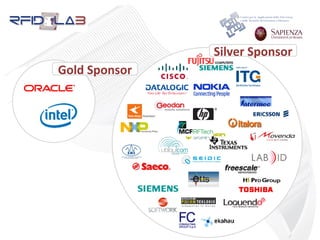
Gold Sponsor Silver Sponsor
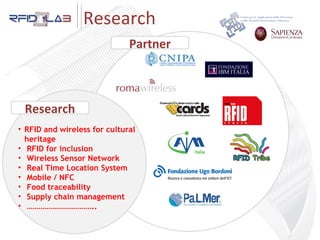
Research RFID and wireless for cultural heritage  RFID for inclusion Wireless Sensor Network Real Time Location System Mobile / NFC Food traceability Supply chain management …………………………… .. Research Partner
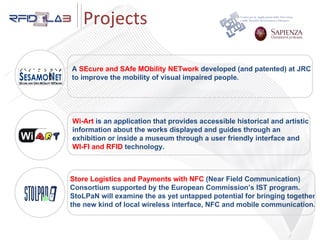
Store Logistics and Payments with NFC  (Near Field Communication)‏ Consortium supported by the European Commission’s IST program.  StoLPaN will examine the as yet untapped potential for bringing together  the new kind of local wireless interface, NFC and mobile communication. A  SEcure and SAfe MObility NETwork  developed (and patented) at JRC  to improve the mobility of visual impaired people. Wi-Art  is an application that provides accessible historical and artistic  information about the works displayed and guides through an  exhibition or inside a museum through a user friendly interface and  WI-FI and RFID  technology. Projects
Usability and Accessibility Lab Prof. Stefano Levialdi (Director)‏   Prof. Carlo Maria Medaglia Prof. Maria De Marsico
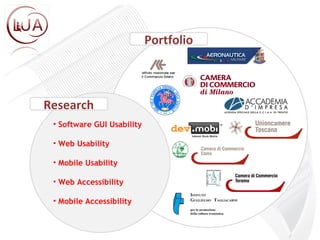
Software GUI Usability Web Usability Mobile Usability Web Accessibility Mobile Accessibility Research Portfolio
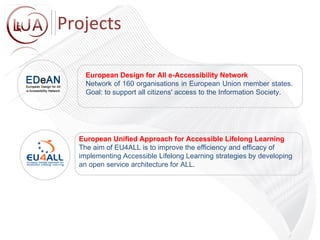
European Unified Approach for Accessible Lifelong Learning The aim of EU4ALL is to improve the efficiency and efficacy of  implementing Accessible Lifelong Learning strategies by developing  an open service architecture for ALL. European Design for All e-Accessibility Network Network of 160 organisations in European Union member states. Goal: to support all citizens' access to the Information Society. Projects
Projects
Prof. Valerio Eletti (Director)‏ Prof. Carlo Maria Medaglia   e-Learning Lab
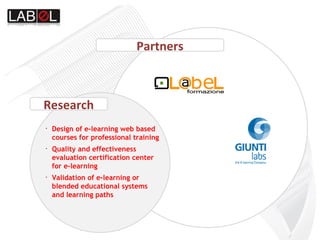
Research Partners Design of e-learning web based courses for professional training Quality and effectiveness evaluation certification center for e-learning  Validation of e-learning or blended educational systems and learning paths
DDesign of an accessible  e-Portfolio management system Sie-L 2007 observatory : e-learning state of art in Italy European Project  E.S.C.S  (European Senior Civil Servant)  in cooperation with CNIPA, SSPA and other european partner  LABEL+LABEL training workshops  (Start September 2009)‏
''WonderLab'' project Promoted by C.A.T.T.I.D. Labs of ''Sapienza” in collaboration with:
Why Wonderland? It is an  open source project , in step with the philosophy of a research lab Thanks to  applications’ sharing opportunities , it states as the 3D virtual world with most immersive user’s experience
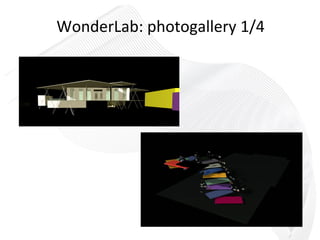
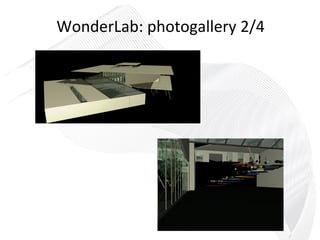
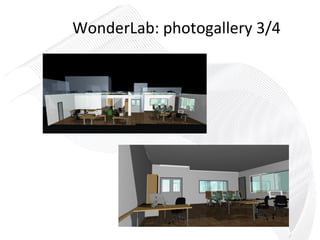
WonderLab is focused on the realization of a 3D virtual world that reproduces the real architecture of Cattid Labs. WonderLab will be a virtual extension of labs, with chances to:  share documents and/or applications;  take a tour in a virtual room; give  stakeholders  an overview about lab's projects; WonderLab: concept
Hand-roll and first approach:  helped by the Wiki available on Java.net, the research team started to work on the Wonderland platform, mounted on three differents OS (Ubuntu, Windows Xp, Osx). Second approach :-)   :  Experiments on importing 3d object through several file formats (obj, 3ds..); sharing documents; launching applications in the default world.   WonderLab: work in progress 1/3
3D Modelling:  firs attempts in creating our own world. The work splits in two parts: creating models (Archicad) in obj format; converting these objects into x3d models (through Blendr). From now on, we have at least two resources committed on these issues. WonderLab 0.1:  goodbye to the default world! Takes life the first version of WonderLab, based on actual proportion of lab.  WonderLab: work in progress 2/3
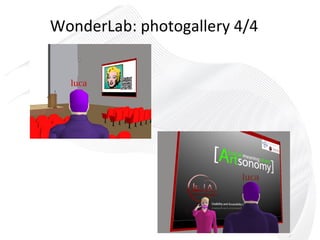
Contents:  Starting import contents designed for end-users. Some of the most representative lab’s projects are uploaded as demos on our Wonderland Server.  (avi, mp4, pdf, au). The Foyer:  in order to have a more “user friendly” 3d experience, our virtual environment is enriched with a whole new piece. Placed at the entrance of virtual labs, the foyer is the only architectonic element not present in real world. WonderLab: work in progress 3/3
Short term  goal is to let external users access in WonderLab, using it as both communication field for involved enterprises and learning tool for students. Medium-long term goal  is to develop projects in which combine sharing features of environments like WonderLab with e-learning and “digital art” experiences. WonderLab: future goals
WonderLab: photogallery 1/4
WonderLab: photogallery 2/4
WonderLab: photogallery 3/4
WonderLab: photogallery 4/4

Wonderland @ Cattid - Sun's Virtual Workplace

  • 1.
  • 2.
    Radio Frequency IdentificationLab Prof. Gianni Orlandi (Director)‏ Prof. Carlo Maria Medaglia  
  • 3.
  • 4.
    Research RFID andwireless for cultural heritage RFID for inclusion Wireless Sensor Network Real Time Location System Mobile / NFC Food traceability Supply chain management …………………………… .. Research Partner
  • 5.
    Store Logistics andPayments with NFC (Near Field Communication)‏ Consortium supported by the European Commission’s IST program. StoLPaN will examine the as yet untapped potential for bringing together the new kind of local wireless interface, NFC and mobile communication. A SEcure and SAfe MObility NETwork developed (and patented) at JRC to improve the mobility of visual impaired people. Wi-Art is an application that provides accessible historical and artistic information about the works displayed and guides through an exhibition or inside a museum through a user friendly interface and WI-FI and RFID technology. Projects
  • 6.
    Usability and AccessibilityLab Prof. Stefano Levialdi (Director)‏   Prof. Carlo Maria Medaglia Prof. Maria De Marsico
  • 7.
    Software GUI UsabilityWeb Usability Mobile Usability Web Accessibility Mobile Accessibility Research Portfolio
  • 8.
    European Unified Approachfor Accessible Lifelong Learning The aim of EU4ALL is to improve the efficiency and efficacy of implementing Accessible Lifelong Learning strategies by developing an open service architecture for ALL. European Design for All e-Accessibility Network Network of 160 organisations in European Union member states. Goal: to support all citizens' access to the Information Society. Projects
  • 9.
  • 10.
    Prof. Valerio Eletti(Director)‏ Prof. Carlo Maria Medaglia   e-Learning Lab
  • 11.
    Research Partners Designof e-learning web based courses for professional training Quality and effectiveness evaluation certification center for e-learning Validation of e-learning or blended educational systems and learning paths
  • 12.
    DDesign of anaccessible e-Portfolio management system Sie-L 2007 observatory : e-learning state of art in Italy European Project E.S.C.S (European Senior Civil Servant) in cooperation with CNIPA, SSPA and other european partner LABEL+LABEL training workshops (Start September 2009)‏
  • 13.
    ''WonderLab'' project Promotedby C.A.T.T.I.D. Labs of ''Sapienza” in collaboration with:
  • 14.
    Why Wonderland? Itis an open source project , in step with the philosophy of a research lab Thanks to applications’ sharing opportunities , it states as the 3D virtual world with most immersive user’s experience
  • 15.
    WonderLab is focusedon the realization of a 3D virtual world that reproduces the real architecture of Cattid Labs. WonderLab will be a virtual extension of labs, with chances to: share documents and/or applications; take a tour in a virtual room; give stakeholders an overview about lab's projects; WonderLab: concept
  • 16.
    Hand-roll and firstapproach: helped by the Wiki available on Java.net, the research team started to work on the Wonderland platform, mounted on three differents OS (Ubuntu, Windows Xp, Osx). Second approach :-) : Experiments on importing 3d object through several file formats (obj, 3ds..); sharing documents; launching applications in the default world. WonderLab: work in progress 1/3
  • 17.
    3D Modelling: firs attempts in creating our own world. The work splits in two parts: creating models (Archicad) in obj format; converting these objects into x3d models (through Blendr). From now on, we have at least two resources committed on these issues. WonderLab 0.1: goodbye to the default world! Takes life the first version of WonderLab, based on actual proportion of lab. WonderLab: work in progress 2/3
  • 18.
    Contents: Startingimport contents designed for end-users. Some of the most representative lab’s projects are uploaded as demos on our Wonderland Server. (avi, mp4, pdf, au). The Foyer: in order to have a more “user friendly” 3d experience, our virtual environment is enriched with a whole new piece. Placed at the entrance of virtual labs, the foyer is the only architectonic element not present in real world. WonderLab: work in progress 3/3
  • 19.
    Short term goal is to let external users access in WonderLab, using it as both communication field for involved enterprises and learning tool for students. Medium-long term goal is to develop projects in which combine sharing features of environments like WonderLab with e-learning and “digital art” experiences. WonderLab: future goals
  • 20.
  • 21.
  • 22.
  • 23.