Personal Learning Environments: What does the future hold? Karen Velasco Deputy Chairman British Institute for Learning and Development
Agenda Introductions Trends in learning PLEs – a potted history The barriers and constraints of PLEs From PLEs to ROLEs The ROLE project Case study Question time 1 October 2009 © www.role-project.eu WOLCE, Birmingham, UK
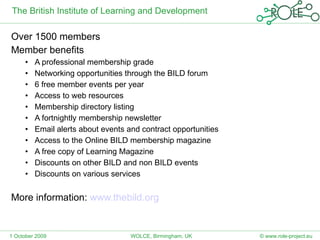
The British Institute of Learning and Development Over 1500 members Member benefits A professional membership grade Networking opportunities through the BILD forum  6 free member events per year Access to web resources Membership directory listing A fortnightly membership newsletter Email alerts about events and contract opportunities Access to the Online BILD membership magazine A free copy of Learning Magazine Discounts on other BILD and non BILD events Discounts on various services More information:  www.thebild.org   1 October 2009 © www.role-project.eu WOLCE, Birmingham, UK
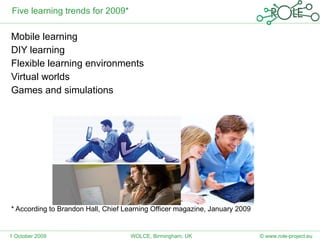
Five learning trends for 2009* Mobile learning DIY learning Flexible learning environments Virtual worlds Games and simulations * According to Brandon Hall, Chief Learning Officer magazine, January 2009 1 October 2009 © www.role-project.eu WOLCE, Birmingham, UK
What is a PLE? A Personal Learning Environment is not: A specific software application A system for creating or delivering e-learning content A learning management system A content management system A virtual learning environment (in its strictest sense) 1 October 2009 © www.role-project.eu WOLCE, Birmingham, UK A Personal Learning Environment is: A concept, based on Web 2.0 technology A collection of tools and systems Browser based An environment where learners access information from a variety of sources Personal to the user – learner-centric Distributed and social
PLEs – definitions A Personal Learning Environment is a facility for an individual to access, aggregate, configure and manipulate digital artefacts of their ongoing learning experiences. Personal Learning Environments are systems that help learners take control of and manager their own learning.  This includes providing support for learners to: Set their own learning goals Manage their learning – both content and process Communicate with other in the process of learning And thereby achieve their learning goals. PLEs are based on the idea that most learning takes place informally, in different contexts and situations, and not by one single provider. 1 October 2009 © www.role-project.eu WOLCE, Birmingham, UK
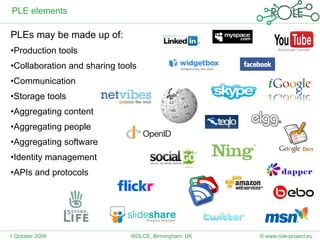
PLE elements PLEs may be made up of: Production tools  Collaboration and sharing tools Communication  Storage tools  Aggregating content Aggregating people Aggregating software Identity management APIs and protocols 1 October 2009 © www.role-project.eu WOLCE, Birmingham, UK
Benefits of PLEs PLEs allow you to: Create a repository of material about a particular subject matter Communicate and collaborate Organise material in a way that is personal to you Learn formally and informally Learn at a time and place to suit you Learn throughout your life Use whatever tools and devices you want (eg mobile phone, PS3, Wii) Interact with friends and wider communities Explore a subject in an informal manner Reflect on your learning  Submit work for assessment and review And much more ... 1 October 2009 © www.role-project.eu WOLCE, Birmingham, UK
Drawbacks of PLEs Numerous tools may be overwhelming  Skill levels Computer literacy Information literacy Differing pedagogical viewpoints Access to technology and software may be limited Reconciling the structured nature of formal education with the informal attributes of networked learning Data privacy and security issues Still mainly linked with FE/HE sectors Take-up in the workplace Do blogs, wikis, and podcasts qualify as a PLE? Just how responsive and intuitive are PLEs? 1 October 2009 © www.role-project.eu WOLCE, Birmingham, UK
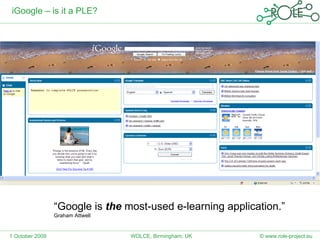
iGoogle – is it a PLE? 1 October 2009 © www.role-project.eu “ Google is  the  most-used e-learning application.” Graham Attwell WOLCE, Birmingham, UK
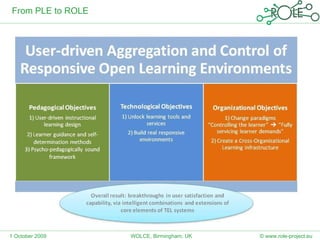
R esponsive  O pen L earning  E nvironments “ an adaptive, predictive learning tool” From PLE to ROLE © www.role-project.eu 1 October 2009 WOLCE, Birmingham, UK
From PLE to ROLE ROLE video 1 October 2009 © www.role-project.eu WOLCE, Birmingham, UK
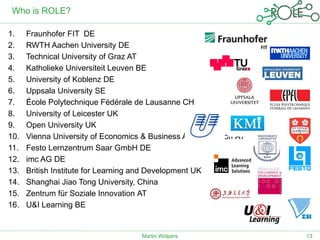
Who is ROLE? Fraunhofer FIT  DE RWTH Aachen University DE Technical University of Graz AT Katholieke Universiteit Leuven BE University of Koblenz DE Uppsala University SE École Polytechnique Fédérale de Lausanne  CH University of Leicester UK Open University UK Vienna University of Economics & Business Administration   AT Festo Lernzentrum Saar GmbH DE imc AG DE British Institute for Learning and Development   UK Shanghai Jiao Tong University, China Zentrum für Soziale Innovation   AT U&I Learning BE Martin Wolpers
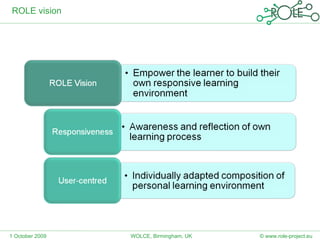
ROLE vision © www.role-project.eu 1 October 2009 WOLCE, Birmingham, UK
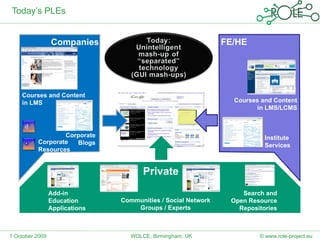
Today’s PLEs Companies Private FE/HE Courses and Content in LMS Corporate Blogs Communities / Social Network Groups / Experts Add-in Education Applications Corporate Resources Search and Open Resource Repositories Courses and Content in LMS/LCMS Institute Services © www.role-project.eu 1 October 2009 WOLCE, Birmingham, UK
From PLE to ROLE 1 October 2009 © www.role-project.eu WOLCE, Birmingham, UK
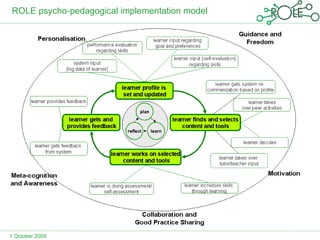
ROLE psycho-pedagogical implementation model 1 October 2009
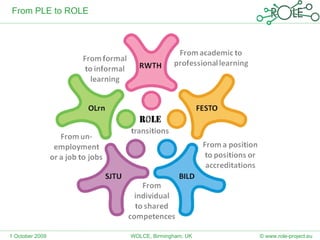
From PLE to ROLE 1 October 2009 © www.role-project.eu WOLCE, Birmingham, UK
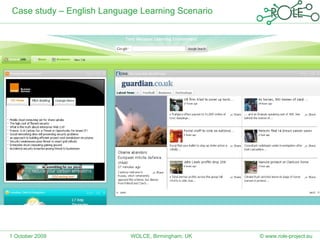
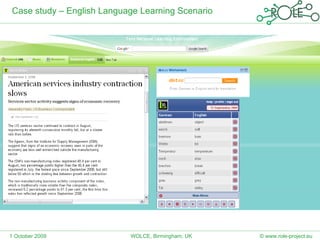
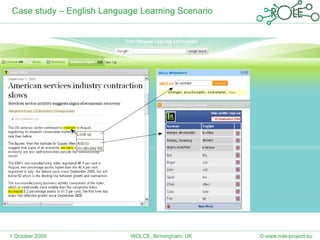
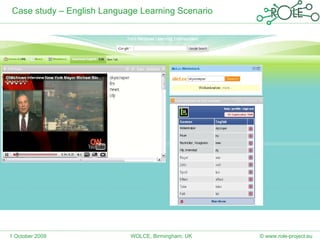
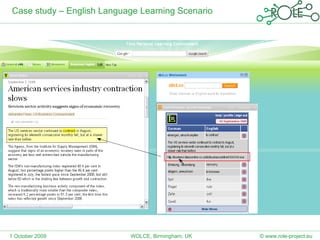
Case study – English Language Learning Scenario 1 October 2009 © www.role-project.eu WOLCE, Birmingham, UK
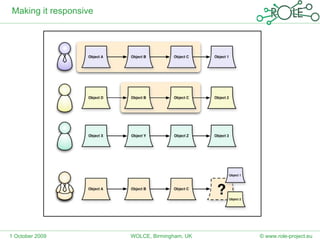
Making it responsive 1 October 2009 WOLCE, Birmingham, UK © www.role-project.eu
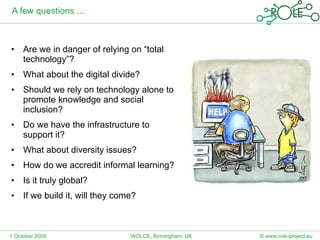
A few questions ... Are we in danger of relying on “total technology”? What about the digital divide? Should we rely on technology alone to promote knowledge and social inclusion? Do we have the infrastructure to support it? What about diversity issues? How do we accredit informal learning? Is it truly global? If we build it, will they come? 1 October 2009 © www.role-project.eu WOLCE, Birmingham, UK
Useful links ROLE website: http://www.role-project.eu/  LinkedIn ROLE group: http://www.linkedin.com/groupInvitation?gid=1590487   British Institute for Learning and Development: http://www.thebild.org Contact me: [email_address] 1 October 2009 © www.role-project.eu WOLCE, Birmingham, UK
Any questions? 1 October 2009 © www.role-project.eu WOLCE, Birmingham, UK

Wolce 2009 Role Presentation

  • 1.
    Personal Learning Environments:What does the future hold? Karen Velasco Deputy Chairman British Institute for Learning and Development
  • 2.
    Agenda Introductions Trendsin learning PLEs – a potted history The barriers and constraints of PLEs From PLEs to ROLEs The ROLE project Case study Question time 1 October 2009 © www.role-project.eu WOLCE, Birmingham, UK
  • 3.
    The British Instituteof Learning and Development Over 1500 members Member benefits A professional membership grade Networking opportunities through the BILD forum 6 free member events per year Access to web resources Membership directory listing A fortnightly membership newsletter Email alerts about events and contract opportunities Access to the Online BILD membership magazine A free copy of Learning Magazine Discounts on other BILD and non BILD events Discounts on various services More information: www.thebild.org 1 October 2009 © www.role-project.eu WOLCE, Birmingham, UK
  • 4.
    Five learning trendsfor 2009* Mobile learning DIY learning Flexible learning environments Virtual worlds Games and simulations * According to Brandon Hall, Chief Learning Officer magazine, January 2009 1 October 2009 © www.role-project.eu WOLCE, Birmingham, UK
  • 5.
    What is aPLE? A Personal Learning Environment is not: A specific software application A system for creating or delivering e-learning content A learning management system A content management system A virtual learning environment (in its strictest sense) 1 October 2009 © www.role-project.eu WOLCE, Birmingham, UK A Personal Learning Environment is: A concept, based on Web 2.0 technology A collection of tools and systems Browser based An environment where learners access information from a variety of sources Personal to the user – learner-centric Distributed and social
  • 6.
    PLEs – definitionsA Personal Learning Environment is a facility for an individual to access, aggregate, configure and manipulate digital artefacts of their ongoing learning experiences. Personal Learning Environments are systems that help learners take control of and manager their own learning. This includes providing support for learners to: Set their own learning goals Manage their learning – both content and process Communicate with other in the process of learning And thereby achieve their learning goals. PLEs are based on the idea that most learning takes place informally, in different contexts and situations, and not by one single provider. 1 October 2009 © www.role-project.eu WOLCE, Birmingham, UK
  • 7.
    PLE elements PLEsmay be made up of: Production tools Collaboration and sharing tools Communication Storage tools Aggregating content Aggregating people Aggregating software Identity management APIs and protocols 1 October 2009 © www.role-project.eu WOLCE, Birmingham, UK
  • 8.
    Benefits of PLEsPLEs allow you to: Create a repository of material about a particular subject matter Communicate and collaborate Organise material in a way that is personal to you Learn formally and informally Learn at a time and place to suit you Learn throughout your life Use whatever tools and devices you want (eg mobile phone, PS3, Wii) Interact with friends and wider communities Explore a subject in an informal manner Reflect on your learning Submit work for assessment and review And much more ... 1 October 2009 © www.role-project.eu WOLCE, Birmingham, UK
  • 9.
    Drawbacks of PLEsNumerous tools may be overwhelming Skill levels Computer literacy Information literacy Differing pedagogical viewpoints Access to technology and software may be limited Reconciling the structured nature of formal education with the informal attributes of networked learning Data privacy and security issues Still mainly linked with FE/HE sectors Take-up in the workplace Do blogs, wikis, and podcasts qualify as a PLE? Just how responsive and intuitive are PLEs? 1 October 2009 © www.role-project.eu WOLCE, Birmingham, UK
  • 10.
    iGoogle – isit a PLE? 1 October 2009 © www.role-project.eu “ Google is the most-used e-learning application.” Graham Attwell WOLCE, Birmingham, UK
  • 11.
    R esponsive O pen L earning E nvironments “ an adaptive, predictive learning tool” From PLE to ROLE © www.role-project.eu 1 October 2009 WOLCE, Birmingham, UK
  • 12.
    From PLE toROLE ROLE video 1 October 2009 © www.role-project.eu WOLCE, Birmingham, UK
  • 13.
    Who is ROLE?Fraunhofer FIT DE RWTH Aachen University DE Technical University of Graz AT Katholieke Universiteit Leuven BE University of Koblenz DE Uppsala University SE École Polytechnique Fédérale de Lausanne CH University of Leicester UK Open University UK Vienna University of Economics & Business Administration AT Festo Lernzentrum Saar GmbH DE imc AG DE British Institute for Learning and Development UK Shanghai Jiao Tong University, China Zentrum für Soziale Innovation AT U&I Learning BE Martin Wolpers
  • 14.
    ROLE vision ©www.role-project.eu 1 October 2009 WOLCE, Birmingham, UK
  • 15.
    Today’s PLEs CompaniesPrivate FE/HE Courses and Content in LMS Corporate Blogs Communities / Social Network Groups / Experts Add-in Education Applications Corporate Resources Search and Open Resource Repositories Courses and Content in LMS/LCMS Institute Services © www.role-project.eu 1 October 2009 WOLCE, Birmingham, UK
  • 16.
    From PLE toROLE 1 October 2009 © www.role-project.eu WOLCE, Birmingham, UK
  • 17.
  • 18.
    From PLE toROLE 1 October 2009 © www.role-project.eu WOLCE, Birmingham, UK
  • 19.
    Case study –English Language Learning Scenario 1 October 2009 © www.role-project.eu WOLCE, Birmingham, UK
  • 20.
    Case study –English Language Learning Scenario 1 October 2009 © www.role-project.eu WOLCE, Birmingham, UK
  • 21.
    Case study –English Language Learning Scenario 1 October 2009 © www.role-project.eu WOLCE, Birmingham, UK
  • 22.
    Case study –English Language Learning Scenario 1 October 2009 © www.role-project.eu WOLCE, Birmingham, UK
  • 23.
    Case study –English Language Learning Scenario 1 October 2009 © www.role-project.eu WOLCE, Birmingham, UK
  • 24.
    Making it responsive1 October 2009 WOLCE, Birmingham, UK © www.role-project.eu
  • 25.
    A few questions... Are we in danger of relying on “total technology”? What about the digital divide? Should we rely on technology alone to promote knowledge and social inclusion? Do we have the infrastructure to support it? What about diversity issues? How do we accredit informal learning? Is it truly global? If we build it, will they come? 1 October 2009 © www.role-project.eu WOLCE, Birmingham, UK
  • 26.
    Useful links ROLEwebsite: http://www.role-project.eu/ LinkedIn ROLE group: http://www.linkedin.com/groupInvitation?gid=1590487 British Institute for Learning and Development: http://www.thebild.org Contact me: [email_address] 1 October 2009 © www.role-project.eu WOLCE, Birmingham, UK
  • 27.
    Any questions? 1October 2009 © www.role-project.eu WOLCE, Birmingham, UK