Starbucks
Coffee, & Culture
In An
American Global Company
1971
Starbucks opens first
store in Seattle’s Pike
Place Market.
1983
Howard travels to Italy, where
he’s impressed with the
popularity
of espresso bars in Milan. He
sees the potential to develop a
similar
coffeehouse culture in Seattle
1984
Howard convinces the
founders of Starbucks to
test the
coffeehouse concept in
downtown Seattle, where
the first
Starbucks® Caffè Latte is
served. This successful
experiment is the
genesis for a company that
Schultz founds in 1985.
1987
Il Giornale acquires Starbucks
assets with the backing of
local
investors and changes its name
to Starbucks Corporation. Opens
in
Chicago and Vancouver,
Canada.
Total stores*: 17
1985
Howard founds Il Giornale,
offering brewed coffee and
espresso
beverages made from
Starbucks® coffee beans.
1988
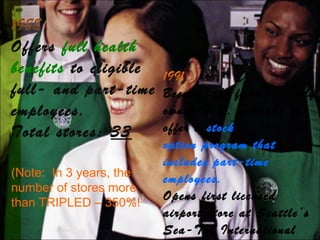
Offers full health
benefits to eligible
full- and part-time
employees.
Total stores: 33
1991
Becomes the first privately
owned U.S. company to
offer a stock
option program that
includes part-time
employees.
Opens first licensed
airport store at Seattle’s
Sea-Tac International
(Note: In 3 years, the
number of stores more
than TRIPLED – 350%!
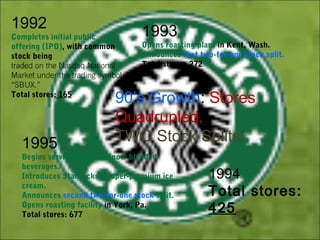
1992
Completes initial public
offering (IPO), with common
stock being
traded on the Nasdaq National
Market under the trading symbol
“SBUX.”
Total stores: 165
1993
Opens roasting plant in Kent, Wash.
Announces first two-for-one stock split.
Total stores: 272
1994
Total stores:
425
1995
Begins serving Frappuccino® blended
beverages.
Introduces Starbucks® super-premium ice
cream.
Announces second two-for-one stock split.
Opens roasting facility in York, Pa.
Total stores: 677
90’s Growth: Stores
Quadrupled,
TWO Stock Splits!
The Late 90’s Agenda :
International Expansion
Growth, Growth, Growth !!!!
1996
Begins selling bottled Frappuccino®
coffee drink through North
American Coffee Partnership (Starbucks and
Pepsi-Cola North
America).
Opens stores in: Japan (first store outside
of North America) and
Singapore.
Total stores: 1,015
1997
Establishes The Starbucks Foundation,
benefiting local literacy
programs in communities where Starbucks
has coffeehouses.
Opens stores in: the Philippines.
Total stores: 1,412
1999
Partners with Conservation International to promote sustainable
coffee-growing practices.
Acquires Hear Music, a San Francisco–based music company.
Announces third two-for-one stock split.
Opens stores in: China, Kuwait, Lebanon and South Korea.
Total stores: 2,498
Store Growth in the 90’s: 116
2,498
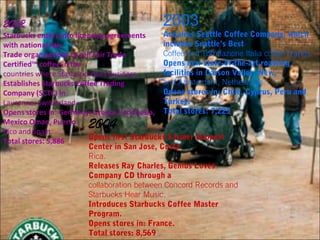
2002
Starbucks enters into licensing agreements
with national Fair
Trade organizations to sell Fair Trade
Certified™ coffee in the
countries where Starbucks does business.
Establishes Starbucks Coffee Trading
Company (SCTC) in
Lausanne, Switzerland.
Opens stores in: Germany, Greece, Indonesia,
Mexico Oman, Puerto
Rico and Spain.
Total stores: 5,886
2003
Acquires Seattle Coffee Company, which
includes Seattle’s Best
Coffee and Torrefazione Italia coffee brands.
Opens new state-of-the-art roasting
facilities in Carson Valley, Nev.,
and Amsterdam, Netherlands.
Opens stores in: Chile, Cyprus, Peru and
Turkey.
Total stores: 7,225
2004
Opens first Starbucks Farmer Support
Center in San Jose, Costa
Rica.
Releases Ray Charles, Genius Loves
Company CD through a
collaboration between Concord Records and
Starbucks Hear Music.
Introduces Starbucks Coffee Master
Program.
Opens stores in: France.
Total stores: 8,569
2005
•Orin Smith retires as Starbucks president and chief
executive
Officer
•Jim Donald promoted to president and chief
executive officer.
•.
Acquires Ethos Water and sets a goal of donating $10
million to
support clean water projects over the next five years.
2006
Launches the industry’s first paper
beverage cup containing
postconsumer
recycled fiber, saving more than 75,000
trees each year.
Opens stores in: Brazil and Egypt.
Total stores: 12,440
Social responsibility continues:
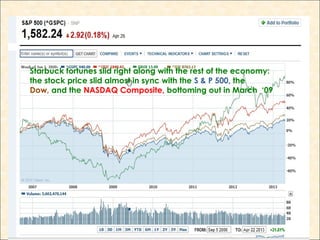
Starbuck fortunes slid right along with the rest of the economy:
the stock price slid almost in sync with the S & P 500, the
Dow, and the NASDAQ Composite, bottoming out in March ‘09
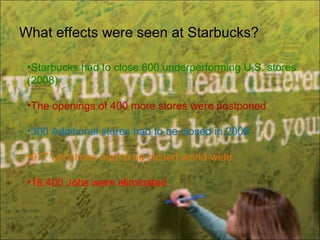
What effects were seen at Starbucks?
•Starbucks had to close 600 underperforming U.S. stores
(2008)
•The openings of 400 more stores were postponed
•300 Additional stores had to be closed in 2009
•977 Locations had to be closed world-wide
•18,400 Jobs were eliminated
Tale of the Tape:
Starbucks’ Financial History
Synopsis
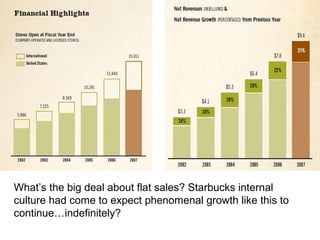
What’s the big deal about flat sales? Starbucks internal
culture had come to expect phenomenal growth like this to
continue…indefinitely?
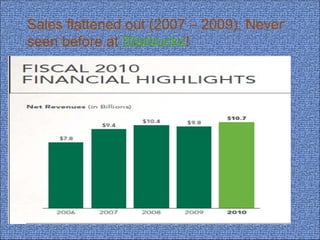
Sales flattened out (2007 – 2009). Never
seen before at Starbucks!
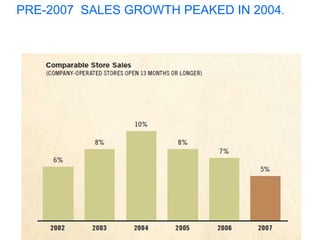
PRE-2007 SALES GROWTH PEAKED IN 2004.
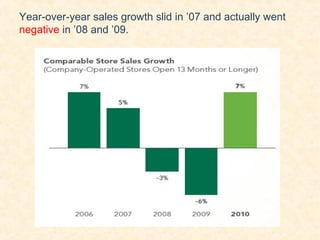
Year-over-year sales growth slid in ’07 and actually went
negative in ’08 and ’09.
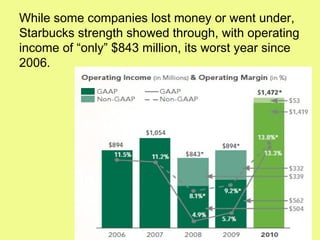
While some companies lost money or went under,
Starbucks strength showed through, with operating
income of “only” $843 million, its worst year since
2006.
“Expansionistic” philosophy was
replaced by a series of moves
designed to maximize returns in
each existing location. These
changes were largely customer-
centric and designed to re-brand
Starbucks back from corporate
commercialism to “coffee culture”
Financial & Philosophical Change: 2008
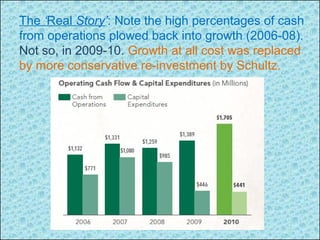
The ‘Real Story’: Note the high percentages of cash
from operations plowed back into growth (2006-08).
Not so, in 2009-10. Growth at all cost was replaced
by more conservative re-investment by Schultz.
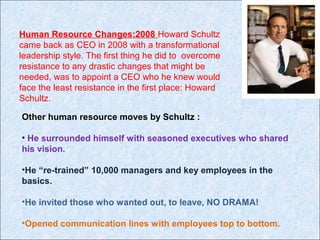
Human Resource Changes:2008 Howard Schultz
came back as CEO in 2008 with a transformational
leadership style. The first thing he did to overcome
resistance to any drastic changes that might be
needed, was to appoint a CEO who he knew would
face the least resistance in the first place: Howard
Schultz.
Other human resource moves by Schultz :
• He surrounded himself with seasoned executives who shared
his vision.
•He “re-trained” 10,000 managers and key employees in the
basics.
•He invited those who wanted out, to leave, NO DRAMA!
•Opened communication lines with employees top to bottom.
Starbuck New Customer-Centric Initiatives
•Cut back on breakfast food, so Starbucks would
smell like coffee in the morning. (Extremely important!!)
•Reduce the clutter on counters devoted to other
merchandising (teddy bears, etc.)
•MyStarbucksIdea.com – website where customers
could voice their feelings, good or bad.
•Mastraena – New machine to enhance the espresso
experience
MORE CUSTOMER-CENTRIC
CHANGES
•Clover – New brewing machine to
enhance flavor and “theatre” of fresh-
brewed.
•The Rewards Program – Incentives to
reward loyal and repeat customers
•Pike Place Roast – Better tasting
coffee designed to broaden the
market.
•Re –Affirmation of Eco-Commitment
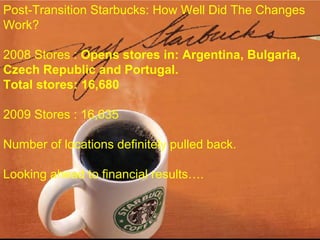
Post-Transition Starbucks: How Well Did The Changes
Work?
2008 Stores : Opens stores in: Argentina, Bulgaria,
Czech Republic and Portugal.
Total stores: 16,680
2009 Stores : 16,635
Number of locations definitely pulled back.
Looking ahead to financial results….
2009
Starbucks helps save lives in Africa through our partnership
with
(RED)™. Millions of daily purchases of (STARBUCKS)RED
products
have generated contributions equal to more than 7 million daily
doses of antiretroviral medicine..
Starbucks the most engaged brand in social media according
to
ENGAGEMENT db Report. Launches myStarbucks and
Starbucks
Card iPhone apps.
Opens stores in: Poland and Aruba.
Total stores: 16,635
Continuing Global Commitment
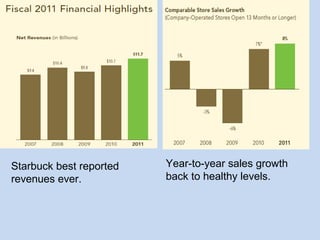
Starbuck best reported
revenues ever.
Year-to-year sales growth
back to healthy levels.
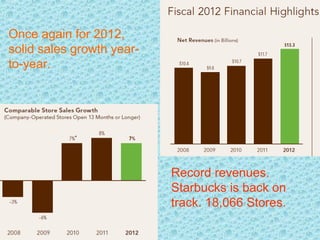
Once again for 2012,
solid sales growth year-
to-year.
Record revenues.
Starbucks is back on
track. 18,066 Stores.
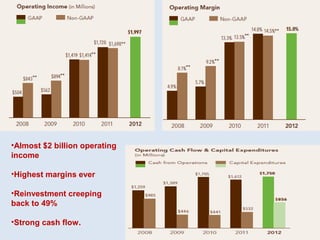
•Almost $2 billion operating
income
•Highest margins ever
•Reinvestment creeping
back to 49%
•Strong cash flow.
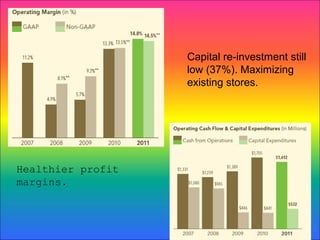
Healthier profit
margins.
Capital re-investment still
low (37%). Maximizing
existing stores.
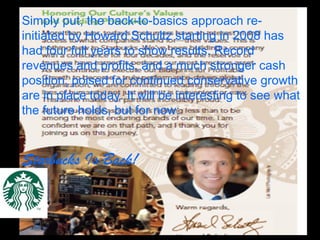
Simply put, the back-to-basics approach re-
initiated by Howard Schultz starting in 2008 has
had four full years to show results. Record
revenues and profits, and a much stronger cash
position, poised for continued conservative growth
are in place today. It will be interesting to see what
the future holds, but for now:
Starbucks Is Back!

Wk7 assgngoodrichm

  • 1.
    Starbucks Coffee, & Culture InAn American Global Company
  • 2.
    1971 Starbucks opens first storein Seattle’s Pike Place Market. 1983 Howard travels to Italy, where he’s impressed with the popularity of espresso bars in Milan. He sees the potential to develop a similar coffeehouse culture in Seattle
  • 3.
    1984 Howard convinces the foundersof Starbucks to test the coffeehouse concept in downtown Seattle, where the first Starbucks® Caffè Latte is served. This successful experiment is the genesis for a company that Schultz founds in 1985.
  • 4.
    1987 Il Giornale acquiresStarbucks assets with the backing of local investors and changes its name to Starbucks Corporation. Opens in Chicago and Vancouver, Canada. Total stores*: 17 1985 Howard founds Il Giornale, offering brewed coffee and espresso beverages made from Starbucks® coffee beans.
  • 5.
    1988 Offers full health benefitsto eligible full- and part-time employees. Total stores: 33 1991 Becomes the first privately owned U.S. company to offer a stock option program that includes part-time employees. Opens first licensed airport store at Seattle’s Sea-Tac International (Note: In 3 years, the number of stores more than TRIPLED – 350%!
  • 6.
    1992 Completes initial public offering(IPO), with common stock being traded on the Nasdaq National Market under the trading symbol “SBUX.” Total stores: 165 1993 Opens roasting plant in Kent, Wash. Announces first two-for-one stock split. Total stores: 272 1994 Total stores: 425 1995 Begins serving Frappuccino® blended beverages. Introduces Starbucks® super-premium ice cream. Announces second two-for-one stock split. Opens roasting facility in York, Pa. Total stores: 677 90’s Growth: Stores Quadrupled, TWO Stock Splits!
  • 7.
    The Late 90’sAgenda : International Expansion Growth, Growth, Growth !!!!
  • 8.
    1996 Begins selling bottledFrappuccino® coffee drink through North American Coffee Partnership (Starbucks and Pepsi-Cola North America). Opens stores in: Japan (first store outside of North America) and Singapore. Total stores: 1,015 1997 Establishes The Starbucks Foundation, benefiting local literacy programs in communities where Starbucks has coffeehouses. Opens stores in: the Philippines. Total stores: 1,412 1999 Partners with Conservation International to promote sustainable coffee-growing practices. Acquires Hear Music, a San Francisco–based music company. Announces third two-for-one stock split. Opens stores in: China, Kuwait, Lebanon and South Korea. Total stores: 2,498 Store Growth in the 90’s: 116 2,498
  • 9.
    2002 Starbucks enters intolicensing agreements with national Fair Trade organizations to sell Fair Trade Certified™ coffee in the countries where Starbucks does business. Establishes Starbucks Coffee Trading Company (SCTC) in Lausanne, Switzerland. Opens stores in: Germany, Greece, Indonesia, Mexico Oman, Puerto Rico and Spain. Total stores: 5,886 2003 Acquires Seattle Coffee Company, which includes Seattle’s Best Coffee and Torrefazione Italia coffee brands. Opens new state-of-the-art roasting facilities in Carson Valley, Nev., and Amsterdam, Netherlands. Opens stores in: Chile, Cyprus, Peru and Turkey. Total stores: 7,225 2004 Opens first Starbucks Farmer Support Center in San Jose, Costa Rica. Releases Ray Charles, Genius Loves Company CD through a collaboration between Concord Records and Starbucks Hear Music. Introduces Starbucks Coffee Master Program. Opens stores in: France. Total stores: 8,569
  • 10.
    2005 •Orin Smith retiresas Starbucks president and chief executive Officer •Jim Donald promoted to president and chief executive officer. •. Acquires Ethos Water and sets a goal of donating $10 million to support clean water projects over the next five years.
  • 11.
    2006 Launches the industry’sfirst paper beverage cup containing postconsumer recycled fiber, saving more than 75,000 trees each year. Opens stores in: Brazil and Egypt. Total stores: 12,440 Social responsibility continues:
  • 12.
    Starbuck fortunes slidright along with the rest of the economy: the stock price slid almost in sync with the S & P 500, the Dow, and the NASDAQ Composite, bottoming out in March ‘09
  • 13.
    What effects wereseen at Starbucks? •Starbucks had to close 600 underperforming U.S. stores (2008) •The openings of 400 more stores were postponed •300 Additional stores had to be closed in 2009 •977 Locations had to be closed world-wide •18,400 Jobs were eliminated
  • 14.
    Tale of theTape: Starbucks’ Financial History Synopsis
  • 15.
    What’s the bigdeal about flat sales? Starbucks internal culture had come to expect phenomenal growth like this to continue…indefinitely?
  • 16.
    Sales flattened out(2007 – 2009). Never seen before at Starbucks!
  • 17.
    PRE-2007 SALES GROWTHPEAKED IN 2004.
  • 18.
    Year-over-year sales growthslid in ’07 and actually went negative in ’08 and ’09.
  • 19.
    While some companieslost money or went under, Starbucks strength showed through, with operating income of “only” $843 million, its worst year since 2006.
  • 20.
    “Expansionistic” philosophy was replacedby a series of moves designed to maximize returns in each existing location. These changes were largely customer- centric and designed to re-brand Starbucks back from corporate commercialism to “coffee culture” Financial & Philosophical Change: 2008
  • 21.
    The ‘Real Story’:Note the high percentages of cash from operations plowed back into growth (2006-08). Not so, in 2009-10. Growth at all cost was replaced by more conservative re-investment by Schultz.
  • 22.
    Human Resource Changes:2008Howard Schultz came back as CEO in 2008 with a transformational leadership style. The first thing he did to overcome resistance to any drastic changes that might be needed, was to appoint a CEO who he knew would face the least resistance in the first place: Howard Schultz. Other human resource moves by Schultz : • He surrounded himself with seasoned executives who shared his vision. •He “re-trained” 10,000 managers and key employees in the basics. •He invited those who wanted out, to leave, NO DRAMA! •Opened communication lines with employees top to bottom.
  • 23.
    Starbuck New Customer-CentricInitiatives •Cut back on breakfast food, so Starbucks would smell like coffee in the morning. (Extremely important!!) •Reduce the clutter on counters devoted to other merchandising (teddy bears, etc.) •MyStarbucksIdea.com – website where customers could voice their feelings, good or bad. •Mastraena – New machine to enhance the espresso experience
  • 24.
    MORE CUSTOMER-CENTRIC CHANGES •Clover –New brewing machine to enhance flavor and “theatre” of fresh- brewed. •The Rewards Program – Incentives to reward loyal and repeat customers •Pike Place Roast – Better tasting coffee designed to broaden the market. •Re –Affirmation of Eco-Commitment
  • 25.
    Post-Transition Starbucks: HowWell Did The Changes Work? 2008 Stores : Opens stores in: Argentina, Bulgaria, Czech Republic and Portugal. Total stores: 16,680 2009 Stores : 16,635 Number of locations definitely pulled back. Looking ahead to financial results….
  • 26.
    2009 Starbucks helps savelives in Africa through our partnership with (RED)™. Millions of daily purchases of (STARBUCKS)RED products have generated contributions equal to more than 7 million daily doses of antiretroviral medicine.. Starbucks the most engaged brand in social media according to ENGAGEMENT db Report. Launches myStarbucks and Starbucks Card iPhone apps. Opens stores in: Poland and Aruba. Total stores: 16,635 Continuing Global Commitment
  • 27.
    Starbuck best reported revenuesever. Year-to-year sales growth back to healthy levels.
  • 28.
    Once again for2012, solid sales growth year- to-year. Record revenues. Starbucks is back on track. 18,066 Stores.
  • 29.
    •Almost $2 billionoperating income •Highest margins ever •Reinvestment creeping back to 49% •Strong cash flow.
  • 30.
    Healthier profit margins. Capital re-investmentstill low (37%). Maximizing existing stores.
  • 31.
    Simply put, theback-to-basics approach re- initiated by Howard Schultz starting in 2008 has had four full years to show results. Record revenues and profits, and a much stronger cash position, poised for continued conservative growth are in place today. It will be interesting to see what the future holds, but for now: Starbucks Is Back!

Editor's Notes

  • #2 This is the story of Starbucks Coffee Company. It started in Seattle in 1971 as a local coffee shop.
  • #3 The current CEO, Howard Schultz started working for what was then the four-location Starbucks in 1982. He is bitten with the “coffee shop culture” bug on a trip to Italy a year later.
  • #4 Howard convinces the founders of Starbucks to test the coffeehouse concept in downtown Seattle, where the first Starbucks® Caffè Latte is served. This successful experiment is the genesis for a company that Schultz founds in 1985.
  • #5 Howard Schultz starts Il Giornale coffee shop on his own, gathers investors and eventually buys and merges with Starbucks.
  • #6 Howard Schultz’s commitment to his “partners” or employees is evident. Health benefits and stock options are not normally offered to part-time employees.
  • #7 The 90’s was strictly business, and all about growth in the number of stores.
  • #9 Howard Schultz grew up poor, but he knew how to think big. The late 90’s agenda was about going multinational. Starbucks also went from 116 stores to 2,498 – phenomenal growth!
  • #10 In 2000, Howard resigned as CEO to become Chief Global Strategist. Starbucks grew well overseas, and totalled 8,569 stores by the end of 2004.
  • #11 Starbucks continues its commitment to social responsibility with Ethos Water.
  • #13 The recession that began in 2007 was global. Starbucks felt the impact in a big way on its retail business, And in its stock price.
  • #14 Just like a lot of American companies, Starbucks had to tighten its belt. Expansionary plans were Postponed, and thousands of unavoidable layoffs were announced.
  • #16 For a good overview, let’s look at pre-2007 financial highlights, and Post-2007 highlights.
  • #17 Slowing sales growth meant that ever-present plans for heavy capital investment in Expansion, had to be re-evaluated.
  • #18 The decline in year-to-year, same store sales could be seen as early As 2005
  • #19 Results from 2008 and 2009 sent shockwaves through Starbucks.
  • #20 Surprisingly, Starbucks has never posted an actual loss.
  • #21 Expansionistic” philosophy was replaced by a series of moves designed to maximize returns in each existing location. These changes were largely customer-centric and designed to re-brand Starbucks back from corporate commercialism to “coffee culture
  • #22 Financially strong, Starbucks funded expansion by using as much as 80% of yearly Cash from operations. Note that Schultz’s response to the challenging economy was To scale that figure back to about 30% - A big change.
  • #23 Schultz knew that he had treated his employees well, and leveraged his Personal relationship style and omnipresent influence to oversee changes.
  • #24 Schultz and trusted top executives also noticed Starbucks becoming too “ commercial.” The strategy was simple: get back to the purest coffee experience Possible.
  • #26 2009 total stores were actually less than the number at the end of 2008, but Would the pull-back be worth it?
  • #27 2009 could very well have been a year when Starbucks management Tended only to their own problems, but this is not Starbucks culture. Humanitarian efforts have never left the Starbucks scene or taken a back seat.
  • #28 2011 revenues were the best in the company’s history. And trimming the underperforming Stores seems to have paid off in sales growth.
  • #29 Financial results for 2012 were equally impressive.
  • #30 In fact, all financial indicators for 2012 were strong.
  • #32 Starbucks today, is on better financial footing that it has ever been. Howard Schultz thanks his “partners” for that, and attributes it to “ Honoring our culture’s values.”