18/03/2015
1
HIT-K ECE-A
Presented by -
•SUSHOVAN SEN
•MARSHAL BASKE
•CHINMOY KARMAKAR
•ABRARUL HAQUE
•DEBARSI DAN
TABLE OF CONTENTS
• Introduction to Witricity
• Need for witricity
• History of wireless power
• Working principle of WPT
• Techniques to transfer
• Application Pros and cons
• Future trends and conclusion
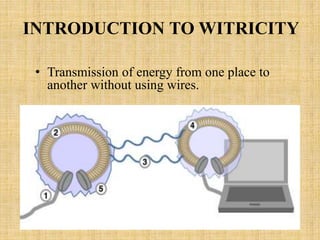
INTRODUCTION TO WITRICITY
• Transmission of energy from one place to
another without using wires.
History of Wireless Power
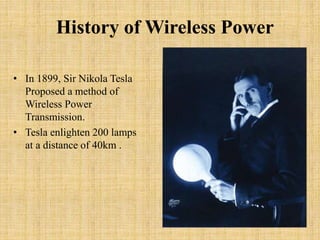
• In 1899, Sir Nikola Tesla
Proposed a method of
Wireless Power
Transmission.
• Tesla enlighten 200 lamps
at a distance of 40km .
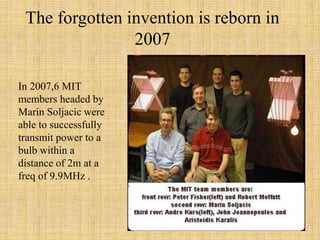
The forgotten invention is reborn in
2007
In 2007,6 MIT
members headed by
Marin Soljacic were
able to successfully
transmit power to a
bulb within a
distance of 2m at a
freq of 9.9MHz .
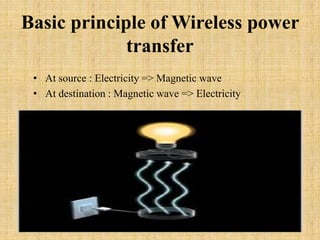
Basic principle of Wireless power
transfer
• At source : Electricity => Magnetic wave
• At destination : Magnetic wave => Electricity
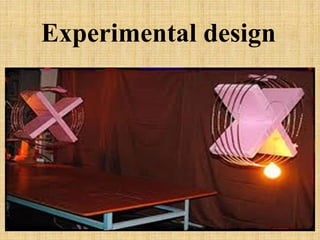
Experimental design
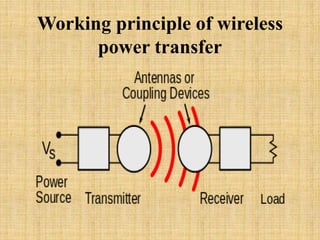
Working principle of wireless
power transfer
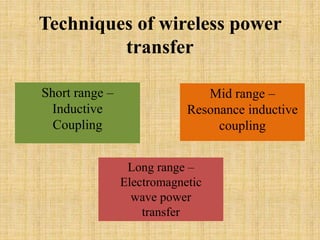
Mid range –
Resonance inductive
coupling
Short range –
Inductive
Coupling
Long range –
Electromagnetic
wave power
transfer
Techniques of wireless power
transfer
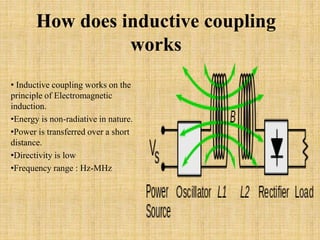
How does inductive coupling
works
• Inductive coupling works on the
principle of Electromagnetic
induction.
•Energy is non-radiative in nature.
•Power is transferred over a short
distance.
•Directivity is low
•Frequency range : Hz-MHz
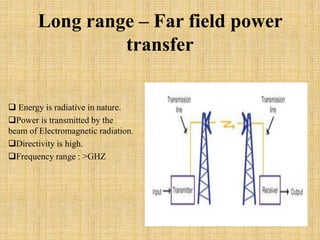
Long range – Far field power
transfer
 Energy is radiative in nature.
Power is transmitted by the
beam of Electromagnetic radiation.
Directivity is high.
Frequency range : >GHZ
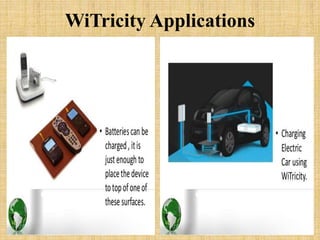
WiTricity Applications
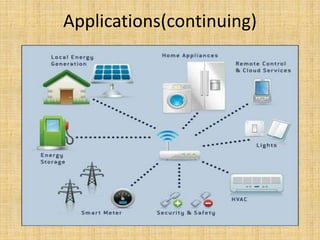
Applications(continuing)
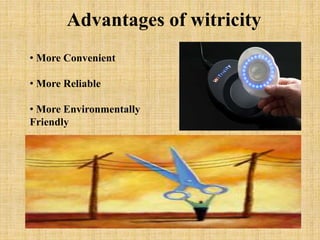
• More Convenient
• More Reliable
• More Environmentally
Friendly
Advantages of witricity
Disadvantages
• Distance constraint
• Field strengths have to be under safety levels
• Initial cost is high
• In RIC, tuning is difficult
• High frequency signals must be the supply
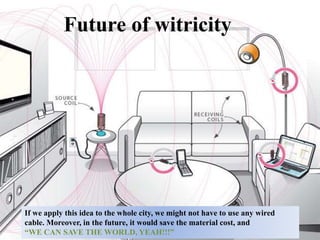
Future of witricity
If we apply this idea to the whole city, we might not have to use any wired
cable. Moreover, in the future, it would save the material cost, and
“WE CAN SAVE THE WORLD, YEAH!!!”
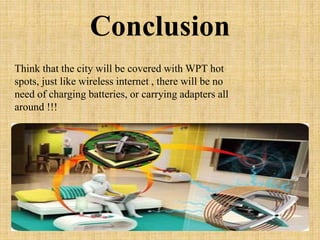
Conclusion
Think that the city will be covered with WPT hot
spots, just like wireless internet , there will be no
need of charging batteries, or carrying adapters all
around !!!
Wireless Power Transfer

Wireless Power Transfer

  • 1.
  • 2.
    Presented by - •SUSHOVANSEN •MARSHAL BASKE •CHINMOY KARMAKAR •ABRARUL HAQUE •DEBARSI DAN
  • 3.
    TABLE OF CONTENTS •Introduction to Witricity • Need for witricity • History of wireless power • Working principle of WPT • Techniques to transfer • Application Pros and cons • Future trends and conclusion
  • 4.
    INTRODUCTION TO WITRICITY •Transmission of energy from one place to another without using wires.
  • 8.
    History of WirelessPower • In 1899, Sir Nikola Tesla Proposed a method of Wireless Power Transmission. • Tesla enlighten 200 lamps at a distance of 40km .
  • 9.
    The forgotten inventionis reborn in 2007 In 2007,6 MIT members headed by Marin Soljacic were able to successfully transmit power to a bulb within a distance of 2m at a freq of 9.9MHz .
  • 10.
    Basic principle ofWireless power transfer • At source : Electricity => Magnetic wave • At destination : Magnetic wave => Electricity
  • 11.
  • 12.
    Working principle ofwireless power transfer
  • 13.
    Mid range – Resonanceinductive coupling Short range – Inductive Coupling Long range – Electromagnetic wave power transfer Techniques of wireless power transfer
  • 14.
    How does inductivecoupling works • Inductive coupling works on the principle of Electromagnetic induction. •Energy is non-radiative in nature. •Power is transferred over a short distance. •Directivity is low •Frequency range : Hz-MHz
  • 16.
    Long range –Far field power transfer  Energy is radiative in nature. Power is transmitted by the beam of Electromagnetic radiation. Directivity is high. Frequency range : >GHZ
  • 17.
  • 18.
  • 19.
    • More Convenient •More Reliable • More Environmentally Friendly Advantages of witricity
  • 20.
    Disadvantages • Distance constraint •Field strengths have to be under safety levels • Initial cost is high • In RIC, tuning is difficult • High frequency signals must be the supply
  • 21.
    Future of witricity Ifwe apply this idea to the whole city, we might not have to use any wired cable. Moreover, in the future, it would save the material cost, and “WE CAN SAVE THE WORLD, YEAH!!!”
  • 22.
    Conclusion Think that thecity will be covered with WPT hot spots, just like wireless internet , there will be no need of charging batteries, or carrying adapters all around !!!

Editor's Notes

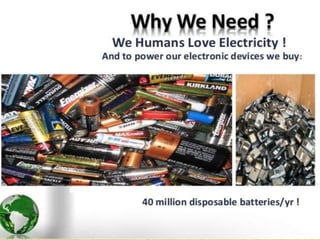
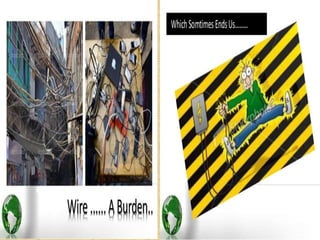
  • #4 Currently, wired electricity powers nearly everything. It travels through wires in the form of Alternating Current electricity, and powers most of our devices. Wireless trasmission of energy will remove our dependency on wires
  • #5 Currently, wired electricity powers nearly everything. It travels through wires in the form of Alternating Current electricity, and powers most of our devices. Wireless trasmission of energy will remove our dependency on wires
  • #9 Tesla coil
  • #11 Currently, wired electricity powers nearly everything. It travels through wires in the form of Alternating Current electricity, and powers most of our devices. Wireless trasmission of energy will remove our dependency on wires
  • #12 Experimental design Our experimental scheme consists of two Self-resonant coils. One coil (source coil) is coupled inductively to an oscillating circuit; the other (device coil) is coupled inductively to a resistive load. Self-resonant coils rely on the interplay between distributed inductance and distributed capacitance to achieve resonance.
  • #13 Refer - Wikipedia