Wire sculpture refers to the creation of sculpture or jewellery (sometimes called wire wrap 
jewellery) out of wire. The use of metal wire in jewellery dates back to the 2nd Dynasty in Egypt and 
to the Bronze and Iron Ages in Europe. In the 20th century, the works of Alexander Calder, Ruth 
Asawa, and other modern practitioners developed the medium of wire sculpture as an art form 
------------------------------------------------------------------------------------------------------------------------------------- 
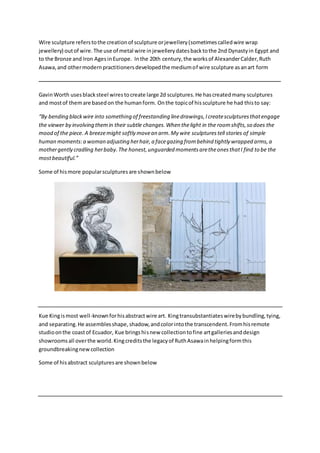
Gavin Worth uses black steel wires to create large 2d sculptures. He has created many sculptures 
and most of them are based on the human form. On the topic of his sculpture he had this to say: 
“By bending black wire into something of freestanding line drawings, I create sculptures that engage 
the viewer by involving them in their subtle changes. When the light in the room shifts, so does the 
mood of the piece. A breeze might softly move an arm. My wire sculptures tell stories of simple 
human moments: a woman adjusting her hair, a face gazing from behind tightly wrapped arms, a 
mother gently cradling her baby. The honest, unguarded moments are the ones that I find to be the 
most beautiful.” 
Some of his more popular sculptures are shown below 
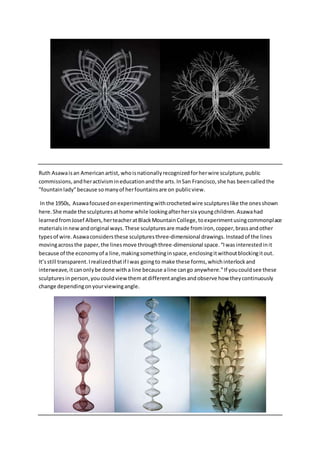
Kue King is most well-known for his abstract wire art. King transubstantiates wire by bundling, tying, 
and separating. He assembles shape, shadow, and color into the transcendent. From his remote 
studio on the coast of Ecuador, Kue brings his new collection to fine art galleries and design 
showrooms all over the world. King credits the legacy of Ruth Asawa in helping form this 
groundbreaking new collection 
Some of his abstract sculptures are shown below
Ruth Asawa is an American artist, who is nationally recognized for her wire sculpture, public 
commissions, and her activism in education and the arts. In San Francisco, she has been called the 
"fountain lady" because so many of her fountains are on public view. 
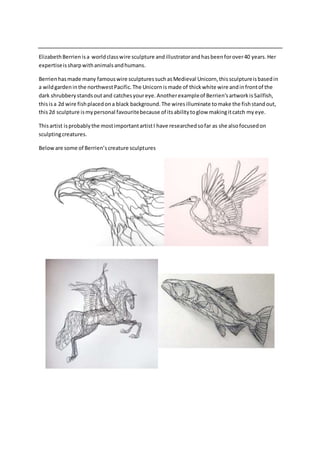
In the 1950s, Asawa focused on experimenting with crocheted wire sculptures like the ones shown 
here. She made the sculptures at home while looking after her six young children. Asawa had 
learned from Josef Albers, her teacher at Black Mountain College, to experiment using commonplace 
materials in new and original ways. These sculptures are made from iron, copper, brass and other 
types of wire. Asawa considers these sculptures three-dimensional drawings. Instead of the lines 
moving across the paper, the lines move through three-dimensional space. “I was interested in it 
because of the economy of a line, making something in space, enclosing it without blocking it out. 
It’s still transparent. I realized that if I was going to make these forms, which interlock and 
interweave, it can only be done with a line because a line can go anywhere.” If you could see these 
sculptures in person, you could view them at different angles and observe how they continuously 
change depending on your viewing angle.
Elizabeth Berrien is a world class wire sculpture and illustrator and has been for over 40 years. Her 
expertise is sharp with animals and humans. 
Berrien has made many famous wire sculptures such as Medieval Unicorn, this sculpture is based in 
a wild garden in the northwest Pacific. The Unicorn is made of thick white wire and in front of the 
dark shrubbery stands out and catches your eye. Another example of Berrien’s artwork is Sailfish, 
this is a 2d wire fish placed on a black background. The wires illuminate to make the fish stand out, 
this 2d sculpture is my personal favourite because of its ability to glow making it catch my eye. 
This artist is probably the most important artist I have researched so far as she also focused on 
sculpting creatures. 
Below are some of Berrien’s creature sculptures

Wire sculptur

  • 1.
    Wire sculpture refersto the creation of sculpture or jewellery (sometimes called wire wrap jewellery) out of wire. The use of metal wire in jewellery dates back to the 2nd Dynasty in Egypt and to the Bronze and Iron Ages in Europe. In the 20th century, the works of Alexander Calder, Ruth Asawa, and other modern practitioners developed the medium of wire sculpture as an art form ------------------------------------------------------------------------------------------------------------------------------------- Gavin Worth uses black steel wires to create large 2d sculptures. He has created many sculptures and most of them are based on the human form. On the topic of his sculpture he had this to say: “By bending black wire into something of freestanding line drawings, I create sculptures that engage the viewer by involving them in their subtle changes. When the light in the room shifts, so does the mood of the piece. A breeze might softly move an arm. My wire sculptures tell stories of simple human moments: a woman adjusting her hair, a face gazing from behind tightly wrapped arms, a mother gently cradling her baby. The honest, unguarded moments are the ones that I find to be the most beautiful.” Some of his more popular sculptures are shown below Kue King is most well-known for his abstract wire art. King transubstantiates wire by bundling, tying, and separating. He assembles shape, shadow, and color into the transcendent. From his remote studio on the coast of Ecuador, Kue brings his new collection to fine art galleries and design showrooms all over the world. King credits the legacy of Ruth Asawa in helping form this groundbreaking new collection Some of his abstract sculptures are shown below
  • 2.
    Ruth Asawa isan American artist, who is nationally recognized for her wire sculpture, public commissions, and her activism in education and the arts. In San Francisco, she has been called the "fountain lady" because so many of her fountains are on public view. In the 1950s, Asawa focused on experimenting with crocheted wire sculptures like the ones shown here. She made the sculptures at home while looking after her six young children. Asawa had learned from Josef Albers, her teacher at Black Mountain College, to experiment using commonplace materials in new and original ways. These sculptures are made from iron, copper, brass and other types of wire. Asawa considers these sculptures three-dimensional drawings. Instead of the lines moving across the paper, the lines move through three-dimensional space. “I was interested in it because of the economy of a line, making something in space, enclosing it without blocking it out. It’s still transparent. I realized that if I was going to make these forms, which interlock and interweave, it can only be done with a line because a line can go anywhere.” If you could see these sculptures in person, you could view them at different angles and observe how they continuously change depending on your viewing angle.
  • 3.
    Elizabeth Berrien isa world class wire sculpture and illustrator and has been for over 40 years. Her expertise is sharp with animals and humans. Berrien has made many famous wire sculptures such as Medieval Unicorn, this sculpture is based in a wild garden in the northwest Pacific. The Unicorn is made of thick white wire and in front of the dark shrubbery stands out and catches your eye. Another example of Berrien’s artwork is Sailfish, this is a 2d wire fish placed on a black background. The wires illuminate to make the fish stand out, this 2d sculpture is my personal favourite because of its ability to glow making it catch my eye. This artist is probably the most important artist I have researched so far as she also focused on sculpting creatures. Below are some of Berrien’s creature sculptures