Heidelberg School
Artists
The Heidelberg School
  The Heidelberg School was the first significant art movement in Australia. The
  name originated in July 1891, when art critic, Sidney Dickinson wrote a review of
  the exhibitions of Walter Withers and Arthur Streeton.

  These artists and others are members of the “HEIDELBERG SCHOOL” for their
  work has been done mainly in this attractive suburb.

  The paintings, which are all selected from the region around Heidelberg, have a
  high appreciation of colour.

  It would be quite impossible to find, in any part of the world, more striking effects
  than are found ready to the artist‟s hand in the Australian landscape at certain
  seasons of the year.

  Since the time of the Sidney Dickinson article, the term „Heidelberg School‟ has
  taken on a broader meaning, and there are now numerous and diverse publications
  on the subject. The term is no longer restricted to those artists who painted in the
  Heidelberg area, but is used to cover the Australian artists of the late Nineteenth
  Century who worked ‘plein air’ at a number of popular painting sites.

  In the 1880‟s and 1890‟s, significant ‘plein air’ painting sites included the Gardiners
  Creek area of Box Hill, the foreshore area of Port Phillip Bay, particularly between
  Brighton and Mentone, and the sunlit valley of the Yarra River in the vicinity of
  Heidelberg, East Ivanhoe, Eaglemont and Templestowe. Later significant sites
  included Eltham, Warrandyte, Diamond Creek and areas of the Dandenong
  Ranges, such as Olinda and Kallista.
Frederick McCubbin, Down on his Luck, 1889, oil on canvas, 145.0 x 183.3 x
        14.0 cm (framed), State Art Collection, Art Gallery of Western
                     Australia, Perth, Purchased, 1896
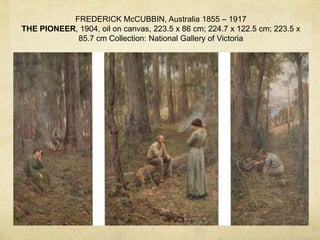
FREDERICK McCUBBIN, Australia 1855 – 1917
THE PIONEER, 1904, oil on canvas, 223.5 x 86 cm; 224.7 x 122.5 cm; 223.5 x
            85.7 cm Collection: National Gallery of Victoria
Frederick McCubbin, Lost,
 1886
oil on canvas
115.8 x
73.9 cm, 
National Gallery of
     Victoria, Melbourne
Tom Roberts (1856-1931) - 1888-1890, Shearing the Rams,
          (National Gallery of Victoria, Australia)
  Oil on canvas on composition board; 122.4 x 183.3 cm
Jane Sutherland, Field naturalists (c.1896)
oil on canvas, National Gallery of
            Victoria, Melbourne
Gift of Mrs E. H. Shackell, 1962
Jane Sutherland, The Mushroom Gatherers (c.1895)
41.8 x 99.3 cm, National
     Gallery of Victoria, Melbourne
Gift of Dr Margaret Sutherland, 1972
Jane Sutherland
Although Sutherland‟s work reflects the same interests
and qualities as that of her male colleagues, it has not
always been equally recognised or valued. Her paintings
sold for significantly less than those of her male
colleagues, and her work was not represented in public
collections until 1962 when a major work, Field
naturalists, c.1896, was given as a gift to the National
Gallery of Victoria. In 1972 another three Sutherland
paintings entered the collection as a gift from the artist‟s
niece. Around this time feminism caused a surge of
interest in the work of women, and new
research, exhibitions and publications recognised and
celebrated the achievements of women artists, including
artists of the past, such as Sutherland.
Heidelberg artistsppt

Heidelberg artistsppt

  • 1.
  • 2.
    The Heidelberg School The Heidelberg School was the first significant art movement in Australia. The name originated in July 1891, when art critic, Sidney Dickinson wrote a review of the exhibitions of Walter Withers and Arthur Streeton. These artists and others are members of the “HEIDELBERG SCHOOL” for their work has been done mainly in this attractive suburb. The paintings, which are all selected from the region around Heidelberg, have a high appreciation of colour. It would be quite impossible to find, in any part of the world, more striking effects than are found ready to the artist‟s hand in the Australian landscape at certain seasons of the year. Since the time of the Sidney Dickinson article, the term „Heidelberg School‟ has taken on a broader meaning, and there are now numerous and diverse publications on the subject. The term is no longer restricted to those artists who painted in the Heidelberg area, but is used to cover the Australian artists of the late Nineteenth Century who worked ‘plein air’ at a number of popular painting sites. In the 1880‟s and 1890‟s, significant ‘plein air’ painting sites included the Gardiners Creek area of Box Hill, the foreshore area of Port Phillip Bay, particularly between Brighton and Mentone, and the sunlit valley of the Yarra River in the vicinity of Heidelberg, East Ivanhoe, Eaglemont and Templestowe. Later significant sites included Eltham, Warrandyte, Diamond Creek and areas of the Dandenong Ranges, such as Olinda and Kallista.
  • 3.
    Frederick McCubbin, Downon his Luck, 1889, oil on canvas, 145.0 x 183.3 x 14.0 cm (framed), State Art Collection, Art Gallery of Western Australia, Perth, Purchased, 1896
  • 4.
    FREDERICK McCUBBIN, Australia1855 – 1917 THE PIONEER, 1904, oil on canvas, 223.5 x 86 cm; 224.7 x 122.5 cm; 223.5 x 85.7 cm Collection: National Gallery of Victoria
  • 5.
    Frederick McCubbin, Lost, 1886
oil on canvas
115.8 x 73.9 cm, 
National Gallery of Victoria, Melbourne
  • 6.
    Tom Roberts (1856-1931)- 1888-1890, Shearing the Rams, (National Gallery of Victoria, Australia) Oil on canvas on composition board; 122.4 x 183.3 cm
  • 7.
    Jane Sutherland, Fieldnaturalists (c.1896)
oil on canvas, National Gallery of Victoria, Melbourne
Gift of Mrs E. H. Shackell, 1962
  • 8.
    Jane Sutherland, TheMushroom Gatherers (c.1895)
41.8 x 99.3 cm, National Gallery of Victoria, Melbourne
Gift of Dr Margaret Sutherland, 1972
  • 9.
    Jane Sutherland Although Sutherland‟swork reflects the same interests and qualities as that of her male colleagues, it has not always been equally recognised or valued. Her paintings sold for significantly less than those of her male colleagues, and her work was not represented in public collections until 1962 when a major work, Field naturalists, c.1896, was given as a gift to the National Gallery of Victoria. In 1972 another three Sutherland paintings entered the collection as a gift from the artist‟s niece. Around this time feminism caused a surge of interest in the work of women, and new research, exhibitions and publications recognised and celebrated the achievements of women artists, including artists of the past, such as Sutherland.