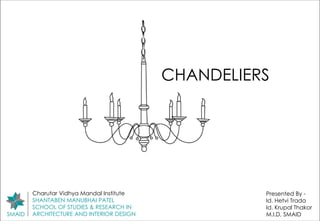


CHANDELIERS
Presented By -
Id. Hetvi Trada
Id. Krupal Thakor
M.I.D, SMAID
SMAID
Charutar Vidhya Mandal Institute
SHANTABEN MANUBHAI PATEL
SCHOOL OF STUDIES & RESEARCH IN
ARCHITECTURE AND INTERIOR DESIGN
OUTLINE
― DEFINIITION
― HISTORY
― MEDIEVAL AGES
― EARLY AMERICANS
― 17TH CENTURY EUROPEAN
― REGENCY AND VICTORIAN
― 20TH CENTURY EUROPEANS
― MID MODERN CENTURY
― TYPES OF CHANDELIERS
― CHANDELIERS BY LIGHT FUNCTIONING
― THINGS TO CONSIDER WHILE CHOOSING CHANDELIERS
― GENERAL RULES THAT APPLY TO MOST SPACES
― REFERENCES.
― A decorative, sometimes ornate, light fixture suspended from a ceiling, usually having branched supports for
a number of lights.
▌ WHAT IS CHANDILIER
▌ BRIEF HISTORY OF CHANDELIERS
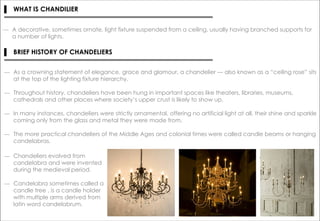
― As a crowning statement of elegance, grace and glamour, a chandelier — also known as a “ceiling rose” sits
at the top of the lighting fixture hierarchy.
― Throughout history, chandeliers have been hung in important spaces like theaters, libraries, museums,
cathedrals and other places where society’s upper crust is likely to show up.
― In many instances, chandeliers were strictly ornamental, offering no artificial light at all, their shine and sparkle
coming only from the glass and metal they were made from.
― The more practical chandeliers of the Middle Ages and colonial times were called candle beams or hanging
candelabras.
― Chandeliers evolved from
candelabra and were invented
during the medieval period.
― Candelabra sometimes called a
candle tree , is a candle holder
with multiple arms derived from
latin word candelabrum.
▌ MEDIEVAL AGES
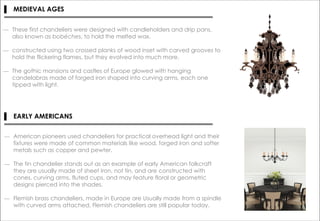
― These first chandeliers were designed with candleholders and drip pans,
also known as bobéches, to hold the melted wax.
― constructed using two crossed planks of wood inset with carved grooves to
hold the flickering flames, but they evolved into much more.
― The gothic mansions and castles of Europe glowed with hanging
candelabras made of forged iron shaped into curving arms, each one
tipped with light.
▌ EARLY AMERICANS
― American pioneers used chandeliers for practical overhead light and their
fixtures were made of common materials like wood, forged iron and softer
metals such as copper and pewter.
― The tin chandelier stands out as an example of early American folkcraft
they are usually made of sheet iron, not tin, and are constructed with
cones, curving arms, fluted cups, and may feature floral or geometric
designs pierced into the shades.
― Flemish brass chandeliers, made in Europe are Usually made from a spindle
with curved arms attached, Flemish chandeliers are still popular today.
▌ 17th CENTURY EUROPEANS
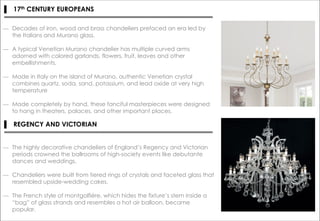
― Decades of iron, wood and brass chandeliers prefaced an era led by
the Italians and Murano glass.
― A typical Venetian Murano chandelier has multiple curved arms
adorned with colored garlands, flowers, fruit, leaves and other
embellishments.
― Made in Italy on the island of Murano, authentic Venetian crystal
combines quartz, soda, sand, potassium, and lead oxide at very high
temperature
― Made completely by hand, these fanciful masterpieces were designed
to hang in theaters, palaces, and other important places.
▌ REGENCY AND VICTORIAN
― The highly decorative chandeliers of England’s Regency and Victorian
periods crowned the ballrooms of high-society events like debutante
dances and weddings.
― Chandeliers were built from tiered rings of crystals and faceted glass that
resembled upside-wedding cakes.
― The French style of montgolfiére, which hides the fixture’s stem inside a
“bag” of glass strands and resembles a hot air balloon, became
popular.
▌ 20th CENTURY EUROPEANS
― Another important development during the 17- and 18th century was the introduction of gas lights. By the
end of the 19th century, both gas and electric lights were used in chandeliers, making them brighter than
ever before.
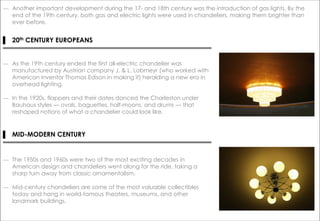
― As the 19th century ended the first all-electric chandelier was
manufactured by Austrian company J. & L. Lobmeyr (who worked with
American inventor Thomas Edison in making it) heralding a new era in
overhead lighting.
― In the 1920s, flappers and their dates danced the Charleston under
Bauhaus styles — ovals, baguettes, half-moons, and drums — that
reshaped notions of what a chandelier could look like.
▌ MID-MODERN CENTURY
― The 1950s and 1960s were two of the most exciting decades in
American design and chandeliers went along for the ride, taking a
sharp turn away from classic ornamentalism.
― Mid-century chandeliers are some of the most valuable collectibles
today and hang in world-famous theaters, museums, and other
landmark buildings.
▌ TYPES OF CHANDELIERS
― They have at least five extensions, each with its own candle-like light at the
end.
― This is suited for those favoring a more rustic style.
― they use lights in the shape of candles, which gives the signature look
without any of the risk or mess of actual candles.
― a slight change of pace by placing lampshades on the candles, giving a
more modern look to the signature piece
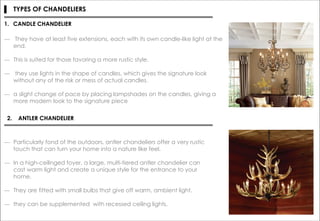
1. CANDLE CHANDELIER
2. ANTLER CHANDELIER
― Particularly fond of the outdoors, antler chandeliers offer a very rustic
touch that can turn your home into a nature like feel.
― In a high-ceilinged foyer, a large, multi-tiered antler chandelier can
cast warm light and create a unique style for the entrance to your
home.
― They are fitted with small bulbs that give off warm, ambient light.
― they can be supplemented with recessed ceiling lights.
― The finest crystal in the world.
― Made from a combination of quartz, sand and minerals.
― Available in a wide range of colors, sizes and shapes
― Machine cut and then machine polished to achieve perfect optic clarity,
razor sharp faceting and unique purity and brilliance.
― An invisible optical coating is then applied making it easier to clean and
maintain.
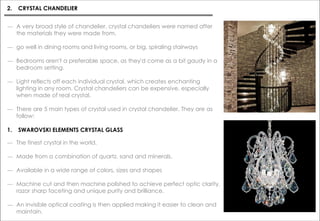
2. CRYSTAL CHANDELIER
― A very broad style of chandelier, crystal chandeliers were named after
the materials they were made from.
― go well in dining rooms and living rooms, or big, spiraling stairways
― Bedrooms aren't a preferable space, as they'd come as a bit gaudy in a
bedroom setting.
― Light reflects off each individual crystal, which creates enchanting
lighting in any room. Crystal chandeliers can be expensive, especially
when made of real crystal.
― There are 5 main types of crystal used in crystal chandelier. They are as
follow:
1. SWAROVSKI ELEMENTS CRYSTAL GLASS
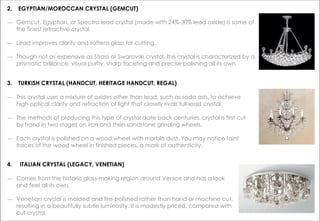
2. EGYPTIAN/MOROCCAN CRYSTAL (GEMCUT)
― Gemcut, Egyptian, or Spectra lead crystal (made with 24%-30% lead oxide) is some of
the finest refractive crystal.
― Lead improves clarity and softens glass for cutting.
― Though not as expensive as Strass or Swarovski crystal, this crystal is characterized by a
prismatic brilliance, visual purity, sharp faceting and precise polishing all its own
3. TURKISH CRYSTAL (HANDCUT, HERITAGE HANDCUT, REGAL)
― This crystal uses a mixture of oxides other than lead, such as soda ash, to achieve
high optical clarity and refraction of light that closely rivals full-lead crystal.
― The methods of producing this type of crystal date back centuries. crystal is first cut
by hand in two stages on iron and then sandstone grinding wheels.
― Each crystal is polished on a wood wheel with marble dust. You may notice faint
traces of the wood wheel in finished pieces, a mark of authenticity.
4. ITALIAN CRYSTAL (LEGACY, VENETIAN)
― Comes from the historic glass-making region around Venice and has a look
and feel all its own.
― Venetian crystal is molded and fire-polished rather than hand or machine cut,
resulting in a beautifully subtle luminosity. It is modestly priced, compared with
cut crystal.
5. PRESSED GLASS OR CHINESE CRYSTAL
― Generally made from sand, soda, and lime heated in furnace and then pressed
(molded), or “drawn” (re-shaped).
― This type of glass is the least expensive.
― Chinese crystal is cut and polished like more expensive grades, but lacks the high
optic quality and precision facets.
― Seams are usually visible in pressed glass lamps and prisms.
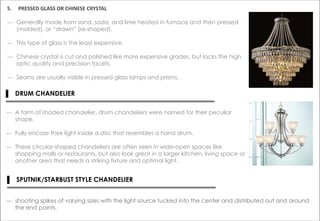
▌ DRUM CHANDELIER
― A form of shaded chandelier, drum chandeliers were named for their peculiar
shape.
― Fully encase their light inside a disc that resembles a hand drum.
― These circular-shaped chandeliers are often seen in wide-open spaces like
shopping malls or restaurants, but also look great in a larger kitchen, living space or
another area that needs a striking fixture and optimal light.
▌ SPUTNIK/STARBUST STYLE CHANDELIER
― shooting spikes of varying sizes with the light source tucked into the center and distributed out and around
the end points.
― The star-like quality of these chandeliers make them perfect for offices, lounge
spaces and entry points of your home.
― They’re great conversation pieces, so hang one near the front door for your
guests to admire as they arrive for a night of card-playing and conversation.
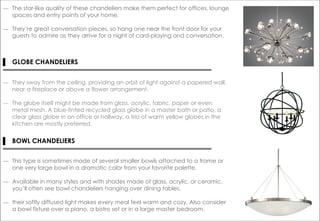
▌ GLOBE CHANDELIERS
― They sway from the ceiling, providing an orbit of light against a papered wall,
near a fireplace or above a flower arrangement.
― The globe itself might be made from glass, acrylic, fabric, paper or even
metal mesh. A blue-tinted recycled glass globe in a master bath or patio, a
clear glass globe in an office or hallway, a trio of warm yellow globes in the
kitchen are mostly preferred.
― This type is sometimes made of several smaller bowls attached to a frame or
one very large bowl in a dramatic color from your favorite palette.
― Available in many styles and with shades made of glass, acrylic, or ceramic,
you’ll often see bowl chandeliers hanging over dining tables.
― their softly diffused light makes every meal feel warm and cozy. Also consider
a bowl fixture over a piano, a bistro set or in a large master bedroom.
▌ BOWL CHANDELIERS
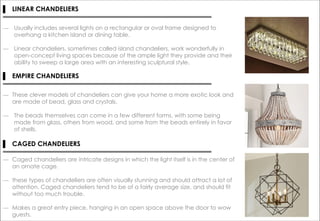
▌ LINEAR CHANDELIERS
― Usually includes several lights on a rectangular or oval frame designed to
overhang a kitchen island or dining table.
― Linear chandeliers, sometimes called island chandeliers, work wonderfully in
open-concept living spaces because of the ample light they provide and their
ability to sweep a large area with an interesting sculptural style.
▌ EMPIRE CHANDELIERS
― These clever models of chandeliers can give your home a more exotic look and
are made of bead, glass and crystals.
― The beads themselves can come in a few different forms, with some being
made from glass, others from wood, and some from the beads entirely in favor
of shells.
― Caged chandeliers are intricate designs in which the light itself is in the center of
an ornate cage.
― these types of chandeliers are often visually stunning and should attract a lot of
attention. Caged chandeliers tend to be of a fairly average size, and should fit
without too much trouble.
― Makes a great entry piece, hanging in an open space above the door to wow
guests.
▌ CAGED CHANDELIERS
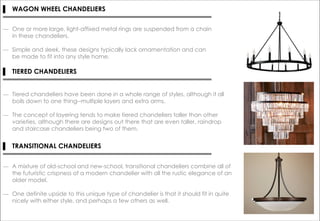
▌ WAGON WHEEL CHANDELIERS
― One or more large, light-affixed metal rings are suspended from a chain
in these chandeliers.
― Simple and sleek, these designs typically lack ornamentation and can
be made to fit into any style home.
▌ TIERED CHANDELIERS
― Tiered chandeliers have been done in a whole range of styles, although it all
boils down to one thing--multiple layers and extra arms.
― The concept of layering tends to make tiered chandeliers taller than other
varieties, although there are designs out there that are even taller, raindrop
and staircase chandeliers being two of them.
▌ TRANSITIONAL CHANDELIERS
― A mixture of old-school and new-school, transitional chandeliers combine all of
the futuristic crispness of a modern chandelier with all the rustic elegance of an
older model.
― One definite upside to this unique type of chandelier is that it should fit in quite
nicely with either style, and perhaps a few others as well.
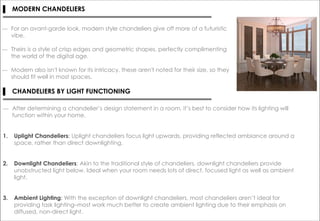
― For an avant-garde look, modern style chandeliers give off more of a futuristic
vibe.
― Theirs is a style of crisp edges and geometric shapes, perfectly complimenting
the world of the digital age.
― Modern also isn't known for its intricacy, these aren't noted for their size, so they
should fit well in most spaces.
▌ MODERN CHANDELIERS
▌ CHANDELIERS BY LIGHT FUNCTIONING
― After determining a chandelier’s design statement in a room, it’s best to consider how its lighting will
function within your home.
1. Uplight Chandeliers: Uplight chandeliers focus light upwards, providing reflected ambiance around a
space, rather than direct downlighting.
2. Downlight Chandeliers: Akin to the traditional style of chandeliers, downlight chandeliers provide
unobstructed light below. Ideal when your room needs lots of direct, focused light as well as ambient
light.
3. Ambient Lighting: With the exception of downlight chandeliers, most chandeliers aren’t ideal for
providing task lighting–most work much better to create ambient lighting due to their emphasis on
diffused, non-direct light.
▌ THINGS TO CONSIDER WHILE CHOOSING CHANDELIERS
1. POSITIONING A CHANDELIER : In an interior space, the position of the chandelier should be as centered as
possible. Here are three reasons why:
1. Aesthetic: A well-designed chandelier is admirable from all angles. Placing the chandelier in a central
position gives you a 360-degree view to admire all the beautiful elements.
2. General Light: Artificial ambient light is more evenly distributed from a centered position.
3. Symmetry: As most likely the only suspended object, a chandelier is best put in a central location for visual
balance.
2. INSTALLATION HEIGHT
― In a dining room, a chandelier should hang approximately 30 inches above a dining table surface so people
seated around it can see each other and won’t get glare in their eyes.
― If you have a high ceiling (9 feet or higher), add about 3 inches for each additional foot of ceiling height.
― In other rooms, you should always consider such line of sight and safe clearance when installing a chandelier.
After all, a light fixture is much less appealing if it blocks your view or if you keep hitting your head on it.
3. CHANDELIER BRIGHTNESS
― The ideal lumen count for ambient lighting in a dining room–or any room–is determined by the space’s
square footage. Per 100 square feet, a dining room needs about 300-400 total lumens.
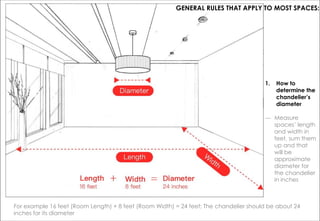
For example 16 feet (Room Length) + 8 feet (Room Width) = 24 feet; The chandelier should be about 24
inches for its diameter
1. How to
determine the
chandelier’s
diameter
― Measure
spaces’ length
and width in
feet, sum them
up and that
will be
approximate
diameter for
the chandelier
in inches
GENERAL RULES THAT APPLY TO MOST SPACES:
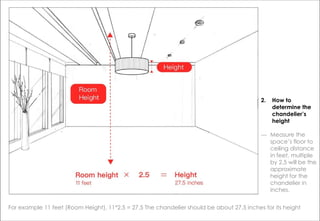
2. How to
determine the
chandelier’s
height
― Measure the
space’s floor to
ceiling distance
in feet, multiple
by 2.5 will be the
approximate
height for the
chandelier in
inches.
For example 11 feet (Room Height), 11*2.5 = 27.5 The chandelier should be about 27.5 inches for its height
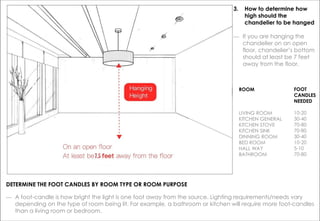
3. How to determine how
high should the
chandelier to be hanged
― If you are hanging the
chandelier on an open
floor, chandelier’s bottom
should at least be 7 feet
away from the floor.
DETERMINE THE FOOT CANDLES BY ROOM TYPE OR ROOM PURPOSE
― A foot-candle is how bright the light is one foot away from the source. Lighting requirements/needs vary
depending on the type of room being lit. For example, a bathroom or kitchen will require more foot-candles
than a living room or bedroom.
ROOM
LIVING ROOM
KITCHEN GENERAL
KITCHEN STOVE
KITCHEN SINK
DINNING ROOM
BED ROOM
HALL WAY
BATHROOM
FOOT
CANDLES
NEEDED
10-20
30-40
70-80
70-80
30-40
10-20
5-10
70-80
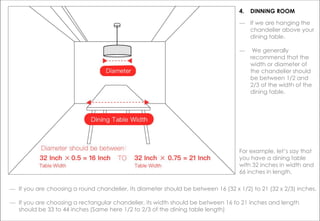
― If we are hanging the
chandelier above your
dining table.
― We generally
recommend that the
width or diameter of
the chandelier should
be between 1/2 and
2/3 of the width of the
dining table.
― If you are choosing a round chandelier, its diameter should be between 16 (32 x 1/2) to 21 (32 x 2/3) inches.
― If you are choosing a rectangular chandelier, its width should be between 16 to 21 inches and length
should be 33 to 44 inches (Same here 1/2 to 2/3 of the dining table length)
For example, let’s say that
you have a dining table
with 32 inches in width and
66 inches in length.
4. DINNING ROOM
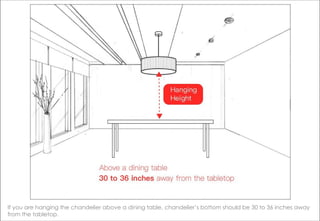
If you are hanging the chandelier above a dining table, chandelier’s bottom should be 30 to 36 inches away
from the tabletop.
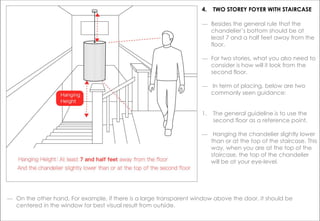
― Besides the general rule that the
chandelier’s bottom should be at
least 7 and a half feet away from the
floor.
― For two stories, what you also need to
consider is how will it look from the
second floor.
― In term of placing, below are two
commonly seen guidance:
1. The general guideline is to use the
second floor as a reference point.
― Hanging the chandelier slightly lower
than or at the top of the staircase. This
way, when you are at the top of the
staircase, the top of the chandelier
will be at your eye-level.
― On the other hand, For example, if there is a large transparent window above the door, it should be
centered in the window for best visual result from outside.
4. TWO STOREY FOYER WITH STAIRCASE
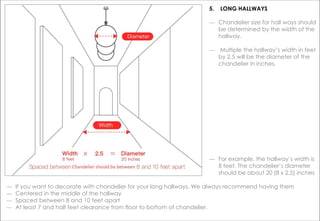
― Chandelier size for hall ways should
be determined by the width of the
hallway.
― Multiple the hallway’s width in feet
by 2.5 will be the diameter of the
chandelier in inches.
― If you want to decorate with chandelier for your long hallways. We always recommend having them
― Centered in the middle of the hallway
― Spaced between 8 and 10 feet apart
― At least 7 and half feet clearance from floor to bottom of chandelier.
5. LONG HALLWAYS
― For example, the hallway’s width is
8 feet. The chandelier’s diameter
should be about 20 (8 x 2.5) inches
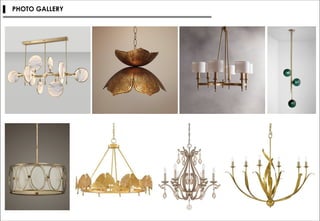
▌ PHOTO GALLERY
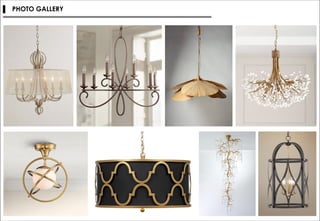
▌ PHOTO GALLERY
https://www.dictionary.com/browse/chandelier
http://www.bellacor.com/blog/a-brief-history-of-chandeliers
https://www.lampsplus.com/ideas-and-advice/crystal-
glass/#:~:text=Modern%20chandeliers%20and%20ceiling%20fixtures,of%20lighting%20simply%20c
annot%20reproduce.
https://www.shadesoflight.com/blog_entries/types-of-crystal
https://www.sofary.com/blogs/chandeliers/ultimate-guide-to-different-types-of-chandeliers
https://www.wayfair.com/sca/ideas-and-advice/guides/types-of-chandeliers-T1296
https://www.bellacor.com/types-of-chandeliers.htm
https://www.ylighting.com/blog/how-to-choose-a-modern-chandelier/
https://www.maximlighting.com/how-much-light
https://www.sofary.com/blogs/chandeliers/chandelier-size-guide
▌ REFERENCES
THANK YOU

Chandeliers

  • 1.
    CHANDELIERS Presented By - Id.Hetvi Trada Id. Krupal Thakor M.I.D, SMAID SMAID Charutar Vidhya Mandal Institute SHANTABEN MANUBHAI PATEL SCHOOL OF STUDIES & RESEARCH IN ARCHITECTURE AND INTERIOR DESIGN
  • 2.
    OUTLINE ― DEFINIITION ― HISTORY ―MEDIEVAL AGES ― EARLY AMERICANS ― 17TH CENTURY EUROPEAN ― REGENCY AND VICTORIAN ― 20TH CENTURY EUROPEANS ― MID MODERN CENTURY ― TYPES OF CHANDELIERS ― CHANDELIERS BY LIGHT FUNCTIONING ― THINGS TO CONSIDER WHILE CHOOSING CHANDELIERS ― GENERAL RULES THAT APPLY TO MOST SPACES ― REFERENCES.
  • 3.
    ― A decorative,sometimes ornate, light fixture suspended from a ceiling, usually having branched supports for a number of lights. ▌ WHAT IS CHANDILIER ▌ BRIEF HISTORY OF CHANDELIERS ― As a crowning statement of elegance, grace and glamour, a chandelier — also known as a “ceiling rose” sits at the top of the lighting fixture hierarchy. ― Throughout history, chandeliers have been hung in important spaces like theaters, libraries, museums, cathedrals and other places where society’s upper crust is likely to show up. ― In many instances, chandeliers were strictly ornamental, offering no artificial light at all, their shine and sparkle coming only from the glass and metal they were made from. ― The more practical chandeliers of the Middle Ages and colonial times were called candle beams or hanging candelabras. ― Chandeliers evolved from candelabra and were invented during the medieval period. ― Candelabra sometimes called a candle tree , is a candle holder with multiple arms derived from latin word candelabrum.
  • 4.
    ▌ MEDIEVAL AGES ―These first chandeliers were designed with candleholders and drip pans, also known as bobéches, to hold the melted wax. ― constructed using two crossed planks of wood inset with carved grooves to hold the flickering flames, but they evolved into much more. ― The gothic mansions and castles of Europe glowed with hanging candelabras made of forged iron shaped into curving arms, each one tipped with light. ▌ EARLY AMERICANS ― American pioneers used chandeliers for practical overhead light and their fixtures were made of common materials like wood, forged iron and softer metals such as copper and pewter. ― The tin chandelier stands out as an example of early American folkcraft they are usually made of sheet iron, not tin, and are constructed with cones, curving arms, fluted cups, and may feature floral or geometric designs pierced into the shades. ― Flemish brass chandeliers, made in Europe are Usually made from a spindle with curved arms attached, Flemish chandeliers are still popular today.
  • 5.
    ▌ 17th CENTURYEUROPEANS ― Decades of iron, wood and brass chandeliers prefaced an era led by the Italians and Murano glass. ― A typical Venetian Murano chandelier has multiple curved arms adorned with colored garlands, flowers, fruit, leaves and other embellishments. ― Made in Italy on the island of Murano, authentic Venetian crystal combines quartz, soda, sand, potassium, and lead oxide at very high temperature ― Made completely by hand, these fanciful masterpieces were designed to hang in theaters, palaces, and other important places. ▌ REGENCY AND VICTORIAN ― The highly decorative chandeliers of England’s Regency and Victorian periods crowned the ballrooms of high-society events like debutante dances and weddings. ― Chandeliers were built from tiered rings of crystals and faceted glass that resembled upside-wedding cakes. ― The French style of montgolfiére, which hides the fixture’s stem inside a “bag” of glass strands and resembles a hot air balloon, became popular.
  • 6.
    ▌ 20th CENTURYEUROPEANS ― Another important development during the 17- and 18th century was the introduction of gas lights. By the end of the 19th century, both gas and electric lights were used in chandeliers, making them brighter than ever before. ― As the 19th century ended the first all-electric chandelier was manufactured by Austrian company J. & L. Lobmeyr (who worked with American inventor Thomas Edison in making it) heralding a new era in overhead lighting. ― In the 1920s, flappers and their dates danced the Charleston under Bauhaus styles — ovals, baguettes, half-moons, and drums — that reshaped notions of what a chandelier could look like. ▌ MID-MODERN CENTURY ― The 1950s and 1960s were two of the most exciting decades in American design and chandeliers went along for the ride, taking a sharp turn away from classic ornamentalism. ― Mid-century chandeliers are some of the most valuable collectibles today and hang in world-famous theaters, museums, and other landmark buildings.
  • 7.
    ▌ TYPES OFCHANDELIERS ― They have at least five extensions, each with its own candle-like light at the end. ― This is suited for those favoring a more rustic style. ― they use lights in the shape of candles, which gives the signature look without any of the risk or mess of actual candles. ― a slight change of pace by placing lampshades on the candles, giving a more modern look to the signature piece 1. CANDLE CHANDELIER 2. ANTLER CHANDELIER ― Particularly fond of the outdoors, antler chandeliers offer a very rustic touch that can turn your home into a nature like feel. ― In a high-ceilinged foyer, a large, multi-tiered antler chandelier can cast warm light and create a unique style for the entrance to your home. ― They are fitted with small bulbs that give off warm, ambient light. ― they can be supplemented with recessed ceiling lights.
  • 8.
    ― The finestcrystal in the world. ― Made from a combination of quartz, sand and minerals. ― Available in a wide range of colors, sizes and shapes ― Machine cut and then machine polished to achieve perfect optic clarity, razor sharp faceting and unique purity and brilliance. ― An invisible optical coating is then applied making it easier to clean and maintain. 2. CRYSTAL CHANDELIER ― A very broad style of chandelier, crystal chandeliers were named after the materials they were made from. ― go well in dining rooms and living rooms, or big, spiraling stairways ― Bedrooms aren't a preferable space, as they'd come as a bit gaudy in a bedroom setting. ― Light reflects off each individual crystal, which creates enchanting lighting in any room. Crystal chandeliers can be expensive, especially when made of real crystal. ― There are 5 main types of crystal used in crystal chandelier. They are as follow: 1. SWAROVSKI ELEMENTS CRYSTAL GLASS
  • 9.
    2. EGYPTIAN/MOROCCAN CRYSTAL(GEMCUT) ― Gemcut, Egyptian, or Spectra lead crystal (made with 24%-30% lead oxide) is some of the finest refractive crystal. ― Lead improves clarity and softens glass for cutting. ― Though not as expensive as Strass or Swarovski crystal, this crystal is characterized by a prismatic brilliance, visual purity, sharp faceting and precise polishing all its own 3. TURKISH CRYSTAL (HANDCUT, HERITAGE HANDCUT, REGAL) ― This crystal uses a mixture of oxides other than lead, such as soda ash, to achieve high optical clarity and refraction of light that closely rivals full-lead crystal. ― The methods of producing this type of crystal date back centuries. crystal is first cut by hand in two stages on iron and then sandstone grinding wheels. ― Each crystal is polished on a wood wheel with marble dust. You may notice faint traces of the wood wheel in finished pieces, a mark of authenticity. 4. ITALIAN CRYSTAL (LEGACY, VENETIAN) ― Comes from the historic glass-making region around Venice and has a look and feel all its own. ― Venetian crystal is molded and fire-polished rather than hand or machine cut, resulting in a beautifully subtle luminosity. It is modestly priced, compared with cut crystal.
  • 10.
    5. PRESSED GLASSOR CHINESE CRYSTAL ― Generally made from sand, soda, and lime heated in furnace and then pressed (molded), or “drawn” (re-shaped). ― This type of glass is the least expensive. ― Chinese crystal is cut and polished like more expensive grades, but lacks the high optic quality and precision facets. ― Seams are usually visible in pressed glass lamps and prisms. ▌ DRUM CHANDELIER ― A form of shaded chandelier, drum chandeliers were named for their peculiar shape. ― Fully encase their light inside a disc that resembles a hand drum. ― These circular-shaped chandeliers are often seen in wide-open spaces like shopping malls or restaurants, but also look great in a larger kitchen, living space or another area that needs a striking fixture and optimal light. ▌ SPUTNIK/STARBUST STYLE CHANDELIER ― shooting spikes of varying sizes with the light source tucked into the center and distributed out and around the end points.
  • 11.
    ― The star-likequality of these chandeliers make them perfect for offices, lounge spaces and entry points of your home. ― They’re great conversation pieces, so hang one near the front door for your guests to admire as they arrive for a night of card-playing and conversation. ▌ GLOBE CHANDELIERS ― They sway from the ceiling, providing an orbit of light against a papered wall, near a fireplace or above a flower arrangement. ― The globe itself might be made from glass, acrylic, fabric, paper or even metal mesh. A blue-tinted recycled glass globe in a master bath or patio, a clear glass globe in an office or hallway, a trio of warm yellow globes in the kitchen are mostly preferred. ― This type is sometimes made of several smaller bowls attached to a frame or one very large bowl in a dramatic color from your favorite palette. ― Available in many styles and with shades made of glass, acrylic, or ceramic, you’ll often see bowl chandeliers hanging over dining tables. ― their softly diffused light makes every meal feel warm and cozy. Also consider a bowl fixture over a piano, a bistro set or in a large master bedroom. ▌ BOWL CHANDELIERS
  • 12.
    ▌ LINEAR CHANDELIERS ―Usually includes several lights on a rectangular or oval frame designed to overhang a kitchen island or dining table. ― Linear chandeliers, sometimes called island chandeliers, work wonderfully in open-concept living spaces because of the ample light they provide and their ability to sweep a large area with an interesting sculptural style. ▌ EMPIRE CHANDELIERS ― These clever models of chandeliers can give your home a more exotic look and are made of bead, glass and crystals. ― The beads themselves can come in a few different forms, with some being made from glass, others from wood, and some from the beads entirely in favor of shells. ― Caged chandeliers are intricate designs in which the light itself is in the center of an ornate cage. ― these types of chandeliers are often visually stunning and should attract a lot of attention. Caged chandeliers tend to be of a fairly average size, and should fit without too much trouble. ― Makes a great entry piece, hanging in an open space above the door to wow guests. ▌ CAGED CHANDELIERS
  • 13.
    ▌ WAGON WHEELCHANDELIERS ― One or more large, light-affixed metal rings are suspended from a chain in these chandeliers. ― Simple and sleek, these designs typically lack ornamentation and can be made to fit into any style home. ▌ TIERED CHANDELIERS ― Tiered chandeliers have been done in a whole range of styles, although it all boils down to one thing--multiple layers and extra arms. ― The concept of layering tends to make tiered chandeliers taller than other varieties, although there are designs out there that are even taller, raindrop and staircase chandeliers being two of them. ▌ TRANSITIONAL CHANDELIERS ― A mixture of old-school and new-school, transitional chandeliers combine all of the futuristic crispness of a modern chandelier with all the rustic elegance of an older model. ― One definite upside to this unique type of chandelier is that it should fit in quite nicely with either style, and perhaps a few others as well.
  • 14.
    ― For anavant-garde look, modern style chandeliers give off more of a futuristic vibe. ― Theirs is a style of crisp edges and geometric shapes, perfectly complimenting the world of the digital age. ― Modern also isn't known for its intricacy, these aren't noted for their size, so they should fit well in most spaces. ▌ MODERN CHANDELIERS ▌ CHANDELIERS BY LIGHT FUNCTIONING ― After determining a chandelier’s design statement in a room, it’s best to consider how its lighting will function within your home. 1. Uplight Chandeliers: Uplight chandeliers focus light upwards, providing reflected ambiance around a space, rather than direct downlighting. 2. Downlight Chandeliers: Akin to the traditional style of chandeliers, downlight chandeliers provide unobstructed light below. Ideal when your room needs lots of direct, focused light as well as ambient light. 3. Ambient Lighting: With the exception of downlight chandeliers, most chandeliers aren’t ideal for providing task lighting–most work much better to create ambient lighting due to their emphasis on diffused, non-direct light.
  • 15.
    ▌ THINGS TOCONSIDER WHILE CHOOSING CHANDELIERS 1. POSITIONING A CHANDELIER : In an interior space, the position of the chandelier should be as centered as possible. Here are three reasons why: 1. Aesthetic: A well-designed chandelier is admirable from all angles. Placing the chandelier in a central position gives you a 360-degree view to admire all the beautiful elements. 2. General Light: Artificial ambient light is more evenly distributed from a centered position. 3. Symmetry: As most likely the only suspended object, a chandelier is best put in a central location for visual balance. 2. INSTALLATION HEIGHT ― In a dining room, a chandelier should hang approximately 30 inches above a dining table surface so people seated around it can see each other and won’t get glare in their eyes. ― If you have a high ceiling (9 feet or higher), add about 3 inches for each additional foot of ceiling height. ― In other rooms, you should always consider such line of sight and safe clearance when installing a chandelier. After all, a light fixture is much less appealing if it blocks your view or if you keep hitting your head on it. 3. CHANDELIER BRIGHTNESS ― The ideal lumen count for ambient lighting in a dining room–or any room–is determined by the space’s square footage. Per 100 square feet, a dining room needs about 300-400 total lumens.
  • 16.
    For example 16feet (Room Length) + 8 feet (Room Width) = 24 feet; The chandelier should be about 24 inches for its diameter 1. How to determine the chandelier’s diameter ― Measure spaces’ length and width in feet, sum them up and that will be approximate diameter for the chandelier in inches GENERAL RULES THAT APPLY TO MOST SPACES:
  • 17.
    2. How to determinethe chandelier’s height ― Measure the space’s floor to ceiling distance in feet, multiple by 2.5 will be the approximate height for the chandelier in inches. For example 11 feet (Room Height), 11*2.5 = 27.5 The chandelier should be about 27.5 inches for its height
  • 18.
    3. How todetermine how high should the chandelier to be hanged ― If you are hanging the chandelier on an open floor, chandelier’s bottom should at least be 7 feet away from the floor. DETERMINE THE FOOT CANDLES BY ROOM TYPE OR ROOM PURPOSE ― A foot-candle is how bright the light is one foot away from the source. Lighting requirements/needs vary depending on the type of room being lit. For example, a bathroom or kitchen will require more foot-candles than a living room or bedroom. ROOM LIVING ROOM KITCHEN GENERAL KITCHEN STOVE KITCHEN SINK DINNING ROOM BED ROOM HALL WAY BATHROOM FOOT CANDLES NEEDED 10-20 30-40 70-80 70-80 30-40 10-20 5-10 70-80
  • 19.
    ― If weare hanging the chandelier above your dining table. ― We generally recommend that the width or diameter of the chandelier should be between 1/2 and 2/3 of the width of the dining table. ― If you are choosing a round chandelier, its diameter should be between 16 (32 x 1/2) to 21 (32 x 2/3) inches. ― If you are choosing a rectangular chandelier, its width should be between 16 to 21 inches and length should be 33 to 44 inches (Same here 1/2 to 2/3 of the dining table length) For example, let’s say that you have a dining table with 32 inches in width and 66 inches in length. 4. DINNING ROOM
  • 20.
    If you arehanging the chandelier above a dining table, chandelier’s bottom should be 30 to 36 inches away from the tabletop.
  • 21.
    ― Besides thegeneral rule that the chandelier’s bottom should be at least 7 and a half feet away from the floor. ― For two stories, what you also need to consider is how will it look from the second floor. ― In term of placing, below are two commonly seen guidance: 1. The general guideline is to use the second floor as a reference point. ― Hanging the chandelier slightly lower than or at the top of the staircase. This way, when you are at the top of the staircase, the top of the chandelier will be at your eye-level. ― On the other hand, For example, if there is a large transparent window above the door, it should be centered in the window for best visual result from outside. 4. TWO STOREY FOYER WITH STAIRCASE
  • 22.
    ― Chandelier sizefor hall ways should be determined by the width of the hallway. ― Multiple the hallway’s width in feet by 2.5 will be the diameter of the chandelier in inches. ― If you want to decorate with chandelier for your long hallways. We always recommend having them ― Centered in the middle of the hallway ― Spaced between 8 and 10 feet apart ― At least 7 and half feet clearance from floor to bottom of chandelier. 5. LONG HALLWAYS ― For example, the hallway’s width is 8 feet. The chandelier’s diameter should be about 20 (8 x 2.5) inches
  • 23.
  • 24.
  • 25.
  • 26.