Characterization of the virulence, growth temperature and antibiotic resistance
of the Campylobacter jejuni IAL 2383 strain isolated from humans
B.B. Fonseca1
, D.A. Rossi2
, C.A. Maia2
, P.C. Nalevaiko2
, R.T. Melo2
,
L.P. Cuccato1
, M.E. Beletti3
1
Faculdade de Medicina Veterinária, Universidade de Uberaba, Uberaba, MG, Brazil.
2
Laboratório de Biotecnologia Animal Aplicada, Universidade Federal de Uberlândia, Uberlândia, MG, Brazil.
3
Centro de Microscopia Eletrônica, Universidade Federal de Uberlândia, Uberlândia, MG, Brazil.
Submitted: July 10, 2012; Approved: April 1, 2013.
Abstract
The objective of this study was to characterize the C. jejuni IAL2383 strain isolated from humans in
Brazil. Transcripts for the racR, dnaJ and ciaB genes were found and flaA, plda and cadF genes were
present in the genome and bacteria was sensitive to most of the important antimicrobials used to treat
humans. C. jejuni IAL2383 is a good experimental model to analyze the interactions with cells.
Key words: virulence, experimental model, thermotolerance, Campylobacter jejuni.
Introduction
The diversity of Campylobacter jejuni reflects this
bacterium’s ability to colonize and cause disease. Variation
in the virulence factors of different strains has been ob-
served in in vitro and in vivo models, demonstrating differ-
ent strategies and consequent risks. An understanding of
the molecular basis of the virulence patterns of the strains
associated with disease and knowledge of the genetic diver-
sity among strains are of paramount importance in disease
control (Ahmed et al., 2002).
The C. jejuni-host cell interaction mechanisms are
not well understood, and there is great disagreement among
researchers. Some of the conflicting results may be ex-
plained by differences between strains, which have been re-
ported by some authors (Deun et al., 2008; Li et al., 2008).
The C. jejuni IAL2383 strain was isolated from humans
with clinical symptoms in Brazil and is maintained by the
Instituto Adolfo Lutz strains. This strain appears to be ideal
for understanding the pathogen-host interactions because
this strain causes symptoms in humans. However, the viru-
lence factors, degree of thermotolerance and resistance to
antibiotics of this strain have not been analyzed. The aim of
this study was to characterize the IAL2383 strain based on
the presence of certain genes, the expression of transcripts
for the major C. jejuni virulence factors, the growth temper-
ature and resistance to antibiotics.
Materials and Methods
This study used the C. jejuni strain IAL 2383, which
was isolated from a human outbreak and is maintained at
the Bank of the Instituto Adolfo Lutz, São Paulo (IAL). All
experiments were performed with bacteria from the first
expansion after receipt from the Bank.
The antibiotic resistance of the IAL2383 strain was
analyzed by the Kirby-Bauer disk diffusion method (Bauer
et al., 1966) using the protocol recommended by the Na-
tional Committee for Clinical Laboratory Standards. The
following antibiotics were tested: trimethoprim (5 mg),
cefoxitin (30 mg) ceftiofur (30 mg), neomycin (30 mg),
chloramphenicol (30 mg), trimethoprim-sulfamethoxazole
(23 mg), amoxicillin (10 mg), tetracycline (30 mg),
gentamicin (10 mg), nalidixic acid (30 mg), norfloxacin
(10 mg), enrofloxacin (5 mg), erythromycin (15 mg), and
sulfazotrim (300 mg). The assays were performed in tripli-
cate on Mueller Hinton agar (Difco) containing 5% horse
blood hemolysate. The plates were incubated at a tempera-
ture of 37 °C for 48 h in a microaerophilic atmosphere
(Probac Brazil).
To determine the optimum temperature for the
growth of C. jejuni IAL 2383. Nine serial dilutions were
performed. Aliquots of 0.1 mL of the 106
to 109
dilutions
were removed and placed on the surface of CCDA agar
(Oxoid) and spread using a Drigalski spatula. Each dilution
Brazilian Journal of Microbiology 45, 1, 271-274 (2014) Copyright © 2014, Sociedade Brasileira de Microbiologia
ISSN 1678-4405 www.sbmicrobiologia.org.br
Send correspondence to B.B. Fonseca. Faculdade de Medicina Veterinária, Universidade de Uberaba, Av. Nenê Sabino 1801, Bairro Universitário,
38055-500 Uberaba, MG, Brazil. E-mail: bialucas@yahoo.com.br.
Research Paper
was streaked in triplicate on plates that were then incubated
at temperatures of 37 and 41 °C in parallel. After 30 h of in-
cubation in a microaerophilic atmosphere, the bacteria
were quantified.
Primers described in the literature were used to deter-
mine if strain IAL2383 harbors the virulence genes cadF,
pldA (Zheng et al., 2006) and flaA (Hänel at al., 2004). C.
jejuni NCTC 11351 was used as a positive control strain.
The extraction of DNA was performed described by Guo et
al. (2000) and Borsoi et al. (2009) with modifications. The
final amplification reaction was composed of 20 ng of bac-
terial DNA and others reagent (Invitrogen) to PCR. The
microtubes were placed in a thermocycler (Eppendorf) and
subjected to annealing temperature at 45 °C. At the end of
the reaction, the amplified products were subjected to elec-
trophoresis and visualized with a UV transilluminator
(L.PIX Loccus Biotechnology).
Assays were performed to verify that the virulence
genes ciaB, dnaJ and racR were expressed in C. jejuni
IAL2383 (Li et al., 2008). To do this, we performed reverse
transcriptase (RT- PCR) and then conventional PCR. We
conducted a test with 3 types of bacteria: C. jejuni
IAL2383; C.coli isolated from chicken (expression of viru-
lence factors no know), and a virulent strain of C. jejuni
NCTC 11351 (positive control). All strains were incubated
at a temperature of 41 °C. In addition, to determine the
change in the levels of transcripts in the presence of euka-
ryotic cells, Caco-2 cells (derived from a human colon
adenocarcinoma) infected with 2.0 x 10⁷
CFU C. jejuni IAL
2383 were used. RNA was extracted using the Trizol Re-
agent ® method (Invitrogen). After RNA extraction, re-
verse transcription was used to synthesize the cDNA using
RNase inhibitor (Invitrogen), MMLV-RT (Amersham Bio-
sciences), MMLV-RT buffer (Amersham Biosciences),
200 mM dNTPs and 126 pmol of random hexamers as
primers at 37 °C for 1 hour. Control reactions were used to
verify the presence of exogenous contaminants. The final
volume of the amplification reaction included 3 mL of the
cDNA and PCR reagents (Invitrogen). The microtubes
were placed in a thermocycler (Eppendorf) and submitted
to annealing temperature 51 °C. At the end of the reaction,
the amplified products were subjected to electrophoresis on
agarose gels as performed for the presence of genes in the
bacterial genome as oversized above.
Results and Discussion
Our results indicate that the C. jejuni IAL 2383 strain
is susceptible to most antibiotics tested, the exceptions
were trimethoprim (5 mg) and cefoxitin (30 mg). Many
strains of C. jejuni exhibit multidrug resistance to antimi-
crobial agents (Jonker and Picard, 1999; Chen et al., 2011),
and the resistance of pathogenic Enterobacteriaceae to
fluoroquinolones and third-generation cephalosporins rep-
resents a major problem because of the possibility of
generating superbugs (Pignatari, 2011).
Regarding the various groups of antibiotics, the resis-
tance of Campylobacter to macrolides, fluoroquinolones,
beta-lactam, trimethoprim and sulphonamides has been
high in several studies, while resistance to other antimi-
crobials agents including tetracycline, aminoglycoside and
chloramphenicol is generally low (Aarestrup and Engberg,
2001; Yan et al., 2005). The sensitivity of this strain shows
that it can be used as a negative control strain for resistance
to most classes of antimicrobials or for the testing of the ac-
quisition of resistance.
The bacterium grew better at 41 °C, and the number
of colonies could be counted only after diluting by 108
or
more. At the temperature of 37 °C, the average growth was
8 x 10⁷
cfu (SD = 0.060), lower than the average of 2 x 10⁸
(SD = 0.242) at 41 °C.
C. jejuni IAL 2383 was found to harbor the virulence
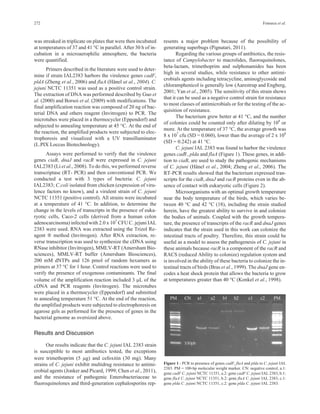
genes cadF, plda and flaA (Figure 1). These genes, in addi-
tion to ciaB, are used to study the pathogenic mechanisms
of C. jejuni (Hänel et al., 2004; Zheng et al., 2006). The
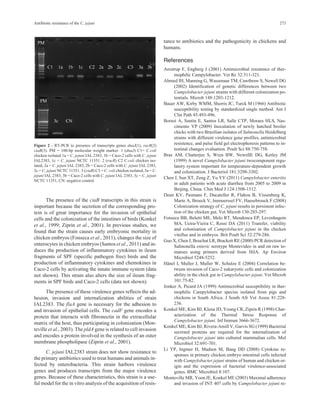
RT-PCR results showed that the bacterium expressed tran-
scripts for the ciaB, dnaJ and racR proteins even in the ab-
sence of contact with eukaryotic cells (Figure 2).
Microorganisms with an optimal growth temperature
near the body temperature of the birds, which varies be-
tween 40 °C and 42 °C (18), including the strain studied
herein, have the greatest ability to survive in and colonize
the bodies of animals. Coupled with the growth tempera-
ture, the presence of transcripts of the racR and dnaJ genes
indicates that the strain used in this work can colonize the
intestinal tracts of poultry. Therefore, this strain could be
useful as a model to assess the pathogenesis of C. jejuni in
these animals because racR is a component of the racR and
RACS (reduced Ability to colonize) regulation system and
is involved in the ability of these bacteria to colonize the in-
testinal tracts of birds (Bras et al., 1999). The dnaJ gene en-
codes a heat shock protein that allows the bacteria to grow
at temperatures greater than 40 °C (Konkel et al., 1998).
272 Fonseca et al.
Figure 1 - PCR to presence of genes cadF, flaA and plda to C. jejuni IAL
2383. PM = 100-bp molecular weight marker. CN: negative control, a.1:
gene cadF C. jejuni NCTC 11351, a.2: gene cadF C. jejuni IAL 2383, b.1:
gene flaA C. jejuni NCTC 11351, b.2: gene flaA C. jejuni IAL 2383, c.1:
gene plda C. jejuni NCTC 11351, c.2: gene plda C. jejuni IAL 2383.
The presence of the ciaB transcripts in this strain is
important because the secretion of the corresponding pro-
tein is of great importance for the invasion of epithelial
cells and the colonization of the intestines of birds (Konkel
et al., 1999; Ziprin et al., 2001). In previous studies, we
found that the strain causes early embryonic mortality in
chicken embryos (Fonseca et al., 2011), changes the size of
enterocytes in chicken embryos (Santos et al., 2011) and in-
duces the production of inflammatory cytokines in ileum
fragments of SPF (specific pathogen free) birds and the
production of inflammatory cytokines and chemokines in
Caco-2 cells by activating the innate immune system (data
not shown). This strain also alters the size of ileum frag-
ments in SPF birds and Caco-2 cells (data not shown).
The presence of these virulence genes reflects the ad-
hesion, invasion and internalization abilities of strain
IAL2383. The flaA gene is necessary for the adhesion to
and invasion of epithelial cells. The cadF gene encodes a
protein that interacts with fibronectin in the extracellular
matrix of the host, thus participating in colonization (Mon-
teville et al., 2003). The pldA gene is related to cell invasion
and encodes a protein involved in the synthesis of an outer
membrane phospholipase (Ziprin et al., 2001).
C. jejuni IAL2383 strain does not show resistance to
the primary antibiotics used to treat humans and animals in-
fected by enterobacteria. This strain harbors virulence
genes and produces transcripts from the major virulence
genes. Because of these characteristics, this strain is a use-
ful model for the in vitro analysis of the acquisition of resis-
tance to antibiotics and the pathogenicity in chickens and
humans.
References
Arestrup F, Engberg J (2001) Antimicrobial resistence of ther-
mophilic Campylobacter. Vet Re 32:311-321.
Ahmed IH, Manning G, Wassenaar TM, Cawthraw S, Newell DG
(2002) Identification of genetic differences between two
Campylobacter jejuni strains with different colonization po-
tentials. Microb 148:1203-1212.
Bauer AW, Kirby WMM, Sherris JC, Turck M (1966) Antibiotic
susceptibility testing by standardized single method. Am J
Clin Path 45:493-496.
Borsoi A, Santin E, Santos LR, Salle CTP, Moraes HLS, Nas-
cimento VP (2009) Inoculation of newly hatched broiler
chicks with two Brazilian isolates of Salmonella Heidelberg
strains with different virulence gene profiles, antimicrobial
resistence, and pulse field gel electrophoresis patterns to in-
testinal changes evaluation. Poult Sci 88:750-758.
Bras AM, Chatterjee S, Wren BW, NewellE DG, Ketley JM
(1999) A novel Campylobacter jejuni twocomponent regu-
latory system important for temperature-dependent growth
and colonization. J Bacteriol 181:3298-3302.
Chen J, Sun XT, Zeng Z, Yu YY (2011) Campylobacter enteritis
in adult patients with acute diarrhea from 2005 to 2009 in
Beijing, China. Chin Med J 124:1508-1512.
Deun KV, Pasmans F, Ducateller R, Flahou B, Vissenberg K,
Marte A, Broeck V, Immuerssel FV, Haesebrouck F (2008)
Colonization strategy of C. jejuni results in persistent infec-
tion of the chicken gut. Vet Microb 130:285-297.
Fonseca BB, Beletti ME, Melo RT, Mendonca EP, Levenhagem
MA, Ueira-Vieira C, Rossi DA (2011) Transfer, viability
and colonisation of Campylobacter jejuni in the chicken
vitellus and in embryos. Brit Poult Sci 52:279-286.
Guo X, Chen J, Beuchat LR, Brackett RE (2000) PCR detection of
Salmonella enteric serotype Montevideo in and on raw to-
matoes using primers derived from HilA. Ap Environ
Microbiol 5248-5252.
Hänel I, Muller J, Muller W, Schulze E (2004) Correlation be-
tween invasion of Caco-2 eukaryotic cells and colonization
ability in the chick gut in Campylobacter jejuni. Vet Microb
101:75-82.
Jonker A, Picard JA (1999) Antimicrobial susceptibility in ther-
mophilic Campylobacter species isolated from pigs and
chickens in South Africa. J South Afr Vet Assoc 81:228-
236.
Konkel ME, Kim BJ, Klena JD, Young CR, Ziprin R (1998) Char-
acterization of the Thermal Stress Response of
Campylobacter jejuni. Inf Immun 3666-3672.
Konkel ME, Kim BJ, Rivera-Amill V, Garvis SG (1999) Bacterial
secreted proteins are required for the internalization of
Campylobacter jejuni into cultured mammalian cells. Mol
Microbiol 32:691-701.
Li YP, Ingmer H, Madsen M, Bang DD (2008) Cytokine re-
sponses in primary chicken embryo intestinal cells infected
with Campylobacter jejuni strains of human and chicken or-
igin and the expression of bacterial virulence-associated
genes. BMC Microbiol 8:107.
Monteville MR, Yoon JE, Konkel ME (2003) Maximal adherence
and invasion of INT 407 cells by Campylobacter jejuni re-
Antibiotic resistance of the C. jejuni 273
Figure 2 - RT-PCR to presence of transcripts genes dnaJ(1), racR(2)
ciaB(3). PM = 100-bp molecular weight marker. 1 (dnaJ) C1= C.coli
chicken isolated 1a = C. jejuni IAL 2383, 1b = Caco-2 cells with C. jejuni
IAL2383, 1c = C. jejuni NCTC 11351. 2 (racR) C2 C.coli chicken iso-
lated, 2a = C. jejuni IAL 2383, 2b = Caco-2 cells with C. jejuni IAL 2383,
2c = C. jejuni NCTC 11351. 3 (ciaB) C3 = C. coli chicken isolated, 3a = C.
jejuni IAL 2383, 3b = Caco-2 cells with C. jejuni IAL 2383, 3c = C. jejuni
NCTC 11351, CN: negative control.
quires the cadF outermembrane protein and microfilament
reorganization. Microbiol 149:153-165.
Pignatari ACC (2011) Epidemiology of Salmonella human infec-
tions and the relevance of integrated data in the food prod-
ucts chain. Anais Memorias del Seminario Internacional
sobre Salmonellosis Aviar. Rio de Janeiro, 28 a 30 de junio
de 2011.
Santos IL, Fonseca BB, Rossi DA, Silva PL, Beletti ME (2011)
Alteração da mucosa intestinal de embriões de galinhas
provocadas por Campylobacter jejuni In: Conferência
FACTA 2011, Santos. Anais da Conferencia Facta 2011.
Yan S, Pendrak M, Foley S, Powers J (2005) Campylobacter in-
fection and GuillainBarré syndrome: public health concerns
from a microbial food safety perspective. Clin Appl Imm
Rev 5:285-305.
Zheng J, Meng JH, Zhao SH, Singh R, Song WX (2006) Adher-
ence to and invasion of human intestinal epithelial cells by
Campylobacter jejuni and Campylobacter coli isolates from
retail meat products. J Food Prot 69:768-774.
Ziprin RL, Young CR, Byrd JA, Stanker LH, Hume ME, Gray
SA, Kim BJ, Konkel ME (2001) Role of C. jejuni potential
virulence genes in cecal colonization. Avian Dis 45:549-
557.
All the content of the journal, except where otherwise noted, is licensed under a
Creative Commons License CC BY-NC.
274 Fonseca et al.

campylobacter

  • 1.
    Characterization of thevirulence, growth temperature and antibiotic resistance of the Campylobacter jejuni IAL 2383 strain isolated from humans B.B. Fonseca1 , D.A. Rossi2 , C.A. Maia2 , P.C. Nalevaiko2 , R.T. Melo2 , L.P. Cuccato1 , M.E. Beletti3 1 Faculdade de Medicina Veterinária, Universidade de Uberaba, Uberaba, MG, Brazil. 2 Laboratório de Biotecnologia Animal Aplicada, Universidade Federal de Uberlândia, Uberlândia, MG, Brazil. 3 Centro de Microscopia Eletrônica, Universidade Federal de Uberlândia, Uberlândia, MG, Brazil. Submitted: July 10, 2012; Approved: April 1, 2013. Abstract The objective of this study was to characterize the C. jejuni IAL2383 strain isolated from humans in Brazil. Transcripts for the racR, dnaJ and ciaB genes were found and flaA, plda and cadF genes were present in the genome and bacteria was sensitive to most of the important antimicrobials used to treat humans. C. jejuni IAL2383 is a good experimental model to analyze the interactions with cells. Key words: virulence, experimental model, thermotolerance, Campylobacter jejuni. Introduction The diversity of Campylobacter jejuni reflects this bacterium’s ability to colonize and cause disease. Variation in the virulence factors of different strains has been ob- served in in vitro and in vivo models, demonstrating differ- ent strategies and consequent risks. An understanding of the molecular basis of the virulence patterns of the strains associated with disease and knowledge of the genetic diver- sity among strains are of paramount importance in disease control (Ahmed et al., 2002). The C. jejuni-host cell interaction mechanisms are not well understood, and there is great disagreement among researchers. Some of the conflicting results may be ex- plained by differences between strains, which have been re- ported by some authors (Deun et al., 2008; Li et al., 2008). The C. jejuni IAL2383 strain was isolated from humans with clinical symptoms in Brazil and is maintained by the Instituto Adolfo Lutz strains. This strain appears to be ideal for understanding the pathogen-host interactions because this strain causes symptoms in humans. However, the viru- lence factors, degree of thermotolerance and resistance to antibiotics of this strain have not been analyzed. The aim of this study was to characterize the IAL2383 strain based on the presence of certain genes, the expression of transcripts for the major C. jejuni virulence factors, the growth temper- ature and resistance to antibiotics. Materials and Methods This study used the C. jejuni strain IAL 2383, which was isolated from a human outbreak and is maintained at the Bank of the Instituto Adolfo Lutz, São Paulo (IAL). All experiments were performed with bacteria from the first expansion after receipt from the Bank. The antibiotic resistance of the IAL2383 strain was analyzed by the Kirby-Bauer disk diffusion method (Bauer et al., 1966) using the protocol recommended by the Na- tional Committee for Clinical Laboratory Standards. The following antibiotics were tested: trimethoprim (5 mg), cefoxitin (30 mg) ceftiofur (30 mg), neomycin (30 mg), chloramphenicol (30 mg), trimethoprim-sulfamethoxazole (23 mg), amoxicillin (10 mg), tetracycline (30 mg), gentamicin (10 mg), nalidixic acid (30 mg), norfloxacin (10 mg), enrofloxacin (5 mg), erythromycin (15 mg), and sulfazotrim (300 mg). The assays were performed in tripli- cate on Mueller Hinton agar (Difco) containing 5% horse blood hemolysate. The plates were incubated at a tempera- ture of 37 °C for 48 h in a microaerophilic atmosphere (Probac Brazil). To determine the optimum temperature for the growth of C. jejuni IAL 2383. Nine serial dilutions were performed. Aliquots of 0.1 mL of the 106 to 109 dilutions were removed and placed on the surface of CCDA agar (Oxoid) and spread using a Drigalski spatula. Each dilution Brazilian Journal of Microbiology 45, 1, 271-274 (2014) Copyright © 2014, Sociedade Brasileira de Microbiologia ISSN 1678-4405 www.sbmicrobiologia.org.br Send correspondence to B.B. Fonseca. Faculdade de Medicina Veterinária, Universidade de Uberaba, Av. Nenê Sabino 1801, Bairro Universitário, 38055-500 Uberaba, MG, Brazil. E-mail: bialucas@yahoo.com.br. Research Paper
  • 2.
    was streaked intriplicate on plates that were then incubated at temperatures of 37 and 41 °C in parallel. After 30 h of in- cubation in a microaerophilic atmosphere, the bacteria were quantified. Primers described in the literature were used to deter- mine if strain IAL2383 harbors the virulence genes cadF, pldA (Zheng et al., 2006) and flaA (Hänel at al., 2004). C. jejuni NCTC 11351 was used as a positive control strain. The extraction of DNA was performed described by Guo et al. (2000) and Borsoi et al. (2009) with modifications. The final amplification reaction was composed of 20 ng of bac- terial DNA and others reagent (Invitrogen) to PCR. The microtubes were placed in a thermocycler (Eppendorf) and subjected to annealing temperature at 45 °C. At the end of the reaction, the amplified products were subjected to elec- trophoresis and visualized with a UV transilluminator (L.PIX Loccus Biotechnology). Assays were performed to verify that the virulence genes ciaB, dnaJ and racR were expressed in C. jejuni IAL2383 (Li et al., 2008). To do this, we performed reverse transcriptase (RT- PCR) and then conventional PCR. We conducted a test with 3 types of bacteria: C. jejuni IAL2383; C.coli isolated from chicken (expression of viru- lence factors no know), and a virulent strain of C. jejuni NCTC 11351 (positive control). All strains were incubated at a temperature of 41 °C. In addition, to determine the change in the levels of transcripts in the presence of euka- ryotic cells, Caco-2 cells (derived from a human colon adenocarcinoma) infected with 2.0 x 10⁷ CFU C. jejuni IAL 2383 were used. RNA was extracted using the Trizol Re- agent ® method (Invitrogen). After RNA extraction, re- verse transcription was used to synthesize the cDNA using RNase inhibitor (Invitrogen), MMLV-RT (Amersham Bio- sciences), MMLV-RT buffer (Amersham Biosciences), 200 mM dNTPs and 126 pmol of random hexamers as primers at 37 °C for 1 hour. Control reactions were used to verify the presence of exogenous contaminants. The final volume of the amplification reaction included 3 mL of the cDNA and PCR reagents (Invitrogen). The microtubes were placed in a thermocycler (Eppendorf) and submitted to annealing temperature 51 °C. At the end of the reaction, the amplified products were subjected to electrophoresis on agarose gels as performed for the presence of genes in the bacterial genome as oversized above. Results and Discussion Our results indicate that the C. jejuni IAL 2383 strain is susceptible to most antibiotics tested, the exceptions were trimethoprim (5 mg) and cefoxitin (30 mg). Many strains of C. jejuni exhibit multidrug resistance to antimi- crobial agents (Jonker and Picard, 1999; Chen et al., 2011), and the resistance of pathogenic Enterobacteriaceae to fluoroquinolones and third-generation cephalosporins rep- resents a major problem because of the possibility of generating superbugs (Pignatari, 2011). Regarding the various groups of antibiotics, the resis- tance of Campylobacter to macrolides, fluoroquinolones, beta-lactam, trimethoprim and sulphonamides has been high in several studies, while resistance to other antimi- crobials agents including tetracycline, aminoglycoside and chloramphenicol is generally low (Aarestrup and Engberg, 2001; Yan et al., 2005). The sensitivity of this strain shows that it can be used as a negative control strain for resistance to most classes of antimicrobials or for the testing of the ac- quisition of resistance. The bacterium grew better at 41 °C, and the number of colonies could be counted only after diluting by 108 or more. At the temperature of 37 °C, the average growth was 8 x 10⁷ cfu (SD = 0.060), lower than the average of 2 x 10⁸ (SD = 0.242) at 41 °C. C. jejuni IAL 2383 was found to harbor the virulence genes cadF, plda and flaA (Figure 1). These genes, in addi- tion to ciaB, are used to study the pathogenic mechanisms of C. jejuni (Hänel et al., 2004; Zheng et al., 2006). The RT-PCR results showed that the bacterium expressed tran- scripts for the ciaB, dnaJ and racR proteins even in the ab- sence of contact with eukaryotic cells (Figure 2). Microorganisms with an optimal growth temperature near the body temperature of the birds, which varies be- tween 40 °C and 42 °C (18), including the strain studied herein, have the greatest ability to survive in and colonize the bodies of animals. Coupled with the growth tempera- ture, the presence of transcripts of the racR and dnaJ genes indicates that the strain used in this work can colonize the intestinal tracts of poultry. Therefore, this strain could be useful as a model to assess the pathogenesis of C. jejuni in these animals because racR is a component of the racR and RACS (reduced Ability to colonize) regulation system and is involved in the ability of these bacteria to colonize the in- testinal tracts of birds (Bras et al., 1999). The dnaJ gene en- codes a heat shock protein that allows the bacteria to grow at temperatures greater than 40 °C (Konkel et al., 1998). 272 Fonseca et al. Figure 1 - PCR to presence of genes cadF, flaA and plda to C. jejuni IAL 2383. PM = 100-bp molecular weight marker. CN: negative control, a.1: gene cadF C. jejuni NCTC 11351, a.2: gene cadF C. jejuni IAL 2383, b.1: gene flaA C. jejuni NCTC 11351, b.2: gene flaA C. jejuni IAL 2383, c.1: gene plda C. jejuni NCTC 11351, c.2: gene plda C. jejuni IAL 2383.
  • 3.
    The presence ofthe ciaB transcripts in this strain is important because the secretion of the corresponding pro- tein is of great importance for the invasion of epithelial cells and the colonization of the intestines of birds (Konkel et al., 1999; Ziprin et al., 2001). In previous studies, we found that the strain causes early embryonic mortality in chicken embryos (Fonseca et al., 2011), changes the size of enterocytes in chicken embryos (Santos et al., 2011) and in- duces the production of inflammatory cytokines in ileum fragments of SPF (specific pathogen free) birds and the production of inflammatory cytokines and chemokines in Caco-2 cells by activating the innate immune system (data not shown). This strain also alters the size of ileum frag- ments in SPF birds and Caco-2 cells (data not shown). The presence of these virulence genes reflects the ad- hesion, invasion and internalization abilities of strain IAL2383. The flaA gene is necessary for the adhesion to and invasion of epithelial cells. The cadF gene encodes a protein that interacts with fibronectin in the extracellular matrix of the host, thus participating in colonization (Mon- teville et al., 2003). The pldA gene is related to cell invasion and encodes a protein involved in the synthesis of an outer membrane phospholipase (Ziprin et al., 2001). C. jejuni IAL2383 strain does not show resistance to the primary antibiotics used to treat humans and animals in- fected by enterobacteria. This strain harbors virulence genes and produces transcripts from the major virulence genes. Because of these characteristics, this strain is a use- ful model for the in vitro analysis of the acquisition of resis- tance to antibiotics and the pathogenicity in chickens and humans. References Arestrup F, Engberg J (2001) Antimicrobial resistence of ther- mophilic Campylobacter. Vet Re 32:311-321. Ahmed IH, Manning G, Wassenaar TM, Cawthraw S, Newell DG (2002) Identification of genetic differences between two Campylobacter jejuni strains with different colonization po- tentials. Microb 148:1203-1212. Bauer AW, Kirby WMM, Sherris JC, Turck M (1966) Antibiotic susceptibility testing by standardized single method. Am J Clin Path 45:493-496. Borsoi A, Santin E, Santos LR, Salle CTP, Moraes HLS, Nas- cimento VP (2009) Inoculation of newly hatched broiler chicks with two Brazilian isolates of Salmonella Heidelberg strains with different virulence gene profiles, antimicrobial resistence, and pulse field gel electrophoresis patterns to in- testinal changes evaluation. Poult Sci 88:750-758. Bras AM, Chatterjee S, Wren BW, NewellE DG, Ketley JM (1999) A novel Campylobacter jejuni twocomponent regu- latory system important for temperature-dependent growth and colonization. J Bacteriol 181:3298-3302. Chen J, Sun XT, Zeng Z, Yu YY (2011) Campylobacter enteritis in adult patients with acute diarrhea from 2005 to 2009 in Beijing, China. Chin Med J 124:1508-1512. Deun KV, Pasmans F, Ducateller R, Flahou B, Vissenberg K, Marte A, Broeck V, Immuerssel FV, Haesebrouck F (2008) Colonization strategy of C. jejuni results in persistent infec- tion of the chicken gut. Vet Microb 130:285-297. Fonseca BB, Beletti ME, Melo RT, Mendonca EP, Levenhagem MA, Ueira-Vieira C, Rossi DA (2011) Transfer, viability and colonisation of Campylobacter jejuni in the chicken vitellus and in embryos. Brit Poult Sci 52:279-286. Guo X, Chen J, Beuchat LR, Brackett RE (2000) PCR detection of Salmonella enteric serotype Montevideo in and on raw to- matoes using primers derived from HilA. Ap Environ Microbiol 5248-5252. Hänel I, Muller J, Muller W, Schulze E (2004) Correlation be- tween invasion of Caco-2 eukaryotic cells and colonization ability in the chick gut in Campylobacter jejuni. Vet Microb 101:75-82. Jonker A, Picard JA (1999) Antimicrobial susceptibility in ther- mophilic Campylobacter species isolated from pigs and chickens in South Africa. J South Afr Vet Assoc 81:228- 236. Konkel ME, Kim BJ, Klena JD, Young CR, Ziprin R (1998) Char- acterization of the Thermal Stress Response of Campylobacter jejuni. Inf Immun 3666-3672. Konkel ME, Kim BJ, Rivera-Amill V, Garvis SG (1999) Bacterial secreted proteins are required for the internalization of Campylobacter jejuni into cultured mammalian cells. Mol Microbiol 32:691-701. Li YP, Ingmer H, Madsen M, Bang DD (2008) Cytokine re- sponses in primary chicken embryo intestinal cells infected with Campylobacter jejuni strains of human and chicken or- igin and the expression of bacterial virulence-associated genes. BMC Microbiol 8:107. Monteville MR, Yoon JE, Konkel ME (2003) Maximal adherence and invasion of INT 407 cells by Campylobacter jejuni re- Antibiotic resistance of the C. jejuni 273 Figure 2 - RT-PCR to presence of transcripts genes dnaJ(1), racR(2) ciaB(3). PM = 100-bp molecular weight marker. 1 (dnaJ) C1= C.coli chicken isolated 1a = C. jejuni IAL 2383, 1b = Caco-2 cells with C. jejuni IAL2383, 1c = C. jejuni NCTC 11351. 2 (racR) C2 C.coli chicken iso- lated, 2a = C. jejuni IAL 2383, 2b = Caco-2 cells with C. jejuni IAL 2383, 2c = C. jejuni NCTC 11351. 3 (ciaB) C3 = C. coli chicken isolated, 3a = C. jejuni IAL 2383, 3b = Caco-2 cells with C. jejuni IAL 2383, 3c = C. jejuni NCTC 11351, CN: negative control.
  • 4.
    quires the cadFoutermembrane protein and microfilament reorganization. Microbiol 149:153-165. Pignatari ACC (2011) Epidemiology of Salmonella human infec- tions and the relevance of integrated data in the food prod- ucts chain. Anais Memorias del Seminario Internacional sobre Salmonellosis Aviar. Rio de Janeiro, 28 a 30 de junio de 2011. Santos IL, Fonseca BB, Rossi DA, Silva PL, Beletti ME (2011) Alteração da mucosa intestinal de embriões de galinhas provocadas por Campylobacter jejuni In: Conferência FACTA 2011, Santos. Anais da Conferencia Facta 2011. Yan S, Pendrak M, Foley S, Powers J (2005) Campylobacter in- fection and GuillainBarré syndrome: public health concerns from a microbial food safety perspective. Clin Appl Imm Rev 5:285-305. Zheng J, Meng JH, Zhao SH, Singh R, Song WX (2006) Adher- ence to and invasion of human intestinal epithelial cells by Campylobacter jejuni and Campylobacter coli isolates from retail meat products. J Food Prot 69:768-774. Ziprin RL, Young CR, Byrd JA, Stanker LH, Hume ME, Gray SA, Kim BJ, Konkel ME (2001) Role of C. jejuni potential virulence genes in cecal colonization. Avian Dis 45:549- 557. All the content of the journal, except where otherwise noted, is licensed under a Creative Commons License CC BY-NC. 274 Fonseca et al.