Winter 21 Developer Updates
@pchittum | pchittum@salesforce.com
Peter Chittum, Developer Advocate
Forward-Looking Statement
Statement under the Private Securities Litigation Reform Act of 1995:
This presentation contains forward-looking statements about the company’s financial and operating results, which may include expected GAAP and non-GAAP financial and other
operating and non-operating results, including revenue, net income, diluted earnings per share, operating cash flow growth, operating margin improvement, expected revenue
growth, expected current remaining performance obligation growth, expected tax rates, the one-time accounting non-cash charge that was incurred in connection with the
Salesforce.org combination; stock-based compensation expenses, amortization of purchased intangibles, shares outstanding, market growth and sustainability goals. The
achievement or success of the matters covered by such forward-looking statements involves risks, uncertainties and assumptions. If any such risks or uncertainties materialize or if
any of the assumptions prove incorrect, the company’s results could differ materially from the results expressed or implied by the forward-looking statements we make.
The risks and uncertainties referred to above include -- but are not limited to -- risks associated with the effect of general economic and market conditions; the impact of geopolitical
events; the impact of foreign currency exchange rate and interest rate fluctuations on our results; our business strategy and our plan to build our business, including our strategy to
be the leading provider of enterprise cloud computing applications and platforms; the pace of change and innovation in enterprise cloud computing services; the seasonal nature of
our sales cycles; the competitive nature of the market in which we participate; our international expansion strategy; the demands on our personnel and infrastructure resulting from
significant growth in our customer base and operations, including as a result of acquisitions; our service performance and security, including the resources and costs required to
avoid unanticipated downtime and prevent, detect and remediate potential security breaches; the expenses associated with new data centers and third-party infrastructure
providers; additional data center capacity; real estate and office facilities space; our operating results and cash flows; new services and product features, including any efforts to
expand our services beyond the CRM market; our strategy of acquiring or making investments in complementary businesses, joint ventures, services, technologies and intellectual
property rights; the performance and fair value of our investments in complementary businesses through our strategic investment portfolio; our ability to realize the benefits from
strategic partnerships, joint ventures and investments; the impact of future gains or losses from our strategic investment portfolio, including gains or losses from overall market
conditions that may affect the publicly traded companies within the company's strategic investment portfolio; our ability to execute our business plans; our ability to successfully
integrate acquired businesses and technologies, including delays related to the integration of Tableau due to regulatory review by the United Kingdom Competition and Markets
Authority; our ability to continue to grow unearned revenue and remaining performance obligation; our ability to protect our intellectual property rights; our ability to develop our
brands; our reliance on third-party hardware, software and platform providers; our dependency on the development and maintenance of the infrastructure of the Internet; the
effect of evolving domestic and foreign government regulations, including those related to the provision of services on the Internet, those related to accessing the Internet, and
those addressing data privacy, cross-border data transfers and import and export controls; the valuation of our deferred tax assets and the release of related valuation allowances;
the potential availability of additional tax assets in the future; the impact of new accounting pronouncements and tax laws; uncertainties affecting our ability to estimate our tax
rate; the impact of expensing stock options and other equity awards; the sufficiency of our capital resources; factors related to our outstanding debt, revolving credit facility, term
loan and loan associated with 50 Fremont; compliance with our debt covenants and lease obligations; current and potential litigation involving us; and the impact of climate change.
Further information on these and other factors that could affect the company’s financial results is included in the reports on Forms 10-K, 10-Q and 8-K and in other filings it makes
with the Securities and Exchange Commission from time to time. These documents are available on the SEC Filings section of the Investor Information section of the company’s
website at www.salesforce.com/investor.
Salesforce.com, inc. assumes no obligation and does not intend to update these forward-looking statements, except as required by law.
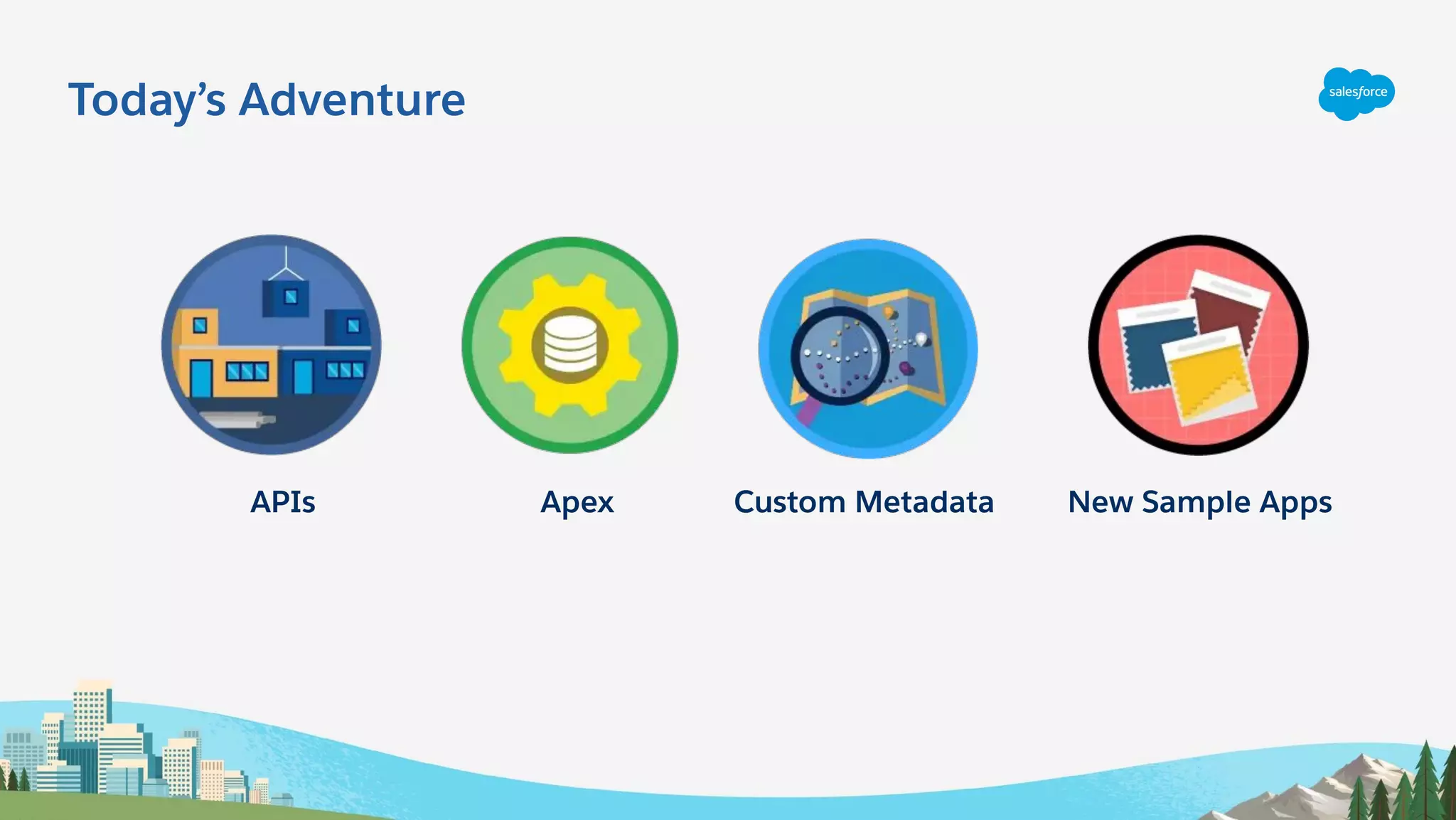
APIs Apex Custom Metadata
Today’s Adventure
New Sample Apps
APIs
Salesforce APIs
Integrate applications with Salesforce
REST
Access and manipulate
data with a RESTful pattern
using JSON and XML
SOAP
Access and manipulate
data using standard SOAP
XML messages
View, create, and join
Chatter conversations
through RESTful APIs
Analytics
Access Salesforce Report
and Dashboard data using
RESTful APIs
Metadata
Package and deploy setup
metadata to Salesforce
orgs asynchronously
Social Tooling
Build custom development
tools for applications using
SOAP and RESTful APIs
Easy access to special
Health and Financial
Services Cloud-specific
objects and features.
Interact with Marketing
Cloud programmatically
Return UI-optimized
payload display, edit, or
create a record
Subscribe to events using
the Bayeux/CometD HTTP
long-polling protocolStreaming
User
Interface
Industries
Marketing
Perform large volume
CRUD operations
asynchronouslyBulk
Build custom SOAP and
REST APIs through Apex
programming languageCustom
Composite Graph API#1
Offload complexity to platform
Composite Graph is the latest API offering that allows
greater reach in processing complexity and scale
without having to write additional code.
Collation enables optimal processing
Optimized for processing CRUD operations on
sObjects through the power of collation.
allOrNone enforced
Ensures that the steps in a given set of operations are
either all completed or all rolled back.
Perform CRUD operations on complex graphs of related sObject records.
GA
Winter '21
500 subrequest nodes
in a single payload
{"Graphs": [
{
"graphId": "graph1",
"compositeRequest": [
{
"method": "POST",
"url": "/services/data/v50.0/sobjects/Account",
"referenceId": "newAccount",
"body": {
"Name": "New Account"
}
},
{
"method": "POST",
"url": "/services/data/v50.0/sobjects/Contact",
"referenceId": "newContact",
"body": {
"LastName": "New Contact",
"AccountId": "@{newAccount.id}"
https://yourInstance.my.salesforce.com/services/data/v50.0/composite/graph
Additional API updates in Winter ‘21
Bulk API 2.0 Enhancements
Enabling support for querying Big Objects, hardDelete operations, and applying default namespace to
job creation.
OpenAPI Specs for sObjects REST API (Closed Pilot)
Generating OpenAPI 3.0 specs for four key sObjects REST resources with support for standard objects
and fields.
Apex
New Apex Features
Safe Navigation Operator
• Get rid of boring null & no-result checks in code.
New SObject Error Methods
• Write generic field-level validation functions.
• Unit test sObject validation functions.
and more...
https://releasenotes.docs.salesforce.com/en-us/winter21/release-notes/rn_apex.htm
GA
Winter '21
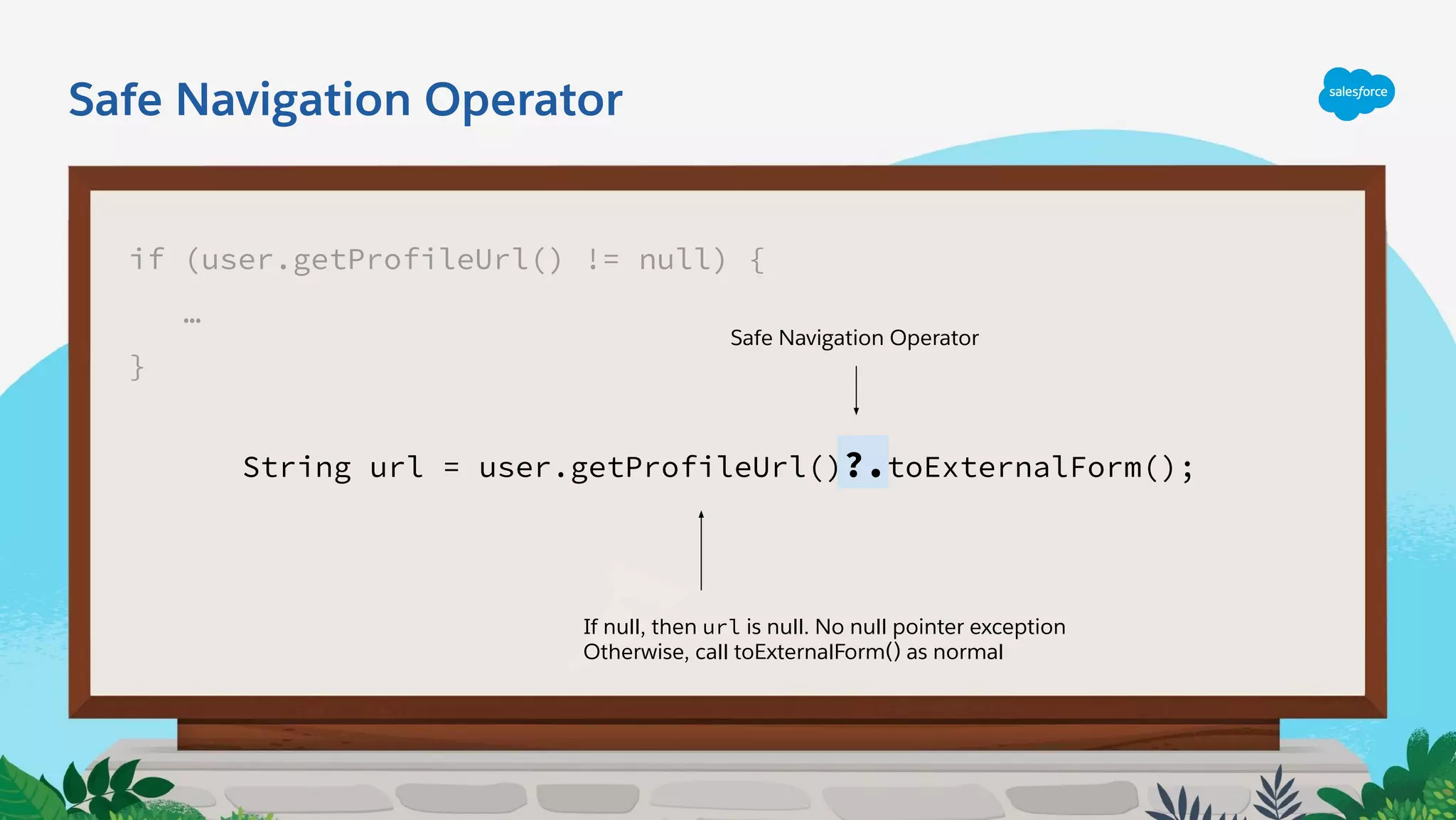
String url = user.getProfileUrl()?.toExternalForm();
If null, then url is null. No null pointer exception
Otherwise, call toExternalForm() as normal
Safe Navigation Operator
if (user.getProfileUrl() != null) {
…
}
Safe Navigation Operator
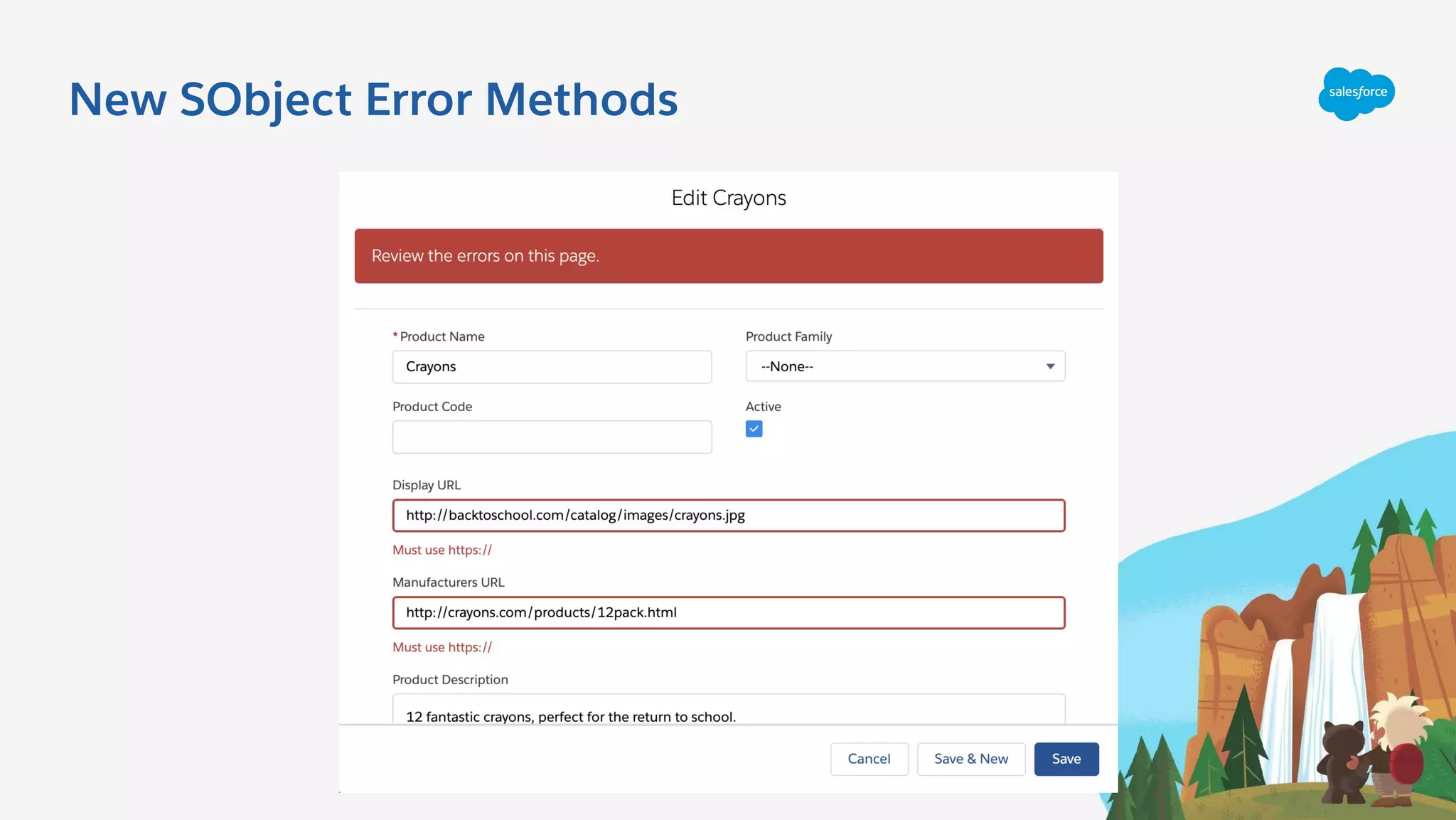
sObj.addError(<fieldName>, <errorMessage>);
• Dynamically choose which field to set an error on, by field name.
System.assert( sObj.hasErrors() );
• Get error status of an sObject without performing DML.
List<Database.Error> errors = sObj.getErrors();
• Get errors on an sObject without performing DML.
New SObject Error Methods
Custom Metadata
Custom Metadata Types Overview
#1
● Custom Metadata Types are special objects designed to store configurational
information for an org, app or package.
● Configurational information is any kind of information that is not business data,
but rather data that defines how business (org, app, package) works.
○ Mappings, business rules, validation rules, allowed lists, secrets
● Yes, we can use Custom Objects and Custom Settings to store configurations,
mappings and custom data, then why custom metadata ?
● Records of Custom Metadata Types are METADATA, not data!
Functionality
List Custom
Settings
Custom Objects
Custom
Metadata Types
Unlimited calls / queries ✔ ✗ ✔
Metadata retrieve / deploy & package install records ✗ ✗ ✔
Protect (hide) the object ✔ ✗ ✔
Protect (hide) individual records ✗ ✗ ✔
Control over editability of fields ✗ ✗ ✔
Setup audit trail history of records ✗ ✗ ✔
Relationships, Picklists, LTA fields ✗ ✔ ✔
Apex support to create and update records ✔ ✔ ✔
Reference records in validation rules, formulas and
process builder
✗ ✗ ✔
Why should you switch to Custom Metadata Types
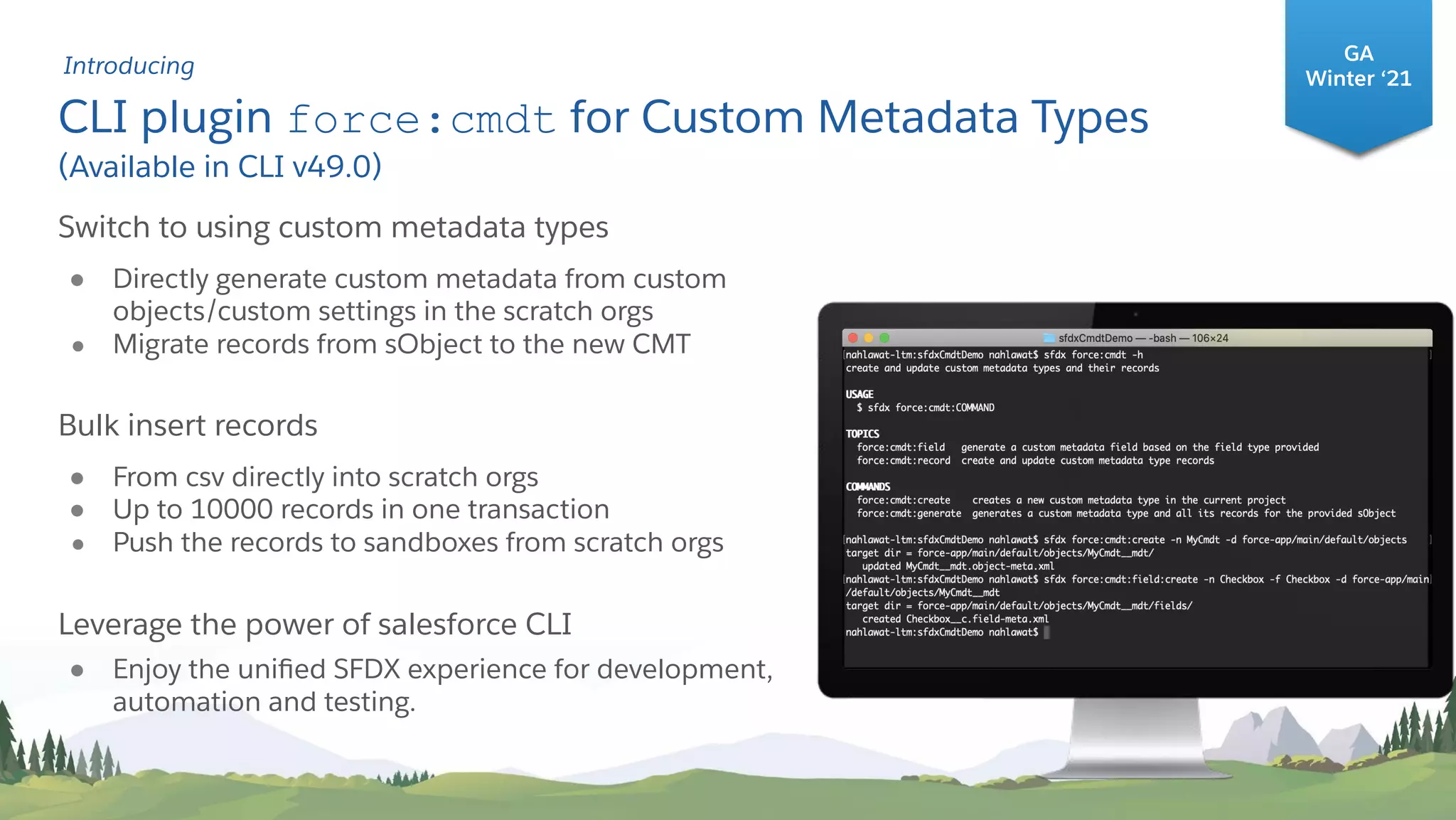
CLI plugin force:cmdt for Custom Metadata Types
(Available in CLI v49.0)
#1
Switch to using custom metadata types
● Directly generate custom metadata from custom
objects/custom settings in the scratch orgs
● Migrate records from sObject to the new CMT
Bulk insert records
● From csv directly into scratch orgs
● Up to 10000 records in one transaction
● Push the records to sandboxes from scratch orgs
Leverage the power of salesforce CLI
● Enjoy the unified SFDX experience for development,
automation and testing.
GA
Winter ‘21
Introducing
CLI plugin for Custom Metadata Types
Commands at a Glance#1
#1
● Create a new custom metadata type
○ sfdx force:cmdt:create
● Create a custom metadata type field
○ sfdx force:cmdt:field:create
● Add record to a custom metadata type
○ sfdx force:cmdt:record:create
● Bulk insert records from a comma separated file (csv)
○ sfdx force:cmdt:record:insert
● Generate a custom metadata type from an sObject and migrate all its records
○ sfdx force:cmdt:generate
Sample Apps
Resources
Safe Navigation Operator: https://sfdc.co/apex-safe-nav
SObject error methods: https://sfdc.co/sobject-adderror
Apex in Winter' 21: https://sfdc.co/apex-winter21-highlights
API Planning Framework: https://sfdc.co/right-api
Discover Trailhead Sample Apps: https://sfdc.co/th-sample-apps
Custom Metadata on Trailhead: https://bit.ly/cmdt-trail
Custom Metadata Types Repo: https://github.com/pchittum/RecordTypeMapper-CS
Trailhead Live: https://trailhead.salesforce.com/live/
Salesforce Developer YouTube: https://www.youtube.com/c/SalesforceDevelopers/
Winter 21 Developer Highlights for Salesforce

Winter 21 Developer Highlights for Salesforce

  • 1.
    Winter 21 DeveloperUpdates @pchittum | pchittum@salesforce.com Peter Chittum, Developer Advocate
  • 2.
    Forward-Looking Statement Statement underthe Private Securities Litigation Reform Act of 1995: This presentation contains forward-looking statements about the company’s financial and operating results, which may include expected GAAP and non-GAAP financial and other operating and non-operating results, including revenue, net income, diluted earnings per share, operating cash flow growth, operating margin improvement, expected revenue growth, expected current remaining performance obligation growth, expected tax rates, the one-time accounting non-cash charge that was incurred in connection with the Salesforce.org combination; stock-based compensation expenses, amortization of purchased intangibles, shares outstanding, market growth and sustainability goals. The achievement or success of the matters covered by such forward-looking statements involves risks, uncertainties and assumptions. If any such risks or uncertainties materialize or if any of the assumptions prove incorrect, the company’s results could differ materially from the results expressed or implied by the forward-looking statements we make. The risks and uncertainties referred to above include -- but are not limited to -- risks associated with the effect of general economic and market conditions; the impact of geopolitical events; the impact of foreign currency exchange rate and interest rate fluctuations on our results; our business strategy and our plan to build our business, including our strategy to be the leading provider of enterprise cloud computing applications and platforms; the pace of change and innovation in enterprise cloud computing services; the seasonal nature of our sales cycles; the competitive nature of the market in which we participate; our international expansion strategy; the demands on our personnel and infrastructure resulting from significant growth in our customer base and operations, including as a result of acquisitions; our service performance and security, including the resources and costs required to avoid unanticipated downtime and prevent, detect and remediate potential security breaches; the expenses associated with new data centers and third-party infrastructure providers; additional data center capacity; real estate and office facilities space; our operating results and cash flows; new services and product features, including any efforts to expand our services beyond the CRM market; our strategy of acquiring or making investments in complementary businesses, joint ventures, services, technologies and intellectual property rights; the performance and fair value of our investments in complementary businesses through our strategic investment portfolio; our ability to realize the benefits from strategic partnerships, joint ventures and investments; the impact of future gains or losses from our strategic investment portfolio, including gains or losses from overall market conditions that may affect the publicly traded companies within the company's strategic investment portfolio; our ability to execute our business plans; our ability to successfully integrate acquired businesses and technologies, including delays related to the integration of Tableau due to regulatory review by the United Kingdom Competition and Markets Authority; our ability to continue to grow unearned revenue and remaining performance obligation; our ability to protect our intellectual property rights; our ability to develop our brands; our reliance on third-party hardware, software and platform providers; our dependency on the development and maintenance of the infrastructure of the Internet; the effect of evolving domestic and foreign government regulations, including those related to the provision of services on the Internet, those related to accessing the Internet, and those addressing data privacy, cross-border data transfers and import and export controls; the valuation of our deferred tax assets and the release of related valuation allowances; the potential availability of additional tax assets in the future; the impact of new accounting pronouncements and tax laws; uncertainties affecting our ability to estimate our tax rate; the impact of expensing stock options and other equity awards; the sufficiency of our capital resources; factors related to our outstanding debt, revolving credit facility, term loan and loan associated with 50 Fremont; compliance with our debt covenants and lease obligations; current and potential litigation involving us; and the impact of climate change. Further information on these and other factors that could affect the company’s financial results is included in the reports on Forms 10-K, 10-Q and 8-K and in other filings it makes with the Securities and Exchange Commission from time to time. These documents are available on the SEC Filings section of the Investor Information section of the company’s website at www.salesforce.com/investor. Salesforce.com, inc. assumes no obligation and does not intend to update these forward-looking statements, except as required by law.
  • 3.
    APIs Apex CustomMetadata Today’s Adventure New Sample Apps
  • 4.
  • 5.
    Salesforce APIs Integrate applicationswith Salesforce REST Access and manipulate data with a RESTful pattern using JSON and XML SOAP Access and manipulate data using standard SOAP XML messages View, create, and join Chatter conversations through RESTful APIs Analytics Access Salesforce Report and Dashboard data using RESTful APIs Metadata Package and deploy setup metadata to Salesforce orgs asynchronously Social Tooling Build custom development tools for applications using SOAP and RESTful APIs Easy access to special Health and Financial Services Cloud-specific objects and features. Interact with Marketing Cloud programmatically Return UI-optimized payload display, edit, or create a record Subscribe to events using the Bayeux/CometD HTTP long-polling protocolStreaming User Interface Industries Marketing Perform large volume CRUD operations asynchronouslyBulk Build custom SOAP and REST APIs through Apex programming languageCustom
  • 6.
    Composite Graph API#1 Offloadcomplexity to platform Composite Graph is the latest API offering that allows greater reach in processing complexity and scale without having to write additional code. Collation enables optimal processing Optimized for processing CRUD operations on sObjects through the power of collation. allOrNone enforced Ensures that the steps in a given set of operations are either all completed or all rolled back. Perform CRUD operations on complex graphs of related sObject records. GA Winter '21 500 subrequest nodes in a single payload {"Graphs": [ { "graphId": "graph1", "compositeRequest": [ { "method": "POST", "url": "/services/data/v50.0/sobjects/Account", "referenceId": "newAccount", "body": { "Name": "New Account" } }, { "method": "POST", "url": "/services/data/v50.0/sobjects/Contact", "referenceId": "newContact", "body": { "LastName": "New Contact", "AccountId": "@{newAccount.id}" https://yourInstance.my.salesforce.com/services/data/v50.0/composite/graph
  • 7.
    Additional API updatesin Winter ‘21 Bulk API 2.0 Enhancements Enabling support for querying Big Objects, hardDelete operations, and applying default namespace to job creation. OpenAPI Specs for sObjects REST API (Closed Pilot) Generating OpenAPI 3.0 specs for four key sObjects REST resources with support for standard objects and fields.
  • 8.
  • 9.
    New Apex Features SafeNavigation Operator • Get rid of boring null & no-result checks in code. New SObject Error Methods • Write generic field-level validation functions. • Unit test sObject validation functions. and more... https://releasenotes.docs.salesforce.com/en-us/winter21/release-notes/rn_apex.htm GA Winter '21
  • 10.
    String url =user.getProfileUrl()?.toExternalForm(); If null, then url is null. No null pointer exception Otherwise, call toExternalForm() as normal Safe Navigation Operator if (user.getProfileUrl() != null) { … } Safe Navigation Operator
  • 11.
    sObj.addError(<fieldName>, <errorMessage>); • Dynamicallychoose which field to set an error on, by field name. System.assert( sObj.hasErrors() ); • Get error status of an sObject without performing DML. List<Database.Error> errors = sObj.getErrors(); • Get errors on an sObject without performing DML. New SObject Error Methods
  • 12.
  • 13.
  • 14.
    Custom Metadata TypesOverview #1 ● Custom Metadata Types are special objects designed to store configurational information for an org, app or package. ● Configurational information is any kind of information that is not business data, but rather data that defines how business (org, app, package) works. ○ Mappings, business rules, validation rules, allowed lists, secrets ● Yes, we can use Custom Objects and Custom Settings to store configurations, mappings and custom data, then why custom metadata ? ● Records of Custom Metadata Types are METADATA, not data!
  • 15.
    Functionality List Custom Settings Custom Objects Custom MetadataTypes Unlimited calls / queries ✔ ✗ ✔ Metadata retrieve / deploy & package install records ✗ ✗ ✔ Protect (hide) the object ✔ ✗ ✔ Protect (hide) individual records ✗ ✗ ✔ Control over editability of fields ✗ ✗ ✔ Setup audit trail history of records ✗ ✗ ✔ Relationships, Picklists, LTA fields ✗ ✔ ✔ Apex support to create and update records ✔ ✔ ✔ Reference records in validation rules, formulas and process builder ✗ ✗ ✔ Why should you switch to Custom Metadata Types
  • 16.
    CLI plugin force:cmdtfor Custom Metadata Types (Available in CLI v49.0) #1 Switch to using custom metadata types ● Directly generate custom metadata from custom objects/custom settings in the scratch orgs ● Migrate records from sObject to the new CMT Bulk insert records ● From csv directly into scratch orgs ● Up to 10000 records in one transaction ● Push the records to sandboxes from scratch orgs Leverage the power of salesforce CLI ● Enjoy the unified SFDX experience for development, automation and testing. GA Winter ‘21 Introducing
  • 17.
    CLI plugin forCustom Metadata Types Commands at a Glance#1 #1 ● Create a new custom metadata type ○ sfdx force:cmdt:create ● Create a custom metadata type field ○ sfdx force:cmdt:field:create ● Add record to a custom metadata type ○ sfdx force:cmdt:record:create ● Bulk insert records from a comma separated file (csv) ○ sfdx force:cmdt:record:insert ● Generate a custom metadata type from an sObject and migrate all its records ○ sfdx force:cmdt:generate
  • 18.
  • 19.
    Resources Safe Navigation Operator:https://sfdc.co/apex-safe-nav SObject error methods: https://sfdc.co/sobject-adderror Apex in Winter' 21: https://sfdc.co/apex-winter21-highlights API Planning Framework: https://sfdc.co/right-api Discover Trailhead Sample Apps: https://sfdc.co/th-sample-apps Custom Metadata on Trailhead: https://bit.ly/cmdt-trail Custom Metadata Types Repo: https://github.com/pchittum/RecordTypeMapper-CS Trailhead Live: https://trailhead.salesforce.com/live/ Salesforce Developer YouTube: https://www.youtube.com/c/SalesforceDevelopers/