WEATHER PATTERNS
IN THE PHILIPPINES
WEEK 3
How can you relate to this statement?
“Weather, weather
lang ‘yan?”
-Kuya Kim, TV Patrol Weather News Anchorman
SCIENCE WORD DRILL
Weather Climate
Seasons Wind
Equator Tropical
LAYERS OF THE ATMOSP
HERE
What is WEATHER?
•WEATHER refers to the
condition of a place in
a short period of time.
•WEATHER can change
anytime.
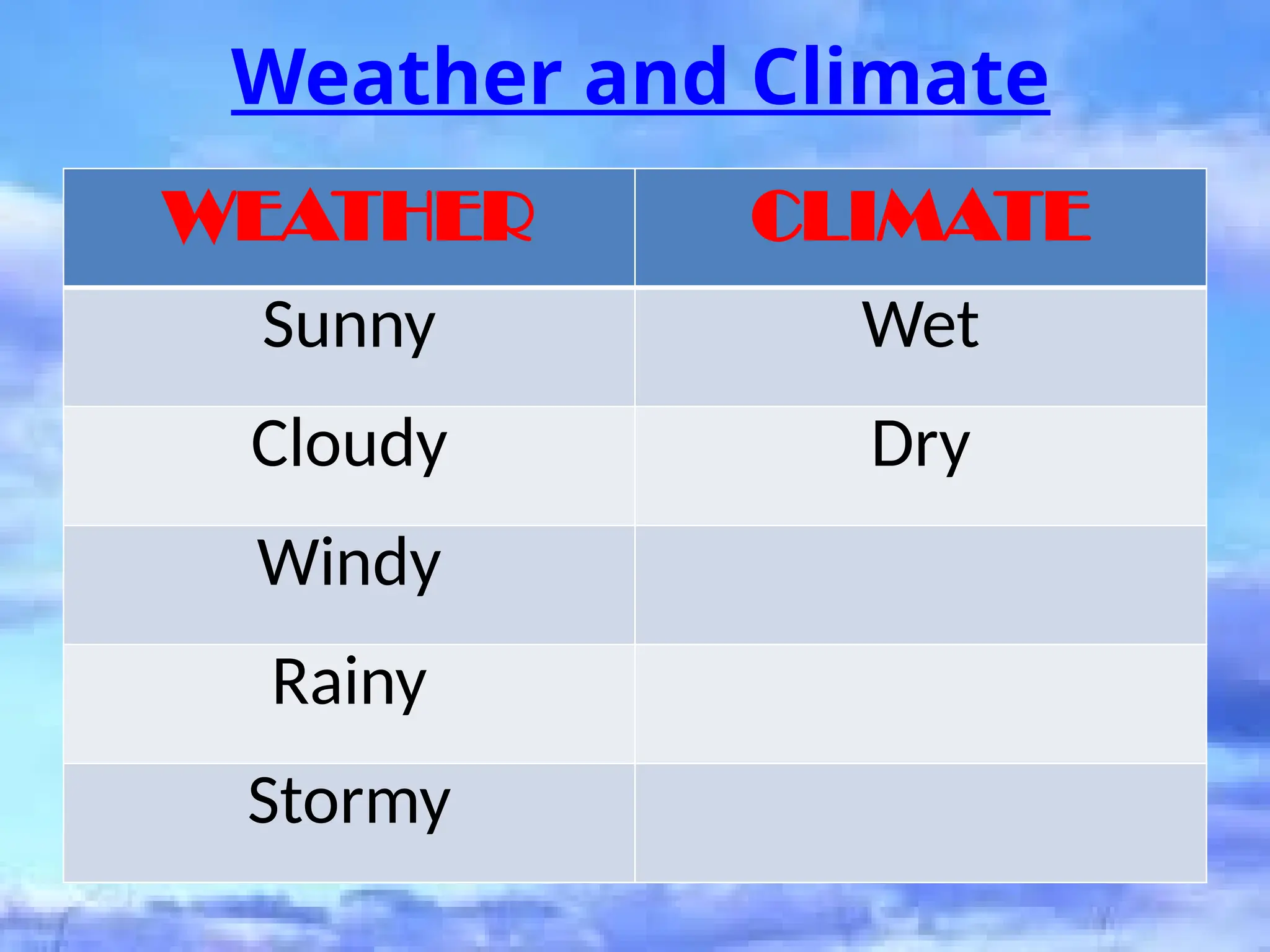
Weather and Climate
• WEATHER refers to the
condition of a place in a short
period of time.
• CLIMATE is an average
condition of a place over long
period of time.
Weather and Climate
WEATHER CLIMATE
Sunny Wet
Cloudy Dry
Windy
Rainy
Stormy
SEASONS
IN THE
PHILIPPINES
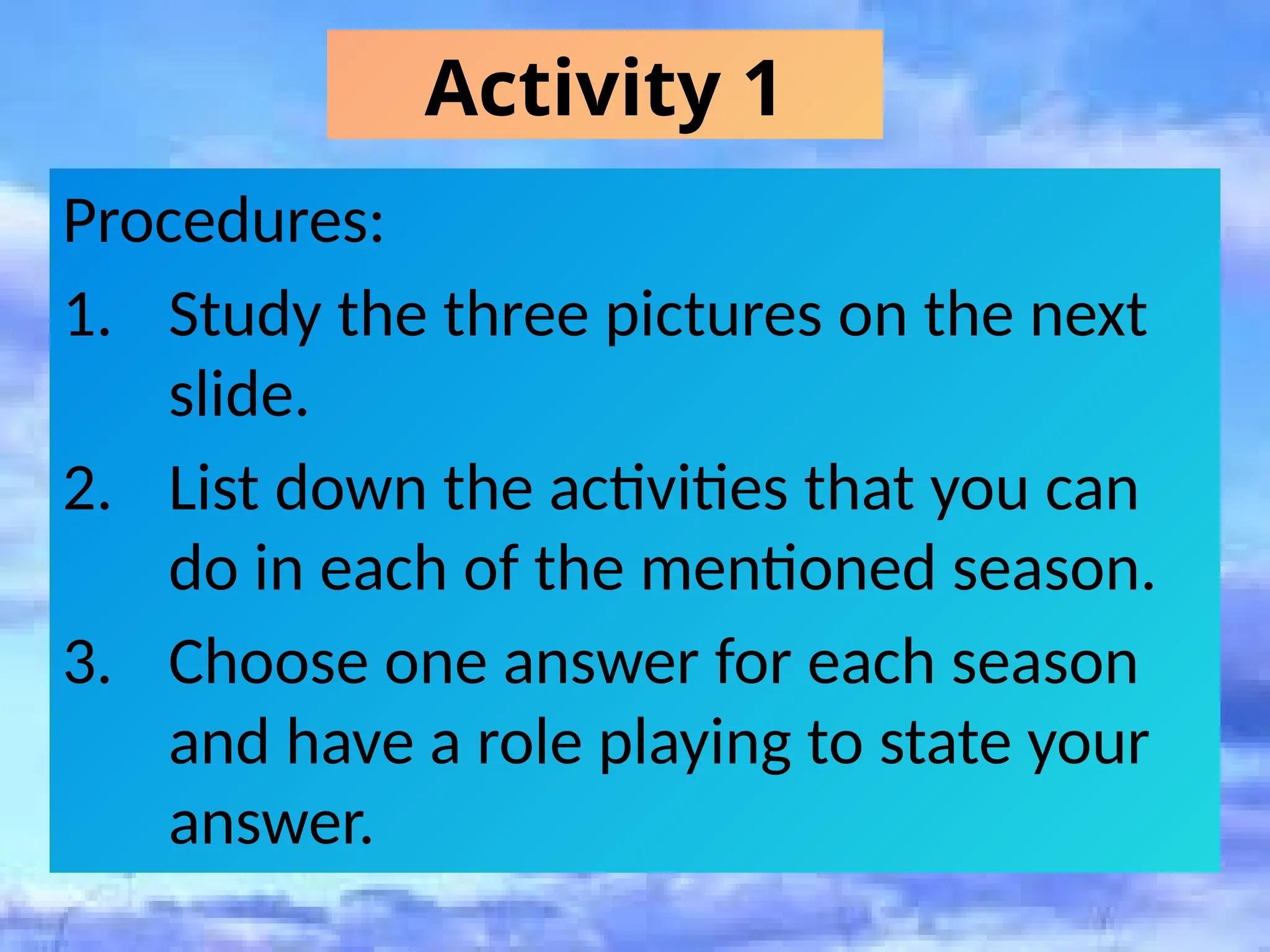
Activity 1
Procedures:
1. Study the three pictures on the next
slide.
2. List down the activities that you can
do in each of the mentioned season.
3. Choose one answer for each season
and have a role playing to state your
answer.
Dry, Rainy and Cool Season
DRY RAINY COOL
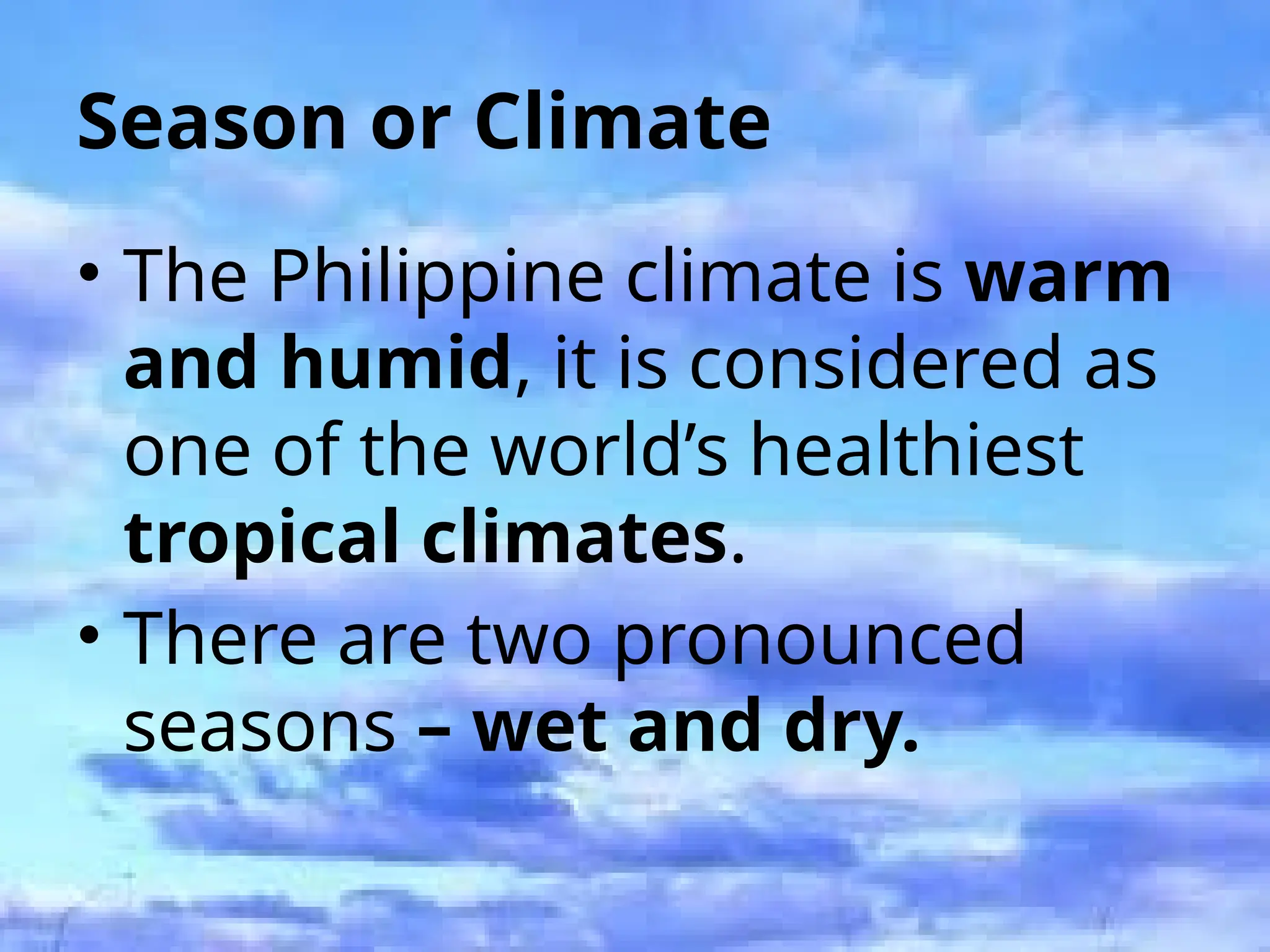
Season or Climate
• The Philippine climate is warm
and humid, it is considered as
one of the world’s healthiest
tropical climates.
• There are two pronounced
seasons – wet and dry.
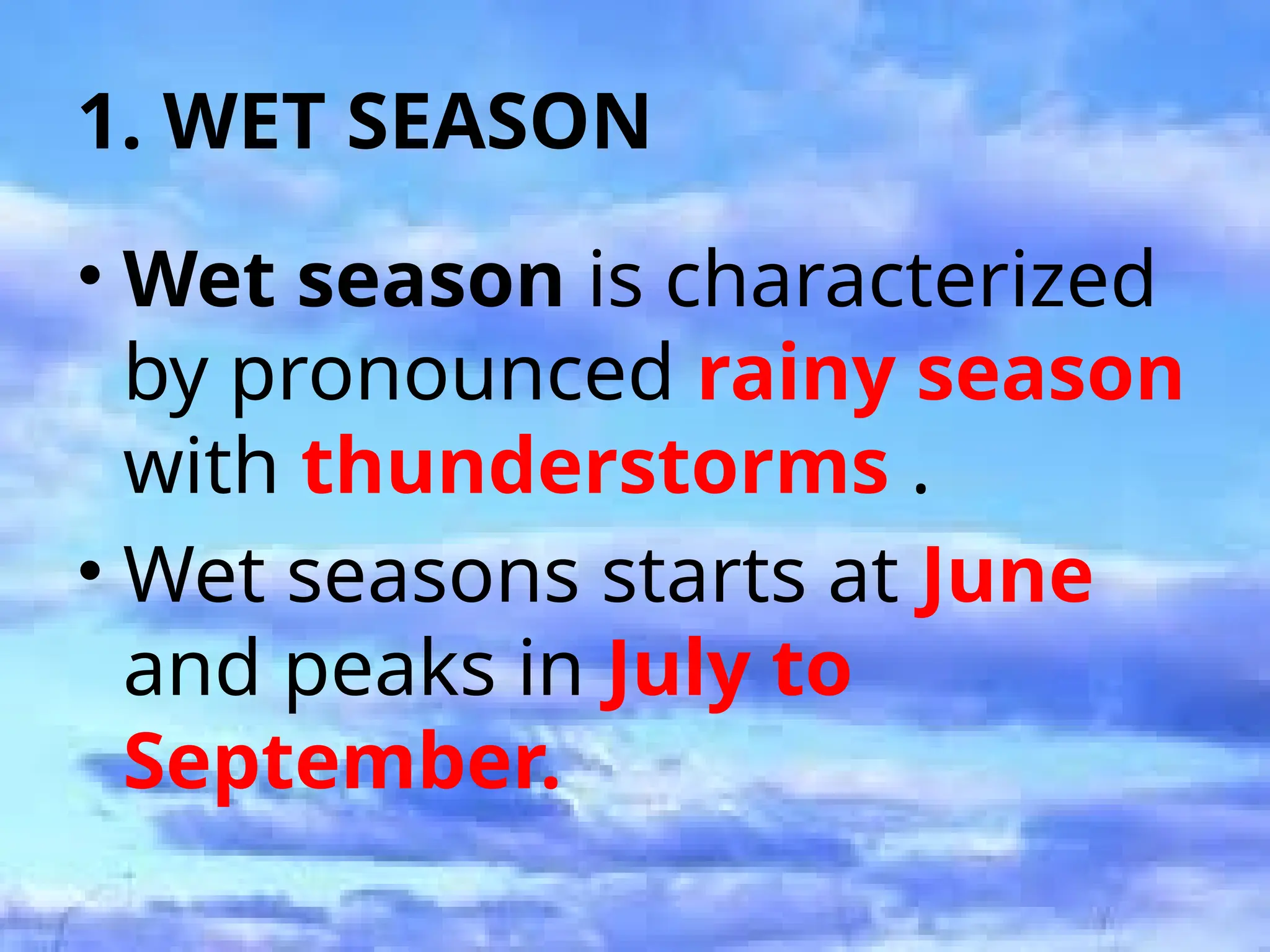
1. WET SEASON
• Wet season is characterized
by pronounced rainy season
with thunderstorms .
• Wet seasons starts at June
and peaks in July to
September.
Philippines during Wet Season
WET SEASON
• Daytime temperature ranges
from 30-36 degrees Celsius.
• Night temperature ranges
from. 21-28 degrees Celsius
• The air is hot and humid ,
which brings heavy rains and
typhoon.
Philippines during Wet Season
WET SEASON
• During the wettest month, rain
is almost in daily occurrence.
• Precipitation (rainfall) is
highest in the area where
Southwest Monsoon
(Habagat) strikes.
Philippines during Wet Season
WET SEASON
• During rainy season it is
advisable to carry an umbrella
especially in the late
afternoon.
• In this season, farmers are
able to plant crops.
Philippines during Wet Season
WET SEASON
• HABAGAT
2. DRY SEASON
2. DRY SEASON
• Dry season is characterized
by hot and cloudless days.
• Between January and May
the climate is usually dry
with occasional rain showers.
The Philippine Dry Season
2. DRY SEASON
• During January and February,
the air is cold and dry.
• The peak of the Dry Season is
in April with less or no rain
shower throughout the
month.
The Philippine Dry Season
2. DRY SEASON
• The Dry Season is influenced by
the Seasonal Wind and the
Northeast Monsoon (Amihan).
• The Northeast breeze from
Siberia and Northern China is
cool and dry, it brings cold
winds and cloudless days.
The Philippine Dry Season
2. DRY SEASON
• Daytime temperature ranges
from 25-32 degrees Celsius.
• Night temperature is 22 degrees
Celsius.
• During dry season, from March
to June temperature can reach
up to 32 degrees Celsius.
The Amount of Rainfall
FACTORS AFFECTING
SEASONS IN THE
PHILIPPINES
1. Location of the Philippines
2. Prevailing Winds
1. Location of the Philippines
• The Philippines is located above
the Equator (Tropical Region).
• Being near the equator, the
Philippines receive the vertical
rays of sunlight.
• Much heat causes water to
evaporate and fall as rain later
on.
The Light Rays of the Sun
2. Prevailing Winds
• Seasons in the Philippines are
influenced by the prevailing
winds.
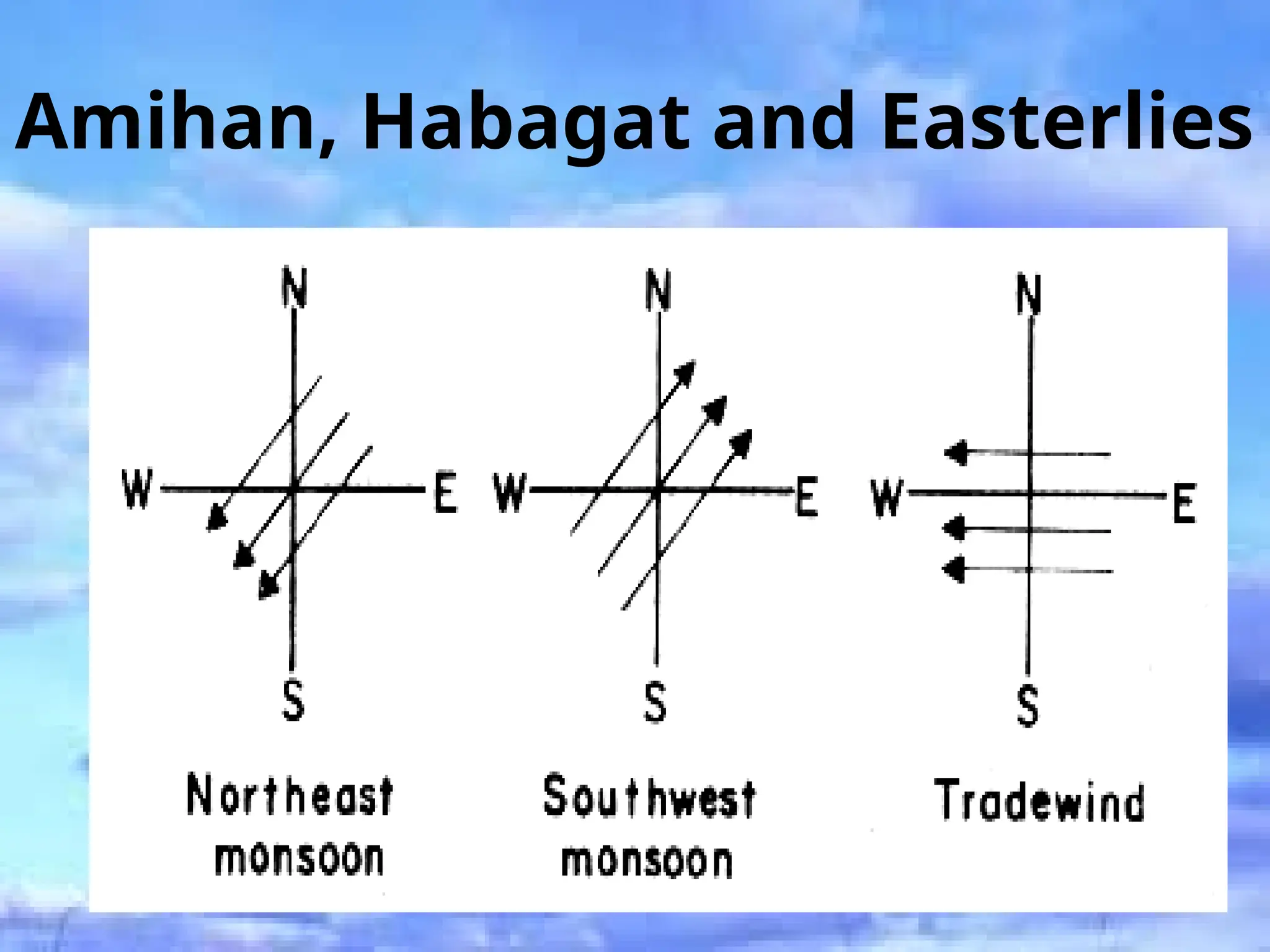
• A Prevailing Wind blows
mostly from a single
direction.
Amihan, Habagat and Easterlies
2. Prevailing Winds
• The Prevailing winds in the
Philippines:
–Southwest Monsoon
(Habagat)
–Northeast Monsoon (Amihan)
–Easterlies (Trade Winds)
Prevailing Winds
• The Southwest Monsoon
blows from May to October.
• The Northeast Monsoon
blows from November to
early May.
The Four Climate
Types in the
Philippines
Type I Climate
Type II Climate
Type III Climate
Type IV Climate
Climate Map of
the Philippines
Philippine
Climate is further
classified into
four types shown
in the map in
four different
colors.
Type 1 Climate
• Pronounced Rainy and Dry
season.
• Occidental Mindoro, Negros,
Palawan, Southern Iloilo
Type II Climate
• Wet Climate all year round.
• From November to April there is
a heavy rainfall and light rainfall
on the rest of the months.
• There is no pronounced dry
season.
• Ex: Eastern Mindanao, Eastern
side of the Philippines.
Type III Climate
• Short Dry Season and a Rainy
season that is not very
pronounced.
• It has no maximum rain period.
• Ex: Masbate, Romblon,
Northeastern Panay
Type IV Climate
• Lack of Dry Season and
Rainfall.
• Ex: Batanes, Central,
Marinduque and Southern
Mindanao.
Philippine Climate
FACTORS
AFFECTING THE
WEATHER
PATTERNS IN THE
PHILIPPINES
1. Air Masses
• An air mass is a large body of air
that has characteristics similar to
the region of the Earth’s surface
where it come from.
• The location of the air mass
where it is developed determines
its characteristics.
2. Fronts
• A front is a boundary between
two air masses of different
densities, moisture or
temperature.
• There are four types of fronts-
cold, warm, occluded and
stationary.
Warm Front
• A warm front is the boundary
along a warm air mass,
pushing out a cold air mass.
• When a warm front moves
forward, clouds in the sky
bring steady rain.
WARM
FRONTS
warm air advances and gently moves over cold
air- causes rain showers
Cold Front
• A cold front is the boundary
along the leading edge of a
cold air mass pushing out a
warm air mass.
• When cold air mass moves, it
pushes and lifts the warm air
mass.
COLD FRONTS
cold air pushes warm air up violently- Causes
severe weather.
Occluded Front
• An Occluded Front is formed
when a cold air mass moves
toward each other with warm
air between them.
• The colder air pushes warm air
upward, clouds develop and a
steady rain is experienced.
Occluded Front
Stationary Front
• A Stationary Front occurs
when a boundary between air
masses stops moving. The
stationary front may remain in
the same place for several days.
• The place will experience light
wind and rain.
Stationary Front
3. Prevailing Winds
• Prevailing winds blow mostly
in one direction.
• The Prevailing winds in the
Philippines are the Southwest
Monsoon (Habagat) and the
Northeast Monsoon
(Amihan).
Habagat
Amihan
Grade 6 PPT_Q4_W3_WEATHER PATTERNS.pptx for grade 6 learners

Grade 6 PPT_Q4_W3_WEATHER PATTERNS.pptx for grade 6 learners

  • 1.
    WEATHER PATTERNS IN THEPHILIPPINES WEEK 3
  • 2.
    How can yourelate to this statement? “Weather, weather lang ‘yan?” -Kuya Kim, TV Patrol Weather News Anchorman
  • 3.
    SCIENCE WORD DRILL WeatherClimate Seasons Wind Equator Tropical
  • 4.
    LAYERS OF THEATMOSP HERE
  • 5.
    What is WEATHER? •WEATHERrefers to the condition of a place in a short period of time. •WEATHER can change anytime.
  • 6.
    Weather and Climate •WEATHER refers to the condition of a place in a short period of time. • CLIMATE is an average condition of a place over long period of time.
  • 7.
    Weather and Climate WEATHERCLIMATE Sunny Wet Cloudy Dry Windy Rainy Stormy
  • 8.
  • 9.
    Activity 1 Procedures: 1. Studythe three pictures on the next slide. 2. List down the activities that you can do in each of the mentioned season. 3. Choose one answer for each season and have a role playing to state your answer.
  • 10.
    Dry, Rainy andCool Season
  • 11.
  • 12.
    Season or Climate •The Philippine climate is warm and humid, it is considered as one of the world’s healthiest tropical climates. • There are two pronounced seasons – wet and dry.
  • 13.
    1. WET SEASON •Wet season is characterized by pronounced rainy season with thunderstorms . • Wet seasons starts at June and peaks in July to September.
  • 14.
  • 15.
    WET SEASON • Daytimetemperature ranges from 30-36 degrees Celsius. • Night temperature ranges from. 21-28 degrees Celsius • The air is hot and humid , which brings heavy rains and typhoon.
  • 16.
  • 17.
    WET SEASON • Duringthe wettest month, rain is almost in daily occurrence. • Precipitation (rainfall) is highest in the area where Southwest Monsoon (Habagat) strikes.
  • 18.
  • 19.
    WET SEASON • Duringrainy season it is advisable to carry an umbrella especially in the late afternoon. • In this season, farmers are able to plant crops.
  • 20.
  • 21.
  • 22.
  • 23.
    2. DRY SEASON •Dry season is characterized by hot and cloudless days. • Between January and May the climate is usually dry with occasional rain showers.
  • 24.
  • 25.
  • 26.
    2. DRY SEASON •During January and February, the air is cold and dry. • The peak of the Dry Season is in April with less or no rain shower throughout the month.
  • 27.
  • 28.
  • 29.
    2. DRY SEASON •The Dry Season is influenced by the Seasonal Wind and the Northeast Monsoon (Amihan). • The Northeast breeze from Siberia and Northern China is cool and dry, it brings cold winds and cloudless days.
  • 30.
  • 31.
    2. DRY SEASON •Daytime temperature ranges from 25-32 degrees Celsius. • Night temperature is 22 degrees Celsius. • During dry season, from March to June temperature can reach up to 32 degrees Celsius.
  • 32.
    The Amount ofRainfall
  • 33.
    FACTORS AFFECTING SEASONS INTHE PHILIPPINES 1. Location of the Philippines 2. Prevailing Winds
  • 34.
    1. Location ofthe Philippines • The Philippines is located above the Equator (Tropical Region). • Being near the equator, the Philippines receive the vertical rays of sunlight. • Much heat causes water to evaporate and fall as rain later on.
  • 36.
    The Light Raysof the Sun
  • 37.
    2. Prevailing Winds •Seasons in the Philippines are influenced by the prevailing winds. • A Prevailing Wind blows mostly from a single direction.
  • 38.
  • 39.
    2. Prevailing Winds •The Prevailing winds in the Philippines: –Southwest Monsoon (Habagat) –Northeast Monsoon (Amihan) –Easterlies (Trade Winds)
  • 41.
    Prevailing Winds • TheSouthwest Monsoon blows from May to October. • The Northeast Monsoon blows from November to early May.
  • 42.
    The Four Climate Typesin the Philippines Type I Climate Type II Climate Type III Climate Type IV Climate
  • 43.
    Climate Map of thePhilippines Philippine Climate is further classified into four types shown in the map in four different colors.
  • 44.
    Type 1 Climate •Pronounced Rainy and Dry season. • Occidental Mindoro, Negros, Palawan, Southern Iloilo
  • 45.
    Type II Climate •Wet Climate all year round. • From November to April there is a heavy rainfall and light rainfall on the rest of the months. • There is no pronounced dry season. • Ex: Eastern Mindanao, Eastern side of the Philippines.
  • 46.
    Type III Climate •Short Dry Season and a Rainy season that is not very pronounced. • It has no maximum rain period. • Ex: Masbate, Romblon, Northeastern Panay
  • 47.
    Type IV Climate •Lack of Dry Season and Rainfall. • Ex: Batanes, Central, Marinduque and Southern Mindanao.
  • 48.
  • 49.
  • 50.
    1. Air Masses •An air mass is a large body of air that has characteristics similar to the region of the Earth’s surface where it come from. • The location of the air mass where it is developed determines its characteristics.
  • 52.
    2. Fronts • Afront is a boundary between two air masses of different densities, moisture or temperature. • There are four types of fronts- cold, warm, occluded and stationary.
  • 54.
    Warm Front • Awarm front is the boundary along a warm air mass, pushing out a cold air mass. • When a warm front moves forward, clouds in the sky bring steady rain.
  • 55.
    WARM FRONTS warm air advancesand gently moves over cold air- causes rain showers
  • 56.
    Cold Front • Acold front is the boundary along the leading edge of a cold air mass pushing out a warm air mass. • When cold air mass moves, it pushes and lifts the warm air mass.
  • 57.
    COLD FRONTS cold airpushes warm air up violently- Causes severe weather.
  • 58.
    Occluded Front • AnOccluded Front is formed when a cold air mass moves toward each other with warm air between them. • The colder air pushes warm air upward, clouds develop and a steady rain is experienced.
  • 59.
  • 60.
    Stationary Front • AStationary Front occurs when a boundary between air masses stops moving. The stationary front may remain in the same place for several days. • The place will experience light wind and rain.
  • 61.
  • 62.
    3. Prevailing Winds •Prevailing winds blow mostly in one direction. • The Prevailing winds in the Philippines are the Southwest Monsoon (Habagat) and the Northeast Monsoon (Amihan).
  • 63.